Categories
Learn

10 interesting facts about Dom Perignon

  • Dom Perignon is the world’s most recognised prestige cuvee, produced exclusively as a vintage wine.
  • A cornerstone of the LVMH portfolio, Dom Perignon possesses massive global brand equity.
  • The secondary market for Dom Perignon is highly liquid compared to other wines.

Dom Perignon is more than just Champagne – it is one of the most popular luxury wines in the world. From its origins in the Abbey of Hautvillers to its position today as the flagship prestige cuvee of Moet & Chandon and LVMH, the brand has become synonymous with celebration, craftsmanship, and collectability. Produced exclusively as a vintage wine, Dom Perignon captures the unique identity of each harvest while balancing rarity, longevity, and global appeal. In this guide, we explore ten fascinating facts that explain how Dom Perignon became one of the most influential and investable names in fine wine.

1. The heritage and legend of the Benedictine monk

The history of Dom Perignon is intertwined with the very foundations of the Champagne region. Pierre Perignon was a Benedictine monk who served as cellar master at the Abbey of Hautvillers in the seventeenth century. While legend often credits him with “inventing” sparkling wine (he didn’t), his true contribution was the refinement of viticultural techniques.

He pioneered the practice of blending grapes from different vineyards to achieve a balanced profile. He also introduced the use of corks and stronger glass bottles to prevent explosions in the cellar. These innovations laid the groundwork for the modern production of luxury sparkling wine.

Key historical milestones for the abbey and the brand:

  • Pierre Perignon arrived at the Abbey of Hautvillers in 1668.
  • Moet & Chandon acquired the Dom Perignon brand in the early twentieth century.
  • The first Dom Perignon vintage was 1921, officially released in 1936.
  • In the early 2000s, Dom Perignon introduced late-disgorged re-releases under the Oenotheque label, later rebranding as P2 and P3 for even older vintages.
  • Under Chef de Cave Vincent Chaperon, the house has moved toward releasing wines from almost every harvest, even in very small quantities, as seen with the limited 2017 vintage.

2. The Moet & Chandon partnership

Dom Perignon is produced by Moet & Chandon, which is the largest Champagne house in the world; however, the brand operates with a significant degree of autonomy. While Moet produces millions of bottles of non-vintage Champagne, Dom Perignon is a vintage product only.

This relationship provides the estate with access to some of the best vineyard sites in the region with the brand utilising grapes from the eight historic Grand Crus and the legendary Premier Cru of Hautvillers. This vast choice of fruit allows the winemaking team to maintain a consistent style despite the variations of individual years.

Technical advantages of the Moet connection:

  • Unrivalled access to high-quality Chardonnay and Pinot Noir grapes.
  • World-class production facilities and technical expertise.
  • Global distribution networks that ensure the wine reaches every major market.
  • A massive library of back vintages kept for the Plenitude programme.
  • The ability to maintain rigorous selection standards for every release.

3. A star in the LVMH luxury portfolio

Dom Perignon sits as one of the twin Champagne peaks of the LVMH (Louis Vuitton Moet Hennessy) wine and spirits division. Within this group, Dom Perignon acts as the global ambassador for French luxury and elegance.

Other Champagne brands within the LVMH constellation include:

  • Moet & Chandon: The largest Champagne house in the world
  • Veuve Clicquot: Famous for its “Yellow Label”
  • Krug: LVMH’s other Champagne peak
  • Ruinart: The oldest established Champagne house in the world since 1729
  • Mercier: Highly popular within France and known for its vast cellar tunnels in Epernay
  • Armand de Brignac (Ace of Spades): In 2021, LVMH acquired a 50% stake in this brand from Shawn Carter better known as Jay-Z

LVMH has been instrumental in positioning the brand as a lifestyle icon. By linking the wine to fashion, art, and high-end gastronomy, they have expanded its appeal far beyond traditional wine circles. This strategic marketing ensures that demand remains high regardless of broader economic fluctuations.

The LVMH influence on the brand:

  • High-profile marketing campaigns featuring global celebrities.
  • Presence in the world’s most exclusive hotels and restaurants.
  • Strategic partnerships with luxury retailers.
  • A focus on limited edition bottlings and bespoke packaging.
  • Synergies with other LVMH brands to create “lifestyle experiences”.

4. Dom Perignon’s commitment to vintage

The most defining characteristic of Dom Perignon is that it is always a vintage wine. Unlike most Champagne houses that rely on a consistent non-vintage blend, Dom Perignon only releases wine from a single harvest. Until very recently if the quality of a year was not sufficient to produce a reasonable quantity of wine, no wine was produced.

This commitment to vintage creates a natural scarcity and ensures that each release is a unique snapshot of a specific time and place. It reflects the weather, the harvest conditions, and the creative vision of the chef de cave and the winemaking team. This variety keeps collectors engaged as they compare different years.

Aspects of the vintage philosophy:

  • Each vintage must be able to age for at least twenty years.
  • The blend is always a balanced mix of Chardonnay and Pinot Noir.
  • The decision to declare a vintage rests solely with the cellar master.

5. The Plenitude concept: Dom Perignon P2 and P3

One of the most innovative aspects of Dom Perignon is the Plenitude programme. The house believes that wine does not age in a linear fashion but is rather a punctuated equilibrium where the wine evolves to specific “plateaus” of maturity and different characteristics come to the fore. These stages are released as P2 (Second Plenitude) and P3 (Third Plenitude).

P2 wines are typically released after fifteen years of age. They offer a surge of energy and a more intense, mineral profile. P3 wines are even rarer, often spending over twenty-five years in the cellar. These bottlings represent the ultimate expression of the wine’s longevity and complexity.

Understanding the Plenitude stages:

  • P1: The standard vintage release, typically aged for eight to nine years.
  • P2: The “energy” phase, offering greater precision and length.
  • P3: The “complexity” phase, showing deep tertiary notes and incredible depth.

These releases can be highly sought after by collectors and investors due to their rarity.

The latest major Dom Perignon Plenitude releases are currently:

  • Dom Perignon P2 2008 – Widely considered one of the most important recent Champagne releases, due to the legendary status of the 2008 vintage.
  • Dom Perignon P3 1995 – The third Plénitude of the 1995 vintage after nearly three decades on lees.
  • Dom Perignon Rosé: A bold expression

The rosé version of Dom Perignon was first created in 1959 and is considered by some the most daring wine in the portfolio. It is not merely a pink version of the standard vintage, but rather a distinct creation that focuses on Pinot Noir. The Dom Perignon rosé is typically released much later than Dom Perignon.

The house uses a significant proportion of red wine in the blend to achieve its characteristic copper hue and structural intensity. For many connoisseurs, the rosé represents the pinnacle of the house’s winemaking skill.

Hallmarks of the rosé include:

  • Intense aromas of wild strawberries, smoke, and spices.
  • A structured palate with fine tannins and vibrant acidity.
  • Strong food-pairing potential due to its weight and depth.
  • Limited production levels that drive high secondary market prices.
  • A reputation for being one of the longest-lived pink Champagnes.

1990, 1996, 2002 and 2008 are generally considered the strongest vintages. 2010 is the most recent release.

7. What does Dom Perignon taste like?

The typical tasting profile of Dom Perignon is defined by balance and tension. It is a wine that manages to be both opulent and precise at the same time. While it has the creamy texture associated with high-quality Champagne, it is always underpinned by a firm mineral backbone.

Common descriptors for young Dom Perignon include citrus, white flowers, and brioche. As the wine ages, it develops more complex notes of toasted nuts, honey, and dried fruits. The finish is famously long, often leaving a salty, mineral sensation that is characteristic of the region’s chalky soils.

Structural elements of the wine:

  • A seamless integration of fruit and acidity.
  • A silky mousse with very fine bubbles.
  • Subtle smoky or reductive notes that add complexity.
  • A mid-palate that is rich but never heavy.
  • The ability to evolve gracefully for several decades in a professional cellar.

8. Dom Perignon artistic collaborations

Dom Perignon has a long history of collaborating with world-renowned artists and musicians. These partnerships often result in limited edition labels and ornate gift boxes that help to bridge the gap between fine wine and contemporary culture.

From Andy Warhol to Jeff Koons, and more recently Lady Gaga, these projects bring a fresh perspective to the brand. They often explore the themes of creativity and transformation that are central to the winemaking process. 

For investors, these limited editions often command a premium over the standard labels; however, their limited edition nature and price premium can limit their liquidity, and only a few have shown themselves to be better investments than the standard bottles.

Notable artistic partnerships:

  • Andy Warhol: A colourful series of labels inspired by the artist’s pop art style.
  • Karl Lagerfeld: Several iconic advertising campaigns and bespoke bottle designs.
  • Iris van Herpen: A sculptural gift box that explored the concept of metamorphosis.
  • Lenny Kravitz: A collaboration that included a hammered metal label and a bespoke table.
  • Lady Gaga: A series of limited editions that celebrated the power of creative freedom.

9. Legacy vintages and record prices

Certain years have achieved legendary status among collectors. Vintages like the 1961, 1966, and 1990 are frequently cited as the benchmarks for quality. These wines have shown incredible resilience and continue to drink beautifully many decades after their harvest.

In the auction room, rare bottles of Dom Perignon frequently reach record prices. This is particularly true for older vintages in original packaging or rare formats like Magnums and Jeroboams. The 1959 Rose and the 1921 vintage are among the most expensive bottles ever sold, reflecting their historical importance.

Significant vintages for investors:

  • 1990: A classic year with incredible richness and balance.
  • 1996: Celebrated for its high acidity and long-term potential.
  • 2002: A powerful vintage now entering its prime drinking window.
  • 2008: One of the most hyped and high-scoring years in recent history.
  • 1959 (Rosé): The inaugural rosé vintage.

10. Dom Perignon investment performance 

Dom Perignon is one of the most liquid assets in the fine wine market. There is always a buyer for well-stored bottles because of the brand’s global recognisability. It acts as a reliable entry point for those beginning a wine portfolio, while remaining a staple for seasoned investors.

Dom Perignon’s dynamic changed post-Covid with a significant rise in prices. Prior to that, the brand had shown steady capital appreciation over the long term. Its performance is often used as a bellwether for the overall health of the Champagne market.

Key investment takeaways:

  • High global demand ensures quick resale on major exchanges.
  • Consistent critical scores provide confidence for long-term holding.
  • The brand serves as a strong diversifier within a multi-region portfolio.
  • Professional storage is essential to maintain the wine’s secondary market value.

FAQ: Dom Perignon

Why is Dom Perignon only made in vintage years? 

The house believes in representing the unique character of a single harvest, anchoring its brand to the concept of vintage champagne.

What is the difference between P1, P2, and P3? 

These represent different “Plenitudes” or stages of maturity, with P2 and P3 spending significantly more time ageing in bottle on the lees before release.

Is Dom Perignon a good investment for beginners? 

Yes, because of its high brand recognition and market liquidity, it is considered one of the most stable entry points for wine investment.

How long can I cellar a bottle of Dom Perignon? 

Most vintages are built to last for twenty to forty years, while the P2 and P3 releases can evolve for even longer. 

WineCap’s independent market analysis showcases the value of portfolio diversification and the stability offered by investing in wine. Speak to one of our wine investment experts and start building your portfolio. Schedule your free consultation today.
Categories
Learn

The ultimate guide to the best Champagne vintages

  • The best Champagne vintages marry the region’s terroir and northerly climate with technical precision.
  • While quality is paramount, the best financial returns often come from correctly priced “off-vintages” or undervalued releases.
  • The shift toward transparency, such as numbered non-vintage editions and grower-led terroir focus, is creating new frontiers for Champagne investment.

A great Champagne is the product of the delicate balance between terroir and human precision. The region’s chalky soils and cool, northerly latitude provide the perfect environment for Chardonnay, Pinot Noir, and Pinot Meunier to maintain the high acidity necessary for long-term ageing.

Unlike other regions, the “house style” has historically been the primary focus in Champagne. This is achieved through the art of blending multiple vintages to create a consistent non-vintage product. However, for the investor, greater interest lies in Vintage Champagne. These are bottles produced only in exceptional years, representing a biological time capsule of a single harvest.

The longevity of Champagne is a key driver of its investment value. The presence of carbon dioxide and high natural acidity act as preservatives, allowing prestige cuvees to evolve gracefully for decades. As the wine ages, the primary citrus and floral notes transform into complex tertiary aromas of toasted brioche, honey, and roasted nuts.

What makes a great Champagne vintage?

To understand what creates a legendary year, we look at the conditions defined by experts. For a northerly region like Champagne, these factors are even more critical and include:

  • Early and rapid flowering 
  • Gradual onset of water stress during July to slow the vine’s growth
  • Warm and dry final months before harvest to ensure the grapes reach full maturity
  • A dry harvest window allowing winemakers to pick at peak ripeness

Champagne vintage variation

Being one of the most northerly wine-producing regions in France, Champagne is subject to more extreme vintage variation. In some years, the grapes struggle to ripen at all, while in others, they reach levels of opulence that define a generation. This volatility is precisely why blending became the region’s hallmark.

By keeping reserve wines from previous years, houses can ensure that even a difficult harvest can be transformed into a high-quality non-vintage blend. For the collector, however, the variation is the draw. A vintage wine almost by definition deserves to stand alone without the help of the reserves.

Why great vintages aren’t always great investments

It is a common mistake for investors to chase only the highest-scoring vintages. However, for a successful investment, the entry price is just as critical as the wine’s quality. When a “vintage of the century” is announced, producers often set release prices at a premium that bakes in all future growth.

Consider the example of Chateau Lafite Rothschild 2013 in Bordeaux. Although it was a difficult year, its low release price allowed it to see values double in the secondary market as it recovered. In Champagne, the same logic applies. An undervalued vintage can often outperform a legendary one if the starting point for the investor is more favourable.

The evolution of non-vintage Champagne: numbered editions

The traditional non-vintage model is changing. Some houses have led the way in creating “multi-vintage” blends that are numbered to allow for differentiation and investment. Krug Grande Cuvee and Jacquesson’s 700-series are the most prominent examples of this shift.

By assigning a number to each release (such as Krug most recent 173eme edition), the producer provides a clear identity to the blend. This allows investors to track the performance of specific editions and trade them as distinct assets. While other houses are beginning to follow this lead, it remains to be seen if they will achieve the same level of secondary market liquidity.

The growing influence of grower Champagne

The rise of grower Champagne has fundamentally shifted the region’s dynamic. These producers grow their own grapes and make their own wine, focusing on specific terroirs rather than a broad house style. Names like Jacques Selosse and Cedric Bouchard have become cult icons for investors.

The success of these growers has influenced the Grandes Marques. For instance, Dom Perignon has begun showing “vins clairs” (base wines) at tastings and releasing every vintage regardless of quantity to reflect the terroir’s narrative. Dom Pertignon’s LVMH stablemate Ruinart is also acknowledging this trend by serving grower wines in their tasting rooms.

Champagne disgorgement and release 

Understanding the release dates of different producers is essential for market timing. There is no standard for how long a Champagne must be aged before release. For example, while Dom Perignon 2017 might be on the market, the most recent release of Krug Clos d’Ambonnay is the 2006.

Furthermore, many houses now offer late-disgorged editions, such as Dom Perignon’s P2 and P3 series. These wines have spent extra time on their lees, gaining complexity and a higher price tag. These releases offer a second or even third window for investment in the same vintage.

The best Champagne vintages before 1982

Before the advent of modern temperature control and precision viticulture, legendary years were rare historical events. These vintages are now considered mythical artefacts of the region, often surviving only in the deep libraries of the great houses or in the world’s most prestigious private cellars. 

For the investor, the time for these vintages has largely passed, although for avid collectors they represent the ultimate “legacy” assets, where value is driven as much by historical importance and provenance as by structural integrity. Some of the best older vintages include:

  • 1921: Frequently cited as the year the modern commercial market for fine Champagne was born, this vintage followed a hot summer that produced incredibly concentrated fruit. 
    • Standout wine: Dom Perignon’s inaugural vintage, although this was not released until the 1930s.
  • 1928: Widely considered the vintage of the century by older collectors, it offered a rare combination of extreme ripeness and record-breaking acidity. 
    • Standout wine: Krug Vintage set a record for the most expensive Champagne ever sold at auction.
  • 1945: A year defined by a brutal spring frost that decimated yields, followed by a glorious summer that produced tiny quantities of liquid gold. 
    • Standout wines: Krug and Bollinger (the predecessor to Vieilles Vignes Francaises).
  • 1955: A classic year known for its aromatic complexity and firm, refreshing acidity that has allowed bottles to mature gracefully for seven decades. 
    • Standout wine: Taittinger Comtes de Champagne.
  • 1975: Celebrated for its high acidity, this vintage produced wines with the structural bones required for multi-decadal ageing. 
    • Standout wines: Louis Roederer Cristal and Dom Perignon.
  • 1979: A balanced and elegant year that saw the debut for one of the most iconic single-vineyard bottlings in history. 
    • Standout wines: Krug Clos du Mesnil’s inaugural vintage after the vineyard’s purchase in 1971.

The best modern Champagne vintages

The trinity: 1988, 1989, 1990

This legendary trio of years offered three distinct styles. 1988 was the year of “linearity” and high acidity, while 1989 was plush and opulent. At the time of release, 1990 was considered the balanced masterpiece that combined the best of both worlds.

  • Perrier-Jouet Belle Epoque 1988: A linear, slow-maturing legend.
  • Charles Heidsieck Collection Crayeres 1989: late disgorged youthful brilliance.
  • Krug Vintage 1990: One of the most sought-after blue-chips of the decade.

The acidity benchmark: 1995 & 1996

1996 is often hailed as a “once in a lifetime” vintage due to its unique combination of record-breaking acidity and high sugar ripeness. 1995, initially in its shadow, is now being recognised for its balance.

  • Salon Le Mesnil 1996: A mythical Blanc de Blancs built for decades of cellaring.
  • Dom Perignon 1996: One of the most successful investment years for the house.
  • Taittinger Comtes de Champagne 1995: A forward, generous expression of Chardonnay.

The 21st century icons: 2002 and 2008

2002 was a near-perfect growing season that produced harmonious, high-definition wines. However, it is 2008 that has become the holy grail for modern collectors. It is a vintage of incredible tension and cool, linear energy.

  • Louis Roederer Cristal 2008: The current market leader in price appreciation.
  • Salon 2008: Famously released only in Magnums due to its tiny production.
  • Krug 2002: A wine of incredible clarity and power.

The modern successors: 2012 and 2013

2012 has emerged as one of the most complete vintages of the modern era, often compared to the legendary 1990. 2013 is a cooler, more classical year that rewards those looking for finesse over raw power.

  • Dom Perignon 2012: A charming and ambitious wine that blossomed early.
  • Louis Roederer Cristal 2012: A biodynamically farmed masterpiece.
  • Pol Roger Winston Churchill 2013: A pure, energetic purist’s vintage.

Vintages bubbling under

Not every great year receives the same fanfare. Some intermediate years can offer exceptional value for drinkers and savvy investors.

  • 1998: A year that was initially overshadowed by 1996 but has aged with surprising grace. Highlight: Dom Perignon 1998.
  • 2004: A vintage of “quiet confidence” that never needed to shout. Elegant and harmonious wines. Highlight: Bollinger VVF 2004.
  • 2014: A high-quality year currently entering the market with strong results for Chardonnay. Highlight: Louis Roederer Cristal 2014.
  • 2016: While a difficult year for many, some specific houses found success where others struggled. Highlight: Dom Perignon 2016.

FAQ: Great Champagne vintages

Why does Champagne have more vintage variation than other regions? 

Being one of the most northerly wine regions, Champagne is on the climatic limit for ripening grapes. This leads to dramatic differences in sugar and acidity levels from year to year.

Is vintage Champagne always better than non-vintage? 

No, generally speaking non-vintage is designed for consistent house style, whereas vintage Champagne is produced only from the best fruit of exceptional years. However,the best multi-vintage wines such as Krug Grand Cuvee and Jacquesson 700 series can hold their own in any company.

How does disgorgement date impact value? 

A later disgorgement (like the P2 series) usually commands a higher price on release because the wine has spent more time on its lees, resulting in greater aromatic complexity.

Should I invest in grower Champagne or the big houses? 

Big houses like Dom Perignon and Krug offer greater market liquidity, making them safer for most investors. Growers offer rarity but can be harder to sell.

WineCap’s independent market analysis showcases the value of portfolio diversification and the stability offered by investing in wine. Speak to one of our wine investment experts and start building your portfolio. Schedule your free consultation today.
Categories
Learn

Is investing in a vineyard profitable? Costs and key considerations

  • Vineyard investment is a hybrid asset that combines real estate with an agricultural business. 
  • Investing in a vineyard is more costly and less liquid than investing in wine, as it requires running a business.
  • Entry points vary from multi-million pound estates to smaller crowdfunding projects. 

Many people dream of owning a sun-drenched vineyard, imagining rows of vines and cool, quiet cellars. However, the reality of vineyard investment is a major financial commitment that goes beyond land and estate ownership, and requires active farming.

This type of investment is very different from “treasure assets” like fine wine. When you buy a bottle of vintage Champagne, you own a finished product. When you buy a vineyard, you own a business.

How to evaluate the profitability of investing in a vineyard? 

Buying a vineyard means you are investing in two things at once. First, you are buying agricultural land. This land often holds its value well over time and may come with tax advantages. In famous regions like Bordeaux or Burgundy, viable vineyard land is a scarce and valuable resource.

Second, you are starting or buying a business, which needs staff, machinery, sales and marketing plan. You must manage the vines, process the grapes, and sell the wine. This dual nature makes the investment unique but also very demanding.

Tax planning for vineyard investment

Tax planning can make a vineyard investment much more attractive for a family and help reduce the financial burden of passing land to children or heirs.

  • United Kingdom: You may qualify for Business Property Relief. This can reduce your Inheritance Tax bill to zero for the vineyard business.
  • France: Owners can receive a 75% discount on wealth tax and gift tax. This requires a formal commitment to the land for many years.
  • Italy: Agricultural entrepreneurs often enjoy lower income tax on their farm profits. This helps cash flow while the vineyard is becoming profitable.

Government policies usually aim to protect domestic food and drink production. This makes farmland a useful tool for financial planning. However, you should always speak to a local expert before you invest.

Investing in a vineyard vs investing in wine

Investing in wine is a popular way to grow wealth. It is relatively simple. You buy a case, store it in a bonded warehouse, and wait for the price to rise. This is a “passive” investment in a luxury good.

By contrast, vineyard investment is “active.” It is also less liquid; you can sell a case of wine in days or weeks but selling a whole estate can take years. There is also a high concentration risk: if you own one vineyard and frost hits, you lose your whole crop. The uncertainty of farming is always present, and it can be a precarious investment, even in good times. Meanwhile, if you own a diverse portfolio of wine bottles, one bad vintage does not hurt you, in fact it might even raise the price of the bottles you already own. 

Scale of vineyard investments

The cost of entry depends on your goals and your budget. At the top end, global luxury groups like LVMH or Treasury Estates set the pace. LVMH famously bought the Clos des Lambrays estate in Burgundy for a price reported to be around £85 million. More recently, Treasury Estates purchased DAOU in California for nearly £700 million.

For these giants, the goal is brand prestige and securing rare supply. Companies like this have the capital to wait decades for a return, whereas most private investors look for smaller opportunities and a speedier return. However, even a modest estate in a good region can set you back millions.

At the other end of the scale are small urban projects. In Brighton, some vineyards have used crowdfunding to get started allowing local people to own a tiny “share” of a vineyard for a few hundred pounds.

Vineyard transactions

The role of crowdfunding

Crowdfunding has become popular in the UK wine scene. Chapel Down is a great example of this having raised more than £12 million from thousands of small investors via crowdfunding efforts and more from sales of equity. Crowdfunders are often incentivised with perks like discounts and tour invites.

This model builds a loyal community of customers, however, there are downsides. Investors often have very little control over the business and it can also be very hard to sell these small shares later.

Vineyard revenue streams and production

A vineyard makes money in several ways. The most obvious is selling wine to shops and restaurants, although many estates also sell direct to consumers either at the “cellar door” in person or through e-commerce. This offers much higher profit margins as there is no middleman and has become increasingly important in recent years.

Some vineyards also sell their grapes to other producers. This provides a quicker cash flow but lower profits. In many regions, tourism is the secret to success. This might include:

  • Tasting room fees
  • Guided vineyard tours
  • Luxury accommodation
  • Hosting weddings and events

Vineyard operating costs

Running a vineyard is expensive. Labour is a major cost, with operations like pruning and harvesting by hand requiring skilled workers. In countries like France or the UK, wages are relatively high which can put pressure on the profit margins.

Machinery is another important factor. Tractors, presses, and fermentation tanks are vital. You also have the cost of oak barrels, bottles, and labels. These costs will vary dramatically by country. For example, land is cheaper in Argentina, but import taxes on equipment can be very high.

Production metrics

Investors must watch their production metrics closely. Yield is measured in tonnes per hectare and while a high yield means more wine, it can often mean lower quality. Premium estates often limit their yield to ensure the grapes are concentrated and flavourful, which raises the price of the final product.

The bottle price is a key metric for profit. To break even, you must sell your wine for more than it cost to grow and make. This sounds simple, but marketing a new brand is a huge and costly task.

The climate factor

Agriculture is always at the mercy of the weather and is arguably the biggest risk for any vineyard owner. Climate change is making this risk harder to manage, especially in the context of frequent extreme weather events like:

  • Late spring frosts
  • Heavy summer hail
  • Long periods of drought
  • Wildfires and smoke taint

In some years, an owner might lose 80% of their crop in a single night. This financial risk is why many vineyards struggle to stay profitable. While insurance is available, it is becoming more expensive as risks rise.

Financial considerations

Beyond the weather, there are wider financial risks. Interest rates can affect the cost of loans for machinery and changes in trade laws or wine taxes can hurt sales. The wine market is also prone to trends: if consumers move away from a certain style, your inventory may lose value.

The investment timeline

Vineyard investment is a long game. If you plant a new vineyard, even after years of preparation and research, the timeline looks like this:

  • Years 1 to 2: Site prep, planting and building production facilities. No income.
  • Year 3: The first “maiden” crops, typically lower in volume and quality.
  • Year 5: The first full harvest. Still ageing in the cellar.
  • Years 7 to 10: The brand begins to find its place in the market.

Profitability often takes a decade or more. If you buy an existing estate, the timeline is shorter; however, the purchase price will be much higher because you are paying for the work someone else has already done.

The exit strategy

Exiting a vineyard investment is also a slow process. Unlike stocks, you cannot sell at the click of a button: finding a buyer for a specific estate takes time. Most buyers will be other wine groups or wealthy individuals looking for a lifestyle change.

A lifestyle choice first

This brings us to the core of vineyard investment. Most people do it for the love of the land. They want to be part of a tradition. They enjoy the prestige of having their name on a label.

As a financial asset, it is often less efficient than a simple portfolio of stocks or bonds. The “return” is often found in the quality of life. It is the joy of seeing the seasons change and sharing your own wine with friends.

Investing in a vineyard is a bold move, with high costs and a lot of patience required. It is a productive business that needs constant attention and care. 

If you want a steady financial return, stick to wine bottles. If you want to change your life and connect with nature, a vineyard is unmatched. Just ensure you enter the market with your eyes wide open to the risks.

WineCap’s independent market analysis showcases the value of portfolio diversification and the stability offered by investing in wine. Speak to one of our wine investment experts and start building your portfolio. Schedule your free consultation today

Categories
Learn

A guide to terroir and its role in wine investment

  • Terroir is a concept that includes climate, soil, geography, biome and human intervention to give an individual wine its unique identity.
  • The distinction between commodity wine and investment-grade fine wine is in part about geographic specificity and the protection of place through strict regulatory frameworks.
  • The most prestigious estates prioritise the expression of their natural environment over stylistic manipulation.

Terroir: The umbrella term for wine identity

Terroir is frequently cited as the primary factor in the exceptional quality and distinctive character of Old World wines. Derived from the French word “terre,” meaning land, it’s much broader than that: collectors understand it as an umbrella term that combines diverse concepts under a single banner.

Understanding this concept means recognising that a wine’s qualities are inherently linked to a specific location which imparts a unique “DNA” to every fine wine. This makes it consistent characteristics across different vintages. Terroir provides a sense of place that cannot be replicated.

Key components of the terroir umbrella include:

  • Climate and weather
  • Geology and soil
  • Topography
  • Biology
  • Human tradition & intervention (or lack of)

The role of climate

Climate is arguably the most significant influence on the natural environment of a vineyard: it dictates the length of the growing season, the rate at which grapes ripen and how well they ripen. For the wine investor, understanding climate is essential, as many great terroirs are linked to long seasons with slow ripening and a long hang time. Weather, as opposed to climate, is what is behind vintage variation and is also critical to wine investors.

For terroir, climate is a factor at three geographical scales:

  • The broad climate of an entire region, such as the continental weather of Burgundy or the maritime influence of Bordeaux.
  • The atmospheric conditions of a specific sub-region or village, such as the sheltered slopes of a Barolo commune.
  • The unique conditions within a single vineyard or even a specific row of vines.

These layers interact to create the conditions that dictate the potential of a wine.

Soil types and water regulation

Old World producers frequently point to geology and soil as the literal bedrock of their success. The underlying materials determine the nature of the topsoil and influence the local topography. For instance, the chalky soils of Champagne and Chablis allow vines to penetrate deep into the subsoil.

Scientists can debate whether vines literally absorb elements that directly influence flavour, however, it is widely accepted that soil significantly regulates the water supply to the vines. Renowned vineyards often feature soils that provide only a moderate water supply, which limits vegetative growth and prevents waterlogging.  Viticulture often happens on land that would be unsuitable for other types of farming, and it is commonly held that the best wines come from vines that have to work hard.

Notable soil and terroir pairings include:

  • Pomerol: Heavy, well-structured clay-based soils.
  • Medoc: Deep, stony-gravelly sands that provide excellent drainage.
  • Burgundy: A complex combination of limestone and clay in marly soils.
  • Mosel: Steep slopes with characteristic slate-based soils.

Geography, geomorphology, and price

The topography of a vineyard – its aspect, position on a slope, and elevation – all contribute to stylistic differences. In Burgundy, a Grand Cru vineyard may be distinguished from a neighbouring plot simply by its mid-slope position.

Geomorphology refers to the physical features of the land and how they were formed. Steeper slopes, such as those in the Northern Rhône, allow for better sunlight exposure and drainage. This physical advantage translates directly into the quality of the harvest and is why certain vineyards are prized as blue-chip assets that trade for many millions of pounds while the valley floor is reserved for commodity production.

Biome and microbiome: The living vineyard

As our understanding of agriculture deepens, modern viticulture is placing increasing emphasis on the biome of the vineyard. This refers to the entire broad ecosystem, including cover crops, hedgerows, trees and the local wildlife and encourages winemakers to think about much more than just the grapes they are growing. 

For instance moving away from heavy machinery and reintroducing horses to the fields isn’t just a marketing ploy; it reduces soil compaction and preserves the natural structure of the earth. A holistic approach encourages a healthy microbiome, where natural yeasts and beneficial bacteria flourish alongside worms, insect life, wildflowers, bees, birds and small mammals.

Estates that focus on biodiversity often showa more authentic expression of place and it can improve quality too: reducing chemical inputs and allowing natural vegetation to grow helps to regulate the soil’s temperature and moisture levels. For the investor, these sustainable practices are increasingly seen as a marker of long-term value and grow an estates’ reputation.

What grape varieties are suited to what terroir

Not every grape variety is suited to every terroir. The choice of variety is a major factor in how a site expresses its character. A grape must be able to achieve full ripeness under local climatic conditions to exhibit its best flavours and structural balance.

For example:

  • Syrah: Reaches its pinnacle in the Northern Rhone.
  • Nebbiolo: Thrives in the specific hillsides of Piedmont.
  • Pinot Noir: Is famously temperamental, requiring the cool climate of Burgundy.
  • Cabernet Sauvignon: Requires the warmth and drainage provided by the gravel plateaus of Pauillac.

When a grape is perfectly matched to its location, the resulting wine possesses a quality that is impossible to replicate. This suitability is often protected by regional laws that mandate certain grape types to prevent the erosion of quality and promote collective branding.

Protecting place: DOC Rules and the Napa Declaration

Over the last 100 years it has become increasingly common for the concept of terroir to be codified through legal systems like the French Appellation d’Origine Controlee rules. These regulations protect specific terroirs by mandating which grapes can be grown and how the wine must be made. This ensures that a bottle carries a guarantee of origin and typicity.

These regulations are not limited to France or Europe, many nations have since adopted similar rules and their protection is often a key goal of international trade negotiations. The Napa Declaration on Place is a significant international agreement where producers committed to protecting the integrity of wine place names recognising that “place” is the most fundamental aspect of a wine’s identity. This prevents the misleading use of geographic terms for wines that were not grown in those specific soils.

Terroir: Fine wine vs commodity wine

So important is terroir that in many ways the distinction between fine wine and commodity wine is geographic specificity. Commodity wines are often produced from grapes sourced across entire countries or continents. They prioritise volume and consistency over the unique characteristics of a single site.

Fine wine, by contrast, is almost always tied to a specific patch of earth; the land is fixed and cannot be expanded. This geographic restriction ensures that supply is capped, creating the conditions for long-term price appreciation in the secondary market.

Winemaking: Expressing vs overriding terroir

The role of the winemaker remains a subject of discussion but winemaking practices undeniably contribute to the final style.

In the late 20th century, as wine critic Robert Parker’s influence expanded his evolving preferences and the impact a high Parker score could have on values began to influence winemaking. A trend of “Parkerization” favoured rich, bold, and heavily oaked wines. Consultants like Michel Rolland were often associated with this opulent style and sometimes accused of overriding terroir in favour of a homogenous international style. 

In reality this was not a plot against terroir by winemakers, consumers or critics, but a reflection of commercial reality.

Recent years have seen a strong reaction against this trend with many producers intentionally adopting a “less is more” philosophy. They may use neutral vessels, such as large Slavonian oak botti rather than imported French oak barrels or wild yeasts from the vineyard rather than cultured products. 

The goal is to act as a steward of the land and reflect that in the wine rather than be the creator of a brand that makes an unchanging product.

Climate change and the shifting map

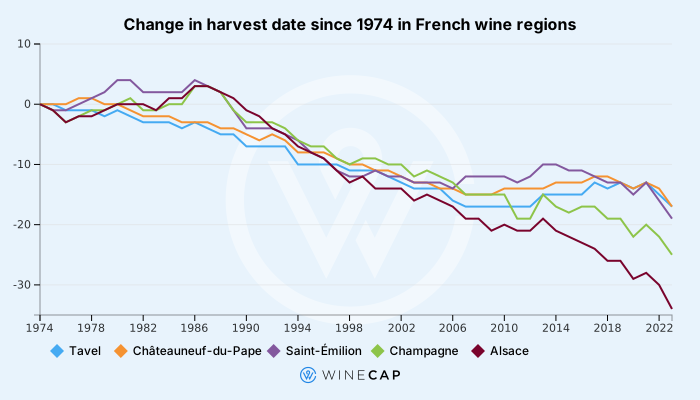
Climate change is having a profound impact on the global wine map. Rising temperatures are shifting the boundaries of where fine wine can be produced, in some regions where a southern aspect was preferred in the 1980s those vineyards are now becoming less productive and limited by the heat that used to be an advantage.

Burgundy Flowering and harvestData Source: jancisrobinson.com

Some historical regions are finding it increasingly difficult to maintain their traditional styles as sugar levels rise and acidity drops.

However, this shift is also opening up new frontiers:

  • English sparkling wine: Counties like Kent and Sussex now share a climate similar to the Champagne of several decades ago.
  • Patagonia and Central Otago: High-latitude regions are becoming top destinations for cool-climate varieties.
  • Emerging northern regions: Areas in Germany and even Scandinavia are beginning to produce high quality Pinot Noir.

For the investor, these changes create both risk and opportunity. While established terroirs are still preferred, new regions may become a more important part of the conversation in coming years.

Terroir beyond the wine glass

The concept of terroir is not exclusive to viticulture. It exists in many other artisanal products where sense of place is paramount. The “Slow Food” movement was built on this foundation, celebrating traditional agricultural products that reflect their local environment.

Other examples of terroir include:

    • Cheese: Such as Comte or Roquefort, where the local grasses and caves define the flavour.
    • Olive oil: Where regional soil and climate produce distinct profiles.
    • Coffee and tea: Where high-altitude “micro-lots” are traded at a premium.
    • Meat: Beef and lamb from the Orkney islands were among the first British products to gain legal recognition of their terroir.

In all these cases, terroir represents an element that imparts a sense of place. It is the ultimate rejection of mass-production and the celebration of the unique.

FAQ: A guide to terroir 

Is terroir just a marketing tool? 

While it is used in branding, terroir is based on documented physical factors like geology, climate, and topography that result in discernible variations in wine character.

Can a winemaker completely change a wine’s terroir? 

A winemaker can hide terroir through excessive oak or extraction, but they cannot create the structural intensity or complexity that only a superior site can provide.

Why does terroir matter for investment? 

Geographic specificity creates a natural cap on supply. Because the most famous vineyards cannot be expanded, the resulting rarity drives value in the secondary market.

Does the New World have terroir? 

Yes. Many New World producers now use soil mapping and single-vineyard designations to highlight the unique character of their specific plots.

WineCap’s independent market analysis showcases the value of portfolio diversification and the stability offered by investing in wine. Speak to one of our wine investment experts and start building your portfolio. Schedule your free consultation today.
Categories
News

Top-scoring Bordeaux 2025 En Primeur wines so far

  • Major critics describe Bordeaux 2025 as a “miracle vintage” due to its exceptional balance and moderate alcohol levels in a hot and dry year.
  • The first 100-point in-barrel scores have emerged. 
  • Critics argue that quality alone will not turn this campaign into a success; the economic climate must be acknowledged.

The 2025 En Primeur campaign has begun, with the first wave of releases and critic reports now emerging. After a growing season that pointed toward blockbuster wines on paper, the reality in the glass tells a more nuanced story. The consensus among leading critics following April’s barrel tastings is that the 2025s are something of a paradox – wines that combine the concentration of a hot, dry year with the balance, freshness and structural poise of a more classical era.

In this article, we look into the first major En Primeur reports from Antonio Galloni (Vinous), William Kelley (Wine Advocate), James Lawther MW (JancisRobinson.com) and Georgie Hindle (Decanter), exploring where their views converge, where they diverge, and highlighting some of their top-scoring Bordeaux 2025 wines. We also focus on key themes, regional standouts, and early signals for what is shaping up to be one of the most intriguing and selective En Primeur campaigns in recent years.

What makes Bordeaux 2025 a “miracle” vintage?

According to major wine critics, the short answer lies in the balance and the moderate alcohol levels of the wines in a year defined by record-breaking heat. In a region where 14.5% or 15% ABV has become the “new normal” for hot vintages, the 2025s have pivoted.

  • Antonio Galloni describes this as a “minor miracle,” noting that while heat and drought usually yield massive tannins and high sugars, 2025 saw sugar ripening slow down while physiological ripeness continued. 
  • William Kelley, who mentions an alcohol range of 12.5% to 13.5%, calls the best wines “thrilling” for their ability to remain classically proportioned despite their density.
  • Georgie Hindle also notes the “paradoxical” nature, stating that the wines don’t “carry the wounds of the vintage.” She observes that alcohol levels are often one to two degrees lower than the 2022s, which have become a point of comparison.
  • James Lawther MW agrees that the “low alcohols and dense, silky tannins” provide a unique originality, particularly in Cabernet-dominant blends.

The growing season: Rainfall as the great arbitrator

Critics agree that the late-August rains were the turning point for the 2025 Bordeaux vintage. Without this 60-90mm of precipitation, many believe the vintage would have been a disaster of desiccation.

  • James Lawther points out that the Médoc received the most significant rainfall (up to 70mm), which “relaunched” ripening in vines that had essentially shut down due to hydric stress.
  • In her report, Georgie Hindle cites a winemaker from Chateau Quintus who noted that “without the rains, we would have made syrup.” This rainfall allowed the three types of ripeness – technological, phenolic, and aromatic – to finally converge.
  • Antonio Galloni adds that the April rains were equally vital, providing the water tables with enough reserves to help the vines survive the initial heat spikes in June.

Low yields: The smallest crop since 1991

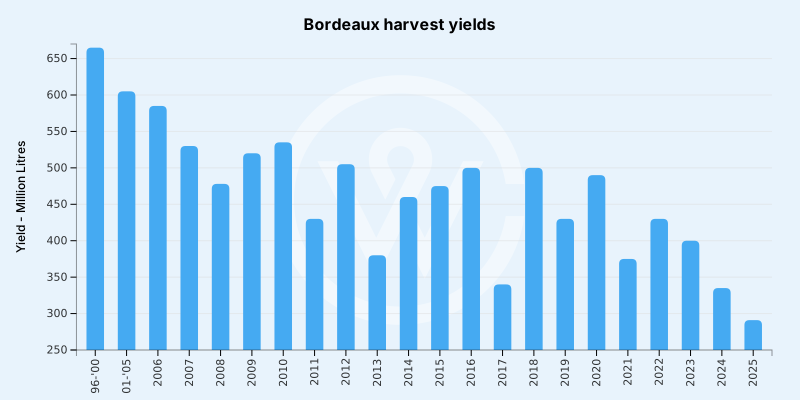
The 2025 vintage is also defined by scarcity, with Bordeaux recording its smallest harvest in over three decades – a factor that will inevitably shape the dynamics of the release campaign. While critics broadly agree on the scale of the shortfall, their interpretations of its causes and implications vary.

Galloni attributes the low yields to a combination of poor conditions during the 2024 flowering cycle – when cluster formation for 2025 was already compromised – and the intense heat and drought of the 2025 growing season, which led to significant berry dehydration. In some cases, Merlot berries weighed as little as 0.8g, well below the typical 1.2g.

Kelley similarly links these reduced yields to the resulting wine style, arguing that the vintage’s “authoritative density” is a direct consequence of this concentration. 

Lawther, meanwhile, sees the small crop as a “positive factor” for quality, as the reduced charge on the vine made it easier for the remaining fruit to reach full maturity despite challenging weather conditions.

Left or Right Bank vintage?

While the quality of the vintage is widely praised, critics have identified a clear hierarchy of consistency, with a notable consensus on which communes struggled.

  • The Pomerol paradox: All four critics flag Pomerol as the most inconsistent appellation. Lawther notes that it suffered most from drought, leading to “bitterness” in some wines due to lack of juice. Galloni and Kelley agree that while the top estates on the clay plateau (like Petrus and La Conseillante) are “elegant,” the appellation, as a whole, is uneven.
  • Margaux and Pauillac: Antonio Galloni crowns Margaux as the “star of the vintage,” noting its consistent brilliance. James Lawther and William Kelley lean toward Pauillac as the most “impressive” or “compelling” sector, with Kelley citing its ability to deliver wines of “real concentration.”
  • Saint-Emilion: The clay-limestone soils here proved their worth. Lawther and Galloni both praise the plateau’s ability to manage water stress, with Lawther highlighting Cheval Blanc’s “stunning” results despite an extremely low 15 hl/ha yield.

Winemaking decisions

With tiny berries and thick skins due to heat and drought, most winemakers opted for gentler extraction techniques when handling the 2025 vintage.

  • Kelley explains that the unusually high solids-to-juice ratio meant structure was “taken for granted,” leading many estates to lower fermentation temperatures and reduce pumping over.
  • Hindle notes that some estates, like Montrose and Phelan Segur, performed their shortest macerations on record to avoid harsh tannins.
  • Lawther warns that hard finishes are an occasional fault in the vintage where winemakers were too heavy-handed with overworked tannins.

Potential 100-point wines so far

While more scores will be released in the coming days from critics including Neal Martin, James Suckling, and Lisa Perrotti-Brown MW, the table below highlights the wines that have already achieved barrel ranges touching 100 points. These early indicators suggest which wines may ultimately reach perfection once bottled and re-tasted in two years’ time.
Bordeaux 2025: 100 point wines

*YC = Yohan Castaing (Wine Advocate), WK = William Kelley (Wine Advocate), AG = Antonio Galloni (Vinous)

It is important to note that En Primeur scores are typically expressed as ranges rather than fixed numbers. This reflects the fact that the wines are still in barrel and continue to evolve. Critics therefore allow for a margin of potential – both upward and downward – based on how the wines are expected to develop before bottling. A range such as 98-100 points signals not only exceptional quality, but also the realistic possibility of a perfect score at maturity.

Among the early reports, William Kelley is the most bullish, identifying seven wines with 100-point potential. Antonio Galloni follows with two, while Yohan Castaing has highlighted one wine in this top tier.

The list itself is telling. First Growths Chateau Haut-Brion and Chateau Margaux both feature, underlining the strength of the Left Bank at the very top level. They are joined by Right Bank icons Petrus and Cheval Blanc, alongside standout performers such as Troplong Mondot, Montrose and Pontet-Canet. 

Bordeaux 2025 market reality

While the wines themselves are widely praised, all critics have raised concerns about the market in their reports.

Kelley describes the En Primeur context as “structurally fragile,” questioning whether consumers still see value in buying futures. Galloni also states that Bordeaux “badly needs a win,” but warns that success depends entirely on pricing discipline. He argues that even modest increases could undermine demand, given the availability of competitively priced back vintages on the secondary market.

Hindle offers a more measured view, noting early signs of pricing restraint in the first releases and a stabilising fine wine market, but still emphasising the need for alignment between producers, merchants and consumers. 

The key to En Primeur success

Taken together, these early critic assessments position 2025 as a highly successful but nuanced Bordeaux vintage. At its best, it delivers a rare combination of concentration, freshness and terroir transparency – wines of both immediate appeal and long-term potential. However, it is not a uniform success. Variability is a defining feature, and careful selection will be essential. 

Perhaps most importantly, 2025 highlights a broader shift in Bordeaux. Through improved viticulture and winemaking, producers are increasingly able to navigate climatic extremes and make balanced wines in challenging conditions. 

But quality alone will not drive demand. The message from the critics is clear: the success of the campaign rests on the chateaux’s willingness to acknowledge the economic climate.

FAQ: Bordeaux 2025 En Primeur

Is Bordeaux 2025 a good vintage?
Yes – critics widely agree that 2025 is a high-quality vintage. Despite extreme heat and drought, the best wines show exceptional balance, freshness and moderate alcohol levels, leading some critics to describe it as a “miracle” or “paradoxical” vintage.

Why is Bordeaux 2025 described as a “miracle vintage”?
Because the wines defy expectations. In a hot, dry year that should have produced heavy, high-alcohol wines, 2025 instead delivered freshness, structure and restraint, thanks largely to cooler nights and crucial late-August rainfall.

What are the alcohol levels in Bordeaux 2025 wines?
Most wines fall between 12.5% and 13.5% ABV, significantly lower than recent hot vintages like 2022, where alcohol levels often exceeded 14.5%.

How important was rainfall in the 2025 vintage?
Late-August rainfall was critical. It rehydrated vines after prolonged drought, slowed sugar accumulation, and allowed full phenolic ripeness, ultimately shaping the balance and style of the wines.

Are Bordeaux 2025 yields low?
Yes. 2025 is the smallest Bordeaux harvest since 1991. 

Which Bordeaux regions performed best in 2025?
Margaux and Pauillac are widely seen as standout performers on the Left Bank, while Saint-Émilion excelled on the Right Bank, particularly on clay-limestone soils. 

Are there any 100-point Bordeaux 2025 wines yet?
Several wines have already received barrel score ranges of 98-100 points, indicating potential for a perfect score once bottled. Top names include Haut-Brion, Margaux, Petrus and Cheval Blanc.

What do En Primeur score ranges (e.g. 98–100) mean?
Barrel scores are given as ranges because the wines are still ageing. A 98-100 score suggests the wine is already exceptional but could improve further before bottling and reach a perfect score.

Will Bordeaux 2025 En Primeur be a successful campaign?
That remains uncertain. While wine quality is high, critics warn that success will depend on pricing. Buyers are increasingly cautious, and competition from back vintages may limit demand.

Should you buy Bordeaux 2025 En Primeur?
Critics emphasise that 2025 is not a uniform vintage. The best wines are outstanding, but variability is high, meaning careful selection will be essential rather than broad, “buy everything” strategies.

WineCap’s independent market analysis showcases the value of portfolio diversification and the stability offered by investing in wine. Speak to one of our wine investment experts and start building your portfolio. Schedule your free consultation today.
Categories
Learn

What is the difference between wine and Fine wine?

  • The vast majority of wine is not fine wine.
  • Fine wine is defined by its quantity, quality and economics, making it a financial asset as well as a luxury beverage.
  • Most wine is produced for immediate consumption and lacks the structural components to improve with age, whereas fine wine is crafted to evolve over decades.

At its heart, all wine is designed for pleasure – made to be drunk and enjoyed – yet fine wine extends that experience beyond the glass, offering the potential for evolution, rarity and lasting value.

The vast majority of global wine production, estimated over 95%, is intended for the dinner table. This comprises most wines found in supermarkets, restaurants and even local wine shops. These consumer goods are made to be consistent vintage and after vintage, accessible, and best enjoyed shortly after purchase. The wines are often fresh, fruit-forward, and technically sound. They satisfy the palate but are not built for the cellar

Meanwhile, in the territory of fine wine, the product shifts from a perishable beverage into a durable asset. This distinction is the bedrock of the wine investment market. Fine wine sits at the very top of the quality pyramid and is the result of specific environmental conditions and craftsmanship that cannot be mass-produced. 

Fine wine has ageing capacity

A primary difference between standard wine and fine wine is the capacity to age

Standard wines often have a shelf life of just two or three years. Most wine does not become better with time; it simply gets old. There is no reward for holding a basic Pinot Grigio in your cupboard, which is best enjoyed the year after harvest. 

Fine wine operates on a different chemical timeline. It possesses high levels of acidity, tannins, and concentrated fruit flavours and aromas, which act as preservatives and structural supports. Over time these components interact, change and create complexity. Ironically what can make fine wine difficult to enjoy in its extreme youth is what makes it exceptional once it has aged.

With ageing, more red fine wines see their primary fruit flavours transform into complex tertiary notes like forest floor, tobacco, and truffle. This evolution is what drives the value of the bottle. Moreover, the wine becomes more desirable as it nears its peak drinking window and supply diminishes as it is consumed.

How fine wine changes with age

  • Phenolic polymerization: Small tannin molecules bond together to form longer chains, which significantly reduces astringency and creates a smoother mouthfeel.
  • Controlled oxidation: Small amounts of oxygen pass through the cork and slowly break down primary fruit compounds and change colour pigments.
  • Esterification and hydrolysis: Continuous reactions between alcohols and acids synthesise new scent compounds, shifting the wine’s aromas from primary fruit to more complex tertiary aromas.
  • Anthocyanin complexation: In red wines, red pigments bond with tannins causing the wine’s colour to shift from vibrant purple-red to garnet or tawny.
  • Colloidal precipitation: As molecules grow they form insoluble sediments which settle at the bottom of the bottle.

Fine wine gets scarcer

The scarcity of aged bottles also plays a critical role in the investment reality. 

As a vintage is consumed, the number of remaining bottles in the world decreases. When you combine increasing quality with decreasing supply, you create the perfect conditions for price appreciation. This is one of the reasons why a rare 80-year-old Domaine de la Romanee Conti recently sold for nearly a million dollars at auction, while a young bottle is closer to $10,000. 

Standard wine can never benefit from this change in the supply/demand dynamic because it cannot survive a journey it was never intended to make.

Fine wine has a sense of place

Fine wine is almost always tied to a specific patch of land. In regions like Burgundy, the difference between an investable Grand Cru wine and a Village wine made for short-term drinking can be a matter of a few metres. This is the concept of terroir. It encompasses the unique soil, the slope of the land, the local climate and seasonal weather, and cannot be replicated.

This regional tie creates a natural limit on supply. The land is fixed and protected by strict local laws. For instance, Domaine de la Romanee-Conti’s flagship wine Romanee-Conti can only come from one specific 4.5 acre vineyard. This restriction makes the wine a rare commodity. 

In contrast, most wines designed for early consumption are made from grapes sourced across entire countries or even continents, prioritising volume over the unique characteristics of a single site.

The blending exception

While terroir is the rule, there are notable exceptions where fine wine is defined by the skill of the blender. 

  • Champagne is the most obvious of these. While many top-tier reds rely on tiny vineyard plots, iconic houses like Dom Perignon produce significant quantities with grapes from plots across the region. This allows cellar masters to create a consistent, complex profile that ages for decades. 
  • Penfolds Grange is another famous example. Unlike the single-vineyard focus of Bordeaux and Burgundy, Grange is a multi-regional blend. The winemakers source the best Shiraz grapes from various locations across South Australia to create a consistent house style. Despite lacking a single-vineyard origin, it is a highly collectible wine.

Fine wine is not solely about where the grapes are grown. While geographic specificity is an indicator, the ultimate test is the quality of the finished product and its ability to age gracefully.

Fine wine has producer reputation 

Reputation is the currency of fine wine. A standard wine might be delicious, but without a historical track record, it cannot be considered an investment. Meanwhile, fine wine estates have often spent centuries building their brand: the 1855 Classification in Bordeaux is still a guide for investors today. It provides a hierarchy that the market trusts and gives buyers the confidence that the wine will perform as expected.

Fine wine attracts critical attention

Critic scores are a modern extension of this and provide crucial information for investors and collectors. A high score from a respected publication can cause an immediate spike in market value; a series of high scores over a number of years might elevate a wine to be considered a fine wine. 

Even so, most wines rarely receive this level of scrutiny. If they are reviewed at all, the assessment might focus on whether they are pleasant to drink right now, rather than on their structural integrity and ageing potential.

Fine wine is more complex

The flavour profile of fine wine is noticeably more complex than that of everyday bottles. Standard wine tends to be more linear: you might taste strawberry or lemon or apples, and that flavour remains consistent from the first sip to the finish. 

By contrast, fine wine is often described as multidimensional. It offers layers of smell and flavour that reveal themselves slowly as the wine sits in the glass.

Fine wine also possesses length. This is the duration that the flavours linger after you have swallowed. In a standard wine, the flavour might vanish in seconds, while in the best fine wines it can last for minutes. 

This is another hallmark of high-quality winemaking. It indicates a level of concentration and balance that is impossible to achieve in mass-market production. The sensory experience is simply deeper and more rewarding.

Price differential

It is a common myth that all fine wine is expensive. While “blue-chip” labels like Petrus or Le Pin can cost thousands of pounds, the entry point for fine wine is often more accessible than people think. Fine wines from regions like Bordeaux or Rioja often sell for well under £50. These wines offer the same ageing potential and structural complexity as their more famous peers, and while they may not be investable, they could still be categorised as “fine wine”.

Beyond cost, there is the question of value. For instance, a £10 bottle of supermarket wine has zero re-sale value the moment you leave the shop. A £60 bottle of high-quality Barolo not only has the potential to double or triple in value over a decade but will leave a lasting impression when consumed. 

Put simply, fine wine is an asset, whereas standard wine is an expense. The higher upfront cost is an investment in a product that can preserve and grow your capital, as well as deliver a different quality of drinking pleasure.

Quality vs quantity

Fine wine relies on the natural concentration of the grapes. This concentration is achieved by keeping vineyard yields low, which increases the cost of production.

Low yields mean fewer bottles of higher quality and is the fundamental trade-off of the fine wine world. A mass-market producer wants to harvest as many grapes as possible to fill as many bottles as they can, while a fine wine producer prunes the vines aggressively to ensure the remaining grapes are packed with flavour and structure. 

This focus on quality over quantity is the most significant contrast between fine wine and standard wine. 

From consumer to collector

Moving from simply drinking wine to collecting and investing in fine wine requires a clear shift in mindset. The focus moves away from what to open tonight, towards what will reach its peak in a decade or more. While the pleasure of fine wine still lies in the glass, it also comes from something deeper – the ability to follow a wine’s evolution over time. Fine wine is a living, changing asset, and that sense of development and anticipation is something few other wines, or indeed other alcoholic products, can truly offer.

FAQ

Can a cheap bottle of wine ever become “fine wine” if I leave it in a cellar? 

No. Ageing cannot create quality where it does not already exist. Fine wine must be “built” for the cellar from the moment the grapes are grown.

Is all expensive wine considered fine wine for investment? 

Not necessarily. Some wines are expensive due to branding, luxury packaging, or celebrity associations but lack a secondary market. To be investment-grade, a wine needs a history of price appreciation and a global network of buyers ready to trade it.

Why does region matter so much in fine wine? 

Specific regions have unique microclimates and soil that produce grapes with exceptional character. These areas are often legally protected, meaning supply is capped. This combination of unique quality and restricted supply is what creates long-term value for investors.

How can I tell if a wine has a different flavour profile without opening it? 

You can rely on critical reviews and tasting notes from professional tasters. They will describe the complexity, the tannins, and the “length” of the wine. Look for terms like “structured,” “tight,” or “evolving,” which indicate a wine that is built to improve over time.

Can a blend be a fine wine? 

Yes. Many of the world’s greatest wines are blends. Most Bordeaux wines are a mix of Cabernet Sauvignon and Merlot. Champagne is often a blend of different areas within the region and even from different years. Penfolds Grange is a multi-region blend. The key is the quality of the components and the skill involved in the assembly.

WineCap’s independent market analysis showcases the value of portfolio diversification and the stability offered by investing in wine. Speak to one of our wine investment experts and start building your portfolio. Schedule your free consultation today.
Categories
Learn

Which wines have the best ageing potential?

  • The ageing potential of a wine is one half of the mechanism that drives its long-term growth.
  • Fortified and sweet wines represent the apex of longevity due to higher levels of alcohol, sugar, and acidity, which act as natural preservatives.
  • While traditional regions like Bordeaux and Piedmont remain the benchmarks for cellaring, modern viticulture in the New World is expanding the horizons.

The importance of ageing in wine investment

Wine is an improving asset in diminishing supply, and time is the most critical ingredient in any fine wine portfolio. 

Unlike most consumer goods that depreciate in value the moment they are purchased, investment-grade wine is a living asset that evolves and improves over time. This is a unique feature to wine and the improvement can be dramatic, as seen in the table below which illustrates Vinous’ Neal Martin Lafite Rothschild 1985 score evolution over time.

Neal Martin's Lafite Rothschild 1985 scores over time

Not only do fine wines improve over time, they also become scarcer. Every bottle drunk reduces the global supply. For a vintage to gain value, it must be able to survive several decades in a cellar. Without this longevity, a wine is a simple consumption purchase rather than a potential investment.

The relationship between age and value is often non-linear. A wine may trade at its release price for several years before hitting a “drinking window.” Once critics confirm a vintage is reaching its peak, demand and pricing often surges and consumption increases. This phase of the lifecycle is where the most significant returns are frequently realised.

What happens when wine ages?

Fine wine is essentially a slow-motion chemistry set. Even when fermentation has ended, the wine matures through constant slow changes that dictate its long-term investment value.

Key transformations include:

  • Micro-oxygenation: Trace amounts of air enter through the cork over decades. This controlled oxidation transforms simple primary fruit into complex tertiary aromas such as leather, tobacco, or forest floor.
  • Polymerisation: Harsh tannin molecules link together to form long chains. These feel silkier on the tongue and eventually precipitate as sediment, naturally refining the wine’s texture and mouthfeel.
  • Esterification: Acids and alcohols react to create esters. This chemical evolution develops the “bouquet,” adding tertiary layers of spice, truffle, and earth that are absent in younger vintages.
  • Anthocyanin shift: The chemicals giving wine its colours change their structure. Red wines fade from vibrant purple to garnet or brick, while white wines darken toward deep gold or amber.

A consistent, cool cellar ensures these reactions happen gradually. Rushing the process with heat prevents complexity from developing. These molecular shifts are what transform a standard wine into a rare, high-value asset.

Wine vs whisky: The biological divide

A common point of confusion for new collectors is the difference between wine and spirits like whisky. Whisky is a distilled spirit with a high alcohol content that effectively halts biological change. Once a whisky is bottled, its flavour profile remains static.

Wine is a living product. It continues to interact with trace amounts of oxygen through the cork and undergoes complex chemical reactions between its acids, tannins, and alcohols. These reactions are what create the sought-after aromas of leather, earth, and dried spices. A bottle of Lafite Rothschild from the 1980s tastes vastly different today than it did in 1990; an examination of scores over time shows this very clearly.

This dynamic nature is why storage conditions are so critical for wine. While a bottle of Macallan can sit on a shelf for years, a First Growth Bordeaux requires a temperature-controlled environment. The risk of spoilage is the price an investor pays for the potential of improvement.

Fortified wines: The indestructible assets

Fortified wines occupy a unique space in the wine world. Unlike “normal” fine wines, which typically range from 12% to 14.5% alcohol, fortified wines are bolstered with grape spirit. This process raises the alcohol level to between 17% and 22%..

This addition of spirit serves two purposes: it stops fermentation early, leaving residual sugar, and acts as a powerful preservative. This is why fortified wines can survive for centuries. While a dry red wine might reach its peak at 40 years, a top-tier Vintage Port or Madeira can still be improving at 100 years.

The winemaking process is also distinct. In many cases, these wines are intentionally exposed to heat or oxygen during production to stabilise them. This pre-ageing makes them incredibly resilient once they are in the bottle.

Long-lived Port

Port is perhaps the most famous fortified wine. Vintage Port is only produced in years of exceptional quality, known as a “declaration.” These wines are designed to be cellared for at least 20 to 50 years before they show their true potential.

The structure of Port comes from its intense tannins and high sugar content. Over time, the aggressive spirit integrates with the fruit, creating a velvet-like texture. Examples of legendary long-lived Ports include:

  • Taylor’s Vintage Port (notably the 1945 and 1992 vintages).
  • Graham’s The Stone Terraces.
  • Quinta do Noval Nacional.

These wines are often considered the ultimate inheritance assets. They are frequently purchased to mark the birth of a child, with the intention of being opened many decades later. Their survival rate is higher than almost any other wine style because they are more robust: so long as the cork remains intact, they are likely to retain their quality.

Sherry with extraordinary ageing potential

While much of the Sherry market is focused on fresh styles, wines like Oloroso, Palo Cortado, and Amontillado have extraordinary ageing potential. The best examples come from the “VOS” (Very Old Sherry) and “VORS” (Very Old Rare Sherry) categories.

These wines have already spent an average of 20 or 30 years ageing in a solera system before bottling. Because they have been intentionally exposed to oxygen for decades, they are virtually immune to further oxidation in the bottle. They offer some of the most complex aromatic profiles in the world, featuring roasted nuts, saline notes, and dried citrus.

Collectible examples include:

  • Gonzalez Byass “Matusalem” Oloroso
  • Valdespino “Coliseo” Palo Cortado
  • Tradición VORS Amontillado

Bordeaux: The global benchmark

Bordeaux is the foundational region for wine investment. Its primary grape, Cabernet Sauvignon, is naturally high in tannins and acidity which are the building blocks of its longevity. As anyone who has attended En Primeur tastings can attest, the structure of a young Bordeaux can be quite harsh, but time softens these elements into a harmonious whole.

The First Growths, such as Latour and Mouton Rothschild, are famous for their ability to withstand long ageing. Even in “off” vintages, the technical precision of these estates ensures a long life.

Notable examples of long-lived Bordeaux:

  • Chateau Latour 1961 
  • Chateau Haut-Brion 1989
  • Chateau Montrose 1990 

The elegance of aged Burgundy

Burgundy offers a different ageing profile compared to Bordeaux because Pinot Noir is a thinner-skinned grape with lower tannin levels. Longevity in Burgundy comes from the perfect balance of acidity and the incredible concentration of fruit found in Grand Cru sites.

While a Bordeaux might be powerful, an aged Burgundy is ethereal. The transition from fresh raspberry to truffle and forest floor flavors is one of the most celebrated experiences in fine wine. However, Burgundy can be more temperamental in the cellar, making provenance and storage even more critical.

Examples of iconic ageing Burgundy:

  • Domaine de la Romanee-Conti (DRC) La Tache
  • Domaine Armand Rousseau Chambertin
  • Domaine Leflaive Montrachet 

Piedmont: Italy’s answer to Burgundy

Like Burgundy, Piedmont focuses on single-vineyard sites and a single grape: Nebbiolo. Nebbiolo is an unusual variety that looks light in the glass but possesses massive tannins and high acidity. Historically young Barolo and Barbaresco were almost impenetrable. It was only in recent years that Piedmont winemakers would declare that their wines could be enjoyed in less than 30 years.

Still, these wines require time to reveal their beauty. A classic Barolo often needs ten to 15 years to become approachable. The best vintages from top producers like Giacomo Conterno or Bruno Giacosa can easily last for half a century.

Examples of long-lived Piedmont:

  • Giacomo Conterno Barolo Riserva Monfortino
  • Bruno Giacosa Barbaresco Santo Stefano
  • Gaja Barbaresco

Tuscany: The rise of the Super Tuscans

Tuscany has two main pillars, both of which can craft long-lived wines: Brunello di Montalcino and the Super Tuscans. Brunello is made from 100% Sangiovese and is legally required to undergo extensive ageing before release. The structure of top Brunello allows it to evolve gracefully for 30 years or more.

Super Tuscans are almost defined by their incorporation of the international varieties brought to fame by Bordeaux: Cabernet Sauvignon and Merlot. These wines were designed to compete on the global stage and have proven their ability to cellar. Sassicaia and Tignanello are the primary examples that investors look for but there are many others that will reward cellaring.

Key Tuscan ageing stars:

  • Biondi-Santi Brunello di Montalcino Riserva
  • Tenuta San Guido Sassicaia
  • Masseto 

The New World: USA and South America

The United States, particularly Napa Valley, has established itself as a producer of long-lived Cabernet Sauvignon. Estates like Ridge Vineyards, Stags Leap Wine Cellars and Heitz have bottles from the 1960s and 1970s that are still drinking beautifully today as evidenced by ongoing re-tastings of wines from the 1976 Judgment of Paris. While the cult wines of Napa are frequently approachable in their youth they are also built for long-term cellaring.

In South America, the focus is on high-altitude sites that preserve acidity. Argentina’s Malbec and Chile’s Cabernet blends have shown surprising resilience. Producers are now making wines with more restrained oak and higher acidity to ensure they age as well as their European counterparts.

Examples of New World longevity:

  • Ridge Monte Bello (California)
  • Screaming Eagle Cabernet Sauvignon (California)
  • Catena Zapata Adrianna Vineyard (Argentina)
  • Seña (Chile)

South Africa and Australia

South Africa has a long history of sweet wine production, but its red blends from Stellenbosch are now proving their mettle. The Cabernet-based wines from Kanonkop are known for their ability to age for several decades and will often outlast their peers from much more expensive regions.

Australia is home to some of the oldest vines in the world. For instance, the grandfather vines at Henschke were planted in the 1860s and vintages from the 1950s have performed well at recent tastings. Penfolds Grange is also well known for its longevity: a multi-regional Shiraz blend that is designed to be tucked away for 30 to 50 years. The power and concentration of Australian Shiraz provide a sturdy foundation for ageing.

Notable examples:

  • Henschke Hill of Grace (Eden Valley)
  • Penfolds Grange (South Australia)
  • Kanonkop Paul Sauer (Stellenbosch)

Dry white wines: Longevity and evolution

Top-tier still whites also possess a capacity to be aged, even if equivalent quality red wines are generally better able to accommodate multiple decades in the cellar. Longevity in this category is primarily driven by high natural acidity and the fruit concentration found in prestigious vineyard sites. Over time, as colour darkens these wines move away from fresh citrus notes, gaining complex tertiary aromas such as honey, toasted nuts, dried flowers and even cheese as they reach extremely old age.

Notable examples of ageable still whites can hail from many regions, but old world dry whites from Burgundy, Bordeaux, Alsace, the German regions in the Rhine and Mosel valleys are arguably best known for their capacity to age with grace. Examples include:

  • Domaine Joseph Drouhin Montrachet Marquis de Laguiche Grand Cru (Burgundy)
  • Domaine de Chevalier Blanc (Bordeaux)
  • Keller G-Max Riesling Trocken (Rheinhessen)
  • Trimbach Riesling Clos Sainte Hune (Alsace)

Can sparkling wine age?

While non-vintage Champagne is ready to drink as soon as it’s available, Vintage Champagne has an undeniable ageing potential. The high acidity and the presence of carbon dioxide act as preservatives that allow ageing to occur over many decades.

As Champagne ages, the bubbles become finer and begin to fade, while the flavour profile shifts from fresh citrus to brioche, honey, and roasted nuts. Some collectors specifically seek late-disgorged bottles that have spent extra time on their lees for even more complexity. Producers are happy to meet that demand: Dom Perignon recently added P3 to their line, allowing a third release window for the best vintages offering vintages from the 1960s and 1970s and 1980s to the market almost 50 years after their initial offering.

Examples of long-lived Champagne:

  • Dom Perignon
  • Krug Vintage
  • Salon Le Mesnil

Underwater ageing: A new frontier

One of the most intriguing developments in recent years is the practice of ageing wine underwater. This trend was sparked by the discovery of 170-year-old Champagne in a shipwreck in the Baltic Sea. The bottles were found to be in remarkable condition, the theory being that constant temperature, darkness, pressure and the lack of vibration fundamentally slow down the ageing process.

Producers are now intentionally submerging cages of wine in the ocean. Notable projects include:

  • Veuve Clicquot’s “Cellar in the Sea”
  • Leclerc’s Abyss
  • Drappier’s Immersion
  • Mira Winery (Napa Valley)
  • Crusoe Treasure (Spain)

The golden finish: Long-lived sweet wines

Sweet wines are the true champions of the cellar. The combination of high sugar and high acidity creates a nearly immortal product of which Sauternes is the most famous example. Here botrytis, a fungal infestation also known as “noble rot”, concentrates the sugars and acids to an extreme degree.

A top-tier Sauternes like Chateau d’Yquem can easily age for a century. Over time, the wine turns from bright gold to a deep amber colour and the flavours evolve from tropical fruit to complex notes of creme brulee, dried fruits, marzipan and nutmeg.

Other sweet wine icons:

  • Suduiraut (Sauternes)
  • Egon Müller Scharzhofberger Riesling TBA (Germany)
  • Royal Tokaji 6 Puttonyos (Hungary)
  • Klein Constantia Vin de Constance (South Africa)

Wine types and ageing profiles

FAQ

How do I know if a wine has ageing potential? 

Look for a balance of high acidity, strong tannin structure (for reds), and high fruit concentration. Reviews from reputable critics often include a suggested “drinking window” to help guide your decision.

What is the best temperature for ageing wine? 

A constant temperature of around 12 to 14 degrees Celsius is ideal for long-term development. Significant fluctuations in temperature can cause the wine to expand and contract, potentially damaging the cork seal.

Does expensive wine always age better than affordable bottles? 

Not necessarily. While most investment-grade wines are expensive because of their longevity, some high-priced wines are made for early consumption. Always check the specific style and vintage before deciding to cellar a bottle.

Can I age white wine as long as red wine? 

Most white wines are intended for early drinking, but high-acid whites like Riesling and Chardonnay from top sites can age for decades. Sweet white wines like Sauternes have the longest potential of all unfortified wine styles.

WineCap’s independent market analysis showcases the value of portfolio diversification and the stability offered by investing in wine. Speak to one of our wine investment experts and start building your portfolio. Schedule your free consultation today.
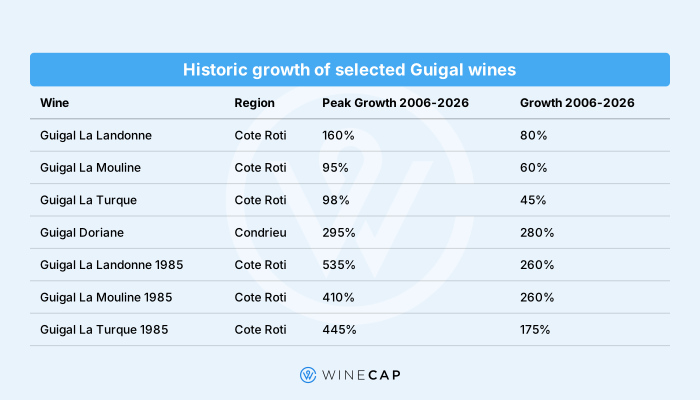
Categories
Learn

Which wines have the best ROI? A 10-year fine wine performance review

  • Bordeaux anchors portfolios with liquidity and stability, while Burgundy and niche producers often deliver the highest upside.
  • Scarcity drives returns: from cult Burgundy to grower Champagne, the biggest gains come where supply is tight and demand is global.
  • After a three-year correction, fine wine prices are on the rise, signaling a prime entry point.

Over the past two decades, fine wine performance has been far from uniform, with returns driven by a distinct mix of liquidity, scarcity, and shifting global demand. The wines that have delivered the best ROI have done so for very different reasons, making a market breakdown essential to understanding where true value lies, and how each region behaves as an investment.

Bordeaux: The “S&P 500” of fine wine 

Bordeaux remains the cornerstone of the secondary wine market due to its high production volumes and global recognition. It provides a level of liquidity that acts as a defensive anchor, weathering the 2022-2025 correction better than most speculative assets.

  • Le Pin

Located in Pomerol, this tiny estate is the absolute leader for the region. Growth from the 2013 bottom to the 2023 peak was over 130%, maintaining its value even during the recent “gut punch” of 2025.

  • Carruades de Lafite

The second wine of Chateau Lafite Rothschild is a high-volume engine. The 2013 vintage, for instance, traded at £950 per case in 2014 and hit over £3,000 in 2022, marking a 215% return. 

  • Calon Segur

A historic Saint Estephe “hidden gem,” prices rose 120% in the ten years up to the 2023 peak and were more  stable than many higher profile peers during the correction from 2023-2025.

Burgundy: Behind the stellar growth

The best historical performance can be found in Burgundy, where rarity meets intense global demand. However, investors must be wary of ghost wines that show huge growth on paper but offer very little real world liquidity.

  • Domaine d’Auvenay

A personal estate of Lalou Bize-Leroy, also the owner of Domaine Leroy and part owner of Domane Romanee Conti, D’Auvenay produces wines of extraordinary intensity and rarity. “Aligote Sous Chatelet” is regarded as the best money can buy. At £30,000 a case, it is a significant asset. While liquidity is limited by small production levels, the price is backed by trades and auctions. It has shown a stunning 11,000% growth over its history. Auction prices for the 2009 vintage rose from £6,000 a case in 2019 to £35,000 in 2023.

  • Domaine Bizot and Arnoux-Lachaux Jean-Yves Bizot

Both domaines produce tiny quantities of wine in Vosne-Romanee using natural winemaking techniques. They saw values soar in the late 2010s and early 2020s. For instance, Bizot Echezeaux 2010 rose from £4,000 in 2016 to £115,000 in 2022; however, few of these extreme values are backed by trades in the open market.

  • Domaine de la Romanee-Conti (DRC)

Commonly known as DRC, Domaine de la Romanee-Conti is the most famous estate in Burgundy and the region’s benchmark for tradable and secure investment. Duvault Blochet is among their most affordable wines and their best performer. While 500% growth in ten years is modest compared to Bizot, DRC remains the most liquid and secure option for Burgundy investors.

The Champagne market: Grandes Marques and grower producers

The Champagne market shows a clear split between the Grandes Marques and grower producers. Large houses offer higher liquidity while grower Champagnes see lower trade volumes but often achieve bigger returns. 

  • Louis Roederer Cristal

Cristal is the flagship wine of the family owned house Louis Roederer. It was the best performer among the large producers in the decade leading to the 2022 market peak. Prices for Cristal increased 160% between 2016 and 2022.

  • Krug Clos du Mesnil

This rare Blanc de Blancs is an example of the single vineyard wines that have become more common in the region over recent years. Clos du Mesnil leads the way in both prominence and performance, with prices up 215% from 2016 to the market top in 2022.

  • Egly-Ouriet

The leader of the artisanal grower surge. Based in Ambonnay, this estate has seen values climb 500% over the last decade as collectors pivot toward terroir-driven grower Champagne. 

Tuscany: Super Tuscans and Brunello 

Tuscany provides a balance of high quality and relative value compared to French regions. The “Super Tuscan” category remains the primary driver of investment both among Italian wines, and within Tuscany.

  • Sassicaia and Tignanello

Tignanello is produced by the historic Antinori family, while Sassicaia is the original Super Tuscan from Tenuta San Guido: these two labels lead the way for Italian wine liquidity. Both have proven to be excellent long-term investments and both have shown steady gains over 10 and 15 year periods. Tignanello has the slight edge, up 160% in the last decade.

  • Il Marroneto Madonna delle Grazie

This Brunello di Montalcino is a more niche selection compared to the coastal Super Tuscans. Older vintages of this wine have risen upwards of 500% over the last decade.

  • Soldera Casse Basse

The late Gianfranco Soldera created a cult following for his uncompromising approach to Sangiovese. This is one of the most expensive wines in Tuscany and has benefited from excellent growth, around 300% over the last decade. It remains just below the price of the 100% Merlot icon Masseto.

Piedmont: The “Burgundy of Italy”

Piedmont offers high growth but generally lower liquidity than Tuscany, mirroring the relationship between single-vineyard single-grape variety focus of Burgundy and the larger production volumes in Bordeaux.

  • Comm G.B. Burlotto

The Burlotto family has made wine in Verduno for generations, but their Monvigliero has become a superstar. The wines of Burlotto are a highlight for the region. They have shown growth in the high hundreds of percentage points.

  • Cappellano and Giovanni Canonica

These producers represent a traditional approach to Barolo that has found favour with modern collectors. Both have shown approximately 500% growth over the last decade. These names reflect the rising interest in terroir-driven, traditional Piedmont wine.

  • Gaja

Angelo Gaja is the man credited with bringing Piedmont to the world stage through modernisation and high production levels compared to its regional peers. For investors and collectors, Gaja Barbaresco is a favourite. The wine has risen 100% in ten years, remaining solid since the 2022 market peak. Meanwhile, Gaja’s flagship white, Gaia and Rey, has seen nearly 400% growth over the last two decades.

USA: Cult wines and beyond

Cult wines often dominate the conversation in the United States. However, more mainstream brands have achieved equally impressive returns recently.

  • Ridge Monte Bello

Ridge Vineyards is famous for its non-interventionist winemaking and focus on high altitude sites. They have a large selection of accessible wines, but Monte Bello is their flagship investment-grade label. Prices for Monte Bello are up 140% over the last 15 years.

  • Opus One

Opus One was founded as a joint venture between Robert Mondavi and Baron Philippe de Rothschild. The estate focuses on producing large volumes of a single Grand Vin. This narrow focus has seen values double over the last decade.

  • Screaming Eagle and Realm “The Absurd”

Screaming Eagle is the quintessential Napa Valley cult wine, produced in extremely small quantities. Lesser vintages, in particular, have proven to be strong performers: the 1998 saw 300% growth in the decade to 2021, while the 2011 vintage rose 240% between 2014 and 2021.

Realm Cellars produces “The Absurd” as a blend of their best barrels. It saw prices rise 300% in the decade to 2022.

High performers from other regions

Excellent growth is available outside the most mainstream regions. While liquidity tends to be more limited, these wines are standouts in their respective countries.

  • Valentini Trebbiano d’Abruzzo

Valentini is a reclusive producer in Abruzzo known for creating whites with immense ageing potential. This white is the most searched for Italian fine wine outside of Piedmont and Tuscany and its index has risen 320% in the last decade.

  • Chateau des Tours 

This estate is under the same ownership as Chateau Rayas in Chateauneuf du Pape, but its wines are available at a much lower price. Their flagship, Vacqueyras, is roughly 10% of the price of Rayas, and while it does not achieve the same scores, values have risen 600% in a decade.

  • Vega Sicilia Valbuena 5°

Vega Sicilia in the Ribera del Duero is perhaps the most prestigious estate in Spain and the best known to investors. Valbuena 5° is the younger sibling to the famous Unico, but its performance has consistently bettered its more costly sibling. It is up 47% over five years, 146% over ten years, and 215% over fifteen years.

  • Sadie Family Columella

Eben Sadie is the leading figure in the new wave of South African winemaking. Their flagship, Columella, is up 140% in a decade. This eclipses other famous South African names like Klein Constantia Vin de Constance, up 60% in the same period.

  • South America: Almaviva and Don Melchor

Almaviva is a joint venture between Baron Philippe de Rothschild and Concha y Toro in Chile. Both Almaviva and Don Melchor lead the way in South American investment performance. They have shown growth of around 200% in the last 15 years and 100% in the last decade.

FAQs: Which wines have the best ROI?

Which wine brand has the highest historical growth? 

The highest percentage growth recorded in our analysis is Domaine d’Auvenay Aligote Sous Chatelet, which has seen stunning 11,000% gains over the last 20 years.

Is it better to invest in Bordeaux or Burgundy? 

Bordeaux generally offers better liquidity and larger production volumes, making it easier to buy and sell. Burgundy has shown higher growth but can be more difficult to trade due to limited supply.

What is a ghost wine in the context of investment? 

A ghost wine refers to a label that shows high price appreciation on paper but has very little actual trading volume or physical liquidity in the open market.

How has the US cult wine market performed recently? 

While cult wines like Screaming Eagle have seen significant historical gains, more mainstream brands like Opus One have proven to be more reliable performers in recent years.

Are there profitable wine investments outside of France and Italy? 

Yes, regions like Spain (Vega Sicilia), South Africa (Sadie Family), and Chile (Almaviva) have all produced wines with triple digit percentage growth over the last decade.

WineCap’s independent market analysis showcases the value of portfolio diversification and the stability offered by investing in wine. Speak to one of our wine investment experts and start building your portfolio. Schedule your free consultation today.
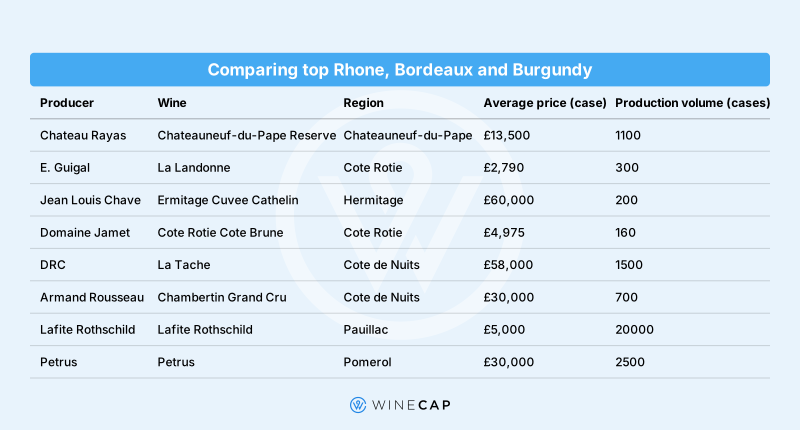
Categories
Learn

The ultimate guide to Bordeaux En Primeur

  • Bordeaux En Primeur is a system where wine is purchased while it is still maturing in barrel, typically 18 months before bottling and delivery.
  • The system operates through a unique network of brokers and merchants known as La Place de Bordeaux.
  • Successful participation in the campaign requires a data-led approach, focusing on the relative value of new releases compared to available back vintages.

What is En Primeur wine buying?

En Primeur, also known as wine futures, is the shorthand for an ecosystem of wine producers, negociant, and merchants that allows consumers and investors to buy wine while it is still in the barrel, before the final bottling takes place. 

While other regions do offer En Primeur purchases, the system is best known in Bordeaux. Grapes for the Bordeaux wines are harvested in the autumn and the young wine is offered for sale the following spring. In practice, this means that the 2026 En Primeur campaign is for the 2025 vintage, 2025 En Primeur was for the 2024 vintage etc.

At this stage, the wine is sold while it is a work in progress, unfinished, unblended and still requiring further ageing in the chateau cellars before being bottled and shipped.

Buyers pay a specific release price for the wine, which can be the lowest price the wine will ever see. This is dependent on the chateaux and negociants setting a sensible entry point and markets holding steady or improving. Once purchased, the wine remains at the estate until a few months after it is bottled, which usually happens 18 months to two years after the harvest. 

A short history of Bordeaux wine futures

Like everything in Bordeaux, the roots of the En Primeur system stretch back but the widespread adoption of modern En Primeur sales has its origins in the early 1970s.  

The establishment of En Primeur was prompted by global recession and cash flow issues caused by the 1973 oil crisis. After poor sales of the 1973 and 1974 vintages, merchants and producers were badly in need of money and with 1975’s samples well received, the wine trade found a way to bring forward revenue and sell wines early, funding the next year’s production and labour costs without waiting for the wine to mature.

It was only with later vintages that the economic advantages of En Primeur buying became clear to investors.

How the En Primeur system operates today

The Bordeaux En Primeur market is governed by La Place de Bordeaux and involves three primary players: chateaux, courtiers and negociants. 

  • Chateaux are the winemakers.
  • Courtiers are brokers who act as middle men distributing the wine to a handful of B2B merchants in Bordeaux known as negociants.
  • Negociants then sell the wine to merchants across the globe who in turn sell to their clients.

Chateaux rarely sells directly to retailers or private clients. Instead, they release allocations to a small group of courtiers who then sell them to a slightly larger group of  negociants in France. Even when a chateau has a strong relationship with a merchant like WineCap and wants to guarantee them allocations, that transaction will still go through a negociant.

Every April, the world’s wine trade descends on the city of Bordeaux for the primeur tastings, with journalists, importers, and merchants spending a manic week tasting hundreds of barrel samples often on multiple occasions to assess the quality of the new vintage. Based on these assessments and the general economic climate, the chateaux release their prices over several subsequent weeks, generally through May and June with negociants simultaneously offering dozens of wines to international merchants, who sell to private clients.

Which UK merchants offer En Primeur?

Most reputable fine wine merchants in the UK participate in the annual campaign. This includes historic firms and modern investment platforms. In a high-quality oversubscribed vintage, retailers compete for allocations of the most sought-after wines, with those that buy most broadly getting priority. In poorer vintages, the balance of power shifts with negociants working harder to place their wines. When selecting a merchant, it is vital to choose one with a proven track record, as you are essentially buying a promise of future delivery.

Buying En Primeur with WineCap

Even if you consider yourself a drinker rather than a collector, looking at wine through an investment lens is beneficial. WineCap’s perspective focuses heavily on relative value and our approach is data first. We believe that a purchase should only be made when there is a clear advantage to doing so. In the En Primeur market, this means carefully analysing whether a new release is actually priced better than an available comparable back vintage. 

Thinking about fine wine with an investment perspective will help ensure you get the best value for money from your purchases, even if your end goal is drinking pleasure. Speak to one of our wine investment experts 

How to evaluate En Primeur opportunities

Evaluation begins with critic scores from major platforms and critics like Neal Martin and Antonio Galloni at Vinous, William Kelley and Yohan Castaing at Robert Parker’s Wine Advocate, James Lawther at JancisRobinson.com, Jane Anson or Lisa Perrotti-Brown MW.

The key is to compare the release price of the new vintage against the current market prices of comparable physically delivered back vintages. If a physical wine from a great year like 2019 is available at a similar price to a new release of similar quality, the financial argument for the newer wine is weak.

You need a compelling reason to buy a wine that is less affordable than a comparable vintage already sitting in a warehouse, vintage reputation is a major factor but investors should always be selective. This is particularly the case in vintages where quality varies significantly between estates. In those years, you must focus on specific successes rather than the vintage as a whole. Early on, it looks like the high-quality 2025 vintage will be one of them.

Benefits of buying wine En Primeur

One primary benefit of buying wine En Primeur is guaranteed access in the formats you are looking for. For the most famous chateaux, allocations can be tight and buying wine futures may be the only way to secure a case of the top labels at opening prices. In especially strong vintages releases for a specific wine may come in several tranches often with later tranches being made available at higher prices: the wine trade’s version of dynamic pricing. WineCap would typically not recommend buying second or third tranches. 

Another major advantage is the ability to request non-standard formats. You can order half bottles, magnums, double magnums, or even larger formats at the time of purchase. These formats can be harder to find on the secondary market once the wine is bottled, so if you’re looking for a large format of wine to drink in 20+ years to celebrate an anniversary or the birth of a child, En Primeur may be especially attractive. This is especially important if you are in a wine market where availability is lower and prices higher than in the major markets of the UK and EU.

When the wines are priced correctly, En Primeur can be the best price the wines will ever be. Finally, buying pre-bottling ensures perfect provenance as the wine moves directly from the chateau to a bonded warehouse in an unbroken chain of custody.

Finding price lists and reports

To stay informed on En Primeur, you should subscribe to newsletters and offers from reputable merchants. These provide real time updates on releases and pricing. Major review platforms are key for technical data such as vintage reports and professional critic scores, although merchants will share those with their clients. Critics spend weeks in Bordeaux tasting hundreds of samples to produce the reports that form the market’s understanding of the vintage quality and how it is likely to evolve over time.

Key factors for consideration

Brand power is the most significant indicator of future liquidity. Names like Chateau Latour or Chateau Cheval Blanc have global demand that protects their value, and search rankings on websites like Wine-searcher provide an excellent proxy by which collectors and investors can understand this. 

Overall vintage quality and pricing will dictate the general market mood, but you must also consider the liquidity and quality of the specific label. Some wines are easy to sell at any time, while others may take much longer to find a buyer. Past performance of the estate is also a useful metric.

A good merchant such as WineCap will synthesise all this data before making recommendations to their clients. Speak to one of our wine investment experts.

Risks of buying wine En Primeur

The most obvious risk is that the final quality may not reflect early critic reviews i.e. a wine that scored highly in barrel may not show as well once it is in the bottle. En Primeur scores are generally given in a range, normally of two to three points to reflect this uncertainty.

Prices may also fall. If a chateau releases its wine at too high a cost, the market may reject the price, leading to lower values when the wines become physical and secondary market trading begins in earnest. 

There are also macro-economic considerations. General market volatility can impact luxury assets although that tends to be less significant and delayed for fine wine, and the broad economic climate and the cost of money may impact demand.

Currency fluctuations and fixed prices

Buyers often worry about currency moves between release and delivery; however, for a UK client, changes do not affect the original purchase. You have committed to buy the wine at a fixed price in GBP at the time of the offer and in return your price is fixed so you should not be concerned about changes in exchange rate between the point of purchase and the point of delivery. 

Subsequently a weak pound can sometimes make UK-held stock more attractive to international buyers, potentially increasing its value.

Storage and delivery logistics

When you buy En Primeur, the price you pay is normally ex-VAT and duty. This means the wine is held in bond once it arrives in the UK. The wine will be delivered to a professional bonded warehouse, such as Octavian or LCB, roughly two years after the campaign. 

At this point, you can choose to keep the wine in bond to preserve its investment potential, avoiding the immediate payment of VAT and excise duty. Unless you are able to cellar the wine properly yourself this is normally the best decision as it ensures the wine ages in benign conditions.  

Another less frequently mentioned benefit of in-bond storage is that the necessity of arranging to have a wine delivered to you means more intent is required before consumption. That is to say, you are less likely to drink on a whim and more likely to wait until the wines are at a point where they are truly ready to enjoy before pulling corks. 

Recommended wines for long-term cellaring

Almost any wine released En Primeur will be suitable for at least a few years of ageing. Even relatively humble estates like Chateau Laroque, Les Cruzelles, and Chateau Cantemerle will easily age and improve over the course of 10-20 years and provide excellent drinking pleasure. Top-tier estates, including the First Growths and their Right Bank peers, are built to allow 40 to 50 years of development in a good vintage although they can be enjoyed sooner.

FAQ: Bordeaux En Primeur

Can I buy En Primeur wines online with UK delivery? 

Yes, most UK merchants allow you to purchase online but it’s always a good idea to engage with your account manager ahead of time, especially if you have specific wines of formats in mind. Physical delivery to your home only occurs once the wine is bottled and the duty and VAT have been paid.

What is a negociant?

A negociant is a wine merchant that operates business-to-business offering wines for sale to retail partners operating business-to-consumer.  

When do new vintage En Primeur campaigns typically start? 

The main Bordeaux campaign begins in the spring, usually starting in mid-late April with the tasting week, with prices following in May and June. It is rare that a campaign goes beyond July, but it has been known to happen.

Which regions are most known for their wine futures offerings? 

Bordeaux is the pioneer and by far the best known, but Burgundy, the Rhone, and some producers in Tuscany and California also offer wines En Primeur.

Is buying En Primeur a guaranteed investment?

No, it is not a guaranteed return. Success depends on the quality of the vintage, the value of the release pricing compared to back vintages and market sentiment.

WineCap’s independent market analysis showcases the value of portfolio diversification and the stability offered by investing in wine. Speak to one of our wine investment experts and start building your portfolio. Schedule your free consultation today

Categories
Learn

10 fascinating facts about Chateau Lafite Rothschild

  • Chateau Lafite Rothschild is one of the most sought-after wines in the world for its investment potential.
  • Lafite is frequently described as the most elegant of the First Growths.
  • Lafite vintages like 1982, 2009, and 2010 have achieved iconic status.

Chateau Lafite Rothschild is an undisputed titan of the fine wine world. For many collectors, it is the first name added to a cellar and the last one ever removed. Lafite Rothschild carries a weight that transcends viticulture, representing a fusion of French history, financial stability, and artisanal quality.

Its enduring prestige was recently cemented at a landmark Sotheby’s New York auction, where two 1870 magnums fetched a staggering $306,250.

In the secondary market, Lafite functions as a “liquid currency,” possessing a level of brand equity that few other luxury Veblen goods, let alone wines, can rival. Whether you are a seasoned oenophile or a newcomer to wine investment, understanding this Pauillac legend is essential. 

This guide explores the ten key facets that define the gold standard of this prestigious wine.

1. The storied history of an icon

Lafite Rothschild’s history is a tapestry of royal patronage and resilience. While vines have existed on the site for centuries, the estate gained international prominence in the late seventeenth century under the Segur family. Marquis Nicolas-Alexandre de Segur was known as the Prince of Vines, and he refined the winemaking techniques that put Lafite on the maps of London and Paris.

By the eighteenth century, Lafite was the favourite of the French royal court. It earned the moniker of King’s Wine, largely thanks to the influence of Marechal de Richelieu. Famously Thomas Jefferson, the third American president, became a devoted follower after visiting the region.

The most significant turning point occurred in 1868. Baron James Mayer de Rothschild purchased the estate at a public auction and added his surname to what had previously been “Chateau Lafite”. This acquisition brought the property into the Rothschild family, where it has remained for five generations.

Key historical milestones in the history of Lafite Rothschild include:

  • The 1855 Classification where Lafite was ranked as one of only four original Premier Grand Cru Classes.
  • The devastating phylloxera crisis of the late nineteenth century which tested the estate’s resolve.
  • The occupation of the chateau during the Second World War.
  • The post-war resurgence led by Baron Elie de Rothschild.
  • The modern era of expansion and technical precision under Baron Eric and now Saskia de Rothschild.

2. The unique terroir of Pauillac

Lafite is defined by its terroir, which is arguably the finest in the Médoc, as you might expect given its price point. The vineyard covers roughly 112 hectares making it the largest of the First Growths and is situated on a plateau of deep gravel. This soil type is crucial for Cabernet Sauvignon, as it provides excellent drainage and forces the vines to grow deep roots.

The climate in Pauillac is moderated by the proximity of the Gironde estuary and the Atlantic Ocean, creating a microclimate that protects the vines from extreme frost and excessive heat. The estate manages its land with a focus on biodiversity and long-term sustainability.

Current vineyard characteristics include:

  • An average vine age of approximately 40 years.
  • A high proportion of Cabernet Sauvignon, usually making up 70 percent or more of the vines and an even larger proportion of the Grand Vin.
  • Significant plantings of Merlot, which adds roundness and flesh to the mid-palate.
  • Smaller plots of Cabernet Franc and Petit Verdot for structural complexity.
  • The vineyard is divided into three main parcels, around the Chateau including the  Carruades plateau, and a plot in St Estephe.

3. The different wines of Lafite Rothschild

Key wines from the property are:

  • Chateau Lafite Rothschild (The Grand Vin).
  • Carruades de Lafite (The Second Wine).
  • Anseillan (A newer, plot-specific release).

While the Grand Vin is the primary focus for investors, the estate produces other notable labels. Each wine follows a strict hierarchy of quality and selection. Only the very best parcels are reserved for the top wine, ensuring its longevity and prestige.

Carruades de Lafite is the estate’s second wine, which typically contains a higher percentage of Merlot than the Grand vin and releases at a third of the price. Once viewed as a simple entry point, it has experienced periods of meteoric price rises over the last two decades and is now considered a viable investment asset in its own right. Prices tend to be more volatile than Lafite, but when bought at the bottom of a market cycle and sold at the top it can be highly lucrative. 

The estate also recently introduced Anseillan. This more affordable wine represents a more accessible side of the DBR portfolio and while it will benefit from some age it is not built for long-term cellaring.

4. Lafite within the Domaines Barons de Rothschild

Lafite serves as the flagship for Domaines Barons de Rothschild, commonly abbreviated as DBR. This global wine empire has expanded significantly since the mid-twentieth century. However, Lafite remains the spiritual and financial heart of the organisation.

Under the leadership of the Rothschild family, DBR has acquired prestigious estates across the globe. This includes properties in South America, China, and other regions of France. The technical expertise developed at Lafite is shared across these subsidiaries with staff moving from one to another.

The DBR portfolio also includes:

  • Chateau L’Evangile in Pomerol.
  • Chateau Rieussec in Sauternes.
  • Vina Los Vascos in Chile.
  • Bodegas Caro in Argentina.
  • Domaine de Long Dai in China.

5. The benchmark Lafite Rothschild style

Lafite is frequently described as the most elegant of the First Growths. While Latour is known for power and Margaux for perfume, Lafite is celebrated for its finesse and complexity. It is rarely a wine that shouts; instead, it whispers with profound depth.

On the nose, young Lafite often displays notes of cedar, graphite, and violets. As it ages, these aromas evolve into complex layers of tobacco, forest floor, and truffle. The tannins are famously fine-grained, described by many critics as silky or lacy.

Structural hallmarks of the wine:

  • A core of intense blackcurrant fruit.
  • Distinctive mineral notes derived from the gravelly soil.
  • High natural acidity which ensures decades of ageing potential.
  • Seamless integration of oak, usually 100 percent new French barrels.
  • An extraordinary length of finish that lingers for minutes.

6. The 1982 Lafite vintage and the modern wine era

The 1982 vintage was a watershed moment for the global wine trade. It marked the emergence of Robert Parker as the world’s most influential wine critic. Parker famously touted the 1982 Bordeaux vintage as legendary while many other critics were hesitant.

Lafite Rothschild 1982 received a perfect 100-point score from Parker. This set the stage for the rise of modern wine criticism and the standardisation of the 100-point scale. It transformed fine wine from a niche hobby into a global asset class.

The significance of 1982 includes:

  • The birth of the modern secondary market for investment-grade wine.
  • A shift towards riper, more opulent styles of winemaking across Bordeaux.
  • The massive increase in global demand for First Growth allocations.
  • The establishment of Lafite as the ultimate status symbol in emerging markets.

On a business level, increasing prices allowed Lafite Rothschild and other chateaux to invest in more precise, cleaner winemaking and improved farming practices, in turn facilitating a dramatic improvement in quality in the years that followed.

7. The rise of Lafite Rothschild in China

Lafite Rothschild holds a unique position in the Chinese market. It became the definitive luxury wine during China’s economic boom.

The name is easy to pronounce in Mandarin, which helped its early adoption. Its association with the Rothschild family also appealed to Chinese investors who value heritage and long-term wealth; this demand drove prices to stratospheric levels, particularly for the 2008 vintage.

The impact of the Chinese market led to:

  • A surge in prices for both recent and back vintages.
  • Increased focus on anti-counterfeiting measures and provenance.
  • The creation of the Long Dai estate in Shandong province by DBR.

8. Special bottlings and labels

Lafite occasionally marks special vintages with subtle changes to its iconic label. Perhaps unsurprisingly for Lafite these are not full label changes a-la Mouton Rothschild 2003, gold labels like Angelus 2012 or brightly coloured full bottle canvases like the Taittinger collection.  Instead they are subtle changes, a small embossing here, a glass relief there, commemorating astronomical events, cultural milestones and vintages blessed by the weather gods.

Notable label variations include:

  • The 1985 vintage features a small etching of Halley’s Comet. 
  • The 1999 vintage includes a small star to celebrate the turn of the millennium.
  • The 2005 vintage depicts the sun and rain on a set of scales for the perfect balance of that growing season
  • The 2008 vintage features a red Chinese character for the number eight.
  • The 2018 vintage shows a hot air balloon to mark 150 years of Rothschild ownership.

These bottles often command a premium at auction beyond what their quality would suggest.

9. The best and most expensive Lafite Rothschild vintages

When discussing the best vintages of Lafite Rothschild, critics often point to years where the weather was nearly perfect. Vintages such as 1953, 1959, and 1961 are legendary for their longevity. More recently 1982, 2009, and 2010 have achieved iconic status.

In terms of the financial performance, the most expensive bottles ever sold often have historical significance. A bottle of 1869 Lafite sold in Hong Kong for over $230,000 in 2010. Even older bottles, such as the 1787 vintage allegedly owned by Thomas Jefferson, have sold for record sums.

Top Lafite vintages for investment:

  • 1982: The benchmark for modern investment.
  • 2000: A millennium vintage with immense staying power.
  • 2005: Perfect structural balance.
  • 2012: Great value and already in its depletion phase.
  • 2016: A modern classic with widespread critical acclaim.
  • 2019 and 2020: High-scoring recent years with good value and strong long term potential.
  • 2024: The most affordable vintage on the market.

Such is the strength of the Lafite brand that its not just the best vintages that have been strong investments, in fact quite frequently the opposite has been the case. The 2013 vintage is a perfect example of this: a 90-point score from Neal Martin and 87-89 points while still in the barrel from Robert Parker in his last En Primeur tastings denotes a vintage that was anything but great. However, it was released at very competitive prices and in percentage terms its performance has eclipsed even the famed 2010.

10. The investment reality of Lafite Rothschild

Lafite remains a cornerstone of any serious wine investment portfolio. Its primary strength is liquidity. Unlike niche wines that may be difficult to sell, there is always a buyer for a well-stored case of Lafite.

It acts as a hedge against inflation and broader market volatility. While prices can fluctuate, the long-term trend for First Growth Bordeaux has historically been upward. The scarcity of back vintages ensures that supply continues to dwindle as bottles are consumed.

Key investment takeaways:

  • Blue-chip status ensures high global demand and easy resale.
  • Consistent quality means that even lesser vintages hold their value well.
  • Provenance is vital, as buyers will pay more for professional storage.
  • The estate’s brand power provides a safety net during economic downturns.
  • It remains the ultimate entry point for those seeking long-term capital appreciation.

Chateau Lafite Rothschild is more than just a vineyard – it is an icon of Bordeaux and an enduring symbol of French viticulture. By balancing a deep respect for tradition with modern financial sense, it continues to lead the fine wine market. Whether you hold it for the pleasure of the palate or the growth of your capital, Lafite represents the gold standard of the fine wine world.

FAQ: Chateau Lafite Rothschild

What makes Chateau Lafite Rothschild so expensive?

Lafite’s value is driven by its First Growth status (the highest ranking in the 1855 Classification), its storied history with the Rothschild family, and its massive brand equity in global markets. Its reputation as a “liquid currency” makes it a stable blue-chip investment.

How does the taste of Lafite differ from other First Growths?

While other top wines like Latour are known for power, Lafite is celebrated for its finesse and elegance. It is often described as a wine that “whispers” rather than shouts, characterised by silky tannins and complex notes of cedar, graphite, violets, and blackcurrant.

What is the difference between the Grand Vin and Carruades de Lafite?

The flagship wine is made from the estate’s very best parcels. It is built for decades of aging and is the primary target for high-level investors. Meanwhile, the estate’s Second Wine typically contains more Merlot, is more accessible in its youth, and costs significantly less (usually about a third of the price of the Grand Vin).

Why is Lafite particularly popular in the Chinese market?

Lafite became a preeminent status symbol in China due to several factors: the name is easy to pronounce in Mandarin, the Rothschild heritage aligns with Chinese values of long-term wealth, and the 2008 vintage specifically featured a red Chinese character for the number eight (a lucky number) on the bottle, which drove demand to unprecedented levels.

Which vintages are considered the best for investment?

The “iconic” vintages for both quality and financial performance include 1982, 2000, 2005, 2009, 2010, and 2016. However, “off-vintages” like 2013 have also proven to be lucrative investments because they were released at lower prices and benefited from the overall strength of the Lafite brand.

How can you tell if a Lafite bottle is a special edition?

Lafite uses subtle etchings or embossments on the glass rather than changing the entire label. For example:

  • 1985: Features Halley’s Comet.
  • 1999: Features a star for the millennium.
  • 2008: Features the Chinese character for “8” ().
  • 2018: Features a hot air balloon to mark 150 years of Rothschild ownership.

WineCap’s independent market analysis showcases the value of portfolio diversification and the stability offered by investing in wine. Speak to one of our wine investment experts and start building your portfolio. Schedule your free consultation today.