Categories
Learn

10 fascinating facts about Chateau Lafite Rothschild

  • Chateau Lafite Rothschild is one of the most sought-after wines in the world for its investment potential.
  • Lafite is frequently described as the most elegant of the First Growths.
  • Lafite vintages like 1982, 2009, and 2010 have achieved iconic status.

Chateau Lafite Rothschild is an undisputed titan of the fine wine world. For many collectors, it is the first name added to a cellar and the last one ever removed. Lafite Rothschild carries a weight that transcends viticulture, representing a fusion of French history, financial stability, and artisanal quality.

Its enduring prestige was recently cemented at a landmark Sotheby’s New York auction, where two 1870 magnums fetched a staggering $306,250.

In the secondary market, Lafite functions as a “liquid currency,” possessing a level of brand equity that few other luxury Veblen goods, let alone wines, can rival. Whether you are a seasoned oenophile or a newcomer to wine investment, understanding this Pauillac legend is essential. 

This guide explores the ten key facets that define the gold standard of this prestigious wine.

1. The storied history of an icon

Lafite Rothschild’s history is a tapestry of royal patronage and resilience. While vines have existed on the site for centuries, the estate gained international prominence in the late seventeenth century under the Segur family. Marquis Nicolas-Alexandre de Segur was known as the Prince of Vines, and he refined the winemaking techniques that put Lafite on the maps of London and Paris.

By the eighteenth century, Lafite was the favourite of the French royal court. It earned the moniker of King’s Wine, largely thanks to the influence of Marechal de Richelieu. Famously Thomas Jefferson, the third American president, became a devoted follower after visiting the region.

The most significant turning point occurred in 1868. Baron James Mayer de Rothschild purchased the estate at a public auction and added his surname to what had previously been “Chateau Lafite”. This acquisition brought the property into the Rothschild family, where it has remained for five generations.

Key historical milestones in the history of Lafite Rothschild include:

  • The 1855 Classification where Lafite was ranked as one of only four original Premier Grand Cru Classes.
  • The devastating phylloxera crisis of the late nineteenth century which tested the estate’s resolve.
  • The occupation of the chateau during the Second World War.
  • The post-war resurgence led by Baron Elie de Rothschild.
  • The modern era of expansion and technical precision under Baron Eric and now Saskia de Rothschild.

2. The unique terroir of Pauillac

Lafite is defined by its terroir, which is arguably the finest in the Médoc, as you might expect given its price point. The vineyard covers roughly 112 hectares making it the largest of the First Growths and is situated on a plateau of deep gravel. This soil type is crucial for Cabernet Sauvignon, as it provides excellent drainage and forces the vines to grow deep roots.

The climate in Pauillac is moderated by the proximity of the Gironde estuary and the Atlantic Ocean, creating a microclimate that protects the vines from extreme frost and excessive heat. The estate manages its land with a focus on biodiversity and long-term sustainability.

Current vineyard characteristics include:

  • An average vine age of approximately 40 years.
  • A high proportion of Cabernet Sauvignon, usually making up 70 percent or more of the vines and an even larger proportion of the Grand Vin.
  • Significant plantings of Merlot, which adds roundness and flesh to the mid-palate.
  • Smaller plots of Cabernet Franc and Petit Verdot for structural complexity.
  • The vineyard is divided into three main parcels, around the Chateau including the  Carruades plateau, and a plot in St Estephe.

3. The different wines of Lafite Rothschild

Key wines from the property are:

  • Chateau Lafite Rothschild (The Grand Vin).
  • Carruades de Lafite (The Second Wine).
  • Anseillan (A newer, plot-specific release).

While the Grand Vin is the primary focus for investors, the estate produces other notable labels. Each wine follows a strict hierarchy of quality and selection. Only the very best parcels are reserved for the top wine, ensuring its longevity and prestige.

Carruades de Lafite is the estate’s second wine, which typically contains a higher percentage of Merlot than the Grand vin and releases at a third of the price. Once viewed as a simple entry point, it has experienced periods of meteoric price rises over the last two decades and is now considered a viable investment asset in its own right. Prices tend to be more volatile than Lafite, but when bought at the bottom of a market cycle and sold at the top it can be highly lucrative. 

The estate also recently introduced Anseillan. This more affordable wine represents a more accessible side of the DBR portfolio and while it will benefit from some age it is not built for long-term cellaring.

4. Lafite within the Domaines Barons de Rothschild

Lafite serves as the flagship for Domaines Barons de Rothschild, commonly abbreviated as DBR. This global wine empire has expanded significantly since the mid-twentieth century. However, Lafite remains the spiritual and financial heart of the organisation.

Under the leadership of the Rothschild family, DBR has acquired prestigious estates across the globe. This includes properties in South America, China, and other regions of France. The technical expertise developed at Lafite is shared across these subsidiaries with staff moving from one to another.

The DBR portfolio also includes:

  • Chateau L’Evangile in Pomerol.
  • Chateau Rieussec in Sauternes.
  • Vina Los Vascos in Chile.
  • Bodegas Caro in Argentina.
  • Domaine de Long Dai in China.

5. The benchmark Lafite Rothschild style

Lafite is frequently described as the most elegant of the First Growths. While Latour is known for power and Margaux for perfume, Lafite is celebrated for its finesse and complexity. It is rarely a wine that shouts; instead, it whispers with profound depth.

On the nose, young Lafite often displays notes of cedar, graphite, and violets. As it ages, these aromas evolve into complex layers of tobacco, forest floor, and truffle. The tannins are famously fine-grained, described by many critics as silky or lacy.

Structural hallmarks of the wine:

  • A core of intense blackcurrant fruit.
  • Distinctive mineral notes derived from the gravelly soil.
  • High natural acidity which ensures decades of ageing potential.
  • Seamless integration of oak, usually 100 percent new French barrels.
  • An extraordinary length of finish that lingers for minutes.

6. The 1982 Lafite vintage and the modern wine era

The 1982 vintage was a watershed moment for the global wine trade. It marked the emergence of Robert Parker as the world’s most influential wine critic. Parker famously touted the 1982 Bordeaux vintage as legendary while many other critics were hesitant.

Lafite Rothschild 1982 received a perfect 100-point score from Parker. This set the stage for the rise of modern wine criticism and the standardisation of the 100-point scale. It transformed fine wine from a niche hobby into a global asset class.

The significance of 1982 includes:

  • The birth of the modern secondary market for investment-grade wine.
  • A shift towards riper, more opulent styles of winemaking across Bordeaux.
  • The massive increase in global demand for First Growth allocations.
  • The establishment of Lafite as the ultimate status symbol in emerging markets.

On a business level, increasing prices allowed Lafite Rothschild and other chateaux to invest in more precise, cleaner winemaking and improved farming practices, in turn facilitating a dramatic improvement in quality in the years that followed.

7. The rise of Lafite Rothschild in China

Lafite Rothschild holds a unique position in the Chinese market. It became the definitive luxury wine during China’s economic boom.

The name is easy to pronounce in Mandarin, which helped its early adoption. Its association with the Rothschild family also appealed to Chinese investors who value heritage and long-term wealth; this demand drove prices to stratospheric levels, particularly for the 2008 vintage.

The impact of the Chinese market led to:

  • A surge in prices for both recent and back vintages.
  • Increased focus on anti-counterfeiting measures and provenance.
  • The creation of the Long Dai estate in Shandong province by DBR.

8. Special bottlings and labels

Lafite occasionally marks special vintages with subtle changes to its iconic label. Perhaps unsurprisingly for Lafite these are not full label changes a-la Mouton Rothschild 2003, gold labels like Angelus 2012 or brightly coloured full bottle canvases like the Taittinger collection.  Instead they are subtle changes, a small embossing here, a glass relief there, commemorating astronomical events, cultural milestones and vintages blessed by the weather gods.

Notable label variations include:

  • The 1985 vintage features a small etching of Halley’s Comet. 
  • The 1999 vintage includes a small star to celebrate the turn of the millennium.
  • The 2005 vintage depicts the sun and rain on a set of scales for the perfect balance of that growing season
  • The 2008 vintage features a red Chinese character for the number eight.
  • The 2018 vintage shows a hot air balloon to mark 150 years of Rothschild ownership.

These bottles often command a premium at auction beyond what their quality would suggest.

9. The best and most expensive Lafite Rothschild vintages

When discussing the best vintages of Lafite Rothschild, critics often point to years where the weather was nearly perfect. Vintages such as 1953, 1959, and 1961 are legendary for their longevity. More recently 1982, 2009, and 2010 have achieved iconic status.

In terms of the financial performance, the most expensive bottles ever sold often have historical significance. A bottle of 1869 Lafite sold in Hong Kong for over $230,000 in 2010. Even older bottles, such as the 1787 vintage allegedly owned by Thomas Jefferson, have sold for record sums.

Top Lafite vintages for investment:

  • 1982: The benchmark for modern investment.
  • 2000: A millennium vintage with immense staying power.
  • 2005: Perfect structural balance.
  • 2012: Great value and already in its depletion phase.
  • 2016: A modern classic with widespread critical acclaim.
  • 2019 and 2020: High-scoring recent years with good value and strong long term potential.
  • 2024: The most affordable vintage on the market.

Such is the strength of the Lafite brand that its not just the best vintages that have been strong investments, in fact quite frequently the opposite has been the case. The 2013 vintage is a perfect example of this: a 90-point score from Neal Martin and 87-89 points while still in the barrel from Robert Parker in his last En Primeur tastings denotes a vintage that was anything but great. However, it was released at very competitive prices and in percentage terms its performance has eclipsed even the famed 2010.

10. The investment reality of Lafite Rothschild

Lafite remains a cornerstone of any serious wine investment portfolio. Its primary strength is liquidity. Unlike niche wines that may be difficult to sell, there is always a buyer for a well-stored case of Lafite.

It acts as a hedge against inflation and broader market volatility. While prices can fluctuate, the long-term trend for First Growth Bordeaux has historically been upward. The scarcity of back vintages ensures that supply continues to dwindle as bottles are consumed.

Key investment takeaways:

  • Blue-chip status ensures high global demand and easy resale.
  • Consistent quality means that even lesser vintages hold their value well.
  • Provenance is vital, as buyers will pay more for professional storage.
  • The estate’s brand power provides a safety net during economic downturns.
  • It remains the ultimate entry point for those seeking long-term capital appreciation.

Chateau Lafite Rothschild is more than just a vineyard – it is an icon of Bordeaux and an enduring symbol of French viticulture. By balancing a deep respect for tradition with modern financial sense, it continues to lead the fine wine market. Whether you hold it for the pleasure of the palate or the growth of your capital, Lafite represents the gold standard of the fine wine world.

FAQ: Chateau Lafite Rothschild

What makes Chateau Lafite Rothschild so expensive?

Lafite’s value is driven by its First Growth status (the highest ranking in the 1855 Classification), its storied history with the Rothschild family, and its massive brand equity in global markets. Its reputation as a “liquid currency” makes it a stable blue-chip investment.

How does the taste of Lafite differ from other First Growths?

While other top wines like Latour are known for power, Lafite is celebrated for its finesse and elegance. It is often described as a wine that “whispers” rather than shouts, characterised by silky tannins and complex notes of cedar, graphite, violets, and blackcurrant.

What is the difference between the Grand Vin and Carruades de Lafite?

The flagship wine is made from the estate’s very best parcels. It is built for decades of aging and is the primary target for high-level investors. Meanwhile, the estate’s Second Wine typically contains more Merlot, is more accessible in its youth, and costs significantly less (usually about a third of the price of the Grand Vin).

Why is Lafite particularly popular in the Chinese market?

Lafite became a preeminent status symbol in China due to several factors: the name is easy to pronounce in Mandarin, the Rothschild heritage aligns with Chinese values of long-term wealth, and the 2008 vintage specifically featured a red Chinese character for the number eight (a lucky number) on the bottle, which drove demand to unprecedented levels.

Which vintages are considered the best for investment?

The “iconic” vintages for both quality and financial performance include 1982, 2000, 2005, 2009, 2010, and 2016. However, “off-vintages” like 2013 have also proven to be lucrative investments because they were released at lower prices and benefited from the overall strength of the Lafite brand.

How can you tell if a Lafite bottle is a special edition?

Lafite uses subtle etchings or embossments on the glass rather than changing the entire label. For example:

  • 1985: Features Halley’s Comet.
  • 1999: Features a star for the millennium.
  • 2008: Features the Chinese character for “8” ().
  • 2018: Features a hot air balloon to mark 150 years of Rothschild ownership.

WineCap’s independent market analysis showcases the value of portfolio diversification and the stability offered by investing in wine. Speak to one of our wine investment experts and start building your portfolio. Schedule your free consultation today.
Categories
News

Bordeaux En Primeur 2024: critic scores and best releases

  • There have been some notable releases in a quieter En Primeur campaign. 
  • All of the top releases have represented the best entry point into their respective brands in the last decade. 
  • Critics have emphasised selectivity in a challenging vintage.

One month in since the start of the Bordeaux 2024 En Primeur campaign, which seems to be nearing its end, we look at critic scores and price trends to evaluate the best releases.

What the critics are saying

After the Wine Advocate’s William Kelley called Bordeaux 2024 ‘the weakest vintage of the last decade’, other critics have echoed his concerns with greater nuance. 

For Jane Anson, ‘the vintage was better than expected […] and clearly better than, for example, 2013 – and 2021 in the best cases.’

Meanwhile, Antonio Galloni (Vinous) observed: ‘The 2024s are all over the place in terms of quality and style, so readers will have to be selective. Within that context, the very best wines have a lot to offer.’ His ‘magnificent eight’ were Beychevelle, Clos Puy Arnaud, Cos d’Estournel, Jean Faure, Larcis Ducasse, Lascombes, La Conseillante and Rauzan-Ségla.

Neal Martin concluded his report, arguing that 2024 is ‘the ideal vintage for a reset’. He noted that ‘given the obstacles placed along the growing season, any 2024 that scores above 90 points is a success’. Martin’s highest barrel range was 96-98 points for La Mission Haut-Brion Blanc. Among the reds, his top wines with 95-97 points were Lafite Rothschild, Trotanoy, Lafleur and Vieux Château Certan.

The state of the market

As Bordeaux continues to lose market share to other regions, and fine wine prices overall are in a correction phase, releasing En Primeur has only worked with heavy discounts. We spoke with leading producers on how they determine their release prices, with strategies ranging from consulting négociants  and importers, and weighing in volumes and vintage quality. 

In his report, Martin speaks of the following reality: ‘There is no saviour riding over the horizon, no emerging country of insatiable Bordeaux-lovers, all against a backdrop of a vine-pull scheme […] and the fact that Bordeaux is wrestling with an image crisis.’ 

The solution? He goes back to the beginning of his career, when ‘off-vintages in the mould of 2024 would be discounted, and […] nobody lost face, including the grandest châteaux, and crucially, it kept the primeur system flowing, bottles passing through the distribution chain to the all-important final consumer’.

Within this context, we look at the releases that have worked so far – where pricing has aligned with trade and consumer expectations, and has offered a window for long-term profitability. 

Best En Primeur releases to date

One of the standout releases of the campaign has been First Growth Château Lafite Rothschild.

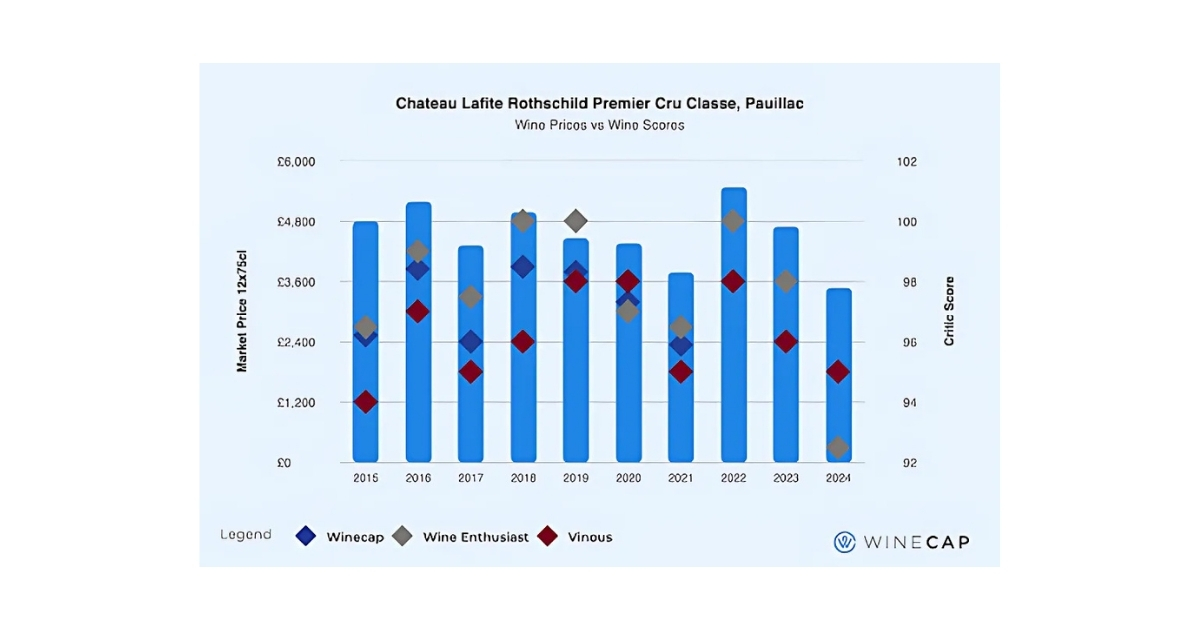
The 2024 vintage emerged as the most attractively priced Lafite in recent memory. In fact, only one other vintage from the past 40 years comes within 25% of its release price. Even lower-rated vintages like 2013 and 2007 – both released before the transformative investments that elevated Lafite’s quality – now trade at considerably higher levels.

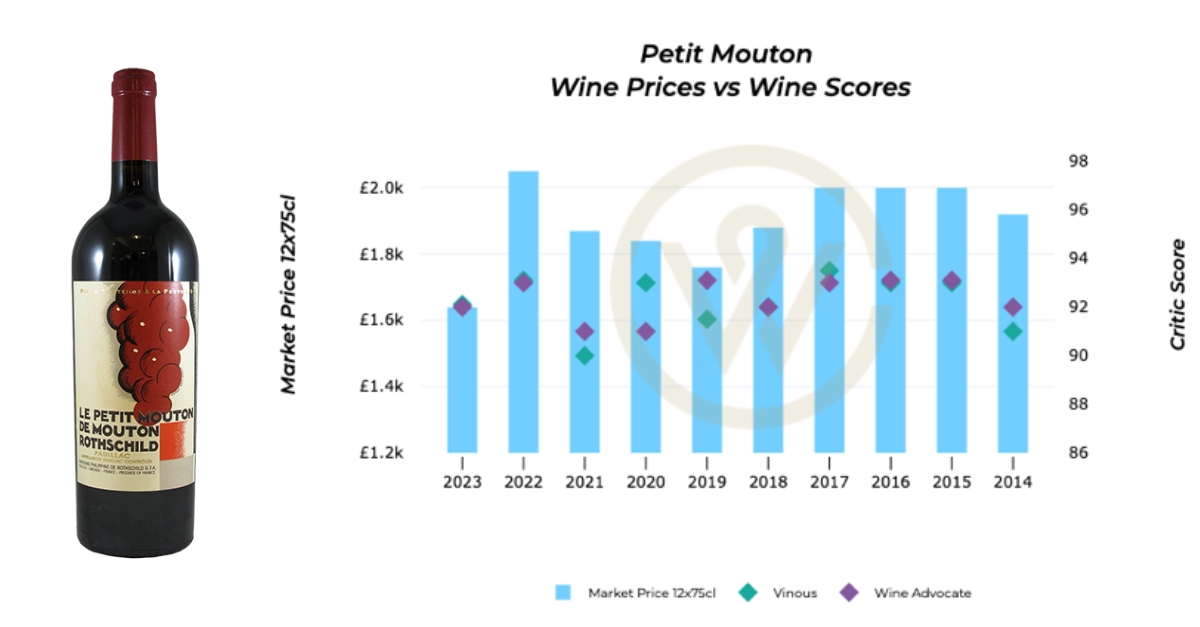
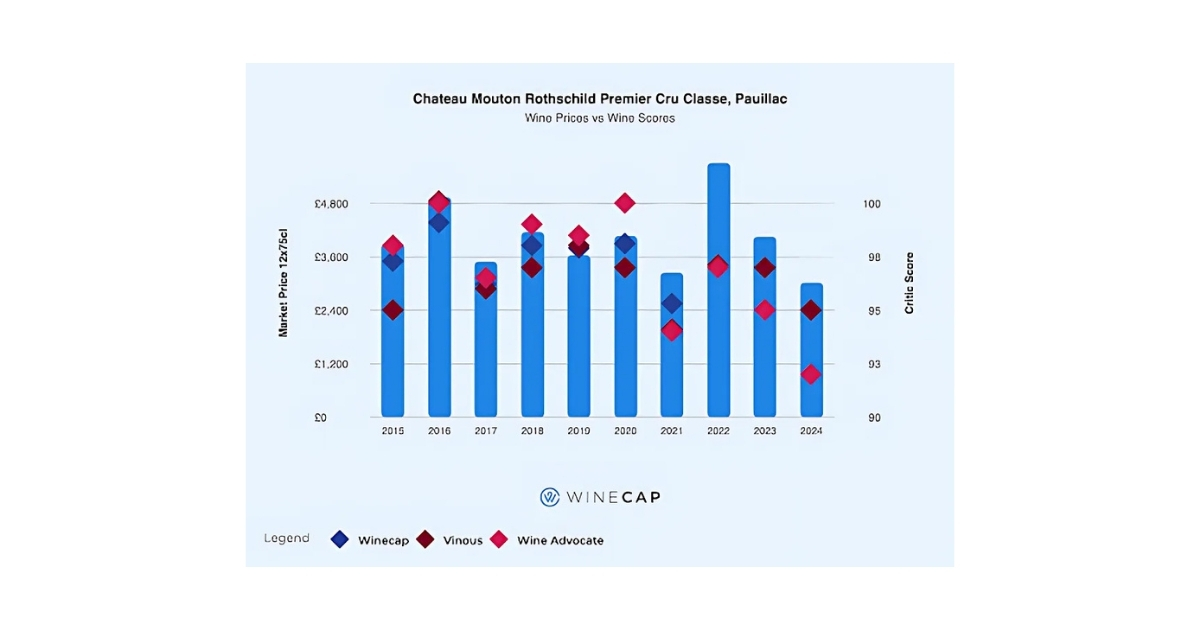
Much like Lafite, the 2024 Mouton Rothschild represents a rare opportunity. It is the best-priced Mouton vintage currently available on the market. Adjusted for inflation, only one other vintage in the last two decades compares in affordability. 

Moreover, Mouton has been the best-performing First Growth over the last five years, while also being Wine-Searcher’s most searched-for wine globally. 

History shows that these ‘less celebrated’ vintages often outperform their more hyped counterparts. For both Lafite and Mouton, vintages such as 2007, 2008, 2013, and 2014 have significantly outpaced the more acclaimed 2009, 2010, or 2016 in price performance.

Chateau Mouton Rothschild wine performance bar graph

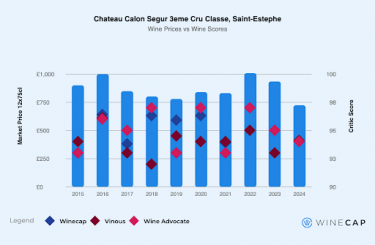
Another notable performer is Calon Ségur. While it may have flown slightly under the radar, its 2024 release represents the best entry point into the brand in over a decade. Calon has built a strong reputation among critics, frequently earning 95+ scores from Wine Advocate and Vinous. 

Its investment credentials are equally impressive: between 2015 and 2023, Calon prices surged more than 80%. Even with recent market dips, our Calon Ségur index remains 75% higher than it was ten years ago – making it one of Bordeaux’s most dynamic performers.

Looking for more? Read our Bordeaux Regional Report.

Categories
News

Bordeaux correction: top wines 20% below their peak

  • Top Bordeaux labels are now approximately 20% below their peaks achieved during the last decade.
  • Lafite Rothschild has been the hardest hit, driven lower by classic vintages such as 2018, 2009 and 2000. 
  • The recent fall in prices has brought many labels back to levels not seen in years.

As recently explored, the fine wine market has been on a downward trend, but what does this mean for individual labels? Today, we turn to Bordeaux’s top names, examining the recent performance of some of the most investable wines in the world.

Bordeaux after the peak

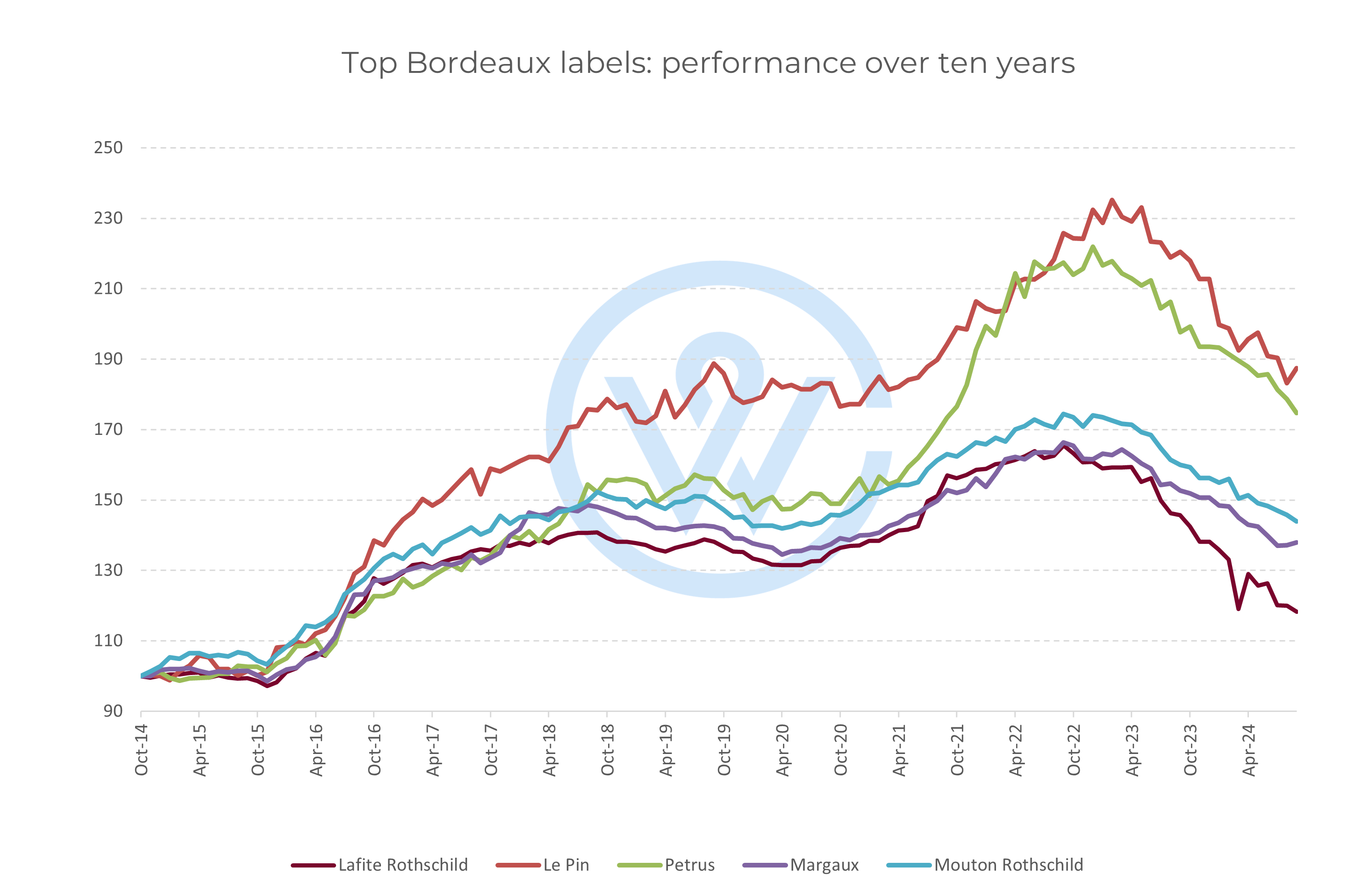
Top Bordeaux labels are now approximately 20% below their peaks, achieved during the last decade. 


The First Growths, which often serve as the barometers of the fine wine market, had been riding high, with September 2022 marking a peak in pricing for Lafite Rothschild, Mouton Rothschild and Margaux. 

However, since then, the landscape has changed dramatically. Lafite Rothschild, once the shining star, has fallen by 28.6%, the most severe decline among the top names. Margaux and Mouton Rothschild have also taken significant hits, falling by 17.1% and 17.5%, respectively.

On the Right Bank, the situation is no different. Petrus, which peaked in December 2022, has since dropped by 21.4%, while Le Pin, which reached its high in February 2023, has declined by 20.3%. These losses have brought prices to levels last seen several years ago.

First Growths peaked in September 2022, since then:

  • Lafite is down 28.6% 
  • Mouton is down 17.5% 
  • Margaux is down 17.1% 

On the Right Bank:

  • Petrus is down 21.4% since its December 2022 peak
  • Le Pin is down 20.3% since its February 2023 peak

The Lafite fall: a deep dive

Lafite Rothschild – the second most-searched-for wine on Wine-Searcher – has seen the steepest decline since its peak, with prices plummeting 28.6% on average.

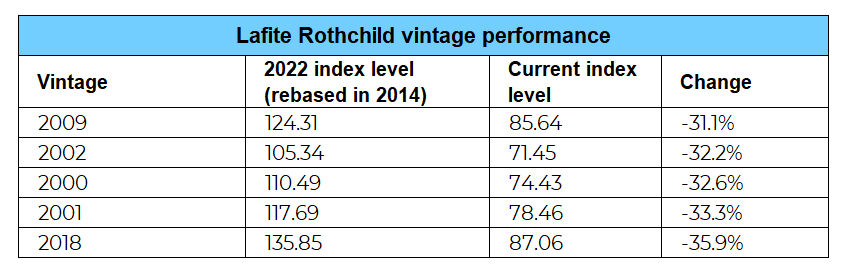
Which vintages have contributed to its fall over the last two years? The 2018 (WA 100 points) has been the hardest hit, down 35.9%. The wine was originally released at levels akin to the brand’s bull years, due to high critic scores, but failed to offer the best investment value. The recent price adjustment has made it a more attractive proposition. 

Older vintages that have had more time to grow have similarly fallen in value by over 30%. The classic 2009 Lafite, which boasts 99+ points from Robert Parker himself, is down 31.1% over the last two years. 

The millenial vintage, with a drinking window that extends well into the 2050s, is currently 32.6% below its peak. 


Buying levels: back to the square one

The recent fall in prices has brought many labels back to levels not seen in years. Lafite, for example, has returned to its 2016 pricing levels, while Margaux and Mouton are back to 2020. On the Right Bank, Petrus and Le Pin have both returned to their 2021 levels.

While this might raise concerns on the surface, it presents a compelling opportunity. The scale of the correction suggests that Bordeaux wines, while still highly valued, may have been oversold in the last 18 months. 

For those looking to enter or expand their portfolios, this could represent a chance to acquire top-tier wines at a significant discount before prices start to rise again.

As with previous corrections, price declines are often followed by periods of recovery. For wealth managers and clients with a long-term investment horizon, the current situation may be seen as a momentary blip in an otherwise upward trajectory.

WineCap’s independent market analysis showcases the value of portfolio diversification and the stability offered by investing in wine. Speak to one of our wine investment experts and start building your portfolio. Schedule your free consultation today.
Categories
News

The best of Bordeaux En Primeur 2023

  • The best Bordeaux En Primeur releases offered a combination of quality and value. 
  • These are wines with high potential for future price appreciation.
  • Some châteaux have followed the En Primeur golden rule that the new release is the cheapest you can get. 

As this year’s Bordeaux En Primeur campaign draws to an end, we evaluate the best 2023 releases. These wines not only boast high quality, as measured by critic scores, but also offer value when compared to previous vintages. Below are our highlights from an investment perspective. 

Beychevelle 

In the words of Château Beychevelle’s Philippe Blanc, ‘our golden rule is the En Primeur price is the cheapest you can get’. 

The rule was observed this year, with the 2023 representing the best priced vintage on the market today. 

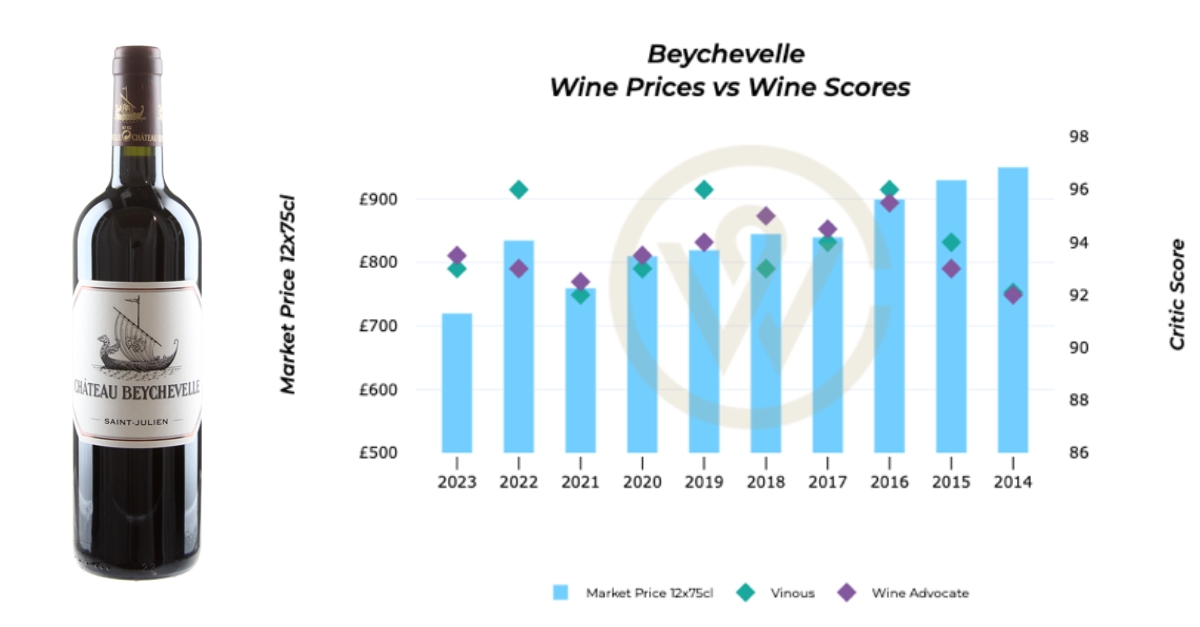
The wine received 94-96 points from Antonio Galloni (Vinous), who said: ‘Beychevelle remains one of the most distinctive wines in all of Bordeaux. It is especially classy in this edition.’ 

Meanwhile, the Wine Advocate’s William Kelley (93-94 points) noted that ‘the 2023 Beychevelle has turned out especially well this year, exhibiting a more integrated, seductive style than recent vintages’.

Lafite Rothschild & Carruades de Lafite

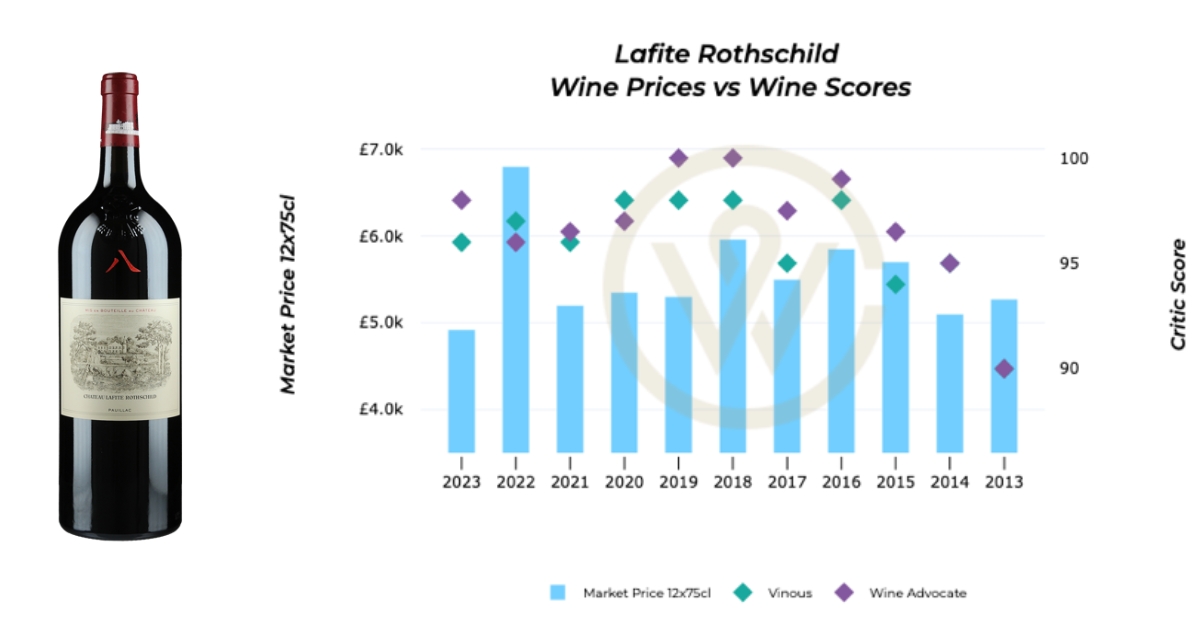
For William Kelley, Lafite Rothschild appeared to be ‘the finest of the first growths this year’. The critic awarded it 97-99 points. The wine was launched at an impressive 32% discount on last year, making the new release the most affordable on the market today. Shortly after release, the wine found its way into the secondary market.

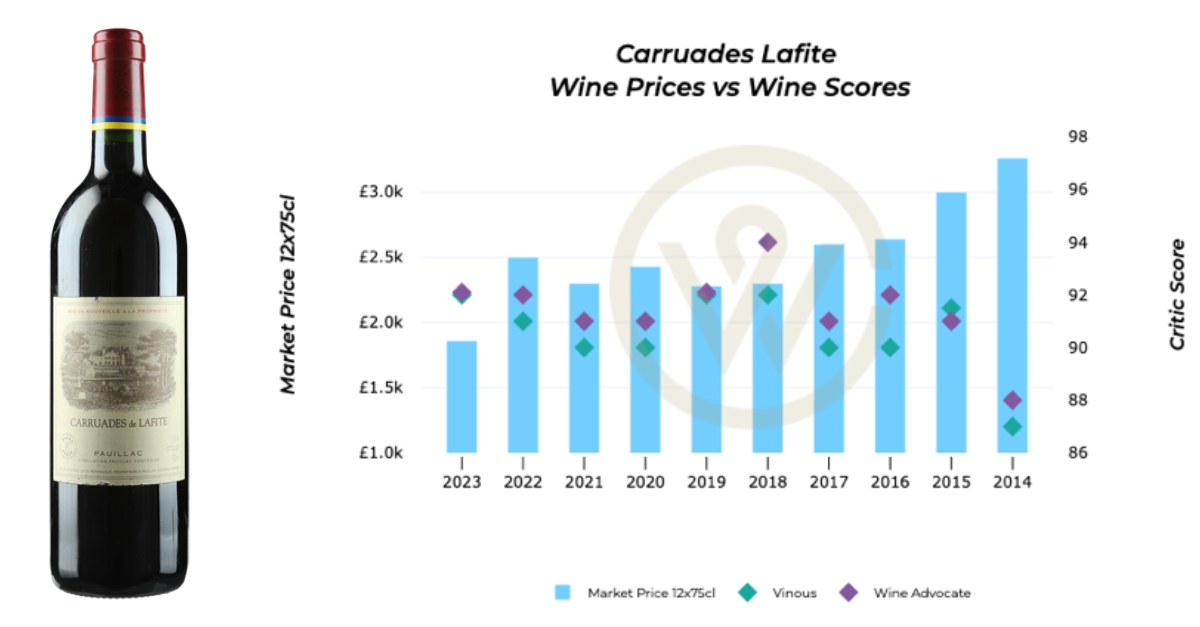
Its second wine also presented an enticing prospect to investors. As well as being the cheapest vintage, the wine was awarded a score of 91-93 from Neal Martin (Vinous), surpassing the 2022, 2016, and 2010. The critic remarked that this is ‘surely one of the best Carruades I have tasted at this stage’.

Mouton Rothschild & Petit Mouton

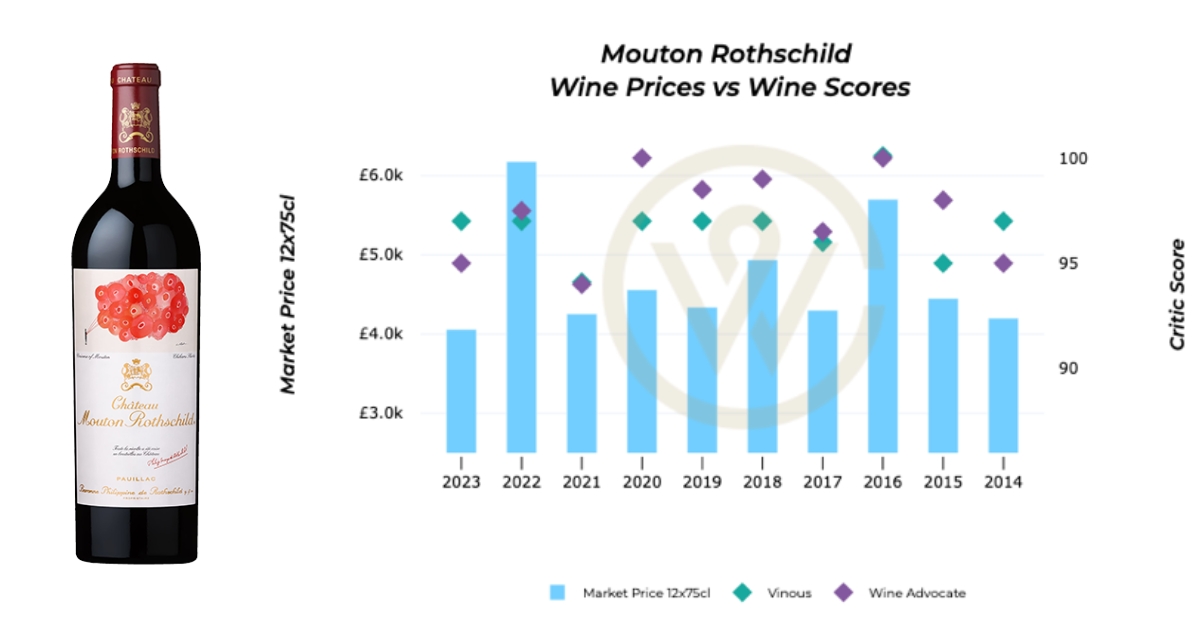
In much the same vein as Lafite Rothschild, the 2023 Mouton Rothschild is the most affordable vintage available on the market today. Antonio Galloni gave it 96-99 points and declared that it ‘is shaping up to be one of the best wines of the vintage on the Left Bank’.

With 96-98 points from Neal Martin, its score looks set to match the 2022, 2020, 2019, and 2018. Only the 100-point 2016 has the upper hand but comes at a hefty 40% premium. 

Once again, there is outstanding value to be found in the second wine. Petit Mouton 2023 is the best priced vintage available today by a healthy margin. And, according to Galloni, ‘it could easy be a Grand Vin at another address’.

Margaux

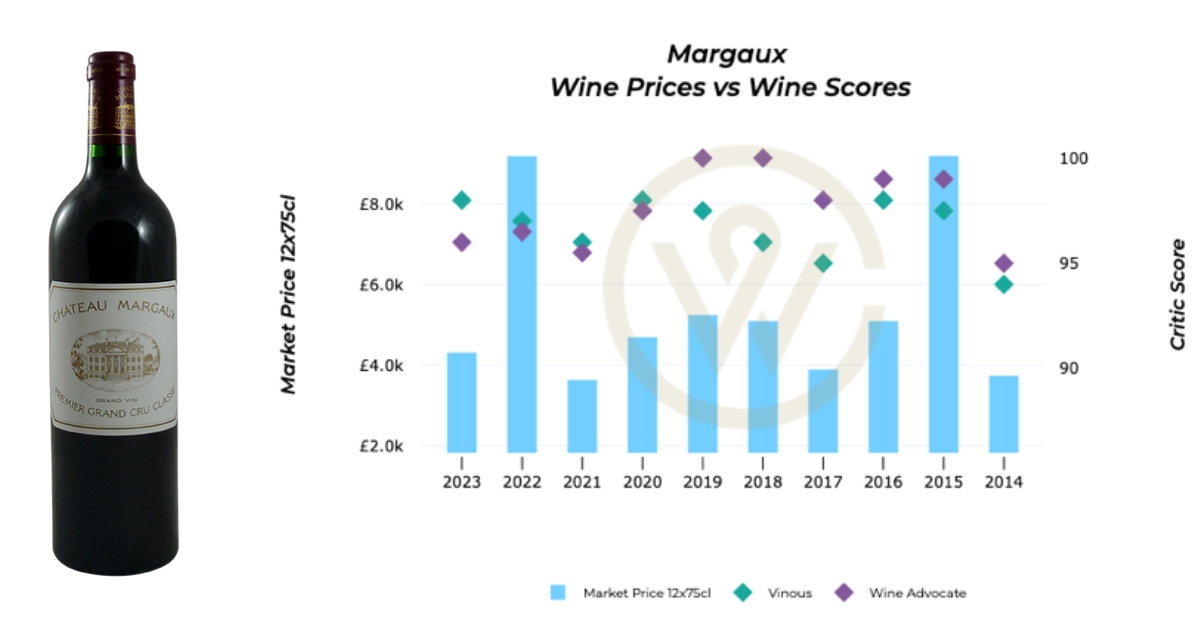
The highest-scoring Bordeaux 2023 wine across major critics, Margaux presented great value.

Galloni awarded it a potentially perfect score of 97-100 points, calling it ‘fabulous, sensual, silky and exceptionally polished’. 

Meanwhile, Martin described it as a ‘quintessential Margaux’, awarding it a score of 97-99 points.

Cheval Blanc

There are few wines that transcend the vintage in 2023, and Cheval Blanc is certainly one of them. 

There were few wines capable of transcending the vintage in 2023, but Cheval Blanc was certainly one of them.

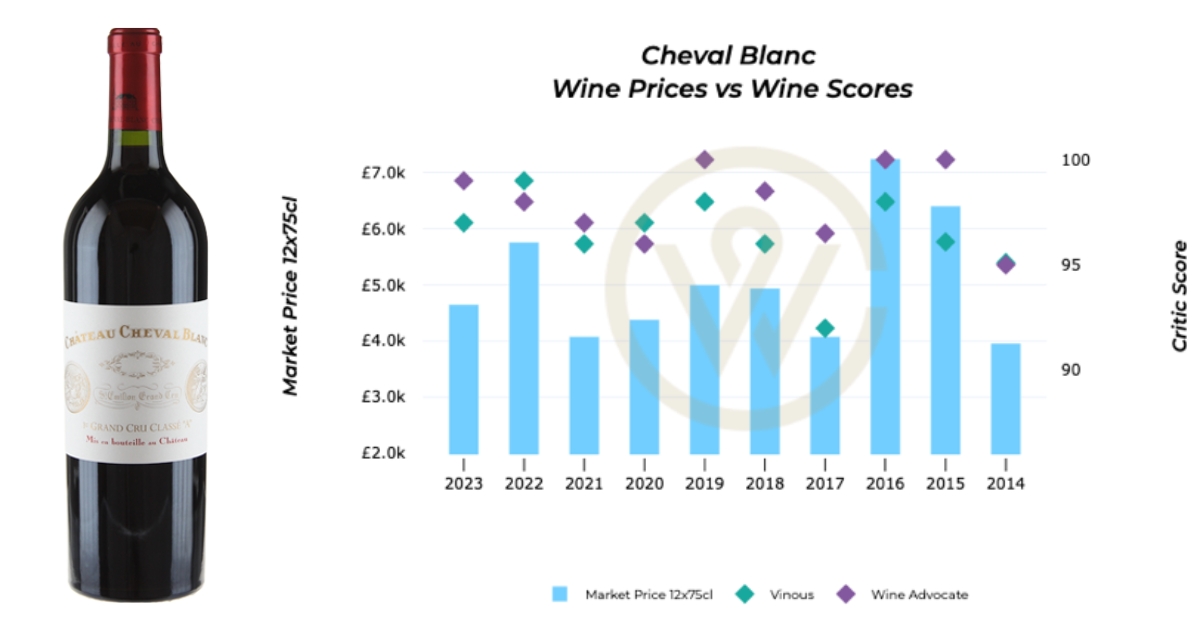
It is the second-highest-scoring Bordeaux 2023 wine across 12 leading critics. Winemaker Pierre-Olivier Clouet even goes so far as to say that it is superior to the 2022, as does the Wine Advocate’s William Kelley. 

Adding to its appeal is the value it offers. The 2023 is the most affordable option among top vintages. This is one of only two unambiguously ‘prime’ Cheval Blanc vintages available under £5,000 a case.

As these highlights show, there is value to be found during En Primeur with the right analysis tools. 

WineCap’s independent market analysis showcases the value of portfolio diversification and the stability offered by investing in wine. Speak to one of our wine investment experts and start building your portfolio. Schedule your free consultation today.
Categories
News

Finding value in the Bordeaux second wines

  • The average First Growth case price is £5,300, while second wines come in at £1,941.
  • Le Clarence de Haut-Brion is the most affordable second wine.
  • Le Petit Mouton has been the best performer over the last decade.

Following our article last week, which examined the performance and value of the Bordeaux First Growths, we take a look at the data behind their second wines.

What are second wines?

Most Bordeaux châteaux produce more than one wine each vintage, and some might make three or four. Each château’s second wine draws on the expertise and knowledge that goes into the Grand Vin. Generally, second wines are made with fruit from younger vines, or vines and parcels that are not quite up to the quality of the Grand Vin in any given year.

However, they are often produced using grapes from the same vineyards as the flagship wines, receiving the same technical treatment in both vineyard and winery. Considerably less expensive than their siblings,  second wines represent a particularly attractive and accessible option for investors.

Second wines – at what price?

White the average First Growth case price is £5,300, second wines come in at less than half the price (£1,941).

Interestingly, prices of the first and the second wine are not always rising in unison. For instance, Château Latour is the second most expensive Grand Vin after Château Lafite Rothschild. Les Forts de Latour, however, sits directly in the middle, with Le Petit Mouton and Carruades de Lafite being pricier.

When it comes to value for money, Le Clarence de Haut-Brion has the lowest price per point of £16, similar to its Grand Vin. As examined last week, Château Haut-Brion is the most affordable of the First Growths, while also boasting the highest average Wine Track score. Yet while Le Clarence is also the most affordable of the second wines, its Wine Track score is lower.

But looking purely at scores is not the best indicator of value when it comes to the second wines. Second wines differ from the Grand Vins, as the dominant relationship is between price and age, not price and quality. As time passes, their value rises, following the traditional wine investment dynamic.

Moreover, this group of wines is often bought by collectors and investors as they present access to a brand. Though suitable for aging, these wines are built for earlier consumption, offering an alternative to opening bottles of the Grand Vin as soon as they are delivered.

Performance of the second wines

In the last decade, Le Petit Mouton de Mouton Rothschild has been the best-performing second wine, up 111.9%.

The most affordable, Le Clarence de Haut-Brion, has delivered the second-best returns of 76.2%. It has been followed by Carruades de Lafite (64.7%) and Pavillon Rouge (63.1%).

WineCap’s independent market analysis showcases the value of portfolio diversification and the stability offered by investing in wine. Speak to one of our wine investment experts and start building your portfolio. Schedule your free consultation today.

Categories
News

Which Bordeaux First Growth has the lowest price per point?

  • The price-per-point metric allows for a comparison of wines based on their market price and perceived quality.
  • This article examines the prices per point of the most liquid group of wines – the Bordeaux First Growths.
  • It also looks at their historic market performances.

Price per point is an indicator of value; it is calculated by dividing the average case price of a given wine by its average critic score. For some wines, prices and points line up. Typically, a 100-point wine will cost more than a 95-point one, though not always. The price-per-point metric allows for a comparison of wines based on both their market price and perceived quality, offering a nuanced view of their value.

Today we examine the price-per-point ratios of the most liquid and popular group of wines – the Bordeaux First Growths. Which Grand Vin has the lowest price per point and thus offers the best value as a brand?

First Growths – price per point

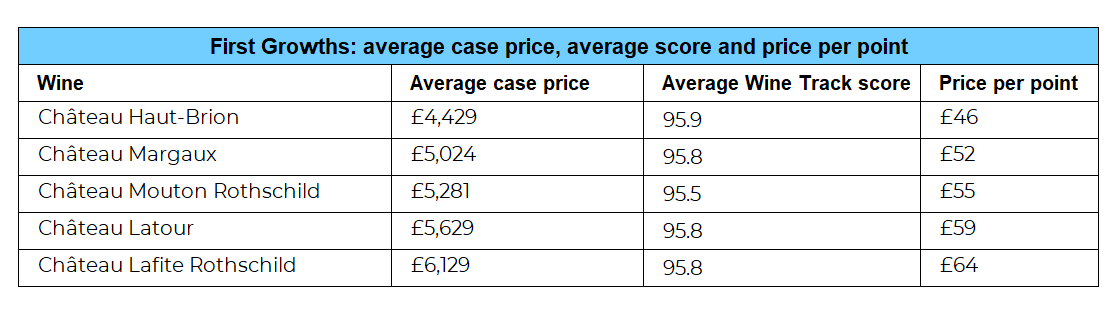
An average case price of £4,429 makes Château Haut-Brion the most affordable of the First Growths. Meanwhile, it has the highest average Wine Track score of 95.9 points. While there is divergence in prices and scores on a vintage-specific level, Château Haut-Brion has the lowest price per point among the First Growths overall.

At the other end of the spectrum, Château Lafite Rothschild has the highest price per point of £64, owing to the highest average case price of £6,129 and a Wine Track score of 95.8.

What does this mean for the wines’ performance?

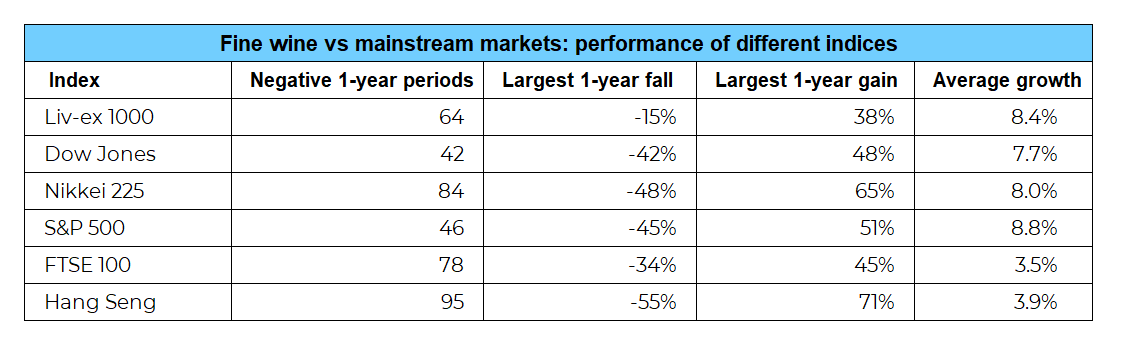
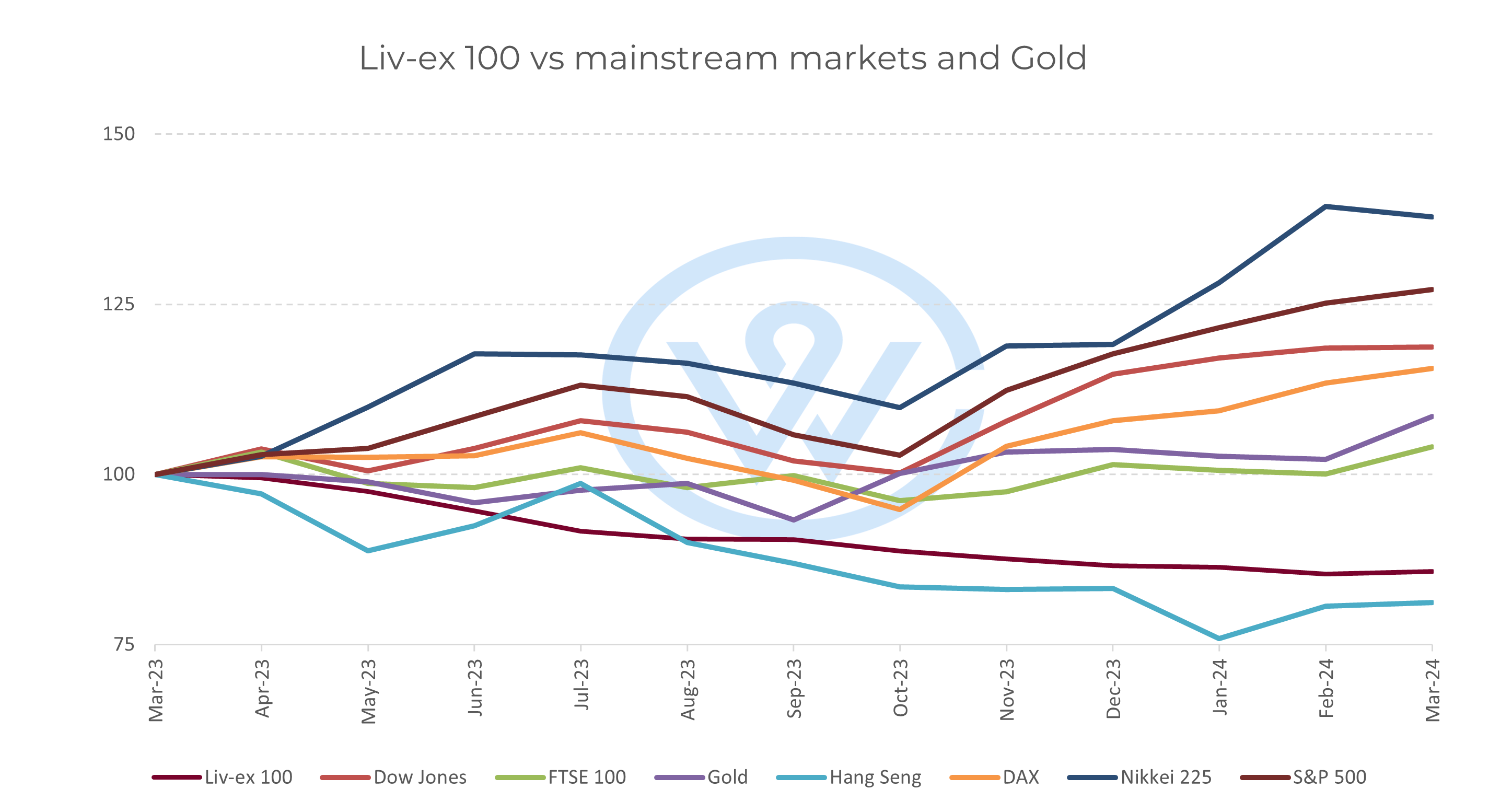
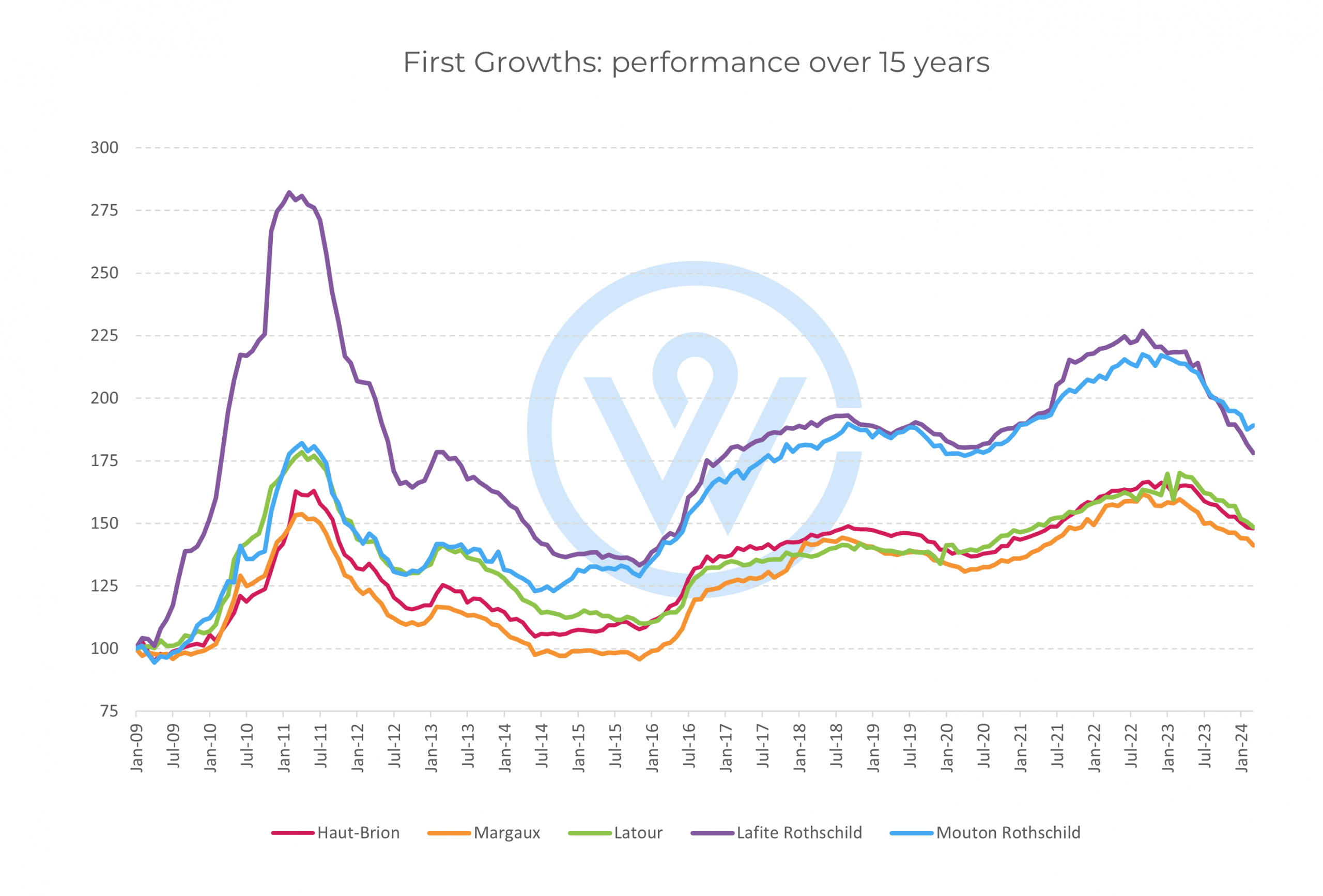
Historically, the First Growths have followed a similar trajectory of highs and lows. They all peaked during the China-led bull market (H1 2011) and experienced a subsequent downfall. Prices started to rise again following the Brexit referendum and have since largely maintained their level. They have fallen in the last year in line with the broader market (the Liv-ex 50 which tracks the First Growths is down 15.3% over one year – the same as the broadest measure, the Liv-ex 1000 index).

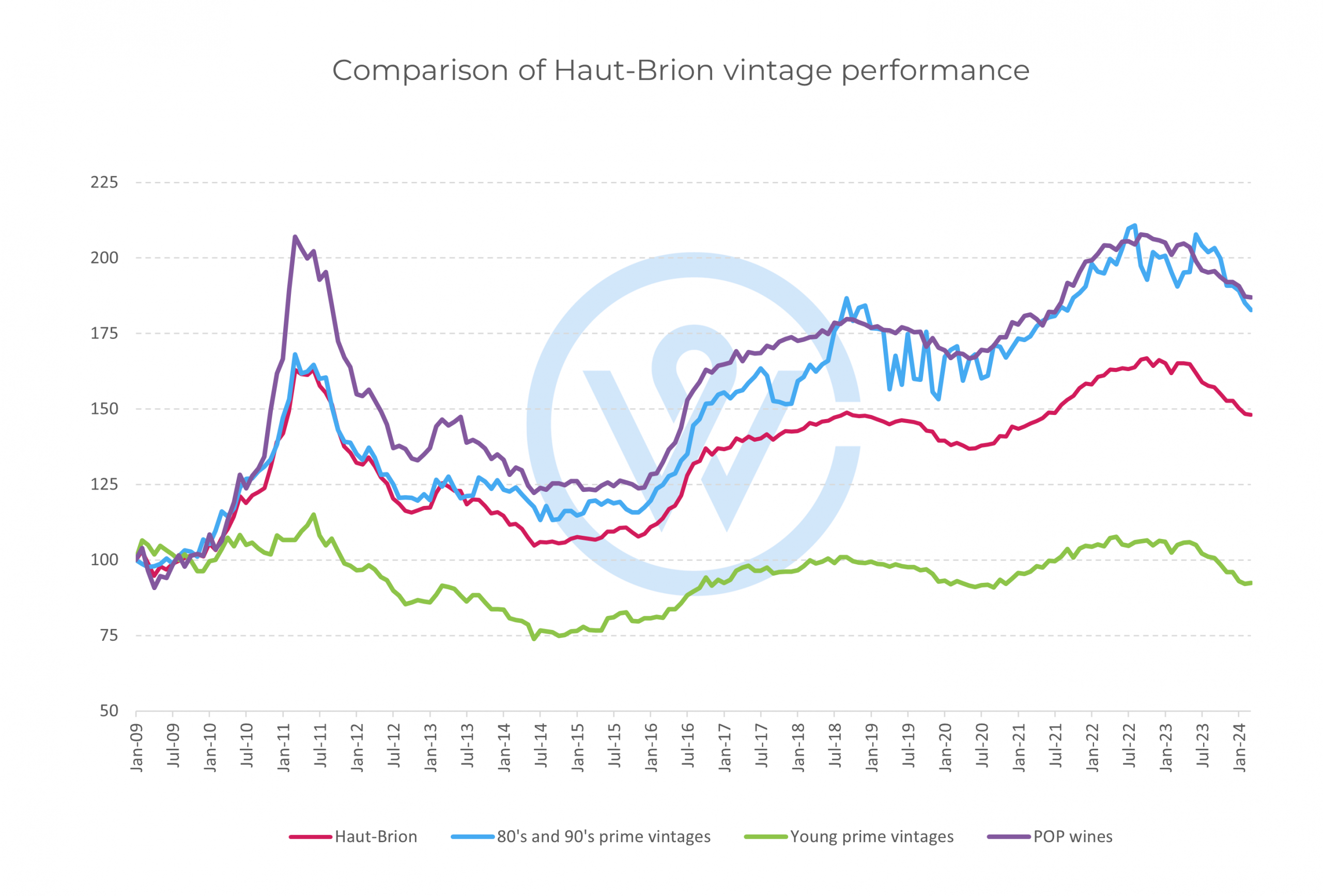
Of the five First Growths, Lafite has risen the most, with our index peaking in February 2011. Recently, however, it has been the biggest faller, dipping 19% in the last year. Haut-Brion, which has been a more modest performer without delivering the same heights, has dipped the least of the First Growths (10%) during the same period. With a more stable market performance, Haut-Brion offers further opportunities for investors and collectors where the price per point remains comparatively low.

Wines that offer value perform the best

In the case of Haut-Brion, value plays an important role in market performance. POP wines (those with a lower price per point) have outperformed the rest over 15 years. These include vintages 2002, 2004, 2006, 2007, 2008, 2011, 2012, 2013, 2014, 2017 and 2019 (the only prime vintage among the POP wines).

The second-best-performing index comprises older ‘prime’ vintages – wines with high scores pre-2000. However, this index has shown higher volatility due to the limited availability and trading volumes of these wines.

The index comprising younger ‘on’ vintages like 2015, 2016, 2018 and 2020 has underperformed the rest of the pack. However, these wines have also had less time in the market and their evolution is yet to be seen.

In conclusion, looking at price per point gives an indication of value and quality. However, historic market performance is telling for investors looking for stability or higher risk and potentially higher rewards.

WineCap’s independent market analysis showcases the value of portfolio diversification and the stability offered by investing in wine. Speak to one of our wine investment experts and start building your portfolio. Schedule your free consultation today.
Categories
Learn

Price ratio: comparing regional First Growths

  • We compare the price performance of Château Lafite Rothschild to other regions’ respective ‘First Growths’.
  • The rising ratio highlights the increased value to be had in the Bordeaux First Growths.
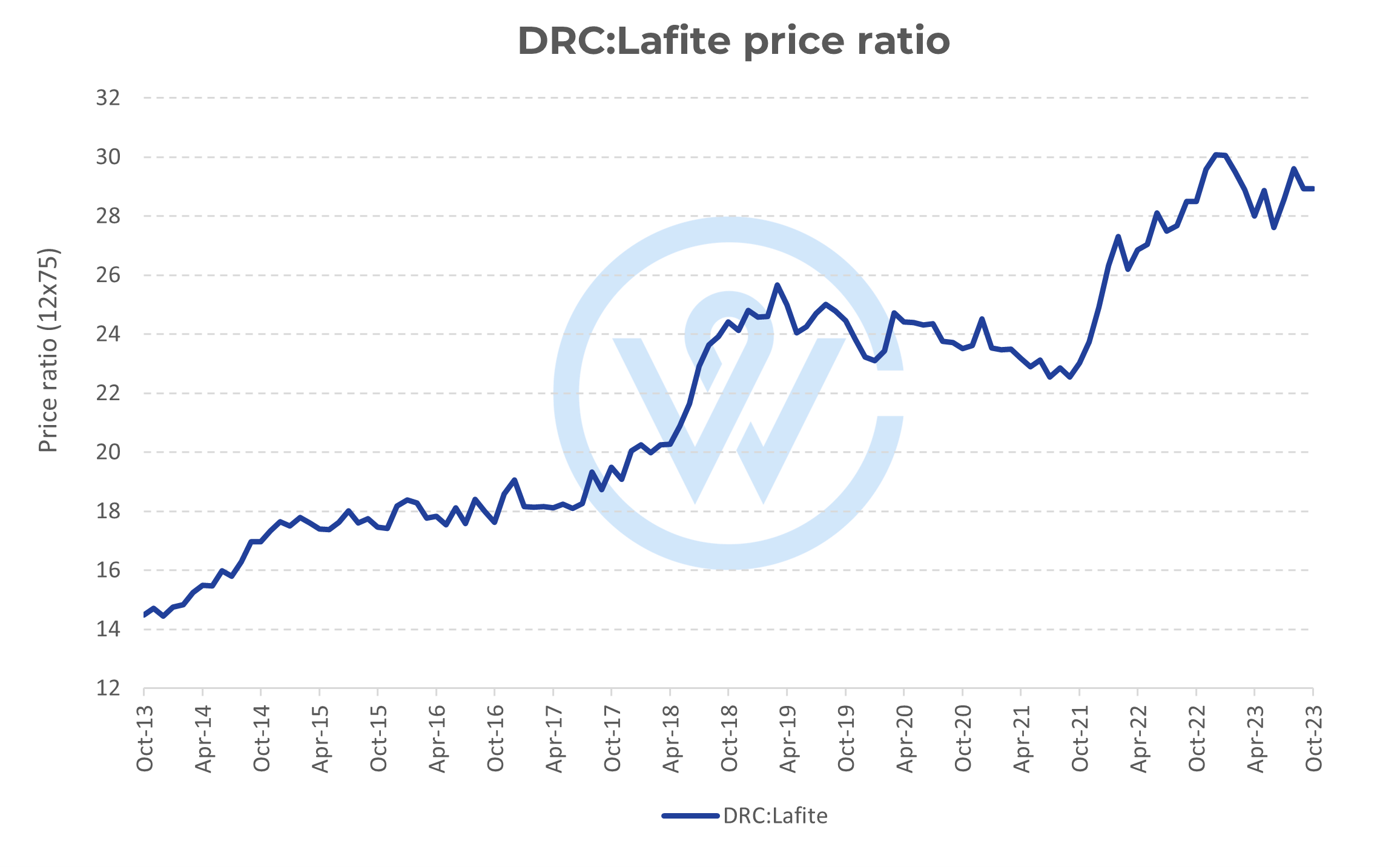
  • Today, one can get 29 bottles of Lafite for the price of Romanée-Conti and almost five for Pétrus and Screaming Eagle.

How many bottles of Château Lafite Rothschild can one get for the price of other regions’ respective ‘First’ wines?

With changing market dynamics at play that have seen the balance between Bordeaux and other regions change, we examine the price ratio between some of the most popular investment-grade wines.

Below we compare the performance of the Bordeaux First Growth Château Lafite Rothschild to Burgundy’s highest echelon Domaine de la Romanée-Conti, the Super Tuscan Sassicaia, the Right Bank Château Pétrus, the Californian cult wine Screaming Eagle, and the most in-demand Champagne, Dom Pérignon. These are all wines that symbolise and even transcend their geography.  In the same way that Lafite has long been the mainstay of Bordeaux, the other wines are bellwethers for their regions.

The ratio between these wines is somewhat reflective of broader trends within their respective regions. Over the last decade, the ratio has risen consistently, highlighting the increased value to be had in the First Growths, as other regions gather momentum.

How many bottles of Lafite for the price of DRC?

Today, one can get on average 29 bottles of Lafite Rothschild for the price of Romanée-Conti. The ratio has risen considerably since 2013 when one could buy just 14 bottles of Lafite for one DRC. It peaked in December 2022, when it stood at 30:1.

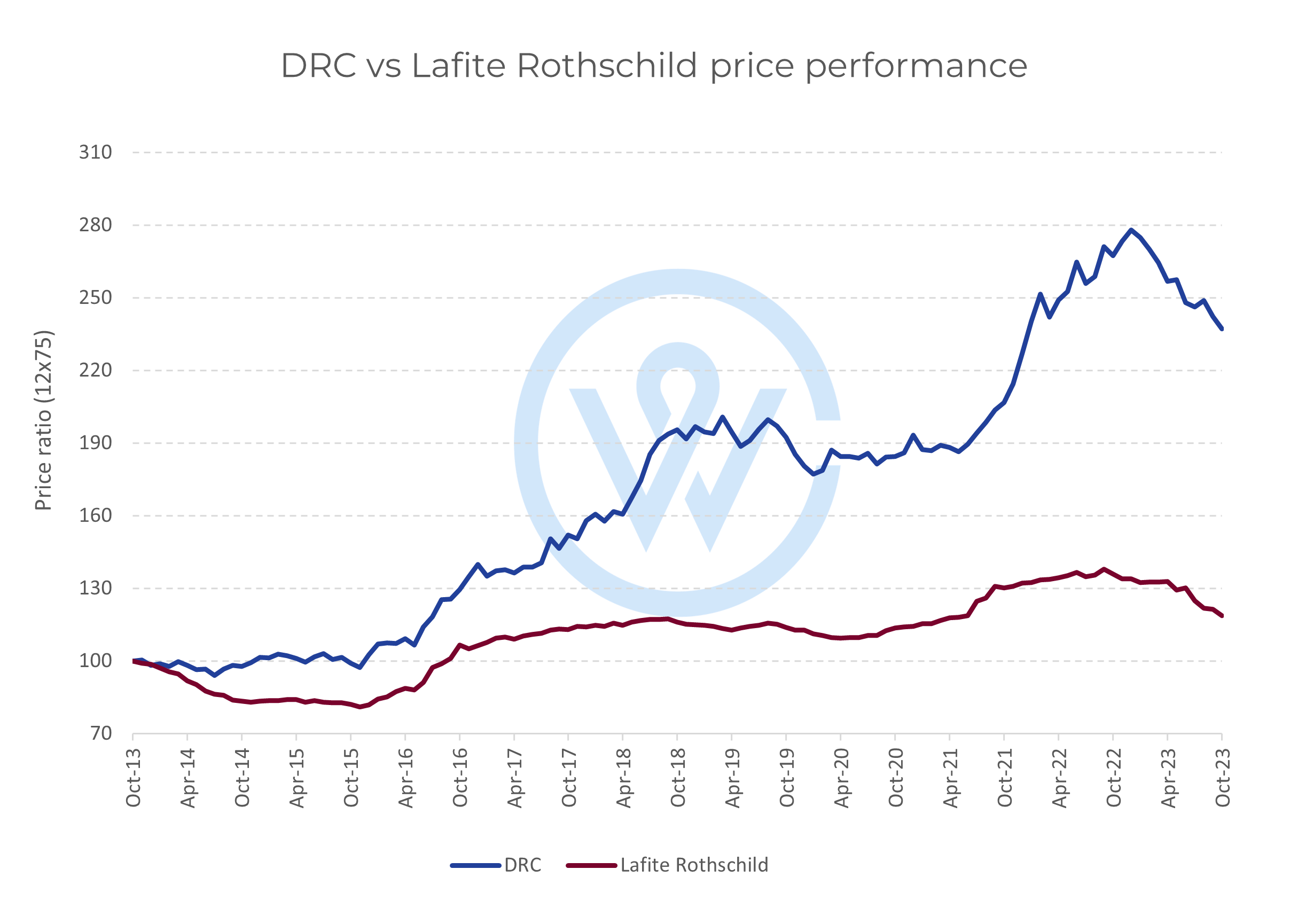
As the chart below shows, the Domaine de la Romanée-Conti index hit a record high in December last year. Meanwhile, the Lafite index has not seen any of the price volatility witnessed by DRC. Year-to-date, prices for both labels have dipped but the fall has been sharper for DRC.

The DRC:Lafite price ratio is somewhat reflective of broader trends within their regions. In the last decade, Burgundy emerged as Bordeaux’s main contender. After Bordeaux peaked at the end of the China-led bull market in 2011, buyers started to seek out other corners of the fine wine world and it was Burgundy that attracted the greatest attention. The allure of rarity and quality meant that demand quickly outstripped already tight supply. Prices for Burgundy peaked, while Bordeaux ran quietly in the background.

For Bordeaux, the period between 2013 and 2015 saw contraction at the tail end of the Chinese correction. The market turned again in October 2015, and since then, Lafite Rothschild has been the second-best-performing First Growth, with some vintages doubling in value. However, it has not managed to catch up with Burgundy’s stellar rise.

Left vs Right Bank

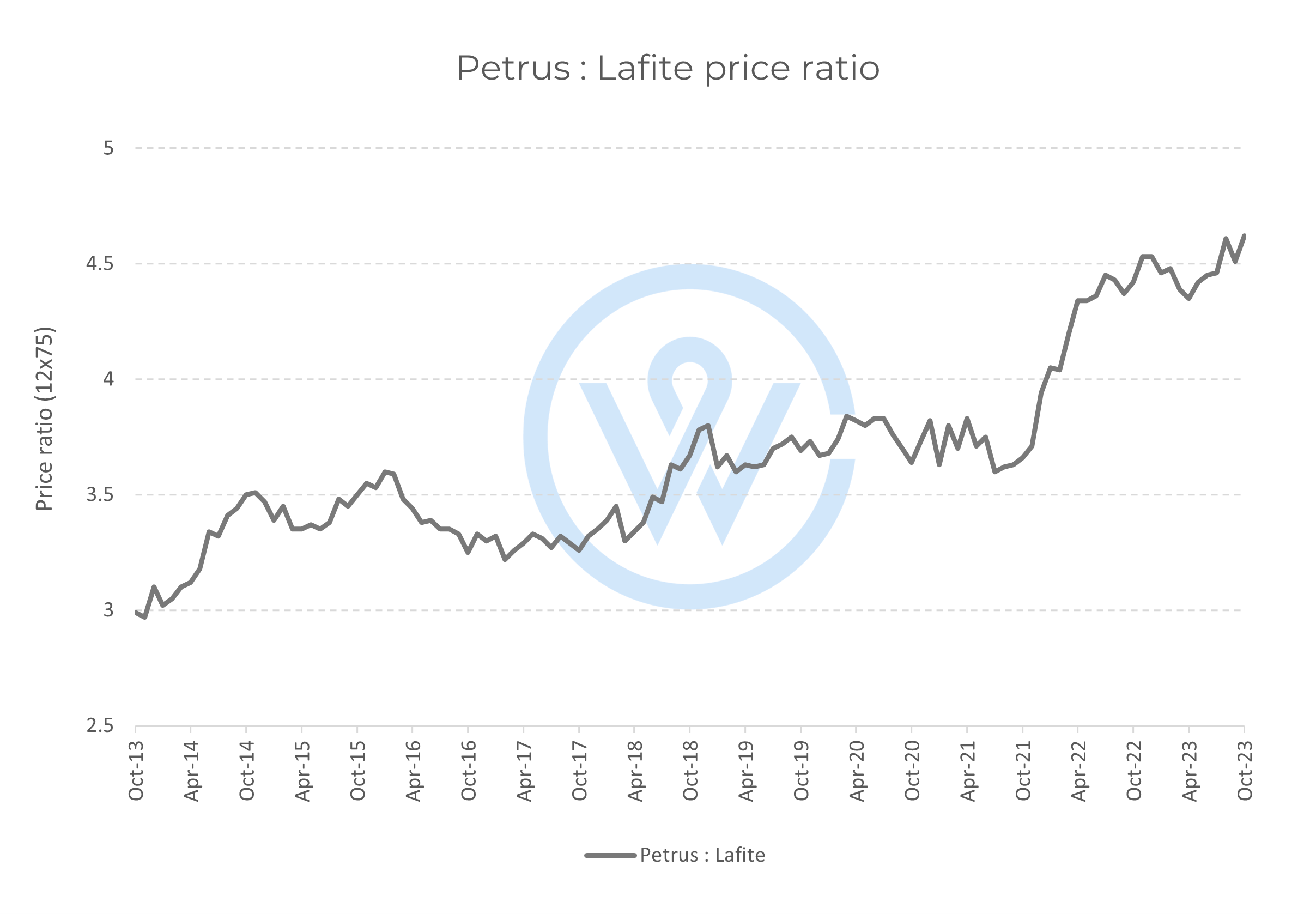
It is also interesting to compare performance within Bordeaux’s Left and Right Bank. Today 4.6 bottles of Lafite gets you a bottle of Château Pétrus, up from 3, ten years ago.

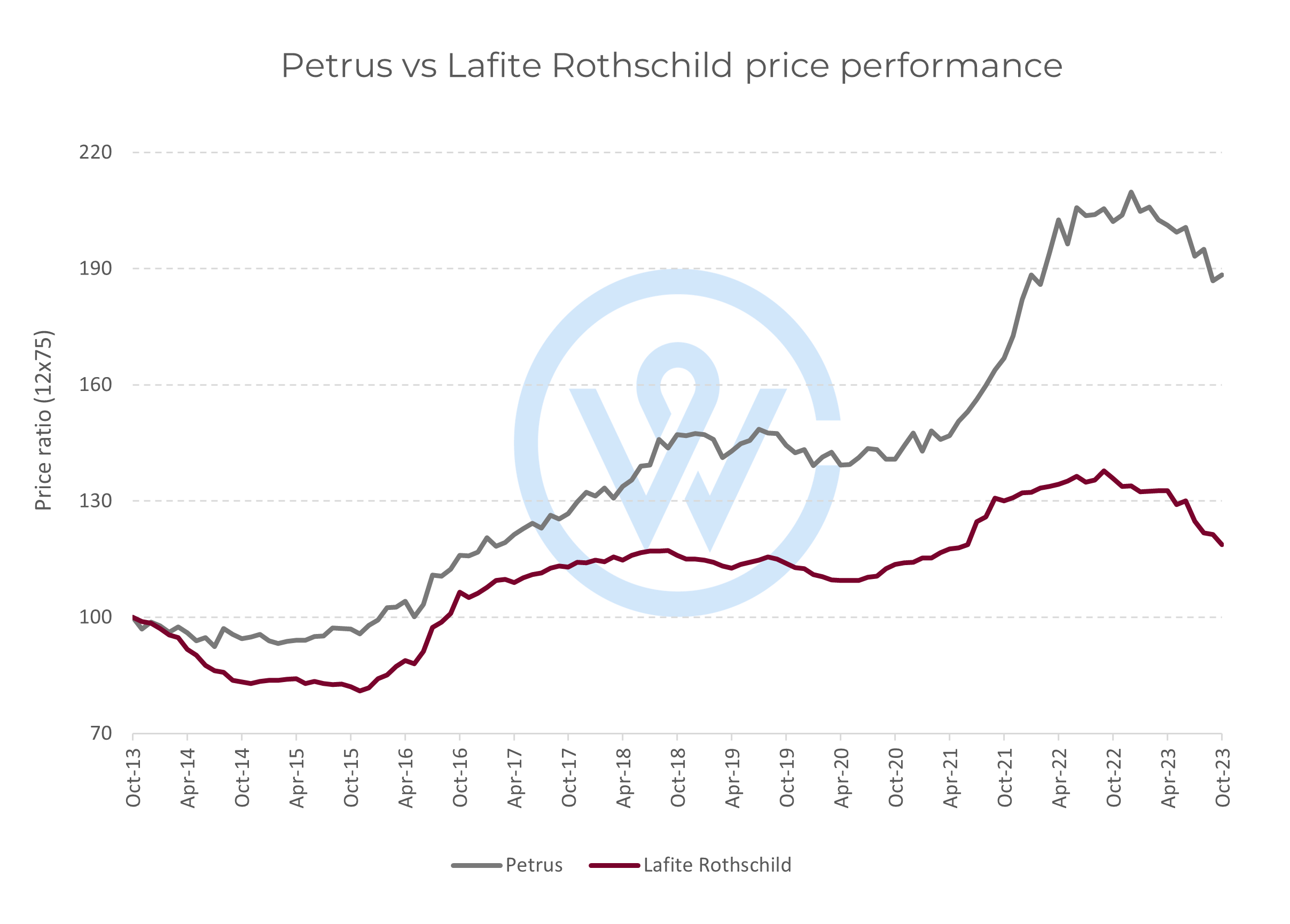
As the chart below shows, Lafite and Pétrus have followed a similar trajectory up to September 2021, when prices for the First Growth flattened while Pétrus continued its rise.

Similar to Burgundy, rarity plays a key role in Pétrus’ appeal and investment performance. Pétrus is produced in much smaller quantities (around 3,000 cases per year) compared to Lafite (around 25,000 cases). Despite commanding a higher price tag, the wine has considerably outperformed Lafite in the last decade.

Dom Pérignon vs Lafite Rothschild

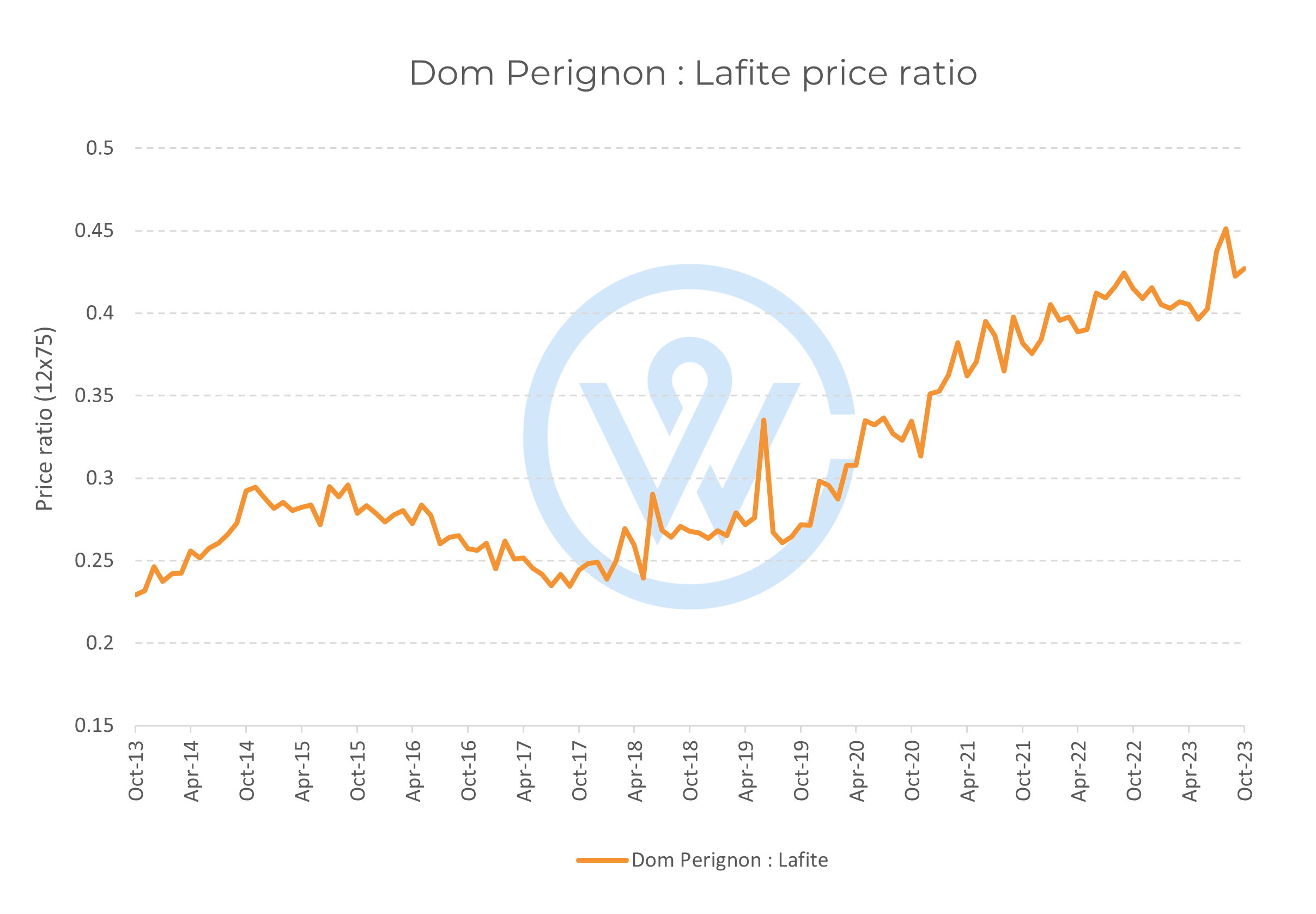
Recent years have seen a surge in Champagne’s market share and price performance. This has been reflected in the performance of its most traded label – Dom Pérignon.

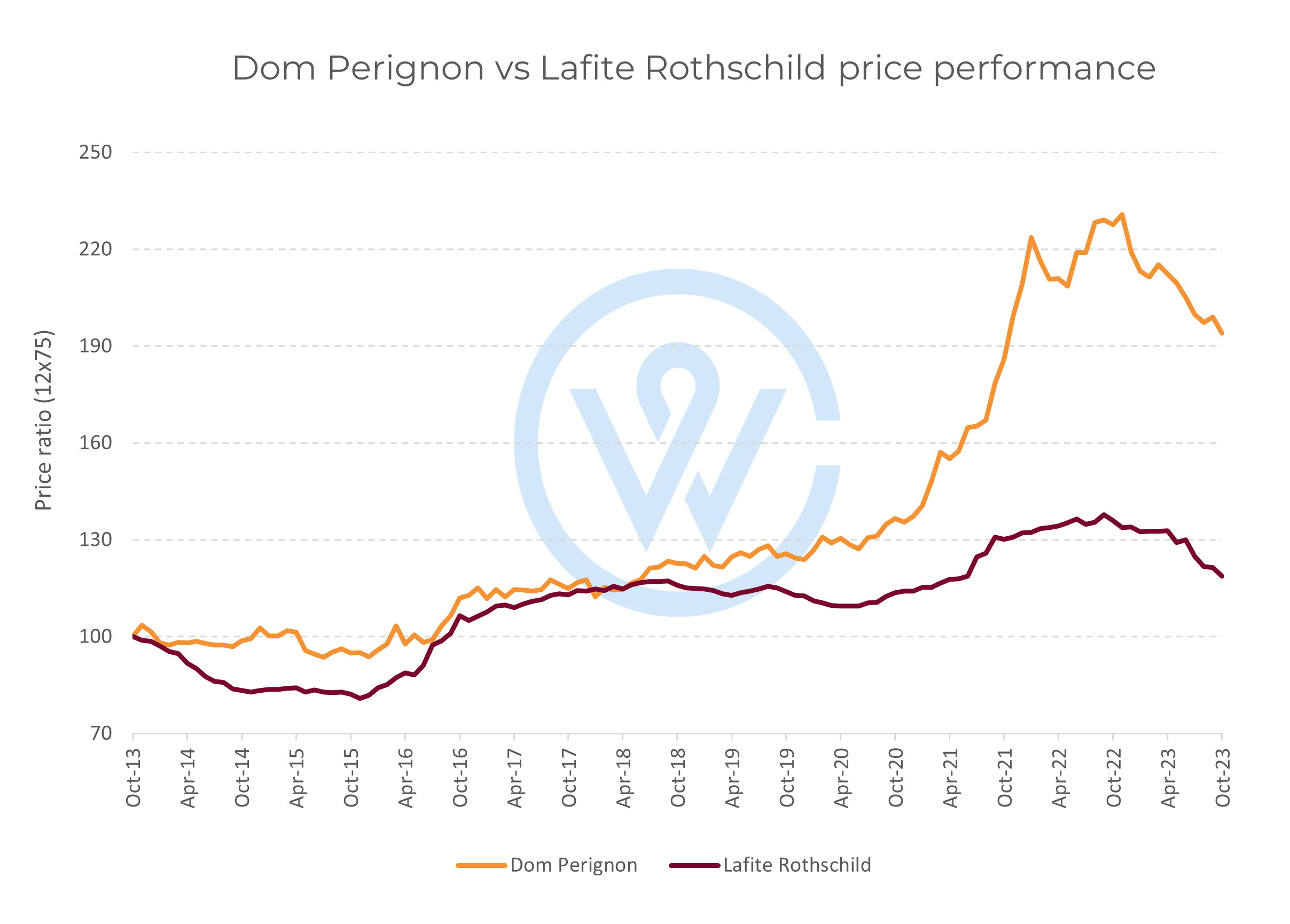
Produced in much larger quantities than Lafite and more widely available, Dom Pérignon has started to catch up with the First Growth. In the last decade, the ratio between them has doubled – from 0.2 to 0.4.

Champagne prices, with Dom Pérignon at the helm, have made considerable gains since the early 2020s. In the last decade, our Dom Pérignon index is up 120%, compared to 20% for Lafite.

Sassicaia vs Lafite Rothschild

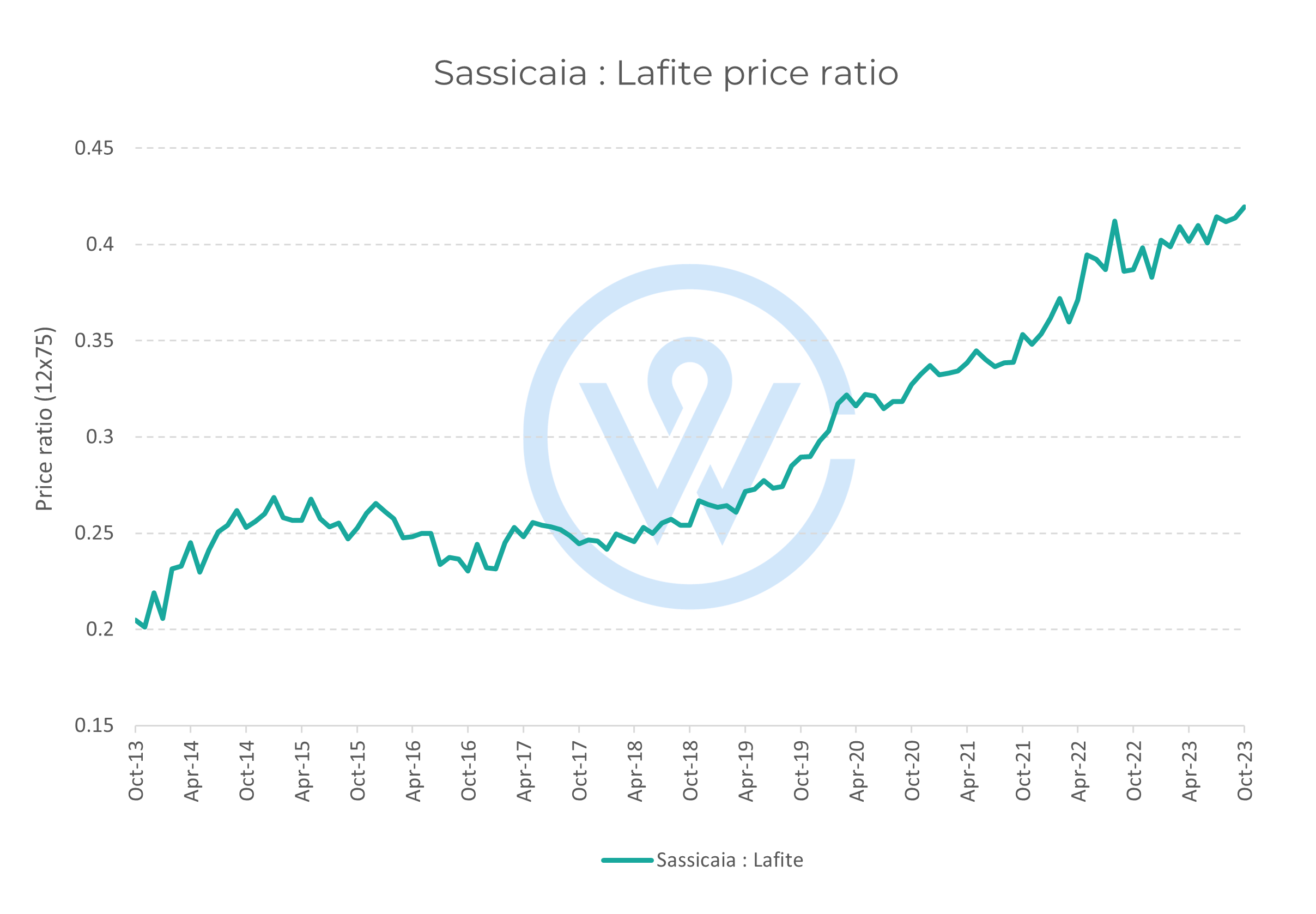
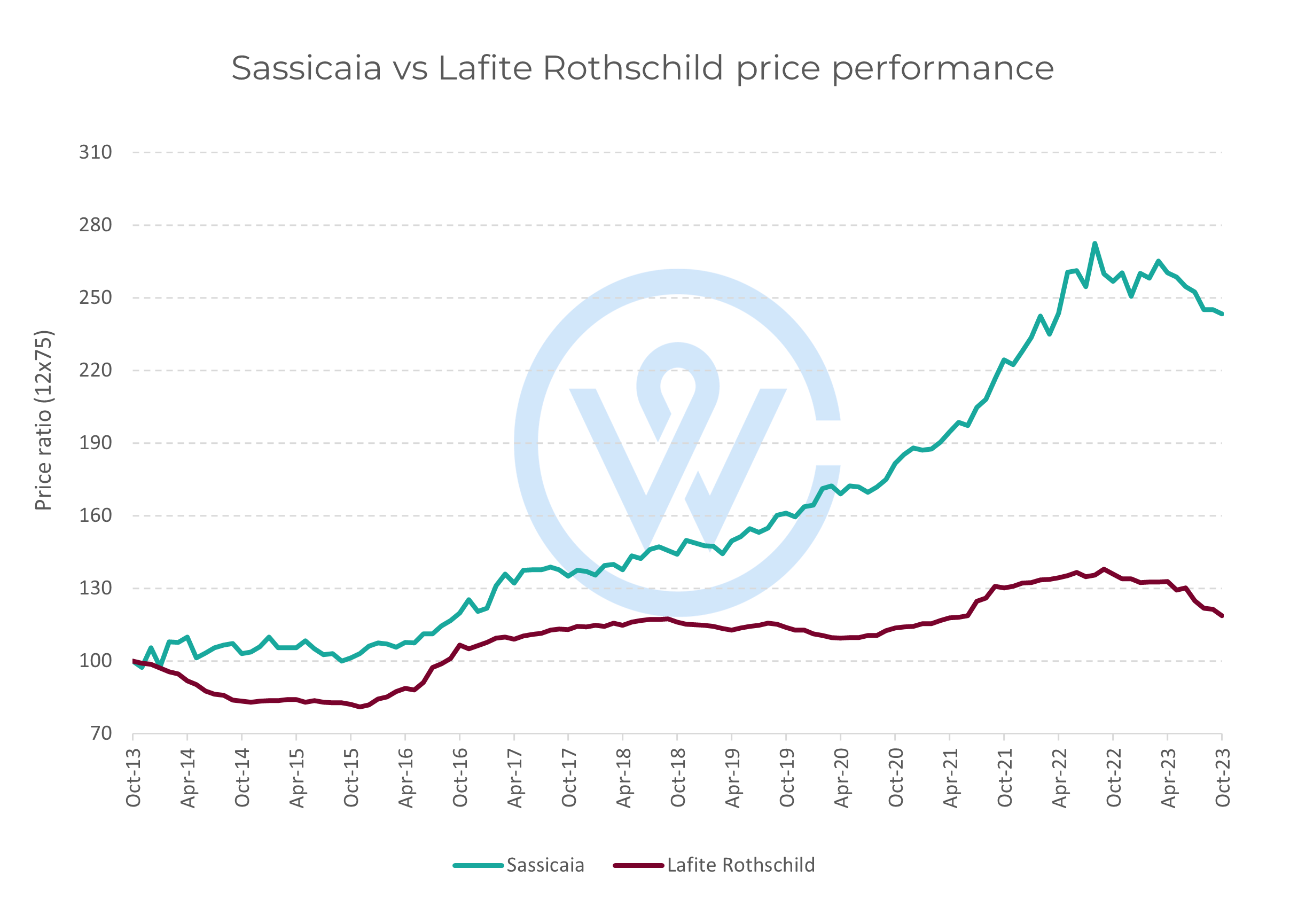
Similarly, the Super Tuscans have been getting more expensive. The most liquid and heavily traded group of Italian wines, their performance has been further boosted by critical acclaim and brand strength, with Sassicaia at the helm.

The ratio between Sassicaia and Lafite has risen from 0.2 ten years ago to 0.42 today.

As the chart below shows, Sassicaia has seen stable and consistent growth. 2019-2022 was a period of upheaval for the brand, which benefited from excellent vintages that captured investors’ interest.

Screaming Eagle vs Lafite Rothschild

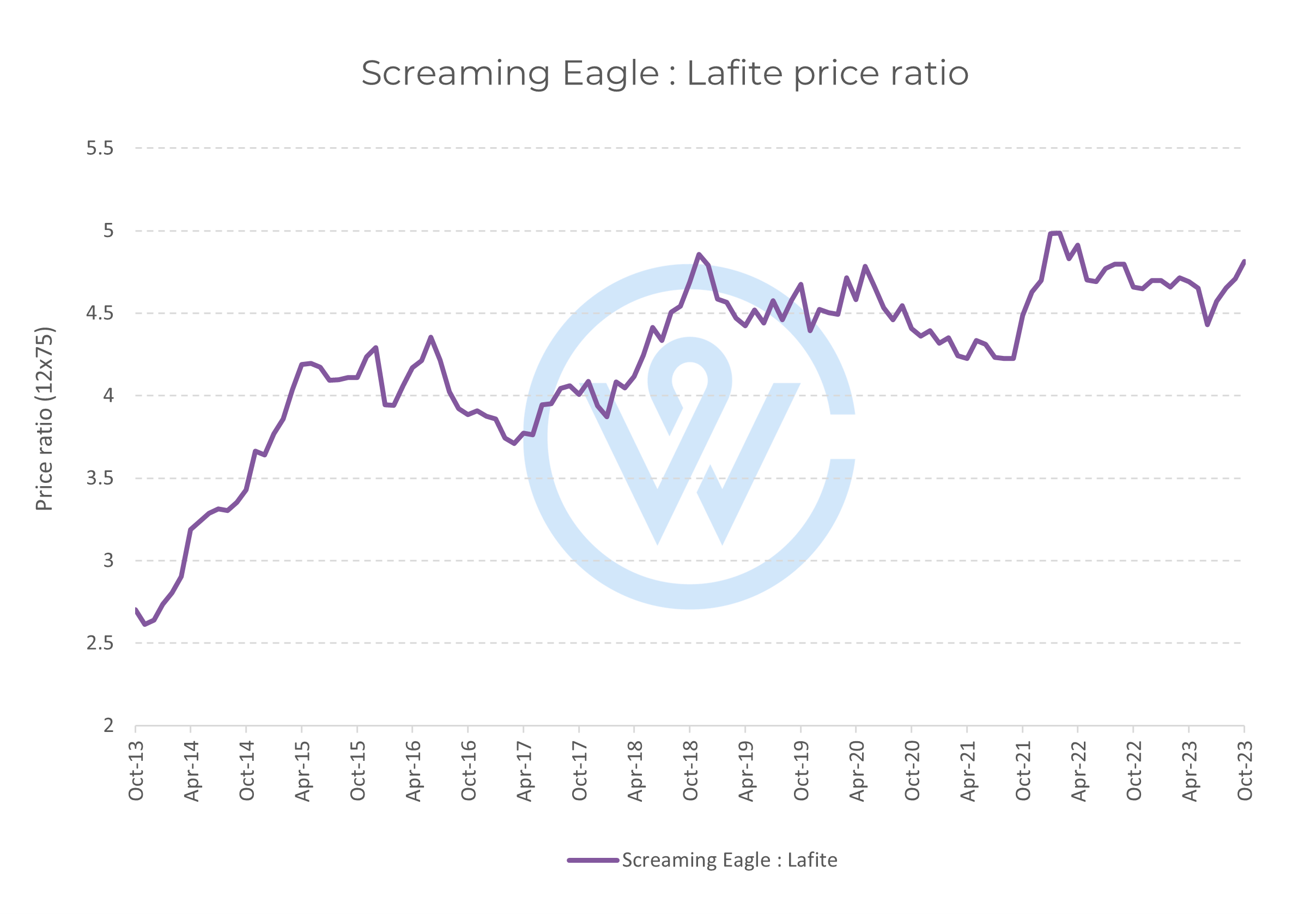
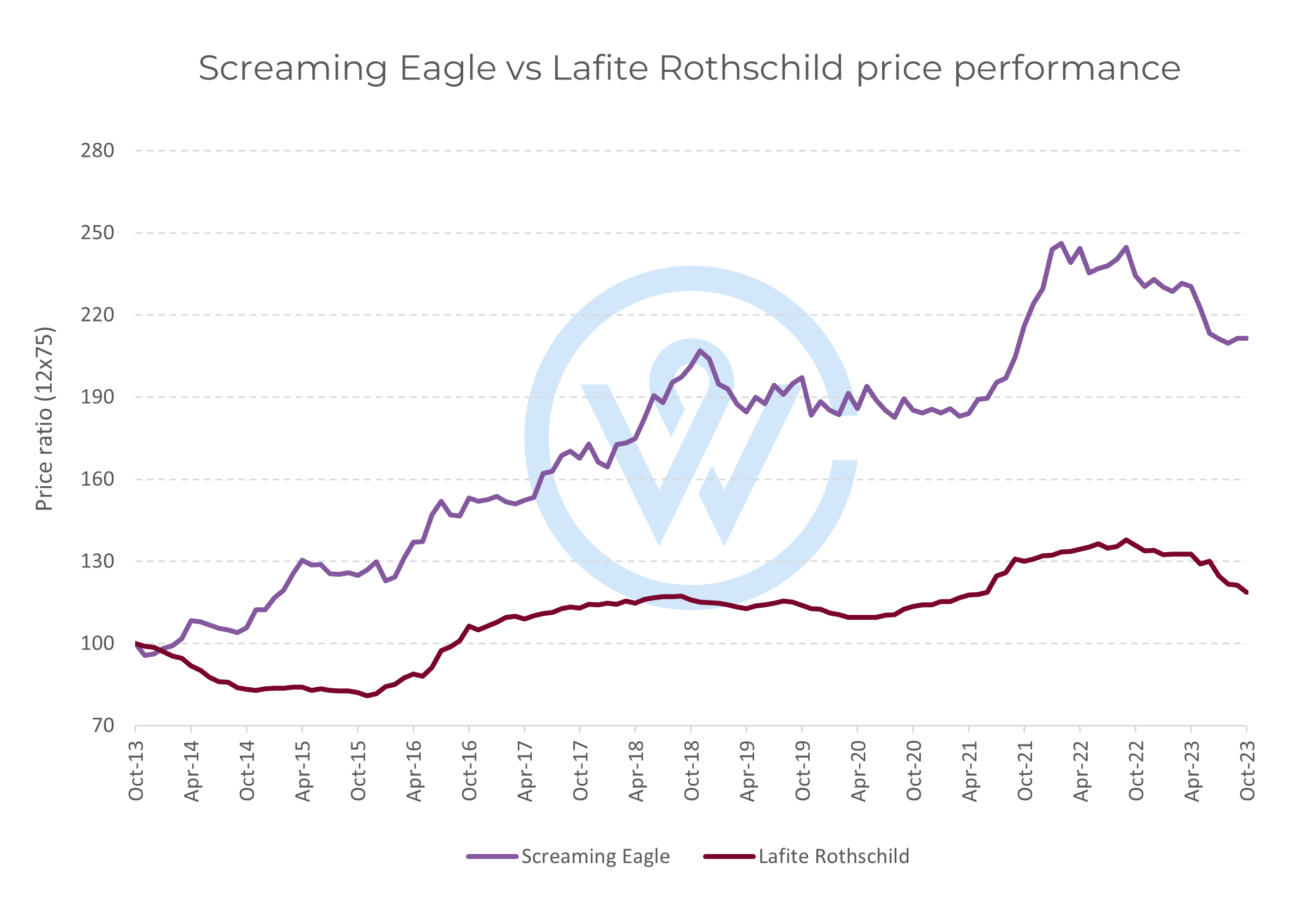
The price ratio between Screaming Eagle and Lafite Rothschild tells a story of increased volatility, which can largely be ascribed to the Californian cult wine. Screaming Eagle has seen bigger price rises, followed by sharper falls.

Today one can now get 4.8 bottles of Lafite for the price of Screaming Eagle, up from 2.7 a decade ago. The ratio peaked in February 2022, when it stood at 5:1.

California has enjoyed serious investment interest which has been reflected in its market share. Today the region holds around 7% of the fine wine trade by value and is the most important New World player.

While Lafite has come to represent better value when compared to other top wines, this is largely due to shifting regional market dynamics. The First Growth continues to entice buyers with brand strength, high-quality releases and returns on investment.

WineCap’s independent market analysis showcases the value of portfolio diversification and the stability offered by investing in wine. Speak to one of our wine investment experts and start building your portfolio. Schedule your free consultation today.
Categories
Learn

The place of the Bordeaux First Growths in a changing fine wine market

  • Once the dominant force in the fine wine market, the Bordeaux First Growths have lost market share due to its broadening.
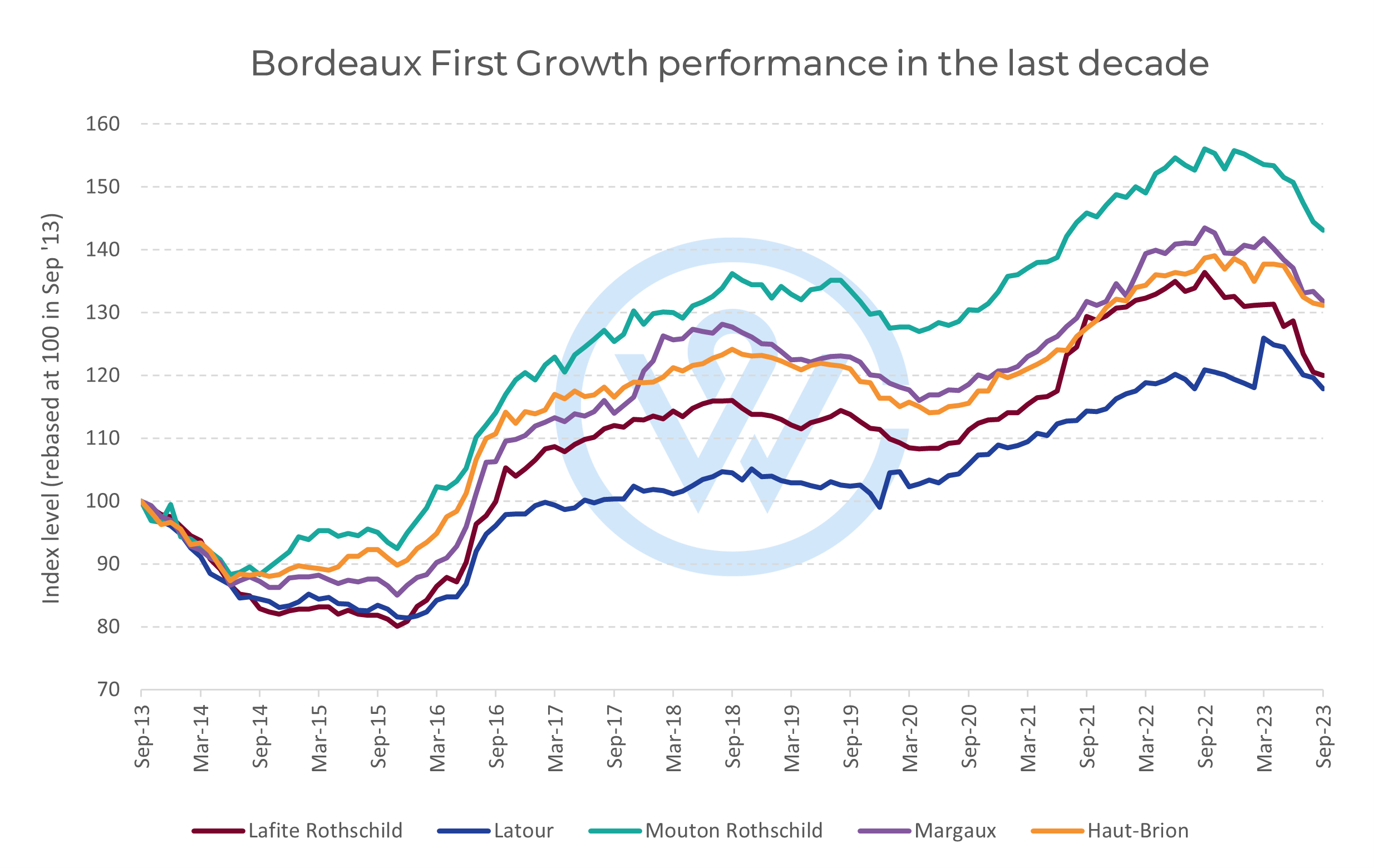
  • In the last decade, Château Mouton Rothschild has been the best price performer, up 43.2%.
  • Château Haut-Brion offers the best value, with the highest average critic score and the lowest average price per case.

The Bordeaux First Growths in a broadening market

The Bordeaux First Growths have long been the cornerstone of the fine wine investment market. Back in 2010, they made up close to 90% of all Bordeaux trade by value – at a time, when Bordeaux’s share of the total market stood at 96%.

With the broadening of the market, their share has decreased and they now regularly account for around 30% of all Bordeaux secondary market trade (which itself has fallen below 35% annual average).

This trend was also reflected in the 2022 Power 100 list, which offered a snapshot of the ever-changing landscape of the secondary market. For the first time ever, no Bordeaux wines featured among the top ten most powerful fine wine labels.

Even if trade for these brands remains consistent or increases, the First Growths are facing greater competition. Still, they are among the wines with the greatest liquidity, attracting regular demand and high praise from critics year after year.

First Growths’ price performance

In terms of price performance, the five First Growths have followed a similar trajectory (i.e. rising post-Covid and dipping in the last year in line with the current market reality). The relative outcast has been Château Latour, whose performance was impacted by the decision to leave the En Primeur system in 2012. The wine has been the worst-performing First Growth, up just 17.9% in the last decade.

The best performer has been Château Mouton Rothschild, with an increase of 43.2%. Recent releases have elevated the performance of the brand, like the 2020 vintage, which boasts 100-points from The Wine Advocate’s William Kelley, 99-100 from James Suckling, 98-100 from Jeff Leve and 99 from Antonio Galloni (Vinous). ‘Off’ vintages like 2011, 2013 and 2014, which have greater room to rise, have also fared well over the last five years.

The second-best performer has been Château Margaux, which is also the second most affordable First Growth. Similarly, its biggest price risers have been 2014, 2011 and 2013. Less classical years reveal the strength of these brands, as demand for the First Growths remains consistently high regardless of the vintage.

First Growths’ price and score comparison

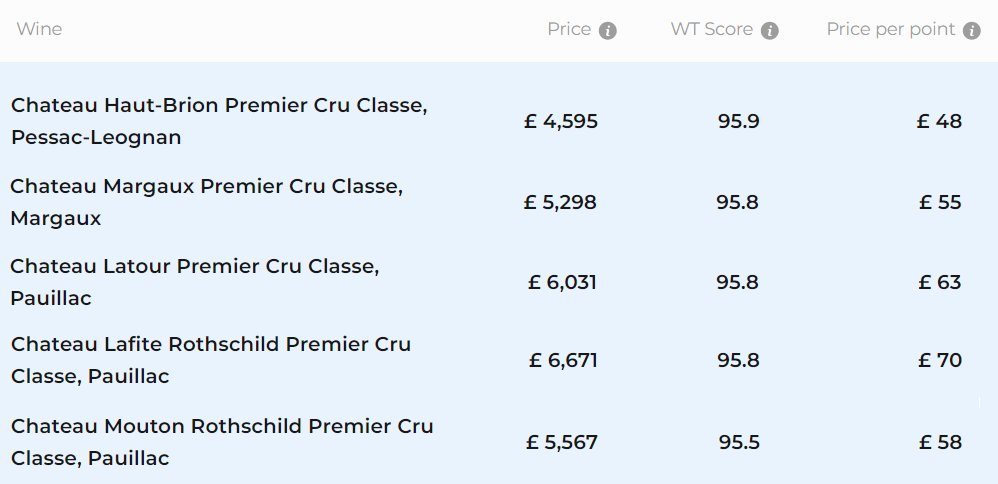
The table below shows the average price per case and critic score of the First Growths for vintages since 2000.

Château Haut-Brion tops the list with the highest average score (95.9) and the lowest average price per case (£4,595). With a price per point of £48, the wine seems to offer the best value among the First Growths. Vintages that have received 100-points from The Wine Advocate include 2018 (LPB), 2016 (LPB), 2015 (LPB), 2009 (LPB) and 2005 (RP).

Looking at the average prices, Château Lafite Rothschild stands out as the most expensive of the First Growths. The wine has achieved 100-points from The Wine Advocate for its 2019 (WK), 2018 (LPB), 2010 (LPB) and 2003 (RP) vintages.

In conclusion, the First Growths remain an important part of the changing secondary market, offering brand strength, consistently high quality and stable growth.

WineCap’s independent market analysis showcases the value of portfolio diversification and the stability offered by investing in wine. Speak to one of our wine investment experts and start building your portfolio. Schedule your free consultation today.
Categories
Learn

The legacy of the 1855 Bordeaux Wine Classification and global rankings

  • Wine classifications serve as guides to quality standards, geographical origins, and historical context.
  • The 1855 Bordeaux Classification continues to serve as a touchstone that has shaped not only Bordeaux but also global perceptions of what constitutes a ‘fine wine’.
  • Wine-producing regions worldwide have developed their own unique classification frameworks, based on quality, price, and terroir.

The classifications of fine wines provide an intriguing labyrinth of quality markers, geographic indicators, and historic relevance. Among the most iconic of these is the 1855 Bordeaux Classification – a system that has endured for over a century and a half. In contrast, the dynamic Saint-Émilion classification demonstrates the capacity for change within the realm of wine classifications. This article delves into these iconic French systems and other similar classifications in countries such as Germany, Italy, and Portugal.

The enduring legacy of the 1855 Bordeaux Classification

Commissioned by Napoleon III for the Exposition Universelle de Paris, the Bordeaux Wine Official Classification of 1855 set the gold standard for wine classifications. Designed to rank the finest wines of Bordeaux – from Médoc, Sauternes, and Barsac – the classification ranges from ‘First Growth’ to ‘Fifth Growth’, based on both quality and trading price. With only one significant modification since its inception – the promotion of Château Mouton Rothschild to First Growth in 1973 – the classification remains a cornerstone in the world of fine wine.

The classification has been both praised for its impact on the wine industry and criticised for its rigidity, given that it reflects a snapshot of quality from more than a century and a half ago. The global wine exchange, Liv-ex, has created a similar classification that uses price alone to determine a hierarchy of the leading fine wine labels in the market.

The Saint-Émilion Classification

In contrast to the static nature of the 1855 Classification, the Saint-Émilion region in Bordeaux has a more dynamic approach to ranking its wines. Established in 1955, the Saint-Émilion Classification is updated approximately every ten years. This system classifies wineries into tiers: Grand Cru Classé A, Grand Cru Classé B, and Grand Cru Classé.

Unlike the 1855 Classification, which is set in stone for the most part, the Saint-Émilion system allows for upward or downward mobility, giving wineries an incentive for continuous improvement.

Nonetheless, the classification has also faced controversy when three leading estates with ‘Premier Grand Cru Classé A’ status – Châteaux Ausone, Cheval Blanc and Angélus – withdrew from the rankings last year.

Classifications beyond Bordeaux 

Burgundy’s Cru System

Unlike Bordeaux, where the 1855 Classification ranks specific châteaux or estates, Burgundy’s Cru System classifies individual vineyards by assessing their terroir (Grand Cru, Premier Cru, Village, Regional).

Even vineyards that are right next to each other but separated by a road or a wall may be classified differently. The terroir is believed to impart specific qualities to the wine, with soil composition, slope, and sun exposure all playing a role.

While the 1855 Bordeaux Classification has changed very little since its inception, Burgundy’s Cru System is more fluid. Vineyards can be promoted or demoted based on ongoing assessments of quality, although changes are relatively rare and usually occur over long periods.

The Burgundy Cru System has been highly influential and is seen as a precursor to many New World terroir-based classifications. However, it’s not without its critics. Some argue that focusing solely on terroir might overlook the skills and contributions of individual winemakers.

Germany’s VDP Classification

The Verband Deutscher Prädikatsweingüter (VDP) has developed a system somewhat inspired by Burgundy. The top tier of this system, the Grosse Lage (Great Growth), designates vineyards with the highest quality potential, followed by Erste Lage (First Growth).

Italy’s Barolo and Barbaresco Cru vineyards

In Italy’s famed Barolo and Barbaresco regions, vineyards are often termed ‘cru’, reflecting the particular characteristics of the terroir. Unlike Bordeaux’s 1855 classification, there isn’t a formal hierarchy, but the cru system nonetheless signifies a level of quality and prestige.

Portugal’s Douro Classification

One of the oldest classification systems for wine comes from Portugal’s Douro region, known for Port wine. Established as early as 1756, this classification focuses on the quality of the grape-growing land, making it an early precursor to the concept of terroir.

Concluding thoughts

In the ever-evolving world of fine wine, the 1855 Bordeaux Classification continues to serve as a touchstone that has shaped not only the Bordeaux region but also global perceptions of what constitutes a ‘fine wine’. By contrast, the more dynamic systems like the Saint-Émilion rankings and Burgundy’s Cru system offer a flexible approach that accommodates change and encourages ongoing excellence. As the article explored, wine-producing regions worldwide have developed their own unique classification frameworks, each adding a different flavor to this complex narrative. Whether these systems will adapt to the challenges of climate change, evolving consumer tastes, and other modern factors remains to be seen, but what is clear is their enduring impact on how we appreciate, value, and ultimately, enjoy wine.

WineCap’s independent market analysis showcases the value of portfolio diversification and the stability offered by investing in wine. Speak to one of our wine investment experts and start building your portfolio. Schedule your free consultation today.