Categories
Learn

The ultimate guide to the best Champagne vintages

  • The best Champagne vintages marry the region’s terroir and northerly climate with technical precision.
  • While quality is paramount, the best financial returns often come from correctly priced “off-vintages” or undervalued releases.
  • The shift toward transparency, such as numbered non-vintage editions and grower-led terroir focus, is creating new frontiers for Champagne investment.

A great Champagne is the product of the delicate balance between terroir and human precision. The region’s chalky soils and cool, northerly latitude provide the perfect environment for Chardonnay, Pinot Noir, and Pinot Meunier to maintain the high acidity necessary for long-term ageing.

Unlike other regions, the “house style” has historically been the primary focus in Champagne. This is achieved through the art of blending multiple vintages to create a consistent non-vintage product. However, for the investor, greater interest lies in Vintage Champagne. These are bottles produced only in exceptional years, representing a biological time capsule of a single harvest.

The longevity of Champagne is a key driver of its investment value. The presence of carbon dioxide and high natural acidity act as preservatives, allowing prestige cuvees to evolve gracefully for decades. As the wine ages, the primary citrus and floral notes transform into complex tertiary aromas of toasted brioche, honey, and roasted nuts.

What makes a great Champagne vintage?

To understand what creates a legendary year, we look at the conditions defined by experts. For a northerly region like Champagne, these factors are even more critical and include:

  • Early and rapid flowering 
  • Gradual onset of water stress during July to slow the vine’s growth
  • Warm and dry final months before harvest to ensure the grapes reach full maturity
  • A dry harvest window allowing winemakers to pick at peak ripeness

Champagne vintage variation

Being one of the most northerly wine-producing regions in France, Champagne is subject to more extreme vintage variation. In some years, the grapes struggle to ripen at all, while in others, they reach levels of opulence that define a generation. This volatility is precisely why blending became the region’s hallmark.

By keeping reserve wines from previous years, houses can ensure that even a difficult harvest can be transformed into a high-quality non-vintage blend. For the collector, however, the variation is the draw. A vintage wine almost by definition deserves to stand alone without the help of the reserves.

Why great vintages aren’t always great investments

It is a common mistake for investors to chase only the highest-scoring vintages. However, for a successful investment, the entry price is just as critical as the wine’s quality. When a “vintage of the century” is announced, producers often set release prices at a premium that bakes in all future growth.

Consider the example of Chateau Lafite Rothschild 2013 in Bordeaux. Although it was a difficult year, its low release price allowed it to see values double in the secondary market as it recovered. In Champagne, the same logic applies. An undervalued vintage can often outperform a legendary one if the starting point for the investor is more favourable.

The evolution of non-vintage Champagne: numbered editions

The traditional non-vintage model is changing. Some houses have led the way in creating “multi-vintage” blends that are numbered to allow for differentiation and investment. Krug Grande Cuvee and Jacquesson’s 700-series are the most prominent examples of this shift.

By assigning a number to each release (such as Krug most recent 173eme edition), the producer provides a clear identity to the blend. This allows investors to track the performance of specific editions and trade them as distinct assets. While other houses are beginning to follow this lead, it remains to be seen if they will achieve the same level of secondary market liquidity.

The growing influence of grower Champagne

The rise of grower Champagne has fundamentally shifted the region’s dynamic. These producers grow their own grapes and make their own wine, focusing on specific terroirs rather than a broad house style. Names like Jacques Selosse and Cedric Bouchard have become cult icons for investors.

The success of these growers has influenced the Grandes Marques. For instance, Dom Perignon has begun showing “vins clairs” (base wines) at tastings and releasing every vintage regardless of quantity to reflect the terroir’s narrative. Dom Pertignon’s LVMH stablemate Ruinart is also acknowledging this trend by serving grower wines in their tasting rooms.

Champagne disgorgement and release 

Understanding the release dates of different producers is essential for market timing. There is no standard for how long a Champagne must be aged before release. For example, while Dom Perignon 2017 might be on the market, the most recent release of Krug Clos d’Ambonnay is the 2006.

Furthermore, many houses now offer late-disgorged editions, such as Dom Perignon’s P2 and P3 series. These wines have spent extra time on their lees, gaining complexity and a higher price tag. These releases offer a second or even third window for investment in the same vintage.

The best Champagne vintages before 1982

Before the advent of modern temperature control and precision viticulture, legendary years were rare historical events. These vintages are now considered mythical artefacts of the region, often surviving only in the deep libraries of the great houses or in the world’s most prestigious private cellars. 

For the investor, the time for these vintages has largely passed, although for avid collectors they represent the ultimate “legacy” assets, where value is driven as much by historical importance and provenance as by structural integrity. Some of the best older vintages include:

  • 1921: Frequently cited as the year the modern commercial market for fine Champagne was born, this vintage followed a hot summer that produced incredibly concentrated fruit. 
    • Standout wine: Dom Perignon’s inaugural vintage, although this was not released until the 1930s.
  • 1928: Widely considered the vintage of the century by older collectors, it offered a rare combination of extreme ripeness and record-breaking acidity. 
    • Standout wine: Krug Vintage set a record for the most expensive Champagne ever sold at auction.
  • 1945: A year defined by a brutal spring frost that decimated yields, followed by a glorious summer that produced tiny quantities of liquid gold. 
    • Standout wines: Krug and Bollinger (the predecessor to Vieilles Vignes Francaises).
  • 1955: A classic year known for its aromatic complexity and firm, refreshing acidity that has allowed bottles to mature gracefully for seven decades. 
    • Standout wine: Taittinger Comtes de Champagne.
  • 1975: Celebrated for its high acidity, this vintage produced wines with the structural bones required for multi-decadal ageing. 
    • Standout wines: Louis Roederer Cristal and Dom Perignon.
  • 1979: A balanced and elegant year that saw the debut for one of the most iconic single-vineyard bottlings in history. 
    • Standout wines: Krug Clos du Mesnil’s inaugural vintage after the vineyard’s purchase in 1971.

The best modern Champagne vintages

The trinity: 1988, 1989, 1990

This legendary trio of years offered three distinct styles. 1988 was the year of “linearity” and high acidity, while 1989 was plush and opulent. At the time of release, 1990 was considered the balanced masterpiece that combined the best of both worlds.

  • Perrier-Jouet Belle Epoque 1988: A linear, slow-maturing legend.
  • Charles Heidsieck Collection Crayeres 1989: late disgorged youthful brilliance.
  • Krug Vintage 1990: One of the most sought-after blue-chips of the decade.

The acidity benchmark: 1995 & 1996

1996 is often hailed as a “once in a lifetime” vintage due to its unique combination of record-breaking acidity and high sugar ripeness. 1995, initially in its shadow, is now being recognised for its balance.

  • Salon Le Mesnil 1996: A mythical Blanc de Blancs built for decades of cellaring.
  • Dom Perignon 1996: One of the most successful investment years for the house.
  • Taittinger Comtes de Champagne 1995: A forward, generous expression of Chardonnay.

The 21st century icons: 2002 and 2008

2002 was a near-perfect growing season that produced harmonious, high-definition wines. However, it is 2008 that has become the holy grail for modern collectors. It is a vintage of incredible tension and cool, linear energy.

  • Louis Roederer Cristal 2008: The current market leader in price appreciation.
  • Salon 2008: Famously released only in Magnums due to its tiny production.
  • Krug 2002: A wine of incredible clarity and power.

The modern successors: 2012 and 2013

2012 has emerged as one of the most complete vintages of the modern era, often compared to the legendary 1990. 2013 is a cooler, more classical year that rewards those looking for finesse over raw power.

  • Dom Perignon 2012: A charming and ambitious wine that blossomed early.
  • Louis Roederer Cristal 2012: A biodynamically farmed masterpiece.
  • Pol Roger Winston Churchill 2013: A pure, energetic purist’s vintage.

Vintages bubbling under

Not every great year receives the same fanfare. Some intermediate years can offer exceptional value for drinkers and savvy investors.

  • 1998: A year that was initially overshadowed by 1996 but has aged with surprising grace. Highlight: Dom Perignon 1998.
  • 2004: A vintage of “quiet confidence” that never needed to shout. Elegant and harmonious wines. Highlight: Bollinger VVF 2004.
  • 2014: A high-quality year currently entering the market with strong results for Chardonnay. Highlight: Louis Roederer Cristal 2014.
  • 2016: While a difficult year for many, some specific houses found success where others struggled. Highlight: Dom Perignon 2016.

FAQ: Great Champagne vintages

Why does Champagne have more vintage variation than other regions? 

Being one of the most northerly wine regions, Champagne is on the climatic limit for ripening grapes. This leads to dramatic differences in sugar and acidity levels from year to year.

Is vintage Champagne always better than non-vintage? 

No, generally speaking non-vintage is designed for consistent house style, whereas vintage Champagne is produced only from the best fruit of exceptional years. However,the best multi-vintage wines such as Krug Grand Cuvee and Jacquesson 700 series can hold their own in any company.

How does disgorgement date impact value? 

A later disgorgement (like the P2 series) usually commands a higher price on release because the wine has spent more time on its lees, resulting in greater aromatic complexity.

Should I invest in grower Champagne or the big houses? 

Big houses like Dom Perignon and Krug offer greater market liquidity, making them safer for most investors. Growers offer rarity but can be harder to sell.

WineCap’s independent market analysis showcases the value of portfolio diversification and the stability offered by investing in wine. Speak to one of our wine investment experts and start building your portfolio. Schedule your free consultation today.
Categories
Learn

What is a Veblen good in fine wine?

  • In fine wine, Veblen status is reserved for a tiny fraction of brands where absolute scarcity and “price-as-prestige” make the cost a primary feature of the product.
  • “Super-Tier” wines like DRC or Petrus can defy traditional economics because their high price tags actively increase desirability.
  • As “vanity assets” catering to the ultra-wealthy, these wines often act as a defensive hedge, maintaining value during market downturns and moving independently of traditional stocks.

In the turbulent waters of the global economy, most consumer goods follow the predictable laws of gravity: when prices rise, demand falls. However, within the climate-controlled cellars of the world’s elite, a different set of physics applies. 

By analysing the Veblen effect, scarcity mechanics, and the psychological drivers of luxury consumption, we can determine if fine wine is the ultimate “vanity asset” and a viable anchor for alternative investment strategies.

The Veblen effect: When price signifies value

In standard economic models, demand decreases as prices rise. However, Veblen goods defy this logic. Named after economist Thorstein Veblen, these are “vanity assets” where a high price tag actually increases desirability by signalling exclusivity and status.

Consider the most expensive wines in the world, such as Domaine de la Romanée-Conti (DRC) or Chateau Petrus. For the ultra-high-net-worth individual, the Petrus wine price is secondary to its rarity. As the price of luxury red wine risess, it enters a stratosphere where it is no longer competing with other beverages, but with rare art, investment watches, and stamp collecting. This “prestige premium” creates a floor for the market, as the target demographic remains insulated from the belt-tightening that affects broader consumer goods during a downturn.

The “Veblen threshold”

It is a common misconception that all expensive wine is a Veblen good. In reality, most fine wines – even those costing several hundred dollars – still obey the traditional laws of economics. If a well-regarded Napa Cabernet doubles in price, many collectors will simply pivot to a similar quality producer from the Rhône or Tuscany.

The true Veblen Effect is reserved for an elite “Super-Tier” of brands. For names like Domaine de la Romanée-Conti (DRC), Château Petrus, or Screaming Eagle, the astronomical price is the product.

In these rare cases, the brand combines absolute scarcity (only a few hundred cases produced annually) with social signalling. When the price of a DRC Romanée-Conti rises from $15,000 to $25,000, demand actually intensifies. The price hike serves as a filter, ensuring that only the most powerful collectors can “play,” thereby increasing the wine’s status as the ultimate trophy. For these brands, a lower price would actually damage their perceived value by making them “too accessible.”

Fine wine as an inflation hedge

One of the most compelling reasons for whisky investment or fine wine allocation is its role as a hedge against the effects of inflation. Unlike currency, which loses purchasing power as central banks increase supply, the supply of vintage red wines is physically capped by the harvest of a specific year.

When the cost of living rises, tangible assets – often referred to as “hard assets” – typically appreciate. Fine wine is a prime example of a Veblen good that retains value because its production cannot be artificially inflated. You cannot simply “print” more 1982 Chateau Lafite Rothschild or Chateau Margaux wine. This inherent scarcity ensures that the wine valuation often moves in lockstep with, or ahead of, inflationary trends.

Fine wine vs stocks 

Investors often seek alternative funds to achieve diversification. While AI intelligence stocks and renewable energy ETF options provide growth, they are highly sensitive to interest rate hikes and geopolitical shifts. Fine wine, however, often shows a low or even inverse correlation to the S&P 500.

During a market “flight to quality,” capital frequently moves out of volatile wine stocks or AI exchange-traded funds and into stable, physical assets. This is why legendary estates like Chateau Latour or Chateau d’Yquem are often described as “defensive” assets. Even in a recession, the global demand for the most expensive whiskey and costly Champagne remains high in emerging markets, providing a globalised safety net for the collector’s wine collection.

Active vs passive investing

For the wine connoisseur, the market offers two paths: active vs passive investing.

  • Active investing: This involves the physical acquisition and storage of bottles. It requires a deep understanding of terroir, top Bordeaux vintages, and the vinification process. The investor must manage red wine storage temperature and ensure the wine cellar temperature is optimal to maintain provenance.
  • Passive investing: For those who prefer a hands-off approach, wine-focused alternative investment strategies allow for exposure to the market without the logistical burden of handling a large wine bottle or an entire cellar operation.

Navigating the “Vanity” trap

While the term “vanity asset” might imply a lack of substance, in the world of pricey wines, vanity is a market force. The desire to own a Chateau Margaux or a Masseto wine drives the secondary market liquidity. However, the wine buyer must be wary of “hype” wines that lack the historical track record of a Grand Cru or a St Emilion wine.

True investment-grade wine requires a marriage of alcohol content (which aids preservation), a prestigious appellation, and a high volume of critical acclaim. Whether you are looking at whisky barrel investment or a case of Pomerol wine, the goal is to find assets that the world’s elite will always want to put on their table, regardless of the current economic climate.

Fine wine defies traditional inflation because it exists at the intersection of art, history, and luxury. As a Veblen good, its value is psychologically reinforced by its price. By diversifying a portfolio with expensive red or white wine, investors can protect their wealth from the erosion of inflation and the unpredictability of the stock market. In the end, a bottle of Chateau Petrus is more than just a drink – it is a bulwark against economic uncertainty.

People also ask:

1. Does wine actually taste better because it’s a Veblen good?

Psychologically, yes. Studies in neuroeconomics have shown that when people are told a wine is more expensive, the pleasure centers of their brain (the medial orbitofrontal cortex) show higher activity. While the chemical composition doesn’t change, the “price-placebo effect” means the Veblen status actually enhances the sensory experience for the drinker.

2. What is the biggest risk in wine investment?

The primary risks are liquidity and provenance. Unlike a stock, you cannot sell a bottle of wine instantly with a click. It can take weeks or months to find a buyer at a fair price. Additionally, if you cannot prove the wine was stored at a consistent and appropriate temperature, its value can plummet, as the wine may have spoiled.

3. Is there a “Veblen” equivalent in spirits?

The market for rare Japanese whisky (like Karuizawa) and “The Macallan fine and rare series” mirrors the wine market. These spirits are often bought as “trophy assets” and are rarely intended to be opened, functioning purely as a store of wealth and a status symbol.

4. Can a wine lose its Veblen status?

Yes. Veblen status relies heavily on brand prestige. If a prestigious estate significantly increases its production volume (diluting scarcity) or if a series of poor vintages damages its critical reputation, it can fall back into the category of a “normal” luxury good, where price increases will once again lead to a drop in demand.

WineCap’s independent market analysis showcases the value of portfolio diversification and the stability offered by investing in wine. Speak to one of our wine investment experts and start building your portfolio. Schedule your free consultation today.
Categories
Learn

The 2025 guide to investing in alternative assets

Alternative assets are investments outside traditional stocks and bonds. These can range from property, private credit and venture to collectibles such as fine wine, art, watches and classic cars. In 2025, fine wine stands out for its low correlation with equities, global demand, finite supply, strong brands, and the ability to build diversified portfolios from blue-chip regions such as Bordeaux, Burgundy, Tuscany, Piedmont, and Champagne. Success comes from rigorous selection, professional storage, long investment horizons (5-10+ years), and data-driven decision making.

What are alternative assets – and why they matter in 2025

Alternative assets cover three broad categories:

  • Collectibles: fine wine, whisky, art, classic cars, watches, rare coins.
  • Private markets: private equity & credit, venture capital, real estate, infrastructure.
  • Hedge strategies: market-neutral, macro, commodities, and other absolute-return approaches.

The Chartered Alternative Investment Analyst Association (CAIA) frames “alternatives” by their limited liquidity, pricing opacity, and non-traditional risk/return drivers compared with public markets.

Why diversification with alternative assets matters

Many alternatives move differently from listed equities and bonds, which means they can dampen portfolio swings when traditional markets are volatile.

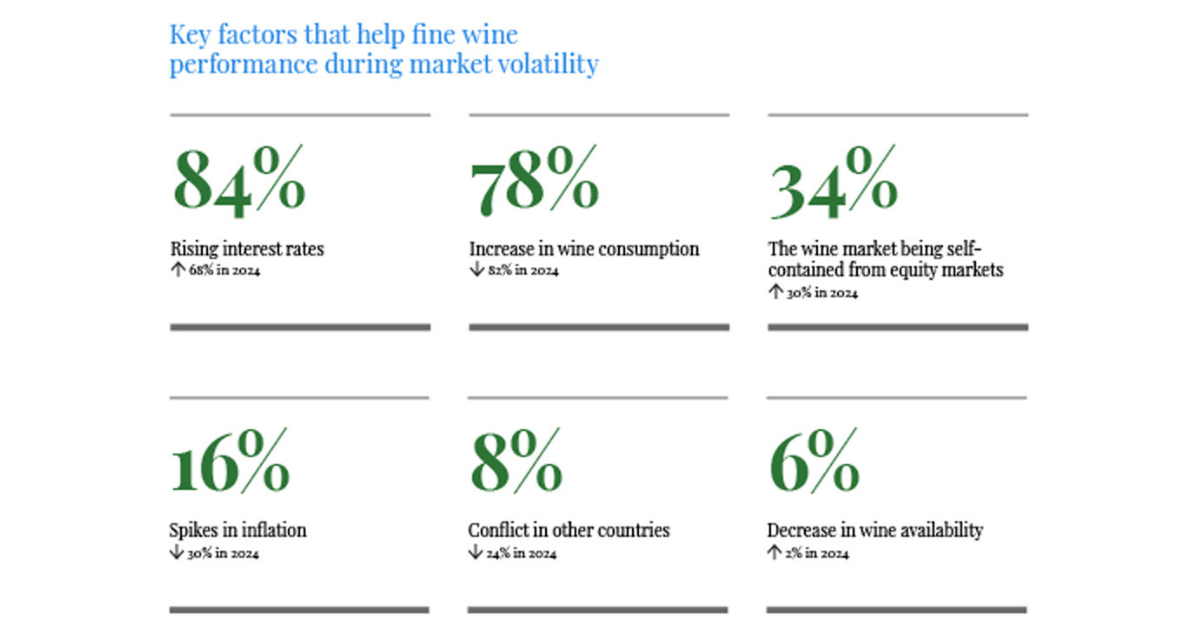
Fine wine is a strong example. Studies have shown it has low – and sometimes negative – correlation with equity markets, improving portfolio efficiency when included alongside traditional assets. In 2025, demand for fine wine has risen by 16% due to its independence from mainstream financial markets. Notably, 34% of UK wealth managers now cite wine’s self-contained nature as a key factor in its resilience during periods of market volatility, up from 30% in 2024.Fine wine performance statistics

Hedge funds aim for the same goal: delivering returns that aren’t tied too closely to market cycles. In 2024-25, hedge fund results have varied across strategies, but overall performance has improved, highlighting their role as diversifiers rather than trackers of stock indices.

Alternative assets and inflation

One of the strongest advantages of alternative assets is their ability to preserve purchasing power when inflation erodes the value of money. Unlike fixed-income instruments, where interest payments may lag rising prices, many alternatives are underpinned by tangible scarcity and global demand, which supports value through inflationary cycles.

  • Private real assets such as infrastructure and opportunistic real estate have historically passed on rising costs more effectively than their listed counterparts, offering stronger inflation protection.
  • Collectibles benefit from their finite nature. The OIV reported 2024 global wine production at a near 60-year low, underlining how supply limits create pricing power. Fine wine is particularly resilient here: each bottle consumed makes the remaining stock rarer, while global demand ensures international relevance. Over time, well-stored vintages not only hold their value but often appreciate at a pace that outstrips inflation, similar to how gold is viewed as a store of value.
  • Art and luxury goods also serve as currency diversifiers. While the global art market saw values contract by 12% in 2024, activity levels remained robust, showing continued demand for tangible assets that trade across currencies and borders.

In effect, alternatives hedge inflation in ways traditional portfolios cannot. By anchoring value in scarcity, durability, and global liquidity, they help investors preserve real wealth.

Why timing and selection are important

Alternative assets do not present a uniform return stream, and fine wine illustrates this better than most. Outcomes differ dramatically depending on region, producer, vintage, and even release timing. Burgundy, for instance, can respond to very different dynamics than Bordeaux, while Champagne and Tuscany follow their own cycles. Within each region, a benchmark producer may hold value through downturns while lesser names fade.

Even within a single estate, the vintage effect is powerful: the release prices and the performance of First Growth Bordeaux shows a wide gap between celebrated vintages like 2000 or 2009 and those considered ‘off’ years. Variables like provenance and storage, widen the gap further. 

Just as in private equity or hedge funds, where manager selection drives returns, in the fine wine market, knowledge and timing are decisive. 

How liquid are alternative assets?

Liquidity in alternative assets differs from mainstream markets. Public equities and bonds trade daily on exchanges with instant settlement. By contrast, most alternatives – whether private funds or fine wine – take longer to change hands. A sale depends on finding a buyer, agreeing on price, and, in some cases, waiting for a trading window.

This slower pace can be advantageous. Investors willing to commit capital for longer are often rewarded with an extra return for patience. In fine wine, the best opportunities often come from holding rare vintages through periods of scarcity, then releasing them to market when demand peaks.

Access, however, is improving. Just as private credit has grown through evergreen and interval funds, fine wine platforms now make trading more efficient and transparent. Still, liquidity remains uneven: blue-chip Bordeaux or Burgundy may find a ready market, while niche producers or lesser vintages can take longer to sell.

The role of fine wine in 2025

Among alternative assets, fine wine stands out. In 2025, for the third year in a row, it came on top as the most in-demand collectible among financial advisors and wealth managers in both the UK and US. Fine wine is a viable alternative investment avenue for the following reasons: 

  • Scarcity meets demand: Production is both finite and shrinking, while rising global wealth continues to fuel steady demand.
  • Global and brand-driven: Iconic names such as Lafite Rothschild, DRC, and Salon are recognised worldwide and have a track record of delivering consistent value.
  • Diversifiable: Unlike art or cars, fine wine offers broad exposure across regions, producers, and vintages. With hundreds or thousands of cases produced each year, valuations are more transparent and portfolios easier to build.
  • Historically resilient: Fine wine has shown stability in market downturns and attractive long-term returns. Investors can track the performance of individual labels – or entire portfolios – directly through Wine Track.

In 2025, alternatives are no longer niche: they are central to how sophisticated investors diversify, preserve wealth, and seek differentiated returns. Fine wine brings together the key qualities that define successful alternatives: tangible scarcity, global demand, and return dispersion that rewards knowledge and timing.

Fine wine investment FAQs

Is fine wine a good hedge against inflation?
It can help preserve purchasing power over multi-year horizons due to finite supply and global demand, but outcomes vary. Diversify and keep realistic horizons.

How much do I need to start?
You can build a credible, diversified starter portfolio with a five-figure GBP budget; larger allocations allow more breadth and depth.

How long should I invest for?
Plan for 5-10+ years to capture ageing-related scarcity and demand. Tactical positions may realise sooner.

Where should I store wine?
In bonded, climate-controlled facilities with full insurance and documented chain of custody.

What returns should I expect?
Returns are not guaranteed. Focus on selection quality, costs, and disciplined process.

Categories
Learn

Is buying early always the best investment?

  • The common concept in fine wine investment has been that buying early (at release) often translates into the best possible price.
  • The concept has its roots in Bordeaux’s En Primeur system but the principle has been challenged in the last decade.
  • Ageing potential is important, but it is not the only factor in price performance.

Timing is crucial when it comes to almost every decision. While not all investments have a lifespan, some do – and fine wine is a prime example of a perishable good that evolves, peaks and declines in quality and value. 

The common concept in fine wine investment has been that buying early or at release often translates into buying at the best possible (lowest) price. Recent Bordeaux En Primeur campaigns have worked against this principle. Individual wine indices, such as those on Wine Track also show that the price performance of a wine is driven by numerous factors beyond age. The value arc does not simply follow the life cycle of the product but responds to demand, critic scores, and brand popularity among other factors.

So, is buying early always the best investment? The answer, as we’ll see, is far more nuanced.

The origins of buying early: Bordeaux En Primeur

The concept of buying wine early has its roots in Bordeaux’s En Primeur system. Emerging in the post-war decades of the 20th century, it was designed to provide much-needed cash flow to châteaux, while offering buyers privileged access to top wines before they were bottled.

En Primeur still works broadly the same way today: buyers purchase wine in the spring following the harvest, while the wine is still ageing in barrel. Delivery follows one to two years later, once bottling has taken place.

For decades, this system benefitted both producers and buyers. Châteaux received upfront financing, while collectors and investors gained access to some of the most prestigious wines in the world at prices significantly lower than they would command once bottled.

The traditional promise of buying early

The original attraction of En Primeur was simple: buy early, secure allocations, and enjoy price appreciation once the wine is released to the wider market. In exceptional vintages like 1982, 2000, or 2005, those who bought early often saw spectacular returns.

For investors, the logic was straightforward:

  • Scarcity effect: Once the wine left the château, supply only diminished as bottles were consumed.
  • Pricing advantage: En Primeur pricing was historically lower than post-release retail.
  • Access to top names: For blue-chip estates like Lafite, Latour, and Margaux, early purchases guaranteed allocations that might otherwise be difficult to secure later.

In these circumstances, buying early equates to buying smart.

When buying early backfires

The past decade, however, has challenged this principle. Several Bordeaux En Primeur campaigns, most notably in 2017 and even 2020, saw release prices set so high that early buyers struggled to achieve returns. In some cases, wines could be purchased at equal or lower prices a year or two after bottling.

The reasons are clear:

  • Aggressive pricing by châteaux: A stronger global demand for fine wine has emboldened producers to set ambitious release prices.
  • Market corrections: Economic slowdowns, global trade disruptions, and shifting consumer preferences have softened demand after release.
  • Vintage variation: Lesser or more challenging vintages often lack the critical acclaim needed to sustain premium En Primeur pricing.

For investors, this has underscored the risk of assuming that ‘earliest means cheapest’.

What makes fine wine different from other assets

To understand why timing matters so much in wine investment, it’s important to recognise how wine differs from other asset classes:

  • Finite supply: Unlike companies that can issue more shares, every bottle consumed reduces global availability.
  • Physical lifespan: Wine matures and eventually declines; it is not a perpetual store of value like gold.
  • Quality peaks: Different wines have different drinking windows, meaning investors must consider not just price but also maturity and market timing.
  • Luxury demand drivers: Beyond fundamentals, fine wine is influenced by critic scores, branding, and even lifestyle trends among global collectors.

This blend of scarcity, perishability, and cultural cachet makes wine a unique – and uniquely complex – investment.

Beyond age: the real drivers of value

Ageing potential is important, but it is not the only factor in price performance. Modern wine indices and case studies reveal a more layered picture. Key drivers include:

  • Critic scores: A 100-point rating from Robert Parker, Neal Martin, or William Kelley can send prices soaring overnight.
  • Producer reputation: Estates like Domaine de la Romanée-Conti, Screaming Eagle, or Krug often outperform peers regardless of vintage quality.
  • Market cycles: Broader economic forces, from currency fluctuations to tariff policies, can depress or lift wine prices.
  • Brand popularity: Rising interest in regions like Champagne or Tuscany can create waves of demand that drive prices beyond what traditional models predict.

In other words, while time and age matter, they are not the sole determinants of performance.

When buying early makes sense

Despite these caveats, buying early can still be an excellent strategy under the right conditions.

  • Exceptional vintages: En Primeur remains compelling in universally acclaimed years, where demand is strong and release pricing is competitive.
  • High-demand producers: Cult estates with limited production – such as Château Lafleur in Pomerol or Domaine Leflaive in Burgundy – make early buying critical for securing allocations.
  • Collector profiles: For those who value access as much as investment return, buying early provides peace of mind.

For these buyers, the combination of access, scarcity, and potential upside makes early purchase attractive.

Alternative timing strategies

If early purchase is no longer a guarantee of success, what are the alternatives?

  • Back-vintage buys: Many investors now prefer to target wines once bottled and scored, when pricing stabilises and market sentiment is clearer.
  • Diversification by region: Burgundy, Champagne, and Italy’s Super Tuscans increasingly offer opportunities outside the Bordeaux En Primeur cycle.
  • Mixed approach: A blend of early allocations (for access) and carefully chosen back-vintage purchases (for value) often proves the most resilient strategy.

By broadening their scope and diversifying their portfolios with different regions and vintages, investors can reduce risk and capture opportunities across global markets.

See also: The best fine wines to invest in 2025

The role of La Place de Bordeaux today

It’s also worth noting that the traditional Bordeaux system has evolved. La Place de Bordeaux, the centuries-old distribution network, now offers not just En Primeur but also back vintages and non-Bordeaux icons such as Opus One, Masseto, and Almaviva.

These September releases are already bottled and ready to ship, offering global investors access to top wines without the risks of futures. In many ways, they reflect the modernisation of fine wine trading: access, liquidity, and global reach, without the same timing pressures as En Primeur.

The art of timing in investment

The idea that buying early is always the best investment belongs to another era. While there are still moments when buying at release delivers the greatest value, these are no longer guaranteed.

Fine wine is unlike any other asset: it is finite, perishable, and driven as much by culture and reputation as by supply and demand. Successful investors understand that while time is crucial, it is not the only variable.

The smart investor balances early buying in exceptional vintages with selective secondary market purchases, diversifies across regions and producers, and pays close attention to global demand trends.

WineCap’s independent market analysis showcases the value of portfolio diversification and the stability offered by investing in wine. Speak to one of our wine investment experts and start building your portfolio. Schedule your free consultation today.
Categories
News

Champagne harvest under scrutiny as region bounces back

  • To promote the highest standards, Champagne set the 2025 yield limit at the lowest level since the pandemic, though early projections suggest a 10–17% year-on-year increase in the natural crop.
  • Comité Champagne introduced “Together for the Champagne Harvest” to align all producers with welfare standards.
  • Champagne’s investment market is beginning to show subtle signs of recovery, supported by improving conditions across the region.

Harvest 2025: Notable yield cap upholds high standards

In July, Champagne stakeholders set a yield cap of 9,000 kg/ha for the 2025 harvest, making it the lowest since the 2020 pandemic year. The industry decision-making body, the Comité Champagne called the move “responsible” citing market uncertainty, geopolitical tensions, and volatile consumer behaviour making forecasting more difficult, as the reasons for the limit.

Yield caps since 2020 (kg/ha)

  • 2020: 8,000
  • 2021: 10,000
  • 2022: 12,000
  • 2023: 11,400
  • 2024: 10,000

The objective of the 2025 reduction is not only to balance production with sales projections: it also aims to support high standards and preserve the exclusivity of Champagne. This investment in quality and new worker welfare measures are positioning the region’s top wines for worthwhile and sustainable investment opportunities.

Champagne key facts

  • Located in northeastern France
  • Received Champagne AOC in 1936
  • 16,000 grape growers & 320 producers
  • 300 million bottles yearly
  • Annual revenue exceeds €5 billion
  • The third most important fine wine investment region after Bordeaux and Burgundy

What is the Comité Champagne?

Established in 1941 and headquartered in Épernay, the Comité Champagne operates as the umbrella organisation for the Champagne industry. This interprofessional organisation promotes cooperation between the Syndicat Général de Vignerons de Champagne (SGV) and the Union des Maisons de Champagne (UMC), two professional groups representing more than 16,000 winegrowers and 350 Champagne houses.

New health, safety, and well-being measures

As the 2025 harvest begins, the Champagne appellation is under observation, with the region determined to counter a tarnished reputation after poor seasonal worker treatment in 2023 recently led to the jailing of three harvest crew contractors. Around 120,000 seasonal harvest workers are arriving across the region to work 34,000 hectares of vines, with their welfare being closely watched.

Following the infamous 2023 season, it’s not only harvest team wellbeing in the spotlight: the protection of the Champagne region’s name and value are also of parallel importance. In line with this two-pronged mission, the Comité Champagne has addressed the challenges with the “Together for the Champagne Harvest” scheme, responding to both the needs of Champagne professionals and the expectations of seasonal workers. 

What is the “Together for the Champagne Harvest”?

Following more than a hundred purpose-driven meetings in 2024, when the sector trialled new measures to improve the safety of seasonal workers, “Together for the Champagne Harvest” was born. The initiative takes the form of a series of guides and talks, informing stakeholders of the labor regulations in force. Aimed at making the Champagne harvest more ethical, collaborative, and organised, the scheme brings together four areas of top priority industry focus:

  • health and safety during harvest
  • collective accommodation for seasonal workers
  • service provision
  • recruitment 

The areas contribute to an emphasis on broader sustainable wine production. All stakeholders were involved in the process: Champagne winegrowers and houses, government departments, inspection services, Mutualité Sociale Agricole, France Travail, prevention and emergency services, employee unions, and service providers. 

What are the Moët & Chandon wellbeing measures?

Global Champagne name, Moët & Chandon, has been a leader in harvest crew welfare for years. During the harvest season, Moët & Chandon employs more than 4,000 people, the lion’s share of whom work in the vineyards. With such a huge operation, the focus is constantly on safety, grape harvest crew welfare, and operational efficiency.

Each harvester receives safety training and a full set of protective equipment for all weather conditions, with health and safety officers present in the field to provide stand-by. Additionally, since 2018, Moët & Chandon has also welcomed 18 physiotherapists to their accommodation centers to support physical well-being.

Moët & Chandon continues to invest in modern and comfortable accommodation for directly-contracted workers. The grape pickers employed by external partners enjoy the same high standards, with the house auditing accommodation ahead of the harvest and inspecting sites during picking.

All sites are equipped with dedicated spaces for relaxation and leisure. Last year, the house established a weekly rest day. In the morning, grape pickers can take part in relaxing activities, followed by behind-the-scenes visits to Moët’s pressing centers.

The aim is to allow harvesters to see how their work contributes to the creation of the Champagnes, and to participate in the story of Moët & Chandon.

Moët & Chandon key facts

  • Founded in 1743 in Épernay, France, where it’s headquartered
  • Part of Wines & Spirits division under Moët Hennessy, which is part of LVMH
  • Moët & Chandon tends 1,150 hectares of vines
  • Vineyards in Montagne de Reims, Vallée de la Marne, and Côte des Blancs
  • Their flagship label, Dom Pérignon Vintage, has risen almost 100% in value in the last decade

A quick look at Champagne’s wine investment market

After more than a year of declines, Champagne market trends are pointing to stabilisation. 

Since 2020, there have been two clear phases in market movement: initially, there was a 93.9% swell from March 2020 to October 2022, then a 34.7% decline that restored prices to 2021 levels. Although modest, June saw the first price uptick, paired with consolidation among top brands, indicating that the bearish market might soon be over. 

Fundamentals such as scarcity, ageing potential, sustainability, and global demand are intact, with more attractive entry points increasing the appeal of Champagne investment. The region is well positioned to be the first fine wine area to re-enter growth, making wine portfolio diversification opportunities difficult to ignore.

For more, read our Champagne Regional Report.