Categories
Learn

A guide to terroir and its role in wine investment

  • Terroir is a concept that includes climate, soil, geography, biome and human intervention to give an individual wine its unique identity.
  • The distinction between commodity wine and investment-grade fine wine is in part about geographic specificity and the protection of place through strict regulatory frameworks.
  • The most prestigious estates prioritise the expression of their natural environment over stylistic manipulation.

Terroir: The umbrella term for wine identity

Terroir is frequently cited as the primary factor in the exceptional quality and distinctive character of Old World wines. Derived from the French word “terre,” meaning land, it’s much broader than that: collectors understand it as an umbrella term that combines diverse concepts under a single banner.

Understanding this concept means recognising that a wine’s qualities are inherently linked to a specific location which imparts a unique “DNA” to every fine wine. This makes it consistent characteristics across different vintages. Terroir provides a sense of place that cannot be replicated.

Key components of the terroir umbrella include:

  • Climate and weather
  • Geology and soil
  • Topography
  • Biology
  • Human tradition & intervention (or lack of)

The role of climate

Climate is arguably the most significant influence on the natural environment of a vineyard: it dictates the length of the growing season, the rate at which grapes ripen and how well they ripen. For the wine investor, understanding climate is essential, as many great terroirs are linked to long seasons with slow ripening and a long hang time. Weather, as opposed to climate, is what is behind vintage variation and is also critical to wine investors.

For terroir, climate is a factor at three geographical scales:

  • The broad climate of an entire region, such as the continental weather of Burgundy or the maritime influence of Bordeaux.
  • The atmospheric conditions of a specific sub-region or village, such as the sheltered slopes of a Barolo commune.
  • The unique conditions within a single vineyard or even a specific row of vines.

These layers interact to create the conditions that dictate the potential of a wine.

Soil types and water regulation

Old World producers frequently point to geology and soil as the literal bedrock of their success. The underlying materials determine the nature of the topsoil and influence the local topography. For instance, the chalky soils of Champagne and Chablis allow vines to penetrate deep into the subsoil.

Scientists can debate whether vines literally absorb elements that directly influence flavour, however, it is widely accepted that soil significantly regulates the water supply to the vines. Renowned vineyards often feature soils that provide only a moderate water supply, which limits vegetative growth and prevents waterlogging.  Viticulture often happens on land that would be unsuitable for other types of farming, and it is commonly held that the best wines come from vines that have to work hard.

Notable soil and terroir pairings include:

  • Pomerol: Heavy, well-structured clay-based soils.
  • Medoc: Deep, stony-gravelly sands that provide excellent drainage.
  • Burgundy: A complex combination of limestone and clay in marly soils.
  • Mosel: Steep slopes with characteristic slate-based soils.

Geography, geomorphology, and price

The topography of a vineyard – its aspect, position on a slope, and elevation – all contribute to stylistic differences. In Burgundy, a Grand Cru vineyard may be distinguished from a neighbouring plot simply by its mid-slope position.

Geomorphology refers to the physical features of the land and how they were formed. Steeper slopes, such as those in the Northern Rhône, allow for better sunlight exposure and drainage. This physical advantage translates directly into the quality of the harvest and is why certain vineyards are prized as blue-chip assets that trade for many millions of pounds while the valley floor is reserved for commodity production.

Biome and microbiome: The living vineyard

As our understanding of agriculture deepens, modern viticulture is placing increasing emphasis on the biome of the vineyard. This refers to the entire broad ecosystem, including cover crops, hedgerows, trees and the local wildlife and encourages winemakers to think about much more than just the grapes they are growing. 

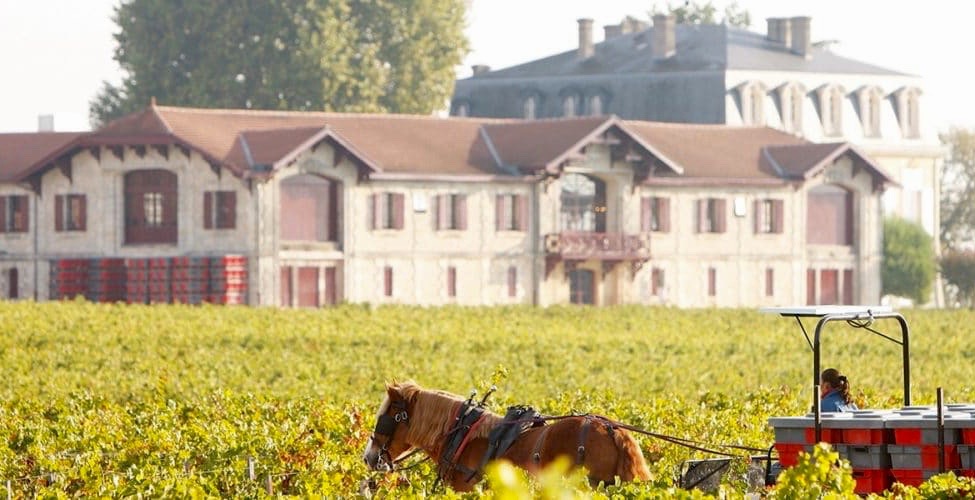
For instance moving away from heavy machinery and reintroducing horses to the fields isn’t just a marketing ploy; it reduces soil compaction and preserves the natural structure of the earth. A holistic approach encourages a healthy microbiome, where natural yeasts and beneficial bacteria flourish alongside worms, insect life, wildflowers, bees, birds and small mammals.

Estates that focus on biodiversity often showa more authentic expression of place and it can improve quality too: reducing chemical inputs and allowing natural vegetation to grow helps to regulate the soil’s temperature and moisture levels. For the investor, these sustainable practices are increasingly seen as a marker of long-term value and grow an estates’ reputation.

What grape varieties are suited to what terroir

Not every grape variety is suited to every terroir. The choice of variety is a major factor in how a site expresses its character. A grape must be able to achieve full ripeness under local climatic conditions to exhibit its best flavours and structural balance.

For example:

  • Syrah: Reaches its pinnacle in the Northern Rhone.
  • Nebbiolo: Thrives in the specific hillsides of Piedmont.
  • Pinot Noir: Is famously temperamental, requiring the cool climate of Burgundy.
  • Cabernet Sauvignon: Requires the warmth and drainage provided by the gravel plateaus of Pauillac.

When a grape is perfectly matched to its location, the resulting wine possesses a quality that is impossible to replicate. This suitability is often protected by regional laws that mandate certain grape types to prevent the erosion of quality and promote collective branding.

Protecting place: DOC Rules and the Napa Declaration

Over the last 100 years it has become increasingly common for the concept of terroir to be codified through legal systems like the French Appellation d’Origine Controlee rules. These regulations protect specific terroirs by mandating which grapes can be grown and how the wine must be made. This ensures that a bottle carries a guarantee of origin and typicity.

These regulations are not limited to France or Europe, many nations have since adopted similar rules and their protection is often a key goal of international trade negotiations. The Napa Declaration on Place is a significant international agreement where producers committed to protecting the integrity of wine place names recognising that “place” is the most fundamental aspect of a wine’s identity. This prevents the misleading use of geographic terms for wines that were not grown in those specific soils.

Terroir: Fine wine vs commodity wine

So important is terroir that in many ways the distinction between fine wine and commodity wine is geographic specificity. Commodity wines are often produced from grapes sourced across entire countries or continents. They prioritise volume and consistency over the unique characteristics of a single site.

Fine wine, by contrast, is almost always tied to a specific patch of earth; the land is fixed and cannot be expanded. This geographic restriction ensures that supply is capped, creating the conditions for long-term price appreciation in the secondary market.

Winemaking: Expressing vs overriding terroir

The role of the winemaker remains a subject of discussion but winemaking practices undeniably contribute to the final style.

In the late 20th century, as wine critic Robert Parker’s influence expanded his evolving preferences and the impact a high Parker score could have on values began to influence winemaking. A trend of “Parkerization” favoured rich, bold, and heavily oaked wines. Consultants like Michel Rolland were often associated with this opulent style and sometimes accused of overriding terroir in favour of a homogenous international style. 

In reality this was not a plot against terroir by winemakers, consumers or critics, but a reflection of commercial reality.

Recent years have seen a strong reaction against this trend with many producers intentionally adopting a “less is more” philosophy. They may use neutral vessels, such as large Slavonian oak botti rather than imported French oak barrels or wild yeasts from the vineyard rather than cultured products. 

The goal is to act as a steward of the land and reflect that in the wine rather than be the creator of a brand that makes an unchanging product.

Climate change and the shifting map

Climate change is having a profound impact on the global wine map. Rising temperatures are shifting the boundaries of where fine wine can be produced, in some regions where a southern aspect was preferred in the 1980s those vineyards are now becoming less productive and limited by the heat that used to be an advantage.
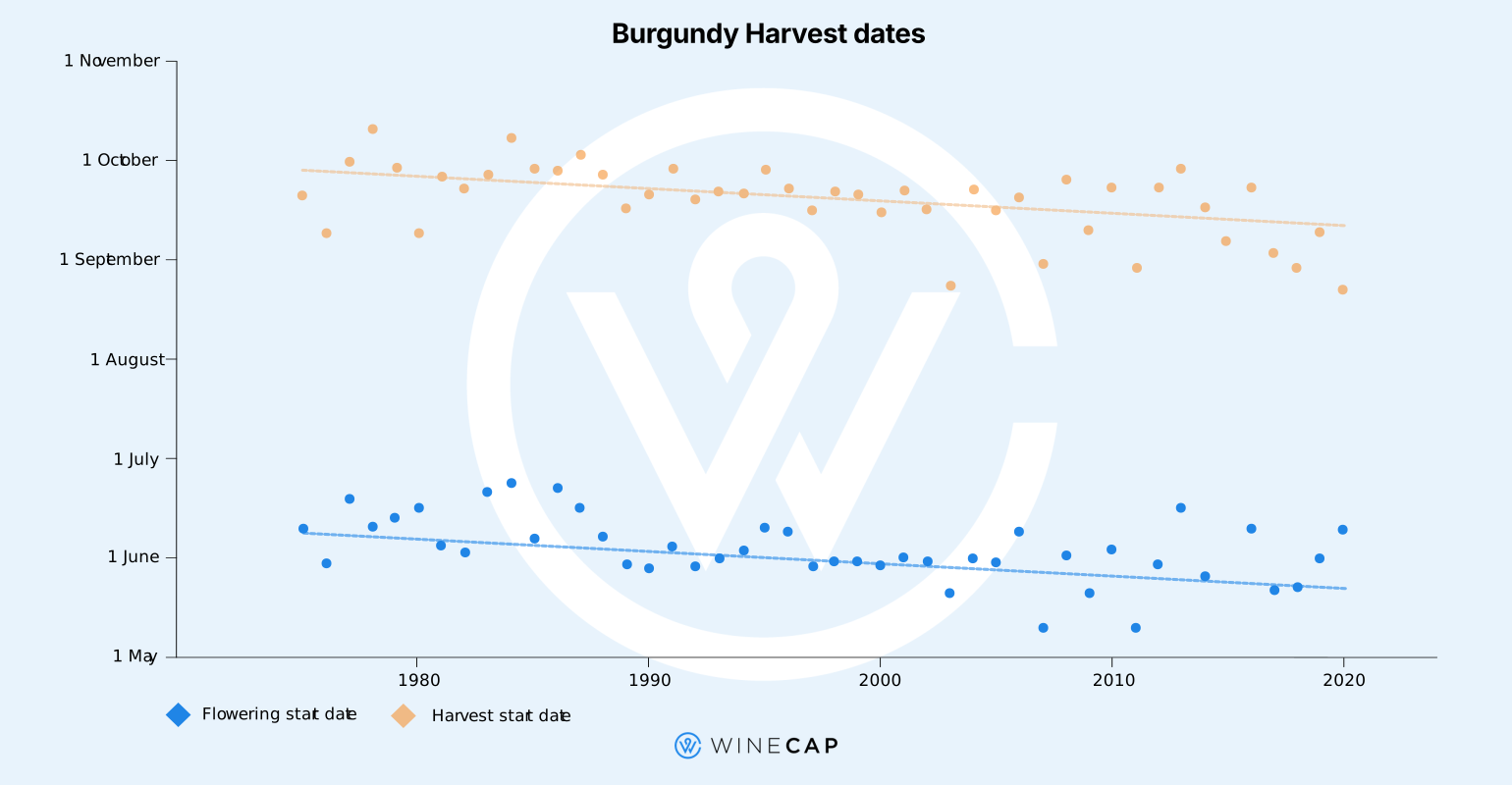
Burgundy Flowering and harvestData Source: jancisrobinson.com

Some historical regions are finding it increasingly difficult to maintain their traditional styles as sugar levels rise and acidity drops.

However, this shift is also opening up new frontiers:

  • English sparkling wine: Counties like Kent and Sussex now share a climate similar to the Champagne of several decades ago.
  • Patagonia and Central Otago: High-latitude regions are becoming top destinations for cool-climate varieties.
  • Emerging northern regions: Areas in Germany and even Scandinavia are beginning to produce high quality Pinot Noir.

For the investor, these changes create both risk and opportunity. While established terroirs are still preferred, new regions may become a more important part of the conversation in coming years.

Terroir beyond the wine glass

The concept of terroir is not exclusive to viticulture. It exists in many other artisanal products where sense of place is paramount. The “Slow Food” movement was built on this foundation, celebrating traditional agricultural products that reflect their local environment.

Other examples of terroir include:

    • Cheese: Such as Comte or Roquefort, where the local grasses and caves define the flavour.
    • Olive oil: Where regional soil and climate produce distinct profiles.
    • Coffee and tea: Where high-altitude “micro-lots” are traded at a premium.
    • Meat: Beef and lamb from the Orkney islands were among the first British products to gain legal recognition of their terroir.

In all these cases, terroir represents an element that imparts a sense of place. It is the ultimate rejection of mass-production and the celebration of the unique.

FAQ: A guide to terroir 

Is terroir just a marketing tool? 

While it is used in branding, terroir is based on documented physical factors like geology, climate, and topography that result in discernible variations in wine character.

Can a winemaker completely change a wine’s terroir? 

A winemaker can hide terroir through excessive oak or extraction, but they cannot create the structural intensity or complexity that only a superior site can provide.

Why does terroir matter for investment? 

Geographic specificity creates a natural cap on supply. Because the most famous vineyards cannot be expanded, the resulting rarity drives value in the secondary market.

Does the New World have terroir? 

Yes. Many New World producers now use soil mapping and single-vineyard designations to highlight the unique character of their specific plots.

WineCap’s independent market analysis showcases the value of portfolio diversification and the stability offered by investing in wine. Speak to one of our wine investment experts and start building your portfolio. Schedule your free consultation today.

Categories
Learn

Top reasons to invest in fine wine in 2024

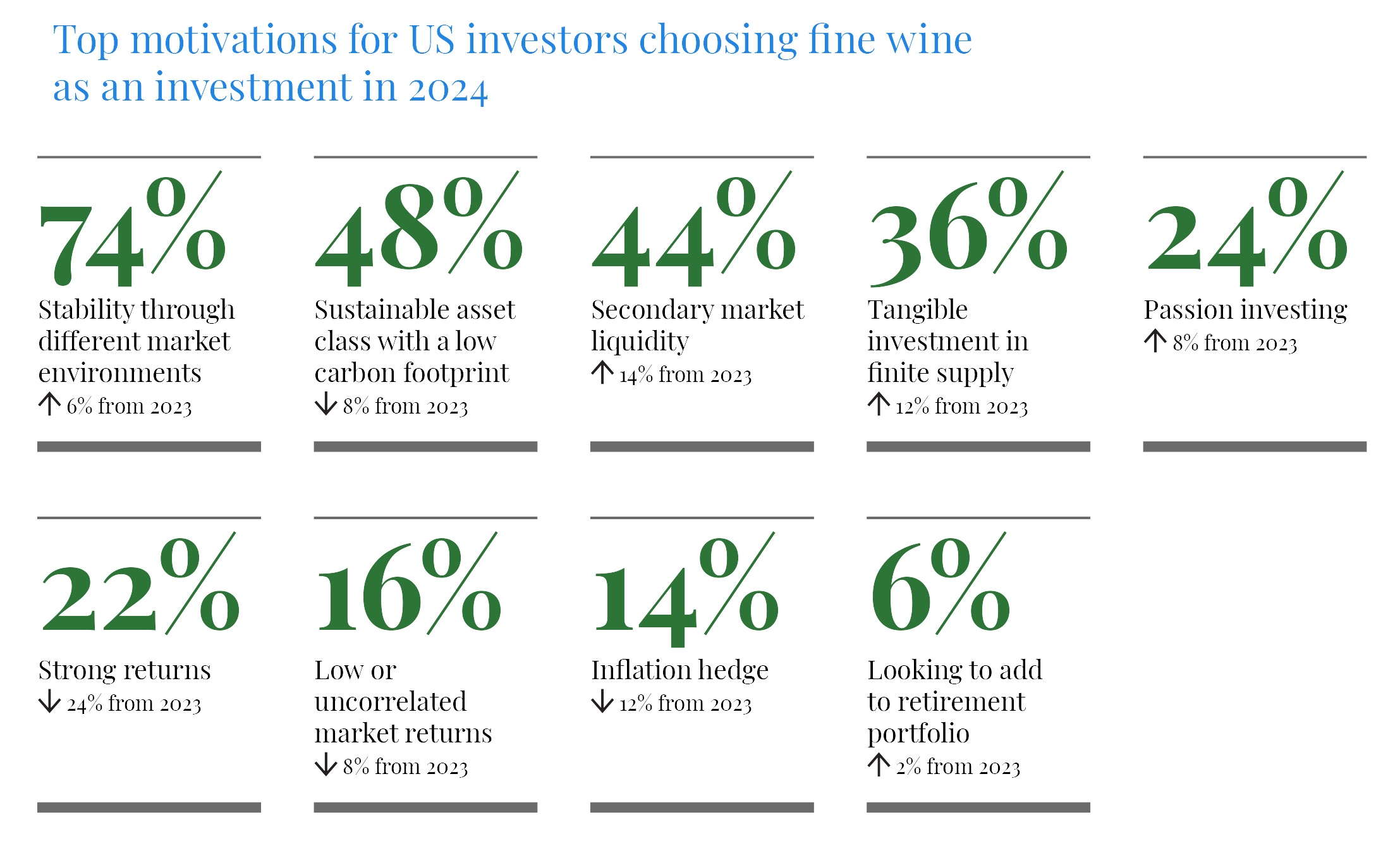
  • Stability, sustainability and increased market liquidity are the key drivers of investment interest in fine wine. 
  • UK investors are also attracted by the tax advantages of fine wine, which is classed as a ‘wasting asset’.
  • Meanwhile, passion investing is on the rise in the US, seeing an 8% uptick since last year.  

Our recent survey among UK and US wealth managers revealed the top reasons why investors are choosing fine wine in 2024. 

While there are differences in their motivations based on demographic, sustainability, stability through different economic environments, and increased liquidity came at the forefront in both markets.  

Fine wine’s stability during market volatility

In uncertain times, investors often seek tangible assets that offer stability. As WineCap’s CEO, Alexander Westgarth puts it, ‘In times of hardship, people want something solid. Literally. Tangible assets like property, gold or fine wine tend to feel more precious during market downfalls’. 

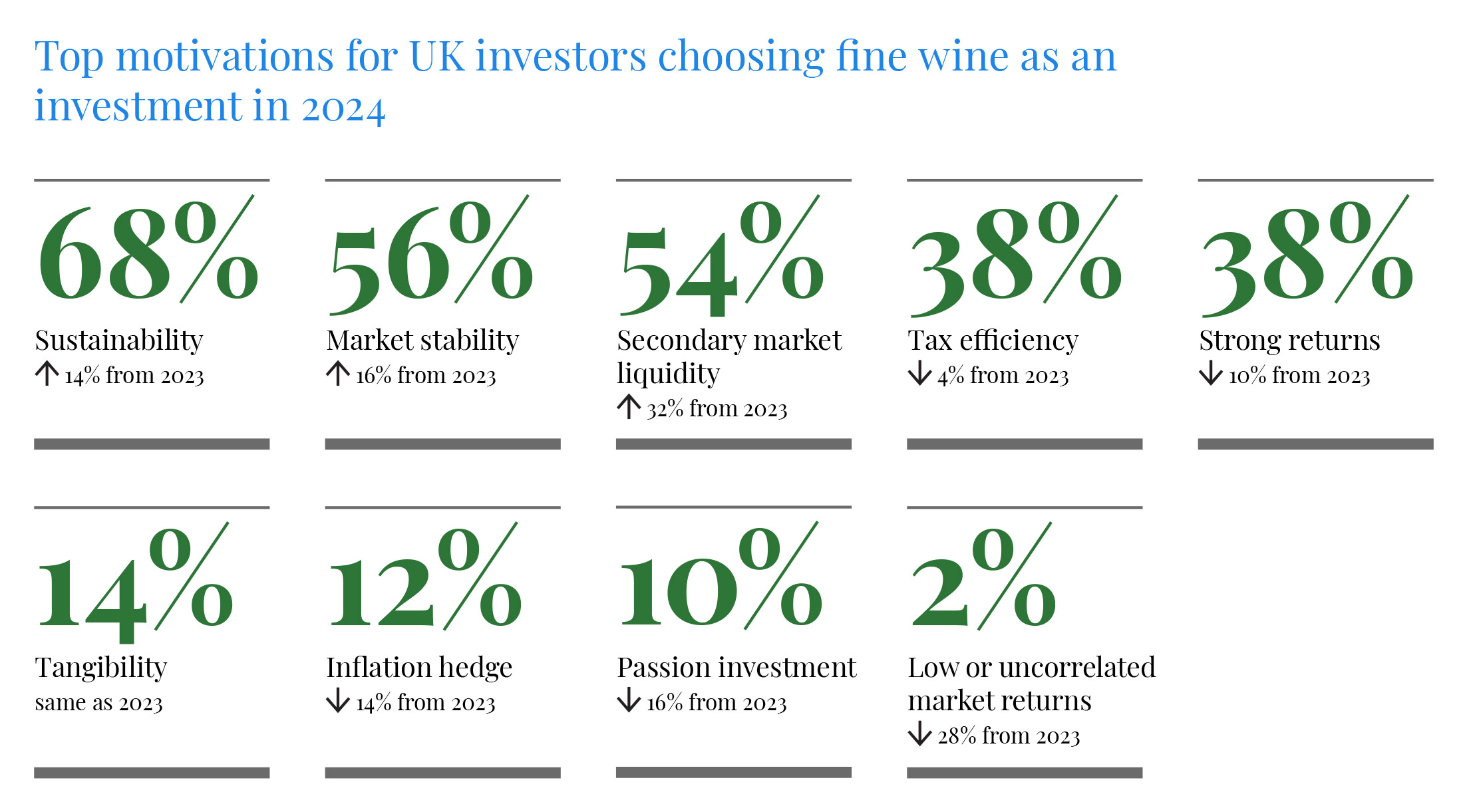
With US market sentiment being one of fear, according to the Fear & Greed index, 74% of US wealth managers chose stability as their top reason to include fine wine in client portfolios, marking a 6% increase from last year.

In the UK, stability came as the second most important factor driving demand for fine wine. It was cited by 56% of our survey respondents, up 16% since 2023. High inflation, slow economic growth and various macroeconomic headwinds have solidified fine wine’s position as a ‘safe haven’ asset, preferred by UK investors. 

Sustainable investing on the rise

Sustainability was the number one reason to invest in fine wine for UK wealth managers, and the second most important factor in the US. 

As we recently explored (‘The growing importance of sustainability in fine wine investment’), there has been a broader global trend where environmental, social, and governance (ESG) factors are increasingly shaping investment strategies across various asset classes, including fine wine.

Research from Morgan Stanley shows that more than half of individual UK investors plan to increase their allocations to sustainable investments in 2024, making fine wine a great investment option. 

According to our survey, 68% of UK investors invest in fine wine because of its low-carbon benefits, with many fine wine producers leading the charge in sustainable viticulture. 

Improved liquidity

Investors in both the UK and US recognise that the fine wine market is becoming more liquid. Advances in technology have opened up new avenues for investors, simplifying buying and selling processes, improving price transparency, and shifting perceptions of fine wine as an “illiquid liquid.”

As a result, UK investor confidence in the market’s liquidity has increased by 32% in 2024. As for the US, there has been a 14% increase from 2023. 

UK tax benefits

UK investors benefit from fine wine’s status as a ‘wasting asset’ making it a more tax-efficient investment. As of April 2024, UK investors pay up to 28% tax on profits over £3,000. Pre-2022, investors paid tax on anything above £12,300, but the past few years have seen the threshold slashed in a bid to plug the ‘fiscal black hole’. 

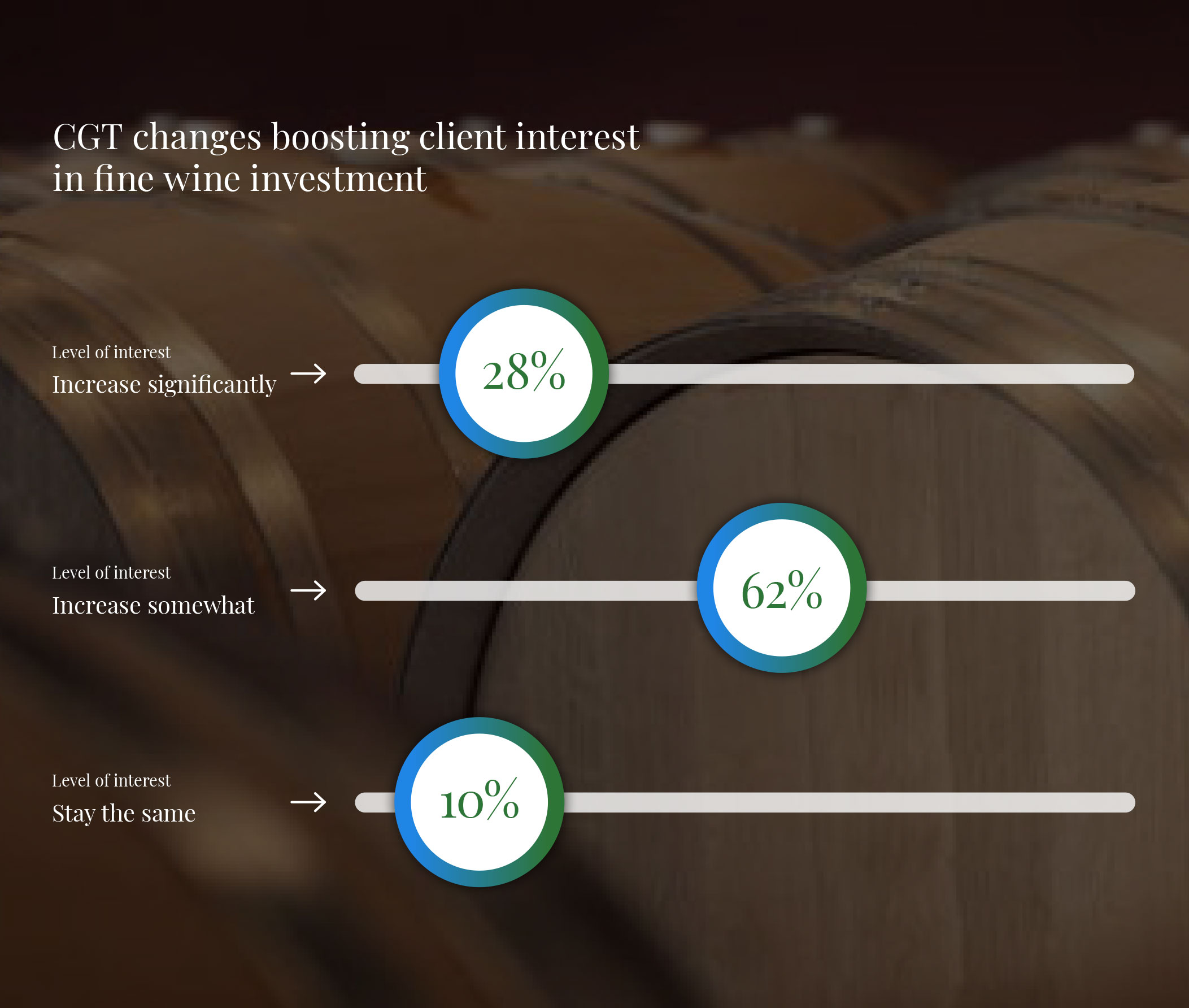
As a ‘wasting asset’, the HMRC does not consider fine wine an investment where the profit should be taxed. Investors recognise this benefit, with 90% of our survey respondents noting that the CGT changes will increase the attractiveness of fine wine.

Tax efficiency was the fourth most important reason for UK investors, cited by 38% of the respondents.

The overlap between collecting and investing in the US

Fine wine, long seen simply as a passion asset, has managed to rebrand itself as a sound alternative investment choice. UK investors today focus less on ‘passion’, a motivation that has seen a 16% dip since last year. 

Still, in the US, many investors start out as collectors. ‘Passion investing’ has been on the rise across the pond, with 24% of the survey respondents being motivated by earning a profit and enjoying the experience that comes with owning a fine wine collection. 

For the full breakdown of the reasons why investors choose fine wine in 2024, read our UK and US Wealth reports.

WineCap’s independent market analysis showcases the value of portfolio diversification and the stability offered by investing in wine. Speak to one of our wine investment experts and start building your portfolio. Schedule your free consultation today.
 

Categories
News

The growing importance of sustainability in fine wine investment

  • Sustainability is a major factor influencing investor decisions in the UK.
  • Fine wine producers are embracing sustainable viticulture techniques aimed at reducing their carbon footprint and making a social impact.
  • Fine wine is a forward-thinking sustainable investment choice.

Sustainability is a major factor influencing investor decisions in the UK. Fine wine producers are increasingly embracing sustainable viticulture techniques aimed at reducing their carbon footprint, making fine wine a forward-thinking investment choice.

The evolving landscape of fine wine investment

In recent years, the landscape of fine wine investment has undergone significant changes. Beyond the traditional allure of rarity and prestige, a new motivation is influencing investor decisions in the UK: sustainability.

This shift reflects a broader global trend where environmental, social, and governance (ESG) factors are increasingly shaping investment strategies across various asset classes, including fine wine. Investors are now looking at the environmental impact of their investments, and fine wine is emerging as a preferred choice for those who prioritise sustainability.

UK investors prioritise sustainability

Historically, investing in fine wine has mostly been driven by passion, financial gains, and the status of owning rare vintages from a select few vineyards. 

However, as society becomes more conscious of sustainability issues, there has been increased global demand for sustainable and impactful investing. Fine wine is ideally positioned to benefit from this shift.

Recent research conducted for our 2024 UK Wealth Report found that sustainability has emerged as the most important factor influencing the preferences of both seasoned and novice investors in the fine wine market. 

Our 2023 survey found that 56% of investors are attracted to fine wine because it is a sustainable asset class with a low carbon footprint. In 2024, this positive investor sentiment towards fine wine has increased in the UK, with 68% of the survey respondents citing sustainability as their top motivation to invest in fine wine. 

UK investors increasingly recognise the benefits of ethical alignment, accessibility, and financial viability that fine wine brings as an asset.

The benefits of sustainable investing

One of the most compelling selling points of fine wine investment lies in its low-carbon benefits. Many fine wine producers are embracing sustainable viticulture techniques aimed at reducing carbon footprints, as outlined in our Fine Wine Sustainability Report.

Vineyards leading the charge are implementing methods to preserve old vines, adapt to climate change, mitigate environmental impact, and promote biodiversity. These sustainable practices not only benefit the environment but also enhance the quality and longevity of the wine, making it an even more attractive investment.

The expanding appeal of sustainable investing is expected to grow, driven by environmentally conscious investors seeking resilient assets that offer both financial security and ethical value. This trend not only enhances the market appeal of fine wine but also reinforces its status as a forward-thinking investment choice.

A deeper dive into the changing fine wine investment attitudes

For those interested in exploring this trend further, WineCap’s 2024 Wealth Report offers an in-depth look into the top motivations for investing in fine wine, the trends shaping the landscape in the UK, and investor sentiment.

This comprehensive report provides valuable insights for both current and prospective investors, highlighting the growing importance of sustainability in the fine wine market.

Download a complimentary copy of WineCap’s 2024 Wealth Report to gain a deeper understanding of this evolving market and the role of sustainability in shaping its future.

WineCap’s independent market analysis showcases the value of portfolio diversification and the stability offered by investing in wine. Speak to one of our wine investment experts and start building your portfolio. Schedule your free consultation today.
Categories
Learn

Fine wine sustainability report (Part III): profiling the sustainable investor

  • There is an overlap between sustainable and fine wine investors as both share a long-term vision and increasingly similar demographics.
  • 56% of investors are attracted to fine wine because it is a sustainable asset class with a low carbon footprint.
  • Environmental, social and financial sustainability is one of the five characteristics that distinguishes fine wine from other beverages.

This is the third part of our ‘Fine wine sustainability report’. See also part I – how is fine wine sustainable and part II – how can fine wine mitigate risk in a sustainable portfolio

There is already some cross-over between sustainable and fine wine investors. The demographics are getting closer all the time.

The most active sustainable investors today are millennials (the group currently aged between 27 and 42). More specifically, the majority of them are entrepreneurs and legacy builders. Likewise, within the world of fine wine, research from Sotheby’s in 2022 found that 35% of new buyers are under the age of forty. This is the second consecutive year of millennials betting on fine wine as the figure hit 37% in 2021.

Fine wine investments can take around ten years to mature, but often take longer to reach scarcity returns. This means that most investors are collecting long-term legacy assets, just like many sustainable investors. The overlap that already exists between ambitious sustainable and fine wine investors is promising. We believe it will continue to grow for the future.

There is already a burgeoning movement of sustainable investors buying fine wine. Our 2023 survey found that 56% of investors are attracted to fine wine because it is a sustainable asset class with a low carbon footprint. Although fine wine has many investment qualities, we believe that the best-suited sustainable investors are those who are looking to hedge against volatility or inflation risks over the long-term. Some investors have religious or personal barriers to investing in fine wine, and in this situation, the asset may not be suitable.

An insatiable passion for change

Is there any industry more determined to adapt and mitigate against the climate crisis than fine wine? The dogged and ruthless determination of winemakers is as inspirational as it is impressive. With floods, forest fires and droughts ripping through the planet, we need every innovation from every industry. Nothing should be discounted. And sustainable investors should be given every possible opportunity to mitigate against risks.

The fine wine industry is rapidly evolving its stance on the planet, with biodiversity, climate adaption and mitigation taking centre stage. Environmental, social and financial sustainability is one of the five characteristics that distinguishes fine wine from other beverages. It is now a defining feature at the heart of every vineyard, nestled in every bottle. What’s more, the Sustainable Wine Roundtable launched a framework for identifying and categorising sustainability in wine in 2023. Now investors have more layers of security than ever before that their investment matches their ethics.

Depriving investors of fine wine would not just leave inflation and stability gaps in portfolios, it would undermine the vital work of an evolving industry. As powerful as it is passionate, this is an asset that packs a seriously low-carbon punch in sustainable portfolios.

“A fine wine is complex, balance, with a potential to age – though highly drinkable at every state of its development. It has the capacity to provoke emotions and wonder in the one drinking it, while reflecting the expression of truth intended by its maker. It is widely recognized, while being environmentally, socially and financially sustainable.

Areni

Categories
Learn

Fine wine sustainability report (Part II): how can fine wine mitigate risk in a sustainable portfolio?

  • The second part of our report focuses on how fine wine can mitigate risk for sustainable investors.
  • By blending sustainability-linked bonds with fine wine, investors can shield some of their wealth from inflation while having access to a regular income stream.
  • The steadiness of fine wine can help to smooth out the overall performance of sustainable portfolios, hedging against the volatility risks of impact investments.

Fine wine has many qualities that make it an environmentally and socially sustainable asset, as discussed in the first part of this report. And we believe that it can offer even more value as a hedge for sustainable portfolios. Just as with traditional investing, each investor is different. However, there will be some common themes and risks. In this section, we analyse how fine wine interacts with some of the most popular sustainable investments, and where the assets can become greater than the sum of their parts.

Sustainability-linked bonds

For businesses to become sustainable, they will usually need to pay for new infrastructure. This is where bonds come in. Investors finance the projects and receive a regular income from the repayments and interest (known as coupons) over a set period of time. There are many examples of corporate and sovereign green bonds, but probably the most impactful is Orsted.

In 2017, Orsted raised 1.25 billion euros from investors to successfully transition from brown to green energy. The bonds last until 2029. Since then, Orsted has been named the world’s most sustainable company. Today 91% of the energy it creates comes from renewable sources. The aim is to be at 99% by 2025. For context, worldwide this accounts for just 13% of energy. Orsted has also just released a blue bond, which focuses on marine life and oceans.

Sustainability-linked bonds can be built around society as well as the environment. Research by Goldman Sachs found 65% of investors are interested in social bonds, with 29% already invested.

Bonds are a good and relatively low-risk way for investors to generate an income while doing good. But there are some downsides. The main issue is that as bonds set a fixed repayment schedule years – sometimes decades – in advance, inflation can reduce the purchasing power of the income over time. In a usual market environment, central banks aim to keep inflation levels to around 2% or under, which is priced into the bond. However, in recent years, it has shot up to double digits. This can slash real returns for investors, and potentially put them off green bonds.

We believe that fine wine can help to hedge against the inflation risk of sustainability-linked bonds. The two assets complement each other well, as fine wine is less liquid but inflation resistant. By blending bonds with fine wine, investors can shield some of their wealth from inflation while having access to a regular income stream.

Impact investments

There are some businesses and organisations that make a clear and measurable change, while delivering returns for investors. Some environmental examples include investments in sustainable waste management, building renewable energy plants or businesses producing meat alternatives. There are also social movements; for example, venture capitalist firms investing in women and people of colour, affordable housing developers or accessible childcare services. When investments make tangible improvements, they are usually known as impact investments (because they make an impact).

While impact investments can be almost any asset class or risk level, in general they tend to be on the riskier side. By their nature, they are usually fairly new ventures, and can also be subject to incoming regulations. This could mean that the stocks spring and plunge, making sustainable investors nervous.

Fine wine, by contrast, is a low-risk asset with little volatility. We feel that the steadiness of fine wine can help to smooth out the overall performance of sustainable portfolios, hedging against the volatility risks of impact investments.

Overall positioning in a portfolio

Fine wine should not be the star of the show, but more of a supporting act. It is often best placed as a hedge against other sustainable or impactful assets, especially those with inflation or volatility risks. Generally, wealth managers and investors keep fine wine allocations under 10% of the total portfolio.

Stay tuned for Part III – profiling the sustainable investor.

Categories
Learn

Fine wine sustainability report (Part I): how is fine wine sustainable?

  • Fine wine offers a sustainable investment option, which is increasingly recognised by wealth managers.
  • The industry is proactively adapting to climate change, with practices like regenerative farming and reducing bottle weight. 
  • Fine wine’s focus on social sustainability, including worker welfare and community support, boosts its appeal as a sustainable investment choice, aligning with modern ESG criteria.

Floods, fires and famine are no longer on our doorstep, they have already crossed the threshold into normality. In the first eight months of 2023 alone, the USA suffered 23 separate billion-dollar climate disasters. Research shows that by 2050, floods in Europe will increase five-fold.

Alongside climate disaster comes human suffering, ever-growing wealth gaps and loss of livelihoods. The homes of indigenous tribes are deforested to clear space for oil drilling. The most vulnerable find their communities and businesses flooded. Meanwhile, social inequality rachets up with poor climate policies.

Investors are all too aware of the damage. A 2023 study by Harvard found 85% ask their advisors about sustainable investments. While some groups – particularly millennials – have become activists themselves, using their shareholder votes to force change. So where does fine wine come into this?

Although ethical investing has been around for centuries, climate-focused sustainable investing is strikingly new. The insatiable demand we see today is less than a decade old. Between 2016 and 2020 alone, sustainable investing in Europe, USA, Canada, Australasia, and Japan swelled by 55%. Even though it is a multi-trillion industry, ‘Sustainable Investment’ still doesn’t even have a definition in most parts of the world. Because of this, the movement has borrowed a lot from pre-existing rules, which were mostly religious.

For centuries, our sustainable investment has been built on the foundations of Quaker and Methodist beliefs. This explains why alcohol, or to quote John Wesley ‘that liquid fire’ has been prohibited from almost all ESG (environmental, social, governance) funds – even when fossil fuel producers, fast fashion and plastic polluters made it on the list.

However, we believe this is a mistake. Fine wine offers extraordinary sustainable benefits to investors, especially when it comes to balancing out the risks of green bonds and risky impact investments. Not only does fine wine contribute to a greener future (it is a natural product after all), but this asset class can also plug vital strategic gaps, giving sustainable investors even more confidence. The time has come to give fine wine the credit it deserves.

How is fine wine sustainable?

While there is no universal definition of a ‘Sustainable Investment’, the European Union has made significant headway. According to the EU taxonomy, an environmentally sustainable investment must contribute significantly to one of the following, without jeopardising the others;

  • Climate change mitigation
  • Climate change adaption
  • Sustainable use and protection of water and marine resources
  • Transition to a circular economy
  • Pollution prevention and control
  • Protection and restoration of biodiversity

We believe that fine wine not only meets this criterion but exceeds it. Vineyards rely on a stable climate, fertile soil and regenerative farming. From using free range ducks and sheep instead of pesticides to replacing heavy glass with lighter alternatives, the environmental innovations in the wine industry are never-ending.

Climate change mitigation and circular economies

To secure a safer future, every efficiency counts. The most carbon-intensive part of fine wine production is making and transporting the heavy glass bottles that contain the wine. According to one Sustainable Wine Roundtable report, this accounts for over half of the total environmental impact of wine. Simply by reducing the bottles from 550g to 420g would cut 25% of carbon emissions.

Although dense packaging has long-been associated with quality, European fine wine producers are throwing themselves into this trend. Burgundy producer, Albert Bichot, for example has reduced the bottle weight from 700-750g to 450g. According to one interview, the producer also uses only recycled glass and biodegradable labels. Even Champagne – which typically uses thicker glass – is experimenting. Bollinger, for example, is committed to a 7% reduction in bottle weight by 2029, as well as to use only recycled and recyclable materials.

Another area for improvement is energy efficiency throughout the manufacturing process. Here, fine wine has achieved far more than other industries. Almost every fine wine producer we could find has taken significant steps to reduce emissions dramatically. One of our favourite examples is Ornellaia. 2022 saw this winery slash liquefied petroleum gases usage by 98% with biomass heat. Today the entire firm uses the equivalent of 5% of the average family of four household over a year. Ornellaia has also blended nature with technology by installing a Building Management System to ensure that the temperature is efficiently set.

Climate change adaption, sustainable use of water and protection of biodiversity

World-famous flavours are at risk from climate change. As Comité Champagne report, temperatures are now 1.8 degrees higher than in the 1980s, meaning grapes are at risk of bursting prematurely or drying out. They now need to be picked thirty days earlier, potentially cutting the characteristic tastes short. Fine wine producers have been rigorousness and brave, proactively innovating in the face of the climate crisis. Not only do these innovations help cool down and protect the precious vines, but they also offer investors significant environmental benefits too.

One of the most widespread practices in fine wine vineyards now is the use of regenerative farming. Rather than using typical organic practices, which can still harm pollinators, producers are leaning into nature. Sheep roam around some vineyards picking off bugs organically, and often, horses are put to work instead of tractors.

Significantly, many fine wine producers such as Château Cheval Blanc plant diverse fruit and forestry trees between the vines. This helps to shade the grapes, sequester carbon and provide homes for vital pollinators. The fungus which grows around the roots of the trees also soaks up water, acting as a pump, pushing nutrients into the vines.

Water irrigation is one of the hottest topics for today’s fine wine producers, with many now working with their natural landscapes to find the best solutions. Vineyards are increasingly planting or shifting vines along the contours of the land, to prevent run-off during heavy rainfalls. They are also adding ground covers to prevent evaporation, keeping the soil damper and more nutritious.

The adaptions are coming thick and fast, as vineyards experiment with new grapes, and alternative locations. Northern France, the UK and Germany are fast becoming viable options for fine wine in this new climate, with producers are always one step ahead of the curve.

Social sustainability

Sustainability is about more than preserving the environment. It is also about protecting workers and supporting local communities. Although the fine wine industry is not as advanced in this area as it is with environmental sustainability, frameworks and strong voices are beginning to emerge. As one wine producer puts it:

‘Do we farm organically because it’s better for the environment? Certainly. Do we farm organically because it makes better-tasting wine? Without question. But the most important reason to farm organically is because the lives of the people who work in the vineyards, and the people who live downstream, matter.’

Caring for the environment and biodiversity also has far-reaching effects on local life. Vineyards continue to play a vital role in the culture and traditions of their local communities. Recently the Comité Champagne proposed a series of tangible solutions to improve the lives of the region’s 120,000 harvest workers. We are also seeing a general trend of permanent contracts for employees, as well as a sharp focus on improving diversity at board levels. While there is certainly work to be done in this space, the general trajectory looks promising.

Stay tuned for Part II of our Fine Wine Sustainability Report, in which we discuss how fine wine can mitigate risk in sustainable portfolios – coming next week.

Categories
Special-reports

Special report – 2023’s big investment themes: fine wine and beyond

Our latest report, 2023’s big investment themes: fine wine and beyond, has now been released. The report looks at the key themes that defined markets this year, from interest rates to sustainability. It positions fine wine within a broader investment context and analyses the key events that influenced its performance.

Report highlights:

  • Tech, interest, and sustainability came to define markets in 2023.
  • The stock market bounced back, and technology stocks rallied as the world became fascinated with generative AI.
  • In a bid to cool down the red-hot inflation levels, the Bank of England cranked up interest rates 14 times.
  • As central banks increased interest rates, they also began to stockpile gold.
  • In the UK, interest rates reached the highest point since 1998. This signalled an end to the era of cheap borrowing, which could limit growth for some economies.
  • 2023 saw the rush of demand for green bonds – borrowing money to finance sustainable projects.
  • Sustainability drove fine wine demand among investors and led to other positive developments in the wine industry.


Download your complimentary copy of the2023’s Big Investment Themes
and discover how fine wine can enhance your investment portfolio.


Big Investment Themes Report 2023


Categories
Learn

Is sustainable wine the next big investment trend?

  • Sustainability in wine encompasses various processes such as environmental stewardship, social responsibility, and long-term financial viability.
  • Sustainability appeals to a growing group of investors who want their money to do good while it grows.
  • Top wineries implementing sustainable practices include Bodega Catena Zapata and Château Pontet-Canet.

The wine investment market has diversified considerably in recent years, with sustainability becoming a core focus. As examined last week, environmental considerations are the number one reason why UK investors choose to invest in fine wine. Today’s article explores the criteria for sustainable wine, its appeal, risks and considerations, as well as the future prospects for this important market segment.

Defining sustainable wine

Sustainability in wine is a nuanced concept that goes beyond certifications like ‘organic’ or ‘biodynamic’ that you might find on a bottle’s label. These certifications are positive indicators but they do not provide a complete picture of a wine’s overall sustainability or its quality. In fact, while organic and biodynamic practices are steps in the right direction, they are not panaceas for all environmental challenges facing vineyards and wineries.

Truly sustainable wines are produced with a broader vision that encompasses not just environmental considerations, but also social and economic aspects. This holistic approach involves responsible land use, ethical labour practices, and a focus on long-term financial viability for producers.

Organic, biodynamic, and sustainable – what is the difference?

Organic wines are made from grapes grown without synthetic pesticides or fertilisers. Biodynamic wines take this a step further by integrating the vineyard into a self-sustaining ecosystem.

Sustainable wines, however, encompass a broader range of practices aimed at the long-term viability of the entire wine-producing operation. Various certifications, such as ‘Certified California Sustainable Winegrowing’, exist to label these wines officially. Organisations such as Sustainable Wine work to enhance clarity around sustainability in the industry as a whole from viticulture to packaging solutions and logistics.

The appeal of sustainable wines

Sustainability appeals to a growing cohort of investors who want their money to do good while it grows. Investing in sustainable wines satisfies this ethical imperative, thereby adding another layer of attraction to the investment.

Studies indicate a rising demand for sustainable products, including wine. This increased consumer demand means greater sales potential and, by extension, a probable rise in value for these wines over time.

Sustainable wines often come with compelling stories of environmental stewardship and community support. This narrative adds a unique selling proposition that can boost brand value and investment potential.

Risks and considerations

Like any investment, putting money into sustainable wines is not without risk. Market volatility, consumer preferences and supply and demand can impact returns as with any other investment-grade wine.

Another risk lies in the potential for ‘greenwashing’, where a wine’s eco-friendly credentials can be exaggerated. Investors must perform due diligence to ensure they are backing genuinely sustainable ventures.

How to invest in sustainable wines

The first step is comprehensive research: utilising online resources, expert reviews, and consumer reports to assess a wine’s investment potential and sustainable credentials. Diversifying your portfolio by including a mix of sustainable wines from various regions and price points can mitigate risks and increase the potential for rewards.

Pay close attention to ratings from renowned wine critics and industry experts. A high rating can significantly impact a wine’s market value.

Sustainability pioneers

Several wineries around the world are setting the bar high for sustainable practices. Frog’s Leap in Napa Valley is known for its organic and dry farming techniques. Germany’s Weingut Wittmann has also embraced organic farming and natural winemaking processes. In Argentina, Bodega Catena Zapata stands out for its sustainable farming and research into high-altitude winemaking. Château Pontet-Canet in Bordeaux is another success story, having converted to biodynamics in 2014 after various setbacks in 2007. Their journey underscores the long-term dedication needed for truly sustainable winemaking.

Future outlook

From water-saving technologies to renewable energy, the wine industry is continually adopting more sustainable practices, pointing to a robust market future. Experts predict the demand for sustainable wines will only grow, particularly as younger generations who prioritise sustainability come of age.

Sustainable wines present a captivating new frontier in wine investment, promising both ethical satisfaction and financial gains. As with any investment, there are risks, but the burgeoning market for these wines, coupled with their unique branding advantages, makes them a trend worth watching. For investors willing to do their homework, the opportunity is ripe for the picking.

WineCap’s independent market analysis showcases the value of portfolio diversification and the stability offered by investing in wine. Speak to one of our wine investment experts and start building your portfolio. Schedule your free consultation today.
Categories
News

Moët Hennessy’s new organic certifications reflect a growing trend in the wine industry

  • Moët Hennessy has achieved new organic certifications for three estates, highlighting their commitment to sustainability and soil health initiatives.
  • The wine industry has seen a rise in organic wineries as more producers adopt sustainable practices to promote soil health, biodiversity, and natural pest control.
  • This is not only beneficial for the environment but presents an opportunity for ESG investors.

Moët Hennessy achieves new organic certifications

Moët Hennessy has achieved new organic certifications for three of its estates as part of its sustainability initiative called ‘Living Soils Living Together’, the drinks business reported.

One of the accreditations was granted to Château Galoupet in Provence, recognising its commitment to soil regeneration and soil health initiatives.

Additionally, two wine estates in Argentina, Chandon Argentina and Terrazas de Los Andes, were awarded the Regenerative Organic Certified (ROC) status by the non-profit organization Regenerative Organic Alliance.

In line with the program, Moët Hennessy had previously committed to ceasing the use of herbicides in its Champagne vineyards.

The rise of organic wineries

Moët Hennessy is not alone in its pursuit of a greener future. There has been a noticeable increase in the number of wineries adopting organic practices in recent years. The organic wine movement has gained significant momentum as consumers and wine investors have become more conscious about sustainable and environmentally friendly products.

Wineries are transitioning to organic farming methods to reduce their use of synthetic chemicals, pesticides, and herbicides in grape cultivation. Such practices focus on promoting soil health, biodiversity, and natural pest control, resulting in healthier vineyards and potentially higher quality grapes.

Renowned organic producers

Some of the most renowned organic producers include Burgundy’s Domaine Leflaive, and the Bordeaux Fifth Growth estate, Château Pontet-Canet.

While not officially certified, Burgundy’s Domaine de la Romanée-Conti also adheres to organic and biodynamic principles in its vineyard management and produces some of the most sought-after wines in the world.

A sustainable investment asset

The increasing adoption of organic and sustainable practices by wineries is not only beneficial for the environment but also presents an opportunity for wine investors. The influence of Environmental, Social and Governance (ESG) factors over investment portfolios has grown dramatically in recent years.

Indeed, fine wine can be considered an ESG investment for the following reasons:

  1. Vineyards are a carbon sink. A rugby-pitched-sized area of vineyard soaks up a respectable 2.84 tonnes of carbon every year.
  2. Soil quality can be enhanced through fine wine. Soil degradation is hot on the radar for concerned environmentalists.
  3. Organic wine production supports pollinators. Organic or pesticide-free vineyards – often one of the hallmarks of fine wine – helps bees and other pollinators get back on track.
  4. Fine wine is fighting back against single-use plastic. Unlike disposable plastic, fine wine glass bottles are something to be treasured.
  5. Vineyards help fill rocky terrain and hills with plants. The higher altitude acts as a natural pesticide, making it much easier to create organic wines.

The combination of sustainable practices and investment potential makes the growing trend of organic wineries a positive development in the wine industry.

WineCap’s independent market analysis showcases the value of portfolio diversification and the stability offered by investing in wine. Speak to one of our wine investment experts and start building your portfolio. Schedule your free consultation today.