Categories
Learn

Which wines have the best ageing potential?

  • The ageing potential of a wine is one half of the mechanism that drives its long-term growth.
  • Fortified and sweet wines represent the apex of longevity due to higher levels of alcohol, sugar, and acidity, which act as natural preservatives.
  • While traditional regions like Bordeaux and Piedmont remain the benchmarks for cellaring, modern viticulture in the New World is expanding the horizons.

The importance of ageing in wine investment

Wine is an improving asset in diminishing supply, and time is the most critical ingredient in any fine wine portfolio. 

Unlike most consumer goods that depreciate in value the moment they are purchased, investment-grade wine is a living asset that evolves and improves over time. This is a unique feature to wine and the improvement can be dramatic, as seen in the table below which illustrates Vinous’ Neal Martin Lafite Rothschild 1985 score evolution over time.
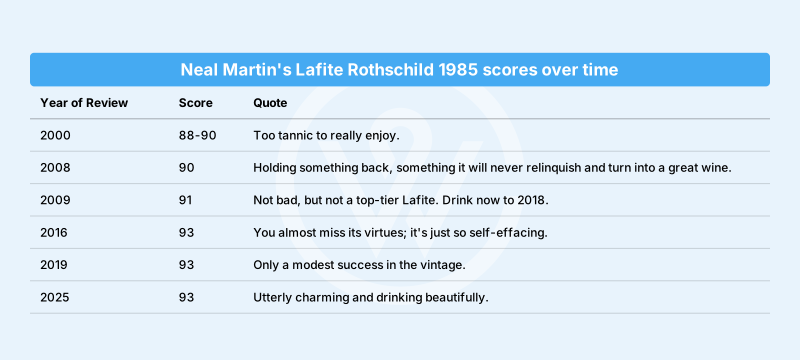
Neal Martin's Lafite Rothschild 1985 scores over time

Not only do fine wines improve over time, they also become scarcer. Every bottle drunk reduces the global supply. For a vintage to gain value, it must be able to survive several decades in a cellar. Without this longevity, a wine is a simple consumption purchase rather than a potential investment.

The relationship between age and value is often non-linear. A wine may trade at its release price for several years before hitting a “drinking window.” Once critics confirm a vintage is reaching its peak, demand and pricing often surges and consumption increases. This phase of the lifecycle is where the most significant returns are frequently realised.

What happens when wine ages?

Fine wine is essentially a slow-motion chemistry set. Even when fermentation has ended, the wine matures through constant slow changes that dictate its long-term investment value.

Key transformations include:

  • Micro-oxygenation: Trace amounts of air enter through the cork over decades. This controlled oxidation transforms simple primary fruit into complex tertiary aromas such as leather, tobacco, or forest floor.
  • Polymerisation: Harsh tannin molecules link together to form long chains. These feel silkier on the tongue and eventually precipitate as sediment, naturally refining the wine’s texture and mouthfeel.
  • Esterification: Acids and alcohols react to create esters. This chemical evolution develops the “bouquet,” adding tertiary layers of spice, truffle, and earth that are absent in younger vintages.
  • Anthocyanin shift: The chemicals giving wine its colours change their structure. Red wines fade from vibrant purple to garnet or brick, while white wines darken toward deep gold or amber.

A consistent, cool cellar ensures these reactions happen gradually. Rushing the process with heat prevents complexity from developing. These molecular shifts are what transform a standard wine into a rare, high-value asset.

Wine vs whisky: The biological divide

A common point of confusion for new collectors is the difference between wine and spirits like whisky. Whisky is a distilled spirit with a high alcohol content that effectively halts biological change. Once a whisky is bottled, its flavour profile remains static.

Wine is a living product. It continues to interact with trace amounts of oxygen through the cork and undergoes complex chemical reactions between its acids, tannins, and alcohols. These reactions are what create the sought-after aromas of leather, earth, and dried spices. A bottle of Lafite Rothschild from the 1980s tastes vastly different today than it did in 1990; an examination of scores over time shows this very clearly.

This dynamic nature is why storage conditions are so critical for wine. While a bottle of Macallan can sit on a shelf for years, a First Growth Bordeaux requires a temperature-controlled environment. The risk of spoilage is the price an investor pays for the potential of improvement.

Fortified wines: The indestructible assets

Fortified wines occupy a unique space in the wine world. Unlike “normal” fine wines, which typically range from 12% to 14.5% alcohol, fortified wines are bolstered with grape spirit. This process raises the alcohol level to between 17% and 22%..

This addition of spirit serves two purposes: it stops fermentation early, leaving residual sugar, and acts as a powerful preservative. This is why fortified wines can survive for centuries. While a dry red wine might reach its peak at 40 years, a top-tier Vintage Port or Madeira can still be improving at 100 years.

The winemaking process is also distinct. In many cases, these wines are intentionally exposed to heat or oxygen during production to stabilise them. This pre-ageing makes them incredibly resilient once they are in the bottle.

Long-lived Port

Port is perhaps the most famous fortified wine. Vintage Port is only produced in years of exceptional quality, known as a “declaration.” These wines are designed to be cellared for at least 20 to 50 years before they show their true potential.

The structure of Port comes from its intense tannins and high sugar content. Over time, the aggressive spirit integrates with the fruit, creating a velvet-like texture. Examples of legendary long-lived Ports include:

  • Taylor’s Vintage Port (notably the 1945 and 1992 vintages).
  • Graham’s The Stone Terraces.
  • Quinta do Noval Nacional.

These wines are often considered the ultimate inheritance assets. They are frequently purchased to mark the birth of a child, with the intention of being opened many decades later. Their survival rate is higher than almost any other wine style because they are more robust: so long as the cork remains intact, they are likely to retain their quality.

Sherry with extraordinary ageing potential

While much of the Sherry market is focused on fresh styles, wines like Oloroso, Palo Cortado, and Amontillado have extraordinary ageing potential. The best examples come from the “VOS” (Very Old Sherry) and “VORS” (Very Old Rare Sherry) categories.

These wines have already spent an average of 20 or 30 years ageing in a solera system before bottling. Because they have been intentionally exposed to oxygen for decades, they are virtually immune to further oxidation in the bottle. They offer some of the most complex aromatic profiles in the world, featuring roasted nuts, saline notes, and dried citrus.

Collectible examples include:

  • Gonzalez Byass “Matusalem” Oloroso
  • Valdespino “Coliseo” Palo Cortado
  • Tradición VORS Amontillado

Bordeaux: The global benchmark

Bordeaux is the foundational region for wine investment. Its primary grape, Cabernet Sauvignon, is naturally high in tannins and acidity which are the building blocks of its longevity. As anyone who has attended En Primeur tastings can attest, the structure of a young Bordeaux can be quite harsh, but time softens these elements into a harmonious whole.

The First Growths, such as Latour and Mouton Rothschild, are famous for their ability to withstand long ageing. Even in “off” vintages, the technical precision of these estates ensures a long life.

Notable examples of long-lived Bordeaux:

  • Chateau Latour 1961 
  • Chateau Haut-Brion 1989
  • Chateau Montrose 1990 

The elegance of aged Burgundy

Burgundy offers a different ageing profile compared to Bordeaux because Pinot Noir is a thinner-skinned grape with lower tannin levels. Longevity in Burgundy comes from the perfect balance of acidity and the incredible concentration of fruit found in Grand Cru sites.

While a Bordeaux might be powerful, an aged Burgundy is ethereal. The transition from fresh raspberry to truffle and forest floor flavors is one of the most celebrated experiences in fine wine. However, Burgundy can be more temperamental in the cellar, making provenance and storage even more critical.

Examples of iconic ageing Burgundy:

  • Domaine de la Romanee-Conti (DRC) La Tache
  • Domaine Armand Rousseau Chambertin
  • Domaine Leflaive Montrachet 

Piedmont: Italy’s answer to Burgundy

Like Burgundy, Piedmont focuses on single-vineyard sites and a single grape: Nebbiolo. Nebbiolo is an unusual variety that looks light in the glass but possesses massive tannins and high acidity. Historically young Barolo and Barbaresco were almost impenetrable. It was only in recent years that Piedmont winemakers would declare that their wines could be enjoyed in less than 30 years.

Still, these wines require time to reveal their beauty. A classic Barolo often needs ten to 15 years to become approachable. The best vintages from top producers like Giacomo Conterno or Bruno Giacosa can easily last for half a century.

Examples of long-lived Piedmont:

  • Giacomo Conterno Barolo Riserva Monfortino
  • Bruno Giacosa Barbaresco Santo Stefano
  • Gaja Barbaresco

Tuscany: The rise of the Super Tuscans

Tuscany has two main pillars, both of which can craft long-lived wines: Brunello di Montalcino and the Super Tuscans. Brunello is made from 100% Sangiovese and is legally required to undergo extensive ageing before release. The structure of top Brunello allows it to evolve gracefully for 30 years or more.

Super Tuscans are almost defined by their incorporation of the international varieties brought to fame by Bordeaux: Cabernet Sauvignon and Merlot. These wines were designed to compete on the global stage and have proven their ability to cellar. Sassicaia and Tignanello are the primary examples that investors look for but there are many others that will reward cellaring.

Key Tuscan ageing stars:

  • Biondi-Santi Brunello di Montalcino Riserva
  • Tenuta San Guido Sassicaia
  • Masseto 

The New World: USA and South America

The United States, particularly Napa Valley, has established itself as a producer of long-lived Cabernet Sauvignon. Estates like Ridge Vineyards, Stags Leap Wine Cellars and Heitz have bottles from the 1960s and 1970s that are still drinking beautifully today as evidenced by ongoing re-tastings of wines from the 1976 Judgment of Paris. While the cult wines of Napa are frequently approachable in their youth they are also built for long-term cellaring.

In South America, the focus is on high-altitude sites that preserve acidity. Argentina’s Malbec and Chile’s Cabernet blends have shown surprising resilience. Producers are now making wines with more restrained oak and higher acidity to ensure they age as well as their European counterparts.

Examples of New World longevity:

  • Ridge Monte Bello (California)
  • Screaming Eagle Cabernet Sauvignon (California)
  • Catena Zapata Adrianna Vineyard (Argentina)
  • Seña (Chile)

South Africa and Australia

South Africa has a long history of sweet wine production, but its red blends from Stellenbosch are now proving their mettle. The Cabernet-based wines from Kanonkop are known for their ability to age for several decades and will often outlast their peers from much more expensive regions.

Australia is home to some of the oldest vines in the world. For instance, the grandfather vines at Henschke were planted in the 1860s and vintages from the 1950s have performed well at recent tastings. Penfolds Grange is also well known for its longevity: a multi-regional Shiraz blend that is designed to be tucked away for 30 to 50 years. The power and concentration of Australian Shiraz provide a sturdy foundation for ageing.

Notable examples:

  • Henschke Hill of Grace (Eden Valley)
  • Penfolds Grange (South Australia)
  • Kanonkop Paul Sauer (Stellenbosch)

Dry white wines: Longevity and evolution

Top-tier still whites also possess a capacity to be aged, even if equivalent quality red wines are generally better able to accommodate multiple decades in the cellar. Longevity in this category is primarily driven by high natural acidity and the fruit concentration found in prestigious vineyard sites. Over time, as colour darkens these wines move away from fresh citrus notes, gaining complex tertiary aromas such as honey, toasted nuts, dried flowers and even cheese as they reach extremely old age.

Notable examples of ageable still whites can hail from many regions, but old world dry whites from Burgundy, Bordeaux, Alsace, the German regions in the Rhine and Mosel valleys are arguably best known for their capacity to age with grace. Examples include:

  • Domaine Joseph Drouhin Montrachet Marquis de Laguiche Grand Cru (Burgundy)
  • Domaine de Chevalier Blanc (Bordeaux)
  • Keller G-Max Riesling Trocken (Rheinhessen)
  • Trimbach Riesling Clos Sainte Hune (Alsace)

Can sparkling wine age?

While non-vintage Champagne is ready to drink as soon as it’s available, Vintage Champagne has an undeniable ageing potential. The high acidity and the presence of carbon dioxide act as preservatives that allow ageing to occur over many decades.

As Champagne ages, the bubbles become finer and begin to fade, while the flavour profile shifts from fresh citrus to brioche, honey, and roasted nuts. Some collectors specifically seek late-disgorged bottles that have spent extra time on their lees for even more complexity. Producers are happy to meet that demand: Dom Perignon recently added P3 to their line, allowing a third release window for the best vintages offering vintages from the 1960s and 1970s and 1980s to the market almost 50 years after their initial offering.

Examples of long-lived Champagne:

  • Dom Perignon
  • Krug Vintage
  • Salon Le Mesnil

Underwater ageing: A new frontier

One of the most intriguing developments in recent years is the practice of ageing wine underwater. This trend was sparked by the discovery of 170-year-old Champagne in a shipwreck in the Baltic Sea. The bottles were found to be in remarkable condition, the theory being that constant temperature, darkness, pressure and the lack of vibration fundamentally slow down the ageing process.

Producers are now intentionally submerging cages of wine in the ocean. Notable projects include:

  • Veuve Clicquot’s “Cellar in the Sea”
  • Leclerc’s Abyss
  • Drappier’s Immersion
  • Mira Winery (Napa Valley)
  • Crusoe Treasure (Spain)

The golden finish: Long-lived sweet wines

Sweet wines are the true champions of the cellar. The combination of high sugar and high acidity creates a nearly immortal product of which Sauternes is the most famous example. Here botrytis, a fungal infestation also known as “noble rot”, concentrates the sugars and acids to an extreme degree.

A top-tier Sauternes like Chateau d’Yquem can easily age for a century. Over time, the wine turns from bright gold to a deep amber colour and the flavours evolve from tropical fruit to complex notes of creme brulee, dried fruits, marzipan and nutmeg.

Other sweet wine icons:

  • Suduiraut (Sauternes)
  • Egon Müller Scharzhofberger Riesling TBA (Germany)
  • Royal Tokaji 6 Puttonyos (Hungary)
  • Klein Constantia Vin de Constance (South Africa)
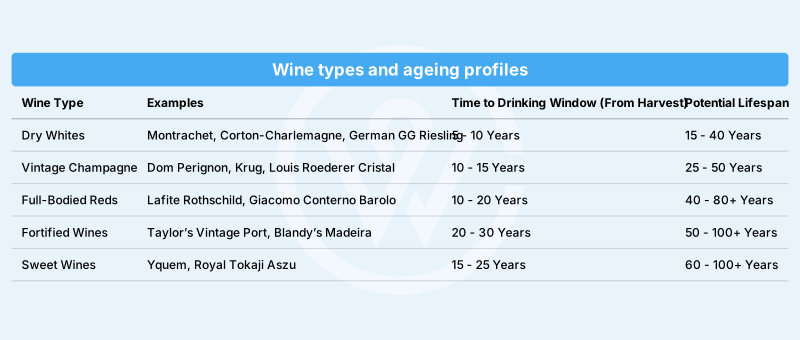
Wine types and ageing profiles

FAQ

How do I know if a wine has ageing potential? 

Look for a balance of high acidity, strong tannin structure (for reds), and high fruit concentration. Reviews from reputable critics often include a suggested “drinking window” to help guide your decision.

What is the best temperature for ageing wine? 

A constant temperature of around 12 to 14 degrees Celsius is ideal for long-term development. Significant fluctuations in temperature can cause the wine to expand and contract, potentially damaging the cork seal.

Does expensive wine always age better than affordable bottles? 

Not necessarily. While most investment-grade wines are expensive because of their longevity, some high-priced wines are made for early consumption. Always check the specific style and vintage before deciding to cellar a bottle.

Can I age white wine as long as red wine? 

Most white wines are intended for early drinking, but high-acid whites like Riesling and Chardonnay from top sites can age for decades. Sweet white wines like Sauternes have the longest potential of all unfortified wine styles.

WineCap’s independent market analysis showcases the value of portfolio diversification and the stability offered by investing in wine. Speak to one of our wine investment experts and start building your portfolio. Schedule your free consultation today.
Categories
Learn

10 fascinating facts about Chateau Lafite Rothschild

  • Chateau Lafite Rothschild is one of the most sought-after wines in the world for its investment potential.
  • Lafite is frequently described as the most elegant of the First Growths.
  • Lafite vintages like 1982, 2009, and 2010 have achieved iconic status.

Chateau Lafite Rothschild is an undisputed titan of the fine wine world. For many collectors, it is the first name added to a cellar and the last one ever removed. Lafite Rothschild carries a weight that transcends viticulture, representing a fusion of French history, financial stability, and artisanal quality.

Its enduring prestige was recently cemented at a landmark Sotheby’s New York auction, where two 1870 magnums fetched a staggering $306,250.

In the secondary market, Lafite functions as a “liquid currency,” possessing a level of brand equity that few other luxury Veblen goods, let alone wines, can rival. Whether you are a seasoned oenophile or a newcomer to wine investment, understanding this Pauillac legend is essential. 

This guide explores the ten key facets that define the gold standard of this prestigious wine.

1. The storied history of an icon

Lafite Rothschild’s history is a tapestry of royal patronage and resilience. While vines have existed on the site for centuries, the estate gained international prominence in the late seventeenth century under the Segur family. Marquis Nicolas-Alexandre de Segur was known as the Prince of Vines, and he refined the winemaking techniques that put Lafite on the maps of London and Paris.

By the eighteenth century, Lafite was the favourite of the French royal court. It earned the moniker of King’s Wine, largely thanks to the influence of Marechal de Richelieu. Famously Thomas Jefferson, the third American president, became a devoted follower after visiting the region.

The most significant turning point occurred in 1868. Baron James Mayer de Rothschild purchased the estate at a public auction and added his surname to what had previously been “Chateau Lafite”. This acquisition brought the property into the Rothschild family, where it has remained for five generations.

Key historical milestones in the history of Lafite Rothschild include:

  • The 1855 Classification where Lafite was ranked as one of only four original Premier Grand Cru Classes.
  • The devastating phylloxera crisis of the late nineteenth century which tested the estate’s resolve.
  • The occupation of the chateau during the Second World War.
  • The post-war resurgence led by Baron Elie de Rothschild.
  • The modern era of expansion and technical precision under Baron Eric and now Saskia de Rothschild.

2. The unique terroir of Pauillac

Lafite is defined by its terroir, which is arguably the finest in the Médoc, as you might expect given its price point. The vineyard covers roughly 112 hectares making it the largest of the First Growths and is situated on a plateau of deep gravel. This soil type is crucial for Cabernet Sauvignon, as it provides excellent drainage and forces the vines to grow deep roots.

The climate in Pauillac is moderated by the proximity of the Gironde estuary and the Atlantic Ocean, creating a microclimate that protects the vines from extreme frost and excessive heat. The estate manages its land with a focus on biodiversity and long-term sustainability.

Current vineyard characteristics include:

  • An average vine age of approximately 40 years.
  • A high proportion of Cabernet Sauvignon, usually making up 70 percent or more of the vines and an even larger proportion of the Grand Vin.
  • Significant plantings of Merlot, which adds roundness and flesh to the mid-palate.
  • Smaller plots of Cabernet Franc and Petit Verdot for structural complexity.
  • The vineyard is divided into three main parcels, around the Chateau including the  Carruades plateau, and a plot in St Estephe.

3. The different wines of Lafite Rothschild

Key wines from the property are:

  • Chateau Lafite Rothschild (The Grand Vin).
  • Carruades de Lafite (The Second Wine).
  • Anseillan (A newer, plot-specific release).

While the Grand Vin is the primary focus for investors, the estate produces other notable labels. Each wine follows a strict hierarchy of quality and selection. Only the very best parcels are reserved for the top wine, ensuring its longevity and prestige.

Carruades de Lafite is the estate’s second wine, which typically contains a higher percentage of Merlot than the Grand vin and releases at a third of the price. Once viewed as a simple entry point, it has experienced periods of meteoric price rises over the last two decades and is now considered a viable investment asset in its own right. Prices tend to be more volatile than Lafite, but when bought at the bottom of a market cycle and sold at the top it can be highly lucrative. 

The estate also recently introduced Anseillan. This more affordable wine represents a more accessible side of the DBR portfolio and while it will benefit from some age it is not built for long-term cellaring.

4. Lafite within the Domaines Barons de Rothschild

Lafite serves as the flagship for Domaines Barons de Rothschild, commonly abbreviated as DBR. This global wine empire has expanded significantly since the mid-twentieth century. However, Lafite remains the spiritual and financial heart of the organisation.

Under the leadership of the Rothschild family, DBR has acquired prestigious estates across the globe. This includes properties in South America, China, and other regions of France. The technical expertise developed at Lafite is shared across these subsidiaries with staff moving from one to another.

The DBR portfolio also includes:

  • Chateau L’Evangile in Pomerol.
  • Chateau Rieussec in Sauternes.
  • Vina Los Vascos in Chile.
  • Bodegas Caro in Argentina.
  • Domaine de Long Dai in China.

5. The benchmark Lafite Rothschild style

Lafite is frequently described as the most elegant of the First Growths. While Latour is known for power and Margaux for perfume, Lafite is celebrated for its finesse and complexity. It is rarely a wine that shouts; instead, it whispers with profound depth.

On the nose, young Lafite often displays notes of cedar, graphite, and violets. As it ages, these aromas evolve into complex layers of tobacco, forest floor, and truffle. The tannins are famously fine-grained, described by many critics as silky or lacy.

Structural hallmarks of the wine:

  • A core of intense blackcurrant fruit.
  • Distinctive mineral notes derived from the gravelly soil.
  • High natural acidity which ensures decades of ageing potential.
  • Seamless integration of oak, usually 100 percent new French barrels.
  • An extraordinary length of finish that lingers for minutes.

6. The 1982 Lafite vintage and the modern wine era

The 1982 vintage was a watershed moment for the global wine trade. It marked the emergence of Robert Parker as the world’s most influential wine critic. Parker famously touted the 1982 Bordeaux vintage as legendary while many other critics were hesitant.

Lafite Rothschild 1982 received a perfect 100-point score from Parker. This set the stage for the rise of modern wine criticism and the standardisation of the 100-point scale. It transformed fine wine from a niche hobby into a global asset class.

The significance of 1982 includes:

  • The birth of the modern secondary market for investment-grade wine.
  • A shift towards riper, more opulent styles of winemaking across Bordeaux.
  • The massive increase in global demand for First Growth allocations.
  • The establishment of Lafite as the ultimate status symbol in emerging markets.

On a business level, increasing prices allowed Lafite Rothschild and other chateaux to invest in more precise, cleaner winemaking and improved farming practices, in turn facilitating a dramatic improvement in quality in the years that followed.

7. The rise of Lafite Rothschild in China

Lafite Rothschild holds a unique position in the Chinese market. It became the definitive luxury wine during China’s economic boom.

The name is easy to pronounce in Mandarin, which helped its early adoption. Its association with the Rothschild family also appealed to Chinese investors who value heritage and long-term wealth; this demand drove prices to stratospheric levels, particularly for the 2008 vintage.

The impact of the Chinese market led to:

  • A surge in prices for both recent and back vintages.
  • Increased focus on anti-counterfeiting measures and provenance.
  • The creation of the Long Dai estate in Shandong province by DBR.

8. Special bottlings and labels

Lafite occasionally marks special vintages with subtle changes to its iconic label. Perhaps unsurprisingly for Lafite these are not full label changes a-la Mouton Rothschild 2003, gold labels like Angelus 2012 or brightly coloured full bottle canvases like the Taittinger collection.  Instead they are subtle changes, a small embossing here, a glass relief there, commemorating astronomical events, cultural milestones and vintages blessed by the weather gods.

Notable label variations include:

  • The 1985 vintage features a small etching of Halley’s Comet. 
  • The 1999 vintage includes a small star to celebrate the turn of the millennium.
  • The 2005 vintage depicts the sun and rain on a set of scales for the perfect balance of that growing season
  • The 2008 vintage features a red Chinese character for the number eight.
  • The 2018 vintage shows a hot air balloon to mark 150 years of Rothschild ownership.

These bottles often command a premium at auction beyond what their quality would suggest.

9. The best and most expensive Lafite Rothschild vintages

When discussing the best vintages of Lafite Rothschild, critics often point to years where the weather was nearly perfect. Vintages such as 1953, 1959, and 1961 are legendary for their longevity. More recently 1982, 2009, and 2010 have achieved iconic status.

In terms of the financial performance, the most expensive bottles ever sold often have historical significance. A bottle of 1869 Lafite sold in Hong Kong for over $230,000 in 2010. Even older bottles, such as the 1787 vintage allegedly owned by Thomas Jefferson, have sold for record sums.

Top Lafite vintages for investment:

  • 1982: The benchmark for modern investment.
  • 2000: A millennium vintage with immense staying power.
  • 2005: Perfect structural balance.
  • 2012: Great value and already in its depletion phase.
  • 2016: A modern classic with widespread critical acclaim.
  • 2019 and 2020: High-scoring recent years with good value and strong long term potential.
  • 2024: The most affordable vintage on the market.

Such is the strength of the Lafite brand that its not just the best vintages that have been strong investments, in fact quite frequently the opposite has been the case. The 2013 vintage is a perfect example of this: a 90-point score from Neal Martin and 87-89 points while still in the barrel from Robert Parker in his last En Primeur tastings denotes a vintage that was anything but great. However, it was released at very competitive prices and in percentage terms its performance has eclipsed even the famed 2010.

10. The investment reality of Lafite Rothschild

Lafite remains a cornerstone of any serious wine investment portfolio. Its primary strength is liquidity. Unlike niche wines that may be difficult to sell, there is always a buyer for a well-stored case of Lafite.

It acts as a hedge against inflation and broader market volatility. While prices can fluctuate, the long-term trend for First Growth Bordeaux has historically been upward. The scarcity of back vintages ensures that supply continues to dwindle as bottles are consumed.

Key investment takeaways:

  • Blue-chip status ensures high global demand and easy resale.
  • Consistent quality means that even lesser vintages hold their value well.
  • Provenance is vital, as buyers will pay more for professional storage.
  • The estate’s brand power provides a safety net during economic downturns.
  • It remains the ultimate entry point for those seeking long-term capital appreciation.

Chateau Lafite Rothschild is more than just a vineyard – it is an icon of Bordeaux and an enduring symbol of French viticulture. By balancing a deep respect for tradition with modern financial sense, it continues to lead the fine wine market. Whether you hold it for the pleasure of the palate or the growth of your capital, Lafite represents the gold standard of the fine wine world.

FAQ: Chateau Lafite Rothschild

What makes Chateau Lafite Rothschild so expensive?

Lafite’s value is driven by its First Growth status (the highest ranking in the 1855 Classification), its storied history with the Rothschild family, and its massive brand equity in global markets. Its reputation as a “liquid currency” makes it a stable blue-chip investment.

How does the taste of Lafite differ from other First Growths?

While other top wines like Latour are known for power, Lafite is celebrated for its finesse and elegance. It is often described as a wine that “whispers” rather than shouts, characterised by silky tannins and complex notes of cedar, graphite, violets, and blackcurrant.

What is the difference between the Grand Vin and Carruades de Lafite?

The flagship wine is made from the estate’s very best parcels. It is built for decades of aging and is the primary target for high-level investors. Meanwhile, the estate’s Second Wine typically contains more Merlot, is more accessible in its youth, and costs significantly less (usually about a third of the price of the Grand Vin).

Why is Lafite particularly popular in the Chinese market?

Lafite became a preeminent status symbol in China due to several factors: the name is easy to pronounce in Mandarin, the Rothschild heritage aligns with Chinese values of long-term wealth, and the 2008 vintage specifically featured a red Chinese character for the number eight (a lucky number) on the bottle, which drove demand to unprecedented levels.

Which vintages are considered the best for investment?

The “iconic” vintages for both quality and financial performance include 1982, 2000, 2005, 2009, 2010, and 2016. However, “off-vintages” like 2013 have also proven to be lucrative investments because they were released at lower prices and benefited from the overall strength of the Lafite brand.

How can you tell if a Lafite bottle is a special edition?

Lafite uses subtle etchings or embossments on the glass rather than changing the entire label. For example:

  • 1985: Features Halley’s Comet.
  • 1999: Features a star for the millennium.
  • 2008: Features the Chinese character for “8” ().
  • 2018: Features a hot air balloon to mark 150 years of Rothschild ownership.

WineCap’s independent market analysis showcases the value of portfolio diversification and the stability offered by investing in wine. Speak to one of our wine investment experts and start building your portfolio. Schedule your free consultation today.
Categories
Learn

Bordeaux vs Burgundy: The two pillars of wine investment

  • Bordeaux and Burgundy are the pillars of fine wine investment portfolios, together offering stability and price performance. 
  • One of the clear contrasts between the two regions lies in their production volumes, which lead to very different market behaviour: Bordeaux is the more liquid market and Burgundy is more volatile.
  • In recent years, Burgundy has increasingly captured Bordeaux’s market share and challenged its dominance as the most important fine wine region.

In the world of fine wine, two regions dominate both conversation and investment portfolios: Bordeaux and Burgundy. While they share France as a homeland, their histories, winemaking philosophies, and market trajectories are strikingly different. For investors, the choice between Bordeaux and Burgundy is not just about taste preferences, but about risk appetite, strategy, and long-term goals.

This article explores the history, styles, secondary market performance, and investment potential of both regions.

A brief history of winemaking

Bordeaux

Bordeaux’s history as a trading hub dates back to the 12th century, when Eleanor of Aquitaine’s marriage to Henry II of England opened English markets to its wines. This commerce played an important role in the region’s development over the following centuries. By the 1855 Classification, Bordeaux had codified its top estates, cementing its position as the epicentre of fine wine commerce. The prestige of First Growths – Lafite, Latour, Margaux, Haut-Brion, and later Mouton Rothschild – has underpinned Bordeaux’s dominance in the secondary market. Their Second Wines, which provide a lower entry point into the best brands, are often among the market’s most reliable performers.

Burgundy

Burgundy’s winemaking dates back even further, with monastic orders (Cistercians and Benedictines) mapping out terroirs as early as the Middle Ages. Unlike Bordeaux, Burgundy did not rely on grand châteaux but on small, family-run domaines. The Napoleonic Code fractured vineyards into tiny parcels, resulting in an extraordinarily complex patchwork of holdings. This fragmentation still defines Burgundy today, where a single vineyard such as Clos Vougeot may have dozens of owners, with each case  commanding a different price.

Wine styles

Bordeaux

Known for blends dominated by Cabernet Sauvignon (Left Bank) or Merlot (Right Bank), Bordeaux produces structured, powerful wines built for ageing. Acclaimed, age-worthy sweet wines like Sauternes produced by esteemed names such as Château d’Yquem add another layer of prestige.

Burgundy

Focused almost exclusively on Pinot Noir for reds and Chardonnay for whites, Burgundy is about terroir expression. Each parcel conveys subtle differences in soil and microclimate, producing wines celebrated for finesse, balance, and aromatic depth.

Production levels and volumes

The sheer difference in production scale between Bordeaux and Burgundy is one of the sharpest contrasts between the two regions – and a key factor for investors.

Bordeaux has over 110,000 hectares under vine, producing on average 500–600 million bottles each year. Even its most prestigious estates typically release several thousand cases annually. This volume underpins Bordeaux’s liquidity and accessibility in the secondary market.

Burgundy, by contrast, is far smaller, with around 30,000 hectares of vineyards and total production closer to 150 million bottles annually. At the pinnacle, many grands crus yield only a few hundred cases. This extreme scarcity amplifies price pressure whenever global demand rises, making Burgundy both highly desirable and more volatile.

The wine investment market: A journey from Bordeaux to Burgundy

Bordeaux: The original pillar 

Bordeaux was the foundation of the global secondary wine market. In 2010, Bordeaux accounted for a staggering 96% of trade by value. The En Primeur system, global brand recognition, and high production volumes made it the natural gateway for collectors and investors.

Bordeaux remains:

  • The most liquid market: Wines trade frequently, with transparent pricing.
  • Stable: While not immune to downturns, Bordeaux prices show less volatility.
  • Accessible: Entry-level investment opportunities exist at lower price points than Burgundy, especially among rising stars like Rauzan-Ségla and Beauséjour-Bécot, which have undergone major capital improvements and now outperform peers.

See also: WineCap Bordeaux Regional Report 

Burgundy: The new destination

Following the China-led boom of the late 2000s and early 2010s, Bordeaux’s dominance began to wane. Chinese buyers initially focused almost exclusively on the region’s First Growths, driving rapid price escalation, but as demand cooled, the market corrected sharply. Investors, collectors, and sommeliers then began to look elsewhere, sparking what has since been described as the ‘Burgundy moment’.

Between 2016 and 2018, and again from 2020 to 2022, Burgundy prices climbed dramatically. Burgundy prices surged ahead of broader fine wine benchmarks, reflecting growing international recognition of the region’s scarcity and quality. Burgundy’s appeal was further amplified by global trends toward terroir-driven, artisanal wines, contrasting Bordeaux’s image of large-scale production.

Scarcity remains Burgundy’s greatest market driver. Many grands crus produce fewer than 500 cases annually, which means that even modest increases in demand create significant price pressure. As a result, blue-chip producers such as Domaine de la Romanée-Conti (DRC) and Domaine Leroy now command astronomical valuations, cementing Burgundy’s role as fine wine’s most exclusive frontier.

See also: WineCap Burgundy Regional Report 

Market share shifts

  • In 2012, Bordeaux held 87.5% of market share, while Burgundy represented just 4.2%.
  • By 2025, Bordeaux is down to 36%, while Burgundy has climbed to 24%.

This data underscores Burgundy’s emergence as a true rival to Bordeaux’s dominance. 

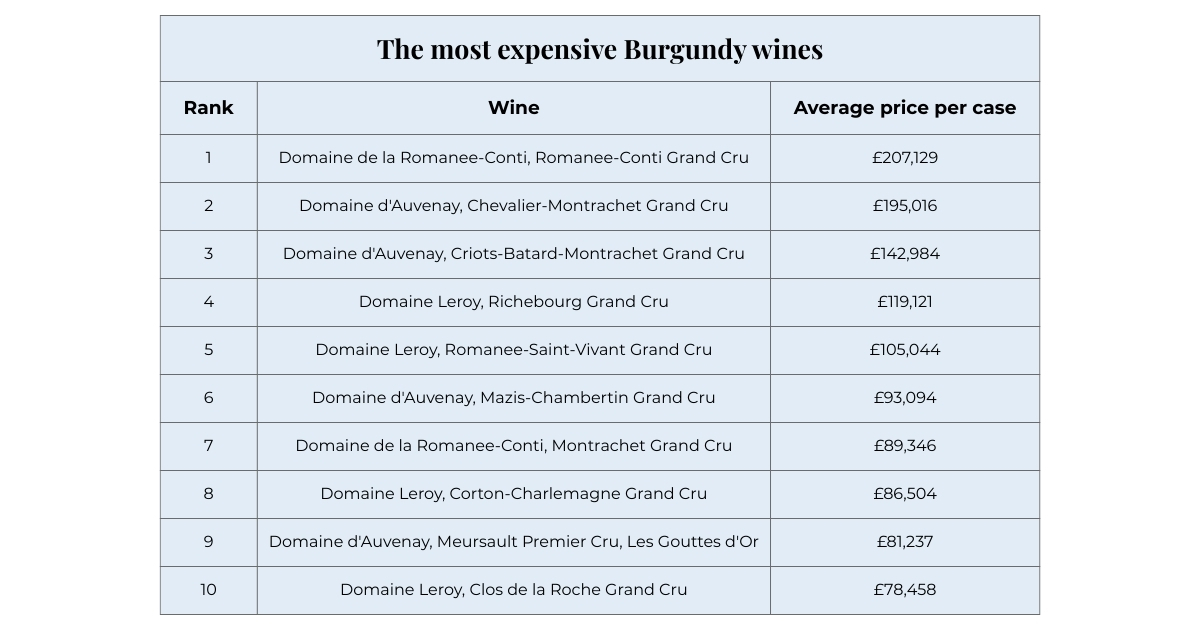
The most expensive Burgundy wines

Most expensive Burgundy wines table

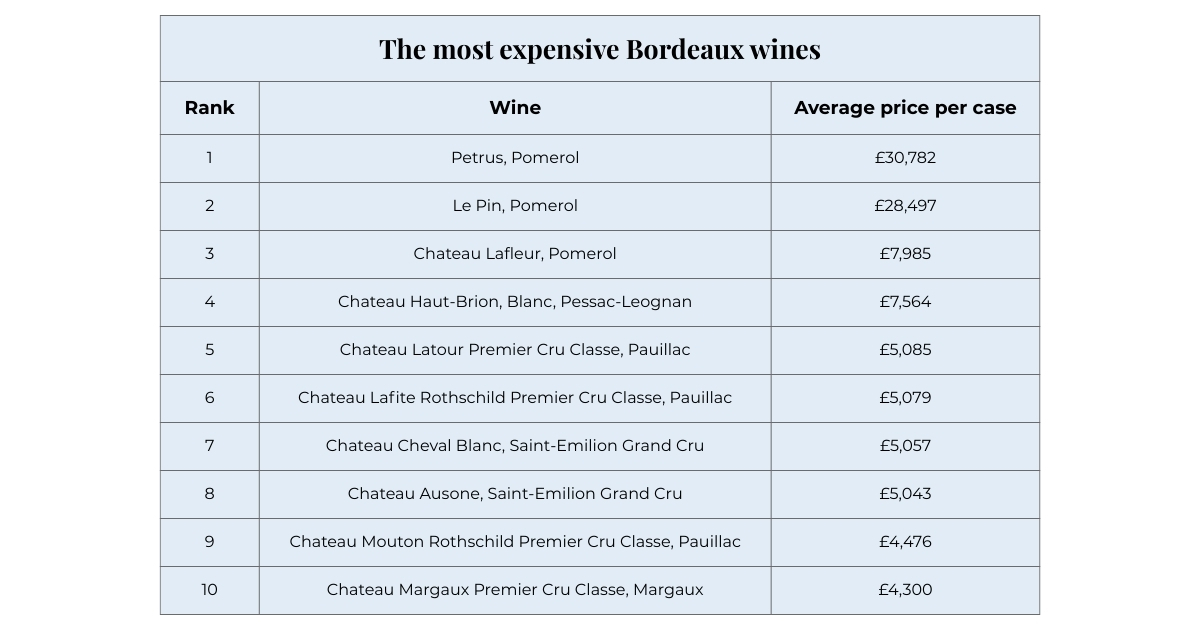
The most expensive Bordeaux wines

The most expensive Bordeaux wines

As the tables above show, Bordeaux’s most prestigious names remain far more affordable than Burgundy’s icons, even as they maintain global popularity.

Also see The most expensive wines in the world (2025 edition).

Investment considerations

Bordeaux

Pros:

  • Deep liquidity and stable pricing
  • Lower entry points for investors
  • Consistent branding and global recognition

Cons:

  • Slower appreciation compared to Burgundy
  • Susceptible to cyclical demand booms (e.g., China-driven surge)

The best Bordeaux vintages

The top Bordeaux vintages are admired for their balance, structure, and cellaring potential, with particular years becoming winemaking benchmarks. Against this background, there are two vintage categories that are relevant for wine investors: “on” years and “off” years.

“On” years are legendary vintages with ideal weather conditions. They include years like 2000, 2005, 2009, 2010, 2015, 2016, 2018, 2019, 2020, and 2022. Such years appear consistently on lists of the best Bordeaux vintages for their fruit purity, elegant tannins, and notable longevity. However, while impressive, they are not necessarily the best years of Bordeaux wines for investment, with lower-priced alternatives (“off” years) potentially offering more favourable opportunities.

So-called “off” years, for example, 2008, 2011, and 2013, don’t always receive the same attention as more critically-acclaimed Bordeaux, but they often present excellent investment opportunities. They can be especially ideal for newcomers seeking good vintages from Bordeaux without the premium prices. Such more accessible releases can perform well over time and, especially when they hail from highly-esteemed châteaux, deliver impressive returns.

Worth noting is that there is no single formula for selecting the right vintage for investing. Producer reputation, terroir expression, critic scores all need to be taken into consideration.

Burgundy

Pros:

  • Exceptional price appreciation potential
  • Extreme scarcity drives prestige and value
  • Global demand from collectors, sommeliers, and investors

Cons:

  • Very high entry points for blue-chip domaines
  • Lower liquidity and fewer trading opportunities
  • Greater price volatility

The best Burgundy vintages

The best Burgundy vintages are sought after for their elegance, purity, and terroir expression, with certain years representative of the region’s ability to produce a pinnacle expression of Pinot Noir and Chardonnay.

Standout “on” years include 1999, 2002, 2005, 2009, 2010, 2015, 2019, 2020 and 2022. These vintages benefited from favourable growing conditions and are, as such, frequently highlighted among the best Burgundy years for their complexity and outstanding ageing potential. However, high quality and price do not always have a direct correlation with long-term investment performance.

So-called “off” years, or vintages that don’t grab the headlines, include 2007, 2011, 2013 and 2017. These years can offer attractive value, especially from well-regarded domaines that are known for consistency regardless of weather challenges. Since Burgundy production is limited and highly appellation-specific, it can be misleading to be guided by broad vintage generalisations, with in-depth domaine-by-domaine analysis often offering a better approach.

Both great Burgundy vintages and overlooked years can be the source of exceptional investment potential, reflecting the diversity and subtlety of the region. In such a granular environment, it is worth aligning investment research and strategy accordingly.

Balancing stability and scarcity

For newcomers to wine investment, Bordeaux remains the most sensible entry point. It is affordable, liquid, and stable, offering opportunities to build a solid foundation in fine wine. Rising stars such as Rauzan-Ségla, Troplong Mondot and Beauséjour-Bécot highlight how estate-level improvements can translate into market outperformance.

For seasoned investors, Burgundy provides the high-risk, high-reward play. While volatile and scarce, the region offers unparalleled potential for price appreciation. The allure of owning rare bottles from DRC or Leroy is both emotional and financial.

Ultimately, a balanced portfolio should include both. Bordeaux provides the security and breadth of a bedrock investment, while Burgundy offers the exclusivity and upside that can truly elevate a collection.

WineCap’s independent market analysis showcases the value of portfolio diversification and the stability offered by investing in wine. Speak to one of our wine investment experts and start building your portfolio. Schedule your free consultation today.
Categories
Learn

The legacy of the 1855 Bordeaux Wine Classification and global rankings

  • Wine classifications serve as guides to quality standards, geographical origins, and historical context.
  • The 1855 Bordeaux Classification continues to serve as a touchstone that has shaped not only Bordeaux but also global perceptions of what constitutes a ‘fine wine’.
  • Wine-producing regions worldwide have developed their own unique classification frameworks, based on quality, price, and terroir.

The classifications of fine wines provide an intriguing labyrinth of quality markers, geographic indicators, and historic relevance. Among the most iconic of these is the 1855 Bordeaux Classification – a system that has endured for over a century and a half. In contrast, the dynamic Saint-Émilion classification demonstrates the capacity for change within the realm of wine classifications. This article delves into these iconic French systems and other similar classifications in countries such as Germany, Italy, and Portugal.

The enduring legacy of the 1855 Bordeaux Classification

Commissioned by Napoleon III for the Exposition Universelle de Paris, the Bordeaux Wine Official Classification of 1855 set the gold standard for wine classifications. Designed to rank the finest wines of Bordeaux – from Médoc, Sauternes, and Barsac – the classification ranges from ‘First Growth’ to ‘Fifth Growth’, based on both quality and trading price. With only one significant modification since its inception – the promotion of Château Mouton Rothschild to First Growth in 1973 – the classification remains a cornerstone in the world of fine wine.

The classification has been both praised for its impact on the wine industry and criticised for its rigidity, given that it reflects a snapshot of quality from more than a century and a half ago. The global wine exchange, Liv-ex, has created a similar classification that uses price alone to determine a hierarchy of the leading fine wine labels in the market.

The Saint-Émilion Classification

In contrast to the static nature of the 1855 Classification, the Saint-Émilion region in Bordeaux has a more dynamic approach to ranking its wines. Established in 1955, the Saint-Émilion Classification is updated approximately every ten years. This system classifies wineries into tiers: Grand Cru Classé A, Grand Cru Classé B, and Grand Cru Classé.

Unlike the 1855 Classification, which is set in stone for the most part, the Saint-Émilion system allows for upward or downward mobility, giving wineries an incentive for continuous improvement.

Nonetheless, the classification has also faced controversy when three leading estates with ‘Premier Grand Cru Classé A’ status – Châteaux Ausone, Cheval Blanc and Angélus – withdrew from the rankings last year.

Classifications beyond Bordeaux 

Burgundy’s Cru System

Unlike Bordeaux, where the 1855 Classification ranks specific châteaux or estates, Burgundy’s Cru System classifies individual vineyards by assessing their terroir (Grand Cru, Premier Cru, Village, Regional).

Even vineyards that are right next to each other but separated by a road or a wall may be classified differently. The terroir is believed to impart specific qualities to the wine, with soil composition, slope, and sun exposure all playing a role.

While the 1855 Bordeaux Classification has changed very little since its inception, Burgundy’s Cru System is more fluid. Vineyards can be promoted or demoted based on ongoing assessments of quality, although changes are relatively rare and usually occur over long periods.

The Burgundy Cru System has been highly influential and is seen as a precursor to many New World terroir-based classifications. However, it’s not without its critics. Some argue that focusing solely on terroir might overlook the skills and contributions of individual winemakers.

Germany’s VDP Classification

The Verband Deutscher Prädikatsweingüter (VDP) has developed a system somewhat inspired by Burgundy. The top tier of this system, the Grosse Lage (Great Growth), designates vineyards with the highest quality potential, followed by Erste Lage (First Growth).

Italy’s Barolo and Barbaresco Cru vineyards

In Italy’s famed Barolo and Barbaresco regions, vineyards are often termed ‘cru’, reflecting the particular characteristics of the terroir. Unlike Bordeaux’s 1855 classification, there isn’t a formal hierarchy, but the cru system nonetheless signifies a level of quality and prestige.

Portugal’s Douro Classification

One of the oldest classification systems for wine comes from Portugal’s Douro region, known for Port wine. Established as early as 1756, this classification focuses on the quality of the grape-growing land, making it an early precursor to the concept of terroir.

Concluding thoughts

In the ever-evolving world of fine wine, the 1855 Bordeaux Classification continues to serve as a touchstone that has shaped not only the Bordeaux region but also global perceptions of what constitutes a ‘fine wine’. By contrast, the more dynamic systems like the Saint-Émilion rankings and Burgundy’s Cru system offer a flexible approach that accommodates change and encourages ongoing excellence. As the article explored, wine-producing regions worldwide have developed their own unique classification frameworks, each adding a different flavor to this complex narrative. Whether these systems will adapt to the challenges of climate change, evolving consumer tastes, and other modern factors remains to be seen, but what is clear is their enduring impact on how we appreciate, value, and ultimately, enjoy wine.

WineCap’s independent market analysis showcases the value of portfolio diversification and the stability offered by investing in wine. Speak to one of our wine investment experts and start building your portfolio. Schedule your free consultation today.
Categories
News

Top 10 most expensive wines in the world

Wine has captivated collectors for centuries – not just for its flavour and artistry, but for its ability to increase in quality and value over time. For many enthusiasts, this has made fine wine one of the world’s most compelling collectible assets.

In recent years, the most expensive bottles of fine wine have evolved into global luxury assets in their own right. Record-breaking sales at Sotheby’s and Christie’s, particularly from Burgundy and Bordeaux, have drawn the attention of collectors across Europe, the United States, and Asia. The fine wine market has proven remarkably resilient, often outperforming traditional investment sectors during periods of volatility. As more investors and collectors explore alternative assets, interest in understanding what drives the value of the world’s rarest bottles has grown rapidly.

But what is the most expensive wine on earth? And why are some bottles worth more than luxury cars – or even homes? In this guide, we explore the top 10 most expensive wines in the world, breaking down their prices, regions, rarity, and what makes a single bottle so valuable.

Ten of the world’s most expensive wines

The wines featured below have achieved legendary status in the world of fine wine – not only because of their craftsmanship, but also due to the unique stories and circumstances that have shaped their value. From minuscule production levels to historic vintages and iconic vineyard sites, each bottle reflects centuries of winemaking heritage and a global appetite for rarity.

Domaine Georges & Christophe Roumier, Musigny Grand Cru

Producer: Domaine Georges & Christophe Roumier

Average price: £13,595

Wine type: Red

Grape: Pinot Noir

Region: Burgundy, France

Domaine Roumier is one of Burgundy’s most revered producers, responsible for some of the region’s most expensive wines. Its Musigny Grand Cru – grown on exceptional limestone soils in the Côte de Nuits – offers remarkable finesse and longevity. As a Grand Cru, Burgundy’s highest classification, this wine is treasured for its age-worthiness, rarity, and ability to command high auction prices.

Production levels from Musigny are extremely limited, and the vineyard’s old vines contribute to the wine’s intensity and depth. Collectors value Roumier for its consistency across vintages and its meticulous approach to viticulture, both of which drive sustained demand and premium pricing.

Château Margaux

Producer: Château Margaux

Price: $225,000 (gained by insurance reimbursement in America)

Wine type: Red

Grape: Bordeaux blend

Region: Bordeaux, France

A bottle of this wine, created in 1787, was said to be a part of Thomas Jefferson’s personal collection.

A wine trader called William Sokolin later acquired it and took it to a dinner in Bordeaux, where the waiter knocked it off the table and smashed the bottle. Sokolin was later reimbursed with $225,000 by his insurance company, but the bottle was originally thought to be worth $500,000. Château Margaux is also a consistent producer of top-performing Cabernet Sauvignon-led blends, reinforcing its status as a pillar of fine wine investment.

Classified as a First Growth in the historic 1855 Classification, Château Margaux’s reputation spans centuries. Pre-phylloxera bottles such as the 1787 are exceptionally rare, making them prized artefacts of wine history. Provenance plays a major role in the value of such wines, and Jefferson-linked bottles remain some of the most sought-after in the world.

Domaine Leroy, Musigny Grand Cru

Producer: Domaine Leroy

Average price: £31,691

Wine type: Red

Grape: Pinot Noir

Region: Burgundy, France

Founded in 1868 by wine merchant François Leroy, the Domaine (vineyard) is now owned by Lalou Bize-Leroy, who also owns Domaine d’Auvenay.

This dry red wine is produced from Pinot Noir grapes and is farmed biodynamically. This ethical approach to farming provides nutrients to the plants by using their own composting measures, as opposed to using chemical fertilisers. Although more labour-intensive, this approach produces high-quality fruit and is better for the environment.

Domaine Leroy’s wines are often considered on par with, or even superior to, those of Domaine de la Romanée-Conti, both making wines from prestigious communes such as Vosne-Romanée. Micro-production levels mean only a few barrels are produced each year, resulting in extremely limited global availability. This scarcity, combined with critical acclaim, contributes significantly to its exceptionally high market value.

Krug Vintage Brut Champagne

Producer: Krug

Price: Sold for £14,800

Wine type: Sparking wine

Grape: Champagne

Region: Champagne, France

Krug is one of Champagne’s most renowned houses, producing some of the region’s most sought-after and expensive wines.

At a Hong Kong wine auction in 2009, the 1928 Krug Vintage Brut set a record as the most expensive Champagne ever sold at the time. Its combination of rarity, craftsmanship, and historical prestige make it a pinnacle of sparkling wine collecting.

Older Champagne vintages like 1928 are incredibly rare because sparkling wine is typically consumed young. Bottles that survive nearly a century in pristine condition gain immense value. Krug’s long ageing process on lees, combined with its dedication to complexity and structure, makes its older vintages particularly collectible.

Screaming Eagle Sauvignon Blanc

Producer: Screaming Eagle

Average price: £4,610

Wine type: White

Grape: Sauvignon Blanc

Region: Oakville, USA

Although not the most expensive wine on the list, this is one of the most expensive white wines from the North Coast of the United States.

As one of Napa Valley’s original “cult wines,” Screaming Eagle produces extremely limited quantities, often fewer than 1,000 cases per year. While known primarily for its Cabernet Sauvignon, its Sauvignon Blanc has become one of the most expensive white wines in the world, driven by rarity and intense demand.

Screaming Eagle’s allocation list is famously difficult to join, with waiting lists spanning years. This exclusivity fuels secondary-market prices, as collectors compete for the winery’s rarest bottles. Napa Valley’s rise as a luxury wine region has further elevated Screaming Eagle’s iconic status.

Domaine Leflaive, Montrachet Grand Cru

Producer: Domaine Leflaive

Average price: £12,430

Wine type: White

Grape: Chardonnay

Region: Burgundy, France

Montrachet is considered the best white wine vineyard in the world, with bottles often dominating top 10 most expensive wine lists. Domaine Leflaive’s Grand Cru Chardonnay – barrel-fermented and known for citrus, hazelnut, and buttery richness – remains a benchmark of Burgundy craftsmanship.

Leflaive’s plots in Montrachet sit on prime limestone-rich soils, offering exceptional drainage and mineral expression. With only a very small portion of the already tiny Montrachet vineyard under its control, Leflaive produces minuscule quantities of this wine each year, contributing significantly to its rarity.

Liber Pater

Producer: Liber Pater

Average price: The 2015 variety had an average price of £27,500

Wine type: Red

Grape: Bordeaux blend

Region: Bordeaux, France

Liber Pater produces some of the most expensive wines in the world. This vintage wine was created in 2015, and due to its very low production numbers and the use of grapes from ungrafted vines, it has become a true collector’s item.

Liber Pater aims to recreate the taste of pre-phylloxera Bordeaux by using nearly extinct grape varieties and traditional winemaking techniques. The estate produced just 550 bottles in 2015, making it one of the lowest-production wines in Europe. Its experimental approach attracts collectors seeking something truly singular.

Château d’Yquem

Producer: Château d’Yquem

Price: Sold for £75,000

Wine type: Dessert

Grape: Semillon & Sauvignon Blanc

Region: Sauternes, France

As the only Premier Cru Supérieur in the 1855 Classification, Château d’Yquem has no rivals in the world of sweet wine. The 1811 vintage – one of its most celebrated – sold for £75,000 and was recognised by Guinness World Records as the most expensive standard bottle of white wine ever sold at auction. The wine bottle is said to be on display in Mr Vanneque’s restaurant in Bali, protected by bulletproof glass.

Château d’Yquem benefits from a unique microclimate that encourages the development of noble rot, allowing the estate to produce extraordinarily concentrated and long-lived wines. Many vintages of Yquem can age for over a century, which further enhances its allure among collectors.

Domaine Leroy, d’Auvenay Chevalier-Montrachet Grand Cru

Producer: Domaine d’Auvenay (part of Domaine Leroy)

Average Price: £23,439

Wine Type: White

Grape: Chardonnay

Region: Burgundy, France

Another masterpiece from Lalou Bize-Leroy, this ultra-rare Grand Cru comes from a tiny four-acre estate. Minuscule yields and perfect craftsmanship make it one of the top 10 most expensive wines in the world.

In certain vintages, only one or two barrels of this wine are produced, placing it among the most limited-production white wines in existence. The combination of terroir precision, strict biodynamic principles, and extremely low output fuels exceptionally high prices.

Egon Müller, Scharzhofberger Riesling Trockenbeerenauslese

Producer: Egon Müller

Average Price: £12,147

Wine Type: Dessert

Grape: Riesling

Region: Mosel, Germany

Egon Müller is synonymous with world-class Riesling. Their Trockenbeerenauslese – made from individually selected botrytised berries – is among the most expensive dessert wines globally, often achieving record prices at international wine auctions.

TBAs are among the rarest and most labour-intensive wines to produce, requiring hand-picking berry by berry. Egon Müller consistently commands the highest Riesling prices in the world, with some vintages selling for tens of thousands of pounds on release.

What makes wine so expensive?

When examining the world’s most expensive wines, several factors consistently influence rarity and price:

1. Reputation and provenance

Producers like Domaine de la Romanée-Conti, Lafite Rothschild, and Krug have global reputations for exceptional quality. Strong brand prestige pushes demand upward – especially when paired with historical significance.

2. Critical acclaim

Fine wine critics such as Robert Parker and major publications like Wine Spectator influence global pricing. High scores often trigger strong interest at wine auctions, driving prices even higher.

3. Ageing potential

Investment-grade wines improve dramatically with age. A wine built for long-term cellaring – such as Bordeaux blends or Grand Cru Burgundy – will usually appreciate in value.

4. Scarcity

Rarity is the backbone of luxury pricing. Limited-production wines, low-yield vineyards, or single-parcel bottlings make wines more exclusive. When only a single bottle or a few hundred bottles exist, demand can skyrocket.

5. Historical or cultural importance

Bottles owned by notable figures (e.g., Thomas Jefferson) or from legendary vintages often become priceless artifacts.

Valuation is also influenced by condition and storage history. Wines stored in professional, temperature-controlled cellars command higher prices, while bottles with damaged labels, signs of leakage, or poor provenance may lose significant value. Auction houses play a major role in establishing price benchmarks, and the presence of original wooden cases, wax seals, or château documentation can increase a bottle’s desirability.

Why invest in fine wine?

Fine wine is a powerful alternative investment because:

  • it has low correlation with global stock markets

  • values tend to rise steadily over time

  • supply naturally decreases as bottles are consumed

  • the category has historically remained more stable than gold or real estate

  • prestige wines retain global demand regardless of economic cycles

Fine wine is also considered tax-efficient in several regions, further increasing its appeal for investors seeking long-term growth without excessive tax burdens. Its global nature – traded actively in London, New York, Hong Kong, and Singapore –provides a diverse base of demand. Historically, fine wine has demonstrated resilience during economic downturns, making it an attractive hedge against inflation and uncertainty.

For collectors, investing also provides the joy of building a cellar filled with some of the most extraordinary wines ever created.

Your wine investment journey starts here

WineCap gives you access to some of the world’s most investible wine allocations. Once your preferences are understood, you gain access to a broad portfolio of investment-grade wines, stored in secure government-bonded facilities.

We don’t charge a management fee and our brokerage charges are very low, so you have access to rare wines at a fair price.

Whether you are looking to begin your portfolio with classic investment wines like First Growth Bordeaux or are exploring ultra-rare bottles such as Domaine Leroy, WineCap provides expert guidance at every stage. Our team can help ensure proper storage, verify provenance, and identify the strongest long-term performers in the market, giving you confidence as you build your wine investment portfolio.

To start your wine investment journey, schedule a consultation with one of our experts.