Categories
News

Top-scoring Bordeaux 2025 En Primeur wines so far

  • Major critics describe Bordeaux 2025 as a “miracle vintage” due to its exceptional balance and moderate alcohol levels in a hot and dry year.
  • The first 100-point in-barrel scores have emerged. 
  • Critics argue that quality alone will not turn this campaign into a success; the economic climate must be acknowledged.

The 2025 En Primeur campaign has begun, with the first wave of releases and critic reports now emerging. After a growing season that pointed toward blockbuster wines on paper, the reality in the glass tells a more nuanced story. The consensus among leading critics following April’s barrel tastings is that the 2025s are something of a paradox – wines that combine the concentration of a hot, dry year with the balance, freshness and structural poise of a more classical era.

In this article, we look into the first major En Primeur reports from Antonio Galloni (Vinous), William Kelley (Wine Advocate), James Lawther MW (JancisRobinson.com) and Georgie Hindle (Decanter), exploring where their views converge, where they diverge, and highlighting some of their top-scoring Bordeaux 2025 wines. We also focus on key themes, regional standouts, and early signals for what is shaping up to be one of the most intriguing and selective En Primeur campaigns in recent years.

What makes Bordeaux 2025 a “miracle” vintage?

According to major wine critics, the short answer lies in the balance and the moderate alcohol levels of the wines in a year defined by record-breaking heat. In a region where 14.5% or 15% ABV has become the “new normal” for hot vintages, the 2025s have pivoted.

  • Antonio Galloni describes this as a “minor miracle,” noting that while heat and drought usually yield massive tannins and high sugars, 2025 saw sugar ripening slow down while physiological ripeness continued. 
  • William Kelley, who mentions an alcohol range of 12.5% to 13.5%, calls the best wines “thrilling” for their ability to remain classically proportioned despite their density.
  • Georgie Hindle also notes the “paradoxical” nature, stating that the wines don’t “carry the wounds of the vintage.” She observes that alcohol levels are often one to two degrees lower than the 2022s, which have become a point of comparison.
  • James Lawther MW agrees that the “low alcohols and dense, silky tannins” provide a unique originality, particularly in Cabernet-dominant blends.

The growing season: Rainfall as the great arbitrator

Critics agree that the late-August rains were the turning point for the 2025 Bordeaux vintage. Without this 60-90mm of precipitation, many believe the vintage would have been a disaster of desiccation.

  • James Lawther points out that the Médoc received the most significant rainfall (up to 70mm), which “relaunched” ripening in vines that had essentially shut down due to hydric stress.
  • In her report, Georgie Hindle cites a winemaker from Chateau Quintus who noted that “without the rains, we would have made syrup.” This rainfall allowed the three types of ripeness – technological, phenolic, and aromatic – to finally converge.
  • Antonio Galloni adds that the April rains were equally vital, providing the water tables with enough reserves to help the vines survive the initial heat spikes in June.

Low yields: The smallest crop since 1991

The 2025 vintage is also defined by scarcity, with Bordeaux recording its smallest harvest in over three decades – a factor that will inevitably shape the dynamics of the release campaign. While critics broadly agree on the scale of the shortfall, their interpretations of its causes and implications vary.

Galloni attributes the low yields to a combination of poor conditions during the 2024 flowering cycle – when cluster formation for 2025 was already compromised – and the intense heat and drought of the 2025 growing season, which led to significant berry dehydration. In some cases, Merlot berries weighed as little as 0.8g, well below the typical 1.2g.

Kelley similarly links these reduced yields to the resulting wine style, arguing that the vintage’s “authoritative density” is a direct consequence of this concentration. 

Lawther, meanwhile, sees the small crop as a “positive factor” for quality, as the reduced charge on the vine made it easier for the remaining fruit to reach full maturity despite challenging weather conditions.

Left or Right Bank vintage?

While the quality of the vintage is widely praised, critics have identified a clear hierarchy of consistency, with a notable consensus on which communes struggled.

  • The Pomerol paradox: All four critics flag Pomerol as the most inconsistent appellation. Lawther notes that it suffered most from drought, leading to “bitterness” in some wines due to lack of juice. Galloni and Kelley agree that while the top estates on the clay plateau (like Petrus and La Conseillante) are “elegant,” the appellation, as a whole, is uneven.
  • Margaux and Pauillac: Antonio Galloni crowns Margaux as the “star of the vintage,” noting its consistent brilliance. James Lawther and William Kelley lean toward Pauillac as the most “impressive” or “compelling” sector, with Kelley citing its ability to deliver wines of “real concentration.”
  • Saint-Emilion: The clay-limestone soils here proved their worth. Lawther and Galloni both praise the plateau’s ability to manage water stress, with Lawther highlighting Cheval Blanc’s “stunning” results despite an extremely low 15 hl/ha yield.

Winemaking decisions

With tiny berries and thick skins due to heat and drought, most winemakers opted for gentler extraction techniques when handling the 2025 vintage.

  • Kelley explains that the unusually high solids-to-juice ratio meant structure was “taken for granted,” leading many estates to lower fermentation temperatures and reduce pumping over.
  • Hindle notes that some estates, like Montrose and Phelan Segur, performed their shortest macerations on record to avoid harsh tannins.
  • Lawther warns that hard finishes are an occasional fault in the vintage where winemakers were too heavy-handed with overworked tannins.

Potential 100-point wines so far

While more scores will be released in the coming days from critics including Neal Martin, James Suckling, and Lisa Perrotti-Brown MW, the table below highlights the wines that have already achieved barrel ranges touching 100 points. These early indicators suggest which wines may ultimately reach perfection once bottled and re-tasted in two years’ time.
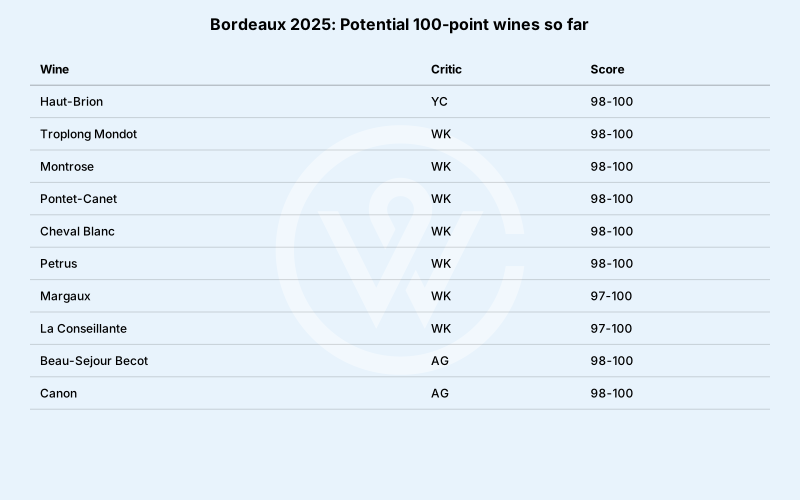
Bordeaux 2025: 100 point wines

*YC = Yohan Castaing (Wine Advocate), WK = William Kelley (Wine Advocate), AG = Antonio Galloni (Vinous)

It is important to note that En Primeur scores are typically expressed as ranges rather than fixed numbers. This reflects the fact that the wines are still in barrel and continue to evolve. Critics therefore allow for a margin of potential – both upward and downward – based on how the wines are expected to develop before bottling. A range such as 98-100 points signals not only exceptional quality, but also the realistic possibility of a perfect score at maturity.

Among the early reports, William Kelley is the most bullish, identifying seven wines with 100-point potential. Antonio Galloni follows with two, while Yohan Castaing has highlighted one wine in this top tier.

The list itself is telling. First Growths Chateau Haut-Brion and Chateau Margaux both feature, underlining the strength of the Left Bank at the very top level. They are joined by Right Bank icons Petrus and Cheval Blanc, alongside standout performers such as Troplong Mondot, Montrose and Pontet-Canet. 

Bordeaux 2025 market reality

While the wines themselves are widely praised, all critics have raised concerns about the market in their reports.

Kelley describes the En Primeur context as “structurally fragile,” questioning whether consumers still see value in buying futures. Galloni also states that Bordeaux “badly needs a win,” but warns that success depends entirely on pricing discipline. He argues that even modest increases could undermine demand, given the availability of competitively priced back vintages on the secondary market.

Hindle offers a more measured view, noting early signs of pricing restraint in the first releases and a stabilising fine wine market, but still emphasising the need for alignment between producers, merchants and consumers. 

The key to En Primeur success

Taken together, these early critic assessments position 2025 as a highly successful but nuanced Bordeaux vintage. At its best, it delivers a rare combination of concentration, freshness and terroir transparency – wines of both immediate appeal and long-term potential. However, it is not a uniform success. Variability is a defining feature, and careful selection will be essential. 

Perhaps most importantly, 2025 highlights a broader shift in Bordeaux. Through improved viticulture and winemaking, producers are increasingly able to navigate climatic extremes and make balanced wines in challenging conditions. 

But quality alone will not drive demand. The message from the critics is clear: the success of the campaign rests on the chateaux’s willingness to acknowledge the economic climate.

FAQ: Bordeaux 2025 En Primeur

Is Bordeaux 2025 a good vintage?
Yes – critics widely agree that 2025 is a high-quality vintage. Despite extreme heat and drought, the best wines show exceptional balance, freshness and moderate alcohol levels, leading some critics to describe it as a “miracle” or “paradoxical” vintage.

Why is Bordeaux 2025 described as a “miracle vintage”?
Because the wines defy expectations. In a hot, dry year that should have produced heavy, high-alcohol wines, 2025 instead delivered freshness, structure and restraint, thanks largely to cooler nights and crucial late-August rainfall.

What are the alcohol levels in Bordeaux 2025 wines?
Most wines fall between 12.5% and 13.5% ABV, significantly lower than recent hot vintages like 2022, where alcohol levels often exceeded 14.5%.

How important was rainfall in the 2025 vintage?
Late-August rainfall was critical. It rehydrated vines after prolonged drought, slowed sugar accumulation, and allowed full phenolic ripeness, ultimately shaping the balance and style of the wines.

Are Bordeaux 2025 yields low?
Yes. 2025 is the smallest Bordeaux harvest since 1991. 

Which Bordeaux regions performed best in 2025?
Margaux and Pauillac are widely seen as standout performers on the Left Bank, while Saint-Émilion excelled on the Right Bank, particularly on clay-limestone soils. 

Are there any 100-point Bordeaux 2025 wines yet?
Several wines have already received barrel score ranges of 98-100 points, indicating potential for a perfect score once bottled. Top names include Haut-Brion, Margaux, Petrus and Cheval Blanc.

What do En Primeur score ranges (e.g. 98–100) mean?
Barrel scores are given as ranges because the wines are still ageing. A 98-100 score suggests the wine is already exceptional but could improve further before bottling and reach a perfect score.

Will Bordeaux 2025 En Primeur be a successful campaign?
That remains uncertain. While wine quality is high, critics warn that success will depend on pricing. Buyers are increasingly cautious, and competition from back vintages may limit demand.

Should you buy Bordeaux 2025 En Primeur?
Critics emphasise that 2025 is not a uniform vintage. The best wines are outstanding, but variability is high, meaning careful selection will be essential rather than broad, “buy everything” strategies.

WineCap’s independent market analysis showcases the value of portfolio diversification and the stability offered by investing in wine. Speak to one of our wine investment experts and start building your portfolio. Schedule your free consultation today.
Categories
News

Bordeaux 2025 En Primeur: Quality meets a market at the crossroads

  • Bordeaux 2025 is a low-yield, heat-shaped vintage delivering concentration, freshness, and a clear shift toward precision viticulture.
  • Early reports point to a high-quality vintage with the potential to rival benchmark years like 2010 and 2016.
  • Set against a cooling market, the En Primeur campaign represents a critical opportunity to reset expectations around pricing and value.

From April 20th to 23rd, 2026, Bordeaux welcomed thousands of merchants, critics, and collectors for the En Primeur tastings of the 2025 vintage. Shaped by intense heat and reduced yields, the new vintage reflects a growing emphasis on precision viticulture – an approach that could come to define Bordeaux’s modern identity.

Yet the usual energy surrounding En Primeur unfolds against a more cautious economic backdrop. Bordeaux finds itself in a period of recalibration. As the first in-barrel scores emerge and the campaign gathers momentum, attention turns not only to what sets the 2025 vintage apart, but also to whether this release can offer real value.

A note on Bordeaux En Primeur

Few moments in the fine wine calendar carry the weight of En Primeur week. Orchestrated by the Union des Grands Crus de Bordeaux (UGCB), the event sees chateaux open their doors to professionals eager to sample wines just months after they were harvested.

Unlike the bottled wines, the En Primeur wines are still unfinished, first presented while ageing in oak. Tasting from barrel requires an expert palate to see through the raw tannins and vibrant acidity to glimpse the potential for greatness years down the line. It is a period of masterclasses, technical presentations, and intense market discussion that signals the pricing direction for the entire year ahead.

The 2025 represents a fascinating stylistic shift. Despite the heat, alcohol levels are reportedly low to moderate. The wines have pronounced aromatics, silky tannins and brisk acidity – hallmarks of great ageing potential. 

Bordeaux 2025: What we know so far

Bordeaux weather and crop reports indicate that 2025 was a year of climatic extremes, resulting in high quality but notably low yields. In fact, production statistics show that 2025 is the smallest crop since the frost-bitten 1991, with yields across many top appellations falling 15-30% below the five-year average.

A season of heat and superb ripening

The growing season was defined by a warm spring and a blistering summer. June 2025 was recorded as one of the hottest in French history, second only to the infamous 2003. This heat, combined with a dry August, led to:

  • Smaller berries: The lack of water and high heat restricted grape size, leading to intense concentration and thick skins.
  • Exceptional phenolic ripeness: While the yields are small, the quality of the tannins is reportedly superb.
  • The “rain of relief”: Just as drought stress became critical, rain in late August and early September refreshed the vines, preserving essential acidity and preventing alcohol levels from spiralling out of control.

Regional highlights

  • The Left Bank (Médoc, Pauillac, St-Julien): The deep-rooted old Cabernet Sauvignon vines thrived, producing structured, age-worthy wines reminiscent of 2022 but with a touch more freshness.
  • The Right Bank (St-Émilion, Pomerol): Clay and limestone soils held onto moisture better than gravel, allowing Merlot to reach lush ripeness without excessive heat stress.
  • Dry whites: Harvested early in mid-August, these show vibrant acidity and tropical aromatics.

The Bordeaux market: The recalibration phase

While the 2025 quality is expected to be high once critic scores are released, the market mood is best described as unsettled. For decades, Bordeaux held an unchallenged dominance in the fine wine market. Recent years have seen a cooling of demand, especially for young releases.

The challenges

  • Increased competition: High-quality rivals from Burgundy, Tuscany, Napa Valley, and even emerging regions have eaten into Bordeaux’s traditional market share.
  • Pricing fatigue: Consistent price hikes in recent En Primeur campaigns – often regardless of the broader economic climate – have tested the loyalty of even the most dedicated collectors.
  • Stock overhang: Many merchants are currently carrying significant inventories of recent great years (2018, 2019, 2020), which has created a bottleneck in the secondary market.

The silver lining

Despite these headwinds, the appetite for older, physical vintages remains robust. There is a clear divergence in the market: while younger vintages (2021-2023) struggle for traction, back vintages from the mid-2000s and 2010s continue to see steady price appreciation. This suggests that the brand of Bordeaux is as strong as ever. The issue lies specifically with release pricing.

Buying wine En Primeur: The question of value

For decades, the “golden rule” of Bordeaux was that En Primeur represented the lowest price point for a wine’s entire lifespan. Today, that assumption is being challenged by data.

Looking at prices at release versus now, several recent vintages can be found on the secondary market for the same price or even less. This has shifted the focus from buying everything to selective acquisition based on specific brand value. Tools like Wine Track, which show the historic performance of specific wine brands, can help investors understand long-term trajectories.

Why data matters

In the 2025 campaign, savvy buyers will be looking for relative value. If a 2025 release is priced higher than a physical, high-scoring 2019 or 2020 vintage currently sitting in a merchant’s warehouse, the incentive to buy En Primeur diminishes. However, because the 2025 yields are so low, scarcity may drive demand for the top-tier “blue chip” estates (the First Growths and their Right Bank equivalents).

The 2025 Bordeaux En Primeur verdict

As critics release their first scores over the coming weeks, all eyes will be on the “price-to-quality ratio.” The 2025 vintage has all the hallmarks of a collector’s dream: scarcity, concentration, and classical structure. For the Bordeaux trade, the 2025 En Primeur is an opportunity for a reset. With early reports pointing towards a vintage that could rival the greats of 2010 or 2016, the quality is likely there.

If the châteaux can marry this quality with a pricing strategy that respects the current market reality, 2025 could mark the beginning of a vibrant new chapter for the world’s most famous wine region.

Bordeaux comment: UGCB President, François-Xavier Maroteaux speaks to WineCap

WineCap: The 2025 vintage promises high quality, yet it arrives as the secondary market has just started to recover from a five-year low, and growing geopolitical tensions discourage speculation and might isolate certain market segments. How do you intend to position the 2025 launch so it doesn’t just survive the current market, but actually revitalises the ‘Bordeaux Brand’ globally?

François-Xavier Maroteaux: The 2025 vintage is a genuine opportunity – but only if we use it wisely. First, pricing must be honest: release prices that ignore five years of secondary market correction damage trust more than they protect margins. A well-priced great vintage is far more powerful than an overpriced one. Second, the narrative must move beyond scores – 2025 has a compelling story of terroir and style that needs to reach consumers directly, not just through trade press. Third, our négociants are brand ambassadors, not just a distribution channel: the properties that genuinely invest in informing and equipping their partners will see it reflected in every market. Finally, the retreat of speculative demand is not a threat – it’s a rebalancing. Bordeaux built its reputation on wine people actually wanted to drink. Refocusing on that is not a concession to difficult times. It’s a return to what made the region great. 

WC: Where do you see the biggest interest in buying Bordeaux at release in the coming years?

FXM: The interest in buying Bordeaux at release remains genuinely global. The best proof of this is the En Primeur week itself: every year, wine professionals from more than 80 nationalities make the journey to taste and buy. That breadth of engagement, even in difficult market conditions, is a strong signal that the foundation is there. Beyond geography, there is another compelling reason to buy at release that we shouldn’t underestimate (and we should be communicating much more actively!): formats. En Primeur remains the best – often the only – window to secure large formats. Magnums, double magnums, imperials are allocated at release and rarely available later at any price. The opportunity is to refocus En Primeur on what it does uniquely well: access, formats, and relationship. That’s a proposition that holds regardless of geopolitics.

WC: Is the En Primeur system still going strong, in your personal view? Do you believe it still offers a genuine win-win? Has it become a luxury-only club for the top 50 estates?

FXM: Yes, I do believe the En Primeur system still works – but I think we need to be honest about what it has become. It works very well for a relatively narrow group of estates where brand strength and secondary market liquidity reinforce each other. For the broader Bordeaux pyramid, it is more complicated. That said, I don’t think the answer is to abandon the system. The answer is to make the win-win genuine again. That means pricing with discipline, communicating with transparency, and making sure négociants and merchants actually make money when they support a release. When that alignment exists, En Primeur is a unique and powerful tool. When it doesn’t, it becomes – as you say – a luxury club for the top names. 

FAQ: Everything you need to know about Bordeaux En Primeur

What does “En Primeur” mean?

En Primeur is a method of purchasing wine while it is still maturing in the barrel. This allows collectors and investors to secure highly sought-after wines before bottling and general market release. This typically happens two years after harvest.

When is the Bordeaux 2025 En Primeur week?

The official tasting week for the 2025 vintage takes place from April 20 to April 23, 2026. During this time, international critics and trade professionals sample the wine from barrel to determine early scores and quality ratings.

Is the 2025 Bordeaux vintage good?

Bordeaux 2025 is a high-quality vintage with intense concentration and bold fruit profiles.Yields are lower than average, which often results in wines with significant ageing potential and structural density.

Why are yields low for the 2025 vintage?

The 2025 growing season saw record-breaking heat and extended dry periods. While this led to exceptional grape ripeness and thick skins (tannin), it resulted in smaller berries and less juice. These lower yields often drive up demand due to the limited number of cases available globally.

Is buying En Primeur a good investment?

Buying En Primeur can be a strategic investment, particularly for top-tier estates (First Growths and “Super Seconds”). However, it is essential to use data-driven insights. While release prices were historically the lowest point of entry, current market fluctuations mean buyers should compare release prices against available physical back-vintages to ensure they are getting true value, as older vintages can often present better buying opportunities than En Primeur.

When is the delivery of the 2025 Bordeaux wines?

In the spring or summer of 2028, following their mandatory ageing period in the châteaux cellars.

What are the “big three” factors to watch in the 2025 campaign?

  1. Critic scores: Initial ratings from major publications will dictate immediate global demand.
  2. Release pricing: How châteaux price their wine in relation to the secondary market.
  3. Volume: With lower yields reported, the scarcity of specific labels will likely be a driver of demand.

WineCap’s independent market analysis showcases the value of portfolio diversification and the stability offered by investing in wine. Speak to one of our wine investment experts and start building your portfolio. Schedule your free consultation today.
Categories
News

Is fine wine investment impacted by wealth exodus?

  • As wealth moves between generations and jurisdictions, investors are prioritising assets with universal value and “borderless” appeal.
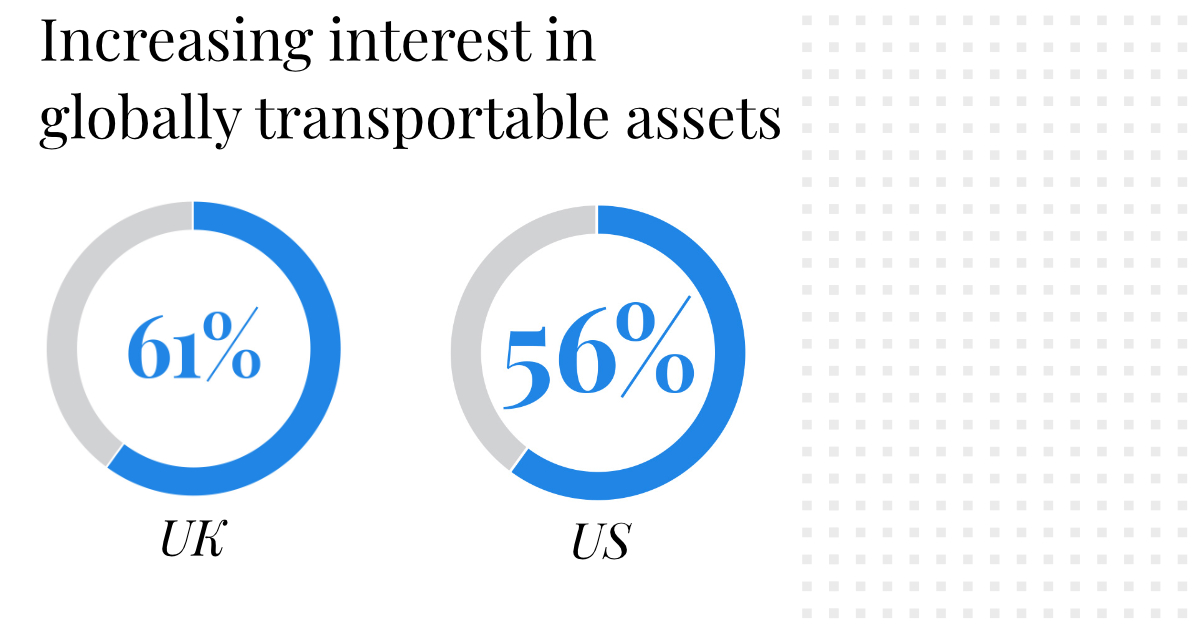
  • About 60% of global investors today show increased interest in globally transportable assets due to political and tax developments.
  • Fine wine can serve as the ultimate “borderless” asset, offering stability and low correlation to mainstream markets.

As the global population of high-net-worth individuals (HNWIs) expands, we are witnessing the cusp of the largest intergenerational wealth transfer in history – all set against a backdrop of profound instability. While private wealth continues to grow, the economic situation of some major countries is weakening, and, consequently, the world is witnessing an unrivalled migration of HNWIs.

This multifaceted shift of wealth is taking place in an unstable global climate, where governments are continually redefining the “social contract” through major reforms and the overhaul of domestic tax regimes. This quest for stability and the safeguarding of assets is prompting a mass relocation of HNWIs that is reshaping traditional “capitals of wealth.”

Findings from the 2026 WineCap Wealth Reports – conducted among hundreds of wealth managers and financial advisors in the UK and US – reveal how this exodus is fundamentally altering the modern investment portfolio. As HNWIs move across borders to escape fiscal tightening and political volatility, fine wine has emerged as a sophisticated, “borderless” financial instrument that could well fit the mobile elite.

Why is wealth moving?

The current exodus is driven by a “perfect storm” of factors that vary by region but share a common goal: capital preservation.

  • In the UK: The term “Wexit” (Wealth Exit) has gained traction following the abolition of the “non-dom” tax status and significant reforms to inheritance tax. Wealthy individuals who once viewed London as a permanent safe haven are now looking toward more tax-favourable jurisdictions.
  • In the US: Movement is driven by a desire to diversify away from domestic political volatility and a weakening reliance on the US Dollar as a singular store of value.
  • Globally: Inflation and high interest rates have made traditional “paper” assets feel increasingly fragile, prompting a flight to tangible quality holdings.

Defining the “borderless” asset

As investors become more mobile, they require assets that share that mobility. A borderless asset is a financial instrument that maintains its value and liquidity regardless of geographical location. Unlike real estate, which is physically anchored to a single jurisdiction, fine wine is recognised and tradable globally.

Fine wine has solidified its role in this exodus due to four key characteristics:

  1. Tangible value: A physical luxury asset with intrinsic worth.
  2. Low correlation to mainstream markets: It operates independently of the “noise” of equity and bond market volatility.
  3. Inherent scarcity: Consumption leads to a permanent reduction in supply. As demand remains steady or increases, prices rise.
  4. Fiscal stability: Fine wine acts as a defensive anchor during periods of high inflation.

Demand for portable asset

A defining trend of 2026 is demand for globally transportable assets. For an investor who is  relocating, an asset that can be stored in a bonded warehouse in one country and sold in another – without the friction of traditional capital flight – is invaluable.

  • UK Context (“Wexit”): With 95% of UK advisors citing fine wine’s status as a “wasting asset” (generally exempt from Capital Gains Tax), it has become a primary tool for “Wexit” planning. Sixty-one per cent of UK wealth managers report that their clients are now explicitly prioritising investments with high portability.
  • US Context: In the US, where 56% of respondents noted a similar priority for mobility, fine wine has evolved from a simple diversifier into a strategic, borderless tool for navigating global wealth transfers.

Since fine wine is not anchored to any single jurisdiction, it allows the modern investor to maintain wealth across borders while avoiding the risks associated with fixed-location assets.

Fine wine’s universal value and fiscal efficiency

The appeal of fine wine is further bolstered by its intrinsic value, which transcends currency fluctuations and regional economic stressors.

  • Currency neutrality: In the US, 98% of wealth managers noted that fine wine’s lack of a direct peg to the USD plays a significant role in its appeal as money moves globally.
  • Tax efficiency: In the UK, 95% of advisors cite its status as a “wasting asset” – which generally exempts it from Capital Gains Tax (CGT) – as a primary driver for its inclusion in sophisticated portfolios.
  • Market maturity: Trading fine wine has become easier than ever before for both buyers and sellers; half of global investors now recognise the sector’s improved liquidity within a well-established, global secondary market.

Deepening capital commitment

The convergence of portability, universal value, and defensive resilience has catalysed a transformation in how capital is committed to fine wine. No longer viewed as a peripheral “passion project” or a speculative hobby, fine wine has solidified its role as a viable alternative asset. This shift can at least partially be attributed to the wealth exodus, as borderless alternatives can offer both stability and growth.

The 2026 WineCap Wealth Reports quantify this deepening commitment, revealing a significant jump in portfolio exposure compared to just twelve months prior. Approximately half of all surveyed wealth managers in the US and nearly half in the UK now report that their clients allocate between 11-20% of their total portfolios to fine wine. This “standard” allocation demonstrates that wine is now being treated with the same strategic weight as traditional alternative mainstays like private equity or hedge funds.

Perhaps the most telling indicator of this trend is the emergence of the “heavyweight” segment – investors who view fine wine as a primary vehicle for wealth preservation during transit. Over a third of respondents in both the UK and US noted that their most committed clients now dedicate between 21-30% of their total wealth to the asset class. To put this in perspective, this represents a tectonic shift in investor behaviour: in 2025, a negligible portion of the market (less than 2% across both regions) held allocations exceeding 20%. 

This deepening commitment is underpinned by growing conviction among the professional advisor community. With a record-breaking 97% of wealth managers forecasting a further increase in demand throughout 2026, the trajectory is clear. 

Fine wine has moved beyond its status as a simple diversifier; it has become the preeminent collectible for a generation of investors who want to preserve, grow, and – most importantly – move their wealth across any jurisdiction on the global map.

WineCap’s independent market analysis showcases the value of portfolio diversification and the stability offered by investing in wine. Speak to one of our wine investment experts and start building your portfolio. Schedule your free consultation today.

Categories
News

Wine investment 2026: How the under-40s are reshaping the market

  • Younger investors are abandoning traditional collecting habits in favour of data-driven strategies.
  • Peer validation is more important than family tradition when it comes to fine wine buying under 40.
  • The under-40 cohort utilises a multi-channel digital ecosystem to find their way into the fine wine market.

In 2026, fine wine investment is undergoing a generational shift. Younger investors under 40 are moving away from traditional collecting, a new report from think tank Areni Global reveals. Instead, they are opting for data-driven wine strategies, digital wine-tech platforms, and alternative asset diversification to hedge against stock market volatility. With fine wine prices currently sitting near five-year lows, under-40s are increasingly viewing the asset class as a critical alternative for diversifying their portfolios. Passion alone is no longer the leading force behind buying fine wine.

Why Millennials and Gen Z view wine as an alternative asset

The traditional “inheritance model” of wine collecting is dead. For decades, the industry assumed a passion for fine wine was passed down through family cellar keys. However, 2026 market data from Areni Global confirms a radical shift: younger investors are entering the market through independent, digital, and social channels.

Peer groups and shared wine experiences

Unlike previous generations, Millennial and Gen Z wine investors prioritise “horizontal discovery.” This means interest is sparked by peer groups, social “defining moments,” and digital communities rather than family heritage. For wealth managers, this highlights a shift from legacy-based collecting to community-driven wine investing.

The 40-year window

The report identifies a “collector’s spark” that must be ignited between the ages of 26 and 35. If a professional hasn’t entered the market by 40, they likely never will.

Gamified investing

For the 30% of the population with a “collector’s pulse,” wine investing is treated like gaming. This means valuing tight mechanics (real time data and execution), clear progression (visualising the growth of a portfolio), and digital transparency.

Women in wine investment 

One of the most significant “systemic failures” in the industry is the retention of female wine investors. While women under 25 enter wine education at rates nearly equal to men, a sharp drop-off occurs in their 30s, with only 25% becoming regular buyers. To tap into this $100bn+ investment opportunity, the 2026 market must evolve. Success lies in building business models that reflect the lifestyle and purchasing patterns of high-net-worth professional women, focusing on value-aligned investing and easier access.

How the under-40s discover the market

The entry point for the modern wine investor has shifted from the oak-panelled cellar to the palm of the hand. Unlike previous generations who relied on exclusive merchant relationships, the under-40 cohort utilises a multi-channel digital ecosystem to find their way into the market.

Social media transparency

Discovery now happens via Instagram influencers, sommeliers on TikTok, and finance-focused creators on YouTube and Substack. These creators strip away the pretension of fine wine, explaining market movements and vintage quality in simple, relatable terms.

The rise of wine-tech

Technology has emerged as a transformative force in wine investment, revolutionising various aspects of the industry. From verifying provenance to streamlining valuation processes, advancements such as blockchain and artificial intelligence (AI) have played a crucial role. Ultimately, the rise of specialised wine investment apps and platforms has been the ultimate “barrier-breaker.” These platforms have lowered the financial entry barrier, making fine wine a viable alternative asset for those looking to diversify away from the volatility of stocks and crypto.

The “social proof” factor

In line with the Areni Global findings, social proof is the primary driver of engagement. Seeing friends or colleagues discuss their wine portfolios creates a “FOMO” (fear of missing out) effect that traditional advertising cannot replicate. This is often supplemented by luxury lifestyle crossover – an interest in fine dining and high-end collectibles naturally leading toward the financial potential of the bottles on the table.

Value-driven investing

Younger investors are increasingly attracted to the sustainability and heritage of fine wine. In an era of “fast fashion” and ephemeral digital goods, a 50-year-old bottle of sustainably farmed Bordeaux represents a tangible, value-aligned asset that appeals to the ethics of the modern professional.

A beginner’s guide to wine portfolio management in 2026

If you are a professional under 40 looking to capitalise on the current market reset, here is the strategic roadmap for 2026:

I. Store wine in-bond

Never take physical delivery of your investment wine. Storing wine in-bond (IB) in a government-regulated, temperature-controlled warehouse is the only way to guarantee provenance. A bottle that has left the “bonded circuit” is immediately worth less to a future buyer because its storage history is broken.

II. Focus on liquidity

New investors often make the mistake of buying obscure labels they personally enjoy. As an investor, focus on liquidity. Regions like Tuscany (Sassicaia, Tignanello) and Champagne currently offer the best balance of lower entry prices and high secondary market demand.

III. Think long-term

Fine wine is not a “get rich quick” scheme. It is a medium-to-long-term play. The natural price appreciation occurs as a vintage is consumed and the global supply shrinks. Plan for a minimum holding period of five to 10 years to see the full “S-curve” of appreciation.

IV. Use wine data

Gone are the days of spreadsheets and faxed price lists. The modern investor uses platforms like WineCap to track real-time valuations and regional performance trends. In 2026, data is as important as the wine in the bottle.

FAQ

1. Is fine wine a good investment in 2026?

With fine wine prices currently sitting at near five-year lows, many analysts view 2026 as an optimal entry point for a “buy low” strategy. Fine wine historically offers a low correlation to traditional equity markets, acting as a defensive “liquid property” asset during periods of financial volatility.

2. What does “in-bond” (IB) storage mean?

“In Bond” refers to wine stored in a government-regulated, climate-controlled warehouse where VAT and Duty do not apply. For investors, this is essential: it guarantees the wine’s provenance (its history of perfect storage), making it significantly easier and more profitable to resell on the secondary market.

4. How to invest in wine for beginners without expertise?

The 2026 market is seeing a surge of “investment newbies” who use data-driven platforms rather than decades of tasting experience. By following trusted market analysts, using price-tracking tools like Wine Track, and focusing on high-liquidity “Blue Chip” labels, beginners can make informed financial decisions without being professional sommeliers.

5. Why is the under-40 demographic important for the wine market?

The Areni Global report identifies a critical “collector’s spark” window between the ages of 26 and 35. Investors who enter the market during this time are more likely to stay engaged for decades. Capturing this demographic is essential for the market’s long-term liquidity and growth.

6. How long should I hold my wine investment?

Fine wine is a medium-to-long-term asset. While some high-demand vintages see short-term spikes, typically, appreciation requires a holding period of five to 10 years. This allows the global supply to dwindle as wine gets consumed, naturally driving up the price of the remaining bottles.

7. What are the best wine regions to invest in right now?

While Bordeaux remains the market’s bedrock, 2026 trends show strong growth in Tuscany, Napa and Champagne. These regions offer high “brand liquidity,” meaning they are easy to trade on the secondary market and often have a lower entry price than top-tier Burgundy.

Categories
News

Wine alcohol volume and UK duty explained

  • The wine’s alcohol by volume (ABV) directly determines the UK wine duty rate.
  • Higher wine percent alcohol now means higher duty, directly influencing retail prices.
  • Understanding alcohol content of wine is becoming essential for both consumers and the wine trade.

From 1 February 2026, the UK Government implemented a new alcohol duty increase across all drinks, including wine, beer and spirits, rising with inflationary measures designed to preserve the real-term value of tax receipts. This follows duty reforms initiated in 2023 and cements the strength-based system that taxes wine according to its alcohol by volume (ABV) – essentially the wine alcohol volume or alcohol percentage wine contained in the bottle rather than a simple flat rate per litre.

Crucially for consumers and the wine trade alike, alcohol content of wine – expressed as alcohol by volume wine – directly influences duty bills and therefore retail prices.

Duty by alcohol strength

The updated system calculates duty based on the pure alcohol in the bottle – meaning that wine percent alcohol (e.g., 12% vs 14% ABV) changes how much tax is levied. Wines between 8.5% and 22% ABV now incur a rate of £30.62 per litre of pure alcohol, with still wines between 3.5% and 8.4% ABV taxed at £26.61. Incremental duty rates continue up the strength ladder.

This structure rewards lower-strength styles slightly – a bottle at 11.5% ABV pays less duty than one at 14.5% ABV – and reflects a policy intention to align tax more closely with alcohol per volume wine.

Recent analysis suggests the 2026 rise, based on Retail Price Index inflation, increases the duty on average wines by roughly 3.5-4.3% on top of the tiered rates already in place.

Why ABV in wine matters 

Since duty links to alcohol by volume, producers must account for shifts in average wine alcohol volume when forecasting costs and pricing.

  • A 13% ABV wine now pays about £2.88 in excise tax per bottle, up compared to previous years.
  • A 14.5% ABV wine pays more, thanks to a higher pure alcohol content translating into more duty per bottle.

For everyday drinkers, this means understanding the alcohol percentage in wine isn’t just about taste or body; it also affects the share of duty baked  into your bottle price.

Wine sector reacts

Industry groups have responded with concern:

  • The Wine and Spirit Trade Association (WSTA) has warned repeated duty increases – on top of other business costs – strain margins across the retail and on-trade sectors, potentially dampening investment.
  • With the UK importing more than 1.7 billion bottles of wine annually, alcohol duty remains a significant revenue source – contributing to £8.5 billion of the £12 billion alcohol duty total – but this essential income must balance industry viability.

Wine businesses, especially independent importers and smaller producers, are adjusting pricing strategies to manage tighter margins while educating customers around alcohol content of wine and its implications for duty and price.

UK vs other markets

The UK’s approach to taxing wine based on alcohol by volume (ABV in wine) contrasts with several other major markets:

  • European Union (EU) countries set minimum excise duty standards but can apply national rates above these minima; some member states impose no excise on wine at all, depending on policy direction.
  • In the United States, federal excise duty on still wines is based on volume (per wine gallon) and is structured around alcohol by volume (ABV) bands, with additional excise taxes levied at the state level.
  • Australia taxes wine at a flat 29% Wine Equalisation Tax on wholesale value rather than strength, with rebate schemes for producers.

These differences highlight how alcohol tax policies vary globally – and how the UK’s strength-based model aligns with broader public health goals while complicating pricing strategies for wines with higher wine percent alcohol.

Consumer impact 

The consumer price impact depends on multiple factors beyond duty, including VAT, retailer margin, and distribution costs. But generally:

  • Higher ABV wines will carry higher duty contributions, pushing up shelf prices relative to lower-ABV wines.
  • Lower-strength and lighter styles may become more appealing to price-sensitive shoppers.

Retailers may increasingly highlight the alcohol content of wine alongside tasting notes and provenance to help consumers make informed choices.

Investment-grade wine, duty, and in-bond storage

An important distinction in the discussion around alcohol duty is how it applies to investment-grade wine stored in bond.

By storing wine in a bonded warehouse under HMRC supervision, investors avoid alcohol duty and VAT while the wine remains in storage. In practical terms, changes to UK alcohol duty do not affect the investor while the wine stays in bond.

This structure underpins the fine wine investment market. Investors buy, sell, and trade wine in bond without triggering duty or VAT. HMRC only levies duty if and when you remove the wine from bond for UK consumption; at that point, the authorities calculate tax based on the wine’s alcohol content at the prevailing rates.

For collectors and investors, this offers several advantages:

  • No duty or VAT while trading – allowing capital to be allocated efficiently
  • Liquidity – wines can change ownership without physical movement
  • Flexibility – duty is only paid if the wine is eventually consumed

From an investment perspective, this also means that rising alcohol duty linked to alcohol volume wine primarily affects drinkers, not investors, provided the wine remains in bond. As a result, duty increases tend to have limited impact on the pricing of investment-grade wines, which typically trade on a duty-suspended basis.

However, for those planning to drink their wines in the future, it remains important to factor in potential duty costs – particularly for higher-ABV wines – when deciding whether to withdraw bottles from bond.

WineCap FAQ – Alcohol duty and wine

Q: What is wine alcohol volume and why does it matter?
A: It’s the measure of alcohol content expressed as a percentage (ABV). In the UK’s duty system, higher alcohol by volume wine means more duty per bottle, ultimately affecting pricing.

Q: Has duty increased for all wines in February 2026?
A: Yes – duty on wine rose broadly in line with inflation and remains tied to ABV rather than a single flat rate, meaning stronger wines see proportionally more tax.

Q: Does higher ABV always mean higher duty?
A: Under the current system yes – alcohol per volume wine (i.e., ABV) is directly linked to duty charges.

Q: How do UK duty rates compare with other countries?
A: The UK is among countries that tax wine excise based on alcohol content. Others, like the US and Australia, use different structures; some EU countries apply minimal or no excise on wine.

Q: Will this tax system change again soon?
A: Duty rates are typically reviewed annually in the Budget and Spring Statements. Future reforms could further adjust how wine percent alcohol influences duty.

Categories
News

How the EU-India trade deal could reshape the fine wine market

  • India remains one of the smallest wine markets globally, but consumption is growing rapidly from a very low base.
  • The latest EU-India trade deal marks the first meaningful step toward tariff liberalisation, improving long-term access for European wine.
  • History shows that when large markets open gradually – as China did in the early 2000s – collector demand and investment interest can follow.

India and the European Union announced a major step forward in trade relations last week, with Brussels hailing the agreement in principle as one of the most significant developments in modern EU trade policy. Among the headline areas under discussion: India is expected to begin easing tariffs on European wine, alongside beer and olive oil, as part of a broader push toward gradual market liberalisation.

At first glance, wine may seem like a footnote in a deal dominated by cars, textiles, pharmaceuticals, and geopolitics. But for the fine wine world – and particularly for the long-term evolution of wine investment demand – India’s gradual market opening could prove far more consequential than current consumption figures suggest.

India’s wine market growth: Small base, rapid expansion

India remains one of the least developed wine markets in the world relative to its population.

Wine represents well below 1% of the country’s total alcohol consumption, and India accounts for only a tiny fraction of global wine imports. Total annual consumption is still modest, with domestic producers supplying the majority of the market.

On a per-capita basis, the numbers are striking: India consumes approximately 0.02 litres per adult per year – the equivalent of a single tasting measure per person annually.

To put that in context:

  • Australia consumes over 20 litres per capita
  • France and Italy sit above 40 litres
  • Portugal leads the world at more than 60 litres

India may be the world’s most populous country, but wine remains a marginal category.

And yet the trajectory is clear: India’s wine market has been expanding at double-digit rates, making it one of the fastest-growing alcoholic beverage segments in the country.

Market researchers project India’s wine market could reach around $520 million by 2028, and potentially approach $1 billion by 2034 – still small globally, but significant given today’s base.

Wine consumption in India: A premium lifestyle category

India’s alcohol market remains overwhelmingly dominated by spirits and beer:

  • Spirits: ~53%
  • Beer: ~46%
  • Wine: less than 1%

In high-income economies, wine often represents around 27% of alcohol consumption, and the European region sits closer to 31%. India’s wine market is therefore not simply small; it is structurally underdeveloped. But this is also why the upside is so significant.

Wine is increasingly positioned not as mass alcohol consumption, but as a lifestyle and premium category, particularly in major urban centres. It is also uniquely aligned with the growth of India’s middle class, which comprised 31% of the population in 2023 and is projected to reach 60% by 2047.

Indian wine imports are rising in urban premium markets

Imported wine remains a small segment in absolute terms, but it is gaining visibility in affluent metropolitan markets such as Mumbai, Delhi, and Bengaluru.

European exporters have reported steady growth, and producers are increasingly investing in distribution networks, brand-building, and consumer education.

Crucially, wine markets almost always develop first in wealthy cities before broadening nationally – and India’s trajectory so far fits that pattern.

India’s wine import tariffs: The key barrier to European wine

For decades, India’s wine market has been constrained less by demand than by access.

India’s 150% wine import duty has historically restricted European wine exports, making imported bottles prohibitively expensive. On top of federal tariffs, each Indian state layers its own excise regime, often inflating shelf prices dramatically.

In practice, imported bottles can end up three to five times more expensive than comparable wines in other major markets once all taxes and fees are applied.

Any reduction in national duties would therefore be meaningful since it will start to unwind the single largest structural barrier at the federal level.

True liberalisation, however, would still require significant state-level reform.

India alcohol taxes: State-by-state barriers remain

India’s wine market is extremely fragmented. States fall into four distinct regulatory environments:

  • Private distribution markets – Maharashtra, Goa, Haryana
  • Government monopoly models – Tamil Nadu, Kerala, Delhi
  • Auction and lottery markets – Punjab, Chandigarh
  • Dry states – Bihar, Gujarat, Nagaland, Mizoram

Even where excise rates are manageable, barriers remain high through label registration fees and entry costs. Delhi, for example, charges a Rs. 2 lakh brand fee, while other states impose steep registration hurdles.

Northern states have even introduced “cow cess” levies — welfare fees on every bottle of wine to fund cattle shelters.

This complexity means that India’s market opening will be uneven, gradual, and city-led.

Wine education on the rise

Fine wine markets do not develop through income alone. They require education.

The rise of figures such as Sonal Holland MW, India’s first and only Master of Wine (since 2016), reflects the growing sophistication of India’s wine ecosystem. Her academy and the India Wine Awards are helping to build a professionalised culture of tasting, curation, and consumer knowledge.

This shift matters enormously: investment demand does not emerge without informed appreciation of provenance, scarcity, and value.

EU–India trade deal arrives in a fragmented global trade world

It is impossible to separate this agreement from the wider context in which it has arrived.

Global trade is becoming more fragmented. Tariff regimes are increasingly politicised, supply chains are being re-evaluated, and cross-border flows of goods are being reshaped by geopolitics as much as economics.

The wine market is not immune. Over the past year, the fine wine industry has been watching renewed trade tensions between the US and key partners, alongside uncertainty around tariffs, shipping, and market access. In that environment, any meaningful liberalisation elsewhere carries outsized importance.

India’s decision to begin lowering duties on European wine therefore signals a gradual shift toward integration, and it is coming at a moment when much of the global trade landscape is moving in the opposite direction.

For fine wine, where demand is global but supply is finite, the emergence of new consumer markets has always been one of the most powerful long-term drivers of price appreciation.

China’s wine boom shows what happens when large markets open

The closest modern parallel to the opening of the Indian wine market is China.

In the early 2000s, China’s wine market was similarly underdeveloped. But gradual reductions in trade barriers, expanding distribution, and the emergence of gifting culture created one of the most dramatic demand transformations the wine world has ever seen.

By the late 2000s and early 2010s:

  • Bordeaux became a symbol of luxury
  • Auction activity surged across Asia
  • Global pricing dynamics shifted

India today is not China in 2010. Its regulatory structure is more fragmented, its per-capita consumption far lower, and cultural constraints are more pronounced.

But the structural similarities remain notable:

  • A vast population starting from a low base
  • Rapid urban wealth concentration
  • Wine positioned as aspirational luxury
  • Increasing education and professionalisation
  • Early steps toward reduced import barriers

In markets of this scale, even modest shifts in penetration can carry long-term implications.

What this could mean for fine wine investment

For investors, the key takeaway is not that India will suddenly become a dominant importer of blue-chip Burgundy or Champagne.

The market is still highly taxed, highly regulated, and structurally complex. State-level excise regimes, distribution monopolies, and steep registration costs remain major constraints. True liberalisation will take years.

However, fine wine investment is not driven by today’s consumption alone – it is driven by expectations of future demand.

Opening markets matter because they create:

  • Greater accessibility
  • More transparent pricing
  • Broader consumer participation
  • And, crucially, the early foundations of collector culture

India is not there yet but may now be entering the first stage of a familiar cycle: from niche consumption, to aspirational luxury, to informed collecting, and eventually, to investment-grade demand.

A wine market to watch

In a world where global trade is becoming more fragmented, even the gradual opening of a market of 1.4 billion people is one of the most important long-term developments the fine wine industry can watch.

The industry has speculated for decades about what India could become for fine wine. Now, for the first time, the market may be beginning to find out.


WineCap’s independent market analysis showcases the value of portfolio diversification and the stability offered by investing in wine. Speak to one of our wine investment experts and start building your portfolio. Schedule your free consultation today

Categories
News

Burgundy En Primeur 2024 and the current market

  • The 2024 Burgundy vintage is low volume with a classic profile
  • Informed selection of reputable domaines and appellations is essential when making purchasing decisions.
  • Burgundy wines showed signs of bounce in Q3 after steady price decline
  • The region remains a major player in the fine wine market despite shifts in Power 100 index

The 2024 Burgundy vintage is characterised by scarcity, precision, and classical elegance. A challenging growing season resulted in sharply reduced yields across the region, notably in red Burgundy wines. However, careful vineyard and winery management produced wines, albeit in smaller volumes, of exceptional quality, balance, and typicity. This is especially evident from Grand Cru and Premier Cru holdings.

This year’s En Primeur campaign unfolds against a complex market environment backdrop: previous vintages are still competing on the secondary market and fine wine pricing is showing cautious signs of stabilisation. This environment is offering collectors and investors opportunity and selectivity from the year’s best Burgundy wines.

This report examines the 2024 Burgundy vintage. It compares reds and Burgundy white wine, highlights standout domaines and appellations, and positions the campaign in a wider market context. This overview provides insights for both investment potential and enjoyment.

2024: Scarcity, vibrancy, and intensity

The defining characteristic of the 2024 Burgundy vintage is that of reduced volumes owing to a difficult growing season. Yields saw significant losses across the region, especially for red Burgundy wines. However, diligent work in the vineyard and winery resulted in wines that display a modern character with an old-school profile. The vintage is widely regarded as a year for admirers of classic, timeless Burgundy wines after a run of (with the exception of 2021) hot summers.

Chablis producer, Samuel Billaud, described the year as “a combination of 2014 (freshness and vibrancy) and 2021 (concentration and intensity of fruit).”

Climatic conditions and alcohol levels in 2024

Cool, wet conditions in spring led to coulure, resulting in reduced yields for Bourgogne red Burgundy wine. Chardonnay was not as badly affected. Spring and summer rain meant mildew and disease also posed a threat, which vignerons tried to deal with through repeated vineyard treatments where possible. Chablis was the worst affected, with yields often under 10hl/ha (usually 50hl/ha). The Côte de Nuits hovered around 15hl/ha. In the Côte de Beaune, red Burgundy grapes yields were at around 50% of typical levels. Chardonnay fared better at about 40hl/ha. Some areas, like the Mâconnais, had normal yields for Mâcon Burgundy. Lower-lying vineyards suffered more than mid-slope holdings. Localised hailstorms also added stress to vineyards. A clement late summer and a cool, dry north wind helped salvage the harvest.

  • Chardonnay’s greatest terroirs benefited from the cool, accentuating typicity and depth.
  • Pinot Noir’s low yields ultimately meant good phenolic maturity and intense ripeness.

Domaines demonstrated meticulous vineyard management and rigorous sorting to mitigate the impact of mildew. Potential alcohol levels across the vintage largely fell short of 13% abv. Some winemakers mitigated this with selective chaptalisation by half a degree. Both tartaric and malic acidities were higher than the previous year. During élevage, this resulted in softer, creamier acidity in fresh, zippy wines.

Reds vs white Burgundy wines: the essence of vintage quality

Like the previous vintage, 2024 was the year of Chardonnay, but Pinot Noirs also displayed grace, character, and balance. Many commenters noted that modern vineyard and winery methods had made finessed red Burgundy wines possible in conditions that would have written off Pinot Noir even just 25 years ago. The consensus was that the style for both reds and whites was traditional and classic, with a modern elegance.

Burgundy white wine featured:

  • Fresh acidity
  • Restrained, concentrated citrus
  • Precise minerality and structure

Grand Crus and Premier crus benefited from the cool weather conditions more than the Villages sites located on lower slopes. Standout appellations include: 

  • Puligny Montrachet wine, such as Les Caillerets
  • Chablis Grand Cru Les Preuses
  • Chevalier Montrachet Grand Cru 

Burgundy Pinot Noir is one of the recent best Burgundy years for:

  • Small quantities
  • Concentrated fruit
  • Elegant, precise profiles

The vintage’s Pinot Noir yields were greatly reduced by the weather, but the wines were classic, expressive, and understated. Carefully timed harvest and stringent sorting resulted in reds with transparency, a core of red fruit, and supple tannins. 

Notable successes include:

  • Gevrey Chambertin Les Dix Climats
  • Volnay 1er Cru Clos des Chenes

Overall, producers such as Samuel Billaud, Domaine Drouhin-Laroze, Pierre-Vincent Girardin, Domaine Y. Clerget, and Simon Colin have been praised for fresh, chiselled Burgundy wines with dynamism and terroir transparency.

Comparing 2023 vs 2024 Burgundy

Comparisons between the 2023 and 2024 Burgundy vintages are inevitable.

  • 2023: Large quantities, wide variability, precision-driven wines
  • 2024: Low volumes (notably of Burgundy red wine grapes), classic, elegant wines with concentrated fruit

Several growers and critics have noted similarities between 2024 and great Burgundy vintages for key characteristics: 2014 for its Burgundy quintessence and 2021 for its intense fruit.

Buyers should approach 2024 with a focus on appellation and domaine, rather than a broad perspective. 

Burgundy 2024 in market context

The Burgundy En Primeur 2024 campaign unfolds against a unique market backdrop.

  • The volumes of 2023 and 2024 mean that there is the potential for competition from previous vintage stock
  • Following a 5-year steady decline in prices, in Q3 2025, Burgundy showed signs of stabilisation with a slight bounce in prices
  • Out of the leading fine wine regions, Burgundy wines had the most movement in the Power 100 index, with ten brands dropping out and nine entering
  • Most climbers are mid-range wines priced under £2,000 in a movement towards prioritising Burgundy to enjoy, not solely as an investment asset
  • Top tier in the Classification Report dominated by Burgundy
  • The region retains a 25–30% share of the global fine wine market, underlining its enduring importance
  • Burgundy continues to demonstrate resilience driven by scarcity and long-term demand

Overall, the best Burgundy wine still constitutes a market juggernaut, but demand is price sensitive. Burgundy vs Bordeaux wine (the dominant fine wine region) comparisons will be accentuated by the En Primeur pricing approach. Commentators and producers alike project Burgundy prices to be reasonable despite a low-volume vintage.

Pricing strategies and producer behaviour

Understanding market conditions, many producers are flexible about their 2024 pricing approach.

Key influencers include:

  • Lower yields by themselves do not automatically justify higher release prices
  • Pricing impacted by values of back vintages of Burgundy wines
  • Producers face margin pressure, but stock inactive in the supply chain has no advantages
  • Burgundy learned that Bordeaux En Primeur overpricing in recent years reduces incentive for early buying
  • Low yields mean the best 2024 wines could be fiercely contested

More limited 2024 yields compared to 2023, sensible pricing, and lessons from Bordeaux hint that demand will be robust for the scarcest, highest-quality wines.

Competition from the secondary market

A key influence on the Burgundy En Primeur 2024 campaign is competition from the secondary market.
Well-stored top rated Burgundy wines from recent strong vintages are maturing well and available at attractive prices. Additionally, market softening has made buyers and investors less willing to purchase at any price. The options are to:

  • Secure 2024 En Primeur at fair pricing (“fair” meaning Bordeaux vs Burgundy En Primeur pricing referenced above)
  • Choose established older vintages with track records

This landscape puts pressure on producers for reasonable pricing and rewards buyers who carefully assess value across multiple vintages.

How buyers should approach Burgundy En Primeur 2024

With such low yields and varied performance across appellations and even plots, the 2024 campaign demands a selective and discerning approach rather than indiscriminate buying.

Essential takeaways:

  • Reduced volumes
  • Pressure to price according to market
  • Classic styles (reds and Burgundy whites)
  • Grand Crus and top Premiers Crus across regions in Burgundy benefited most from the cool, precise vintage
  • Signs of gradual market uptick 

Whether or not 2024 is one of the best Burgundy vintages is not of prime importance. What is critical is that, with its classic styles, low quantities, and appearance at a time when the market hints at upward correction, 2024 could present competitive opportunities for selective investors.

Burgundy’s enduring strength

Despite short-term market shifts, Burgundy’s long-term fundamentals remain robust:

  • Exceptional vineyards
  • Strong global demand
  • Enduring, prestigious cultural and historical legacy
  • Consistent scarcity at the very top tier of Burgundy wines

The 2024 En Primeur campaign puts in relief a region responding to market and climate pressures while maintaining the qualities that make good Burgundy wine such a consistently prized segment. 

Final thoughts on Burgundy En Primeur 2024

The 2024 Burgundy vintage offers a rare combination of low volumes, selective quality, and evolving pricing strategies at a moment when the fine market has signalled a bounce following pricing decline.

The finest Burgundy wine examples – particularly among the best white Burgundy – display precision, vitality, and strong value. 

Jasper Morris MW says …”a miserable growing season does not have to translate into miserable wines”, adding, “Do not boycott 2024 – there are many delicious wines which merit attention”

Neal Martin (Vinous) says: “2024 is an endlessly fascinating vintage that will enamour the small number who imbibe the fruits of much labour.”

For informed investors, the present market conditions create a strategic window to engage with wine from Burgundy thoughtfully, balancing new releases against secondary market opportunities. 


WineCap’s independent market analysis showcases the value of portfolio diversification and the stability offered by investing in wine. Speak to one of our wine investment experts and start building your portfolio. Schedule your free consultation today

Categories
News

Fine wine market starts 2026 on firmer footing

  • The fine wine market has closed 2025 on a positive note, with prices rising for four consecutive months.
  • Despite improving momentum, fine wine prices remain close to five-year lows, creating buying opportunities. 
  • Market broadening is a defining feature of rising markets, and 2026 is likely to mark the early stages of this transition.

After three years defined by correction, caution and recalibration, the fine wine market enters 2026 in a notably stronger position. Prices have stabilised, liquidity has improved, and demand is beginning to broaden – all signs that the market has moved beyond its most challenging phase and is laying the foundations for a sustainable recovery.

While it would be premature to describe the current environment as a full rebound, the early months of 2026 mark the firmest starting point the fine wine market has seen since 2022. For investors with a medium- to long-term horizon, this combination of stabilising prices and still-attractive valuations presents one of the most compelling opportunity windows in several years.

A firmer start to the year than at any point in the past three years

In our final article of 2025, we examined the performance of Bordeaux, Burgundy and Champagne – the three most important fine wine regions for investors – and highlighted pockets of growth across each. Crucially, that momentum has not faded with the turn of the calendar year.

Fine wine prices have now risen for four consecutive months, closing 2025 on a positive note and carrying that strength into early 2026. This sustained improvement matters. Rather than a short-term technical bounce, it signals a market that is beginning to find equilibrium after a prolonged period of repricing.

Key indicators suggest the market is now operating on firmer footing:

  • Prices have stabilised after reaching five-year lows
  • Liquidity has improved across leading regions and producers
  • Buyers are returning with greater confidence and selectivity
  • Multiple regions are now participating in early recovery trends

Taken together, these developments point to a healthier, more balanced fine wine market entering the new year.

Buying opportunities remain as prices hover near five-year lows

Despite improving momentum, fine wine prices remain close to five-year lows across many regions and vintages. Historically, this late-stage downturn phase – when prices stabilise before rising meaningfully – has offered some of the most attractive entry points for long-term investors.

Importantly, recovery does not begin with uniformly rising prices. Instead, it starts with price consolidation, followed by gradual gains concentrated in the most liquid and well-recognised segments of the market. That is precisely the pattern emerging today.

For investors, this creates a rare alignment of conditions:

  • Valuations remain compelling
  • Downside risk has diminished compared to previous years
  • Demand is rising without speculative excess
  • Portfolio construction can prioritise quality and value

Rather than signalling missed opportunity, the current environment suggests that disciplined, data-driven allocation remains well-timed.

Demand is rising and signs of recovery are becoming clearer

Demand has strengthened steadily since the second half of 2025, with improving sentiment evident across both private collectors and wealth managers. While activity remains selective, confidence has clearly returned.

Several regions have already begun to turn:

  • Champagne has benefited from strong global recognition, accessible entry points and consistent liquidity
  • Bordeaux has stabilised, particularly in older vintages and First and Second Growths
  • Burgundy continues to demonstrate resilience driven by scarcity and long-term demand
  • Tuscany and the Rhône have seen renewed interest as investors look beyond the most concentrated names

This multi-regional participation is an important signal. Recoveries that are confined to a single region tend to be fragile; recoveries that broaden tend to endure.

Momentum from late 2025 has been sustained

One of the most encouraging developments is the continuity of momentum. This matters for two reasons. First, it suggests that buyers are responding to fundamentals rather than short-term catalysts. Second, it indicates that confidence is building gradually, allowing the market to recover in a measured, sustainable way.

Sustained momentum also reinforces the importance of patience. Fine wine recoveries rarely follow sharp, V-shaped trajectories. Instead, they evolve through phases of stabilisation, selective appreciation and eventual broadening.

The case for market broadening in 2026

Market broadening is a defining feature of rising markets, and 2026 is likely to mark the early stages of this transition.

During periods of falling or uncertain prices, demand tends to narrow. Investors concentrate on the most established names, mature vintages and highest-liquidity wines. This was a defining theme throughout much of 2024 and 2025 global wine investment trends.

As confidence improves, the opposite dynamic emerges:

  • Buyers begin to search for relative value
  • Secondary regions and vintages re-enter consideration
  • Portfolios become more diversified
  • Opportunity expands beyond a small group of blue-chip wines

In 2026, this process is likely to unfold gradually, with selective broadening, supported by brand strength and the search for value.

Tariffs and the macro backdrop: a potential catalyst

Another factor shaping early 2026 sentiment is the evolving global trade environment. Tariffs remain under review by the US Supreme Court after lower courts deemed them illegal. While outcomes remain uncertain, the broader implications extend well beyond fine wine.

Should tariff pressures ease, the effects could ripple across global markets:

  • Improved trade clarity
  • Increased capital availability
  • Stronger investor confidence
  • Renewed appetite for alternative assets

In periods when liquidity improves and uncertainty recedes, portfolio diversification tends to increase. As a top-performing collectible and passion investment, historically, fine wine has benefited from such shifts. 

Fine wine remains the most in-demand collectible

According to the WineCap 2025 Wealth Reports, fine wine is the most in-demand collectible asset among wealth managers and financial advisers, outperforming art, watches, whisky and luxury handbags.

Several factors continue to underpin this appeal:

  • Proven long-term performance
  • Increasing market transparency
  • Global liquidity and established secondary markets
  • Growing acceptance within diversified portfolios

Fine wine’s evolution from passion asset to mainstream alternative investment has been gradual, but it is now firmly established.

Looking ahead: The 2026 Wealth Report

As the market enters this next phase, attention will increasingly turn to how wealth managers and financial advisers are adapting their allocation strategies. WineCap’s upcoming 2026 Wealth Report will examine these shifts in detail, exploring how fine wine is being integrated into portfolios amid changing economic conditions.

Early indications suggest that fine wine’s role as a diversification tool is strengthening, supported by improved data access, transparency and liquidity.

A healthier starting point for 2026

The fine wine market enters 2026 at a point where prices have stabilised, demand is rising, and opportunity is broadening. For investors, this marks a healthier phase of the cycle. After three challenging years, the market is finally positioned to move forward on firmer footing – and for those willing to act selectively, the early stages of recovery often prove the most rewarding.

WineCap’s independent market analysis showcases the value of portfolio diversification and the stability offered by investing in wine. Speak to one of our wine investment experts and start building your portfolio. Schedule your free consultation today.
Categories
News

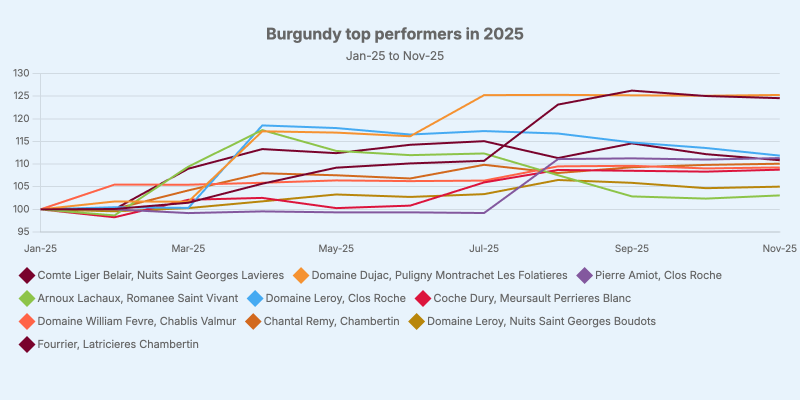
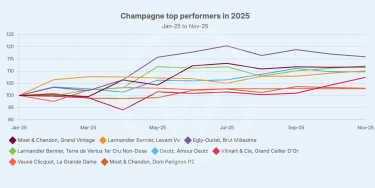
The best-performing Bordeaux, Burgundy and Champagne wines of 2025

  • Even as Bordeaux, Burgundy and Champagne declined in 2025, select wines delivered double-digit gains.
  • Value, scarcity and specificity proved decisive as investors became more selective.
  • Early signs of market broadening suggest the correction phase may be nearing its end.

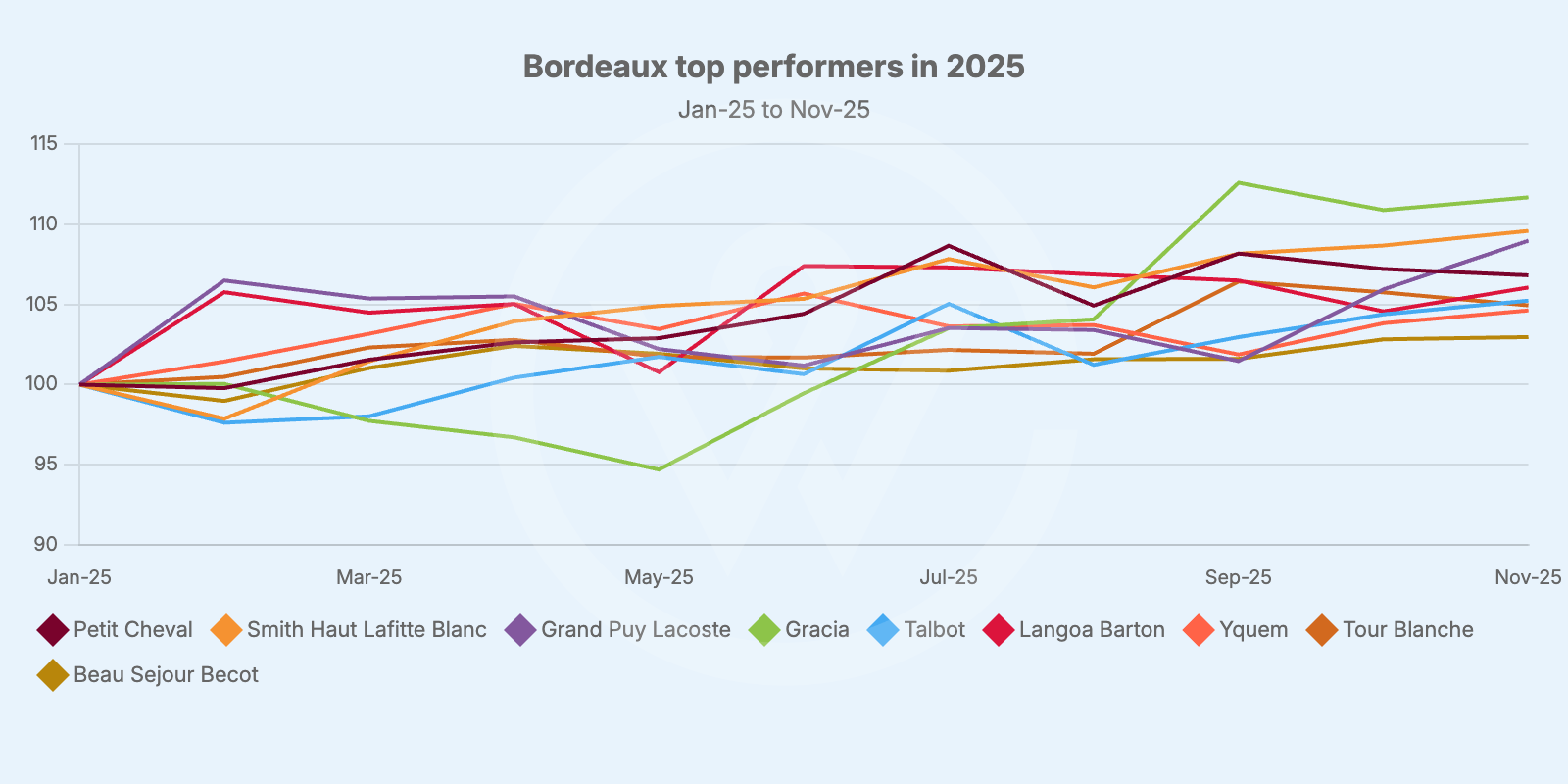
In our annual Fine Wine Report, published last week, we revealed the top-performing wines of 2025 – a diverse group spanning the Rhône, Burgundy, Tuscany and Sauternes. Some of these standout performers posted gains of over 65% in a year defined by prolonged market weakness, subdued sentiment and cautious capital allocation. But beyond these headline risers lies a subtler story.

In this final article of the year, we focus on the three most important fine wine regions globally by demand and liquidity: Bordeaux, Burgundy and Champagne. These regions were among the hardest hit during the downturn. Year-to-date, Bordeaux remains down 6.6%, Burgundy – 4.4%, and Champagne – 4.3%.

Yet within each of these regions, distinct pockets of resilience and growth have emerged. Individual wines not only stabilised but delivered meaningful appreciation, offering a clear view into how capital behaves at the tail end of a correction.

What follows is a closer look at the best-performing individual wine indices in Bordeaux, Burgundy and Champagne in 2025, and what they might reveal about the next phase of the fine wine market.

Key points

  • Regional averages mask significant dispersion at the individual wine level
  • Market downturns tend to reward selectivity rather than broad exposure
  • Outliers often signal early shifts in investor behaviour

Bordeaux investment: Value at the bottom of the cycle

Bordeaux, the most important region in fine wine by traded volume and global recognition, was also among the weakest performers in 2025. A muted En Primeur campaign, coupled with high stock levels and investor fatigue following several years of overpricing, placed sustained downward pressure on prices.

However, Bordeaux’s top performers tell a more nuanced story.

By mid-year, prices across the region appeared to find a floor. As the year progressed, demand selectively returned – first to wines offering clear value relative to quality, and later to brands that had fallen hardest during the correction.

Bordeaux top performing wines 2025

The top performing Bordeaux this year has been Château Gracia, rising 11.7%. The wine has an average price per case of just £881, underscoring the importance of value. The second best performer was Château Smith Haut Lafitte Blanc, up 9.6%. It was followed by Grand Puy Lacoste (9.0%), another relatively undervalued classically styled Pauillac, which saw an uptick in the last quarter. The wine has an average price per case of £589, and has enjoyed a 64% rise in the last decade.

In a market saturated with stock, prices only rise where quality is evident and upside remains. In 2025, investors increasingly favoured estates offering an avenue for growth. 

Key points

  • Lower entry prices improve downside protection in uncertain markets
  • Classic styles and strong track records continue to attract long-term capital
  • White Bordeaux is gaining relevance within diversified wine portfolios

Burgundy’s biggest risers: after the fall

Burgundy remains Bordeaux’s closest rival in market share terms, and one of the most volatile regions of the past decade. After dramatic price appreciation between 2019 and 2022, Burgundy was among the steepest fallers during the downturn, alongside Champagne.

In 2025, Burgundy declined 4.4% on average, but the performance dispersion within the region widened sharply.

Dujac’s Puligny-Montrachet Les Folatières has been the best performing Burgundy this year, up 25.3%, closely followed by Comte Liger Belair, Nuits Saint Georges Lavieres, up 24.6%. The rest of the pack recorded more modest gains in comparison, between 5% and 11%.

After years of capital concentrating narrowly on the most famous Grand Crus, 2025 marked the beginning of a more discriminating phase for Burgundy investment.

Key points

  • Burgundy’s volatility reflects its scarcity-driven pricing structureCorrections tend to be sharper after periods of rapid appreciation
  • Relative value within elite producer ranges is increasingly important

Champagne: From tariff shock to broadening demand

Champagne’s trajectory in 2025 was shaped by external macro forces. The US tariff threat in March hit the region particularly hard, triggering a sharp dip in prices. However, clarity emerged by July, and with it a steady return of demand.

Year-to-date, Champagne has finished down 4.3%, but the region’s top performers tell a story of structural strength and evolving investor preferences.

Champagne top performing wines 2025

The top performing wine from the region has been a grower Champagne; Egly-Ouriet has increased 15.9% so far this year. Scarcity, authenticity and critical acclaim have elevated top growers into an investment category once dominated exclusively by Grandes Marques.

Meanwhile, Larmandier-Bernier’s Terre de Vertus in second place, with a 12.0% rise, illustrates the appeal of singular wines: 100% Chardonnay, single terroir, single vintage, and priced well below prestige cuvées. Meanwhile, Moët’s Grand Vintage, up 11.7%, highlights that recognisable brands at accessible price points still command deep global demand.

Collectively, these performers reflect Champagne’s unique strength: a balance of brand familiarity, approachability and increasing diversity.

Key points

  • Brand recognition underpins long-term liquidity
  • Grower Champagne continues to gain institutional recognition
  • Accessible pricing supports both liquidity and diversification

Looking ahead: From narrowing to broadening

One of the defining themes in our annual report – and a key signal for 2026 – is the return of market broadening.

During periods of stress, demand narrows. Capital clusters around the safest names and most mature vintages, while secondary and emerging opportunities are overlooked. The past three years exemplified this dynamic.

The performance patterns seen in Bordeaux, Burgundy and Champagne in 2025 suggest that this phase is beginning to reverse. As volatility subsides and confidence returns, investors are once again willing to look beyond the obvious. The fog is lifting, and with it comes a clearer view of where the next opportunities may lie.

In fine wine, as in all long-term markets, recovery rarely announces itself loudly. It begins quietly – in the outliers.

WineCap’s independent market analysis showcases the value of portfolio diversification and the stability offered by investing in wine. Speak to one of our wine investment experts and start building your portfolio. Schedule your free consultation today.
Categories
News

Bordeaux 2022 leads critics’ top wines of 2025

  • Global critic lists show unprecedented diversity across regions and styles.
  • Bordeaux 2022 was in the spotlight across major publications.
  • Collectible wines and investment-grade wines differ – only some critic favourites have long-term market potential.

Each November, major critic publications around the world release their annual Top 100 wines of the year rankings. Rather than showcasing the wines only released in the past twelve months, the lists highlight standout bottles tasted throughout the year, spanning vintages, regions, and stylistic expressions.

A clear trend emerges from looking at past and current lists: increasing diversity. Critics are no longer focusing exclusively on tried-and-true regions like Bordeaux, Napa, or Barolo. Instead, their selections – this year spanning wines from Etna to Stellenbosch, Central Otago to Morgon – reflect the global expansion of fine wine quality, elevated vineyard management, and the growing maturity of the market.

Critic choices largely align with broader shifts seen in the fine wine investment landscape. As quality rises around the world, more wines now boast age-worthiness, critical acclaim, and technical precision. However, this raises an important point: not all critic-favourite wines carry investment potential.


A collectible wine may be rare, high-scoring, or culturally important, while an investment-grade wine must also demonstrate a proven secondary-market track record, liquidity, stable long-term demand, and price performance history.


Below, we explore three of the most influential 2025 global rankings and what the top wines reveal about the state of the fine wine market going into 2026.

Wine Spectator’s Wine of the Year

Wine Spectator’s annual Top 100 list is arguably the most commercially impactful ranking in the global wine calendar. Historically, the No. 1 Wine of the Year has triggered immediate surges in demand, and often dramatic price rises, across global markets. A clear example came in 2023, when Argiano Brunello di Montalcino 2018 – previously quiet on the secondary market – experienced a rapid uptick in both demand and value within days of receiving the top spot.


Wine Spectator's top 5 wines 2025

In 2025, the top position went to Château Giscours 2022, marking a major endorsement for Bordeaux’s strong 2022 vintage at a time when the region often finds itself facing criticism. Senior Editor James Molesworth explains: ‘Recent vintages have been mercurial in quality, while the region’s annual spring en primeur campaigns have fizzled. Tariffs haven’t helped. But if you needed a reminder that Bordeaux still makes some of the greatest wines in the world – and that its producers can evolve with changing times – the Château Giscours Margaux 2022 is your wine. This third-growth classified estate earns our top honor this year.’ 

Molesworth further highlights the wine as the culmination of decades of rebuilding work at the estate: ‘The efforts of Van Beek to surpass numerous obstacles over a generation is a clear example of how wine is a long game.’ The critic notes that recent improvements, including refined harvesting practices and guidance from consultant Thomas Duclos, have helped elevate quality, vintage after vintage. In 2022, these efforts culminated in a grand vin that Wine Spectator describes as fresh, seductive and finely detailed, with no second wine produced due to the exceptional quality of the harvest.

The rest of the top four represent a strong showing for California. Aubert’s UV-SL Chardonnay (No. 2) was praised as the union of ‘a renowned winemaker, a special vineyard and an exceptional vintage.’ Meanwhile, Ridge’s Lytton Springs 2023 and Williams Selyem’s Eastside Road Neighbors Pinot Noir 2023 reflect the continued strength and stylistic diversity of Californian wine across Dry Creek Valley and Russian River Valley.

Rounding out the top five is another Bordeaux 2022 wine: Château Beau-Séjour Bécot. Wine Spectator calls it a ‘dreamy wine’, reinforcing the broader pattern seen across both critic and market attention this year. Bordeaux 2022 is clearly one of the defining narratives of the 2025 rankings, earning major positions across multiple publications.

Vinous’ top 100 wines of 2025

Vinous’ annual list, which Antonio Galloni says aims to capture the ‘diversity and dynamism of today’s wine world,’ showcases wines of exceptional quality, character, and excitement rather than simply the highest-scoring bottles.


Vinous' top five wines 2025

This year, Italy takes the top spot with Monsanto’s Il Poggio, which Galloni calls “a total stunner” and “one of the very finest Il Poggios ever made.”

One of the most notable placements comes at No. 2: Van Loggerenberg’s “Graft” Syrah 2024 from South Africa. Neal Martin awarded it 98 points, praising its mineral character, balance, and crystalline finish – another sign of South Africa’s accelerating rise in fine wine quality.

The third wine in the list represents a more classical pick, but with a symbolic shift. With ownership passing to Henri Lurton’s children, Martin sees the 2022 Château Brane-Cantenac as a defining benchmark: ‘A year when… the 2022 is a benchmark for the Margaux estate, its future North Star.’

The list continues with strong representation from both New and Old World producers, including Frog’s Leap’s classically styled 2023 Cabernet Sauvignon and Tenuta delle Terre Nere’s deeply structured Etna Rosso San Lorenzo.

James Suckling’s favourite wines of 2025

James Suckling’s team tasted over 45,000 wines in the last year, making his Top 100 one of the most globally comprehensive. His selections prioritise balance and drinkability – wines that shine immediately, whether from bottle or barrel.


James Suckling's top five wines 2025

His top wine – Château d’Issan 2022 – reflects the broader dominance of Bordeaux’s 2022s across his list. Suckling emphasises that the vintage remains one of the biggest stories of the year, praising how the wines show focus, brightness and precision despite extreme heat and drought. He compares 2022 to other hot-vintage classics such as 1982, 1959, 1947 and 1928, all of which have stood the test of time, an important indicator for long-term growth. 

Suckling also notes how the accessibility of 2022 Bordeaux – widely released, easy to sample, and available across markets – enabled more comprehensive evaluation this year, contributing to their strong representation.

The remaining wines illustrate the global reach of modern fine wine quality. American Pinot Noir features prominently, with standout bottles from Raen and Arterberry Maresh. Meanwhile, two of the most surprising inclusions – Burgaud’s Morgon Côte du Py and Terra Sancta’s Bannockburn Pinot Noir – are also among the most affordable on the list, reinforcing Suckling’s point about the exceptional value emerging from Beaujolais and regions such as Central Otago. His report proposes that once-overlooked regions are now producing wines of extraordinary finesse and consistency.

Across all three critic rankings, a consistent narrative emerges: fine wine quality is more global, diverse and dynamic than ever before. At the same time, the spotlight on Bordeaux 2022 signals a vintage with both critical momentum and long-term relevance, firmly positioning it as one of the defining investment stories of the year.

Not every critically acclaimed wine is an investment wine, but the themes that surface – regional momentum, stylistic shifts, the performance of key vintages, and the critics’ influence on market behaviour – will all shape the fine wine landscape as we move into 2026.

WineCap’s independent market analysis showcases the value of portfolio diversification and the stability offered by investing in wine. Speak to one of our wine investment experts and start building your portfolio. Schedule your free consultation today