Categories
Learn

The ultimate guide to the best Champagne vintages

  • The best Champagne vintages marry the region’s terroir and northerly climate with technical precision.
  • While quality is paramount, the best financial returns often come from correctly priced “off-vintages” or undervalued releases.
  • The shift toward transparency, such as numbered non-vintage editions and grower-led terroir focus, is creating new frontiers for Champagne investment.

A great Champagne is the product of the delicate balance between terroir and human precision. The region’s chalky soils and cool, northerly latitude provide the perfect environment for Chardonnay, Pinot Noir, and Pinot Meunier to maintain the high acidity necessary for long-term ageing.

Unlike other regions, the “house style” has historically been the primary focus in Champagne. This is achieved through the art of blending multiple vintages to create a consistent non-vintage product. However, for the investor, greater interest lies in Vintage Champagne. These are bottles produced only in exceptional years, representing a biological time capsule of a single harvest.

The longevity of Champagne is a key driver of its investment value. The presence of carbon dioxide and high natural acidity act as preservatives, allowing prestige cuvees to evolve gracefully for decades. As the wine ages, the primary citrus and floral notes transform into complex tertiary aromas of toasted brioche, honey, and roasted nuts.

What makes a great Champagne vintage?

To understand what creates a legendary year, we look at the conditions defined by experts. For a northerly region like Champagne, these factors are even more critical and include:

  • Early and rapid flowering 
  • Gradual onset of water stress during July to slow the vine’s growth
  • Warm and dry final months before harvest to ensure the grapes reach full maturity
  • A dry harvest window allowing winemakers to pick at peak ripeness

Champagne vintage variation

Being one of the most northerly wine-producing regions in France, Champagne is subject to more extreme vintage variation. In some years, the grapes struggle to ripen at all, while in others, they reach levels of opulence that define a generation. This volatility is precisely why blending became the region’s hallmark.

By keeping reserve wines from previous years, houses can ensure that even a difficult harvest can be transformed into a high-quality non-vintage blend. For the collector, however, the variation is the draw. A vintage wine almost by definition deserves to stand alone without the help of the reserves.

Why great vintages aren’t always great investments

It is a common mistake for investors to chase only the highest-scoring vintages. However, for a successful investment, the entry price is just as critical as the wine’s quality. When a “vintage of the century” is announced, producers often set release prices at a premium that bakes in all future growth.

Consider the example of Chateau Lafite Rothschild 2013 in Bordeaux. Although it was a difficult year, its low release price allowed it to see values double in the secondary market as it recovered. In Champagne, the same logic applies. An undervalued vintage can often outperform a legendary one if the starting point for the investor is more favourable.

The evolution of non-vintage Champagne: numbered editions

The traditional non-vintage model is changing. Some houses have led the way in creating “multi-vintage” blends that are numbered to allow for differentiation and investment. Krug Grande Cuvee and Jacquesson’s 700-series are the most prominent examples of this shift.

By assigning a number to each release (such as Krug most recent 173eme edition), the producer provides a clear identity to the blend. This allows investors to track the performance of specific editions and trade them as distinct assets. While other houses are beginning to follow this lead, it remains to be seen if they will achieve the same level of secondary market liquidity.

The growing influence of grower Champagne

The rise of grower Champagne has fundamentally shifted the region’s dynamic. These producers grow their own grapes and make their own wine, focusing on specific terroirs rather than a broad house style. Names like Jacques Selosse and Cedric Bouchard have become cult icons for investors.

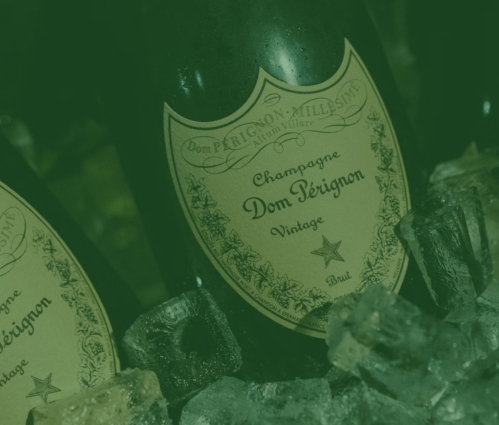
The success of these growers has influenced the Grandes Marques. For instance, Dom Perignon has begun showing “vins clairs” (base wines) at tastings and releasing every vintage regardless of quantity to reflect the terroir’s narrative. Dom Pertignon’s LVMH stablemate Ruinart is also acknowledging this trend by serving grower wines in their tasting rooms.

Champagne disgorgement and release 

Understanding the release dates of different producers is essential for market timing. There is no standard for how long a Champagne must be aged before release. For example, while Dom Perignon 2017 might be on the market, the most recent release of Krug Clos d’Ambonnay is the 2006.

Furthermore, many houses now offer late-disgorged editions, such as Dom Perignon’s P2 and P3 series. These wines have spent extra time on their lees, gaining complexity and a higher price tag. These releases offer a second or even third window for investment in the same vintage.

The best Champagne vintages before 1982

Before the advent of modern temperature control and precision viticulture, legendary years were rare historical events. These vintages are now considered mythical artefacts of the region, often surviving only in the deep libraries of the great houses or in the world’s most prestigious private cellars. 

For the investor, the time for these vintages has largely passed, although for avid collectors they represent the ultimate “legacy” assets, where value is driven as much by historical importance and provenance as by structural integrity. Some of the best older vintages include:

  • 1921: Frequently cited as the year the modern commercial market for fine Champagne was born, this vintage followed a hot summer that produced incredibly concentrated fruit. 
    • Standout wine: Dom Perignon’s inaugural vintage, although this was not released until the 1930s.
  • 1928: Widely considered the vintage of the century by older collectors, it offered a rare combination of extreme ripeness and record-breaking acidity. 
    • Standout wine: Krug Vintage set a record for the most expensive Champagne ever sold at auction.
  • 1945: A year defined by a brutal spring frost that decimated yields, followed by a glorious summer that produced tiny quantities of liquid gold. 
    • Standout wines: Krug and Bollinger (the predecessor to Vieilles Vignes Francaises).
  • 1955: A classic year known for its aromatic complexity and firm, refreshing acidity that has allowed bottles to mature gracefully for seven decades. 
    • Standout wine: Taittinger Comtes de Champagne.
  • 1975: Celebrated for its high acidity, this vintage produced wines with the structural bones required for multi-decadal ageing. 
    • Standout wines: Louis Roederer Cristal and Dom Perignon.
  • 1979: A balanced and elegant year that saw the debut for one of the most iconic single-vineyard bottlings in history. 
    • Standout wines: Krug Clos du Mesnil’s inaugural vintage after the vineyard’s purchase in 1971.

The best modern Champagne vintages

The trinity: 1988, 1989, 1990

This legendary trio of years offered three distinct styles. 1988 was the year of “linearity” and high acidity, while 1989 was plush and opulent. At the time of release, 1990 was considered the balanced masterpiece that combined the best of both worlds.

  • Perrier-Jouet Belle Epoque 1988: A linear, slow-maturing legend.
  • Charles Heidsieck Collection Crayeres 1989: late disgorged youthful brilliance.
  • Krug Vintage 1990: One of the most sought-after blue-chips of the decade.

The acidity benchmark: 1995 & 1996

1996 is often hailed as a “once in a lifetime” vintage due to its unique combination of record-breaking acidity and high sugar ripeness. 1995, initially in its shadow, is now being recognised for its balance.

  • Salon Le Mesnil 1996: A mythical Blanc de Blancs built for decades of cellaring.
  • Dom Perignon 1996: One of the most successful investment years for the house.
  • Taittinger Comtes de Champagne 1995: A forward, generous expression of Chardonnay.

The 21st century icons: 2002 and 2008

2002 was a near-perfect growing season that produced harmonious, high-definition wines. However, it is 2008 that has become the holy grail for modern collectors. It is a vintage of incredible tension and cool, linear energy.

  • Louis Roederer Cristal 2008: The current market leader in price appreciation.
  • Salon 2008: Famously released only in Magnums due to its tiny production.
  • Krug 2002: A wine of incredible clarity and power.

The modern successors: 2012 and 2013

2012 has emerged as one of the most complete vintages of the modern era, often compared to the legendary 1990. 2013 is a cooler, more classical year that rewards those looking for finesse over raw power.

  • Dom Perignon 2012: A charming and ambitious wine that blossomed early.
  • Louis Roederer Cristal 2012: A biodynamically farmed masterpiece.
  • Pol Roger Winston Churchill 2013: A pure, energetic purist’s vintage.

Vintages bubbling under

Not every great year receives the same fanfare. Some intermediate years can offer exceptional value for drinkers and savvy investors.

  • 1998: A year that was initially overshadowed by 1996 but has aged with surprising grace. Highlight: Dom Perignon 1998.
  • 2004: A vintage of “quiet confidence” that never needed to shout. Elegant and harmonious wines. Highlight: Bollinger VVF 2004.
  • 2014: A high-quality year currently entering the market with strong results for Chardonnay. Highlight: Louis Roederer Cristal 2014.
  • 2016: While a difficult year for many, some specific houses found success where others struggled. Highlight: Dom Perignon 2016.

FAQ: Great Champagne vintages

Why does Champagne have more vintage variation than other regions? 

Being one of the most northerly wine regions, Champagne is on the climatic limit for ripening grapes. This leads to dramatic differences in sugar and acidity levels from year to year.

Is vintage Champagne always better than non-vintage? 

No, generally speaking non-vintage is designed for consistent house style, whereas vintage Champagne is produced only from the best fruit of exceptional years. However,the best multi-vintage wines such as Krug Grand Cuvee and Jacquesson 700 series can hold their own in any company.

How does disgorgement date impact value? 

A later disgorgement (like the P2 series) usually commands a higher price on release because the wine has spent more time on its lees, resulting in greater aromatic complexity.

Should I invest in grower Champagne or the big houses? 

Big houses like Dom Perignon and Krug offer greater market liquidity, making them safer for most investors. Growers offer rarity but can be harder to sell.

WineCap’s independent market analysis showcases the value of portfolio diversification and the stability offered by investing in wine. Speak to one of our wine investment experts and start building your portfolio. Schedule your free consultation today.
Categories
Learn

Is investing in a vineyard profitable? Costs and key considerations

  • Vineyard investment is a hybrid asset that combines real estate with an agricultural business. 
  • Investing in a vineyard is more costly and less liquid than investing in wine, as it requires running a business.
  • Entry points vary from multi-million pound estates to smaller crowdfunding projects. 

Many people dream of owning a sun-drenched vineyard, imagining rows of vines and cool, quiet cellars. However, the reality of vineyard investment is a major financial commitment that goes beyond land and estate ownership, and requires active farming.

This type of investment is very different from “treasure assets” like fine wine. When you buy a bottle of vintage Champagne, you own a finished product. When you buy a vineyard, you own a business.

How to evaluate the profitability of investing in a vineyard? 

Buying a vineyard means you are investing in two things at once. First, you are buying agricultural land. This land often holds its value well over time and may come with tax advantages. In famous regions like Bordeaux or Burgundy, viable vineyard land is a scarce and valuable resource.

Second, you are starting or buying a business, which needs staff, machinery, sales and marketing plan. You must manage the vines, process the grapes, and sell the wine. This dual nature makes the investment unique but also very demanding.

Tax planning for vineyard investment

Tax planning can make a vineyard investment much more attractive for a family and help reduce the financial burden of passing land to children or heirs.

  • United Kingdom: You may qualify for Business Property Relief. This can reduce your Inheritance Tax bill to zero for the vineyard business.
  • France: Owners can receive a 75% discount on wealth tax and gift tax. This requires a formal commitment to the land for many years.
  • Italy: Agricultural entrepreneurs often enjoy lower income tax on their farm profits. This helps cash flow while the vineyard is becoming profitable.

Government policies usually aim to protect domestic food and drink production. This makes farmland a useful tool for financial planning. However, you should always speak to a local expert before you invest.

Investing in a vineyard vs investing in wine

Investing in wine is a popular way to grow wealth. It is relatively simple. You buy a case, store it in a bonded warehouse, and wait for the price to rise. This is a “passive” investment in a luxury good.

By contrast, vineyard investment is “active.” It is also less liquid; you can sell a case of wine in days or weeks but selling a whole estate can take years. There is also a high concentration risk: if you own one vineyard and frost hits, you lose your whole crop. The uncertainty of farming is always present, and it can be a precarious investment, even in good times. Meanwhile, if you own a diverse portfolio of wine bottles, one bad vintage does not hurt you, in fact it might even raise the price of the bottles you already own. 

Scale of vineyard investments

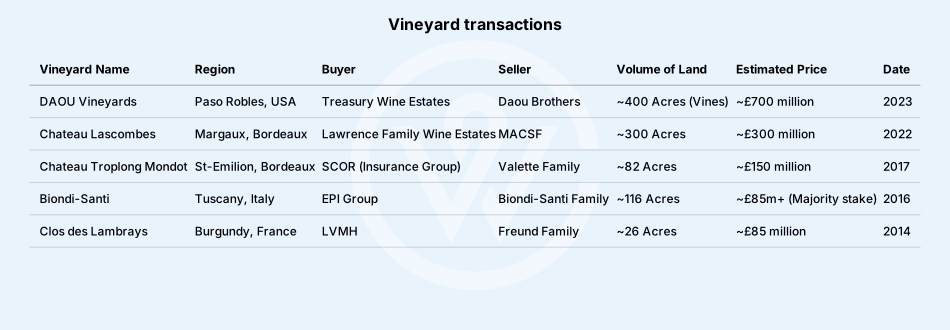
The cost of entry depends on your goals and your budget. At the top end, global luxury groups like LVMH or Treasury Estates set the pace. LVMH famously bought the Clos des Lambrays estate in Burgundy for a price reported to be around £85 million. More recently, Treasury Estates purchased DAOU in California for nearly £700 million.

For these giants, the goal is brand prestige and securing rare supply. Companies like this have the capital to wait decades for a return, whereas most private investors look for smaller opportunities and a speedier return. However, even a modest estate in a good region can set you back millions.

At the other end of the scale are small urban projects. In Brighton, some vineyards have used crowdfunding to get started allowing local people to own a tiny “share” of a vineyard for a few hundred pounds.

Vineyard transactions

The role of crowdfunding

Crowdfunding has become popular in the UK wine scene. Chapel Down is a great example of this having raised more than £12 million from thousands of small investors via crowdfunding efforts and more from sales of equity. Crowdfunders are often incentivised with perks like discounts and tour invites.

This model builds a loyal community of customers, however, there are downsides. Investors often have very little control over the business and it can also be very hard to sell these small shares later.

Vineyard revenue streams and production

A vineyard makes money in several ways. The most obvious is selling wine to shops and restaurants, although many estates also sell direct to consumers either at the “cellar door” in person or through e-commerce. This offers much higher profit margins as there is no middleman and has become increasingly important in recent years.

Some vineyards also sell their grapes to other producers. This provides a quicker cash flow but lower profits. In many regions, tourism is the secret to success. This might include:

  • Tasting room fees
  • Guided vineyard tours
  • Luxury accommodation
  • Hosting weddings and events

Vineyard operating costs

Running a vineyard is expensive. Labour is a major cost, with operations like pruning and harvesting by hand requiring skilled workers. In countries like France or the UK, wages are relatively high which can put pressure on the profit margins.

Machinery is another important factor. Tractors, presses, and fermentation tanks are vital. You also have the cost of oak barrels, bottles, and labels. These costs will vary dramatically by country. For example, land is cheaper in Argentina, but import taxes on equipment can be very high.

Production metrics

Investors must watch their production metrics closely. Yield is measured in tonnes per hectare and while a high yield means more wine, it can often mean lower quality. Premium estates often limit their yield to ensure the grapes are concentrated and flavourful, which raises the price of the final product.

The bottle price is a key metric for profit. To break even, you must sell your wine for more than it cost to grow and make. This sounds simple, but marketing a new brand is a huge and costly task.

The climate factor

Agriculture is always at the mercy of the weather and is arguably the biggest risk for any vineyard owner. Climate change is making this risk harder to manage, especially in the context of frequent extreme weather events like:

  • Late spring frosts
  • Heavy summer hail
  • Long periods of drought
  • Wildfires and smoke taint

In some years, an owner might lose 80% of their crop in a single night. This financial risk is why many vineyards struggle to stay profitable. While insurance is available, it is becoming more expensive as risks rise.

Financial considerations

Beyond the weather, there are wider financial risks. Interest rates can affect the cost of loans for machinery and changes in trade laws or wine taxes can hurt sales. The wine market is also prone to trends: if consumers move away from a certain style, your inventory may lose value.

The investment timeline

Vineyard investment is a long game. If you plant a new vineyard, even after years of preparation and research, the timeline looks like this:

  • Years 1 to 2: Site prep, planting and building production facilities. No income.
  • Year 3: The first “maiden” crops, typically lower in volume and quality.
  • Year 5: The first full harvest. Still ageing in the cellar.
  • Years 7 to 10: The brand begins to find its place in the market.

Profitability often takes a decade or more. If you buy an existing estate, the timeline is shorter; however, the purchase price will be much higher because you are paying for the work someone else has already done.

The exit strategy

Exiting a vineyard investment is also a slow process. Unlike stocks, you cannot sell at the click of a button: finding a buyer for a specific estate takes time. Most buyers will be other wine groups or wealthy individuals looking for a lifestyle change.

A lifestyle choice first

This brings us to the core of vineyard investment. Most people do it for the love of the land. They want to be part of a tradition. They enjoy the prestige of having their name on a label.

As a financial asset, it is often less efficient than a simple portfolio of stocks or bonds. The “return” is often found in the quality of life. It is the joy of seeing the seasons change and sharing your own wine with friends.

Investing in a vineyard is a bold move, with high costs and a lot of patience required. It is a productive business that needs constant attention and care. 

If you want a steady financial return, stick to wine bottles. If you want to change your life and connect with nature, a vineyard is unmatched. Just ensure you enter the market with your eyes wide open to the risks.

WineCap’s independent market analysis showcases the value of portfolio diversification and the stability offered by investing in wine. Speak to one of our wine investment experts and start building your portfolio. Schedule your free consultation today

Categories
Learn

10 fascinating facts about Chateau Lafite Rothschild

  • Chateau Lafite Rothschild is one of the most sought-after wines in the world for its investment potential.
  • Lafite is frequently described as the most elegant of the First Growths.
  • Lafite vintages like 1982, 2009, and 2010 have achieved iconic status.

Chateau Lafite Rothschild is an undisputed titan of the fine wine world. For many collectors, it is the first name added to a cellar and the last one ever removed. Lafite Rothschild carries a weight that transcends viticulture, representing a fusion of French history, financial stability, and artisanal quality.

Its enduring prestige was recently cemented at a landmark Sotheby’s New York auction, where two 1870 magnums fetched a staggering $306,250.

In the secondary market, Lafite functions as a “liquid currency,” possessing a level of brand equity that few other luxury Veblen goods, let alone wines, can rival. Whether you are a seasoned oenophile or a newcomer to wine investment, understanding this Pauillac legend is essential. 

This guide explores the ten key facets that define the gold standard of this prestigious wine.

1. The storied history of an icon

Lafite Rothschild’s history is a tapestry of royal patronage and resilience. While vines have existed on the site for centuries, the estate gained international prominence in the late seventeenth century under the Segur family. Marquis Nicolas-Alexandre de Segur was known as the Prince of Vines, and he refined the winemaking techniques that put Lafite on the maps of London and Paris.

By the eighteenth century, Lafite was the favourite of the French royal court. It earned the moniker of King’s Wine, largely thanks to the influence of Marechal de Richelieu. Famously Thomas Jefferson, the third American president, became a devoted follower after visiting the region.

The most significant turning point occurred in 1868. Baron James Mayer de Rothschild purchased the estate at a public auction and added his surname to what had previously been “Chateau Lafite”. This acquisition brought the property into the Rothschild family, where it has remained for five generations.

Key historical milestones in the history of Lafite Rothschild include:

  • The 1855 Classification where Lafite was ranked as one of only four original Premier Grand Cru Classes.
  • The devastating phylloxera crisis of the late nineteenth century which tested the estate’s resolve.
  • The occupation of the chateau during the Second World War.
  • The post-war resurgence led by Baron Elie de Rothschild.
  • The modern era of expansion and technical precision under Baron Eric and now Saskia de Rothschild.

2. The unique terroir of Pauillac

Lafite is defined by its terroir, which is arguably the finest in the Médoc, as you might expect given its price point. The vineyard covers roughly 112 hectares making it the largest of the First Growths and is situated on a plateau of deep gravel. This soil type is crucial for Cabernet Sauvignon, as it provides excellent drainage and forces the vines to grow deep roots.

The climate in Pauillac is moderated by the proximity of the Gironde estuary and the Atlantic Ocean, creating a microclimate that protects the vines from extreme frost and excessive heat. The estate manages its land with a focus on biodiversity and long-term sustainability.

Current vineyard characteristics include:

  • An average vine age of approximately 40 years.
  • A high proportion of Cabernet Sauvignon, usually making up 70 percent or more of the vines and an even larger proportion of the Grand Vin.
  • Significant plantings of Merlot, which adds roundness and flesh to the mid-palate.
  • Smaller plots of Cabernet Franc and Petit Verdot for structural complexity.
  • The vineyard is divided into three main parcels, around the Chateau including the  Carruades plateau, and a plot in St Estephe.

3. The different wines of Lafite Rothschild

Key wines from the property are:

  • Chateau Lafite Rothschild (The Grand Vin).
  • Carruades de Lafite (The Second Wine).
  • Anseillan (A newer, plot-specific release).

While the Grand Vin is the primary focus for investors, the estate produces other notable labels. Each wine follows a strict hierarchy of quality and selection. Only the very best parcels are reserved for the top wine, ensuring its longevity and prestige.

Carruades de Lafite is the estate’s second wine, which typically contains a higher percentage of Merlot than the Grand vin and releases at a third of the price. Once viewed as a simple entry point, it has experienced periods of meteoric price rises over the last two decades and is now considered a viable investment asset in its own right. Prices tend to be more volatile than Lafite, but when bought at the bottom of a market cycle and sold at the top it can be highly lucrative. 

The estate also recently introduced Anseillan. This more affordable wine represents a more accessible side of the DBR portfolio and while it will benefit from some age it is not built for long-term cellaring.

4. Lafite within the Domaines Barons de Rothschild

Lafite serves as the flagship for Domaines Barons de Rothschild, commonly abbreviated as DBR. This global wine empire has expanded significantly since the mid-twentieth century. However, Lafite remains the spiritual and financial heart of the organisation.

Under the leadership of the Rothschild family, DBR has acquired prestigious estates across the globe. This includes properties in South America, China, and other regions of France. The technical expertise developed at Lafite is shared across these subsidiaries with staff moving from one to another.

The DBR portfolio also includes:

  • Chateau L’Evangile in Pomerol.
  • Chateau Rieussec in Sauternes.
  • Vina Los Vascos in Chile.
  • Bodegas Caro in Argentina.
  • Domaine de Long Dai in China.

5. The benchmark Lafite Rothschild style

Lafite is frequently described as the most elegant of the First Growths. While Latour is known for power and Margaux for perfume, Lafite is celebrated for its finesse and complexity. It is rarely a wine that shouts; instead, it whispers with profound depth.

On the nose, young Lafite often displays notes of cedar, graphite, and violets. As it ages, these aromas evolve into complex layers of tobacco, forest floor, and truffle. The tannins are famously fine-grained, described by many critics as silky or lacy.

Structural hallmarks of the wine:

  • A core of intense blackcurrant fruit.
  • Distinctive mineral notes derived from the gravelly soil.
  • High natural acidity which ensures decades of ageing potential.
  • Seamless integration of oak, usually 100 percent new French barrels.
  • An extraordinary length of finish that lingers for minutes.

6. The 1982 Lafite vintage and the modern wine era

The 1982 vintage was a watershed moment for the global wine trade. It marked the emergence of Robert Parker as the world’s most influential wine critic. Parker famously touted the 1982 Bordeaux vintage as legendary while many other critics were hesitant.

Lafite Rothschild 1982 received a perfect 100-point score from Parker. This set the stage for the rise of modern wine criticism and the standardisation of the 100-point scale. It transformed fine wine from a niche hobby into a global asset class.

The significance of 1982 includes:

  • The birth of the modern secondary market for investment-grade wine.
  • A shift towards riper, more opulent styles of winemaking across Bordeaux.
  • The massive increase in global demand for First Growth allocations.
  • The establishment of Lafite as the ultimate status symbol in emerging markets.

On a business level, increasing prices allowed Lafite Rothschild and other chateaux to invest in more precise, cleaner winemaking and improved farming practices, in turn facilitating a dramatic improvement in quality in the years that followed.

7. The rise of Lafite Rothschild in China

Lafite Rothschild holds a unique position in the Chinese market. It became the definitive luxury wine during China’s economic boom.

The name is easy to pronounce in Mandarin, which helped its early adoption. Its association with the Rothschild family also appealed to Chinese investors who value heritage and long-term wealth; this demand drove prices to stratospheric levels, particularly for the 2008 vintage.

The impact of the Chinese market led to:

  • A surge in prices for both recent and back vintages.
  • Increased focus on anti-counterfeiting measures and provenance.
  • The creation of the Long Dai estate in Shandong province by DBR.

8. Special bottlings and labels

Lafite occasionally marks special vintages with subtle changes to its iconic label. Perhaps unsurprisingly for Lafite these are not full label changes a-la Mouton Rothschild 2003, gold labels like Angelus 2012 or brightly coloured full bottle canvases like the Taittinger collection.  Instead they are subtle changes, a small embossing here, a glass relief there, commemorating astronomical events, cultural milestones and vintages blessed by the weather gods.

Notable label variations include:

  • The 1985 vintage features a small etching of Halley’s Comet. 
  • The 1999 vintage includes a small star to celebrate the turn of the millennium.
  • The 2005 vintage depicts the sun and rain on a set of scales for the perfect balance of that growing season
  • The 2008 vintage features a red Chinese character for the number eight.
  • The 2018 vintage shows a hot air balloon to mark 150 years of Rothschild ownership.

These bottles often command a premium at auction beyond what their quality would suggest.

9. The best and most expensive Lafite Rothschild vintages

When discussing the best vintages of Lafite Rothschild, critics often point to years where the weather was nearly perfect. Vintages such as 1953, 1959, and 1961 are legendary for their longevity. More recently 1982, 2009, and 2010 have achieved iconic status.

In terms of the financial performance, the most expensive bottles ever sold often have historical significance. A bottle of 1869 Lafite sold in Hong Kong for over $230,000 in 2010. Even older bottles, such as the 1787 vintage allegedly owned by Thomas Jefferson, have sold for record sums.

Top Lafite vintages for investment:

  • 1982: The benchmark for modern investment.
  • 2000: A millennium vintage with immense staying power.
  • 2005: Perfect structural balance.
  • 2012: Great value and already in its depletion phase.
  • 2016: A modern classic with widespread critical acclaim.
  • 2019 and 2020: High-scoring recent years with good value and strong long term potential.
  • 2024: The most affordable vintage on the market.

Such is the strength of the Lafite brand that its not just the best vintages that have been strong investments, in fact quite frequently the opposite has been the case. The 2013 vintage is a perfect example of this: a 90-point score from Neal Martin and 87-89 points while still in the barrel from Robert Parker in his last En Primeur tastings denotes a vintage that was anything but great. However, it was released at very competitive prices and in percentage terms its performance has eclipsed even the famed 2010.

10. The investment reality of Lafite Rothschild

Lafite remains a cornerstone of any serious wine investment portfolio. Its primary strength is liquidity. Unlike niche wines that may be difficult to sell, there is always a buyer for a well-stored case of Lafite.

It acts as a hedge against inflation and broader market volatility. While prices can fluctuate, the long-term trend for First Growth Bordeaux has historically been upward. The scarcity of back vintages ensures that supply continues to dwindle as bottles are consumed.

Key investment takeaways:

  • Blue-chip status ensures high global demand and easy resale.
  • Consistent quality means that even lesser vintages hold their value well.
  • Provenance is vital, as buyers will pay more for professional storage.
  • The estate’s brand power provides a safety net during economic downturns.
  • It remains the ultimate entry point for those seeking long-term capital appreciation.

Chateau Lafite Rothschild is more than just a vineyard – it is an icon of Bordeaux and an enduring symbol of French viticulture. By balancing a deep respect for tradition with modern financial sense, it continues to lead the fine wine market. Whether you hold it for the pleasure of the palate or the growth of your capital, Lafite represents the gold standard of the fine wine world.

FAQ: Chateau Lafite Rothschild

What makes Chateau Lafite Rothschild so expensive?

Lafite’s value is driven by its First Growth status (the highest ranking in the 1855 Classification), its storied history with the Rothschild family, and its massive brand equity in global markets. Its reputation as a “liquid currency” makes it a stable blue-chip investment.

How does the taste of Lafite differ from other First Growths?

While other top wines like Latour are known for power, Lafite is celebrated for its finesse and elegance. It is often described as a wine that “whispers” rather than shouts, characterised by silky tannins and complex notes of cedar, graphite, violets, and blackcurrant.

What is the difference between the Grand Vin and Carruades de Lafite?

The flagship wine is made from the estate’s very best parcels. It is built for decades of aging and is the primary target for high-level investors. Meanwhile, the estate’s Second Wine typically contains more Merlot, is more accessible in its youth, and costs significantly less (usually about a third of the price of the Grand Vin).

Why is Lafite particularly popular in the Chinese market?

Lafite became a preeminent status symbol in China due to several factors: the name is easy to pronounce in Mandarin, the Rothschild heritage aligns with Chinese values of long-term wealth, and the 2008 vintage specifically featured a red Chinese character for the number eight (a lucky number) on the bottle, which drove demand to unprecedented levels.

Which vintages are considered the best for investment?

The “iconic” vintages for both quality and financial performance include 1982, 2000, 2005, 2009, 2010, and 2016. However, “off-vintages” like 2013 have also proven to be lucrative investments because they were released at lower prices and benefited from the overall strength of the Lafite brand.

How can you tell if a Lafite bottle is a special edition?

Lafite uses subtle etchings or embossments on the glass rather than changing the entire label. For example:

  • 1985: Features Halley’s Comet.
  • 1999: Features a star for the millennium.
  • 2008: Features the Chinese character for “8” ().
  • 2018: Features a hot air balloon to mark 150 years of Rothschild ownership.

WineCap’s independent market analysis showcases the value of portfolio diversification and the stability offered by investing in wine. Speak to one of our wine investment experts and start building your portfolio. Schedule your free consultation today.
Categories
News

Bordeaux 2025 En Primeur: Quality meets a market at the crossroads

  • Bordeaux 2025 is a low-yield, heat-shaped vintage delivering concentration, freshness, and a clear shift toward precision viticulture.
  • Early reports point to a high-quality vintage with the potential to rival benchmark years like 2010 and 2016.
  • Set against a cooling market, the En Primeur campaign represents a critical opportunity to reset expectations around pricing and value.

From April 20th to 23rd, 2026, Bordeaux welcomed thousands of merchants, critics, and collectors for the En Primeur tastings of the 2025 vintage. Shaped by intense heat and reduced yields, the new vintage reflects a growing emphasis on precision viticulture – an approach that could come to define Bordeaux’s modern identity.

Yet the usual energy surrounding En Primeur unfolds against a more cautious economic backdrop. Bordeaux finds itself in a period of recalibration. As the first in-barrel scores emerge and the campaign gathers momentum, attention turns not only to what sets the 2025 vintage apart, but also to whether this release can offer real value.

A note on Bordeaux En Primeur

Few moments in the fine wine calendar carry the weight of En Primeur week. Orchestrated by the Union des Grands Crus de Bordeaux (UGCB), the event sees chateaux open their doors to professionals eager to sample wines just months after they were harvested.

Unlike the bottled wines, the En Primeur wines are still unfinished, first presented while ageing in oak. Tasting from barrel requires an expert palate to see through the raw tannins and vibrant acidity to glimpse the potential for greatness years down the line. It is a period of masterclasses, technical presentations, and intense market discussion that signals the pricing direction for the entire year ahead.

The 2025 represents a fascinating stylistic shift. Despite the heat, alcohol levels are reportedly low to moderate. The wines have pronounced aromatics, silky tannins and brisk acidity – hallmarks of great ageing potential. 

Bordeaux 2025: What we know so far

Bordeaux weather and crop reports indicate that 2025 was a year of climatic extremes, resulting in high quality but notably low yields. In fact, production statistics show that 2025 is the smallest crop since the frost-bitten 1991, with yields across many top appellations falling 15-30% below the five-year average.

A season of heat and superb ripening

The growing season was defined by a warm spring and a blistering summer. June 2025 was recorded as one of the hottest in French history, second only to the infamous 2003. This heat, combined with a dry August, led to:

  • Smaller berries: The lack of water and high heat restricted grape size, leading to intense concentration and thick skins.
  • Exceptional phenolic ripeness: While the yields are small, the quality of the tannins is reportedly superb.
  • The “rain of relief”: Just as drought stress became critical, rain in late August and early September refreshed the vines, preserving essential acidity and preventing alcohol levels from spiralling out of control.

Regional highlights

  • The Left Bank (Médoc, Pauillac, St-Julien): The deep-rooted old Cabernet Sauvignon vines thrived, producing structured, age-worthy wines reminiscent of 2022 but with a touch more freshness.
  • The Right Bank (St-Émilion, Pomerol): Clay and limestone soils held onto moisture better than gravel, allowing Merlot to reach lush ripeness without excessive heat stress.
  • Dry whites: Harvested early in mid-August, these show vibrant acidity and tropical aromatics.

The Bordeaux market: The recalibration phase

While the 2025 quality is expected to be high once critic scores are released, the market mood is best described as unsettled. For decades, Bordeaux held an unchallenged dominance in the fine wine market. Recent years have seen a cooling of demand, especially for young releases.

The challenges

  • Increased competition: High-quality rivals from Burgundy, Tuscany, Napa Valley, and even emerging regions have eaten into Bordeaux’s traditional market share.
  • Pricing fatigue: Consistent price hikes in recent En Primeur campaigns – often regardless of the broader economic climate – have tested the loyalty of even the most dedicated collectors.
  • Stock overhang: Many merchants are currently carrying significant inventories of recent great years (2018, 2019, 2020), which has created a bottleneck in the secondary market.

The silver lining

Despite these headwinds, the appetite for older, physical vintages remains robust. There is a clear divergence in the market: while younger vintages (2021-2023) struggle for traction, back vintages from the mid-2000s and 2010s continue to see steady price appreciation. This suggests that the brand of Bordeaux is as strong as ever. The issue lies specifically with release pricing.

Buying wine En Primeur: The question of value

For decades, the “golden rule” of Bordeaux was that En Primeur represented the lowest price point for a wine’s entire lifespan. Today, that assumption is being challenged by data.

Looking at prices at release versus now, several recent vintages can be found on the secondary market for the same price or even less. This has shifted the focus from buying everything to selective acquisition based on specific brand value. Tools like Wine Track, which show the historic performance of specific wine brands, can help investors understand long-term trajectories.

Why data matters

In the 2025 campaign, savvy buyers will be looking for relative value. If a 2025 release is priced higher than a physical, high-scoring 2019 or 2020 vintage currently sitting in a merchant’s warehouse, the incentive to buy En Primeur diminishes. However, because the 2025 yields are so low, scarcity may drive demand for the top-tier “blue chip” estates (the First Growths and their Right Bank equivalents).

The 2025 Bordeaux En Primeur verdict

As critics release their first scores over the coming weeks, all eyes will be on the “price-to-quality ratio.” The 2025 vintage has all the hallmarks of a collector’s dream: scarcity, concentration, and classical structure. For the Bordeaux trade, the 2025 En Primeur is an opportunity for a reset. With early reports pointing towards a vintage that could rival the greats of 2010 or 2016, the quality is likely there.

If the châteaux can marry this quality with a pricing strategy that respects the current market reality, 2025 could mark the beginning of a vibrant new chapter for the world’s most famous wine region.

Bordeaux comment: UGCB President, François-Xavier Maroteaux speaks to WineCap

WineCap: The 2025 vintage promises high quality, yet it arrives as the secondary market has just started to recover from a five-year low, and growing geopolitical tensions discourage speculation and might isolate certain market segments. How do you intend to position the 2025 launch so it doesn’t just survive the current market, but actually revitalises the ‘Bordeaux Brand’ globally?

François-Xavier Maroteaux: The 2025 vintage is a genuine opportunity – but only if we use it wisely. First, pricing must be honest: release prices that ignore five years of secondary market correction damage trust more than they protect margins. A well-priced great vintage is far more powerful than an overpriced one. Second, the narrative must move beyond scores – 2025 has a compelling story of terroir and style that needs to reach consumers directly, not just through trade press. Third, our négociants are brand ambassadors, not just a distribution channel: the properties that genuinely invest in informing and equipping their partners will see it reflected in every market. Finally, the retreat of speculative demand is not a threat – it’s a rebalancing. Bordeaux built its reputation on wine people actually wanted to drink. Refocusing on that is not a concession to difficult times. It’s a return to what made the region great. 

WC: Where do you see the biggest interest in buying Bordeaux at release in the coming years?

FXM: The interest in buying Bordeaux at release remains genuinely global. The best proof of this is the En Primeur week itself: every year, wine professionals from more than 80 nationalities make the journey to taste and buy. That breadth of engagement, even in difficult market conditions, is a strong signal that the foundation is there. Beyond geography, there is another compelling reason to buy at release that we shouldn’t underestimate (and we should be communicating much more actively!): formats. En Primeur remains the best – often the only – window to secure large formats. Magnums, double magnums, imperials are allocated at release and rarely available later at any price. The opportunity is to refocus En Primeur on what it does uniquely well: access, formats, and relationship. That’s a proposition that holds regardless of geopolitics.

WC: Is the En Primeur system still going strong, in your personal view? Do you believe it still offers a genuine win-win? Has it become a luxury-only club for the top 50 estates?

FXM: Yes, I do believe the En Primeur system still works – but I think we need to be honest about what it has become. It works very well for a relatively narrow group of estates where brand strength and secondary market liquidity reinforce each other. For the broader Bordeaux pyramid, it is more complicated. That said, I don’t think the answer is to abandon the system. The answer is to make the win-win genuine again. That means pricing with discipline, communicating with transparency, and making sure négociants and merchants actually make money when they support a release. When that alignment exists, En Primeur is a unique and powerful tool. When it doesn’t, it becomes – as you say – a luxury club for the top names. 

FAQ: Everything you need to know about Bordeaux En Primeur

What does “En Primeur” mean?

En Primeur is a method of purchasing wine while it is still maturing in the barrel. This allows collectors and investors to secure highly sought-after wines before bottling and general market release. This typically happens two years after harvest.

When is the Bordeaux 2025 En Primeur week?

The official tasting week for the 2025 vintage takes place from April 20 to April 23, 2026. During this time, international critics and trade professionals sample the wine from barrel to determine early scores and quality ratings.

Is the 2025 Bordeaux vintage good?

Bordeaux 2025 is a high-quality vintage with intense concentration and bold fruit profiles.Yields are lower than average, which often results in wines with significant ageing potential and structural density.

Why are yields low for the 2025 vintage?

The 2025 growing season saw record-breaking heat and extended dry periods. While this led to exceptional grape ripeness and thick skins (tannin), it resulted in smaller berries and less juice. These lower yields often drive up demand due to the limited number of cases available globally.

Is buying En Primeur a good investment?

Buying En Primeur can be a strategic investment, particularly for top-tier estates (First Growths and “Super Seconds”). However, it is essential to use data-driven insights. While release prices were historically the lowest point of entry, current market fluctuations mean buyers should compare release prices against available physical back-vintages to ensure they are getting true value, as older vintages can often present better buying opportunities than En Primeur.

When is the delivery of the 2025 Bordeaux wines?

In the spring or summer of 2028, following their mandatory ageing period in the châteaux cellars.

What are the “big three” factors to watch in the 2025 campaign?

  1. Critic scores: Initial ratings from major publications will dictate immediate global demand.
  2. Release pricing: How châteaux price their wine in relation to the secondary market.
  3. Volume: With lower yields reported, the scarcity of specific labels will likely be a driver of demand.

WineCap’s independent market analysis showcases the value of portfolio diversification and the stability offered by investing in wine. Speak to one of our wine investment experts and start building your portfolio. Schedule your free consultation today.
Categories
Learn

Champagne vs. Prosecco vs. Cava vs. English bubbles: Which sparkling wine should you buy?

  • In the vast world of sparkling wine, Champagne remains the global benchmark for both quality and prestige.
  • The production method creates a divide: Champagne, Cava, and most English sparkling wine use the bottle-fermented “traditional method,” while Prosecco relies on the faster “tank method.”
  • From a financial perspective, Champagne is the only truly investable sparkling wine on the secondary market.

Sparkling wine, fit for any celebration, is more than just a drink for a toast. It is a vast category defined by geography, history, and chemistry. While most people recognise the pop of a cork, the liquid inside that bottle can vary wildly depending on where the grapes have been grown and how it was made.

To understand the difference between Champagne, Prosecco, Cava, and English sparkling wine we have to look at what happens inside the cellar. While they all have bubbles, the way those bubbles are created changes the flavour, the texture, the price tag and the investment reality.

The traditional method: Champagne, Cava and English fizz

Champagne, Cava, and English sparkling wine are all made using the “traditional method.” This is the most expensive and time-consuming way to make wine.

  • First, the winemaker creates a still dry wine. 
  • Then, they put it into a bottle with a little bit of sugar and yeast and seal it with a crown cap like you’d find on a bottle of beer. 
  • A second fermentation happens inside that specific bottle. Because the carbon dioxide cannot escape, it dissolves into the wine, creating the sparkle.

The final stage has the wine sitting on the lees: the dead yeast cells. Over months or years, these cells break down and give the wine flavours of toasted bread, brioche, and nuts. This is what experts call “autolytic” character. It is the reason why a glass of Champagne often smells like a bakery, while a Prosecco smells like a fruit basket.

Champagne: The undisputed king

Champagne is a specific region in northern France. If a sparkling wine is not from there, it is not Champagne. The region is famous for its white, chalky soil. This soil acts like a sponge, holding water but also reflecting sunlight back up to the vines.

The major grapes here are: 

  • Chardonnay 
  • Pinot Noir
  • Pinot Meunier

Four other varieties are also permitted but rarely used:

  • Pinot Blanc
  • Pinot Gris
  • Arbane
  • Pinot Meslier

This combination creates a wine with incredible structure and high acidity. This acidity is the backbone that allows the wine to age for decades.

Indeed, its ageability, decades long reputation and high quality make Champagne one of the most prominent investment players on the secondary market for fine wine. Still, there is a catch. 

Most non-vintage (NV) bottles, which are the standard blends houses produce every year, do not necessarily increase in value. With very few exceptions, only vintage Champagne is investable. These are wines made from grapes harvested in a single year. They are produced in smaller quantities and are built to last.

Vintage Champagnes are the primary targets for collectors and investors looking for a return.

Looking for more? Read our Champagne Regional Report.

English sparkling wine: The rising star

The story of English sparkling wine is one of geology and changing climates. The same chalk seam that runs through Champagne actually dips under the English Channel and pops up again in the South of England.

Counties like Kent, Sussex, and Hampshire have soil that is nearly identical to the best plots in France. As the climate has warmed, these regions have become perfect for growing the same three grapes used in Champagne.

  • Chardonnay
  • Pinot Noir
  • Pinot Meurnier

The style of English sparkling wine is often very lean and crisp. It has a piercing acidity that makes it incredibly refreshing. While the quality is now world class, the market is still catching up.

Search data on Wine-Searcher shows that the most popular English sparkling wines are currently sitting just inside the top 5000 most searched for wines. Interest is growing, but it is still a long way from the global dominance of the famous French houses.

Cava: Spain’s traditional bubble

Cava is Spain’s answer to Champagne. Most of it comes from the Penedès region in Catalonia. While it uses the same traditional method as Champagne, the flavours are different because the grapes are different.

The traditional Cava blend uses:

  • Macabeo
  • Xarel-lo
  • Parellada

These indigenous Spanish grapes often produce wines that are a bit more earthy or floral. They generally have lower acidity than Champagne or English sparkling wine, which makes them feel softer in the mouth.

Despite its long history, Cava struggles on the secondary market. It is often viewed as a value-for-money option rather than a luxury collectible. This is reflected in its search rankings: even the most famous Cavas usually sit outside the top 3000 most searched for wines globally. For an investor, Cava currently lacks the secondary market activity needed to be a viable asset.

The Charmat method: Prosecco

Prosecco is a completely different beast. It comes from the Veneto and Friuli regions of Italy and is made using the “tank method” (also known as the Charmat method).

Instead of the second fermentation happening in a bottle, it happens in a large stainless steel tank. This is much faster and cheaper. The goal here is not to create bread-like flavours from yeast, but to keep the wine tasting like fresh fruit.

Glera must make up 85% of the blend with the rest consisting of:

  • Verdiso 
  • Bianchetta Trevigiana 
  • Perera 
  • Glera Lunga
  • Chardonnay
  • Pinot Bianco 
  • Pinot Grigio
  • Pinot Noir

The Glera grape used in Prosecco is naturally aromatic. It smells of white peach, pear, and honeydew melon. Because it does not spend long on the yeast, the bubbles are often bigger and frothier.

Prosecco is designed to be drunk fresh. It does not improve with age. Because of this, it has almost no presence in the investment world. Like Cava, the most popular Proseccos are found outside the top 3000 most searched for wines. It is a wine for the moment, not for the cellar.

Investing in sparkling wine: a guide

The difference in investment potential between these regions is striking. While you can find a delicious bottle of sparkling wine from any of these four places, the financial world only really cares about one.

Secondary market activity is the engine that drives wine investment. This involves collectors buying and selling bottles through auction houses or private exchanges. This activity requires three main things:

  • Brand power: A name that people all over the world recognise and want.
  • Scarcity: A limited supply that cannot meet the high demand.
  • Longevity: A wine that will actually taste better (and be worth more) in time.

Champagne, specifically Vintage Champagne and “Prestige Cuvées” like Dom Pérignon or Krug, checks all three boxes. English sparkling wine is building the brand power, but it lacks the historical track record and data about its aging potential that investors crave. Cava and Prosecco, meanwhile, are produced in such high volumes that scarcity is rarely an issue, which prevents prices from climbing on the secondary market.Champagne sparkling wine table

Other sparkling wine regions

The world of bubbles does not end with these four. Other regions are also making their mark, though they face similar hurdles regarding investment.

  • Franciacorta: Italy’s premium sparkling wine made in the traditional method. It uses Chardonnay and Pinot Nero, often resulting in a richer, riper style than Champagne.
  • Crémant: These are French sparkling wines made outside of Champagne. Crémant de Bourgogne (Burgundy) and Crémant d’Alsace are excellent value alternatives that use the traditional method.
  • Tasmania: Australia’s cool-climate island is producing some of the most exciting New World bubbles, characterised by high acidity and elegance.
  • California: Areas like the Anderson Valley produce powerful sparkling wines that often show more ripe fruit and oak influence than their European cousins.

While these wines are fantastic for enthusiasts, they currently exist outside the scope of “investment grade” wine. They are brilliant additions to a dinner party, but they are not yet staples of a financial portfolio.

Sparkling wine style: texture and taste

When you are choosing a bottle, the “mousse” or the feel of the bubbles is a great way to tell them apart.

Traditional method wines (Champagne, English, Cava) usually have very fine, tiny bubbles that tingle on the tongue. This is because the carbon dioxide has had a long time to integrate with the liquid during its years in the bottle.

Tank method wines (Prosecco) have larger, more lively bubbles. They feel more “fizzy” and can sometimes be a bit more aggressive. This is why Prosecco is so popular in cocktails like the Aperol Spritz: the bubbles are strong enough to stand up to other ingredients.Champagne styles

Whether you are looking for a bottle to open tonight or one to keep for a decade, the differences between these four regions are significant.

Champagne remains the gold standard and is the only choice for those looking at sparkling wine as an asset.

English sparkling wine is the exciting newcomer, offering a taste of what Champagne used to be before the impact of climate change: high-acid, lean, and intensely fresh. Cava provides a wonderful, earthy alternative for those who love the traditional method but want a different flavour profile. Finally, Prosecco remains the ultimate choice for accessible, fruity fun.

By understanding the production methods and the market data, you can navigate the wine aisle with much more confidence. The world of sparkling wine is diverse, and while only a small slice of it is “investable,” every region offers something unique for the palate.

People Also Ask

What is the main difference between Champagne, Cava, and Prosecco?

The primary difference lies in the production method and region. Champagne (France) and Cava (Spain) use the “traditional method,” where the second fermentation happens in the bottle, creating complex brioche flavors. Prosecco (Italy) uses the “tank method,” which is faster and preserves the fresh, fruity flavors of the Glera grape.

Is English sparkling wine as good as Champagne?

Yes, many critics now consider English sparkling wine to be of world-class quality. Because the South of England shares the same chalky soil seam and a similar (though cooler) climate to Champagne, it produces wines with high acidity and lean, crisp profiles that rival top French houses.

Why is Champagne more expensive than Cava and Prosecco?

Champagne is generally more expensive due to its labor-intensive production, long aging requirements (on the “lees”), and the high cost of land in the Champagne region. Additionally, its global reputation for luxury and high demand on the secondary market keeps prices at a premium compared to high-volume regions.

Which sparkling wines are best for investment?

Currently, Vintage Champagne and Prestige Cuvées (like Dom Pérignon or Krug) are the only sparkling wines with a significant track record for investment. They offer the necessary brand power, scarcity, and longevity to increase in value on the secondary market, whereas Prosecco and Cava are designed for immediate consumption.

Can you age Cava or Prosecco like Champagne?

Generally, no. Prosecco is designed to be drunk fresh to enjoy its floral aromas; it does not improve with age. While some premium Cavas can age, most do not have the same “autolytic” structure or acidity as Vintage Champagne, which is specifically built to evolve over decades.

What does “Traditional Method” mean on a wine label?

The “traditional method” (or Méthode Traditionnelle) indicates that the wine underwent its second fermentation inside the bottle. This process creates finer bubbles and distinct flavors of toast, brioche, and nuts, which are characteristic of Champagne, Cava, and English sparkling wine.

WineCap’s independent market analysis showcases the value of portfolio diversification and the stability offered by investing in wine. Speak to one of our wine investment experts and start building your portfolio. Schedule your free consultation today.
 

Categories
Learn

Barolo wine: a guide to Italy’s most collectible red

  • Barolo, the benchmark for Nebbiolo, sits at the top of Italy’s fine wine hierarchy.
  • Its rarity, long ageing potential and diversity of styles make it highly collectable.
  • In the secondary market, top Barolo producers often outperform all other Italian regions.

Barolo sits at the very top of Italy’s fine wine hierarchy. It’s the benchmark for Nebbiolo, the calling card of Piedmont, and one of the most consistently traded Italian categories on the secondary market. However, it’s also a wine that can feel intimidating: communes, crus, “traditional vs modern”, long ageing, and producer styles vary dramatically even within a few kilometres.

This Barolo wine guide is designed to demystify the region – whether you’re buying your first serious bottle, building a cellar, or thinking about it as part of a diversified fine wine portfolio.

What is Barolo?

Barolo is a DOCG wine from the Langhe hills in Piedmont, made from 100% Nebbiolo. It is known for high acidity and tannin, aromatic complexity (rose, tar, dried cherry, spice), and an ability to improve for decades in bottle – traits that underpin its collector appeal.

Why Barolo is built for cellaring

One reason Barolo has such strong longevity and investment relevance is the mandatory ageing requirement: Barolo must be aged at least 38 months before release, and Barolo Riserva must be aged longer (commonly cited as 62 months), depending on the rules in force and producer practice. This extended maturation helps set expectations in the market: Barolo is supposed to age, and top examples routinely do.

Traditional Barolo

Barolo’s modern identity was forged in a late-20th-century stylistic divide that continues to shape both perception and pricing today.

For much of the 20th century, Barolo was defined by a firmly traditional approach. Long macerations – sometimes stretching to 30 days or more – extracted formidable tannin and structure from Nebbiolo’s thick skins. Ageing took place in large, neutral Slavonian oak casks (botti), which had often already been used multiple times. This practice remains in place today. These vessels allow slow, gradual oxygen exchange without imparting overt oak flavour. The result? Wines that emphasise structure, savoury complexity, and terroir transparency over fruit sweetness or texture. In youth, they can seem austere, even severe. With time, however, they develop the haunting aromatics and layered nuance that define classic Barolo.

Modern Barolo

In the 1980s and 1990s, a new generation of producers – often referred to as the “modernists” – sought a different expression. Shorter macerations reduced harsh tannin extraction, while ageing in smaller French oak barriques, frequently new or partially new, introduced a different dynamic. Smaller barrels increase the ratio of wood surface area to wine, accelerating oxygen exchange and allowing oak compounds like vanillin, toast, spice and subtle sweetness to influence the wine’s profile. The tannins often feel rounder and more polished, the fruit darker and more immediate, and the wines generally more accessible in their youth.

Oak, therefore, became more than just a maturation vessel but a stylistic signature. Large botti tend to preserve Nebbiolo’s natural austerity and aromatic precision, while small barriques can frame the grape in a richer, more textural, internationally recognisable style.  Over time, the binary has softened. Many leading estates now blend elements of both philosophies, moderating extraction, using a mix of large casks and smaller barrels, and aiming for balance rather than dogma. 

Why Barolo style matters

From an investment perspective, style matters because it shapes buyer pools. Some collectors actively seek the slow-burn, classically structured wines that demand patience and reward decades in the cellar. Others prefer a more polished, earlier-drinking profile that broadens appeal across international markets. Crucially, the most successful producers, whether modernists or traditionalists, maintain liquidity because demand rests on reputation, consistency, and ageing track record.

Barolo’s map: communes and how they taste

Barolo is one of the world’s clearest examples of place-defining style. Within the small Barolo DOCG, varied vineyard exposure, altitude, soil type, and producer philosophy can dramatically shift the personality of a wine.

That said, collectors often use the main communes as a shorthand for understanding Barolo style, ageing potential, and overall profile, especially when comparing bottles on the secondary market.

Key Barolo communes 

Below is our Barolo wine guide to the region’s most important communes.

  • La Morra
    • Often the most perfumed and approachable in youth
    • Notes of rose, red cherry, violet, sweet spice
    • Generally softer tannins and earlier-drinking charm
  • Barolo (commune)
    • Can combine perfume with more depth and structure than La Morra
    • Often shows classic tar-and-roses character with firm backbone
    • A strong balance of finesse and ageing ability
  • Monforte d’Alba
    • Typically darker, more muscular, and structured
    • Powerful tannins, earthy tones, black cherry, liquorice
    • Built for long ageing and collector demand
  • Serralunga d’Alba
    • Often the most intense and long-haul expression of Barolo
    • Firm tannic spine, mineral grip, darker fruit, iron-like depth
    • Highly prized for investment-grade longevity
  • Castiglione Falletto
    • Frequently, the “sweet spot” commune: perfume and structure
    • Aromatic lift with serious mid-palate power
    • Often considered one of the most complete all-round expressions
  • Verduno
    • Lighter-framed but highly distinctive: spice, florals, lift
    • Often shows herbal notes, pepper, red fruits, and energy
    • Increasingly sought-after by “insider” collectors

Barolo’s MGA labelling

Barolo’s “MGA” system (translating as “additional geographic mentions”) functions like a cru framework: it gives clearer origin signals and helps buyers compare vineyard-designated bottlings across producers. In practice, that clarity supports collectability because it improves recognition and repeat buying.

What makes Barolo investment-grade?

Not all Barolo is investment-worthy. The bottles that behave best in the secondary market usually share five key traits:

1. Producer reputation and long-term consistency

Investment-grade Barolo almost always begins with the producer.

  • Decades (often generations) of proven quality
  • Strong performance across multiple vintages – not just in “great” years
  • Established global distribution and recognition

Collectors and merchants prioritise names with a track record (to check the performance of your favourite Barolos, visit Wine Track). Consistency reduces risk, supports liquidity, and anchors pricing even during broader market slowdowns.

2. Recognisable vineyards or flagship labels

Single-vineyard (cru) Barolos with strong brand equity tend to trade more reliably.

  • Clearly labelled, prestigious crus
  • Estate flagship bottlings with cult followings
  • Wines that appear regularly in auction results and critic reports

In fine wine investment, recognisability matters. Buyers gravitate toward labels they understand and can benchmark easily.

3. Scarcity and allocation pressure

Supply dynamics play a major role in price behaviour.

  • Limited production volumes
  • Tight allocations to merchants
  • Strong on-trade (restaurant) and private client demand

Scarcity supports pricing power, particularly when global demand widens. Wines that are hard to source tend to maintain tension in the market.

4. Sustained critical attention

While high scores can spark short-term spikes, what truly drives investment performance is consistent quality and repeated coverage.

  • Consistent strong reviews across vintages
  • Ongoing commentary from major critics
  • Inclusion in vintage retrospectives and “top wine” lists

Repeat visibility reinforces confidence. It builds a narrative around the wine, which sustains demand. 

5. Provenance and professional storage

Even the greatest Barolo will struggle in the market without impeccable provenance supported by:

  • Professional bonded storage
  • Clear transfer history
  • Untampered original packaging

In today’s market, institutional and high-net-worth buyers prioritise condition and traceability.

Top Barolo producers for collectors

Below is our quick guide to the best Barolo producers from an investment perspectives – estates that see steady collectors’ demand.

Giacomo Conterno (especially Monfortino)

If you want a single label that globally signals serious Barolo collecting, Conterno is it. Monfortino Riserva is widely treated as a blue-chip Italian collectible, combining rarity, historic reputation, and famously long ageing curves — all traits that tend to underpin long-term demand.

Bartolo Mascarello

Mascarello is emblematic of “traditional Barolo” and has become a cultural symbol as much as a producer, helped by the estate’s uncompromising identity and loyal collector base. Their history (estate roots and a long-standing family narrative) is part of the brand power that keeps demand resilient. The market watches Mascarello releases closely because scarcity and reputation combine into a powerful collector signal.

Giuseppe Rinaldi

Long a cult favourite, Rinaldi is defined by tiny production and obsessive collector loyalty. These are the types of wines that can remain firm even during softer market cycles, simply because bottles become difficult to replace once they disappear into private cellars.

Bruno Giacosa

Bruno Giacosa remains one of Piedmont’s most respected names, often associated with finesse, precision, and classical structure. The estate’s top Barolos carry enduring prestige, particularly among collectors who prioritise elegance over sheer power.

Cappellano

A true “insider” estate, Cappellano is spoken about with reverence among Barolo specialists. Scarcity, a fiercely consistent house style, and limited international supply combine to create long-term collectability.

Luciano Sandrone

Sandrone is a modern-era benchmark and one of the most globally understood names in Barolo. The wines often strike a balance between power, polish, and early approachability, which tends to broaden the buyer pool – helpful for liquidity.

Elio Altare

Altare is closely tied to the modernist chapter of Barolo history, and that narrative itself has become part of the collectable appeal. For many buyers, Altare represents a style shift that shaped modern Barolo’s global reputation.

Roberto Voerzio

Voerzio is associated with intensity, concentration, and limited supply, a combination that can perform well when allocations tighten and demand remains international. The estate’s wines are often bought with long-term collecting in mind.

Vietti

Vietti is extremely collector-friendly: widely recognised, strong branding, and often released across multiple crus, making it easier to build a structured cellar (verticals, commune comparisons, vineyard sets). It also benefits from consistent visibility in the global fine wine conversation.

Best Barolo vintages

Vintage matters in Barolo, but its importance varies depending on your goal.

If you’re buying to drink, you can often win by targeting “less hyped” vintages from elite producers. These years can offer outstanding quality at better pricing, often with earlier accessibility.

If you’re buying for investment, vintage confidence becomes far more important. The best-performing Barolo vintages are the ones the global market broadly agrees on – because shared confidence drives demand, pricing power, and liquidity.

In Barolo, the ideal vintage delivers tannin ripeness, aromatic purity, and acidity in balance. When that happens, the wines don’t just age well – they become long-term reference points for collectors.

Top Barolo vintages 

These are the vintages most widely regarded as benchmark years, with strong consistency across producers and excellent long-term ageing potential:

  • 1988 – classic, structured, long-lived
  • 1989 – richer, generous, highly collectable
  • 1990 – iconic, powerful, long-haul Barolo
  • 1996 – firm, structured, built for decades
  • 1999 – excellent balance, depth, ageing curve
  • 2001 – one of the great modern “complete” vintages
  • 2010 – highly celebrated, textbook balance and longevity
  • 2016 – outstanding across the region; one of the most trusted recent vintages
  • 2019 – emerging as a modern classic with freshness and depth

These years tend to show the qualities collectors love most: structure without harshness, aromatic complexity, and a long runway of development.

How Barolo performs in a portfolio

Barolo demand is producer and site-led

Collectors often buy Barolo because they want a particular estate and, increasingly, a particular cru or commune. This creates a “specialist collector base” dynamic: deep knowledge, high conviction, and strong attention to provenance and bottle condition.

Structure supports long ageing curves

Nebbiolo’s tannin and acidity framework means top wines often need time before they reach peak drinking and peak market maturity. That longer runway can be a feature (rarity over time), but it also means Barolo is rarely a quick-turn category.

Liquidity concentrates at the top

The blue-chip names can be extremely tradeable, but the mid-tier is more style and market-dependent than Tuscany’s global flagships. 

Barolo vs Super Tuscans

In the market, Barolo often behaves differently from the Super Tuscans – the most liquid group of Italian wines:

  • Barolo: site/producers drive demand; tannin structure supports long ageing; strong specialist collector base.
  • Super Tuscans: brand power is more “global luxury”; often broader mainstream liquidity.

Most serious Italian-focused portfolios hold both: Barolo for terroir-driven collectability, Tuscany for brand-driven liquidity.

FAQs

Is Barolo a good investment wine?

Top Barolo can be investment-grade when it combines producer reputation, scarcity, consistent demand, and strong provenance. The category is a core pillar of Italian fine wine collecting, particularly among Piedmont specialists.

What is the best Barolo producer?

There isn’t one “best” producer. That said, blue-chip names that commonly perform well in the secondary market and see sustained demand include Giacomo Conterno, Bartolo Mascarello, Giuseppe Rinaldi, and Bruno Giacosa. Modern benchmarks like Sandrone, Altare, and Voerzio are also top performers.

How long should you age Barolo?

Many quality Barolos benefit from extended ageing; the category is defined by long-term evolution, reinforced by required minimum ageing before release. 

What is the difference between Barolo and Barbaresco?

Both are 100% Nebbiolo from Piedmont, but Barolo is often called the “King” and Barbaresco the “Queen.” Barolo soils (especially in Serralunga) tend to produce more powerful, tannic wines that require longer ageing. Barbaresco generally has slightly sandier soils and a warmer maritime influence, leading to softer tannins and earlier accessibility.

What does “MGA” stand for on a Barolo label?

MGA stands for Menzioni Geografiche Aggiuntive. It is the official classification system that defines specific vineyard boundaries (similar to the “Cru” system in Burgundy). Seeing an MGA name like Cannubi or Vigna Rionda on a label typically indicates a higher level of prestige and terroir specificity than a standard “normale” blend.

Why is Barolo so expensive compared to other Italian wines?

“The Three S’s” drive value: Scarcity (the DOCG is small), Structure (the high tannin/acid required for long-term cellaring), and Slow release (producers must hold stock for years before selling). This makes the cost of production and the “hold value” much higher than high-volume regions.

Do I need to decant Barolo?

Yes, almost always. Younger Barolos (under 15 years) need oxygen to soften their aggressive tannins and “open up” their floral aromatics. Older, sediment-heavy bottles should be decanted carefully just before serving to separate the wine from the solids, though fragile, very old bottles should be monitored closely as they can fade quickly once exposed to air.

Categories
News

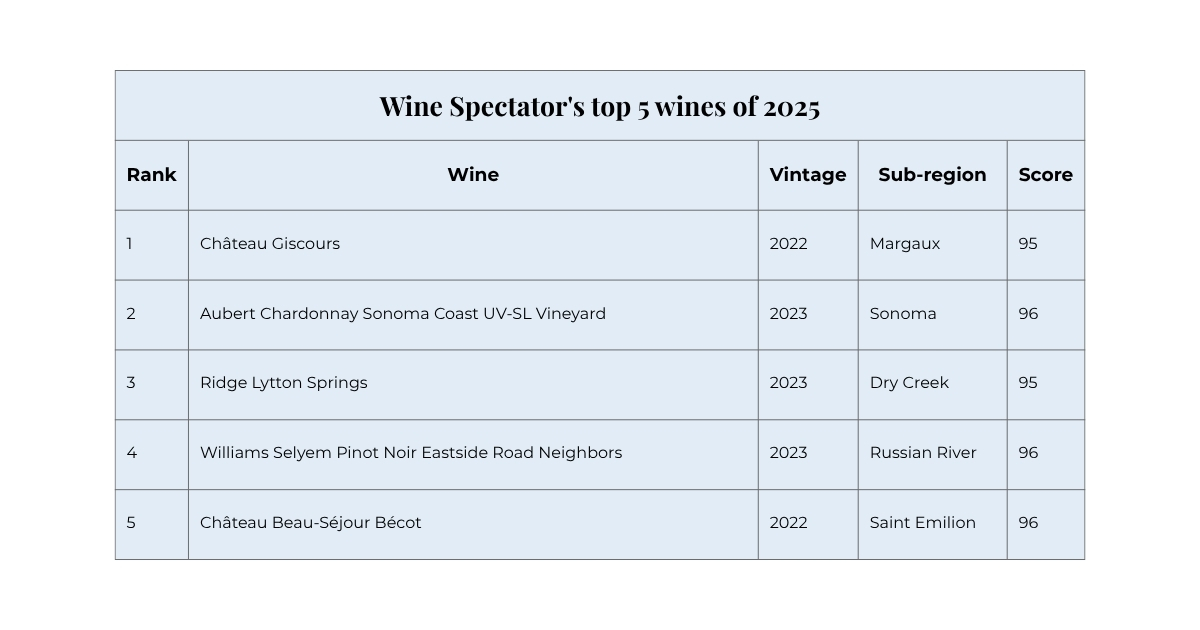
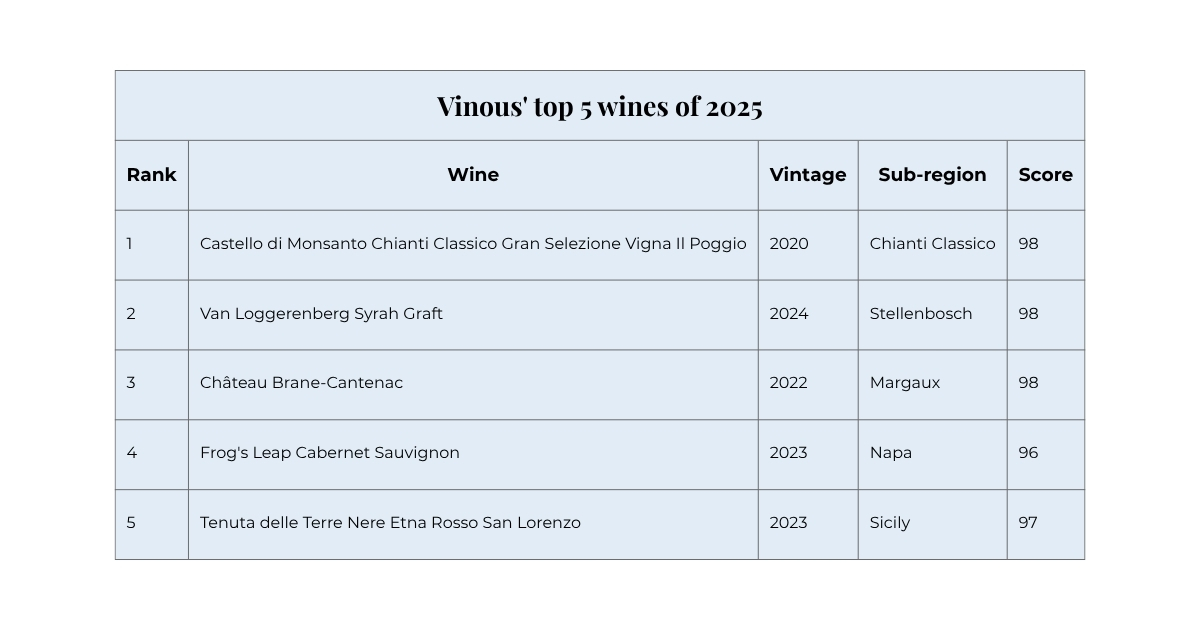
Bordeaux 2022 leads critics’ top wines of 2025

  • Global critic lists show unprecedented diversity across regions and styles.
  • Bordeaux 2022 was in the spotlight across major publications.
  • Collectible wines and investment-grade wines differ – only some critic favourites have long-term market potential.

Each November, major critic publications around the world release their annual Top 100 wines of the year rankings. Rather than showcasing the wines only released in the past twelve months, the lists highlight standout bottles tasted throughout the year, spanning vintages, regions, and stylistic expressions.

A clear trend emerges from looking at past and current lists: increasing diversity. Critics are no longer focusing exclusively on tried-and-true regions like Bordeaux, Napa, or Barolo. Instead, their selections – this year spanning wines from Etna to Stellenbosch, Central Otago to Morgon – reflect the global expansion of fine wine quality, elevated vineyard management, and the growing maturity of the market.

Critic choices largely align with broader shifts seen in the fine wine investment landscape. As quality rises around the world, more wines now boast age-worthiness, critical acclaim, and technical precision. However, this raises an important point: not all critic-favourite wines carry investment potential.


A collectible wine may be rare, high-scoring, or culturally important, while an investment-grade wine must also demonstrate a proven secondary-market track record, liquidity, stable long-term demand, and price performance history.


Below, we explore three of the most influential 2025 global rankings and what the top wines reveal about the state of the fine wine market going into 2026.

Wine Spectator’s Wine of the Year

Wine Spectator’s annual Top 100 list is arguably the most commercially impactful ranking in the global wine calendar. Historically, the No. 1 Wine of the Year has triggered immediate surges in demand, and often dramatic price rises, across global markets. A clear example came in 2023, when Argiano Brunello di Montalcino 2018 – previously quiet on the secondary market – experienced a rapid uptick in both demand and value within days of receiving the top spot.


Wine Spectator's top 5 wines 2025

In 2025, the top position went to Château Giscours 2022, marking a major endorsement for Bordeaux’s strong 2022 vintage at a time when the region often finds itself facing criticism. Senior Editor James Molesworth explains: ‘Recent vintages have been mercurial in quality, while the region’s annual spring en primeur campaigns have fizzled. Tariffs haven’t helped. But if you needed a reminder that Bordeaux still makes some of the greatest wines in the world – and that its producers can evolve with changing times – the Château Giscours Margaux 2022 is your wine. This third-growth classified estate earns our top honor this year.’ 

Molesworth further highlights the wine as the culmination of decades of rebuilding work at the estate: ‘The efforts of Van Beek to surpass numerous obstacles over a generation is a clear example of how wine is a long game.’ The critic notes that recent improvements, including refined harvesting practices and guidance from consultant Thomas Duclos, have helped elevate quality, vintage after vintage. In 2022, these efforts culminated in a grand vin that Wine Spectator describes as fresh, seductive and finely detailed, with no second wine produced due to the exceptional quality of the harvest.

The rest of the top four represent a strong showing for California. Aubert’s UV-SL Chardonnay (No. 2) was praised as the union of ‘a renowned winemaker, a special vineyard and an exceptional vintage.’ Meanwhile, Ridge’s Lytton Springs 2023 and Williams Selyem’s Eastside Road Neighbors Pinot Noir 2023 reflect the continued strength and stylistic diversity of Californian wine across Dry Creek Valley and Russian River Valley.

Rounding out the top five is another Bordeaux 2022 wine: Château Beau-Séjour Bécot. Wine Spectator calls it a ‘dreamy wine’, reinforcing the broader pattern seen across both critic and market attention this year. Bordeaux 2022 is clearly one of the defining narratives of the 2025 rankings, earning major positions across multiple publications.

Vinous’ top 100 wines of 2025

Vinous’ annual list, which Antonio Galloni says aims to capture the ‘diversity and dynamism of today’s wine world,’ showcases wines of exceptional quality, character, and excitement rather than simply the highest-scoring bottles.


Vinous' top five wines 2025

This year, Italy takes the top spot with Monsanto’s Il Poggio, which Galloni calls “a total stunner” and “one of the very finest Il Poggios ever made.”

One of the most notable placements comes at No. 2: Van Loggerenberg’s “Graft” Syrah 2024 from South Africa. Neal Martin awarded it 98 points, praising its mineral character, balance, and crystalline finish – another sign of South Africa’s accelerating rise in fine wine quality.

The third wine in the list represents a more classical pick, but with a symbolic shift. With ownership passing to Henri Lurton’s children, Martin sees the 2022 Château Brane-Cantenac as a defining benchmark: ‘A year when… the 2022 is a benchmark for the Margaux estate, its future North Star.’

The list continues with strong representation from both New and Old World producers, including Frog’s Leap’s classically styled 2023 Cabernet Sauvignon and Tenuta delle Terre Nere’s deeply structured Etna Rosso San Lorenzo.

James Suckling’s favourite wines of 2025

James Suckling’s team tasted over 45,000 wines in the last year, making his Top 100 one of the most globally comprehensive. His selections prioritise balance and drinkability – wines that shine immediately, whether from bottle or barrel.


James Suckling's top five wines 2025

His top wine – Château d’Issan 2022 – reflects the broader dominance of Bordeaux’s 2022s across his list. Suckling emphasises that the vintage remains one of the biggest stories of the year, praising how the wines show focus, brightness and precision despite extreme heat and drought. He compares 2022 to other hot-vintage classics such as 1982, 1959, 1947 and 1928, all of which have stood the test of time, an important indicator for long-term growth. 

Suckling also notes how the accessibility of 2022 Bordeaux – widely released, easy to sample, and available across markets – enabled more comprehensive evaluation this year, contributing to their strong representation.

The remaining wines illustrate the global reach of modern fine wine quality. American Pinot Noir features prominently, with standout bottles from Raen and Arterberry Maresh. Meanwhile, two of the most surprising inclusions – Burgaud’s Morgon Côte du Py and Terra Sancta’s Bannockburn Pinot Noir – are also among the most affordable on the list, reinforcing Suckling’s point about the exceptional value emerging from Beaujolais and regions such as Central Otago. His report proposes that once-overlooked regions are now producing wines of extraordinary finesse and consistency.

Across all three critic rankings, a consistent narrative emerges: fine wine quality is more global, diverse and dynamic than ever before. At the same time, the spotlight on Bordeaux 2022 signals a vintage with both critical momentum and long-term relevance, firmly positioning it as one of the defining investment stories of the year.

Not every critically acclaimed wine is an investment wine, but the themes that surface – regional momentum, stylistic shifts, the performance of key vintages, and the critics’ influence on market behaviour – will all shape the fine wine landscape as we move into 2026.

WineCap’s independent market analysis showcases the value of portfolio diversification and the stability offered by investing in wine. Speak to one of our wine investment experts and start building your portfolio. Schedule your free consultation today

Categories
Learn

How long should you hold your wine investment?

  • Fine wine investment differs significantly from traditional markets because supply diminishes with time.
  • Holding periods determine whether an investor benefits from liquidity windows, maturity or scarcity premiums.
  • Investors should not expect uniform results across all wines or timeframes.

When it comes to fine wine investment, most discussions focus on the what: which wines, which vintages, which regions. Equally critical, but less often addressed, is the when: how long you hold your investment.

Holding periods can dramatically shape your returns, mitigate risks, and define your overall strategy. Unlike equities or bonds, fine wine is both a physical asset and a cultural commodity, with unique cycles of demand and consumption. Understanding how time interacts with these cycles is essential for building a resilient portfolio.

Why holding periods matter in wine investment

Fine wine investment differs from traditional markets in one key respect: supply diminishes over time. Bottles are uncorked and consumed, which means that scarcity increases naturally as years pass. At the same time, the wines themselves evolve in bottle, often improving in complexity and desirability. This dual dynamic of shrinking availability and increasing quality drives long-term price appreciation.

However, investors cannot expect uniform results across all wines or timeframes. Some wines appreciate rapidly within a few years, while others demand decades of patience. Holding periods determine whether an investor benefits from:

  • Liquidity windows – when supply and demand align to create strong secondary market interest.
  • Maturity premiums – when wines are at or approaching their drinking peak.
  • Scarcity premiums – when older vintages are nearly impossible to source.

Short-term wine investment holds (1–3 years): Potential high gains?

Short-term holding in fine wine is less common but not without opportunity. Investors might target wines with clear catalysts for appreciation in the near future:

  • Critical acclaim: A 100-point score from leading critics such as Robert Parker, Neal Martin, or Antonio Galloni can trigger immediate demand.
  • Market cycles and estate events: Certain vintages or regions may benefit from renewed attention during En Primeur campaigns or La Place de Bordeaux releases. Similarly, external factors such as a change of ownership, the passing of a renowned winemaker, or a significant new investment in the estate can act as a catalyst. These events often lead to brand repositioning and higher release prices for new vintages, which in turn push up the value of older vintages as buyers seek relative value.
  • Macro-drivers: Currency fluctuations, tariff shifts or geopolitical events can create short-term arbitrage opportunities.

That said, short-term holds may carry higher volatility. Transaction costs – storage, insurance, brokerage fees – also eat more heavily into returns when compounded over only a few years. As a result, short-term trading tends to suit sophisticated investors with high market awareness rather than long-term collectors.

Medium-term wine investment holds (5–10 years): The sweet spot?

The medium-term horizon is often considered the sweet spot for many wine investors. This is when:

  • Wines mature: Many Bordeaux, Burgundy, and Champagne houses see optimal secondary market demand when their wines are 5–10 years post-vintage. At this stage, they have begun to show character but remain relatively youthful, making them appealing to both collectors and drinkers.
  • Supply drops: The first wave of consumption removes weaker hands from the market, while professional storage ensures the surviving bottles command a premium.
  • Liquidity is strong: Buyers – both private and institutional – seek wines that are ready-to-drink but still have substantial cellaring potential.

This period allows investors to capture meaningful appreciation without committing to decades of illiquidity. For many, the medium-term strategy provides a balance of growth potential and portfolio flexibility.

Long-term wine investment holds (10–20+ years): Scarcity and compounding value?

For truly iconic wines, long-term holding unlocks the greatest rewards. Scarcity compounds dramatically after 15–20 years, and mature bottles often become the centrepiece of collectors’ cellars. Wines that especially benefit from this approach include:

  • First Growth Bordeaux: Château Lafite, Latour, and Margaux often reach their full secondary market potential decades after release.
  • Grand Cru Burgundy: Producers like Domaine de la Romanée-Conti or Armand Rousseau are prized for aged expressions, which are scarce even at release.
  • Prestige Champagne: Top cuvées such as Krug or Salon are often held back by maisons themselves, releasing older vintages at a premium.

The trade-off is clear: long-term holding requires patience, optimal storage, and careful insurance. Illiquidity can become an issue if capital is needed suddenly. However, for investors with a multi-decade outlook, these holds can deliver extraordinary compounding returns – often well outperforming traditional assets.

Factors that impact value over time

Not all wines follow the same trajectory. Determining how long to hold depends on a mix of factors:

  1. Region and style
    • Bordeaux and Napa Cabernet: typically longer arcs, rewarding 10–20+ years.
    • Burgundy Pinot Noir: often peaks earlier (7–15 years), though the best can go much longer.
    • Champagne: prestige cuvées benefit from extended ageing, while non-vintage wines are less suited to investment.
  2. Producer reputation
    Iconic names command steady demand across all stages, while lesser-known producers may see sharper peaks tied to critical acclaim.
  3. Vintage quality
    Strong vintages (e.g., Bordeaux 2000, Champagne 2008) often sustain demand longer, while weaker vintages may peak quickly.
  4. Critic scores and re-releases
    A re-rating or late-release program can extend or shift the ideal holding window.
  5. Market conditions
    Global economic health, currency exchange rates, and tariffs can all affect when it’s most profitable to sell.

Risks of mistimed holding

Holding periods are not without risk. Selling too early can mean missing out on peak premiums. Selling too late risks encountering diminishing returns as wines pass their drinking window. Additionally, improper storage can compromise value, no matter the holding period. There are also liquidity risks: Even top wines may face temporary illiquidity in weak markets.
This is why professional portfolio management and exit planning are critical in fine wine investment.

Practical guidance for wine investors

  1. Diversify holding periods: Mix short, medium, and long-term positions across your portfolio. This smooths out returns and provides liquidity when needed.
  2. Match horizon to goals: If you expect to need capital in five years, avoid exclusively long-term wines.
  3. Work with data: Tools like Wine Track can help identify optimal exit windows by tracking price curves and critic sentiment.
  4. Reassess regularly: Market conditions evolve. A wine planned for long-term holding may benefit from earlier exit if demand spikes unexpectedly.

In fine wine investment, holding periods are the mechanism by which wine transforms from a consumable product into an appreciating asset. Short-term traders may profit from timing and market-driven gains, medium-term investors enjoy liquidity and strong demand, and long-term holders benefit from scarcity-driven premiums.

The best approach often combines all three, balancing risk and opportunity across different time horizons. With the right strategy, time becomes your most powerful ally – quietly compounding value as the bottles rest in the cellar.

WineCap’s independent market analysis showcases the value of portfolio diversification and the stability offered by investing in wine. Speak to one of our wine investment experts and start building your portfolio. Schedule your free consultation today.
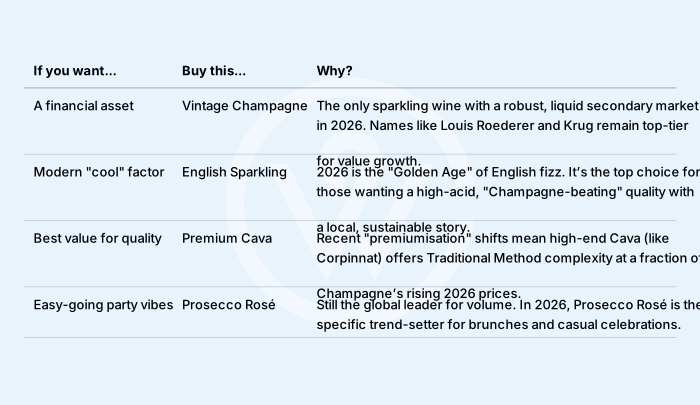
Categories
Learn

Is buying early always the best investment?

  • The common concept in fine wine investment has been that buying early (at release) often translates into the best possible price.
  • The concept has its roots in Bordeaux’s En Primeur system but the principle has been challenged in the last decade.
  • Ageing potential is important, but it is not the only factor in price performance.

Timing is crucial when it comes to almost every decision. While not all investments have a lifespan, some do – and fine wine is a prime example of a perishable good that evolves, peaks and declines in quality and value. 

The common concept in fine wine investment has been that buying early or at release often translates into buying at the best possible (lowest) price. Recent Bordeaux En Primeur campaigns have worked against this principle. Individual wine indices, such as those on Wine Track also show that the price performance of a wine is driven by numerous factors beyond age. The value arc does not simply follow the life cycle of the product but responds to demand, critic scores, and brand popularity among other factors.

So, is buying early always the best investment? The answer, as we’ll see, is far more nuanced.

The origins of buying early: Bordeaux En Primeur

The concept of buying wine early has its roots in Bordeaux’s En Primeur system. Emerging in the post-war decades of the 20th century, it was designed to provide much-needed cash flow to châteaux, while offering buyers privileged access to top wines before they were bottled.

En Primeur still works broadly the same way today: buyers purchase wine in the spring following the harvest, while the wine is still ageing in barrel. Delivery follows one to two years later, once bottling has taken place.

For decades, this system benefitted both producers and buyers. Châteaux received upfront financing, while collectors and investors gained access to some of the most prestigious wines in the world at prices significantly lower than they would command once bottled.

The traditional promise of buying early

The original attraction of En Primeur was simple: buy early, secure allocations, and enjoy price appreciation once the wine is released to the wider market. In exceptional vintages like 1982, 2000, or 2005, those who bought early often saw spectacular returns.

For investors, the logic was straightforward:

  • Scarcity effect: Once the wine left the château, supply only diminished as bottles were consumed.
  • Pricing advantage: En Primeur pricing was historically lower than post-release retail.
  • Access to top names: For blue-chip estates like Lafite, Latour, and Margaux, early purchases guaranteed allocations that might otherwise be difficult to secure later.

In these circumstances, buying early equates to buying smart.

When buying early backfires

The past decade, however, has challenged this principle. Several Bordeaux En Primeur campaigns, most notably in 2017 and even 2020, saw release prices set so high that early buyers struggled to achieve returns. In some cases, wines could be purchased at equal or lower prices a year or two after bottling.

The reasons are clear:

  • Aggressive pricing by châteaux: A stronger global demand for fine wine has emboldened producers to set ambitious release prices.
  • Market corrections: Economic slowdowns, global trade disruptions, and shifting consumer preferences have softened demand after release.
  • Vintage variation: Lesser or more challenging vintages often lack the critical acclaim needed to sustain premium En Primeur pricing.

For investors, this has underscored the risk of assuming that ‘earliest means cheapest’.

What makes fine wine different from other assets

To understand why timing matters so much in wine investment, it’s important to recognise how wine differs from other asset classes:

  • Finite supply: Unlike companies that can issue more shares, every bottle consumed reduces global availability.
  • Physical lifespan: Wine matures and eventually declines; it is not a perpetual store of value like gold.
  • Quality peaks: Different wines have different drinking windows, meaning investors must consider not just price but also maturity and market timing.
  • Luxury demand drivers: Beyond fundamentals, fine wine is influenced by critic scores, branding, and even lifestyle trends among global collectors.

This blend of scarcity, perishability, and cultural cachet makes wine a unique – and uniquely complex – investment.

Beyond age: the real drivers of value

Ageing potential is important, but it is not the only factor in price performance. Modern wine indices and case studies reveal a more layered picture. Key drivers include:

  • Critic scores: A 100-point rating from Robert Parker, Neal Martin, or William Kelley can send prices soaring overnight.
  • Producer reputation: Estates like Domaine de la Romanée-Conti, Screaming Eagle, or Krug often outperform peers regardless of vintage quality.
  • Market cycles: Broader economic forces, from currency fluctuations to tariff policies, can depress or lift wine prices.
  • Brand popularity: Rising interest in regions like Champagne or Tuscany can create waves of demand that drive prices beyond what traditional models predict.

In other words, while time and age matter, they are not the sole determinants of performance.

When buying early makes sense

Despite these caveats, buying early can still be an excellent strategy under the right conditions.

  • Exceptional vintages: En Primeur remains compelling in universally acclaimed years, where demand is strong and release pricing is competitive.
  • High-demand producers: Cult estates with limited production – such as Château Lafleur in Pomerol or Domaine Leflaive in Burgundy – make early buying critical for securing allocations.
  • Collector profiles: For those who value access as much as investment return, buying early provides peace of mind.

For these buyers, the combination of access, scarcity, and potential upside makes early purchase attractive.

Alternative timing strategies

If early purchase is no longer a guarantee of success, what are the alternatives?

  • Back-vintage buys: Many investors now prefer to target wines once bottled and scored, when pricing stabilises and market sentiment is clearer.
  • Diversification by region: Burgundy, Champagne, and Italy’s Super Tuscans increasingly offer opportunities outside the Bordeaux En Primeur cycle.
  • Mixed approach: A blend of early allocations (for access) and carefully chosen back-vintage purchases (for value) often proves the most resilient strategy.

By broadening their scope and diversifying their portfolios with different regions and vintages, investors can reduce risk and capture opportunities across global markets.

See also: The best fine wines to invest in 2025

The role of La Place de Bordeaux today

It’s also worth noting that the traditional Bordeaux system has evolved. La Place de Bordeaux, the centuries-old distribution network, now offers not just En Primeur but also back vintages and non-Bordeaux icons such as Opus One, Masseto, and Almaviva.

These September releases are already bottled and ready to ship, offering global investors access to top wines without the risks of futures. In many ways, they reflect the modernisation of fine wine trading: access, liquidity, and global reach, without the same timing pressures as En Primeur.

The art of timing in investment

The idea that buying early is always the best investment belongs to another era. While there are still moments when buying at release delivers the greatest value, these are no longer guaranteed.

Fine wine is unlike any other asset: it is finite, perishable, and driven as much by culture and reputation as by supply and demand. Successful investors understand that while time is crucial, it is not the only variable.

The smart investor balances early buying in exceptional vintages with selective secondary market purchases, diversifies across regions and producers, and pays close attention to global demand trends.

WineCap’s independent market analysis showcases the value of portfolio diversification and the stability offered by investing in wine. Speak to one of our wine investment experts and start building your portfolio. Schedule your free consultation today.
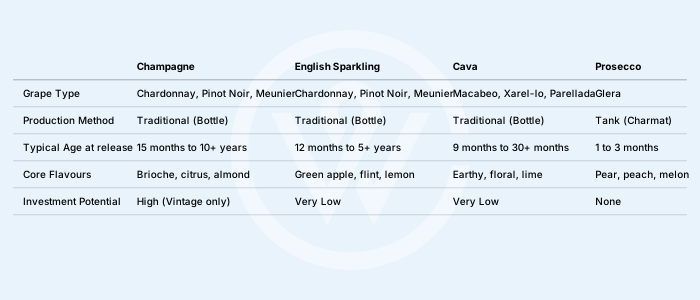
Categories
Learn

The best fine wines to invest in 2025

How to pick the best investment wines

The fine wine secondary market is still working through a correction that began in late 2022. Prices declined further throughout the first half of this year, with the Liv-ex 100 index down 5.2%. For investors, this means many blue-chip wines are available at levels not seen for years, yet careful selection matters more than ever. 

When choosing fine wines for investment in 2025, the following five criteria should be considered:

  1. Liquidity: depth of secondary market trading 
  2. Scarcity: limited production and strong back-vintage demand. 
  3. Proven vintage quality: critics’ consensus across strong years.
  4. Price momentum and entry point: assets that corrected to historically attractive bands.
  5. Fundamentals: brand power, distribution, and ageing potential.

These filters reflect a cautious market where ‘selectivity and scarcity’ are driving the handful of winners that still posted gains in H1 2025.

Best Bordeaux wines to invest in: value in maturity

Bordeaux’s share of global trade has shrunk over the past decade – from a once dominant force to now accounting for just over a third of the market by value. It’s also been one of the hardest-hit regions in terms of price performance during the recent downturn. On the surface, that may look like a negative but in reality, it has opened a window of opportunity for new buyers.

The recent correction has created compelling value in back vintages. The long-standing myth that ‘the best Bordeaux to invest in is always the latest release’ has been debunked by recent market behaviour and En Primeur campaigns. In 2025, many of the most sought-after Bordeaux wines for investment were not recent releases but mature, well-stored vintages offering proven quality, established critic scores, and immediate drinkability.

Even the 2024 En Primeur campaign underscored this shift in thinking: while release prices were often cut aggressively to stimulate demand, in many cases, comparable back vintages offered more value for money.

Where to focus

  • Classed growth Left Bank from strong years: First Growth prices have fallen with the market, but that’s precisely where patiently-awaited value emerges in proven vintages with long drinking windows.
  • High-momentum châteaux like Les Carmes Haut-Brion: its critical trajectory and scarcity keep it on many ‘accumulate on dips’ lists.
  • Second wines are mixed: prefer estates with consistent quality vs the Grand Vin and strong brand equity.

A cyclical downturn, steeper primary price cuts, and abundant back-vintage supply allow building positions in classic names at 2014-era equivalents.

Best Burgundy wines to invest in: buy selectively

Burgundy, which has fallen 5.8% year-to-date, remains one of the regions most affected by the broader market correction. After leading the charge in the 2020-2022 price surge, it’s now working off those highs, but that’s drawing in patient buyers. Liv-ex recently reported that their Burgundy 150’s bid:offer ratio is climbing as buyers take advantage of softer conditions. 

The best opportunities are in domaines with transparent distribution, consistent critic backing, and production levels that support liquidity. The aim isn’t to chase the rarest unicorns with the widest spreads, but to target ageworthy Premiers and Grands Cru wines from established producers – especially where pricing has stabilised.

Where to focus

Tip: Our full list of best-performing Burgundies is updated live on Wine Track – use it to cross-check performance momentum against your shortlist before committing capital.

Best Italian wines to invest in 2025: Super Tuscans and Piedmont

Italy’s indices have been more resilient than much of the market since 2023, with the Italy 100 showing a ‘tale of two cities’ – some weakness, but better relative performance than Burgundy and Bordeaux in the drawdown. Price discipline at release and broadening global demand help.

Where to focus

For diversification within Italy, combining steady Super Tuscan exposure with carefully chosen Piedmont parcels can balance liquidity with potential upside.

Best Champagnes to invest in 2025: stabilisation & early upside

Champagne combines brand prestige with broad global demand, strong critical reputations, and genuine scarcity in top vintages. After more than a year of declines, Champagne’s investment market is showing its first signs of recovery. In June 2025, the Liv-ex Champagne 50 posted its first monthly gain in twelve months, rising 0.8%. 

Individual brand performances are another encouraging sign. Across 50 flagship vintages from Dom Pérignon, Cristal, Salon, Krug, and Taittinger Comtes, over 85% have halted their price declines, with most holding steady for at least six months, reaching a classic consolidation phase. 

Moreover, demand is back on the rise. Champagne’s market share on Liv-ex has climbed to 12.4% year-to-date, above 2024’s average.

With prices now at more attractive entry points, this could be the first major fine wine region to re-enter growth mode, potentially ahead of Bordeaux, Burgundy, and Italy in the recovery cycle.

Where to focus

For investors seeking diversification with cyclical upside, the signs suggest Champagne may soon be popping again.

Best California wines to invest in 2025: pound strength opportunity

Sterling’s strength against the US dollar – at near decade highs – has combined with an 11.4% year-on-year price decline in Californian fine wine to create one of the most attractive buying climates in recent memory for European investors. 

Market leaders such as Screaming Eagle, Dominus and Opus One offer strong recovery potential, relative scarcity and top quality. Screaming Eagle’s long-term track record is particularly impressive, with six 100-point vintages in just 13 releases, and index growth of over 200% in the last two decades.

Where to focus

  • Icons at cyclical lows: Screaming Eagle 2021, Opus One, and Dominus for recovery-driven gains.
  • High-growth, small-production labels: Bond Melbury and Screaming Eagle The Flight, combining scarcity with recent strong momentum.
  • Diversification beyond Cabernet: Aubert Chardonnay and Occidental Pinot Noir for breadth and reduced volatility in US exposure.

With pricing, currency, and availability aligning, California offers a unique short-term window to secure both blue-chip icons and emerging stars at levels not seen in years.

Best investment vintages: quick compass in 2025

2005 (Bordeaux & beyond):
Now entering a glorious drinking window for Left Bank and Right Bank; quality is broadly exceptional with structure to age. Availability exists across the spectrum, often at meaningful discounts to 2022 highs. Great for ‘drink or hold’ strategies.

2009 (Bordeaux):
Riper, glamorous wines with huge critical appeal. Prices inflated in prior cycles, but the correction has pruned excess. Choose château by château; prime cellaring histories command premiums, but fair value has returned for top Left Bank and Right Bank bottlings. 

2016 (Bordeaux + Italy):
Among the most investable ‘modern classics’. Left Bank 2016 remains a reference point for balance, precision, and longevity; Tuscany 2016 (including Bolgheri) also shines. If you want one core vintage anchor for Bordeaux exposure in 2025, 2016 is the workhorse – especially as prices have softened. 

2020 (Burgundy + Tuscany + select Bordeaux):
A high-quality, warm year with strong critic support in many regions. In Burgundy, 2020 reds can be concentrated yet poised; in Tuscany, 2020 offers ripe, polished profiles for Ornellaia and peers. Corrections since 2023 have made select Bordeaux 2020s attractive relative to peak price points. 

En Primeur 2024 (context for new allocations):
Not a ‘vintage to chase at any price’, but the pricing is the story: releases down roughly 30% from 2023 at top estates, in several cases the lowest since 2014. If you buy En Primeur in 2025, do it for value vs readily available back vintages and only for estates with a clear historical discount at release.

Producers to watch in 2025

  • Les Carmes Haut-Brion combines small volumes, soaring critical trajectories, and a style that has captivated collectors. Pricing cooled with the market – use corrections to build modest positions with strict provenance.
  • Piedmont rarities with widening global followings, like Roagna’s single-vineyard Barbarescos and Barolos and Bartolo Mascarello. Watch for select back vintage offers post-correction.
  • Bolgheri peers beyond the ‘Big Three’ such as Le Macchiole Paleo and La Messorio, Tua Rita Redigaffi, and Soldera.
  • Select white Burgundy domaines with stronger availability (e.g. PYCM, Leflaive, Dauvissat). There is renewed interest in mature whites amid the broader correction.

Fine wine market 2025: why timing matters

Several data points contextualise 2025 positioning:

  • Market performance: Liv-ex’s broad Fine Wine 1000 is down 10.1% over one year and 20.9% over two years, illustrating the size of the reset. H1 2025 specifically saw the Fine Wine 100 fall roughly 4.4%, below the trade’s own start-of-year expectations.
  • Investor demand: Our primary research among wealth managers in both the UK and US showed they expect fine wine demand to rise this year – the highest expectation across luxury assets – despite the price falls. That tells you professional allocators are eyeing the dip.
  • Trade news: Quarterly round-ups from the wine trade echo the general market softness, highlight pockets of strength and cross-asset diversification appeal.

How to invest in fine wine in 2025

  1. Favour maturity or proven classics over speculative juveniles. The 2024-2025 buyer trend is toward ready-to-drink, mature vintages at corrected prices; that’s often the cleanest risk-adjusted exposure right now.
  2. Cross-check new releases vs back vintages for value. If the new release isn’t clearly cheaper than equal-or-better scored back vintages, skip it.
  3. Diversify by region and producer style. Italy’s relative resilience helps balance Burgundy/Bordeaux cyclicality; include Champagne/Rhône sleeves if your strategy allows.

Key takeaway: best fine wines to invest in 2025

2025 remains a buyers’ market. Liquidity is uneven, but the combination of cheaper Bordeaux, normalised Burgundy, and resilient Super Tuscans offers a compelling entry point. The market correction is still visible in the broader benchmark indices, but the best names at the right vintages and prices are being quietly accumulated again.

View our full Fine Wine Investment Guide

FAQs: Fine wine investment in 2025

1) Is fine wine a good investment in 2025?
Yes. 2025 remains a buyer’s market after a multi-year correction. Returns will be driven by selectivity (region/producer/vintage), provenance, and a longer holding period rather than quick flips.

2) Which regions offer the best value right now?
Bordeaux (mature back vintages), Burgundy (disciplined buys; mature whites and select 2019–2020 reds), Italy (Super Tuscans with steady liquidity), Champagne (early stabilisation), and California (GBP strength vs USD creating entry points).

3) How long should I hold investment wine?
Plan for 5-10+ years. Liquidity varies, but blue-chip Bordeaux can require 10-20 years to peak; Super Tuscans and Champagne often realise value earlier. Shorter holds increase friction and pricing risk.

4) What’s the minimum budget to start?
Practically, £5k-£25k builds a diversified starter portfolio. 

5) En Primeur or back vintages – which is better in 2025?
Often back vintages: you avoid waiting, see real critic consensus, and can compare prices like-for-like. Buy En Primeur only when the release clearly beats equivalent back vintages.

6) How important is provenance and storage?
Critical. Favour in-bond stock, original cases, full paper trails, professional storage, and inspection photos. 

7) How do currency and tariffs affect returns?
FX can add or subtract several percentage points. Tariff and duty regimes differ by route and change over time.

8) How do I manage liquidity?
Diversify across regions and styles and buy wines with established secondary market depth.