Categories
News

Top-scoring Bordeaux 2025 En Primeur wines so far

  • Major critics describe Bordeaux 2025 as a “miracle vintage” due to its exceptional balance and moderate alcohol levels in a hot and dry year.
  • The first 100-point in-barrel scores have emerged. 
  • Critics argue that quality alone will not turn this campaign into a success; the economic climate must be acknowledged.

The 2025 En Primeur campaign has begun, with the first wave of releases and critic reports now emerging. After a growing season that pointed toward blockbuster wines on paper, the reality in the glass tells a more nuanced story. The consensus among leading critics following April’s barrel tastings is that the 2025s are something of a paradox – wines that combine the concentration of a hot, dry year with the balance, freshness and structural poise of a more classical era.

In this article, we look into the first major En Primeur reports from Antonio Galloni (Vinous), William Kelley (Wine Advocate), James Lawther MW (JancisRobinson.com) and Georgie Hindle (Decanter), exploring where their views converge, where they diverge, and highlighting some of their top-scoring Bordeaux 2025 wines. We also focus on key themes, regional standouts, and early signals for what is shaping up to be one of the most intriguing and selective En Primeur campaigns in recent years.

What makes Bordeaux 2025 a “miracle” vintage?

According to major wine critics, the short answer lies in the balance and the moderate alcohol levels of the wines in a year defined by record-breaking heat. In a region where 14.5% or 15% ABV has become the “new normal” for hot vintages, the 2025s have pivoted.

  • Antonio Galloni describes this as a “minor miracle,” noting that while heat and drought usually yield massive tannins and high sugars, 2025 saw sugar ripening slow down while physiological ripeness continued. 
  • William Kelley, who mentions an alcohol range of 12.5% to 13.5%, calls the best wines “thrilling” for their ability to remain classically proportioned despite their density.
  • Georgie Hindle also notes the “paradoxical” nature, stating that the wines don’t “carry the wounds of the vintage.” She observes that alcohol levels are often one to two degrees lower than the 2022s, which have become a point of comparison.
  • James Lawther MW agrees that the “low alcohols and dense, silky tannins” provide a unique originality, particularly in Cabernet-dominant blends.

The growing season: Rainfall as the great arbitrator

Critics agree that the late-August rains were the turning point for the 2025 Bordeaux vintage. Without this 60-90mm of precipitation, many believe the vintage would have been a disaster of desiccation.

  • James Lawther points out that the Médoc received the most significant rainfall (up to 70mm), which “relaunched” ripening in vines that had essentially shut down due to hydric stress.
  • In her report, Georgie Hindle cites a winemaker from Chateau Quintus who noted that “without the rains, we would have made syrup.” This rainfall allowed the three types of ripeness – technological, phenolic, and aromatic – to finally converge.
  • Antonio Galloni adds that the April rains were equally vital, providing the water tables with enough reserves to help the vines survive the initial heat spikes in June.

Low yields: The smallest crop since 1991

The 2025 vintage is also defined by scarcity, with Bordeaux recording its smallest harvest in over three decades – a factor that will inevitably shape the dynamics of the release campaign. While critics broadly agree on the scale of the shortfall, their interpretations of its causes and implications vary.

Galloni attributes the low yields to a combination of poor conditions during the 2024 flowering cycle – when cluster formation for 2025 was already compromised – and the intense heat and drought of the 2025 growing season, which led to significant berry dehydration. In some cases, Merlot berries weighed as little as 0.8g, well below the typical 1.2g.

Kelley similarly links these reduced yields to the resulting wine style, arguing that the vintage’s “authoritative density” is a direct consequence of this concentration. 

Lawther, meanwhile, sees the small crop as a “positive factor” for quality, as the reduced charge on the vine made it easier for the remaining fruit to reach full maturity despite challenging weather conditions.

Left or Right Bank vintage?

While the quality of the vintage is widely praised, critics have identified a clear hierarchy of consistency, with a notable consensus on which communes struggled.

  • The Pomerol paradox: All four critics flag Pomerol as the most inconsistent appellation. Lawther notes that it suffered most from drought, leading to “bitterness” in some wines due to lack of juice. Galloni and Kelley agree that while the top estates on the clay plateau (like Petrus and La Conseillante) are “elegant,” the appellation, as a whole, is uneven.
  • Margaux and Pauillac: Antonio Galloni crowns Margaux as the “star of the vintage,” noting its consistent brilliance. James Lawther and William Kelley lean toward Pauillac as the most “impressive” or “compelling” sector, with Kelley citing its ability to deliver wines of “real concentration.”
  • Saint-Emilion: The clay-limestone soils here proved their worth. Lawther and Galloni both praise the plateau’s ability to manage water stress, with Lawther highlighting Cheval Blanc’s “stunning” results despite an extremely low 15 hl/ha yield.

Winemaking decisions

With tiny berries and thick skins due to heat and drought, most winemakers opted for gentler extraction techniques when handling the 2025 vintage.

  • Kelley explains that the unusually high solids-to-juice ratio meant structure was “taken for granted,” leading many estates to lower fermentation temperatures and reduce pumping over.
  • Hindle notes that some estates, like Montrose and Phelan Segur, performed their shortest macerations on record to avoid harsh tannins.
  • Lawther warns that hard finishes are an occasional fault in the vintage where winemakers were too heavy-handed with overworked tannins.

Potential 100-point wines so far

While more scores will be released in the coming days from critics including Neal Martin, James Suckling, and Lisa Perrotti-Brown MW, the table below highlights the wines that have already achieved barrel ranges touching 100 points. These early indicators suggest which wines may ultimately reach perfection once bottled and re-tasted in two years’ time.
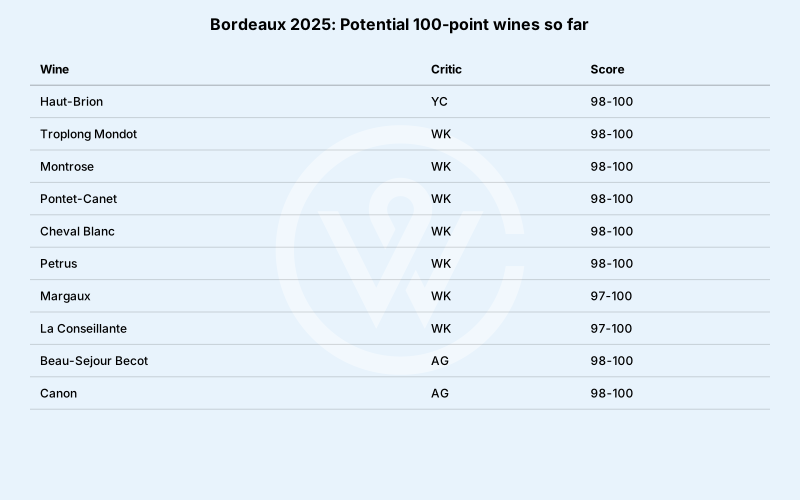
Bordeaux 2025: 100 point wines

*YC = Yohan Castaing (Wine Advocate), WK = William Kelley (Wine Advocate), AG = Antonio Galloni (Vinous)

It is important to note that En Primeur scores are typically expressed as ranges rather than fixed numbers. This reflects the fact that the wines are still in barrel and continue to evolve. Critics therefore allow for a margin of potential – both upward and downward – based on how the wines are expected to develop before bottling. A range such as 98-100 points signals not only exceptional quality, but also the realistic possibility of a perfect score at maturity.

Among the early reports, William Kelley is the most bullish, identifying seven wines with 100-point potential. Antonio Galloni follows with two, while Yohan Castaing has highlighted one wine in this top tier.

The list itself is telling. First Growths Chateau Haut-Brion and Chateau Margaux both feature, underlining the strength of the Left Bank at the very top level. They are joined by Right Bank icons Petrus and Cheval Blanc, alongside standout performers such as Troplong Mondot, Montrose and Pontet-Canet. 

Bordeaux 2025 market reality

While the wines themselves are widely praised, all critics have raised concerns about the market in their reports.

Kelley describes the En Primeur context as “structurally fragile,” questioning whether consumers still see value in buying futures. Galloni also states that Bordeaux “badly needs a win,” but warns that success depends entirely on pricing discipline. He argues that even modest increases could undermine demand, given the availability of competitively priced back vintages on the secondary market.

Hindle offers a more measured view, noting early signs of pricing restraint in the first releases and a stabilising fine wine market, but still emphasising the need for alignment between producers, merchants and consumers. 

The key to En Primeur success

Taken together, these early critic assessments position 2025 as a highly successful but nuanced Bordeaux vintage. At its best, it delivers a rare combination of concentration, freshness and terroir transparency – wines of both immediate appeal and long-term potential. However, it is not a uniform success. Variability is a defining feature, and careful selection will be essential. 

Perhaps most importantly, 2025 highlights a broader shift in Bordeaux. Through improved viticulture and winemaking, producers are increasingly able to navigate climatic extremes and make balanced wines in challenging conditions. 

But quality alone will not drive demand. The message from the critics is clear: the success of the campaign rests on the chateaux’s willingness to acknowledge the economic climate.

FAQ: Bordeaux 2025 En Primeur

Is Bordeaux 2025 a good vintage?
Yes – critics widely agree that 2025 is a high-quality vintage. Despite extreme heat and drought, the best wines show exceptional balance, freshness and moderate alcohol levels, leading some critics to describe it as a “miracle” or “paradoxical” vintage.

Why is Bordeaux 2025 described as a “miracle vintage”?
Because the wines defy expectations. In a hot, dry year that should have produced heavy, high-alcohol wines, 2025 instead delivered freshness, structure and restraint, thanks largely to cooler nights and crucial late-August rainfall.

What are the alcohol levels in Bordeaux 2025 wines?
Most wines fall between 12.5% and 13.5% ABV, significantly lower than recent hot vintages like 2022, where alcohol levels often exceeded 14.5%.

How important was rainfall in the 2025 vintage?
Late-August rainfall was critical. It rehydrated vines after prolonged drought, slowed sugar accumulation, and allowed full phenolic ripeness, ultimately shaping the balance and style of the wines.

Are Bordeaux 2025 yields low?
Yes. 2025 is the smallest Bordeaux harvest since 1991. 

Which Bordeaux regions performed best in 2025?
Margaux and Pauillac are widely seen as standout performers on the Left Bank, while Saint-Émilion excelled on the Right Bank, particularly on clay-limestone soils. 

Are there any 100-point Bordeaux 2025 wines yet?
Several wines have already received barrel score ranges of 98-100 points, indicating potential for a perfect score once bottled. Top names include Haut-Brion, Margaux, Petrus and Cheval Blanc.

What do En Primeur score ranges (e.g. 98–100) mean?
Barrel scores are given as ranges because the wines are still ageing. A 98-100 score suggests the wine is already exceptional but could improve further before bottling and reach a perfect score.

Will Bordeaux 2025 En Primeur be a successful campaign?
That remains uncertain. While wine quality is high, critics warn that success will depend on pricing. Buyers are increasingly cautious, and competition from back vintages may limit demand.

Should you buy Bordeaux 2025 En Primeur?
Critics emphasise that 2025 is not a uniform vintage. The best wines are outstanding, but variability is high, meaning careful selection will be essential rather than broad, “buy everything” strategies.

WineCap’s independent market analysis showcases the value of portfolio diversification and the stability offered by investing in wine. Speak to one of our wine investment experts and start building your portfolio. Schedule your free consultation today.
Categories
News

Bordeaux 2025 En Primeur: Quality meets a market at the crossroads

  • Bordeaux 2025 is a low-yield, heat-shaped vintage delivering concentration, freshness, and a clear shift toward precision viticulture.
  • Early reports point to a high-quality vintage with the potential to rival benchmark years like 2010 and 2016.
  • Set against a cooling market, the En Primeur campaign represents a critical opportunity to reset expectations around pricing and value.

From April 20th to 23rd, 2026, Bordeaux welcomed thousands of merchants, critics, and collectors for the En Primeur tastings of the 2025 vintage. Shaped by intense heat and reduced yields, the new vintage reflects a growing emphasis on precision viticulture – an approach that could come to define Bordeaux’s modern identity.

Yet the usual energy surrounding En Primeur unfolds against a more cautious economic backdrop. Bordeaux finds itself in a period of recalibration. As the first in-barrel scores emerge and the campaign gathers momentum, attention turns not only to what sets the 2025 vintage apart, but also to whether this release can offer real value.

A note on Bordeaux En Primeur

Few moments in the fine wine calendar carry the weight of En Primeur week. Orchestrated by the Union des Grands Crus de Bordeaux (UGCB), the event sees chateaux open their doors to professionals eager to sample wines just months after they were harvested.

Unlike the bottled wines, the En Primeur wines are still unfinished, first presented while ageing in oak. Tasting from barrel requires an expert palate to see through the raw tannins and vibrant acidity to glimpse the potential for greatness years down the line. It is a period of masterclasses, technical presentations, and intense market discussion that signals the pricing direction for the entire year ahead.

The 2025 represents a fascinating stylistic shift. Despite the heat, alcohol levels are reportedly low to moderate. The wines have pronounced aromatics, silky tannins and brisk acidity – hallmarks of great ageing potential. 

Bordeaux 2025: What we know so far

Bordeaux weather and crop reports indicate that 2025 was a year of climatic extremes, resulting in high quality but notably low yields. In fact, production statistics show that 2025 is the smallest crop since the frost-bitten 1991, with yields across many top appellations falling 15-30% below the five-year average.

A season of heat and superb ripening

The growing season was defined by a warm spring and a blistering summer. June 2025 was recorded as one of the hottest in French history, second only to the infamous 2003. This heat, combined with a dry August, led to:

  • Smaller berries: The lack of water and high heat restricted grape size, leading to intense concentration and thick skins.
  • Exceptional phenolic ripeness: While the yields are small, the quality of the tannins is reportedly superb.
  • The “rain of relief”: Just as drought stress became critical, rain in late August and early September refreshed the vines, preserving essential acidity and preventing alcohol levels from spiralling out of control.

Regional highlights

  • The Left Bank (Médoc, Pauillac, St-Julien): The deep-rooted old Cabernet Sauvignon vines thrived, producing structured, age-worthy wines reminiscent of 2022 but with a touch more freshness.
  • The Right Bank (St-Émilion, Pomerol): Clay and limestone soils held onto moisture better than gravel, allowing Merlot to reach lush ripeness without excessive heat stress.
  • Dry whites: Harvested early in mid-August, these show vibrant acidity and tropical aromatics.

The Bordeaux market: The recalibration phase

While the 2025 quality is expected to be high once critic scores are released, the market mood is best described as unsettled. For decades, Bordeaux held an unchallenged dominance in the fine wine market. Recent years have seen a cooling of demand, especially for young releases.

The challenges

  • Increased competition: High-quality rivals from Burgundy, Tuscany, Napa Valley, and even emerging regions have eaten into Bordeaux’s traditional market share.
  • Pricing fatigue: Consistent price hikes in recent En Primeur campaigns – often regardless of the broader economic climate – have tested the loyalty of even the most dedicated collectors.
  • Stock overhang: Many merchants are currently carrying significant inventories of recent great years (2018, 2019, 2020), which has created a bottleneck in the secondary market.

The silver lining

Despite these headwinds, the appetite for older, physical vintages remains robust. There is a clear divergence in the market: while younger vintages (2021-2023) struggle for traction, back vintages from the mid-2000s and 2010s continue to see steady price appreciation. This suggests that the brand of Bordeaux is as strong as ever. The issue lies specifically with release pricing.

Buying wine En Primeur: The question of value

For decades, the “golden rule” of Bordeaux was that En Primeur represented the lowest price point for a wine’s entire lifespan. Today, that assumption is being challenged by data.

Looking at prices at release versus now, several recent vintages can be found on the secondary market for the same price or even less. This has shifted the focus from buying everything to selective acquisition based on specific brand value. Tools like Wine Track, which show the historic performance of specific wine brands, can help investors understand long-term trajectories.

Why data matters

In the 2025 campaign, savvy buyers will be looking for relative value. If a 2025 release is priced higher than a physical, high-scoring 2019 or 2020 vintage currently sitting in a merchant’s warehouse, the incentive to buy En Primeur diminishes. However, because the 2025 yields are so low, scarcity may drive demand for the top-tier “blue chip” estates (the First Growths and their Right Bank equivalents).

The 2025 Bordeaux En Primeur verdict

As critics release their first scores over the coming weeks, all eyes will be on the “price-to-quality ratio.” The 2025 vintage has all the hallmarks of a collector’s dream: scarcity, concentration, and classical structure. For the Bordeaux trade, the 2025 En Primeur is an opportunity for a reset. With early reports pointing towards a vintage that could rival the greats of 2010 or 2016, the quality is likely there.

If the châteaux can marry this quality with a pricing strategy that respects the current market reality, 2025 could mark the beginning of a vibrant new chapter for the world’s most famous wine region.

Bordeaux comment: UGCB President, François-Xavier Maroteaux speaks to WineCap

WineCap: The 2025 vintage promises high quality, yet it arrives as the secondary market has just started to recover from a five-year low, and growing geopolitical tensions discourage speculation and might isolate certain market segments. How do you intend to position the 2025 launch so it doesn’t just survive the current market, but actually revitalises the ‘Bordeaux Brand’ globally?

François-Xavier Maroteaux: The 2025 vintage is a genuine opportunity – but only if we use it wisely. First, pricing must be honest: release prices that ignore five years of secondary market correction damage trust more than they protect margins. A well-priced great vintage is far more powerful than an overpriced one. Second, the narrative must move beyond scores – 2025 has a compelling story of terroir and style that needs to reach consumers directly, not just through trade press. Third, our négociants are brand ambassadors, not just a distribution channel: the properties that genuinely invest in informing and equipping their partners will see it reflected in every market. Finally, the retreat of speculative demand is not a threat – it’s a rebalancing. Bordeaux built its reputation on wine people actually wanted to drink. Refocusing on that is not a concession to difficult times. It’s a return to what made the region great. 

WC: Where do you see the biggest interest in buying Bordeaux at release in the coming years?

FXM: The interest in buying Bordeaux at release remains genuinely global. The best proof of this is the En Primeur week itself: every year, wine professionals from more than 80 nationalities make the journey to taste and buy. That breadth of engagement, even in difficult market conditions, is a strong signal that the foundation is there. Beyond geography, there is another compelling reason to buy at release that we shouldn’t underestimate (and we should be communicating much more actively!): formats. En Primeur remains the best – often the only – window to secure large formats. Magnums, double magnums, imperials are allocated at release and rarely available later at any price. The opportunity is to refocus En Primeur on what it does uniquely well: access, formats, and relationship. That’s a proposition that holds regardless of geopolitics.

WC: Is the En Primeur system still going strong, in your personal view? Do you believe it still offers a genuine win-win? Has it become a luxury-only club for the top 50 estates?

FXM: Yes, I do believe the En Primeur system still works – but I think we need to be honest about what it has become. It works very well for a relatively narrow group of estates where brand strength and secondary market liquidity reinforce each other. For the broader Bordeaux pyramid, it is more complicated. That said, I don’t think the answer is to abandon the system. The answer is to make the win-win genuine again. That means pricing with discipline, communicating with transparency, and making sure négociants and merchants actually make money when they support a release. When that alignment exists, En Primeur is a unique and powerful tool. When it doesn’t, it becomes – as you say – a luxury club for the top names. 

FAQ: Everything you need to know about Bordeaux En Primeur

What does “En Primeur” mean?

En Primeur is a method of purchasing wine while it is still maturing in the barrel. This allows collectors and investors to secure highly sought-after wines before bottling and general market release. This typically happens two years after harvest.

When is the Bordeaux 2025 En Primeur week?

The official tasting week for the 2025 vintage takes place from April 20 to April 23, 2026. During this time, international critics and trade professionals sample the wine from barrel to determine early scores and quality ratings.

Is the 2025 Bordeaux vintage good?

Bordeaux 2025 is a high-quality vintage with intense concentration and bold fruit profiles.Yields are lower than average, which often results in wines with significant ageing potential and structural density.

Why are yields low for the 2025 vintage?

The 2025 growing season saw record-breaking heat and extended dry periods. While this led to exceptional grape ripeness and thick skins (tannin), it resulted in smaller berries and less juice. These lower yields often drive up demand due to the limited number of cases available globally.

Is buying En Primeur a good investment?

Buying En Primeur can be a strategic investment, particularly for top-tier estates (First Growths and “Super Seconds”). However, it is essential to use data-driven insights. While release prices were historically the lowest point of entry, current market fluctuations mean buyers should compare release prices against available physical back-vintages to ensure they are getting true value, as older vintages can often present better buying opportunities than En Primeur.

When is the delivery of the 2025 Bordeaux wines?

In the spring or summer of 2028, following their mandatory ageing period in the châteaux cellars.

What are the “big three” factors to watch in the 2025 campaign?

  1. Critic scores: Initial ratings from major publications will dictate immediate global demand.
  2. Release pricing: How châteaux price their wine in relation to the secondary market.
  3. Volume: With lower yields reported, the scarcity of specific labels will likely be a driver of demand.

WineCap’s independent market analysis showcases the value of portfolio diversification and the stability offered by investing in wine. Speak to one of our wine investment experts and start building your portfolio. Schedule your free consultation today.
Categories
Learn

Understanding the fine wine secondary market: Investing, liquidity and valuation

  • While the primary market is the initial sale from the estate, the secondary market is the global trading ecosystem where wine is treated as a financial asset.
  • Secondary market prices are dictated by supply/demand – as bottles are consumed, the rarity of the remaining vintage drives exponential value growth.
  • Secondary market success relies heavily on professional storage and documented history to ensure investment-grade quality.

For centuries, fine wine has been seen as a treasured collectible; over the last twenty years, it has started to be recognised as a sophisticated alternative asset class too. To understand how wine functions as an investment, one must grasp the mechanics of its lifecycle – specifically the transition from the primary market to the secondary market.

This guide provides an in-depth exploration of the fine wine ecosystem, offering clarity for collectors, investors, and enthusiasts looking to navigate the complexities of global wine trading.

What is the primary market for fine wine?

Before diving into the secondary market, we must define its origin. The primary market refers to the first time a bottle of wine is sold after production. In this stage, the transaction occurs directly between the producer (the winery or estate) and the first buyer who could be an individual or a business (i.e. wine merchant).

Key characteristics of the primary market:

  • Direct sourcing: The wine moves from the cellar of the estate to a distributor, importer, or La Place de Bordeaux courtier.
  • Fixed pricing: Prices are typically set by the estate based on production costs, brand equity, and vintage quality.
  • En Primeur (Wine Futures): A hallmark of the primary market, particularly in Bordeaux. Investors purchase wine while it is still aging in barrels, often 12-18 months before bottling. This offers the lowest possible entry price but carries the risk of the wine evolving differently than expected.
  • Allocation systems: For “cult” wines (like Domaine de la Romanée-Conti or Screaming Eagle), primary market access is restricted to exclusive mailing lists or long-standing restaurant partners.

What is the secondary market for fine wine?

The secondary market encompasses all subsequent transactions of a wine after its initial sale in the primary market. Once a bottle leaves the original distribution chain and enters the hands of a private collector, an investment firm, or a specialised retailer, any future sale happens on the secondary market.

Unlike the primary market, where supply is controlled by the winery, the secondary market is driven by supply and demand. As bottles are consumed over time, the remaining supply of a specific vintage diminishes, often driving prices upward – a concept known as “inverse supply elasticity.”

Why the secondary market matters

The secondary market is where “wine” becomes “liquid gold.” It provides:

  1. Liquidity: A platform for collectors to exit their positions and convert wine into cash.
  2. Price discovery: Real-time valuation based on what global buyers are actually willing to pay.
  3. Vintage depth: Access to aged, “library” wines that are no longer available from the producer.

The core components of the secondary market

1. Wine exchanges

The London International Vintners Exchange (Liv-ex) is the “stock exchange” for wine. It provides a standardised platform for merchants to trade, offering price transparency and indices (like the Liv-ex Bordeaux 500) that track market health.

2. Auction houses

Global powerhouses like Sotheby’s, Christie’s, and Zachys dominate the high-end secondary market. Auctions are the primary venue for rare collections and “unicorn” bottles. Online auction platforms have recently democratised this space, allowing smaller collectors to participate.

3. Specialised brokers and investment platforms

Modern fintech platforms allow investors to buy managed portfolios. These entities operate almost entirely within the secondary market, sourcing back vintages with proven provenance.

4. Peer-to-peer and retail re-sales

Specialty retailers often buy back well-cellared collections from private individuals to resell them to other collectors.

Key drivers of secondary market value

What makes a bottle appreciate in the secondary market? It is not just the name on the label.

Provenance and storage

In the secondary market, provenance is everything. A bottle of 1982 Château Lafite Rothschild is worthless if it was stored in a warm kitchen. Buyers look for “ex-cellar” history or professional storage records (bonded warehouses) to ensure the wine has been kept at a constant 12-14°C (55°F) with optimal humidity.

Critic scores

Ratings from “palate-makers” like Robert Parker’s Wine Advocate, Antonio Galloni (Vinous), or Jancis Robinson act as market catalysts. A 100-point score can cause an overnight price surge on the secondary market.

Scarcity and rarity

The secondary market thrives on scarcity. If a producer only makes 500 cases of a particular cuvée, and 200 are consumed in the first five years, the remaining 300 bottles become significantly more valuable to collectors seeking a complete vertical.

Bonded warehouses and “In-Bond” trading

In the secondary market, how you store your wine is as important as the wine itself. Professional investors almost exclusively trade wine “In-Bond” (IB).

In-Bond (IB) vs. Duty Paid (DP)

  • In-Bond (IB): The wine is stored in a government-approved bonded warehouse. It has not yet attracted VAT or Excise Duty. If you sell the wine while it is still “in bond,” you never have to pay these taxes. This increases the profit margin for investors and ensures the wine has never left a temperature-controlled environment.
  • Duty Paid (DP): Taxes have been paid, and the wine has likely been delivered to a private home. In the secondary market, Duty Paid wine often sells at a discount because its storage history is harder to verify.

Expert tip: For maximum resale value, always keep your investment-grade wine “under bond” in a recognized facility like London City Bond.

Secondary fine wine market global trade hubs 

While London remains the historical heart of the wine trade, the secondary market has shifted toward a tri-polar model:

  1. London: The center for technical trading and storage.
  2. Hong Kong: The tax-free gateway to the thirsty Asian market.
  3. Singapore: A growing hub for Southeast Asian high-net-worth individuals.

The “laggard” phenomenon

Fine wine is often described as a “laggard” asset. It does not react instantly to stock market crashes. Usually, there is a 6-to-12-month delay before wine prices reflect broader macroeconomic shifts. This makes it a powerful hedge against inflation and sudden equity volatility.

Secondary market trends: Beyond Bordeaux

Historically, the secondary market was 95% Bordeaux. Today, the landscape is much more diverse:

  • Burgundy: Now represents a massive share of market value due to extreme scarcity and global prestige.
  • Italy: The rise of “Super Tuscans” (Sassicaia, Tignanello) and Barolo has created a robust secondary niche.
  • Champagne: Recently one of the top-performing sectors, as collectors realize the aging potential of prestige cuvées.
  • The New World: Cult Californians (Harlan Estate) and Australian icons (Penfolds Grange) are now staples of global trading.

Risks in the secondary market

Investing in the secondary market is not without peril:

  • Counterfeits: High prices attract fraud. Verification of labels, corks, and glass is essential.
  • Market volatility: Like any asset, wine prices can fluctuate based on global economic conditions.
  • Illiquidity: While more liquid than it used to be, selling a wine collection still typically takes longer than selling a stock.

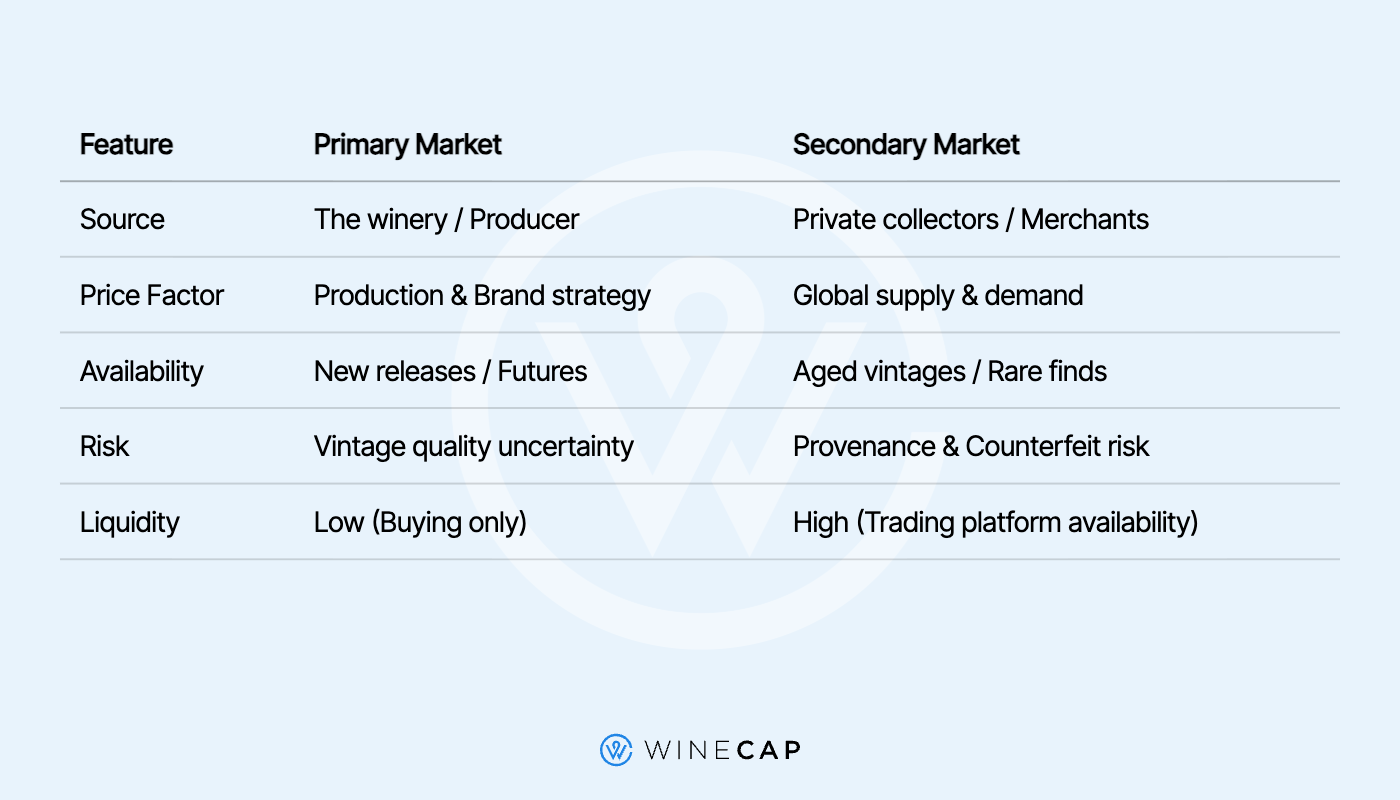
Primary vs. Secondary Market Comparison

Primary vs Secondary Market Comparison

Frequently asked questions (FAQ)

Is fine wine a good investment?

Fine wine has historically shown low correlation with traditional stock markets, making it an excellent diversifier. It often delivers steady long-term capital appreciation, though it requires patience and proper storage.

What is a “bonded warehouse”?

A bonded warehouse is a tax-secured facility where wine is stored without the owner having to pay Duty or VAT. This is the preferred storage method for the secondary market, as it guarantees professional conditions and makes the wine easier to resell.

How do I check the secondary market price of my wine?

Platforms like Wine-Searcher provide market data. Specialised wine investment companies can provide valuations. Auction hammer prices are also a reliable indicator of current value.

Can individuals sell wine on the secondary market?

Yes, but it is regulated. Most individuals sell through auction houses or brokers who take a commission. Selling directly to another individual often requires specific licensing depending on your jurisdiction.

What is the best way to enter the secondary market?

Most investors start by using a managed platform or a specialised broker. This ensures you are buying wine with perfect provenance and professional storage already in place.

Why do prices fluctuate so much?

Secondary market prices react to critic scores, weather events affecting future crops, and shifts in global currency (the USD/GBP exchange rate is particularly influential).

Can I sell a single bottle?

While possible through online auctions, the secondary market is most liquid for full original wooden cases (OWC). Single bottles often face steeper commissions and lower demand.

WineCap’s independent market analysis showcases the value of portfolio diversification and the stability offered by investing in wine. Speak to one of our wine investment experts and start building your portfolio. Schedule your free consultation today.
Categories
News

Bordeaux En Primeur 2024: critic scores and best releases

  • There have been some notable releases in a quieter En Primeur campaign. 
  • All of the top releases have represented the best entry point into their respective brands in the last decade. 
  • Critics have emphasised selectivity in a challenging vintage.

One month in since the start of the Bordeaux 2024 En Primeur campaign, which seems to be nearing its end, we look at critic scores and price trends to evaluate the best releases.

What the critics are saying

After the Wine Advocate’s William Kelley called Bordeaux 2024 ‘the weakest vintage of the last decade’, other critics have echoed his concerns with greater nuance. 

For Jane Anson, ‘the vintage was better than expected […] and clearly better than, for example, 2013 – and 2021 in the best cases.’

Meanwhile, Antonio Galloni (Vinous) observed: ‘The 2024s are all over the place in terms of quality and style, so readers will have to be selective. Within that context, the very best wines have a lot to offer.’ His ‘magnificent eight’ were Beychevelle, Clos Puy Arnaud, Cos d’Estournel, Jean Faure, Larcis Ducasse, Lascombes, La Conseillante and Rauzan-Ségla.

Neal Martin concluded his report, arguing that 2024 is ‘the ideal vintage for a reset’. He noted that ‘given the obstacles placed along the growing season, any 2024 that scores above 90 points is a success’. Martin’s highest barrel range was 96-98 points for La Mission Haut-Brion Blanc. Among the reds, his top wines with 95-97 points were Lafite Rothschild, Trotanoy, Lafleur and Vieux Château Certan.

The state of the market

As Bordeaux continues to lose market share to other regions, and fine wine prices overall are in a correction phase, releasing En Primeur has only worked with heavy discounts. We spoke with leading producers on how they determine their release prices, with strategies ranging from consulting négociants  and importers, and weighing in volumes and vintage quality. 

In his report, Martin speaks of the following reality: ‘There is no saviour riding over the horizon, no emerging country of insatiable Bordeaux-lovers, all against a backdrop of a vine-pull scheme […] and the fact that Bordeaux is wrestling with an image crisis.’ 

The solution? He goes back to the beginning of his career, when ‘off-vintages in the mould of 2024 would be discounted, and […] nobody lost face, including the grandest châteaux, and crucially, it kept the primeur system flowing, bottles passing through the distribution chain to the all-important final consumer’.

Within this context, we look at the releases that have worked so far – where pricing has aligned with trade and consumer expectations, and has offered a window for long-term profitability. 

Best En Primeur releases to date

One of the standout releases of the campaign has been First Growth Château Lafite Rothschild.

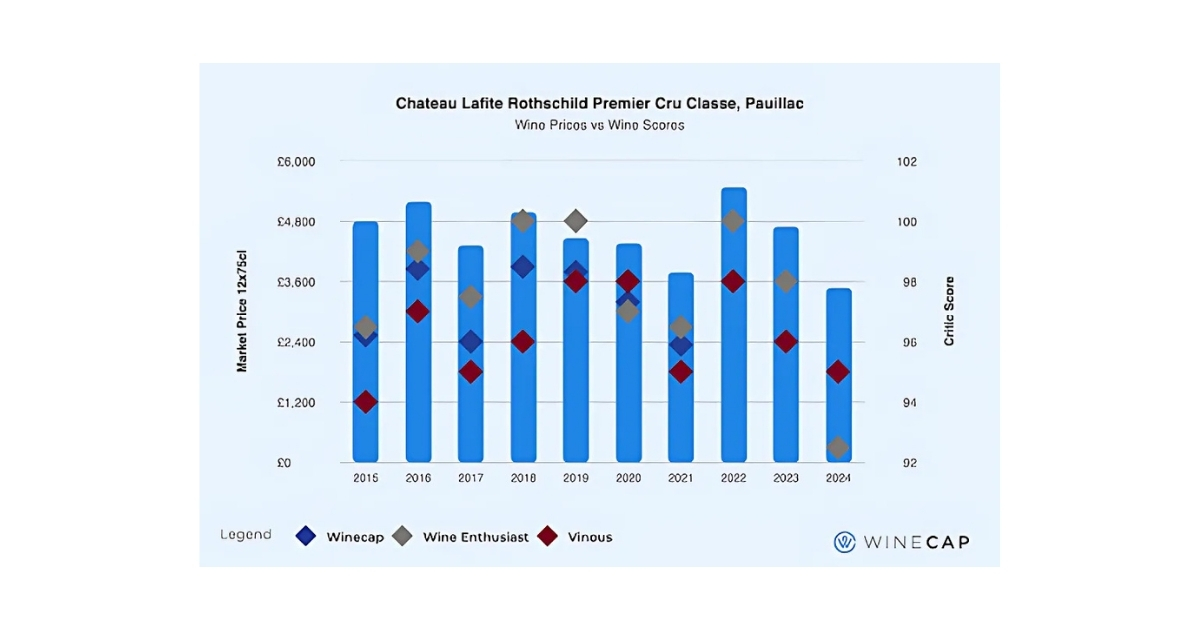
The 2024 vintage emerged as the most attractively priced Lafite in recent memory. In fact, only one other vintage from the past 40 years comes within 25% of its release price. Even lower-rated vintages like 2013 and 2007 – both released before the transformative investments that elevated Lafite’s quality – now trade at considerably higher levels.

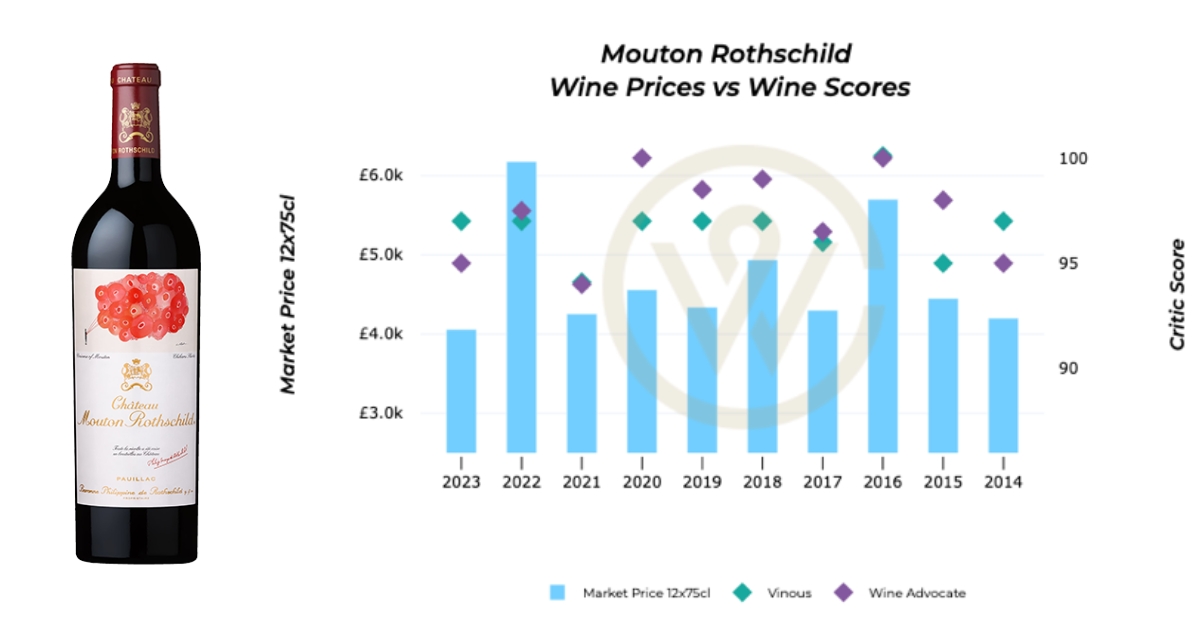
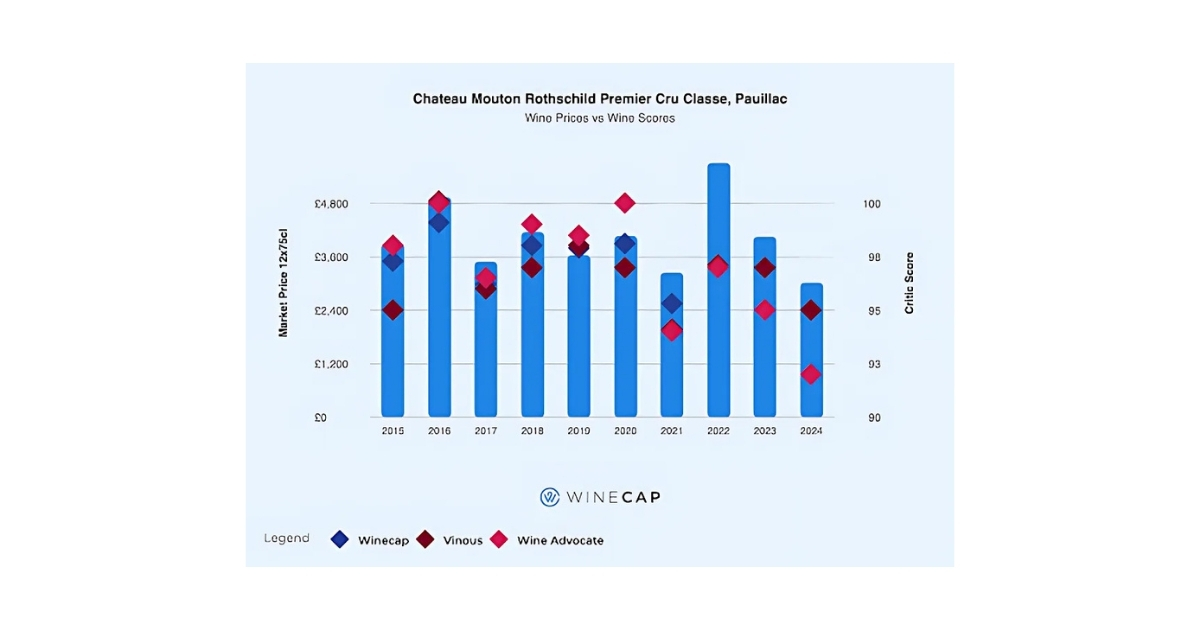
Much like Lafite, the 2024 Mouton Rothschild represents a rare opportunity. It is the best-priced Mouton vintage currently available on the market. Adjusted for inflation, only one other vintage in the last two decades compares in affordability. 

Moreover, Mouton has been the best-performing First Growth over the last five years, while also being Wine-Searcher’s most searched-for wine globally. 

History shows that these ‘less celebrated’ vintages often outperform their more hyped counterparts. For both Lafite and Mouton, vintages such as 2007, 2008, 2013, and 2014 have significantly outpaced the more acclaimed 2009, 2010, or 2016 in price performance.

Chateau Mouton Rothschild wine performance bar graph

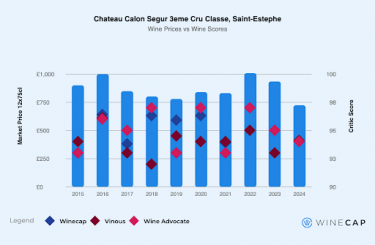
Another notable performer is Calon Ségur. While it may have flown slightly under the radar, its 2024 release represents the best entry point into the brand in over a decade. Calon has built a strong reputation among critics, frequently earning 95+ scores from Wine Advocate and Vinous. 

Its investment credentials are equally impressive: between 2015 and 2023, Calon prices surged more than 80%. Even with recent market dips, our Calon Ségur index remains 75% higher than it was ten years ago – making it one of Bordeaux’s most dynamic performers.

Looking for more? Read our Bordeaux Regional Report.

Categories
News

Mixed signals: correction continues but top wines prove the exception

  • Despite a broader market correction, some fine wines have risen over 10% year-to-date. 
  • The top-performers are united by their strong value proposition. 
  • The 2024 En Primeur is all about momentum and timing, given the mixed quality and the availability of well-priced older vintages.

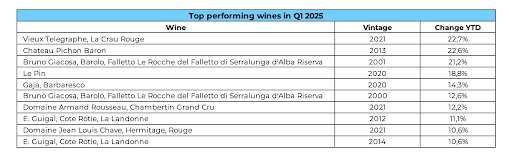
Despite a broader market correction – with the Liv-ex 1000 index declining 2.1% year-to-date – select fine wines have demonstrated remarkable resilience. A closer look at Q1’s top performers reveals a diverse spread across key wine regions: Bordeaux, Piedmont, the Rhône, and Burgundy.

The best performing wines

The best performing wine was Vieux Telegraphe La Crau Rouge 2021, which surged 22.7%. The long-term trajectory of the brand has been upwards, with a 54% rise in value over the past decade.

The second spot was taken up by Pichon Baron 2013 with a 22.6% rise. Often overlooked due to the vintage’s cooler weather, it now stands out for its relative value and strong long-term potential. Over the past ten years, the brand’s prices have climbed by 58% on average.

From the Northern Rhône, Guigal’s La Landonne secured two spots on the leaderboard: the 2012 vintage rose 11.1%, while the 2014 – 10.6%. Across the past decade, the La La wines have appreciated by 47%, affirming their iconic status among Rhône collectors.

From Barolo, the 2001 Bruno Giacosa Serralunga d’Alba made the top ten with a 21.2% rise, showcasing continued demand for aged, cellar-ready Nebbiolo from one of Piedmont’s most revered producers.

Regional trends: pressure persists

While these individual wines bucked the trend, broader regional indices tell a more sobering story. Both Burgundy and Bordeaux, the primary pillars of the fine wine market, fell by 2.9% in Q1. Even regions that showed resilience – such as the Rhône, which rose 1.1% in March – remain down overall for the quarter.

This pattern underscores the current investor mindset: cautious, value-driven, and increasingly selective.

2024 En Primeur: momentum and timing

The 2024 Bordeaux En Primeur campaign has landed in challenging terrain. With the market in retreat and the specter of new U.S. tariffs, producers have had no choice but to re-evaluate pricing strategies. The first releases came in below last year’s prices, and before critic scores were published.

While these adjustments reflect an awareness of the macroeconomic environment, price cuts alone don’t guarantee demand. Investors are weighing these new offers against older vintages available at comparable – or better – value.

The swift pace and early start of this year’s campaign echo the successful 2019 En Primeur release, which capitalised on momentum and timing. However, given the mixed vintage quality and volatile market, strategic selectivity is more essential than ever.

Looking for more? Read our Q1 2025 Fine Wine Report.

Categories
Learn

How does Bordeaux set its release prices?

In the springtime of each year, all eyes turn to Bordeaux as the region begins its extended En Primeur campaign when châteaux across this prominent region set their wine prices.

Such decisions require the navigation of multiple factors within a delicate financial and cultural ecosystem. WineCap spoke with eminent producers for insights into what influences the all-important price setting.

  •         Previous vintages and price key influences
  •         Profitability for all players is an important driver
  •         Compelling price point for customers is critical
  •         Brand and critical ratings have some impact

Château Smith Haut-Lafitte, Grand Cru Classé, Graves

“Don’t believe people say, ‘I do it all by myself’,” said Florence Cathiard who co-owns the Graves house with her husband Daniel. “It’s a long process and very delicate because we have to take several parameters into account.”

These include contemplating pushing prices higher because of swift sales in previous years, the vintage quality, and the general global environment.

“We also take advice from some of the best négociants, brokers, and even some importers — not those who are just trying to put the price down, to sell high, but the real friends.”

Château Pichon-Longueville Baron, Second Growth, Pauillac

Christian Seely, managing director of AXA Millésimes, owner of Château Pichon-Longueville Baron, has devised a formula for the optimal release price of a Grand Cru Wine.

“The ideal price is the highest price possible at which my existing customers will buy the wine with enthusiasm,” he said. “It has to be the highest price possible, otherwise I might get fired. But it has to be the highest price possible at which my existing customers will buy the wine with enthusiasm. If you go too high, your existing customers might buy it without enthusiasm. If you go much too high, maybe your existing customers won’t buy it, and that would be terrible. It’s a personal judgment based on experience.”

Château Pichon Comtesse, Second Growth, Pauillac

Nicolas Glumineau, CEO and winemaker of Château Pichon Comtesse, combines mathematics with common sense.

To price the wine correctly, you have to be very respectful of your market. And what we do is to have a very sharp eye on market prices,” he explained. “We consider that each step of the distribution chain has to get remuneration. It’s very important for each of us to earn money thanks to the distribution of Pichon Comtesse.”

Château Cheval Blanc, Saint-Émilion

Pierre-Oliver Clouet, Managing Director at Château Cheval Blanc has a similarly logical approach.

“En Primeur should be forever the lowest price you can find in your bottle,” he told WineCap. “The release price depends on many things: the quality of the vintage, the economic context in the world, and, as well, the price of new vintages available on the market. So, ultimately, the definition of the price En Primeur is not something difficult to reach. This is something mathematical.”

Château Canon, Premier Grand Cru Classé, Saint-Émilion.

Nicolas Audebert also follows mathematical logic in the pricing game. “If you go En Primeur, the interest for the consumer, the guy buying the bottle is that ‘if I buy en primeur, the bottle that I will put in my cellar and not able to drink now, it has to be at a lower price of the same quality I can buy in the market and drink now’,” he told WineCap.

Audebert takes an equivalent quality vintage from recent years, considers the margin, does some precision-calculations, and arrives at a price that offers a ‘win-win’ for all parties.

“Of course, afterwards, you can have ‘plus-value’ on the exceptional quality of the vintage or something like that. But if we play primeur, we have to play the game of logical pricing.”

Château Pavie, Premier Grand Cru Classé (A), Saint-Émilion

“There are some secrets,” jokes Olivier Gailly, commercial director for the Perse wine family at the renowned house. “There are a lot of different factors, which are, first of all, the history of your château, the different vintages and prices in the past, and how successful it was.

If the market demands, you have to push some, but you have to listen to it as well. Of course, ratings still play a role, meaning the feedback from the customers when they come and taste during the En Primeur week in Bordeaux. We then meet with Monsieur Perse and take the decision together. The final one will be his, being the owner of the property.”

Château La Mondotte, Premier Grand Cru Classé, Saint-Émilion

“If you have the wrong price, it’s a disaster,” Stéphane von Neipperg, owner of the Right Bank house said. “Nobody wants a lot of people wh don’t want to buy the wine.”

When his team goes to the market, they consider the global economy, the local market price direction, and information from brokers and négociants. “You have to absolutely test the price with negotiants, brokers, and also with your friends, the importers. Then we can say, ‘well, this would be a good price’. A good price is when everyone in the business makes money.”

Cos d’Estournel, Second Growth, Saint-Estèphe

Charles Thomas, commercial director of the Left Bank château, places an emphasis on quality and the good value the region offers when deciding on price. “I would be lying if I said it doesn’t depend sometimes on the exchange rate,” he said. “But also, it’s according to the quality we have — and this is the most important thing. Bordeaux is not expensive when you look at Burgundy and Napa Valley and some wine from other appellations.”

Vintage has more of an impact than elsewhere and can link to market price, Thomas added. “Of course, in Bordeaux you have the vintage effect that you don’t always have in other parts of the world. We try to be more stable for the client or the consumer, though, so they can accept any necessary price variation.”

Château Angelus, Saint-Émilion

As well as previous vintage pricing in Bordeaux and internationally, for Château Angelus CEO Stéphanie de Boüard-Rivoal, two more factors are key influences when the prestigious house goes to market.

“The volume as well, of course, because it makes a real impact,” she explained. “I’d say the strength of the brand as well.”

See also our Bordeaux I Regional Report

WineCap’s independent market analysis showcases the value of portfolio diversification and the stability offered by investing in wine. Speak to one of our wine investment experts and start building your portfolio. Schedule your free consultation today.
Categories
Regional-reports

Bordeaux Regional Report

Our Bordeaux Regional Report examines the evolution of its investment market, the First Growths, their second wines and En Primeur.

Bordeaux has long been the backbone of the fine wine market. Its unique combination of history, scale, and globally recognised brands has positioned it not just as a leading wine region, but as the reference point for fine wine investment worldwide.

As early as 1787, Thomas Jefferson recognised the collectible potential of Bordeaux’s finest estates. More than two centuries later, that early insight still holds true. While the fine wine market has diversified significantly in recent years, Bordeaux continues to play a defining role – often setting the tone for broader market performance.

At its peak in 2010, Bordeaux accounted for an extraordinary 96% of the fine wine market by value. Although its share has since moderated as regions such as Burgundy and Champagne have risen, Bordeaux remains the most influential and liquid region in the investment landscape.

WineCap’s Bordeaux Regional Report explores why this remains the case – and where the most compelling opportunities now lie.

Key findings from the Bordeaux Regional Report

Bordeaux remains the most important fine wine investment region

Despite increased diversification, Bordeaux still accounts for over a third of the fine wine market by value today. Its long-established distribution networks, global demand, and deep secondary market continue to underpin its dominance, particularly for investors prioritising liquidity and long-term stability.

The First Growths continue to anchor the market

The Bordeaux First Growths – Château Lafite Rothschild, Château Latour, Château Margaux, Château Haut-Brion, and Château Mouton Rothschild – remain the cornerstones of fine wine portfolios. While their share of total trade has declined from historic highs, they still represent around 30% of Bordeaux’s secondary market activity, reinforcing their role as pricing benchmarks and confidence indicators.

Second Wines and “Super Seconds” offer compelling value

One of the most notable trends highlighted in the report is the growing importance of second wines and so-called “Super Second” estates. These wines benefit from the same terroirs and technical expertise as their flagship counterparts but offer more accessible entry points. In many cases, they have delivered stronger relative performance over the past decade, driven by rising quality and growing global recognition.

Older vintages are often undervalued

The report shows that some of the most attractive opportunities in Bordeaux today lie not in the latest releases, but in older, overlooked vintages. These wines frequently trade at favourable price-to-quality ratios and can offer greater upside potential than more recent En Primeur releases, particularly in a more price-sensitive market environment.

En Primeur’s influence has weakened

While En Primeur remains a defining feature of Bordeaux, its role has evolved. Pricing misalignment in recent campaigns has reduced its appeal, shifting the focus towards disciplined, selective participation. The report highlights that En Primeur can still present opportunities, but only when release prices reflect broader market conditions and long-term value.

Bordeaux’s role in a diversified market

As the fine wine market has broadened to include Burgundy, Champagne, Italy, and California, Bordeaux has increasingly positioned itself as the region of stability. Its slower but steadier appreciation, combined with unrivalled liquidity, continues to make it a foundational allocation within diversified fine wine portfolios.

Explore the full report

WineCap’s Bordeaux Regional Report provides a detailed analysis of the region’s evolution, historic performance, key investment estates, and future outlook in an increasingly diversified fine wine market.

Download the full Bordeaux Regional Report to explore the data, insights, and opportunities shaping one of the world’s most important fine wine regions.


Bordeaux Regional Report
Download

Categories
News

Burgundy En Primeur 2023 and the current market

  • The 2023 Burgundy vintage is bountiful but heterogeneous in quality.
  • Careful selection of reputable domains and top producers is necessary when making purchasing decisions.
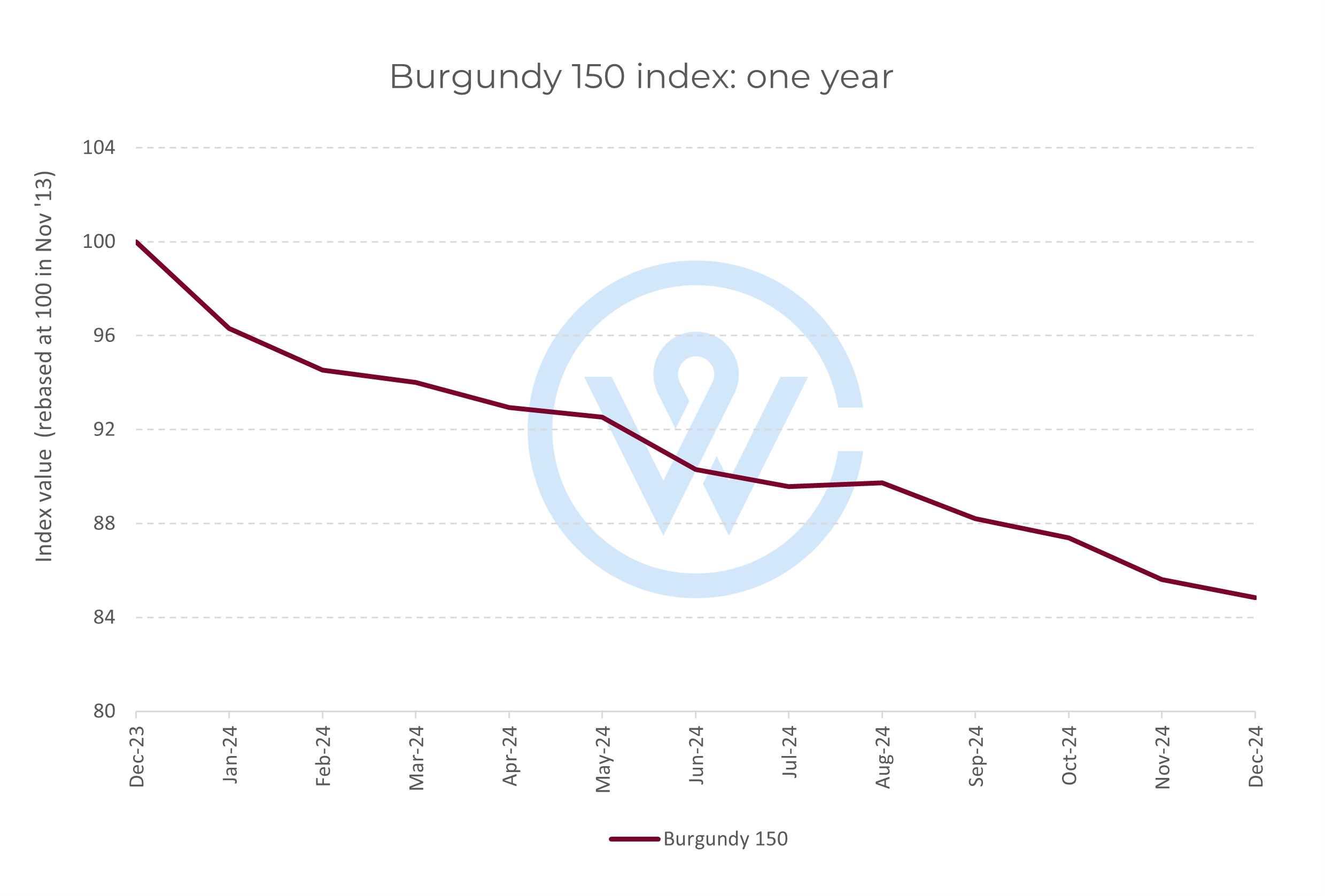
  • In the secondary market, Burgundy prices have fallen 15.2% in the last year.

The Burgundy En Primeur 2023 campaign brings a vintage full of potential and expectations: potential due to the quality but mostly quantity of the vintage in a region defined by scarcity, and expectations for reduced pricing given producers’ desire to sell.

This article provides an overview of the 2023 Burgundy vintage and the market environment that surrounds its launch. 

A heterogeneous but plentiful vintage

The 2023 Burgundy vintage first made news for its volume, which surpassed the region’s average production levels by 30%. Despite heat, drought and flooding challenges, the overall perception is of success – large quantities and above-average quality. Sarah Marsh MW summed it up: ‘The 2023 Burgundy was a bounteous but heterogenous vintage in which the white wines outshone the reds’. 

2023 saw a late-season heat spike that concentrated the fruit. Chardonnay benefited from earlier harvests before extreme heat, while Pinot Noir avoided dilution concerns and achieved natural alcohol levels of 13 – 13.5%. 

The vintage’s overall quality depended heavily on producer management, such as controlling yields for reds and maintaining freshness and acidity in whites. In comparison to the richer, more consistent 2022 vintage, the 2023s demonstrate greater precision, transparency and approachability. Growers and critics have suggested that the 2022/23 might mirror the 2015/16 or 2009/10 pairs.  

The highlights include Bonnes Mares, which stood out for its opulence and structure, with the best examples from Domaine de la Vougeraie and Domaine Dujac. For whites, cooler and mineral-driven sites like Puligny Caillerets and Meursault Perrières were particularly compelling, showcasing precision and vibrancy. Producers like Comte de Vogue, Jean Chartron, and Violot-Guillemard have garnered critical praise. 

Market context

The Burgundy En Primeur 2023 campaign unfolds against a backdrop of shifting market dynamics. Following a robust 2022 vintage and a successful campaign, producers are navigating a softened market. Burgundy prices have fallen 15.2% in the past year, more than any other fine wine region.


Additionally, seven Burgundies dropped from the list of the most 100 most powerful brands in the world in 2024. Still, Burgundy continues to dominate the list, cementing its place as a powerhouse in the global fine wine market. The region’s market share also remains strong, hovering around 25% and sometimes reaching 30%.

Pricing strategies

As producers seek to gather momentum with the 2023 vintage, some are keeping stable pricing levels or even lowering prices. The sizable 2023 yields stand in contrast to the tiny harvests anticipated in 2024, further amplifying the value proposition of the current release.

The 2023 vintage can thus represent a strategic opportunity. Careful selection – looking both at quality and value compared to older vintages – will be necessary, especially as the downward market trend offers a window to secure high-quality Burgundy wines at more accessible price points. More and better priced stock from older vintages has become available, creating competition for the new releases. 

The current market dynamics, characterised by adjusted pricing and evolving consumer trends, create an intriguing context for the campaign. As Burgundy continues to adapt to market shifts and climatic challenges, its enduring prestige remains as compelling as ever.

WineCap’s independent market analysis showcases the value of portfolio diversification and the stability offered by investing in wine. Speak to one of our wine investment experts and start building your portfolio. Schedule your free consultation today

Categories
News

The best of Bordeaux En Primeur 2023

  • The best Bordeaux En Primeur releases offered a combination of quality and value. 
  • These are wines with high potential for future price appreciation.
  • Some châteaux have followed the En Primeur golden rule that the new release is the cheapest you can get. 

As this year’s Bordeaux En Primeur campaign draws to an end, we evaluate the best 2023 releases. These wines not only boast high quality, as measured by critic scores, but also offer value when compared to previous vintages. Below are our highlights from an investment perspective. 

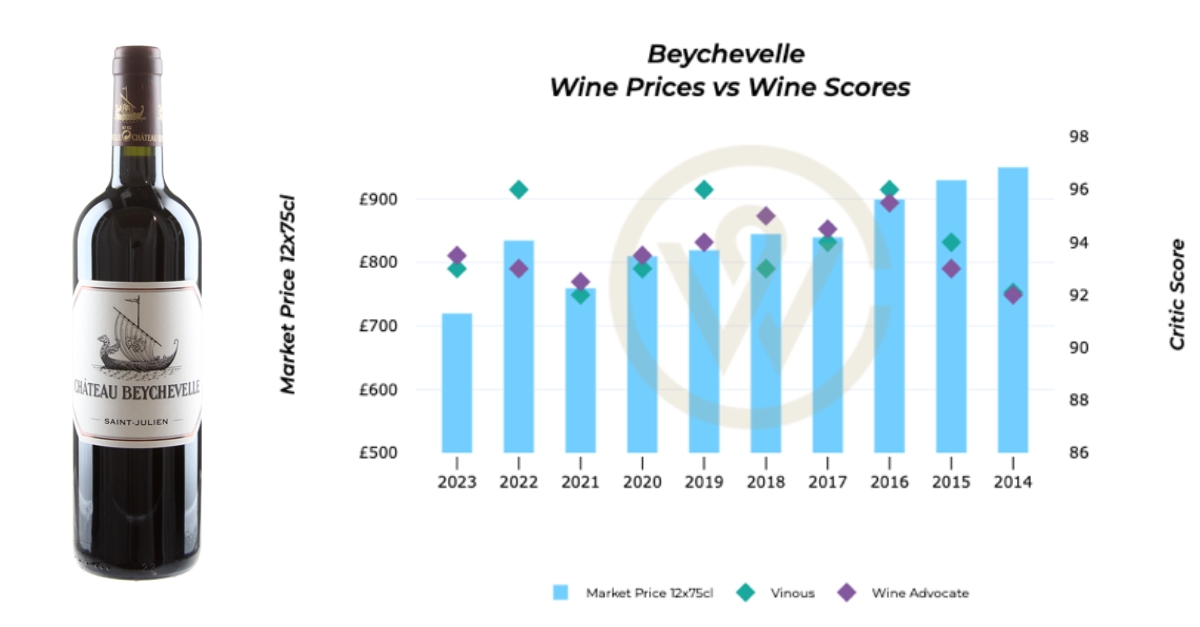
Beychevelle 

In the words of Château Beychevelle’s Philippe Blanc, ‘our golden rule is the En Primeur price is the cheapest you can get’. 

The rule was observed this year, with the 2023 representing the best priced vintage on the market today. 

The wine received 94-96 points from Antonio Galloni (Vinous), who said: ‘Beychevelle remains one of the most distinctive wines in all of Bordeaux. It is especially classy in this edition.’ 

Meanwhile, the Wine Advocate’s William Kelley (93-94 points) noted that ‘the 2023 Beychevelle has turned out especially well this year, exhibiting a more integrated, seductive style than recent vintages’.

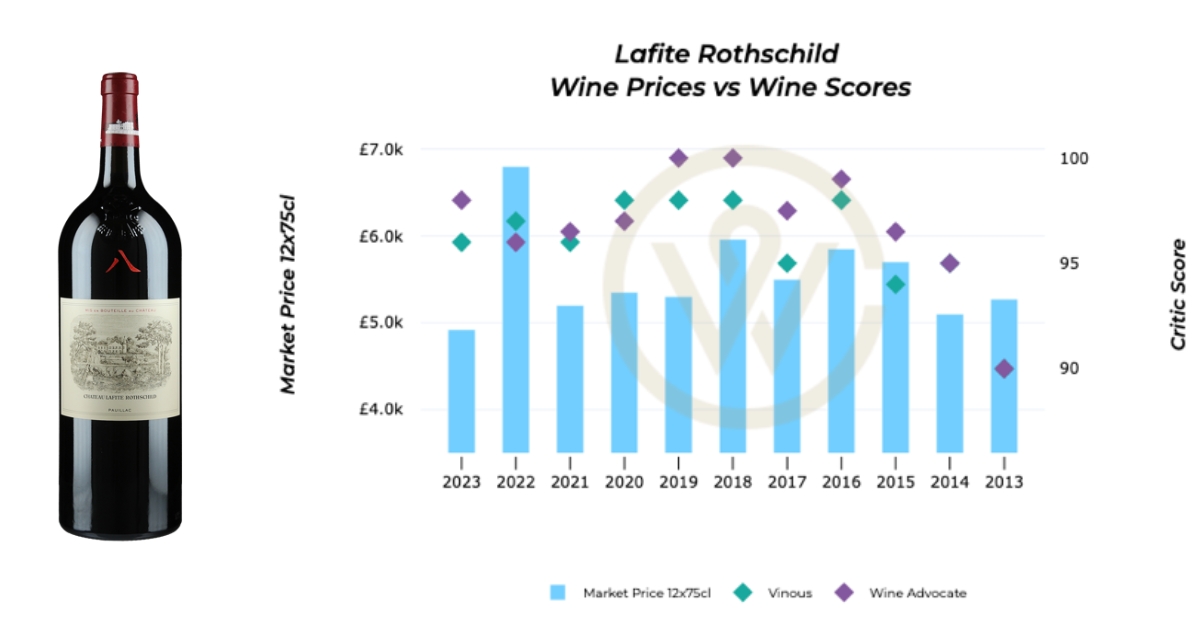
Lafite Rothschild & Carruades de Lafite

For William Kelley, Lafite Rothschild appeared to be ‘the finest of the first growths this year’. The critic awarded it 97-99 points. The wine was launched at an impressive 32% discount on last year, making the new release the most affordable on the market today. Shortly after release, the wine found its way into the secondary market.

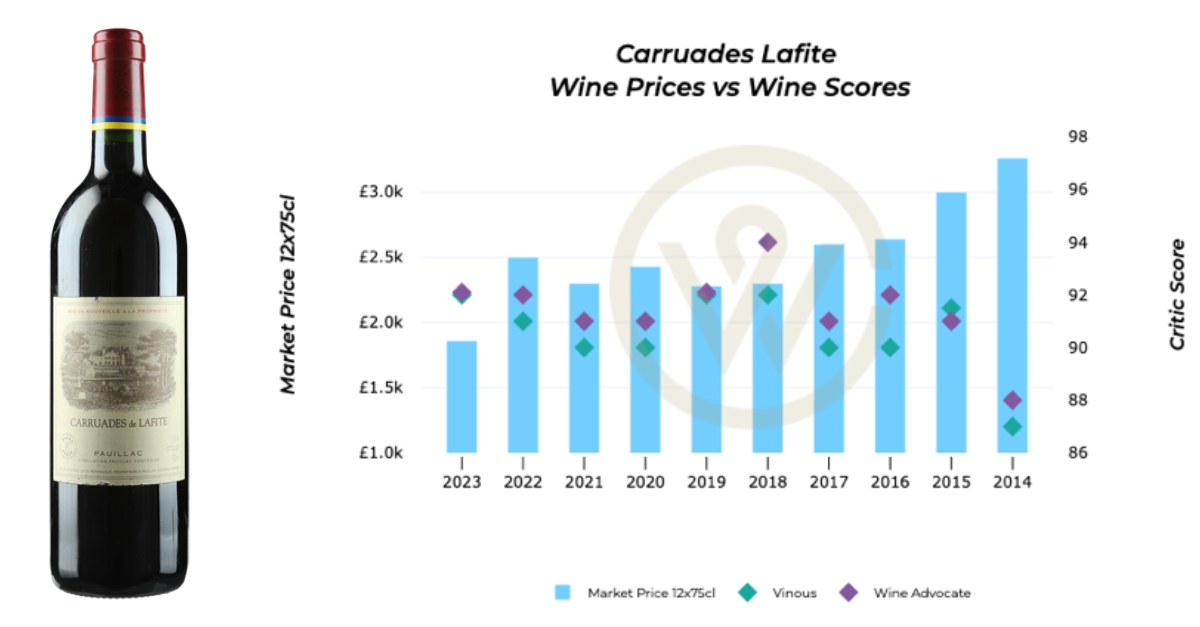
Its second wine also presented an enticing prospect to investors. As well as being the cheapest vintage, the wine was awarded a score of 91-93 from Neal Martin (Vinous), surpassing the 2022, 2016, and 2010. The critic remarked that this is ‘surely one of the best Carruades I have tasted at this stage’.

Mouton Rothschild & Petit Mouton

In much the same vein as Lafite Rothschild, the 2023 Mouton Rothschild is the most affordable vintage available on the market today. Antonio Galloni gave it 96-99 points and declared that it ‘is shaping up to be one of the best wines of the vintage on the Left Bank’.

With 96-98 points from Neal Martin, its score looks set to match the 2022, 2020, 2019, and 2018. Only the 100-point 2016 has the upper hand but comes at a hefty 40% premium. 

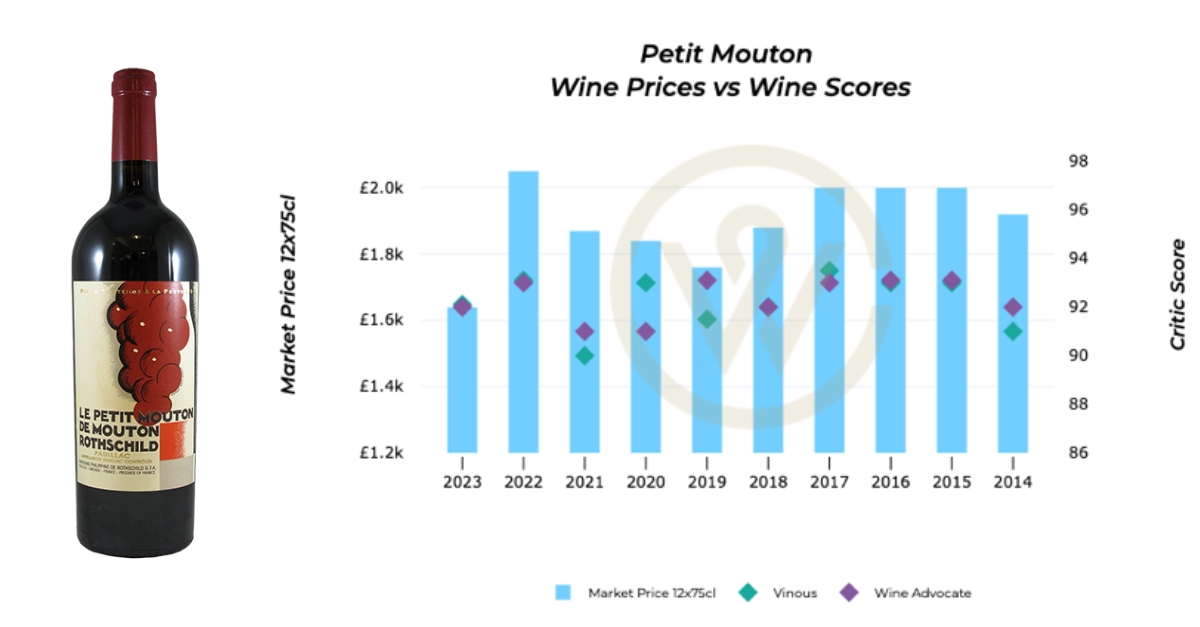
Once again, there is outstanding value to be found in the second wine. Petit Mouton 2023 is the best priced vintage available today by a healthy margin. And, according to Galloni, ‘it could easy be a Grand Vin at another address’.

Margaux

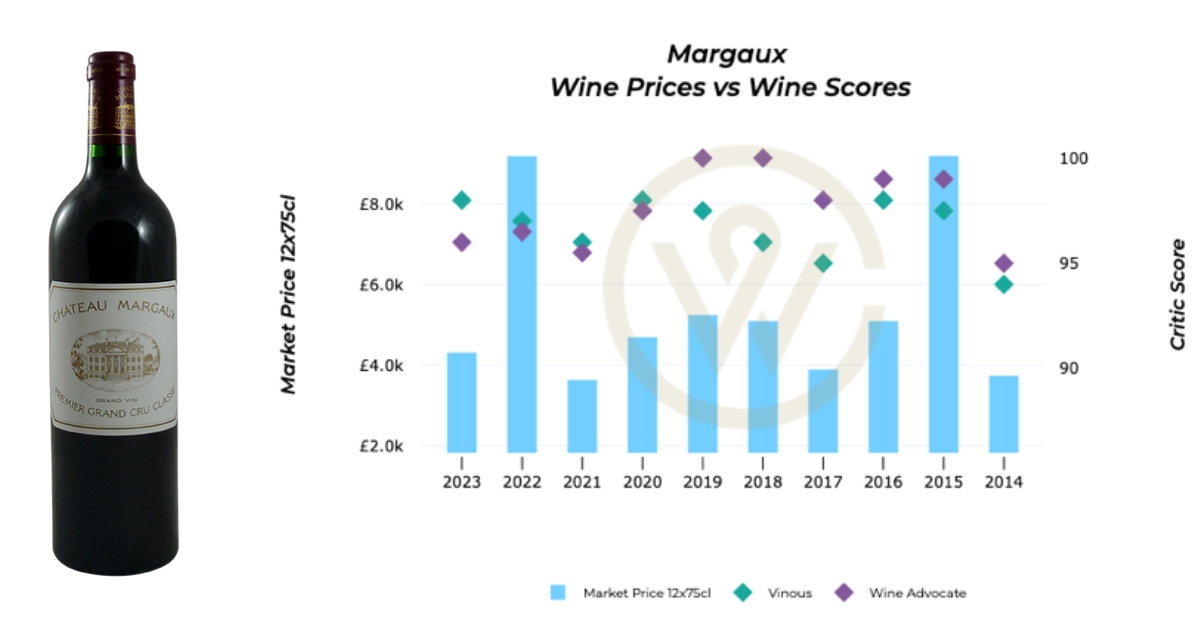
The highest-scoring Bordeaux 2023 wine across major critics, Margaux presented great value.

Galloni awarded it a potentially perfect score of 97-100 points, calling it ‘fabulous, sensual, silky and exceptionally polished’. 

Meanwhile, Martin described it as a ‘quintessential Margaux’, awarding it a score of 97-99 points.

Cheval Blanc

There are few wines that transcend the vintage in 2023, and Cheval Blanc is certainly one of them. 

There were few wines capable of transcending the vintage in 2023, but Cheval Blanc was certainly one of them.

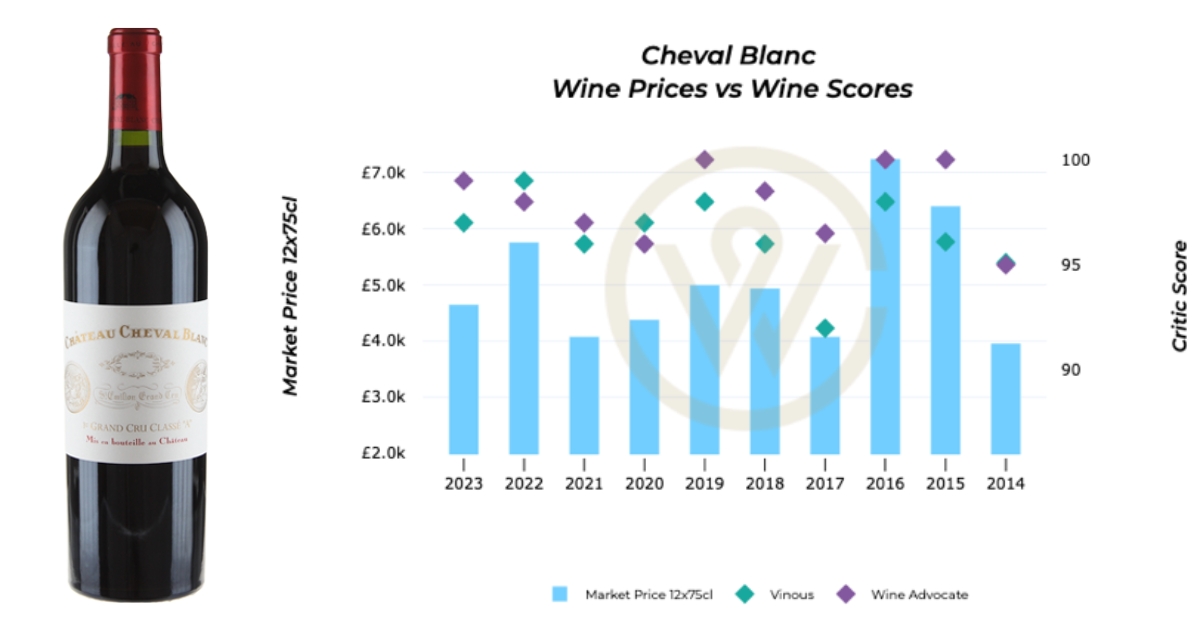
It is the second-highest-scoring Bordeaux 2023 wine across 12 leading critics. Winemaker Pierre-Olivier Clouet even goes so far as to say that it is superior to the 2022, as does the Wine Advocate’s William Kelley. 

Adding to its appeal is the value it offers. The 2023 is the most affordable option among top vintages. This is one of only two unambiguously ‘prime’ Cheval Blanc vintages available under £5,000 a case.

As these highlights show, there is value to be found during En Primeur with the right analysis tools. 

WineCap’s independent market analysis showcases the value of portfolio diversification and the stability offered by investing in wine. Speak to one of our wine investment experts and start building your portfolio. Schedule your free consultation today.
Categories
Learn

Bordeaux En Primeur 2023: under pressure

  • Bordeaux 2023 largely met trade expectations for reduced pricing but only some releases have stood out as offering fantastic value. 
  • Price cuts slowed towards the end of the campaign, from 27.4% average discount in week one, to 23.3% in week four.  
  • Bordeaux’s ability to adapt does not only matter for its short-term sales but also for its long-term relevance in a highly competitive market.

Over the last month, our news coverage centered around the ongoing Bordeaux 2023 En Primeur campaign, examining critic scores and the investment potential of the new releases. 

Prior to the start of the campaign, Bordeaux châteaux faced considerable pressure from the trade to reduce release prices. Price cuts of around 30% were expected. In some cases, these expectations were met, with reductions of up to 40%. 

Now that the campaign is coming to a close, we weigh its success, considering the current state of Bordeaux’s investment market. 

En Primeur 2023 – back in vogue?

Critics of En Primeur contend that the system no longer meets buyer expectations, and the 2023 vintage wanted to rise to the challenge of defying the norm.

Partially it did. Wines like Lafite Rothschild, Carruades de Lafite, Mouton Rothschild, Petit Mouton, Beychevelle, Cheval Blanc and Haut-Brion delivered value and were met with high demand. 

Liv-ex reported immediate trades on its exchange for some of the releases. A developing secondary market is a positive sign for investors, although both Lafite Rothschild and Mouton Rothschild 2023 changed hands below their opening levels. 

According to Liv-ex, ‘it is clear there continues to be a market for Bordeaux En Primeur at the right price. What that price is, is perhaps less clear and will not always be agreed upon’.

The En Primeur golden rule  

For investors, an En Primeur release needs to be the most affordable wine among vintages with comparable scores to make sense. Where that isn’t the case, one should be cautious when buying. 

‘Our golden rule is the En Primeur price is the cheapest you can get. You can’t get anything cheaper. Generally speaking, it’s reasonably successful, not to say 100% successful, and then the price goes up.’ – Philippe Blanc, Château Beychevelle

En Primeur should be forever the lowest price you can find in your bottle. If you purchase later, it’s going to be more difficult to find and it’s going to be more expensive.’ – Pierre-Olivier Clouet, Château Cheval Blanc

The price decrease trajectory

The average price reduction among the top wines released in the first week of the campaign was 27.4%, going as low as 40% discount on the previous year.

In the fourth week of the campaign, this trajectory of offers slowed down. The average discount was reduced to 23.2%, the most significant being Château La Fleur-Pétrus 2023, down 33.6%, and the least significant, Beychevelle (-11.1%).

However, even though Beychevelle has seen one of the smallest discounts, it has still been one of the best value releases this campaign.

The Bordeaux market slowdown

The pressure to reduce release pricing was largely owing to the current market environment. 

Over the past two years, Bordeaux prices are down 12%. Over the past five years, Bordeaux is one of the slowest growing markets, up 2.1%, considerably lagging behind Burgundy (25.2%), Italy (31.2%) and Champagne (45.5%). 

The market for top Bordeaux has suffered the most. First Growth prices are down 17.3% in the last two years, and 3.7% in the last five years.

The region is also losing market share to its contenders. In 2023, Bordeaux accounted for 40% of the trade by value on Liv-ex compared to 60% in 2018.

This is further exacerbated by slowing demand. Liv-ex noted that today ‘there is more than three times as much Bordeaux for sale than the fine wine market is looking to absorb’.

The need to adapt

The 2023 En Primeur campaign has unfolded under the shadow of mounting pressure for Bordeaux to realign with market demands. The campaign highlighted the critical balance Bordeaux must maintain: offering wines at attractive prices for everyone in the chain. 

Successful examples from this year’s campaign, where price cuts coincided with high demand, underscore the potential for Bordeaux to adapt. However, the slower reduction rates towards the campaign’s end and varied responses from buyers reflect the ongoing debate about the optimal pricing strategy.

Ultimately, as Bordeaux grapples with these challenges, the 2023 En Primeur has underscored the importance of responsiveness to market dynamics. The region’s ability to adjust will not only determine its short-term sales but also its long-term relevance in a highly competitive and ever-evolving global wine market.

WineCap’s independent market analysis showcases the value of portfolio diversification and the stability offered by investing in wine. Speak to one of our wine investment experts and start building your portfolio. Schedule your free consultation today.