Categories
Special-reports

Fine Wine Taxation | Guide

Fine wine offers you a sound and lucrative investment. While traditional investors have only fairly recently discovered the tremendous opportunities available with fine wine, collectors have known about its profit-making value for hundreds of years. Through the centuries, shrewd wine lovers have been selling part of their collections as a way of subsidising their consumption, leveraging the gains of a uniquely rarifying asset against their own cellars.

Granting easy access to this highly lucrative asset, WineCap offers extensive advice from a team of seasoned experts who can help with sourcing, storage and other crucial aspects to wine investment. With the benefit of our industry-leading technology, we can help you make the most of a bespoke portfolio and reach your investment goals. 

Acting as agents, we take care of sourcing your wine and organising its storage and insurance while you remain in complete control over your investment. Thanks to our links to the UK, you’ll benefit from the most developed secondary fine wine market there is. You’ll also enjoy access to the worldwide wholesale market via the London International Vintners Exchange known as Liv-ex, allowing you to secure a fast and fruitful sale once you’ve reached your investment goals. Lastly, we feature an unparalleled global reach while being tactically positioned in London, the fine wine market’s premier hub.

Click the button below to download our Fine Wine Taxation Guide and learn more about our proven strategy for investment success. Do not hesitate to get in touch and speak to one of our wine investment advisors for further information and to reserve your allocations.


Fine Wine Taxation Guide
Download
Categories
Learn

White wine types: Grapes, styles and investment-worthy bottles

  • Most white wines are made for freshness and early drinking, limiting long-term investment appeal.
  • A small number of categories – notably white Burgundy and German Riesling – are major exceptions with proven ageing and collector demand.
  • Sweet white wines like Sauternes and Barsac also offer historical prestige and investment potential in top names and vintages.

White wine represents some of the most diverse and widely consumed styles in the world that have been rising in popularity over the last decade. From crisp Sauvignon Blanc to rich Chardonnay, from bone-dry Riesling to the world’s greatest sweet wines, the category spans an extraordinary range of flavours, regions, and winemaking traditions.

Yet despite this breadth and growing consumer interest, white wine remains a smaller part of the fine wine investment market than red wine. While collectors have historically focused on Bordeaux First Growths, Burgundy Grand Crus, and top Italian reds, only a handful of white wine categories consistently attract long-term secondary market demand.

So which white wines are simply made to drink, and which are genuinely investment-worthy?

In this WineCap guide, we explore the major white wine types, the most important white wine grapes, the difference between dry and sweet white wine, and the specific categories where white wine becomes collectible.

What are the main types of white wine?

There are several often overlapping white wine categories:

  • Wines defined by grape variety (Chardonnay, Riesling, Sauvignon Blanc)
  • Wines defined by sweetness (dry white wine vs sweet white wine)
  • Wines defined by region (White Burgundy, Mosel Riesling, Bordeaux Blanc)
  • Wines defined by ageing potential (fresh vs cellar-worthy)

Unlike red wines, where tannin and structure often imply longevity, white wines vary dramatically: from light and aromatic to intensely age-worthy.

For most consumers, white wine is associated with refreshment and immediacy. For collectors, however, the question looks different: which whites have the structure to age and the scarcity and demand required to increase in value?

White wine grapes: the most important varieties

Chardonnay

Chardonnay is the world’s most famous white grape – and the backbone of the most collectible dry white wines.

It is uniquely versatile, capable of producing:

  • Lean, mineral wines (Chablis)
  • Rich, oak-aged wines (Meursault)
  • The world’s greatest dry whites (Montrachet)
  • Sparkling base wines (Champagne Blanc de Blancs)

Investment relevance: Extremely high at the top end of Burgundy.

Sauvignon Blanc

Sauvignon Blanc is defined by freshness, citrus aromatics, and bright acidity.

Key regions include:

  • Loire Valley (Sancerre, Pouilly-Fumé)
  • Bordeaux Blanc blends
  • New Zealand

Most Sauvignon Blanc is produced for early drinking, limiting its collectability.

Investment relevance: Limited, except for rare classified Bordeaux white blends.

Riesling

Riesling is arguably the most age-worthy white grape in the world.

It can produce wines ranging from bone-dry to intensely sweet, with acidity that allows the finest examples to age for decades, sometimes a century.

Key regions:

  • Mosel
  • Rheingau
  • Nahe
  • Alsace

Investment relevance: Very high in top German Riesling.

Pinot Gris / Pinot Grigio

Typically light, approachable, and widely consumed young.

Investment relevance: Minimal.

Chenin Blanc

Chenin Blanc is highly versatile, producing dry, sparkling, and sweet wines.

Key region: Loire Valley (Vouvray, Savennieres).

Investment relevance: Niche, but growing among collectors.

Semillon

Semillon is essential in Bordeaux sweet wines such as Sauternes, and often blended with Sauvignon Blanc in dry Bordeaux whites.

Investment relevance: High in Sauternes’ top names.

Dry white wine vs sweet white wine

Dry white wines

Most global white wines are dry, including:

  • Chardonnay
  • Sauvignon Blanc
  • Dry Riesling
  • White Burgundy
  • Dry Bordeaux Blanc

These dominate restaurant consumption and everyday drinking.

Sweet white wines

Sweet whites include:

  • Sauternes
  • Barsac
  • German Auslese and Trockenbeerenauslese Rieslings
  • Tokaji Aszú

Sweet wines often have extraordinary ageing potential but investment demand is more niche.

Why white wine is a smaller investment market than red wine

White wine makes up a significant share of global production and consumption, but a much smaller share of investment-grade trading.

There are several reasons.

1. Most white wines are made for early drinking

Freshness is often the selling point, not longevity.

2. Lower tannin structure

Tannin helps preserve red wines for decades. Many whites rely on acidity instead, narrowing the range of cellar-worthy examples.

3. Fewer secondary market benchmarks

The fine wine market depends on benchmark regions. For whites, those benchmarks are concentrated in only a few areas.

4. Collector psychology still favours reds

Historically, prestige collecting has been dominated by Bordeaux and Burgundy reds, shaping demand patterns.

The reality is that white wine investment is not a broad market but a selective one. Where scarcity, longevity, and global demand align, white wine becomes truly collectible. Where they do not, it remains primarily a drinking category.

The investment exceptions: white wines that truly matter

Despite these constraints, several categories of white wine are undeniably blue-chip.

1. White Burgundy: the benchmark investment white wine

If there is one region that defines investment-grade white wine, it is Burgundy.

While red Burgundy dominates headlines, the region’s greatest whites – made almost entirely from Chardonnay – represent some of the most sought-after and scarce wines in the world. In many cases, demand for top white Burgundy now rivals (and sometimes exceeds) demand for equivalent reds.

White Burgundy’s investment relevance is concentrated in the Côte de Beaune, where the finest vineyard sites produce wines that combine richness, minerality, and longevity.

Key white Burgundy appellations collectors focus on

Chablis

Located in northern Burgundy, Chablis produces some of the world’s most mineral-driven Chardonnay.

  • Grand Cru vineyards like Les Clos and Vaudésir represent the collectible tier.

Meursault

Perhaps the most famous village for rich, textured white Burgundy.

  • Premier Crus such as Perrières and Genevrières are highly sought-after.

Puligny-Montrachet

Often considered the spiritual heart of Burgundy’s greatest whites.

  • Home to Montrachet and Chevalier-Montrachet.

Chassagne-Montrachet

Puligny’s neighbour, producing whites that can be broader and more opulent, with enormous collector demand.

Corton-Charlemagne Grand Cru

One of Burgundy’s most important Grand Cru whites, prized for structure and long ageing horizons.

The pinnacle: Grand Cru Chardonnay

At the very top sits Montrachet, widely regarded as the greatest dry white wine vineyard on earth.

Key investment producers include:

  • Domaine Leflaive
  • Coche-Dury
  • Domaine Ramonet
  • Domaine Roulot
  • Domaine de la Romanée-Conti (Montrachet)

WineCap view: White Burgundy is the clearest example of white wine functioning as a true blue-chip asset class.

2. German Riesling: the most age-worthy white grape

If Burgundy is the luxury benchmark for Chardonnay, then Germany is the benchmark for Riesling.

German Riesling occupies a unique position: it is intellectually revered among collectors, yet still underappreciated by mainstream consumers, creating an interesting investment dynamic.

What makes Riesling compelling is its combination of:

  • piercing acidity
  • low alcohol
  • extraordinary longevity
  • transparent terroir expression

Key German Riesling regions

Mosel

The most famous Riesling region, defined by steep slate vineyards.

Top producer: JJ Prüm

Rheingau

Historically prestigious, producing structured dry Rieslings.

Top producer: Robert Weil

Nahe

A rising star with increasing collector focus.

Top producer: Dönnhoff

Pfalz

Known for richer, powerful dry Rieslings.

Top producer: Keller

WineCap view: German Riesling is one of the few white wine categories with both heritage and genuine investment upside.

3. Bordeaux white wines: dry blends with prestige

Bordeaux is synonymous with red wine, but its greatest whites are quietly compelling and increasingly collectible.

Dry Bordeaux whites are typically blends of:

  • Sauvignon Blanc
  • Semillon

Key subregions for Bordeaux white wine

Pessac-Léognan

The epicentre of serious dry Bordeaux whites.

Top wines include:

Graves

Historically important for structured dry whites.

Entre-Deux-Mers

Produces lighter early-drinking whites, not typically investment relevant.

WineCap view: Bordeaux whites are niche collectibles, best approached through the top estates.

4. Sweet white wines: Sauternes and Barsac

Sweet wines occupy a fascinating position.

Historically, they were among Europe’s most prestigious wines. Yet modern demand has narrowed, leaving the category highly selective.

The benchmark sweet whites come from Sauternes and Barsac, where noble rot concentrates sugars and flavours into wines of extraordinary richness and longevity.

Key sweet wine appellations

Sauternes

Home to Château d’Yquem – the only Premier Cru Supérieur in 1855.

Barsac

Often producing fresher, more lifted wines.

Key estate: Château Climens

WineCap view: Sauternes is heritage collectible rather than a broad growth market, with Yquem as the clear standout.

White wine ageing ability: what lasts?

Whites that age exceptionally well:

Whites that are usually early-drinking:

  • Pinot Grigio
  • Most Sauvignon Blanc
  • Entry-level Chardonnay
  • Commercial aromatic whites

Ageing ability is one of the strongest dividers between wine to drink and wine to collect.

WineCap view: white wine is selective, not broad

White wine is essential to the global wine conversation but the investment market remains highly concentrated.

Most white wines are:

  • produced for freshness
  • consumed young
  • not traded actively
  • difficult to benchmark

However, at the top tier, white wine becomes truly blue-chip. WineCap considers these categories the most investment-relevant:

FAQ: White wine types 

What are the main types of white wine?

Chardonnay, Sauvignon Blanc, Riesling, Pinot Grigio, Chenin Blanc, and Semillon-based wines.

Is white wine sweet?

Some whites are sweet, but most are dry.

What is the best dry white wine?

White Burgundy and top dry Riesling are among the greatest from a collectors’ perspective.

Can white wine be investment-worthy?

Yes, but only selectively – particularly white Burgundy, German Riesling, and rare Bordeaux whites.

Do white wines age well?

Some do. High-acid, structured whites can age for decades.

Categories
Learn

Orange wine explained: Trends, history and investment reality

  • Orange wine is trending globally, but remains a niche category in the fine wine market.
  • Demand is driven by drinkers, not collectors, limiting investment relevance.
  • Ancient in origin, modern in branding, orange wine sits outside blue-chip benchmarks.

Orange wine has become one of the most visible wine trends of the past decade – a style that dominates progressive restaurant lists, natural wine shelves, and social media feeds. Its amber hue and unconventional structure make it instantly distinctive.

However, from an investment standpoint, orange wine occupies a very different space from the blue-chip categories that define the fine wine market. While Champagne, Burgundy and top Bordeaux continue to attract global collector demand and measurable secondary-market liquidity, orange wine remains largely consumption-driven – fascinating to drink, but rarely traded, benchmarked, or treated as an asset.

That is not because orange wine lacks history. In fact, the techniques behind it may be among the oldest in the world. Instead, it reflects a category where cultural momentum has not translated into investment fundamentals.

Below, we explore what orange wine is, where it comes from, why it has risen in popularity and why it remains, for now, a wine trend rather than a collectible market.

We clarify why its investment potential is limited, highlighting how it compares to portfolio-grade wine segments.

What is orange wine?

Orange wine is best understood as white wine made using red wine production methods.

Instead of pressing white grapes immediately and fermenting only the juice, orange wine is fermented with the grape skins – and sometimes stems – for an extended period. This process, known as skin contact, extracts colour, tannins, texture, and phenolic complexity, producing wines that range from golden amber to deep orange in appearance.

Despite the name, orange wine has nothing to do with oranges or citrus fruit. The colour comes entirely from the grape skins.

Orange wine is also commonly referred to as:

  • Skin-contact white wine
  • Amber wine (particularly in Georgian traditions)

This simple shift in technique creates a style that sits between categories: structurally closer to red wine, yet aromatically rooted in white grapes.

How is orange wine made?

The defining feature of orange wine is maceration: the extended contact between grape juice and skins.

Most conventional white wines are pressed off skins quickly to preserve freshness and minimise tannin. Orange wine does the opposite: it embraces skin contact to build depth and structure.

Key variables include:

Length of skin contact

This can range from a few days to several months. Longer maceration generally increases tannin, grip, and savoury complexity.

Fermentation vessels

Orange wines can be made in:

  • Stainless steel (cleaner, fruit-driven styles)
  • Oak barrels (more oxidative, structured examples)
  • Amphora or clay vessels (traditional, earthy styles)
  • Georgian qvevri (buried clay pots used for millennia)

Winemaking philosophy

Orange wine overlaps heavily with the natural wine movement, though not all orange wines are “natural.” The technique is separate from the ideology. The result is one of the wine world’s most diverse categories – exciting, but also highly variable.

Where did orange wine originate?

Orange wine may feel modern, but its origins are ancient.

The most frequently cited historical anchor is Georgia, where winemakers have produced skin-contact wines for thousands of years using traditional clay vessels called qvevri. This method is so culturally significant that UNESCO has recognised the ancient Georgian qvevri winemaking tradition as part of humanity’s intangible heritage.

What is new is not the practice, but the label. The term “orange wine” itself was coined in 2004 by British importer David A. Harvey as a way to describe this hard-to-classify style in accessible language. The name stuck, helping transform an old technique into a modern global category.

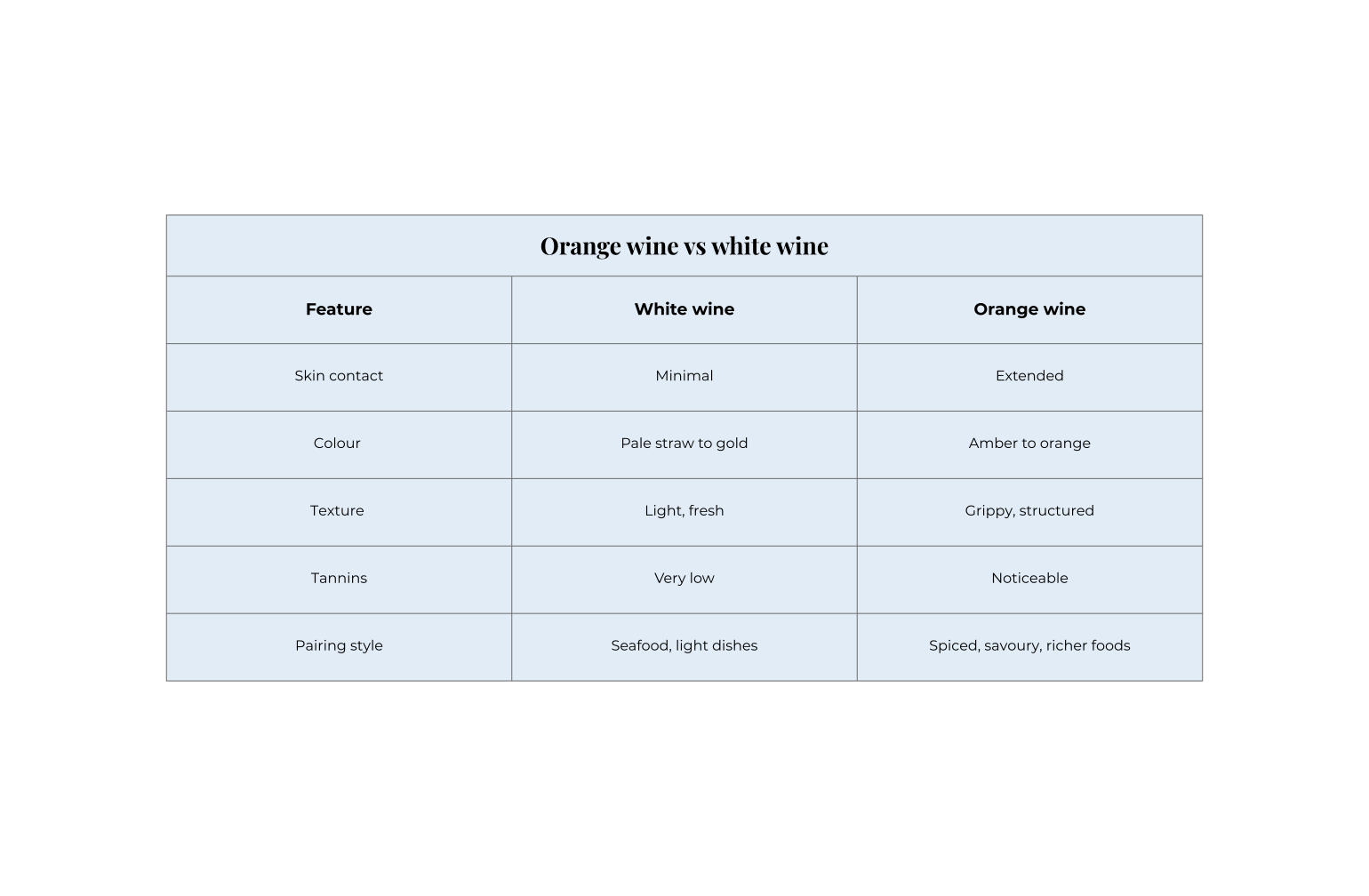
Orange wine vs white wine: what’s the difference?

One of the most common questions is how orange wine differs from traditional white wine. 

White wine vs orange wine

Orange wine occupies a middle ground: it can drink like a white, but behave like a red at the table.

Why has orange wine become so popular?

Orange wine’s rise is best understood as the overlap of three powerful trends.

1. The natural wine movement

Orange wine fits neatly into the minimal-intervention narrative: ancient techniques, lower additives, small producers, authenticity. It became a signature style within the broader natural wine boom.

2. On-trade influence

Sommeliers embraced orange wine because it fills a useful gap. It pairs widely, offers guests something new, and provides a “third lane” between red and white.

3. Social media visibility

Orange wine is visually distinctive. Its colour, story, and identity are easy to communicate in a single image or short video, making it one of the most shareable wine categories of the last decade.

Like many trends, however, enthusiasm can be cyclical. Some markets have already seen drinkers shift toward adjacent styles, such as chilled reds, after peak orange wine experimentation.

Orange wine: Flavour profile

Orange wine reveals a spectrum of flavours. Common tasting characteristics include:

  • Dried apricot and orange peel
  • Herbal tea and chamomile
  • Nuts, spice, and savoury tones
  • Oxidative notes in some traditional styles
  • A firm, tannic grip uncommon in white wine

For adventurous drinkers, this is precisely the appeal. But for investors, it highlights the category’s stylistic inconsistency.

Best orange wine regions to know

Orange wine is now global, but several regions remain reference points:

  • Georgia – the historic home of qvevri wines
  • Friuli-Venezia Giulia (Italy) – a modern epicentre for serious skin-contact whites
  • Slovenia (Brda/Goriška) – cult producers and structured examples
  • Austria and Alsace – aromatic varieties well suited to maceration

These regions help reinforce orange wine’s credibility; however, this growing reputation for quality does not always translate into collectability.

Why orange wine is interesting for drinking

If your goal is pleasure per pound (rather than return per annum), orange wine can be genuinely compelling:

It’s food-friendly in a way most whites aren’t

Tannin and savoury texture means orange wine can handle:

  • Spice and aromatics (think Middle Eastern, North African, Thai-inspired dishes)
  • Umami-heavy plates
  • Rich vegetables and fermented flavours

It offers a “third lane” between white and red

For drinkers interested in exploring styles beyond the obvious categories, orange wine is a legitimate alternative, especially when served slightly cool, like a light red.

It rewards curiosity

Because methods differ wildly, orange wine invites exploration: maceration length, vessel choice, grape variety, oxidative handling, and winemaker intent all show up clearly.

Why isn’t orange wine “investment-grade” in most cases?

Popularity doesn’t automatically create an investment market. Fine wine investment tends to concentrate where the market has deep liquidity, transparent pricing, repeatable demand, and established benchmarks.

1. Liquidity: there isn’t a thick secondary market

Most orange wine is produced in small volumes by small producers and bought to drink, not trade. That typically means:

  • Fewer repeat transactions
  • Wider bid:offer spreads
  • Less reliable exit options

2. Benchmarking: pricing is fragmented

Investment-grade wine categories like Bordeaux, Burgundy, and Champagne benefit from comparable “reference labels” across vintages and formats. Orange wine is too stylistically diverse – and too producer-fragmented – to form a stable, broadly recognised benchmark set in the way Bordeaux’s Growths or top Burgundy domains do.

3. Consistency and quality control can be uneven

Orange wine overlaps heavily with minimal-intervention winemaking. When it’s great, it’s distinctive; when it’s flawed, it’s obvious. Some on-trade commentary has highlighted consumer fatigue with more extreme or inconsistent examples in certain markets. From an investment lens, variability increases risk and reduces broad-based demand on resale.

4. Cultural prestige hasn’t translated into “blue-chip” status

While range wine has history (Georgia) and cult producers (Friuli/Slovenia), the category lacks the long-established global collector infrastructure that underpins investment-grade segments – the kind of ecosystem visible in widely tracked fine wine indices and luxury-asset reporting. 

Can any orange wines be collectible?

Some orange wines may show collectible traits if they combine:

  • Producer cult status and long-term critical attention
  • Provenance-friendly packaging and consistent release patterns
  • Demonstrated longevity (some serious skin-contact whites can age)
  • Repeat demand from a niche but wealthy collector base

Even then, “collectible” is not the same as “investment-grade”.Without a robust resale venue and repeated market clearing prices, the potential remains very low at present.

WineCap view: orange wine is a trend, not an allocation

Orange wine is one of the most interesting modern wine stories because it flips expectations: it looks new, but its roots are ancient; it is fashionable, yet rarely traded; and it is driven more by experience than asset behaviour.

For most collectors, orange wine is best treated as:

  • A consumption-led category (buy to drink, not to flip)
  • A cultural trend worth understanding

Orange wine and blue chip investment summary

For investors seeking long-term appreciation, the market continues to favour regions with established liquidity and repeatable demand, including:

  • Top Champagne (Dom Pérignon, Krug, Salon)
  • Burgundy domaines with constrained supply
  • Classified Bordeaux with global recognition
  • Italian blue chips (Sassicaia, Giacomo Conterno)

Orange wine may be one of the most exciting categories to explore as a drinker but investment-grade wine remains defined by structure, scarcity, and market depth.

FAQ: Orange wine

What is orange wine?

Orange wine is white wine fermented with grape skins, creating an amber colour and tannic structure.

Why is orange wine orange?

Because extended skin contact extracts colour and phenolics from white grape skins.

How is orange wine different from white wine?

Orange wine has more tannin, texture, and savoury complexity due to skin fermentation.

Is orange wine natural wine?

Not necessarily. Orange wine refers to technique, while natural wine refers to philosophy.

Does orange wine age well?

Some structured examples can age, but the category is too broad to generalise.

Is orange wine a good investment?

In most cases, no. Orange wine lacks the liquidity, benchmarking, and collector infrastructure required for investment-grade status.

Categories
Learn

Wine bottle sizes and their importance explained

  • Bottle sizes play an important role in the investment landscape.
  • How many ml are in a bottle of wine influences maturation and value.
  • Prestigious regions favour different bottle sizes for ageing.
  • Careful consideration of varying bottle types is critical for a wine investment strategy.

Standard, Magnum, Jeroboam, and Melchizedek: Understanding wine bottle sizes is key for wine investors. Wine bottle size impacts how wine matures, its value, and its portfolio performance. This guide covers the names, background, and advantages of each size, helping wine investors navigate which formats are optimal for their strategy and have the potential for long-term returns.

Wine bottle sizes

There is more to the wide array of wine bottle sizes than their intriguing names. The size of a bottle, whether a Piccolo or a Melchizedek, is crucial in wine maturing and value. From an investment and collecting point of view, knowledge about how many mls in a bottle of wine informs decisions on choice, storage, and how long to hold an asset.

This guide demystifies the names, uses, history, and importance of different wine bottle sizes, explaining the advantages of each for both established and newcomer investors.

Wine bottle sizes names

Split/Piccolo (187 ml / 18.7 cl)

The Split, or Piccolo (meaning “tiny” in Italian), contains a single serving of wine. It is most usually used for sparkling wines like Champagne or Prosecco.

Advantages

  • perfect for individual glasses
  • when from a prestigious house, adds charm to a wine collection

Half-Bottle (375 ml / 37.5 cl)

A half-bottle holds 2.5 glasses of wine. It is commonly used for still styles destined for early enjoyment and dessert wines such as Sauternes.

Advantages

  • offer a unique tasting experience
  • affordable route to rare wines

Half Litre/Jennie (500 ml / 50 cl)

The Jennie is not as common as the previous two sizes. How many ml in a bottle of wine of this size? The answer is 500ml or three glasses. It is usually found in parts of Germany and regions like the Loire Valley, typically for sweet wines.

Advantages

  • ideal for smaller servings (sweet or dry)
  • adds variety to collections

Standard Bottle (750 ml / 75 cl)

This is the size investors and collectors are most familiar with. This global benchmark has endured since the 19th century and was standardised in the 1970s. It contains five glasses, making it a practical and versatile option for daily use and cellaring.

Advantages

Litre Bottle (1 litre / 100 cl)

This bottle size holds 1.33 standard bottles. It is a common sight in European table wines. The Litre Bottle is less prevalent in collections of fine wines.

Advantages

  • offers practicality for casual drinking
  • ideal for large gatherings

Magnum (1.5 litres / 150 cl)

How many mils in a bottle of wine named a Magnum? This holds 1.5 litres and has a firm place in the world of collecting and investing because of its maturation-enhancing attributes. It is especially prevalent among premium wines from Bordeaux, Burgundy, and Champagne. The name derives from the Latin for ‘large’ and has been used since the end of the 1700s.

Advantages

  • volume allows wine to mature gradually, enhancing complexity
  • prized for both prestige and superior maturation capacity

Larger and less common bottle sizes

We now enter the world of the large wine bottle format. The names become even more exotic, historical, and often biblical. The significance for collectors and investors is even more notable.

Jeroboam/Double Magnum (3 litres / 300 cl, 4.5 litres/ 450 cl, 5 litres/ 500cl )

The Jeroboam, or Double Magnum, contains four times the quantity of wine as the standard bottle. The first documented use of this name dates to the early decades of the 18th century in Bordeaux. It was named after a biblical king to signify its superior size. How many ml is in a bottle of wine with these names depends on the region. In Champagne and Burgundy, both names can refer to a 3-litre capacity, while in Bordeaux, this quantity solely means Double Magnum. In the same region, a Jeroboam indicates 5 litres.

Advantages

  • ideal for high-quality wines and long-term ageing
  • offers rarity and collectability

Rehoboam (4.5 litres / 450 cl)

This big bottle of wine is known as the Rehoboam, the name of the biblical king who was the son of wise man Solomon. This size is common in fine wine regions, Champagne and Burgundy.

Advantages

  • allows wines to mature slowly and steadily, deepening complexity
  • especially prized for Grand Cru reds

Methuselah/Imperial (6 litres / 600 cl)

Often referred to as an “Imperial” in Bordeaux, the Methuselah is named for the longest-lived figure in the Old Testament (969 years). While nearly a millennium in the cellar might be a challenge for even the finest of wines, the name does nod to the longevity offered by large-format wines. This 6-litre size is highly valued in Champagne, Bordeaux, and Burgundy for the maturation it facilitates.

Advantages

  • for wines destined for long-term ageing
  • valued for rarity and maturation potential

Salmanazar (9 litres / 900 cl)

Also falling into the category of “big bottles of wine”, the Salmanazar has the capacity for 12 standard bottles. Most often associated with Bordeaux and Champagne, this size is named for a dynasty of Assyrian kings who had vast kingdoms in the BC era.

Advantages

Balthazar (12 litres / 1,200 cl)

Balthazar bottles hold 16 standard bottles. They are used for the finest-quality wines, destined for gradual, complex evolution. This large format aids in the slowing of unwanted oxidation, allowing elegant ageing. Balthazar was one of the biblical wise men and an ancient king.

Advantages

  • very large bottle of wine ideal for slow, finessed evolution
  • valued for combination of rarity and prestige

Nebuchadnezzar (15 litres / 1,500 cl)

A Nebuchadnezzars is the equivalent to 20 standard bottles. These rare formats are delegated to the most prestigious wines, especially those from Bordeaux or Burgundy. This format takes its name from another biblical source: Nebuchadnezzar, Babylon’s greatest king, who transformed his kingdom into a magnificent land.

Advantages

  • size facilitates slow, finessed evolution
  • rare and prestigious bottle format

Rare and colossal formats

This section is dedicated to massive bottles of wine. These formats are reserved for top vintages and appellations. They are among the most prized sizes for investment and collecting. They are usually named after biblical kings and figures to symbolise generosity, grandeur, and abundance.

Melchior (18 litres / 1,800 cl)

This huge bottle of wine contains 18 litres. Named Melchior after one of the three wise men, this format is exceptionally rare, reserved for top vintages from premium regions like Bordeaux, Burgundy, and Champagne.

Advantages

  • size allows deep, gradual evolution
  • valued for both rarity and quality.

Solomon (20 litres / 2,000 cl)

Solomon was the biblical king admired for his wisdom, wealth, and eloquence. Solomons are reserved for ceremonial releases and special editions, usually in blue-chip regions like Bordeaux and Burgundy. Their historical significance, along with their rarity make them highly valuable.

Advantages

  • Rare and prized
  • Historical value
  • Capacity supports finessed evolution

Sovereign (22.5 litres / 2,250 cl)

This massive bottle of wine brings us from ancient to modern times. It was introduced by Taittinger Champagne house in 1988, when it was used to christen the world’s largest cruise ship, the Sovereign of the Seas. This format is associated with luxury and the most celebrated wines and vintages.

Advantages

Primat/Goliath (27 litres / 2,700 cl)

This is nearly classed as the largest wine bottle. Colossal, with a capacity of 27 litres or 36 bottles, Primat is synonymous with exclusivity. Also called Primato or Goliath after the giant biblical warrior, it is reserved for the finest Bordeaux, Burgundy, and Champagne. Its volume capacity amplifies ageing potential and value. The name Primat is derived from the Latin for “first class”. In the wine world, it was used for the first time in 1999.

Advantages

Melchizedek/ Midas (30 litres / 3,000 cl)

The biggest wine bottle format in the collecting and investment space is the Melchizedek, with a capacity for 40 bottles. Nicknamed the “king of all bottles”, this exceptionally rare format is used for Grand Vins and special releases, showcasing the pinnacle of prestige, rarity, and ageing capacity. It is named after a biblical king and priest famed for his wisdom and foresight. The moniker “Midas” refers to the Greek mythological king known for turning everything he touched into gold. The name reflects the ultimate luxury of this size.

Advantages

The large wine bottle: Regions and history

Wine bottle sizes have taken centuries to evolve. In early viniculture, before glassmaking developed, wines were stored in clay vessels. To provide gravitas, many large bottle sizes of wine were named after well-known biblical or historical figures.

The choice of size of a bottle of wine varies regionally. Champagne favours Magnums and the Jeroboams size for ageing, Bordeaux prefers large wine bottle sizes for reds, and Burgundy prefers them for Grand Crus. In other premium regions such as Tuscany, the Rhône, and Rioja, similar practices mirror local winemaking traditions and styles.

Wine bottle sizes: Impact on wine ageing and value

How many milliliters in a wine bottle influences oxidation and the pace and depth of maturation. The greater the height of a bottle of wine and the wine bottle diameter, the slower the ageing process is, resulting in complexity over decades. Investors and collectors prize a very large wine bottle like Magnums, Jeroboams, and Methuselahs for longevity, stability, rarity, and, often, higher market value than the standard size of a wine bottle.

Size of wine bottle: Collecting and investing

Market value

Larger bottles command premium prices owing to their rarity, ageing capacity, and prestige. Magnums, Jeroboams, and Methuselahs from Bordeaux and Champagne are highly valued, elevating both portfolios and collections.

Investment potential

Slow-maturing wines in large formats often appreciate over the years. Limited editions or special releases increase value, making them excellent choices for long-term investment horizons.

Display prestige

The largest bottle sizes enhance cellars with their value and prestige. Large wine bottles speak of wine expertise and add aesthetic and financial value to collections.

Final thoughts: wine bottle sizes and names

From the tiny Piccolo to the massive Melchizedek, wine bottle sizes impart history and symbolism, and influence the wine itself. An understanding of how many mls in a bottle of wine can help collectors and investors appreciate the position of different sizes.

Next time you review your wine investment strategy, think about wine bottles sizes. They’re more than vessels with colourful names; they have the potential to transform your portfolio.

FAQs

  1. Why do collectors admire big-format bottles of wine so much?
    Large formats like Magnums and Jeroboams aren’t just visually impressive – they age more gracefully thanks to slower oxidation. This means finer texture, deeper complexity, and often a higher market value over time.
  2. Is there a real benefit to buying unusual sizes like Salmanazar or Melchizedek?
    Yes. Beyond the spectacle, these huge bottles are produced in tiny quantities. Their rarity, combined with exceptional ageing potential, makes them sought-after assets in wine investment portfolios.
  3. How many ml are actually in a bottle of wine – and why does it matter?
    Bottle size can range from 187 ml Piccolos to 30-litre Melchizedeks. The volume affects how wine develops, how rare the format is, and ultimately how desirable it becomes on the secondary market – key factors for collectors and investors alike.

WineCap’s independent market analysis showcases the value of portfolio diversification and the stability offered by investing in wine. Speak to one of our wine investment experts and start building your portfolio. Schedule your free consultation today

Categories
News

How the EU-India trade deal could reshape the fine wine market

  • India remains one of the smallest wine markets globally, but consumption is growing rapidly from a very low base.
  • The latest EU-India trade deal marks the first meaningful step toward tariff liberalisation, improving long-term access for European wine.
  • History shows that when large markets open gradually – as China did in the early 2000s – collector demand and investment interest can follow.

India and the European Union announced a major step forward in trade relations last week, with Brussels hailing the agreement in principle as one of the most significant developments in modern EU trade policy. Among the headline areas under discussion: India is expected to begin easing tariffs on European wine, alongside beer and olive oil, as part of a broader push toward gradual market liberalisation.

At first glance, wine may seem like a footnote in a deal dominated by cars, textiles, pharmaceuticals, and geopolitics. But for the fine wine world – and particularly for the long-term evolution of wine investment demand – India’s gradual market opening could prove far more consequential than current consumption figures suggest.

India’s wine market growth: Small base, rapid expansion

India remains one of the least developed wine markets in the world relative to its population.

Wine represents well below 1% of the country’s total alcohol consumption, and India accounts for only a tiny fraction of global wine imports. Total annual consumption is still modest, with domestic producers supplying the majority of the market.

On a per-capita basis, the numbers are striking: India consumes approximately 0.02 litres per adult per year – the equivalent of a single tasting measure per person annually.

To put that in context:

  • Australia consumes over 20 litres per capita
  • France and Italy sit above 40 litres
  • Portugal leads the world at more than 60 litres

India may be the world’s most populous country, but wine remains a marginal category.

And yet the trajectory is clear: India’s wine market has been expanding at double-digit rates, making it one of the fastest-growing alcoholic beverage segments in the country.

Market researchers project India’s wine market could reach around $520 million by 2028, and potentially approach $1 billion by 2034 – still small globally, but significant given today’s base.

Wine consumption in India: A premium lifestyle category

India’s alcohol market remains overwhelmingly dominated by spirits and beer:

  • Spirits: ~53%
  • Beer: ~46%
  • Wine: less than 1%

In high-income economies, wine often represents around 27% of alcohol consumption, and the European region sits closer to 31%. India’s wine market is therefore not simply small; it is structurally underdeveloped. But this is also why the upside is so significant.

Wine is increasingly positioned not as mass alcohol consumption, but as a lifestyle and premium category, particularly in major urban centres. It is also uniquely aligned with the growth of India’s middle class, which comprised 31% of the population in 2023 and is projected to reach 60% by 2047.

Indian wine imports are rising in urban premium markets

Imported wine remains a small segment in absolute terms, but it is gaining visibility in affluent metropolitan markets such as Mumbai, Delhi, and Bengaluru.

European exporters have reported steady growth, and producers are increasingly investing in distribution networks, brand-building, and consumer education.

Crucially, wine markets almost always develop first in wealthy cities before broadening nationally – and India’s trajectory so far fits that pattern.

India’s wine import tariffs: The key barrier to European wine

For decades, India’s wine market has been constrained less by demand than by access.

India’s 150% wine import duty has historically restricted European wine exports, making imported bottles prohibitively expensive. On top of federal tariffs, each Indian state layers its own excise regime, often inflating shelf prices dramatically.

In practice, imported bottles can end up three to five times more expensive than comparable wines in other major markets once all taxes and fees are applied.

Any reduction in national duties would therefore be meaningful since it will start to unwind the single largest structural barrier at the federal level.

True liberalisation, however, would still require significant state-level reform.

India alcohol taxes: State-by-state barriers remain

India’s wine market is extremely fragmented. States fall into four distinct regulatory environments:

  • Private distribution markets – Maharashtra, Goa, Haryana
  • Government monopoly models – Tamil Nadu, Kerala, Delhi
  • Auction and lottery markets – Punjab, Chandigarh
  • Dry states – Bihar, Gujarat, Nagaland, Mizoram

Even where excise rates are manageable, barriers remain high through label registration fees and entry costs. Delhi, for example, charges a Rs. 2 lakh brand fee, while other states impose steep registration hurdles.

Northern states have even introduced “cow cess” levies — welfare fees on every bottle of wine to fund cattle shelters.

This complexity means that India’s market opening will be uneven, gradual, and city-led.

Wine education on the rise

Fine wine markets do not develop through income alone. They require education.

The rise of figures such as Sonal Holland MW, India’s first and only Master of Wine (since 2016), reflects the growing sophistication of India’s wine ecosystem. Her academy and the India Wine Awards are helping to build a professionalised culture of tasting, curation, and consumer knowledge.

This shift matters enormously: investment demand does not emerge without informed appreciation of provenance, scarcity, and value.

EU–India trade deal arrives in a fragmented global trade world

It is impossible to separate this agreement from the wider context in which it has arrived.

Global trade is becoming more fragmented. Tariff regimes are increasingly politicised, supply chains are being re-evaluated, and cross-border flows of goods are being reshaped by geopolitics as much as economics.

The wine market is not immune. Over the past year, the fine wine industry has been watching renewed trade tensions between the US and key partners, alongside uncertainty around tariffs, shipping, and market access. In that environment, any meaningful liberalisation elsewhere carries outsized importance.

India’s decision to begin lowering duties on European wine therefore signals a gradual shift toward integration, and it is coming at a moment when much of the global trade landscape is moving in the opposite direction.

For fine wine, where demand is global but supply is finite, the emergence of new consumer markets has always been one of the most powerful long-term drivers of price appreciation.

China’s wine boom shows what happens when large markets open

The closest modern parallel to the opening of the Indian wine market is China.

In the early 2000s, China’s wine market was similarly underdeveloped. But gradual reductions in trade barriers, expanding distribution, and the emergence of gifting culture created one of the most dramatic demand transformations the wine world has ever seen.

By the late 2000s and early 2010s:

  • Bordeaux became a symbol of luxury
  • Auction activity surged across Asia
  • Global pricing dynamics shifted

India today is not China in 2010. Its regulatory structure is more fragmented, its per-capita consumption far lower, and cultural constraints are more pronounced.

But the structural similarities remain notable:

  • A vast population starting from a low base
  • Rapid urban wealth concentration
  • Wine positioned as aspirational luxury
  • Increasing education and professionalisation
  • Early steps toward reduced import barriers

In markets of this scale, even modest shifts in penetration can carry long-term implications.

What this could mean for fine wine investment

For investors, the key takeaway is not that India will suddenly become a dominant importer of blue-chip Burgundy or Champagne.

The market is still highly taxed, highly regulated, and structurally complex. State-level excise regimes, distribution monopolies, and steep registration costs remain major constraints. True liberalisation will take years.

However, fine wine investment is not driven by today’s consumption alone – it is driven by expectations of future demand.

Opening markets matter because they create:

  • Greater accessibility
  • More transparent pricing
  • Broader consumer participation
  • And, crucially, the early foundations of collector culture

India is not there yet but may now be entering the first stage of a familiar cycle: from niche consumption, to aspirational luxury, to informed collecting, and eventually, to investment-grade demand.

A wine market to watch

In a world where global trade is becoming more fragmented, even the gradual opening of a market of 1.4 billion people is one of the most important long-term developments the fine wine industry can watch.

The industry has speculated for decades about what India could become for fine wine. Now, for the first time, the market may be beginning to find out.


WineCap’s independent market analysis showcases the value of portfolio diversification and the stability offered by investing in wine. Speak to one of our wine investment experts and start building your portfolio. Schedule your free consultation today