Categories
News

Top-scoring Bordeaux 2025 En Primeur wines so far

  • Major critics describe Bordeaux 2025 as a “miracle vintage” due to its exceptional balance and moderate alcohol levels in a hot and dry year.
  • The first 100-point in-barrel scores have emerged. 
  • Critics argue that quality alone will not turn this campaign into a success; the economic climate must be acknowledged.

The 2025 En Primeur campaign has begun, with the first wave of releases and critic reports now emerging. After a growing season that pointed toward blockbuster wines on paper, the reality in the glass tells a more nuanced story. The consensus among leading critics following April’s barrel tastings is that the 2025s are something of a paradox – wines that combine the concentration of a hot, dry year with the balance, freshness and structural poise of a more classical era.

In this article, we look into the first major En Primeur reports from Antonio Galloni (Vinous), William Kelley (Wine Advocate), James Lawther MW (JancisRobinson.com) and Georgie Hindle (Decanter), exploring where their views converge, where they diverge, and highlighting some of their top-scoring Bordeaux 2025 wines. We also focus on key themes, regional standouts, and early signals for what is shaping up to be one of the most intriguing and selective En Primeur campaigns in recent years.

What makes Bordeaux 2025 a “miracle” vintage?

According to major wine critics, the short answer lies in the balance and the moderate alcohol levels of the wines in a year defined by record-breaking heat. In a region where 14.5% or 15% ABV has become the “new normal” for hot vintages, the 2025s have pivoted.

  • Antonio Galloni describes this as a “minor miracle,” noting that while heat and drought usually yield massive tannins and high sugars, 2025 saw sugar ripening slow down while physiological ripeness continued. 
  • William Kelley, who mentions an alcohol range of 12.5% to 13.5%, calls the best wines “thrilling” for their ability to remain classically proportioned despite their density.
  • Georgie Hindle also notes the “paradoxical” nature, stating that the wines don’t “carry the wounds of the vintage.” She observes that alcohol levels are often one to two degrees lower than the 2022s, which have become a point of comparison.
  • James Lawther MW agrees that the “low alcohols and dense, silky tannins” provide a unique originality, particularly in Cabernet-dominant blends.

The growing season: Rainfall as the great arbitrator

Critics agree that the late-August rains were the turning point for the 2025 Bordeaux vintage. Without this 60-90mm of precipitation, many believe the vintage would have been a disaster of desiccation.

  • James Lawther points out that the Médoc received the most significant rainfall (up to 70mm), which “relaunched” ripening in vines that had essentially shut down due to hydric stress.
  • In her report, Georgie Hindle cites a winemaker from Chateau Quintus who noted that “without the rains, we would have made syrup.” This rainfall allowed the three types of ripeness – technological, phenolic, and aromatic – to finally converge.
  • Antonio Galloni adds that the April rains were equally vital, providing the water tables with enough reserves to help the vines survive the initial heat spikes in June.

Low yields: The smallest crop since 1991

The 2025 vintage is also defined by scarcity, with Bordeaux recording its smallest harvest in over three decades – a factor that will inevitably shape the dynamics of the release campaign. While critics broadly agree on the scale of the shortfall, their interpretations of its causes and implications vary.

Galloni attributes the low yields to a combination of poor conditions during the 2024 flowering cycle – when cluster formation for 2025 was already compromised – and the intense heat and drought of the 2025 growing season, which led to significant berry dehydration. In some cases, Merlot berries weighed as little as 0.8g, well below the typical 1.2g.

Kelley similarly links these reduced yields to the resulting wine style, arguing that the vintage’s “authoritative density” is a direct consequence of this concentration. 

Lawther, meanwhile, sees the small crop as a “positive factor” for quality, as the reduced charge on the vine made it easier for the remaining fruit to reach full maturity despite challenging weather conditions.

Left or Right Bank vintage?

While the quality of the vintage is widely praised, critics have identified a clear hierarchy of consistency, with a notable consensus on which communes struggled.

  • The Pomerol paradox: All four critics flag Pomerol as the most inconsistent appellation. Lawther notes that it suffered most from drought, leading to “bitterness” in some wines due to lack of juice. Galloni and Kelley agree that while the top estates on the clay plateau (like Petrus and La Conseillante) are “elegant,” the appellation, as a whole, is uneven.
  • Margaux and Pauillac: Antonio Galloni crowns Margaux as the “star of the vintage,” noting its consistent brilliance. James Lawther and William Kelley lean toward Pauillac as the most “impressive” or “compelling” sector, with Kelley citing its ability to deliver wines of “real concentration.”
  • Saint-Emilion: The clay-limestone soils here proved their worth. Lawther and Galloni both praise the plateau’s ability to manage water stress, with Lawther highlighting Cheval Blanc’s “stunning” results despite an extremely low 15 hl/ha yield.

Winemaking decisions

With tiny berries and thick skins due to heat and drought, most winemakers opted for gentler extraction techniques when handling the 2025 vintage.

  • Kelley explains that the unusually high solids-to-juice ratio meant structure was “taken for granted,” leading many estates to lower fermentation temperatures and reduce pumping over.
  • Hindle notes that some estates, like Montrose and Phelan Segur, performed their shortest macerations on record to avoid harsh tannins.
  • Lawther warns that hard finishes are an occasional fault in the vintage where winemakers were too heavy-handed with overworked tannins.

Potential 100-point wines so far

While more scores will be released in the coming days from critics including Neal Martin, James Suckling, and Lisa Perrotti-Brown MW, the table below highlights the wines that have already achieved barrel ranges touching 100 points. These early indicators suggest which wines may ultimately reach perfection once bottled and re-tasted in two years’ time.
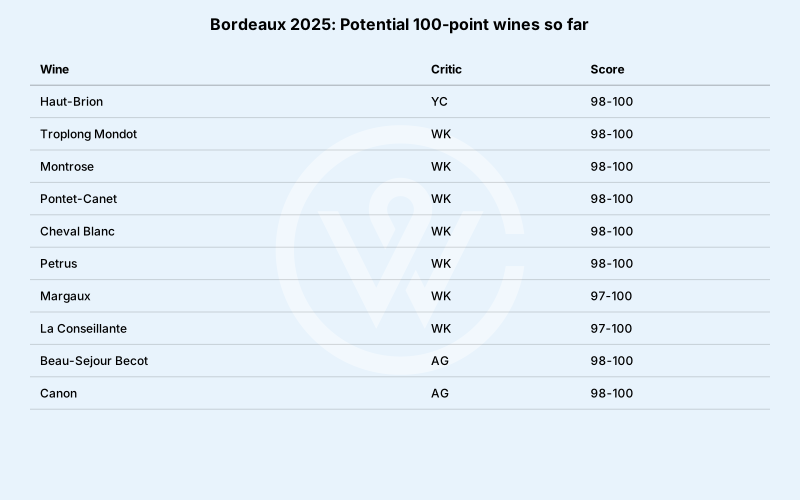
Bordeaux 2025: 100 point wines

*YC = Yohan Castaing (Wine Advocate), WK = William Kelley (Wine Advocate), AG = Antonio Galloni (Vinous)

It is important to note that En Primeur scores are typically expressed as ranges rather than fixed numbers. This reflects the fact that the wines are still in barrel and continue to evolve. Critics therefore allow for a margin of potential – both upward and downward – based on how the wines are expected to develop before bottling. A range such as 98-100 points signals not only exceptional quality, but also the realistic possibility of a perfect score at maturity.

Among the early reports, William Kelley is the most bullish, identifying seven wines with 100-point potential. Antonio Galloni follows with two, while Yohan Castaing has highlighted one wine in this top tier.

The list itself is telling. First Growths Chateau Haut-Brion and Chateau Margaux both feature, underlining the strength of the Left Bank at the very top level. They are joined by Right Bank icons Petrus and Cheval Blanc, alongside standout performers such as Troplong Mondot, Montrose and Pontet-Canet. 

Bordeaux 2025 market reality

While the wines themselves are widely praised, all critics have raised concerns about the market in their reports.

Kelley describes the En Primeur context as “structurally fragile,” questioning whether consumers still see value in buying futures. Galloni also states that Bordeaux “badly needs a win,” but warns that success depends entirely on pricing discipline. He argues that even modest increases could undermine demand, given the availability of competitively priced back vintages on the secondary market.

Hindle offers a more measured view, noting early signs of pricing restraint in the first releases and a stabilising fine wine market, but still emphasising the need for alignment between producers, merchants and consumers. 

The key to En Primeur success

Taken together, these early critic assessments position 2025 as a highly successful but nuanced Bordeaux vintage. At its best, it delivers a rare combination of concentration, freshness and terroir transparency – wines of both immediate appeal and long-term potential. However, it is not a uniform success. Variability is a defining feature, and careful selection will be essential. 

Perhaps most importantly, 2025 highlights a broader shift in Bordeaux. Through improved viticulture and winemaking, producers are increasingly able to navigate climatic extremes and make balanced wines in challenging conditions. 

But quality alone will not drive demand. The message from the critics is clear: the success of the campaign rests on the chateaux’s willingness to acknowledge the economic climate.

FAQ: Bordeaux 2025 En Primeur

Is Bordeaux 2025 a good vintage?
Yes – critics widely agree that 2025 is a high-quality vintage. Despite extreme heat and drought, the best wines show exceptional balance, freshness and moderate alcohol levels, leading some critics to describe it as a “miracle” or “paradoxical” vintage.

Why is Bordeaux 2025 described as a “miracle vintage”?
Because the wines defy expectations. In a hot, dry year that should have produced heavy, high-alcohol wines, 2025 instead delivered freshness, structure and restraint, thanks largely to cooler nights and crucial late-August rainfall.

What are the alcohol levels in Bordeaux 2025 wines?
Most wines fall between 12.5% and 13.5% ABV, significantly lower than recent hot vintages like 2022, where alcohol levels often exceeded 14.5%.

How important was rainfall in the 2025 vintage?
Late-August rainfall was critical. It rehydrated vines after prolonged drought, slowed sugar accumulation, and allowed full phenolic ripeness, ultimately shaping the balance and style of the wines.

Are Bordeaux 2025 yields low?
Yes. 2025 is the smallest Bordeaux harvest since 1991. 

Which Bordeaux regions performed best in 2025?
Margaux and Pauillac are widely seen as standout performers on the Left Bank, while Saint-Émilion excelled on the Right Bank, particularly on clay-limestone soils. 

Are there any 100-point Bordeaux 2025 wines yet?
Several wines have already received barrel score ranges of 98-100 points, indicating potential for a perfect score once bottled. Top names include Haut-Brion, Margaux, Petrus and Cheval Blanc.

What do En Primeur score ranges (e.g. 98–100) mean?
Barrel scores are given as ranges because the wines are still ageing. A 98-100 score suggests the wine is already exceptional but could improve further before bottling and reach a perfect score.

Will Bordeaux 2025 En Primeur be a successful campaign?
That remains uncertain. While wine quality is high, critics warn that success will depend on pricing. Buyers are increasingly cautious, and competition from back vintages may limit demand.

Should you buy Bordeaux 2025 En Primeur?
Critics emphasise that 2025 is not a uniform vintage. The best wines are outstanding, but variability is high, meaning careful selection will be essential rather than broad, “buy everything” strategies.

WineCap’s independent market analysis showcases the value of portfolio diversification and the stability offered by investing in wine. Speak to one of our wine investment experts and start building your portfolio. Schedule your free consultation today.
Categories
News

Finding value in the Bordeaux second wines

  • The average First Growth case price is £5,300, while second wines come in at £1,941.
  • Le Clarence de Haut-Brion is the most affordable second wine.
  • Le Petit Mouton has been the best performer over the last decade.

Following our article last week, which examined the performance and value of the Bordeaux First Growths, we take a look at the data behind their second wines.

What are second wines?

Most Bordeaux châteaux produce more than one wine each vintage, and some might make three or four. Each château’s second wine draws on the expertise and knowledge that goes into the Grand Vin. Generally, second wines are made with fruit from younger vines, or vines and parcels that are not quite up to the quality of the Grand Vin in any given year.

However, they are often produced using grapes from the same vineyards as the flagship wines, receiving the same technical treatment in both vineyard and winery. Considerably less expensive than their siblings,  second wines represent a particularly attractive and accessible option for investors.

Second wines – at what price?

White the average First Growth case price is £5,300, second wines come in at less than half the price (£1,941).

Interestingly, prices of the first and the second wine are not always rising in unison. For instance, Château Latour is the second most expensive Grand Vin after Château Lafite Rothschild. Les Forts de Latour, however, sits directly in the middle, with Le Petit Mouton and Carruades de Lafite being pricier.

When it comes to value for money, Le Clarence de Haut-Brion has the lowest price per point of £16, similar to its Grand Vin. As examined last week, Château Haut-Brion is the most affordable of the First Growths, while also boasting the highest average Wine Track score. Yet while Le Clarence is also the most affordable of the second wines, its Wine Track score is lower.

But looking purely at scores is not the best indicator of value when it comes to the second wines. Second wines differ from the Grand Vins, as the dominant relationship is between price and age, not price and quality. As time passes, their value rises, following the traditional wine investment dynamic.

Moreover, this group of wines is often bought by collectors and investors as they present access to a brand. Though suitable for aging, these wines are built for earlier consumption, offering an alternative to opening bottles of the Grand Vin as soon as they are delivered.

Performance of the second wines

In the last decade, Le Petit Mouton de Mouton Rothschild has been the best-performing second wine, up 111.9%.

The most affordable, Le Clarence de Haut-Brion, has delivered the second-best returns of 76.2%. It has been followed by Carruades de Lafite (64.7%) and Pavillon Rouge (63.1%).

WineCap’s independent market analysis showcases the value of portfolio diversification and the stability offered by investing in wine. Speak to one of our wine investment experts and start building your portfolio. Schedule your free consultation today.
Categories
News

Which Bordeaux First Growth has the lowest price per point?

  • The price-per-point metric allows for a comparison of wines based on their market price and perceived quality.
  • This article examines the prices per point of the most liquid group of wines – the Bordeaux First Growths.
  • It also looks at their historic market performances.

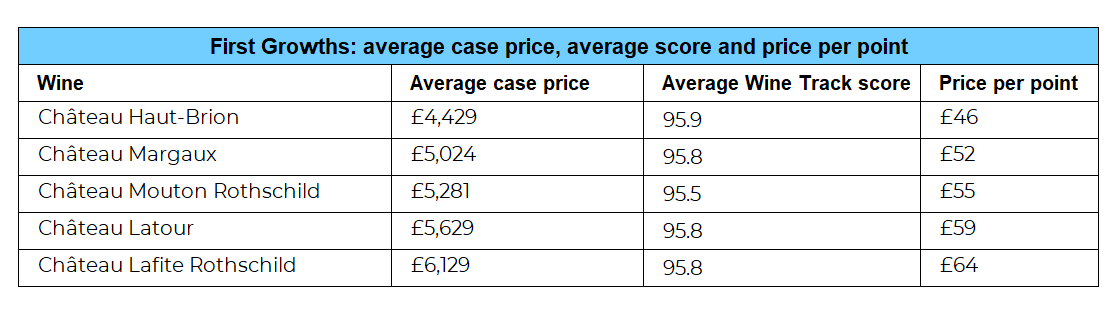
Price per point is an indicator of value; it is calculated by dividing the average case price of a given wine by its average critic score. For some wines, prices and points line up. Typically, a 100-point wine will cost more than a 95-point one, though not always. The price-per-point metric allows for a comparison of wines based on both their market price and perceived quality, offering a nuanced view of their value.

Today we examine the price-per-point ratios of the most liquid and popular group of wines – the Bordeaux First Growths. Which Grand Vin has the lowest price per point and thus offers the best value as a brand?

First Growths – price per point

An average case price of £4,429 makes Château Haut-Brion the most affordable of the First Growths. Meanwhile, it has the highest average Wine Track score of 95.9 points. While there is divergence in prices and scores on a vintage-specific level, Château Haut-Brion has the lowest price per point among the First Growths overall.

At the other end of the spectrum, Château Lafite Rothschild has the highest price per point of £64, owing to the highest average case price of £6,129 and a Wine Track score of 95.8.

What does this mean for the wines’ performance?

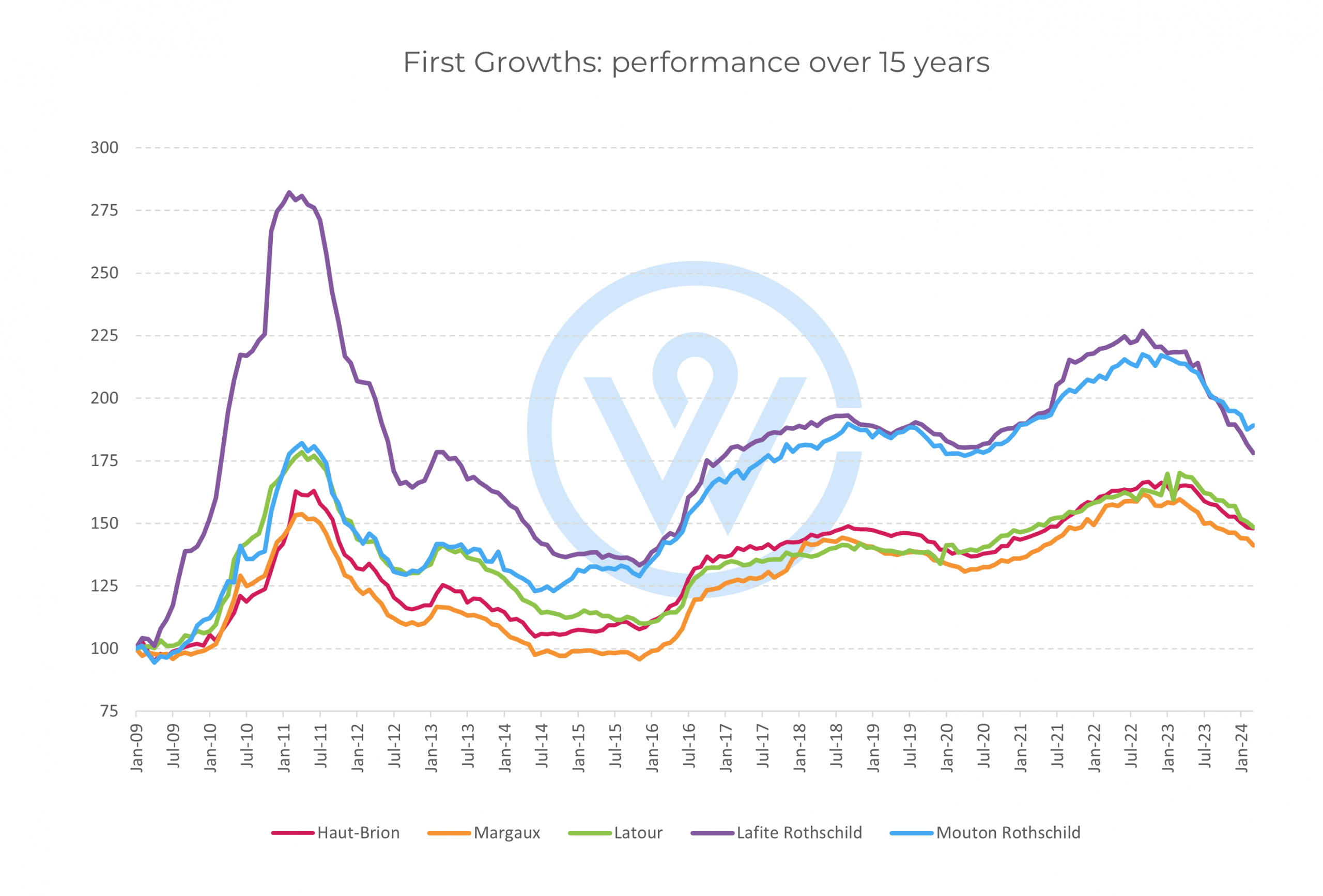
Historically, the First Growths have followed a similar trajectory of highs and lows. They all peaked during the China-led bull market (H1 2011) and experienced a subsequent downfall. Prices started to rise again following the Brexit referendum and have since largely maintained their level. They have fallen in the last year in line with the broader market (the Liv-ex 50 which tracks the First Growths is down 15.3% over one year – the same as the broadest measure, the Liv-ex 1000 index).

Of the five First Growths, Lafite has risen the most, with our index peaking in February 2011. Recently, however, it has been the biggest faller, dipping 19% in the last year. Haut-Brion, which has been a more modest performer without delivering the same heights, has dipped the least of the First Growths (10%) during the same period. With a more stable market performance, Haut-Brion offers further opportunities for investors and collectors where the price per point remains comparatively low.

Wines that offer value perform the best

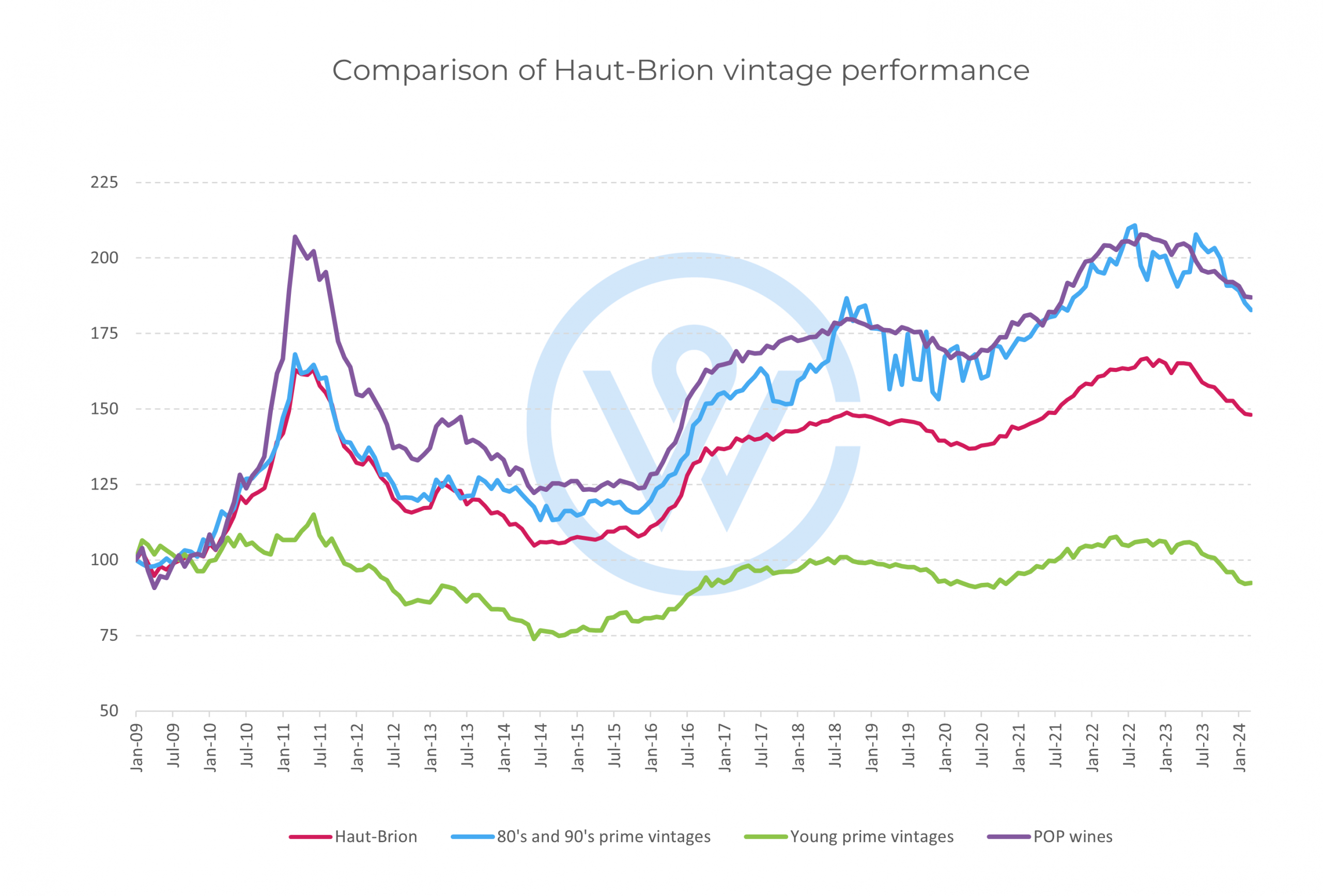
In the case of Haut-Brion, value plays an important role in market performance. POP wines (those with a lower price per point) have outperformed the rest over 15 years. These include vintages 2002, 2004, 2006, 2007, 2008, 2011, 2012, 2013, 2014, 2017 and 2019 (the only prime vintage among the POP wines).

The second-best-performing index comprises older ‘prime’ vintages – wines with high scores pre-2000. However, this index has shown higher volatility due to the limited availability and trading volumes of these wines.

The index comprising younger ‘on’ vintages like 2015, 2016, 2018 and 2020 has underperformed the rest of the pack. However, these wines have also had less time in the market and their evolution is yet to be seen.

In conclusion, looking at price per point gives an indication of value and quality. However, historic market performance is telling for investors looking for stability or higher risk and potentially higher rewards.

WineCap’s independent market analysis showcases the value of portfolio diversification and the stability offered by investing in wine. Speak to one of our wine investment experts and start building your portfolio. Schedule your free consultation today.
Categories
Learn

The place of the Bordeaux First Growths in a changing fine wine market

  • Once the dominant force in the fine wine market, the Bordeaux First Growths have lost market share due to its broadening.
  • In the last decade, Château Mouton Rothschild has been the best price performer, up 43.2%.
  • Château Haut-Brion offers the best value, with the highest average critic score and the lowest average price per case.

The Bordeaux First Growths in a broadening market

The Bordeaux First Growths have long been the cornerstone of the fine wine investment market. Back in 2010, they made up close to 90% of all Bordeaux trade by value – at a time, when Bordeaux’s share of the total market stood at 96%.

With the broadening of the market, their share has decreased and they now regularly account for around 30% of all Bordeaux secondary market trade (which itself has fallen below 35% annual average).

This trend was also reflected in the 2022 Power 100 list, which offered a snapshot of the ever-changing landscape of the secondary market. For the first time ever, no Bordeaux wines featured among the top ten most powerful fine wine labels.

Even if trade for these brands remains consistent or increases, the First Growths are facing greater competition. Still, they are among the wines with the greatest liquidity, attracting regular demand and high praise from critics year after year.

First Growths’ price performance

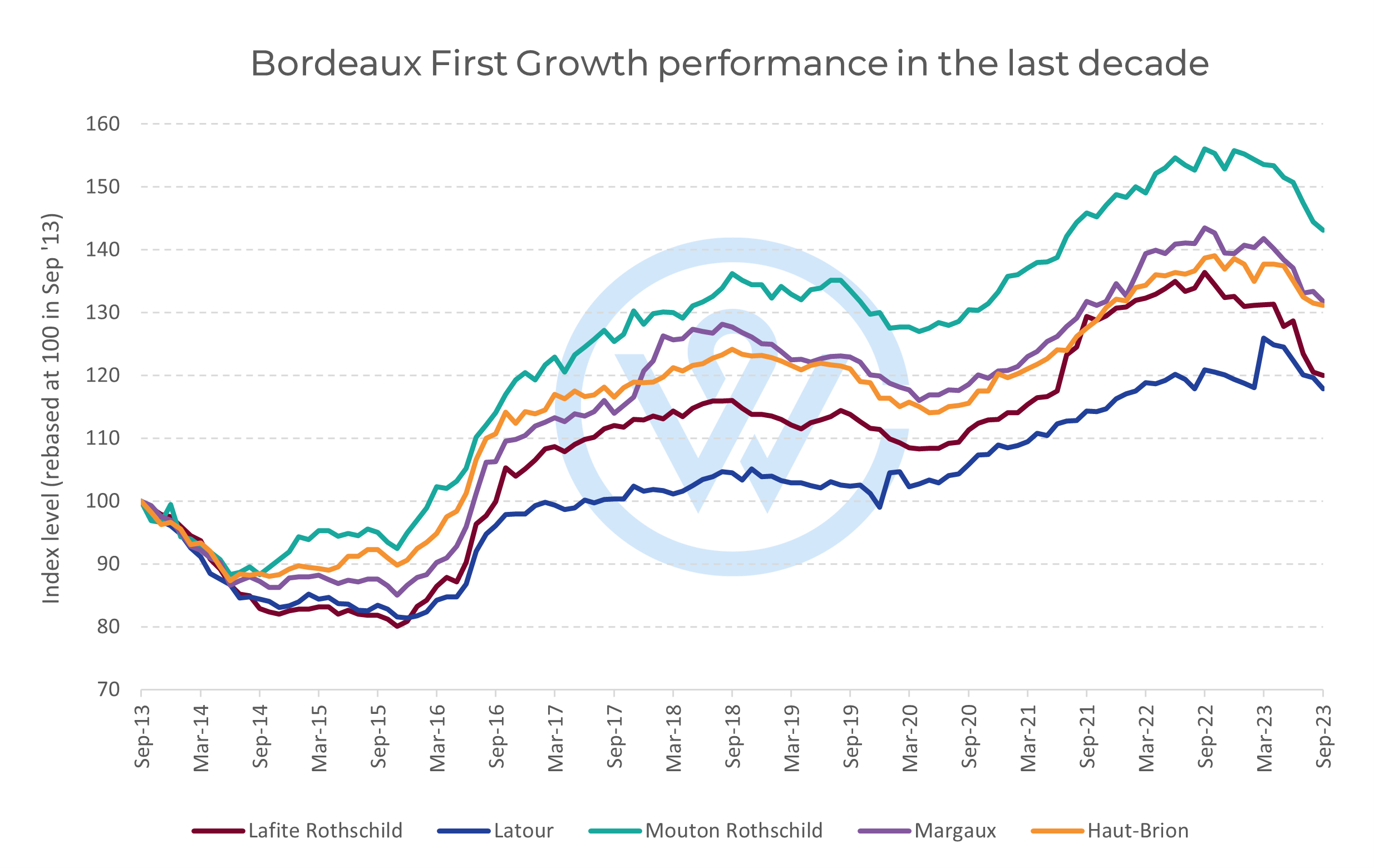
In terms of price performance, the five First Growths have followed a similar trajectory (i.e. rising post-Covid and dipping in the last year in line with the current market reality). The relative outcast has been Château Latour, whose performance was impacted by the decision to leave the En Primeur system in 2012. The wine has been the worst-performing First Growth, up just 17.9% in the last decade.

The best performer has been Château Mouton Rothschild, with an increase of 43.2%. Recent releases have elevated the performance of the brand, like the 2020 vintage, which boasts 100-points from The Wine Advocate’s William Kelley, 99-100 from James Suckling, 98-100 from Jeff Leve and 99 from Antonio Galloni (Vinous). ‘Off’ vintages like 2011, 2013 and 2014, which have greater room to rise, have also fared well over the last five years.

The second-best performer has been Château Margaux, which is also the second most affordable First Growth. Similarly, its biggest price risers have been 2014, 2011 and 2013. Less classical years reveal the strength of these brands, as demand for the First Growths remains consistently high regardless of the vintage.

First Growths’ price and score comparison

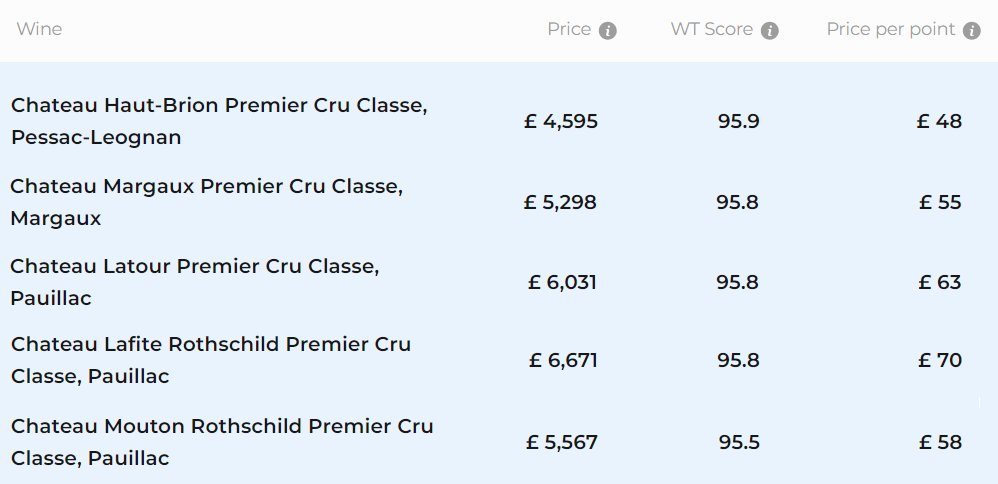
The table below shows the average price per case and critic score of the First Growths for vintages since 2000.

Château Haut-Brion tops the list with the highest average score (95.9) and the lowest average price per case (£4,595). With a price per point of £48, the wine seems to offer the best value among the First Growths. Vintages that have received 100-points from The Wine Advocate include 2018 (LPB), 2016 (LPB), 2015 (LPB), 2009 (LPB) and 2005 (RP).

Looking at the average prices, Château Lafite Rothschild stands out as the most expensive of the First Growths. The wine has achieved 100-points from The Wine Advocate for its 2019 (WK), 2018 (LPB), 2010 (LPB) and 2003 (RP) vintages.

In conclusion, the First Growths remain an important part of the changing secondary market, offering brand strength, consistently high quality and stable growth.

WineCap’s independent market analysis showcases the value of portfolio diversification and the stability offered by investing in wine. Speak to one of our wine investment experts and start building your portfolio. Schedule your free consultation today.
Categories
Learn

The legacy of the 1855 Bordeaux Wine Classification and global rankings

  • Wine classifications serve as guides to quality standards, geographical origins, and historical context.
  • The 1855 Bordeaux Classification continues to serve as a touchstone that has shaped not only Bordeaux but also global perceptions of what constitutes a ‘fine wine’.
  • Wine-producing regions worldwide have developed their own unique classification frameworks, based on quality, price, and terroir.

The classifications of fine wines provide an intriguing labyrinth of quality markers, geographic indicators, and historic relevance. Among the most iconic of these is the 1855 Bordeaux Classification – a system that has endured for over a century and a half. In contrast, the dynamic Saint-Émilion classification demonstrates the capacity for change within the realm of wine classifications. This article delves into these iconic French systems and other similar classifications in countries such as Germany, Italy, and Portugal.

The enduring legacy of the 1855 Bordeaux Classification

Commissioned by Napoleon III for the Exposition Universelle de Paris, the Bordeaux Wine Official Classification of 1855 set the gold standard for wine classifications. Designed to rank the finest wines of Bordeaux – from Médoc, Sauternes, and Barsac – the classification ranges from ‘First Growth’ to ‘Fifth Growth’, based on both quality and trading price. With only one significant modification since its inception – the promotion of Château Mouton Rothschild to First Growth in 1973 – the classification remains a cornerstone in the world of fine wine.

The classification has been both praised for its impact on the wine industry and criticised for its rigidity, given that it reflects a snapshot of quality from more than a century and a half ago. The global wine exchange, Liv-ex, has created a similar classification that uses price alone to determine a hierarchy of the leading fine wine labels in the market.

The Saint-Émilion Classification

In contrast to the static nature of the 1855 Classification, the Saint-Émilion region in Bordeaux has a more dynamic approach to ranking its wines. Established in 1955, the Saint-Émilion Classification is updated approximately every ten years. This system classifies wineries into tiers: Grand Cru Classé A, Grand Cru Classé B, and Grand Cru Classé.

Unlike the 1855 Classification, which is set in stone for the most part, the Saint-Émilion system allows for upward or downward mobility, giving wineries an incentive for continuous improvement.

Nonetheless, the classification has also faced controversy when three leading estates with ‘Premier Grand Cru Classé A’ status – Châteaux Ausone, Cheval Blanc and Angélus – withdrew from the rankings last year.

Classifications beyond Bordeaux 

Burgundy’s Cru System

Unlike Bordeaux, where the 1855 Classification ranks specific châteaux or estates, Burgundy’s Cru System classifies individual vineyards by assessing their terroir (Grand Cru, Premier Cru, Village, Regional).

Even vineyards that are right next to each other but separated by a road or a wall may be classified differently. The terroir is believed to impart specific qualities to the wine, with soil composition, slope, and sun exposure all playing a role.

While the 1855 Bordeaux Classification has changed very little since its inception, Burgundy’s Cru System is more fluid. Vineyards can be promoted or demoted based on ongoing assessments of quality, although changes are relatively rare and usually occur over long periods.

The Burgundy Cru System has been highly influential and is seen as a precursor to many New World terroir-based classifications. However, it’s not without its critics. Some argue that focusing solely on terroir might overlook the skills and contributions of individual winemakers.

Germany’s VDP Classification

The Verband Deutscher Prädikatsweingüter (VDP) has developed a system somewhat inspired by Burgundy. The top tier of this system, the Grosse Lage (Great Growth), designates vineyards with the highest quality potential, followed by Erste Lage (First Growth).

Italy’s Barolo and Barbaresco Cru vineyards

In Italy’s famed Barolo and Barbaresco regions, vineyards are often termed ‘cru’, reflecting the particular characteristics of the terroir. Unlike Bordeaux’s 1855 classification, there isn’t a formal hierarchy, but the cru system nonetheless signifies a level of quality and prestige.

Portugal’s Douro Classification

One of the oldest classification systems for wine comes from Portugal’s Douro region, known for Port wine. Established as early as 1756, this classification focuses on the quality of the grape-growing land, making it an early precursor to the concept of terroir.

Concluding thoughts

In the ever-evolving world of fine wine, the 1855 Bordeaux Classification continues to serve as a touchstone that has shaped not only the Bordeaux region but also global perceptions of what constitutes a ‘fine wine’. By contrast, the more dynamic systems like the Saint-Émilion rankings and Burgundy’s Cru system offer a flexible approach that accommodates change and encourages ongoing excellence. As the article explored, wine-producing regions worldwide have developed their own unique classification frameworks, each adding a different flavor to this complex narrative. Whether these systems will adapt to the challenges of climate change, evolving consumer tastes, and other modern factors remains to be seen, but what is clear is their enduring impact on how we appreciate, value, and ultimately, enjoy wine.

WineCap’s independent market analysis showcases the value of portfolio diversification and the stability offered by investing in wine. Speak to one of our wine investment experts and start building your portfolio. Schedule your free consultation today.
Categories
News

Marchesi Antinori acquires iconic Napa Valley’s Stag’s Leap

  • Marchesi Antinori has taken full ownership of Napa Valley’s iconic winery Stag’s Leap.
  • Stag’s Leap laid the foundation for the emergence of cult wines after winning the Judgement of Paris in 1976.
  • Antinori’s innovations in the ‘Super Tuscan’ revolution of the 1970s and recent acquisition of Stag’s Leap position both for continued success in the fine wine investment market.

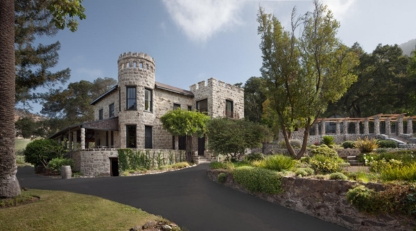
Marchesi Antinori, one of the oldest and largest wine companies in the world, has gained full ownership of the iconic Napa Valley estate Stag’s Leap. Wine Spectator has reported that the current sale includes ‘the winery, the brand and inventory, and close to 300 acres of Napa vines, including the Fay and S.L.V. vineyards’.

Antinori has held a minority stake in Stag’s Leap since 2007, when Ste. Michelle Wine Estates purchased it from founder Warren Winiarksi.

Some of the most prominent wineries owned by Antinori include the Super Tuscan Tignanello and Guado al Tasso, as well as Antica Napa Valley.

Stag’s Leap performance

Stag’s Leap was among the pioneering Californian wineries that laid the foundation for the emergence of cult brands.

It was its S.L.V. Cabernet Sauvignon 1973 – the winery’s second vintage, and first produced at the estate and in commercial quantities – that won the Judgement of Paris in 1976. Stag’s Leap put Californian wine on the map by winning over its French competitors, which included the First Growths Château Mouton Rothschild 1970 and Château Haut-Brion 1970.

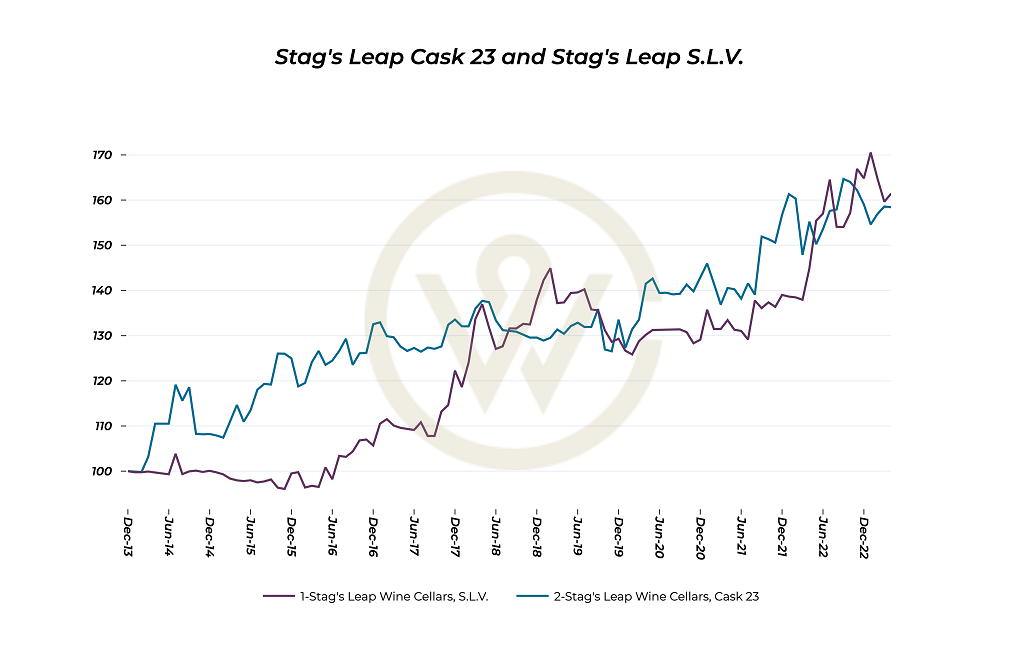
In the fine wine market, demand for Stag’s Leap has grown considerably over the last decade, with prices for its Cask 23 increasing 59% and for S.L.V. – up 61% on average.

The brand has been helped by the relative value for money it offers compared to other Californian ‘cult wines’. The average price per point for S.L.V., for instance, is just £19, compared to £472 for Screaming Eagle Cabernet Sauvignon.

The 2014 vintage has enjoyed particularly strong price performance. Stag’s Leap S.L.V. is up 80.5% since release. Cask 23 has risen 77.4% over the past two years, placing it among some of California’s biggest risers.

Antinori’s overarching impact

If Stag’s Leap has greatly contributed to the emergence of California’s cult wines, Antinori’s innovations played a large part in the ‘Super Tuscan’ revolution of the 1970s. Both have managed to re-define ‘fine wine’ outside the confines of Bordeaux, in USA and Italy respectively.

With history that can be traced back to 1385, Antinori has been one of the most successful wine companies. Its Tignanello ranked as the 49th most powerful wine brand in the world, due to high trade volume and value. Liv-ex noted that it was helped by the remarkable value for money it offers being ‘the cheapest Italian wine in the top 100, with an average case price of £1,076’.

While it is yet to be seen how the full acquisition of Stag’s Leap will play out, it seems like both Antinori and Stag’s Leap are poised for continued success and reaching new heights in the fine wine market.


WineCap’s independent market analysis showcases the value of portfolio diversification and the stability offered by investing in wine. Speak to one of our wine investment experts and start building your portfolio. Schedule your free consultation today.