Categories
Learn

Is investing in a vineyard profitable? Costs and key considerations

  • Vineyard investment is a hybrid asset that combines real estate with an agricultural business. 
  • Investing in a vineyard is more costly and less liquid than investing in wine, as it requires running a business.
  • Entry points vary from multi-million pound estates to smaller crowdfunding projects. 

Many people dream of owning a sun-drenched vineyard, imagining rows of vines and cool, quiet cellars. However, the reality of vineyard investment is a major financial commitment that goes beyond land and estate ownership, and requires active farming.

This type of investment is very different from “treasure assets” like fine wine. When you buy a bottle of vintage Champagne, you own a finished product. When you buy a vineyard, you own a business.

How to evaluate the profitability of investing in a vineyard? 

Buying a vineyard means you are investing in two things at once. First, you are buying agricultural land. This land often holds its value well over time and may come with tax advantages. In famous regions like Bordeaux or Burgundy, viable vineyard land is a scarce and valuable resource.

Second, you are starting or buying a business, which needs staff, machinery, sales and marketing plan. You must manage the vines, process the grapes, and sell the wine. This dual nature makes the investment unique but also very demanding.

Tax planning for vineyard investment

Tax planning can make a vineyard investment much more attractive for a family and help reduce the financial burden of passing land to children or heirs.

  • United Kingdom: You may qualify for Business Property Relief. This can reduce your Inheritance Tax bill to zero for the vineyard business.
  • France: Owners can receive a 75% discount on wealth tax and gift tax. This requires a formal commitment to the land for many years.
  • Italy: Agricultural entrepreneurs often enjoy lower income tax on their farm profits. This helps cash flow while the vineyard is becoming profitable.

Government policies usually aim to protect domestic food and drink production. This makes farmland a useful tool for financial planning. However, you should always speak to a local expert before you invest.

Investing in a vineyard vs investing in wine

Investing in wine is a popular way to grow wealth. It is relatively simple. You buy a case, store it in a bonded warehouse, and wait for the price to rise. This is a “passive” investment in a luxury good.

By contrast, vineyard investment is “active.” It is also less liquid; you can sell a case of wine in days or weeks but selling a whole estate can take years. There is also a high concentration risk: if you own one vineyard and frost hits, you lose your whole crop. The uncertainty of farming is always present, and it can be a precarious investment, even in good times. Meanwhile, if you own a diverse portfolio of wine bottles, one bad vintage does not hurt you, in fact it might even raise the price of the bottles you already own. 

Scale of vineyard investments

The cost of entry depends on your goals and your budget. At the top end, global luxury groups like LVMH or Treasury Estates set the pace. LVMH famously bought the Clos des Lambrays estate in Burgundy for a price reported to be around £85 million. More recently, Treasury Estates purchased DAOU in California for nearly £700 million.

For these giants, the goal is brand prestige and securing rare supply. Companies like this have the capital to wait decades for a return, whereas most private investors look for smaller opportunities and a speedier return. However, even a modest estate in a good region can set you back millions.

At the other end of the scale are small urban projects. In Brighton, some vineyards have used crowdfunding to get started allowing local people to own a tiny “share” of a vineyard for a few hundred pounds.
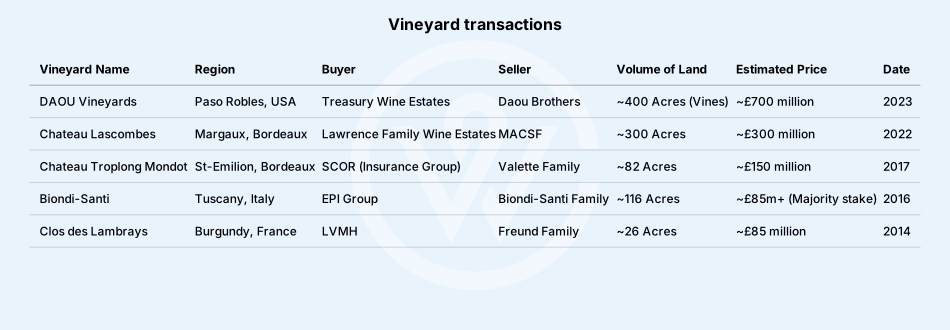
Vineyard transactions

The role of crowdfunding

Crowdfunding has become popular in the UK wine scene. Chapel Down is a great example of this having raised more than £12 million from thousands of small investors via crowdfunding efforts and more from sales of equity. Crowdfunders are often incentivised with perks like discounts and tour invites.

This model builds a loyal community of customers, however, there are downsides. Investors often have very little control over the business and it can also be very hard to sell these small shares later.

Vineyard revenue streams and production

A vineyard makes money in several ways. The most obvious is selling wine to shops and restaurants, although many estates also sell direct to consumers either at the “cellar door” in person or through e-commerce. This offers much higher profit margins as there is no middleman and has become increasingly important in recent years.

Some vineyards also sell their grapes to other producers. This provides a quicker cash flow but lower profits. In many regions, tourism is the secret to success. This might include:

  • Tasting room fees
  • Guided vineyard tours
  • Luxury accommodation
  • Hosting weddings and events

Vineyard operating costs

Running a vineyard is expensive. Labour is a major cost, with operations like pruning and harvesting by hand requiring skilled workers. In countries like France or the UK, wages are relatively high which can put pressure on the profit margins.

Machinery is another important factor. Tractors, presses, and fermentation tanks are vital. You also have the cost of oak barrels, bottles, and labels. These costs will vary dramatically by country. For example, land is cheaper in Argentina, but import taxes on equipment can be very high.

Production metrics

Investors must watch their production metrics closely. Yield is measured in tonnes per hectare and while a high yield means more wine, it can often mean lower quality. Premium estates often limit their yield to ensure the grapes are concentrated and flavourful, which raises the price of the final product.

The bottle price is a key metric for profit. To break even, you must sell your wine for more than it cost to grow and make. This sounds simple, but marketing a new brand is a huge and costly task.

The climate factor

Agriculture is always at the mercy of the weather and is arguably the biggest risk for any vineyard owner. Climate change is making this risk harder to manage, especially in the context of frequent extreme weather events like:

  • Late spring frosts
  • Heavy summer hail
  • Long periods of drought
  • Wildfires and smoke taint

In some years, an owner might lose 80% of their crop in a single night. This financial risk is why many vineyards struggle to stay profitable. While insurance is available, it is becoming more expensive as risks rise.

Financial considerations

Beyond the weather, there are wider financial risks. Interest rates can affect the cost of loans for machinery and changes in trade laws or wine taxes can hurt sales. The wine market is also prone to trends: if consumers move away from a certain style, your inventory may lose value.

The investment timeline

Vineyard investment is a long game. If you plant a new vineyard, even after years of preparation and research, the timeline looks like this:

  • Years 1 to 2: Site prep, planting and building production facilities. No income.
  • Year 3: The first “maiden” crops, typically lower in volume and quality.
  • Year 5: The first full harvest. Still ageing in the cellar.
  • Years 7 to 10: The brand begins to find its place in the market.

Profitability often takes a decade or more. If you buy an existing estate, the timeline is shorter; however, the purchase price will be much higher because you are paying for the work someone else has already done.

The exit strategy

Exiting a vineyard investment is also a slow process. Unlike stocks, you cannot sell at the click of a button: finding a buyer for a specific estate takes time. Most buyers will be other wine groups or wealthy individuals looking for a lifestyle change.

A lifestyle choice first

This brings us to the core of vineyard investment. Most people do it for the love of the land. They want to be part of a tradition. They enjoy the prestige of having their name on a label.

As a financial asset, it is often less efficient than a simple portfolio of stocks or bonds. The “return” is often found in the quality of life. It is the joy of seeing the seasons change and sharing your own wine with friends.

Investing in a vineyard is a bold move, with high costs and a lot of patience required. It is a productive business that needs constant attention and care. 

If you want a steady financial return, stick to wine bottles. If you want to change your life and connect with nature, a vineyard is unmatched. Just ensure you enter the market with your eyes wide open to the risks.

WineCap’s independent market analysis showcases the value of portfolio diversification and the stability offered by investing in wine. Speak to one of our wine investment experts and start building your portfolio. Schedule your free consultation today
Categories
Learn

10 fascinating facts about Chateau Lafite Rothschild

  • Chateau Lafite Rothschild is one of the most sought-after wines in the world for its investment potential.
  • Lafite is frequently described as the most elegant of the First Growths.
  • Lafite vintages like 1982, 2009, and 2010 have achieved iconic status.

Chateau Lafite Rothschild is an undisputed titan of the fine wine world. For many collectors, it is the first name added to a cellar and the last one ever removed. Lafite Rothschild carries a weight that transcends viticulture, representing a fusion of French history, financial stability, and artisanal quality.

Its enduring prestige was recently cemented at a landmark Sotheby’s New York auction, where two 1870 magnums fetched a staggering $306,250.

In the secondary market, Lafite functions as a “liquid currency,” possessing a level of brand equity that few other luxury Veblen goods, let alone wines, can rival. Whether you are a seasoned oenophile or a newcomer to wine investment, understanding this Pauillac legend is essential. 

This guide explores the ten key facets that define the gold standard of this prestigious wine.

1. The storied history of an icon

Lafite Rothschild’s history is a tapestry of royal patronage and resilience. While vines have existed on the site for centuries, the estate gained international prominence in the late seventeenth century under the Segur family. Marquis Nicolas-Alexandre de Segur was known as the Prince of Vines, and he refined the winemaking techniques that put Lafite on the maps of London and Paris.

By the eighteenth century, Lafite was the favourite of the French royal court. It earned the moniker of King’s Wine, largely thanks to the influence of Marechal de Richelieu. Famously Thomas Jefferson, the third American president, became a devoted follower after visiting the region.

The most significant turning point occurred in 1868. Baron James Mayer de Rothschild purchased the estate at a public auction and added his surname to what had previously been “Chateau Lafite”. This acquisition brought the property into the Rothschild family, where it has remained for five generations.

Key historical milestones in the history of Lafite Rothschild include:

  • The 1855 Classification where Lafite was ranked as one of only four original Premier Grand Cru Classes.
  • The devastating phylloxera crisis of the late nineteenth century which tested the estate’s resolve.
  • The occupation of the chateau during the Second World War.
  • The post-war resurgence led by Baron Elie de Rothschild.
  • The modern era of expansion and technical precision under Baron Eric and now Saskia de Rothschild.

2. The unique terroir of Pauillac

Lafite is defined by its terroir, which is arguably the finest in the Médoc, as you might expect given its price point. The vineyard covers roughly 112 hectares making it the largest of the First Growths and is situated on a plateau of deep gravel. This soil type is crucial for Cabernet Sauvignon, as it provides excellent drainage and forces the vines to grow deep roots.

The climate in Pauillac is moderated by the proximity of the Gironde estuary and the Atlantic Ocean, creating a microclimate that protects the vines from extreme frost and excessive heat. The estate manages its land with a focus on biodiversity and long-term sustainability.

Current vineyard characteristics include:

  • An average vine age of approximately 40 years.
  • A high proportion of Cabernet Sauvignon, usually making up 70 percent or more of the vines and an even larger proportion of the Grand Vin.
  • Significant plantings of Merlot, which adds roundness and flesh to the mid-palate.
  • Smaller plots of Cabernet Franc and Petit Verdot for structural complexity.
  • The vineyard is divided into three main parcels, around the Chateau including the  Carruades plateau, and a plot in St Estephe.

3. The different wines of Lafite Rothschild

Key wines from the property are:

  • Chateau Lafite Rothschild (The Grand Vin).
  • Carruades de Lafite (The Second Wine).
  • Anseillan (A newer, plot-specific release).

While the Grand Vin is the primary focus for investors, the estate produces other notable labels. Each wine follows a strict hierarchy of quality and selection. Only the very best parcels are reserved for the top wine, ensuring its longevity and prestige.

Carruades de Lafite is the estate’s second wine, which typically contains a higher percentage of Merlot than the Grand vin and releases at a third of the price. Once viewed as a simple entry point, it has experienced periods of meteoric price rises over the last two decades and is now considered a viable investment asset in its own right. Prices tend to be more volatile than Lafite, but when bought at the bottom of a market cycle and sold at the top it can be highly lucrative. 

The estate also recently introduced Anseillan. This more affordable wine represents a more accessible side of the DBR portfolio and while it will benefit from some age it is not built for long-term cellaring.

4. Lafite within the Domaines Barons de Rothschild

Lafite serves as the flagship for Domaines Barons de Rothschild, commonly abbreviated as DBR. This global wine empire has expanded significantly since the mid-twentieth century. However, Lafite remains the spiritual and financial heart of the organisation.

Under the leadership of the Rothschild family, DBR has acquired prestigious estates across the globe. This includes properties in South America, China, and other regions of France. The technical expertise developed at Lafite is shared across these subsidiaries with staff moving from one to another.

The DBR portfolio also includes:

  • Chateau L’Evangile in Pomerol.
  • Chateau Rieussec in Sauternes.
  • Vina Los Vascos in Chile.
  • Bodegas Caro in Argentina.
  • Domaine de Long Dai in China.

5. The benchmark Lafite Rothschild style

Lafite is frequently described as the most elegant of the First Growths. While Latour is known for power and Margaux for perfume, Lafite is celebrated for its finesse and complexity. It is rarely a wine that shouts; instead, it whispers with profound depth.

On the nose, young Lafite often displays notes of cedar, graphite, and violets. As it ages, these aromas evolve into complex layers of tobacco, forest floor, and truffle. The tannins are famously fine-grained, described by many critics as silky or lacy.

Structural hallmarks of the wine:

  • A core of intense blackcurrant fruit.
  • Distinctive mineral notes derived from the gravelly soil.
  • High natural acidity which ensures decades of ageing potential.
  • Seamless integration of oak, usually 100 percent new French barrels.
  • An extraordinary length of finish that lingers for minutes.

6. The 1982 Lafite vintage and the modern wine era

The 1982 vintage was a watershed moment for the global wine trade. It marked the emergence of Robert Parker as the world’s most influential wine critic. Parker famously touted the 1982 Bordeaux vintage as legendary while many other critics were hesitant.

Lafite Rothschild 1982 received a perfect 100-point score from Parker. This set the stage for the rise of modern wine criticism and the standardisation of the 100-point scale. It transformed fine wine from a niche hobby into a global asset class.

The significance of 1982 includes:

  • The birth of the modern secondary market for investment-grade wine.
  • A shift towards riper, more opulent styles of winemaking across Bordeaux.
  • The massive increase in global demand for First Growth allocations.
  • The establishment of Lafite as the ultimate status symbol in emerging markets.

On a business level, increasing prices allowed Lafite Rothschild and other chateaux to invest in more precise, cleaner winemaking and improved farming practices, in turn facilitating a dramatic improvement in quality in the years that followed.

7. The rise of Lafite Rothschild in China

Lafite Rothschild holds a unique position in the Chinese market. It became the definitive luxury wine during China’s economic boom.

The name is easy to pronounce in Mandarin, which helped its early adoption. Its association with the Rothschild family also appealed to Chinese investors who value heritage and long-term wealth; this demand drove prices to stratospheric levels, particularly for the 2008 vintage.

The impact of the Chinese market led to:

  • A surge in prices for both recent and back vintages.
  • Increased focus on anti-counterfeiting measures and provenance.
  • The creation of the Long Dai estate in Shandong province by DBR.

8. Special bottlings and labels

Lafite occasionally marks special vintages with subtle changes to its iconic label. Perhaps unsurprisingly for Lafite these are not full label changes a-la Mouton Rothschild 2003, gold labels like Angelus 2012 or brightly coloured full bottle canvases like the Taittinger collection.  Instead they are subtle changes, a small embossing here, a glass relief there, commemorating astronomical events, cultural milestones and vintages blessed by the weather gods.

Notable label variations include:

  • The 1985 vintage features a small etching of Halley’s Comet. 
  • The 1999 vintage includes a small star to celebrate the turn of the millennium.
  • The 2005 vintage depicts the sun and rain on a set of scales for the perfect balance of that growing season
  • The 2008 vintage features a red Chinese character for the number eight.
  • The 2018 vintage shows a hot air balloon to mark 150 years of Rothschild ownership.

These bottles often command a premium at auction beyond what their quality would suggest.

9. The best and most expensive Lafite Rothschild vintages

When discussing the best vintages of Lafite Rothschild, critics often point to years where the weather was nearly perfect. Vintages such as 1953, 1959, and 1961 are legendary for their longevity. More recently 1982, 2009, and 2010 have achieved iconic status.

In terms of the financial performance, the most expensive bottles ever sold often have historical significance. A bottle of 1869 Lafite sold in Hong Kong for over $230,000 in 2010. Even older bottles, such as the 1787 vintage allegedly owned by Thomas Jefferson, have sold for record sums.

Top Lafite vintages for investment:

  • 1982: The benchmark for modern investment.
  • 2000: A millennium vintage with immense staying power.
  • 2005: Perfect structural balance.
  • 2012: Great value and already in its depletion phase.
  • 2016: A modern classic with widespread critical acclaim.
  • 2019 and 2020: High-scoring recent years with good value and strong long term potential.
  • 2024: The most affordable vintage on the market.

Such is the strength of the Lafite brand that its not just the best vintages that have been strong investments, in fact quite frequently the opposite has been the case. The 2013 vintage is a perfect example of this: a 90-point score from Neal Martin and 87-89 points while still in the barrel from Robert Parker in his last En Primeur tastings denotes a vintage that was anything but great. However, it was released at very competitive prices and in percentage terms its performance has eclipsed even the famed 2010.

10. The investment reality of Lafite Rothschild

Lafite remains a cornerstone of any serious wine investment portfolio. Its primary strength is liquidity. Unlike niche wines that may be difficult to sell, there is always a buyer for a well-stored case of Lafite.

It acts as a hedge against inflation and broader market volatility. While prices can fluctuate, the long-term trend for First Growth Bordeaux has historically been upward. The scarcity of back vintages ensures that supply continues to dwindle as bottles are consumed.

Key investment takeaways:

  • Blue-chip status ensures high global demand and easy resale.
  • Consistent quality means that even lesser vintages hold their value well.
  • Provenance is vital, as buyers will pay more for professional storage.
  • The estate’s brand power provides a safety net during economic downturns.
  • It remains the ultimate entry point for those seeking long-term capital appreciation.

Chateau Lafite Rothschild is more than just a vineyard – it is an icon of Bordeaux and an enduring symbol of French viticulture. By balancing a deep respect for tradition with modern financial sense, it continues to lead the fine wine market. Whether you hold it for the pleasure of the palate or the growth of your capital, Lafite represents the gold standard of the fine wine world.

FAQ: Chateau Lafite Rothschild

What makes Chateau Lafite Rothschild so expensive?

Lafite’s value is driven by its First Growth status (the highest ranking in the 1855 Classification), its storied history with the Rothschild family, and its massive brand equity in global markets. Its reputation as a “liquid currency” makes it a stable blue-chip investment.

How does the taste of Lafite differ from other First Growths?

While other top wines like Latour are known for power, Lafite is celebrated for its finesse and elegance. It is often described as a wine that “whispers” rather than shouts, characterised by silky tannins and complex notes of cedar, graphite, violets, and blackcurrant.

What is the difference between the Grand Vin and Carruades de Lafite?

The flagship wine is made from the estate’s very best parcels. It is built for decades of aging and is the primary target for high-level investors. Meanwhile, the estate’s Second Wine typically contains more Merlot, is more accessible in its youth, and costs significantly less (usually about a third of the price of the Grand Vin).

Why is Lafite particularly popular in the Chinese market?

Lafite became a preeminent status symbol in China due to several factors: the name is easy to pronounce in Mandarin, the Rothschild heritage aligns with Chinese values of long-term wealth, and the 2008 vintage specifically featured a red Chinese character for the number eight (a lucky number) on the bottle, which drove demand to unprecedented levels.

Which vintages are considered the best for investment?

The “iconic” vintages for both quality and financial performance include 1982, 2000, 2005, 2009, 2010, and 2016. However, “off-vintages” like 2013 have also proven to be lucrative investments because they were released at lower prices and benefited from the overall strength of the Lafite brand.

How can you tell if a Lafite bottle is a special edition?

Lafite uses subtle etchings or embossments on the glass rather than changing the entire label. For example:

  • 1985: Features Halley’s Comet.
  • 1999: Features a star for the millennium.
  • 2008: Features the Chinese character for “8” ().
  • 2018: Features a hot air balloon to mark 150 years of Rothschild ownership.

WineCap’s independent market analysis showcases the value of portfolio diversification and the stability offered by investing in wine. Speak to one of our wine investment experts and start building your portfolio. Schedule your free consultation today.

Categories
Learn

Wine investor vs collector: which one are you?

  • On the outside, wine collecting and investment look similar, but they are different activities with unique objectives.
  • Wine collectors and wine investors have different considerations and motivations.
  • Most fine wine lovers are a mix of collector and investor and need professional guidance for optimal decision-making.

Many wine lovers curate an expanding cellar over time. However, while some earmark these special wines for future dinner parties and family events, others regard them as financial assets with growth and return potential. From the outside, wine collecting and wine investment often look similar – but the mindsets, motivations, and strategies that drive these activities are fundamentally different.

As the fine wine investment space continues to grow and garner interest as an alternative asset class (owing to its record of stability, low correlation to equities, and years of consistent wine investment returns), understanding these differences is crucial.

Are you a private wine collector or a global wine investor – or a combination of both? Read on to find out.

What is wine collecting?

What drives wine collecting is, above all, passion. Fine wine collectors buy items they admire because of their storytelling, ability to evoke memories, or simply because they align with their tastes. When making decisions about which wines to buy, financial goals are not a key factor.

Collectors of wine typically:

  • Buy wines they intend to enjoy one day.
  • Curate their collection around regions or producers they esteem.
  • Purchase wines spanning a range of styles, including niche bottles.
  • Build verticals for pleasure rather than profit.
  • Store wines at home or in mixed-use cellars.
  • Open rare bottles to celebrate important milestones.

For a collector, the ‘return on wine investment’ is the quality of the experience when a treasured bottle is finally opened and enjoyed.

What is wine investment?

In contrast, wine investment is a financial strategy, rather than purely an expression of taste. Investors regard fine wine as an asset – one that has shown strong returns over decades, enjoys low volatility, and displays reliable resilience in periods of economic turbulence. It is often regarded as a valuable addition to a wider investment portfolio, performing as an asset that can weather the volatility sometimes seen in equities.

Investors typically:

  • Select wines which have strong capital appreciation.
  • Concentrate on blue-chip regions with deep and consistent demand globally such as Bordeaux, Burgundy, Champagne, Tuscany, Piedmont, Napa, and the Rhône.
  • Use wine investment market data: indicators of market liquidity, critic scores, scarcity, and historical performance to evaluate the best wines to invest in.
  • Put provenance, condition, and professional storage first.
  • Buy and store wine via trusted wine investment platforms.
  • Are guided by data, analytics, and market signals over personal taste.
  • Have a clear time horizon and exit strategy.

Investors measure success by risk-adjusted return, not just by how pleasurable a wine might be to enjoy at a future date.

Asset behaviour: drinkable luxury vs financial instrument

Investors and collectors are each interested in pricey wines because of their quality and historical significance. However, while the former values prestige wines mostly for their potential financial value, the latter appreciates their cultural capital.

Collectors value wine for its:

Against this background, they may be comfortable purchasing wines with imperfect provenance or storage, as the drinking enjoyment overrides any financial return of wine investment.

Investors value wine as:

  • An object with unique economic and structural features and potential.
  • A reliable portfolio diversifier.
  • Having a finite supply, which can work in favour of price performance.
  • Possessing global demand and growth potential as established markets grow and new ones emerge.
  • An asset with advantageous low correlation with stocks, currency, and commodities.

These characteristics are key influencers in wine investor decisions and can play a stabilising role in diversified portfolios during periods of market volatility.

Financial mechanics

Both categories of wine lovers have to navigate factors that impact if and when they buy, sell, or enjoy their bottles. The most significant are costs, liquidity and wine investment growth.

Costs

Both collectors and investors may face costs associated with:

  • Professional storage.
  • Insurance.
  • Shipping and logistics.
  • Potential taxes depending on jurisdiction.

While costs are similar for both collecting and investing, how they are approached varies vastly. Collectors usually accommodate expenses as part of their hobby. Investors, however, have to take them into account when calculating net returns. For example, storage and fees can impact long-term profits.

Liquidity

Wine as an asset class is less liquid than equities. Due to its tangibility, selling can take days or weeks, meaning investors need:

  • A platform or experienced broker.
  • Impeccable provenance records.
  • Timely demand for the particular wine and/ or vintage.

In contrast, collectors don’t necessarily factor selling into the equation. In fact, they often don’t sell at all, with most of their bottles eventually being opened and enjoyed.

Returns

Investment-grade wine has a long history of producing solid long-term returns, with many indices outperforming conventional markets during major downturns. However, fine wine performance is cyclical, like all assets.

Meanwhile, for collectors, the return is the pleasure they enjoy when they choose to open a bottle for private enjoyment or to mark a special occasion. It does not correlate to the rise and fall of the market.

Other considerations

Collectors and investors have different buying motivations but they still need to consider how to balance their cellars or portfolios. 

Collectors buy based on emotion, which can mean that they: 

  • Overbuy wines they don’t drink. 
  • Don’t have proper or enough storage.
  • Build imbalance cellars.
  • Are too sentimental to sell or open valuable bottles when the time is right (in their peak drinking window).

Investors purchase wine for its returns potential, which means they need to consider the market and operations:

  • Market cycles, shifts in regional demand, and the influence of critics.
  • Optimal liquidity. 
  • Buying the right wine from a reputable supplier. 
  • Reliable storage and logistics.

Where are you on the spectrum?

Most wine enthusiasts do not fall 100% into either the collector or investor category; they are usually a hybrid of both. The key question you need to ask yourself is: Do you buy wine for emotional or financial return?

If you buy wine because you love what’s in the bottle, you’re a collector. If you purchase wine because of how it can enhance your portfolio, you’re an investor. If you are somewhere in between and are looking to fine-tune your objectives, WineCap can guide you with clarity, confidence, and data-driven precision as you take the next step. 

WineCap’s independent market analysis showcases the value of portfolio diversification and the stability offered by investing in wine. Speak to one of our wine investment experts and start building your portfolio. Schedule your free consultation today.