Categories
Learn

Which wines have the best ROI? A 10-year fine wine performance review

  • Bordeaux anchors portfolios with liquidity and stability, while Burgundy and niche producers often deliver the highest upside.
  • Scarcity drives returns: from cult Burgundy to grower Champagne, the biggest gains come where supply is tight and demand is global.
  • After a three-year correction, fine wine prices are on the rise, signaling a prime entry point.

Over the past two decades, fine wine performance has been far from uniform, with returns driven by a distinct mix of liquidity, scarcity, and shifting global demand. The wines that have delivered the best ROI have done so for very different reasons, making a market breakdown essential to understanding where true value lies, and how each region behaves as an investment.

Bordeaux: The “S&P 500” of fine wine 

Bordeaux remains the cornerstone of the secondary wine market due to its high production volumes and global recognition. It provides a level of liquidity that acts as a defensive anchor, weathering the 2022-2025 correction better than most speculative assets.

  • Le Pin

Located in Pomerol, this tiny estate is the absolute leader for the region. Growth from the 2013 bottom to the 2023 peak was over 130%, maintaining its value even during the recent “gut punch” of 2025.

  • Carruades de Lafite

The second wine of Chateau Lafite Rothschild is a high-volume engine. The 2013 vintage, for instance, traded at £950 per case in 2014 and hit over £3,000 in 2022, marking a 215% return. 

  • Calon Segur

A historic Saint Estephe “hidden gem,” prices rose 120% in the ten years up to the 2023 peak and were more  stable than many higher profile peers during the correction from 2023-2025.

Burgundy: Behind the stellar growth

The best historical performance can be found in Burgundy, where rarity meets intense global demand. However, investors must be wary of ghost wines that show huge growth on paper but offer very little real world liquidity.

  • Domaine d’Auvenay

A personal estate of Lalou Bize-Leroy, also the owner of Domaine Leroy and part owner of Domane Romanee Conti, D’Auvenay produces wines of extraordinary intensity and rarity. “Aligote Sous Chatelet” is regarded as the best money can buy. At £30,000 a case, it is a significant asset. While liquidity is limited by small production levels, the price is backed by trades and auctions. It has shown a stunning 11,000% growth over its history. Auction prices for the 2009 vintage rose from £6,000 a case in 2019 to £35,000 in 2023.

  • Domaine Bizot and Arnoux-Lachaux Jean-Yves Bizot

Both domaines produce tiny quantities of wine in Vosne-Romanee using natural winemaking techniques. They saw values soar in the late 2010s and early 2020s. For instance, Bizot Echezeaux 2010 rose from £4,000 in 2016 to £115,000 in 2022; however, few of these extreme values are backed by trades in the open market.

  • Domaine de la Romanee-Conti (DRC)

Commonly known as DRC, Domaine de la Romanee-Conti is the most famous estate in Burgundy and the region’s benchmark for tradable and secure investment. Duvault Blochet is among their most affordable wines and their best performer. While 500% growth in ten years is modest compared to Bizot, DRC remains the most liquid and secure option for Burgundy investors.

The Champagne market: Grandes Marques and grower producers

The Champagne market shows a clear split between the Grandes Marques and grower producers. Large houses offer higher liquidity while grower Champagnes see lower trade volumes but often achieve bigger returns. 

  • Louis Roederer Cristal

Cristal is the flagship wine of the family owned house Louis Roederer. It was the best performer among the large producers in the decade leading to the 2022 market peak. Prices for Cristal increased 160% between 2016 and 2022.

  • Krug Clos du Mesnil

This rare Blanc de Blancs is an example of the single vineyard wines that have become more common in the region over recent years. Clos du Mesnil leads the way in both prominence and performance, with prices up 215% from 2016 to the market top in 2022.

  • Egly-Ouriet

The leader of the artisanal grower surge. Based in Ambonnay, this estate has seen values climb 500% over the last decade as collectors pivot toward terroir-driven grower Champagne. 

Tuscany: Super Tuscans and Brunello 

Tuscany provides a balance of high quality and relative value compared to French regions. The “Super Tuscan” category remains the primary driver of investment both among Italian wines, and within Tuscany.

  • Sassicaia and Tignanello

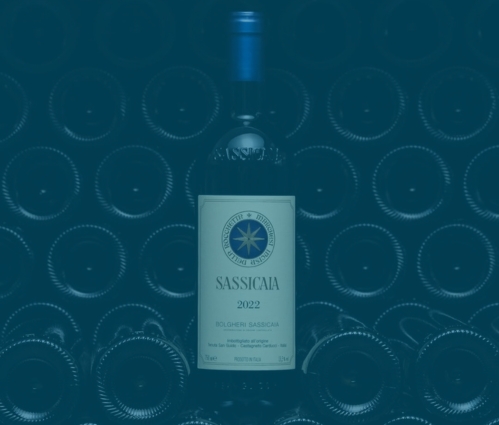
Tignanello is produced by the historic Antinori family, while Sassicaia is the original Super Tuscan from Tenuta San Guido: these two labels lead the way for Italian wine liquidity. Both have proven to be excellent long-term investments and both have shown steady gains over 10 and 15 year periods. Tignanello has the slight edge, up 160% in the last decade.

  • Il Marroneto Madonna delle Grazie

This Brunello di Montalcino is a more niche selection compared to the coastal Super Tuscans. Older vintages of this wine have risen upwards of 500% over the last decade.

  • Soldera Casse Basse

The late Gianfranco Soldera created a cult following for his uncompromising approach to Sangiovese. This is one of the most expensive wines in Tuscany and has benefited from excellent growth, around 300% over the last decade. It remains just below the price of the 100% Merlot icon Masseto.

Piedmont: The “Burgundy of Italy”

Piedmont offers high growth but generally lower liquidity than Tuscany, mirroring the relationship between single-vineyard single-grape variety focus of Burgundy and the larger production volumes in Bordeaux.

  • Comm G.B. Burlotto

The Burlotto family has made wine in Verduno for generations, but their Monvigliero has become a superstar. The wines of Burlotto are a highlight for the region. They have shown growth in the high hundreds of percentage points.

  • Cappellano and Giovanni Canonica

These producers represent a traditional approach to Barolo that has found favour with modern collectors. Both have shown approximately 500% growth over the last decade. These names reflect the rising interest in terroir-driven, traditional Piedmont wine.

  • Gaja

Angelo Gaja is the man credited with bringing Piedmont to the world stage through modernisation and high production levels compared to its regional peers. For investors and collectors, Gaja Barbaresco is a favourite. The wine has risen 100% in ten years, remaining solid since the 2022 market peak. Meanwhile, Gaja’s flagship white, Gaia and Rey, has seen nearly 400% growth over the last two decades.

USA: Cult wines and beyond

Cult wines often dominate the conversation in the United States. However, more mainstream brands have achieved equally impressive returns recently.

  • Ridge Monte Bello

Ridge Vineyards is famous for its non-interventionist winemaking and focus on high altitude sites. They have a large selection of accessible wines, but Monte Bello is their flagship investment-grade label. Prices for Monte Bello are up 140% over the last 15 years.

  • Opus One

Opus One was founded as a joint venture between Robert Mondavi and Baron Philippe de Rothschild. The estate focuses on producing large volumes of a single Grand Vin. This narrow focus has seen values double over the last decade.

  • Screaming Eagle and Realm “The Absurd”

Screaming Eagle is the quintessential Napa Valley cult wine, produced in extremely small quantities. Lesser vintages, in particular, have proven to be strong performers: the 1998 saw 300% growth in the decade to 2021, while the 2011 vintage rose 240% between 2014 and 2021.

Realm Cellars produces “The Absurd” as a blend of their best barrels. It saw prices rise 300% in the decade to 2022.

High performers from other regions

Excellent growth is available outside the most mainstream regions. While liquidity tends to be more limited, these wines are standouts in their respective countries.

  • Valentini Trebbiano d’Abruzzo

Valentini is a reclusive producer in Abruzzo known for creating whites with immense ageing potential. This white is the most searched for Italian fine wine outside of Piedmont and Tuscany and its index has risen 320% in the last decade.

  • Chateau des Tours 

This estate is under the same ownership as Chateau Rayas in Chateauneuf du Pape, but its wines are available at a much lower price. Their flagship, Vacqueyras, is roughly 10% of the price of Rayas, and while it does not achieve the same scores, values have risen 600% in a decade.

  • Vega Sicilia Valbuena 5°

Vega Sicilia in the Ribera del Duero is perhaps the most prestigious estate in Spain and the best known to investors. Valbuena 5° is the younger sibling to the famous Unico, but its performance has consistently bettered its more costly sibling. It is up 47% over five years, 146% over ten years, and 215% over fifteen years.

  • Sadie Family Columella

Eben Sadie is the leading figure in the new wave of South African winemaking. Their flagship, Columella, is up 140% in a decade. This eclipses other famous South African names like Klein Constantia Vin de Constance, up 60% in the same period.

  • South America: Almaviva and Don Melchor

Almaviva is a joint venture between Baron Philippe de Rothschild and Concha y Toro in Chile. Both Almaviva and Don Melchor lead the way in South American investment performance. They have shown growth of around 200% in the last 15 years and 100% in the last decade.

FAQs: Which wines have the best ROI?

Which wine brand has the highest historical growth? 

The highest percentage growth recorded in our analysis is Domaine d’Auvenay Aligote Sous Chatelet, which has seen stunning 11,000% gains over the last 20 years.

Is it better to invest in Bordeaux or Burgundy? 

Bordeaux generally offers better liquidity and larger production volumes, making it easier to buy and sell. Burgundy has shown higher growth but can be more difficult to trade due to limited supply.

What is a ghost wine in the context of investment? 

A ghost wine refers to a label that shows high price appreciation on paper but has very little actual trading volume or physical liquidity in the open market.

How has the US cult wine market performed recently? 

While cult wines like Screaming Eagle have seen significant historical gains, more mainstream brands like Opus One have proven to be more reliable performers in recent years.

Are there profitable wine investments outside of France and Italy? 

Yes, regions like Spain (Vega Sicilia), South Africa (Sadie Family), and Chile (Almaviva) have all produced wines with triple digit percentage growth over the last decade.

WineCap’s independent market analysis showcases the value of portfolio diversification and the stability offered by investing in wine. Speak to one of our wine investment experts and start building your portfolio. Schedule your free consultation today.
Categories
Learn

The ultimate guide to Bordeaux En Primeur

  • Bordeaux En Primeur is a system where wine is purchased while it is still maturing in barrel, typically 18 months before bottling and delivery.
  • The system operates through a unique network of brokers and merchants known as La Place de Bordeaux.
  • Successful participation in the campaign requires a data-led approach, focusing on the relative value of new releases compared to available back vintages.

What is En Primeur wine buying?

En Primeur, also known as wine futures, is the shorthand for an ecosystem of wine producers, negociant, and merchants that allows consumers and investors to buy wine while it is still in the barrel, before the final bottling takes place. 

While other regions do offer En Primeur purchases, the system is best known in Bordeaux. Grapes for the Bordeaux wines are harvested in the autumn and the young wine is offered for sale the following spring. In practice, this means that the 2026 En Primeur campaign is for the 2025 vintage, 2025 En Primeur was for the 2024 vintage etc.

At this stage, the wine is sold while it is a work in progress, unfinished, unblended and still requiring further ageing in the chateau cellars before being bottled and shipped.

Buyers pay a specific release price for the wine, which can be the lowest price the wine will ever see. This is dependent on the chateaux and negociants setting a sensible entry point and markets holding steady or improving. Once purchased, the wine remains at the estate until a few months after it is bottled, which usually happens 18 months to two years after the harvest. 

A short history of Bordeaux wine futures

Like everything in Bordeaux, the roots of the En Primeur system stretch back but the widespread adoption of modern En Primeur sales has its origins in the early 1970s.  

The establishment of En Primeur was prompted by global recession and cash flow issues caused by the 1973 oil crisis. After poor sales of the 1973 and 1974 vintages, merchants and producers were badly in need of money and with 1975’s samples well received, the wine trade found a way to bring forward revenue and sell wines early, funding the next year’s production and labour costs without waiting for the wine to mature.

It was only with later vintages that the economic advantages of En Primeur buying became clear to investors.

How the En Primeur system operates today

The Bordeaux En Primeur market is governed by La Place de Bordeaux and involves three primary players: chateaux, courtiers and negociants. 

  • Chateaux are the winemakers.
  • Courtiers are brokers who act as middle men distributing the wine to a handful of B2B merchants in Bordeaux known as negociants.
  • Negociants then sell the wine to merchants across the globe who in turn sell to their clients.

Chateaux rarely sells directly to retailers or private clients. Instead, they release allocations to a small group of courtiers who then sell them to a slightly larger group of  negociants in France. Even when a chateau has a strong relationship with a merchant like WineCap and wants to guarantee them allocations, that transaction will still go through a negociant.

Every April, the world’s wine trade descends on the city of Bordeaux for the primeur tastings, with journalists, importers, and merchants spending a manic week tasting hundreds of barrel samples often on multiple occasions to assess the quality of the new vintage. Based on these assessments and the general economic climate, the chateaux release their prices over several subsequent weeks, generally through May and June with negociants simultaneously offering dozens of wines to international merchants, who sell to private clients.

Which UK merchants offer En Primeur?

Most reputable fine wine merchants in the UK participate in the annual campaign. This includes historic firms and modern investment platforms. In a high-quality oversubscribed vintage, retailers compete for allocations of the most sought-after wines, with those that buy most broadly getting priority. In poorer vintages, the balance of power shifts with negociants working harder to place their wines. When selecting a merchant, it is vital to choose one with a proven track record, as you are essentially buying a promise of future delivery.

Buying En Primeur with WineCap

Even if you consider yourself a drinker rather than a collector, looking at wine through an investment lens is beneficial. WineCap’s perspective focuses heavily on relative value and our approach is data first. We believe that a purchase should only be made when there is a clear advantage to doing so. In the En Primeur market, this means carefully analysing whether a new release is actually priced better than an available comparable back vintage. 

Thinking about fine wine with an investment perspective will help ensure you get the best value for money from your purchases, even if your end goal is drinking pleasure. Speak to one of our wine investment experts 

How to evaluate En Primeur opportunities

Evaluation begins with critic scores from major platforms and critics like Neal Martin and Antonio Galloni at Vinous, William Kelley and Yohan Castaing at Robert Parker’s Wine Advocate, James Lawther at JancisRobinson.com, Jane Anson or Lisa Perrotti-Brown MW.

The key is to compare the release price of the new vintage against the current market prices of comparable physically delivered back vintages. If a physical wine from a great year like 2019 is available at a similar price to a new release of similar quality, the financial argument for the newer wine is weak.

You need a compelling reason to buy a wine that is less affordable than a comparable vintage already sitting in a warehouse, vintage reputation is a major factor but investors should always be selective. This is particularly the case in vintages where quality varies significantly between estates. In those years, you must focus on specific successes rather than the vintage as a whole. Early on, it looks like the high-quality 2025 vintage will be one of them.

Benefits of buying wine En Primeur

One primary benefit of buying wine En Primeur is guaranteed access in the formats you are looking for. For the most famous chateaux, allocations can be tight and buying wine futures may be the only way to secure a case of the top labels at opening prices. In especially strong vintages releases for a specific wine may come in several tranches often with later tranches being made available at higher prices: the wine trade’s version of dynamic pricing. WineCap would typically not recommend buying second or third tranches. 

Another major advantage is the ability to request non-standard formats. You can order half bottles, magnums, double magnums, or even larger formats at the time of purchase. These formats can be harder to find on the secondary market once the wine is bottled, so if you’re looking for a large format of wine to drink in 20+ years to celebrate an anniversary or the birth of a child, En Primeur may be especially attractive. This is especially important if you are in a wine market where availability is lower and prices higher than in the major markets of the UK and EU.

When the wines are priced correctly, En Primeur can be the best price the wines will ever be. Finally, buying pre-bottling ensures perfect provenance as the wine moves directly from the chateau to a bonded warehouse in an unbroken chain of custody.

Finding price lists and reports

To stay informed on En Primeur, you should subscribe to newsletters and offers from reputable merchants. These provide real time updates on releases and pricing. Major review platforms are key for technical data such as vintage reports and professional critic scores, although merchants will share those with their clients. Critics spend weeks in Bordeaux tasting hundreds of samples to produce the reports that form the market’s understanding of the vintage quality and how it is likely to evolve over time.

Key factors for consideration

Brand power is the most significant indicator of future liquidity. Names like Chateau Latour or Chateau Cheval Blanc have global demand that protects their value, and search rankings on websites like Wine-searcher provide an excellent proxy by which collectors and investors can understand this. 

Overall vintage quality and pricing will dictate the general market mood, but you must also consider the liquidity and quality of the specific label. Some wines are easy to sell at any time, while others may take much longer to find a buyer. Past performance of the estate is also a useful metric.

A good merchant such as WineCap will synthesise all this data before making recommendations to their clients. Speak to one of our wine investment experts.

Risks of buying wine En Primeur

The most obvious risk is that the final quality may not reflect early critic reviews i.e. a wine that scored highly in barrel may not show as well once it is in the bottle. En Primeur scores are generally given in a range, normally of two to three points to reflect this uncertainty.

Prices may also fall. If a chateau releases its wine at too high a cost, the market may reject the price, leading to lower values when the wines become physical and secondary market trading begins in earnest. 

There are also macro-economic considerations. General market volatility can impact luxury assets although that tends to be less significant and delayed for fine wine, and the broad economic climate and the cost of money may impact demand.

Currency fluctuations and fixed prices

Buyers often worry about currency moves between release and delivery; however, for a UK client, changes do not affect the original purchase. You have committed to buy the wine at a fixed price in GBP at the time of the offer and in return your price is fixed so you should not be concerned about changes in exchange rate between the point of purchase and the point of delivery. 

Subsequently a weak pound can sometimes make UK-held stock more attractive to international buyers, potentially increasing its value.

Storage and delivery logistics

When you buy En Primeur, the price you pay is normally ex-VAT and duty. This means the wine is held in bond once it arrives in the UK. The wine will be delivered to a professional bonded warehouse, such as Octavian or LCB, roughly two years after the campaign. 

At this point, you can choose to keep the wine in bond to preserve its investment potential, avoiding the immediate payment of VAT and excise duty. Unless you are able to cellar the wine properly yourself this is normally the best decision as it ensures the wine ages in benign conditions.  

Another less frequently mentioned benefit of in-bond storage is that the necessity of arranging to have a wine delivered to you means more intent is required before consumption. That is to say, you are less likely to drink on a whim and more likely to wait until the wines are at a point where they are truly ready to enjoy before pulling corks. 

Recommended wines for long-term cellaring

Almost any wine released En Primeur will be suitable for at least a few years of ageing. Even relatively humble estates like Chateau Laroque, Les Cruzelles, and Chateau Cantemerle will easily age and improve over the course of 10-20 years and provide excellent drinking pleasure. Top-tier estates, including the First Growths and their Right Bank peers, are built to allow 40 to 50 years of development in a good vintage although they can be enjoyed sooner.

FAQ: Bordeaux En Primeur

Can I buy En Primeur wines online with UK delivery? 

Yes, most UK merchants allow you to purchase online but it’s always a good idea to engage with your account manager ahead of time, especially if you have specific wines of formats in mind. Physical delivery to your home only occurs once the wine is bottled and the duty and VAT have been paid.

What is a negociant?

A negociant is a wine merchant that operates business-to-business offering wines for sale to retail partners operating business-to-consumer.  

When do new vintage En Primeur campaigns typically start? 

The main Bordeaux campaign begins in the spring, usually starting in mid-late April with the tasting week, with prices following in May and June. It is rare that a campaign goes beyond July, but it has been known to happen.

Which regions are most known for their wine futures offerings? 

Bordeaux is the pioneer and by far the best known, but Burgundy, the Rhone, and some producers in Tuscany and California also offer wines En Primeur.

Is buying En Primeur a guaranteed investment?

No, it is not a guaranteed return. Success depends on the quality of the vintage, the value of the release pricing compared to back vintages and market sentiment.

WineCap’s independent market analysis showcases the value of portfolio diversification and the stability offered by investing in wine. Speak to one of our wine investment experts and start building your portfolio. Schedule your free consultation today

Categories
Learn

10 fascinating facts about Chateau Lafite Rothschild

  • Chateau Lafite Rothschild is one of the most sought-after wines in the world for its investment potential.
  • Lafite is frequently described as the most elegant of the First Growths.
  • Lafite vintages like 1982, 2009, and 2010 have achieved iconic status.

Chateau Lafite Rothschild is an undisputed titan of the fine wine world. For many collectors, it is the first name added to a cellar and the last one ever removed. Lafite Rothschild carries a weight that transcends viticulture, representing a fusion of French history, financial stability, and artisanal quality.

Its enduring prestige was recently cemented at a landmark Sotheby’s New York auction, where two 1870 magnums fetched a staggering $306,250.

In the secondary market, Lafite functions as a “liquid currency,” possessing a level of brand equity that few other luxury Veblen goods, let alone wines, can rival. Whether you are a seasoned oenophile or a newcomer to wine investment, understanding this Pauillac legend is essential. 

This guide explores the ten key facets that define the gold standard of this prestigious wine.

1. The storied history of an icon

Lafite Rothschild’s history is a tapestry of royal patronage and resilience. While vines have existed on the site for centuries, the estate gained international prominence in the late seventeenth century under the Segur family. Marquis Nicolas-Alexandre de Segur was known as the Prince of Vines, and he refined the winemaking techniques that put Lafite on the maps of London and Paris.

By the eighteenth century, Lafite was the favourite of the French royal court. It earned the moniker of King’s Wine, largely thanks to the influence of Marechal de Richelieu. Famously Thomas Jefferson, the third American president, became a devoted follower after visiting the region.

The most significant turning point occurred in 1868. Baron James Mayer de Rothschild purchased the estate at a public auction and added his surname to what had previously been “Chateau Lafite”. This acquisition brought the property into the Rothschild family, where it has remained for five generations.

Key historical milestones in the history of Lafite Rothschild include:

  • The 1855 Classification where Lafite was ranked as one of only four original Premier Grand Cru Classes.
  • The devastating phylloxera crisis of the late nineteenth century which tested the estate’s resolve.
  • The occupation of the chateau during the Second World War.
  • The post-war resurgence led by Baron Elie de Rothschild.
  • The modern era of expansion and technical precision under Baron Eric and now Saskia de Rothschild.

2. The unique terroir of Pauillac

Lafite is defined by its terroir, which is arguably the finest in the Médoc, as you might expect given its price point. The vineyard covers roughly 112 hectares making it the largest of the First Growths and is situated on a plateau of deep gravel. This soil type is crucial for Cabernet Sauvignon, as it provides excellent drainage and forces the vines to grow deep roots.

The climate in Pauillac is moderated by the proximity of the Gironde estuary and the Atlantic Ocean, creating a microclimate that protects the vines from extreme frost and excessive heat. The estate manages its land with a focus on biodiversity and long-term sustainability.

Current vineyard characteristics include:

  • An average vine age of approximately 40 years.
  • A high proportion of Cabernet Sauvignon, usually making up 70 percent or more of the vines and an even larger proportion of the Grand Vin.
  • Significant plantings of Merlot, which adds roundness and flesh to the mid-palate.
  • Smaller plots of Cabernet Franc and Petit Verdot for structural complexity.
  • The vineyard is divided into three main parcels, around the Chateau including the  Carruades plateau, and a plot in St Estephe.

3. The different wines of Lafite Rothschild

Key wines from the property are:

  • Chateau Lafite Rothschild (The Grand Vin).
  • Carruades de Lafite (The Second Wine).
  • Anseillan (A newer, plot-specific release).

While the Grand Vin is the primary focus for investors, the estate produces other notable labels. Each wine follows a strict hierarchy of quality and selection. Only the very best parcels are reserved for the top wine, ensuring its longevity and prestige.

Carruades de Lafite is the estate’s second wine, which typically contains a higher percentage of Merlot than the Grand vin and releases at a third of the price. Once viewed as a simple entry point, it has experienced periods of meteoric price rises over the last two decades and is now considered a viable investment asset in its own right. Prices tend to be more volatile than Lafite, but when bought at the bottom of a market cycle and sold at the top it can be highly lucrative. 

The estate also recently introduced Anseillan. This more affordable wine represents a more accessible side of the DBR portfolio and while it will benefit from some age it is not built for long-term cellaring.

4. Lafite within the Domaines Barons de Rothschild

Lafite serves as the flagship for Domaines Barons de Rothschild, commonly abbreviated as DBR. This global wine empire has expanded significantly since the mid-twentieth century. However, Lafite remains the spiritual and financial heart of the organisation.

Under the leadership of the Rothschild family, DBR has acquired prestigious estates across the globe. This includes properties in South America, China, and other regions of France. The technical expertise developed at Lafite is shared across these subsidiaries with staff moving from one to another.

The DBR portfolio also includes:

  • Chateau L’Evangile in Pomerol.
  • Chateau Rieussec in Sauternes.
  • Vina Los Vascos in Chile.
  • Bodegas Caro in Argentina.
  • Domaine de Long Dai in China.

5. The benchmark Lafite Rothschild style

Lafite is frequently described as the most elegant of the First Growths. While Latour is known for power and Margaux for perfume, Lafite is celebrated for its finesse and complexity. It is rarely a wine that shouts; instead, it whispers with profound depth.

On the nose, young Lafite often displays notes of cedar, graphite, and violets. As it ages, these aromas evolve into complex layers of tobacco, forest floor, and truffle. The tannins are famously fine-grained, described by many critics as silky or lacy.

Structural hallmarks of the wine:

  • A core of intense blackcurrant fruit.
  • Distinctive mineral notes derived from the gravelly soil.
  • High natural acidity which ensures decades of ageing potential.
  • Seamless integration of oak, usually 100 percent new French barrels.
  • An extraordinary length of finish that lingers for minutes.

6. The 1982 Lafite vintage and the modern wine era

The 1982 vintage was a watershed moment for the global wine trade. It marked the emergence of Robert Parker as the world’s most influential wine critic. Parker famously touted the 1982 Bordeaux vintage as legendary while many other critics were hesitant.

Lafite Rothschild 1982 received a perfect 100-point score from Parker. This set the stage for the rise of modern wine criticism and the standardisation of the 100-point scale. It transformed fine wine from a niche hobby into a global asset class.

The significance of 1982 includes:

  • The birth of the modern secondary market for investment-grade wine.
  • A shift towards riper, more opulent styles of winemaking across Bordeaux.
  • The massive increase in global demand for First Growth allocations.
  • The establishment of Lafite as the ultimate status symbol in emerging markets.

On a business level, increasing prices allowed Lafite Rothschild and other chateaux to invest in more precise, cleaner winemaking and improved farming practices, in turn facilitating a dramatic improvement in quality in the years that followed.

7. The rise of Lafite Rothschild in China

Lafite Rothschild holds a unique position in the Chinese market. It became the definitive luxury wine during China’s economic boom.

The name is easy to pronounce in Mandarin, which helped its early adoption. Its association with the Rothschild family also appealed to Chinese investors who value heritage and long-term wealth; this demand drove prices to stratospheric levels, particularly for the 2008 vintage.

The impact of the Chinese market led to:

  • A surge in prices for both recent and back vintages.
  • Increased focus on anti-counterfeiting measures and provenance.
  • The creation of the Long Dai estate in Shandong province by DBR.

8. Special bottlings and labels

Lafite occasionally marks special vintages with subtle changes to its iconic label. Perhaps unsurprisingly for Lafite these are not full label changes a-la Mouton Rothschild 2003, gold labels like Angelus 2012 or brightly coloured full bottle canvases like the Taittinger collection.  Instead they are subtle changes, a small embossing here, a glass relief there, commemorating astronomical events, cultural milestones and vintages blessed by the weather gods.

Notable label variations include:

  • The 1985 vintage features a small etching of Halley’s Comet. 
  • The 1999 vintage includes a small star to celebrate the turn of the millennium.
  • The 2005 vintage depicts the sun and rain on a set of scales for the perfect balance of that growing season
  • The 2008 vintage features a red Chinese character for the number eight.
  • The 2018 vintage shows a hot air balloon to mark 150 years of Rothschild ownership.

These bottles often command a premium at auction beyond what their quality would suggest.

9. The best and most expensive Lafite Rothschild vintages

When discussing the best vintages of Lafite Rothschild, critics often point to years where the weather was nearly perfect. Vintages such as 1953, 1959, and 1961 are legendary for their longevity. More recently 1982, 2009, and 2010 have achieved iconic status.

In terms of the financial performance, the most expensive bottles ever sold often have historical significance. A bottle of 1869 Lafite sold in Hong Kong for over $230,000 in 2010. Even older bottles, such as the 1787 vintage allegedly owned by Thomas Jefferson, have sold for record sums.

Top Lafite vintages for investment:

  • 1982: The benchmark for modern investment.
  • 2000: A millennium vintage with immense staying power.
  • 2005: Perfect structural balance.
  • 2012: Great value and already in its depletion phase.
  • 2016: A modern classic with widespread critical acclaim.
  • 2019 and 2020: High-scoring recent years with good value and strong long term potential.
  • 2024: The most affordable vintage on the market.

Such is the strength of the Lafite brand that its not just the best vintages that have been strong investments, in fact quite frequently the opposite has been the case. The 2013 vintage is a perfect example of this: a 90-point score from Neal Martin and 87-89 points while still in the barrel from Robert Parker in his last En Primeur tastings denotes a vintage that was anything but great. However, it was released at very competitive prices and in percentage terms its performance has eclipsed even the famed 2010.

10. The investment reality of Lafite Rothschild

Lafite remains a cornerstone of any serious wine investment portfolio. Its primary strength is liquidity. Unlike niche wines that may be difficult to sell, there is always a buyer for a well-stored case of Lafite.

It acts as a hedge against inflation and broader market volatility. While prices can fluctuate, the long-term trend for First Growth Bordeaux has historically been upward. The scarcity of back vintages ensures that supply continues to dwindle as bottles are consumed.

Key investment takeaways:

  • Blue-chip status ensures high global demand and easy resale.
  • Consistent quality means that even lesser vintages hold their value well.
  • Provenance is vital, as buyers will pay more for professional storage.
  • The estate’s brand power provides a safety net during economic downturns.
  • It remains the ultimate entry point for those seeking long-term capital appreciation.

Chateau Lafite Rothschild is more than just a vineyard – it is an icon of Bordeaux and an enduring symbol of French viticulture. By balancing a deep respect for tradition with modern financial sense, it continues to lead the fine wine market. Whether you hold it for the pleasure of the palate or the growth of your capital, Lafite represents the gold standard of the fine wine world.

FAQ: Chateau Lafite Rothschild

What makes Chateau Lafite Rothschild so expensive?

Lafite’s value is driven by its First Growth status (the highest ranking in the 1855 Classification), its storied history with the Rothschild family, and its massive brand equity in global markets. Its reputation as a “liquid currency” makes it a stable blue-chip investment.

How does the taste of Lafite differ from other First Growths?

While other top wines like Latour are known for power, Lafite is celebrated for its finesse and elegance. It is often described as a wine that “whispers” rather than shouts, characterised by silky tannins and complex notes of cedar, graphite, violets, and blackcurrant.

What is the difference between the Grand Vin and Carruades de Lafite?

The flagship wine is made from the estate’s very best parcels. It is built for decades of aging and is the primary target for high-level investors. Meanwhile, the estate’s Second Wine typically contains more Merlot, is more accessible in its youth, and costs significantly less (usually about a third of the price of the Grand Vin).

Why is Lafite particularly popular in the Chinese market?

Lafite became a preeminent status symbol in China due to several factors: the name is easy to pronounce in Mandarin, the Rothschild heritage aligns with Chinese values of long-term wealth, and the 2008 vintage specifically featured a red Chinese character for the number eight (a lucky number) on the bottle, which drove demand to unprecedented levels.

Which vintages are considered the best for investment?

The “iconic” vintages for both quality and financial performance include 1982, 2000, 2005, 2009, 2010, and 2016. However, “off-vintages” like 2013 have also proven to be lucrative investments because they were released at lower prices and benefited from the overall strength of the Lafite brand.

How can you tell if a Lafite bottle is a special edition?

Lafite uses subtle etchings or embossments on the glass rather than changing the entire label. For example:

  • 1985: Features Halley’s Comet.
  • 1999: Features a star for the millennium.
  • 2008: Features the Chinese character for “8” ().
  • 2018: Features a hot air balloon to mark 150 years of Rothschild ownership.

WineCap’s independent market analysis showcases the value of portfolio diversification and the stability offered by investing in wine. Speak to one of our wine investment experts and start building your portfolio. Schedule your free consultation today.
Categories
Learn

Is wine investing regulated?

  • Wine investment remains outside the direct jurisdiction of the Financial Conduct Authority in the United Kingdom, as physical wine is classified as a tangible asset rather than a financial security.
  • The Alcohol Wholesaler Registration Scheme and HMRC bonded warehouse regulations provide a rigorous framework for provenance and tax efficiency, ensuring the legitimacy of the secondary market.
  • Profits from the sale of fine wine are frequently exempt from Capital Gains Tax due to its classification as a wasting asset, making it a highly attractive component of a diversified portfolio.

The basics of wine investment

Investing in fine wine involves the acquisition of high-quality bottles with the intent of selling them at a higher price as they mature and become scarce. Unlike high street wine intended for immediate consumption, investment-grade wine possesses the ability to improve over decades. 

This category is dominated by a small percentage of global production, primarily hailing from storied regions such as:

  • Bordeaux 
  • Burgundy
  • Champagne
  • Tuscany

The primary drivers of value in this market are critical acclaim, brand heritage, and the quality of the vintage. When a renowned critic awards a wine a high score, global demand can surge. As bottles from that specific vintage are opened and consumed, the remaining supply dwindles, creating a natural upward pressure on price. 

This is the fundamental mechanic of the wine market: it is an asset that is consumed and  disappears over time.

Investors typically choose between purchasing individual cases or building a managed portfolio. The focus is on the blue-chip estates: 

  • In Bordeaux, this includes the First Growths like Château Lafite Rothschild and Château Mouton Rothschild. 
  • In Burgundy, the focus shifts to small production levels from producers such as Domaine de la Romanée-Conti and Domaine Leroy. 
  • In Italy, the market has expanded to include high-performing Italians like Barolo and the Super Tuscans.
  • In Champagne, we see the most recognisable brands in wine with prestige cuvees such as Dom Perignon, Louis Roederer Cristal and Taittinger Comtes de Champagne dominating.  

These wines are not merely luxury Veblen goods; they are liquid assets with a historical track record of outperforming traditional equities especially during periods of market volatility.

Current regulations surrounding wine investment

The regulatory environment for wine investment in the United Kingdom is distinct from that of stocks, bonds, or insurance products. The most significant distinction is that the Financial Conduct Authority does not regulate the sale or management of physical wine portfolios. 

Because wine is a tangible, moveable property, it is treated as a commodity. This lack of FCA oversight means that investors do not have recourse to the Financial Services Compensation Scheme or the Financial Ombudsman Service if a wine investment does not perform as expected.

However, the trade itself is far from a free-for-all. 

To operate legally within the UK, wine merchants and investment firms must adhere to strict HMRC requirements. One of the most vital is the Alcohol Wholesaler Registration Scheme. This scheme requires any business trading in wholesale alcohol to be vetted and approved by HMRC. 

Investors should always verify that their chosen partner holds a valid AWRS number. This tells you that the business has passed a fit and proper test, providing a layer of security regarding the legitimacy of the merchant.

Distance selling regulations also play a role. When wine is purchased online or over the phone, the Consumer Rights Act 2015 applies. These rules govern the right to clear information, states that products must be fit for purpose, and as described.

Collective Investment Schemes represent a different regulatory tier. If an investment firm pools the capital of multiple investors to buy a shared interest in a large cellar, this may be classified as a CIS. 

In such instances, the manager of the scheme must be authorised and regulated by the FCA. Investors must distinguish between owning specific, identifiable cases of wine in their own name and owning “units” in a fund. The former is a direct commodity investment, while the latter is a regulated financial activity with its own advantages and disadvantages

Comparing wine investment regulations across different regions

The UK is widely considered the global hub for wine investment, largely due to its sophisticated bonded warehouse system. In the UK, wine can be stored “In Bond,” meaning VAT and excise duty are suspended as long as the wine remains in an HMRC-approved facility. This system is highly regulated and provides an impeccable paper trail for provenance.

This is why most wine investment companies store their wine in the UK regardless of the country they operate in.

In the European Union, regulation is often tied to the production side through the Protected Designation of Origin system. These laws dictate exactly how a wine can be made, which grapes can be used, and the maximum yields allowed. 

While this is a form of agricultural regulation, it serves investors by strictly limiting supply. For example, the DOCG rules in Barolo ensure that the “King of Wines” cannot be mass-produced, thereby protecting its investment value. 

The United States presents a more fragmented regulatory picture due to the three-tier system established after Prohibition. This system requires a strict separation between producers, wholesalers, and retailers. 

Regulation is handled both at the federal level by the Alcohol and Tobacco Tax and Trade Bureau and at the state level. 

For an investor, the US market can be complex because laws regarding the shipping of alcohol across state lines vary wildly. Some states allow direct-to-consumer shipping from out-of-state retailers, while others strictly forbid it. This can impact the liquidity of an investment, as the pool of potential buyers may be restricted by geography and explains why US based wine investment companies still tend to store their wines in the UK.

The risks and benefits of investing in wine

The most lauded benefit of wine investment is its role as a diversifier. Fine wine historically shows a low correlation with the FTSE 100 or the S&P 500. When the stock market suffers a downturn, wine prices tend to remain stable or even increase, as collectors seek hard assets to preserve wealth.

Tax efficiency is another major advantage for UK residents. HMRC typically classifies wine as a “wasting asset.” which means it has a predictable useful life of less than fifty years. 

Because wine is a living product that eventually spoils, it often falls into this category. Consequently, profits made from the sale of wine are usually exempt from Capital Gains Tax. 

Furthermore, if wine is held in bond, the investor avoids paying the 20 per cent VAT and the alcohol duty that would be due if they took physical delivery.

The risks include:

  • Liquidity: you cannot sell a case of Petrus as quickly as you can sell a share in Apple. The process of finding a buyer and executing a trade can take weeks. 
  • Physical damage: Wine is sensitive to temperature, light, and vibration. Without professional storage, the value of the investment can vanish. 
  • Market trends can be fickle: A region that is fashionable today may not hold its value as a long-term investment compared to the established stalwarts.

The importance of authenticity and provenance

In a market where a single bottle can command thousands of pounds, the threat of counterfeiting is a reality although less significant than in the past. For the modern investor, protecting against this risk is a matter of rigorous due diligence regarding provenance.

Provenance is the documented history of a bottle’s ownership and storage conditions. The gold standard for provenance is bonded status. When wine stays within the bonded system, it is never handled by the public, and its journey from the vineyard to the warehouse is tracked and verified. This bonded status is what future buyers pay a premium for.

Authenticity is also being bolstered by technology. Many top estates now use Prooftag seals, which provide a unique digital thumbprint for every bottle. Others are embedding microchips in labels or using laser-etched serial numbers on the glass. When buying through a reputable merchant, the investor relies on the expert inspection of the house specialists who check for correct cork markings, glass weight, and label typography. 

The clear history that in bond status grants is what makes a wine valuable as an investment.

Future trends in wine regulation 

The future of wine investment regulation and trading is likely to be defined by increased transparency and digital integration. As global authorities tighten anti-money laundering regulations, the wine trade will see more stringent “Know Your Customer” requirements. This will likely move the trade further away from the opaque reputation of the past and into a more standardised financial environment.

Blockchain technology is another emerging trend. By creating a digital twin of a physical bottle on a blockchain, merchants can provide an immutable record of ownership and provenance. This could allow for the “tokenisation” of wine, where investors buy shares in a specific high-value barrel or cellar. While this is an interesting frontier, it replicates existing assurances implicit in bonded status and in practical terms may actually limit liquidity.

Sustainability is also moving from a niche interest to a value driver. Investors as well as drinkers are increasingly looking for assets that not only appreciate in value but also adhere to ethical production standards, suggesting that the “Green Revolution” will soon have a permanent seat at the table of the fine wine trade.

FAQ

Is my wine investment protected by the FCA?

No, physical wine is not a regulated financial product in the UK. You should only trade with merchants who are registered under the Alcohol Wholesaler Registration Scheme to ensure they meet HMRC’s standards.

Do I have to pay tax on my wine profits?

In the UK, wine is generally regarded as a “wasting asset” by HMRC, which means it is usually exempt from Capital Gains Tax. Additionally, if you keep your wine in a bonded warehouse, you do not have to pay VAT or excise duty. You should consult a tax professional for advice specific to your circumstances.

Why is “In Bond” storage so important for regulation?

Storing wine in an HMRC-approved bonded warehouse ensures the wine is kept in perfect conditions and provides assurance of its provenance. It also allows for the suspension of taxes, which improves the liquidity and resale value of the asset.

What are the rules regarding collective wine investments?

If you are investing in a fund where capital is pooled and the assets are managed by a third party, this may be considered a Collective Investment Scheme. Under these circumstances, the firm managing the fund must be authorised and regulated by the FCA. Always clarify whether you own the physical bottles or a share in a scheme.

WineCap’s independent market analysis showcases the value of portfolio diversification and the stability offered by investing in wine. Speak to one of our wine investment experts and start building your portfolio. Schedule your free consultation today.
Categories
News

Bordeaux 2025 En Primeur: Quality meets a market at the crossroads

  • Bordeaux 2025 is a low-yield, heat-shaped vintage delivering concentration, freshness, and a clear shift toward precision viticulture.
  • Early reports point to a high-quality vintage with the potential to rival benchmark years like 2010 and 2016.
  • Set against a cooling market, the En Primeur campaign represents a critical opportunity to reset expectations around pricing and value.

From April 20th to 23rd, 2026, Bordeaux welcomed thousands of merchants, critics, and collectors for the En Primeur tastings of the 2025 vintage. Shaped by intense heat and reduced yields, the new vintage reflects a growing emphasis on precision viticulture – an approach that could come to define Bordeaux’s modern identity.

Yet the usual energy surrounding En Primeur unfolds against a more cautious economic backdrop. Bordeaux finds itself in a period of recalibration. As the first in-barrel scores emerge and the campaign gathers momentum, attention turns not only to what sets the 2025 vintage apart, but also to whether this release can offer real value.

A note on Bordeaux En Primeur

Few moments in the fine wine calendar carry the weight of En Primeur week. Orchestrated by the Union des Grands Crus de Bordeaux (UGCB), the event sees chateaux open their doors to professionals eager to sample wines just months after they were harvested.

Unlike the bottled wines, the En Primeur wines are still unfinished, first presented while ageing in oak. Tasting from barrel requires an expert palate to see through the raw tannins and vibrant acidity to glimpse the potential for greatness years down the line. It is a period of masterclasses, technical presentations, and intense market discussion that signals the pricing direction for the entire year ahead.

The 2025 represents a fascinating stylistic shift. Despite the heat, alcohol levels are reportedly low to moderate. The wines have pronounced aromatics, silky tannins and brisk acidity – hallmarks of great ageing potential. 

Bordeaux 2025: What we know so far

Bordeaux weather and crop reports indicate that 2025 was a year of climatic extremes, resulting in high quality but notably low yields. In fact, production statistics show that 2025 is the smallest crop since the frost-bitten 1991, with yields across many top appellations falling 15-30% below the five-year average.

A season of heat and superb ripening

The growing season was defined by a warm spring and a blistering summer. June 2025 was recorded as one of the hottest in French history, second only to the infamous 2003. This heat, combined with a dry August, led to:

  • Smaller berries: The lack of water and high heat restricted grape size, leading to intense concentration and thick skins.
  • Exceptional phenolic ripeness: While the yields are small, the quality of the tannins is reportedly superb.
  • The “rain of relief”: Just as drought stress became critical, rain in late August and early September refreshed the vines, preserving essential acidity and preventing alcohol levels from spiralling out of control.

Regional highlights

  • The Left Bank (Médoc, Pauillac, St-Julien): The deep-rooted old Cabernet Sauvignon vines thrived, producing structured, age-worthy wines reminiscent of 2022 but with a touch more freshness.
  • The Right Bank (St-Émilion, Pomerol): Clay and limestone soils held onto moisture better than gravel, allowing Merlot to reach lush ripeness without excessive heat stress.
  • Dry whites: Harvested early in mid-August, these show vibrant acidity and tropical aromatics.

The Bordeaux market: The recalibration phase

While the 2025 quality is expected to be high once critic scores are released, the market mood is best described as unsettled. For decades, Bordeaux held an unchallenged dominance in the fine wine market. Recent years have seen a cooling of demand, especially for young releases.

The challenges

  • Increased competition: High-quality rivals from Burgundy, Tuscany, Napa Valley, and even emerging regions have eaten into Bordeaux’s traditional market share.
  • Pricing fatigue: Consistent price hikes in recent En Primeur campaigns – often regardless of the broader economic climate – have tested the loyalty of even the most dedicated collectors.
  • Stock overhang: Many merchants are currently carrying significant inventories of recent great years (2018, 2019, 2020), which has created a bottleneck in the secondary market.

The silver lining

Despite these headwinds, the appetite for older, physical vintages remains robust. There is a clear divergence in the market: while younger vintages (2021-2023) struggle for traction, back vintages from the mid-2000s and 2010s continue to see steady price appreciation. This suggests that the brand of Bordeaux is as strong as ever. The issue lies specifically with release pricing.

Buying wine En Primeur: The question of value

For decades, the “golden rule” of Bordeaux was that En Primeur represented the lowest price point for a wine’s entire lifespan. Today, that assumption is being challenged by data.

Looking at prices at release versus now, several recent vintages can be found on the secondary market for the same price or even less. This has shifted the focus from buying everything to selective acquisition based on specific brand value. Tools like Wine Track, which show the historic performance of specific wine brands, can help investors understand long-term trajectories.

Why data matters

In the 2025 campaign, savvy buyers will be looking for relative value. If a 2025 release is priced higher than a physical, high-scoring 2019 or 2020 vintage currently sitting in a merchant’s warehouse, the incentive to buy En Primeur diminishes. However, because the 2025 yields are so low, scarcity may drive demand for the top-tier “blue chip” estates (the First Growths and their Right Bank equivalents).

The 2025 Bordeaux En Primeur verdict

As critics release their first scores over the coming weeks, all eyes will be on the “price-to-quality ratio.” The 2025 vintage has all the hallmarks of a collector’s dream: scarcity, concentration, and classical structure. For the Bordeaux trade, the 2025 En Primeur is an opportunity for a reset. With early reports pointing towards a vintage that could rival the greats of 2010 or 2016, the quality is likely there.

If the châteaux can marry this quality with a pricing strategy that respects the current market reality, 2025 could mark the beginning of a vibrant new chapter for the world’s most famous wine region.

Bordeaux comment: UGCB President, François-Xavier Maroteaux speaks to WineCap

WineCap: The 2025 vintage promises high quality, yet it arrives as the secondary market has just started to recover from a five-year low, and growing geopolitical tensions discourage speculation and might isolate certain market segments. How do you intend to position the 2025 launch so it doesn’t just survive the current market, but actually revitalises the ‘Bordeaux Brand’ globally?

François-Xavier Maroteaux: The 2025 vintage is a genuine opportunity – but only if we use it wisely. First, pricing must be honest: release prices that ignore five years of secondary market correction damage trust more than they protect margins. A well-priced great vintage is far more powerful than an overpriced one. Second, the narrative must move beyond scores – 2025 has a compelling story of terroir and style that needs to reach consumers directly, not just through trade press. Third, our négociants are brand ambassadors, not just a distribution channel: the properties that genuinely invest in informing and equipping their partners will see it reflected in every market. Finally, the retreat of speculative demand is not a threat – it’s a rebalancing. Bordeaux built its reputation on wine people actually wanted to drink. Refocusing on that is not a concession to difficult times. It’s a return to what made the region great. 

WC: Where do you see the biggest interest in buying Bordeaux at release in the coming years?

FXM: The interest in buying Bordeaux at release remains genuinely global. The best proof of this is the En Primeur week itself: every year, wine professionals from more than 80 nationalities make the journey to taste and buy. That breadth of engagement, even in difficult market conditions, is a strong signal that the foundation is there. Beyond geography, there is another compelling reason to buy at release that we shouldn’t underestimate (and we should be communicating much more actively!): formats. En Primeur remains the best – often the only – window to secure large formats. Magnums, double magnums, imperials are allocated at release and rarely available later at any price. The opportunity is to refocus En Primeur on what it does uniquely well: access, formats, and relationship. That’s a proposition that holds regardless of geopolitics.

WC: Is the En Primeur system still going strong, in your personal view? Do you believe it still offers a genuine win-win? Has it become a luxury-only club for the top 50 estates?

FXM: Yes, I do believe the En Primeur system still works – but I think we need to be honest about what it has become. It works very well for a relatively narrow group of estates where brand strength and secondary market liquidity reinforce each other. For the broader Bordeaux pyramid, it is more complicated. That said, I don’t think the answer is to abandon the system. The answer is to make the win-win genuine again. That means pricing with discipline, communicating with transparency, and making sure négociants and merchants actually make money when they support a release. When that alignment exists, En Primeur is a unique and powerful tool. When it doesn’t, it becomes – as you say – a luxury club for the top names. 

FAQ: Everything you need to know about Bordeaux En Primeur

What does “En Primeur” mean?

En Primeur is a method of purchasing wine while it is still maturing in the barrel. This allows collectors and investors to secure highly sought-after wines before bottling and general market release. This typically happens two years after harvest.

When is the Bordeaux 2025 En Primeur week?

The official tasting week for the 2025 vintage takes place from April 20 to April 23, 2026. During this time, international critics and trade professionals sample the wine from barrel to determine early scores and quality ratings.

Is the 2025 Bordeaux vintage good?

Bordeaux 2025 is a high-quality vintage with intense concentration and bold fruit profiles.Yields are lower than average, which often results in wines with significant ageing potential and structural density.

Why are yields low for the 2025 vintage?

The 2025 growing season saw record-breaking heat and extended dry periods. While this led to exceptional grape ripeness and thick skins (tannin), it resulted in smaller berries and less juice. These lower yields often drive up demand due to the limited number of cases available globally.

Is buying En Primeur a good investment?

Buying En Primeur can be a strategic investment, particularly for top-tier estates (First Growths and “Super Seconds”). However, it is essential to use data-driven insights. While release prices were historically the lowest point of entry, current market fluctuations mean buyers should compare release prices against available physical back-vintages to ensure they are getting true value, as older vintages can often present better buying opportunities than En Primeur.

When is the delivery of the 2025 Bordeaux wines?

In the spring or summer of 2028, following their mandatory ageing period in the châteaux cellars.

What are the “big three” factors to watch in the 2025 campaign?

  1. Critic scores: Initial ratings from major publications will dictate immediate global demand.
  2. Release pricing: How châteaux price their wine in relation to the secondary market.
  3. Volume: With lower yields reported, the scarcity of specific labels will likely be a driver of demand.

WineCap’s independent market analysis showcases the value of portfolio diversification and the stability offered by investing in wine. Speak to one of our wine investment experts and start building your portfolio. Schedule your free consultation today.
Categories
Learn

Understanding the fine wine secondary market: Investing, liquidity and valuation

  • While the primary market is the initial sale from the estate, the secondary market is the global trading ecosystem where wine is treated as a financial asset.
  • Secondary market prices are dictated by supply/demand – as bottles are consumed, the rarity of the remaining vintage drives exponential value growth.
  • Secondary market success relies heavily on professional storage and documented history to ensure investment-grade quality.

For centuries, fine wine has been seen as a treasured collectible; over the last twenty years, it has started to be recognised as a sophisticated alternative asset class too. To understand how wine functions as an investment, one must grasp the mechanics of its lifecycle – specifically the transition from the primary market to the secondary market.

This guide provides an in-depth exploration of the fine wine ecosystem, offering clarity for collectors, investors, and enthusiasts looking to navigate the complexities of global wine trading.

What is the primary market for fine wine?

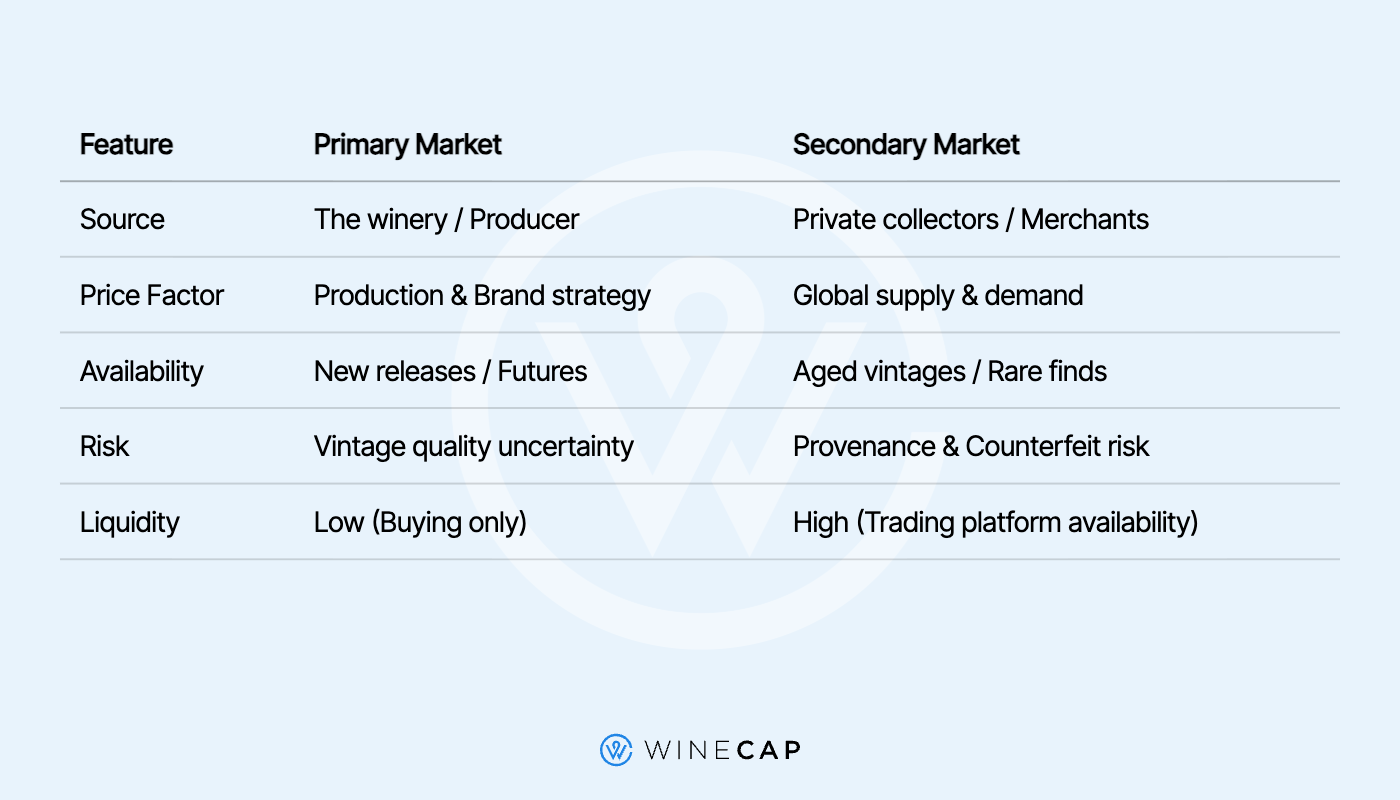
Before diving into the secondary market, we must define its origin. The primary market refers to the first time a bottle of wine is sold after production. In this stage, the transaction occurs directly between the producer (the winery or estate) and the first buyer who could be an individual or a business (i.e. wine merchant).

Key characteristics of the primary market:

  • Direct sourcing: The wine moves from the cellar of the estate to a distributor, importer, or La Place de Bordeaux courtier.
  • Fixed pricing: Prices are typically set by the estate based on production costs, brand equity, and vintage quality.
  • En Primeur (Wine Futures): A hallmark of the primary market, particularly in Bordeaux. Investors purchase wine while it is still aging in barrels, often 12-18 months before bottling. This offers the lowest possible entry price but carries the risk of the wine evolving differently than expected.
  • Allocation systems: For “cult” wines (like Domaine de la Romanée-Conti or Screaming Eagle), primary market access is restricted to exclusive mailing lists or long-standing restaurant partners.

What is the secondary market for fine wine?

The secondary market encompasses all subsequent transactions of a wine after its initial sale in the primary market. Once a bottle leaves the original distribution chain and enters the hands of a private collector, an investment firm, or a specialised retailer, any future sale happens on the secondary market.

Unlike the primary market, where supply is controlled by the winery, the secondary market is driven by supply and demand. As bottles are consumed over time, the remaining supply of a specific vintage diminishes, often driving prices upward – a concept known as “inverse supply elasticity.”

Why the secondary market matters

The secondary market is where “wine” becomes “liquid gold.” It provides:

  1. Liquidity: A platform for collectors to exit their positions and convert wine into cash.
  2. Price discovery: Real-time valuation based on what global buyers are actually willing to pay.
  3. Vintage depth: Access to aged, “library” wines that are no longer available from the producer.

The core components of the secondary market

1. Wine exchanges

The London International Vintners Exchange (Liv-ex) is the “stock exchange” for wine. It provides a standardised platform for merchants to trade, offering price transparency and indices (like the Liv-ex Bordeaux 500) that track market health.

2. Auction houses

Global powerhouses like Sotheby’s, Christie’s, and Zachys dominate the high-end secondary market. Auctions are the primary venue for rare collections and “unicorn” bottles. Online auction platforms have recently democratised this space, allowing smaller collectors to participate.

3. Specialised brokers and investment platforms

Modern fintech platforms allow investors to buy managed portfolios. These entities operate almost entirely within the secondary market, sourcing back vintages with proven provenance.

4. Peer-to-peer and retail re-sales

Specialty retailers often buy back well-cellared collections from private individuals to resell them to other collectors.

Key drivers of secondary market value

What makes a bottle appreciate in the secondary market? It is not just the name on the label.

Provenance and storage

In the secondary market, provenance is everything. A bottle of 1982 Château Lafite Rothschild is worthless if it was stored in a warm kitchen. Buyers look for “ex-cellar” history or professional storage records (bonded warehouses) to ensure the wine has been kept at a constant 12-14°C (55°F) with optimal humidity.

Critic scores

Ratings from “palate-makers” like Robert Parker’s Wine Advocate, Antonio Galloni (Vinous), or Jancis Robinson act as market catalysts. A 100-point score can cause an overnight price surge on the secondary market.

Scarcity and rarity

The secondary market thrives on scarcity. If a producer only makes 500 cases of a particular cuvée, and 200 are consumed in the first five years, the remaining 300 bottles become significantly more valuable to collectors seeking a complete vertical.

Bonded warehouses and “In-Bond” trading

In the secondary market, how you store your wine is as important as the wine itself. Professional investors almost exclusively trade wine “In-Bond” (IB).

In-Bond (IB) vs. Duty Paid (DP)

  • In-Bond (IB): The wine is stored in a government-approved bonded warehouse. It has not yet attracted VAT or Excise Duty. If you sell the wine while it is still “in bond,” you never have to pay these taxes. This increases the profit margin for investors and ensures the wine has never left a temperature-controlled environment.
  • Duty Paid (DP): Taxes have been paid, and the wine has likely been delivered to a private home. In the secondary market, Duty Paid wine often sells at a discount because its storage history is harder to verify.

Expert tip: For maximum resale value, always keep your investment-grade wine “under bond” in a recognized facility like London City Bond.

Secondary fine wine market global trade hubs 

While London remains the historical heart of the wine trade, the secondary market has shifted toward a tri-polar model:

  1. London: The center for technical trading and storage.
  2. Hong Kong: The tax-free gateway to the thirsty Asian market.
  3. Singapore: A growing hub for Southeast Asian high-net-worth individuals.

The “laggard” phenomenon

Fine wine is often described as a “laggard” asset. It does not react instantly to stock market crashes. Usually, there is a 6-to-12-month delay before wine prices reflect broader macroeconomic shifts. This makes it a powerful hedge against inflation and sudden equity volatility.

Secondary market trends: Beyond Bordeaux

Historically, the secondary market was 95% Bordeaux. Today, the landscape is much more diverse:

  • Burgundy: Now represents a massive share of market value due to extreme scarcity and global prestige.
  • Italy: The rise of “Super Tuscans” (Sassicaia, Tignanello) and Barolo has created a robust secondary niche.
  • Champagne: Recently one of the top-performing sectors, as collectors realize the aging potential of prestige cuvées.
  • The New World: Cult Californians (Harlan Estate) and Australian icons (Penfolds Grange) are now staples of global trading.

Risks in the secondary market

Investing in the secondary market is not without peril:

  • Counterfeits: High prices attract fraud. Verification of labels, corks, and glass is essential.
  • Market volatility: Like any asset, wine prices can fluctuate based on global economic conditions.
  • Illiquidity: While more liquid than it used to be, selling a wine collection still typically takes longer than selling a stock.

Primary vs. Secondary Market Comparison

Primary vs Secondary Market Comparison

Frequently asked questions (FAQ)

Is fine wine a good investment?

Fine wine has historically shown low correlation with traditional stock markets, making it an excellent diversifier. It often delivers steady long-term capital appreciation, though it requires patience and proper storage.

What is a “bonded warehouse”?

A bonded warehouse is a tax-secured facility where wine is stored without the owner having to pay Duty or VAT. This is the preferred storage method for the secondary market, as it guarantees professional conditions and makes the wine easier to resell.

How do I check the secondary market price of my wine?

Platforms like Wine-Searcher provide market data. Specialised wine investment companies can provide valuations. Auction hammer prices are also a reliable indicator of current value.

Can individuals sell wine on the secondary market?

Yes, but it is regulated. Most individuals sell through auction houses or brokers who take a commission. Selling directly to another individual often requires specific licensing depending on your jurisdiction.

What is the best way to enter the secondary market?

Most investors start by using a managed platform or a specialised broker. This ensures you are buying wine with perfect provenance and professional storage already in place.

Why do prices fluctuate so much?

Secondary market prices react to critic scores, weather events affecting future crops, and shifts in global currency (the USD/GBP exchange rate is particularly influential).

Can I sell a single bottle?

While possible through online auctions, the secondary market is most liquid for full original wooden cases (OWC). Single bottles often face steeper commissions and lower demand.

WineCap’s independent market analysis showcases the value of portfolio diversification and the stability offered by investing in wine. Speak to one of our wine investment experts and start building your portfolio. Schedule your free consultation today.
Categories
News

Is fine wine investment impacted by wealth exodus?

  • As wealth moves between generations and jurisdictions, investors are prioritising assets with universal value and “borderless” appeal.
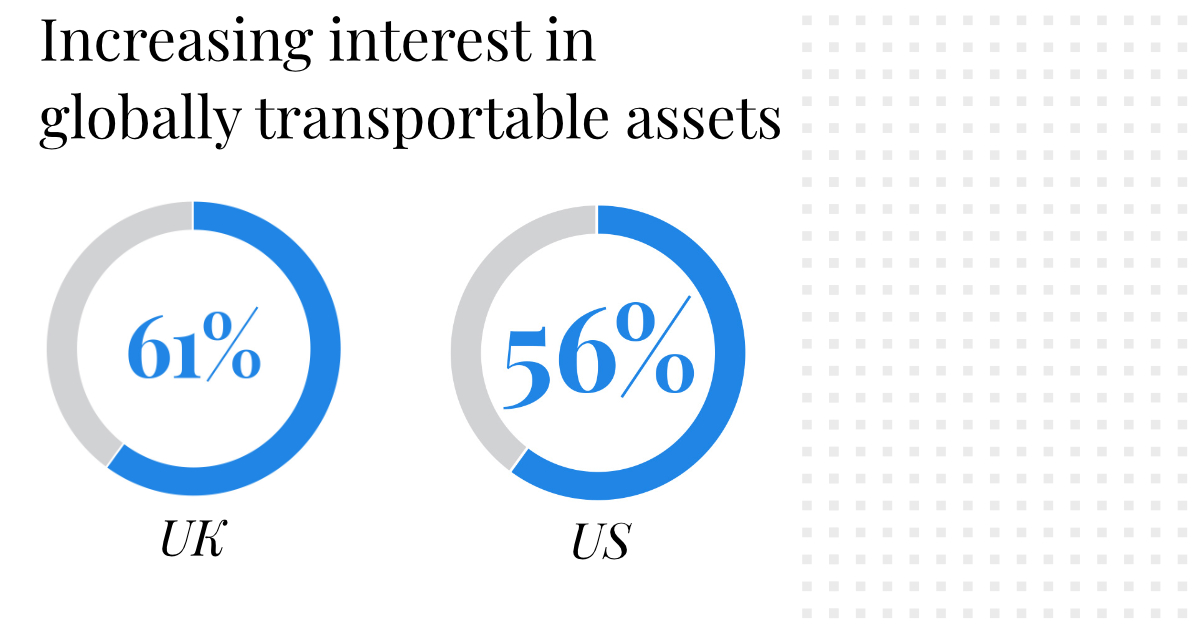
  • About 60% of global investors today show increased interest in globally transportable assets due to political and tax developments.
  • Fine wine can serve as the ultimate “borderless” asset, offering stability and low correlation to mainstream markets.

As the global population of high-net-worth individuals (HNWIs) expands, we are witnessing the cusp of the largest intergenerational wealth transfer in history – all set against a backdrop of profound instability. While private wealth continues to grow, the economic situation of some major countries is weakening, and, consequently, the world is witnessing an unrivalled migration of HNWIs.

This multifaceted shift of wealth is taking place in an unstable global climate, where governments are continually redefining the “social contract” through major reforms and the overhaul of domestic tax regimes. This quest for stability and the safeguarding of assets is prompting a mass relocation of HNWIs that is reshaping traditional “capitals of wealth.”

Findings from the 2026 WineCap Wealth Reports – conducted among hundreds of wealth managers and financial advisors in the UK and US – reveal how this exodus is fundamentally altering the modern investment portfolio. As HNWIs move across borders to escape fiscal tightening and political volatility, fine wine has emerged as a sophisticated, “borderless” financial instrument that could well fit the mobile elite.

Why is wealth moving?

The current exodus is driven by a “perfect storm” of factors that vary by region but share a common goal: capital preservation.

  • In the UK: The term “Wexit” (Wealth Exit) has gained traction following the abolition of the “non-dom” tax status and significant reforms to inheritance tax. Wealthy individuals who once viewed London as a permanent safe haven are now looking toward more tax-favourable jurisdictions.
  • In the US: Movement is driven by a desire to diversify away from domestic political volatility and a weakening reliance on the US Dollar as a singular store of value.
  • Globally: Inflation and high interest rates have made traditional “paper” assets feel increasingly fragile, prompting a flight to tangible quality holdings.

Defining the “borderless” asset

As investors become more mobile, they require assets that share that mobility. A borderless asset is a financial instrument that maintains its value and liquidity regardless of geographical location. Unlike real estate, which is physically anchored to a single jurisdiction, fine wine is recognised and tradable globally.

Fine wine has solidified its role in this exodus due to four key characteristics:

  1. Tangible value: A physical luxury asset with intrinsic worth.
  2. Low correlation to mainstream markets: It operates independently of the “noise” of equity and bond market volatility.
  3. Inherent scarcity: Consumption leads to a permanent reduction in supply. As demand remains steady or increases, prices rise.
  4. Fiscal stability: Fine wine acts as a defensive anchor during periods of high inflation.

Demand for portable asset

A defining trend of 2026 is demand for globally transportable assets. For an investor who is  relocating, an asset that can be stored in a bonded warehouse in one country and sold in another – without the friction of traditional capital flight – is invaluable.

  • UK Context (“Wexit”): With 95% of UK advisors citing fine wine’s status as a “wasting asset” (generally exempt from Capital Gains Tax), it has become a primary tool for “Wexit” planning. Sixty-one per cent of UK wealth managers report that their clients are now explicitly prioritising investments with high portability.
  • US Context: In the US, where 56% of respondents noted a similar priority for mobility, fine wine has evolved from a simple diversifier into a strategic, borderless tool for navigating global wealth transfers.

Since fine wine is not anchored to any single jurisdiction, it allows the modern investor to maintain wealth across borders while avoiding the risks associated with fixed-location assets.

Fine wine’s universal value and fiscal efficiency

The appeal of fine wine is further bolstered by its intrinsic value, which transcends currency fluctuations and regional economic stressors.

  • Currency neutrality: In the US, 98% of wealth managers noted that fine wine’s lack of a direct peg to the USD plays a significant role in its appeal as money moves globally.
  • Tax efficiency: In the UK, 95% of advisors cite its status as a “wasting asset” – which generally exempts it from Capital Gains Tax (CGT) – as a primary driver for its inclusion in sophisticated portfolios.
  • Market maturity: Trading fine wine has become easier than ever before for both buyers and sellers; half of global investors now recognise the sector’s improved liquidity within a well-established, global secondary market.

Deepening capital commitment

The convergence of portability, universal value, and defensive resilience has catalysed a transformation in how capital is committed to fine wine. No longer viewed as a peripheral “passion project” or a speculative hobby, fine wine has solidified its role as a viable alternative asset. This shift can at least partially be attributed to the wealth exodus, as borderless alternatives can offer both stability and growth.

The 2026 WineCap Wealth Reports quantify this deepening commitment, revealing a significant jump in portfolio exposure compared to just twelve months prior. Approximately half of all surveyed wealth managers in the US and nearly half in the UK now report that their clients allocate between 11-20% of their total portfolios to fine wine. This “standard” allocation demonstrates that wine is now being treated with the same strategic weight as traditional alternative mainstays like private equity or hedge funds.

Perhaps the most telling indicator of this trend is the emergence of the “heavyweight” segment – investors who view fine wine as a primary vehicle for wealth preservation during transit. Over a third of respondents in both the UK and US noted that their most committed clients now dedicate between 21-30% of their total wealth to the asset class. To put this in perspective, this represents a tectonic shift in investor behaviour: in 2025, a negligible portion of the market (less than 2% across both regions) held allocations exceeding 20%. 

This deepening commitment is underpinned by growing conviction among the professional advisor community. With a record-breaking 97% of wealth managers forecasting a further increase in demand throughout 2026, the trajectory is clear. 

Fine wine has moved beyond its status as a simple diversifier; it has become the preeminent collectible for a generation of investors who want to preserve, grow, and – most importantly – move their wealth across any jurisdiction on the global map.

WineCap’s independent market analysis showcases the value of portfolio diversification and the stability offered by investing in wine. Speak to one of our wine investment experts and start building your portfolio. Schedule your free consultation today.
Categories
Learn

Bubbles & bull markets: Investing in Vintage Champagne

  • Unlike Non-Vintage (NV) bottles, Vintage Champagne is produced only 3-4 times per decade, creating an inherent supply cap that drives long-term price appreciation.
  • Labels such as Dom Pérignon and Louis Roederer (Cristal) act as market benchmarks, offering high liquidity and global brand recognition.
  • Many investors prioritise Champagne magnums due to slower ageing process and higher premiums. 

For the uninitiated, Champagne is the liquid synonym for celebration. However, for the serious collector, it represents one of the most resilient and rewarding asset classes in the alternative investment world. Moving beyond “party bubbles” requires a shift in perspective – from the high-volume non-vintage (NV) bottles found on supermarket shelves to the rare prestige cuvées that dominate the secondary market.

Understanding the liquid gold: Is sparkling wine Champagne?

Before diving into the financials, every novice must master the terminology. A common entry-point question is: is sparkling wine Champagne? The answer is a matter of strict geography and law. Only wine produced in the Champagne region of France, under the stringent rules of the Appellation d’Origine Contrôlée (AOC), can carry the name. While Italian sparkling wine or Spanish sparkling wine like Cava offers excellent drinking, they rarely command the investment-grade premiums of a Grand Cru Champagne.

The scarcity engine: Vintage vs Non-Vintage

The primary driver of value in this market is the distinction between NV and vintage champagne.

  • Non-Vintage (NV): These are the house styles (e.g., standard Moet and Chandon ) blended from multiple years to ensure a consistent brand profile.
  • Vintage Champagne: Produced only in exceptional years, these bottles are a snapshot of a single harvest. Because they are produced in limited quantities and only 3-4 times a decade, they possess the inherent scarcity required for price appreciation.

The titans of the market: Dom Pérignon and Louis Roederer

If you are looking for the “Blue Chips” of the bubbly world, you must look at the prestige cuvées.

  • Dom Pérignon: As a powerhouse brand , the Dom Perignon price is a frequent benchmark for market health. Investors closely watch the Dom Perignon Champagne price for new releases, often holding them for a decade as the supply dwindles.
  • Louis Roederer: Specifically their “Cristal” label, Louis Roederer Champagne is a staple of elite portfolios.
  • Cult favourites: For those looking beyond the famous houses, labels like Jacques Selosse (often referred to simply as Selosse Champagne ) represent the “grower” movement, where limited production meets astronomical demand in the secondary market.

Size and longevity: Why magnums matter

In the world of investment, Champagne bottle sizes are not just about the volume of liquid. The magnum Champagne (1.5L) is the preferred format for investors. Because a magnum has a lower ratio of air-to-liquid than a standard bottle, the wine ages more slowly and gracefully. Rare large formats, such as the Jeroboam bottle or the massive Nebuchadnezzar, often fetch significantly higher premiums at auction due to their sheer rarity.

Storage and spoilage considerations

A common concern for novices is: “Does Champagne go off?” or “Can champagne go bad?” Unlike spirits, wine is a living product. How long does Champagne last? While a standard NV bottle might only stay fresh for a few years, a vintage Champagne can evolve and improve for 20 to 30 years if stored correctly.

To protect the costly Champagne in your portfolio, professional storage is non-negotiable. Light, vibration, and temperature fluctuations are the enemies of value. An investor must know how to store wine in a temperature-controlled environment to ensure that when it comes time to exit the investment, the provenance is impeccable.

The secondary market: Why the boom?

The most expensive champagne is no longer just for drinking; it is for trading. With the rise of global wealth and a fixed supply of the best vintages, the secondary market for labels like Krug, Salon, and Taittinger (check the Taittinger Champagne price for recent spikes) has seen consistent growth. Champagne often acts as a Veblen good – a luxury item where demand increases as the price rises, further fueling the bull market for the world’s finest bubbles.

Grand Cru and the terroir premium

To truly understand why some bottles command five-figure sums while others languish, the novice investor must look at the soil. Champagne is divided into a strict hierarchy of villages. At the pinnacle are the 17 Grand Cru villages, such as Ambonnay, Bouzy, and Le Mesnil-sur-Oger. These sites represent the absolute best terroir in the region, where the chalky soils and microclimates produce grapes with the highest concentration and acidity – the two vital components for long-term aging.

Below the Grand Crus sit the 44 Premier Cru villages. While still exceptional, the market price for a Grand Cru bottle often grows at a significantly higher rate than its Premier Cru counterparts. For the investor, “buying the label” is often secondary to “buying the land.” When you see a label from a producer like Jacques Selosse, you aren’t just paying for the name; you are paying for access to some of the most coveted Grand Cru plots in the Côte des Blancs. Understanding this hierarchy allows an investor to spot “undervalued” producers who may own vines in the same prestigious villages as the famous houses but have not yet reached their peak market valuation.

How long to hold your Champagne?

One of the most frequent questions from novices is how long to hold their Champagne. To answer this with an investment lens, we must discuss “lees aging.” Unlike most red wines, which age primarily in the bottle, Champagne derives its complexity from sitting on its lees (dead yeast cells) during the second fermentation.

A prestige cuvée like Dom Pérignon or Krug may spend seven to fifteen years in the cellar before it is even released to the public. This “pre-aging” by the house is why the Dom Perignon price is so high upon release; the producer has already absorbed the storage costs for a decade. However, the real “Alpha” for investors happens after release. As bottles are consumed globally, the remaining supply of a specific vintage becomes infinitesimally small. This is the “Scarcity Curve.” A vintage Champagne that was released at £150 may double in value over the next five years simply because 90% of the vintage has been drunk, leaving collectors to scramble for the remaining 10%.

Champagne as a defensive asset

In times of economic uncertainty, wine often acts as a “safe haven” asset. Unlike stocks, which can go to zero, a bottle of Louis Roederer Cristal is a tangible asset with intrinsic value. Historically, the fine wine market – and Champagne in particular – has shown a lower correlation to traditional equity markets.

When inflation rises, luxury goods often see a price surge. Champagne is a classic Veblen good in this regard; as it becomes more expensive, its desirability among the ultra-wealthy increases, creating a self-fulfilling prophecy of price growth. Furthermore, the secondary market for Champagne is more liquid than for many other rare wines. Because brand recognition is so high – everyone knows the names Moet, Bollinger, and Taittinger – it is much easier to find a buyer for a case of Champagne than for an obscure Burgundy.

Navigating the risks

No guide would be complete without a word of caution. As the most expensive Champagne prices continue to climb, the risk of counterfeits rises. Investors must ensure they receive “Original Wooden Cases” (OWC) whenever possible and verify the provenance. A bottle that has been kept at room temperature for five years is functionally worthless as an investment, even if the label is pristine. This is why professional, temperature-controlled storage is the “hidden cost” that ensures your liquid assets don’t turn into expensive vinegar.

FAQ

Is sparkling wine the same as Champagne?

No. While all Champagne is sparkling wine, not all sparkling wine is Champagne. Legally, only wine produced in the Champagne region of France under strict AOC regulations can use the name. 

Does Champagne go off or go bad?

Yes, Champagne is a living product and can spoil if not stored correctly. While a standard Non-Vintage bottle is meant for immediate consumption, a Vintage Champagne can age and improve for 20 to 30 years. However, exposure to heat, light, or vibration can turn a prestige cuvée into “expensive vinegar” and render the investment worthless.

Why is the “Dom Pérignon price” used as a market benchmark?

Dom Pérignon is considered a “Blue Chip” asset due to its massive global brand recognition and consistent quality. Because it is widely traded, its price fluctuations often signal the overall health and sentiment of the Champagne secondary market.

How long should I hold my Champagne investment?

Most experts recommend a holding period of 5 to 10 years after the initial release. This allows the “Scarcity Curve” to take effect; as the majority of the vintage is consumed globally, the remaining bottles become rarer and more valuable to collectors.

What is the best way to store investment-grade Champagne?

Professional, temperature-controlled storage is non-negotiable. To maintain its value and ensure “impeccable provenance” for future buyers, Champagne should be kept at a constant temperature (around 10-12°C) in a dark, vibration-free environment, ideally in its Original Wooden Case (OWC).

Categories
Special-reports

WineCap Wealth Report 2026: UK Edition

Fine wine has continued its transition from a luxury collectible to a critical fiscal anchor for the UK’s wealthiest investors. According to the newly released WineCap Wealth Report 2026, the asset class is seeing an unprecedented surge in professional confidence, serving as a “borderless” hedge against domestic economic volatility and tax shifts.

Drawing on exclusive research from leading UK wealth managers and financial advisors, the 2026 report explores how fine wine is being utilised to navigate a high-inflation environment and a historic exodus of capital from the UK.

Key report findings:

  • 97% of wealth managers expect demand for fine wine to rise in 2026 – the highest level of confidence in the report’s four-year history.
  • Over a third of committed investors now allocate 21-30% of their total wealth to fine wine.
  • 61% of advisors cite portability as a primary driver, as investors seek assets that can easily move across jurisdictions.
  • 95% of advisors highlight fine wine’s status as a “wasting asset” (exempt from Capital Gains Tax) as a core reason for its broadening appeal.
  • 74% of managers believe AI is the primary catalyst for the market’s future, driving new standards in provenance and price transparency.

From passion to portability

The 2026 report highlights a significant evolution in investor behaviour. While 2025 saw a generational shift, 2026 is defined by geopolitical necessity. As High-Net-Worth Individuals (HNWIs) relocate at record rates, the demand for tangible, transportable wealth has skyrocketed. Unlike real estate, fine wine offers “portable liquidity,” maintaining its intrinsic value whether the owner is in London, Geneva, or Singapore.

Resilience in a high-interest world

Despite a high-interest-rate environment, the report reveals a surprising trend: 77% of wealth managers believe rising rates actually support fine wine performance. This “flight to quality” suggests that when traditional markets become volatile, investors retreat to “hard” assets with proven longevity.

The role of Artificial Intelligence

With nearly three-quarters of the industry looking to AI for security, the market is becoming more transparent and accessible than ever before. From verifying centuries-old provenance to real-time global price tracking, AI is providing the institutional-grade confidence that modern wealth managers demand.

The full report further examines the “Great Wealth Flight,” the impact of global trade shifts on risk appetite, and why fine wine is now considered a “fiscal necessity” in a diversified portfolio.

Categories
Special-reports

WineCap Wealth Report 2026: US Edition

Fine wine has officially stepped out of the private cellar and into the heart of the American investment portfolio. According to the newly released WineCap Wealth Report 2026: US Edition, the asset class is experiencing a historic surge in institutional and private interest, repositioning itself as a critical defensive pillar against global economic volatility.

Based on fresh research among US-based wealth managers and financial advisors, the 2026 report reveals an unprecedented shift in how high-net-worth (HNW) individuals are protecting their capital.

Key report findings:

  • A record 97% of US wealth managers expect demand for fine wine to increase in 2026 – the highest level of bullish sentiment recorded in the study’s history.
  • In a major shift, one-third of investors now dedicate 21-30% of their total wealth to fine wine, marking a significant leap from 2025 levels.
  • 81% of advisors now view fine wine as a “fiscal necessity,” valuing it as a borderless asset that remains independent of currency fluctuations.
  • 67% of respondents believe Artificial Intelligence is the primary driver for future market transparency, price discovery, and fraud detection.
  • For the modern investor, values drive value – 55% of investors now cite ESG and environmental credentials as a decisive factor for market entry.

From passion asset to defensive pillar

The 2026 report highlights a professionalization of the market. While wine was once categorized as a “passion asset,” US advisors now prioritize it for its low correlation to traditional markets. As geopolitical uncertainty persists, the “borderless” nature of fine wine – its ability to be moved and traded globally without being tied to a single central bank – has made it an essential component of the “Great Wealth Flight” strategy.

The rise of the green cellar

Sustainability is no longer a secondary concern for US investors. With over half of respondents prioritizing ESG credentials, the report highlights a growing demand for “conscious” viticulture. Investors are increasingly looking for estates that combine world-class heritage with future-proof environmental standards, proving that sustainability and high performance now go hand-in-hand.

Transparency through technology

The “black box” of wine pricing is being opened by AI. Two-thirds of US wealth managers now look to Artificial Intelligence to provide the institutional-grade security once missing from the sector. According to the survey data, technology is providing the confidence needed for advisors to recommend higher portfolio allocations than ever before.

The full report further explores the impact of interest rate hikes on tangible assets, the growing demand for collectibles, and why fine wine is now considered a “fiscal necessity” in a diversified portfolio.