Categories
Quarterly-reports

Q1 2026 Fine Wine Report

In our first quarterly summary for the year, we look at how global geopolitical instability has affected demand for safe-haven assets and how fine wine is poised to benefit. We also examine the pricing strategy of recent releases through La Place de Bordeaux, and what this tells us about the state of the market and how it sets the tone for the upcoming En Primeur campaign. Beyond the news headlines, we deep dive into this quarter’s top performers – wines that have shown resilience and, in some cases, double-digit returns.  

Key findings: 

  • Geopolitical instability in the Middle East has driven a “flight to safety” among investors. As a tangible hedge against inflation and market volatility, fine wine is keenly poised.
  • New releases from Yquem, Latour, and Bollinger have combined high quality with keen pricing strategies that prioritise market liquidity.
  • Bordeaux accounted for 80% of the quarter’s top performers, led by Sauternes and Barsac.
  • A consistently increasing bid:offer ratio throughout Q1 suggests the secondary market has established a solid floor and is seeing defensive growth entering Q2.  
  • Landmark trade deals in India and Europe are redirecting global liquidity, creating a structural foundation for long-term demand growth in the East.
  • A new record-breaking auction result set by DRC 1945 at $812,500 highlighted the unprecedented value the market continues to place on rare, historic assets.

Executive summary

The first quarter of 2026 was a tale of two halves, beginning with a surge of renewed market optimism that quickly collided with a transformative geopolitical crisis. The year opened with the FTSE 100 hitting historic milestones and a “Goldilocks” cooling of inflation, but the upward trajectory of mainstream markets was abruptly severed by the outbreak of the war in Iran and the subsequent closure of the Strait of Hormuz. The conflict triggered an immediate and aggressive “flight to safety,” sending gold and the U.S. Dollar to premium levels, simultaneously forcing a dramatic repricing of global energy and supply chain risks. 

As markets continue to grapple with a destabilised Middle East and investors look to navigate heightened volatility, assets that offer both tangibility and independence from traditional market shocks like fine wine can be uniquely positioned to benefit.

According to our annual wealth management survey (full results to be released next week), 50% of US and 35% of UK respondents believe that global conflict actually helps fine wine perform during periods of market volatility in the sense that it highlights fine wine’s role as a psychological and financial refuge. Fine wine’s physical nature provides a sense of security that digital or equity-based assets cannot replicate in a climate of uncertainty. 

While fine wine operates on its own internal dynamics, the signs of a market recovery from within have been highly encouraging. The bid:offer ratio has continued to rise throughout the quarter, signalling increased demand and growing liquidity – both of which have underpinned price stability. As our report explores, while broader market indices remain steady, select high-performing labels have already registered double-digit returns this quarter.

Perhaps the most encouraging sign of optimism has been the sensible pricing of new releases. Vintages that offer clear relative value compared to back-catalogue stock are reinvigorating buyer appetite and restoring long-term trust. This disciplined approach to pricing sets a constructive tone for the upcoming Bordeaux En Primeur campaign – the defining event of Q2 – which we anticipate will be a critical barometer for the market’s direction in the months ahead.

What new wine releases tell us about the state of the market?

While the global economy faces external shocks, the fine wine market is providing its own internal “green shoots”. The narrative of the last six months has been one of adjustment and acceptance. We are seeing a concerted effort from major estates to meet the market where it is, rather than where they wish it to be.

This trend arguably began last summer with Taittinger Comtes de Champagne Rosé  2012. Offered at what many consider the low point of the recent market cycle, it was the first major release priced with enough sensitivity to reinvigorate trade. That successful launch set a precedent that we are now seeing echoed across the board in the 2026 Spring releases from giants like Bollinger, Yquem, and Latour.

The “Yquem Factor”: Quality meets stability

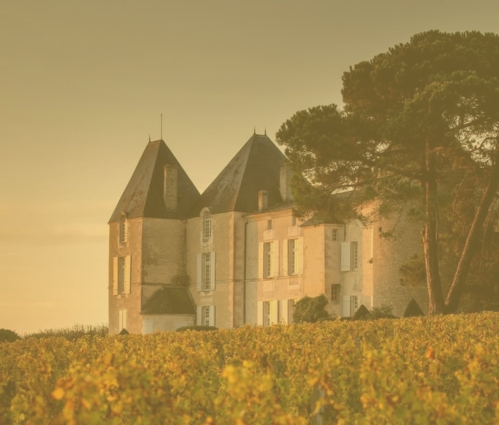
The recent release of Château d’Yquem serves as a primary example of how tangibility and quality are driving the current “flight to safety.” With a rare unanimity of 100-point scores from Wine Advocate, James Suckling, and Vinum, this “epochal” vintage is being compared to the legendary 2001. However, by coming to market at roughly 50% of the price of its 2001 peer, Yquem is offering a clear value proposition in a volatile world. This sensible entry point, combined with the fact that our Wine Track Yquem index has remained remarkably stable since early 2025, highlights the region’s role as a resilient financial refuge.
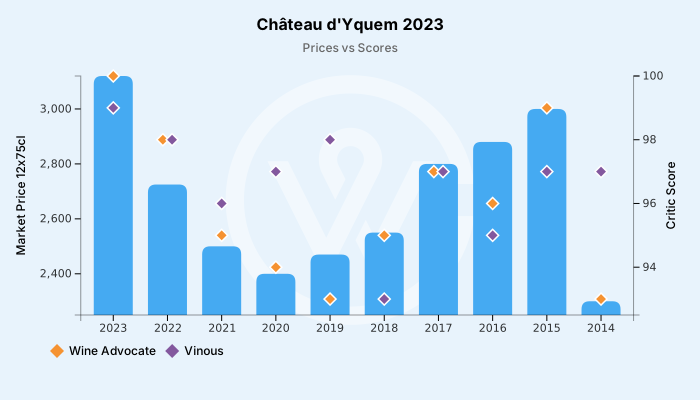
chateau yquem 2023 wine prices

Latour 2019: The benchmark for “keen” pricing

The momentum has reached a crescendo with the release of Château Latour 2019. While critics like William Kelley describe it as a “profound wine in the making,” its true significance lies in its pricing strategy. Released at a more accessible level than any comparable back vintage, it sits 15% lower than the 2016, even as prices for the 2009 and 2010 vintages have begun to climb. By pricing the 2019 to offer immediate relative value, Latour is successfully reinvigorating trade and setting a disciplined, optimistic tone for the upcoming campaign in the region.
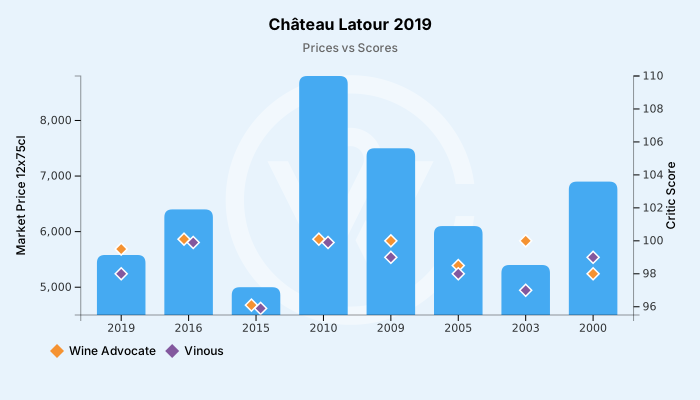
chateau latour 2019 wine prices

Bollinger La Grande Année 2018: Value in Champagne

Outside of Bordeaux, Champagne house Bollinger released its 2018 La Grande Année Brut and Rosé this March.  As the first of a trio of exceptional warm vintages – drawing comparisons to the legendary 1988–1990 run – the wine arrives with significant critical weight. Boasting a 96-point score from Antonio Galloni (Vinous), the 2018 notably outperforms the prestigious 2002 and 2012 editions. Crucially, Bollinger has matched this high quality with an aggressive pricing strategy, entering the market at an approximately 15% lower cost than the most recent 2015 release. The competitive price point of the house echoes the strategy seen with Latour and Yquem, proving that producers across the board understand the importance of liquidity and building buyer trust.
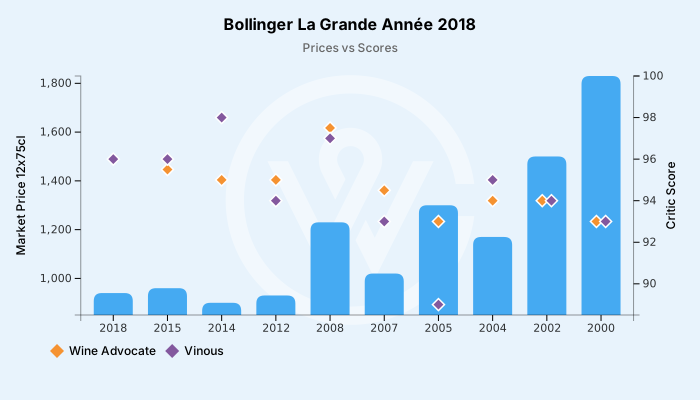
bollinger grande annee 2018 champagne

Acceptance of the “new reality”

These releases signal a significant shift in the primary market. By pricing new vintages to offer relative value against existing back-stock, estates are rebuilding trust and liquidity. This discipline is being mirrored in the secondary market, where we are seeing:

  1. Improved trade volumes: A rising bid:offer ratio across the major exchanges.
  2. Sustained stability: A “floor” has been established, allowing for the double-digit returns seen in our top-performing wines this quarter.

This environment of sensible pricing and high critic consensus sets a highly optimistic tone for the upcoming Bordeaux En Primeur campaign. It suggests that the market has not just stabilised, but is actively preparing for its next growth phase.

The best-performing wines of Q1 2026

While the broader market has focused on stability, a selection of labels has delivered exceptional year-to-date (YTD) growth. The first quarter was unequivocally dominated by Bordeaux, which accounted for eight of the top ten performers, showcasing the region’s enduring appeal as a primary destination for “flight to safety” capital.

The resurgence of Sauternes and Barsac

The most striking trend of Q1 has been the performance of Bordeaux’s sweet wines. Chateau Rieussec 2021 led the market with a remarkable 55.6% YTD increase, further supported by its 2013 vintage, which grew by 22.1%. This positive momentum can be tied to buyers finding value in back vintages in light of more expensive recent Rieussec releases. This trend extended to Barsac, where Chateau Coutet 2016 and Chateau Climens 2012 both posted gains near 20%. This suggests a significant re-rating of the sector as investors seek out high-quality wines that may have been previously undervalued.

Blue-chip resilience

Beyond the sweet wine categories, Right Bank powerhouses and elite Left Bank estates showed defensive strength:

  • Chateau Lafleur 2016 saw a significant jump of 33.6%, reinforcing its status as a collector favourite with high scarcity value.
  • Pavillon Rouge du Chateau Margaux 2013 and Chateau Haut-Bailly 2021 both delivered a robust 25% return, proving that quality second wines and top-tier Cru Classé estates remain resilient despite the wider geopolitical “re-pricing.”

Diversification beyond Bordeaux

Outside of France, top-tier international labels also found favour. Italy’s Giacomo Conterno, Barolo Monfortino Riserva 2005 rose by 21.0%, while California’s Dominus 2017 represented Napa Valley with a strong 20.1% gain.
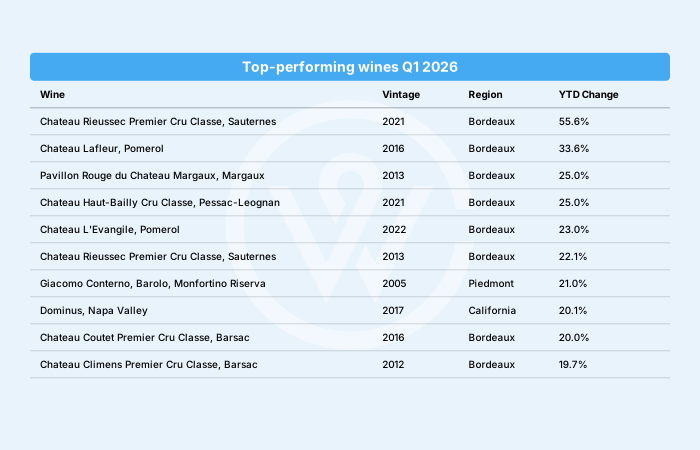
top performing wines quarter 1 2026

New wine auction record

Perhaps the most significant wine event in Q1 came from the auction room, which saw a new record broken for the most expensive wine ever sold. In a definitive display of the market’s appetite for rare, tangible history, Acker Merrall & Condit auctioned a single bottle of 1945 Domaine de la Romanée-Conti (DRC) Romanée-Conti for a record-breaking $812,500 (including buyer’s premium).

This sale shattered the previous world record for a standard 75cl bottle, set in 2018. As one of only 600 bottles ever produced from this “unicorn” vintage – harvested at the close of WWII and just before the vineyard’s vines were pulled for replanting – the 1945 DRC represents the pinnacle of provenance and scarcity. The new record is a powerful reminder that even amidst geopolitical uncertainty, the world’s most historic and tangible assets continue to command unprecedented value.

Q1 wine tariffs update

A significant theme this past quarter was the shifting landscape of global wine tariffs, ranging from US policy changes and the landmark India trade deal to the evolving terms for Australian wine imports into Europe.

The US “tariff reset”

The US market began the quarter in a state of regulatory flux. In February, the Supreme Court struck down previous “emergency” tariffs as unconstitutional, only for the executive branch to immediately pivot to Section 122 of the Trade Act. This imposed a new 10% baseline tariff (with threats to rise to 15%) on almost all imported wine.

  • The market impact: While this has created a “wait-and-see” approach among some US collectors, the secondary market has proven remarkably resilient. Unlike previous cycles, the market is no longer solely dependent on a hyper-active US base; instead, it is being bolstered by robust demand from Europe and Asia. Furthermore, US buying activity has shown improvement compared to the same period last year, suggesting that seasoned collectors are looking past the “noise” of temporary duties.
  • The opportunity: These new tariffs are temporary by design, set to expire in late July 2026 unless extended by Congress. This 150-day window has paradoxically increased the appeal of existing “pre-tariff” stock already held in US warehouses, while the broader global market continues to find its floor through diversified international trade.

India: The next great frontier

Perhaps the most significant long-term development for the fine wine market is the newly signed EU-India and UK-India trade deals. For nearly two decades, India’s 150% federal import tariff has stood as the single greatest barrier to entry for the world’s most prestigious estates.

  • The update: Under the new agreements, tariffs on premium EU and UK wines are being slashed from 150% down to 100% immediately, with a glide path to 25% over the next decade for bottles meeting specific price thresholds.
  • The impact: While this policy change is unlikely to transform the market overnight, it represents a massive structural milestone. With India’s middle class projected to comprise 60% of the population by 2047, this tariff reduction provides the necessary foundation for India to eventually rival China as a primary pillar of global fine wine demand. By lowering the cost of entry, these deals open a vital new channel for liquidity and diversification at a time when traditional Western markets are facing increased volatility.

EU removes tariffs on Australian wine imports

Following years of friction, Australia and the EU finalised a Free Trade Agreement (FTA) in late March. This deal effectively removes almost all EU import tariffs on Australian wine – a move expected to save Australian exporters roughly $37 million annually.

  • The trade-Off: In exchange for zero-tariff access, Australia has agreed to protect 1,600 EU Geographical Indications (GIs). Most notably, Australian producers will phase out the use of “Prosecco” on export labels over the next ten years.
  • The benefit: This agreement levels the playing field for Australian “fine wine” exports into Europe, allowing high-end producers from regions like Margaret River and the Barossa to compete more aggressively with European counterparts on price.

Why this matters 

As global trade becomes more fragmented, these shifts are redirecting the flow of fine wine. While US demand is temporarily throttled by domestic policy uncertainty, the “opening up” of India and the streamlined EU-Australia trade route suggest that liquidity is shifting toward the East and the Commonwealth.

Fine wine outlook for Q2 2026

The global macro environment remains defined by heightened uncertainty. With the conflict in the Middle East continuing to disrupt energy corridors, global inflation has seen a resurgence. In this high-inflation environment, the case for fine wine as a proven inflation hedge and a “tangible” store of wealth has rarely been more compelling. Unlike traditional equities, which remain sensitive to fluctuating interest rates and energy-driven volatility, fine wine’s historical low correlation to mainstream markets is expected to remain its greatest strength throughout the spring.

The Bordeaux 2025 En Primeur campaign

The defining event for the wine trade will be the Bordeaux 2025 En Primeur campaign (April–June). Following the “keen” pricing strategies established by Latour and Yquem in Q1, the industry mood is one of cautious optimism. There is a clear expectation that for the 2025 vintage to succeed, estates must continue this trend of market-aligned pricing.

  • The opportunity: If châteaux offer the 2025 vintage at a relative discount to existing physical stock, we can expect a release of sideline capital into the market.
  • The sentiment: Early reports suggest the 2025 vintage is one of exceptional quality, potentially providing the “high-score, high-value” combination required to sustain the market’s current recovery phase.

Industry events and global liquidity

Beyond Bordeaux, the upcoming London Wine Fair and various Asian trade summits in May will serve as critical barometers for global liquidity. We expect these events to highlight the burgeoning demand from the rest of the world, especially in light of recent tariff changes.

Solid market floor

Overall, our outlook for Q2 is one of defensive growth. While the world remains volatile, the “green shoots” identified in Q1 – sensible pricing, rising bid:offer ratios, and record-breaking auction results – suggest that fine wine has established a solid floor. Its relative isolation from traditional markets can also play in its favour, providing investors with a psychological and financial refuge that continues to command value even as mainstream markets fluctuate.

Q&A

Q: How has the war in Iran impacted the fine wine market compared to gold? 

A: While gold remains the traditional “first responder” to geopolitical shocks – surpassing $5,400/oz this quarter – fine wine is also a “safe haven” asset. Its value is driven by different mechanics; while gold reacts to currency fear, fine wine reacts to the search for tangible, depleting assets. This quarter, we saw fine wine indices rise, proving the asset’s role as an effective portfolio “smoother” during times of crisis.

Q: With inflation rising again due to energy costs, is now a good time to buy? 

A: Historically, yes. Fine wine has a proven track record of outpacing inflation, particularly when cost-of-living increases are driven by supply shocks. Because it is a physical asset with a finite supply that decreases as it is consumed, it naturally holds its value better than cash. With prices for many blue-chip wines currently near a five-year floor, Q1 has presented a rare “double opportunity”: low entry prices combined with high inflation protection.

Q: What should I look for in the upcoming Bordeaux En Primeur?

A: The “golden rule” for En Primeur is relative value. We are looking for châteaux that follow the lead of Latour and Yquem by offering “keen” pricing. The 2025 vintage is reported to be of exceptional quality but with lower yields due to the August heatwaves; this scarcity, combined with sensible release prices, could make it a significant investment opportunity.

WineCap’s independent market analysis showcases the value of portfolio diversification and the stability offered by investing in wine. Speak to one of our wine investment experts and start building your portfolio. Schedule your free consultation today.
Categories
Quarterly-reports

A year in review: 2025’s top wine investment trends

In our final summary of the year, we look back at 2025’s top wine investment stories, from the impact of US tariffs on regional demand to market stabilisation and improvement in the second half of the year.  

Key themes:

WineCap’s round-up of 2025’s top stories presents a picture of a fine wine market that is showing signs of renewal following three years of downturn. Annual UK and US wealth reports reaffirmed fine wine’s growing position in diversified portfolios, despite tariff threats, restrained En Primeur activity, and uneven regional performance influencing sentiment. Early indicators of stabilisation in key regions and vibrant critic endorsement point to a transitioning market, laying foundations for fresh momentum.

UK and US wealth reports predict third-year rise in wine investing 

For the third year running, the year-start WineCap wealth outlook was positive. Predictions of rising demand for fine wine gradually bore out over an uncertain year. 

A combined 95% of wealth managers in the UK and the US said that fine wine would remain a top-performing collectible despite political uncertainty and shifting interest rates. Across both countries, fine wine was seen as one of the best alternative investments, outperforming other luxury assets such as art, watches, whiskey, and handbags.

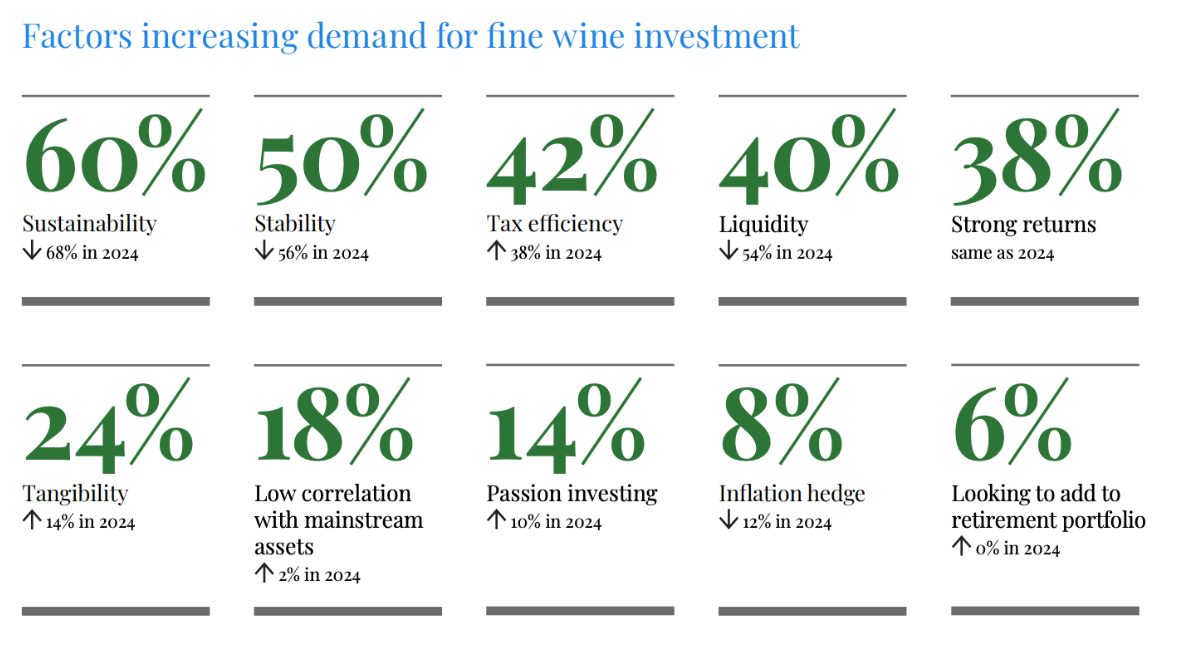
In the UK, the trend was driven by investors seeking tax efficiency, stability, and diversification benefits, with wine increasingly appearing in higher-risk portfolios and retirement planning.

Factors increasing demand for fine wine investment table

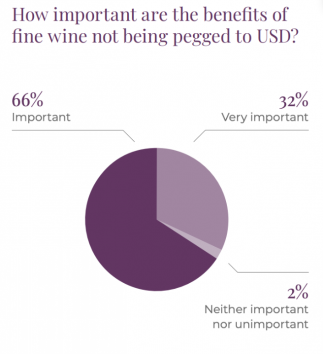
Meanwhile, in the US, the trajectory was similar, with protection from currency volatility an additional attraction of fine wine investment.

Benefits of fine wine investment pie chart

Wealth managers from both sides of the Atlantic noted that the proportion of younger, data-driven investors entering the market continues to rise, and an overall shift in fine wine evolving into a broader wealth-building strategy rather than a niche passion.

Key points

  • At the start of the year, 95% of UK and US wealth managers felt positive about fine wine investment.
  • Fine wine is appearing in higher-risk portfolios.
  • Fine wine is moving from specialist investment interest to mainstream strategy.

Trump tariffs bring uncertainty to fine wine market 

With Donald Trump’s return to the White House at the beginning of 2025, the new administration posited fresh economic policies, including the threat of 200% tariffs on alcohol from the EU. The announcement sent a chill through the fine wine market: buyers paused, demand slipped, and prices softened as investors temporarily redirected capital toward equities, property, and currency.

Yet alternative assets held firmer than expected. WineCap’s UK and US Wealth Reports showed that 58% and 74% of respondents respectively continued to view assets such as fine wine as attractive stores of value.

Stability returned in July 2025, when the US and EU agreed to a far more measured 15% tariff on European exports. With clarity restored, buyers re-entered the market – particularly in regions initially hit hardest, such as Champagne and Spain, which were among the first to rebound.

Key points

  • Trump’s EU alcohol tariff threat initially dampened market activity.
  • WineCap wealth reports indicate fine wine remains attractive regardless of the political climate.
  • Tariff consolidation in July saw US buying demand return, especially in the most impacted regions like Champagne and Spain.

Subdued Bordeaux 2024 En Primeur campaign

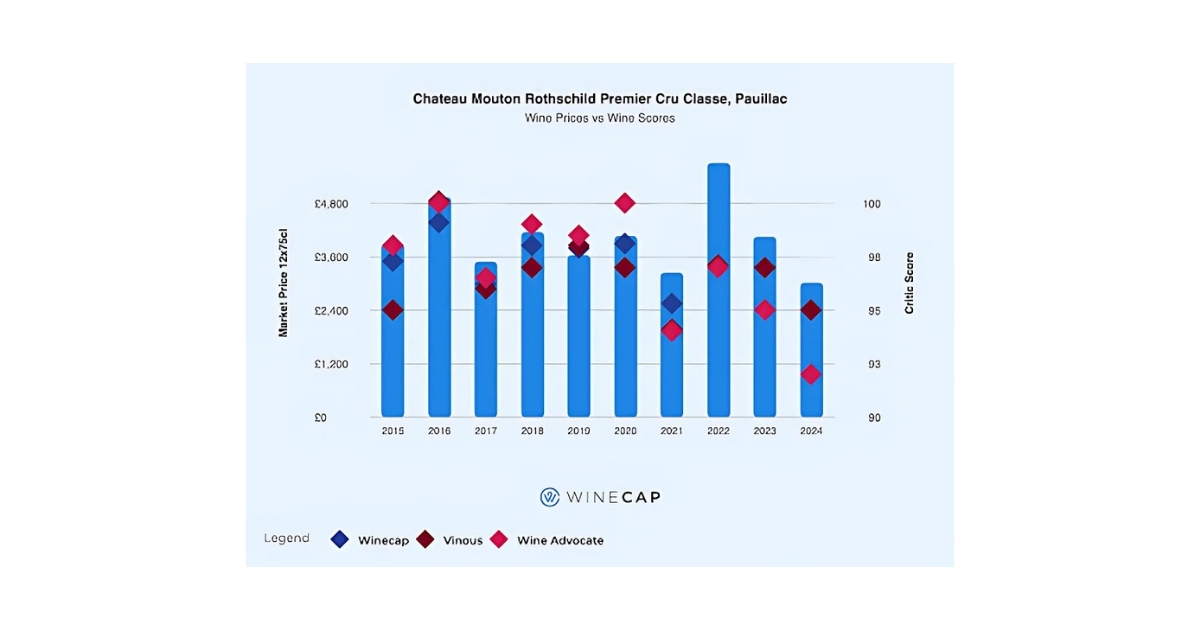
The annual Bordeaux En Primeur 2024 campaign launched towards the end of April against the background of a cautious market, triggering 20-30% price cuts in the leading French wine region in an attempt to increase demand. With Bordeaux’s global market share losing ground and a general correction in fine wine prices, discounting was a key driver of sales, over vintage (regarded as uneven) and brand. This approach increased access to rare-value opportunities in Bordeaux wine, most notably for First Growth estates, Lafite Rothschild and Mouton Rothschild. The 2024 vintage proved a strong year for white wines, with Haut-Brion and Domaine de Chevalier among the standouts.

Chateau Mouton Rothschild wine performance bar graph

Key points

  • Critics noted that Bordeaux 2024 was the perfect vintage for a reset. 
  • En Primeur demand was soft and price cuts were necessary.
  • First Growths Lafite and Mouton Rothschild were among the campaign’s biggest successes.

Early signs of stabilisation in Champagne and Italy

After two years of consistent declines, the fine wine market hinted at an early reversal in the second half of 2025, with Champagne being the first region to indicate a small upturn, in its first month-on-month gain in a year in June. With the majority of leading vintages of Champagne brands like Dom Pérignon, Cristal, Salon, Krug, and Taittinger flatlining for at least six months, a welcome phase of consolidation was indicated. 

Champagne’s strong recognisability, cellaring capacity, and relatively accessible entry points have positioned it well for a return to growth. Indeed, the region showing resilience throughout the second half of 2025. The Rhône also saw stronger demand, while “off” vintages in Bordeaux trended in a region that, alongside wine from Burgundy, showed signs of finding its bottom.

Momentum characterised the Italian fine wine market too, with the Tuscan region gaining traction as investors looked to Brunello and Super Tuscans like Sassicaia, Ornellaia, and Masseto. Performance for key Piedmont wines, however, remained softer. This was due to owing to investor preference for regions with wider international recognition and greater liquidity in the current economic climate. In California, global demand and strong branding fuelled rising interest for labels such as Opus One and Screaming Eagle.

Key points

  • Fine wine reversal indicated after two years of decline.
  • Champagne and Tuscany were the first to turn positive. 
  • Bordeaux “off” vintages stood out, while strong branding drove demand for Champagne and California’s cult wines.

La Place: strong global reach meets soft sentiment

In September, the 2025 La Place campaign continued its steady expansion beyond French Bordeaux wines with more than 130 labels also representing emblematic estates from Tuscany, California, Chile, Argentina, and Australia, released through the prestigious distribution network. This year’s campaign unfolded against a backdrop of economic ambiguity and a softer fine wine market environment. This naturally led to strategic price cuts. Overall, La Place 2025 underperformed, but this signalled a cautious stance in the market rather than decline.

Key points

  • La Place continued to reflect global quality.
  • Strategic price cuts were a key feature of this campaign.
  • Campaign lagged, but the reason was mostly tied to general market mood and macroeconomic factors. 

Record fine wine auctions in 2025

Against a backdrop of renewed regional stability in the fine wine market in the second half of the year, several record auctions hit the headlines. While multimillion-dollar sales from the likes of William I. Koch ($28.8mln) and Jacqueline (de Rothschild) Piatigorsky ($11.16 mln) displayed appetite for provenance and iconic vintages, they did not reflect the core secondary market. However, analytical investors could detect long-term demand for blue-chip wines and micro-trends in these auction results.

More reliable signals came from the 2025 Hospices de Beaune auction, which achieved €18.75 million, the third-highest total in its 166-year history. Robust bidding for top cuvées – notably the Bâtard-Montrachet Grand Cru “Cuvée Dames de Flandres” at €400,000 per barrel and the Pommard Premier Cru Les Rugiens President’s Barrel, also at €400,000 – confirmed the market’s persistent confidence in Burgundy terroir and mature premium whites. These results paralleled broader trends seen throughout the year with a decisive pivot towards established producers and investment-grade appellations.

Nevertheless, headline auctions hint at fine wine market sentiment at the very top end like DRC and Petrus. They do not reflect the reality of the investment market as a whole. Auction headlines offer pointers to appetite for particular fine wine segments, but data-driven portfolios continue to cultivate the potential for sustainable returns.

Key points

  • Several record-setting fine wine auctions took place in 2025, including a landmark Hospices de Beaune sale.
  • Strong results confirmed appetite for established estates and iconic vintages, but did not reflect the broader market dynamics.
  • A diversified investment portfolio goes beyond the headline-grabbing names to good value alternatives with strong growth potential.

First positive gain for the fine wine market in Q3

The fine wine market started to stabilise in Q3 as global economic sentiment improved and the anticipation of steady rate cuts supported alternative assets. Regions that led this early-stage market equilibrium were Champagne, the Rhône, notably with Domaine du Vieux Télégraphe, Tuscany, famous Napa wineries in California, and First Growth Bordeaux.

In the final months of the year, these regions continued to show resilience. Scarcity, selectivity, and estate reputation drove returns. This phase is signalling a market that is bottoming out and poised for gradual recovery, offering attractive entry points for medium- to long-term investors.

Key points

  • Fine wine market stabilised in H2 2025.
  • Champagne, the Rhône, Tuscany, California, and Bordeaux showed resilience.
  • This laid the ground for positive market movement.

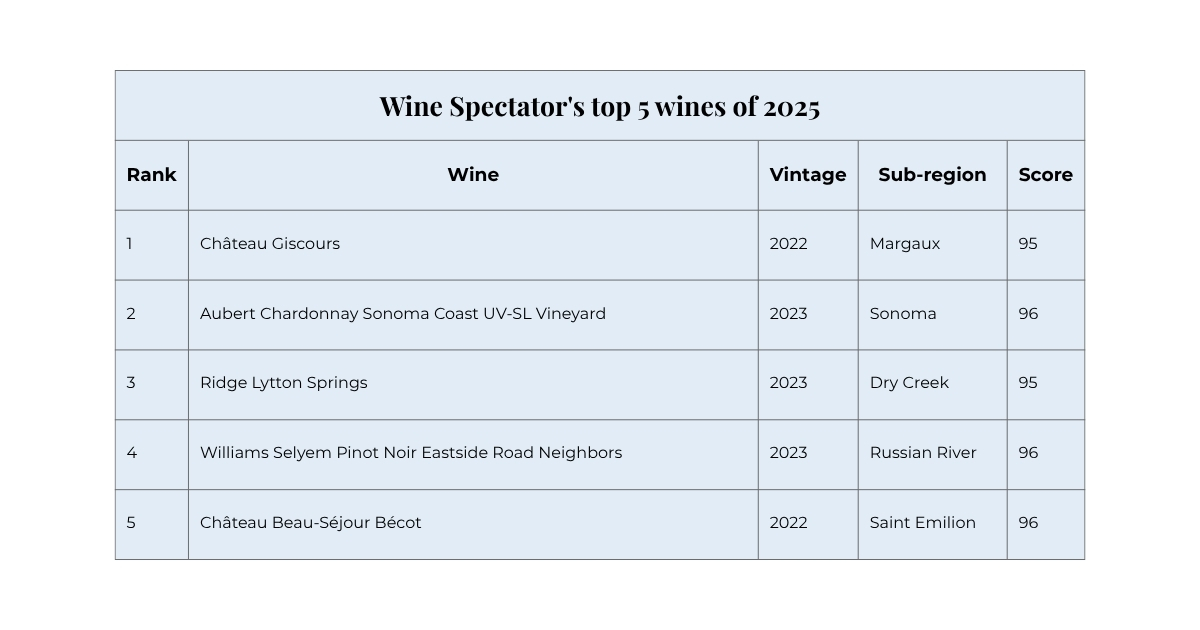
Bordeaux 2022 dominates critics’ top wine choices

The year neared its end with the 2025 global critic rankings highlighting the fine wine market’s increased diversity. Top choices spanned with Bordeaux, California, Italy, South Africa, Etna, Central Otago, and Beaujolais. Bordeaux 2022 was the star region and vintage as Château Giscours, Château Beau-Séjour Bécot, and Château d’Issan earned top positions from Wine Spectator, Vinous, and James Suckling. The selection bolstered Bordeaux’s market significance despite the challenges the region has been facing. Alongside Bordeaux’s success, Italy and New World regions shone (particularly Californian cult labels and South African wine brands), pointing to a rise in quality across the wine world.

Key points

  • Annual critic ratings featured fine wine regional diversity.
  • Bordeaux 2022 was a leading choice across rankings.
  • Quality in New World wines indicated by the rising number of listings.

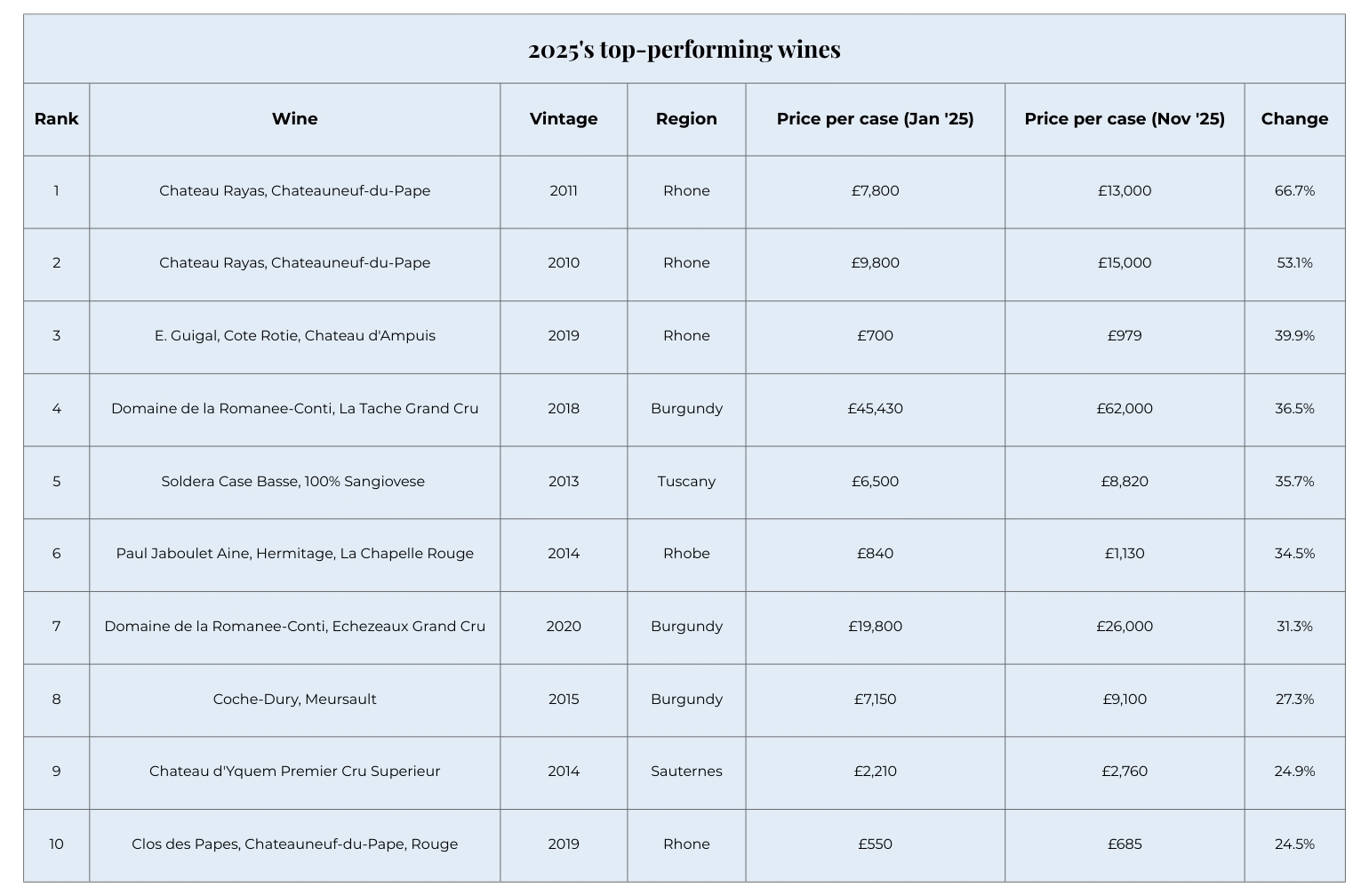
2025’s top-performing wines

The strongest performers of 2025 were concentrated in a few key regions. The Rhône dominated with 50% of the top movers, followed by Burgundy (30%), Tuscany (10%), and Sauternes (10%). Château Rayas led the rankings, with two vintages taking the year’s top spots. Rayas prices have been particularly volatile following the passing of Emmanuel Reynaud in November. A similar market reaction occurred after the sudden death of Jacques Reynaud in 1997, whose tenure from 1978 cemented Rayas’ reputation as one of the Rhône’s modern icons.

Momentum extended across the Rhône more broadly. E. Guigal’s Cote Rotie Chateau d’Ampuis  2019 climbed 40%, while Paul Jaboulet Aîné’s Hermitage La Chapelle Rouge 2014 gained 35%.

In Burgundy, DRC La Tache 2018 emerged as the region’s standout, up nearly 37% over the year. Tuscany’s top performer was Soldera Casse Basse, which rose 36% and continues its long-term outperformance. Over the past decade, Soldera prices have risen an exceptional 224% – well ahead of the Super Tuscans.

Key points

  • The Rhône dominates the list of 2025’s top-performing wines.
  • Château Rayas prices are rising sharply following the death of Emmanuel Reynaud.
  • Soldera Case Basse is Italy’s top performer of 2025 and continues to outperform the Super Tuscans over the long term.

Q4 2025: recovery precedes diversification 

By the final quarter of 2025, the fine wine market had begun to emerge from its most prolonged downturn in over a decade. The recovery remains uneven and cannot yet be described as a full rebound. However, underlying indicators suggest that the foundations for 2026 are firmer than at any point since the correction began.

Prices have stabilised, liquidity has improved, and several leading brands have now posted consistent monthly gains. Importantly, the early recovery has been measured rather than speculative, encouraging renewed participation from both private collectors and wealth managers.

Brand-level movements in late 2025 reinforced this early momentum. Many of the world’s most recognisable estates – across Bordeaux, Champagne, and the Rhône – posted modest but steady price increases, while over half of the most traded wines globally, finished November in the positive territory. A handful of standout performers, including top Bordeaux châteaux, iconic Rhône bottlings, and prestige cuvée Champagnes, delivered some of the strongest month-on-month rises seen all year. Not every segment moved uniformly: a number of cult California and Piedmont labels continued to ease back, underlining that different regions and vintages are still finding their floors at different times. The picture is stabilising, but it remains nuanced.

This complexity will define the transition into 2026. Investors should expect a market composed of multiple micro-cycles, where pricing floors and recovery curves vary by region, style, and vintage. 

Key points

  • Q4 2025 saw stabilising prices and improved liquidity after the longest downturn in over a decade.
  • Over half of the most actively traded wines posted gains in November 2025.
  • Recovery remains uneven, with different regions and vintages finding pricing floors at different times.

Looking ahead to 2026

Looking ahead, diversity is likely to shape the next stage of recovery. As fine wine continued to evolve from into a mainstream portfolio tool, investors will broaden their focus beyond the blue-chips. This shift is supported by the industry’s accelerated modernisation. Expanded global distribution networks, higher transparency, sustainability initiatives, and improved data access are making fine wine more accessible. The sector still faces an image challenge, but meaningful innovation is helping to reshape perceptions.

While a sharp, v-shaped upturn remains unlikely, the groundwork for a slow, sustainable and more widely distributed recovery is now in place. For medium- to long-term investors, 2026 is expected to offer clearer opportunities, improved sentiment, and a more diversified set of growth pathways than the volatile years immediately preceding it.

Key points

  • Broader diversification, stronger branding, and industry modernisation will shape 2026.
  • A steady, sustainable recovery is more likely than a rapid rebound, offering attractive entry points for investors.

FAQs

What were the biggest fine wine investment trends of 2025?
The major themes of 2025 included tariff-driven market volatility, followed by stabilisation in H2. 

Did the fine wine market recover in 2025?
The market began to show early recovery in Q2 and delivered its first positive quarter since 2022 in Q3. Stabilisation strengthened in the second half of the year, although the recovery remains uneven across regions.

Why was 2025 a turning point for the fine wine market?
2025 marked a shift from a three-year downturn to early signs of renewal. Prices stabilised, liquidity improved, younger investors increased their participation, and strong critic support helped reinforce confidence in key regions.

Are US tariffs likely to continue impacting fine wine prices in 2026?
Tariffs remain a key factor to watch, but the market proved resilient in 2025. Wealth managers in both the UK and US still view fine wine as a strong inflation-resistant and diversification asset.

Which wines performed best in 2025?
The Rhône led performance, accounting for around 50% of the year’s top movers, followed by Burgundy, Tuscany and Sauternes. 

Why did Château Rayas prices surge in 2025?
Prices were highly reactive to the passing of Emmanuel Reynaud in November. This echoed the sharp price movements seen after Jacques Reynaud’s sudden death in 1997.

Which regions are expected to lead the 2026 recovery?
Champagne, Tuscany, Napa Valley, the Rhône and top-tier Bordeaux appear to be the clearest candidates for early momentum.

WineCap’s independent market analysis showcases the value of portfolio diversification and the stability offered by investing in wine. Speak to one of our wine investment experts and start building your portfolio. Schedule your free consultation today.
Categories
Quarterly-reports

Q3 2025 Fine Wine Report

In our Q3 summary of the fine wine market we look at how the global economic landscape is shaping investment strategies, the road to recovery in fine wine, and the best-performing regions and wines so far this year. Read on for more on Lafleur’s recent classification withdrawal, the autumn La Place de Bordeaux campaign, and other industry-defining trends.

Executive summary

  • Market backdrop strengthens: Global equities advanced in Q3 amid optimism for gradual rate cuts and corporate earnings. Improving sentiment and policy clarity provided a firmer foundation for alternative assets, including fine wine.
  • Fine wine stabilises: After two years of correction, the fine wine market showed early signs of recovery. The Liv-ex 100 posted its first quarterly gain since the downturn began.
  • Regional divergence narrows: Champagne, Rhône, and Italy led the quarter, while Bordeaux and Burgundy also showed improvements; evidence of a maturing market phase approaching equilibrium.
  • Selectivity drives returns: The best performing wines came from overlooked vintages, particularly Bordeaux 2013/2014, alongside Rhône’s consistent value names and global icons such as DRC and Screaming Eagle.
  • La Place campaign underwhelms: The autumn La Place de Bordeaux campaign failed to shift market momentum. Demand remained subdued as release prices offered limited value versus back vintages in most cases.
  • News – Lafleur withdraws from Pomerol AOC: In a significant development, Château Lafleur announced its withdrawal from the Pomerol AOC, citing the need for greater viticultural flexibility in response to climate change. We explore how this might affect its market performance.

The trends that shaped the fine wine market

Market optimism sets the stage for fine wine stability

Global markets rallied through Q3 2025, driven by renewed optimism over growth and the prospect of gradual rate cuts, even as inflation proved sticky. US equities extended record highs, powered by strong earnings and ongoing enthusiasm for AI-related sectors, while Europe delivered mixed results amid weak German data but resilience in France and the UK. Gold surged as investors sought safety from lingering geopolitical tensions and trade uncertainties linked to US tariff policy. Bond markets posted modest gains as central banks maintained a cautious stance. Overall, investor sentiment steadied following a turbulent first half, with risk appetite supported by policy optimism and improving economic data, creating a firmer backdrop for alternative assets, such as fine wine, heading into Q4.

Fine wine market starts to turn

Signs of stability continued to build across the fine wine market in Q3, reinforcing the gradual improvement noted in our Q2 Fine Wine Report. After two years of consistent decline, several regional indices turned positive over the quarter. Five of the Liv-ex regional indices rose in August and September, and for the first time in three years, the Liv-ex 50, which tracks the prices of the Bordeaux First Growths, experienced monthly growth.

Broader market measures also improved. The Liv-ex 100 rose 1.1% in September, and the bid:offer ratio – a key gauge of demand relative to supply – reached 0.70, its highest level since April 2023. This sustained rise suggests buyers are gradually re-entering the market, drawn by attractive pricing and renewed confidence following a prolonged correction. While it is too early to call a full recovery, these movements point to a maturing phase of the downturn where value-seeking activity replaces reactive selling. 

La Place autumn campaign fails to shift momentum

A key event of the third quarter every year is the La Place de Bordeaux autumn campaign, which saw the release of over 130 wines from around the globe in September. However, in 2025, the campaign did little to shift momentum. New releases that did not offer value in the context of back vintages available in the market largely fell short, and demand was tepid even for the traditionally most sought-after labels like Opus One, Masseto, Ornellaia, Solaia and Penfolds. Tariff uncertainty, oversupply and general market cautiousness were a structural drag. Unless prices and allocation discipline improve, the campaign is likely to continue to alienate buyers.

Mainstream markets lead Q3; fine wine re-emerges

Global equities posted solid gains in Q3, buoyed by growing optimism around prospective interest-rate cuts and resilient corporate earnings. While mainstream markets outpaced most alternatives, select segments of the alternative asset universe – particularly private credit and real assets – showed signs of resilience. Fine wine also staged a modest recovery.

The Liv-ex 100 Index, which tracks the performance of the most sought-after investment-grade wines, recorded its first quarterly gain since the market downturn began, rising 0.4% over the quarter. Losses in July and August were offset by a 1.1% rebound in September, signalling renewed confidence. The broader Liv-ex 1000 Index slipped 0.5% over Q3, though it, too, recovered 0.4% in September, suggesting stabilisation across a wider basket of fine wines.

Meanwhile, the First Growths Index – a barometer for Bordeaux’s top estates – rose 0.7% in September but remained 0.7% lower for the quarter overall, reflecting the uneven pace of recovery across regions and price tiers. Nonetheless, after several quarters of decline, Q3 marked a turning point where fine wine once again began to move in step with the broader risk-on sentiment seen in global markets.

Fine wine vs mainstream markets

Regional fine wine performance in Q3

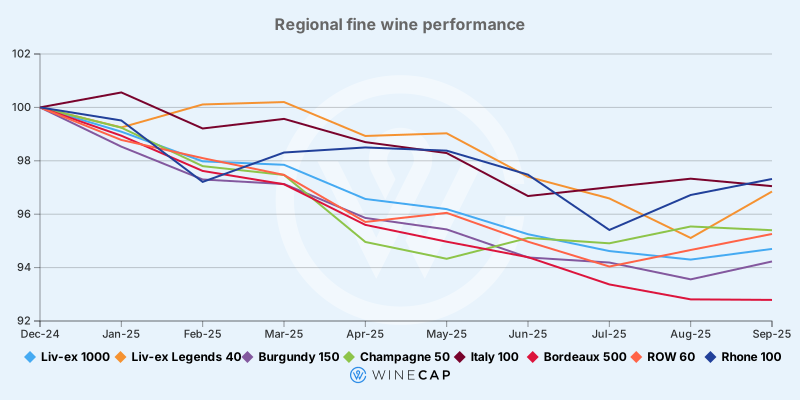
Regional fine wine indices displayed a mixed picture in Q3, but the pace of decline eased, and several categories began to rise. The Liv-ex 1000 ended the quarter 0.6% lower, yet September brought a broad uptick across most regions – an encouraging sign after months of subdued activity.

Champagne held its ground best, maintaining near-flat performance over the quarter and retaining its position as one of the most resilient categories in 2025. The region benefited from increased demand from Asia and the US. The Rhone 100 also improved modestly, ending Q3 just above its Q2 level as buyers continued to favour regions offering relative value.

Italy (0.4%) and the Rest of the World 60 (0.3%) both saw small gains in Q3, hinting at early signs of renewed confidence beyond the traditional strongholds of Bordeaux and Burgundy, which fell in Q3.Regional fine wine performance 2025

The Bordeaux 500 declined 1.7%, while the Bordeaux Legends 40 dipped just 0.6%, as mature Bordeaux continued to attract active buyers. However, of the six Bordeaux sub-indices, three went up in September – those measuring the performance of the First Growths, their Second Wines, and the top 100 wines from the Right Bank. Burgundy prices softened slightly, down 0.2%, but its top wines remained among the most robust performers since the 2022 peak.

The combination of improving sentiment, selective buying, and greater market stability suggests that regional fine wine prices may be nearing their floor, setting the stage for a more balanced close to 2025.

The best performing wines so far in 2025

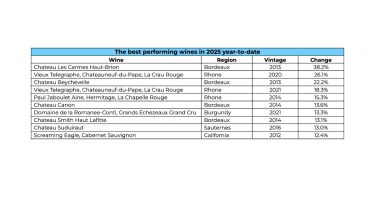
Even in a broadly subdued market, 2025 has shown that fine wine remains a story of selectivity and scarcity. A handful of standout wines have delivered strong double-digit returns, proving that, even during correction phases, the right names and vintages can outperform significantly.

The spread between the top-performing fine wines (+18% on average) and the Liv-ex 1000’s broad decline year-to-date (around -4.7%) highlights exactly why selection is paramount.

Best performing wines 2025 table

Three key themes stand out among the top-performing wines in 2025 year-to-date:

  • ‘Off’ vintage Bordeaux is back in vogue

Wines from cooler or once-overlooked vintages – such as Bordeaux 2013 and 2014 – have led the pack. Collectors appear increasingly willing to reward finesse, drinkability, and scarcity over hype, with Château Les Carmes Haut-Brion (+38.2%) and Château Beychevelle (+22.2%) exemplifying this trend.


  • The Rhône’s value overdelivers

Rhône wines continued to prove their value credentials. Vieux Télégraphe’s 2020 and 2021 vintages and Jaboulet’s La Chapelle 2014 all posted impressive gains, driven by limited production, consistent critical endorsement, and comparatively attractive pricing.


  • Scarcity runs the market

At the very top end, scarcity remains the strongest currency. Domaine de la Romanée-Conti, and Screaming Eagle demonstrated that rare, blue-chip wines continue to attract capital regardless of broader sentiment.


Investors focusing on authenticity, producer pedigree, and under-appreciated vintages have outperformed the broader market, suggesting that quality and insight remain the keys to long-term success.

Q3 releases: Spotlight on Taittinger Comtes de Champagne 2014

Champagne has proven one of the most resilient categories in 2025, with the Champagne 50 Index outperforming most regional peers in Q3 (up 0.3%). The region is also enjoying renewed global demand as buyers take advantage of the attractive price levels post its 2022 peak. Within this steadying landscape, Champagne house Taittinger released the 2014 vintage of its Comtes de Champagne.

Awarded 97 points by both Yohan Castaing (The Wine Advocate) and Antonio Galloni (Vinous), it ranks among the highest-rated Comtes vintages ever – and Galloni notably compared it to the legendary 2008, which trades at a nearly 40% premium.

The 2014 release also carries historical significance. As the last truly cool-climate vintage in Champagne, it represents a stylistic milestone unlikely to be replicated amid the region’s ongoing warming trend – a factor that enhances its long-term collectability.

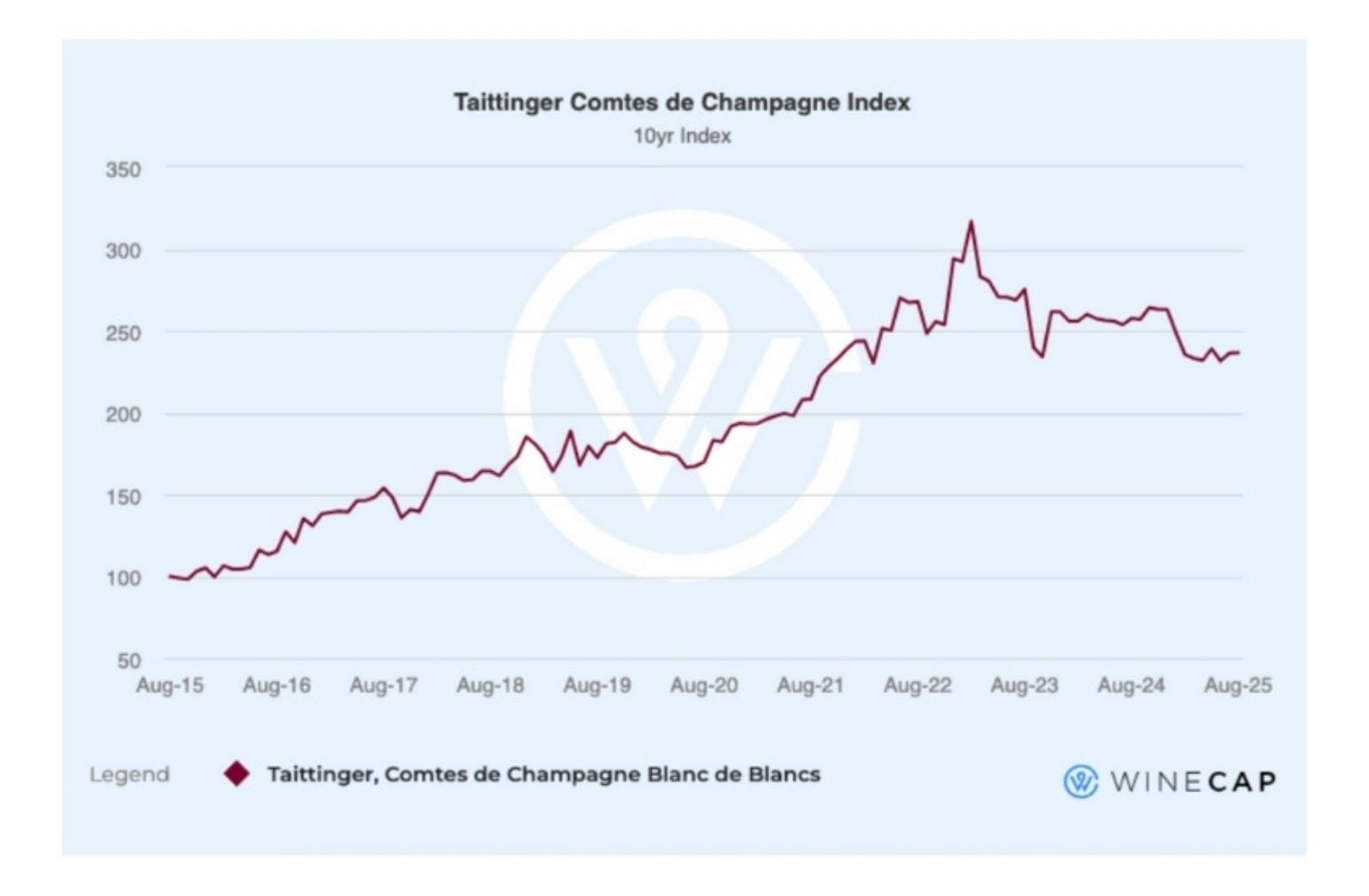
From an investment perspective, Comtes has been a quiet outperformer. The Taittinger Comtes de Champagne index has risen steadily over the past decade, outpacing both Dom Pérignon and Louis Roederer Cristal during the bull market of 2020–2023, and showing notable price stability throughout 2025.

‘Taittinger consistently stands out as one of the best values among top-tier Champagnes, frequently outperforming many other Grand Marques tête-de-cuvée offerings.’
– Yohan Castaing, The Wine AdvocateTattinger Champagne index

Market snapshot

  • 2014 Release price: £1,190 per 12×75
  • Critic scores: 97 points (Vinous, The Wine Advocate)
  • Ranking: 62nd in the 2024 Liv-ex Power 100 (up nine places year-on-year)

With exceptional critic consensus, proven secondary market demand, and a price point that remains competitive, the 2014 Taittinger Comtes de Champagne exemplifies why the region continues to attract buyers, whether for enjoyment or investment. 

Q3 Fine wine news: Lafleur withdraws from Pomerol AOC

In August, Château Lafleur confirmed that from the 2025 vintage onward, its wines will no longer carry the Pomerol AOC designation, instead being labeled Vin de France. The decision extends across the Guinaudeau family’s portfolio, including Les Pensées, Les Perrières, and Grand Village.

The estate cited the need for greater viticultural flexibility in the face of accelerating climate change. In correspondence with trade partners, the Guinaudeau family wrote: ‘Climate is changing fast and hard… We must think, readapt, act.’ 

The withdrawal allows Lafleur to implement adaptive farming methods not currently authorised under the appellation’s 1936 regulations, such as controlled irrigation, soil covering to reduce evaporation, canopy shading, and adjusted planting density. 

Lafleur’s independence enables it to act without the procedural delays that constrain larger or corporate-owned estates. The move is consistent with its reputation for long-term thinking and precision farming, aligning vineyard practice more closely with environmental reality.

Market context

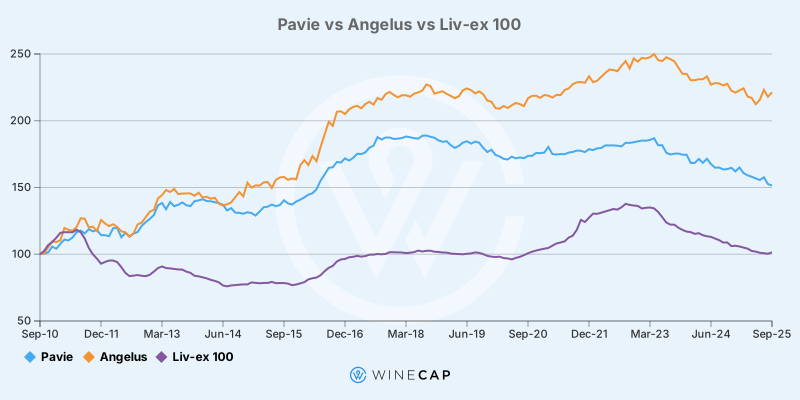
Historically, classification changes in Bordeaux have affected perception and pricing. The 2012 promotions of Pavie and Angélus within Saint-Émilion’s hierarchy, for instance, coincided with rapid market repricing, even though the wines themselves did not change. Lafleur’s withdrawal represents the opposite: the relinquishment of an appellation name rather than an elevation within it.

Pavie vs angelus wine performance

In the short term, pricing impact is likely to be neutral, as Lafleur’s identity and market position are defined by brand equity rather than by appellation. The château’s production is limited, its critical reputation exceptional, and its collector base highly stable. Over time, however, label differentiation could influence liquidity and buyer psychology, particularly between the final ‘Pomerol’ labelled vintages and the inaugural ‘Vin de France’ release, both of which may acquire added significance in secondary trading.

Performance and relative strength

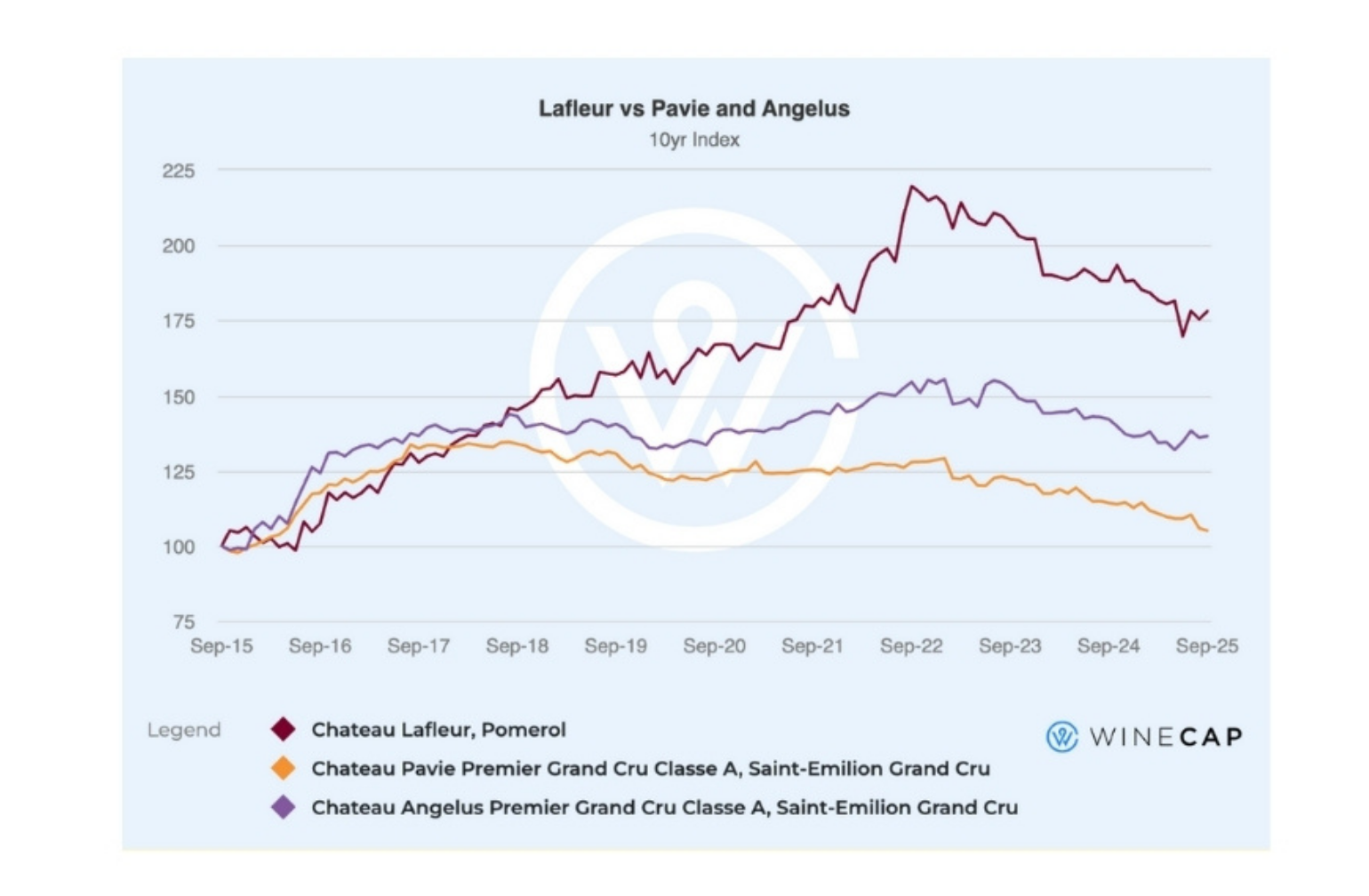
Over the past decade, Lafleur’s secondary market performance has outpaced that of both the First Growths and its Right Bank peers, Pavie and Angélus. Despite the broader Bordeaux market correction since 2022, Lafleur has retained a significant premium, perhaps reflecting scarcity and confidence in the Guinaudeau family’s brand.

Lafleur fine wine performance

Should the transition to ‘Vin de France’ labelling prove commercially seamless, the move could even enhance Lafleur’s individuality, reinforcing its cult status as a technically driven, terroir-first estate. 

All in all, Lafleur’s withdrawal prompts a broader structural question for Bordeaux: how the appellation system adapts to climate change through balancing regional reputation with innovation arising from global-warming challenges. For Lafleur, the decision appears evolutionary rather than disruptive, designed to preserve vineyard resilience and wine quality in a shifting climate.

If Lafleur’s performance continues to mirror its past decade – where brand identity outweighed classification – this change may ultimately serve to strengthen, rather than dilute, its market position.

Q3 summary and a look ahead to Q4

The third quarter of 2025 marked a transition phase for the fine wine market. With mainstream assets recovering and investor sentiment stabilising, fine wine has begun to re-establish its footing after a protracted two-year downturn. Indicators such as the rising bid:offer ratio and renewed regional resilience point toward a more balanced market environment heading into Q4. Price declines have largely moderated, and value-seeking capital is returning, particularly to regions offering long-term quality at attractive entry points.

Looking ahead, the key drivers of performance will continue to be scarcity, selectivity, and producer reputation. Top estates with disciplined production, strong brand equity, and adaptability are well-positioned to outperform as the market moves toward recovery. As Q3 showed, the correction appears to have reached maturity; the next phase is likely to be characterised by gradual re-pricing, focused accumulation, and renewed confidence in fine wine as a stable, long-term asset.

WineCap’s independent market analysis showcases the value of portfolio diversification and the stability offered by investing in wine. Speak to one of our wine investment experts and start building your portfolio. Schedule your free consultation today.
Categories
Quarterly-reports

Q2 2025 Fine Wine Report

Explore key trends in the Q2 2025 Fine Wine Market Report – from Trump’s proposed tariffs to Bordeaux En Primeur 2024, index performance, and standout wines like Chave Hermitage and Screaming Eagle. Discover where value and stability are emerging.

Executive summary

  • Trump’s proposed tariffs dominated headlines, yet the delayed implementation gave markets breathing room.
  • The Liv-ex 100 index declined 3% in Q2 but showed signs of levelling off by quarter-end.
  • Bordeaux En Primeur 2024 was met with weak demand driven by oversupply and collector preference for mature vintages.
  • Regional performance diverged, with Bordeaux and Burgundy leading declines, while Champagne showed signs of stabilisation.
  • Top-performing wines defied broader market trends, with double-digit gains from names like Chave Hermitage 2021, Château d’Yquem 2014, and Screaming Eagle 2012.
  • Fine wine remains in a correction phase, but select names, regions, and vintages continue to offer compelling investment opportunities.

The trends that shaped the fine wine market

Global markets adjust as tariff volatility eases

President Trump’s revival of protectionist trade policies set the tone for global markets in Q2. From January to April, the average U.S. tariff rate on imported goods like cars, steel, and aluminium surged from 2.5% to a century-high 27%, before easing to 15.8% in June.

While the March tariff threat initially triggered sharp volatility, the fallout was relatively short-lived. Early April brought a brief dip into bear territory for the S&P 500 on tariff fears. But with policy pauses and stronger-than-expected earnings – 78% of S&P companies beat forecasts – investor confidence returned. Equities in Europe and Asia rallied as well, with the FTSE 100 testing new highs. Corporate investment, especially in AI, remained robust despite political and fiscal uncertainty. 

This broader resilience helped buoy alternative assets like fine wine. While less liquid than stocks, fine wine saw continued interest from long-term investors. Crucially, there was no evidence of panic selling – a sign of confidence in the asset class’s underlying stability.

Telling signs of stability in the fine wine investment market

The pace of fine wine price declines slowed in the second half of the second quarter, although the market is not yet in full recovery mode. On average, fine wine prices as measured by the Liv-ex 100 index, dipped 3% in Q2 2025. The index has been in a freefall since September 2022, seeing only five minor upticks during this time. Meanwhile, the Liv-ex 50, which tracks the performance of the Bordeaux First Growth, has been in a consistent decline during the last 33 months.  

Still, the recent falls have been less pronounced, and prices for many of the index component wines have maintained their new levels without falling further. The market seems to be adjusting to the new environment, with participants showing greater acceptance of the status quo and reduced sensitivity to geopolitical noise. In Q2, demand even began to resurface, particularly from Asia, which has been notoriously quiet, and the U.S., which had initially retreated due to tariff fears.

Muted demand for Bordeaux En Primeur 2024 as market shifts for mature wines

With the market still absorbing past vintages and saturation setting in, enthusiasm for Bordeaux En Primeur 2024 was notably subdued. Despite reduced release prices, the wines often failed to offer compelling quality or value when compared to older vintages readily available on the secondary market.

Bordeaux’s structural challenges persist. Negociants remain overstocked and weighed down by rising bank interest, while many merchants lack the appetite or capital to buy for stock. Meanwhile, the once-crucial Chinese market remains largely dormant.

This muted campaign reflects a broader shift in buyer behaviour. Demand has tilted decisively toward mature wines with a track record of quality and drinkability. While the short-term appeal of buying young futures has faded for now, Bordeaux’s reputation for ageability and long-term value endures.

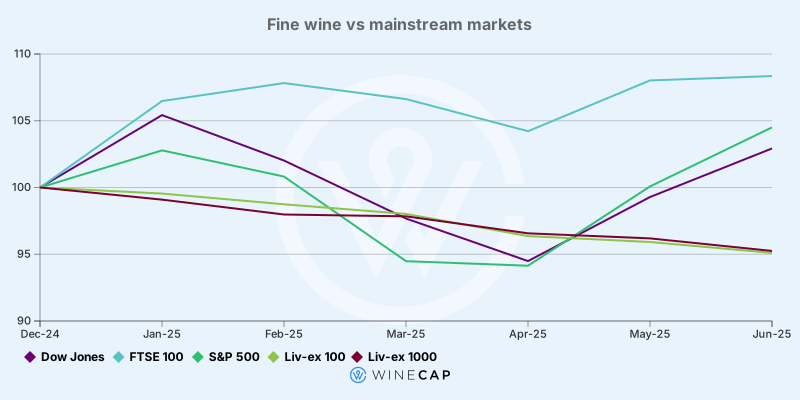
Fine wine vs mainstream markets in H1 2025

Fine wine vs mainstream markets

While mainstream equity markets swung between bear and bull phases in Q2, the fine wine market charted a notably more stable path. Fine wine prices declined modestly over the period, but without the sharp drops or rallies seen in the S&P 500, Dow Jones Industrial, or FTSE 100. The contrast, seen in the chart above, reinforces fine wine’s reputation as a lower-volatility asset during times of heightened macroeconomic and geopolitical uncertainty.

Importantly, this steady decline was not marked by panic selling or dramatic shifts. This reflects the market’s structural differences: lower liquidity, longer holding periods, and a collector-investor base that prioritises wealth preservation over short-term trading.

Moreover, beneath the surface, outliers and outperformers remain. Read on to discover where relative value has emerged, and which regions and producers have shown resilience – or even strength – so far this year.

Regional fine wine performance: year-to-date trends

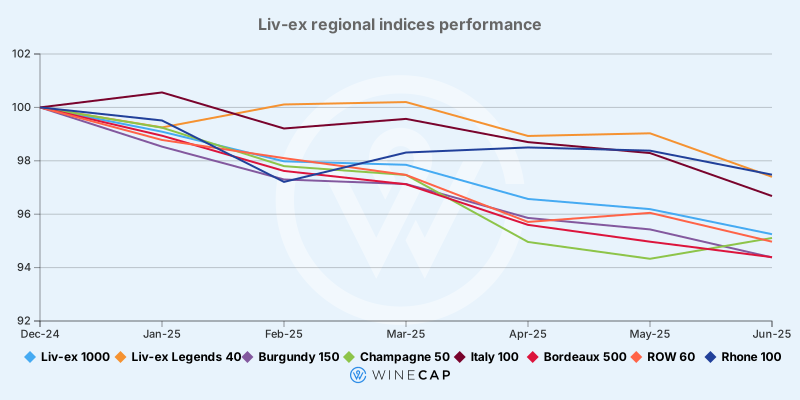
The first half of 2025 has revealed consistent pressure across nearly all fine wine indices, with no region posting growth year-to-date. Yet the degree of decline varies.

Liv-ex fine wine regional indices

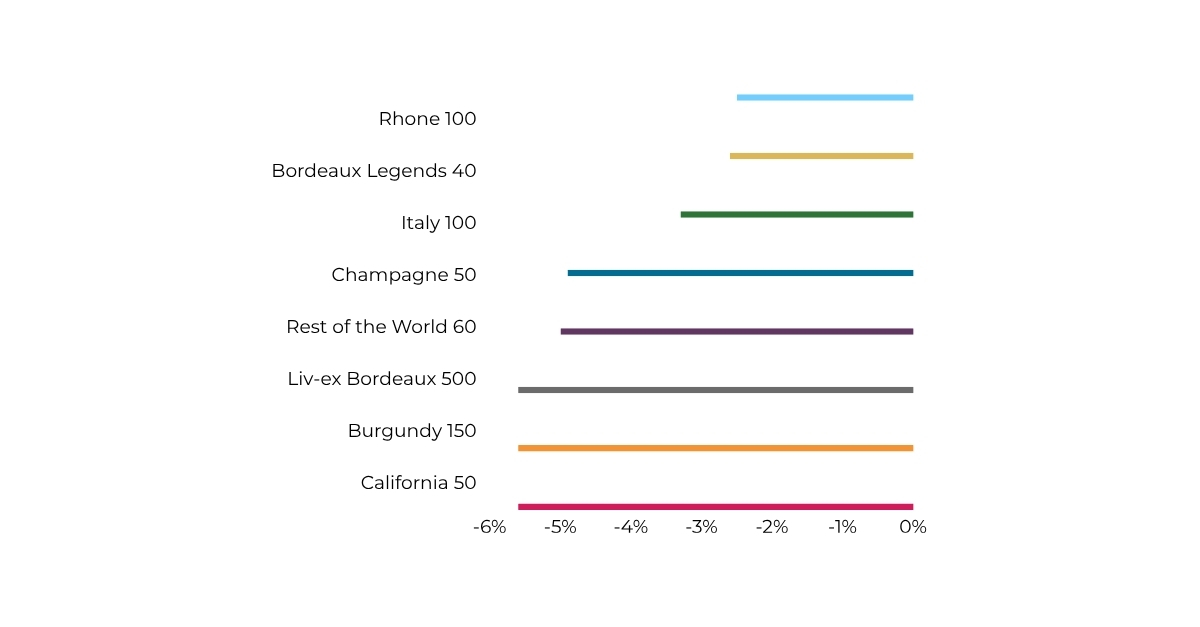
Bordeaux and Burgundy lead declines (-5.6%)

Both the Liv-ex Bordeaux 500 and Burgundy 150 have posted the steepest year-to-date losses among the major indices, each down 5.6%. For Bordeaux, this reflects tepid interest in younger vintages and a sluggish En Primeur campaign, coupled with a lack of support from Asia. Burgundy continues to correct from previous pricing spikes, as buyers recalibrate in search of better relative value.

Auction results defy the indices

While Bordeaux and Burgundy’s regional indices posted year-to-date declines of -5.6%, recent auction results tell a different story at the very top end of the market.

In June 2025, Christie’s held a landmark sale of the personal wine collection of billionaire collector Bill Koch, generating a record-breaking $28.8 million over three days. The sale drew global participation and intense bidding across 1,500 lots, each of which was sold. The standout was a 1999 Romanée-Conti Methuselah, which fetched an eye-catching $275,000.

The collection featured rare Bordeaux and Burgundy – the very categories currently under pressure in secondary market indices – yet buyer appetite was strong, and prices exceeded estimates across multiple lots.

Champagne shows relative stability

The Champagne 50 has held up better than most, down just 4.9% year-to-date, and was the only region to show positive month-on-month growth in June (+0.8%). While the broader category has cooled after a strong run, interest in top names remains, especially among collectors focused on prestige and scarcity. Indeed, many of Champagne’s top brands now represent the best entry point into the region in years. Prices have stabilised, and there are signs they will not fall any further, but might start to rise again. 

Broader weakness across other regions

  • Rest of the World 60 is down 5.0%, showing soft demand beyond the mainstay regions.
  • California 50, also down 5.6%, mirrors this trend and highlights ongoing sensitivity to U.S. economic and tariff concerns.
  • Italy 100 has dropped 3.3%, suggesting a more measured pullback, consistent with the region’s reputation for offering value and dependable quality.
  • Bordeaux Legends 40 and Rhone 100 are holding up best, with declines of only 2.6% and 2.5% respectively. This speaks to market confidence in mature Bordeaux and Rhône’s reputation for steady, value-driven performance.

best performing wine regions half 1 2025

As the fine wine market works through broader corrections, defensive regions – particularly Rhône and mature Bordeaux – are outperforming, while Burgundy and California remain under pressure. Champagne’s recent bounce may signal early signs of selective recovery. For investors, opportunities may lie in regions demonstrating resilience rather than those still working through valuation resets.

The best-performing wines so far this year

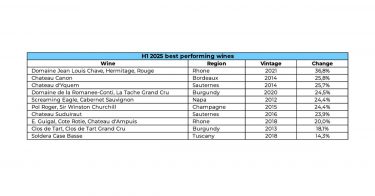
best performing wines half 1 2025

Despite broad declines across regional indices, a select group of wines delivered standout returns in H1 2025, highlighting the importance of producer reputation, scarcity, and vintage specificity in fine wine performance.

The Rhône leads driven by Chave

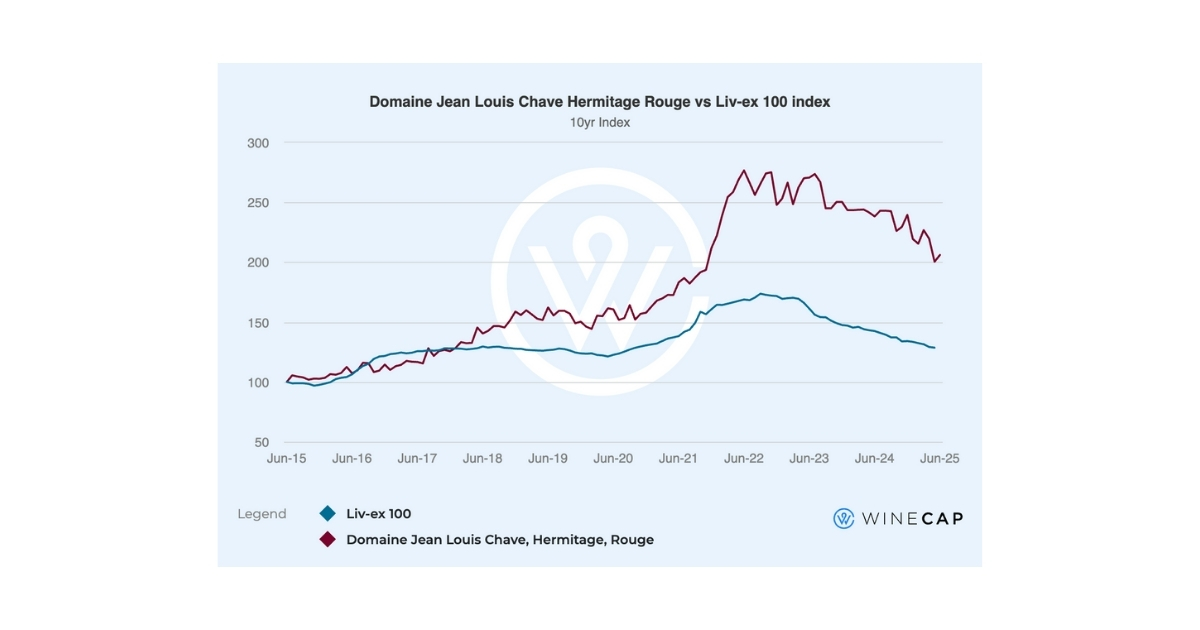
The top-performing wine was Domaine Jean Louis Chave’s 2021 Hermitage Rouge, which rose +36.8% in the first half of the year. This outperformance stands in stark contrast to the overall Rhône 100 index, which declined 2.5%. Over the last decade, prices for the brand are up 127% (compare its performance to other market benchmarks on Wine Track).

Domaine Jean Louis Chave Hermitage

Château d’Yquem 2014 and Château Suduiraut 2016 returned 25.7% and 23.9% respectively, bucking the downward trend in Sauternes. On a brand level, Yquem has risen 7% in the last six months and 3% in Q2; Suduiraut is up 11% in H1 2025. These results signal renewed collector appetite for premium dessert wines – particularly in top vintages where quality and longevity are indisputable – yet prices remain relatively low.

Prestige investment opportunities in Napa and Champagne 

The California 50 index fell 5.6%, but iconic Napa cult wine Screaming Eagle 2012 rose 24.4%, affirming the strength of globally recognised, ultra-luxury labels. Indeed, average prices for the brand rose 5% in H1 2025. Similarly, Pol Roger Sir Winston Churchill 2015 posted a 24.4% gain, demonstrating that top-tier Champagne continues to attract collectors even as the Champagne 50 index overall declined.

Burgundy and Tuscany standouts reinforce blue-chip strategies

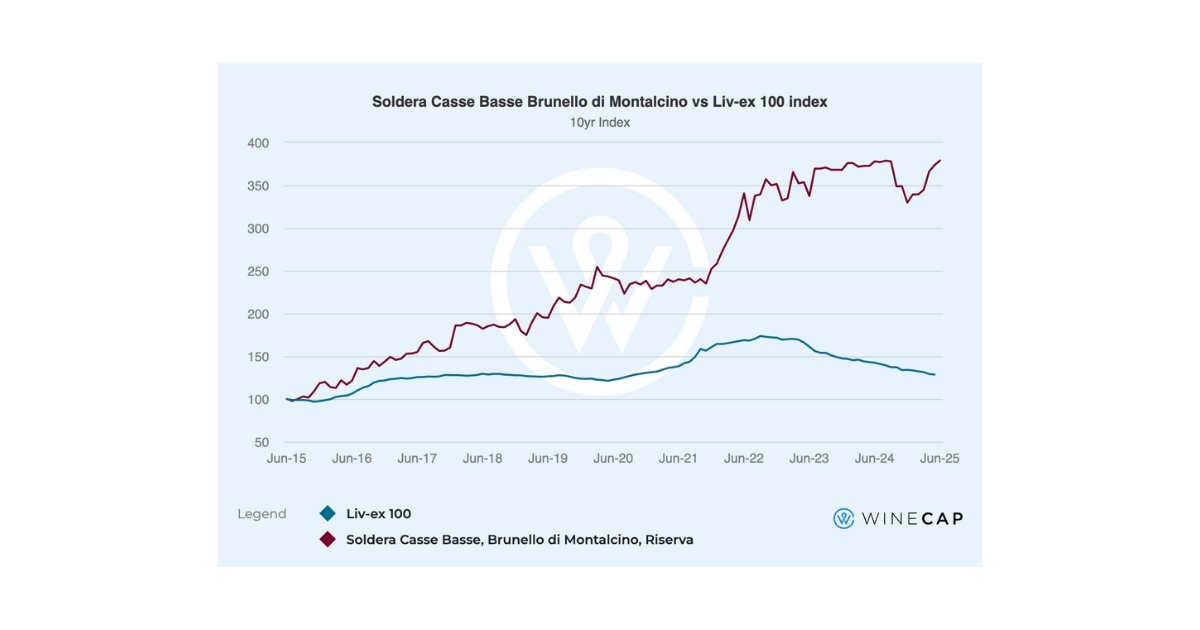
Despite Burgundy’s broader correction, DRC’s La Tâche 2020 and Clos de Tart 2013 delivered 24.5% and 18.1% returns respectively. These names remain benchmarks of rarity and prestige. Meanwhile, Soldera Case Basse 2018 gained 14.3%, pointing to sustained momentum behind top Italian producers. In Q2 alone, prices for the Tuscan premium brand are up 11%; in H1, 16%. 

Soldera Montalcino fine wine performance

Investor takeaways

  • Market-wide declines don’t mean universal losses. Select wines not only held value but also delivered double-digit returns.
  • Rarity and recognisability remain key drivers. Names like Chave, Yquem, Screaming Eagle, and DRC continue to offer portfolio resilience.
  • Smart vintage selection pays. Wines from underappreciated years – like Canon 2014 – produced outsized gains relative to their pricing base.
  • Dessert wines are back on the radar. Contrarian plays in Sauternes may offer continued upside in H2 2025.

Brands to watch

Signs of a Champagne revival

After being the fine wine market’s standout performer in 2022, Champagne experienced one of the sharpest pullbacks during the broader market correction of 2023–2024. However, signals suggest the tide may now be turning again.

From peak to pause: A market in transition

Prices across the Champagne sector have fallen significantly from their highs, but the sell-off appears to have run its course. June marked a notable shift: Champagne was the first regional index to post positive month-on-month growth, rising +0.8%, a potential inflexion point after months of stagnation.

More importantly, price stability has returned. The sector’s recent performance suggests we may be entering a new phase of the Champagne investment cycle, where prices consolidate before a potential recovery.

Market data signals stabilisation

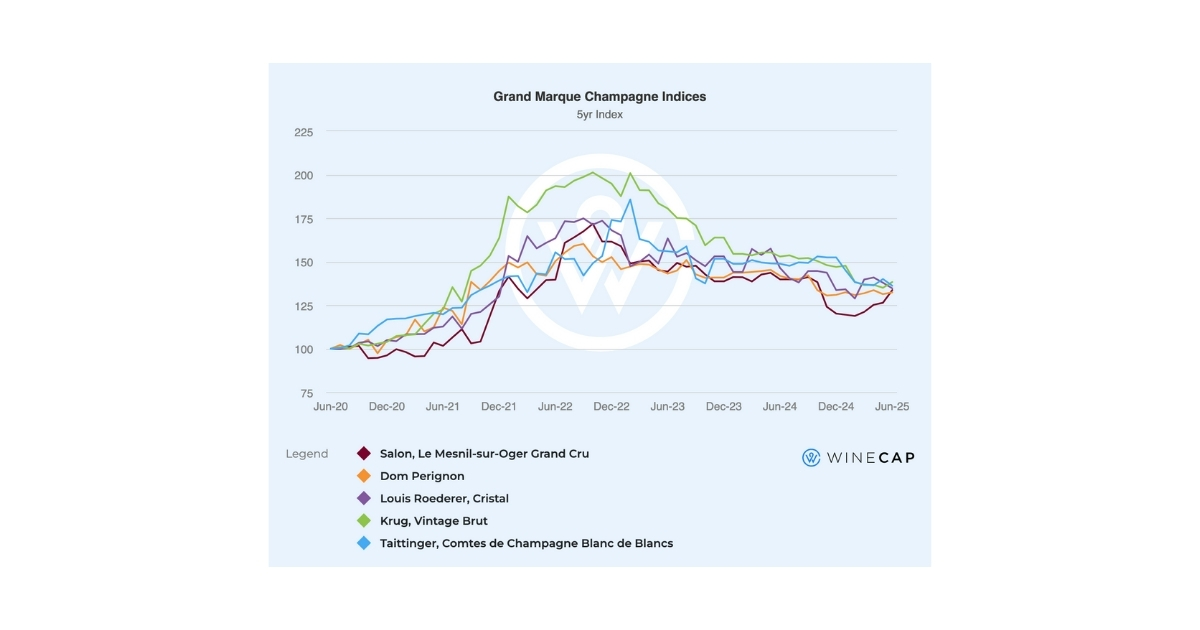
To test this trend, we analysed the 10 most recent vintages of the five most-searched “Grand Marque” Champagnes:

Of these 50 individual wines,

  • 43 have resisted their price declines,
  • 40 have remained stable for at least six months,
  • the indexes aggregating their vintages confirm this plateau.

Champagne fine wine indices

Notably, Dom Pérignon has shown the earliest and most sustained stabilisation, with its index bottoming out in November 2024. Krug Vintage and Taittinger Comtes de Champagne are the most recent to enter this stable phase, suggesting broader alignment across the category.

A new phase for Champagne?

This pattern of index symmetry and brand-level stabilisation is a clear signal that Champagne may be transitioning from correction to consolidation. Investor sentiment appears to be catching up to underlying fundamentals, with many of Champagne’s leading brands now offering compelling re-entry points. Liv-ex market share data supports this trend:year-to-date, Champagne has taken 12.4% of the market by value, up from an annual 2024 average of 11.8%, signalling that demand is returning. 

If this trend holds, Champagne could become one of the first major regions to re-enter positive growth territory, supported by brand power, vintage scarcity, and collector loyalty.

Q3 2025 market outlook: A pause before the pulse?

The third quarter – traditionally the quietest in the fine wine calendar – arrives amid a tentative calm. Following the volatility of Q2, Q3 is shaping up to be more subdued but not without potential catalysts.

Tariff watch

President Trump’s planned tariffs, originally slated for Q2, have now been delayed until August 1st. Markets have so far responded with a muted shrug, suggesting either tariff fatigue or confidence that negotiations may temper the final impact. But the uncertainty remains a live wire: should enforcement proceed, volatility could resurface late in the quarter. For now, however, investors appear cautiously indifferent.

La Place de Bordeaux’s autumn window

With the Bordeaux 2024 En Primeur campaign having underwhelmed, attention now turns to La Place de Bordeaux’s autumn campaign. This presents a rare chance for standout producers from around the world to seize attention, particularly those releasing back vintages or special bottlings. A well-priced, tightly-curated campaign could reignite interest and provide pockets of momentum in an otherwise quiet market.

Rest of the World builds buzz

As traditional strongholds like Bordeaux and Burgundy continue to correct or stagnate, Rest of the World wines are beginning to command more attention. California, Tuscany, and Rhône producers featured prominently among H1’s top performers, and collectors may increasingly look to these regions for value, scarcity, and differentiation in the second half of the year.

A stable market… but will it rise?

Fine wine’s reputation for stability held firm in H1, avoiding the sharp swings seen in equities. The question now is whether this stability will give way to price appreciation. While some wines are poised to rise, we expect the broader market to remain sluggish through the summer. Liquidity typically thins in July and August, and the broader mood is unlikely to shift meaningfully until September.

What to watch

  • Tariff developments post-August 1st
  • Autumn releases on La Place, especially non-Bordeaux
  • Top Champagne brands starting to rise in value
  • Collector appetite for emerging regional stars
  • Signs of rotation from defensive to opportunistic buying behaviour

WineCap’s independent market analysis showcases the value of portfolio diversification and the stability offered by investing in wine. Speak to one of our wine investment experts and start building your portfolio. Schedule your free consultation today.
Categories
Quarterly-reports

Q1 2025 Fine Wine Report

It has been a volatile start to the year, with President Donald Trump’s return to the White House unsettling global markets. The fine wine market continued its measured slowdown, yet optimism persists: wealth managers increasingly view fine wine as a strategic diversifier, with demand expected to rise in 2025. Q1 saw a cautiously successful Burgundy 2023 En Primeur campaign and a mixed round of spring La Place releases – headlined by the highly anticipated, 6×100-point Latour 2016.

This report explores the key trends that shaped Q1, from geopolitical tensions and shifting market sentiment to the top-performing wines and regional highlights.

Executive summary

  • Mainstream markets faltered:
    At the time of writing, the S&P 500 has fallen 7.2% year-to-date, Nikkei 225 dropped 20.5%, and crude oil is down 13.2%.
  • Fine wine prices dipped:
    The Liv-ex 100 declined 2.0% in Q1 2025. The broader Liv-ex 1000 index is down 2.1%.
  • Regional performance:
    Bordeaux and Burgundy were the weakest regions in Q1, each falling 2.9%. Italy continued to show resilience, down just 0.4%.
  • Top performer:
    The best performing wine was Vieux Telegraphe La Crau Rouge 2021, which surged 22.7%.
  • La Place spring campaign:
    Expanded further with new entrants. The Latour 2016, backed by six 100-point scores, stood out as one of the most successful and talked-about releases.
  • Looking ahead:
    The Bordeaux 2024 En Primeur campaign, the key fine wine event of Q2, faces heightened price pressure and buyer caution amid broader economic headwinds.

The trends that shaped the fine wine market

Escalating trade war tensions

One of the most disruptive forces in Q1 2025 has been the re-escalation of global trade tensions, largely stemming from President Donald Trump’s newly announced tariffs. The dramatic return to tariffs has created significant headwinds for global markets, and fine wine has not been immune.

Tariffs fluctuated rapidly. In early April, Trump declared 54% tariffs on Chinese goods imported into the US, a figure he raised to 125% just days later. In the same breath, he confirmed 20% tariffs on European goods, before abruptly announcing a 90-day pause on April 9th, during which tariffs for all non-Chinese countries were lowered to 10%. While this provided short-term relief to EU producers, the volatility has caused widespread uncertainty. 

One thing seems clear: the coming months will be pivotal, with trade developments likely to dictate sentiment and demand in key markets.

Markets under stress

In Q1 2025, mainstream financial markets experienced significant volatility, largely driven by the abrupt changes outlined above. The S&P 500 entered correction territory, declining over 10% from its February 19th high, before partially recovering in late March. The energy sector mirrored this instability. Oil prices plunged to a four-year low amid recession fears and heightened tariffs, only to rebound following announcements of tariff pauses. The rapid succession of policy shifts has led to a climate of uncertainty, making it difficult for investors to anticipate market movements.

Fine wine in Q1 2025

The fine wine market similarly felt the pressure. Prices fell 2% on average over the last three months. The broader Liv-ex 1000 index declined 2.1%, highlighting continued softness across the board. Regionally, Bordeaux and Burgundy were the weakest performers, each down 2.9%. Italy once again stood out for its resilience, declining 0.4%, thanks to consistent demand for top names and relatively stable pricing. The top performing wines in Q1 included Bruno Giacosa Barolo Falletto Vigna Le Rocche Riserva 2014 (72.1%), Château Léoville Barton 2021 (30.9%), and Château Rieussec 2019 (22.8%).

Pressure on En Primeur

The ongoing trade war comes at a particularly sensitive time for the Bordeaux 2024 En Primeur campaign, which is about to launch. The system has been under increasing scrutiny in recent years, with release prices often failing to offer meaningful value versus back vintages. The threat of added import costs, even if delayed, puts further pressure on producers and négociants to rethink pricing strategies. With confidence in En Primeur already eroding, this year’s campaign faces a delicate balancing act: justify pricing amid broader market weakness, or risk alienating already-cautious buyers.

Regional fine wine performance in Q1

Regional fine wine performance


Since the start of the year, fine wine prices across major regions have fallen 2.1% on average. While some regions experienced temporary increases – the Rhône bounced back by 1.1% in March – the majority were in consistent decline. Burgundy and Bordeaux – the two dominant market forces – fell the most, down 2.9% in Q1. 

Despite falling prices, Liv-ex noted that trade activity is rising – total trade volume and value were up on Q1 2024.

The best-performing wines

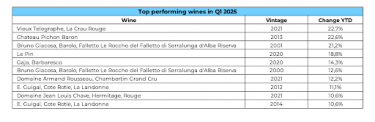
Q1’s top performers comprised a varied group from across Bordeaux, Piedmont, the Rhône, and Burgundy. The best performing wine was Vieux Telegraphe La Crau Rouge 2021, which surged 22.7%. Pichon Baron 2013 followed with a 22.6% rise. 

Two vintages of Guigal La Landonne also appeared in the rankings, the 2012 (11.1%) and 2014 (10.6%). 

From Barolo, the 2001 Bruno Giacosa Serralunga d’Alba made the top ten with a 21.2% rise in value over the past three months.

The spring La Place campaign

March saw just over 50 wine releases via La Place de Bordeaux, including new Burgundies, grower Champagne and big names like Promontory 2020, Ao Yun 2021 and Latour 2016. 

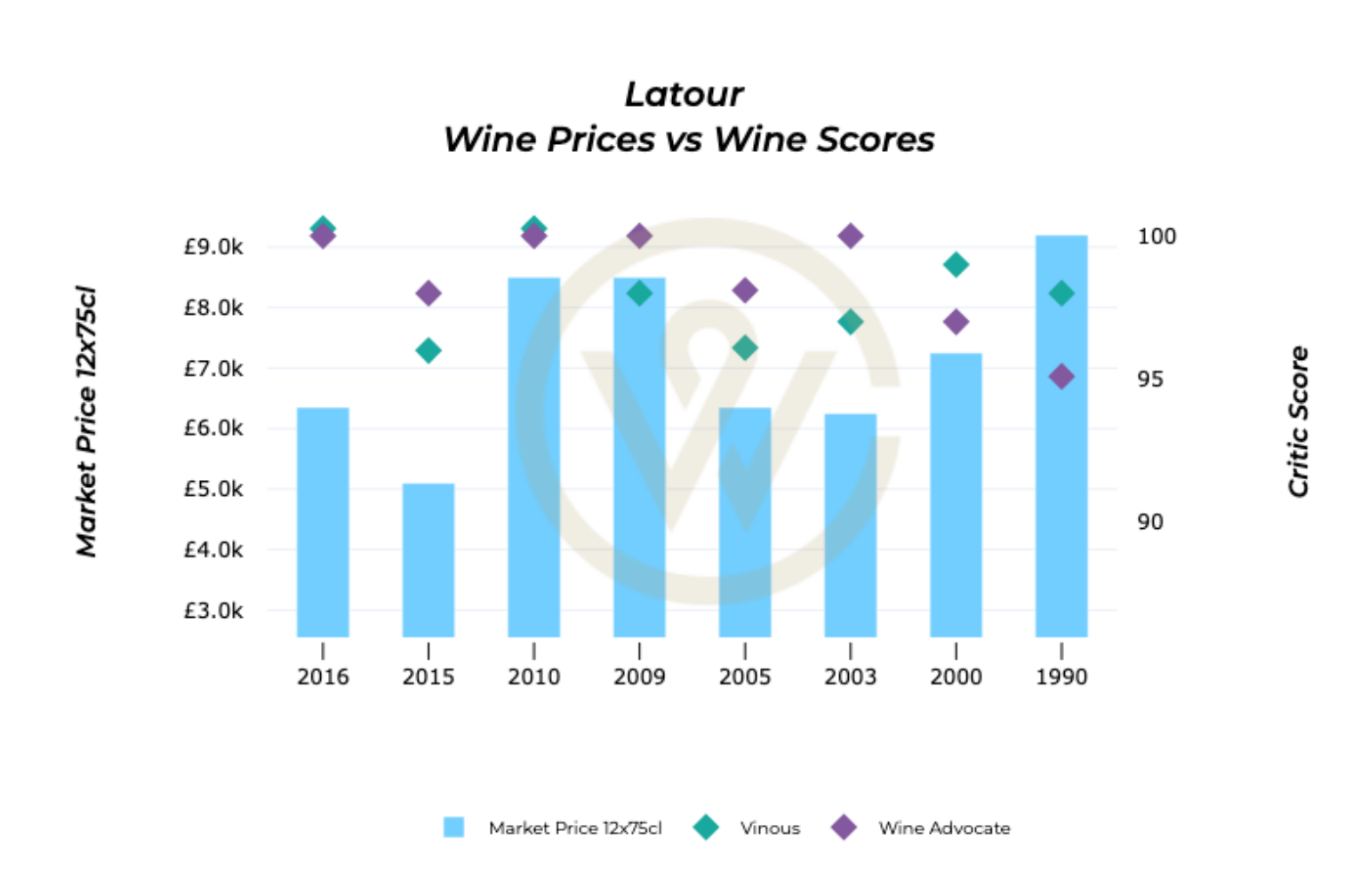
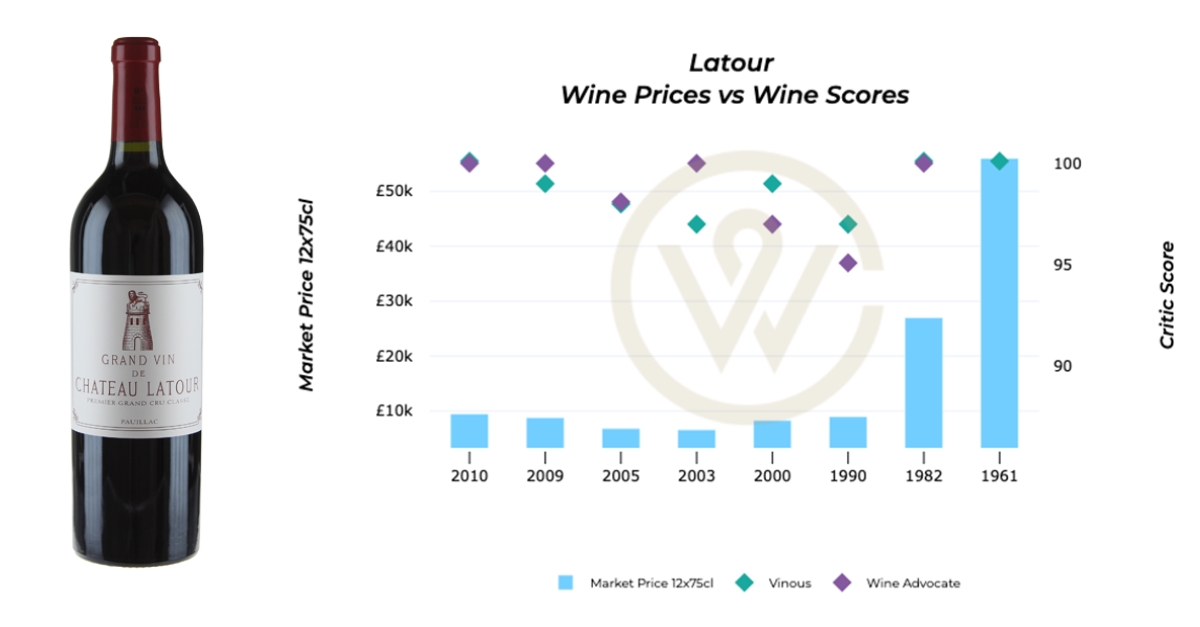
The latter was particularly notable as the first prime release to hit the market since the château abandoned the En Primeur system. The wine boasts a number of 100-points from major critics including Neal Martin, Antonio Galloni, Lisa Perotti-Brown MW, Jane Anson, Jeff Leve, and Tim Atkin.

The comparisons being made – to 1961, 1982, and 2010 – suggest the wine is already being framed within the estate’s historic lineage. What’s more, while the price reflects its stature, its positioning below recent back vintages like 2009 and 2010 suggests value for money.

In a campaign that highlighted the growing breadth of La Place, Latour served as a reminder of Bordeaux’s enduring ability to dominate the conversation, when it chooses to.

Latour wine prices vs wine scores

Fine wine enjoys resilient fundamentals and growing confidence

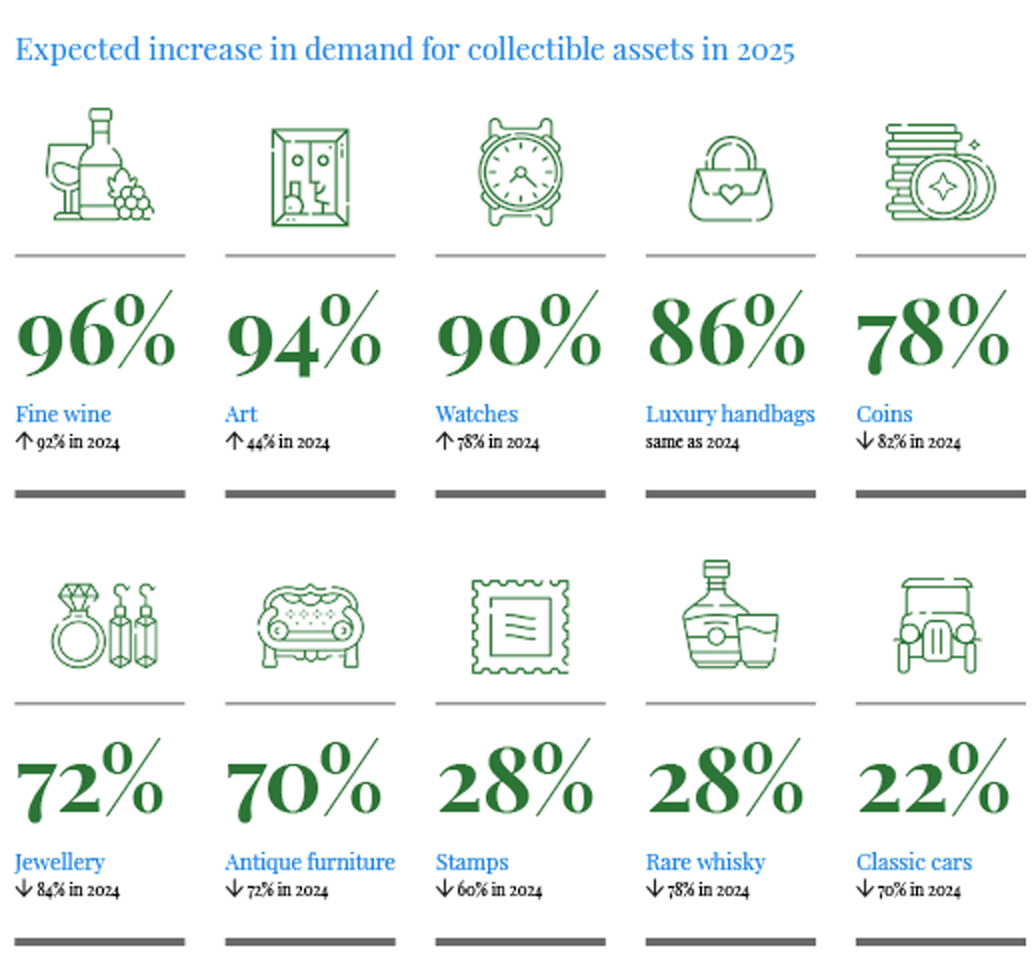
Beneath the surface of a softening market, confidence in fine wine as a long-term investment continues to strengthen. Our recent Wealth Reports released in Q1 revealed a clear trend in investor attitudes: 96% of UK wealth managers expect demand for fine wine to increase in 2025, underscoring its growing role in diversified portfolios.

This optimism is rooted in fine wine’s defining characteristics – low correlation to mainstream markets, long-term price appreciation, and intrinsic scarcity. While short-term volatility and trade disruptions have created a subdued environment, many see this as an attractive entry point. With prices off their peak, the market now offers a rare opportunity to access top names at more favourable levels.

Fine wine is increasingly viewed as a maturing asset class – one that rewards patience rather than speculation. As macroeconomic uncertainty continues to rattle equities and bonds, fine wine’s stability and resilience are drawing renewed attention from high-net-worth individuals and wealth advisors.

Collectible assets 2025

Q2 2025 market outlook

All eyes now turn to the Bordeaux 2024 En Primeur campaign – the most significant event in the fine wine calendar and a litmus test for buyer confidence in a fragile market. After a lacklustre few years, the system finds itself at a crossroads. Pressure is mounting for producers and négociants to reset expectations, as past campaigns have struggled to offer compelling value compared to back vintages already available on the secondary market. Adding to the challenge is the uncertain tariff environment. 

At the same time, there is cautious optimism. While prices across Bordeaux have softened, trade volume has increased – a signal that buyers are still engaged, albeit more selective. If producers respond with competitive pricing and clear value propositions, 2024 could mark a turning point for the campaign.

Beyond Bordeaux, Q2 is expected to bring continued price sensitivity, but also renewed interest from investors who see current levels as a buying opportunity. The long-term fundamentals remain intact: scarcity, brand equity, and an increasing role for fine wine in diversified portfolios. In short, while the market remains in a momentary phase of recalibration, Q2 may offer the first signs of recovery if the right tone is struck.

WineCap’s independent market analysis showcases the value of portfolio diversification and the stability offered by investing in wine. Speak to one of our wine investment experts and start building your portfolio. Schedule your free consultation today.
Categories
Quarterly-reports

Opportunities in uncertainty: the 2024 fine wine market and 2025 outlook

Executive summary

  • Q4 was marked by political developments, changing economic policies, and geopolitical events, including the re-election of President Trump.
  • The strengthened US dollar boosted fine wine demand across the pond.
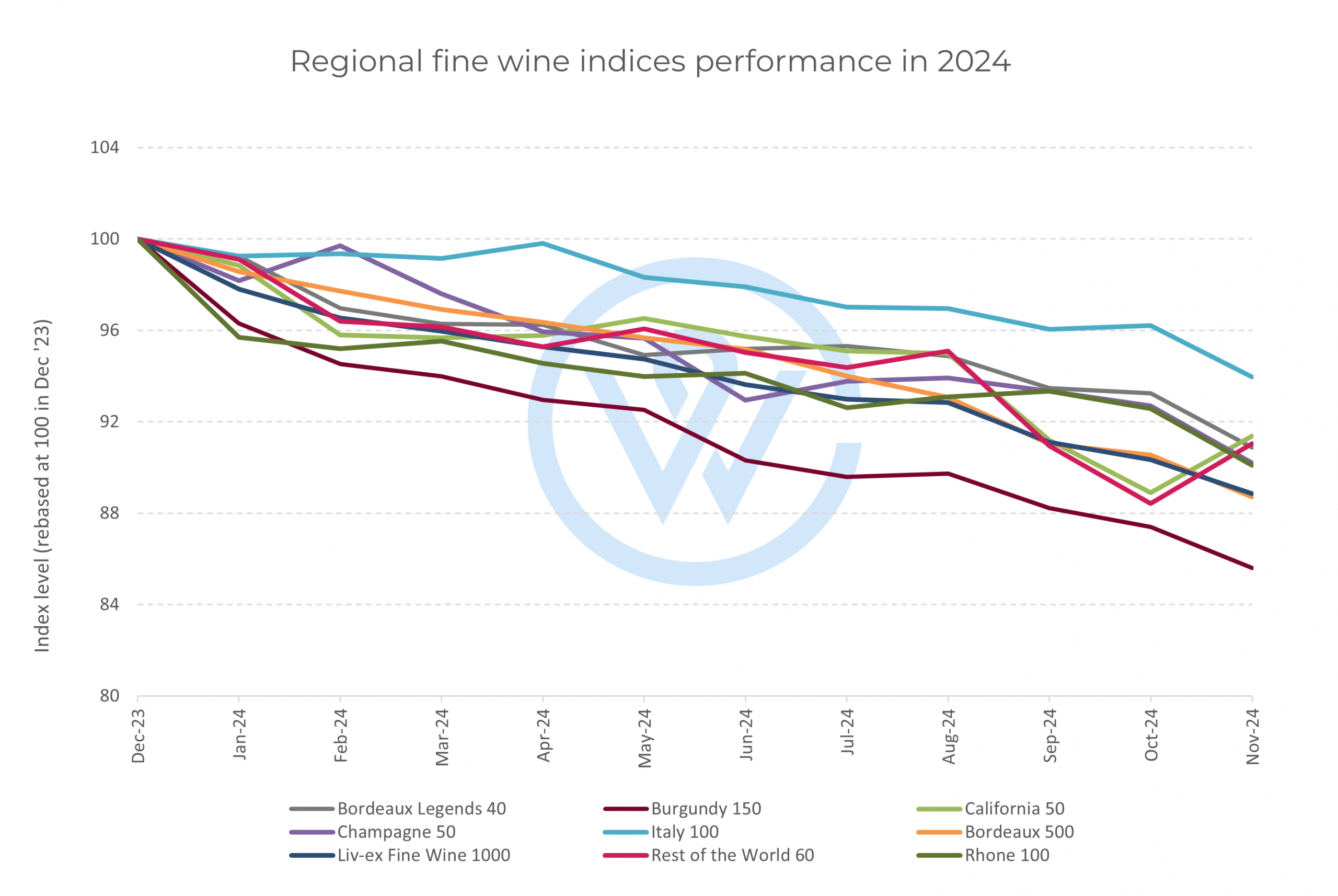
  • Fine wine prices fell 11% across major regions in 2024, reflecting a continued market correction. 
  • Italy was the most resilient fine wine region, while Burgundy experienced the biggest adjustment.
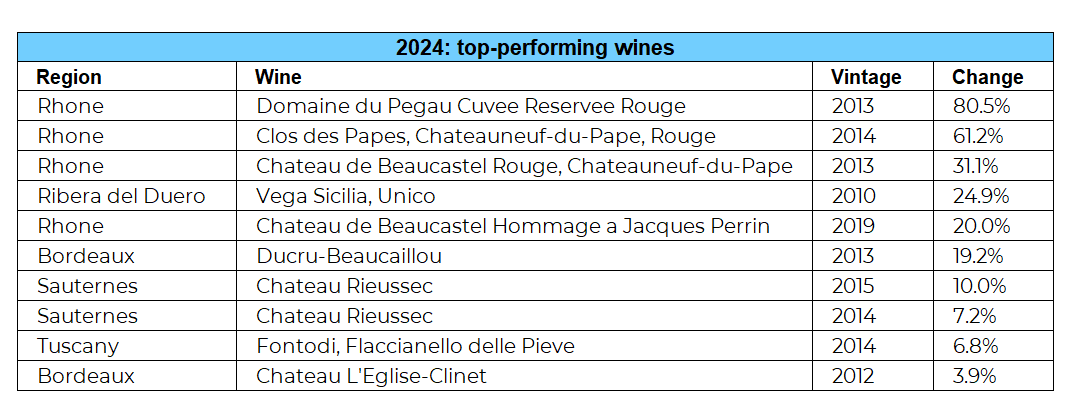
  • Rhône wines dominated the list of the best performing wines in 2024, with Domaine Pegau Cuvée Réservée Rouge 2013 leading (80.5%).
  • Older vintages (2010-2014) performed well, reflecting the market’s preference for mature, proven wines, while new releases struggled when not priced correctly.
  • Optimism for market recovery is focused on premium regions like Piedmont, Champagne, and Burgundy.
  • Economic uncertainties and mixed performance in Bordeaux are expected to persist, but continued interest in fine wine signals resilience and potential for long-term growth.

Q4 in context: political and economic drivers

It has been an eventful quarter, marked by political developments, changing economic policies, and geopolitical events. The re-election of President Donald Trump in November prompted a rapid response in global markets. US equities reacted positively to the outcome, as investors anticipated business-friendly policies and potential fiscal stimulus, particularly benefiting sectors like manufacturing and technology. However, concerns over increased tariffs created uncertainties for multinational corporations.

Rising US Treasury yields, driven by expectations of future interest rate hikes, attracted capital inflows, strengthening the US dollar. While this reinforced investor confidence in U.S. economic policies, it also raised concerns about higher borrowing costs and their potential drag on economic growth. Emerging market currencies faced downward pressure as fears of US trade measures and capital outflows grew.

In late November, a US-France-brokered ceasefire between Israel and Hezbollah took effect, reducing immediate geopolitical risks after over a year of hostilities. Despite the agreement, markets remained cautious, keeping a close watch for potential disruptions to the fragile stability.

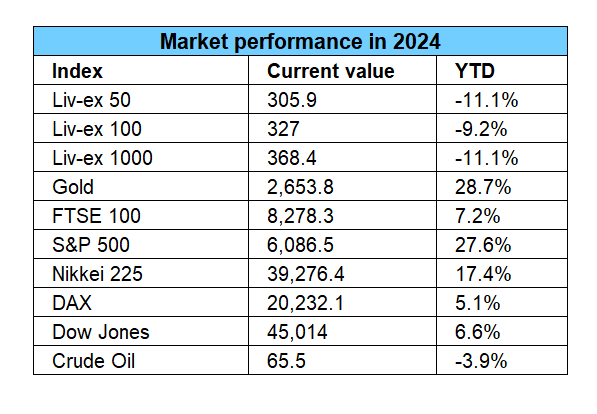
Markets in 2024: the year that was

Bitcoin made headlines this month by surpassing the $100,000 mark for the first time, peaking at an all-time high of $104,000 on Coinbase. The surge was fuelled by growing investor optimism around a favourable regulatory environment under President-elect Donald Trump, who has signalled support for cryptocurrencies through key appointments and policy proposals.

Equity markets have also enjoyed a strong year, bolstered by a resilient US economy and easing inflation pressures. These conditions have allowed central banks to pause or slow rate hikes. Strong corporate earnings, particularly in the technology and AI sectors, have further propelled the S&P 500’s stellar performance.

The global energy market in 2024 has experienced notable fluctuations. Concerns over a potential global economic slowdown, driven by weak demand from China and other developed economies, have weighed on crude oil prices. While OPEC’s production cuts have provided some price support, they have not been sufficient to fully offset the impact of declining demand.

Meanwhile, gold has reaffirmed its role as a safe-haven asset in 2024. Persistent geopolitical tensions, inflation concerns, and financial market volatility have driven demand for the precious metal, supporting its strong performance throughout the year.

*Current values: 06/12/2024

The fine wine market in 2024

The fine wine market in 2024 continued its downward trajectory from 2023, with broad declines across major indices. The Liv-ex 100 has fallen 9.2% year-to-date, while the Liv-ex 50, which tracks First Growth Bordeaux, is down 10.9%.

Despite these overall declines, the market showcased notable regional disparities and emerging opportunities. Examined at more length in the following section, Italy has been a beacon of resilience, while ‘overheated’ regions like Burgundy have readjusted.    

Notably, prices did not fall because of lower demand for fine wine. Market activity remained high, with the number of fine wine trades in 2024 surpassing 2023 by 7.9%. 

Regional fine wine performance

The fine wine market saw mixed performances as the year drew to a close. Italy stood out as the most resilient region, with prices falling 6% – a fraction of the 11.1% average decline in the Liv-ex 1000 index. High-scoring releases buoyed Italy’s secondary market, while diverse offerings such as Antinori Brunello di Montalcino Vigna Ferrovia Riserva (38%) underscored the country’s stability and value. Italy’s growing influence was evident in the 2024 Power 100 rankings, where it claimed 22 spots – nine more than last year – closing the gap on Burgundy and Bordeaux in terms of investor interest and price performance.

Burgundy has faced the greatest readjustment among all regions, with prices declining by 14.4% year-to-date. This correction followed years of meteoric growth and reflects a market adjustment as prices recalibrate. The decline has created opportunities for investors to acquire rare and prestigious labels at more accessible prices. Burgundy’s reputation as a cornerstone of fine wine investment remains intact despite this year’s setbacks, with long-term demand likely to persist.

Champagne also experienced a challenging year, with prices falling 9.8%. However, the region showed signs of stabilisation toward the end of the year. Older vintages led this recovery, with labels such as Taittinger Brut Millesime up 29%, signalling enduring interest in high-quality, aged Champagne. 

Bordeaux, the largest and most liquid fine wine region, saw an 11.3% decline. Liquidity remains Bordeaux’s strength, but it no longer guarantees safety in today’s market. Recent vintages in particular have struggled, with many trading below their release prices. 

California wines fell 8.6% but showed positive momentum in November. The region’s growing presence in the fine wine investment space has been driven by the rising popularity of brands like Dominus, Joseph Phelps, and Promontory.

Spanish wine also benefitted from surging US demand, with Vega Sicilia Unico taking the top spot as the most powerful fine wine brand in 2024. Two other Spanish wines also made the rankings – Dominio de Pingus and R. Lopez de Heredia – a testament to Spain’s growing investment potential.  

The best-performing wines in 2024

The Rhône dominated this year’s top-performing wines, claiming four of the ten spots on the list. Domaine de Pegau Cuvee Reservee Rouge 2013 led the charge with an impressive 80.5% rise. Other regional standouts, including Clos des Papes Châteauneuf-du-Pape Rouge 2014 (61.2%) and Château de Beaucastel Rouge 2013 (31.1%), highlighted the enduring demand for Châteauneuf-du-Pape from highly rated, older vintages.

Beyond the Rhône, Spain’s Vega Sicilia Unico 2010 (24.9%) showcased the strength of Ribera del Duero as a rising force in the wine investment market. Vega Sicilia also ranked as the most powerful wine brand in the 2024 Power 100 rankings. 

Bordeaux and Sauternes also featured. Château Rieussec took two spots with its 2015 (10%) and 2014 (7.2%) vintages. Meanwhile, Ducru-Beaucaillou 2013 (19.2%) and Château L’Eglise-Clinet 2012 (3.9%) showed that Bordeaux’s established names have continued to attract investment interest where there has been value on offer.

A clear trend this year was the strong performance of older vintages, with wines from 2010 to 2014 dominating the list. Only two ‘younger’ vintages, 2015 and 2019, appeared on the list and no new releases. This aligns with a broader preference for mature wines, which offer proven track records and immediate drinkability.

2024 takeaways

The market downturn has presented opportunities to acquire premium wines at more accessible price points, offering a chance to diversify portfolios with an asset known for its historically strong long-term performance.

For another year, Bordeaux En Primeur struggled to attract significant interest with the release of the 2023 vintage, especially for wines where older proven vintages offered better value. Economic uncertainty further highlighted the appeal of the classics. Iconic Bordeaux vintages – such as 2000, 2005, and 2009 – and Italy’s Super Tuscans stood out as stable investment options. These wines offered a combination of historical performance and consistent demand, reinforcing their status as cornerstone assets in fine wine portfolios.

Declining prices also brought rare and prestigious wines back into circulation, offering investors the chance to secure assets that were previously inaccessible. This period allowed for strategic acquisitions of iconic labels at attractive price points, setting the stage for potential long-term gains as the market stabilises.

Below the surface of the downturn, 2024 presented great buying opportunities, making it a pivotal year for investors, whether looking to enter the market or enhance their existing portfolios.  

2025 market outlook

The 2025 fine wine market outlook is cautiously positive, driven by optimism for premium regions such as Piedmont, Champagne, and Burgundy. Insights from the 2024 Golden Vines Report show that 64% of industry professionals anticipate market growth, particularly for high-end Italian wines like Barolo and Barbaresco, which are increasingly viewed as alternatives to Burgundy.

Key trends include rising demand for sustainability and terroir-driven wines. According to the report, Piedmont (20%) leads in growth potential, followed by Champagne (17%), Burgundy (14%) and Tuscany (12%), while Bordeaux faces mixed prospects, with 27% of the respondents expecting further declines. Challenges like economic pressures and geopolitical uncertainties persist but continued strong fine wine demand signals resilience in the market.

Fine wine remains the most popular collectible celebrated for its diversification benefits, sustainability and stability through different market environments.

Stay tuned for our 2025 Wealth Report, which will examine wealth and investment managers’ views and sentiments towards fine wine early next year.

See also – WineCap Wealth Report 2024: UK Edition

WineCap’s independent market analysis showcases the value of portfolio diversification and the stability offered by investing in wine. Speak to one of our wine investment experts and start building your portfolio. Schedule your free consultation today.
Categories
Quarterly-reports

Q3 2024 Fine Wine Report

The fine wine market continued its downward trend throughout Q3 2024, but there are reasons for cautious optimism. Our Q3 2024 Fine Wine Report highlights the main themes that shaped the market, from regional performance to specific brand successes, and provides an outlook for the remainder of the year.

Executive summary

  • Since October 2022, fine wine prices have been in consistent decline, with a 4% drop on average in Q3 2024.
  • Bordeaux experienced the steepest fall at 4.4%, while Champagne defied the trend with a modest 0.4% increase last quarter.
  • Steady demand for fine wine continues to suggest a price recovery on the horizon.
  • Certain brands have outperformed the market, including Ruinart, Taittinger, and Château de Beaucastel.
  • Krug Vintage Brut 2004 has been the best-performing wine year-to-date, up 21.6%.
  • This year has already seen several broken auction records, including for high-profile Burgundy, which points to continued interest in fine wine.
  • Nine wines received perfect 100-point scores by Jane Anson in her recent Bordeaux 2009 and 2010 vintage retrospective.
  • France’s 2024 harvest is projected to be down 22% compared to last year, and 15% below the five-year average.
  • Looking ahead to Q4 2024, the market continues to present attractive buying opportunities, especially for investors with a long-term vision.

The trends that shaped the fine wine market

Global market recovery driven by rate cuts

In Q3 2024, global markets showed signs of recovery, bolstered by central banks pivoting towards interest rate cuts as inflation began to ease. Following turbulence in early August, stock markets rebounded, setting new records by the end of the quarter. Central banks, including the US Federal Reserve, the European Central Bank (ECB), and the Bank of England, all shifted their focus from inflation control to stimulating economic growth. The Fed’s September rate cut – the first since 2020 – catalysed a surge in US stocks, and similar moves from other central banks supported this global rebound. Despite lingering concerns about a potential US recession and Japanese market volatility, the overall global outlook improved, with lower rates and better economic conditions presenting growth opportunities.

Fine wine prices fall 4% in Q3

In contrast to the broader economic recovery, the fine wine market remained bearish, with a 4% average drop in prices in Q3. The Liv-ex 100 index saw its steepest fall of the year, down 1.7% in October. Bordeaux led the decline, with a 4.4% drop, although there was a slight uptick in Sauternes prices. Champagne offered a bright spot, rising 0.4% last quarter, with brands like Dom Ruinart Blanc de Blancs and Taittinger posting strong returns (over 30% in the last six months). This mixed performance underscores the complexity of the fine wine market, where price movements can vary widely by region and brand.

New fine wine releases beyond Bordeaux

As always, autumn brought the highly anticipated La Place de Bordeaux campaign, with major New World brands such as Almaviva, Seña, and Penfolds Grange releasing their latest vintages. However, this year’s campaign fell flat, with many new releases priced similarly to last year, despite older vintages showing better value and investment potential due to price corrections. Investors may find more favourable opportunities in back vintages that boast higher critic scores at lower prices.

Regional fine wine performance in Q3

The fine wine market has now returned to its 2021 levels, with prices declining across most regions in Q3 2024, except for Champagne, which recorded a modest 0.4% increase.

Bordeaux experienced the most significant drop, falling 4.4%, driven down primarily by the Second Wine 50 index, which plunged 6.6%, and the Right Bank 50 index, down 4.6%. Many wines from the 2019 vintage, which had previously appreciated in value, have now returned to their original release prices.

Despite this trend, Bordeaux is enjoying steady market demand, taking over a third of the market by value. Moreover, Jane Anson recently revisited the 2009 and 2010 vintages, awarding nine wines 100 points – a move likely to stimulate demand and prices.

When it comes to other regions, Italy and Burgundy also saw a 2% drop in Q3. The Rhône was somewhat more resilient, experiencing a smaller decrease of 0.8%.

The best-performing wines

While the broader market continues to face challenges, certain wines buck the trend, reinforcing the importance of strategic, brand-specific investment decisions.

In Q3 2024, some brands have delivered exceptional returns. The table below showcases the best-performing wines year-to-date, with regions like Tuscany and the Rhône dominating the list.

Leading the pack is Krug 2004, which saw an impressive rise of 21.6%, reflecting the continued strength of Champagne in the investment market. Earlier this year, Antonio Galloni (Vinous) rescored the wine, giving it 98 points. He described it as a ‘gorgeous Champagne that is just beginning to enter its first plateau of maturity’.

Close behind is Domaine du Pégau’s Châteauneuf-du-Pape Cuvée Réservée 2012, which appreciated by 21.2%. Sassicaia 2011 follows with a 21% increase, while its 2015 vintage takes the tenth spot, with a 12.1% rise.

Vega Sicilia Único also features twice with its 2010 and 2011 vintages, demonstrating the increased demand for Spanish wines.

Wines from Bordeaux and the Rhône also make the list, showcasing the diversity of the wine investment market.

The most expensive wines in 2024

The world’s most expensive wines in 2024 are overwhelmingly dominated by Burgundy. At the top of the list is Domaine de la Romanée-Conti’s Romanée-Conti Grand Cru, with an average price of £221,233 per case. Following closely is Domaine d’Auvenay Chevalier-Montrachet Grand Cru, priced at £204,328.

Other notable entries include:

  • Domaine d’Auvenay, Criots-Bâtard-Montrachet Grand Cru at £141,979.
  • Liber Pater, from Bordeaux, priced at £140,009, stands out as the only non-Burgundy wine in the list.
  • Domaine Leroy, Richebourg Grand Cru, valued at £120,007, further establishes Burgundy’s dominance as a highly collectible wine region.

Burgundy producers such as Domaine Leroy and Domaine d’Auvenay appear multiple times on the list. The trend reflects how scarcity, reputation, and critical acclaim are key drivers of value, especially as the market for fine wine becomes increasingly selective in uncertain economic times.

Further entries include:

  • Domaine Leroy, Romanée-Saint-Vivant Grand Cru at £103,844.
  • Domaine d’Auvenay, Mazis-Chambertin Grand Cru at £93,818.
  • Domaine de la Romanée-Conti, Montrachet Grand Cru at £89,529.
  • Domaine Leroy, Corton-Charlemagne Grand Cru at £81,827.
  • Domaine d’Auvenay, Meursault Premier Cru, Les Gouttes d’Or at £80,715.

This dominance by Burgundy reflects its unmatched status in the global wine market, where scarcity and consistent quality continue to command premium prices.

For more information, visit Wine Track.

Fine wine news

The autumn La Place de Bordeaux release campaign

The 2024 La Place de Bordeaux campaign saw the latest releases from Masseto, Solaia, Seña, Penfolds Grange and many more. However, many of these new vintages were released at the same or slightly higher price levels as last year, despite a general market decline, making them less attractive from an investment perspective.

For instance, Masseto 2021 received a perfect 100-point score from Antonio Galloni but was priced at the same level as last year, with back vintages such as 2017, 2018 and 2019 offering better value. Meanwhile, the 100-point Solaia 2021 was released at a 15.7% premium on the 2020 vintage.

From Chile, the 2022 Seña and Viñedo Chadwick were offered at last year’s prices, but older, higher-scoring vintages such as Seña 2019 and Viñedo Chadwick 2021 remain more affordable. Penfolds Grange 2020 saw a small price increase, yet back vintages like the 100-point 2013 offer greater investment potential. Overall, back vintages, with comparable or higher critic scores, often provide better value for investors looking to capitalise on the current market dip.

Historically low yields in France

The 2024 French wine harvest is projected to be one of the smallest in recent history, with regions like Burgundy and Bordeaux experiencing significant declines due to adverse weather conditions.

Burgundy’s output is projected to be down by 25% compared to 2023, while Bordeaux is facing a 10% drop, resulting in the region’s lowest production volume since 2017.

Historically, such scarcity in Burgundy has driven secondary market price increases, as collectors rush to secure rare wines. However, the economic downturn may temper this trend, making selectivity key for investors. In Bordeaux, while smaller harvests often support price stability for premium wines, the broader market conditions may limit price recoveries, especially for mid-tier labels.

Q4 2024 market outlook

The consistent decline in fine wine prices leaves many wondering when the market will stabilise. Despite this downward trend, several factors point toward potential recovery and attractive buying opportunities in Q4.

Firstly, strong demand for select wines persists, particularly for brands that continue to outperform the market. This year has already seen several broken auction records, including for high-profile Burgundy, which points to continued interest in fine wine.

While the market as a whole is facing challenges, strategic investment in the right wines can still yield impressive returns. Investors looking to capitalise on market lows should consider brands which have consistently shown growth despite broader regional declines.

The global economic backdrop also provides reasons for optimism. Central banks, led by the US Federal Reserve, have shifted towards interest rate cuts which could stimulate further investment in alternative assets like fine wine.

In terms of regional performance, the ongoing declines in key regions may start to stabilise, as already seen in Champagne. Despite a 4.4% drop in Q3, Bordeaux remains a dominant player with one-third of the market share by value. With critics such as Jane Anson awarding nine perfect 100-point scores to Bordeaux wines from the 2009 and 2010 vintages, we may see renewed interest in classic vintages.

In summary, Q4 2024 offers a unique window of opportunity for long-term investors. With the current decline, strategic investments in high-performing brands and undervalued vintages could offer substantial returns on the road to recovery.

WineCap’s independent market analysis showcases the value of portfolio diversification and the stability offered by investing in wine. Speak to one of our wine investment experts and start building your portfolio. Schedule your free consultation today.
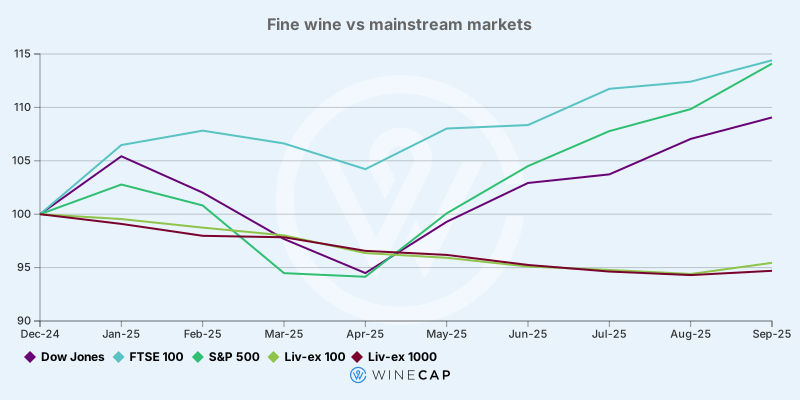
Categories
Quarterly-reports

Q2 2024 Fine Wine Report

Our Q2 2024 report has now been released. The report examines the macroeconomic factors affecting fine wine prices, the Bordeaux 2023 En Primeur campaign, the best-performing wines, industry news and an outlook for Q3.

Executive summary

  • The second quarter built on the successes of the first, with risk assets delivering another set of positive returns to investors.
  • Global equity markets were buoyed by resilient economic growth and rising investor confidence.
  • UK investment sentiment also improved after a landslide election win for the new Labour government.
  • The fine wine market remains a buyers’ market, with Burgundy and Champagne priced down the most in Q2. 
  • Bordeaux back vintages enjoyed rising demand and prices, following the 2023 En Primeur campaign.
  • The best-performing wine in Q2 was the 100-point Château Léoville Las Cases 2016.
  • This year’s En Primeur yielded mixed results with few great successes despite the general price cuts. 
  • Some of the best releases included the First Growths and their second wines, Beychevelle, and Cheval Blanc.
  • In other news, Sotheby’s Burgundy sale smashed wine auction records and Marchesi Antinori took full ownership of the Washington State winery Col Solare.
  • In buying opportunities, Latour 2009 offers perfect scores at the best possible price on the market.
  • Looking ahead, we anticipate the autumn La Place de Bordeaux campaign following a short summer lull.

The trends that shaped the fine wine market

Economic resilience boasts global markets

The second quarter delivered positive results for global equity markets which were buoyed by resilient economic growth, and supportive earnings and sales expectations. This strong economic foundation has allowed equities to advance, even as stubborn inflation poses potential challenges. Bond markets also appeared attractive; however, the same economic resilience that benefitted equities introduced near-term risks for fixed-income investments.

UK investment sentiment also improved following a landslide election victory for the new Labour government. The British pound, which has been the strongest major currency against the dollar this year, nudged higher when the scale of Labour’s victory became clear. The UK-focused FTSE 250 share index, which has outperformed the more global FTSE 100 year-to-date, rose to its highest level since April 2022, reflecting renewed investor confidence in the country’s economic prospects.

Fine wine – a buyer’s market

Meanwhile, fine wine prices continued to decline. The Liv-ex 1000 index, the broadest measure of the market, is currently at the level it was in August 2021 (388.28). Despite falling prices, trade volumes are higher than this time last year, suggesting that buyers are seizing opportunities to acquire wines at more favourable prices. Moreover, some of the best-performing wines this quarter rose as much as 20% in value. There are opportunities to be had if one follows closely.

En Primeur and Bordeaux’s falling prices

Some of these opportunities arose during the 2023 Bordeaux En Primeur campaign. The best new releases offered a compelling mix of quality and value, with a significant potential for future price appreciation. These included Beychevelle, Cheval Blanc, and the First Growths’ Grand vins and second wines – still, few and far between given the scale of the campaign. In the secondary market, Bordeaux prices fell 1.8% in the second quarter, making back vintages even more attractive. The only index that rose in value as the campaign concluded was the Bordeaux Legends 40 – exceptional older vintages that enjoyed rising demand. 

Regional fine wine performance

As the market’s focus shifted to new releases, prices in the secondary market fell in Q2. The broadest measure, the Liv-ex 1000 index, dipped 2.4%. It was led lower by the Burgundy 150 (-3.9%) and the Champagne 50 (-3.7%). The Rest of the World 60 and the Italy 100 indices experienced the smallest declines of 1.1% and 1.2% respectively.

As the chart above shows, Italy has shown relative resilience in the current bearish market. Despite broader market uncertainties, some Italian brands have even recorded positive movement in the last six months as high as 15%.

In June, the Bordeaux Legends 40 index recorded its first positive movement in almost a year, rising 0.3%. The index tracks the performance of a selection of 40 Bordeaux wines from exceptional older vintages (from 1989 onwards). As we have previously highlighted, older vintages can often be a lucrative investment prospect, offering a combination of quality, value and bottle age. 

The best-performing wines in Q2

The best-performing wines this quarter were a diverse mix from Bordeaux, Burgundy, Piedmont, the Rhone and Champagne. Leading the charge was the 100-point (WA) Château Léoville Las Cases 2016, with an impressive 19.4% increase. William Kelley described it as ‘one of the high points of this great vintage’. Close behind was Château Angélus 2019, which saw a 19.1% rise.

From Burgundy, Domaine Bonneau du Martray Corton-Charlemagne Grand Cru 2020 came third, up 15.2%. Other wines from the region that rose in value included Domaine de la Romanée-Conti La Tache Grand Cru 2017 and Coche-Dury Meursault 2018

Dom Pérignon Rosé 2009 also made the rankings, with a 9.6% rise this past quarter. On average, prices for the wine have risen 83% in the last decade.

Fine wine news

Sotheby’s Burgundy sale smashes records

On July 5, 2024, Sotheby’s conducted its first exclusive single-owner Burgundy sale, breaking eight world records and achieving €2 million ($2.1 million). Held in the historic Caves du Couvent des Cordeliers in Beaune, the auction featured over 175 lots from Taiwanese entrepreneur Pierre Chen’s cellar.

Top highlights included six bottles of Chevalier Montrachet d’Auvenay 2009, which fetched €106,250 (£89,915), and 12 bottles of Domaine Armand Rousseau Chambertin Clos de Bèze 1990, sold for €100,000 (£84,630). Among the record-setting sales were three bottles of 2005 DRC Échezeaux at €10,000 per bottle and a magnum of 2005 DRC La Tâche at €35,000.

Last month, Chen’s collection of fine and rare Champagne achieved €1.35 million (£1.14 million) at Sotheby’s in Paris, with notable sales including three magnums of Salon Le Mesnil Blanc de Blancs 1990 for €25,000 (£19,600) and a magnum of Dom Pérignon P3 1966 for €23,750 (£20,100), both setting new records.

Sotheby’s expects Chen’s collection to fetch a record $50 million (£39.2 million) by the series’ end, with upcoming auctions in New York and Hong Kong.

Antinori expands into Washington

Marchesi Antinori, one of Italy’s oldest family-owned fine wine producers, has taken full ownership of the Washington State winery Col Solare, which was established as a joint venture in 1995 with Ste. Michelle Wine Estate (SMWE). The acquisition includes the winery, the estate vineyard spanning 12 hectares planted primarily with Cabernet Sauvignon, and the brand, which produces around 5,000 bottles annually. Piero Antinori, president of Marchesi Antinori, expressed admiration for Red Mountain AVA’s unique terroir, emphasising the challenge and excitement of producing high-quality Washington red wines.

Juan Muñoz-Oca, COO of Antinori USA, highlighted the significance of this acquisition, reflecting Washington’s growing reputation for luxury wines. This move follows Antinori’s 2022 acquisition of Napa’s Stag’s Leap Wine Cellars, transitioning from a 15% to 100% stake after SMWE was sold to Sycamore Partners for $1.2 billion in 2021. Besides Stag’s Leap, Antinori owns Antica, a 200-hectare estate in Napa Valley, as part of their expansion in the states.

Buying opportunities: Latour 2009

Château Latour 2009 currently represents a combination of perfect scores and perfect timing. The highest-scoring wine ever at the annual Southwold tasting, Latour 2009 is now at the best price it has been in almost a decade. 

The recipient of no less than five perfect scores from Robert Parker, Lisa Perrotti-Brown MW, Jeff Leve, James Suckling, and Falstaff, Latour 2009 is a stand-out wine among critics. Hailed by Robert Parker as the greatest vintage he’d ever tasted, more recently Neal Martin described it as ‘outstanding’ and a ‘Latour firing on all cylinders’.

Latour is also the highest-scoring 2009 Bordeaux on Cellar Tracker, where it’s also the second-highest-scoring wine of the entire decade, beaten only by Petrus 2000 at more than six times the price.

In terms of price performance, Latour has outperformed all the other First Growths over one, two and five years. 

The 2009 vintage, which is currently available at one of the lowest price points ever, offers value among other prime vintages. Its scores match the 1982 and 1961, both of which come at a significant premium.

It is more affordable than the 2010 as well as the 2000 and 1990 vintages but with superior scores than all of them. The 2009 Latour is a hidden gem that seems particularly good to seek out now.

Outlook for Q3

With the onset of the summer lull, the market is expected to experience a temporary slowdown as usual. Despite this seasonal dip, numerous opportunities remain available. The market for collectibles, including fine wine, is gaining popularity among new investors looking for diversity and uncorrelated market returns.  

Over the next two months, the fine wine market will shift its focus to wines from around the globe as the autumn La Place de Bordeaux campaign takes centre stage. Esteemed producers such as Almaviva, Opus One, Vérité, Seña, Catena Zapata, Masseto, and Solaia will unveil their latest vintages on the international stage, accompanied by numerous other exciting releases.

As the campaign expands to include New World wines, the category is expected to see a surge in secondary market demand, potentially driving up prices. We will continue to spotlight the best investment opportunities where exceptional quality and brand prestige meet attractive pricing.

WineCap’s independent market analysis showcases the value of portfolio diversification and the stability offered by investing in wine. Speak to one of our wine investment experts and start building your portfolio. Schedule your free consultation today.
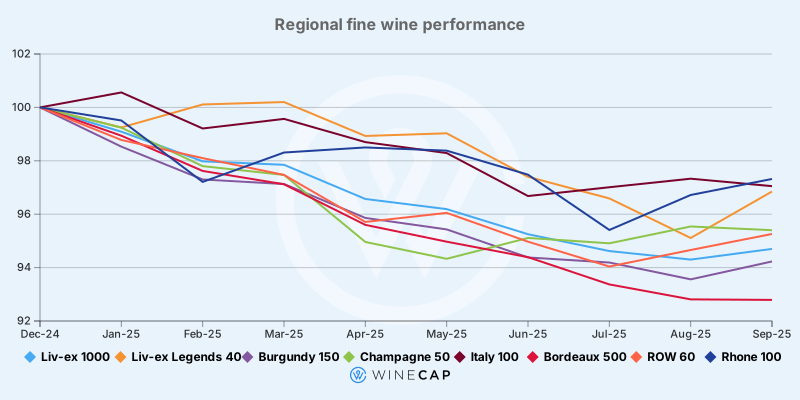
Categories
Quarterly-reports

Q1 2024 Fine Wine Report

Our Q1 2024 Fine Wine Report has now been released. The report offers a comprehensive overview of the fine wine market in the last quarter, including the impact of interest rates and geopolitical risks, the best-performing wines and regions, and analysis on the rising popularity of non-vintage Champagne as an investment.

Report highlights:

  • Mainstream markets rallied in Q1 2024, driven by resilient economic growth and expectations for future interest rate cuts by central banks.
  • The first green shoots started to appear in the fine wine market towards the end of Q1.
  • Fine wine prices (Liv-ex 100 index) experienced a smaller decline of 1% in Q1, compared to a fall of 4.2% in Q4 2023.
  • Italian wine enjoyed rising demand amid a flurry of new releases, including the 100-point Sassicaia 2021.
  • A number of Champagne labels that experienced consistent declines last year have started to recover, including Dom Pérignon, Salon Le Mesnil, and Pol Roger.
  • The Burgundy 2022 En Primeur campaign delivered high quality and quantity, with about 10% of producers reducing pricing year-on-year due to the challenging market environment.
  • China lifted tariffs on Australian wine after more than three years.
  • Critics and trade are now preparing for the 2023 Bordeaux En Primeur campaign, which will dominate the news in Q2 2024.

Click below to download your free copy of our quarterly investment report.


Fine Wine Report

Categories
Quarterly-reports

Q4 2023 Fine Wine Report & 2024 Outlook

Our Q4 2023 report has now been released. The report offers a comprehensive overview of the fine wine market in the last quarter and a forward-looking perspective for 2024. In a landscape marked by correction and repositioning, it delves into the dynamic interplay of market forces, unveiling both challenges and opportunities for investors.

Report highlights:

  • The fine wine market is navigating 2024 amidst a correction phase, presenting a chance for strategic repositioning.
  • Fine wine prices (Liv-ex 100 index) experienced a 4.2% decline in Q4, reflective of market adjustments amid global economic uncertainties.
  • Increased risk aversion has redirected focus to classic wines and regions, with Bordeaux emerging as a standout beneficiary.

  • Bordeaux’s resurgence, driven by liquidity and a solid reputation, underscores the market’s adaptability to changing dynamics.
  • The upcoming high-volume Burgundy and Bordeaux En Primeur campaigns present opportunities for strategic investment, with pricing strategies holding the key to success.
  • Investors, seeking value and consistency, anticipate potential opportunities in the evolving landscape.
  • As an improving asset in diminishing supply, their emphasis should remain on long-term gains.

Click below to download your free copy of our quarterly investment report.


Fine Wine Report