Categories
Learn

10 interesting facts about Dom Perignon

  • Dom Perignon is the world’s most recognised prestige cuvee, produced exclusively as a vintage wine.
  • A cornerstone of the LVMH portfolio, Dom Perignon possesses massive global brand equity.
  • The secondary market for Dom Perignon is highly liquid compared to other wines.

Dom Perignon is more than just Champagne – it is one of the most popular luxury wines in the world. From its origins in the Abbey of Hautvillers to its position today as the flagship prestige cuvee of Moet & Chandon and LVMH, the brand has become synonymous with celebration, craftsmanship, and collectability. Produced exclusively as a vintage wine, Dom Perignon captures the unique identity of each harvest while balancing rarity, longevity, and global appeal. In this guide, we explore ten fascinating facts that explain how Dom Perignon became one of the most influential and investable names in fine wine.

1. The heritage and legend of the Benedictine monk

The history of Dom Perignon is intertwined with the very foundations of the Champagne region. Pierre Perignon was a Benedictine monk who served as cellar master at the Abbey of Hautvillers in the seventeenth century. While legend often credits him with “inventing” sparkling wine (he didn’t), his true contribution was the refinement of viticultural techniques.

He pioneered the practice of blending grapes from different vineyards to achieve a balanced profile. He also introduced the use of corks and stronger glass bottles to prevent explosions in the cellar. These innovations laid the groundwork for the modern production of luxury sparkling wine.

Key historical milestones for the abbey and the brand:

  • Pierre Perignon arrived at the Abbey of Hautvillers in 1668.
  • Moet & Chandon acquired the Dom Perignon brand in the early twentieth century.
  • The first Dom Perignon vintage was 1921, officially released in 1936.
  • In the early 2000s, Dom Perignon introduced late-disgorged re-releases under the Oenotheque label, later rebranding as P2 and P3 for even older vintages.
  • Under Chef de Cave Vincent Chaperon, the house has moved toward releasing wines from almost every harvest, even in very small quantities, as seen with the limited 2017 vintage.

2. The Moet & Chandon partnership

Dom Perignon is produced by Moet & Chandon, which is the largest Champagne house in the world; however, the brand operates with a significant degree of autonomy. While Moet produces millions of bottles of non-vintage Champagne, Dom Perignon is a vintage product only.

This relationship provides the estate with access to some of the best vineyard sites in the region with the brand utilising grapes from the eight historic Grand Crus and the legendary Premier Cru of Hautvillers. This vast choice of fruit allows the winemaking team to maintain a consistent style despite the variations of individual years.

Technical advantages of the Moet connection:

  • Unrivalled access to high-quality Chardonnay and Pinot Noir grapes.
  • World-class production facilities and technical expertise.
  • Global distribution networks that ensure the wine reaches every major market.
  • A massive library of back vintages kept for the Plenitude programme.
  • The ability to maintain rigorous selection standards for every release.

3. A star in the LVMH luxury portfolio

Dom Perignon sits as one of the twin Champagne peaks of the LVMH (Louis Vuitton Moet Hennessy) wine and spirits division. Within this group, Dom Perignon acts as the global ambassador for French luxury and elegance.

Other Champagne brands within the LVMH constellation include:

  • Moet & Chandon: The largest Champagne house in the world
  • Veuve Clicquot: Famous for its “Yellow Label”
  • Krug: LVMH’s other Champagne peak
  • Ruinart: The oldest established Champagne house in the world since 1729
  • Mercier: Highly popular within France and known for its vast cellar tunnels in Epernay
  • Armand de Brignac (Ace of Spades): In 2021, LVMH acquired a 50% stake in this brand from Shawn Carter better known as Jay-Z

LVMH has been instrumental in positioning the brand as a lifestyle icon. By linking the wine to fashion, art, and high-end gastronomy, they have expanded its appeal far beyond traditional wine circles. This strategic marketing ensures that demand remains high regardless of broader economic fluctuations.

The LVMH influence on the brand:

  • High-profile marketing campaigns featuring global celebrities.
  • Presence in the world’s most exclusive hotels and restaurants.
  • Strategic partnerships with luxury retailers.
  • A focus on limited edition bottlings and bespoke packaging.
  • Synergies with other LVMH brands to create “lifestyle experiences”.

4. Dom Perignon’s commitment to vintage

The most defining characteristic of Dom Perignon is that it is always a vintage wine. Unlike most Champagne houses that rely on a consistent non-vintage blend, Dom Perignon only releases wine from a single harvest. Until very recently if the quality of a year was not sufficient to produce a reasonable quantity of wine, no wine was produced.

This commitment to vintage creates a natural scarcity and ensures that each release is a unique snapshot of a specific time and place. It reflects the weather, the harvest conditions, and the creative vision of the chef de cave and the winemaking team. This variety keeps collectors engaged as they compare different years.

Aspects of the vintage philosophy:

  • Each vintage must be able to age for at least twenty years.
  • The blend is always a balanced mix of Chardonnay and Pinot Noir.
  • The decision to declare a vintage rests solely with the cellar master.

5. The Plenitude concept: Dom Perignon P2 and P3

One of the most innovative aspects of Dom Perignon is the Plenitude programme. The house believes that wine does not age in a linear fashion but is rather a punctuated equilibrium where the wine evolves to specific “plateaus” of maturity and different characteristics come to the fore. These stages are released as P2 (Second Plenitude) and P3 (Third Plenitude).

P2 wines are typically released after fifteen years of age. They offer a surge of energy and a more intense, mineral profile. P3 wines are even rarer, often spending over twenty-five years in the cellar. These bottlings represent the ultimate expression of the wine’s longevity and complexity.

Understanding the Plenitude stages:

  • P1: The standard vintage release, typically aged for eight to nine years.
  • P2: The “energy” phase, offering greater precision and length.
  • P3: The “complexity” phase, showing deep tertiary notes and incredible depth.

These releases can be highly sought after by collectors and investors due to their rarity.

The latest major Dom Perignon Plenitude releases are currently:

  • Dom Perignon P2 2008 – Widely considered one of the most important recent Champagne releases, due to the legendary status of the 2008 vintage.
  • Dom Perignon P3 1995 – The third Plénitude of the 1995 vintage after nearly three decades on lees.
  • Dom Perignon Rosé: A bold expression

The rosé version of Dom Perignon was first created in 1959 and is considered by some the most daring wine in the portfolio. It is not merely a pink version of the standard vintage, but rather a distinct creation that focuses on Pinot Noir. The Dom Perignon rosé is typically released much later than Dom Perignon.

The house uses a significant proportion of red wine in the blend to achieve its characteristic copper hue and structural intensity. For many connoisseurs, the rosé represents the pinnacle of the house’s winemaking skill.

Hallmarks of the rosé include:

  • Intense aromas of wild strawberries, smoke, and spices.
  • A structured palate with fine tannins and vibrant acidity.
  • Strong food-pairing potential due to its weight and depth.
  • Limited production levels that drive high secondary market prices.
  • A reputation for being one of the longest-lived pink Champagnes.

1990, 1996, 2002 and 2008 are generally considered the strongest vintages. 2010 is the most recent release.

7. What does Dom Perignon taste like?

The typical tasting profile of Dom Perignon is defined by balance and tension. It is a wine that manages to be both opulent and precise at the same time. While it has the creamy texture associated with high-quality Champagne, it is always underpinned by a firm mineral backbone.

Common descriptors for young Dom Perignon include citrus, white flowers, and brioche. As the wine ages, it develops more complex notes of toasted nuts, honey, and dried fruits. The finish is famously long, often leaving a salty, mineral sensation that is characteristic of the region’s chalky soils.

Structural elements of the wine:

  • A seamless integration of fruit and acidity.
  • A silky mousse with very fine bubbles.
  • Subtle smoky or reductive notes that add complexity.
  • A mid-palate that is rich but never heavy.
  • The ability to evolve gracefully for several decades in a professional cellar.

8. Dom Perignon artistic collaborations

Dom Perignon has a long history of collaborating with world-renowned artists and musicians. These partnerships often result in limited edition labels and ornate gift boxes that help to bridge the gap between fine wine and contemporary culture.

From Andy Warhol to Jeff Koons, and more recently Lady Gaga, these projects bring a fresh perspective to the brand. They often explore the themes of creativity and transformation that are central to the winemaking process. 

For investors, these limited editions often command a premium over the standard labels; however, their limited edition nature and price premium can limit their liquidity, and only a few have shown themselves to be better investments than the standard bottles.

Notable artistic partnerships:

  • Andy Warhol: A colourful series of labels inspired by the artist’s pop art style.
  • Karl Lagerfeld: Several iconic advertising campaigns and bespoke bottle designs.
  • Iris van Herpen: A sculptural gift box that explored the concept of metamorphosis.
  • Lenny Kravitz: A collaboration that included a hammered metal label and a bespoke table.
  • Lady Gaga: A series of limited editions that celebrated the power of creative freedom.

9. Legacy vintages and record prices

Certain years have achieved legendary status among collectors. Vintages like the 1961, 1966, and 1990 are frequently cited as the benchmarks for quality. These wines have shown incredible resilience and continue to drink beautifully many decades after their harvest.

In the auction room, rare bottles of Dom Perignon frequently reach record prices. This is particularly true for older vintages in original packaging or rare formats like Magnums and Jeroboams. The 1959 Rose and the 1921 vintage are among the most expensive bottles ever sold, reflecting their historical importance.

Significant vintages for investors:

  • 1990: A classic year with incredible richness and balance.
  • 1996: Celebrated for its high acidity and long-term potential.
  • 2002: A powerful vintage now entering its prime drinking window.
  • 2008: One of the most hyped and high-scoring years in recent history.
  • 1959 (Rosé): The inaugural rosé vintage.

10. Dom Perignon investment performance 

Dom Perignon is one of the most liquid assets in the fine wine market. There is always a buyer for well-stored bottles because of the brand’s global recognisability. It acts as a reliable entry point for those beginning a wine portfolio, while remaining a staple for seasoned investors.

Dom Perignon’s dynamic changed post-Covid with a significant rise in prices. Prior to that, the brand had shown steady capital appreciation over the long term. Its performance is often used as a bellwether for the overall health of the Champagne market.

Key investment takeaways:

  • High global demand ensures quick resale on major exchanges.
  • Consistent critical scores provide confidence for long-term holding.
  • The brand serves as a strong diversifier within a multi-region portfolio.
  • Professional storage is essential to maintain the wine’s secondary market value.

FAQ: Dom Perignon

Why is Dom Perignon only made in vintage years? 

The house believes in representing the unique character of a single harvest, anchoring its brand to the concept of vintage champagne.

What is the difference between P1, P2, and P3? 

These represent different “Plenitudes” or stages of maturity, with P2 and P3 spending significantly more time ageing in bottle on the lees before release.

Is Dom Perignon a good investment for beginners? 

Yes, because of its high brand recognition and market liquidity, it is considered one of the most stable entry points for wine investment.

How long can I cellar a bottle of Dom Perignon? 

Most vintages are built to last for twenty to forty years, while the P2 and P3 releases can evolve for even longer. 

WineCap’s independent market analysis showcases the value of portfolio diversification and the stability offered by investing in wine. Speak to one of our wine investment experts and start building your portfolio. Schedule your free consultation today.
Categories
Learn

A guide to terroir and its role in wine investment

  • Terroir is a concept that includes climate, soil, geography, biome and human intervention to give an individual wine its unique identity.
  • The distinction between commodity wine and investment-grade fine wine is in part about geographic specificity and the protection of place through strict regulatory frameworks.
  • The most prestigious estates prioritise the expression of their natural environment over stylistic manipulation.

Terroir: The umbrella term for wine identity

Terroir is frequently cited as the primary factor in the exceptional quality and distinctive character of Old World wines. Derived from the French word “terre,” meaning land, it’s much broader than that: collectors understand it as an umbrella term that combines diverse concepts under a single banner.

Understanding this concept means recognising that a wine’s qualities are inherently linked to a specific location which imparts a unique “DNA” to every fine wine. This makes it consistent characteristics across different vintages. Terroir provides a sense of place that cannot be replicated.

Key components of the terroir umbrella include:

  • Climate and weather
  • Geology and soil
  • Topography
  • Biology
  • Human tradition & intervention (or lack of)

The role of climate

Climate is arguably the most significant influence on the natural environment of a vineyard: it dictates the length of the growing season, the rate at which grapes ripen and how well they ripen. For the wine investor, understanding climate is essential, as many great terroirs are linked to long seasons with slow ripening and a long hang time. Weather, as opposed to climate, is what is behind vintage variation and is also critical to wine investors.

For terroir, climate is a factor at three geographical scales:

  • The broad climate of an entire region, such as the continental weather of Burgundy or the maritime influence of Bordeaux.
  • The atmospheric conditions of a specific sub-region or village, such as the sheltered slopes of a Barolo commune.
  • The unique conditions within a single vineyard or even a specific row of vines.

These layers interact to create the conditions that dictate the potential of a wine.

Soil types and water regulation

Old World producers frequently point to geology and soil as the literal bedrock of their success. The underlying materials determine the nature of the topsoil and influence the local topography. For instance, the chalky soils of Champagne and Chablis allow vines to penetrate deep into the subsoil.

Scientists can debate whether vines literally absorb elements that directly influence flavour, however, it is widely accepted that soil significantly regulates the water supply to the vines. Renowned vineyards often feature soils that provide only a moderate water supply, which limits vegetative growth and prevents waterlogging.  Viticulture often happens on land that would be unsuitable for other types of farming, and it is commonly held that the best wines come from vines that have to work hard.

Notable soil and terroir pairings include:

  • Pomerol: Heavy, well-structured clay-based soils.
  • Medoc: Deep, stony-gravelly sands that provide excellent drainage.
  • Burgundy: A complex combination of limestone and clay in marly soils.
  • Mosel: Steep slopes with characteristic slate-based soils.

Geography, geomorphology, and price

The topography of a vineyard – its aspect, position on a slope, and elevation – all contribute to stylistic differences. In Burgundy, a Grand Cru vineyard may be distinguished from a neighbouring plot simply by its mid-slope position.

Geomorphology refers to the physical features of the land and how they were formed. Steeper slopes, such as those in the Northern Rhône, allow for better sunlight exposure and drainage. This physical advantage translates directly into the quality of the harvest and is why certain vineyards are prized as blue-chip assets that trade for many millions of pounds while the valley floor is reserved for commodity production.

Biome and microbiome: The living vineyard

As our understanding of agriculture deepens, modern viticulture is placing increasing emphasis on the biome of the vineyard. This refers to the entire broad ecosystem, including cover crops, hedgerows, trees and the local wildlife and encourages winemakers to think about much more than just the grapes they are growing. 

For instance moving away from heavy machinery and reintroducing horses to the fields isn’t just a marketing ploy; it reduces soil compaction and preserves the natural structure of the earth. A holistic approach encourages a healthy microbiome, where natural yeasts and beneficial bacteria flourish alongside worms, insect life, wildflowers, bees, birds and small mammals.

Estates that focus on biodiversity often showa more authentic expression of place and it can improve quality too: reducing chemical inputs and allowing natural vegetation to grow helps to regulate the soil’s temperature and moisture levels. For the investor, these sustainable practices are increasingly seen as a marker of long-term value and grow an estates’ reputation.

What grape varieties are suited to what terroir

Not every grape variety is suited to every terroir. The choice of variety is a major factor in how a site expresses its character. A grape must be able to achieve full ripeness under local climatic conditions to exhibit its best flavours and structural balance.

For example:

  • Syrah: Reaches its pinnacle in the Northern Rhone.
  • Nebbiolo: Thrives in the specific hillsides of Piedmont.
  • Pinot Noir: Is famously temperamental, requiring the cool climate of Burgundy.
  • Cabernet Sauvignon: Requires the warmth and drainage provided by the gravel plateaus of Pauillac.

When a grape is perfectly matched to its location, the resulting wine possesses a quality that is impossible to replicate. This suitability is often protected by regional laws that mandate certain grape types to prevent the erosion of quality and promote collective branding.

Protecting place: DOC Rules and the Napa Declaration

Over the last 100 years it has become increasingly common for the concept of terroir to be codified through legal systems like the French Appellation d’Origine Controlee rules. These regulations protect specific terroirs by mandating which grapes can be grown and how the wine must be made. This ensures that a bottle carries a guarantee of origin and typicity.

These regulations are not limited to France or Europe, many nations have since adopted similar rules and their protection is often a key goal of international trade negotiations. The Napa Declaration on Place is a significant international agreement where producers committed to protecting the integrity of wine place names recognising that “place” is the most fundamental aspect of a wine’s identity. This prevents the misleading use of geographic terms for wines that were not grown in those specific soils.

Terroir: Fine wine vs commodity wine

So important is terroir that in many ways the distinction between fine wine and commodity wine is geographic specificity. Commodity wines are often produced from grapes sourced across entire countries or continents. They prioritise volume and consistency over the unique characteristics of a single site.

Fine wine, by contrast, is almost always tied to a specific patch of earth; the land is fixed and cannot be expanded. This geographic restriction ensures that supply is capped, creating the conditions for long-term price appreciation in the secondary market.

Winemaking: Expressing vs overriding terroir

The role of the winemaker remains a subject of discussion but winemaking practices undeniably contribute to the final style.

In the late 20th century, as wine critic Robert Parker’s influence expanded his evolving preferences and the impact a high Parker score could have on values began to influence winemaking. A trend of “Parkerization” favoured rich, bold, and heavily oaked wines. Consultants like Michel Rolland were often associated with this opulent style and sometimes accused of overriding terroir in favour of a homogenous international style. 

In reality this was not a plot against terroir by winemakers, consumers or critics, but a reflection of commercial reality.

Recent years have seen a strong reaction against this trend with many producers intentionally adopting a “less is more” philosophy. They may use neutral vessels, such as large Slavonian oak botti rather than imported French oak barrels or wild yeasts from the vineyard rather than cultured products. 

The goal is to act as a steward of the land and reflect that in the wine rather than be the creator of a brand that makes an unchanging product.

Climate change and the shifting map

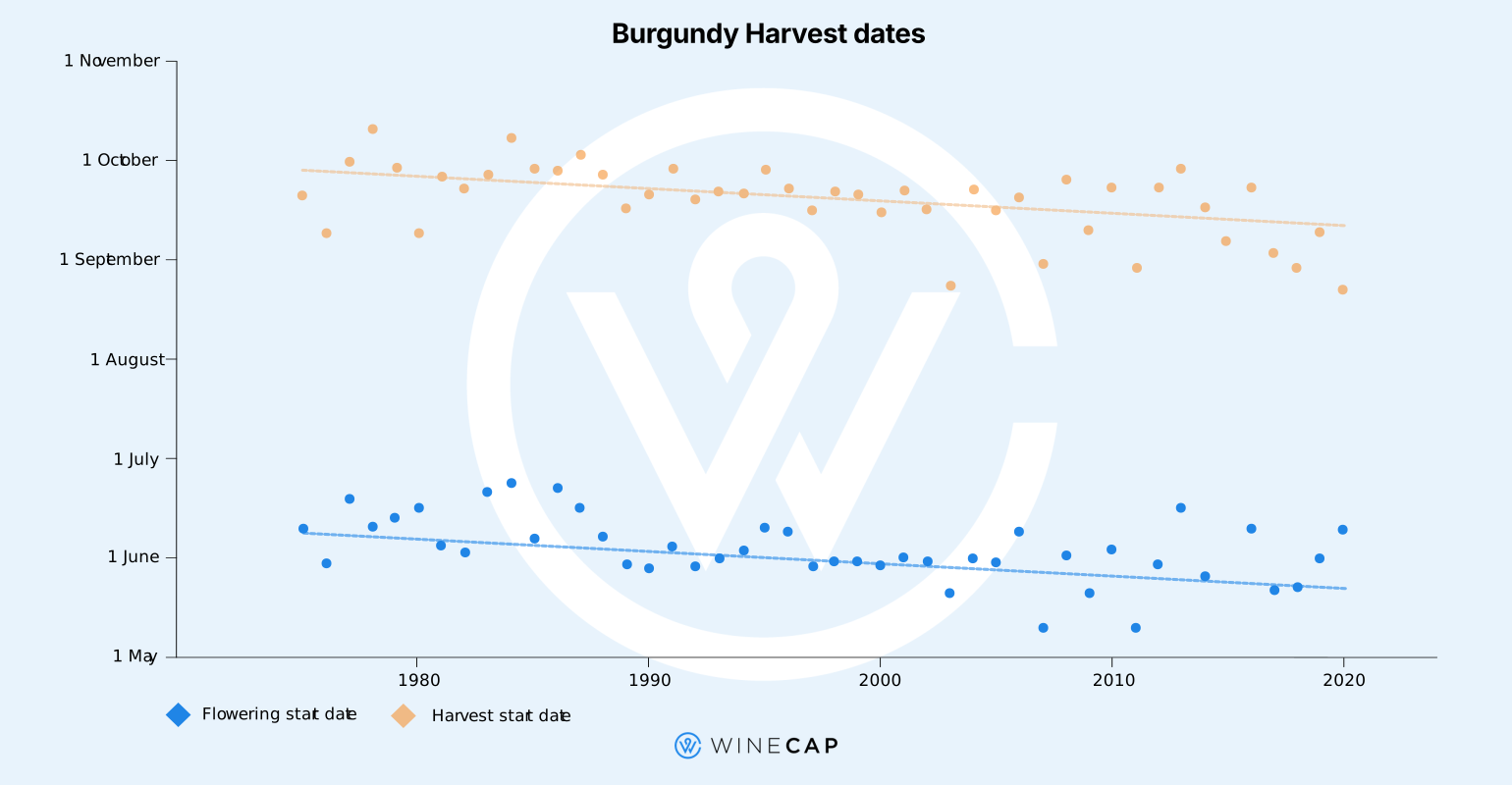
Climate change is having a profound impact on the global wine map. Rising temperatures are shifting the boundaries of where fine wine can be produced, in some regions where a southern aspect was preferred in the 1980s those vineyards are now becoming less productive and limited by the heat that used to be an advantage.

Burgundy Flowering and harvestData Source: jancisrobinson.com

Some historical regions are finding it increasingly difficult to maintain their traditional styles as sugar levels rise and acidity drops.

However, this shift is also opening up new frontiers:

  • English sparkling wine: Counties like Kent and Sussex now share a climate similar to the Champagne of several decades ago.
  • Patagonia and Central Otago: High-latitude regions are becoming top destinations for cool-climate varieties.
  • Emerging northern regions: Areas in Germany and even Scandinavia are beginning to produce high quality Pinot Noir.

For the investor, these changes create both risk and opportunity. While established terroirs are still preferred, new regions may become a more important part of the conversation in coming years.

Terroir beyond the wine glass

The concept of terroir is not exclusive to viticulture. It exists in many other artisanal products where sense of place is paramount. The “Slow Food” movement was built on this foundation, celebrating traditional agricultural products that reflect their local environment.

Other examples of terroir include:

    • Cheese: Such as Comte or Roquefort, where the local grasses and caves define the flavour.
    • Olive oil: Where regional soil and climate produce distinct profiles.
    • Coffee and tea: Where high-altitude “micro-lots” are traded at a premium.
    • Meat: Beef and lamb from the Orkney islands were among the first British products to gain legal recognition of their terroir.

In all these cases, terroir represents an element that imparts a sense of place. It is the ultimate rejection of mass-production and the celebration of the unique.

FAQ: A guide to terroir 

Is terroir just a marketing tool? 

While it is used in branding, terroir is based on documented physical factors like geology, climate, and topography that result in discernible variations in wine character.

Can a winemaker completely change a wine’s terroir? 

A winemaker can hide terroir through excessive oak or extraction, but they cannot create the structural intensity or complexity that only a superior site can provide.

Why does terroir matter for investment? 

Geographic specificity creates a natural cap on supply. Because the most famous vineyards cannot be expanded, the resulting rarity drives value in the secondary market.

Does the New World have terroir? 

Yes. Many New World producers now use soil mapping and single-vineyard designations to highlight the unique character of their specific plots.

WineCap’s independent market analysis showcases the value of portfolio diversification and the stability offered by investing in wine. Speak to one of our wine investment experts and start building your portfolio. Schedule your free consultation today.
Categories
Learn

Understanding the fine wine secondary market: Investing, liquidity and valuation

  • While the primary market is the initial sale from the estate, the secondary market is the global trading ecosystem where wine is treated as a financial asset.
  • Secondary market prices are dictated by supply/demand – as bottles are consumed, the rarity of the remaining vintage drives exponential value growth.
  • Secondary market success relies heavily on professional storage and documented history to ensure investment-grade quality.

For centuries, fine wine has been seen as a treasured collectible; over the last twenty years, it has started to be recognised as a sophisticated alternative asset class too. To understand how wine functions as an investment, one must grasp the mechanics of its lifecycle – specifically the transition from the primary market to the secondary market.

This guide provides an in-depth exploration of the fine wine ecosystem, offering clarity for collectors, investors, and enthusiasts looking to navigate the complexities of global wine trading.

What is the primary market for fine wine?

Before diving into the secondary market, we must define its origin. The primary market refers to the first time a bottle of wine is sold after production. In this stage, the transaction occurs directly between the producer (the winery or estate) and the first buyer who could be an individual or a business (i.e. wine merchant).

Key characteristics of the primary market:

  • Direct sourcing: The wine moves from the cellar of the estate to a distributor, importer, or La Place de Bordeaux courtier.
  • Fixed pricing: Prices are typically set by the estate based on production costs, brand equity, and vintage quality.
  • En Primeur (Wine Futures): A hallmark of the primary market, particularly in Bordeaux. Investors purchase wine while it is still aging in barrels, often 12-18 months before bottling. This offers the lowest possible entry price but carries the risk of the wine evolving differently than expected.
  • Allocation systems: For “cult” wines (like Domaine de la Romanée-Conti or Screaming Eagle), primary market access is restricted to exclusive mailing lists or long-standing restaurant partners.

What is the secondary market for fine wine?

The secondary market encompasses all subsequent transactions of a wine after its initial sale in the primary market. Once a bottle leaves the original distribution chain and enters the hands of a private collector, an investment firm, or a specialised retailer, any future sale happens on the secondary market.

Unlike the primary market, where supply is controlled by the winery, the secondary market is driven by supply and demand. As bottles are consumed over time, the remaining supply of a specific vintage diminishes, often driving prices upward – a concept known as “inverse supply elasticity.”

Why the secondary market matters

The secondary market is where “wine” becomes “liquid gold.” It provides:

  1. Liquidity: A platform for collectors to exit their positions and convert wine into cash.
  2. Price discovery: Real-time valuation based on what global buyers are actually willing to pay.
  3. Vintage depth: Access to aged, “library” wines that are no longer available from the producer.

The core components of the secondary market

1. Wine exchanges

The London International Vintners Exchange (Liv-ex) is the “stock exchange” for wine. It provides a standardised platform for merchants to trade, offering price transparency and indices (like the Liv-ex Bordeaux 500) that track market health.

2. Auction houses

Global powerhouses like Sotheby’s, Christie’s, and Zachys dominate the high-end secondary market. Auctions are the primary venue for rare collections and “unicorn” bottles. Online auction platforms have recently democratised this space, allowing smaller collectors to participate.

3. Specialised brokers and investment platforms

Modern fintech platforms allow investors to buy managed portfolios. These entities operate almost entirely within the secondary market, sourcing back vintages with proven provenance.

4. Peer-to-peer and retail re-sales

Specialty retailers often buy back well-cellared collections from private individuals to resell them to other collectors.

Key drivers of secondary market value

What makes a bottle appreciate in the secondary market? It is not just the name on the label.

Provenance and storage

In the secondary market, provenance is everything. A bottle of 1982 Château Lafite Rothschild is worthless if it was stored in a warm kitchen. Buyers look for “ex-cellar” history or professional storage records (bonded warehouses) to ensure the wine has been kept at a constant 12-14°C (55°F) with optimal humidity.

Critic scores

Ratings from “palate-makers” like Robert Parker’s Wine Advocate, Antonio Galloni (Vinous), or Jancis Robinson act as market catalysts. A 100-point score can cause an overnight price surge on the secondary market.

Scarcity and rarity

The secondary market thrives on scarcity. If a producer only makes 500 cases of a particular cuvée, and 200 are consumed in the first five years, the remaining 300 bottles become significantly more valuable to collectors seeking a complete vertical.

Bonded warehouses and “In-Bond” trading

In the secondary market, how you store your wine is as important as the wine itself. Professional investors almost exclusively trade wine “In-Bond” (IB).

In-Bond (IB) vs. Duty Paid (DP)

  • In-Bond (IB): The wine is stored in a government-approved bonded warehouse. It has not yet attracted VAT or Excise Duty. If you sell the wine while it is still “in bond,” you never have to pay these taxes. This increases the profit margin for investors and ensures the wine has never left a temperature-controlled environment.
  • Duty Paid (DP): Taxes have been paid, and the wine has likely been delivered to a private home. In the secondary market, Duty Paid wine often sells at a discount because its storage history is harder to verify.

Expert tip: For maximum resale value, always keep your investment-grade wine “under bond” in a recognized facility like London City Bond.

Secondary fine wine market global trade hubs 

While London remains the historical heart of the wine trade, the secondary market has shifted toward a tri-polar model:

  1. London: The center for technical trading and storage.
  2. Hong Kong: The tax-free gateway to the thirsty Asian market.
  3. Singapore: A growing hub for Southeast Asian high-net-worth individuals.

The “laggard” phenomenon

Fine wine is often described as a “laggard” asset. It does not react instantly to stock market crashes. Usually, there is a 6-to-12-month delay before wine prices reflect broader macroeconomic shifts. This makes it a powerful hedge against inflation and sudden equity volatility.

Secondary market trends: Beyond Bordeaux

Historically, the secondary market was 95% Bordeaux. Today, the landscape is much more diverse:

  • Burgundy: Now represents a massive share of market value due to extreme scarcity and global prestige.
  • Italy: The rise of “Super Tuscans” (Sassicaia, Tignanello) and Barolo has created a robust secondary niche.
  • Champagne: Recently one of the top-performing sectors, as collectors realize the aging potential of prestige cuvées.
  • The New World: Cult Californians (Harlan Estate) and Australian icons (Penfolds Grange) are now staples of global trading.

Risks in the secondary market

Investing in the secondary market is not without peril:

  • Counterfeits: High prices attract fraud. Verification of labels, corks, and glass is essential.
  • Market volatility: Like any asset, wine prices can fluctuate based on global economic conditions.
  • Illiquidity: While more liquid than it used to be, selling a wine collection still typically takes longer than selling a stock.

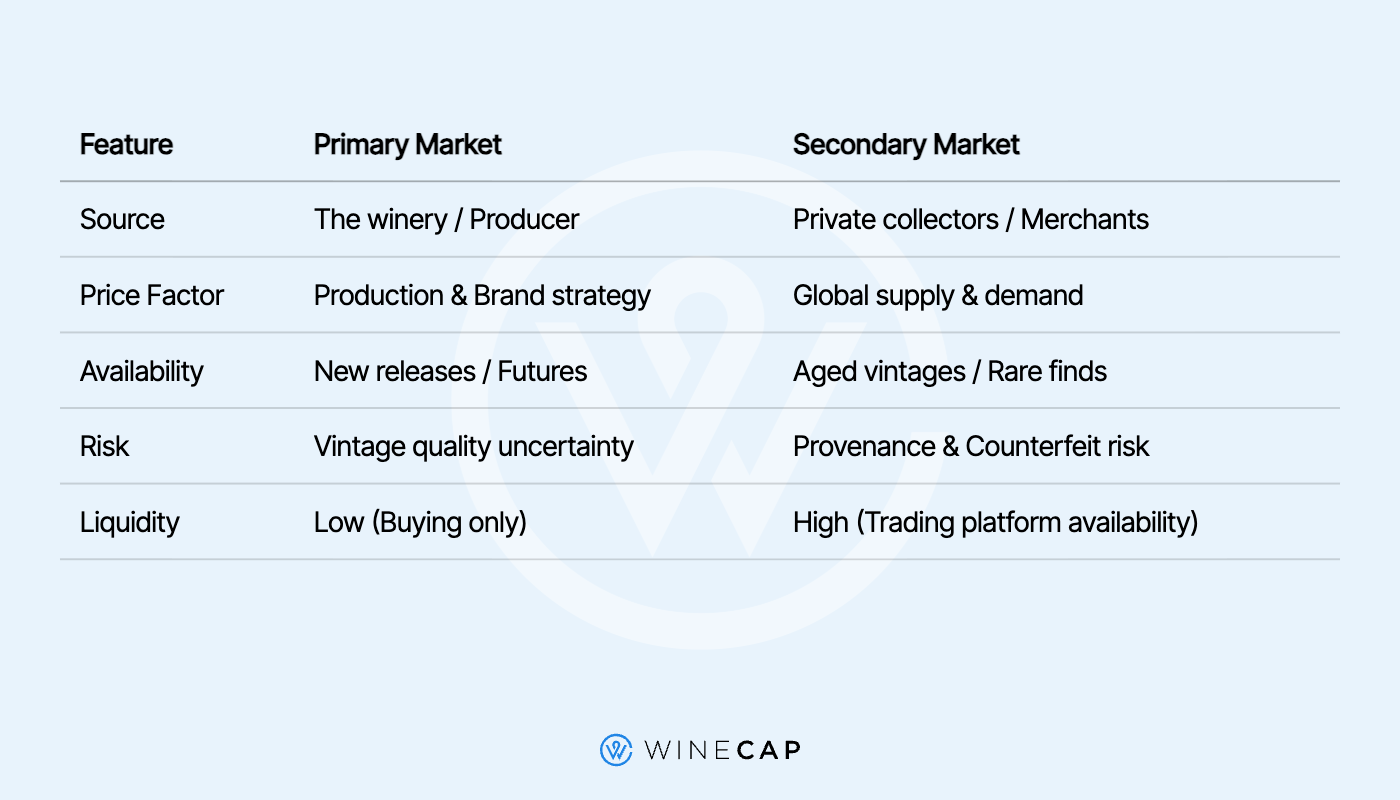
Primary vs. Secondary Market Comparison

Primary vs Secondary Market Comparison

Frequently asked questions (FAQ)

Is fine wine a good investment?

Fine wine has historically shown low correlation with traditional stock markets, making it an excellent diversifier. It often delivers steady long-term capital appreciation, though it requires patience and proper storage.

What is a “bonded warehouse”?

A bonded warehouse is a tax-secured facility where wine is stored without the owner having to pay Duty or VAT. This is the preferred storage method for the secondary market, as it guarantees professional conditions and makes the wine easier to resell.

How do I check the secondary market price of my wine?

Platforms like Wine-Searcher provide market data. Specialised wine investment companies can provide valuations. Auction hammer prices are also a reliable indicator of current value.

Can individuals sell wine on the secondary market?

Yes, but it is regulated. Most individuals sell through auction houses or brokers who take a commission. Selling directly to another individual often requires specific licensing depending on your jurisdiction.

What is the best way to enter the secondary market?

Most investors start by using a managed platform or a specialised broker. This ensures you are buying wine with perfect provenance and professional storage already in place.

Why do prices fluctuate so much?

Secondary market prices react to critic scores, weather events affecting future crops, and shifts in global currency (the USD/GBP exchange rate is particularly influential).

Can I sell a single bottle?

While possible through online auctions, the secondary market is most liquid for full original wooden cases (OWC). Single bottles often face steeper commissions and lower demand.

WineCap’s independent market analysis showcases the value of portfolio diversification and the stability offered by investing in wine. Speak to one of our wine investment experts and start building your portfolio. Schedule your free consultation today.
Categories
Learn

Fine wine vs luxury handbags: the investment perspective

  • Luxury handbags are the second most popular collectible item among UK wealth managers in 2024, after fine wine.
  • Rising prices in the primary market for handbags have led to investment interest.
  • While valuations for brands like Chanel and Hermès have spiked dramatically, the secondary market is less established and more illiquid than the fine wine market.

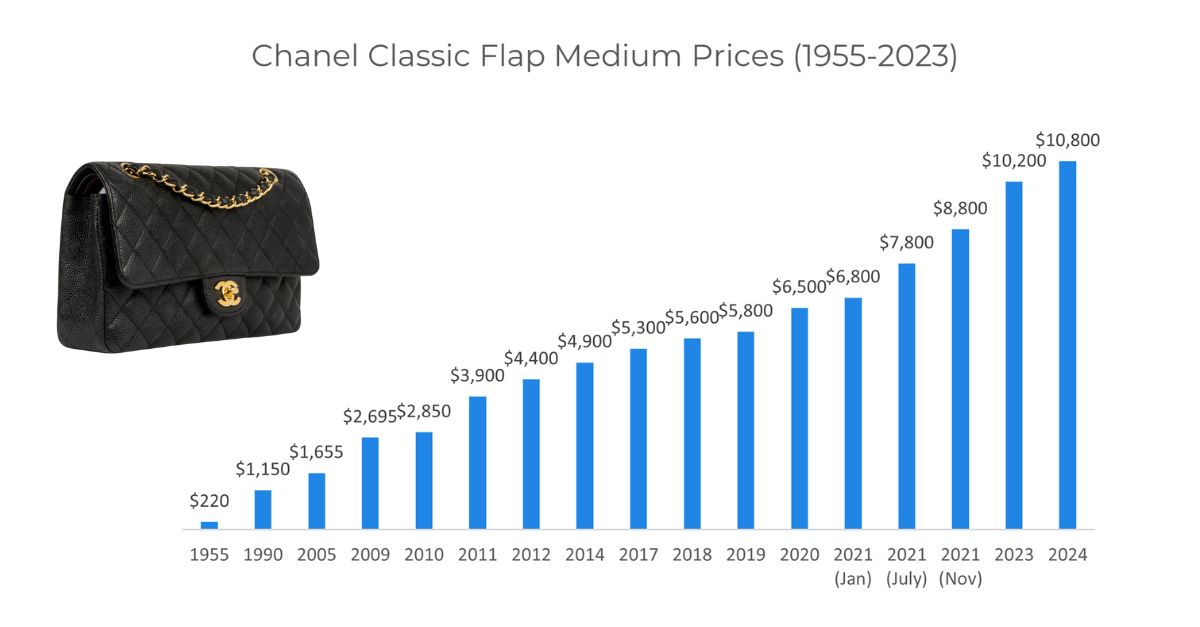
Recent headlines have been filled with news about skyrocketing prices for luxury handbags. The price of the Chanel medium classic flap bag has risen close to 553% since 2005; and 4,809% since 1955.

With prices in the primary market reaching record highs, interest in handbags as a collectible has grown. The term ‘investment piece’ no longer serves to simply describe the timelessness of an item; for investors today, it has taken a much more literal meaning.

Meanwhile, fine wine remains a more established member of the ‘collectibles’ family. In recent years, fine wine has transitioned from a passion investment to a mainstream asset class.

This article explores the shift in investment trends, the rising popularity of luxury assets, and the risks and rewards associated with fine wine and luxury handbags.

A shift in investment trends

Traditionally, investments have been confined to stocks, bonds, and real estate. Now, they are sharing the spotlight with more tactile assets like fine wine and luxury handbags.

According to our recent survey among US and UK wealth managers, there has been a significant uptick in interest for collectibles. In 2024, 78% of US wealth managers expect demand for luxury handbags to increase, complemented by a strong ongoing interest in fine wine (84%).

In the UK, 86% anticipate growth in demand for luxury handbags, up 6% from 2023, while 92% expect sustained demand for fine wine.

The full findings of this survey will be released later this month.

Comparing fine wine vs luxury handbags

Fine wine is sought after for its stability and remains the top investment choice among alternative assets. Its secondary market is more established, offering increased liquidity and price transparency.

It does not lack impressive performers either; luxury Champagnes Salon Le Mesnil-sur-Oger Grand Cru has appreciated 304% over a decade, and Egly-Ouriet Brut Millésime Grand Cru has seen returns of 452%. Prestigious Burgundy wine, Domaine René Engel Vosne-Romanée is up 3,105% over the same period.

Although luxury handbags are a newer investment avenue, they have shown considerable promise. The valuation of iconic pieces like the Hermès Birkin and Chanel Flap Bag has spiked dramatically, reflecting their growing appeal among investors who value both fashion and finance.

Celebrity endorsements

Celebrity endorsements have significantly influenced this market segment. For instance, the Louis Vuitton Pochette Accessoires bag retailed for $165 in 2001; today, it costs $1,520 – an increase of 821%. Over that period, celebrities like Paris Hilton, Nicole Richie, and even fictional character Carrie Bradshaw have boosted its value.

This phenomenon is less prevalent in the world of fine wine, though not entirely absent. Domaine Dujac, for instance, became a brand on the move (the highest riser in the 2018 Liv-ex Power 100 rankings) due to DJ Khaled’s endorsement in a music video.

Investor demographics

Another key distinction between these investment avenues lies in their typical investor demographics. According to the Financial Times, luxury handbags tend to attract younger female clients, who are drawn to both the fashion statement and the investment potential of these pieces. In contrast, the typical fine wine investor is often older and male, with a preference for the historical depth and long-term value appreciation that fine wines offer.

Risks and rewards

Investing in luxury handbags comes with its set of challenges. Unlike fine wine, which can be stored and aged with relative ease, handbags require meticulous care to maintain their condition and value.

Additionally, the market for luxury bags is more volatile, influenced heavily by trends and the limited number of high-value players like Hermès, Chanel, and Louis Vuitton. Future demand for specific models or brands can be unpredictable, and the resale market is often less liquid than that of fine wines.

Both fine wine and luxury handbags offer intriguing opportunities for portfolio diversification, each with unique benefits and challenges. The consistent performance and security of fine wine make it a reliable choice for those seeking steady growth. In contrast, luxury handbags can provide the pleasure of owning a piece of high fashion, though they carry higher risks.

As the luxury investment landscape continues to evolve, the blend of passion and profitability remains a compelling draw for high-net-worth investors globally.

WineCap’s independent market analysis showcases the value of portfolio diversification and the stability offered by investing in wine. Speak to one of our wine investment experts and start building your portfolio. Schedule your free consultation today.

Categories
Learn

The place of the Bordeaux First Growths in a changing fine wine market

  • Once the dominant force in the fine wine market, the Bordeaux First Growths have lost market share due to its broadening.
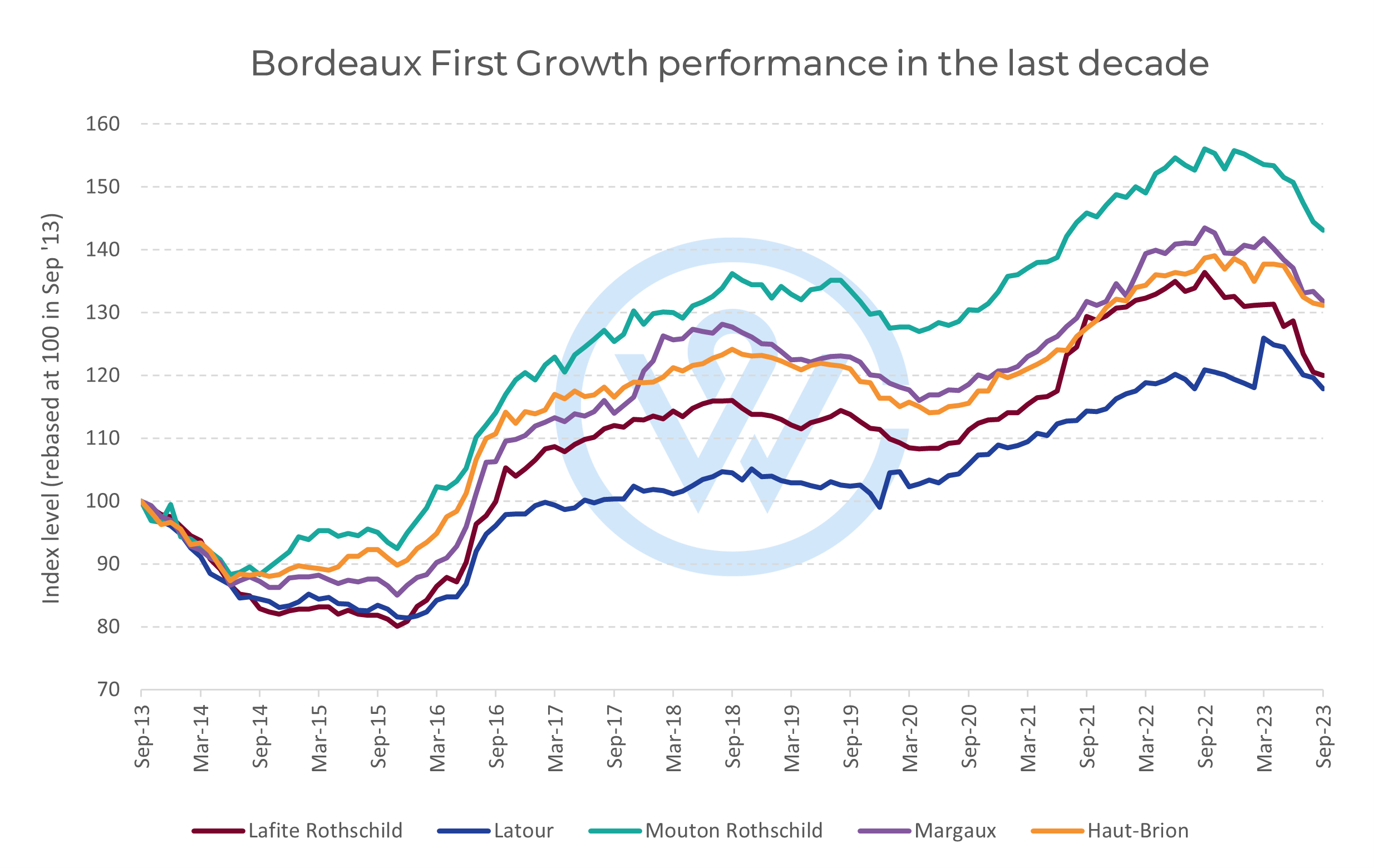
  • In the last decade, Château Mouton Rothschild has been the best price performer, up 43.2%.
  • Château Haut-Brion offers the best value, with the highest average critic score and the lowest average price per case.

The Bordeaux First Growths in a broadening market

The Bordeaux First Growths have long been the cornerstone of the fine wine investment market. Back in 2010, they made up close to 90% of all Bordeaux trade by value – at a time, when Bordeaux’s share of the total market stood at 96%.

With the broadening of the market, their share has decreased and they now regularly account for around 30% of all Bordeaux secondary market trade (which itself has fallen below 35% annual average).

This trend was also reflected in the 2022 Power 100 list, which offered a snapshot of the ever-changing landscape of the secondary market. For the first time ever, no Bordeaux wines featured among the top ten most powerful fine wine labels.

Even if trade for these brands remains consistent or increases, the First Growths are facing greater competition. Still, they are among the wines with the greatest liquidity, attracting regular demand and high praise from critics year after year.

First Growths’ price performance

In terms of price performance, the five First Growths have followed a similar trajectory (i.e. rising post-Covid and dipping in the last year in line with the current market reality). The relative outcast has been Château Latour, whose performance was impacted by the decision to leave the En Primeur system in 2012. The wine has been the worst-performing First Growth, up just 17.9% in the last decade.

The best performer has been Château Mouton Rothschild, with an increase of 43.2%. Recent releases have elevated the performance of the brand, like the 2020 vintage, which boasts 100-points from The Wine Advocate’s William Kelley, 99-100 from James Suckling, 98-100 from Jeff Leve and 99 from Antonio Galloni (Vinous). ‘Off’ vintages like 2011, 2013 and 2014, which have greater room to rise, have also fared well over the last five years.

The second-best performer has been Château Margaux, which is also the second most affordable First Growth. Similarly, its biggest price risers have been 2014, 2011 and 2013. Less classical years reveal the strength of these brands, as demand for the First Growths remains consistently high regardless of the vintage.

First Growths’ price and score comparison

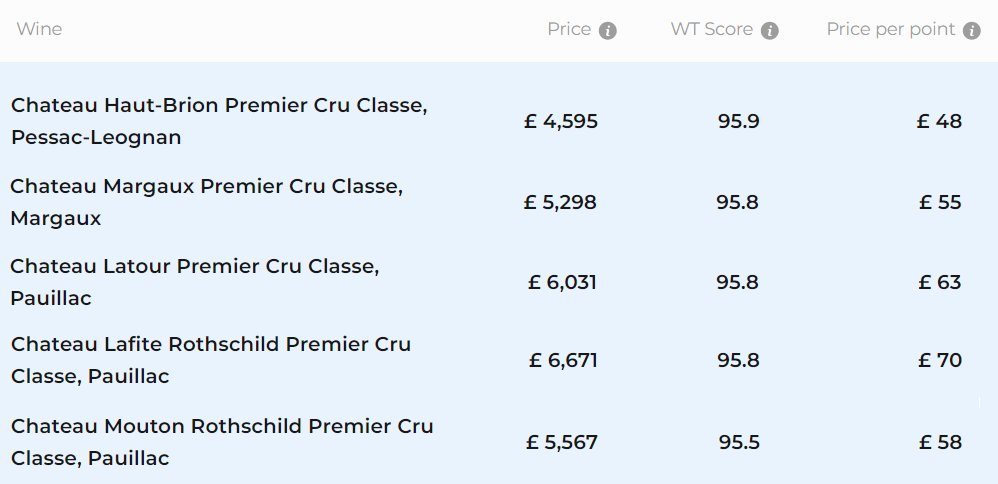
The table below shows the average price per case and critic score of the First Growths for vintages since 2000.

Château Haut-Brion tops the list with the highest average score (95.9) and the lowest average price per case (£4,595). With a price per point of £48, the wine seems to offer the best value among the First Growths. Vintages that have received 100-points from The Wine Advocate include 2018 (LPB), 2016 (LPB), 2015 (LPB), 2009 (LPB) and 2005 (RP).

Looking at the average prices, Château Lafite Rothschild stands out as the most expensive of the First Growths. The wine has achieved 100-points from The Wine Advocate for its 2019 (WK), 2018 (LPB), 2010 (LPB) and 2003 (RP) vintages.

In conclusion, the First Growths remain an important part of the changing secondary market, offering brand strength, consistently high quality and stable growth.

WineCap’s independent market analysis showcases the value of portfolio diversification and the stability offered by investing in wine. Speak to one of our wine investment experts and start building your portfolio. Schedule your free consultation today.
Categories
News

Cautious optimism for Australian wine amid tariff review

  • Australia and China have agreed to a suspension of their ongoing dispute over the steep tariffs imposed on Australian wine since November 2020.
  • The tariffs had a profound impact on demand and price performance of Australian wine.
  • Australia’s best price performers have risen over 40% in value in the last year.

Australian wine tariffs under review

In a significant shift that could redefine trade relations between Australia and China, the two nations have agreed to a suspension of their ongoing dispute over the steep tariffs imposed on Australian wine since November 2020. This development comes ahead of Australian Prime Minister Anthony Albanese’s forthcoming trip to Beijing, marking a potential thaw in the trade tensions that have severely impacted Australia’s wine industry.

While the Chinese government has consented to an expedited five-month review of the punitive duties, which have plummeted Australia’s wine exports from over $1 billion to a mere $12 million, there remains a cautious optimism. Despite this progress, industry experts predict that even if the tariffs are promptly revoked, the Australian wine sector, which has undergone substantial restructuring in response to the lost Chinese market, would still require approximately two years to recuperate and effectively redistribute its current surplus.

Impact on Australia’s wine investment market

The Chinese tariffs, ranging from 180% to 200% on Australian wine imports, had a profound impact on Australia’s budding secondary market. The country has historically been the second most important fine wine player from the New World after the U.S., enjoying greater demand than South Africa, Chile or Argentina.

After a record-breaking year of trade in 2020, Australia’s investment market shrank in 2021. The number of different Australian wines traded on Liv-ex declined 32.2% year-on-year, as demand decreased.

Fewer wines from Australia made it into the rankings of the most powerful brands in the world. Australia’s leading label, Penfolds Grange, dropped in the 2021 Power 100 rankings, from fifth in 2020 to 45th place in 2021. In last year’s edition of the rankings, the wine fell further – from 45th to 55th place, while Henschke exited altogether. Part of the reason is that Penfolds has historically been heavily reliant on the Chinese market. In an attempt to rebuilt tariff-hit business, earlier this year Treasury Wine Estates, owner of Penfolds, announced the introduction of its first China-sourced premium wine.

Australian wine price performance

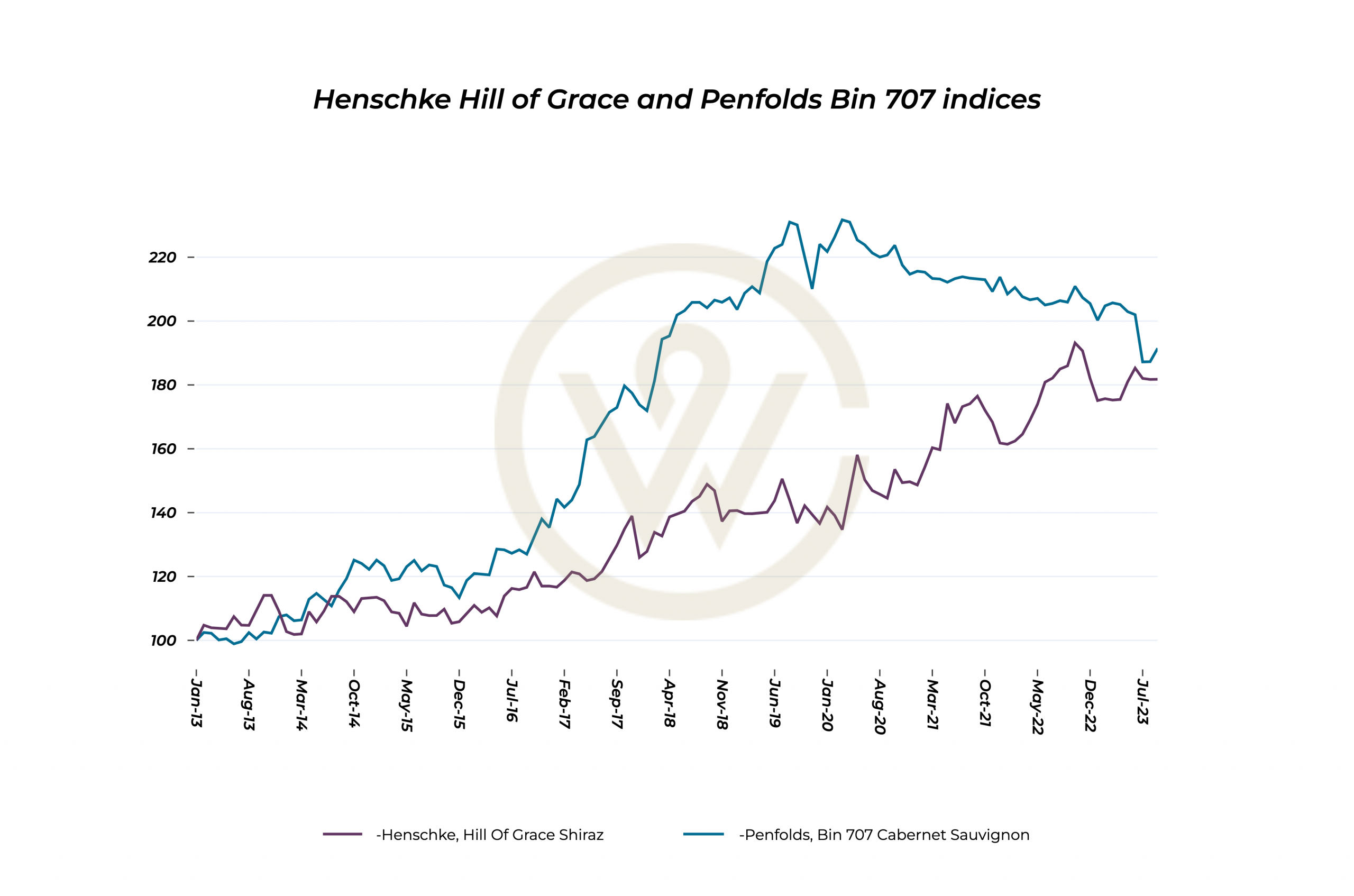
Since the tariff introduction, prices for some of the top wines have dipped, creating pockets of opportunity. For instance, the average price of Henschke Hill of Grace is down 4% in the last year; similarly, Penfolds Bin 707 is down 9%. While their trajectories are different, the long-term growth trend remains, with over 90% rise in the last decade.

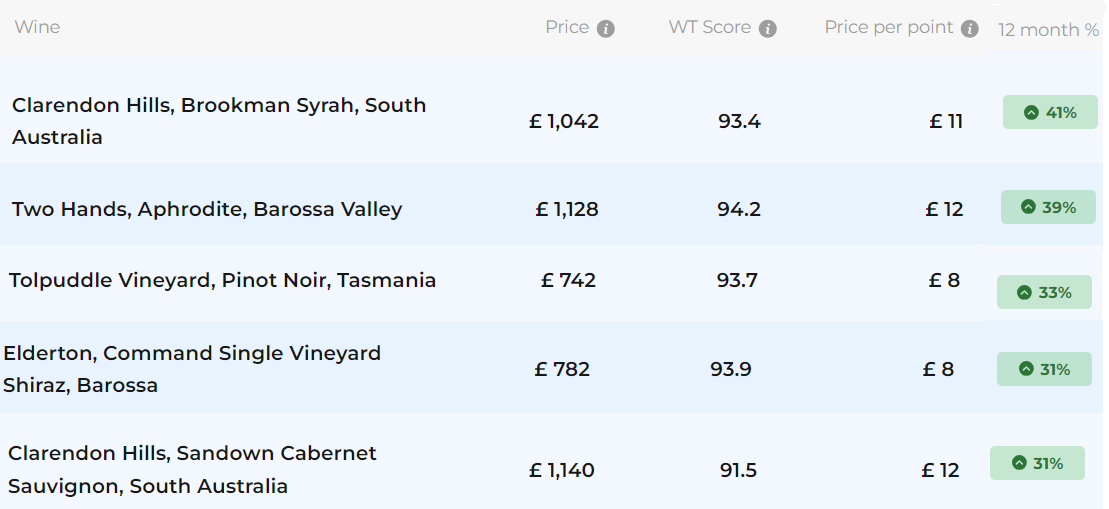
Some Australian brands have seen impressive price performance despite the ongoing trade tension. The table below shows the five best performers on Wine Track in the last year, which have risen between 31% and 41% on average. Clarendon Hills Brookman Syrah leads the rankings, with an average price per case of £1,042. Two Hands Aphrodite has been the second-best performer, up 39%.

The cautious optimism for Australian wine will likely affect its secondary market performance. As demand rises, so will prices. It remains to be seen if a potential tariff suspension will bring back the momentum to a region that has quietened down in the last three years but nonetheless remains an important New World representative.

WineCap’s independent market analysis showcases the value of portfolio diversification and the stability offered by investing in wine. Speak to one of our wine investment experts and start building your portfolio. Schedule your free consultation today.

Categories
News

Joseph Drouhin expands vineyard holdings to meet rising Burgundy demand

  • Joseph Drouhin has acquired two properties, Château de Chasselas in Saint-Véran and Rapet in Saint-Romain.
  • The expansion comes as both producers and buyers seek to find stock and value in an increasingly competitive market for Burgundy.
  • Drouhin has been a brand on the move, with some of its wines rising near 40% in value in the last year.

Joseph Drouhin expands its vineyard holdings 

Rising demand for Burgundy has fueled winery purchases and new investments. One of the most prominent producers, Maison Joseph Drouhin, has expanded its vineyard holdings with the recent acquisition of Château de Chasselas in Saint-Véran and Rapet in Saint-Romain.

Frédéric Drouhin, president of the Maison, explained that this decision was driven by increased competition and challenges in acquiring vineyards and purchasing grapes. The purchase focuses on high-quality yet more affordable areas in Burgundy – outside the main Côte d’Or villages, as both producers and buyers seek to find value in a region that has experienced significant price increases in recent years.

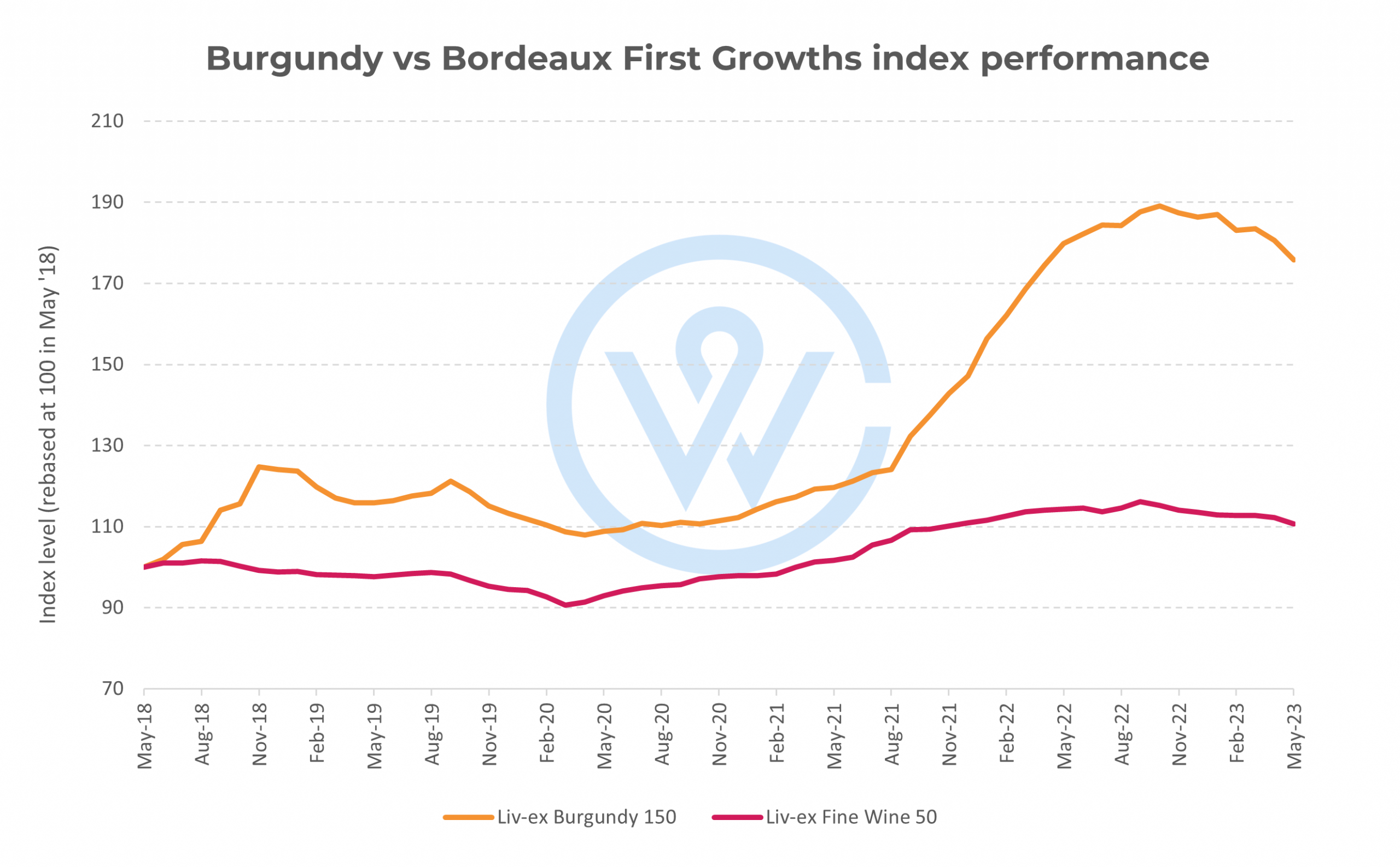
Just in the last five years, Burgundy fine wine prices have risen 75.7% – more than seven times the prices of the Bordeaux First Growths.

The insatiable demand and investment interest in the region have also impacted the cost of land, creating something of a vicious circle. 

The price of the latest Drouhin purchase was not disclosed.

The estates

Château de Chasselas encompasses 17.3 acres and is already a major supplier of Drouhin’s Saint-Véran wine. The property also includes small parcels in Chasselas and Beaujolais. The Rapet estate spans 19.8 acres and includes both Pinot Noir and Chardonnay vineyards in Saint-Romain, as well as small parcels in Auxey-Duresses, Pommard, and Meursault.

The debut vintage of Drouhin’s Saint-Romain wine is the 2022, while the first bottling of Saint-Véran Château de Chasselas will be the 2023 vintage, which will be released in 2024. All the newly acquired vineyards are being transitioned to organic farming practices.

With these acquisitions, Maison Joseph Drouhin owns close to 250 acres of vineyards, spanning from Chablis to Mâcon and encompassing 60 appellations. Their portfolio includes 14 Grands Crus and 20 Premier Crus. 

Drouhin’s place in Burgundy’s secondary market

Joseph Drouhin has been a Burgundy brand on the move. The brand jumped 142 places in the 2022 Power 100 rankings, thanks to its price performance. 

Four wines from the estate also ranked in the first tier of the 2021 Liv-ex Classification, which ranks the wines of the world solely by price: Montrachet Grand Cru Marquis de Laguiche, Musigny Grand Cru, Chambertin-Clos de Bèze Grand Cru, and Chambolle-Musigny Premier Cru Les Amoureuses.

The best performing Drouhin wines

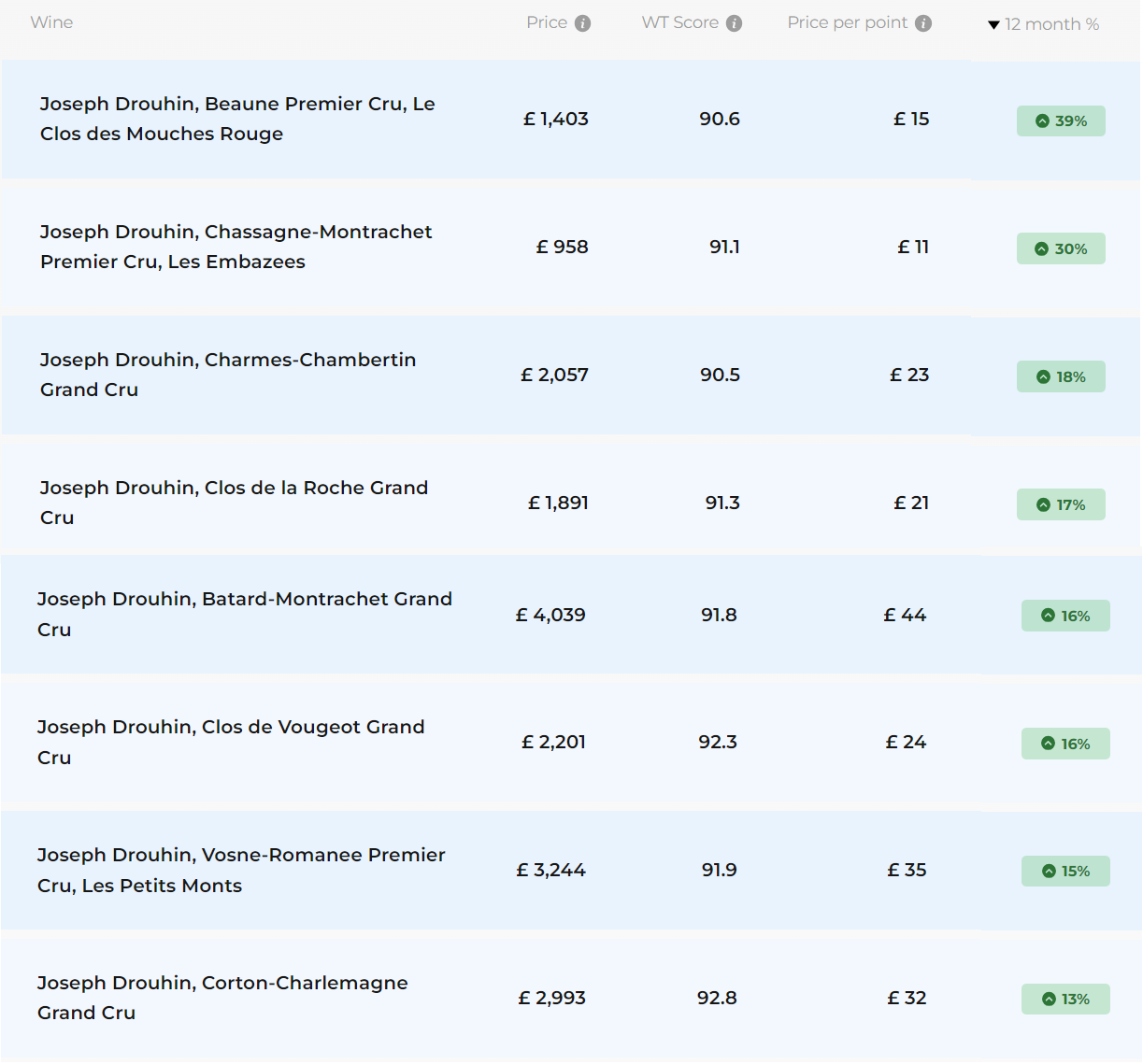
In the last year alone, the best performing Joseph Drouhin wines have risen between 13% and 39%, outperforming the Burgundy 150 index. 

The biggest riser has been their Beaune Premier Cru Le Clos des Mouches Rouge, which has an average price of £1,403 per case.

You can now explore the historic performance of these wines on Wine Track. Our tool provides a clear overview of a fine wine’s track record, including critic scores, average price and investment returns. 

WineCap’s independent market analysis showcases the value of portfolio diversification and the stability offered by investing in wine. Speak to one of our wine investment experts and start building your portfolio. Schedule your free consultation today.