Categories
News

Top-scoring Bordeaux 2025 En Primeur wines so far

  • Major critics describe Bordeaux 2025 as a “miracle vintage” due to its exceptional balance and moderate alcohol levels in a hot and dry year.
  • The first 100-point in-barrel scores have emerged. 
  • Critics argue that quality alone will not turn this campaign into a success; the economic climate must be acknowledged.

The 2025 En Primeur campaign has begun, with the first wave of releases and critic reports now emerging. After a growing season that pointed toward blockbuster wines on paper, the reality in the glass tells a more nuanced story. The consensus among leading critics following April’s barrel tastings is that the 2025s are something of a paradox – wines that combine the concentration of a hot, dry year with the balance, freshness and structural poise of a more classical era.

In this article, we look into the first major En Primeur reports from Antonio Galloni (Vinous), William Kelley (Wine Advocate), James Lawther MW (JancisRobinson.com) and Georgie Hindle (Decanter), exploring where their views converge, where they diverge, and highlighting some of their top-scoring Bordeaux 2025 wines. We also focus on key themes, regional standouts, and early signals for what is shaping up to be one of the most intriguing and selective En Primeur campaigns in recent years.

What makes Bordeaux 2025 a “miracle” vintage?

According to major wine critics, the short answer lies in the balance and the moderate alcohol levels of the wines in a year defined by record-breaking heat. In a region where 14.5% or 15% ABV has become the “new normal” for hot vintages, the 2025s have pivoted.

  • Antonio Galloni describes this as a “minor miracle,” noting that while heat and drought usually yield massive tannins and high sugars, 2025 saw sugar ripening slow down while physiological ripeness continued. 
  • William Kelley, who mentions an alcohol range of 12.5% to 13.5%, calls the best wines “thrilling” for their ability to remain classically proportioned despite their density.
  • Georgie Hindle also notes the “paradoxical” nature, stating that the wines don’t “carry the wounds of the vintage.” She observes that alcohol levels are often one to two degrees lower than the 2022s, which have become a point of comparison.
  • James Lawther MW agrees that the “low alcohols and dense, silky tannins” provide a unique originality, particularly in Cabernet-dominant blends.

The growing season: Rainfall as the great arbitrator

Critics agree that the late-August rains were the turning point for the 2025 Bordeaux vintage. Without this 60-90mm of precipitation, many believe the vintage would have been a disaster of desiccation.

  • James Lawther points out that the Médoc received the most significant rainfall (up to 70mm), which “relaunched” ripening in vines that had essentially shut down due to hydric stress.
  • In her report, Georgie Hindle cites a winemaker from Chateau Quintus who noted that “without the rains, we would have made syrup.” This rainfall allowed the three types of ripeness – technological, phenolic, and aromatic – to finally converge.
  • Antonio Galloni adds that the April rains were equally vital, providing the water tables with enough reserves to help the vines survive the initial heat spikes in June.

Low yields: The smallest crop since 1991

The 2025 vintage is also defined by scarcity, with Bordeaux recording its smallest harvest in over three decades – a factor that will inevitably shape the dynamics of the release campaign. While critics broadly agree on the scale of the shortfall, their interpretations of its causes and implications vary.

Galloni attributes the low yields to a combination of poor conditions during the 2024 flowering cycle – when cluster formation for 2025 was already compromised – and the intense heat and drought of the 2025 growing season, which led to significant berry dehydration. In some cases, Merlot berries weighed as little as 0.8g, well below the typical 1.2g.

Kelley similarly links these reduced yields to the resulting wine style, arguing that the vintage’s “authoritative density” is a direct consequence of this concentration. 

Lawther, meanwhile, sees the small crop as a “positive factor” for quality, as the reduced charge on the vine made it easier for the remaining fruit to reach full maturity despite challenging weather conditions.

Left or Right Bank vintage?

While the quality of the vintage is widely praised, critics have identified a clear hierarchy of consistency, with a notable consensus on which communes struggled.

  • The Pomerol paradox: All four critics flag Pomerol as the most inconsistent appellation. Lawther notes that it suffered most from drought, leading to “bitterness” in some wines due to lack of juice. Galloni and Kelley agree that while the top estates on the clay plateau (like Petrus and La Conseillante) are “elegant,” the appellation, as a whole, is uneven.
  • Margaux and Pauillac: Antonio Galloni crowns Margaux as the “star of the vintage,” noting its consistent brilliance. James Lawther and William Kelley lean toward Pauillac as the most “impressive” or “compelling” sector, with Kelley citing its ability to deliver wines of “real concentration.”
  • Saint-Emilion: The clay-limestone soils here proved their worth. Lawther and Galloni both praise the plateau’s ability to manage water stress, with Lawther highlighting Cheval Blanc’s “stunning” results despite an extremely low 15 hl/ha yield.

Winemaking decisions

With tiny berries and thick skins due to heat and drought, most winemakers opted for gentler extraction techniques when handling the 2025 vintage.

  • Kelley explains that the unusually high solids-to-juice ratio meant structure was “taken for granted,” leading many estates to lower fermentation temperatures and reduce pumping over.
  • Hindle notes that some estates, like Montrose and Phelan Segur, performed their shortest macerations on record to avoid harsh tannins.
  • Lawther warns that hard finishes are an occasional fault in the vintage where winemakers were too heavy-handed with overworked tannins.

Potential 100-point wines so far

While more scores will be released in the coming days from critics including Neal Martin, James Suckling, and Lisa Perrotti-Brown MW, the table below highlights the wines that have already achieved barrel ranges touching 100 points. These early indicators suggest which wines may ultimately reach perfection once bottled and re-tasted in two years’ time.
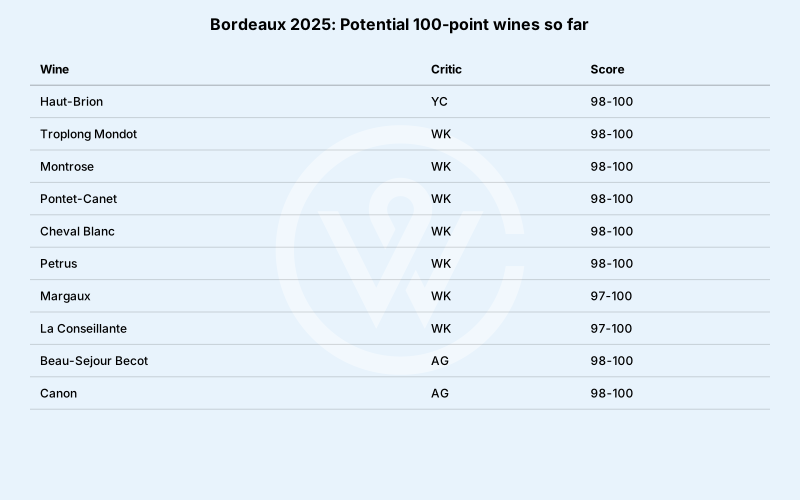
Bordeaux 2025: 100 point wines

*YC = Yohan Castaing (Wine Advocate), WK = William Kelley (Wine Advocate), AG = Antonio Galloni (Vinous)

It is important to note that En Primeur scores are typically expressed as ranges rather than fixed numbers. This reflects the fact that the wines are still in barrel and continue to evolve. Critics therefore allow for a margin of potential – both upward and downward – based on how the wines are expected to develop before bottling. A range such as 98-100 points signals not only exceptional quality, but also the realistic possibility of a perfect score at maturity.

Among the early reports, William Kelley is the most bullish, identifying seven wines with 100-point potential. Antonio Galloni follows with two, while Yohan Castaing has highlighted one wine in this top tier.

The list itself is telling. First Growths Chateau Haut-Brion and Chateau Margaux both feature, underlining the strength of the Left Bank at the very top level. They are joined by Right Bank icons Petrus and Cheval Blanc, alongside standout performers such as Troplong Mondot, Montrose and Pontet-Canet. 

Bordeaux 2025 market reality

While the wines themselves are widely praised, all critics have raised concerns about the market in their reports.

Kelley describes the En Primeur context as “structurally fragile,” questioning whether consumers still see value in buying futures. Galloni also states that Bordeaux “badly needs a win,” but warns that success depends entirely on pricing discipline. He argues that even modest increases could undermine demand, given the availability of competitively priced back vintages on the secondary market.

Hindle offers a more measured view, noting early signs of pricing restraint in the first releases and a stabilising fine wine market, but still emphasising the need for alignment between producers, merchants and consumers. 

The key to En Primeur success

Taken together, these early critic assessments position 2025 as a highly successful but nuanced Bordeaux vintage. At its best, it delivers a rare combination of concentration, freshness and terroir transparency – wines of both immediate appeal and long-term potential. However, it is not a uniform success. Variability is a defining feature, and careful selection will be essential. 

Perhaps most importantly, 2025 highlights a broader shift in Bordeaux. Through improved viticulture and winemaking, producers are increasingly able to navigate climatic extremes and make balanced wines in challenging conditions. 

But quality alone will not drive demand. The message from the critics is clear: the success of the campaign rests on the chateaux’s willingness to acknowledge the economic climate.

FAQ: Bordeaux 2025 En Primeur

Is Bordeaux 2025 a good vintage?
Yes – critics widely agree that 2025 is a high-quality vintage. Despite extreme heat and drought, the best wines show exceptional balance, freshness and moderate alcohol levels, leading some critics to describe it as a “miracle” or “paradoxical” vintage.

Why is Bordeaux 2025 described as a “miracle vintage”?
Because the wines defy expectations. In a hot, dry year that should have produced heavy, high-alcohol wines, 2025 instead delivered freshness, structure and restraint, thanks largely to cooler nights and crucial late-August rainfall.

What are the alcohol levels in Bordeaux 2025 wines?
Most wines fall between 12.5% and 13.5% ABV, significantly lower than recent hot vintages like 2022, where alcohol levels often exceeded 14.5%.

How important was rainfall in the 2025 vintage?
Late-August rainfall was critical. It rehydrated vines after prolonged drought, slowed sugar accumulation, and allowed full phenolic ripeness, ultimately shaping the balance and style of the wines.

Are Bordeaux 2025 yields low?
Yes. 2025 is the smallest Bordeaux harvest since 1991. 

Which Bordeaux regions performed best in 2025?
Margaux and Pauillac are widely seen as standout performers on the Left Bank, while Saint-Émilion excelled on the Right Bank, particularly on clay-limestone soils. 

Are there any 100-point Bordeaux 2025 wines yet?
Several wines have already received barrel score ranges of 98-100 points, indicating potential for a perfect score once bottled. Top names include Haut-Brion, Margaux, Petrus and Cheval Blanc.

What do En Primeur score ranges (e.g. 98–100) mean?
Barrel scores are given as ranges because the wines are still ageing. A 98-100 score suggests the wine is already exceptional but could improve further before bottling and reach a perfect score.

Will Bordeaux 2025 En Primeur be a successful campaign?
That remains uncertain. While wine quality is high, critics warn that success will depend on pricing. Buyers are increasingly cautious, and competition from back vintages may limit demand.

Should you buy Bordeaux 2025 En Primeur?
Critics emphasise that 2025 is not a uniform vintage. The best wines are outstanding, but variability is high, meaning careful selection will be essential rather than broad, “buy everything” strategies.

WineCap’s independent market analysis showcases the value of portfolio diversification and the stability offered by investing in wine. Speak to one of our wine investment experts and start building your portfolio. Schedule your free consultation today.
Categories
Learn

The ultimate guide to Bordeaux En Primeur

  • Bordeaux En Primeur is a system where wine is purchased while it is still maturing in barrel, typically 18 months before bottling and delivery.
  • The system operates through a unique network of brokers and merchants known as La Place de Bordeaux.
  • Successful participation in the campaign requires a data-led approach, focusing on the relative value of new releases compared to available back vintages.

What is En Primeur wine buying?

En Primeur, also known as wine futures, is the shorthand for an ecosystem of wine producers, negociant, and merchants that allows consumers and investors to buy wine while it is still in the barrel, before the final bottling takes place. 

While other regions do offer En Primeur purchases, the system is best known in Bordeaux. Grapes for the Bordeaux wines are harvested in the autumn and the young wine is offered for sale the following spring. In practice, this means that the 2026 En Primeur campaign is for the 2025 vintage, 2025 En Primeur was for the 2024 vintage etc.

At this stage, the wine is sold while it is a work in progress, unfinished, unblended and still requiring further ageing in the chateau cellars before being bottled and shipped.

Buyers pay a specific release price for the wine, which can be the lowest price the wine will ever see. This is dependent on the chateaux and negociants setting a sensible entry point and markets holding steady or improving. Once purchased, the wine remains at the estate until a few months after it is bottled, which usually happens 18 months to two years after the harvest. 

A short history of Bordeaux wine futures

Like everything in Bordeaux, the roots of the En Primeur system stretch back but the widespread adoption of modern En Primeur sales has its origins in the early 1970s.  

The establishment of En Primeur was prompted by global recession and cash flow issues caused by the 1973 oil crisis. After poor sales of the 1973 and 1974 vintages, merchants and producers were badly in need of money and with 1975’s samples well received, the wine trade found a way to bring forward revenue and sell wines early, funding the next year’s production and labour costs without waiting for the wine to mature.

It was only with later vintages that the economic advantages of En Primeur buying became clear to investors.

How the En Primeur system operates today

The Bordeaux En Primeur market is governed by La Place de Bordeaux and involves three primary players: chateaux, courtiers and negociants. 

  • Chateaux are the winemakers.
  • Courtiers are brokers who act as middle men distributing the wine to a handful of B2B merchants in Bordeaux known as negociants.
  • Negociants then sell the wine to merchants across the globe who in turn sell to their clients.

Chateaux rarely sells directly to retailers or private clients. Instead, they release allocations to a small group of courtiers who then sell them to a slightly larger group of  negociants in France. Even when a chateau has a strong relationship with a merchant like WineCap and wants to guarantee them allocations, that transaction will still go through a negociant.

Every April, the world’s wine trade descends on the city of Bordeaux for the primeur tastings, with journalists, importers, and merchants spending a manic week tasting hundreds of barrel samples often on multiple occasions to assess the quality of the new vintage. Based on these assessments and the general economic climate, the chateaux release their prices over several subsequent weeks, generally through May and June with negociants simultaneously offering dozens of wines to international merchants, who sell to private clients.

Which UK merchants offer En Primeur?

Most reputable fine wine merchants in the UK participate in the annual campaign. This includes historic firms and modern investment platforms. In a high-quality oversubscribed vintage, retailers compete for allocations of the most sought-after wines, with those that buy most broadly getting priority. In poorer vintages, the balance of power shifts with negociants working harder to place their wines. When selecting a merchant, it is vital to choose one with a proven track record, as you are essentially buying a promise of future delivery.

Buying En Primeur with WineCap

Even if you consider yourself a drinker rather than a collector, looking at wine through an investment lens is beneficial. WineCap’s perspective focuses heavily on relative value and our approach is data first. We believe that a purchase should only be made when there is a clear advantage to doing so. In the En Primeur market, this means carefully analysing whether a new release is actually priced better than an available comparable back vintage. 

Thinking about fine wine with an investment perspective will help ensure you get the best value for money from your purchases, even if your end goal is drinking pleasure. Speak to one of our wine investment experts 

How to evaluate En Primeur opportunities

Evaluation begins with critic scores from major platforms and critics like Neal Martin and Antonio Galloni at Vinous, William Kelley and Yohan Castaing at Robert Parker’s Wine Advocate, James Lawther at JancisRobinson.com, Jane Anson or Lisa Perrotti-Brown MW.

The key is to compare the release price of the new vintage against the current market prices of comparable physically delivered back vintages. If a physical wine from a great year like 2019 is available at a similar price to a new release of similar quality, the financial argument for the newer wine is weak.

You need a compelling reason to buy a wine that is less affordable than a comparable vintage already sitting in a warehouse, vintage reputation is a major factor but investors should always be selective. This is particularly the case in vintages where quality varies significantly between estates. In those years, you must focus on specific successes rather than the vintage as a whole. Early on, it looks like the high-quality 2025 vintage will be one of them.

Benefits of buying wine En Primeur

One primary benefit of buying wine En Primeur is guaranteed access in the formats you are looking for. For the most famous chateaux, allocations can be tight and buying wine futures may be the only way to secure a case of the top labels at opening prices. In especially strong vintages releases for a specific wine may come in several tranches often with later tranches being made available at higher prices: the wine trade’s version of dynamic pricing. WineCap would typically not recommend buying second or third tranches. 

Another major advantage is the ability to request non-standard formats. You can order half bottles, magnums, double magnums, or even larger formats at the time of purchase. These formats can be harder to find on the secondary market once the wine is bottled, so if you’re looking for a large format of wine to drink in 20+ years to celebrate an anniversary or the birth of a child, En Primeur may be especially attractive. This is especially important if you are in a wine market where availability is lower and prices higher than in the major markets of the UK and EU.

When the wines are priced correctly, En Primeur can be the best price the wines will ever be. Finally, buying pre-bottling ensures perfect provenance as the wine moves directly from the chateau to a bonded warehouse in an unbroken chain of custody.

Finding price lists and reports

To stay informed on En Primeur, you should subscribe to newsletters and offers from reputable merchants. These provide real time updates on releases and pricing. Major review platforms are key for technical data such as vintage reports and professional critic scores, although merchants will share those with their clients. Critics spend weeks in Bordeaux tasting hundreds of samples to produce the reports that form the market’s understanding of the vintage quality and how it is likely to evolve over time.

Key factors for consideration

Brand power is the most significant indicator of future liquidity. Names like Chateau Latour or Chateau Cheval Blanc have global demand that protects their value, and search rankings on websites like Wine-searcher provide an excellent proxy by which collectors and investors can understand this. 

Overall vintage quality and pricing will dictate the general market mood, but you must also consider the liquidity and quality of the specific label. Some wines are easy to sell at any time, while others may take much longer to find a buyer. Past performance of the estate is also a useful metric.

A good merchant such as WineCap will synthesise all this data before making recommendations to their clients. Speak to one of our wine investment experts.

Risks of buying wine En Primeur

The most obvious risk is that the final quality may not reflect early critic reviews i.e. a wine that scored highly in barrel may not show as well once it is in the bottle. En Primeur scores are generally given in a range, normally of two to three points to reflect this uncertainty.

Prices may also fall. If a chateau releases its wine at too high a cost, the market may reject the price, leading to lower values when the wines become physical and secondary market trading begins in earnest. 

There are also macro-economic considerations. General market volatility can impact luxury assets although that tends to be less significant and delayed for fine wine, and the broad economic climate and the cost of money may impact demand.

Currency fluctuations and fixed prices

Buyers often worry about currency moves between release and delivery; however, for a UK client, changes do not affect the original purchase. You have committed to buy the wine at a fixed price in GBP at the time of the offer and in return your price is fixed so you should not be concerned about changes in exchange rate between the point of purchase and the point of delivery. 

Subsequently a weak pound can sometimes make UK-held stock more attractive to international buyers, potentially increasing its value.

Storage and delivery logistics

When you buy En Primeur, the price you pay is normally ex-VAT and duty. This means the wine is held in bond once it arrives in the UK. The wine will be delivered to a professional bonded warehouse, such as Octavian or LCB, roughly two years after the campaign. 

At this point, you can choose to keep the wine in bond to preserve its investment potential, avoiding the immediate payment of VAT and excise duty. Unless you are able to cellar the wine properly yourself this is normally the best decision as it ensures the wine ages in benign conditions.  

Another less frequently mentioned benefit of in-bond storage is that the necessity of arranging to have a wine delivered to you means more intent is required before consumption. That is to say, you are less likely to drink on a whim and more likely to wait until the wines are at a point where they are truly ready to enjoy before pulling corks. 

Recommended wines for long-term cellaring

Almost any wine released En Primeur will be suitable for at least a few years of ageing. Even relatively humble estates like Chateau Laroque, Les Cruzelles, and Chateau Cantemerle will easily age and improve over the course of 10-20 years and provide excellent drinking pleasure. Top-tier estates, including the First Growths and their Right Bank peers, are built to allow 40 to 50 years of development in a good vintage although they can be enjoyed sooner.

FAQ: Bordeaux En Primeur

Can I buy En Primeur wines online with UK delivery? 

Yes, most UK merchants allow you to purchase online but it’s always a good idea to engage with your account manager ahead of time, especially if you have specific wines of formats in mind. Physical delivery to your home only occurs once the wine is bottled and the duty and VAT have been paid.

What is a negociant?

A negociant is a wine merchant that operates business-to-business offering wines for sale to retail partners operating business-to-consumer.  

When do new vintage En Primeur campaigns typically start? 

The main Bordeaux campaign begins in the spring, usually starting in mid-late April with the tasting week, with prices following in May and June. It is rare that a campaign goes beyond July, but it has been known to happen.

Which regions are most known for their wine futures offerings? 

Bordeaux is the pioneer and by far the best known, but Burgundy, the Rhone, and some producers in Tuscany and California also offer wines En Primeur.

Is buying En Primeur a guaranteed investment?

No, it is not a guaranteed return. Success depends on the quality of the vintage, the value of the release pricing compared to back vintages and market sentiment.

WineCap’s independent market analysis showcases the value of portfolio diversification and the stability offered by investing in wine. Speak to one of our wine investment experts and start building your portfolio. Schedule your free consultation today

Categories
News

Bordeaux: Is the downturn finally ending?

  • Bordeaux prices have hit support levels across top wines and prime vintages.
  • First Growths lead the way in market stabilisation. 
  • The market’s most reliable signals of recovery – improved liquidity, narrowing spreads, and renewed price consistency – are beginning to appear in Bordeaux.

In July, WineCap reported that Champagne prices appeared to be stabilising. Our research into the ten most-searched prestige cuvées on Wine-Searcher found that 47 out of 50 wines had maintained price stability for at least three months – and 40 for six months or more. Since then, the Liv-ex Champagne 50 index has risen 1.6% on average.

Fast forward a few months, and signs of stabilisation have begun to emerge across the broader fine wine market. The Liv-ex 100 index, which represents the most sought-after fine wines globally, rose 2% over September and October. Gains were supported by sterling weakness, renewed buyer demand, and an improving bid:offer ratio, all suggesting that confidence is returning to the market.

Bordeaux, still the largest and most liquid segment of the fine wine world, also reflects this shift. Our latest research reveals that a growing share of Bordeaux’s top wines – from First Growths to leading Second Growths – have found support levels after a prolonged correction, suggesting the market may be nearing its floor.

Our methodology

To identify whether Bordeaux prices are indeed hitting support levels, WineCap analysed two baskets of wines across fifteen physical vintages:

  • First Growths + Cheval Blanc: Lafite Rothschild, Mouton Rothschild, Château Margaux, Haut-Brion, and Cheval Blanc – 75 wines across 15 vintages.
  • Top Second Growths: Pontet-Canet, Lynch-Bages, Palmer, Montrose, Cos d’Estournel, and Léoville Las Cases – 90 wines across the same period.

Because of Château Latour’s unique release schedule and limited market volume since the 2011 vintage, it was excluded from the analysis. To ensure coverage of all recent prime vintages, we expanded our dataset to include the 2005 vintage alongside the 2008–2021 range.

Price stability was defined as a period of at least three months without meaningful movement – a signal that buying and selling pressure have reached equilibrium. This approach captures early indicators of market turning points, where sellers have adjusted expectations and buyers begin to re-engage.

First Growths: Signs of strength

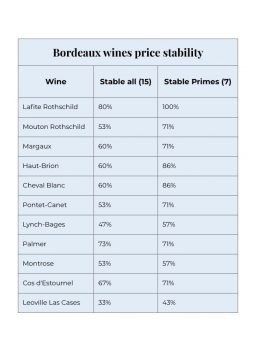
Among the first group of wines, covering four of the First Growths and Cheval Blanc, 47 out of 75 wines (just over 60%) have kept their value firm. Lafite Rothschild is the standout performer, with 12 of its 15 vintages maintaining stable prices.

When isolating the prime vintages – 2005, 2009, 2010, 2016, 2018, 2019, and 2020 – the pattern becomes even clearer. Across these, 29 of 35 wines (83%) are price stable, including every single Lafite vintage in the set. Mouton Rothschild and Château Margaux, meanwhile, have maintained stability in five out of seven vintages (just over 70%).

The data further highlight the gap between prime and off-vintages. Among the less-heralded years of 2011–2014, only four out of twenty wines are stable, suggesting continued downward pressure where trading volume is lower. This divergence reinforces a key principle: in periods of market weakness, liquidity and confidence concentrate around the most established players.

Second Growths: Following the leaders

Second Growths often act as the market’s echo chamber. They don’t move first, but when they start to stabilise, it confirms that sentiment is improving and buyers are returning.

Among Bordeaux’s 90 elite Second Growths, 49 (55%) are now price stable. When focusing on prime vintages, that figure rises to 26 out of 42 (62%).

This suggests that the stabilisation process has been underway for several months, gradually filtering from First Growths down to the wider market. Historically, such a pattern has preceded broader upturns, as investors and collectors begin to seek relative value further down the classification ladder.

Château Palmer and Cos d’Estournel have led this segment, with 11 and 10 of 15 vintages respectively showing resilience. Both have five out of seven stable prime vintages, alongside Château Pontet-Canet. Lynch-Bages and Léoville Las Cases, meanwhile, have seen stability emerge more recently and across a narrower base of vintages.

Broader market context

The timing of this Bordeaux stabilisation coincides with modest gains across major Liv-ex indices, including the Bordeaux Legends 50 and Fine Wine 1000, both of which posted small rises in recent months.

Beyond wine-specific factors, macroeconomic influences have also played a role. Sterling weakness since late summer has improved overseas buying power, while rising global demand (reflected in a higher bid:offer ratio on Liv-ex) signals growing confidence.

In short, the market’s most reliable signals of recovery – improved liquidity, narrowing spreads, and renewed price consistency – are beginning to appear in key regions.

Taken together, the evidence suggests that prime-vintage Bordeaux First Growths have reached stability, while top Second Growths are close behind. In standout years such as 2005, 2010, 2016, and 2019, all tracked wines are now price stable, indicating strong market support.

Weaker vintages remain under pressure, but history shows that stabilisation at the top of the market often precedes wider recovery. With the Liv-ex 100 up 2%, the bid:offer ratio climbing, and sentiment improving, the fine wine market appears to be entering a new phase of balance. Indeed, these conditions may represent the most compelling entry point into Bordeaux since 2020.

WineCap’s independent market analysis showcases the value of portfolio diversification and the stability offered by investing in wine. Speak to one of our wine investment experts and start building your portfolio. Schedule your free consultation today.
Categories
Learn

Fine wine investment returns: if you’d put £1,000 in 10 years ago

Fine wine has long been celebrated as both a pleasure to own and a source of steady, inflation-beating returns. But how much difference can the choice of region, producer, and timing make over the long term?

Using Wine Track data, we’ve taken a decade-long view – from 2015 to 2025 – to see exactly how a £1,000 investment in some of the world’s most sought-after wines would have performed. The results reveal disparities between regions and labels, driven by factors such as scarcity, critical acclaim, brand momentum, and the fluctuations of global demand.

In some cases, your £1,000 would have barely kept pace with inflation. In others, it could have doubled, tripled, or even more – often in places you might not expect. What’s more, because fine wine is a cyclical market, today’s leaders aren’t always tomorrow’s winners, and periods of market correction can present some of the best opportunities for future growth.

This analysis explores several key regions, showing not just the percentage returns but also what your £1,000 investment would be worth today, and what you could have bought then compared with now.

Bordeaux: a decade of divergence

In 2015, a £1,000 investment in a top Bordeaux could have taken very different paths over the following decade. If you had chosen Château Figeac, your £1,000 would now be worth £2,310 – more than doubling your money thanks to a +131% average return over the past decade. This performance has been fuelled by Figeac’s promotion to Premier Grand Cru Classé A and consistently high-scoring vintages.

Château Les Carmes Haut-Brion in Pessac-Léognan has been another star performer, climbing 163% over the past ten years. This is a rare combination of strong brand momentum, critical acclaim, and relative scarcity, making it one of the most compelling growth stories in the Bordeaux market.

By contrast, the First Growths have had a more subdued performance. Looking at the current average market prices for the several blue-chip Pauillac labels and their second wines, the past decade has been anything but uniform:

  • Château Lafite Rothschild sits today at around £5,106 per case, up just 6% over the last decade. This reflects both its lofty 2015 starting point and the cooling of the top-tier Bordeaux segment in recent years. However, some vintages have outperformed the overall brand.
  • Château Latour is similar, with a 10-year rise of 4%, now averaging £4,960 per case.
  • Château Mouton Rothschild fared better, with a 22% decade-long gain to £4,496 per case, thanks partly to strong demand for key vintages in the late 2010s.

The best relative value in the First Growth orbit has often been found in their second wines:

This ‘second wine premium’ over the decade illustrates a key point for investors: sometimes the best relative value comes not from the pinnacle labels, but from their immediate tier below. These wines benefit from the halo effect of the grand vin’s reputation while offering lower starting prices.

However, the current context matters. The performance of the Liv-ex 50 (First Growths) and Bordeaux 500 (broader region) shows how the 2022 peak has given way to a sharp correction, with prices now trending towards 2015 levels. This is classic market cyclicality: those who bought during the previous trough and held through the rally have realised strong gains; those entering now may be positioning themselves at the start of the next upswing.

Burgundy: the market reset

If Bordeaux’s decade has been a story of cyclical swings and selective outperformance, Burgundy’s has been one of explosive gains followed by a sharp correction. The Liv-ex Burgundy 150 index more than quadrupled between 2015 and its 2022 peak, fuelled by surging global demand for small-production, high-prestige domaines. Since then, prices have retraced significantly, but remain far above their 2015 levels, underscoring the long-term wealth-generating power of the region’s top wines.

At the very top sits Domaine de la Romanée-Conti, Romanée-Conti Grand Cru, whose sky-high starting point means it was always going to operate in a different financial stratosphere to most wines. Over the past decade, prices have risen by 147%, elevating the wine’s average price per case to £213,303.

Among the biggest long-term winners is Domaine René Engel, Vosne-Romanée Premier Cru Aux Brûlées, which has climbed 1,482% in the past decade. That’s enough to turn £1,000 into a staggering £15,820 today. Engel’s cult status has only intensified since the sudden passing of Philippe Engel in 2005, leaving the estate without a clear successor, and its eventual sale to François Pinault, who renamed it Domaine d’Eugénie.

Meanwhile, Domaine Leroy Richebourg Grand Cru has appreciated by 507% over the same period, due to a combination of biodynamic viticulture, minuscule yields, and demand consistently outstripping supply.

The sheer magnitude of these returns reflects Burgundy’s unique market dynamics:

  • Scarcity at every level – often just a handful of barrels per cru.
  • Global demand from Asia to the Americas.
  • Producer-led brand power that eclipses even vintage variation in driving prices.

Yet the post-2022 decline in Burgundy shows that even this hallowed region is not immune to market cycles. For investors, today’s lower prices could represent a rare opportunity to enter or rebalance Burgundy holdings – though the barriers to entry at the very top remain as formidable as ever.

Champagne: the market fizzes with potential

Champagne has traditionally been viewed as a steady, blue-chip corner of the fine wine market: less volatile than Burgundy and Bordeaux, yet capable of delivering strong long-term growth. Over the past decade, the Champagne 50 index has shown a clear upward trajectory, punctuated by a sharp rally between 2019 and 2022 before a mild correction. 

The most eye-catching long-term gains have come not only from the established houses but also from small-production grower-producers like Egly-Ouriet, Brut Millésime Grand Cru, which has surged 633% in the last decade. That growth has been fuelled by a wave of sommelier-driven interest in terroir-driven Champagne and limited allocations reaching the market.

Prestige cuvées from major houses have also rewarded patient investors. Salon Le Mesnil-sur-Oger Grand Cru has delivered a 298% return, while Billecart-Salmon Le Clos Saint-Hilaire climbed 203%.

A particularly notable outlier is Cédric Bouchard, Rosé de Saignée Le Creux d’Enfer, with an extraordinary 418% return – turning £1,000 into £5,180 – reflecting the explosive demand for rare, artisanal Champagne in recent years.

Champagne’s appeal lies in its dual identity: both a luxury good for immediate enjoyment and a serious investment asset. With the market cooling slightly from 2022 highs, current conditions may offer attractive entry points for those looking to secure allocations before the next phase of appreciation.

Italy: quiet consistency and standout performers

Italy’s fine wine market has been a story of steady, broad-based growth over the past decade, delivering consistent returns and avoiding some of the more extreme volatility seen in Burgundy or Champagne. 

At the very top of the performance table sits G.B. Burlotto Barolo Monvigliero, with a remarkable 1,162% return over the last ten years. In Tuscany, Soldera Casse Basse, Brunello di Montalcino Riserva has been a powerhouse, rising 280% over the decade. The modern Tuscan icon Masseto has also posted a healthy 79%, taking £1,000 to £1,790.

Italy’s appeal lies in its combination of relative affordability, quality across multiple regions, and improving international distribution. While Piedmont’s and Tuscany’s top names have led the charge, there’s also significant breadth in the country from Abruzzo, Veneto, and beyond, giving investors multiple entry points into a market with both stability and pockets of spectacular growth.

Lessons from a decade of fine wine investing

Looking back from 2025, one reality stands out: fine wine is not a single market, but a patchwork of micro-markets, each with its own rhythm, risks, and rewards. 

For investors, three lessons are clear:

  1. Selection is everything – Even within a single region, the difference between a modest gain and a market-beating return can be measured in multiples.
  2. Cycles create opportunity – Market peaks and troughs are inevitable; buying quality during a correction often positions you for the next rally.
  3. Diversification pays off – Spreading capital across regions and producer tiers balances the potential for growth with the stability of blue-chip holdings.

As the market sits in a post-2022 cooling phase, parallels with earlier cycles suggest that this may be a moment for strategic accumulation. History shows that the investors who pair patience with informed selection tend to enjoy the richest rewards – sometimes quite literally.