Categories
Learn

A guide to terroir and its role in wine investment

  • Terroir is a concept that includes climate, soil, geography, biome and human intervention to give an individual wine its unique identity.
  • The distinction between commodity wine and investment-grade fine wine is in part about geographic specificity and the protection of place through strict regulatory frameworks.
  • The most prestigious estates prioritise the expression of their natural environment over stylistic manipulation.

Terroir: The umbrella term for wine identity

Terroir is frequently cited as the primary factor in the exceptional quality and distinctive character of Old World wines. Derived from the French word “terre,” meaning land, it’s much broader than that: collectors understand it as an umbrella term that combines diverse concepts under a single banner.

Understanding this concept means recognising that a wine’s qualities are inherently linked to a specific location which imparts a unique “DNA” to every fine wine. This makes it consistent characteristics across different vintages. Terroir provides a sense of place that cannot be replicated.

Key components of the terroir umbrella include:

  • Climate and weather
  • Geology and soil
  • Topography
  • Biology
  • Human tradition & intervention (or lack of)

The role of climate

Climate is arguably the most significant influence on the natural environment of a vineyard: it dictates the length of the growing season, the rate at which grapes ripen and how well they ripen. For the wine investor, understanding climate is essential, as many great terroirs are linked to long seasons with slow ripening and a long hang time. Weather, as opposed to climate, is what is behind vintage variation and is also critical to wine investors.

For terroir, climate is a factor at three geographical scales:

  • The broad climate of an entire region, such as the continental weather of Burgundy or the maritime influence of Bordeaux.
  • The atmospheric conditions of a specific sub-region or village, such as the sheltered slopes of a Barolo commune.
  • The unique conditions within a single vineyard or even a specific row of vines.

These layers interact to create the conditions that dictate the potential of a wine.

Soil types and water regulation

Old World producers frequently point to geology and soil as the literal bedrock of their success. The underlying materials determine the nature of the topsoil and influence the local topography. For instance, the chalky soils of Champagne and Chablis allow vines to penetrate deep into the subsoil.

Scientists can debate whether vines literally absorb elements that directly influence flavour, however, it is widely accepted that soil significantly regulates the water supply to the vines. Renowned vineyards often feature soils that provide only a moderate water supply, which limits vegetative growth and prevents waterlogging.  Viticulture often happens on land that would be unsuitable for other types of farming, and it is commonly held that the best wines come from vines that have to work hard.

Notable soil and terroir pairings include:

  • Pomerol: Heavy, well-structured clay-based soils.
  • Medoc: Deep, stony-gravelly sands that provide excellent drainage.
  • Burgundy: A complex combination of limestone and clay in marly soils.
  • Mosel: Steep slopes with characteristic slate-based soils.

Geography, geomorphology, and price

The topography of a vineyard – its aspect, position on a slope, and elevation – all contribute to stylistic differences. In Burgundy, a Grand Cru vineyard may be distinguished from a neighbouring plot simply by its mid-slope position.

Geomorphology refers to the physical features of the land and how they were formed. Steeper slopes, such as those in the Northern Rhône, allow for better sunlight exposure and drainage. This physical advantage translates directly into the quality of the harvest and is why certain vineyards are prized as blue-chip assets that trade for many millions of pounds while the valley floor is reserved for commodity production.

Biome and microbiome: The living vineyard

As our understanding of agriculture deepens, modern viticulture is placing increasing emphasis on the biome of the vineyard. This refers to the entire broad ecosystem, including cover crops, hedgerows, trees and the local wildlife and encourages winemakers to think about much more than just the grapes they are growing. 

For instance moving away from heavy machinery and reintroducing horses to the fields isn’t just a marketing ploy; it reduces soil compaction and preserves the natural structure of the earth. A holistic approach encourages a healthy microbiome, where natural yeasts and beneficial bacteria flourish alongside worms, insect life, wildflowers, bees, birds and small mammals.

Estates that focus on biodiversity often showa more authentic expression of place and it can improve quality too: reducing chemical inputs and allowing natural vegetation to grow helps to regulate the soil’s temperature and moisture levels. For the investor, these sustainable practices are increasingly seen as a marker of long-term value and grow an estates’ reputation.

What grape varieties are suited to what terroir

Not every grape variety is suited to every terroir. The choice of variety is a major factor in how a site expresses its character. A grape must be able to achieve full ripeness under local climatic conditions to exhibit its best flavours and structural balance.

For example:

  • Syrah: Reaches its pinnacle in the Northern Rhone.
  • Nebbiolo: Thrives in the specific hillsides of Piedmont.
  • Pinot Noir: Is famously temperamental, requiring the cool climate of Burgundy.
  • Cabernet Sauvignon: Requires the warmth and drainage provided by the gravel plateaus of Pauillac.

When a grape is perfectly matched to its location, the resulting wine possesses a quality that is impossible to replicate. This suitability is often protected by regional laws that mandate certain grape types to prevent the erosion of quality and promote collective branding.

Protecting place: DOC Rules and the Napa Declaration

Over the last 100 years it has become increasingly common for the concept of terroir to be codified through legal systems like the French Appellation d’Origine Controlee rules. These regulations protect specific terroirs by mandating which grapes can be grown and how the wine must be made. This ensures that a bottle carries a guarantee of origin and typicity.

These regulations are not limited to France or Europe, many nations have since adopted similar rules and their protection is often a key goal of international trade negotiations. The Napa Declaration on Place is a significant international agreement where producers committed to protecting the integrity of wine place names recognising that “place” is the most fundamental aspect of a wine’s identity. This prevents the misleading use of geographic terms for wines that were not grown in those specific soils.

Terroir: Fine wine vs commodity wine

So important is terroir that in many ways the distinction between fine wine and commodity wine is geographic specificity. Commodity wines are often produced from grapes sourced across entire countries or continents. They prioritise volume and consistency over the unique characteristics of a single site.

Fine wine, by contrast, is almost always tied to a specific patch of earth; the land is fixed and cannot be expanded. This geographic restriction ensures that supply is capped, creating the conditions for long-term price appreciation in the secondary market.

Winemaking: Expressing vs overriding terroir

The role of the winemaker remains a subject of discussion but winemaking practices undeniably contribute to the final style.

In the late 20th century, as wine critic Robert Parker’s influence expanded his evolving preferences and the impact a high Parker score could have on values began to influence winemaking. A trend of “Parkerization” favoured rich, bold, and heavily oaked wines. Consultants like Michel Rolland were often associated with this opulent style and sometimes accused of overriding terroir in favour of a homogenous international style. 

In reality this was not a plot against terroir by winemakers, consumers or critics, but a reflection of commercial reality.

Recent years have seen a strong reaction against this trend with many producers intentionally adopting a “less is more” philosophy. They may use neutral vessels, such as large Slavonian oak botti rather than imported French oak barrels or wild yeasts from the vineyard rather than cultured products. 

The goal is to act as a steward of the land and reflect that in the wine rather than be the creator of a brand that makes an unchanging product.

Climate change and the shifting map

Climate change is having a profound impact on the global wine map. Rising temperatures are shifting the boundaries of where fine wine can be produced, in some regions where a southern aspect was preferred in the 1980s those vineyards are now becoming less productive and limited by the heat that used to be an advantage.
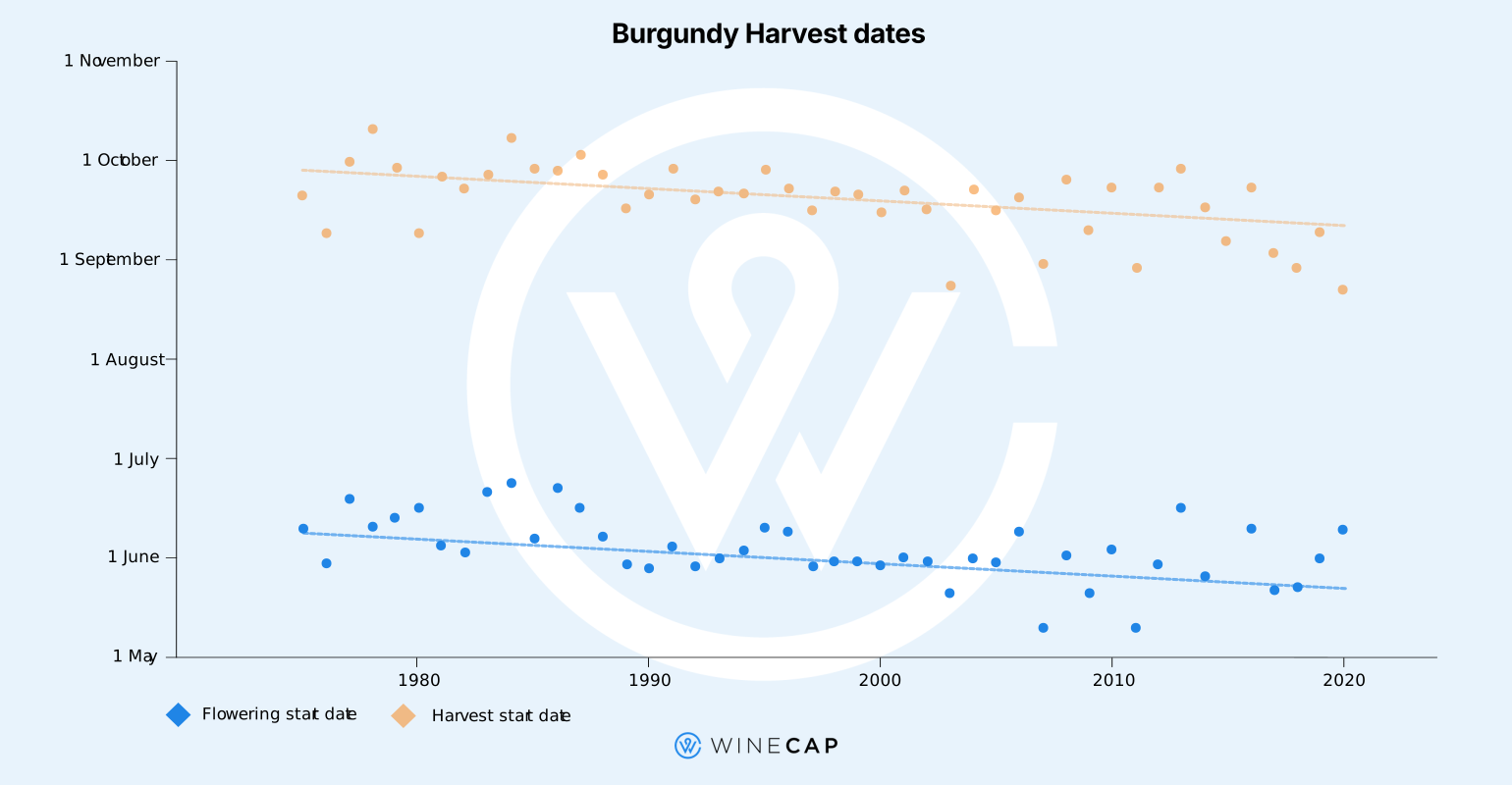
Burgundy Flowering and harvestData Source: jancisrobinson.com

Some historical regions are finding it increasingly difficult to maintain their traditional styles as sugar levels rise and acidity drops.

However, this shift is also opening up new frontiers:

  • English sparkling wine: Counties like Kent and Sussex now share a climate similar to the Champagne of several decades ago.
  • Patagonia and Central Otago: High-latitude regions are becoming top destinations for cool-climate varieties.
  • Emerging northern regions: Areas in Germany and even Scandinavia are beginning to produce high quality Pinot Noir.

For the investor, these changes create both risk and opportunity. While established terroirs are still preferred, new regions may become a more important part of the conversation in coming years.

Terroir beyond the wine glass

The concept of terroir is not exclusive to viticulture. It exists in many other artisanal products where sense of place is paramount. The “Slow Food” movement was built on this foundation, celebrating traditional agricultural products that reflect their local environment.

Other examples of terroir include:

    • Cheese: Such as Comte or Roquefort, where the local grasses and caves define the flavour.
    • Olive oil: Where regional soil and climate produce distinct profiles.
    • Coffee and tea: Where high-altitude “micro-lots” are traded at a premium.
    • Meat: Beef and lamb from the Orkney islands were among the first British products to gain legal recognition of their terroir.

In all these cases, terroir represents an element that imparts a sense of place. It is the ultimate rejection of mass-production and the celebration of the unique.

FAQ: A guide to terroir 

Is terroir just a marketing tool? 

While it is used in branding, terroir is based on documented physical factors like geology, climate, and topography that result in discernible variations in wine character.

Can a winemaker completely change a wine’s terroir? 

A winemaker can hide terroir through excessive oak or extraction, but they cannot create the structural intensity or complexity that only a superior site can provide.

Why does terroir matter for investment? 

Geographic specificity creates a natural cap on supply. Because the most famous vineyards cannot be expanded, the resulting rarity drives value in the secondary market.

Does the New World have terroir? 

Yes. Many New World producers now use soil mapping and single-vineyard designations to highlight the unique character of their specific plots.

WineCap’s independent market analysis showcases the value of portfolio diversification and the stability offered by investing in wine. Speak to one of our wine investment experts and start building your portfolio. Schedule your free consultation today.
Categories
Learn

What is the difference between wine and Fine wine?

  • The vast majority of wine is not fine wine.
  • Fine wine is defined by its quantity, quality and economics, making it a financial asset as well as a luxury beverage.
  • Most wine is produced for immediate consumption and lacks the structural components to improve with age, whereas fine wine is crafted to evolve over decades.

At its heart, all wine is designed for pleasure – made to be drunk and enjoyed – yet fine wine extends that experience beyond the glass, offering the potential for evolution, rarity and lasting value.

The vast majority of global wine production, estimated over 95%, is intended for the dinner table. This comprises most wines found in supermarkets, restaurants and even local wine shops. These consumer goods are made to be consistent vintage and after vintage, accessible, and best enjoyed shortly after purchase. The wines are often fresh, fruit-forward, and technically sound. They satisfy the palate but are not built for the cellar

Meanwhile, in the territory of fine wine, the product shifts from a perishable beverage into a durable asset. This distinction is the bedrock of the wine investment market. Fine wine sits at the very top of the quality pyramid and is the result of specific environmental conditions and craftsmanship that cannot be mass-produced. 

Fine wine has ageing capacity

A primary difference between standard wine and fine wine is the capacity to age

Standard wines often have a shelf life of just two or three years. Most wine does not become better with time; it simply gets old. There is no reward for holding a basic Pinot Grigio in your cupboard, which is best enjoyed the year after harvest. 

Fine wine operates on a different chemical timeline. It possesses high levels of acidity, tannins, and concentrated fruit flavours and aromas, which act as preservatives and structural supports. Over time these components interact, change and create complexity. Ironically what can make fine wine difficult to enjoy in its extreme youth is what makes it exceptional once it has aged.

With ageing, more red fine wines see their primary fruit flavours transform into complex tertiary notes like forest floor, tobacco, and truffle. This evolution is what drives the value of the bottle. Moreover, the wine becomes more desirable as it nears its peak drinking window and supply diminishes as it is consumed.

How fine wine changes with age

  • Phenolic polymerization: Small tannin molecules bond together to form longer chains, which significantly reduces astringency and creates a smoother mouthfeel.
  • Controlled oxidation: Small amounts of oxygen pass through the cork and slowly break down primary fruit compounds and change colour pigments.
  • Esterification and hydrolysis: Continuous reactions between alcohols and acids synthesise new scent compounds, shifting the wine’s aromas from primary fruit to more complex tertiary aromas.
  • Anthocyanin complexation: In red wines, red pigments bond with tannins causing the wine’s colour to shift from vibrant purple-red to garnet or tawny.
  • Colloidal precipitation: As molecules grow they form insoluble sediments which settle at the bottom of the bottle.

Fine wine gets scarcer

The scarcity of aged bottles also plays a critical role in the investment reality. 

As a vintage is consumed, the number of remaining bottles in the world decreases. When you combine increasing quality with decreasing supply, you create the perfect conditions for price appreciation. This is one of the reasons why a rare 80-year-old Domaine de la Romanee Conti recently sold for nearly a million dollars at auction, while a young bottle is closer to $10,000. 

Standard wine can never benefit from this change in the supply/demand dynamic because it cannot survive a journey it was never intended to make.

Fine wine has a sense of place

Fine wine is almost always tied to a specific patch of land. In regions like Burgundy, the difference between an investable Grand Cru wine and a Village wine made for short-term drinking can be a matter of a few metres. This is the concept of terroir. It encompasses the unique soil, the slope of the land, the local climate and seasonal weather, and cannot be replicated.

This regional tie creates a natural limit on supply. The land is fixed and protected by strict local laws. For instance, Domaine de la Romanee-Conti’s flagship wine Romanee-Conti can only come from one specific 4.5 acre vineyard. This restriction makes the wine a rare commodity. 

In contrast, most wines designed for early consumption are made from grapes sourced across entire countries or even continents, prioritising volume over the unique characteristics of a single site.

The blending exception

While terroir is the rule, there are notable exceptions where fine wine is defined by the skill of the blender. 

  • Champagne is the most obvious of these. While many top-tier reds rely on tiny vineyard plots, iconic houses like Dom Perignon produce significant quantities with grapes from plots across the region. This allows cellar masters to create a consistent, complex profile that ages for decades. 
  • Penfolds Grange is another famous example. Unlike the single-vineyard focus of Bordeaux and Burgundy, Grange is a multi-regional blend. The winemakers source the best Shiraz grapes from various locations across South Australia to create a consistent house style. Despite lacking a single-vineyard origin, it is a highly collectible wine.

Fine wine is not solely about where the grapes are grown. While geographic specificity is an indicator, the ultimate test is the quality of the finished product and its ability to age gracefully.

Fine wine has producer reputation 

Reputation is the currency of fine wine. A standard wine might be delicious, but without a historical track record, it cannot be considered an investment. Meanwhile, fine wine estates have often spent centuries building their brand: the 1855 Classification in Bordeaux is still a guide for investors today. It provides a hierarchy that the market trusts and gives buyers the confidence that the wine will perform as expected.

Fine wine attracts critical attention

Critic scores are a modern extension of this and provide crucial information for investors and collectors. A high score from a respected publication can cause an immediate spike in market value; a series of high scores over a number of years might elevate a wine to be considered a fine wine. 

Even so, most wines rarely receive this level of scrutiny. If they are reviewed at all, the assessment might focus on whether they are pleasant to drink right now, rather than on their structural integrity and ageing potential.

Fine wine is more complex

The flavour profile of fine wine is noticeably more complex than that of everyday bottles. Standard wine tends to be more linear: you might taste strawberry or lemon or apples, and that flavour remains consistent from the first sip to the finish. 

By contrast, fine wine is often described as multidimensional. It offers layers of smell and flavour that reveal themselves slowly as the wine sits in the glass.

Fine wine also possesses length. This is the duration that the flavours linger after you have swallowed. In a standard wine, the flavour might vanish in seconds, while in the best fine wines it can last for minutes. 

This is another hallmark of high-quality winemaking. It indicates a level of concentration and balance that is impossible to achieve in mass-market production. The sensory experience is simply deeper and more rewarding.

Price differential

It is a common myth that all fine wine is expensive. While “blue-chip” labels like Petrus or Le Pin can cost thousands of pounds, the entry point for fine wine is often more accessible than people think. Fine wines from regions like Bordeaux or Rioja often sell for well under £50. These wines offer the same ageing potential and structural complexity as their more famous peers, and while they may not be investable, they could still be categorised as “fine wine”.

Beyond cost, there is the question of value. For instance, a £10 bottle of supermarket wine has zero re-sale value the moment you leave the shop. A £60 bottle of high-quality Barolo not only has the potential to double or triple in value over a decade but will leave a lasting impression when consumed. 

Put simply, fine wine is an asset, whereas standard wine is an expense. The higher upfront cost is an investment in a product that can preserve and grow your capital, as well as deliver a different quality of drinking pleasure.

Quality vs quantity

Fine wine relies on the natural concentration of the grapes. This concentration is achieved by keeping vineyard yields low, which increases the cost of production.

Low yields mean fewer bottles of higher quality and is the fundamental trade-off of the fine wine world. A mass-market producer wants to harvest as many grapes as possible to fill as many bottles as they can, while a fine wine producer prunes the vines aggressively to ensure the remaining grapes are packed with flavour and structure. 

This focus on quality over quantity is the most significant contrast between fine wine and standard wine. 

From consumer to collector

Moving from simply drinking wine to collecting and investing in fine wine requires a clear shift in mindset. The focus moves away from what to open tonight, towards what will reach its peak in a decade or more. While the pleasure of fine wine still lies in the glass, it also comes from something deeper – the ability to follow a wine’s evolution over time. Fine wine is a living, changing asset, and that sense of development and anticipation is something few other wines, or indeed other alcoholic products, can truly offer.

FAQ

Can a cheap bottle of wine ever become “fine wine” if I leave it in a cellar? 

No. Ageing cannot create quality where it does not already exist. Fine wine must be “built” for the cellar from the moment the grapes are grown.

Is all expensive wine considered fine wine for investment? 

Not necessarily. Some wines are expensive due to branding, luxury packaging, or celebrity associations but lack a secondary market. To be investment-grade, a wine needs a history of price appreciation and a global network of buyers ready to trade it.

Why does region matter so much in fine wine? 

Specific regions have unique microclimates and soil that produce grapes with exceptional character. These areas are often legally protected, meaning supply is capped. This combination of unique quality and restricted supply is what creates long-term value for investors.

How can I tell if a wine has a different flavour profile without opening it? 

You can rely on critical reviews and tasting notes from professional tasters. They will describe the complexity, the tannins, and the “length” of the wine. Look for terms like “structured,” “tight,” or “evolving,” which indicate a wine that is built to improve over time.

Can a blend be a fine wine? 

Yes. Many of the world’s greatest wines are blends. Most Bordeaux wines are a mix of Cabernet Sauvignon and Merlot. Champagne is often a blend of different areas within the region and even from different years. Penfolds Grange is a multi-region blend. The key is the quality of the components and the skill involved in the assembly.

WineCap’s independent market analysis showcases the value of portfolio diversification and the stability offered by investing in wine. Speak to one of our wine investment experts and start building your portfolio. Schedule your free consultation today.
Categories
Learn

10 fascinating facts about Chateau Lafite Rothschild

  • Chateau Lafite Rothschild is one of the most sought-after wines in the world for its investment potential.
  • Lafite is frequently described as the most elegant of the First Growths.
  • Lafite vintages like 1982, 2009, and 2010 have achieved iconic status.

Chateau Lafite Rothschild is an undisputed titan of the fine wine world. For many collectors, it is the first name added to a cellar and the last one ever removed. Lafite Rothschild carries a weight that transcends viticulture, representing a fusion of French history, financial stability, and artisanal quality.

Its enduring prestige was recently cemented at a landmark Sotheby’s New York auction, where two 1870 magnums fetched a staggering $306,250.

In the secondary market, Lafite functions as a “liquid currency,” possessing a level of brand equity that few other luxury Veblen goods, let alone wines, can rival. Whether you are a seasoned oenophile or a newcomer to wine investment, understanding this Pauillac legend is essential. 

This guide explores the ten key facets that define the gold standard of this prestigious wine.

1. The storied history of an icon

Lafite Rothschild’s history is a tapestry of royal patronage and resilience. While vines have existed on the site for centuries, the estate gained international prominence in the late seventeenth century under the Segur family. Marquis Nicolas-Alexandre de Segur was known as the Prince of Vines, and he refined the winemaking techniques that put Lafite on the maps of London and Paris.

By the eighteenth century, Lafite was the favourite of the French royal court. It earned the moniker of King’s Wine, largely thanks to the influence of Marechal de Richelieu. Famously Thomas Jefferson, the third American president, became a devoted follower after visiting the region.

The most significant turning point occurred in 1868. Baron James Mayer de Rothschild purchased the estate at a public auction and added his surname to what had previously been “Chateau Lafite”. This acquisition brought the property into the Rothschild family, where it has remained for five generations.

Key historical milestones in the history of Lafite Rothschild include:

  • The 1855 Classification where Lafite was ranked as one of only four original Premier Grand Cru Classes.
  • The devastating phylloxera crisis of the late nineteenth century which tested the estate’s resolve.
  • The occupation of the chateau during the Second World War.
  • The post-war resurgence led by Baron Elie de Rothschild.
  • The modern era of expansion and technical precision under Baron Eric and now Saskia de Rothschild.

2. The unique terroir of Pauillac

Lafite is defined by its terroir, which is arguably the finest in the Médoc, as you might expect given its price point. The vineyard covers roughly 112 hectares making it the largest of the First Growths and is situated on a plateau of deep gravel. This soil type is crucial for Cabernet Sauvignon, as it provides excellent drainage and forces the vines to grow deep roots.

The climate in Pauillac is moderated by the proximity of the Gironde estuary and the Atlantic Ocean, creating a microclimate that protects the vines from extreme frost and excessive heat. The estate manages its land with a focus on biodiversity and long-term sustainability.

Current vineyard characteristics include:

  • An average vine age of approximately 40 years.
  • A high proportion of Cabernet Sauvignon, usually making up 70 percent or more of the vines and an even larger proportion of the Grand Vin.
  • Significant plantings of Merlot, which adds roundness and flesh to the mid-palate.
  • Smaller plots of Cabernet Franc and Petit Verdot for structural complexity.
  • The vineyard is divided into three main parcels, around the Chateau including the  Carruades plateau, and a plot in St Estephe.

3. The different wines of Lafite Rothschild

Key wines from the property are:

  • Chateau Lafite Rothschild (The Grand Vin).
  • Carruades de Lafite (The Second Wine).
  • Anseillan (A newer, plot-specific release).

While the Grand Vin is the primary focus for investors, the estate produces other notable labels. Each wine follows a strict hierarchy of quality and selection. Only the very best parcels are reserved for the top wine, ensuring its longevity and prestige.

Carruades de Lafite is the estate’s second wine, which typically contains a higher percentage of Merlot than the Grand vin and releases at a third of the price. Once viewed as a simple entry point, it has experienced periods of meteoric price rises over the last two decades and is now considered a viable investment asset in its own right. Prices tend to be more volatile than Lafite, but when bought at the bottom of a market cycle and sold at the top it can be highly lucrative. 

The estate also recently introduced Anseillan. This more affordable wine represents a more accessible side of the DBR portfolio and while it will benefit from some age it is not built for long-term cellaring.

4. Lafite within the Domaines Barons de Rothschild

Lafite serves as the flagship for Domaines Barons de Rothschild, commonly abbreviated as DBR. This global wine empire has expanded significantly since the mid-twentieth century. However, Lafite remains the spiritual and financial heart of the organisation.

Under the leadership of the Rothschild family, DBR has acquired prestigious estates across the globe. This includes properties in South America, China, and other regions of France. The technical expertise developed at Lafite is shared across these subsidiaries with staff moving from one to another.

The DBR portfolio also includes:

  • Chateau L’Evangile in Pomerol.
  • Chateau Rieussec in Sauternes.
  • Vina Los Vascos in Chile.
  • Bodegas Caro in Argentina.
  • Domaine de Long Dai in China.

5. The benchmark Lafite Rothschild style

Lafite is frequently described as the most elegant of the First Growths. While Latour is known for power and Margaux for perfume, Lafite is celebrated for its finesse and complexity. It is rarely a wine that shouts; instead, it whispers with profound depth.

On the nose, young Lafite often displays notes of cedar, graphite, and violets. As it ages, these aromas evolve into complex layers of tobacco, forest floor, and truffle. The tannins are famously fine-grained, described by many critics as silky or lacy.

Structural hallmarks of the wine:

  • A core of intense blackcurrant fruit.
  • Distinctive mineral notes derived from the gravelly soil.
  • High natural acidity which ensures decades of ageing potential.
  • Seamless integration of oak, usually 100 percent new French barrels.
  • An extraordinary length of finish that lingers for minutes.

6. The 1982 Lafite vintage and the modern wine era

The 1982 vintage was a watershed moment for the global wine trade. It marked the emergence of Robert Parker as the world’s most influential wine critic. Parker famously touted the 1982 Bordeaux vintage as legendary while many other critics were hesitant.

Lafite Rothschild 1982 received a perfect 100-point score from Parker. This set the stage for the rise of modern wine criticism and the standardisation of the 100-point scale. It transformed fine wine from a niche hobby into a global asset class.

The significance of 1982 includes:

  • The birth of the modern secondary market for investment-grade wine.
  • A shift towards riper, more opulent styles of winemaking across Bordeaux.
  • The massive increase in global demand for First Growth allocations.
  • The establishment of Lafite as the ultimate status symbol in emerging markets.

On a business level, increasing prices allowed Lafite Rothschild and other chateaux to invest in more precise, cleaner winemaking and improved farming practices, in turn facilitating a dramatic improvement in quality in the years that followed.

7. The rise of Lafite Rothschild in China

Lafite Rothschild holds a unique position in the Chinese market. It became the definitive luxury wine during China’s economic boom.

The name is easy to pronounce in Mandarin, which helped its early adoption. Its association with the Rothschild family also appealed to Chinese investors who value heritage and long-term wealth; this demand drove prices to stratospheric levels, particularly for the 2008 vintage.

The impact of the Chinese market led to:

  • A surge in prices for both recent and back vintages.
  • Increased focus on anti-counterfeiting measures and provenance.
  • The creation of the Long Dai estate in Shandong province by DBR.

8. Special bottlings and labels

Lafite occasionally marks special vintages with subtle changes to its iconic label. Perhaps unsurprisingly for Lafite these are not full label changes a-la Mouton Rothschild 2003, gold labels like Angelus 2012 or brightly coloured full bottle canvases like the Taittinger collection.  Instead they are subtle changes, a small embossing here, a glass relief there, commemorating astronomical events, cultural milestones and vintages blessed by the weather gods.

Notable label variations include:

  • The 1985 vintage features a small etching of Halley’s Comet. 
  • The 1999 vintage includes a small star to celebrate the turn of the millennium.
  • The 2005 vintage depicts the sun and rain on a set of scales for the perfect balance of that growing season
  • The 2008 vintage features a red Chinese character for the number eight.
  • The 2018 vintage shows a hot air balloon to mark 150 years of Rothschild ownership.

These bottles often command a premium at auction beyond what their quality would suggest.

9. The best and most expensive Lafite Rothschild vintages

When discussing the best vintages of Lafite Rothschild, critics often point to years where the weather was nearly perfect. Vintages such as 1953, 1959, and 1961 are legendary for their longevity. More recently 1982, 2009, and 2010 have achieved iconic status.

In terms of the financial performance, the most expensive bottles ever sold often have historical significance. A bottle of 1869 Lafite sold in Hong Kong for over $230,000 in 2010. Even older bottles, such as the 1787 vintage allegedly owned by Thomas Jefferson, have sold for record sums.

Top Lafite vintages for investment:

  • 1982: The benchmark for modern investment.
  • 2000: A millennium vintage with immense staying power.
  • 2005: Perfect structural balance.
  • 2012: Great value and already in its depletion phase.
  • 2016: A modern classic with widespread critical acclaim.
  • 2019 and 2020: High-scoring recent years with good value and strong long term potential.
  • 2024: The most affordable vintage on the market.

Such is the strength of the Lafite brand that its not just the best vintages that have been strong investments, in fact quite frequently the opposite has been the case. The 2013 vintage is a perfect example of this: a 90-point score from Neal Martin and 87-89 points while still in the barrel from Robert Parker in his last En Primeur tastings denotes a vintage that was anything but great. However, it was released at very competitive prices and in percentage terms its performance has eclipsed even the famed 2010.

10. The investment reality of Lafite Rothschild

Lafite remains a cornerstone of any serious wine investment portfolio. Its primary strength is liquidity. Unlike niche wines that may be difficult to sell, there is always a buyer for a well-stored case of Lafite.

It acts as a hedge against inflation and broader market volatility. While prices can fluctuate, the long-term trend for First Growth Bordeaux has historically been upward. The scarcity of back vintages ensures that supply continues to dwindle as bottles are consumed.

Key investment takeaways:

  • Blue-chip status ensures high global demand and easy resale.
  • Consistent quality means that even lesser vintages hold their value well.
  • Provenance is vital, as buyers will pay more for professional storage.
  • The estate’s brand power provides a safety net during economic downturns.
  • It remains the ultimate entry point for those seeking long-term capital appreciation.

Chateau Lafite Rothschild is more than just a vineyard – it is an icon of Bordeaux and an enduring symbol of French viticulture. By balancing a deep respect for tradition with modern financial sense, it continues to lead the fine wine market. Whether you hold it for the pleasure of the palate or the growth of your capital, Lafite represents the gold standard of the fine wine world.

FAQ: Chateau Lafite Rothschild

What makes Chateau Lafite Rothschild so expensive?

Lafite’s value is driven by its First Growth status (the highest ranking in the 1855 Classification), its storied history with the Rothschild family, and its massive brand equity in global markets. Its reputation as a “liquid currency” makes it a stable blue-chip investment.

How does the taste of Lafite differ from other First Growths?

While other top wines like Latour are known for power, Lafite is celebrated for its finesse and elegance. It is often described as a wine that “whispers” rather than shouts, characterised by silky tannins and complex notes of cedar, graphite, violets, and blackcurrant.

What is the difference between the Grand Vin and Carruades de Lafite?

The flagship wine is made from the estate’s very best parcels. It is built for decades of aging and is the primary target for high-level investors. Meanwhile, the estate’s Second Wine typically contains more Merlot, is more accessible in its youth, and costs significantly less (usually about a third of the price of the Grand Vin).

Why is Lafite particularly popular in the Chinese market?

Lafite became a preeminent status symbol in China due to several factors: the name is easy to pronounce in Mandarin, the Rothschild heritage aligns with Chinese values of long-term wealth, and the 2008 vintage specifically featured a red Chinese character for the number eight (a lucky number) on the bottle, which drove demand to unprecedented levels.

Which vintages are considered the best for investment?

The “iconic” vintages for both quality and financial performance include 1982, 2000, 2005, 2009, 2010, and 2016. However, “off-vintages” like 2013 have also proven to be lucrative investments because they were released at lower prices and benefited from the overall strength of the Lafite brand.

How can you tell if a Lafite bottle is a special edition?

Lafite uses subtle etchings or embossments on the glass rather than changing the entire label. For example:

  • 1985: Features Halley’s Comet.
  • 1999: Features a star for the millennium.
  • 2008: Features the Chinese character for “8” ().
  • 2018: Features a hot air balloon to mark 150 years of Rothschild ownership.

WineCap’s independent market analysis showcases the value of portfolio diversification and the stability offered by investing in wine. Speak to one of our wine investment experts and start building your portfolio. Schedule your free consultation today.
Categories
News

Bordeaux 2025 En Primeur: Quality meets a market at the crossroads

  • Bordeaux 2025 is a low-yield, heat-shaped vintage delivering concentration, freshness, and a clear shift toward precision viticulture.
  • Early reports point to a high-quality vintage with the potential to rival benchmark years like 2010 and 2016.
  • Set against a cooling market, the En Primeur campaign represents a critical opportunity to reset expectations around pricing and value.

From April 20th to 23rd, 2026, Bordeaux welcomed thousands of merchants, critics, and collectors for the En Primeur tastings of the 2025 vintage. Shaped by intense heat and reduced yields, the new vintage reflects a growing emphasis on precision viticulture – an approach that could come to define Bordeaux’s modern identity.

Yet the usual energy surrounding En Primeur unfolds against a more cautious economic backdrop. Bordeaux finds itself in a period of recalibration. As the first in-barrel scores emerge and the campaign gathers momentum, attention turns not only to what sets the 2025 vintage apart, but also to whether this release can offer real value.

A note on Bordeaux En Primeur

Few moments in the fine wine calendar carry the weight of En Primeur week. Orchestrated by the Union des Grands Crus de Bordeaux (UGCB), the event sees chateaux open their doors to professionals eager to sample wines just months after they were harvested.

Unlike the bottled wines, the En Primeur wines are still unfinished, first presented while ageing in oak. Tasting from barrel requires an expert palate to see through the raw tannins and vibrant acidity to glimpse the potential for greatness years down the line. It is a period of masterclasses, technical presentations, and intense market discussion that signals the pricing direction for the entire year ahead.

The 2025 represents a fascinating stylistic shift. Despite the heat, alcohol levels are reportedly low to moderate. The wines have pronounced aromatics, silky tannins and brisk acidity – hallmarks of great ageing potential. 

Bordeaux 2025: What we know so far

Bordeaux weather and crop reports indicate that 2025 was a year of climatic extremes, resulting in high quality but notably low yields. In fact, production statistics show that 2025 is the smallest crop since the frost-bitten 1991, with yields across many top appellations falling 15-30% below the five-year average.

A season of heat and superb ripening

The growing season was defined by a warm spring and a blistering summer. June 2025 was recorded as one of the hottest in French history, second only to the infamous 2003. This heat, combined with a dry August, led to:

  • Smaller berries: The lack of water and high heat restricted grape size, leading to intense concentration and thick skins.
  • Exceptional phenolic ripeness: While the yields are small, the quality of the tannins is reportedly superb.
  • The “rain of relief”: Just as drought stress became critical, rain in late August and early September refreshed the vines, preserving essential acidity and preventing alcohol levels from spiralling out of control.

Regional highlights

  • The Left Bank (Médoc, Pauillac, St-Julien): The deep-rooted old Cabernet Sauvignon vines thrived, producing structured, age-worthy wines reminiscent of 2022 but with a touch more freshness.
  • The Right Bank (St-Émilion, Pomerol): Clay and limestone soils held onto moisture better than gravel, allowing Merlot to reach lush ripeness without excessive heat stress.
  • Dry whites: Harvested early in mid-August, these show vibrant acidity and tropical aromatics.

The Bordeaux market: The recalibration phase

While the 2025 quality is expected to be high once critic scores are released, the market mood is best described as unsettled. For decades, Bordeaux held an unchallenged dominance in the fine wine market. Recent years have seen a cooling of demand, especially for young releases.

The challenges

  • Increased competition: High-quality rivals from Burgundy, Tuscany, Napa Valley, and even emerging regions have eaten into Bordeaux’s traditional market share.
  • Pricing fatigue: Consistent price hikes in recent En Primeur campaigns – often regardless of the broader economic climate – have tested the loyalty of even the most dedicated collectors.
  • Stock overhang: Many merchants are currently carrying significant inventories of recent great years (2018, 2019, 2020), which has created a bottleneck in the secondary market.

The silver lining

Despite these headwinds, the appetite for older, physical vintages remains robust. There is a clear divergence in the market: while younger vintages (2021-2023) struggle for traction, back vintages from the mid-2000s and 2010s continue to see steady price appreciation. This suggests that the brand of Bordeaux is as strong as ever. The issue lies specifically with release pricing.

Buying wine En Primeur: The question of value

For decades, the “golden rule” of Bordeaux was that En Primeur represented the lowest price point for a wine’s entire lifespan. Today, that assumption is being challenged by data.

Looking at prices at release versus now, several recent vintages can be found on the secondary market for the same price or even less. This has shifted the focus from buying everything to selective acquisition based on specific brand value. Tools like Wine Track, which show the historic performance of specific wine brands, can help investors understand long-term trajectories.

Why data matters

In the 2025 campaign, savvy buyers will be looking for relative value. If a 2025 release is priced higher than a physical, high-scoring 2019 or 2020 vintage currently sitting in a merchant’s warehouse, the incentive to buy En Primeur diminishes. However, because the 2025 yields are so low, scarcity may drive demand for the top-tier “blue chip” estates (the First Growths and their Right Bank equivalents).

The 2025 Bordeaux En Primeur verdict

As critics release their first scores over the coming weeks, all eyes will be on the “price-to-quality ratio.” The 2025 vintage has all the hallmarks of a collector’s dream: scarcity, concentration, and classical structure. For the Bordeaux trade, the 2025 En Primeur is an opportunity for a reset. With early reports pointing towards a vintage that could rival the greats of 2010 or 2016, the quality is likely there.

If the châteaux can marry this quality with a pricing strategy that respects the current market reality, 2025 could mark the beginning of a vibrant new chapter for the world’s most famous wine region.

Bordeaux comment: UGCB President, François-Xavier Maroteaux speaks to WineCap

WineCap: The 2025 vintage promises high quality, yet it arrives as the secondary market has just started to recover from a five-year low, and growing geopolitical tensions discourage speculation and might isolate certain market segments. How do you intend to position the 2025 launch so it doesn’t just survive the current market, but actually revitalises the ‘Bordeaux Brand’ globally?

François-Xavier Maroteaux: The 2025 vintage is a genuine opportunity – but only if we use it wisely. First, pricing must be honest: release prices that ignore five years of secondary market correction damage trust more than they protect margins. A well-priced great vintage is far more powerful than an overpriced one. Second, the narrative must move beyond scores – 2025 has a compelling story of terroir and style that needs to reach consumers directly, not just through trade press. Third, our négociants are brand ambassadors, not just a distribution channel: the properties that genuinely invest in informing and equipping their partners will see it reflected in every market. Finally, the retreat of speculative demand is not a threat – it’s a rebalancing. Bordeaux built its reputation on wine people actually wanted to drink. Refocusing on that is not a concession to difficult times. It’s a return to what made the region great. 

WC: Where do you see the biggest interest in buying Bordeaux at release in the coming years?

FXM: The interest in buying Bordeaux at release remains genuinely global. The best proof of this is the En Primeur week itself: every year, wine professionals from more than 80 nationalities make the journey to taste and buy. That breadth of engagement, even in difficult market conditions, is a strong signal that the foundation is there. Beyond geography, there is another compelling reason to buy at release that we shouldn’t underestimate (and we should be communicating much more actively!): formats. En Primeur remains the best – often the only – window to secure large formats. Magnums, double magnums, imperials are allocated at release and rarely available later at any price. The opportunity is to refocus En Primeur on what it does uniquely well: access, formats, and relationship. That’s a proposition that holds regardless of geopolitics.

WC: Is the En Primeur system still going strong, in your personal view? Do you believe it still offers a genuine win-win? Has it become a luxury-only club for the top 50 estates?

FXM: Yes, I do believe the En Primeur system still works – but I think we need to be honest about what it has become. It works very well for a relatively narrow group of estates where brand strength and secondary market liquidity reinforce each other. For the broader Bordeaux pyramid, it is more complicated. That said, I don’t think the answer is to abandon the system. The answer is to make the win-win genuine again. That means pricing with discipline, communicating with transparency, and making sure négociants and merchants actually make money when they support a release. When that alignment exists, En Primeur is a unique and powerful tool. When it doesn’t, it becomes – as you say – a luxury club for the top names. 

FAQ: Everything you need to know about Bordeaux En Primeur

What does “En Primeur” mean?

En Primeur is a method of purchasing wine while it is still maturing in the barrel. This allows collectors and investors to secure highly sought-after wines before bottling and general market release. This typically happens two years after harvest.

When is the Bordeaux 2025 En Primeur week?

The official tasting week for the 2025 vintage takes place from April 20 to April 23, 2026. During this time, international critics and trade professionals sample the wine from barrel to determine early scores and quality ratings.

Is the 2025 Bordeaux vintage good?

Bordeaux 2025 is a high-quality vintage with intense concentration and bold fruit profiles.Yields are lower than average, which often results in wines with significant ageing potential and structural density.

Why are yields low for the 2025 vintage?

The 2025 growing season saw record-breaking heat and extended dry periods. While this led to exceptional grape ripeness and thick skins (tannin), it resulted in smaller berries and less juice. These lower yields often drive up demand due to the limited number of cases available globally.

Is buying En Primeur a good investment?

Buying En Primeur can be a strategic investment, particularly for top-tier estates (First Growths and “Super Seconds”). However, it is essential to use data-driven insights. While release prices were historically the lowest point of entry, current market fluctuations mean buyers should compare release prices against available physical back-vintages to ensure they are getting true value, as older vintages can often present better buying opportunities than En Primeur.

When is the delivery of the 2025 Bordeaux wines?

In the spring or summer of 2028, following their mandatory ageing period in the châteaux cellars.

What are the “big three” factors to watch in the 2025 campaign?

  1. Critic scores: Initial ratings from major publications will dictate immediate global demand.
  2. Release pricing: How châteaux price their wine in relation to the secondary market.
  3. Volume: With lower yields reported, the scarcity of specific labels will likely be a driver of demand.

WineCap’s independent market analysis showcases the value of portfolio diversification and the stability offered by investing in wine. Speak to one of our wine investment experts and start building your portfolio. Schedule your free consultation today.
Categories
Learn

Bubbles & bull markets: Investing in Vintage Champagne

  • Unlike Non-Vintage (NV) bottles, Vintage Champagne is produced only 3-4 times per decade, creating an inherent supply cap that drives long-term price appreciation.
  • Labels such as Dom Pérignon and Louis Roederer (Cristal) act as market benchmarks, offering high liquidity and global brand recognition.
  • Many investors prioritise Champagne magnums due to slower ageing process and higher premiums. 

For the uninitiated, Champagne is the liquid synonym for celebration. However, for the serious collector, it represents one of the most resilient and rewarding asset classes in the alternative investment world. Moving beyond “party bubbles” requires a shift in perspective – from the high-volume non-vintage (NV) bottles found on supermarket shelves to the rare prestige cuvées that dominate the secondary market.

Understanding the liquid gold: Is sparkling wine Champagne?

Before diving into the financials, every novice must master the terminology. A common entry-point question is: is sparkling wine Champagne? The answer is a matter of strict geography and law. Only wine produced in the Champagne region of France, under the stringent rules of the Appellation d’Origine Contrôlée (AOC), can carry the name. While Italian sparkling wine or Spanish sparkling wine like Cava offers excellent drinking, they rarely command the investment-grade premiums of a Grand Cru Champagne.

The scarcity engine: Vintage vs Non-Vintage

The primary driver of value in this market is the distinction between NV and vintage champagne.

  • Non-Vintage (NV): These are the house styles (e.g., standard Moet and Chandon ) blended from multiple years to ensure a consistent brand profile.
  • Vintage Champagne: Produced only in exceptional years, these bottles are a snapshot of a single harvest. Because they are produced in limited quantities and only 3-4 times a decade, they possess the inherent scarcity required for price appreciation.

The titans of the market: Dom Pérignon and Louis Roederer

If you are looking for the “Blue Chips” of the bubbly world, you must look at the prestige cuvées.

  • Dom Pérignon: As a powerhouse brand , the Dom Perignon price is a frequent benchmark for market health. Investors closely watch the Dom Perignon Champagne price for new releases, often holding them for a decade as the supply dwindles.
  • Louis Roederer: Specifically their “Cristal” label, Louis Roederer Champagne is a staple of elite portfolios.
  • Cult favourites: For those looking beyond the famous houses, labels like Jacques Selosse (often referred to simply as Selosse Champagne ) represent the “grower” movement, where limited production meets astronomical demand in the secondary market.

Size and longevity: Why magnums matter

In the world of investment, Champagne bottle sizes are not just about the volume of liquid. The magnum Champagne (1.5L) is the preferred format for investors. Because a magnum has a lower ratio of air-to-liquid than a standard bottle, the wine ages more slowly and gracefully. Rare large formats, such as the Jeroboam bottle or the massive Nebuchadnezzar, often fetch significantly higher premiums at auction due to their sheer rarity.

Storage and spoilage considerations

A common concern for novices is: “Does Champagne go off?” or “Can champagne go bad?” Unlike spirits, wine is a living product. How long does Champagne last? While a standard NV bottle might only stay fresh for a few years, a vintage Champagne can evolve and improve for 20 to 30 years if stored correctly.

To protect the costly Champagne in your portfolio, professional storage is non-negotiable. Light, vibration, and temperature fluctuations are the enemies of value. An investor must know how to store wine in a temperature-controlled environment to ensure that when it comes time to exit the investment, the provenance is impeccable.

The secondary market: Why the boom?

The most expensive champagne is no longer just for drinking; it is for trading. With the rise of global wealth and a fixed supply of the best vintages, the secondary market for labels like Krug, Salon, and Taittinger (check the Taittinger Champagne price for recent spikes) has seen consistent growth. Champagne often acts as a Veblen good – a luxury item where demand increases as the price rises, further fueling the bull market for the world’s finest bubbles.

Grand Cru and the terroir premium

To truly understand why some bottles command five-figure sums while others languish, the novice investor must look at the soil. Champagne is divided into a strict hierarchy of villages. At the pinnacle are the 17 Grand Cru villages, such as Ambonnay, Bouzy, and Le Mesnil-sur-Oger. These sites represent the absolute best terroir in the region, where the chalky soils and microclimates produce grapes with the highest concentration and acidity – the two vital components for long-term aging.

Below the Grand Crus sit the 44 Premier Cru villages. While still exceptional, the market price for a Grand Cru bottle often grows at a significantly higher rate than its Premier Cru counterparts. For the investor, “buying the label” is often secondary to “buying the land.” When you see a label from a producer like Jacques Selosse, you aren’t just paying for the name; you are paying for access to some of the most coveted Grand Cru plots in the Côte des Blancs. Understanding this hierarchy allows an investor to spot “undervalued” producers who may own vines in the same prestigious villages as the famous houses but have not yet reached their peak market valuation.

How long to hold your Champagne?

One of the most frequent questions from novices is how long to hold their Champagne. To answer this with an investment lens, we must discuss “lees aging.” Unlike most red wines, which age primarily in the bottle, Champagne derives its complexity from sitting on its lees (dead yeast cells) during the second fermentation.

A prestige cuvée like Dom Pérignon or Krug may spend seven to fifteen years in the cellar before it is even released to the public. This “pre-aging” by the house is why the Dom Perignon price is so high upon release; the producer has already absorbed the storage costs for a decade. However, the real “Alpha” for investors happens after release. As bottles are consumed globally, the remaining supply of a specific vintage becomes infinitesimally small. This is the “Scarcity Curve.” A vintage Champagne that was released at £150 may double in value over the next five years simply because 90% of the vintage has been drunk, leaving collectors to scramble for the remaining 10%.

Champagne as a defensive asset

In times of economic uncertainty, wine often acts as a “safe haven” asset. Unlike stocks, which can go to zero, a bottle of Louis Roederer Cristal is a tangible asset with intrinsic value. Historically, the fine wine market – and Champagne in particular – has shown a lower correlation to traditional equity markets.

When inflation rises, luxury goods often see a price surge. Champagne is a classic Veblen good in this regard; as it becomes more expensive, its desirability among the ultra-wealthy increases, creating a self-fulfilling prophecy of price growth. Furthermore, the secondary market for Champagne is more liquid than for many other rare wines. Because brand recognition is so high – everyone knows the names Moet, Bollinger, and Taittinger – it is much easier to find a buyer for a case of Champagne than for an obscure Burgundy.

Navigating the risks

No guide would be complete without a word of caution. As the most expensive Champagne prices continue to climb, the risk of counterfeits rises. Investors must ensure they receive “Original Wooden Cases” (OWC) whenever possible and verify the provenance. A bottle that has been kept at room temperature for five years is functionally worthless as an investment, even if the label is pristine. This is why professional, temperature-controlled storage is the “hidden cost” that ensures your liquid assets don’t turn into expensive vinegar.

FAQ

Is sparkling wine the same as Champagne?

No. While all Champagne is sparkling wine, not all sparkling wine is Champagne. Legally, only wine produced in the Champagne region of France under strict AOC regulations can use the name. 

Does Champagne go off or go bad?

Yes, Champagne is a living product and can spoil if not stored correctly. While a standard Non-Vintage bottle is meant for immediate consumption, a Vintage Champagne can age and improve for 20 to 30 years. However, exposure to heat, light, or vibration can turn a prestige cuvée into “expensive vinegar” and render the investment worthless.

Why is the “Dom Pérignon price” used as a market benchmark?

Dom Pérignon is considered a “Blue Chip” asset due to its massive global brand recognition and consistent quality. Because it is widely traded, its price fluctuations often signal the overall health and sentiment of the Champagne secondary market.

How long should I hold my Champagne investment?

Most experts recommend a holding period of 5 to 10 years after the initial release. This allows the “Scarcity Curve” to take effect; as the majority of the vintage is consumed globally, the remaining bottles become rarer and more valuable to collectors.

What is the best way to store investment-grade Champagne?

Professional, temperature-controlled storage is non-negotiable. To maintain its value and ensure “impeccable provenance” for future buyers, Champagne should be kept at a constant temperature (around 10-12°C) in a dark, vibration-free environment, ideally in its Original Wooden Case (OWC).

Categories
Learn

Champagne vs. Prosecco vs. Cava vs. English bubbles: Which sparkling wine should you buy?

  • In the vast world of sparkling wine, Champagne remains the global benchmark for both quality and prestige.
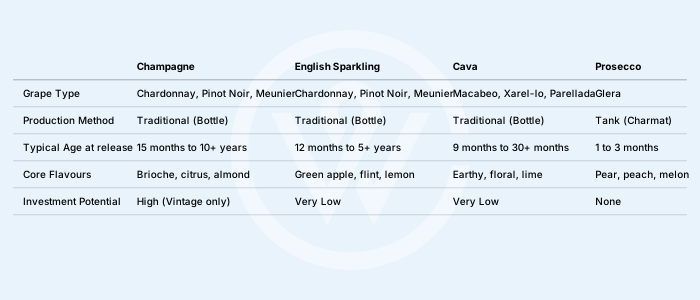
  • The production method creates a divide: Champagne, Cava, and most English sparkling wine use the bottle-fermented “traditional method,” while Prosecco relies on the faster “tank method.”
  • From a financial perspective, Champagne is the only truly investable sparkling wine on the secondary market.

Sparkling wine, fit for any celebration, is more than just a drink for a toast. It is a vast category defined by geography, history, and chemistry. While most people recognise the pop of a cork, the liquid inside that bottle can vary wildly depending on where the grapes have been grown and how it was made.

To understand the difference between Champagne, Prosecco, Cava, and English sparkling wine we have to look at what happens inside the cellar. While they all have bubbles, the way those bubbles are created changes the flavour, the texture, the price tag and the investment reality.

The traditional method: Champagne, Cava and English fizz

Champagne, Cava, and English sparkling wine are all made using the “traditional method.” This is the most expensive and time-consuming way to make wine.

  • First, the winemaker creates a still dry wine. 
  • Then, they put it into a bottle with a little bit of sugar and yeast and seal it with a crown cap like you’d find on a bottle of beer. 
  • A second fermentation happens inside that specific bottle. Because the carbon dioxide cannot escape, it dissolves into the wine, creating the sparkle.

The final stage has the wine sitting on the lees: the dead yeast cells. Over months or years, these cells break down and give the wine flavours of toasted bread, brioche, and nuts. This is what experts call “autolytic” character. It is the reason why a glass of Champagne often smells like a bakery, while a Prosecco smells like a fruit basket.

Champagne: The undisputed king

Champagne is a specific region in northern France. If a sparkling wine is not from there, it is not Champagne. The region is famous for its white, chalky soil. This soil acts like a sponge, holding water but also reflecting sunlight back up to the vines.

The major grapes here are: 

  • Chardonnay 
  • Pinot Noir
  • Pinot Meunier

Four other varieties are also permitted but rarely used:

  • Pinot Blanc
  • Pinot Gris
  • Arbane
  • Pinot Meslier

This combination creates a wine with incredible structure and high acidity. This acidity is the backbone that allows the wine to age for decades.

Indeed, its ageability, decades long reputation and high quality make Champagne one of the most prominent investment players on the secondary market for fine wine. Still, there is a catch. 

Most non-vintage (NV) bottles, which are the standard blends houses produce every year, do not necessarily increase in value. With very few exceptions, only vintage Champagne is investable. These are wines made from grapes harvested in a single year. They are produced in smaller quantities and are built to last.

Vintage Champagnes are the primary targets for collectors and investors looking for a return.

Looking for more? Read our Champagne Regional Report.

English sparkling wine: The rising star

The story of English sparkling wine is one of geology and changing climates. The same chalk seam that runs through Champagne actually dips under the English Channel and pops up again in the South of England.

Counties like Kent, Sussex, and Hampshire have soil that is nearly identical to the best plots in France. As the climate has warmed, these regions have become perfect for growing the same three grapes used in Champagne.

  • Chardonnay
  • Pinot Noir
  • Pinot Meurnier

The style of English sparkling wine is often very lean and crisp. It has a piercing acidity that makes it incredibly refreshing. While the quality is now world class, the market is still catching up.

Search data on Wine-Searcher shows that the most popular English sparkling wines are currently sitting just inside the top 5000 most searched for wines. Interest is growing, but it is still a long way from the global dominance of the famous French houses.

Cava: Spain’s traditional bubble

Cava is Spain’s answer to Champagne. Most of it comes from the Penedès region in Catalonia. While it uses the same traditional method as Champagne, the flavours are different because the grapes are different.

The traditional Cava blend uses:

  • Macabeo
  • Xarel-lo
  • Parellada

These indigenous Spanish grapes often produce wines that are a bit more earthy or floral. They generally have lower acidity than Champagne or English sparkling wine, which makes them feel softer in the mouth.

Despite its long history, Cava struggles on the secondary market. It is often viewed as a value-for-money option rather than a luxury collectible. This is reflected in its search rankings: even the most famous Cavas usually sit outside the top 3000 most searched for wines globally. For an investor, Cava currently lacks the secondary market activity needed to be a viable asset.

The Charmat method: Prosecco

Prosecco is a completely different beast. It comes from the Veneto and Friuli regions of Italy and is made using the “tank method” (also known as the Charmat method).

Instead of the second fermentation happening in a bottle, it happens in a large stainless steel tank. This is much faster and cheaper. The goal here is not to create bread-like flavours from yeast, but to keep the wine tasting like fresh fruit.

Glera must make up 85% of the blend with the rest consisting of:

  • Verdiso 
  • Bianchetta Trevigiana 
  • Perera 
  • Glera Lunga
  • Chardonnay
  • Pinot Bianco 
  • Pinot Grigio
  • Pinot Noir

The Glera grape used in Prosecco is naturally aromatic. It smells of white peach, pear, and honeydew melon. Because it does not spend long on the yeast, the bubbles are often bigger and frothier.

Prosecco is designed to be drunk fresh. It does not improve with age. Because of this, it has almost no presence in the investment world. Like Cava, the most popular Proseccos are found outside the top 3000 most searched for wines. It is a wine for the moment, not for the cellar.

Investing in sparkling wine: a guide

The difference in investment potential between these regions is striking. While you can find a delicious bottle of sparkling wine from any of these four places, the financial world only really cares about one.

Secondary market activity is the engine that drives wine investment. This involves collectors buying and selling bottles through auction houses or private exchanges. This activity requires three main things:

  • Brand power: A name that people all over the world recognise and want.
  • Scarcity: A limited supply that cannot meet the high demand.
  • Longevity: A wine that will actually taste better (and be worth more) in time.

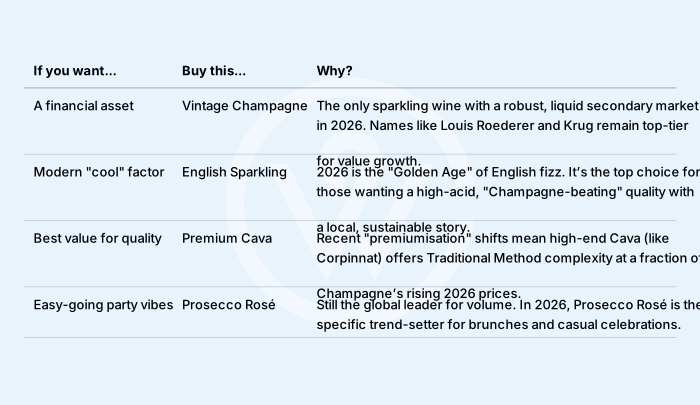
Champagne, specifically Vintage Champagne and “Prestige Cuvées” like Dom Pérignon or Krug, checks all three boxes. English sparkling wine is building the brand power, but it lacks the historical track record and data about its aging potential that investors crave. Cava and Prosecco, meanwhile, are produced in such high volumes that scarcity is rarely an issue, which prevents prices from climbing on the secondary market.Champagne sparkling wine table

Other sparkling wine regions

The world of bubbles does not end with these four. Other regions are also making their mark, though they face similar hurdles regarding investment.

  • Franciacorta: Italy’s premium sparkling wine made in the traditional method. It uses Chardonnay and Pinot Nero, often resulting in a richer, riper style than Champagne.
  • Crémant: These are French sparkling wines made outside of Champagne. Crémant de Bourgogne (Burgundy) and Crémant d’Alsace are excellent value alternatives that use the traditional method.
  • Tasmania: Australia’s cool-climate island is producing some of the most exciting New World bubbles, characterised by high acidity and elegance.
  • California: Areas like the Anderson Valley produce powerful sparkling wines that often show more ripe fruit and oak influence than their European cousins.

While these wines are fantastic for enthusiasts, they currently exist outside the scope of “investment grade” wine. They are brilliant additions to a dinner party, but they are not yet staples of a financial portfolio.

Sparkling wine style: texture and taste

When you are choosing a bottle, the “mousse” or the feel of the bubbles is a great way to tell them apart.

Traditional method wines (Champagne, English, Cava) usually have very fine, tiny bubbles that tingle on the tongue. This is because the carbon dioxide has had a long time to integrate with the liquid during its years in the bottle.

Tank method wines (Prosecco) have larger, more lively bubbles. They feel more “fizzy” and can sometimes be a bit more aggressive. This is why Prosecco is so popular in cocktails like the Aperol Spritz: the bubbles are strong enough to stand up to other ingredients.Champagne styles

Whether you are looking for a bottle to open tonight or one to keep for a decade, the differences between these four regions are significant.

Champagne remains the gold standard and is the only choice for those looking at sparkling wine as an asset.

English sparkling wine is the exciting newcomer, offering a taste of what Champagne used to be before the impact of climate change: high-acid, lean, and intensely fresh. Cava provides a wonderful, earthy alternative for those who love the traditional method but want a different flavour profile. Finally, Prosecco remains the ultimate choice for accessible, fruity fun.

By understanding the production methods and the market data, you can navigate the wine aisle with much more confidence. The world of sparkling wine is diverse, and while only a small slice of it is “investable,” every region offers something unique for the palate.

People Also Ask

What is the main difference between Champagne, Cava, and Prosecco?

The primary difference lies in the production method and region. Champagne (France) and Cava (Spain) use the “traditional method,” where the second fermentation happens in the bottle, creating complex brioche flavors. Prosecco (Italy) uses the “tank method,” which is faster and preserves the fresh, fruity flavors of the Glera grape.

Is English sparkling wine as good as Champagne?

Yes, many critics now consider English sparkling wine to be of world-class quality. Because the South of England shares the same chalky soil seam and a similar (though cooler) climate to Champagne, it produces wines with high acidity and lean, crisp profiles that rival top French houses.

Why is Champagne more expensive than Cava and Prosecco?

Champagne is generally more expensive due to its labor-intensive production, long aging requirements (on the “lees”), and the high cost of land in the Champagne region. Additionally, its global reputation for luxury and high demand on the secondary market keeps prices at a premium compared to high-volume regions.

Which sparkling wines are best for investment?

Currently, Vintage Champagne and Prestige Cuvées (like Dom Pérignon or Krug) are the only sparkling wines with a significant track record for investment. They offer the necessary brand power, scarcity, and longevity to increase in value on the secondary market, whereas Prosecco and Cava are designed for immediate consumption.

Can you age Cava or Prosecco like Champagne?

Generally, no. Prosecco is designed to be drunk fresh to enjoy its floral aromas; it does not improve with age. While some premium Cavas can age, most do not have the same “autolytic” structure or acidity as Vintage Champagne, which is specifically built to evolve over decades.

What does “Traditional Method” mean on a wine label?

The “traditional method” (or Méthode Traditionnelle) indicates that the wine underwent its second fermentation inside the bottle. This process creates finer bubbles and distinct flavors of toast, brioche, and nuts, which are characteristic of Champagne, Cava, and English sparkling wine.

WineCap’s independent market analysis showcases the value of portfolio diversification and the stability offered by investing in wine. Speak to one of our wine investment experts and start building your portfolio. Schedule your free consultation today.
 

Categories
Learn

Which types of wine are considered investment-grade?

  • Investment-grade wine is characterised by exceptional quality, rarity, and a proven track record of price appreciation.
  • Most investment-grade wines come from regions like Bordeaux, Burgundy, Champagne, Tuscany, Barolo, Napa Valley and the Rhône.
  • Successful wine investing requires a long-term perspective, professional storage and a keen understanding of market trends. 

Understanding investment-grade wine

Investing in wine is not just about acquiring expensive bottles; it’s about selecting those that have the potential to appreciate in value over time. Investment-grade wines are those that are likely to increase in price due to factors such as rarity, quality, and demand. Unlike more common wines, these bottles often come from renowned vineyards and are produced in limited quantities, making them highly sought-after by a global pool of buyers.

The allure of investment-grade wine lies in its dual appeal: it is both a consumable luxury and a tangible asset. Unlike stocks or bonds, wine offers a tactile and sensory experience, which can make the investment feel more personal and engaging. However, to succeed in wine investment, one must understand the specific attributes that make a wine worthy of this status. This includes knowing the regions, varietals, and vintages that have historically performed well in the market.

In essence, the world of investment-grade wine is a blend of art and science. It requires a keen eye for quality, a solid understanding of market trends, and a bit of intuition. By mastering these elements, investors can build a portfolio that not only appreciates in value but also brings a unique joy and sophistication to their collection.

Characteristics of investment-grade wines

Investment-grade wines typically share several key characteristics that set them apart from everyday bottles. First and foremost is quality, often judged by critic scores. These wines are crafted with meticulous attention to detail from the vineyard to the bottle, using carefully selected grapes from the best plots and employing traditional winemaking techniques. The result is a wine that not only tastes exceptional but also has the potential to age gracefully over decades. With time, its value rises.

Another crucial element is rarity. Investment-grade wines are often produced in limited quantities, which adds to their exclusivity and desirability. This scarcity can be due to the vineyard’s small size, the particular vintage’s limited yield, or even deliberate production choices by the winemaker. The combination of high quality and limited supply creates a sense of urgency among collectors and investors, driving up the wine’s market value.

Provenance and reputation also play significant roles in determining a wine’s investment potential. Wines from renowned estates or those with a storied history are more likely to be considered investment-grade. The vineyard’s reputation for producing consistently high-quality wines can assure investors that they are making a sound choice. Additionally, wines that have received high ratings from respected critics and publications are more likely to appreciate in value, as these endorsements can significantly boost demand.

In summary, the following criteria make a wine investment-grade:

The “core four” investment criteria

  • Secondary market liquidity: The wine must attract a high volume of global trading at auction and the secondary market.
  • Ageing potential (longevity): Investment-grade wines are built to improve over 20 to 50 years. This is typically driven by high tannin, acidity, and alcohol structures that allow the flavor profile to evolve rather than decay.
  • Critical acclaim: A “consensus” score of 95 points or higher from influential critics (such as The Wine Advocate or Vinous) acts as a price floor and reduces the risk for the investor.
  • Pristine provenance: A documented “paper trail” proving the wine has been stored in climate-controlled conditions since its original release.

Scarcity and production factors

  • Limited production: Most investment wines are produced in quantities of fewer than 10,000 cases annually, ensuring that as bottles are consumed, the remaining supply becomes more valuable.
  • Vintage quality: “Great” years (characterised by perfect weather during the growing season) tend to see higher appreciation than “off-vintages” from the same producer if priced correctly at release.
  • Brand equity: The reputation of the estate (e.g., a First Growth in Bordeaux or a Grand Cru in Burgundy) acts as a brand guarantee, much like a “Blue Chip” stock.

Top wine regions for investment

While fine wine is produced globally, the investment market is concentrated in a few legendary regions with established secondary market histories.

France: The historical leaders

  • Bordeaux: The backbone of wine investing, known for high-volume liquid markets and prestigious First Growth estates like Château Lafite Rothschild and Château Margaux.
  • Burgundy: Driven by extreme scarcity and fragmented “Climat” terroir; Grand Cru Pinot Noir and Chardonnay from producers like DRC or Leroy command the world’s highest prices.
  • Champagne: A high-growth category where vintage-dated prestige cuvées (e.g., Dom Pérignon, Krug) offer excellent long-term appreciation due to celebratory demand.
  • The Rhône Valley: Home to robust, age-worthy Syrah and Grenache blends, particularly from the Hermitage and Châteauneuf-du-Pape appellations.

Italy & The USA: The “blue chip” alternatives

  • Tuscany (Super Tuscans): High-performing “Bordeaux-style” Italian blends such as Sassicaia, Tignanello, and Ornellaia that offer consistent global demand.
  • Piedmont: Small-production Barolo and Barbaresco (Nebbiolo) are increasingly compared to Burgundy for their terroir-driven value and ageing potential.
  • Napa Valley (California): The premier New World investment region, famous for “Cult Cabernets” like Screaming Eagle and Harlan Estate that rival the best of France.

Popular investment-grade wine varietals

Certain grape varietals are more likely to produce investment-grade wines due to their inherent qualities and the regions where they are cultivated. Cabernet Sauvignon, for example, is a cornerstone of many top investment wines, particularly those from Bordeaux and Napa Valley. Known for its bold flavors, robust tannins, and excellent aging potential, Cabernet Sauvignon has the structure and potential to support price appreciation if handled properly in the vineyard and the cellar, and coming from a reputable producer.

Pinot Noir is another varietal that often features in investment-grade wines. Having made a name in Burgundy, Pinot Noir is renowned for its complexity, elegance, and ability to reflect the terroir where it is cultivated. Wines made from Pinot Noir can develop incredible depth and nuance over time, making them highly desirable for long-term investment. The scarcity of top-tier Pinot Noir, particularly from Grand Cru vineyards, further enhances its investment appeal.

Chardonnay also holds a significant place in the investment wine market. While it is grown in many regions, the finest investment-grade Chardonnays often come from Burgundy, where the grape achieves its highest expression. These wines are celebrated for their balance, minerality, and ageing potential. Investment-grade Chardonnays from top producers and premier vineyards can command high prices and are sought after by collectors worldwide.

How to evaluate wine for investment potential

Evaluating a wine for its investment potential involves several key factors. One of the most critical is the wine’s provenance, which refers to its origin and history. Wines from renowned producers and prestigious vineyards are more likely to appreciate in value. Provenance also includes the wine’s storage history, as proper storage conditions are essential for maintaining its quality and marketability.

Another important factor is the wine’s vintage. Certain years produce better grapes due to favourable weather conditions, resulting in higher-quality wines. These vintage years are often marked by critics and can significantly influence a wine’s investment potential. Researching historical data and expert opinions on different vintages can help investors make informed decisions.

Market demand and trends also play a crucial role in evaluating investment potential. Wines that are highly sought after by collectors and enthusiasts are more likely to see price increases. Staying informed about market trends, auction results, and emerging regions or varietals can provide valuable insights into where to invest. Additionally, understanding the wine’s ageing potential and how it develops over time can help investors determine the optimal holding period for maximizing returns.

For investors, tools like Wine Track help observe a wine’s historic performance over time, as well as average entry point, critic scores, and investment returns. 

The role of wine ratings and reviews

Wine ratings and reviews are invaluable tools for investors, providing an expert assessment of a wine’s quality and potential. Renowned critics and publications, such as Robert Parker’s Wine Advocate, Vinous, Jeb Dunnuck, Jancis Robinson and Wine Spectator, to name a few, offer scores and reviews that can significantly influence a wine’s market value. High ratings from these sources can boost demand and drive up prices, making them an essential consideration for investors.

However, it’s important to understand that not all ratings and reviews are created equal. The credibility of the critic and the consistency of their evaluations play a significant role in their impact on the market. For example, a 95-point score from a highly respected critic like Robert Parker can have a more substantial effect than a similar score from a lesser-known reviewer. Investors should familiarise themselves with the most influential critics and publications to make informed decisions.

In addition to numerical scores, the detailed tasting notes provided by critics can offer valuable insights into a wine’s characteristics and ageing potential. These reviews often highlight the wine’s complexity, balance, and potential for development, helping investors gauge its long-term prospects. By combining ratings with in-depth reviews, investors can gain a comprehensive understanding of a wine’s investment potential.

Storage and preservation of investment wines

Proper storage and preservation are crucial for maintaining the quality and value of investment-grade wines. Unlike everyday bottles that are consumed shortly after purchase, investment wines often require decades of ageing to reach their full potential. This means that the conditions in which they are stored can significantly impact their quality and marketability.

The ideal storage environment for investment-grade wine is a cool, dark, and humid space with minimal temperature fluctuations. The temperature should be kept between 55-58°F (13-15°C), with a relative humidity of around 70%. These conditions help prevent the wine from spoiling and the cork from drying out, which can lead to oxidation and spoilage. Many serious collectors invest in professional wine storage facilities or custom-built wine cellars to ensure optimal conditions.

In addition to temperature and humidity control, it’s important to minimise exposure to light and vibrations. Ultraviolet light can degrade the wine’s flavors and aromas, while vibrations can disturb the sediment and affect the wine’s aging process. Storing bottles horizontally also helps keep the cork moist, preventing air from entering the bottle. By adhering to these storage principles, investors can preserve the quality and value of their investment wines.

Market trends in wine investment

The wine investment market is dynamic and influenced by various trends that can impact the value of different wines. One significant trend is the increasing interest in wines from emerging regions. While Bordeaux and Burgundy have long dominated the market, regions like California, Italy, and even China are gaining recognition for producing high-quality, investment-worthy wines. Savvy investors are diversifying their portfolios to include wines from many up-and-coming regions, capitalising on their growing popularity.

Another trend is the rise of sustainable and organic wines. As consumers become more environmentally conscious, there is a growing demand for wines produced using sustainable, organic, or biodynamic practices. These wines often command higher prices and can offer attractive investment opportunities. Investors who stay ahead of this trend can benefit from the increasing market demand for eco-friendly wines.

The role of technology and data analytics is also transforming the wine investment landscape. Advanced tools and platforms are now available to help investors track market trends, analyze historical data, and make informed decisions. Online wine marketplaces and auction sites are making it easier for investors to buy and sell wines, increasing market transparency and accessibility. By leveraging these technological advancements, investors can stay informed and navigate the market more effectively.

Risks and considerations in wine investing

While wine investing can be rewarding, it is not without its risks and considerations. One of the primary risks is market volatility. The value of investment-grade wines can fluctuate due to changes in demand, economic conditions, and other external factors. Unlike traditional financial investments, the wine market is less regulated and can be more susceptible to speculation and price manipulation.

Another consideration is the time and effort required to manage a wine investment portfolio. Unlike stocks or bonds, wine requires proper storage, insurance, and occasional monitoring to ensure its quality is maintained. The costs associated with storage and insurance can add up, potentially impacting the overall return on investment. Investors must also be prepared to hold onto their wines for an extended period, as it can take years or even decades for certain wines to reach their peak value.

Fraud and counterfeit wines are also significant concerns in the wine investment market. High-value wines are often targeted by counterfeiters, and distinguishing genuine bottles from fakes can be challenging. Investors should take precautions by buying from reputable sources, verifying provenance, and using authentication services when necessary. By being aware of these risks and taking appropriate measures, investors can protect their assets and make more informed investment decisions.

Is wine a worthwhile investment?

Investing in wine can be a worthwhile endeavour for those who appreciate its unique blend of art, science, and luxury. Investment-grade wines, characterised by their quality, rarity, and provenance, have the potential to appreciate in value over time, offering attractive returns. By understanding the key characteristics of investment-grade wines, staying informed about market trends, and taking proper storage and preservation measures, investors can build a successful wine investment portfolio.

However, it’s essential to recognise that wine investing comes with its own set of risks and challenges. Market volatility, storage and insurance costs, and the risk of fraud are all factors that investors must consider. Wine investment requires a long-term commitment, careful research, and a passion for the world of fine wine. For those willing to put in the time and effort, wine investing can be a rewarding and enjoyable pursuit that combines financial gains with the pleasure of owning and experiencing some of the world’s finest wines.

People also ask

What makes a wine “investment-grade”?

Investment-grade wines are high-quality bottles with proven aging potential, high critic scores (95+), and secondary market demand. They typically possess a combination of rarity, prestigious provenance, and a track record of price appreciation.

Which wine regions offer the best investment returns?

Bordeaux and Burgundy remain the gold standard for investors. However, “Super Tuscans” from Italy, premium Cabernet Sauvignons from Napa Valley, and top-tier Champagnes are increasingly recognised as stable, high-growth assets.

Do I need a professional cellar to invest in wine?

Yes, or a professional bonded warehouse. Investment-grade wine must be stored at constant temperatures (55-58°F) and 70% humidity. Without proof of professional storage (provenance), the resale value can drop.

Which grape varietals are most valuable for collectors?

Cabernet Sauvignon and Pinot Noir are the primary drivers of the investment market due to their longevity. High-end Chardonnay (specifically from Burgundy) and Syrah/Shiraz from the Rhône or Australia also hold significant value.

Is wine a safe alternative to stocks and bonds?

Wine is a “tangible asset” with low correlation to traditional markets, making it a great diversifier. While it offers protection during inflation, it is less liquid and involves costs like insurance, storage, and selling fees.

How do I start investing in fine wine in the UK?

To invest in the UK, you typically buy wine “In Bond.” This means the wine is stored in an HMRC-approved bonded warehouse where VAT and Alcohol Duty are deferred. You only pay these taxes if you withdraw the wine for personal consumption. If you sell the wine while it is still “under bond” to another investor or merchant, you never pay these taxes, which significantly protects your profit margins.

Categories
Learn

The best Italian wines: A complete guide

  • This guide breaks down the best Italian wines by region, grape variety, and style, making it easy to understand what matters most.
  • We also highlight the Italian wines with proven investment potential, including the producers most traded on the secondary market.
  • From Barolo and Barbaresco to Brunello and Super Tuscans, Italy produces some of the world’s most collectable wines.

Italian wine is one of the most complex, expressive, and rewarding categories in the world. With hundreds of native grape varieties, deeply-rooted regional identities, and a growing presence in the global fine wine market, Italy offers an unmatched combination of history, diversity, and long-term potential.

For many people, Italian wine starts with familiar names such as Chianti or Prosecco but these only scratch the surface. Beneath them lies a vast and nuanced landscape shaped by geography, tradition, and evolving winemaking philosophies.

Over the past decade, Italian wine has taken on a new role: not just as something to enjoy at the table, but as a serious category within fine wine collecting and investment. Once dominated by Bordeaux and Burgundy, the secondary market has increasingly embraced Italy’s top wines, particularly from Piedmont and Tuscany. Italy’s market share by value has risen from 5.7% to 15.3% since 2016, making it an important addition to investment portfolios, providing stability and potential for high returns.

This guide explores the best Italian wines, explains the regions and grape varieties behind them, and outlines why certain Italian wines have become sought after by collectors worldwide.

Why Italy is one of the most important wine countries

Italy is the world’s largest wine producer by volume and one of the oldest wine cultures in existence. Wine has been produced on the Italian peninsula for more than two millennia, and today it remains deeply intertwined with everyday life, food, and regional identity.

What sets Italy apart from other wine-producing countries is its extraordinary diversity. Officially, Italy recognises more than 500 native grape varieties, far more than France or Spain. These grapes are cultivated across dramatically varied climates – from Alpine vineyards in the north to Mediterranean coastlines in the south.

From a global perspective, Italy combines:

  • Strong domestic consumption
  • Consistent export demand
  • Increasing collector and investor interest

This balance has helped Italian wine remain resilient through changing market conditions and has supported long-term appreciation for the country’s top wines.

Understanding Italian wine classifications

Italian wines are regulated by a classification system designed to protect origin and quality. While not a guarantee of excellence, classification provides important context when navigating Italian wine.

  • DOCG (Denominazione di Origine Controllata e Garantita)
    The highest level, covering iconic wines such as Barolo, Barbaresco, and Brunello di Montalcino.
  • DOC (Denominazione di Origine Controllata)
    A broad category covering many high-quality wines with defined production rules.
  • IGT (Indicazione Geografica Tipica)
    Introduced to allow flexibility and innovation, famously used by Super Tuscan producers.

From a collecting perspective, classification matters because it signals consistency, recognisability, and historical reputation. However, some of Italy’s most valuable wines sit outside the DOCG system, proving that producer reputation often outweighs classification alone.

Italian wine regions explained

Italy’s geography plays a defining role in its wines. Stretching from the Alps in the north to the Mediterranean islands in the south, the country encompasses a wide range of climates, soils, and elevations. Understanding Italian wine regions is the foundation for understanding the best Italian wines.

Piedmont: Home of Barolo and Barbaresco

Piedmont is widely regarded as Italy’s most important fine wine region. Located in the north-west of the country, it is defined by rolling hills, foggy autumns, and a continental climate ideal for slow ripening. It is widely regarded as the most important region for investment-grade Italian red wines.

Its flagship grape, Nebbiolo, produces two of Italy’s most famous wines:

  • Barolo
  • Barbaresco

These wines are known for their structure, complexity, and ability to age for decades. Barolo, often referred to as “the King of Wines,” combines power with finesse, while Barbaresco tends to offer slightly more elegance and earlier approachability.

From an investment perspective, Piedmont wines benefit from:

  • Strict production rules
  • Limited vineyard land
  • Strong international demand

As a result, Barolo and Barbaresco consistently feature among the best Italian wines to collect.

Tuscany: Sangiovese, Brunello and Super Tuscans

Tuscany is perhaps Italy’s most recognisable wine region, producing some of the most famous Italian wines in the world. At the heart of  Tuscan wine is Sangiovese, a grape capable of producing everything from fresh, everyday wines to long-lived icons.

Key Tuscan wines include:

  • Chianti Classico
  • Brunello di Montalcino
  • Vino Nobile di Montepulciano

Brunello di Montalcino, made exclusively from Sangiovese Grosso, is among Italy’s most age-worthy wines, often developing over 20-30 years.

Tuscany is also home to the Super Tuscans – wines like Sassicaia, Tignanello, and Ornellaia. These wines broke traditional rules by incorporating international grapes such as Cabernet Sauvignon and Merlot, and today they rank among the best Italian wines for collectors and investors.

Veneto: Amarone and Valpolicella

Veneto, in north-eastern Italy, produces a broad range of styles, but its most prestigious wine is Amarone della Valpolicella.

Amarone is made using partially dried grapes, resulting in a powerful, concentrated red wine with high ageing potential. While stylistically different from Barolo or Brunello, top Amarone wines can develop beautifully over time and occupy a niche role in Italian wine collections.

Veneto also produces:

  • Valpolicella Classico
  • Valpolicella Ripasso
  • Soave (white)

While not all Veneto wines are investment-grade, Amarone remains one of the best Italian red wines for collectors seeking diversity.

Southern Italy and the islands

Southern regions such as Sicily, Puglia, and Campania have undergone a quality renaissance in recent decades.

Key grapes include:

  • Nero d’Avola (Sicily)
  • Primitivo (Puglia)
  • Aglianico (Campania)

These regions produce expressive and often excellent-value wines, but most are intended for enjoyment rather than long-term investment. That said, select producers – particularly in Sicily – are increasingly attracting collector interest.

The best Italian wines by style

Understanding Italian wine styles helps narrow down what makes certain bottles stand out.

Best Italian red wines

Italy is best known for its red wines, particularly those capable of ageing.

Standout styles include:

  • Nebbiolo-based wines (Barolo, Barbaresco)
  • Sangiovese-based wines (Brunello, Chianti Classico)
  • Amarone della Valpolicella
  • Super Tuscan blends

These wines combine structure, acidity, and tannin, all key elements for longevity.

Best Italian white wines

Italian white wines are often overshadowed by reds, but they play an important role in Italy’s wine identity.

Notable white wines include:

  • Gavi (Cortese)
  • Soave (Garganega)
  • Verdicchio
  • Vermentino

While most Italian white wines are produced for early consumption, a small number – particularly from top producers – can age gracefully. From an investment standpoint, however, Italian whites remain a niche category.

Best Italian wines for ageing

Age-worthy Italian wines typically share:

  • High acidity
  • Firm tannins
  • Structured phenolics

Examples include:

  • Barolo
  • Barbaresco
  • Brunello di Montalcino
  • Super Tuscans

These wines often improve for decades, making them attractive to collectors focused on long-term horizons.

What makes Italian wine investment-grade?

Not all Italian wines are suitable for investment. The best Italian wines for collectors tend to meet several criteria:

  1. Producer reputation
    Iconic estates with long track records perform best.
  2. Regional prestige
    Piedmont and Tuscany dominate secondary market activity.
  3. Scarcity
    Limited production drives long-term demand.
  4. Critical recognition
    Consistent acclaim helps sustain liquidity.
  5. Provenance and storage
    Condition matters as much as the wine itself.

Investment-grade Italian wines to know

While Italy produces an extraordinary range of styles, only a relatively small group of producers have built the kind of global reputation, scarcity, and long-term demand required to be considered truly investment-grade.

The wines below are among the most consistently traded and collected Italian labels, forming the backbone of many high-performing fine wine portfolios.

Top Barolo producers

Barolo remains Italy’s most internationally recognised collectible wine, and several estates have established themselves as long-term benchmarks:

  • Giacomo Conterno
    Widely regarded as one of the most important names in Barolo. Monfortino Riserva is among Italy’s most iconic and investment-relevant wines, consistently commanding premium market pricing.
  • Giuseppe Rinaldi
    A cult producer with extremely limited production. Rinaldi Barolo has long been a collector favourite, with demand far outstripping supply.
  • Bartolo Mascarello
    Famous for its traditional style and unwavering consistency. Mascarello’s Barolo is a staple of serious Italian collections, prized for both provenance and ageing ability.
  • Bruno Giacosa
    Known for producing some of Piedmont’s most elegant and refined wines. Bottlings such as Barolo Falletto and the estate’s Riserva releases remain highly sought after.
  • Vietti
    A collector-friendly producer with broad distribution, consistent critic attention, and strong brand recognition. Vietti’s single-vineyard Barolos are widely followed.
  • Luciano Sandrone
    One of Barolo’s most respected modern-era producers, with a strong track record for quality and international demand.
  • Roberto Voerzio
    Highly allocated and limited in volume, Voerzio’s wines have become increasingly important in collector circles.
  • Elio Altare
    A pioneering modernist producer whose Barolos remain highly regarded for their intensity and style.
  • Cappellano
    A cult name best known for Pie Rupestris, increasingly recognised as a serious collectible Barolo.

In general, the most investment-relevant Barolos are those with a combination of scarcity, critical reputation, and a recognisable brand identity – particularly wines tied to celebrated crus such as Cannubi, Monfortino, Brunate, Bussia, Rocche dell’Annunziata, and Cerequio.

Leading Barbaresco estates

While Barolo tends to dominate headlines, Barbaresco has become one of the strongest growth categories in Italian fine wine, often delivering exceptional quality with slightly earlier drinking windows.

Key investment-grade Barbaresco names include:

  • Gaja
    The global powerhouse of Barbaresco. Single-vineyard wines such as Costa Russi, Sori Tildin, and Sori San Lorenzo remain among the most traded Italian wines worldwide.
  • Roagna
    Roagna is a producer with rising collector demand, known for long macerations, terroir transparency, and extremely age-worthy wines.
  • Bruno Giacosa
    Giacosa’s Barbaresco releases are often considered some of the region’s most refined expressions.
  • Produttori del Barbaresco
    One of the most important cooperative estates in the world. Their single-vineyard Riservas offer strong quality-to-price value and have earned growing collector attention.
  • Ceretto
    A well-known producer with broad recognition and strong positioning in international markets.
  • Sottimano
    Sottimano is increasingly sought after by collectors for its purity and quality.

For many collectors, Barbaresco represents one of the most compelling Italian categories due to its prestige, lower relative pricing (vs Barolo), and strong long-term market momentum.

Other Piedmont wines collectors watch

While Nebbiolo dominates Piedmont’s investment landscape, the region also produces collectible wines outside the Barolo/Barbaresco framework:

  • Barbera d’Alba (top cuvées) from producers such as Giacomo Conterno and Vietti
  • Langhe Nebbiolo from elite estates, increasingly viewed as entry-level collector wines
  • Alto Piemonte Nebbiolo (Gattinara, Boca, Lessona), a category gaining interest among sophisticated collectors

Tuscan benchmarks: Brunello, Chianti Classico and Super Tuscans

If Piedmont is defined by tradition and Nebbiolo, Tuscany is defined by global brand strength and diversity. Tuscany’s finest wines are among the most recognisable Italian labels in the world, making them particularly attractive to collectors seeking liquidity.

Brunello di Montalcino

Brunello is one of Italy’s most age-worthy and internationally respected wines. The most investment-grade producers include:

  • Biondi-Santi
    A historic name often regarded as Brunello’s spiritual home. Rare Riserva bottlings are especially prized by collectors.
  • Gianfranco Soldera (Case Basse)
    A cult-level producer whose wines are among the most sought-after Italian bottlings globally.
  • Salvioni
    Another low-production, high-reputation estate with growing global presence.
  • Casanova di Neri
    A modern benchmark, with wines like Tenuta Nuova and Cerretalto frequently followed by collectors.
  • Valdicava
    A key Brunello name with a strong reputation for power and ageing capacity.
  • Il Poggione
    A historic estate offering strong brand recognition and a consistent track record.

The best Brunello wines combine structure, longevity, and a reputation for consistent quality across vintages, making them increasingly relevant in diversified Italian wine portfolios.

Chianti Classico: Top estates worth watching

Chianti is often seen as a “drinking category,” but at the highest level, Chianti Classico is becoming increasingly collectable – particularly as producers push quality higher and vineyard sites become more clearly defined.

Notable names include:

  • Fontodi
  • Isole e Olena
  • Castello di Ama
  • Fèlsina
  • Ricasoli
  • Antinori (Badia a Passignano/Peppoli)

While Chianti Classico generally trades less than Barolo or Super Tuscans, top bottlings are increasingly viewed as long-term value plays for collectors.

The Super Tuscans: Italy’s most investable wines

If there is one Italian category that rivals Bordeaux in global brand power, it is Super Tuscan wine. These labels dominate auction catalogues, collector wish lists, and international trading platforms.

Sassicaia (Tenuta San Guido)

Arguably Italy’s most famous wine, Sassicaia combines prestige, ageing potential, and consistent global demand. For many collectors, it is the gateway into Italian fine wine investment.

Tignanello (Marchesi Antinori)

One of the original Super Tuscan wines and still one of the most widely recognised. It remains highly liquid in the secondary market and benefits from Antinori’s immense global reach.

Ornellaia

A benchmark Bolgheri estate known for polished, powerful wines and strong vintage consistency. Ornellaia’s limited art releases further elevate its collector status.

Masseto

Often considered Italy’s most coveted modern wine. Masseto is produced in very limited quantities and enjoys significant international demand, particularly in Asia and the US. Its pricing reflects its scarcity and cult reputation.

Solaia (Marchesi Antinori)

Another flagship Antinori wine, often compared to top Left Bank Bordeaux blends. Solaia remains highly collectible and typically outperforms many Italian peers in global visibility.

Guado al Tasso (Antinori)

A Bolgheri classic that has gained momentum among collectors as a slightly more accessible alternative to Sassicaia and Ornellaia.

Bolgheri, in general, has become one of Italy’s most important fine wine sub-regions due to its international style, strong critic scores, and consistent market liquidity.

Premium Amarone della Valpolicella

Amarone is a unique Italian wine style with a global following. While not all Amarone is investment-grade, a handful of producers have established strong reputations and consistent demand.

For collectors, Amarone offers diversification: it is stylistically different from Barolo and Brunello, yet still capable of long ageing and secondary market relevance.

  • Giuseppe Quintarelli
    The most iconic Amarone producer. Quintarelli’s wines are extremely limited, highly allocated, and among the most collectable wines of Veneto.
  • Dal Forno Romano
    A powerful modern benchmark. Dal Forno’s Amarone is often compared to cult Napa Cabernet in intensity and concentration, and it remains highly sought after.

The best Italian wines combine history, craftsmanship, and longevity in a way few other categories can match. For drinkers, they offer endless discovery. For collectors, they offer scarcity, prestige, and long-term relevance.

As global demand continues to grow, Italian wines are no longer the “alternative” to Bordeaux or Burgundy – they are a cornerstone of the fine wine market in their own right.

FAQs about the best Italian wines

What are the best Italian wines for beginners?

Chianti Classico, Barbera d’Alba, and Valpolicella offer approachable introductions to Italian wine styles.

What are the most famous Italian wines?

Barolo, Brunello di Montalcino, Amarone, Chianti Classico, and Super Tuscans are among the most famous Italian wines globally.

Are Italian wines good investments?

Select Italian wines – particularly from Piedmont and Tuscany – have proven to be strong long-term performers in the fine wine market.

Which Italian wines age the longest?

Barolo, Barbaresco, Brunello di Montalcino, and top Super Tuscans are among the most age-worthy Italian wines.


Feature image: Tenuta San Guido

Categories
Learn

Orange wine explained: Trends, history and investment reality

  • Orange wine is trending globally, but remains a niche category in the fine wine market.
  • Demand is driven by drinkers, not collectors, limiting investment relevance.
  • Ancient in origin, modern in branding, orange wine sits outside blue-chip benchmarks.

Orange wine has become one of the most visible wine trends of the past decade – a style that dominates progressive restaurant lists, natural wine shelves, and social media feeds. Its amber hue and unconventional structure make it instantly distinctive.

However, from an investment standpoint, orange wine occupies a very different space from the blue-chip categories that define the fine wine market. While Champagne, Burgundy and top Bordeaux continue to attract global collector demand and measurable secondary-market liquidity, orange wine remains largely consumption-driven – fascinating to drink, but rarely traded, benchmarked, or treated as an asset.

That is not because orange wine lacks history. In fact, the techniques behind it may be among the oldest in the world. Instead, it reflects a category where cultural momentum has not translated into investment fundamentals.

Below, we explore what orange wine is, where it comes from, why it has risen in popularity and why it remains, for now, a wine trend rather than a collectible market.

We clarify why its investment potential is limited, highlighting how it compares to portfolio-grade wine segments.

What is orange wine?

Orange wine is best understood as white wine made using red wine production methods.

Instead of pressing white grapes immediately and fermenting only the juice, orange wine is fermented with the grape skins – and sometimes stems – for an extended period. This process, known as skin contact, extracts colour, tannins, texture, and phenolic complexity, producing wines that range from golden amber to deep orange in appearance.

Despite the name, orange wine has nothing to do with oranges or citrus fruit. The colour comes entirely from the grape skins.

Orange wine is also commonly referred to as:

  • Skin-contact white wine
  • Amber wine (particularly in Georgian traditions)

This simple shift in technique creates a style that sits between categories: structurally closer to red wine, yet aromatically rooted in white grapes.

How is orange wine made?

The defining feature of orange wine is maceration: the extended contact between grape juice and skins.

Most conventional white wines are pressed off skins quickly to preserve freshness and minimise tannin. Orange wine does the opposite: it embraces skin contact to build depth and structure.

Key variables include:

Length of skin contact

This can range from a few days to several months. Longer maceration generally increases tannin, grip, and savoury complexity.

Fermentation vessels

Orange wines can be made in:

  • Stainless steel (cleaner, fruit-driven styles)
  • Oak barrels (more oxidative, structured examples)
  • Amphora or clay vessels (traditional, earthy styles)
  • Georgian qvevri (buried clay pots used for millennia)

Winemaking philosophy

Orange wine overlaps heavily with the natural wine movement, though not all orange wines are “natural.” The technique is separate from the ideology. The result is one of the wine world’s most diverse categories – exciting, but also highly variable.

Where did orange wine originate?

Orange wine may feel modern, but its origins are ancient.

The most frequently cited historical anchor is Georgia, where winemakers have produced skin-contact wines for thousands of years using traditional clay vessels called qvevri. This method is so culturally significant that UNESCO has recognised the ancient Georgian qvevri winemaking tradition as part of humanity’s intangible heritage.

What is new is not the practice, but the label. The term “orange wine” itself was coined in 2004 by British importer David A. Harvey as a way to describe this hard-to-classify style in accessible language. The name stuck, helping transform an old technique into a modern global category.

Orange wine vs white wine: what’s the difference?

One of the most common questions is how orange wine differs from traditional white wine. 

White wine vs orange wine

Orange wine occupies a middle ground: it can drink like a white, but behave like a red at the table.

Why has orange wine become so popular?

Orange wine’s rise is best understood as the overlap of three powerful trends.

1. The natural wine movement

Orange wine fits neatly into the minimal-intervention narrative: ancient techniques, lower additives, small producers, authenticity. It became a signature style within the broader natural wine boom.

2. On-trade influence

Sommeliers embraced orange wine because it fills a useful gap. It pairs widely, offers guests something new, and provides a “third lane” between red and white.

3. Social media visibility

Orange wine is visually distinctive. Its colour, story, and identity are easy to communicate in a single image or short video, making it one of the most shareable wine categories of the last decade.

Like many trends, however, enthusiasm can be cyclical. Some markets have already seen drinkers shift toward adjacent styles, such as chilled reds, after peak orange wine experimentation.

Orange wine: Flavour profile

Orange wine reveals a spectrum of flavours. Common tasting characteristics include:

  • Dried apricot and orange peel
  • Herbal tea and chamomile
  • Nuts, spice, and savoury tones
  • Oxidative notes in some traditional styles
  • A firm, tannic grip uncommon in white wine

For adventurous drinkers, this is precisely the appeal. But for investors, it highlights the category’s stylistic inconsistency.

Best orange wine regions to know

Orange wine is now global, but several regions remain reference points:

  • Georgia – the historic home of qvevri wines
  • Friuli-Venezia Giulia (Italy) – a modern epicentre for serious skin-contact whites
  • Slovenia (Brda/Goriška) – cult producers and structured examples
  • Austria and Alsace – aromatic varieties well suited to maceration

These regions help reinforce orange wine’s credibility; however, this growing reputation for quality does not always translate into collectability.

Why orange wine is interesting for drinking

If your goal is pleasure per pound (rather than return per annum), orange wine can be genuinely compelling:

It’s food-friendly in a way most whites aren’t

Tannin and savoury texture means orange wine can handle:

  • Spice and aromatics (think Middle Eastern, North African, Thai-inspired dishes)
  • Umami-heavy plates
  • Rich vegetables and fermented flavours

It offers a “third lane” between white and red

For drinkers interested in exploring styles beyond the obvious categories, orange wine is a legitimate alternative, especially when served slightly cool, like a light red.

It rewards curiosity

Because methods differ wildly, orange wine invites exploration: maceration length, vessel choice, grape variety, oxidative handling, and winemaker intent all show up clearly.

Why isn’t orange wine “investment-grade” in most cases?

Popularity doesn’t automatically create an investment market. Fine wine investment tends to concentrate where the market has deep liquidity, transparent pricing, repeatable demand, and established benchmarks.

1. Liquidity: there isn’t a thick secondary market

Most orange wine is produced in small volumes by small producers and bought to drink, not trade. That typically means:

  • Fewer repeat transactions
  • Wider bid:offer spreads
  • Less reliable exit options

2. Benchmarking: pricing is fragmented

Investment-grade wine categories like Bordeaux, Burgundy, and Champagne benefit from comparable “reference labels” across vintages and formats. Orange wine is too stylistically diverse – and too producer-fragmented – to form a stable, broadly recognised benchmark set in the way Bordeaux’s Growths or top Burgundy domains do.

3. Consistency and quality control can be uneven

Orange wine overlaps heavily with minimal-intervention winemaking. When it’s great, it’s distinctive; when it’s flawed, it’s obvious. Some on-trade commentary has highlighted consumer fatigue with more extreme or inconsistent examples in certain markets. From an investment lens, variability increases risk and reduces broad-based demand on resale.

4. Cultural prestige hasn’t translated into “blue-chip” status

While range wine has history (Georgia) and cult producers (Friuli/Slovenia), the category lacks the long-established global collector infrastructure that underpins investment-grade segments – the kind of ecosystem visible in widely tracked fine wine indices and luxury-asset reporting. 

Can any orange wines be collectible?

Some orange wines may show collectible traits if they combine:

  • Producer cult status and long-term critical attention
  • Provenance-friendly packaging and consistent release patterns
  • Demonstrated longevity (some serious skin-contact whites can age)
  • Repeat demand from a niche but wealthy collector base

Even then, “collectible” is not the same as “investment-grade”.Without a robust resale venue and repeated market clearing prices, the potential remains very low at present.

WineCap view: orange wine is a trend, not an allocation

Orange wine is one of the most interesting modern wine stories because it flips expectations: it looks new, but its roots are ancient; it is fashionable, yet rarely traded; and it is driven more by experience than asset behaviour.

For most collectors, orange wine is best treated as:

  • A consumption-led category (buy to drink, not to flip)
  • A cultural trend worth understanding

Orange wine and blue chip investment summary

For investors seeking long-term appreciation, the market continues to favour regions with established liquidity and repeatable demand, including:

  • Top Champagne (Dom Pérignon, Krug, Salon)
  • Burgundy domaines with constrained supply
  • Classified Bordeaux with global recognition
  • Italian blue chips (Sassicaia, Giacomo Conterno)

Orange wine may be one of the most exciting categories to explore as a drinker but investment-grade wine remains defined by structure, scarcity, and market depth.

FAQ: Orange wine

What is orange wine?

Orange wine is white wine fermented with grape skins, creating an amber colour and tannic structure.

Why is orange wine orange?

Because extended skin contact extracts colour and phenolics from white grape skins.

How is orange wine different from white wine?

Orange wine has more tannin, texture, and savoury complexity due to skin fermentation.

Is orange wine natural wine?

Not necessarily. Orange wine refers to technique, while natural wine refers to philosophy.

Does orange wine age well?

Some structured examples can age, but the category is too broad to generalise.

Is orange wine a good investment?

In most cases, no. Orange wine lacks the liquidity, benchmarking, and collector infrastructure required for investment-grade status.

Categories
News

How the EU-India trade deal could reshape the fine wine market

  • India remains one of the smallest wine markets globally, but consumption is growing rapidly from a very low base.
  • The latest EU-India trade deal marks the first meaningful step toward tariff liberalisation, improving long-term access for European wine.
  • History shows that when large markets open gradually – as China did in the early 2000s – collector demand and investment interest can follow.

India and the European Union announced a major step forward in trade relations last week, with Brussels hailing the agreement in principle as one of the most significant developments in modern EU trade policy. Among the headline areas under discussion: India is expected to begin easing tariffs on European wine, alongside beer and olive oil, as part of a broader push toward gradual market liberalisation.

At first glance, wine may seem like a footnote in a deal dominated by cars, textiles, pharmaceuticals, and geopolitics. But for the fine wine world – and particularly for the long-term evolution of wine investment demand – India’s gradual market opening could prove far more consequential than current consumption figures suggest.

India’s wine market growth: Small base, rapid expansion

India remains one of the least developed wine markets in the world relative to its population.

Wine represents well below 1% of the country’s total alcohol consumption, and India accounts for only a tiny fraction of global wine imports. Total annual consumption is still modest, with domestic producers supplying the majority of the market.

On a per-capita basis, the numbers are striking: India consumes approximately 0.02 litres per adult per year – the equivalent of a single tasting measure per person annually.

To put that in context:

  • Australia consumes over 20 litres per capita
  • France and Italy sit above 40 litres
  • Portugal leads the world at more than 60 litres

India may be the world’s most populous country, but wine remains a marginal category.

And yet the trajectory is clear: India’s wine market has been expanding at double-digit rates, making it one of the fastest-growing alcoholic beverage segments in the country.

Market researchers project India’s wine market could reach around $520 million by 2028, and potentially approach $1 billion by 2034 – still small globally, but significant given today’s base.

Wine consumption in India: A premium lifestyle category

India’s alcohol market remains overwhelmingly dominated by spirits and beer:

  • Spirits: ~53%
  • Beer: ~46%
  • Wine: less than 1%

In high-income economies, wine often represents around 27% of alcohol consumption, and the European region sits closer to 31%. India’s wine market is therefore not simply small; it is structurally underdeveloped. But this is also why the upside is so significant.

Wine is increasingly positioned not as mass alcohol consumption, but as a lifestyle and premium category, particularly in major urban centres. It is also uniquely aligned with the growth of India’s middle class, which comprised 31% of the population in 2023 and is projected to reach 60% by 2047.

Indian wine imports are rising in urban premium markets

Imported wine remains a small segment in absolute terms, but it is gaining visibility in affluent metropolitan markets such as Mumbai, Delhi, and Bengaluru.

European exporters have reported steady growth, and producers are increasingly investing in distribution networks, brand-building, and consumer education.

Crucially, wine markets almost always develop first in wealthy cities before broadening nationally – and India’s trajectory so far fits that pattern.

India’s wine import tariffs: The key barrier to European wine

For decades, India’s wine market has been constrained less by demand than by access.

India’s 150% wine import duty has historically restricted European wine exports, making imported bottles prohibitively expensive. On top of federal tariffs, each Indian state layers its own excise regime, often inflating shelf prices dramatically.

In practice, imported bottles can end up three to five times more expensive than comparable wines in other major markets once all taxes and fees are applied.

Any reduction in national duties would therefore be meaningful since it will start to unwind the single largest structural barrier at the federal level.

True liberalisation, however, would still require significant state-level reform.

India alcohol taxes: State-by-state barriers remain

India’s wine market is extremely fragmented. States fall into four distinct regulatory environments:

  • Private distribution markets – Maharashtra, Goa, Haryana
  • Government monopoly models – Tamil Nadu, Kerala, Delhi
  • Auction and lottery markets – Punjab, Chandigarh
  • Dry states – Bihar, Gujarat, Nagaland, Mizoram

Even where excise rates are manageable, barriers remain high through label registration fees and entry costs. Delhi, for example, charges a Rs. 2 lakh brand fee, while other states impose steep registration hurdles.

Northern states have even introduced “cow cess” levies — welfare fees on every bottle of wine to fund cattle shelters.

This complexity means that India’s market opening will be uneven, gradual, and city-led.

Wine education on the rise

Fine wine markets do not develop through income alone. They require education.

The rise of figures such as Sonal Holland MW, India’s first and only Master of Wine (since 2016), reflects the growing sophistication of India’s wine ecosystem. Her academy and the India Wine Awards are helping to build a professionalised culture of tasting, curation, and consumer knowledge.

This shift matters enormously: investment demand does not emerge without informed appreciation of provenance, scarcity, and value.

EU–India trade deal arrives in a fragmented global trade world

It is impossible to separate this agreement from the wider context in which it has arrived.

Global trade is becoming more fragmented. Tariff regimes are increasingly politicised, supply chains are being re-evaluated, and cross-border flows of goods are being reshaped by geopolitics as much as economics.

The wine market is not immune. Over the past year, the fine wine industry has been watching renewed trade tensions between the US and key partners, alongside uncertainty around tariffs, shipping, and market access. In that environment, any meaningful liberalisation elsewhere carries outsized importance.

India’s decision to begin lowering duties on European wine therefore signals a gradual shift toward integration, and it is coming at a moment when much of the global trade landscape is moving in the opposite direction.

For fine wine, where demand is global but supply is finite, the emergence of new consumer markets has always been one of the most powerful long-term drivers of price appreciation.

China’s wine boom shows what happens when large markets open

The closest modern parallel to the opening of the Indian wine market is China.

In the early 2000s, China’s wine market was similarly underdeveloped. But gradual reductions in trade barriers, expanding distribution, and the emergence of gifting culture created one of the most dramatic demand transformations the wine world has ever seen.

By the late 2000s and early 2010s:

  • Bordeaux became a symbol of luxury
  • Auction activity surged across Asia
  • Global pricing dynamics shifted

India today is not China in 2010. Its regulatory structure is more fragmented, its per-capita consumption far lower, and cultural constraints are more pronounced.

But the structural similarities remain notable:

  • A vast population starting from a low base
  • Rapid urban wealth concentration
  • Wine positioned as aspirational luxury
  • Increasing education and professionalisation
  • Early steps toward reduced import barriers

In markets of this scale, even modest shifts in penetration can carry long-term implications.

What this could mean for fine wine investment

For investors, the key takeaway is not that India will suddenly become a dominant importer of blue-chip Burgundy or Champagne.

The market is still highly taxed, highly regulated, and structurally complex. State-level excise regimes, distribution monopolies, and steep registration costs remain major constraints. True liberalisation will take years.

However, fine wine investment is not driven by today’s consumption alone – it is driven by expectations of future demand.

Opening markets matter because they create:

  • Greater accessibility
  • More transparent pricing
  • Broader consumer participation
  • And, crucially, the early foundations of collector culture

India is not there yet but may now be entering the first stage of a familiar cycle: from niche consumption, to aspirational luxury, to informed collecting, and eventually, to investment-grade demand.

A wine market to watch

In a world where global trade is becoming more fragmented, even the gradual opening of a market of 1.4 billion people is one of the most important long-term developments the fine wine industry can watch.

The industry has speculated for decades about what India could become for fine wine. Now, for the first time, the market may be beginning to find out.


WineCap’s independent market analysis showcases the value of portfolio diversification and the stability offered by investing in wine. Speak to one of our wine investment experts and start building your portfolio. Schedule your free consultation today