Categories
News

Top-scoring Bordeaux 2025 En Primeur wines so far

  • Major critics describe Bordeaux 2025 as a “miracle vintage” due to its exceptional balance and moderate alcohol levels in a hot and dry year.
  • The first 100-point in-barrel scores have emerged. 
  • Critics argue that quality alone will not turn this campaign into a success; the economic climate must be acknowledged.

The 2025 En Primeur campaign has begun, with the first wave of releases and critic reports now emerging. After a growing season that pointed toward blockbuster wines on paper, the reality in the glass tells a more nuanced story. The consensus among leading critics following April’s barrel tastings is that the 2025s are something of a paradox – wines that combine the concentration of a hot, dry year with the balance, freshness and structural poise of a more classical era.

In this article, we look into the first major En Primeur reports from Antonio Galloni (Vinous), William Kelley (Wine Advocate), James Lawther MW (JancisRobinson.com) and Georgie Hindle (Decanter), exploring where their views converge, where they diverge, and highlighting some of their top-scoring Bordeaux 2025 wines. We also focus on key themes, regional standouts, and early signals for what is shaping up to be one of the most intriguing and selective En Primeur campaigns in recent years.

What makes Bordeaux 2025 a “miracle” vintage?

According to major wine critics, the short answer lies in the balance and the moderate alcohol levels of the wines in a year defined by record-breaking heat. In a region where 14.5% or 15% ABV has become the “new normal” for hot vintages, the 2025s have pivoted.

  • Antonio Galloni describes this as a “minor miracle,” noting that while heat and drought usually yield massive tannins and high sugars, 2025 saw sugar ripening slow down while physiological ripeness continued. 
  • William Kelley, who mentions an alcohol range of 12.5% to 13.5%, calls the best wines “thrilling” for their ability to remain classically proportioned despite their density.
  • Georgie Hindle also notes the “paradoxical” nature, stating that the wines don’t “carry the wounds of the vintage.” She observes that alcohol levels are often one to two degrees lower than the 2022s, which have become a point of comparison.
  • James Lawther MW agrees that the “low alcohols and dense, silky tannins” provide a unique originality, particularly in Cabernet-dominant blends.

The growing season: Rainfall as the great arbitrator

Critics agree that the late-August rains were the turning point for the 2025 Bordeaux vintage. Without this 60-90mm of precipitation, many believe the vintage would have been a disaster of desiccation.

  • James Lawther points out that the Médoc received the most significant rainfall (up to 70mm), which “relaunched” ripening in vines that had essentially shut down due to hydric stress.
  • In her report, Georgie Hindle cites a winemaker from Chateau Quintus who noted that “without the rains, we would have made syrup.” This rainfall allowed the three types of ripeness – technological, phenolic, and aromatic – to finally converge.
  • Antonio Galloni adds that the April rains were equally vital, providing the water tables with enough reserves to help the vines survive the initial heat spikes in June.

Low yields: The smallest crop since 1991

The 2025 vintage is also defined by scarcity, with Bordeaux recording its smallest harvest in over three decades – a factor that will inevitably shape the dynamics of the release campaign. While critics broadly agree on the scale of the shortfall, their interpretations of its causes and implications vary.

Galloni attributes the low yields to a combination of poor conditions during the 2024 flowering cycle – when cluster formation for 2025 was already compromised – and the intense heat and drought of the 2025 growing season, which led to significant berry dehydration. In some cases, Merlot berries weighed as little as 0.8g, well below the typical 1.2g.

Kelley similarly links these reduced yields to the resulting wine style, arguing that the vintage’s “authoritative density” is a direct consequence of this concentration. 

Lawther, meanwhile, sees the small crop as a “positive factor” for quality, as the reduced charge on the vine made it easier for the remaining fruit to reach full maturity despite challenging weather conditions.

Left or Right Bank vintage?

While the quality of the vintage is widely praised, critics have identified a clear hierarchy of consistency, with a notable consensus on which communes struggled.

  • The Pomerol paradox: All four critics flag Pomerol as the most inconsistent appellation. Lawther notes that it suffered most from drought, leading to “bitterness” in some wines due to lack of juice. Galloni and Kelley agree that while the top estates on the clay plateau (like Petrus and La Conseillante) are “elegant,” the appellation, as a whole, is uneven.
  • Margaux and Pauillac: Antonio Galloni crowns Margaux as the “star of the vintage,” noting its consistent brilliance. James Lawther and William Kelley lean toward Pauillac as the most “impressive” or “compelling” sector, with Kelley citing its ability to deliver wines of “real concentration.”
  • Saint-Emilion: The clay-limestone soils here proved their worth. Lawther and Galloni both praise the plateau’s ability to manage water stress, with Lawther highlighting Cheval Blanc’s “stunning” results despite an extremely low 15 hl/ha yield.

Winemaking decisions

With tiny berries and thick skins due to heat and drought, most winemakers opted for gentler extraction techniques when handling the 2025 vintage.

  • Kelley explains that the unusually high solids-to-juice ratio meant structure was “taken for granted,” leading many estates to lower fermentation temperatures and reduce pumping over.
  • Hindle notes that some estates, like Montrose and Phelan Segur, performed their shortest macerations on record to avoid harsh tannins.
  • Lawther warns that hard finishes are an occasional fault in the vintage where winemakers were too heavy-handed with overworked tannins.

Potential 100-point wines so far

While more scores will be released in the coming days from critics including Neal Martin, James Suckling, and Lisa Perrotti-Brown MW, the table below highlights the wines that have already achieved barrel ranges touching 100 points. These early indicators suggest which wines may ultimately reach perfection once bottled and re-tasted in two years’ time.
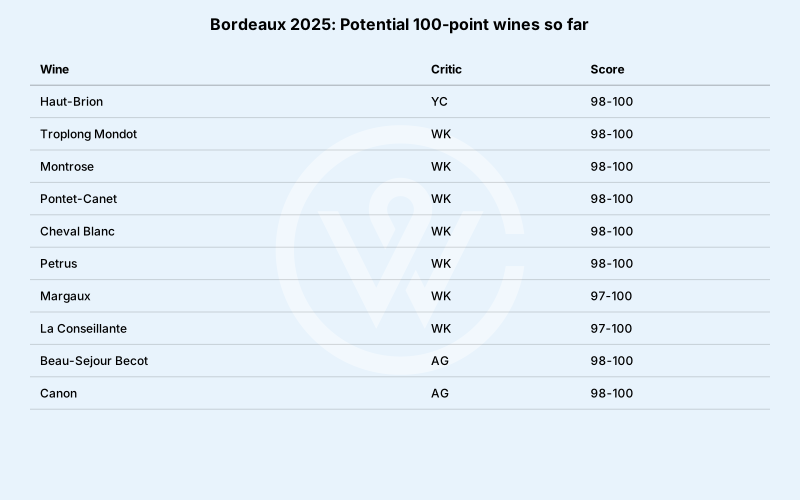
Bordeaux 2025: 100 point wines

*YC = Yohan Castaing (Wine Advocate), WK = William Kelley (Wine Advocate), AG = Antonio Galloni (Vinous)

It is important to note that En Primeur scores are typically expressed as ranges rather than fixed numbers. This reflects the fact that the wines are still in barrel and continue to evolve. Critics therefore allow for a margin of potential – both upward and downward – based on how the wines are expected to develop before bottling. A range such as 98-100 points signals not only exceptional quality, but also the realistic possibility of a perfect score at maturity.

Among the early reports, William Kelley is the most bullish, identifying seven wines with 100-point potential. Antonio Galloni follows with two, while Yohan Castaing has highlighted one wine in this top tier.

The list itself is telling. First Growths Chateau Haut-Brion and Chateau Margaux both feature, underlining the strength of the Left Bank at the very top level. They are joined by Right Bank icons Petrus and Cheval Blanc, alongside standout performers such as Troplong Mondot, Montrose and Pontet-Canet. 

Bordeaux 2025 market reality

While the wines themselves are widely praised, all critics have raised concerns about the market in their reports.

Kelley describes the En Primeur context as “structurally fragile,” questioning whether consumers still see value in buying futures. Galloni also states that Bordeaux “badly needs a win,” but warns that success depends entirely on pricing discipline. He argues that even modest increases could undermine demand, given the availability of competitively priced back vintages on the secondary market.

Hindle offers a more measured view, noting early signs of pricing restraint in the first releases and a stabilising fine wine market, but still emphasising the need for alignment between producers, merchants and consumers. 

The key to En Primeur success

Taken together, these early critic assessments position 2025 as a highly successful but nuanced Bordeaux vintage. At its best, it delivers a rare combination of concentration, freshness and terroir transparency – wines of both immediate appeal and long-term potential. However, it is not a uniform success. Variability is a defining feature, and careful selection will be essential. 

Perhaps most importantly, 2025 highlights a broader shift in Bordeaux. Through improved viticulture and winemaking, producers are increasingly able to navigate climatic extremes and make balanced wines in challenging conditions. 

But quality alone will not drive demand. The message from the critics is clear: the success of the campaign rests on the chateaux’s willingness to acknowledge the economic climate.

FAQ: Bordeaux 2025 En Primeur

Is Bordeaux 2025 a good vintage?
Yes – critics widely agree that 2025 is a high-quality vintage. Despite extreme heat and drought, the best wines show exceptional balance, freshness and moderate alcohol levels, leading some critics to describe it as a “miracle” or “paradoxical” vintage.

Why is Bordeaux 2025 described as a “miracle vintage”?
Because the wines defy expectations. In a hot, dry year that should have produced heavy, high-alcohol wines, 2025 instead delivered freshness, structure and restraint, thanks largely to cooler nights and crucial late-August rainfall.

What are the alcohol levels in Bordeaux 2025 wines?
Most wines fall between 12.5% and 13.5% ABV, significantly lower than recent hot vintages like 2022, where alcohol levels often exceeded 14.5%.

How important was rainfall in the 2025 vintage?
Late-August rainfall was critical. It rehydrated vines after prolonged drought, slowed sugar accumulation, and allowed full phenolic ripeness, ultimately shaping the balance and style of the wines.

Are Bordeaux 2025 yields low?
Yes. 2025 is the smallest Bordeaux harvest since 1991. 

Which Bordeaux regions performed best in 2025?
Margaux and Pauillac are widely seen as standout performers on the Left Bank, while Saint-Émilion excelled on the Right Bank, particularly on clay-limestone soils. 

Are there any 100-point Bordeaux 2025 wines yet?
Several wines have already received barrel score ranges of 98-100 points, indicating potential for a perfect score once bottled. Top names include Haut-Brion, Margaux, Petrus and Cheval Blanc.

What do En Primeur score ranges (e.g. 98–100) mean?
Barrel scores are given as ranges because the wines are still ageing. A 98-100 score suggests the wine is already exceptional but could improve further before bottling and reach a perfect score.

Will Bordeaux 2025 En Primeur be a successful campaign?
That remains uncertain. While wine quality is high, critics warn that success will depend on pricing. Buyers are increasingly cautious, and competition from back vintages may limit demand.

Should you buy Bordeaux 2025 En Primeur?
Critics emphasise that 2025 is not a uniform vintage. The best wines are outstanding, but variability is high, meaning careful selection will be essential rather than broad, “buy everything” strategies.

WineCap’s independent market analysis showcases the value of portfolio diversification and the stability offered by investing in wine. Speak to one of our wine investment experts and start building your portfolio. Schedule your free consultation today.
Categories
News

Bordeaux 2025 En Primeur: Quality meets a market at the crossroads

  • Bordeaux 2025 is a low-yield, heat-shaped vintage delivering concentration, freshness, and a clear shift toward precision viticulture.
  • Early reports point to a high-quality vintage with the potential to rival benchmark years like 2010 and 2016.
  • Set against a cooling market, the En Primeur campaign represents a critical opportunity to reset expectations around pricing and value.

From April 20th to 23rd, 2026, Bordeaux welcomed thousands of merchants, critics, and collectors for the En Primeur tastings of the 2025 vintage. Shaped by intense heat and reduced yields, the new vintage reflects a growing emphasis on precision viticulture – an approach that could come to define Bordeaux’s modern identity.

Yet the usual energy surrounding En Primeur unfolds against a more cautious economic backdrop. Bordeaux finds itself in a period of recalibration. As the first in-barrel scores emerge and the campaign gathers momentum, attention turns not only to what sets the 2025 vintage apart, but also to whether this release can offer real value.

A note on Bordeaux En Primeur

Few moments in the fine wine calendar carry the weight of En Primeur week. Orchestrated by the Union des Grands Crus de Bordeaux (UGCB), the event sees chateaux open their doors to professionals eager to sample wines just months after they were harvested.

Unlike the bottled wines, the En Primeur wines are still unfinished, first presented while ageing in oak. Tasting from barrel requires an expert palate to see through the raw tannins and vibrant acidity to glimpse the potential for greatness years down the line. It is a period of masterclasses, technical presentations, and intense market discussion that signals the pricing direction for the entire year ahead.

The 2025 represents a fascinating stylistic shift. Despite the heat, alcohol levels are reportedly low to moderate. The wines have pronounced aromatics, silky tannins and brisk acidity – hallmarks of great ageing potential. 

Bordeaux 2025: What we know so far

Bordeaux weather and crop reports indicate that 2025 was a year of climatic extremes, resulting in high quality but notably low yields. In fact, production statistics show that 2025 is the smallest crop since the frost-bitten 1991, with yields across many top appellations falling 15-30% below the five-year average.

A season of heat and superb ripening

The growing season was defined by a warm spring and a blistering summer. June 2025 was recorded as one of the hottest in French history, second only to the infamous 2003. This heat, combined with a dry August, led to:

  • Smaller berries: The lack of water and high heat restricted grape size, leading to intense concentration and thick skins.
  • Exceptional phenolic ripeness: While the yields are small, the quality of the tannins is reportedly superb.
  • The “rain of relief”: Just as drought stress became critical, rain in late August and early September refreshed the vines, preserving essential acidity and preventing alcohol levels from spiralling out of control.

Regional highlights

  • The Left Bank (Médoc, Pauillac, St-Julien): The deep-rooted old Cabernet Sauvignon vines thrived, producing structured, age-worthy wines reminiscent of 2022 but with a touch more freshness.
  • The Right Bank (St-Émilion, Pomerol): Clay and limestone soils held onto moisture better than gravel, allowing Merlot to reach lush ripeness without excessive heat stress.
  • Dry whites: Harvested early in mid-August, these show vibrant acidity and tropical aromatics.

The Bordeaux market: The recalibration phase

While the 2025 quality is expected to be high once critic scores are released, the market mood is best described as unsettled. For decades, Bordeaux held an unchallenged dominance in the fine wine market. Recent years have seen a cooling of demand, especially for young releases.

The challenges

  • Increased competition: High-quality rivals from Burgundy, Tuscany, Napa Valley, and even emerging regions have eaten into Bordeaux’s traditional market share.
  • Pricing fatigue: Consistent price hikes in recent En Primeur campaigns – often regardless of the broader economic climate – have tested the loyalty of even the most dedicated collectors.
  • Stock overhang: Many merchants are currently carrying significant inventories of recent great years (2018, 2019, 2020), which has created a bottleneck in the secondary market.

The silver lining

Despite these headwinds, the appetite for older, physical vintages remains robust. There is a clear divergence in the market: while younger vintages (2021-2023) struggle for traction, back vintages from the mid-2000s and 2010s continue to see steady price appreciation. This suggests that the brand of Bordeaux is as strong as ever. The issue lies specifically with release pricing.

Buying wine En Primeur: The question of value

For decades, the “golden rule” of Bordeaux was that En Primeur represented the lowest price point for a wine’s entire lifespan. Today, that assumption is being challenged by data.

Looking at prices at release versus now, several recent vintages can be found on the secondary market for the same price or even less. This has shifted the focus from buying everything to selective acquisition based on specific brand value. Tools like Wine Track, which show the historic performance of specific wine brands, can help investors understand long-term trajectories.

Why data matters

In the 2025 campaign, savvy buyers will be looking for relative value. If a 2025 release is priced higher than a physical, high-scoring 2019 or 2020 vintage currently sitting in a merchant’s warehouse, the incentive to buy En Primeur diminishes. However, because the 2025 yields are so low, scarcity may drive demand for the top-tier “blue chip” estates (the First Growths and their Right Bank equivalents).

The 2025 Bordeaux En Primeur verdict

As critics release their first scores over the coming weeks, all eyes will be on the “price-to-quality ratio.” The 2025 vintage has all the hallmarks of a collector’s dream: scarcity, concentration, and classical structure. For the Bordeaux trade, the 2025 En Primeur is an opportunity for a reset. With early reports pointing towards a vintage that could rival the greats of 2010 or 2016, the quality is likely there.

If the châteaux can marry this quality with a pricing strategy that respects the current market reality, 2025 could mark the beginning of a vibrant new chapter for the world’s most famous wine region.

Bordeaux comment: UGCB President, François-Xavier Maroteaux speaks to WineCap

WineCap: The 2025 vintage promises high quality, yet it arrives as the secondary market has just started to recover from a five-year low, and growing geopolitical tensions discourage speculation and might isolate certain market segments. How do you intend to position the 2025 launch so it doesn’t just survive the current market, but actually revitalises the ‘Bordeaux Brand’ globally?

François-Xavier Maroteaux: The 2025 vintage is a genuine opportunity – but only if we use it wisely. First, pricing must be honest: release prices that ignore five years of secondary market correction damage trust more than they protect margins. A well-priced great vintage is far more powerful than an overpriced one. Second, the narrative must move beyond scores – 2025 has a compelling story of terroir and style that needs to reach consumers directly, not just through trade press. Third, our négociants are brand ambassadors, not just a distribution channel: the properties that genuinely invest in informing and equipping their partners will see it reflected in every market. Finally, the retreat of speculative demand is not a threat – it’s a rebalancing. Bordeaux built its reputation on wine people actually wanted to drink. Refocusing on that is not a concession to difficult times. It’s a return to what made the region great. 

WC: Where do you see the biggest interest in buying Bordeaux at release in the coming years?

FXM: The interest in buying Bordeaux at release remains genuinely global. The best proof of this is the En Primeur week itself: every year, wine professionals from more than 80 nationalities make the journey to taste and buy. That breadth of engagement, even in difficult market conditions, is a strong signal that the foundation is there. Beyond geography, there is another compelling reason to buy at release that we shouldn’t underestimate (and we should be communicating much more actively!): formats. En Primeur remains the best – often the only – window to secure large formats. Magnums, double magnums, imperials are allocated at release and rarely available later at any price. The opportunity is to refocus En Primeur on what it does uniquely well: access, formats, and relationship. That’s a proposition that holds regardless of geopolitics.

WC: Is the En Primeur system still going strong, in your personal view? Do you believe it still offers a genuine win-win? Has it become a luxury-only club for the top 50 estates?

FXM: Yes, I do believe the En Primeur system still works – but I think we need to be honest about what it has become. It works very well for a relatively narrow group of estates where brand strength and secondary market liquidity reinforce each other. For the broader Bordeaux pyramid, it is more complicated. That said, I don’t think the answer is to abandon the system. The answer is to make the win-win genuine again. That means pricing with discipline, communicating with transparency, and making sure négociants and merchants actually make money when they support a release. When that alignment exists, En Primeur is a unique and powerful tool. When it doesn’t, it becomes – as you say – a luxury club for the top names. 

FAQ: Everything you need to know about Bordeaux En Primeur

What does “En Primeur” mean?

En Primeur is a method of purchasing wine while it is still maturing in the barrel. This allows collectors and investors to secure highly sought-after wines before bottling and general market release. This typically happens two years after harvest.

When is the Bordeaux 2025 En Primeur week?

The official tasting week for the 2025 vintage takes place from April 20 to April 23, 2026. During this time, international critics and trade professionals sample the wine from barrel to determine early scores and quality ratings.

Is the 2025 Bordeaux vintage good?

Bordeaux 2025 is a high-quality vintage with intense concentration and bold fruit profiles.Yields are lower than average, which often results in wines with significant ageing potential and structural density.

Why are yields low for the 2025 vintage?

The 2025 growing season saw record-breaking heat and extended dry periods. While this led to exceptional grape ripeness and thick skins (tannin), it resulted in smaller berries and less juice. These lower yields often drive up demand due to the limited number of cases available globally.

Is buying En Primeur a good investment?

Buying En Primeur can be a strategic investment, particularly for top-tier estates (First Growths and “Super Seconds”). However, it is essential to use data-driven insights. While release prices were historically the lowest point of entry, current market fluctuations mean buyers should compare release prices against available physical back-vintages to ensure they are getting true value, as older vintages can often present better buying opportunities than En Primeur.

When is the delivery of the 2025 Bordeaux wines?

In the spring or summer of 2028, following their mandatory ageing period in the châteaux cellars.

What are the “big three” factors to watch in the 2025 campaign?

  1. Critic scores: Initial ratings from major publications will dictate immediate global demand.
  2. Release pricing: How châteaux price their wine in relation to the secondary market.
  3. Volume: With lower yields reported, the scarcity of specific labels will likely be a driver of demand.

WineCap’s independent market analysis showcases the value of portfolio diversification and the stability offered by investing in wine. Speak to one of our wine investment experts and start building your portfolio. Schedule your free consultation today.