Categories
Report

The growing market for alternative investments

  • The market for alternative investments has seen robust growth owing to burgeoning demand for non-traditional assets.
  • Alternative assets offer a hedge against inflation, and often provide investors with higher returns.
  • Some of the main challenges when it comes to alternative investments are accurate valuations and liquidity.

Alternative investments, those that fall outside traditional financial assets like stocks, bonds, and cash, have garnered immense popularity among affluent investors. From classic cars and luxury handbags to fine art, these assets represent both a passion and a store of value. According to the results of our global wealth management survey, fine wine emerged as the most in-demand passion asset. This article explores the burgeoning market for alternative investments, with a special emphasis on fine wine, contrasting and comparing their attributes, risks, and potential.

Alternative investment landscape

Alternative investments, often tangible assets, are known for their rarity, craftsmanship, and cultural relevance. Watches, luxury bags, art, whisky, and fine wine fall under this category, offering diversification for investment portfolios.

The market for alternative investments has witnessed robust growth owing to rising global wealth and a burgeoning demand for non-traditional assets. According to Richard Bacon, Head of Business Development at Shard Capital, ‘in the last two years there has been a tangible increase in how accessible and democratized these assets have become’.
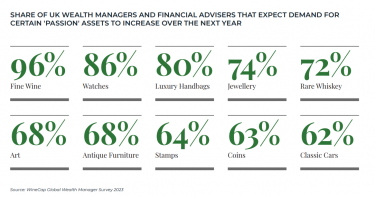
As traditional markets have faced increased volatility, clients have turned to passion assets to safeguard their wealth. Economic uncertainty and inflation have fuelled interest, as these assets tend to retain value over time and provide investors with higher returns outside of their traditional portfolios.

This can be noted in the performance of the luxury goods market, which posted a record year in 2022, reaching a market value of €345 billion, despite geopolitical tensions and macroeconomic uncertainty. This momentum persisted into the first quarter of 2023, achieving 10% growth over 2022, according to Bain & Company.

The luxury group Louis Vuitton Moët Hennessy (LVMH), which owns Champagne houses Moët & Chandon, Dom Pérignon, Veuve Clicquot, Krug, Ruinart and Mercier, also had a record year in 2022, and reported a 15% growth in the first half of 2023.

Alternative assets compared

While alternative investments have enjoyed growing popularity, each asset class operates by its own market dynamics. There are some notable differences and similarities, for instance, between fine wine, art and luxury goods. Below we outline some of the differences.

Investment nature:

  • Fine wine: A consumable and perishable asset produced in multiple quantities (vintage-dependent) with value appreciation due to age, supply-demand and quality.
  • Art: A unique, non-perishable asset, valuing subjectivity and aesthetic appeal.
  • Luxury goods: Tangible assets like watches and bags, offering functional utility and value based on brand prestige and condition.

Value determinants:

  • Fine wine: Producer reputation, age, rarity, condition, critic scores.
  • Art: Artist reputation, uniqueness, historical significance, and condition.
  • Luxury goods: Brand reputation, craftsmanship, condition, and rarity.

Risks:

  • Fine wine: Market fluctuations, storage conditions, and provenance verification.
  • Art: Market trends, authenticity, and condition degradation.
  • Luxury goods: Counterfeiting, fashion trends, and wear and tear.

However, all these assets share common grounds, including tangibility, scarcity and uniqueness driving value, a strong connection to culture and lifestyle, and being a hedge against inflation and economic uncertainty.

Market challenges and opportunities

Some of the main challenges when it comes to alternative investments are valuations and liquidity. Some assets may need longer time to trade compared to traditional investments. Values may fluctuate based on trends, and condition. It is often harder to value a single piece of art accurately, compared to fine wine, which is often made in significant quantities and cases regularly trade internationally.

The main opportunities in the alternative investment market are diversification, their potential for appreciation and pleasure and fulfilment beyond the monetary benefits. Alternative assets offer a balanced and diversified portfolio, mitigating risks from traditional markets. Meanwhile, rarity and cultural significance can result in substantial value appreciation. Beyond financial rewards, these investments offer emotional and aesthetic satisfaction. Navigating the market for alternative investments requires an understanding of the underlying dynamics, diligent verification, and a discerning eye for value.

To find out more about fine wine as an alternative investment, download our special report below.


Categories
Report

En Primeur Report – Bordeaux 2022: Unfulfilled Potential

Bordeaux 2022 is a great vintage that, despite its high quality, failed to reverse the waning sentiment for En Primeur. The excitement of the new was counteracted by the value on offer.

Although there was a significant increase in the number of visitors at the En Primeur tastings this spring, the campaign did not succeed in capitalising on this positive momentum.

Our latest report, Bordeaux 2022: Unfulfilled Potential, delves into the reasons why the campaign didn’t quite deliver on hopes and the event’s place within the industry in coming years.

Key findings:

  • Bordeaux 2022 is a high-quality vintage that has surpassed expectations, given the challenges of the growing season.
  • Neal Martin’s average 2022 in-barrel score was below 2020, 2019, and 2016, with most critics noting that it is a vintage to be selective.
  • The En Primeur tastings saw a significant increase in the number of visitors this spring, indicating continued interest in the region.
  • Some wines managed to offer value and were met with high demand upon release, including Château Cheval Blanc, Château Beychevelle, and Château Lafleur.
  • Average price increases between 15% and 25%, and as high as 55%, did not resonate well with the soft Bordeaux market.
  • Bordeaux 2022 vintage failed to reverse the declining sentiment for En Primeur due to high release prices in the context of older vintages offering better value.
  • Producers should evaluate the market dynamics to navigate the evolving fine wine market, and the role of En Primeur within it.


Categories
Report

Bordeaux 2021 | Vintage Report

Our Bordeaux 2021 En Primeur Report is now available to download. Read our full analysis of the new 2021 vintage which is considered to be an approachable, good quality one that differs in style to the wines from the three previous years.

2021 was the coolest and second wettest vintage in the past decade with frosts, rain and mildew. This meant yields were down significantly in some appellations. Meticulous sorting in both the vineyard and the winery enabled producers to select only the best fruit and this created the finest wines possible. 

Critic reports suggested that quality was better than expected and there is a selection of outstanding wines on offer that will bear comparison with the very best and various châteaux have produced some of their highest ever rated wines.

Prospective buyers have been expectantly waiting for the 2021 vintage’s scores and prices. Release prices were expected to be lower than those of the top rated trilogy of 2018, 2019 and 2020 as this is a different style of vintage from a challenging year. However, there were economic reasons that could justify price rises such as inflation, wine shortages and the US dollar’s appreciation against the Euro.

In general, wines have been released at the same price as 2020 – just 1% lower on average. However, some châteaux released at up to 15% discounts, while others at up to a 15% premium with lower scores than last year.

Discover our analysis and the fine wines we recommend fully in this report. While it was a mixed vintage, there are some excellent wines on offer at attractive prices.

Categories
Report

Bordeaux 2020 | Vintage Report

Our Bordeaux En Primeur 2020 Report is available to download. Discover our wine investment experts thoughts on 2020, a vintage that has widely been heralded by prominent wine critics as excellent and the third in a row of top Bordeaux vintages. Find out which Bordeaux sub-regions and producers they feel delivered top class wines that are worth seeking out. 

As with the two vintages that preceded it, conditions in 2020 favoured producers with multiple plots of different soil types due to the abundance of both sunshine and rainfall. Right Bank clay soils were better able to retain water and thus sustain the vines. 

Although Bordeaux En Primeur 2020 is undoubtedly a fantastic vintage, investors are advised to be selective and search for relative value rather than being led solely by critics’ scores. 

Through careful study and data analysis, WineCap provides insight into the wines that we feel present both value and opportunity for capital growth. With our bespoke, industry-leading graph and analysis tools we have concluded that the wines selected in this report are attractive prospects and that any carefully built investment portfolio should consider 2020 Bordeaux.

Click the button below to download our Bordeaux En Primeur Report. Do not hesitate to get in touch and speak to one of our wine investment advisors to reserve your allocations.

Categories
Report Uncategorized

Bordeaux 2019 | Vintage Report

Our Bordeaux En Primeur 2019 Report is available to download. Find out what our wine investment experts thought of 2019, a wonderful vintage that saw a surprisingly successful En Primeur campaign during the global uncertainty and financial stress of the time. Discover which Bordeaux sub-regions and producers we feel delivered top class wines worth paying attention to. 

In 2019, cool weather during flowering led to reduced quantities and conditions favoured producers with multiple plots of different soil types that could handle both the sunshine and rainfall. Right Bank clay soils were better able to retain water and thus sustain the vines.

Though 2019 is undoubtedly a fantastic vintage, investors are advised to be selective and search for relative value rather than being led solely by critics’ scores. 2019 was quite different in terms of how tastings were conducted. No longer could massive trade tastings be held for the media and critics. Therefore, the tasting notes from that year may be the most careful and well-thought out of any, as the critics were not being whisked from one mass tasting to another and could taste samples at their leisure at home. Without the pressure of being in the company of the winemaker, or under the influence of peers, these may be some of the most honest ratings ever. 

Through careful study and data analysis, WineCap provides insight into the wines that we feel present both value and opportunity for capital growth. With our bespoke, industry-leading graph and analysis tools we have concluded that the wines selected in this report are attractive prospects and that any carefully built investment portfolio should consider 2019 Bordeaux.

Click the button below to download our Bordeaux En Primeur Report. Do not hesitate to get in touch and speak to one of our wine investment advisors to discuss buying wines En Primeur.

Categories
Report

United States | Regional Report

1976 was the turning point for California and US wine in general. ‘The Judgement of Paris’ blind tasting on May 24th proved that France had a serious contender when top Californian Bordeaux blends were tasted against Bordeaux classed growths, and Californian Chardonnays against white Burgundy. To the surprise of many, California led on both fronts.

This was the first step that set the region in motion. In the 1990s, the first Californian ‘cult wines’ emerged – big brands that attracted collector followings. Producers such as Inglenook, Stag’s Leap, and Robert Mondavi were the pioneers, but it was Screaming Eagle that established the formula for success that many followed: tiny volumes, word-of-mouth hype, and soaring prices. Robert Parker’s appraisal and perfect scores further bolstered their image.

The global market for US wines, dominated by California but also featuring wines from Washington and Oregon, has exploded in recent years. Its share of secondary market trade has risen from 0.1% in 2010 to around 7% this year, and an increasing number of previously overlooked wineries are now showing investment-worthy returns.

Our USA Report delves into the development of its investment market, historic performance, recent expansion and key players.

Discover more about:

  • History of the US wine industry
  • International and domestic trade
  • California’s most significant AVAs
  • Napa Valley’s investment-worthy wines

Do not hesitate to get in touch and speak to one of our wine investment advisors for further information and to reserve your allocations.

Categories
Report

United States Regional Report

Our United States Regional Report explores the development of an investment market, the emergence of cult wines and other key players.

The modern story of US fine wine begins in 1976, with the now-legendary Judgement of Paris. In a blind tasting held on 24 May, leading Californian Bordeaux-style blends were pitted against classified growth Bordeaux, and Californian Chardonnays against white Burgundy. To the surprise of many – and the disbelief of some – California emerged victorious in both categories.

This moment marked a turning point for American wine. What followed was not an overnight transformation, but a steady ascent. In the 1990s, the first Californian “cult wines” began to emerge – highly sought-after labels produced in tiny quantities, driven by word-of-mouth demand and critical acclaim. Screaming Eagle, in particular, established a model that many later producers would follow, supported by Robert Parker’s perfect scores and a growing global collector base.

Today, the United States – dominated by California, but increasingly supported by Washington and Oregon – has become a meaningful force in the global fine wine investment market.

WineCap’s USA Regional Report explores how this market has developed, how performance has evolved, and where opportunities are emerging across the country.

Key findings from the United States Regional Report

The United States has become a key fine wine investment region

In 2010, US wines accounted for just 0.1% of global secondary market trade. Today, that figure stands at around 7%, making the United States the largest non-European fine wine investment region by value.

This growth has been driven by strong domestic demand, expanding international distribution, and a sustained run of high-quality vintages over the past decade.

California dominates – but is no longer alone

California accounts for approximately 99% of US secondary market trade, with demand concentrated around a core group of powerful brands including Screaming Eagle, Opus One, Harlan Estate, Dominus, Promontory, Scarecrow, and Ridge Monte Bello.

However, investment-worthy wines from Washington and Oregon are increasingly attracting attention, offering relative value and diversification within the US allocation.

Strong long-term performance with recent buying opportunities

Over the last 15 years, Californian fine wines have outperformed both the Liv-ex 100 and Liv-ex 1000 indices, delivering steady long-term growth. Prices peaked in September 2022, after which the Liv-ex California 50 index declined by approximately 26% on average.

This correction has created attractive entry points, particularly for investors seeking exposure to top US brands at more favourable levels.

A brand-driven market with increasing terroir focus

Historically, Californian fine wine has been driven by brand power. While this remains true, the market has increasingly shifted towards a deeper understanding of terroir, AVAs, and vineyard specificity. Napa Valley remains the epicentre, with Oakville, Stags Leap District, and Rutherford firmly in the investment spotlight.

This evolution mirrors the maturity seen in Old World regions, strengthening California’s long-term investment credentials.

Expanding distribution is improving liquidity

Access has historically been a challenge in the US market, with private mailing lists and long waiting times limiting availability. More recently, leading estates such as Opus One, Inglenook, and Vérité have begun releasing wines via La Place de Bordeaux, improving transparency, access, and international liquidity.

This shift has been welcomed by the market and is expected to support further growth in secondary-market activity.

Explore the full report

WineCap’s United States Regional Report provides a comprehensive analysis of the US fine wine market, including its historic development, price performance, key AVAs, and the most investment-worthy producers, with a particular focus on Napa Valley.

Download the full United States Regional Report to explore the data, insights, and opportunities shaping one of the fastest-growing fine wine investment regions in the world.

Categories
Report

Champagne | Regional Report

Champagne needs little introduction, even to those not typically involved with fine wine. It is everywhere – from restaurants and clubs to airport lounges and private cellars. Fit for every occasion, Champagne has developed an investment market in part thanks to its strong brand recognition. More approachable than other fine wines, the Champagne market has become one of the most liquid – an added benefit for investors. In fact, the region dominated the top-traded wines on the secondary market in 2023.

A decade ago, the region made up less than 3% of the fine wine investment market. Today, its trade share comfortably sits between 13% and 15%, making it a close contender to Burgundy (the second-     most-popular region after Bordeaux).

Pricing dynamics have also evolved during this time. From a relatively modest price performer, and one of the most affordable entry points into the wine investment market, Champagne has risen to new heights in recent years. As the ultimate fine wine ‘luxury’ asset, Champagne has shown remarkable resilience to economic crisis and relatively low volatility.

Our Champagne Report delves into the fundamentals of this fascinating region, including the development of its investment market, historic performance, recent expansion and key players.

Discover more about:

  • Champagne’s investment performance
  • Supply and demand dynamics
  • Key Champagne houses and brands to watch

Do not hesitate to get in touch and speak to one of our wine investment advisors for further information and to reserve your allocations.