Categories
Learn

Understanding the fine wine secondary market: Investing, liquidity and valuation

  • While the primary market is the initial sale from the estate, the secondary market is the global trading ecosystem where wine is treated as a financial asset.
  • Secondary market prices are dictated by supply/demand – as bottles are consumed, the rarity of the remaining vintage drives exponential value growth.
  • Secondary market success relies heavily on professional storage and documented history to ensure investment-grade quality.

For centuries, fine wine has been seen as a treasured collectible; over the last twenty years, it has started to be recognised as a sophisticated alternative asset class too. To understand how wine functions as an investment, one must grasp the mechanics of its lifecycle – specifically the transition from the primary market to the secondary market.

This guide provides an in-depth exploration of the fine wine ecosystem, offering clarity for collectors, investors, and enthusiasts looking to navigate the complexities of global wine trading.

What is the primary market for fine wine?

Before diving into the secondary market, we must define its origin. The primary market refers to the first time a bottle of wine is sold after production. In this stage, the transaction occurs directly between the producer (the winery or estate) and the first buyer who could be an individual or a business (i.e. wine merchant).

Key characteristics of the primary market:

  • Direct sourcing: The wine moves from the cellar of the estate to a distributor, importer, or La Place de Bordeaux courtier.
  • Fixed pricing: Prices are typically set by the estate based on production costs, brand equity, and vintage quality.
  • En Primeur (Wine Futures): A hallmark of the primary market, particularly in Bordeaux. Investors purchase wine while it is still aging in barrels, often 12-18 months before bottling. This offers the lowest possible entry price but carries the risk of the wine evolving differently than expected.
  • Allocation systems: For “cult” wines (like Domaine de la Romanée-Conti or Screaming Eagle), primary market access is restricted to exclusive mailing lists or long-standing restaurant partners.

What is the secondary market for fine wine?

The secondary market encompasses all subsequent transactions of a wine after its initial sale in the primary market. Once a bottle leaves the original distribution chain and enters the hands of a private collector, an investment firm, or a specialised retailer, any future sale happens on the secondary market.

Unlike the primary market, where supply is controlled by the winery, the secondary market is driven by supply and demand. As bottles are consumed over time, the remaining supply of a specific vintage diminishes, often driving prices upward – a concept known as “inverse supply elasticity.”

Why the secondary market matters

The secondary market is where “wine” becomes “liquid gold.” It provides:

  1. Liquidity: A platform for collectors to exit their positions and convert wine into cash.
  2. Price discovery: Real-time valuation based on what global buyers are actually willing to pay.
  3. Vintage depth: Access to aged, “library” wines that are no longer available from the producer.

The core components of the secondary market

1. Wine exchanges

The London International Vintners Exchange (Liv-ex) is the “stock exchange” for wine. It provides a standardised platform for merchants to trade, offering price transparency and indices (like the Liv-ex Bordeaux 500) that track market health.

2. Auction houses

Global powerhouses like Sotheby’s, Christie’s, and Zachys dominate the high-end secondary market. Auctions are the primary venue for rare collections and “unicorn” bottles. Online auction platforms have recently democratised this space, allowing smaller collectors to participate.

3. Specialised brokers and investment platforms

Modern fintech platforms allow investors to buy managed portfolios. These entities operate almost entirely within the secondary market, sourcing back vintages with proven provenance.

4. Peer-to-peer and retail re-sales

Specialty retailers often buy back well-cellared collections from private individuals to resell them to other collectors.

Key drivers of secondary market value

What makes a bottle appreciate in the secondary market? It is not just the name on the label.

Provenance and storage

In the secondary market, provenance is everything. A bottle of 1982 Château Lafite Rothschild is worthless if it was stored in a warm kitchen. Buyers look for “ex-cellar” history or professional storage records (bonded warehouses) to ensure the wine has been kept at a constant 12-14°C (55°F) with optimal humidity.

Critic scores

Ratings from “palate-makers” like Robert Parker’s Wine Advocate, Antonio Galloni (Vinous), or Jancis Robinson act as market catalysts. A 100-point score can cause an overnight price surge on the secondary market.

Scarcity and rarity

The secondary market thrives on scarcity. If a producer only makes 500 cases of a particular cuvée, and 200 are consumed in the first five years, the remaining 300 bottles become significantly more valuable to collectors seeking a complete vertical.

Bonded warehouses and “In-Bond” trading

In the secondary market, how you store your wine is as important as the wine itself. Professional investors almost exclusively trade wine “In-Bond” (IB).

In-Bond (IB) vs. Duty Paid (DP)

  • In-Bond (IB): The wine is stored in a government-approved bonded warehouse. It has not yet attracted VAT or Excise Duty. If you sell the wine while it is still “in bond,” you never have to pay these taxes. This increases the profit margin for investors and ensures the wine has never left a temperature-controlled environment.
  • Duty Paid (DP): Taxes have been paid, and the wine has likely been delivered to a private home. In the secondary market, Duty Paid wine often sells at a discount because its storage history is harder to verify.

Expert tip: For maximum resale value, always keep your investment-grade wine “under bond” in a recognized facility like London City Bond.

Secondary fine wine market global trade hubs 

While London remains the historical heart of the wine trade, the secondary market has shifted toward a tri-polar model:

  1. London: The center for technical trading and storage.
  2. Hong Kong: The tax-free gateway to the thirsty Asian market.
  3. Singapore: A growing hub for Southeast Asian high-net-worth individuals.

The “laggard” phenomenon

Fine wine is often described as a “laggard” asset. It does not react instantly to stock market crashes. Usually, there is a 6-to-12-month delay before wine prices reflect broader macroeconomic shifts. This makes it a powerful hedge against inflation and sudden equity volatility.

Secondary market trends: Beyond Bordeaux

Historically, the secondary market was 95% Bordeaux. Today, the landscape is much more diverse:

  • Burgundy: Now represents a massive share of market value due to extreme scarcity and global prestige.
  • Italy: The rise of “Super Tuscans” (Sassicaia, Tignanello) and Barolo has created a robust secondary niche.
  • Champagne: Recently one of the top-performing sectors, as collectors realize the aging potential of prestige cuvées.
  • The New World: Cult Californians (Harlan Estate) and Australian icons (Penfolds Grange) are now staples of global trading.

Risks in the secondary market

Investing in the secondary market is not without peril:

  • Counterfeits: High prices attract fraud. Verification of labels, corks, and glass is essential.
  • Market volatility: Like any asset, wine prices can fluctuate based on global economic conditions.
  • Illiquidity: While more liquid than it used to be, selling a wine collection still typically takes longer than selling a stock.

Primary vs. Secondary Market Comparison
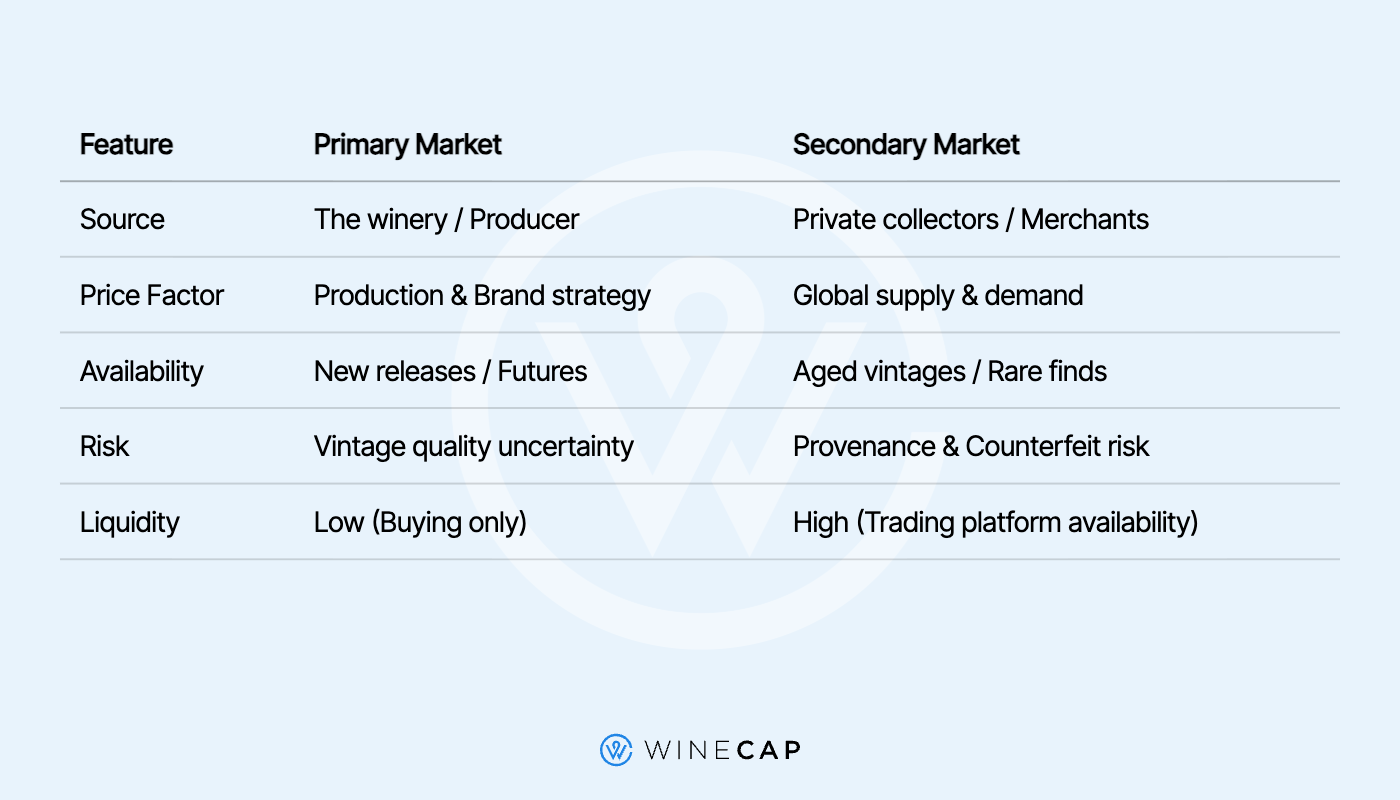
Primary vs Secondary Market Comparison

Frequently asked questions (FAQ)

Is fine wine a good investment?

Fine wine has historically shown low correlation with traditional stock markets, making it an excellent diversifier. It often delivers steady long-term capital appreciation, though it requires patience and proper storage.

What is a “bonded warehouse”?

A bonded warehouse is a tax-secured facility where wine is stored without the owner having to pay Duty or VAT. This is the preferred storage method for the secondary market, as it guarantees professional conditions and makes the wine easier to resell.

How do I check the secondary market price of my wine?

Platforms like Wine-Searcher provide market data. Specialised wine investment companies can provide valuations. Auction hammer prices are also a reliable indicator of current value.

Can individuals sell wine on the secondary market?

Yes, but it is regulated. Most individuals sell through auction houses or brokers who take a commission. Selling directly to another individual often requires specific licensing depending on your jurisdiction.

What is the best way to enter the secondary market?

Most investors start by using a managed platform or a specialised broker. This ensures you are buying wine with perfect provenance and professional storage already in place.

Why do prices fluctuate so much?

Secondary market prices react to critic scores, weather events affecting future crops, and shifts in global currency (the USD/GBP exchange rate is particularly influential).

Can I sell a single bottle?

While possible through online auctions, the secondary market is most liquid for full original wooden cases (OWC). Single bottles often face steeper commissions and lower demand.

WineCap’s independent market analysis showcases the value of portfolio diversification and the stability offered by investing in wine. Speak to one of our wine investment experts and start building your portfolio. Schedule your free consultation today.
Categories
Learn

Bubbles & bull markets: Investing in Vintage Champagne

  • Unlike Non-Vintage (NV) bottles, Vintage Champagne is produced only 3-4 times per decade, creating an inherent supply cap that drives long-term price appreciation.
  • Labels such as Dom Pérignon and Louis Roederer (Cristal) act as market benchmarks, offering high liquidity and global brand recognition.
  • Many investors prioritise Champagne magnums due to slower ageing process and higher premiums. 

For the uninitiated, Champagne is the liquid synonym for celebration. However, for the serious collector, it represents one of the most resilient and rewarding asset classes in the alternative investment world. Moving beyond “party bubbles” requires a shift in perspective – from the high-volume non-vintage (NV) bottles found on supermarket shelves to the rare prestige cuvées that dominate the secondary market.

Understanding the liquid gold: Is sparkling wine Champagne?

Before diving into the financials, every novice must master the terminology. A common entry-point question is: is sparkling wine Champagne? The answer is a matter of strict geography and law. Only wine produced in the Champagne region of France, under the stringent rules of the Appellation d’Origine Contrôlée (AOC), can carry the name. While Italian sparkling wine or Spanish sparkling wine like Cava offers excellent drinking, they rarely command the investment-grade premiums of a Grand Cru Champagne.

The scarcity engine: Vintage vs Non-Vintage

The primary driver of value in this market is the distinction between NV and vintage champagne.

  • Non-Vintage (NV): These are the house styles (e.g., standard Moet and Chandon ) blended from multiple years to ensure a consistent brand profile.
  • Vintage Champagne: Produced only in exceptional years, these bottles are a snapshot of a single harvest. Because they are produced in limited quantities and only 3-4 times a decade, they possess the inherent scarcity required for price appreciation.

The titans of the market: Dom Pérignon and Louis Roederer

If you are looking for the “Blue Chips” of the bubbly world, you must look at the prestige cuvées.

  • Dom Pérignon: As a powerhouse brand , the Dom Perignon price is a frequent benchmark for market health. Investors closely watch the Dom Perignon Champagne price for new releases, often holding them for a decade as the supply dwindles.
  • Louis Roederer: Specifically their “Cristal” label, Louis Roederer Champagne is a staple of elite portfolios.
  • Cult favourites: For those looking beyond the famous houses, labels like Jacques Selosse (often referred to simply as Selosse Champagne ) represent the “grower” movement, where limited production meets astronomical demand in the secondary market.

Size and longevity: Why magnums matter

In the world of investment, Champagne bottle sizes are not just about the volume of liquid. The magnum Champagne (1.5L) is the preferred format for investors. Because a magnum has a lower ratio of air-to-liquid than a standard bottle, the wine ages more slowly and gracefully. Rare large formats, such as the Jeroboam bottle or the massive Nebuchadnezzar, often fetch significantly higher premiums at auction due to their sheer rarity.

Storage and spoilage considerations

A common concern for novices is: “Does Champagne go off?” or “Can champagne go bad?” Unlike spirits, wine is a living product. How long does Champagne last? While a standard NV bottle might only stay fresh for a few years, a vintage Champagne can evolve and improve for 20 to 30 years if stored correctly.

To protect the costly Champagne in your portfolio, professional storage is non-negotiable. Light, vibration, and temperature fluctuations are the enemies of value. An investor must know how to store wine in a temperature-controlled environment to ensure that when it comes time to exit the investment, the provenance is impeccable.

The secondary market: Why the boom?

The most expensive champagne is no longer just for drinking; it is for trading. With the rise of global wealth and a fixed supply of the best vintages, the secondary market for labels like Krug, Salon, and Taittinger (check the Taittinger Champagne price for recent spikes) has seen consistent growth. Champagne often acts as a Veblen good – a luxury item where demand increases as the price rises, further fueling the bull market for the world’s finest bubbles.

Grand Cru and the terroir premium

To truly understand why some bottles command five-figure sums while others languish, the novice investor must look at the soil. Champagne is divided into a strict hierarchy of villages. At the pinnacle are the 17 Grand Cru villages, such as Ambonnay, Bouzy, and Le Mesnil-sur-Oger. These sites represent the absolute best terroir in the region, where the chalky soils and microclimates produce grapes with the highest concentration and acidity – the two vital components for long-term aging.

Below the Grand Crus sit the 44 Premier Cru villages. While still exceptional, the market price for a Grand Cru bottle often grows at a significantly higher rate than its Premier Cru counterparts. For the investor, “buying the label” is often secondary to “buying the land.” When you see a label from a producer like Jacques Selosse, you aren’t just paying for the name; you are paying for access to some of the most coveted Grand Cru plots in the Côte des Blancs. Understanding this hierarchy allows an investor to spot “undervalued” producers who may own vines in the same prestigious villages as the famous houses but have not yet reached their peak market valuation.

How long to hold your Champagne?

One of the most frequent questions from novices is how long to hold their Champagne. To answer this with an investment lens, we must discuss “lees aging.” Unlike most red wines, which age primarily in the bottle, Champagne derives its complexity from sitting on its lees (dead yeast cells) during the second fermentation.

A prestige cuvée like Dom Pérignon or Krug may spend seven to fifteen years in the cellar before it is even released to the public. This “pre-aging” by the house is why the Dom Perignon price is so high upon release; the producer has already absorbed the storage costs for a decade. However, the real “Alpha” for investors happens after release. As bottles are consumed globally, the remaining supply of a specific vintage becomes infinitesimally small. This is the “Scarcity Curve.” A vintage Champagne that was released at £150 may double in value over the next five years simply because 90% of the vintage has been drunk, leaving collectors to scramble for the remaining 10%.

Champagne as a defensive asset

In times of economic uncertainty, wine often acts as a “safe haven” asset. Unlike stocks, which can go to zero, a bottle of Louis Roederer Cristal is a tangible asset with intrinsic value. Historically, the fine wine market – and Champagne in particular – has shown a lower correlation to traditional equity markets.

When inflation rises, luxury goods often see a price surge. Champagne is a classic Veblen good in this regard; as it becomes more expensive, its desirability among the ultra-wealthy increases, creating a self-fulfilling prophecy of price growth. Furthermore, the secondary market for Champagne is more liquid than for many other rare wines. Because brand recognition is so high – everyone knows the names Moet, Bollinger, and Taittinger – it is much easier to find a buyer for a case of Champagne than for an obscure Burgundy.

Navigating the risks

No guide would be complete without a word of caution. As the most expensive Champagne prices continue to climb, the risk of counterfeits rises. Investors must ensure they receive “Original Wooden Cases” (OWC) whenever possible and verify the provenance. A bottle that has been kept at room temperature for five years is functionally worthless as an investment, even if the label is pristine. This is why professional, temperature-controlled storage is the “hidden cost” that ensures your liquid assets don’t turn into expensive vinegar.

FAQ

Is sparkling wine the same as Champagne?

No. While all Champagne is sparkling wine, not all sparkling wine is Champagne. Legally, only wine produced in the Champagne region of France under strict AOC regulations can use the name. 

Does Champagne go off or go bad?

Yes, Champagne is a living product and can spoil if not stored correctly. While a standard Non-Vintage bottle is meant for immediate consumption, a Vintage Champagne can age and improve for 20 to 30 years. However, exposure to heat, light, or vibration can turn a prestige cuvée into “expensive vinegar” and render the investment worthless.

Why is the “Dom Pérignon price” used as a market benchmark?

Dom Pérignon is considered a “Blue Chip” asset due to its massive global brand recognition and consistent quality. Because it is widely traded, its price fluctuations often signal the overall health and sentiment of the Champagne secondary market.

How long should I hold my Champagne investment?

Most experts recommend a holding period of 5 to 10 years after the initial release. This allows the “Scarcity Curve” to take effect; as the majority of the vintage is consumed globally, the remaining bottles become rarer and more valuable to collectors.

What is the best way to store investment-grade Champagne?

Professional, temperature-controlled storage is non-negotiable. To maintain its value and ensure “impeccable provenance” for future buyers, Champagne should be kept at a constant temperature (around 10-12°C) in a dark, vibration-free environment, ideally in its Original Wooden Case (OWC).

Categories
Learn

Which types of wine are considered investment-grade?

  • Investment-grade wine is characterised by exceptional quality, rarity, and a proven track record of price appreciation.
  • Most investment-grade wines come from regions like Bordeaux, Burgundy, Champagne, Tuscany, Barolo, Napa Valley and the Rhône.
  • Successful wine investing requires a long-term perspective, professional storage and a keen understanding of market trends. 

Understanding investment-grade wine

Investing in wine is not just about acquiring expensive bottles; it’s about selecting those that have the potential to appreciate in value over time. Investment-grade wines are those that are likely to increase in price due to factors such as rarity, quality, and demand. Unlike more common wines, these bottles often come from renowned vineyards and are produced in limited quantities, making them highly sought-after by a global pool of buyers.

The allure of investment-grade wine lies in its dual appeal: it is both a consumable luxury and a tangible asset. Unlike stocks or bonds, wine offers a tactile and sensory experience, which can make the investment feel more personal and engaging. However, to succeed in wine investment, one must understand the specific attributes that make a wine worthy of this status. This includes knowing the regions, varietals, and vintages that have historically performed well in the market.

In essence, the world of investment-grade wine is a blend of art and science. It requires a keen eye for quality, a solid understanding of market trends, and a bit of intuition. By mastering these elements, investors can build a portfolio that not only appreciates in value but also brings a unique joy and sophistication to their collection.

Characteristics of investment-grade wines

Investment-grade wines typically share several key characteristics that set them apart from everyday bottles. First and foremost is quality, often judged by critic scores. These wines are crafted with meticulous attention to detail from the vineyard to the bottle, using carefully selected grapes from the best plots and employing traditional winemaking techniques. The result is a wine that not only tastes exceptional but also has the potential to age gracefully over decades. With time, its value rises.

Another crucial element is rarity. Investment-grade wines are often produced in limited quantities, which adds to their exclusivity and desirability. This scarcity can be due to the vineyard’s small size, the particular vintage’s limited yield, or even deliberate production choices by the winemaker. The combination of high quality and limited supply creates a sense of urgency among collectors and investors, driving up the wine’s market value.

Provenance and reputation also play significant roles in determining a wine’s investment potential. Wines from renowned estates or those with a storied history are more likely to be considered investment-grade. The vineyard’s reputation for producing consistently high-quality wines can assure investors that they are making a sound choice. Additionally, wines that have received high ratings from respected critics and publications are more likely to appreciate in value, as these endorsements can significantly boost demand.

In summary, the following criteria make a wine investment-grade:

The “core four” investment criteria

  • Secondary market liquidity: The wine must attract a high volume of global trading at auction and the secondary market.
  • Ageing potential (longevity): Investment-grade wines are built to improve over 20 to 50 years. This is typically driven by high tannin, acidity, and alcohol structures that allow the flavor profile to evolve rather than decay.
  • Critical acclaim: A “consensus” score of 95 points or higher from influential critics (such as The Wine Advocate or Vinous) acts as a price floor and reduces the risk for the investor.
  • Pristine provenance: A documented “paper trail” proving the wine has been stored in climate-controlled conditions since its original release.

Scarcity and production factors

  • Limited production: Most investment wines are produced in quantities of fewer than 10,000 cases annually, ensuring that as bottles are consumed, the remaining supply becomes more valuable.
  • Vintage quality: “Great” years (characterised by perfect weather during the growing season) tend to see higher appreciation than “off-vintages” from the same producer if priced correctly at release.
  • Brand equity: The reputation of the estate (e.g., a First Growth in Bordeaux or a Grand Cru in Burgundy) acts as a brand guarantee, much like a “Blue Chip” stock.

Top wine regions for investment

While fine wine is produced globally, the investment market is concentrated in a few legendary regions with established secondary market histories.

France: The historical leaders

  • Bordeaux: The backbone of wine investing, known for high-volume liquid markets and prestigious First Growth estates like Château Lafite Rothschild and Château Margaux.
  • Burgundy: Driven by extreme scarcity and fragmented “Climat” terroir; Grand Cru Pinot Noir and Chardonnay from producers like DRC or Leroy command the world’s highest prices.
  • Champagne: A high-growth category where vintage-dated prestige cuvées (e.g., Dom Pérignon, Krug) offer excellent long-term appreciation due to celebratory demand.
  • The Rhône Valley: Home to robust, age-worthy Syrah and Grenache blends, particularly from the Hermitage and Châteauneuf-du-Pape appellations.

Italy & The USA: The “blue chip” alternatives

  • Tuscany (Super Tuscans): High-performing “Bordeaux-style” Italian blends such as Sassicaia, Tignanello, and Ornellaia that offer consistent global demand.
  • Piedmont: Small-production Barolo and Barbaresco (Nebbiolo) are increasingly compared to Burgundy for their terroir-driven value and ageing potential.
  • Napa Valley (California): The premier New World investment region, famous for “Cult Cabernets” like Screaming Eagle and Harlan Estate that rival the best of France.

Popular investment-grade wine varietals

Certain grape varietals are more likely to produce investment-grade wines due to their inherent qualities and the regions where they are cultivated. Cabernet Sauvignon, for example, is a cornerstone of many top investment wines, particularly those from Bordeaux and Napa Valley. Known for its bold flavors, robust tannins, and excellent aging potential, Cabernet Sauvignon has the structure and potential to support price appreciation if handled properly in the vineyard and the cellar, and coming from a reputable producer.

Pinot Noir is another varietal that often features in investment-grade wines. Having made a name in Burgundy, Pinot Noir is renowned for its complexity, elegance, and ability to reflect the terroir where it is cultivated. Wines made from Pinot Noir can develop incredible depth and nuance over time, making them highly desirable for long-term investment. The scarcity of top-tier Pinot Noir, particularly from Grand Cru vineyards, further enhances its investment appeal.

Chardonnay also holds a significant place in the investment wine market. While it is grown in many regions, the finest investment-grade Chardonnays often come from Burgundy, where the grape achieves its highest expression. These wines are celebrated for their balance, minerality, and ageing potential. Investment-grade Chardonnays from top producers and premier vineyards can command high prices and are sought after by collectors worldwide.

How to evaluate wine for investment potential

Evaluating a wine for its investment potential involves several key factors. One of the most critical is the wine’s provenance, which refers to its origin and history. Wines from renowned producers and prestigious vineyards are more likely to appreciate in value. Provenance also includes the wine’s storage history, as proper storage conditions are essential for maintaining its quality and marketability.

Another important factor is the wine’s vintage. Certain years produce better grapes due to favourable weather conditions, resulting in higher-quality wines. These vintage years are often marked by critics and can significantly influence a wine’s investment potential. Researching historical data and expert opinions on different vintages can help investors make informed decisions.

Market demand and trends also play a crucial role in evaluating investment potential. Wines that are highly sought after by collectors and enthusiasts are more likely to see price increases. Staying informed about market trends, auction results, and emerging regions or varietals can provide valuable insights into where to invest. Additionally, understanding the wine’s ageing potential and how it develops over time can help investors determine the optimal holding period for maximizing returns.

For investors, tools like Wine Track help observe a wine’s historic performance over time, as well as average entry point, critic scores, and investment returns. 

The role of wine ratings and reviews

Wine ratings and reviews are invaluable tools for investors, providing an expert assessment of a wine’s quality and potential. Renowned critics and publications, such as Robert Parker’s Wine Advocate, Vinous, Jeb Dunnuck, Jancis Robinson and Wine Spectator, to name a few, offer scores and reviews that can significantly influence a wine’s market value. High ratings from these sources can boost demand and drive up prices, making them an essential consideration for investors.

However, it’s important to understand that not all ratings and reviews are created equal. The credibility of the critic and the consistency of their evaluations play a significant role in their impact on the market. For example, a 95-point score from a highly respected critic like Robert Parker can have a more substantial effect than a similar score from a lesser-known reviewer. Investors should familiarise themselves with the most influential critics and publications to make informed decisions.

In addition to numerical scores, the detailed tasting notes provided by critics can offer valuable insights into a wine’s characteristics and ageing potential. These reviews often highlight the wine’s complexity, balance, and potential for development, helping investors gauge its long-term prospects. By combining ratings with in-depth reviews, investors can gain a comprehensive understanding of a wine’s investment potential.

Storage and preservation of investment wines

Proper storage and preservation are crucial for maintaining the quality and value of investment-grade wines. Unlike everyday bottles that are consumed shortly after purchase, investment wines often require decades of ageing to reach their full potential. This means that the conditions in which they are stored can significantly impact their quality and marketability.

The ideal storage environment for investment-grade wine is a cool, dark, and humid space with minimal temperature fluctuations. The temperature should be kept between 55-58°F (13-15°C), with a relative humidity of around 70%. These conditions help prevent the wine from spoiling and the cork from drying out, which can lead to oxidation and spoilage. Many serious collectors invest in professional wine storage facilities or custom-built wine cellars to ensure optimal conditions.

In addition to temperature and humidity control, it’s important to minimise exposure to light and vibrations. Ultraviolet light can degrade the wine’s flavors and aromas, while vibrations can disturb the sediment and affect the wine’s aging process. Storing bottles horizontally also helps keep the cork moist, preventing air from entering the bottle. By adhering to these storage principles, investors can preserve the quality and value of their investment wines.

Market trends in wine investment

The wine investment market is dynamic and influenced by various trends that can impact the value of different wines. One significant trend is the increasing interest in wines from emerging regions. While Bordeaux and Burgundy have long dominated the market, regions like California, Italy, and even China are gaining recognition for producing high-quality, investment-worthy wines. Savvy investors are diversifying their portfolios to include wines from many up-and-coming regions, capitalising on their growing popularity.

Another trend is the rise of sustainable and organic wines. As consumers become more environmentally conscious, there is a growing demand for wines produced using sustainable, organic, or biodynamic practices. These wines often command higher prices and can offer attractive investment opportunities. Investors who stay ahead of this trend can benefit from the increasing market demand for eco-friendly wines.

The role of technology and data analytics is also transforming the wine investment landscape. Advanced tools and platforms are now available to help investors track market trends, analyze historical data, and make informed decisions. Online wine marketplaces and auction sites are making it easier for investors to buy and sell wines, increasing market transparency and accessibility. By leveraging these technological advancements, investors can stay informed and navigate the market more effectively.

Risks and considerations in wine investing

While wine investing can be rewarding, it is not without its risks and considerations. One of the primary risks is market volatility. The value of investment-grade wines can fluctuate due to changes in demand, economic conditions, and other external factors. Unlike traditional financial investments, the wine market is less regulated and can be more susceptible to speculation and price manipulation.

Another consideration is the time and effort required to manage a wine investment portfolio. Unlike stocks or bonds, wine requires proper storage, insurance, and occasional monitoring to ensure its quality is maintained. The costs associated with storage and insurance can add up, potentially impacting the overall return on investment. Investors must also be prepared to hold onto their wines for an extended period, as it can take years or even decades for certain wines to reach their peak value.

Fraud and counterfeit wines are also significant concerns in the wine investment market. High-value wines are often targeted by counterfeiters, and distinguishing genuine bottles from fakes can be challenging. Investors should take precautions by buying from reputable sources, verifying provenance, and using authentication services when necessary. By being aware of these risks and taking appropriate measures, investors can protect their assets and make more informed investment decisions.

Is wine a worthwhile investment?

Investing in wine can be a worthwhile endeavour for those who appreciate its unique blend of art, science, and luxury. Investment-grade wines, characterised by their quality, rarity, and provenance, have the potential to appreciate in value over time, offering attractive returns. By understanding the key characteristics of investment-grade wines, staying informed about market trends, and taking proper storage and preservation measures, investors can build a successful wine investment portfolio.

However, it’s essential to recognise that wine investing comes with its own set of risks and challenges. Market volatility, storage and insurance costs, and the risk of fraud are all factors that investors must consider. Wine investment requires a long-term commitment, careful research, and a passion for the world of fine wine. For those willing to put in the time and effort, wine investing can be a rewarding and enjoyable pursuit that combines financial gains with the pleasure of owning and experiencing some of the world’s finest wines.

People also ask

What makes a wine “investment-grade”?

Investment-grade wines are high-quality bottles with proven aging potential, high critic scores (95+), and secondary market demand. They typically possess a combination of rarity, prestigious provenance, and a track record of price appreciation.

Which wine regions offer the best investment returns?

Bordeaux and Burgundy remain the gold standard for investors. However, “Super Tuscans” from Italy, premium Cabernet Sauvignons from Napa Valley, and top-tier Champagnes are increasingly recognised as stable, high-growth assets.

Do I need a professional cellar to invest in wine?

Yes, or a professional bonded warehouse. Investment-grade wine must be stored at constant temperatures (55-58°F) and 70% humidity. Without proof of professional storage (provenance), the resale value can drop.

Which grape varietals are most valuable for collectors?

Cabernet Sauvignon and Pinot Noir are the primary drivers of the investment market due to their longevity. High-end Chardonnay (specifically from Burgundy) and Syrah/Shiraz from the Rhône or Australia also hold significant value.

Is wine a safe alternative to stocks and bonds?

Wine is a “tangible asset” with low correlation to traditional markets, making it a great diversifier. While it offers protection during inflation, it is less liquid and involves costs like insurance, storage, and selling fees.

How do I start investing in fine wine in the UK?

To invest in the UK, you typically buy wine “In Bond.” This means the wine is stored in an HMRC-approved bonded warehouse where VAT and Alcohol Duty are deferred. You only pay these taxes if you withdraw the wine for personal consumption. If you sell the wine while it is still “under bond” to another investor or merchant, you never pay these taxes, which significantly protects your profit margins.