Categories
Learn

Which types of wine are considered investment-grade?

  • Investment-grade wine is characterised by exceptional quality, rarity, and a proven track record of price appreciation.
  • Most investment-grade wines come from regions like Bordeaux, Burgundy, Champagne, Tuscany, Barolo, Napa Valley and the Rhône.
  • Successful wine investing requires a long-term perspective, professional storage and a keen understanding of market trends. 

Understanding investment-grade wine

Investing in wine is not just about acquiring expensive bottles; it’s about selecting those that have the potential to appreciate in value over time. Investment-grade wines are those that are likely to increase in price due to factors such as rarity, quality, and demand. Unlike more common wines, these bottles often come from renowned vineyards and are produced in limited quantities, making them highly sought-after by a global pool of buyers.

The allure of investment-grade wine lies in its dual appeal: it is both a consumable luxury and a tangible asset. Unlike stocks or bonds, wine offers a tactile and sensory experience, which can make the investment feel more personal and engaging. However, to succeed in wine investment, one must understand the specific attributes that make a wine worthy of this status. This includes knowing the regions, varietals, and vintages that have historically performed well in the market.

In essence, the world of investment-grade wine is a blend of art and science. It requires a keen eye for quality, a solid understanding of market trends, and a bit of intuition. By mastering these elements, investors can build a portfolio that not only appreciates in value but also brings a unique joy and sophistication to their collection.

Characteristics of investment-grade wines

Investment-grade wines typically share several key characteristics that set them apart from everyday bottles. First and foremost is quality, often judged by critic scores. These wines are crafted with meticulous attention to detail from the vineyard to the bottle, using carefully selected grapes from the best plots and employing traditional winemaking techniques. The result is a wine that not only tastes exceptional but also has the potential to age gracefully over decades. With time, its value rises.

Another crucial element is rarity. Investment-grade wines are often produced in limited quantities, which adds to their exclusivity and desirability. This scarcity can be due to the vineyard’s small size, the particular vintage’s limited yield, or even deliberate production choices by the winemaker. The combination of high quality and limited supply creates a sense of urgency among collectors and investors, driving up the wine’s market value.

Provenance and reputation also play significant roles in determining a wine’s investment potential. Wines from renowned estates or those with a storied history are more likely to be considered investment-grade. The vineyard’s reputation for producing consistently high-quality wines can assure investors that they are making a sound choice. Additionally, wines that have received high ratings from respected critics and publications are more likely to appreciate in value, as these endorsements can significantly boost demand.

In summary, the following criteria make a wine investment-grade:

The “core four” investment criteria

  • Secondary market liquidity: The wine must attract a high volume of global trading at auction and the secondary market.
  • Ageing potential (longevity): Investment-grade wines are built to improve over 20 to 50 years. This is typically driven by high tannin, acidity, and alcohol structures that allow the flavor profile to evolve rather than decay.
  • Critical acclaim: A “consensus” score of 95 points or higher from influential critics (such as The Wine Advocate or Vinous) acts as a price floor and reduces the risk for the investor.
  • Pristine provenance: A documented “paper trail” proving the wine has been stored in climate-controlled conditions since its original release.

Scarcity and production factors

  • Limited production: Most investment wines are produced in quantities of fewer than 10,000 cases annually, ensuring that as bottles are consumed, the remaining supply becomes more valuable.
  • Vintage quality: “Great” years (characterised by perfect weather during the growing season) tend to see higher appreciation than “off-vintages” from the same producer if priced correctly at release.
  • Brand equity: The reputation of the estate (e.g., a First Growth in Bordeaux or a Grand Cru in Burgundy) acts as a brand guarantee, much like a “Blue Chip” stock.

Top wine regions for investment

While fine wine is produced globally, the investment market is concentrated in a few legendary regions with established secondary market histories.

France: The historical leaders

  • Bordeaux: The backbone of wine investing, known for high-volume liquid markets and prestigious First Growth estates like Château Lafite Rothschild and Château Margaux.
  • Burgundy: Driven by extreme scarcity and fragmented “Climat” terroir; Grand Cru Pinot Noir and Chardonnay from producers like DRC or Leroy command the world’s highest prices.
  • Champagne: A high-growth category where vintage-dated prestige cuvées (e.g., Dom Pérignon, Krug) offer excellent long-term appreciation due to celebratory demand.
  • The Rhône Valley: Home to robust, age-worthy Syrah and Grenache blends, particularly from the Hermitage and Châteauneuf-du-Pape appellations.

Italy & The USA: The “blue chip” alternatives

  • Tuscany (Super Tuscans): High-performing “Bordeaux-style” Italian blends such as Sassicaia, Tignanello, and Ornellaia that offer consistent global demand.
  • Piedmont: Small-production Barolo and Barbaresco (Nebbiolo) are increasingly compared to Burgundy for their terroir-driven value and ageing potential.
  • Napa Valley (California): The premier New World investment region, famous for “Cult Cabernets” like Screaming Eagle and Harlan Estate that rival the best of France.

Popular investment-grade wine varietals

Certain grape varietals are more likely to produce investment-grade wines due to their inherent qualities and the regions where they are cultivated. Cabernet Sauvignon, for example, is a cornerstone of many top investment wines, particularly those from Bordeaux and Napa Valley. Known for its bold flavors, robust tannins, and excellent aging potential, Cabernet Sauvignon has the structure and potential to support price appreciation if handled properly in the vineyard and the cellar, and coming from a reputable producer.

Pinot Noir is another varietal that often features in investment-grade wines. Having made a name in Burgundy, Pinot Noir is renowned for its complexity, elegance, and ability to reflect the terroir where it is cultivated. Wines made from Pinot Noir can develop incredible depth and nuance over time, making them highly desirable for long-term investment. The scarcity of top-tier Pinot Noir, particularly from Grand Cru vineyards, further enhances its investment appeal.

Chardonnay also holds a significant place in the investment wine market. While it is grown in many regions, the finest investment-grade Chardonnays often come from Burgundy, where the grape achieves its highest expression. These wines are celebrated for their balance, minerality, and ageing potential. Investment-grade Chardonnays from top producers and premier vineyards can command high prices and are sought after by collectors worldwide.

How to evaluate wine for investment potential

Evaluating a wine for its investment potential involves several key factors. One of the most critical is the wine’s provenance, which refers to its origin and history. Wines from renowned producers and prestigious vineyards are more likely to appreciate in value. Provenance also includes the wine’s storage history, as proper storage conditions are essential for maintaining its quality and marketability.

Another important factor is the wine’s vintage. Certain years produce better grapes due to favourable weather conditions, resulting in higher-quality wines. These vintage years are often marked by critics and can significantly influence a wine’s investment potential. Researching historical data and expert opinions on different vintages can help investors make informed decisions.

Market demand and trends also play a crucial role in evaluating investment potential. Wines that are highly sought after by collectors and enthusiasts are more likely to see price increases. Staying informed about market trends, auction results, and emerging regions or varietals can provide valuable insights into where to invest. Additionally, understanding the wine’s ageing potential and how it develops over time can help investors determine the optimal holding period for maximizing returns.

For investors, tools like Wine Track help observe a wine’s historic performance over time, as well as average entry point, critic scores, and investment returns. 

The role of wine ratings and reviews

Wine ratings and reviews are invaluable tools for investors, providing an expert assessment of a wine’s quality and potential. Renowned critics and publications, such as Robert Parker’s Wine Advocate, Vinous, Jeb Dunnuck, Jancis Robinson and Wine Spectator, to name a few, offer scores and reviews that can significantly influence a wine’s market value. High ratings from these sources can boost demand and drive up prices, making them an essential consideration for investors.

However, it’s important to understand that not all ratings and reviews are created equal. The credibility of the critic and the consistency of their evaluations play a significant role in their impact on the market. For example, a 95-point score from a highly respected critic like Robert Parker can have a more substantial effect than a similar score from a lesser-known reviewer. Investors should familiarise themselves with the most influential critics and publications to make informed decisions.

In addition to numerical scores, the detailed tasting notes provided by critics can offer valuable insights into a wine’s characteristics and ageing potential. These reviews often highlight the wine’s complexity, balance, and potential for development, helping investors gauge its long-term prospects. By combining ratings with in-depth reviews, investors can gain a comprehensive understanding of a wine’s investment potential.

Storage and preservation of investment wines

Proper storage and preservation are crucial for maintaining the quality and value of investment-grade wines. Unlike everyday bottles that are consumed shortly after purchase, investment wines often require decades of ageing to reach their full potential. This means that the conditions in which they are stored can significantly impact their quality and marketability.

The ideal storage environment for investment-grade wine is a cool, dark, and humid space with minimal temperature fluctuations. The temperature should be kept between 55-58°F (13-15°C), with a relative humidity of around 70%. These conditions help prevent the wine from spoiling and the cork from drying out, which can lead to oxidation and spoilage. Many serious collectors invest in professional wine storage facilities or custom-built wine cellars to ensure optimal conditions.

In addition to temperature and humidity control, it’s important to minimise exposure to light and vibrations. Ultraviolet light can degrade the wine’s flavors and aromas, while vibrations can disturb the sediment and affect the wine’s aging process. Storing bottles horizontally also helps keep the cork moist, preventing air from entering the bottle. By adhering to these storage principles, investors can preserve the quality and value of their investment wines.

Market trends in wine investment

The wine investment market is dynamic and influenced by various trends that can impact the value of different wines. One significant trend is the increasing interest in wines from emerging regions. While Bordeaux and Burgundy have long dominated the market, regions like California, Italy, and even China are gaining recognition for producing high-quality, investment-worthy wines. Savvy investors are diversifying their portfolios to include wines from many up-and-coming regions, capitalising on their growing popularity.

Another trend is the rise of sustainable and organic wines. As consumers become more environmentally conscious, there is a growing demand for wines produced using sustainable, organic, or biodynamic practices. These wines often command higher prices and can offer attractive investment opportunities. Investors who stay ahead of this trend can benefit from the increasing market demand for eco-friendly wines.

The role of technology and data analytics is also transforming the wine investment landscape. Advanced tools and platforms are now available to help investors track market trends, analyze historical data, and make informed decisions. Online wine marketplaces and auction sites are making it easier for investors to buy and sell wines, increasing market transparency and accessibility. By leveraging these technological advancements, investors can stay informed and navigate the market more effectively.

Risks and considerations in wine investing

While wine investing can be rewarding, it is not without its risks and considerations. One of the primary risks is market volatility. The value of investment-grade wines can fluctuate due to changes in demand, economic conditions, and other external factors. Unlike traditional financial investments, the wine market is less regulated and can be more susceptible to speculation and price manipulation.

Another consideration is the time and effort required to manage a wine investment portfolio. Unlike stocks or bonds, wine requires proper storage, insurance, and occasional monitoring to ensure its quality is maintained. The costs associated with storage and insurance can add up, potentially impacting the overall return on investment. Investors must also be prepared to hold onto their wines for an extended period, as it can take years or even decades for certain wines to reach their peak value.

Fraud and counterfeit wines are also significant concerns in the wine investment market. High-value wines are often targeted by counterfeiters, and distinguishing genuine bottles from fakes can be challenging. Investors should take precautions by buying from reputable sources, verifying provenance, and using authentication services when necessary. By being aware of these risks and taking appropriate measures, investors can protect their assets and make more informed investment decisions.

Is wine a worthwhile investment?

Investing in wine can be a worthwhile endeavour for those who appreciate its unique blend of art, science, and luxury. Investment-grade wines, characterised by their quality, rarity, and provenance, have the potential to appreciate in value over time, offering attractive returns. By understanding the key characteristics of investment-grade wines, staying informed about market trends, and taking proper storage and preservation measures, investors can build a successful wine investment portfolio.

However, it’s essential to recognise that wine investing comes with its own set of risks and challenges. Market volatility, storage and insurance costs, and the risk of fraud are all factors that investors must consider. Wine investment requires a long-term commitment, careful research, and a passion for the world of fine wine. For those willing to put in the time and effort, wine investing can be a rewarding and enjoyable pursuit that combines financial gains with the pleasure of owning and experiencing some of the world’s finest wines.

People also ask

What makes a wine “investment-grade”?

Investment-grade wines are high-quality bottles with proven aging potential, high critic scores (95+), and secondary market demand. They typically possess a combination of rarity, prestigious provenance, and a track record of price appreciation.

Which wine regions offer the best investment returns?

Bordeaux and Burgundy remain the gold standard for investors. However, “Super Tuscans” from Italy, premium Cabernet Sauvignons from Napa Valley, and top-tier Champagnes are increasingly recognised as stable, high-growth assets.

Do I need a professional cellar to invest in wine?

Yes, or a professional bonded warehouse. Investment-grade wine must be stored at constant temperatures (55-58°F) and 70% humidity. Without proof of professional storage (provenance), the resale value can drop.

Which grape varietals are most valuable for collectors?

Cabernet Sauvignon and Pinot Noir are the primary drivers of the investment market due to their longevity. High-end Chardonnay (specifically from Burgundy) and Syrah/Shiraz from the Rhône or Australia also hold significant value.

Is wine a safe alternative to stocks and bonds?

Wine is a “tangible asset” with low correlation to traditional markets, making it a great diversifier. While it offers protection during inflation, it is less liquid and involves costs like insurance, storage, and selling fees.

How do I start investing in fine wine in the UK?

To invest in the UK, you typically buy wine “In Bond.” This means the wine is stored in an HMRC-approved bonded warehouse where VAT and Alcohol Duty are deferred. You only pay these taxes if you withdraw the wine for personal consumption. If you sell the wine while it is still “under bond” to another investor or merchant, you never pay these taxes, which significantly protects your profit margins.

Categories
News

Fine wine market starts 2026 on firmer footing

  • The fine wine market has closed 2025 on a positive note, with prices rising for four consecutive months.
  • Despite improving momentum, fine wine prices remain close to five-year lows, creating buying opportunities. 
  • Market broadening is a defining feature of rising markets, and 2026 is likely to mark the early stages of this transition.

After three years defined by correction, caution and recalibration, the fine wine market enters 2026 in a notably stronger position. Prices have stabilised, liquidity has improved, and demand is beginning to broaden – all signs that the market has moved beyond its most challenging phase and is laying the foundations for a sustainable recovery.

While it would be premature to describe the current environment as a full rebound, the early months of 2026 mark the firmest starting point the fine wine market has seen since 2022. For investors with a medium- to long-term horizon, this combination of stabilising prices and still-attractive valuations presents one of the most compelling opportunity windows in several years.

A firmer start to the year than at any point in the past three years

In our final article of 2025, we examined the performance of Bordeaux, Burgundy and Champagne – the three most important fine wine regions for investors – and highlighted pockets of growth across each. Crucially, that momentum has not faded with the turn of the calendar year.

Fine wine prices have now risen for four consecutive months, closing 2025 on a positive note and carrying that strength into early 2026. This sustained improvement matters. Rather than a short-term technical bounce, it signals a market that is beginning to find equilibrium after a prolonged period of repricing.

Key indicators suggest the market is now operating on firmer footing:

  • Prices have stabilised after reaching five-year lows
  • Liquidity has improved across leading regions and producers
  • Buyers are returning with greater confidence and selectivity
  • Multiple regions are now participating in early recovery trends

Taken together, these developments point to a healthier, more balanced fine wine market entering the new year.

Buying opportunities remain as prices hover near five-year lows

Despite improving momentum, fine wine prices remain close to five-year lows across many regions and vintages. Historically, this late-stage downturn phase – when prices stabilise before rising meaningfully – has offered some of the most attractive entry points for long-term investors.

Importantly, recovery does not begin with uniformly rising prices. Instead, it starts with price consolidation, followed by gradual gains concentrated in the most liquid and well-recognised segments of the market. That is precisely the pattern emerging today.

For investors, this creates a rare alignment of conditions:

  • Valuations remain compelling
  • Downside risk has diminished compared to previous years
  • Demand is rising without speculative excess
  • Portfolio construction can prioritise quality and value

Rather than signalling missed opportunity, the current environment suggests that disciplined, data-driven allocation remains well-timed.

Demand is rising and signs of recovery are becoming clearer

Demand has strengthened steadily since the second half of 2025, with improving sentiment evident across both private collectors and wealth managers. While activity remains selective, confidence has clearly returned.

Several regions have already begun to turn:

  • Champagne has benefited from strong global recognition, accessible entry points and consistent liquidity
  • Bordeaux has stabilised, particularly in older vintages and First and Second Growths
  • Burgundy continues to demonstrate resilience driven by scarcity and long-term demand
  • Tuscany and the Rhône have seen renewed interest as investors look beyond the most concentrated names

This multi-regional participation is an important signal. Recoveries that are confined to a single region tend to be fragile; recoveries that broaden tend to endure.

Momentum from late 2025 has been sustained

One of the most encouraging developments is the continuity of momentum. This matters for two reasons. First, it suggests that buyers are responding to fundamentals rather than short-term catalysts. Second, it indicates that confidence is building gradually, allowing the market to recover in a measured, sustainable way.

Sustained momentum also reinforces the importance of patience. Fine wine recoveries rarely follow sharp, V-shaped trajectories. Instead, they evolve through phases of stabilisation, selective appreciation and eventual broadening.

The case for market broadening in 2026

Market broadening is a defining feature of rising markets, and 2026 is likely to mark the early stages of this transition.

During periods of falling or uncertain prices, demand tends to narrow. Investors concentrate on the most established names, mature vintages and highest-liquidity wines. This was a defining theme throughout much of 2024 and 2025 global wine investment trends.

As confidence improves, the opposite dynamic emerges:

  • Buyers begin to search for relative value
  • Secondary regions and vintages re-enter consideration
  • Portfolios become more diversified
  • Opportunity expands beyond a small group of blue-chip wines

In 2026, this process is likely to unfold gradually, with selective broadening, supported by brand strength and the search for value.

Tariffs and the macro backdrop: a potential catalyst

Another factor shaping early 2026 sentiment is the evolving global trade environment. Tariffs remain under review by the US Supreme Court after lower courts deemed them illegal. While outcomes remain uncertain, the broader implications extend well beyond fine wine.

Should tariff pressures ease, the effects could ripple across global markets:

  • Improved trade clarity
  • Increased capital availability
  • Stronger investor confidence
  • Renewed appetite for alternative assets

In periods when liquidity improves and uncertainty recedes, portfolio diversification tends to increase. As a top-performing collectible and passion investment, historically, fine wine has benefited from such shifts. 

Fine wine remains the most in-demand collectible

According to the WineCap 2025 Wealth Reports, fine wine is the most in-demand collectible asset among wealth managers and financial advisers, outperforming art, watches, whisky and luxury handbags.

Several factors continue to underpin this appeal:

  • Proven long-term performance
  • Increasing market transparency
  • Global liquidity and established secondary markets
  • Growing acceptance within diversified portfolios

Fine wine’s evolution from passion asset to mainstream alternative investment has been gradual, but it is now firmly established.

Looking ahead: The 2026 Wealth Report

As the market enters this next phase, attention will increasingly turn to how wealth managers and financial advisers are adapting their allocation strategies. WineCap’s upcoming 2026 Wealth Report will examine these shifts in detail, exploring how fine wine is being integrated into portfolios amid changing economic conditions.

Early indications suggest that fine wine’s role as a diversification tool is strengthening, supported by improved data access, transparency and liquidity.

A healthier starting point for 2026

The fine wine market enters 2026 at a point where prices have stabilised, demand is rising, and opportunity is broadening. For investors, this marks a healthier phase of the cycle. After three challenging years, the market is finally positioned to move forward on firmer footing – and for those willing to act selectively, the early stages of recovery often prove the most rewarding.

WineCap’s independent market analysis showcases the value of portfolio diversification and the stability offered by investing in wine. Speak to one of our wine investment experts and start building your portfolio. Schedule your free consultation today.

Categories
Regional-reports

Italy Regional Report

Our Italy Regional Report examines the development of its investment market, historic performance, and key players.

Italy is the world’s largest wine producer, responsible for more than 6.5 billion bottles annually across nearly two million acres of vineyards. While its dominance in the mass wine market is undisputed, Italy’s fine wine sector has undergone a remarkable transformation over the past half century.

The modern era of Italian fine wine began in the 1970s with the emergence of the Super Tuscans – wines such as Sassicaia and Tignanello that challenged traditional classifications and redefined quality expectations. This shift elevated Italy’s global reputation and laid the foundations for a serious fine wine investment market.

Today, Italy stands as one of the most dynamic and resilient regions in the global fine wine landscape. Once overshadowed by Bordeaux and Burgundy, it now accounts for over 15% of secondary fine wine trade by value, with a growing roster of investment-grade wines. The complementary strengths of Tuscany and Piedmont, alongside emerging regions such as Veneto and Sicily, have positioned Italy as a compelling choice for portfolio diversification.

WineCap’s Italy Regional Report examines how this evolution has unfolded – and where the most attractive opportunities now lie.

Key findings from the Italy Regional Report

Italy has become a core fine wine investment region

Over the past two decades, Italy’s presence in the secondary market has grown steadily. In 2010, Italian wines represented less than 2% of global fine wine trade. Today, they account for more than 15%, reflecting rising international demand, increased critical acclaim, and greater investor confidence. This growth has been achieved without the extreme volatility seen in some other regions, reinforcing Italy’s reputation as a stable, long-term investment option.

Consistent performance with lower volatility

Italy’s investment appeal is underpinned by steady performance. The Italy 100 index has risen by over 200% in the past twenty years, outperforming both the Liv-ex 100 and Liv-ex 1000 indices over the last decade. Importantly, Italian wines have shown greater resilience during market downturns, with less pronounced corrections than Burgundy or Champagne.

This combination of growth and stability makes Italy particularly attractive to investors seeking diversification with reduced risk.

Accessibility and affordability set Italy apart

One of Italy’s defining advantages is accessibility. Top Italian wines are generally priced well below their French counterparts, offering a more approachable entry point into fine wine investment. In addition, higher production volumes for flagship wines such as Tignanello, Sassicaia, and Ornellaia enhance liquidity and ease of acquisition, particularly when compared to the extremely limited production of top Burgundy or Californian wines.

This balance of quality, availability, and price makes Italy an effective way to build meaningful exposure within a diversified portfolio.

Tuscany and Piedmont play complementary eoles

Italy’s two leading investment regions serve distinct but complementary functions. Tuscany provides scale, brand recognition, and liquidity through its iconic Super Tuscans and Brunello di Montalcino, delivering consistent returns over time. Piedmont, often compared to Burgundy, offers greater scarcity and potential upside through its Barolo and Barbaresco wines, driven by limited production and strong critical demand.

Together, these regions allow investors to balance stability and growth within a single country allocation.

Emerging regions are gaining traction

Beyond Tuscany and Piedmont, Italy’s regional diversity is increasingly reflected in the investment market. Veneto, Abruzzo, Umbria, Sicily, Campania, and Alto Adige are attracting attention for their quality, value, and growing international recognition. As exposure increases, these regions are expected to play a larger role in Italy’s fine wine trade. This depth and breadth of opportunity is unmatched by any other fine wine-producing country.

Explore the full report

WineCap’s Italy Regional Report provides a comprehensive analysis of Italy’s investment performance, accessibility, regional diversity, and best-performing wines – alongside a clear framework for understanding Tuscany, Piedmont, and the country’s most promising emerging regions.

Download the full Italy Regional Report to explore the data, insights, and opportunities shaping one of the most resilient and accessible fine wine investment markets in the world.


Italy Regional Report
 
Categories
Learn

The best wine investment regions in 2024

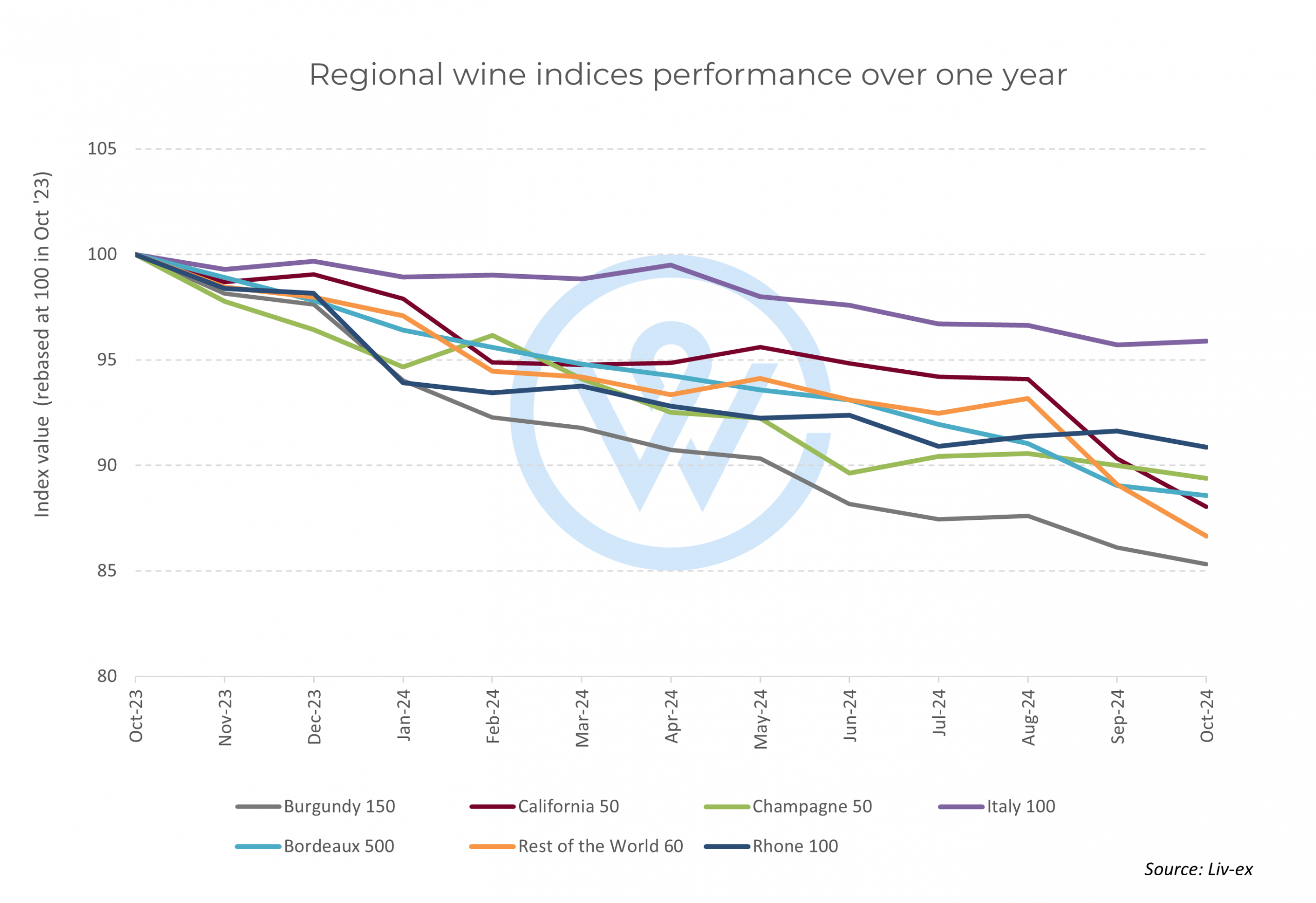
  • Italy’s market performance has been the most resilient across all fine wine regions.
  • Burgundy prices have fallen the most in the last year. 
  • Champagne is showing consistent signs of recovery.  

The market downturn has affected all fine wine regions, arguably making it a great time to invest while prices are low. Today we take a deep dive into the performance of individual regions – identifying the most resilient markets, the best opportunities, and the regions offering the greatest value.

Italy: the most resilient market

Prices for Italian wine have fallen 4.1% in the past year – less than all other fine wine regions. By comparison, fine wine prices have fallen 11.6% on average, according to the Liv-ex 1000 index. 

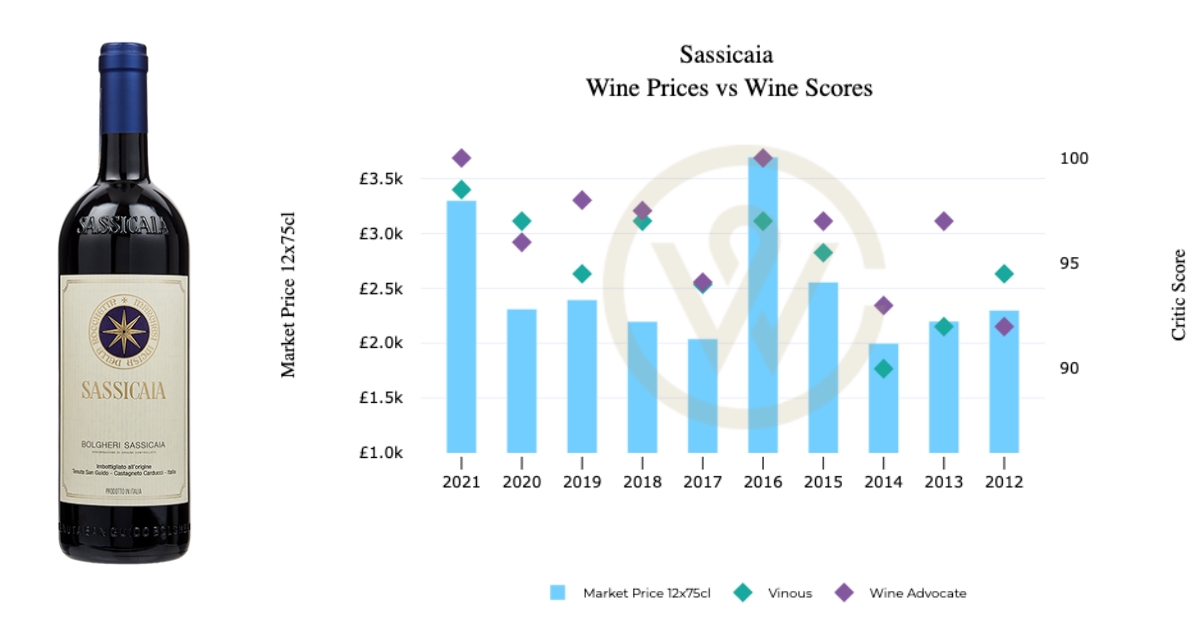
Italy’s secondary market has been stimulated by high-scoring releases, like Sassicaia and Ornellaia 2021. Beyond the Super Tuscans, which are some of the most liquid wines, the country continues to offer diversity, stable performance and relative value. 

Some of the best-performing wine brands in the last year are Italian – all with an average price under £1,300 per 12×75, like Antinori Brunello di Montalcino Vigna Ferrovia Riserva (£1,267, +38%).

Other examples under £1,000 per case include Le Chiuse Brunello di Montalcino (+28%), Gaja Rossj-Bass (+27%), and Speri Amarone della Valpolicella Classico Monte Sant Urbano (+25%).

Burgundy takes a hit

Burgundy’s meteoric rise over the past two decades made it a beacon for collectors, but its steep growth left it vulnerable to corrections. In the past year, Burgundy prices have fallen 14.7%, making it the hardest-hit region. This downturn has released more stock into the market, creating opportunities for investors to access wines in a region often defined by scarcity and exclusivity.

Wines experiencing the largest declines include include Domaine Jacques Prieur Meursault Santenots Premier Cru (-41%), Domaine Arnoux-Lachaux Nuits-Saint-Georges (-35%), and Domaine Rene Engel Clos de Vougeot Grand Cru (-28%). For new entrants, these price drops offer a rare chance to acquire prestigious labels at relatively lower costs.

Champagne: on the road to recovery

Champagne has changed its trajectory over the last year: from a fast faller like Burgundy to more consistency and stability. While prices are down 10.6% on average, the dips over the last few months have been smaller than 0.6%. The index also rose in February and August this year, driven by steady demand. 

Some of the region’s most popular labels have become more accessible for buyers like Dom Perignon Rose (-14%), Philipponnat Clos des Goisses (-13%) and Krug Clos du Mesnil (-12%).

Meanwhile, the best performers have been Taittinger Brut Millesime (+29%) and Ruinart Dom Ruinart Blanc de Blancs (+28%), which has largely been driven by older vintages such as the 1995, 1996 and 1998.

The fine wine market in 2024 reflects a unique moment of transition. Italy’s resilience, Burgundy’s price corrections, and Champagne’s recovery illustrate a diverse set of opportunities for investors. With prices across the board at lower levels, this could be an ideal time to diversify portfolios with high-quality wines from these regions, anticipating long-term growth as the market stabilises.

WineCap’s independent market analysis showcases the value of portfolio diversification and the stability offered by investing in wine. Speak to one of our wine investment experts and start building your portfolio. Schedule your free consultation today.


Categories
Quarterly-reports

Q1 2024 Fine Wine Report

Our Q1 2024 Fine Wine Report has now been released. The report offers a comprehensive overview of the fine wine market in the last quarter, including the impact of interest rates and geopolitical risks, the best-performing wines and regions, and analysis on the rising popularity of non-vintage Champagne as an investment.

Report highlights:

  • Mainstream markets rallied in Q1 2024, driven by resilient economic growth and expectations for future interest rate cuts by central banks.
  • The first green shoots started to appear in the fine wine market towards the end of Q1.
  • Fine wine prices (Liv-ex 100 index) experienced a smaller decline of 1% in Q1, compared to a fall of 4.2% in Q4 2023.
  • Italian wine enjoyed rising demand amid a flurry of new releases, including the 100-point Sassicaia 2021.
  • A number of Champagne labels that experienced consistent declines last year have started to recover, including Dom Pérignon, Salon Le Mesnil, and Pol Roger.
  • The Burgundy 2022 En Primeur campaign delivered high quality and quantity, with about 10% of producers reducing pricing year-on-year due to the challenging market environment.
  • China lifted tariffs on Australian wine after more than three years.
  • Critics and trade are now preparing for the 2023 Bordeaux En Primeur campaign, which will dominate the news in Q2 2024.

Click below to download your free copy of our quarterly investment report.


Fine Wine Report

Categories
News

Italian wine enjoys demand amid new releases

  • New releases from Italy have led to increased secondary market activity for the region.
  • Italian fine wine prices rose in February with some wines enjoying double-digit returns.
  • The 100-point Sassicaia 2021 has traded with a premium since its release last month.

Italian wine is currently in the spotlight amid a flurry of new releases, including the high-quality Brunello 2019 vintage and the 2021 vintage of the Super Tuscans Sassicaia and Ornellaia.

Brunello 2019 enters the market

The 2019 Brunello vintage is shaping up to be exceptional, potentially surpassing the subsequent vintages of 2020, 2021, and 2022, which were characterised by significantly higher temperatures. In terms of quality, critics have placed it on par with 2016, 2010 and 2006.

While Brunello may not dominate the fine wine market as prominently as the Super Tuscans, it has potential for attractive investment returns, especially from producers like Biondi Santi, Poggio di Sotto, and Casanova di Neri. These wines often come at more appealing price points compared to their counterparts.

For instance, Biondi Santi Brunello di Montalcino has risen 73% in value over the last five years, outperforming the likes of Sassicaia and Masseto. Poggio di Sotto’s performance has been equally impressive, rising 187% in the last decade, while Casanova di Neri Tenuta Nuova has been up 126%. At the top end, the more expensive and highly sought-after Soldera Casse Basse has returned 237% over the same period.

The historic performance of these brands strengthens the case for buying in vintages where the quality is high, and where the releases offer relative value.

Super Tuscan releases

In the world of fine wine, the most talked about Italian releases have been Sassicaia and Ornellaia 2021.

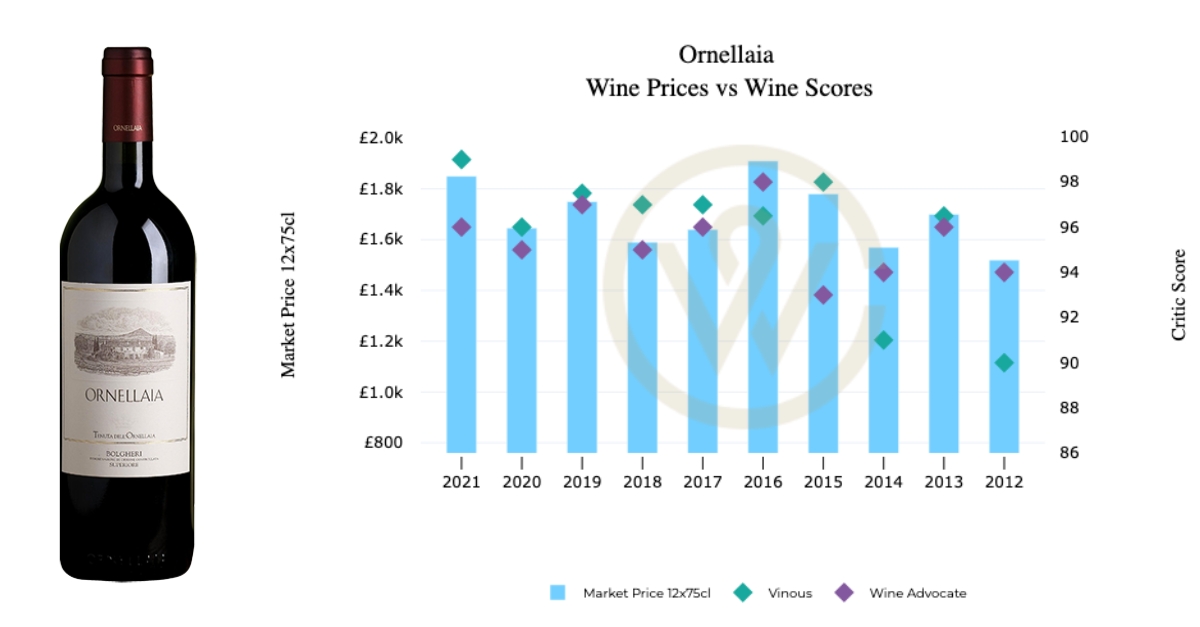
Ornellaia 2021 was released at £1,850 per 12×75, the same price as the 2020 release. At this price, the wine is the most expensive recent vintage on the market since 2016. Antonio Galloni (Vinous) awarded it 99-points and said that it ‘captures all the magic of this sensational vintage on the Tuscan Coast’. Meanwhile, Monica Larner (Wine Advocate) gave it 96-points and described it as ‘a very open-knit and exuberant Tuscan red’.

Ornellaia

Sassicaia 2021 was released last month at £2,500 per case, up 4.2% on the 2020‘s release price. The wine has since traded at a premium on the secondary market. It received 100-points from Monica Larner who called it ‘a quintessential Sassicaia that represents the excellence of the vintage and also respects the unique taste profile of this distinguished Tuscan blend of Cabernets Sauvignon and Franc’. Galloni gave it 98+ points and noted that it was ‘one of the best young Sassicaias I can remember tasting’. ‘In a word: magnificent’, said the critic.

Sassicaia

Italy gathers momentum

Recent releases have stimulated the secondary market for Italian wine. The region has been the best performing fine wine market segment over the last two years, as well as in the last few months. In February, the Liv-ex Italy 100 index posted a modest rise of 0.1%, but some vintages of Fontodi Flaccianello delle Pieve Colli della Toscana Centrale, Tignanello and Giacomo Conterno Barolo Monfortino Riserva enjoyed double-digit returns.

WineCap’s independent market analysis showcases the value of portfolio diversification and the stability offered by investing in wine. Speak to one of our wine investment experts and start building your portfolio. Schedule your free consultation today.