Categories
Learn

Understanding the fine wine secondary market: Investing, liquidity and valuation

  • While the primary market is the initial sale from the estate, the secondary market is the global trading ecosystem where wine is treated as a financial asset.
  • Secondary market prices are dictated by supply/demand – as bottles are consumed, the rarity of the remaining vintage drives exponential value growth.
  • Secondary market success relies heavily on professional storage and documented history to ensure investment-grade quality.

For centuries, fine wine has been seen as a treasured collectible; over the last twenty years, it has started to be recognised as a sophisticated alternative asset class too. To understand how wine functions as an investment, one must grasp the mechanics of its lifecycle – specifically the transition from the primary market to the secondary market.

This guide provides an in-depth exploration of the fine wine ecosystem, offering clarity for collectors, investors, and enthusiasts looking to navigate the complexities of global wine trading.

What is the primary market for fine wine?

Before diving into the secondary market, we must define its origin. The primary market refers to the first time a bottle of wine is sold after production. In this stage, the transaction occurs directly between the producer (the winery or estate) and the first buyer who could be an individual or a business (i.e. wine merchant).

Key characteristics of the primary market:

  • Direct sourcing: The wine moves from the cellar of the estate to a distributor, importer, or La Place de Bordeaux courtier.
  • Fixed pricing: Prices are typically set by the estate based on production costs, brand equity, and vintage quality.
  • En Primeur (Wine Futures): A hallmark of the primary market, particularly in Bordeaux. Investors purchase wine while it is still aging in barrels, often 12-18 months before bottling. This offers the lowest possible entry price but carries the risk of the wine evolving differently than expected.
  • Allocation systems: For “cult” wines (like Domaine de la Romanée-Conti or Screaming Eagle), primary market access is restricted to exclusive mailing lists or long-standing restaurant partners.

What is the secondary market for fine wine?

The secondary market encompasses all subsequent transactions of a wine after its initial sale in the primary market. Once a bottle leaves the original distribution chain and enters the hands of a private collector, an investment firm, or a specialised retailer, any future sale happens on the secondary market.

Unlike the primary market, where supply is controlled by the winery, the secondary market is driven by supply and demand. As bottles are consumed over time, the remaining supply of a specific vintage diminishes, often driving prices upward – a concept known as “inverse supply elasticity.”

Why the secondary market matters

The secondary market is where “wine” becomes “liquid gold.” It provides:

  1. Liquidity: A platform for collectors to exit their positions and convert wine into cash.
  2. Price discovery: Real-time valuation based on what global buyers are actually willing to pay.
  3. Vintage depth: Access to aged, “library” wines that are no longer available from the producer.

The core components of the secondary market

1. Wine exchanges

The London International Vintners Exchange (Liv-ex) is the “stock exchange” for wine. It provides a standardised platform for merchants to trade, offering price transparency and indices (like the Liv-ex Bordeaux 500) that track market health.

2. Auction houses

Global powerhouses like Sotheby’s, Christie’s, and Zachys dominate the high-end secondary market. Auctions are the primary venue for rare collections and “unicorn” bottles. Online auction platforms have recently democratised this space, allowing smaller collectors to participate.

3. Specialised brokers and investment platforms

Modern fintech platforms allow investors to buy managed portfolios. These entities operate almost entirely within the secondary market, sourcing back vintages with proven provenance.

4. Peer-to-peer and retail re-sales

Specialty retailers often buy back well-cellared collections from private individuals to resell them to other collectors.

Key drivers of secondary market value

What makes a bottle appreciate in the secondary market? It is not just the name on the label.

Provenance and storage

In the secondary market, provenance is everything. A bottle of 1982 Château Lafite Rothschild is worthless if it was stored in a warm kitchen. Buyers look for “ex-cellar” history or professional storage records (bonded warehouses) to ensure the wine has been kept at a constant 12-14°C (55°F) with optimal humidity.

Critic scores

Ratings from “palate-makers” like Robert Parker’s Wine Advocate, Antonio Galloni (Vinous), or Jancis Robinson act as market catalysts. A 100-point score can cause an overnight price surge on the secondary market.

Scarcity and rarity

The secondary market thrives on scarcity. If a producer only makes 500 cases of a particular cuvée, and 200 are consumed in the first five years, the remaining 300 bottles become significantly more valuable to collectors seeking a complete vertical.

Bonded warehouses and “In-Bond” trading

In the secondary market, how you store your wine is as important as the wine itself. Professional investors almost exclusively trade wine “In-Bond” (IB).

In-Bond (IB) vs. Duty Paid (DP)

  • In-Bond (IB): The wine is stored in a government-approved bonded warehouse. It has not yet attracted VAT or Excise Duty. If you sell the wine while it is still “in bond,” you never have to pay these taxes. This increases the profit margin for investors and ensures the wine has never left a temperature-controlled environment.
  • Duty Paid (DP): Taxes have been paid, and the wine has likely been delivered to a private home. In the secondary market, Duty Paid wine often sells at a discount because its storage history is harder to verify.

Expert tip: For maximum resale value, always keep your investment-grade wine “under bond” in a recognized facility like London City Bond.

Secondary fine wine market global trade hubs 

While London remains the historical heart of the wine trade, the secondary market has shifted toward a tri-polar model:

  1. London: The center for technical trading and storage.
  2. Hong Kong: The tax-free gateway to the thirsty Asian market.
  3. Singapore: A growing hub for Southeast Asian high-net-worth individuals.

The “laggard” phenomenon

Fine wine is often described as a “laggard” asset. It does not react instantly to stock market crashes. Usually, there is a 6-to-12-month delay before wine prices reflect broader macroeconomic shifts. This makes it a powerful hedge against inflation and sudden equity volatility.

Secondary market trends: Beyond Bordeaux

Historically, the secondary market was 95% Bordeaux. Today, the landscape is much more diverse:

  • Burgundy: Now represents a massive share of market value due to extreme scarcity and global prestige.
  • Italy: The rise of “Super Tuscans” (Sassicaia, Tignanello) and Barolo has created a robust secondary niche.
  • Champagne: Recently one of the top-performing sectors, as collectors realize the aging potential of prestige cuvées.
  • The New World: Cult Californians (Harlan Estate) and Australian icons (Penfolds Grange) are now staples of global trading.

Risks in the secondary market

Investing in the secondary market is not without peril:

  • Counterfeits: High prices attract fraud. Verification of labels, corks, and glass is essential.
  • Market volatility: Like any asset, wine prices can fluctuate based on global economic conditions.
  • Illiquidity: While more liquid than it used to be, selling a wine collection still typically takes longer than selling a stock.

Primary vs. Secondary Market Comparison
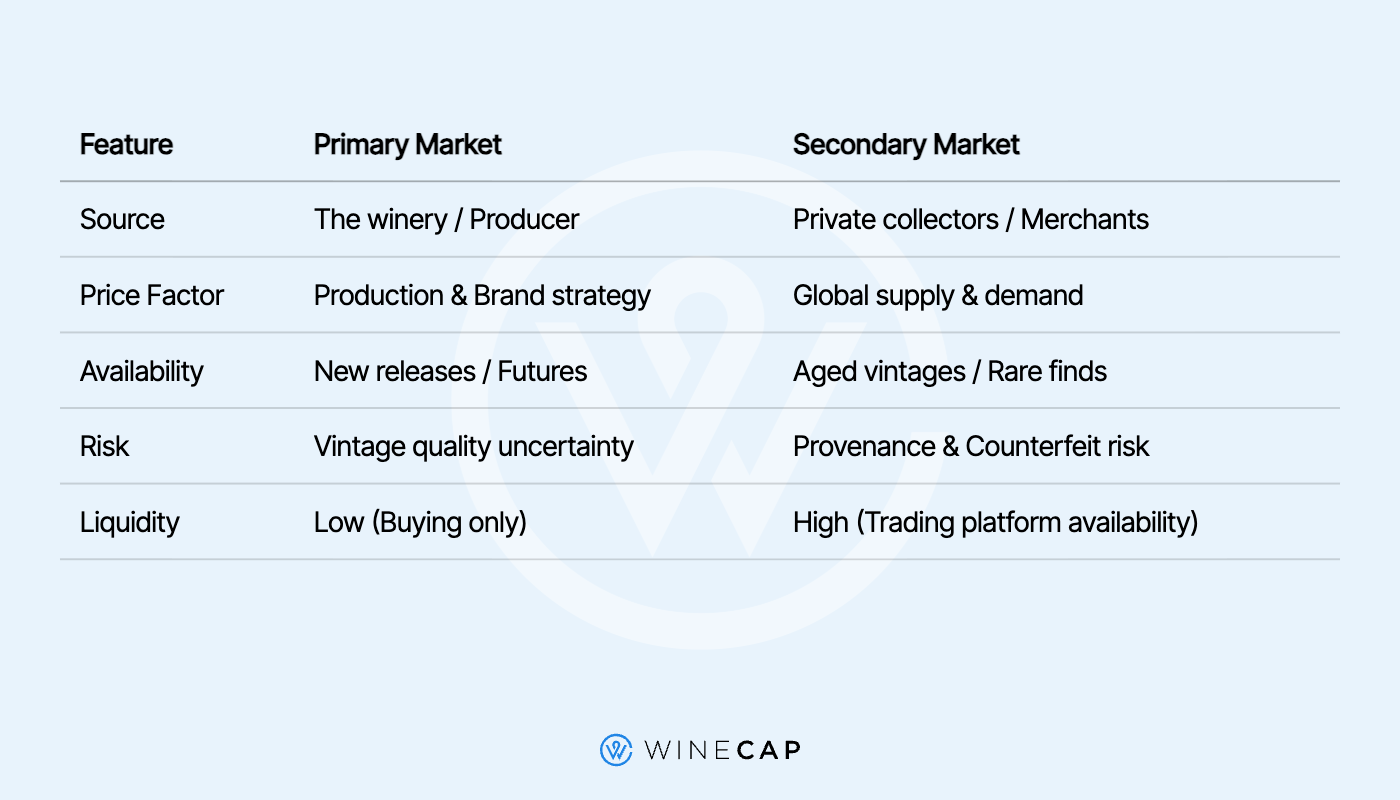
Primary vs Secondary Market Comparison

Frequently asked questions (FAQ)

Is fine wine a good investment?

Fine wine has historically shown low correlation with traditional stock markets, making it an excellent diversifier. It often delivers steady long-term capital appreciation, though it requires patience and proper storage.

What is a “bonded warehouse”?

A bonded warehouse is a tax-secured facility where wine is stored without the owner having to pay Duty or VAT. This is the preferred storage method for the secondary market, as it guarantees professional conditions and makes the wine easier to resell.

How do I check the secondary market price of my wine?

Platforms like Wine-Searcher provide market data. Specialised wine investment companies can provide valuations. Auction hammer prices are also a reliable indicator of current value.

Can individuals sell wine on the secondary market?

Yes, but it is regulated. Most individuals sell through auction houses or brokers who take a commission. Selling directly to another individual often requires specific licensing depending on your jurisdiction.

What is the best way to enter the secondary market?

Most investors start by using a managed platform or a specialised broker. This ensures you are buying wine with perfect provenance and professional storage already in place.

Why do prices fluctuate so much?

Secondary market prices react to critic scores, weather events affecting future crops, and shifts in global currency (the USD/GBP exchange rate is particularly influential).

Can I sell a single bottle?

While possible through online auctions, the secondary market is most liquid for full original wooden cases (OWC). Single bottles often face steeper commissions and lower demand.

WineCap’s independent market analysis showcases the value of portfolio diversification and the stability offered by investing in wine. Speak to one of our wine investment experts and start building your portfolio. Schedule your free consultation today.

Categories
Learn

Is buying early always the best investment?

  • The common concept in fine wine investment has been that buying early (at release) often translates into the best possible price.
  • The concept has its roots in Bordeaux’s En Primeur system but the principle has been challenged in the last decade.
  • Ageing potential is important, but it is not the only factor in price performance.

Timing is crucial when it comes to almost every decision. While not all investments have a lifespan, some do – and fine wine is a prime example of a perishable good that evolves, peaks and declines in quality and value. 

The common concept in fine wine investment has been that buying early or at release often translates into buying at the best possible (lowest) price. Recent Bordeaux En Primeur campaigns have worked against this principle. Individual wine indices, such as those on Wine Track also show that the price performance of a wine is driven by numerous factors beyond age. The value arc does not simply follow the life cycle of the product but responds to demand, critic scores, and brand popularity among other factors.

So, is buying early always the best investment? The answer, as we’ll see, is far more nuanced.

The origins of buying early: Bordeaux En Primeur

The concept of buying wine early has its roots in Bordeaux’s En Primeur system. Emerging in the post-war decades of the 20th century, it was designed to provide much-needed cash flow to châteaux, while offering buyers privileged access to top wines before they were bottled.

En Primeur still works broadly the same way today: buyers purchase wine in the spring following the harvest, while the wine is still ageing in barrel. Delivery follows one to two years later, once bottling has taken place.

For decades, this system benefitted both producers and buyers. Châteaux received upfront financing, while collectors and investors gained access to some of the most prestigious wines in the world at prices significantly lower than they would command once bottled.

The traditional promise of buying early

The original attraction of En Primeur was simple: buy early, secure allocations, and enjoy price appreciation once the wine is released to the wider market. In exceptional vintages like 1982, 2000, or 2005, those who bought early often saw spectacular returns.

For investors, the logic was straightforward:

  • Scarcity effect: Once the wine left the château, supply only diminished as bottles were consumed.
  • Pricing advantage: En Primeur pricing was historically lower than post-release retail.
  • Access to top names: For blue-chip estates like Lafite, Latour, and Margaux, early purchases guaranteed allocations that might otherwise be difficult to secure later.

In these circumstances, buying early equates to buying smart.

When buying early backfires

The past decade, however, has challenged this principle. Several Bordeaux En Primeur campaigns, most notably in 2017 and even 2020, saw release prices set so high that early buyers struggled to achieve returns. In some cases, wines could be purchased at equal or lower prices a year or two after bottling.

The reasons are clear:

  • Aggressive pricing by châteaux: A stronger global demand for fine wine has emboldened producers to set ambitious release prices.
  • Market corrections: Economic slowdowns, global trade disruptions, and shifting consumer preferences have softened demand after release.
  • Vintage variation: Lesser or more challenging vintages often lack the critical acclaim needed to sustain premium En Primeur pricing.

For investors, this has underscored the risk of assuming that ‘earliest means cheapest’.

What makes fine wine different from other assets

To understand why timing matters so much in wine investment, it’s important to recognise how wine differs from other asset classes:

  • Finite supply: Unlike companies that can issue more shares, every bottle consumed reduces global availability.
  • Physical lifespan: Wine matures and eventually declines; it is not a perpetual store of value like gold.
  • Quality peaks: Different wines have different drinking windows, meaning investors must consider not just price but also maturity and market timing.
  • Luxury demand drivers: Beyond fundamentals, fine wine is influenced by critic scores, branding, and even lifestyle trends among global collectors.

This blend of scarcity, perishability, and cultural cachet makes wine a unique – and uniquely complex – investment.

Beyond age: the real drivers of value

Ageing potential is important, but it is not the only factor in price performance. Modern wine indices and case studies reveal a more layered picture. Key drivers include:

  • Critic scores: A 100-point rating from Robert Parker, Neal Martin, or William Kelley can send prices soaring overnight.
  • Producer reputation: Estates like Domaine de la Romanée-Conti, Screaming Eagle, or Krug often outperform peers regardless of vintage quality.
  • Market cycles: Broader economic forces, from currency fluctuations to tariff policies, can depress or lift wine prices.
  • Brand popularity: Rising interest in regions like Champagne or Tuscany can create waves of demand that drive prices beyond what traditional models predict.

In other words, while time and age matter, they are not the sole determinants of performance.

When buying early makes sense

Despite these caveats, buying early can still be an excellent strategy under the right conditions.

  • Exceptional vintages: En Primeur remains compelling in universally acclaimed years, where demand is strong and release pricing is competitive.
  • High-demand producers: Cult estates with limited production – such as Château Lafleur in Pomerol or Domaine Leflaive in Burgundy – make early buying critical for securing allocations.
  • Collector profiles: For those who value access as much as investment return, buying early provides peace of mind.

For these buyers, the combination of access, scarcity, and potential upside makes early purchase attractive.

Alternative timing strategies

If early purchase is no longer a guarantee of success, what are the alternatives?

  • Back-vintage buys: Many investors now prefer to target wines once bottled and scored, when pricing stabilises and market sentiment is clearer.
  • Diversification by region: Burgundy, Champagne, and Italy’s Super Tuscans increasingly offer opportunities outside the Bordeaux En Primeur cycle.
  • Mixed approach: A blend of early allocations (for access) and carefully chosen back-vintage purchases (for value) often proves the most resilient strategy.

By broadening their scope and diversifying their portfolios with different regions and vintages, investors can reduce risk and capture opportunities across global markets.

See also: The best fine wines to invest in 2025

The role of La Place de Bordeaux today

It’s also worth noting that the traditional Bordeaux system has evolved. La Place de Bordeaux, the centuries-old distribution network, now offers not just En Primeur but also back vintages and non-Bordeaux icons such as Opus One, Masseto, and Almaviva.

These September releases are already bottled and ready to ship, offering global investors access to top wines without the risks of futures. In many ways, they reflect the modernisation of fine wine trading: access, liquidity, and global reach, without the same timing pressures as En Primeur.

The art of timing in investment

The idea that buying early is always the best investment belongs to another era. While there are still moments when buying at release delivers the greatest value, these are no longer guaranteed.

Fine wine is unlike any other asset: it is finite, perishable, and driven as much by culture and reputation as by supply and demand. Successful investors understand that while time is crucial, it is not the only variable.

The smart investor balances early buying in exceptional vintages with selective secondary market purchases, diversifies across regions and producers, and pays close attention to global demand trends.

WineCap’s independent market analysis showcases the value of portfolio diversification and the stability offered by investing in wine. Speak to one of our wine investment experts and start building your portfolio. Schedule your free consultation today.

Categories
Learn

Fine Wine Investment for Beginners

Fine wine investment is increasingly gaining popularity amongst beginners and novices looking to reap the benefits of this alternative asset. Not only is it a proven way to diversify and strengthen an investment portfolio, but also an enjoyable pastime for wine enthusiasts and budding connoisseurs.

Surging prices regularly push fine wine investment into the spotlight, and headlines are filled with stories of investors who bought wine at low prices, then sold it years later for thousands. But how and where do you get started as a beginner? And what are the wine investment returns that you can expect?

The following guide provides an overview of the fine wine investment market and how it works in practice.

How big is the wine investment market?

Investing in wine is no new phenomenon. In fact, it has existed in different forms since antiquity, as wine was circulated and traded throughout the ancient world by Greeks, Egyptians, Phoenicians, and Romans. The writings of Thomas Jefferson provide one of the first pieces of evidence of a premium charged for an older wine. In 1787, he wrote that the 1786 vintage for top Bordeaux wines cost 1800 livres per tonneau compared to 2000 livres for the older 1783. Through the centuries, shrewd wine lovers have been selling part of their collections as a way of subsidising their consumption, leveraging the gains of a uniquely rarifying asset against their own cellars.

Today, the market is transparent and open for beginners as well as experienced investors looking to embark on their wine journey. Investing in fine wine is easier than ever, thanks to specialised wine investment companies, relying on current market data and the latest technology.

The global wine market is forecast to reach US$525 billion by 2025. But while fine wine has emerged as a popular alternative investment, not every wine is investment worthy. For example, the majority of wines produced in renowned regions, such as Burgundy and Bordeaux – perhaps surprisingly – often won’t appreciate in value. In fact, of all the wines made worldwide, only a very small percentage have the potential to improve as they age, and an even smaller percentage of that group has the capacity to see its price rise.

Precisely this scarcity of investible wines is one of the main drivers behind wine investment’s profitability. The limited supply of collectible wine leads to price increases, especially for labels in high demand. This is why it is important to keep abreast of the latest market trends and factors influencing global appetite.

More fine wine investment opportunities than ever before

Historically, Bordeaux’s classified growths have been the leading force on the fine wine investment market. In 2010, Bordeaux took 96% of all trade on the global marketplace for wine. Today, it accounts for less than a third of this market by value.

The main reason behind its declining trade share is that the fine wine investment market is bigger and broader than ever before. Other French regions like Burgundy, Champagne and the Rhône, USA, Italy (led by Tuscany and Piedmont), Germany, Spain and Australia are increasingly seen as reliable sources of considerable wine investment returns.

Investing in fine wine is thus not limited to a small group of wines, contrary to what one might expect. There are more opportunities than ever before that can be suited to your stylistic preferences and budget. The collectors’ market is booming, with record number of investible wines trading right now.

Greater fine wine investment returns

As global demand for fine wine has grown, the investment returns have increased too. Burgundy is a prime example. Thanks to its iconic status and its tiny production levels, early investors in the sector have seen eye-watering growth: upwards of 2000% in 15 years for some wines. The volume, value and breadth of trading has increased significantly, and wine prices have risen dramatically over the last decade; the region’s major index is up almost 200% in the past ten years.

Meanwhile, investors in Champagne have benefitted from supremely consistent returns, although it is not the most expensive or the rarest of fine wines. Its brand strength and distribution network, however, remain unparalleled.

Prices for different regions and wines have risen at a different pace. Region and wine-specific factors thus play a role in the returns that an investor can expect, the cost and length of the investment.

How long do I need to invest in fine wines for?

Fine wine is considered a medium to long-term investment. As a general rule, we advise our clients to hold their wines for three years at the very least.

Many collectible wines have long ageing windows, between ten and 50 years. As the scarcity and quality of fine wine appreciates over time, so does its value. The premise of fine wine investment is to buy wine when it’s young, then sell it once it’s older and more valuable. There are other external factors that may help determine how quickly a wine may deliver the desired returns such as critic scores, supply/demand and significant events related to the region or the producer.

For instance, the price of the Super Tuscan Sassicaia 2015 went up 25% in the day when the American publication Wine Spectator announced its ‘Wine of the Year 2018’. Those buying and re-selling the wine on the day would have made a small profit; however, those holding the wine since release would have seen its value rise over 160% to the present day.

As a long-term low-risk investment, fine wine doesn’t lose its value overnight. Where share prices may increase one day and decrease the next, fine wine provides stable returns year after year. Its low volatility has led many to consider it the best ‘safe-haven’ asset – a great advantage particularly in times of market turmoil.

Unlike mainstream assets, fine wine is fairly insensitive to macro-economic events. When global markets tumbled due to ongoing Covid-19 restrictions and upon Russia’s invasion of Ukraine, fine wine remained resilient. The returns of leading fine wine indices were greater than the FTSE100, S&P500 and even other safe investments such as gold.

How do I start investing in wine?

There are a lot of decisions you need to make when taking on wine investment. Wine investment experts like our team here at WineCap can help you make decisions relating to the following factors:

Set a wine investment strategy

The first step is to set your budget. Consider how long you would like to hold your wines for and your preferred investment strategy. Fine wines command a range of prices depending on the producer, how much of their wine is made and the wines’ age. Make sure to set your budget before embarking on building your portfolio so you can ensure you have exposure to all countries and regions.

Speak to a wine investment expert

There are different routes to accessing the wine investment market, such as through specialised retailers and auction houses. Expert wine investment brokers offer unbiased advice on strategic investment opportunities and can help you build your portfolio, based on your preferred length of investment and budget. While WineCap doesn’t charge any annual fees, most wine investment companies do, so be sure to do your research and be aware of any fees your portfolio might incur.

Select world-class wines for your portfolio

A wine investment expert will help you find the wines best suited for your investment portfolio. WineCap has formed long-lasting relationships over the past decade with négociants, wholesalers and private collectors. This means that we have access to some of the world’s most prized wines. What’s more, our unique proprietary technology analyses over 400,000 wine prices a day to identify the right, undervalued wines to buy and sell across the global market at the right time and price.

Store your wines professionally

Choose to keep your wines in government bonded warehouses as this will ensure they are professionally stored in temperature-controlled conditions best-suited for ageing wines. World-class care ensures that when you come to sell, your wines’ provenance will quickly secure maximum prices.

Fine wine investment can be daunting if you are a beginner, but with a little practice and help you can soon enjoy the benefits of the best-performing luxury asset.

Ready to get started now you know more about how to invest in wine? Speak to one of WineCap’s investment experts to discover the next steps on your wine journey.