
- As wealth moves between generations and jurisdictions, investors are prioritising assets with universal value and “borderless” appeal.
- About 60% of global investors today show increased interest in globally transportable assets due to political and tax developments.
- Fine wine can serve as the ultimate “borderless” asset, offering stability and low correlation to mainstream markets.
As the global population of high-net-worth individuals (HNWIs) expands, we are witnessing the cusp of the largest intergenerational wealth transfer in history – all set against a backdrop of profound instability. While private wealth continues to grow, the economic situation of some major countries is weakening, and, consequently, the world is witnessing an unrivalled migration of HNWIs.
This multifaceted shift of wealth is taking place in an unstable global climate, where governments are continually redefining the “social contract” through major reforms and the overhaul of domestic tax regimes. This quest for stability and the safeguarding of assets is prompting a mass relocation of HNWIs that is reshaping traditional “capitals of wealth.”
Findings from the 2026 WineCap Wealth Reports – conducted among hundreds of wealth managers and financial advisors in the UK and US – reveal how this exodus is fundamentally altering the modern investment portfolio. As HNWIs move across borders to escape fiscal tightening and political volatility, fine wine has emerged as a sophisticated, “borderless” financial instrument that could well fit the mobile elite.
Why is wealth moving?
The current exodus is driven by a “perfect storm” of factors that vary by region but share a common goal: capital preservation.
- In the UK: The term “Wexit” (Wealth Exit) has gained traction following the abolition of the “non-dom” tax status and significant reforms to inheritance tax. Wealthy individuals who once viewed London as a permanent safe haven are now looking toward more tax-favourable jurisdictions.
- In the US: Movement is driven by a desire to diversify away from domestic political volatility and a weakening reliance on the US Dollar as a singular store of value.
- Globally: Inflation and high interest rates have made traditional “paper” assets feel increasingly fragile, prompting a flight to tangible quality holdings.
Defining the “borderless” asset
As investors become more mobile, they require assets that share that mobility. A borderless asset is a financial instrument that maintains its value and liquidity regardless of geographical location. Unlike real estate, which is physically anchored to a single jurisdiction, fine wine is recognised and tradable globally.
Fine wine has solidified its role in this exodus due to four key characteristics:
- Tangible value: A physical luxury asset with intrinsic worth.
- Low correlation to mainstream markets: It operates independently of the “noise” of equity and bond market volatility.
- Inherent scarcity: Consumption leads to a permanent reduction in supply. As demand remains steady or increases, prices rise.
- Fiscal stability: Fine wine acts as a defensive anchor during periods of high inflation.
Demand for portable asset
A defining trend of 2026 is demand for globally transportable assets. For an investor who is relocating, an asset that can be stored in a bonded warehouse in one country and sold in another – without the friction of traditional capital flight – is invaluable.
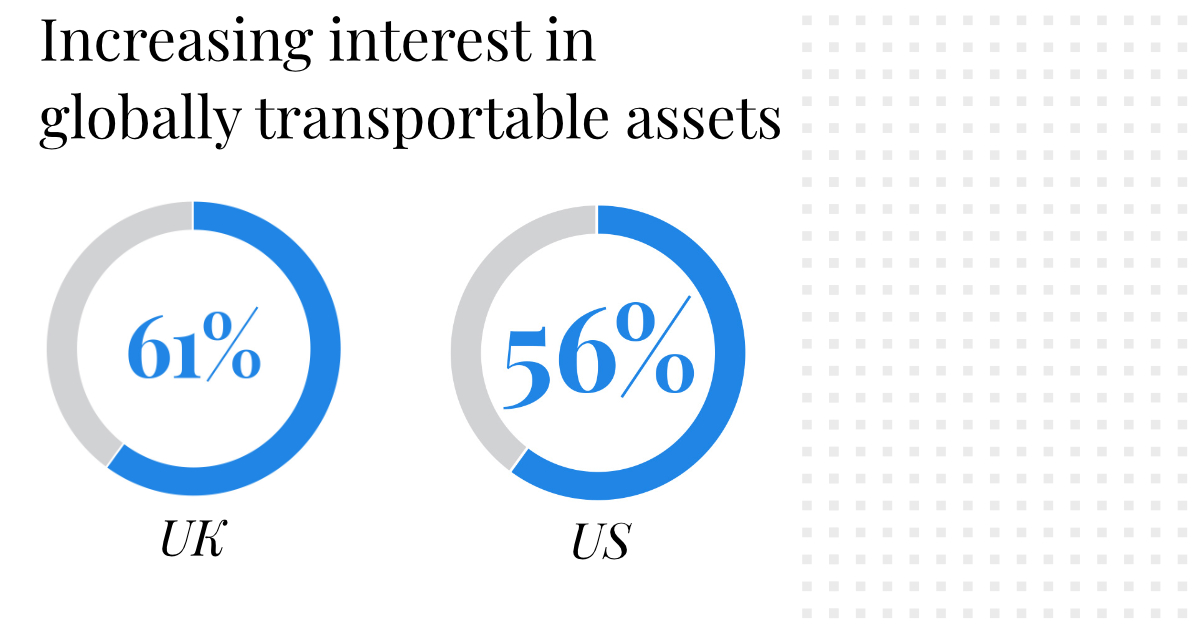
- UK Context (“Wexit”): With 95% of UK advisors citing fine wine’s status as a “wasting asset” (generally exempt from Capital Gains Tax), it has become a primary tool for “Wexit” planning. Sixty-one per cent of UK wealth managers report that their clients are now explicitly prioritising investments with high portability.
- US Context: In the US, where 56% of respondents noted a similar priority for mobility, fine wine has evolved from a simple diversifier into a strategic, borderless tool for navigating global wealth transfers.
Since fine wine is not anchored to any single jurisdiction, it allows the modern investor to maintain wealth across borders while avoiding the risks associated with fixed-location assets.
Fine wine’s universal value and fiscal efficiency
The appeal of fine wine is further bolstered by its intrinsic value, which transcends currency fluctuations and regional economic stressors.
- Currency neutrality: In the US, 98% of wealth managers noted that fine wine’s lack of a direct peg to the USD plays a significant role in its appeal as money moves globally.
- Tax efficiency: In the UK, 95% of advisors cite its status as a “wasting asset” – which generally exempts it from Capital Gains Tax (CGT) – as a primary driver for its inclusion in sophisticated portfolios.
- Market maturity: Trading fine wine has become easier than ever before for both buyers and sellers; half of global investors now recognise the sector’s improved liquidity within a well-established, global secondary market.
Deepening capital commitment
The convergence of portability, universal value, and defensive resilience has catalysed a transformation in how capital is committed to fine wine. No longer viewed as a peripheral “passion project” or a speculative hobby, fine wine has solidified its role as a viable alternative asset. This shift can at least partially be attributed to the wealth exodus, as borderless alternatives can offer both stability and growth.
The 2026 WineCap Wealth Reports quantify this deepening commitment, revealing a significant jump in portfolio exposure compared to just twelve months prior. Approximately half of all surveyed wealth managers in the US and nearly half in the UK now report that their clients allocate between 11-20% of their total portfolios to fine wine. This “standard” allocation demonstrates that wine is now being treated with the same strategic weight as traditional alternative mainstays like private equity or hedge funds.
Perhaps the most telling indicator of this trend is the emergence of the “heavyweight” segment – investors who view fine wine as a primary vehicle for wealth preservation during transit. Over a third of respondents in both the UK and US noted that their most committed clients now dedicate between 21-30% of their total wealth to the asset class. To put this in perspective, this represents a tectonic shift in investor behaviour: in 2025, a negligible portion of the market (less than 2% across both regions) held allocations exceeding 20%.
This deepening commitment is underpinned by growing conviction among the professional advisor community. With a record-breaking 97% of wealth managers forecasting a further increase in demand throughout 2026, the trajectory is clear.
Fine wine has moved beyond its status as a simple diversifier; it has become the preeminent collectible for a generation of investors who want to preserve, grow, and – most importantly – move their wealth across any jurisdiction on the global map.
WineCap’s independent market analysis showcases the value of portfolio diversification and the stability offered by investing in wine. Speak to one of our wine investment experts and start building your portfolio. Schedule your free consultation today.