Categories
Learn

Wine auctions vs wine investing – which offers the best growth strategy?

  • Both auctions and portfolio approaches have a role to play in wine investment, but the latter is a more viable route to steady growth.
  • Auctions can provide useful signals, but investors should identify and avoid market noise and hype.
  • An expertly-managed portfolio focuses on growth, diversification, and liquidity over chasing auction trophy wines.

The wine world frequently makes headlines for astronomical prices at attention-catching auctions. Bottles can fetch sky-high sums as multimillion-dollar collections capture international interest. For investors, such record-breaking spectacles can appear to be proof of fine wine’s irresistible upwards trajectory.

However, glamorous and inspiring as they are, these auctions are not the market. They are the sharpest tip of it – distinct moments where scarcity, storytelling, and sentiment come together. A pristine bottle of Domaine de la Romanée-Conti or Château Pétrus with impeccable provenance might clear 20–50% above its estimate in a single-owner sale. While impressive, such outliers don’t speak of underlying market performance.

Understanding the difference between prices that make the news and the reality of the market is essential for any serious wine investor.

What ‘auction price’ really is

An auction price is more than meets the eye; it’s a composite shaped by multiple components. What does that sales figure really mean? 

Hammer vs all-in costs

The hammer price is the winning bid declared by the auctioneer – but that’s not the final price. The buyer then pays a buyer’s premium (10%–25%), plus taxes, shipping, and insurance. A bottle that hits the headlines at £100,000 could ultimately cost the buyer £120,000.

Single-owner vs mixed-owner sales

Provenance is all-important. Bottles from single-owner collections, especially with engaging stories and original documentation, often command premiums far above market average. In contrast, mixed-owner sales tend to be a more accurate mirror of demand.

Estimate bands and marketing psychology

Auction houses set low and high estimates to guide bidding – and to generate excitement. These figures act equally as marketing tools and predictive indicators. Only a lot that exceeds the high parameter of its estimate band hits the news; one that sells within its estimated range represents the quieter reality.

True liquidity

A record price for a single bottle does not automatically translate into similar highs for other lots. Headline-making hammer prices are outliers, influenced by rarity, media coverage, and competitive auction frenzy rather than a broader trend in the market. 

Wine auction record setters

The following are examples of headline-making auctions which illustrate the factors that drive remarkable performance: wine rarity, media frenzy, storytelling, and collector pedigree.

$34.5 mln – Henri Jayer, “The Heritage” (2018, Geneva)

  • Legendary producer’s last 855 bottles from private cellar.
  • 209 coveted magnums.
  • Rare Vosne-Romanée vintages.

$28.8 mln – William I. Koch, “The Great American Wine Collector” (2025, New York)

  • 750 large formats (Jeroboams, Methuselahs, Salmanazars).
  • Leading Bordeaux, Burgundy, Rhône, Napa, and Piedmont wines.
  • Single-owner collection.

$25.3 mln – Joseph Lau, “Iconic Wines” I–III (2022–2025, Hong Kong)

  • Rare Burgundy and Bordeaux.
  • Single-owner collection auctioned over three years created story.

$16.8 mln – Pierre Chen, “The Epicurean’s Atlas” (2023–2025, Hong Kong, Paris, Burgundy, New York)

  • Iconic Burgundy, Bordeaux, Champagne, and New World wines.
  • Legendary vintages.

$11.16 mln – Jacqueline Piatigorsky (2025, New York)

These auctions were hugely successful, but outcomes weren’t solely due to wine calibre. The unique auction environment also played a role. Such heady sums are not necessarily representative of wider market pricing.

What auctions can tell investors

While not presenting a definitive picture, auctions do generate a treasure trove of information. However, it’s important to follow results with a discerning eye because not all of the information is useful for a wine investor. You need to learn how to separate signal from media noise to understand the true meaning of auction prices.

Useful signals for investors

  • Provenance premiums: Illustrates how much collectors are willing to pay for documented bottles over generic lots. Formats, condition, and original packaging often contribute to worthwhile premiums.
  • Bidding depth: The number of bidders within the estimate band indicates genuine demand. Likewise, consistent competition across lots can point to authentic appetite that exists beyond the auction house.
  • Regional and vintage momentum: Repeated strong results across particular regions or vintages can signal emerging segments rather than one-off auction-driven prices.
  • Thin trading: The highest-profile bottles typically sell only once a decade. Such rare transactions can provide valuable insights into the wider market.

Limits and noise

  • Selection bias: “Survivorship bias” can distort average values. For a range of reasons, some wines survive the test of time while others don’t. Not every mature wine deserves high valuation.
  • Seasonality and venue effects: Marquee sales held in the spring and summer tend to attract more bidders and media coverage, inflating prices temporarily. The location of the auction can also impact results.
  • Story premium: Worth repeating is the character of the narrative surrounding an auction can elevate prices far beyond what would be achievable in normal market conditions. Celebrity collections, charity sales, and unique stories fall into this category.

Buying at auction

Auctions offer both opportunity and challenge for collectors and investors. Understanding their structure sets realistic expectations before bidding.

Pros

Cons

Building a wine investment portfolio with a trusted manager

While auctions can offer wine performance insights, a structured, portfolio-driven approach is most optimal for serious investors. This method focuses on growth, diversification, and liquidity planning in response to the genuine market, rather than chasing one-off, high-performer auction house bottles. In short, headline bottles make news; diversified cases make portfolios.

Strategy-led

Discipline drives serious wine investment. A considered portfolio allocates across regions, producers, and vintages. Tiered maturity and style diversification help smooth returns and reduce volatility.

Execution

Acquiring wine at scale requires access to multiple channels: primary releases, négociant networks, ex-château allocations, and selective secondary market opportunities. Professional execution ensures consistent quality, provenance verification, and optimal pricing.

Expert oversight

A trusted manager maximises successful outcomes by safeguarding custody, insurance, and exit strategies, targeting holding periods and rebalancing, to shield investments from market swings.

Research & data

Continuous market monitoring is critical to disciplined investment. This data-driven strategy identifies trends and fair-value bands, so investors can avoid the pitfall of overpaying for hype and market noise.

Cost clarity

Unlike auctions, wine investment portfolio costs – custody, insurance, execution – are transparent upfront, allowing granular knowledge of charges for clear return comparisons.
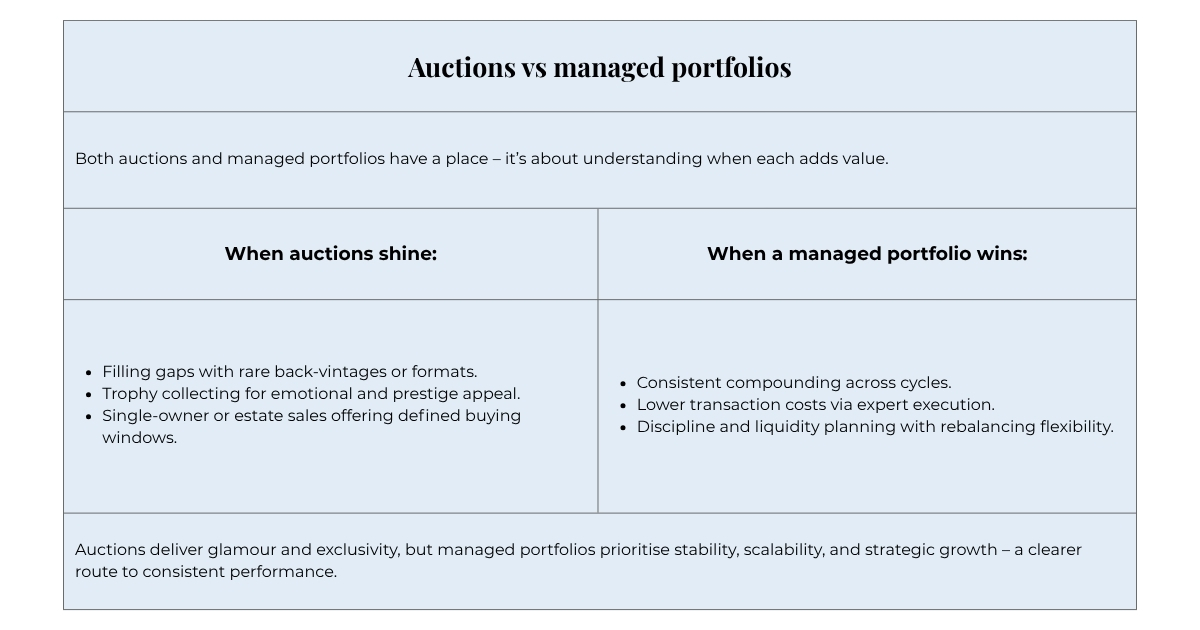
fine wine auction summary table

Next steps

The fine wine world will always carry glamour, but serious investors should see auction headlines as stories, not signals. The real market for fine wine investment and value growth is built on data, liquidity, and expert execution rather than the excitement of ‘show-stopping’ headlines.

Key takeaways:

  • Don’t fixate on record breakers – they rarely mirror market performance.
  • Focus on repeatability and liquidity for sustainable returns.
  • Calculate all-in costs for true value comparison.
  • Diversify and plan exits through portfolio management for resilience.

Fine wine investment is guided by expertise, patience, data, and structure, separating steady compounding from the volatile environment of speculation.

WineCap’s independent market analysis showcases the value of portfolio diversification and the stability offered by investing in wine. Speak to one of our wine investment experts and start building your portfolio. Schedule your free consultation today.
Categories
Learn

How does Bordeaux set its release prices?

In the springtime of each year, all eyes turn to Bordeaux as the region begins its extended En Primeur campaign when châteaux across this prominent region set their wine prices.

Such decisions require the navigation of multiple factors within a delicate financial and cultural ecosystem. WineCap spoke with eminent producers for insights into what influences the all-important price setting.

  •         Previous vintages and price key influences
  •         Profitability for all players is an important driver
  •         Compelling price point for customers is critical
  •         Brand and critical ratings have some impact

Château Smith Haut-Lafitte, Grand Cru Classé, Graves

“Don’t believe people say, ‘I do it all by myself’,” said Florence Cathiard who co-owns the Graves house with her husband Daniel. “It’s a long process and very delicate because we have to take several parameters into account.”

These include contemplating pushing prices higher because of swift sales in previous years, the vintage quality, and the general global environment.

“We also take advice from some of the best négociants, brokers, and even some importers — not those who are just trying to put the price down, to sell high, but the real friends.”

Château Pichon-Longueville Baron, Second Growth, Pauillac

Christian Seely, managing director of AXA Millésimes, owner of Château Pichon-Longueville Baron, has devised a formula for the optimal release price of a Grand Cru Wine.

“The ideal price is the highest price possible at which my existing customers will buy the wine with enthusiasm,” he said. “It has to be the highest price possible, otherwise I might get fired. But it has to be the highest price possible at which my existing customers will buy the wine with enthusiasm. If you go too high, your existing customers might buy it without enthusiasm. If you go much too high, maybe your existing customers won’t buy it, and that would be terrible. It’s a personal judgment based on experience.”

Château Pichon Comtesse, Second Growth, Pauillac

Nicolas Glumineau, CEO and winemaker of Château Pichon Comtesse, combines mathematics with common sense.

To price the wine correctly, you have to be very respectful of your market. And what we do is to have a very sharp eye on market prices,” he explained. “We consider that each step of the distribution chain has to get remuneration. It’s very important for each of us to earn money thanks to the distribution of Pichon Comtesse.”

Château Cheval Blanc, Saint-Émilion

Pierre-Oliver Clouet, Managing Director at Château Cheval Blanc has a similarly logical approach.

“En Primeur should be forever the lowest price you can find in your bottle,” he told WineCap. “The release price depends on many things: the quality of the vintage, the economic context in the world, and, as well, the price of new vintages available on the market. So, ultimately, the definition of the price En Primeur is not something difficult to reach. This is something mathematical.”

Château Canon, Premier Grand Cru Classé, Saint-Émilion.

Nicolas Audebert also follows mathematical logic in the pricing game. “If you go En Primeur, the interest for the consumer, the guy buying the bottle is that ‘if I buy en primeur, the bottle that I will put in my cellar and not able to drink now, it has to be at a lower price of the same quality I can buy in the market and drink now’,” he told WineCap.

Audebert takes an equivalent quality vintage from recent years, considers the margin, does some precision-calculations, and arrives at a price that offers a ‘win-win’ for all parties.

“Of course, afterwards, you can have ‘plus-value’ on the exceptional quality of the vintage or something like that. But if we play primeur, we have to play the game of logical pricing.”

Château Pavie, Premier Grand Cru Classé (A), Saint-Émilion

“There are some secrets,” jokes Olivier Gailly, commercial director for the Perse wine family at the renowned house. “There are a lot of different factors, which are, first of all, the history of your château, the different vintages and prices in the past, and how successful it was.

If the market demands, you have to push some, but you have to listen to it as well. Of course, ratings still play a role, meaning the feedback from the customers when they come and taste during the En Primeur week in Bordeaux. We then meet with Monsieur Perse and take the decision together. The final one will be his, being the owner of the property.”

Château La Mondotte, Premier Grand Cru Classé, Saint-Émilion

“If you have the wrong price, it’s a disaster,” Stéphane von Neipperg, owner of the Right Bank house said. “Nobody wants a lot of people wh don’t want to buy the wine.”

When his team goes to the market, they consider the global economy, the local market price direction, and information from brokers and négociants. “You have to absolutely test the price with negotiants, brokers, and also with your friends, the importers. Then we can say, ‘well, this would be a good price’. A good price is when everyone in the business makes money.”

Cos d’Estournel, Second Growth, Saint-Estèphe

Charles Thomas, commercial director of the Left Bank château, places an emphasis on quality and the good value the region offers when deciding on price. “I would be lying if I said it doesn’t depend sometimes on the exchange rate,” he said. “But also, it’s according to the quality we have — and this is the most important thing. Bordeaux is not expensive when you look at Burgundy and Napa Valley and some wine from other appellations.”

Vintage has more of an impact than elsewhere and can link to market price, Thomas added. “Of course, in Bordeaux you have the vintage effect that you don’t always have in other parts of the world. We try to be more stable for the client or the consumer, though, so they can accept any necessary price variation.”

Château Angelus, Saint-Émilion

As well as previous vintage pricing in Bordeaux and internationally, for Château Angelus CEO Stéphanie de Boüard-Rivoal, two more factors are key influences when the prestigious house goes to market.

“The volume as well, of course, because it makes a real impact,” she explained. “I’d say the strength of the brand as well.”

See also our Bordeaux I Regional Report

WineCap’s independent market analysis showcases the value of portfolio diversification and the stability offered by investing in wine. Speak to one of our wine investment experts and start building your portfolio. Schedule your free consultation today.
Categories
Learn

How is the price of fine wine determined?

The price of fine wine is influenced by a combination of tangible and intangible factors. For anyone interested in wine investment, understanding these factors is essential to making informed decisions. This guide explores the key elements that determine the price of fine wine, from production to market dynamics.

Producer and brand reputation

The reputation of a winery or estate significantly impacts the price of its wines. Prestigious producers, often with centuries-old traditions and consistent track records of quality, command higher prices. These brands have established trust and recognition in the global market, creating demand that sustains their premium pricing. A bottle from a renowned producer like Château Margaux, Domaine de la Romanée-Conti, or Screaming Eagle is synonymous with luxury and excellence. Even wines from less prominent producers within these regions gain value by association, benefiting from the overall prestige of their appellation or terroir.

Vintage quality

The quality of the harvest in a particular year, known as the vintage, is one of the most critical factors in determining wine prices. Weather conditions during the growing season have a profound impact on grape quality, which in turn affects the wine’s flavor, aging potential, and market desirability. Exceptional vintages often garner high critical acclaim, making them highly sought after by collectors and investors alike. For example, Bordeaux’s 1982 vintage and Burgundy’s 2010 vintage are renowned for their excellence and have seen sharp price appreciation over time. On the other hand, wines from less favorable vintages may be priced lower initially or experience slower value growth.

Scarcity and production volume

Scarcity plays a pivotal role in determining the price of fine wine. Wines from small-batch producers or limited-production labels are often more valuable because demand outstrips supply. Additionally, the concept of “drink or hold” means that as bottles are consumed, the remaining supply becomes increasingly rare, further driving up prices. For example, cult wines from Napa Valley, which are produced in limited quantities, often experience rapid price increases due to their exclusivity. Over time, the scarcity of these wines enhances their desirability, making them a strong candidate for investment.

Critical scores and reviews

The opinions of influential wine critics and publications play a significant role in shaping a wine’s price. High scores or glowing reviews can lead to immediate surges in demand and pricing, while mediocre evaluations may suppress a wine’s market reception. A 100-point score from Robert Parker, for instance, can increase a wine’s price by 30-50% almost overnight. Wines with consistently high ratings from multiple critics maintain stronger long-term value, as these endorsements build buyer confidence and elevate the wine’s reputation in the market. Conversely, a lack of critical acclaim can limit a wine’s appeal, even if it has other desirable qualities.

Provenance and storage conditions

Provenance refers to the documented history of a wine’s ownership and storage. It is a crucial factor in maintaining and enhancing a wine’s value. Wines with impeccable provenance that have been stored under ideal conditions, such as controlled temperature and humidity, fetch higher prices at auction or in private sales. Poor storage or uncertain provenance can drastically reduce a wine’s worth, even if it is rare or highly rated. Auction houses and private collectors often highlight provenance as a selling point, justifying higher prices for bottles with a verifiable and pristine history. Wines sold directly from the producer or through trusted merchants also carry a premium for their authenticity and reliability.

Market trends and global demand

Broader economic and market trends significantly influence wine prices. Factors such as rising wealth in emerging markets, changing consumer preferences, and currency exchange rates can all impact global demand for fine wine. For example, growing interest in Burgundy from Asian markets over the past decade has driven exponential price increases for wines from this region. Shifts in consumer tastes, such as a preference for organic or biodynamic wines, can also affect pricing, as these categories attract a more environmentally conscious audience. Additionally, economic stability in key markets often correlates with increased investment in fine wine, further bolstering demand.

Age and maturity

The age and maturity of a wine are also critical in determining its price. As fine wine ages, its value often increases, especially as it approaches its optimal drinking window. Collectors are willing to pay a premium for wines that have been properly aged, as this reduces the time and risk associated with cellaring young wines. For example, a young Bordeaux might sell for $200 upon release but appreciate to $500 or more as it nears its peak drinking years. This appreciation makes aged wines particularly attractive to both collectors and investors seeking reliable returns.

Regional prestige and classification systems

Certain wine regions, such as Bordeaux, Burgundy, and Napa Valley, carry inherent prestige that significantly influences pricing. Classification systems, like Bordeaux’s 1855 Classification or Burgundy’s Grand Cru designations, further bolster a wine’s market position. For instance, First Growth Bordeaux, such as Château Latour, consistently commands higher prices than less prestigious classifications, regardless of vintage. Similarly, Burgundy’s Grand Crus outperform wines from lesser designations due to their perceived quality and exclusivity. This regional prestige not only affects initial pricing but also contributes to a wine’s long-term appreciation potential.

WineCap’s independent market analysis showcases the value of portfolio diversification and the stability offered by investing in wine. Speak to one of our wine investment experts and start building your portfolio. Schedule your free consultation today.

Categories
Learn

What factors affect fine wine prices?

  • The most important factors that affect fine wine prices are production costs, climate change, market demand, and economic conditions.
  • Market demand is influenced by critic scores, rarity, producer reputation, vintage quality, and geopolitics.
  • Understanding the factors that affect fine wine prices is key to making smart investment decisions.

Fine wine is more than just a luxury product – it is an asset class, a status symbol, and for many, a serious investment. While buyers might be aware of the rising value of sought-after labels, understanding the factors that drive these prices (upwards or downwards) is key to navigating the fine wine market. 

In this article, we explore the primary factors affecting fine wine prices, including production costs, climate change, market demand, and broader economic conditions.

How production costs shape fine wine prices

At the heart of fine wine pricing are the production costs. The making of a high-end wine is a meticulous, labour-intensive process that is inevitably reflected in the price. So are the land costs, which can reach astronomic heights in famous fine wine regions like Burgundy, Napa or Bordeaux. 

For instance, the luxury conglomerate LVMH recently acquired 1.3 hectares of Grand Cru vineyards on the Côte d’Or for 15.5 million euros. The purchase includes half a hectare each in Corton-Charlemagne and Romanée-Saint-Vivant, as well as 0.3 hectares in Corton Bressandes.

Besides land costs, manual labour and vineyard management can further affect release prices. The more human intervention required – whether in the vineyard or the winemaking process – the more costs add up.

Finally, many fine wines are not ready for release for several years after production. Extended ageing means producers incur additional costs, which in turn drives up prices for wines that are stored for longer periods before hitting the market.

The impact of climate change on fine wine pricing

In many traditional wine regions, unpredictable weather patterns, such as frost, heatwaves, and hailstorms, have resulted in lower grape yields. For example, the devastating frost in Burgundy in 2021 significantly reduced production, leading to a scarcity of wines from that vintage. 

When yields are lower, the limited supply pushes prices higher, especially for in-demand producers. This scarcity effect can be seen in top wines like Domaine Leflaive or Domaine de la Romanée-Conti, where a challenging growing season can result in soaring prices.

Additionally, climate change is affecting the style of wines being produced. While some regions like Bordeaux are adapting to these new conditions, climate volatility has added another layer of unpredictability to wine prices. It has also facilitated the emergence of new wine regions, leading to a more competitive landscape.

Market demand and the rise of fine wine investment

Market demand is perhaps the most significant factor affecting fine wine prices. The most sought-after bottles usually rise in value, as quality improves over time and supply diminishes.

Producer reputation, vintage quality and scores from major critics like Robert Parker and Neal Martin play a key role here, informing buying decisions and pricing strategies. A 100-point wine often commands a significant premium to a 99-point wine. When it comes to the Bordeaux First Growths, for instance, the average difference between a 99-point and a 100-point wine is over £350 per case.

Market demand is also shaped by geopolitical factors. The global nature of wine trading platforms means that market sentiment can affect wine prices faster than ever before. Demand from China largely contributed to Bordeaux’s pricing surge in 2011, and today interest is moving towards Burgundy and Champagne.

Economic forces that influence fine wine prices

While the fine wine market generally operates with its own dynamics, macroeconomic factors such as inflation, currency fluctuations, and recessions can all have an impact.  

In times of economic downturn, discretionary spending often decreases, which can lead to short-term drops in wine prices. However, fine wine has historically shown remarkable resilience due to its tangibility, rebounding after economic dips. 

Currency fluctuations also play a role; for instance, a weaker euro might make European wines more attractive to international buyers, spurring demand and increasing prices in markets like the US or Asia.

Changes in trade policies and tariffs can also have an impact. The Trump tariffs on European wines in 2020 temporarily raised the prices of French and Italian wines in the American market. While these tariffs have been reduced, ongoing changes in trade regulations can create volatility in wine pricing, particularly for internationally traded wines.

Understanding price fluctuations within fine wine

Fine wine prices are influenced by a complex interplay of factors, from the inherent quality of the wine itself to broader market forces and economic conditions. Understanding these factors is key to making informed decisions and maximising returns on investment.

Want to learn more about fine wine investment? Download our free guide.

Categories
News

Joseph Drouhin expands vineyard holdings to meet rising Burgundy demand

  • Joseph Drouhin has acquired two properties, Château de Chasselas in Saint-Véran and Rapet in Saint-Romain.
  • The expansion comes as both producers and buyers seek to find stock and value in an increasingly competitive market for Burgundy.
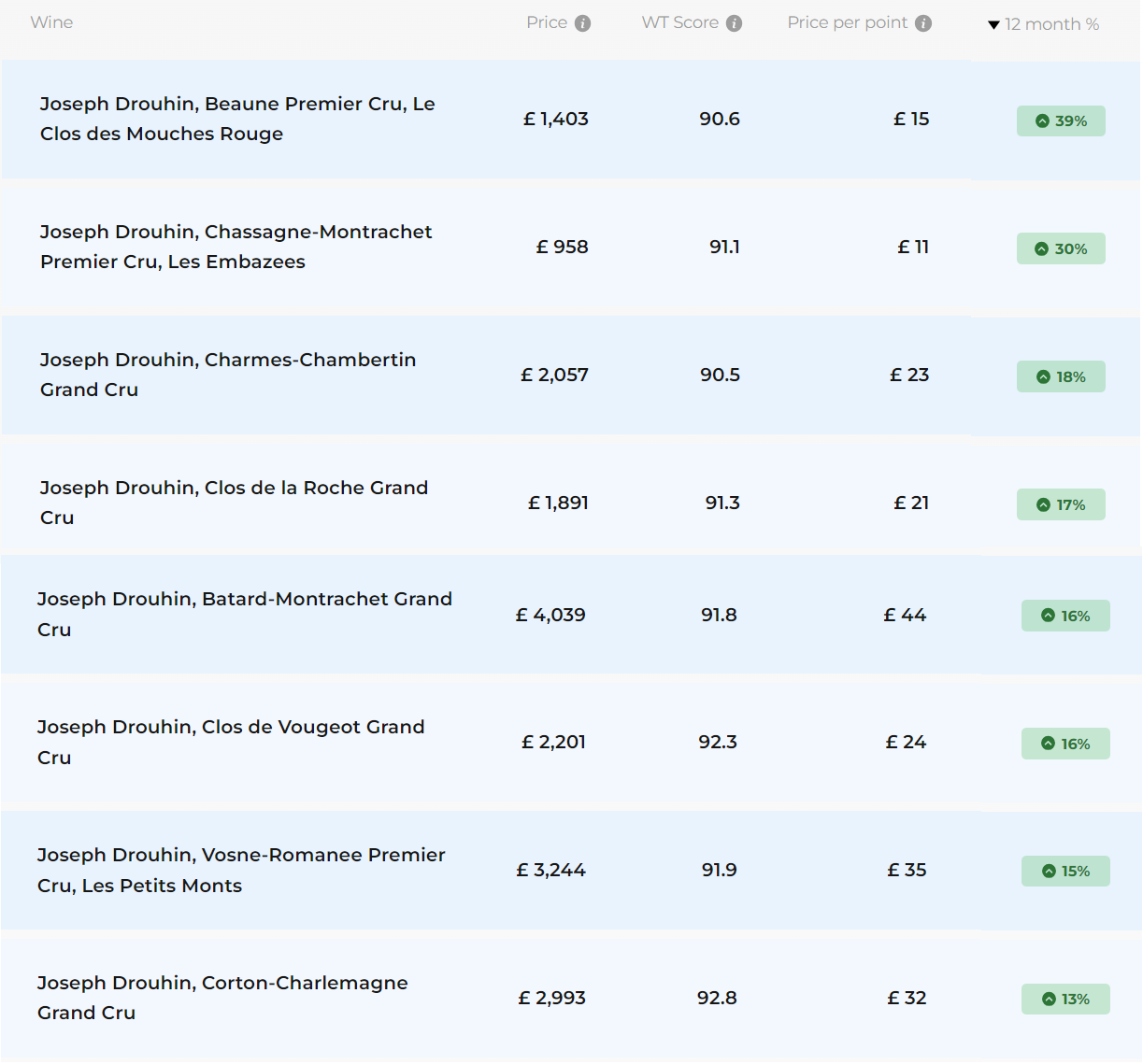
  • Drouhin has been a brand on the move, with some of its wines rising near 40% in value in the last year.

Joseph Drouhin expands its vineyard holdings 

Rising demand for Burgundy has fueled winery purchases and new investments. One of the most prominent producers, Maison Joseph Drouhin, has expanded its vineyard holdings with the recent acquisition of Château de Chasselas in Saint-Véran and Rapet in Saint-Romain.

Frédéric Drouhin, president of the Maison, explained that this decision was driven by increased competition and challenges in acquiring vineyards and purchasing grapes. The purchase focuses on high-quality yet more affordable areas in Burgundy – outside the main Côte d’Or villages, as both producers and buyers seek to find value in a region that has experienced significant price increases in recent years.

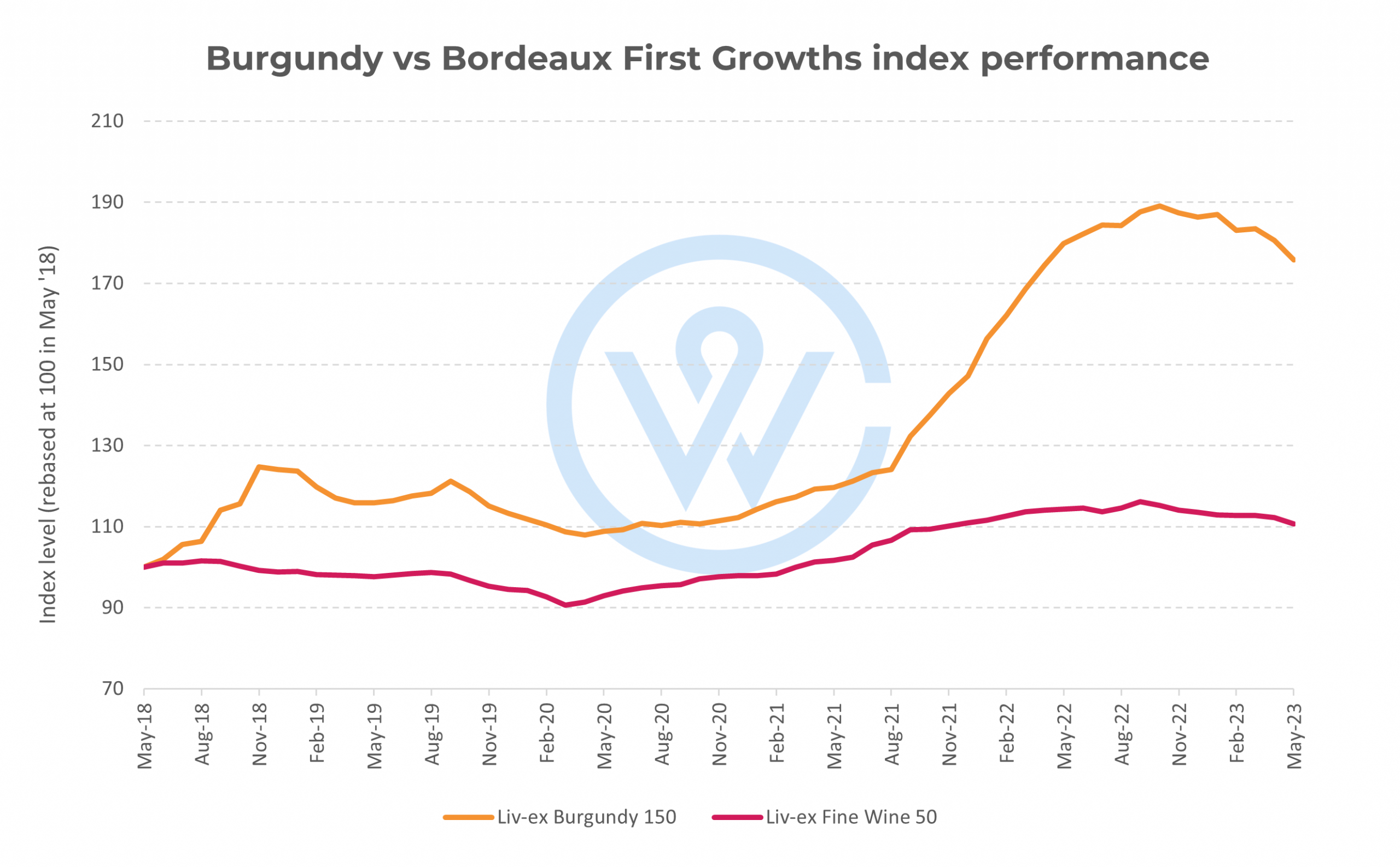
Just in the last five years, Burgundy fine wine prices have risen 75.7% – more than seven times the prices of the Bordeaux First Growths.

The insatiable demand and investment interest in the region have also impacted the cost of land, creating something of a vicious circle. 

The price of the latest Drouhin purchase was not disclosed.

The estates

Château de Chasselas encompasses 17.3 acres and is already a major supplier of Drouhin’s Saint-Véran wine. The property also includes small parcels in Chasselas and Beaujolais. The Rapet estate spans 19.8 acres and includes both Pinot Noir and Chardonnay vineyards in Saint-Romain, as well as small parcels in Auxey-Duresses, Pommard, and Meursault.

The debut vintage of Drouhin’s Saint-Romain wine is the 2022, while the first bottling of Saint-Véran Château de Chasselas will be the 2023 vintage, which will be released in 2024. All the newly acquired vineyards are being transitioned to organic farming practices.

With these acquisitions, Maison Joseph Drouhin owns close to 250 acres of vineyards, spanning from Chablis to Mâcon and encompassing 60 appellations. Their portfolio includes 14 Grands Crus and 20 Premier Crus. 

Drouhin’s place in Burgundy’s secondary market

Joseph Drouhin has been a Burgundy brand on the move. The brand jumped 142 places in the 2022 Power 100 rankings, thanks to its price performance. 

Four wines from the estate also ranked in the first tier of the 2021 Liv-ex Classification, which ranks the wines of the world solely by price: Montrachet Grand Cru Marquis de Laguiche, Musigny Grand Cru, Chambertin-Clos de Bèze Grand Cru, and Chambolle-Musigny Premier Cru Les Amoureuses.

The best performing Drouhin wines

In the last year alone, the best performing Joseph Drouhin wines have risen between 13% and 39%, outperforming the Burgundy 150 index. 

The biggest riser has been their Beaune Premier Cru Le Clos des Mouches Rouge, which has an average price of £1,403 per case.

You can now explore the historic performance of these wines on Wine Track. Our tool provides a clear overview of a fine wine’s track record, including critic scores, average price and investment returns. 

WineCap’s independent market analysis showcases the value of portfolio diversification and the stability offered by investing in wine. Speak to one of our wine investment experts and start building your portfolio. Schedule your free consultation today.