Categories
Regional-reports

Italy Regional Report

Our Italy Regional Report examines the development of its investment market, historic performance, and key players.

Italy is the world’s largest wine producer, responsible for more than 6.5 billion bottles annually across nearly two million acres of vineyards. While its dominance in the mass wine market is undisputed, Italy’s fine wine sector has undergone a remarkable transformation over the past half century.

The modern era of Italian fine wine began in the 1970s with the emergence of the Super Tuscans – wines such as Sassicaia and Tignanello that challenged traditional classifications and redefined quality expectations. This shift elevated Italy’s global reputation and laid the foundations for a serious fine wine investment market.

Today, Italy stands as one of the most dynamic and resilient regions in the global fine wine landscape. Once overshadowed by Bordeaux and Burgundy, it now accounts for over 15% of secondary fine wine trade by value, with a growing roster of investment-grade wines. The complementary strengths of Tuscany and Piedmont, alongside emerging regions such as Veneto and Sicily, have positioned Italy as a compelling choice for portfolio diversification.

WineCap’s Italy Regional Report examines how this evolution has unfolded – and where the most attractive opportunities now lie.

Key findings from the Italy Regional Report

Italy has become a core fine wine investment region

Over the past two decades, Italy’s presence in the secondary market has grown steadily. In 2010, Italian wines represented less than 2% of global fine wine trade. Today, they account for more than 15%, reflecting rising international demand, increased critical acclaim, and greater investor confidence. This growth has been achieved without the extreme volatility seen in some other regions, reinforcing Italy’s reputation as a stable, long-term investment option.

Consistent performance with lower volatility

Italy’s investment appeal is underpinned by steady performance. The Italy 100 index has risen by over 200% in the past twenty years, outperforming both the Liv-ex 100 and Liv-ex 1000 indices over the last decade. Importantly, Italian wines have shown greater resilience during market downturns, with less pronounced corrections than Burgundy or Champagne.

This combination of growth and stability makes Italy particularly attractive to investors seeking diversification with reduced risk.

Accessibility and affordability set Italy apart

One of Italy’s defining advantages is accessibility. Top Italian wines are generally priced well below their French counterparts, offering a more approachable entry point into fine wine investment. In addition, higher production volumes for flagship wines such as Tignanello, Sassicaia, and Ornellaia enhance liquidity and ease of acquisition, particularly when compared to the extremely limited production of top Burgundy or Californian wines.

This balance of quality, availability, and price makes Italy an effective way to build meaningful exposure within a diversified portfolio.

Tuscany and Piedmont play complementary eoles

Italy’s two leading investment regions serve distinct but complementary functions. Tuscany provides scale, brand recognition, and liquidity through its iconic Super Tuscans and Brunello di Montalcino, delivering consistent returns over time. Piedmont, often compared to Burgundy, offers greater scarcity and potential upside through its Barolo and Barbaresco wines, driven by limited production and strong critical demand.

Together, these regions allow investors to balance stability and growth within a single country allocation.

Emerging regions are gaining traction

Beyond Tuscany and Piedmont, Italy’s regional diversity is increasingly reflected in the investment market. Veneto, Abruzzo, Umbria, Sicily, Campania, and Alto Adige are attracting attention for their quality, value, and growing international recognition. As exposure increases, these regions are expected to play a larger role in Italy’s fine wine trade. This depth and breadth of opportunity is unmatched by any other fine wine-producing country.

Explore the full report

WineCap’s Italy Regional Report provides a comprehensive analysis of Italy’s investment performance, accessibility, regional diversity, and best-performing wines – alongside a clear framework for understanding Tuscany, Piedmont, and the country’s most promising emerging regions.

Download the full Italy Regional Report to explore the data, insights, and opportunities shaping one of the most resilient and accessible fine wine investment markets in the world.


Italy Regional Report
 
Categories
Regional-reports

Bordeaux Regional Report

Our Bordeaux Regional Report examines the evolution of its investment market, the First Growths, their second wines and En Primeur.

Bordeaux has long been the backbone of the fine wine market. Its unique combination of history, scale, and globally recognised brands has positioned it not just as a leading wine region, but as the reference point for fine wine investment worldwide.

As early as 1787, Thomas Jefferson recognised the collectible potential of Bordeaux’s finest estates. More than two centuries later, that early insight still holds true. While the fine wine market has diversified significantly in recent years, Bordeaux continues to play a defining role – often setting the tone for broader market performance.

At its peak in 2010, Bordeaux accounted for an extraordinary 96% of the fine wine market by value. Although its share has since moderated as regions such as Burgundy and Champagne have risen, Bordeaux remains the most influential and liquid region in the investment landscape.

WineCap’s Bordeaux Regional Report explores why this remains the case – and where the most compelling opportunities now lie.

Key findings from the Bordeaux Regional Report

Bordeaux remains the most important fine wine investment region

Despite increased diversification, Bordeaux still accounts for over a third of the fine wine market by value today. Its long-established distribution networks, global demand, and deep secondary market continue to underpin its dominance, particularly for investors prioritising liquidity and long-term stability.

The First Growths continue to anchor the market

The Bordeaux First Growths – Château Lafite Rothschild, Château Latour, Château Margaux, Château Haut-Brion, and Château Mouton Rothschild – remain the cornerstones of fine wine portfolios. While their share of total trade has declined from historic highs, they still represent around 30% of Bordeaux’s secondary market activity, reinforcing their role as pricing benchmarks and confidence indicators.

Second Wines and “Super Seconds” offer compelling value

One of the most notable trends highlighted in the report is the growing importance of second wines and so-called “Super Second” estates. These wines benefit from the same terroirs and technical expertise as their flagship counterparts but offer more accessible entry points. In many cases, they have delivered stronger relative performance over the past decade, driven by rising quality and growing global recognition.

Older vintages are often undervalued

The report shows that some of the most attractive opportunities in Bordeaux today lie not in the latest releases, but in older, overlooked vintages. These wines frequently trade at favourable price-to-quality ratios and can offer greater upside potential than more recent En Primeur releases, particularly in a more price-sensitive market environment.

En Primeur’s influence has weakened

While En Primeur remains a defining feature of Bordeaux, its role has evolved. Pricing misalignment in recent campaigns has reduced its appeal, shifting the focus towards disciplined, selective participation. The report highlights that En Primeur can still present opportunities, but only when release prices reflect broader market conditions and long-term value.

Bordeaux’s role in a diversified market

As the fine wine market has broadened to include Burgundy, Champagne, Italy, and California, Bordeaux has increasingly positioned itself as the region of stability. Its slower but steadier appreciation, combined with unrivalled liquidity, continues to make it a foundational allocation within diversified fine wine portfolios.

Explore the full report

WineCap’s Bordeaux Regional Report provides a detailed analysis of the region’s evolution, historic performance, key investment estates, and future outlook in an increasingly diversified fine wine market.

Download the full Bordeaux Regional Report to explore the data, insights, and opportunities shaping one of the world’s most important fine wine regions.


Bordeaux Regional Report
Download

Categories
Quarterly-reports

Q3 2024 Fine Wine Report

The fine wine market continued its downward trend throughout Q3 2024, but there are reasons for cautious optimism. Our Q3 2024 Fine Wine Report highlights the main themes that shaped the market, from regional performance to specific brand successes, and provides an outlook for the remainder of the year.

Executive summary

  • Since October 2022, fine wine prices have been in consistent decline, with a 4% drop on average in Q3 2024.
  • Bordeaux experienced the steepest fall at 4.4%, while Champagne defied the trend with a modest 0.4% increase last quarter.
  • Steady demand for fine wine continues to suggest a price recovery on the horizon.
  • Certain brands have outperformed the market, including Ruinart, Taittinger, and Château de Beaucastel.
  • Krug Vintage Brut 2004 has been the best-performing wine year-to-date, up 21.6%.
  • This year has already seen several broken auction records, including for high-profile Burgundy, which points to continued interest in fine wine.
  • Nine wines received perfect 100-point scores by Jane Anson in her recent Bordeaux 2009 and 2010 vintage retrospective.
  • France’s 2024 harvest is projected to be down 22% compared to last year, and 15% below the five-year average.
  • Looking ahead to Q4 2024, the market continues to present attractive buying opportunities, especially for investors with a long-term vision.

The trends that shaped the fine wine market

Global market recovery driven by rate cuts

In Q3 2024, global markets showed signs of recovery, bolstered by central banks pivoting towards interest rate cuts as inflation began to ease. Following turbulence in early August, stock markets rebounded, setting new records by the end of the quarter. Central banks, including the US Federal Reserve, the European Central Bank (ECB), and the Bank of England, all shifted their focus from inflation control to stimulating economic growth. The Fed’s September rate cut – the first since 2020 – catalysed a surge in US stocks, and similar moves from other central banks supported this global rebound. Despite lingering concerns about a potential US recession and Japanese market volatility, the overall global outlook improved, with lower rates and better economic conditions presenting growth opportunities.

Fine wine prices fall 4% in Q3

In contrast to the broader economic recovery, the fine wine market remained bearish, with a 4% average drop in prices in Q3. The Liv-ex 100 index saw its steepest fall of the year, down 1.7% in October. Bordeaux led the decline, with a 4.4% drop, although there was a slight uptick in Sauternes prices. Champagne offered a bright spot, rising 0.4% last quarter, with brands like Dom Ruinart Blanc de Blancs and Taittinger posting strong returns (over 30% in the last six months). This mixed performance underscores the complexity of the fine wine market, where price movements can vary widely by region and brand.

New fine wine releases beyond Bordeaux

As always, autumn brought the highly anticipated La Place de Bordeaux campaign, with major New World brands such as Almaviva, Seña, and Penfolds Grange releasing their latest vintages. However, this year’s campaign fell flat, with many new releases priced similarly to last year, despite older vintages showing better value and investment potential due to price corrections. Investors may find more favourable opportunities in back vintages that boast higher critic scores at lower prices.

Regional fine wine performance in Q3
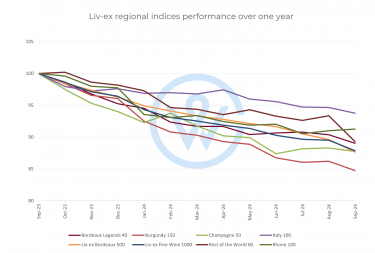
The fine wine market has now returned to its 2021 levels, with prices declining across most regions in Q3 2024, except for Champagne, which recorded a modest 0.4% increase.

Bordeaux experienced the most significant drop, falling 4.4%, driven down primarily by the Second Wine 50 index, which plunged 6.6%, and the Right Bank 50 index, down 4.6%. Many wines from the 2019 vintage, which had previously appreciated in value, have now returned to their original release prices.

Despite this trend, Bordeaux is enjoying steady market demand, taking over a third of the market by value. Moreover, Jane Anson recently revisited the 2009 and 2010 vintages, awarding nine wines 100 points – a move likely to stimulate demand and prices.

When it comes to other regions, Italy and Burgundy also saw a 2% drop in Q3. The Rhône was somewhat more resilient, experiencing a smaller decrease of 0.8%.

The best-performing wines

While the broader market continues to face challenges, certain wines buck the trend, reinforcing the importance of strategic, brand-specific investment decisions.

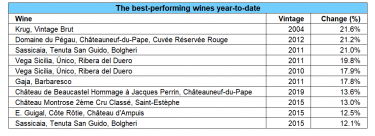
In Q3 2024, some brands have delivered exceptional returns. The table below showcases the best-performing wines year-to-date, with regions like Tuscany and the Rhône dominating the list.

Leading the pack is Krug 2004, which saw an impressive rise of 21.6%, reflecting the continued strength of Champagne in the investment market. Earlier this year, Antonio Galloni (Vinous) rescored the wine, giving it 98 points. He described it as a ‘gorgeous Champagne that is just beginning to enter its first plateau of maturity’.

Close behind is Domaine du Pégau’s Châteauneuf-du-Pape Cuvée Réservée 2012, which appreciated by 21.2%. Sassicaia 2011 follows with a 21% increase, while its 2015 vintage takes the tenth spot, with a 12.1% rise.

Vega Sicilia Único also features twice with its 2010 and 2011 vintages, demonstrating the increased demand for Spanish wines.

Wines from Bordeaux and the Rhône also make the list, showcasing the diversity of the wine investment market.
The most expensive wines in 2024

The world’s most expensive wines in 2024 are overwhelmingly dominated by Burgundy. At the top of the list is Domaine de la Romanée-Conti’s Romanée-Conti Grand Cru, with an average price of £221,233 per case. Following closely is Domaine d’Auvenay Chevalier-Montrachet Grand Cru, priced at £204,328.

Other notable entries include:

  • Domaine d’Auvenay, Criots-Bâtard-Montrachet Grand Cru at £141,979.
  • Liber Pater, from Bordeaux, priced at £140,009, stands out as the only non-Burgundy wine in the list.
  • Domaine Leroy, Richebourg Grand Cru, valued at £120,007, further establishes Burgundy’s dominance as a highly collectible wine region.

Burgundy producers such as Domaine Leroy and Domaine d’Auvenay appear multiple times on the list. The trend reflects how scarcity, reputation, and critical acclaim are key drivers of value, especially as the market for fine wine becomes increasingly selective in uncertain economic times.

Further entries include:

  • Domaine Leroy, Romanée-Saint-Vivant Grand Cru at £103,844.
  • Domaine d’Auvenay, Mazis-Chambertin Grand Cru at £93,818.
  • Domaine de la Romanée-Conti, Montrachet Grand Cru at £89,529.
  • Domaine Leroy, Corton-Charlemagne Grand Cru at £81,827.
  • Domaine d’Auvenay, Meursault Premier Cru, Les Gouttes d’Or at £80,715.

This dominance by Burgundy reflects its unmatched status in the global wine market, where scarcity and consistent quality continue to command premium prices.

For more information, visit Wine Track.

Fine wine news

The autumn La Place de Bordeaux release campaign

The 2024 La Place de Bordeaux campaign saw the latest releases from Masseto, Solaia, Seña, Penfolds Grange and many more. However, many of these new vintages were released at the same or slightly higher price levels as last year, despite a general market decline, making them less attractive from an investment perspective.

For instance, Masseto 2021 received a perfect 100-point score from Antonio Galloni but was priced at the same level as last year, with back vintages such as 2017, 2018 and 2019 offering better value. Meanwhile, the 100-point Solaia 2021 was released at a 15.7% premium on the 2020 vintage.

From Chile, the 2022 Seña and Viñedo Chadwick were offered at last year’s prices, but older, higher-scoring vintages such as Seña 2019 and Viñedo Chadwick 2021 remain more affordable. Penfolds Grange 2020 saw a small price increase, yet back vintages like the 100-point 2013 offer greater investment potential. Overall, back vintages, with comparable or higher critic scores, often provide better value for investors looking to capitalise on the current market dip.

Historically low yields in France

The 2024 French wine harvest is projected to be one of the smallest in recent history, with regions like Burgundy and Bordeaux experiencing significant declines due to adverse weather conditions.

Burgundy’s output is projected to be down by 25% compared to 2023, while Bordeaux is facing a 10% drop, resulting in the region’s lowest production volume since 2017.

Historically, such scarcity in Burgundy has driven secondary market price increases, as collectors rush to secure rare wines. However, the economic downturn may temper this trend, making selectivity key for investors. In Bordeaux, while smaller harvests often support price stability for premium wines, the broader market conditions may limit price recoveries, especially for mid-tier labels.

Q4 2024 market outlook

The consistent decline in fine wine prices leaves many wondering when the market will stabilise. Despite this downward trend, several factors point toward potential recovery and attractive buying opportunities in Q4.

Firstly, strong demand for select wines persists, particularly for brands that continue to outperform the market. This year has already seen several broken auction records, including for high-profile Burgundy, which points to continued interest in fine wine.

While the market as a whole is facing challenges, strategic investment in the right wines can still yield impressive returns. Investors looking to capitalise on market lows should consider brands which have consistently shown growth despite broader regional declines.

The global economic backdrop also provides reasons for optimism. Central banks, led by the US Federal Reserve, have shifted towards interest rate cuts which could stimulate further investment in alternative assets like fine wine.

In terms of regional performance, the ongoing declines in key regions may start to stabilise, as already seen in Champagne. Despite a 4.4% drop in Q3, Bordeaux remains a dominant player with one-third of the market share by value. With critics such as Jane Anson awarding nine perfect 100-point scores to Bordeaux wines from the 2009 and 2010 vintages, we may see renewed interest in classic vintages.

In summary, Q4 2024 offers a unique window of opportunity for long-term investors. With the current decline, strategic investments in high-performing brands and undervalued vintages could offer substantial returns on the road to recovery.

WineCap’s independent market analysis showcases the value of portfolio diversification and the stability offered by investing in wine. Speak to one of our wine investment experts and start building your portfolio. Schedule your free consultation today.

Categories
Learn

History of Burgundy’s price performance

The following article is an extract from our Burgundy regional wine investment report.

  • Burgundy is the region with the highest average bottle prices.
  • It is the best-performing fine wine region, considerably outperforming industry benchmarks.
  • This article analyses its historic performance, the drivers behind its success, and what this might meant for the future of the region.

Burgundy has earned an impressive reputation in the fine wine investment landscape. The region is the outright leader when it comes to average bottle prices and the long-term performance of its wines.

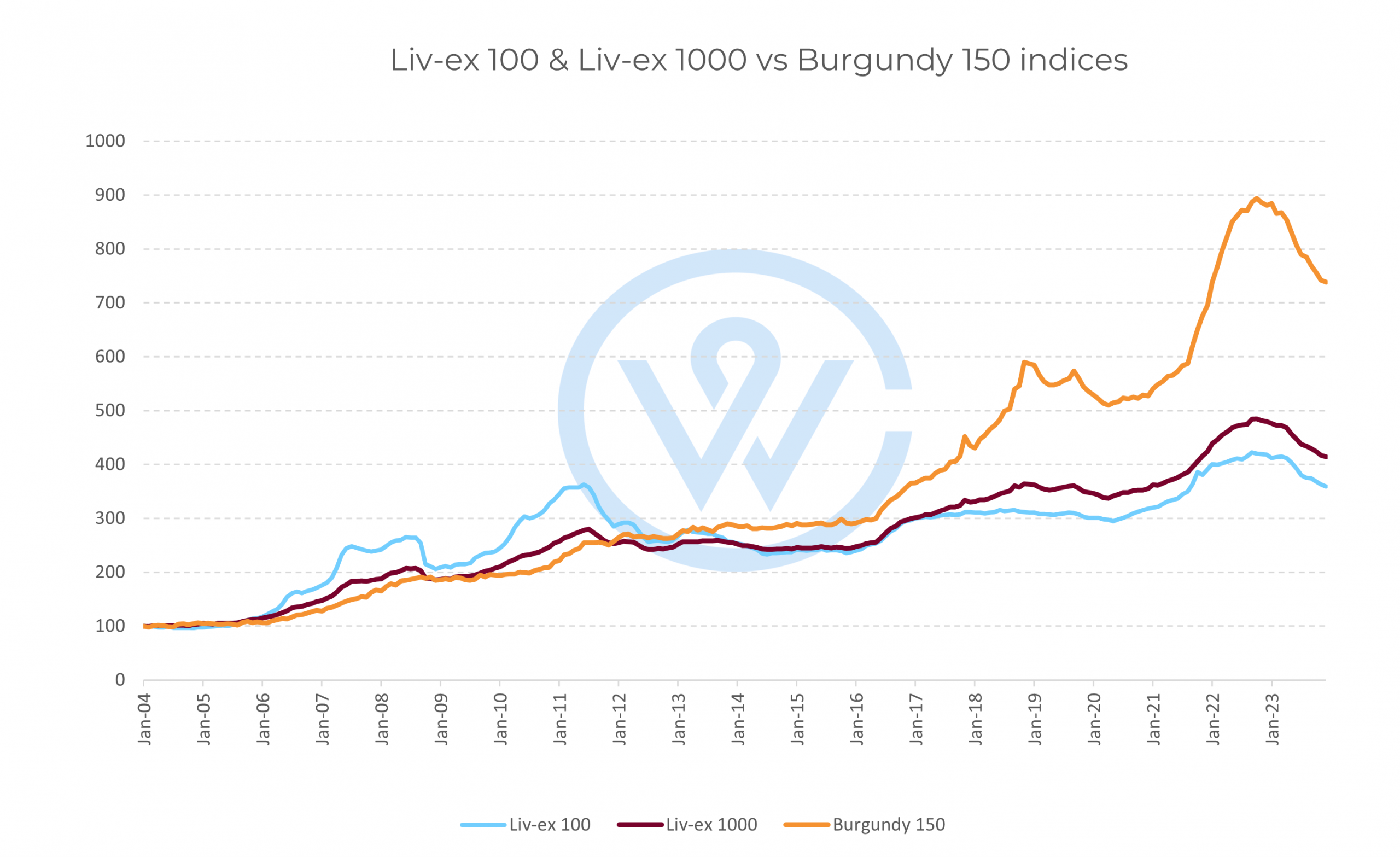
The Burgundy 150 index, which tracks the prices of the last ten vintages across 15 Burgundy brands, is the leading Liv-ex regional index, continually outperforming Bordeaux, Italy and Champagne. It is up over 650% since its inception.

Although the index only comprises a narrow pool of highly traded wines, it provides an indication of the direction of Burgundy prices. During its impressive rise, the index experienced only one significant drop of 15%, giving investors confidence that its punctuated equilibrium will continue.

Historic performance of Burgundy prices

The Liv-ex Burgundy 150 index doubled from early 2006 to mid/late 2008 — the first awakening of the Burgundy market as a new generation of wealthy consumers started to dominate the collectors’ market. This was at least in part driven by the volume of information available to them online from reviewers like Robert Parker and Allen Meadows and a greater focus on fine wine from the major auction houses.

After the 2008 financial crisis, Burgundy was somewhat left in the shadow. With the opening of the Chinese market, Bordeaux grew massively between 2008 and 2011. When Bordeaux fell from its 2011 peak, a new generation of investors flocked to Burgundy, seeking growth and breadth to their holdings.

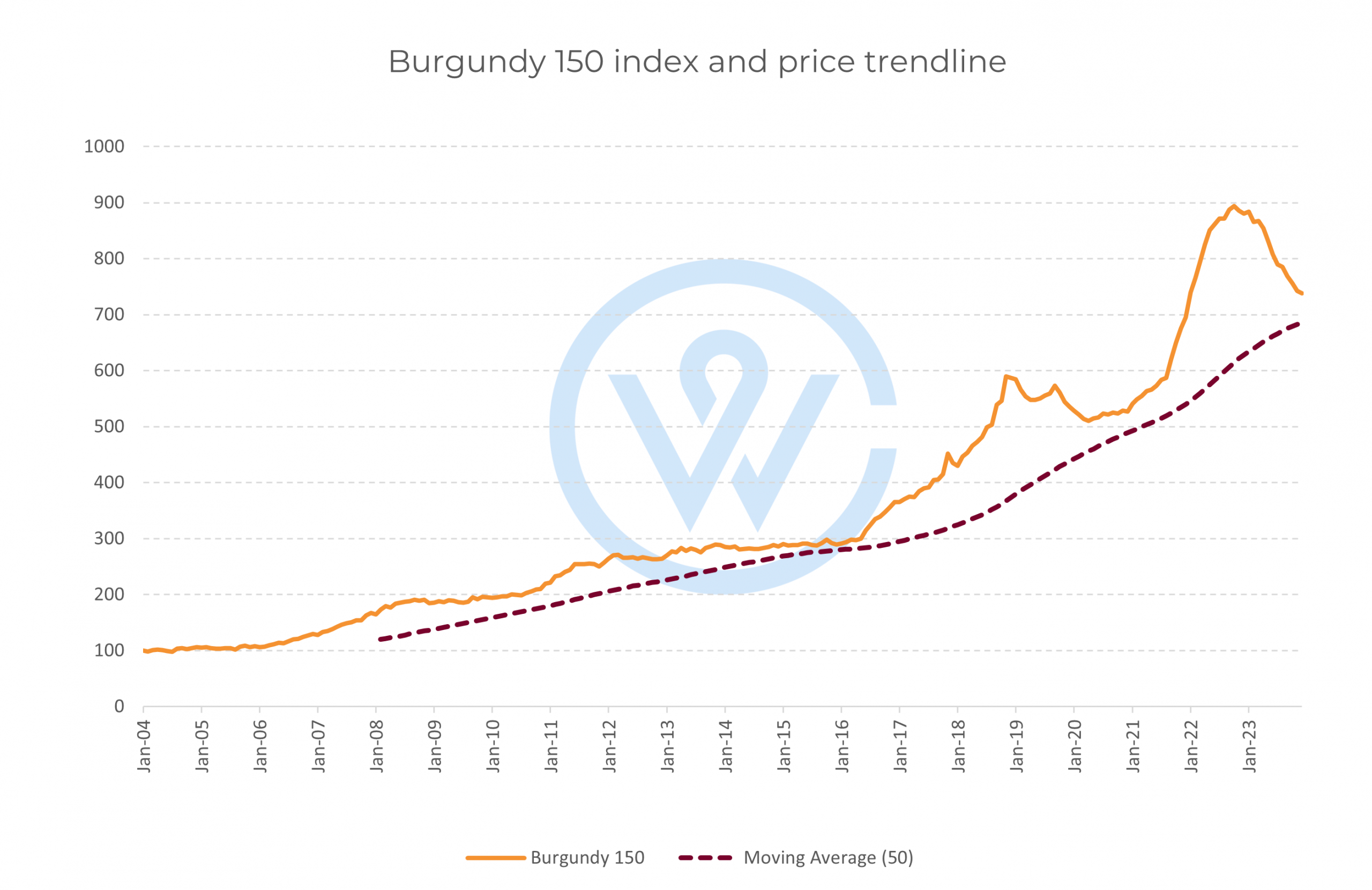
From 2016 to late-2018, the value of the Burgundy 150 index doubled again. This can be attributed to growing liquidity in the sector and its recognition as a viable high-return investment. The region experienced a period of decline in 2019/2020, after a 15-year period without any significant downward movements. Some of this retreat has been related to profit taking and, later on, to the Covid-19 pandemic. Burgundy quickly made up for lost time in 2021 and 2022, with factors such as increased at-home consumption of fine wine, growing online trade, and rising liquidity contributing to its success. The index hit an all-time high in October 2022 at 909.4.

The market at large experienced another period of contraction in 2023, due to a combination of macroeconomic factors such as geopolitical conflicts, the lasting effects of the pandemic, high inflation and rising interest rates. Burgundy was the hardest hit region.

However, the overall direction of prices remains upwards as the trendline in the chart below shows. Such periods are advantageous times for Burgundy buyers who are usually able to find more stock at lower prices.

To find out more about the investment market for Burgundy wines, read the full report here.