Categories
News

Fine wine market starts 2026 on firmer footing

  • The fine wine market has closed 2025 on a positive note, with prices rising for four consecutive months.
  • Despite improving momentum, fine wine prices remain close to five-year lows, creating buying opportunities. 
  • Market broadening is a defining feature of rising markets, and 2026 is likely to mark the early stages of this transition.

After three years defined by correction, caution and recalibration, the fine wine market enters 2026 in a notably stronger position. Prices have stabilised, liquidity has improved, and demand is beginning to broaden – all signs that the market has moved beyond its most challenging phase and is laying the foundations for a sustainable recovery.

While it would be premature to describe the current environment as a full rebound, the early months of 2026 mark the firmest starting point the fine wine market has seen since 2022. For investors with a medium- to long-term horizon, this combination of stabilising prices and still-attractive valuations presents one of the most compelling opportunity windows in several years.

A firmer start to the year than at any point in the past three years

In our final article of 2025, we examined the performance of Bordeaux, Burgundy and Champagne – the three most important fine wine regions for investors – and highlighted pockets of growth across each. Crucially, that momentum has not faded with the turn of the calendar year.

Fine wine prices have now risen for four consecutive months, closing 2025 on a positive note and carrying that strength into early 2026. This sustained improvement matters. Rather than a short-term technical bounce, it signals a market that is beginning to find equilibrium after a prolonged period of repricing.

Key indicators suggest the market is now operating on firmer footing:

  • Prices have stabilised after reaching five-year lows
  • Liquidity has improved across leading regions and producers
  • Buyers are returning with greater confidence and selectivity
  • Multiple regions are now participating in early recovery trends

Taken together, these developments point to a healthier, more balanced fine wine market entering the new year.

Buying opportunities remain as prices hover near five-year lows

Despite improving momentum, fine wine prices remain close to five-year lows across many regions and vintages. Historically, this late-stage downturn phase – when prices stabilise before rising meaningfully – has offered some of the most attractive entry points for long-term investors.

Importantly, recovery does not begin with uniformly rising prices. Instead, it starts with price consolidation, followed by gradual gains concentrated in the most liquid and well-recognised segments of the market. That is precisely the pattern emerging today.

For investors, this creates a rare alignment of conditions:

  • Valuations remain compelling
  • Downside risk has diminished compared to previous years
  • Demand is rising without speculative excess
  • Portfolio construction can prioritise quality and value

Rather than signalling missed opportunity, the current environment suggests that disciplined, data-driven allocation remains well-timed.

Demand is rising and signs of recovery are becoming clearer

Demand has strengthened steadily since the second half of 2025, with improving sentiment evident across both private collectors and wealth managers. While activity remains selective, confidence has clearly returned.

Several regions have already begun to turn:

  • Champagne has benefited from strong global recognition, accessible entry points and consistent liquidity
  • Bordeaux has stabilised, particularly in older vintages and First and Second Growths
  • Burgundy continues to demonstrate resilience driven by scarcity and long-term demand
  • Tuscany and the Rhône have seen renewed interest as investors look beyond the most concentrated names

This multi-regional participation is an important signal. Recoveries that are confined to a single region tend to be fragile; recoveries that broaden tend to endure.

Momentum from late 2025 has been sustained

One of the most encouraging developments is the continuity of momentum. This matters for two reasons. First, it suggests that buyers are responding to fundamentals rather than short-term catalysts. Second, it indicates that confidence is building gradually, allowing the market to recover in a measured, sustainable way.

Sustained momentum also reinforces the importance of patience. Fine wine recoveries rarely follow sharp, V-shaped trajectories. Instead, they evolve through phases of stabilisation, selective appreciation and eventual broadening.

The case for market broadening in 2026

Market broadening is a defining feature of rising markets, and 2026 is likely to mark the early stages of this transition.

During periods of falling or uncertain prices, demand tends to narrow. Investors concentrate on the most established names, mature vintages and highest-liquidity wines. This was a defining theme throughout much of 2024 and 2025 global wine investment trends.

As confidence improves, the opposite dynamic emerges:

  • Buyers begin to search for relative value
  • Secondary regions and vintages re-enter consideration
  • Portfolios become more diversified
  • Opportunity expands beyond a small group of blue-chip wines

In 2026, this process is likely to unfold gradually, with selective broadening, supported by brand strength and the search for value.

Tariffs and the macro backdrop: a potential catalyst

Another factor shaping early 2026 sentiment is the evolving global trade environment. Tariffs remain under review by the US Supreme Court after lower courts deemed them illegal. While outcomes remain uncertain, the broader implications extend well beyond fine wine.

Should tariff pressures ease, the effects could ripple across global markets:

  • Improved trade clarity
  • Increased capital availability
  • Stronger investor confidence
  • Renewed appetite for alternative assets

In periods when liquidity improves and uncertainty recedes, portfolio diversification tends to increase. As a top-performing collectible and passion investment, historically, fine wine has benefited from such shifts. 

Fine wine remains the most in-demand collectible

According to the WineCap 2025 Wealth Reports, fine wine is the most in-demand collectible asset among wealth managers and financial advisers, outperforming art, watches, whisky and luxury handbags.

Several factors continue to underpin this appeal:

  • Proven long-term performance
  • Increasing market transparency
  • Global liquidity and established secondary markets
  • Growing acceptance within diversified portfolios

Fine wine’s evolution from passion asset to mainstream alternative investment has been gradual, but it is now firmly established.

Looking ahead: The 2026 Wealth Report

As the market enters this next phase, attention will increasingly turn to how wealth managers and financial advisers are adapting their allocation strategies. WineCap’s upcoming 2026 Wealth Report will examine these shifts in detail, exploring how fine wine is being integrated into portfolios amid changing economic conditions.

Early indications suggest that fine wine’s role as a diversification tool is strengthening, supported by improved data access, transparency and liquidity.

A healthier starting point for 2026

The fine wine market enters 2026 at a point where prices have stabilised, demand is rising, and opportunity is broadening. For investors, this marks a healthier phase of the cycle. After three challenging years, the market is finally positioned to move forward on firmer footing – and for those willing to act selectively, the early stages of recovery often prove the most rewarding.

WineCap’s independent market analysis showcases the value of portfolio diversification and the stability offered by investing in wine. Speak to one of our wine investment experts and start building your portfolio. Schedule your free consultation today.

Categories
Learn

Top reasons to invest in fine wine in 2024

  • Stability, sustainability and increased market liquidity are the key drivers of investment interest in fine wine. 
  • UK investors are also attracted by the tax advantages of fine wine, which is classed as a ‘wasting asset’.
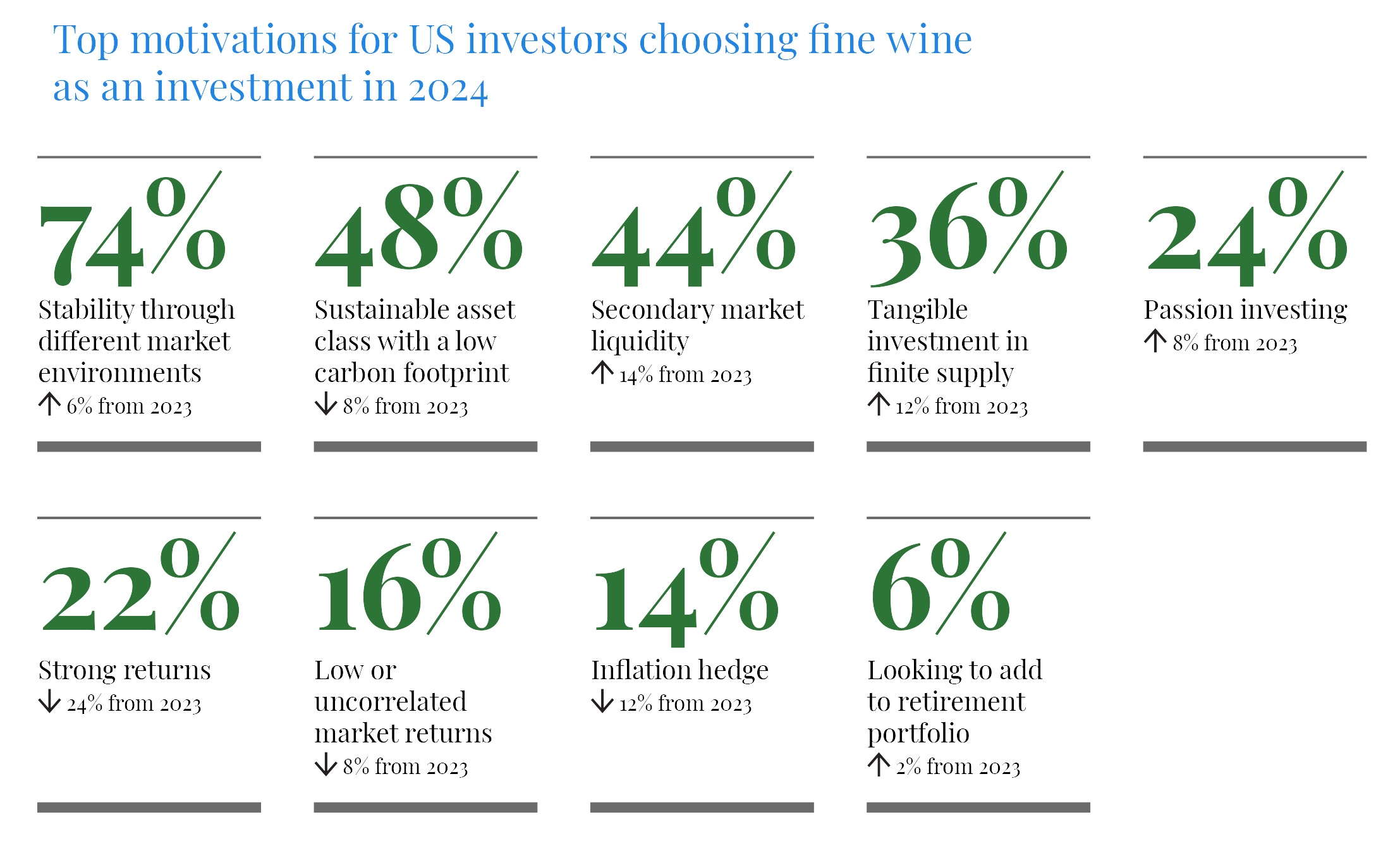
  • Meanwhile, passion investing is on the rise in the US, seeing an 8% uptick since last year.  

Our recent survey among UK and US wealth managers revealed the top reasons why investors are choosing fine wine in 2024. 

While there are differences in their motivations based on demographic, sustainability, stability through different economic environments, and increased liquidity came at the forefront in both markets.  

Fine wine’s stability during market volatility

In uncertain times, investors often seek tangible assets that offer stability. As WineCap’s CEO, Alexander Westgarth puts it, ‘In times of hardship, people want something solid. Literally. Tangible assets like property, gold or fine wine tend to feel more precious during market downfalls’. 

With US market sentiment being one of fear, according to the Fear & Greed index, 74% of US wealth managers chose stability as their top reason to include fine wine in client portfolios, marking a 6% increase from last year.

In the UK, stability came as the second most important factor driving demand for fine wine. It was cited by 56% of our survey respondents, up 16% since 2023. High inflation, slow economic growth and various macroeconomic headwinds have solidified fine wine’s position as a ‘safe haven’ asset, preferred by UK investors. 

Sustainable investing on the rise

Sustainability was the number one reason to invest in fine wine for UK wealth managers, and the second most important factor in the US. 

As we recently explored (‘The growing importance of sustainability in fine wine investment’), there has been a broader global trend where environmental, social, and governance (ESG) factors are increasingly shaping investment strategies across various asset classes, including fine wine.

Research from Morgan Stanley shows that more than half of individual UK investors plan to increase their allocations to sustainable investments in 2024, making fine wine a great investment option. 

According to our survey, 68% of UK investors invest in fine wine because of its low-carbon benefits, with many fine wine producers leading the charge in sustainable viticulture. 

Improved liquidity

Investors in both the UK and US recognise that the fine wine market is becoming more liquid. Advances in technology have opened up new avenues for investors, simplifying buying and selling processes, improving price transparency, and shifting perceptions of fine wine as an “illiquid liquid.”

As a result, UK investor confidence in the market’s liquidity has increased by 32% in 2024. As for the US, there has been a 14% increase from 2023. 

UK tax benefits

UK investors benefit from fine wine’s status as a ‘wasting asset’ making it a more tax-efficient investment. As of April 2024, UK investors pay up to 28% tax on profits over £3,000. Pre-2022, investors paid tax on anything above £12,300, but the past few years have seen the threshold slashed in a bid to plug the ‘fiscal black hole’. 

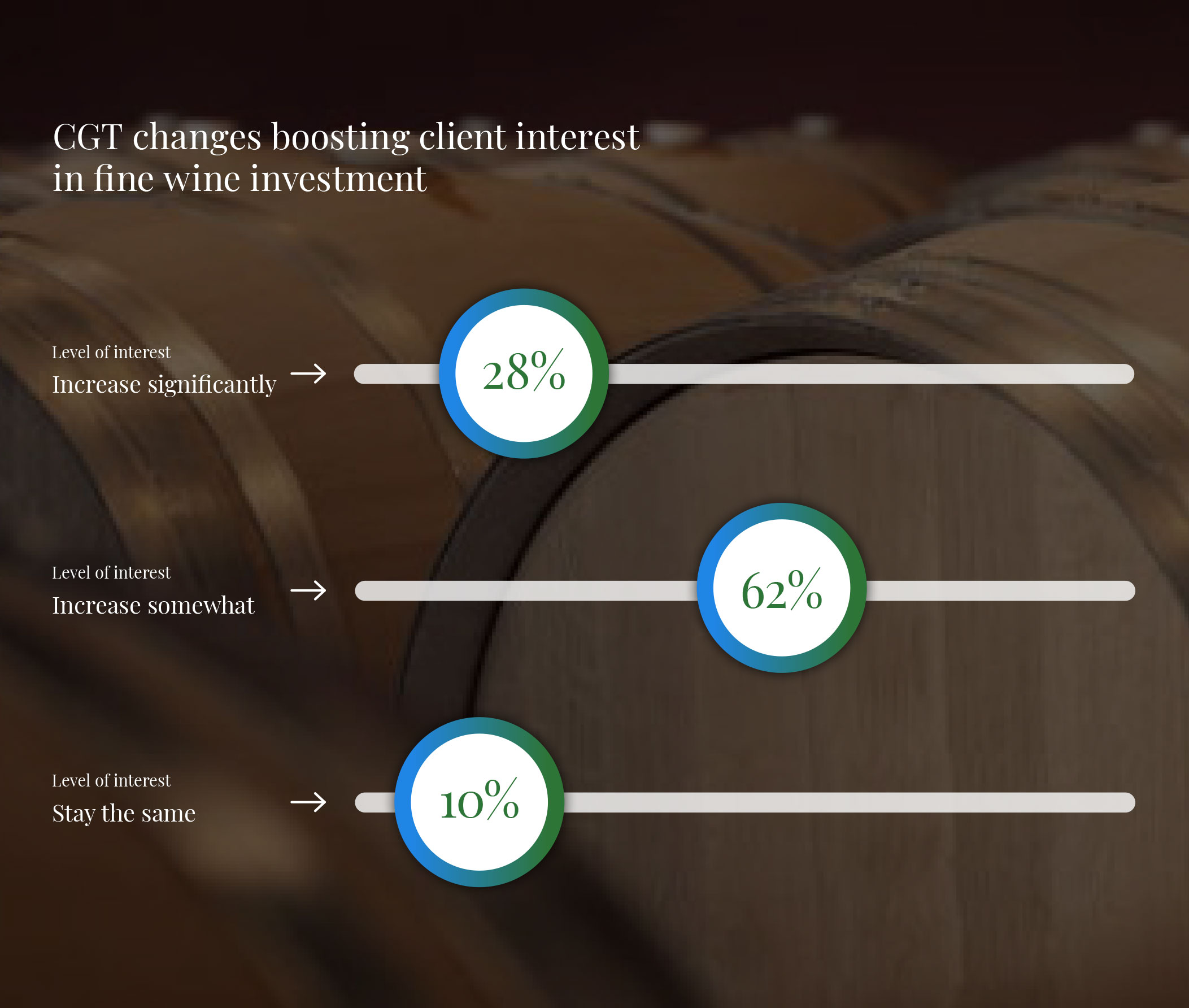
As a ‘wasting asset’, the HMRC does not consider fine wine an investment where the profit should be taxed. Investors recognise this benefit, with 90% of our survey respondents noting that the CGT changes will increase the attractiveness of fine wine.

Tax efficiency was the fourth most important reason for UK investors, cited by 38% of the respondents.

The overlap between collecting and investing in the US

Fine wine, long seen simply as a passion asset, has managed to rebrand itself as a sound alternative investment choice. UK investors today focus less on ‘passion’, a motivation that has seen a 16% dip since last year. 

Still, in the US, many investors start out as collectors. ‘Passion investing’ has been on the rise across the pond, with 24% of the survey respondents being motivated by earning a profit and enjoying the experience that comes with owning a fine wine collection. 

For the full breakdown of the reasons why investors choose fine wine in 2024, read our UK and US Wealth reports.

WineCap’s independent market analysis showcases the value of portfolio diversification and the stability offered by investing in wine. Speak to one of our wine investment experts and start building your portfolio. Schedule your free consultation today.


Categories
Quarterly-reports

Q2 2024 Fine Wine Report

Our Q2 2024 report has now been released. The report examines the macroeconomic factors affecting fine wine prices, the Bordeaux 2023 En Primeur campaign, the best-performing wines, industry news and an outlook for Q3.

Executive summary

  • The second quarter built on the successes of the first, with risk assets delivering another set of positive returns to investors.
  • Global equity markets were buoyed by resilient economic growth and rising investor confidence.
  • UK investment sentiment also improved after a landslide election win for the new Labour government.
  • The fine wine market remains a buyers’ market, with Burgundy and Champagne priced down the most in Q2. 
  • Bordeaux back vintages enjoyed rising demand and prices, following the 2023 En Primeur campaign.
  • The best-performing wine in Q2 was the 100-point Château Léoville Las Cases 2016.
  • This year’s En Primeur yielded mixed results with few great successes despite the general price cuts. 
  • Some of the best releases included the First Growths and their second wines, Beychevelle, and Cheval Blanc.
  • In other news, Sotheby’s Burgundy sale smashed wine auction records and Marchesi Antinori took full ownership of the Washington State winery Col Solare.
  • In buying opportunities, Latour 2009 offers perfect scores at the best possible price on the market.
  • Looking ahead, we anticipate the autumn La Place de Bordeaux campaign following a short summer lull.

The trends that shaped the fine wine market

Economic resilience boasts global markets

The second quarter delivered positive results for global equity markets which were buoyed by resilient economic growth, and supportive earnings and sales expectations. This strong economic foundation has allowed equities to advance, even as stubborn inflation poses potential challenges. Bond markets also appeared attractive; however, the same economic resilience that benefitted equities introduced near-term risks for fixed-income investments.

UK investment sentiment also improved following a landslide election victory for the new Labour government. The British pound, which has been the strongest major currency against the dollar this year, nudged higher when the scale of Labour’s victory became clear. The UK-focused FTSE 250 share index, which has outperformed the more global FTSE 100 year-to-date, rose to its highest level since April 2022, reflecting renewed investor confidence in the country’s economic prospects.

Fine wine – a buyer’s market

Meanwhile, fine wine prices continued to decline. The Liv-ex 1000 index, the broadest measure of the market, is currently at the level it was in August 2021 (388.28). Despite falling prices, trade volumes are higher than this time last year, suggesting that buyers are seizing opportunities to acquire wines at more favourable prices. Moreover, some of the best-performing wines this quarter rose as much as 20% in value. There are opportunities to be had if one follows closely.

En Primeur and Bordeaux’s falling prices

Some of these opportunities arose during the 2023 Bordeaux En Primeur campaign. The best new releases offered a compelling mix of quality and value, with a significant potential for future price appreciation. These included Beychevelle, Cheval Blanc, and the First Growths’ Grand vins and second wines – still, few and far between given the scale of the campaign. In the secondary market, Bordeaux prices fell 1.8% in the second quarter, making back vintages even more attractive. The only index that rose in value as the campaign concluded was the Bordeaux Legends 40 – exceptional older vintages that enjoyed rising demand. 

Regional fine wine performance

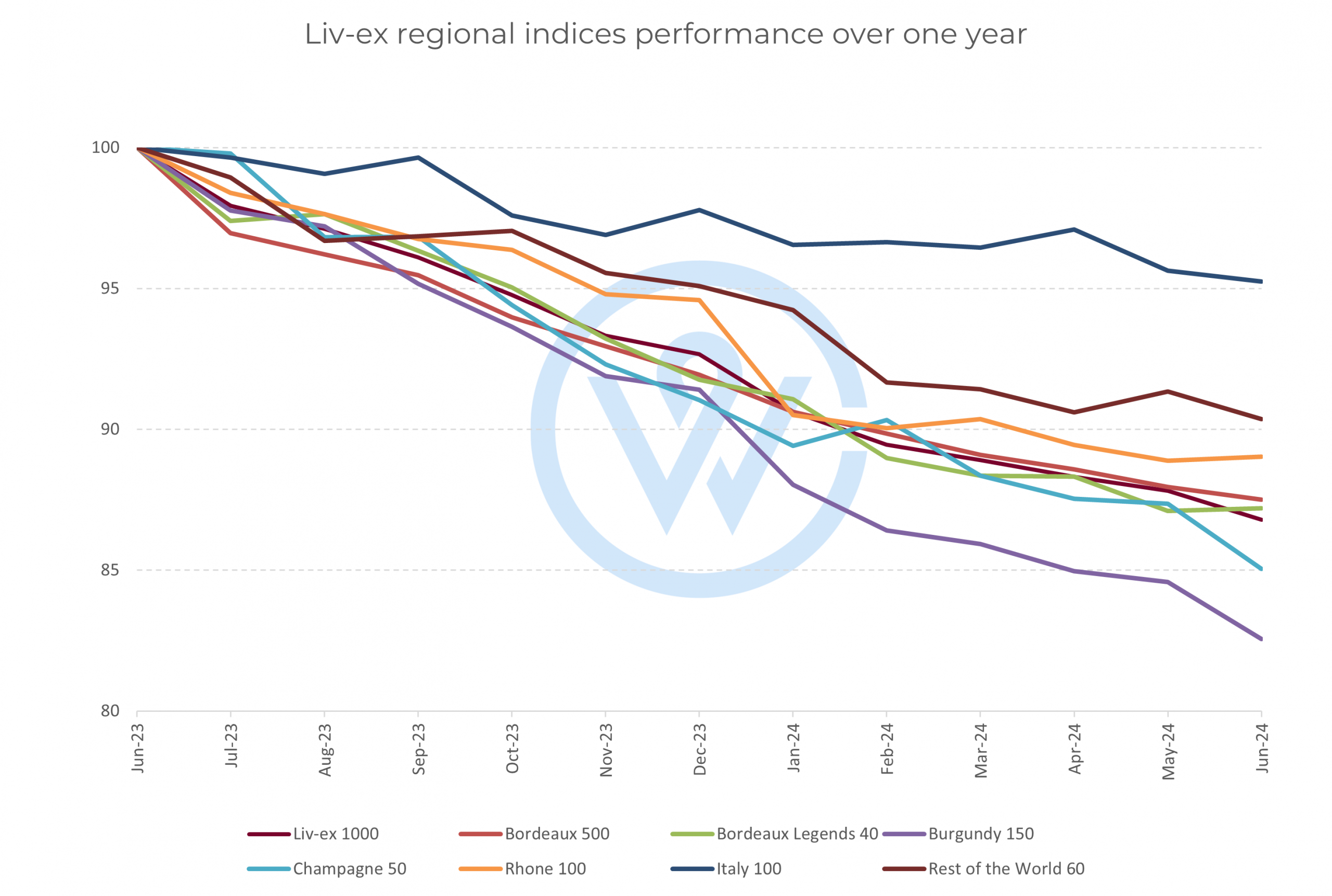
As the market’s focus shifted to new releases, prices in the secondary market fell in Q2. The broadest measure, the Liv-ex 1000 index, dipped 2.4%. It was led lower by the Burgundy 150 (-3.9%) and the Champagne 50 (-3.7%). The Rest of the World 60 and the Italy 100 indices experienced the smallest declines of 1.1% and 1.2% respectively.

As the chart above shows, Italy has shown relative resilience in the current bearish market. Despite broader market uncertainties, some Italian brands have even recorded positive movement in the last six months as high as 15%.

In June, the Bordeaux Legends 40 index recorded its first positive movement in almost a year, rising 0.3%. The index tracks the performance of a selection of 40 Bordeaux wines from exceptional older vintages (from 1989 onwards). As we have previously highlighted, older vintages can often be a lucrative investment prospect, offering a combination of quality, value and bottle age. 

The best-performing wines in Q2

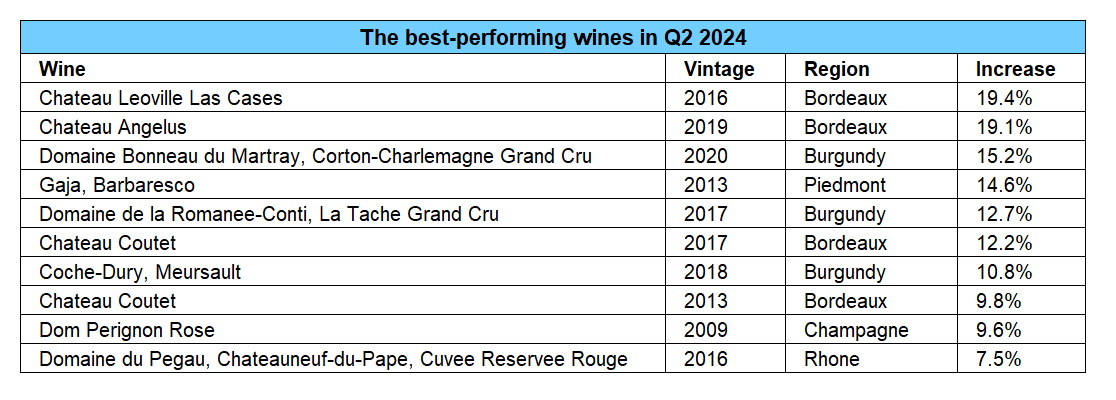
The best-performing wines this quarter were a diverse mix from Bordeaux, Burgundy, Piedmont, the Rhone and Champagne. Leading the charge was the 100-point (WA) Château Léoville Las Cases 2016, with an impressive 19.4% increase. William Kelley described it as ‘one of the high points of this great vintage’. Close behind was Château Angélus 2019, which saw a 19.1% rise.

From Burgundy, Domaine Bonneau du Martray Corton-Charlemagne Grand Cru 2020 came third, up 15.2%. Other wines from the region that rose in value included Domaine de la Romanée-Conti La Tache Grand Cru 2017 and Coche-Dury Meursault 2018

Dom Pérignon Rosé 2009 also made the rankings, with a 9.6% rise this past quarter. On average, prices for the wine have risen 83% in the last decade.

Fine wine news

Sotheby’s Burgundy sale smashes records

On July 5, 2024, Sotheby’s conducted its first exclusive single-owner Burgundy sale, breaking eight world records and achieving €2 million ($2.1 million). Held in the historic Caves du Couvent des Cordeliers in Beaune, the auction featured over 175 lots from Taiwanese entrepreneur Pierre Chen’s cellar.

Top highlights included six bottles of Chevalier Montrachet d’Auvenay 2009, which fetched €106,250 (£89,915), and 12 bottles of Domaine Armand Rousseau Chambertin Clos de Bèze 1990, sold for €100,000 (£84,630). Among the record-setting sales were three bottles of 2005 DRC Échezeaux at €10,000 per bottle and a magnum of 2005 DRC La Tâche at €35,000.

Last month, Chen’s collection of fine and rare Champagne achieved €1.35 million (£1.14 million) at Sotheby’s in Paris, with notable sales including three magnums of Salon Le Mesnil Blanc de Blancs 1990 for €25,000 (£19,600) and a magnum of Dom Pérignon P3 1966 for €23,750 (£20,100), both setting new records.

Sotheby’s expects Chen’s collection to fetch a record $50 million (£39.2 million) by the series’ end, with upcoming auctions in New York and Hong Kong.

Antinori expands into Washington

Marchesi Antinori, one of Italy’s oldest family-owned fine wine producers, has taken full ownership of the Washington State winery Col Solare, which was established as a joint venture in 1995 with Ste. Michelle Wine Estate (SMWE). The acquisition includes the winery, the estate vineyard spanning 12 hectares planted primarily with Cabernet Sauvignon, and the brand, which produces around 5,000 bottles annually. Piero Antinori, president of Marchesi Antinori, expressed admiration for Red Mountain AVA’s unique terroir, emphasising the challenge and excitement of producing high-quality Washington red wines.

Juan Muñoz-Oca, COO of Antinori USA, highlighted the significance of this acquisition, reflecting Washington’s growing reputation for luxury wines. This move follows Antinori’s 2022 acquisition of Napa’s Stag’s Leap Wine Cellars, transitioning from a 15% to 100% stake after SMWE was sold to Sycamore Partners for $1.2 billion in 2021. Besides Stag’s Leap, Antinori owns Antica, a 200-hectare estate in Napa Valley, as part of their expansion in the states.

Buying opportunities: Latour 2009

Château Latour 2009 currently represents a combination of perfect scores and perfect timing. The highest-scoring wine ever at the annual Southwold tasting, Latour 2009 is now at the best price it has been in almost a decade. 

The recipient of no less than five perfect scores from Robert Parker, Lisa Perrotti-Brown MW, Jeff Leve, James Suckling, and Falstaff, Latour 2009 is a stand-out wine among critics. Hailed by Robert Parker as the greatest vintage he’d ever tasted, more recently Neal Martin described it as ‘outstanding’ and a ‘Latour firing on all cylinders’.

Latour is also the highest-scoring 2009 Bordeaux on Cellar Tracker, where it’s also the second-highest-scoring wine of the entire decade, beaten only by Petrus 2000 at more than six times the price.

In terms of price performance, Latour has outperformed all the other First Growths over one, two and five years. 

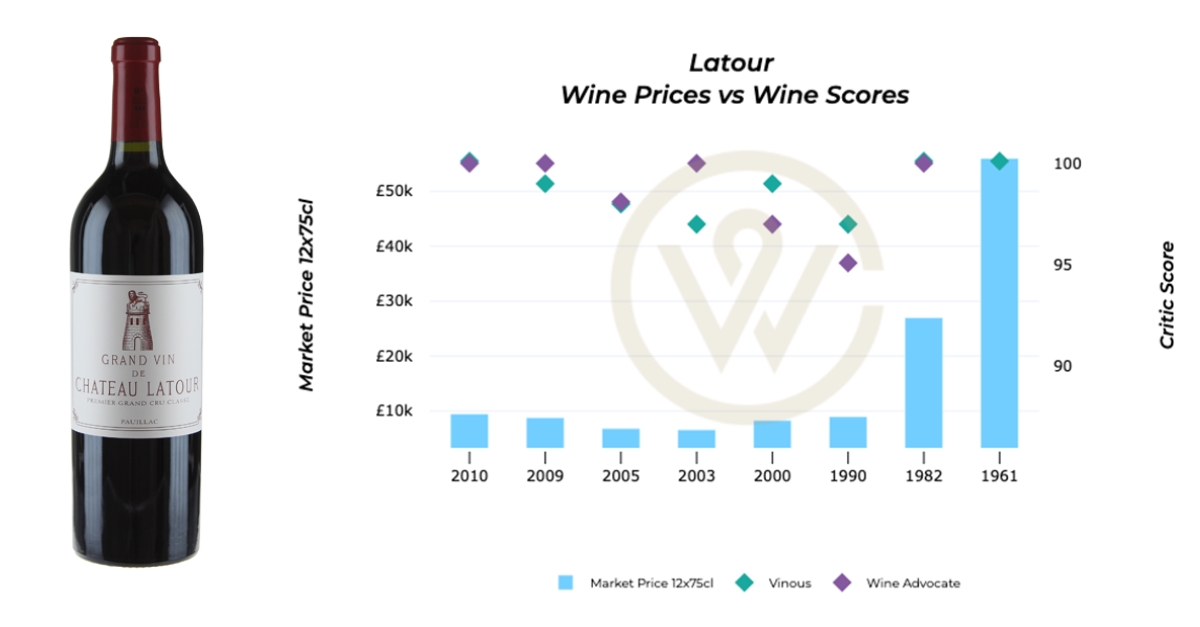
The 2009 vintage, which is currently available at one of the lowest price points ever, offers value among other prime vintages. Its scores match the 1982 and 1961, both of which come at a significant premium.

It is more affordable than the 2010 as well as the 2000 and 1990 vintages but with superior scores than all of them. The 2009 Latour is a hidden gem that seems particularly good to seek out now.

Outlook for Q3

With the onset of the summer lull, the market is expected to experience a temporary slowdown as usual. Despite this seasonal dip, numerous opportunities remain available. The market for collectibles, including fine wine, is gaining popularity among new investors looking for diversity and uncorrelated market returns.  

Over the next two months, the fine wine market will shift its focus to wines from around the globe as the autumn La Place de Bordeaux campaign takes centre stage. Esteemed producers such as Almaviva, Opus One, Vérité, Seña, Catena Zapata, Masseto, and Solaia will unveil their latest vintages on the international stage, accompanied by numerous other exciting releases.

As the campaign expands to include New World wines, the category is expected to see a surge in secondary market demand, potentially driving up prices. We will continue to spotlight the best investment opportunities where exceptional quality and brand prestige meet attractive pricing.

WineCap’s independent market analysis showcases the value of portfolio diversification and the stability offered by investing in wine. Speak to one of our wine investment experts and start building your portfolio. Schedule your free consultation today.

Categories
News

The best of Dom Pérignon: top vintages and investment opportunities

  • Dom Pérignon is one of the most popular wine brands in the world, resonating with drinkers, collectors and investors.
  • This week saw the latest Dom Pérignon vintage release – the 2015. 
  • Dom Pérignon prices have risen on average 90% in the last decade.

Dom Pérignon is one of the most popular wine brands in the world. It consistently ranks in Wine-Searcher’s top five most searched-for wines, and its label resonates with drinkers, collectors and investors alike.

Latest vintage release: Dom Pérignon 2015

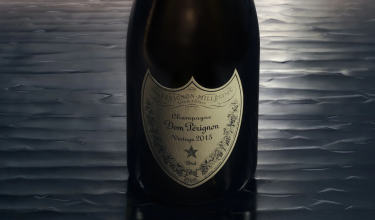
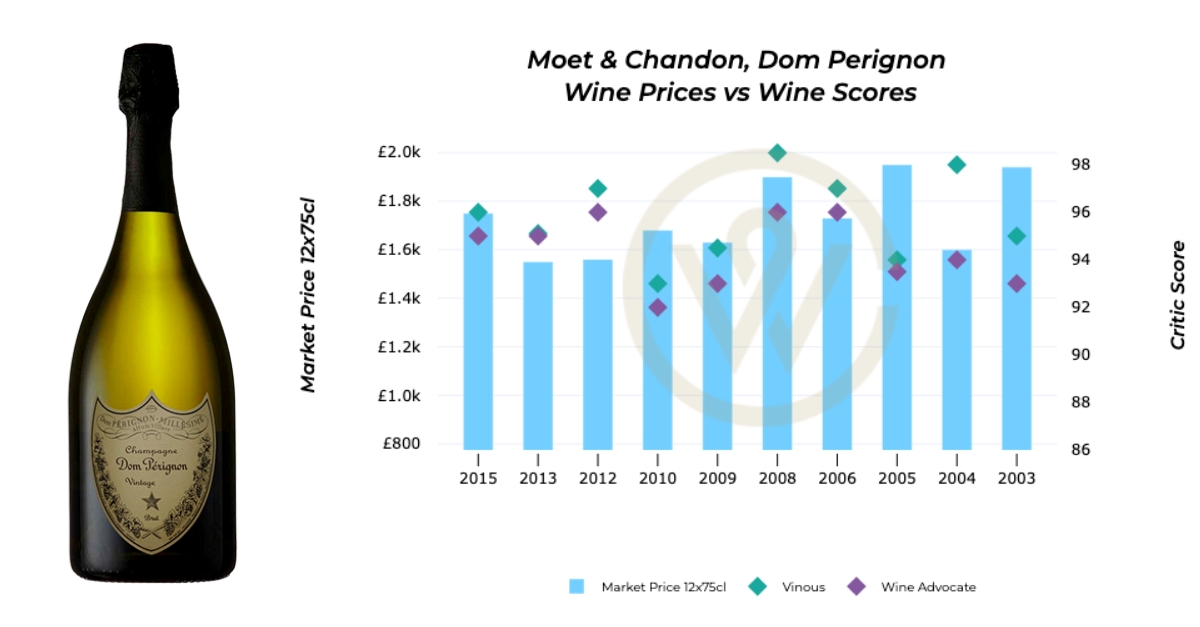
This week saw the latest vintage release from the renowned Champagne house – Dom Pérignon 2015, with a recommended retail price of £1,750 per 12×75 case. The wine boasts 96 points from Antonio Galloni (Vinous) who said that it ‘shows terrific energy’ and ‘is a fine showing in a vintage that has proven to be tricky’.

Brief history of Dom Pérignon

Dom Pérignon is named after a Benedictine monk, Dom Pierre Pérignon (1638–1715). As a cellar master at the Abbey of Hautvillers in the Champagne region of France, he significantly contributed to the quality and production methods of Champagne, such as blending grapes from different vineyards and improving clarity. Moët & Chandon introduced the Dom Pérignon brand as its prestige cuvée in the 20th century, with the first vintage released in 1921. Since then, the wine has become synonymous with luxury and celebration.

Dom Pérignon investment performance

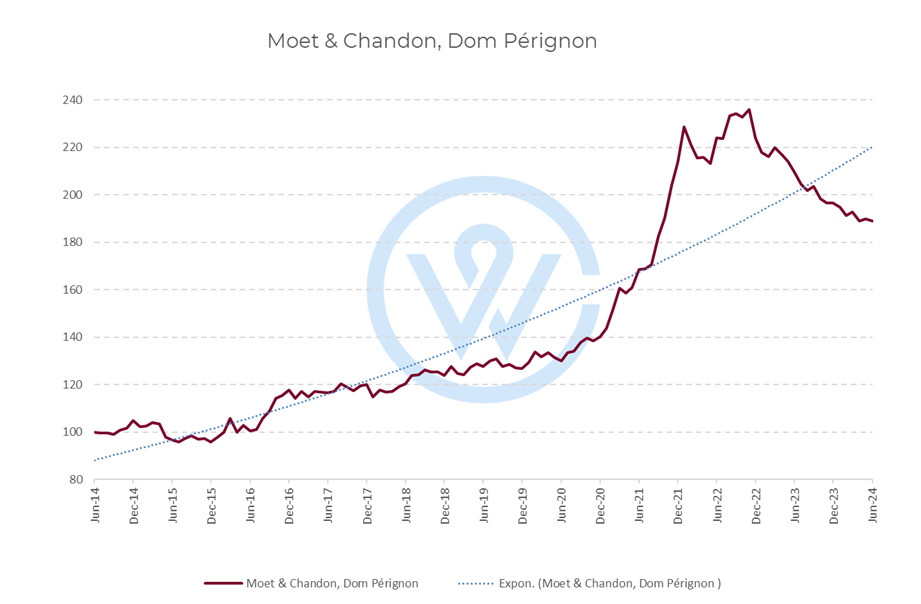
Dom Pérignon has been one of the most popular Champagne brands for investment for a reason. On average, prices have risen 90% over the last decade. The Dom Pérignon index hit an all-time high in November 2022 (up 136% since June 2014). Prices have since come off their peak making now an opportune time to buy, given the overall upward trend. 

The average Dom Pérignon price per case is £2,260, making it more affordable than other popular investment-grade Champagnes like Krug, Louis Roederer Cristal, Pol Roger Sir Winston Churchill, Bollinger RD and Philipponnat Clos des Goisses, all the while providing similar returns.

The highest-scoring Dom Pérignon vintages 

The highest-scoring Dom Pérignon vintage from Galloni is the 2008 (98+), which he describes as ‘magnificent’ and a ‘Champagne that plays in three dimensions’.

The 2004 (‘one of my favourite Dom Pérignons’) and 2002 (‘speaks to opulence and intensity’) boast 98-points from the critic. Up next with 97-points is 2012, which he called ‘a dynamic Champagne endowed with tremendous character’, and the ‘beautifully balanced, harmonious’ 2006. 

From Wine Advocate, the top-scoring Dom Pérignon vintages include 1996 (98 pts), 1961 (97 pts), and several vintages scoring 96 points, such as 2008, 2002, 2006, 1976, 1990, 1982, and 2012.

The best value Dom Pérignon on the market today

The 2004 and 2012 Dom Pérignon vintages are two of the most popular, not least because they offer great value in the context of other vintages. They are two of the most affordable on the market today, while also boasting high scores. The 2004 further benefits from additional time in bottle; however, these earlier vintages are often harder to source than the new releases.

Regardless of the vintage of choice, and whether for investment or collecting, Dom Pérignon remains the pinnacle of the Champagne world. Its strong branding, outstanding quality and investment performance make it a top choice for wine enthusiasts and investors alike.

WineCap’s independent market analysis showcases the value of portfolio diversification and the stability offered by investing in wine. Speak to one of our wine investment experts and start building your portfolio. Schedule your free consultation today.