Categories
News

Pound strength creates opportunity in Californian wine

  • Sterling strength against the US dollar, combined with Californian fine wine prices down 11.4% year-on-year create prime buying conditions for European investors.
  • From Screaming Eagle and Opus One to Bond Melbury and Aubert Chardonnay, select Californian wines are showing resilience and strong returns.
  • US wines are not subject to the same tariffs as European wines entering America, amplifying the current opportunity.

Currency tailwinds meet market softness

With pound sterling trading near its strongest levels against the US dollar in almost a decade, European fine wine buyers are enjoying a rare currency advantage. In addition, prices for Californian fine wine have fallen 11.4% on average in the last year – a steeper drop than Burgundy, Champagne, Italy and the Rhône. And while European exports are now subject to a 15% tariff in America, American wines enter the EU with only minimal import duties. 

For those looking west, this means more than just favourable exchange rates – it’s a window of opportunity to acquire some of California’s top investment-grade wines at effectively lower prices. The combination of market softness in the US and a relatively strong pound has created a buying climate that hasn’t been so compelling in years.

California’s investment appeal

California has long been America’s fine wine powerhouse, with its top labels regularly commanding global attention alongside Bordeaux First Growths and Burgundy Grand Crus. The state offers remarkable diversity, from the cult Cabernet Sauvignons of Napa Valley to the elegant Chardonnays of the Sonoma Coast.

Yet it is also a market where fine wines have historically been harder to acquire in Europe. Limited allocations, strong domestic demand, and brand-loyal followings have often kept supply tight. In the current environment, however, these barriers have eased slightly. Some of California’s most iconic names are trading at multi-year lows, as part of the wider correction in the global fine wine market.

Screaming Eagle: The US investment benchmark

Screaming Eagle remains the top traded US wine by value, with a market history as intense as its scarcity. With six perfect 100-point scores in just 13 vintages, it sits in a league of its own among American wines. Over the past two decades, Screaming Eagle’s prices have climbed more than 200%, making it one of the most lucrative long-term holds in the fine wine market.

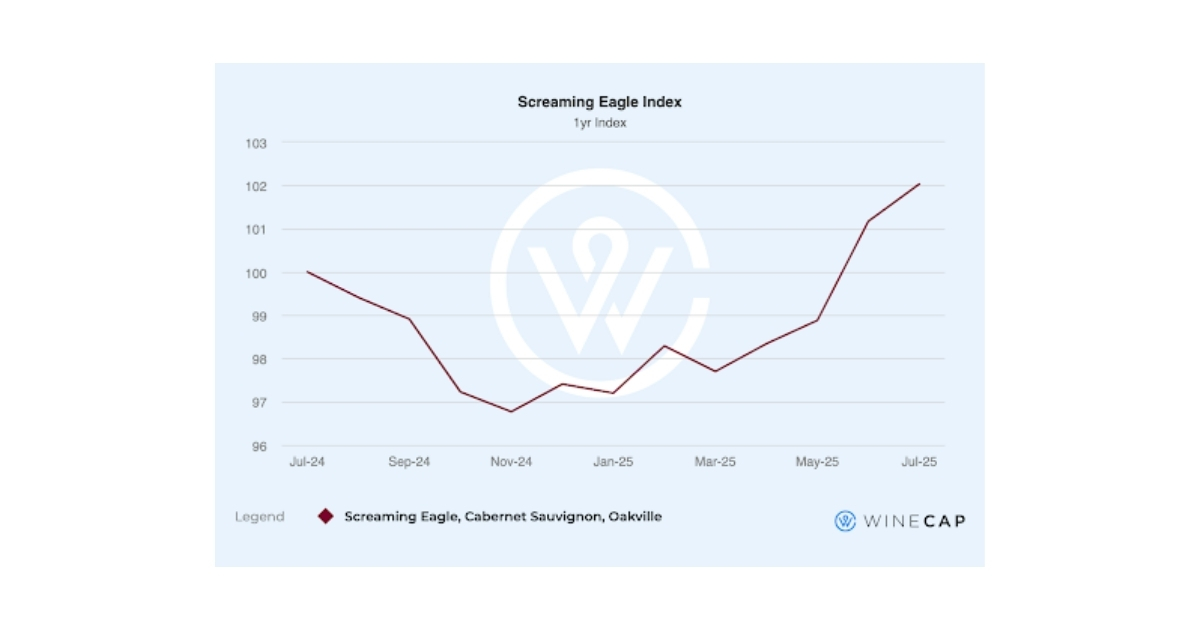
That said, the past few years have been volatile. After peaking in 2022, prices fell as broader market sentiment cooled, particularly in the ultra-high-end segment. The Screaming Eagle index has since shown signs of stabilisation, rising more than 5% year-to-date. For investors, this is often the sweet spot – when a correction has bottomed and momentum begins to turn.
Screaming Eagle wine performance

The 2021 vintage is especially compelling. A 100-point release, it remains the most affordable among the perfect-score cohort. For those seeking a rare combination of topmost quality, brand prestige, and relative value, this vintage offers an unusually attractive entry point.

Other Californian fine wines to watch

While Screaming Eagle often dominates the conversation, California’s investment landscape is far broader. Several names have shown resilience or are quietly building momentum:

  • Opus One – This Franco-American collaboration has traded in higher volumes this year on Liv-ex than European stalwarts such as Léoville Las Cases, Ornellaia, and Pol Roger Sir Winston Churchill. Year-to-date, our Opus One wine index is up 4%, with healthy liquidity that makes it attractive for active traders.
  • Joseph Phelps Insignia – A model of consistency, Insignia’s prices have risen through the broader market downturn. The index is up 7% over the past six months and has appreciated more than 70% in the last decade. Its track record makes it one of the most reliable US names for long-term investment.
  • Dominus – Known for its Bordeaux-style Napa blends, Dominus has declined just 1% in the past year. More recently, it has begun consolidating, with a 2% rise since January 2025, suggesting a potential base is forming for the next move higher.

These examples highlight an important point: not all Californian wines follow the same market rhythm. While the ultra-luxury segment can be more volatile, there are pockets of stability and even steady growth available to more risk-conscious investors.

Top-performing US wines over the past year

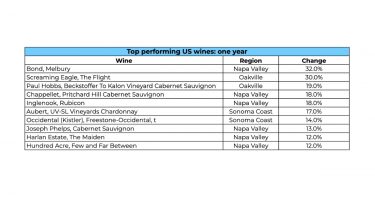
According to Wine Track, several Californian labels have posted double-digit gains despite general market challenges and political uncertainty. This once again underscores the value of selective buying, even in a cooling market.
Top performing US wines

Bond Melbury and Screaming Eagle The Flight lead the field, each posting gains of 30% or more – an impressive performance given the overall market softness. Both wines share similar investment traits: small production, critical acclaim, and established brand prestige.

The appearance of Aubert Chardonnay and Occidental Pinot Noir on this list also highlights a growing trend: high-quality Californian whites and Pinot Noirs are attracting more collector attention, offering diversification beyond Cabernet Sauvignon and Bordeaux-style blends.

Investment takeaways

The combination of currency tailwinds and a market correction presents a rare opportunity for European buyers. For investors, the strategy is twofold:

  1. Target icons at cyclical lows: Screaming Eagle, Opus One, Harlan Estate, and Dominus are trading below peak levels, offering the potential for recovery-driven gains.
  2. Diversify with proven mid-tier performers: wines like Bond Melbury, Aubert Chardonnay, and Chappellet have delivered strong recent returns and often come with lower volatility than the ultra-cult names.

With sterling strong and US prices still subdued, this is a moment where timing and selectivity could translate into meaningful portfolio gains. California may be half a world away, but for European investors, the opportunity has rarely felt closer.

For more, read our United States Regional Report.

Categories
Regional-reports

United States | Regional Report

1976 was the turning point for California and US wine in general. ‘The Judgement of Paris’ blind tasting on May 24th proved that France had a serious contender when top Californian Bordeaux blends were tasted against Bordeaux classed growths, and Californian Chardonnays against white Burgundy. To the surprise of many, California led on both fronts.

This was the first step that set the region in motion. In the 1990s, the first Californian ‘cult wines’ emerged – big brands that attracted collector followings. Producers such as Inglenook, Stag’s Leap, and Robert Mondavi were the pioneers, but it was Screaming Eagle that established the formula for success that many followed: tiny volumes, word-of-mouth hype, and soaring prices. Robert Parker’s appraisal and perfect scores further bolstered their image.

The global market for US wines, dominated by California but also featuring wines from Washington and Oregon, has exploded in recent years. Its share of secondary market trade has risen from 0.1% in 2010 to around 7% this year, and an increasing number of previously overlooked wineries are now showing investment-worthy returns.

Our USA Report delves into the development of its investment market, historic performance, recent expansion and key players.

Discover more about:

  • History of the US wine industry
  • International and domestic trade
  • California’s most significant AVAs
  • Napa Valley’s investment-worthy wines

Do not hesitate to get in touch and speak to one of our wine investment advisors for further information and to reserve your allocations.

Download your complimentary copy of the United States Regional Report and discover how fine wine can enhance your investment portfolio.

United States Regional ReportDownload


Categories
News

What to expect from the 2024 La Place de Bordeaux campaign?

  • La Place de Bordeaux’s autumn campaign continues to expand, with new entries from Germany, France and the rest of the world.
  • The network offers producers logistics expertise and knowledge of the world’s fine wine markets.
  • Some of the top brands that enjoy sustained demand every year include Californian cult wines Opus One and Promontory, and the Super Tuscans Solaia and Masseto.

Following a mixed 2023 Bordeaux En Primeur campaign, which saw many châteaux lowering their prices compared to last year, this autumn will see the annual hors Bordeaux La Place campaign.

As the market for Bordeaux narrows, the system, originally designed purely to sell the wines from the region, continues to expand. However, it’s essential to recognise the challenges that lie ahead.

Current market sentiment

The fine wine market is currently navigating through a period of uncertainty. Economic downturns in key markets like China, where Bordeaux sales have plummeted by two-thirds since their peak in 2017, and the looming threat of a recession in the US, have created a cautious environment. This has significantly impacted confidence in the market, with many stakeholders bracing for a potentially attritional campaign this autumn.

Continued expansion of La Place de Bordeaux

For new producers, the benefits of joining the La Place distribution network are manifold. As Areni put it in a recent article, ‘La Place offers fine wine producers something remarkable: a depth and breadth of fine wine expertise, coupled with a fine-grained knowledge of the world’s fine wine markets and plenty of logistics expertise. La Place also offers prestige, making it highly attractive to many of the world’s fine wine producers’.

According to Mathieu Chadronnier, president of Bordeaux négociant CVBG, ‘We will see more wines from beyond Bordeaux come to La Place. That trend is not going anywhere because the fundamental rationale that fine wine is one single category that embraces regions and countries of origin remains.’

This shift is particularly significant in light of the current market conditions. As Bordeaux faces challenges, the inclusion of international wines has become more crucial, providing a broader range of offerings and catering to an increasingly global market.

New entries on La Place

Ernst Loosen, the renowned Mosel-based producer, is entering La Place for the first time this year with a limited-production wine, Weingut Dr. Loosen, Zach. Bergweiler-Prüm Erben.

Meanwhile, Rheingau Riesling producer Schloss Johannisberg is advancing its strategy to expand the global reach of its premium Rieslings. This autumn, they will introduce Schloss Johannisberg Riesling Goldlack and Schloss Johannisberg Riesling Orangelack Kabinett to a broader international audience using the network’s global reach.

Additionally, Maison Georges Vigouroux will release the first Malbec from Cahors – Château de Haute-Serre Grand Malbec 2022 – through La Place de Bordeaux. This marks the first global ‘icon’ wine from the appellation since phylloxera nearly eradicated the grape variety in France almost 200 years ago.

Top brands to watch

The coming weeks will see the release of the latest vintage from some of the hottest brands, including the Super Tuscans Solaia, Masseto and Bibi Graetz, Californian cult wine Opus One joined by estates such as Inglenook, Joseph Phelps and Promontory, the Chilean Almaviva, Viñedo Chadwick and Viña Seña.

From Australia, Wynns will release the 2021 John Riddoch, Cloudburst its Cabernet Sauvignon, Chardonnay and Malbec 2021, Jim Barry ‘The Armagh’ Shiraz 2021, and Penfolds Bin 169 2022.

France will also see the release of the 2022 vintage of Le Petit Cheval Blanc, Y de Yquem and Château de Beaucastel Hommage à Jacques Perrin, Philipponnat Clos des Goisses 2015, and Latour 2009.

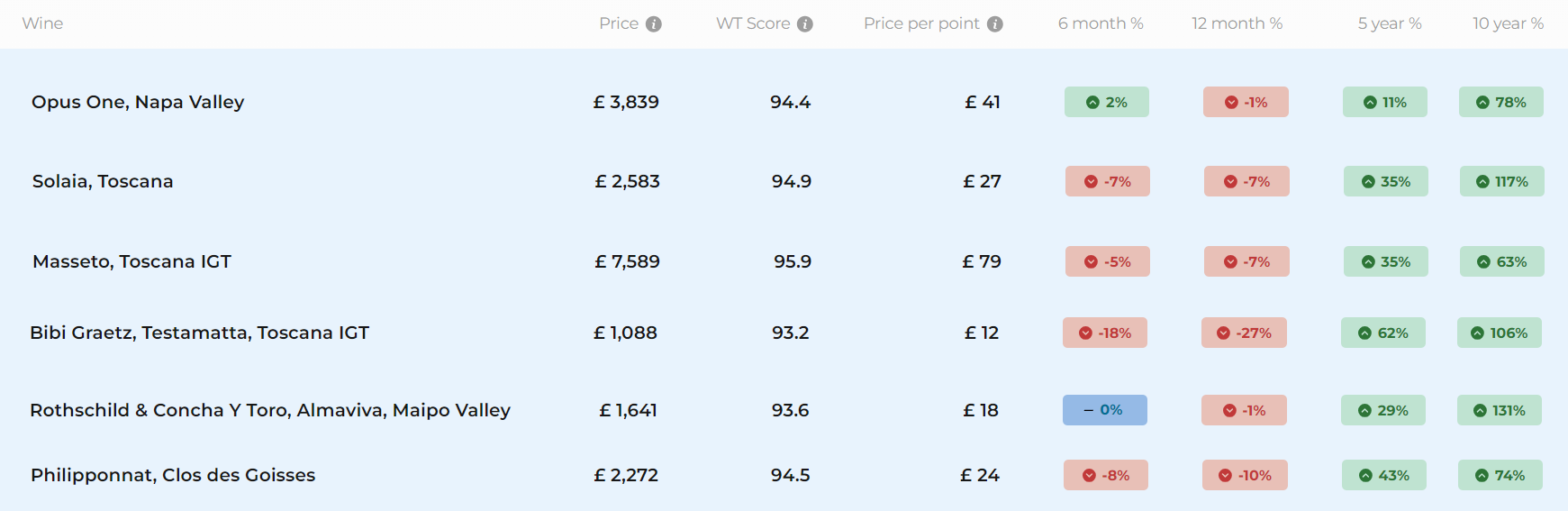
The table below shows the performance and price points of some of the top brands released via La Place de Bordeaux every autumn.

Long-term prospects

Although prices for all these brands have fallen in the last year – creating the so called ‘buyer’s market’ – they remain great long term investments. Moreover, the new releases enjoy sustained demand year after year.

The current downturn in the market presents an opportunity for change. This period of uncertainty has led to more informed decision-making, a focus on quality, and a more selective approach to the new releases.

The 2024 La Place de Bordeaux campaign is set to be a dynamic and expansive event, showcasing a diverse array of global wines alongside the region’s traditional offerings. Despite the current challenges, the long-term prospects for La Place are promising, with the potential for significant growth and continued evolution in the years to come.

WineCap’s independent market analysis showcases the value of portfolio diversification and the stability offered by investing in wine. Speak to one of our wine investment experts and start building your portfolio. Schedule your free consultation today.

Categories
Quarterly-reports

Q1 2024 Fine Wine Report

Our Q1 2024 Fine Wine Report has now been released. The report offers a comprehensive overview of the fine wine market in the last quarter, including the impact of interest rates and geopolitical risks, the best-performing wines and regions, and analysis on the rising popularity of non-vintage Champagne as an investment.

Report highlights:

  • Mainstream markets rallied in Q1 2024, driven by resilient economic growth and expectations for future interest rate cuts by central banks.
  • The first green shoots started to appear in the fine wine market towards the end of Q1.
  • Fine wine prices (Liv-ex 100 index) experienced a smaller decline of 1% in Q1, compared to a fall of 4.2% in Q4 2023.
  • Italian wine enjoyed rising demand amid a flurry of new releases, including the 100-point Sassicaia 2021.
  • A number of Champagne labels that experienced consistent declines last year have started to recover, including Dom Pérignon, Salon Le Mesnil, and Pol Roger.
  • The Burgundy 2022 En Primeur campaign delivered high quality and quantity, with about 10% of producers reducing pricing year-on-year due to the challenging market environment.
  • China lifted tariffs on Australian wine after more than three years.
  • Critics and trade are now preparing for the 2023 Bordeaux En Primeur campaign, which will dominate the news in Q2 2024.

Click below to download your free copy of our quarterly investment report.


Fine Wine Report

Categories
Learn

Inside the USA’s wine investment market

The following article is an extract from our USA regional wine investment report.

  • Today, the USA is one of the key fine wine investment regions.
  • Its share of secondary market trade has risen from 0.1% in 2010 to around 8% this year.
  • Demand has been stimulated by a string of good vintages in the past decade, high critic scores, and expanding distribution.

Today, the USA is one of the key fine wine investment regions. Its share of secondary market trade has risen from 0.1% in 2010 to about 8% this year, and an increasing number of previously overlooked wineries are now showing investment-worthy returns.

Inside the USA’s investment market

California has long been the driver behind the USA’s ever-growing presence in the fine wine investment landscape, accounting for roughly 99% of the country’s secondary market trade. Buying demand has been largely UK and US-driven and centred around the top names: Screaming Eagle, Opus One, Dominus, Harlan Estate, Promontory, and Scarecrow.

Price differentials

California is the second-most-expensive fine wine region after Burgundy, based on the average price of its leading estates. However, there are big differences in pricing between the region’s top names.

At the time of writing, the average case price of Screaming Eagle Cabernet Sauvignon is £39,117, compared to £7,399 for Promontory, £3,764 for Opus One, £2,773 for Dominus, and £2,719 for Ridge Monte Bello. To explore average trade prices, visit our indexing tool Wine Track.

Price performance

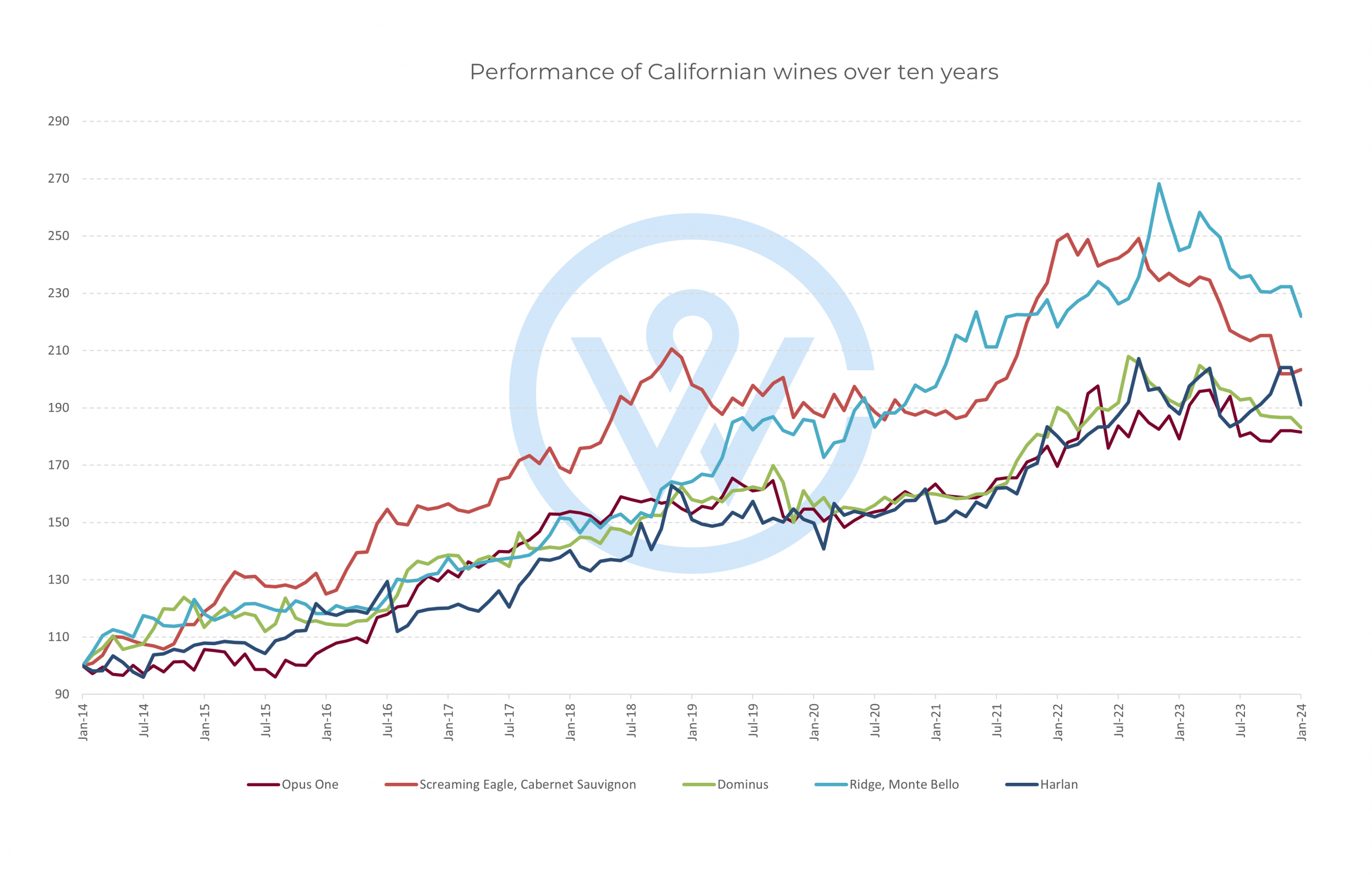
Prices for Californian fine wines have risen slowly and steadily. Over the last 15 years, the Liv-ex California 50 index which tracks the price movements of the last 10 physical vintages across five of the most traded brands (Dominus, Opus One, Harlan, Ridge, and Screaming Eagle) has outperformed both the Liv-ex 100 and Liv-ex 1000 indices. The California 50 is up 166.2%, compared to 71.6% for the Liv-ex 100 and 116.6% for the Liv-ex 1000. Moreover, over the long and short term, California has fared better than Bordeaux as an investment, yielding higher returns.

The best brands for investment

Among the most popular labels, Ridge Monte Bello has been the best-performing Californian wine, up 121.9% in the last decade. It has been followed by Screaming Eagle Cabernet Sauvignon with a 103.3% rise and Harlan, up 91.1%. All the wines in the chart below have risen over 80% in the last decade.

However, other producers beyond the most traded names have also been making waves. Caymus Cabernet Sauvignon has risen an impressive 154.8%, while Dunn Howell Mountain Cabernet Sauvignon is up 137.5% in the last decade. This data suggests that there is a significant number of American wines beyond the most popular names that can deliver healthy investment returns.

California: A 100-point region

Price performance has been influenced by ‘cult’ status and vintage quality. California regularly tops critic rankings as the region with the most 100-point wines. Relatively consistent climate has led to less vintage variation than in other dominant fine-wine producing regions. Major critic publications like Wine Advocate and Wine Enthusiast highlight 2001, 2007, 2012, 2013, 2015, 2016, 2018, 2019, and 2021 as particularly good.

To find out more about the investment market for US wines, read the full report here.

Categories
Learn

Fine Wine Investment for Beginners

Fine wine investment is increasingly gaining popularity amongst beginners and novices looking to reap the benefits of this alternative asset. Not only is it a proven way to diversify and strengthen an investment portfolio, but also an enjoyable pastime for wine enthusiasts and budding connoisseurs.

Surging prices regularly push fine wine investment into the spotlight, and headlines are filled with stories of investors who bought wine at low prices, then sold it years later for thousands. But how and where do you get started as a beginner? And what are the wine investment returns that you can expect?

The following guide provides an overview of the fine wine investment market and how it works in practice.

How big is the wine investment market?

Investing in wine is no new phenomenon. In fact, it has existed in different forms since antiquity, as wine was circulated and traded throughout the ancient world by Greeks, Egyptians, Phoenicians, and Romans. The writings of Thomas Jefferson provide one of the first pieces of evidence of a premium charged for an older wine. In 1787, he wrote that the 1786 vintage for top Bordeaux wines cost 1800 livres per tonneau compared to 2000 livres for the older 1783. Through the centuries, shrewd wine lovers have been selling part of their collections as a way of subsidising their consumption, leveraging the gains of a uniquely rarifying asset against their own cellars.

Today, the market is transparent and open for beginners as well as experienced investors looking to embark on their wine journey. Investing in fine wine is easier than ever, thanks to specialised wine investment companies, relying on current market data and the latest technology.

The global wine market is forecast to reach US$525 billion by 2025. But while fine wine has emerged as a popular alternative investment, not every wine is investment worthy. For example, the majority of wines produced in renowned regions, such as Burgundy and Bordeaux – perhaps surprisingly – often won’t appreciate in value. In fact, of all the wines made worldwide, only a very small percentage have the potential to improve as they age, and an even smaller percentage of that group has the capacity to see its price rise.

Precisely this scarcity of investible wines is one of the main drivers behind wine investment’s profitability. The limited supply of collectible wine leads to price increases, especially for labels in high demand. This is why it is important to keep abreast of the latest market trends and factors influencing global appetite.

More fine wine investment opportunities than ever before

Historically, Bordeaux’s classified growths have been the leading force on the fine wine investment market. In 2010, Bordeaux took 96% of all trade on the global marketplace for wine. Today, it accounts for less than a third of this market by value.

The main reason behind its declining trade share is that the fine wine investment market is bigger and broader than ever before. Other French regions like Burgundy, Champagne and the Rhône, USA, Italy (led by Tuscany and Piedmont), Germany, Spain and Australia are increasingly seen as reliable sources of considerable wine investment returns.

Investing in fine wine is thus not limited to a small group of wines, contrary to what one might expect. There are more opportunities than ever before that can be suited to your stylistic preferences and budget. The collectors’ market is booming, with record number of investible wines trading right now.

Greater fine wine investment returns

As global demand for fine wine has grown, the investment returns have increased too. Burgundy is a prime example. Thanks to its iconic status and its tiny production levels, early investors in the sector have seen eye-watering growth: upwards of 2000% in 15 years for some wines. The volume, value and breadth of trading has increased significantly, and wine prices have risen dramatically over the last decade; the region’s major index is up almost 200% in the past ten years.

Meanwhile, investors in Champagne have benefitted from supremely consistent returns, although it is not the most expensive or the rarest of fine wines. Its brand strength and distribution network, however, remain unparalleled.

Prices for different regions and wines have risen at a different pace. Region and wine-specific factors thus play a role in the returns that an investor can expect, the cost and length of the investment.

How long do I need to invest in fine wines for?

Fine wine is considered a medium to long-term investment. As a general rule, we advise our clients to hold their wines for three years at the very least.

Many collectible wines have long ageing windows, between ten and 50 years. As the scarcity and quality of fine wine appreciates over time, so does its value. The premise of fine wine investment is to buy wine when it’s young, then sell it once it’s older and more valuable. There are other external factors that may help determine how quickly a wine may deliver the desired returns such as critic scores, supply/demand and significant events related to the region or the producer.

For instance, the price of the Super Tuscan Sassicaia 2015 went up 25% in the day when the American publication Wine Spectator announced its ‘Wine of the Year 2018’. Those buying and re-selling the wine on the day would have made a small profit; however, those holding the wine since release would have seen its value rise over 160% to the present day.

As a long-term low-risk investment, fine wine doesn’t lose its value overnight. Where share prices may increase one day and decrease the next, fine wine provides stable returns year after year. Its low volatility has led many to consider it the best ‘safe-haven’ asset – a great advantage particularly in times of market turmoil.

Unlike mainstream assets, fine wine is fairly insensitive to macro-economic events. When global markets tumbled due to ongoing Covid-19 restrictions and upon Russia’s invasion of Ukraine, fine wine remained resilient. The returns of leading fine wine indices were greater than the FTSE100, S&P500 and even other safe investments such as gold.

How do I start investing in wine?

There are a lot of decisions you need to make when taking on wine investment. Wine investment experts like our team here at WineCap can help you make decisions relating to the following factors:

Set a wine investment strategy

The first step is to set your budget. Consider how long you would like to hold your wines for and your preferred investment strategy. Fine wines command a range of prices depending on the producer, how much of their wine is made and the wines’ age. Make sure to set your budget before embarking on building your portfolio so you can ensure you have exposure to all countries and regions.

Speak to a wine investment expert

There are different routes to accessing the wine investment market, such as through specialised retailers and auction houses. Expert wine investment brokers offer unbiased advice on strategic investment opportunities and can help you build your portfolio, based on your preferred length of investment and budget. While WineCap doesn’t charge any annual fees, most wine investment companies do, so be sure to do your research and be aware of any fees your portfolio might incur.

Select world-class wines for your portfolio

A wine investment expert will help you find the wines best suited for your investment portfolio. WineCap has formed long-lasting relationships over the past decade with négociants, wholesalers and private collectors. This means that we have access to some of the world’s most prized wines. What’s more, our unique proprietary technology analyses over 400,000 wine prices a day to identify the right, undervalued wines to buy and sell across the global market at the right time and price.

Store your wines professionally

Choose to keep your wines in government bonded warehouses as this will ensure they are professionally stored in temperature-controlled conditions best-suited for ageing wines. World-class care ensures that when you come to sell, your wines’ provenance will quickly secure maximum prices.

Fine wine investment can be daunting if you are a beginner, but with a little practice and help you can soon enjoy the benefits of the best-performing luxury asset.

Ready to get started now you know more about how to invest in wine? Speak to one of WineCap’s investment experts to discover the next steps on your wine journey.

Categories
Report

United States | Regional Report

1976 was the turning point for California and US wine in general. ‘The Judgement of Paris’ blind tasting on May 24th proved that France had a serious contender when top Californian Bordeaux blends were tasted against Bordeaux classed growths, and Californian Chardonnays against white Burgundy. To the surprise of many, California led on both fronts.

This was the first step that set the region in motion. In the 1990s, the first Californian ‘cult wines’ emerged – big brands that attracted collector followings. Producers such as Inglenook, Stag’s Leap, and Robert Mondavi were the pioneers, but it was Screaming Eagle that established the formula for success that many followed: tiny volumes, word-of-mouth hype, and soaring prices. Robert Parker’s appraisal and perfect scores further bolstered their image.

The global market for US wines, dominated by California but also featuring wines from Washington and Oregon, has exploded in recent years. Its share of secondary market trade has risen from 0.1% in 2010 to around 7% this year, and an increasing number of previously overlooked wineries are now showing investment-worthy returns.

Our USA Report delves into the development of its investment market, historic performance, recent expansion and key players.

Discover more about:

  • History of the US wine industry
  • International and domestic trade
  • California’s most significant AVAs
  • Napa Valley’s investment-worthy wines

Do not hesitate to get in touch and speak to one of our wine investment advisors for further information and to reserve your allocations.

Categories
Report

United States Regional Report

Our United States Regional Report explores the development of an investment market, the emergence of cult wines and other key players.

The modern story of US fine wine begins in 1976, with the now-legendary Judgement of Paris. In a blind tasting held on 24 May, leading Californian Bordeaux-style blends were pitted against classified growth Bordeaux, and Californian Chardonnays against white Burgundy. To the surprise of many – and the disbelief of some – California emerged victorious in both categories.

This moment marked a turning point for American wine. What followed was not an overnight transformation, but a steady ascent. In the 1990s, the first Californian “cult wines” began to emerge – highly sought-after labels produced in tiny quantities, driven by word-of-mouth demand and critical acclaim. Screaming Eagle, in particular, established a model that many later producers would follow, supported by Robert Parker’s perfect scores and a growing global collector base.

Today, the United States – dominated by California, but increasingly supported by Washington and Oregon – has become a meaningful force in the global fine wine investment market.

WineCap’s USA Regional Report explores how this market has developed, how performance has evolved, and where opportunities are emerging across the country.

Key findings from the United States Regional Report

The United States has become a key fine wine investment region

In 2010, US wines accounted for just 0.1% of global secondary market trade. Today, that figure stands at around 7%, making the United States the largest non-European fine wine investment region by value.

This growth has been driven by strong domestic demand, expanding international distribution, and a sustained run of high-quality vintages over the past decade.

California dominates – but is no longer alone

California accounts for approximately 99% of US secondary market trade, with demand concentrated around a core group of powerful brands including Screaming Eagle, Opus One, Harlan Estate, Dominus, Promontory, Scarecrow, and Ridge Monte Bello.

However, investment-worthy wines from Washington and Oregon are increasingly attracting attention, offering relative value and diversification within the US allocation.

Strong long-term performance with recent buying opportunities

Over the last 15 years, Californian fine wines have outperformed both the Liv-ex 100 and Liv-ex 1000 indices, delivering steady long-term growth. Prices peaked in September 2022, after which the Liv-ex California 50 index declined by approximately 26% on average.

This correction has created attractive entry points, particularly for investors seeking exposure to top US brands at more favourable levels.

A brand-driven market with increasing terroir focus

Historically, Californian fine wine has been driven by brand power. While this remains true, the market has increasingly shifted towards a deeper understanding of terroir, AVAs, and vineyard specificity. Napa Valley remains the epicentre, with Oakville, Stags Leap District, and Rutherford firmly in the investment spotlight.

This evolution mirrors the maturity seen in Old World regions, strengthening California’s long-term investment credentials.

Expanding distribution is improving liquidity

Access has historically been a challenge in the US market, with private mailing lists and long waiting times limiting availability. More recently, leading estates such as Opus One, Inglenook, and Vérité have begun releasing wines via La Place de Bordeaux, improving transparency, access, and international liquidity.

This shift has been welcomed by the market and is expected to support further growth in secondary-market activity.

Explore the full report

WineCap’s United States Regional Report provides a comprehensive analysis of the US fine wine market, including its historic development, price performance, key AVAs, and the most investment-worthy producers, with a particular focus on Napa Valley.

Download the full United States Regional Report to explore the data, insights, and opportunities shaping one of the fastest-growing fine wine investment regions in the world.