Categories
Learn

Types of Champagne explained

Beyond the glamour of iconic Champagne brands, the category’s power and influence is found in its diversity. Each Champagne style — from cellar-worthy Vintage wines to cult Grower labels — has its own story, profile, and market behaviour. Understanding these distinctions is key for navigating one of the fine wine world’s most resilient segments.

Bullet points

  • Champagne is prestigious wine with global enduring appeal  
  • Four categories of Champagne are Vintage, NV Brut, Rosé, and Grower Champagne
  • Each segment has a unique profile and significance for consumers, investors, and collectors
  • Luxury, strong brands, scarcity, and terroir expression are features wine lovers appreciate about Champagne

Best Champagne styles

Champagne has long held a unique place in the fine wine world. This can be explained by the fact that it is both a symbol of luxury and an extraordinarily resilient wine category. Over the medium and long-term, Champagne weathers market cycles, global uncertainty, and changing consumer tastes while maintaining robust demand.

Behind the prestigious labels and glamour lies:

  • a diverse array of Champagne styles with varying structures
  • “cellarability”
  • market behaviour
  • investment profiles

Developing an understanding of types of Champagne is critical for any wine investment journey. What follows is a breakdown of the four key Champagne categories that are most significant to investors and why. These are: Vintage, Brut (Non-Vintage), Rosé, and Grower Champagne.

We look at what defines these kinds of sparkling wine and why they are important from both a drinking and Champagne investment perspective.

1. Vintage Champagne

 What is Vintage Champagne?

Vintage Champagne is a distinguished wine produced solely in exceptional years. This means that a particular Champagne sub-region’s weather conditions have been ideal, yielding fruit of excellent quality and optimal concentration. This enabled the wine to stand alone, showing the unique characteristics of the harvest. This is opposed to the practice of blending wines from across multiple years, as is typical for Non-Vintage (NV) Champagne.

Vintage Champagne requires a minimum of three years of lees ageing. Some houses age vintage cuvées for longer to enhance complexity.

Style

Since it reflects a single, outstanding year, Vintage Champagne tends to be more concentrated, structured, and complex than its NV counterparts. It displays:

  • rich textures
  • evolved fruit
  • nutty, biscuity, brioche, toasty complexity
  • good mineral definition
  • the capacity to cellar for decades

Champagne houses often regard their vintage wines as emblematic expressions of terroir and brand identity.

Why is Vintage one of the types of Champagne important for investors?

Vintage Champagne is viewed as the most consistent and reliable asset in the sparkling wine investment category. This is for the following reasons:

  • limited production: only made in the best years, and usually in much smaller quantities than NV Champagne
  • exceptional longevity: finest vintages from great champagne brands such as Krug, Dom Pérignon, Bollinger Champagne, Pol Roger Champagne and Roederer evolve over decades, resulting in steady price appreciation
  • historical price performance: Vintage Champagne has displayed some of the most advantageous compound annual growth rates in the fine wine sector, with so-called blue-chip vintages garnering above-average returns  
  •  strong demand globally: Vintage Champagne is consumed widely all around the world, creating pressure on diminishing stocks. This leads to scarcity and increases in  Dom Perignon price, for example

From a Champagne investment perspective, Vintage is the category’s backbone. It offers steady long-term growth and less volatility. These features make it an ideal place for beginner investors to start.

2. Brut Non-Vintage (NV) 

What is Brut NV Champagne?

Brut NV Champagne is the most common and one of the types of Champagne that wine lovers usually experience first (around 90% of Champagne sold is Brut).

Brut Champagne are made through blending what are called “base wines” from several different vintages. Together, they produce a consistent and recognisable “house style”. Prestige NV cuvées are especially sought-after, demonstrating house blending skill, distinct quality, and complexity with the finest fruit from across vintages. 

NV is one of the types of Champagne required to age for at least 15 months prior to release. Many producers go beyond this minimum to enhance a wine’s depth.

Style

A typical Brut NV is:

  • dry, fresh, and crisp
  • bright and citrusy
  • well balanced with delicate brioche or pastry hints
  • built for early enjoyment, but some styles lend themselves to ageing

Because NV wines reflect the house’s philosophy, they serve as an essential introduction to each brand.

Why is NV Champagne important for investors?

Usually, Brut NV Champagne is not a key focus for longer-term investment. However, it plays an important role in the broader evaluation of a house’s reputation and offers insights into wider market conditions. Here’s why:

  • brand identity/consistency: solid NV releases bolster brand confidence, especially important for great Champagne brands like Bollinger, Pol Roger, Roederer, and Charles Heidsieck
  • market demand: Prestige NV cuvées (finest blends) have become collectibles, demonstrating steady performance and rising interest from investors. Examples include Krug Grande Cuvée, Laurent-Perrier Grand Siècle
  • portfolio diversification: Prestige NV offers accessibility and can be ideal for shorter-term investment arcs
  • gateway for collectors: robust NV sales drive interest in a house’s vintage and Prestige Champagne, influencing their long-term value 

Brut NV is not a leading stand-alone Champagne investment category. That said, top prestige NV cuvées demonstrate stability and gradual value appreciation. Investors and collectors are increasingly recognising the value of this segment for building verticals that are brand-oriented.

3. Rosé Champagne

What is Rosé Champagne?

Rosé Champagne emerged as a style in the late 18th century, with Ruinart and Veuve Clicquot the first houses to produce pink sparkling wine. Wine lovers admire it for its fresh, expressive character and delicate red fruit. This Champagne can be produced in two ways:

  • blending small quantities of still Pinot Noir or Meunier into Blanc Champagne
  • the saignée method, where the pink colour comes from brief red grape skin contact

The majority of Rosé Champagnes are NV, made from a blend of multiple base wines from different harvests for a consistent, identifiable house style. Like Brut NV, this is one of the types of Champagne that is required to age for at least 15 months before release. Many houses go beyond this minimum to develop extra depth and elegance.

Style

A Rosé Champagne bottle features:

  • subtle red berry such as strawberry, raspberry, cherry
  • full, rounder mouthfeel
  • appealing hue that promotes a luxurious image
  • food-pairing versatility

For many wine consumers, Rosé Champagne has an indulgent and celebratory profile.

Why is Rosé important for Champagne investment?

Rosé Champagne has seen a rapid rise in popularity around the world, especially among younger, HNW individuals. Its position as one of the industry’s fastest-growing types of Champagne segments is paralleled by its increasing significance in the investment space. This is because of:

  • scarcity: this style requires additional production steps, needs more grape selection, and has smaller production amounts than standard Champagne.
  • luxury appeal: markets in Asia, the UK, and the US, especially, have elevated rosé to a Champagne status symbol
  • strong market performance: prestige rosés like Cristal Rosé, Dom Pérignon Rosé, and Krug Rosé regularly outperform many of their Brut counterparts
  • faster appreciation: Rosé Champagne typically appreciates in value more quickly than Brut
  • ageing capacity: leading rosé cuvées age elegantly, developing highly-valued, savoury umami depth

For investors looking for high-growth and scarcity, prestige rosé Champagnes display strong performance.

4. Grower Champagne

What is Grower Champagne?

This segment (usually labelled “RM” meaning récoltant-manipulant) is one of the region’s most exciting types of Champagne. The term encompasses producers who cultivate their own fruit and make Champagne from such vineyard holdings. These tend towards small, artisanal, often family affairs that cultivate single villages or specific parcels.

They contrast with big houses (NM, or négociant manipulant) that use multiple growers from across the region to source their grapes.

Style

Grower Champagnes are:

  • terroir-driven, expressing a sense of place
  • distinctive and full of character
  • produced in small quantities

Leading examples of Grower Champagne names include Egly-Ouriet, Selosse, Cédric Bouchard, and Ulysse Collin.

Why is Grower Champagne important for investors?

Grower Champagne has a unique profile, which has led to this sparkling wine’s rise in the fine wine world. By extension, this elevation is influencing its status in the Champagne investment world for the following reasons:

  • scarcity: most growers produce minuscule quantities
  • cult status: demand for Champagne with precise terroir identity is on the rise
  • market recognition: top grower producers are achieving impressive secondary market footprints, with steep year-on-year appreciation
  • premiumisation: Grower Champagne resembles Burgundy’s signature approach of single-vineyard, terroir-driven wines

Grower Champagnes brings a boutique, diversifying slant to a portfolio, offering a contrast to the market behaviour of large-volume houses. They’re ideal for investors who appreciate scarcity, craftsmanship, and terroir purity. 

Final thoughts: The enduring appeal of different types of Champagne

A number of factors position Champagne as a compelling wine investment category. These are:

  • reliable global consumption
  • strong brands
  • strict production regulations for quality guarantee
  • ageing capacity
  • growing scarcity of older vintages
  • luxury demand

Whether building a diversified portfolio or focusing on targeted, high-performing cuvées, an understanding of various types of Champagne  is essential for informed investment. This sparkling wine’s styles collectively represent a resilient, robust, and rewarding segment of the fine wine investment space. 

FAQs

How should an investor think about the best Vintage Champagnes?

Vintage Champagne from leading houses forms the cornerstone for long-term investment. This category features historically proven returns, consistent ageing trajectories, global liquidity, and relatively low volatility.

How should an investor approach Prestige Rosé?

This Champagne category is a high-growth luxury segment offering excellent price arcs. It is characterised by robust international demand, small production, and impressive long-term appreciation.

What’s the ideal investment strategy for Grower Champagne?

Grower Champagne is a boutique segment with cult followings and an appeal driven by scarcity and a distinct identity. It is gaining traction because of its very limited amounts and how it offers the opportunity for diversification and early positioning for emerging iconic names.

What’s the best way to approach NV Brut Champagne?

Although typically secondary to Vintage or Rosé Champagne for long-term horizons, Brut NV represents a good gauge of house reputation. Prestige NV cuvées can display solid performance for short to medium-term investment.

The most expensive Champagne brands

The table below shows the most expensive Champagnes, with prices per case, according to Wine Track data. For more information on performance and scores, please visit Wine Track.
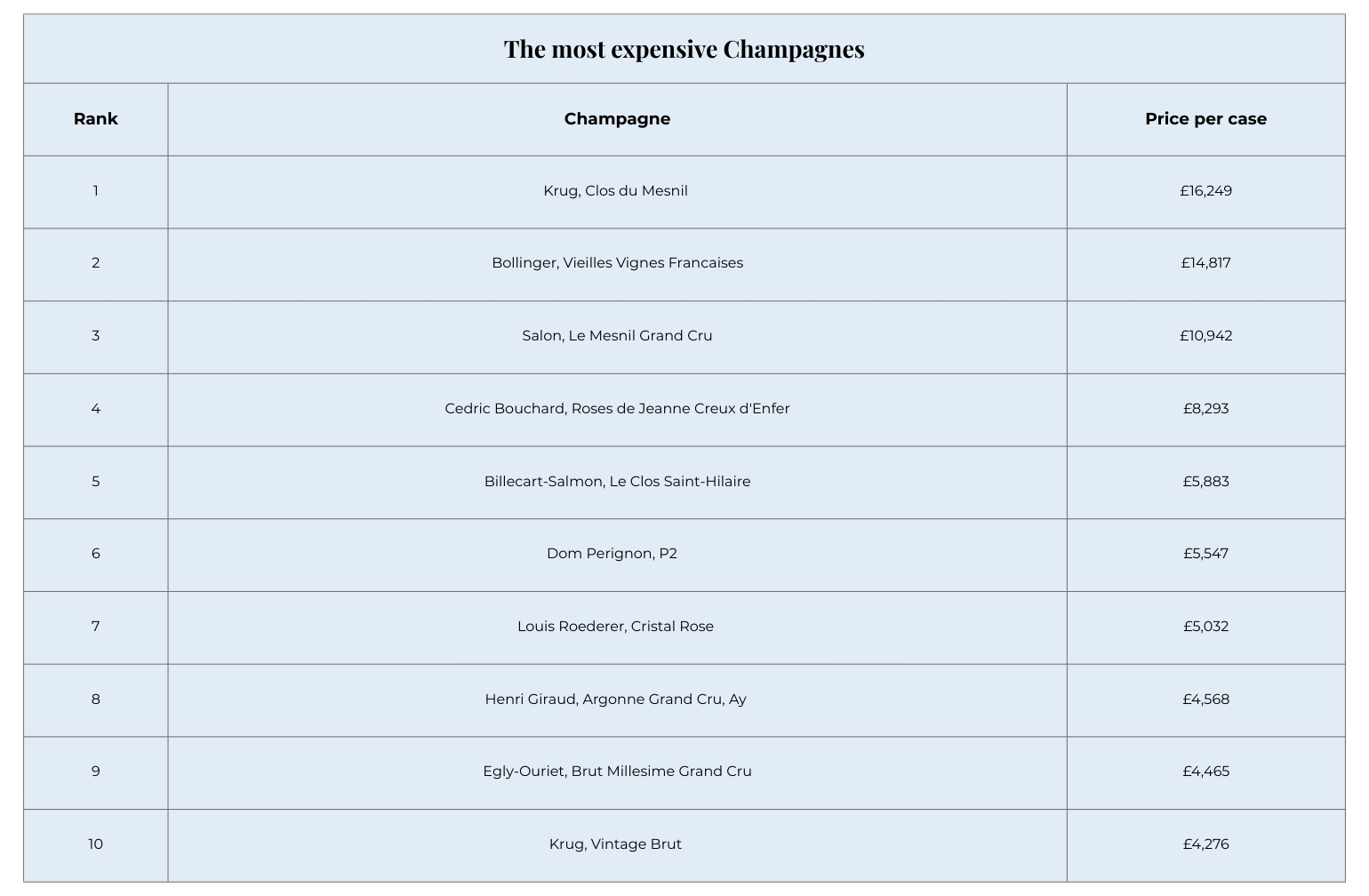
Most expensive Champagne brands table

Looking for more? See also WineCap’s Champagne Regional Report.

WineCap’s independent market analysis showcases the value of portfolio diversification and the stability offered by investing in wine. Speak to one of our wine investment experts and start building your portfolio. Schedule your free consultation today
Categories
Quarterly-reports

Q2 2025 Fine Wine Report

Explore key trends in the Q2 2025 Fine Wine Market Report – from Trump’s proposed tariffs to Bordeaux En Primeur 2024, index performance, and standout wines like Chave Hermitage and Screaming Eagle. Discover where value and stability are emerging.

Executive summary

  • Trump’s proposed tariffs dominated headlines, yet the delayed implementation gave markets breathing room.
  • The Liv-ex 100 index declined 3% in Q2 but showed signs of levelling off by quarter-end.
  • Bordeaux En Primeur 2024 was met with weak demand driven by oversupply and collector preference for mature vintages.
  • Regional performance diverged, with Bordeaux and Burgundy leading declines, while Champagne showed signs of stabilisation.
  • Top-performing wines defied broader market trends, with double-digit gains from names like Chave Hermitage 2021, Château d’Yquem 2014, and Screaming Eagle 2012.
  • Fine wine remains in a correction phase, but select names, regions, and vintages continue to offer compelling investment opportunities.

The trends that shaped the fine wine market

Global markets adjust as tariff volatility eases

President Trump’s revival of protectionist trade policies set the tone for global markets in Q2. From January to April, the average U.S. tariff rate on imported goods like cars, steel, and aluminium surged from 2.5% to a century-high 27%, before easing to 15.8% in June.

While the March tariff threat initially triggered sharp volatility, the fallout was relatively short-lived. Early April brought a brief dip into bear territory for the S&P 500 on tariff fears. But with policy pauses and stronger-than-expected earnings – 78% of S&P companies beat forecasts – investor confidence returned. Equities in Europe and Asia rallied as well, with the FTSE 100 testing new highs. Corporate investment, especially in AI, remained robust despite political and fiscal uncertainty. 

This broader resilience helped buoy alternative assets like fine wine. While less liquid than stocks, fine wine saw continued interest from long-term investors. Crucially, there was no evidence of panic selling – a sign of confidence in the asset class’s underlying stability.

Telling signs of stability in the fine wine investment market

The pace of fine wine price declines slowed in the second half of the second quarter, although the market is not yet in full recovery mode. On average, fine wine prices as measured by the Liv-ex 100 index, dipped 3% in Q2 2025. The index has been in a freefall since September 2022, seeing only five minor upticks during this time. Meanwhile, the Liv-ex 50, which tracks the performance of the Bordeaux First Growth, has been in a consistent decline during the last 33 months.  

Still, the recent falls have been less pronounced, and prices for many of the index component wines have maintained their new levels without falling further. The market seems to be adjusting to the new environment, with participants showing greater acceptance of the status quo and reduced sensitivity to geopolitical noise. In Q2, demand even began to resurface, particularly from Asia, which has been notoriously quiet, and the U.S., which had initially retreated due to tariff fears.

Muted demand for Bordeaux En Primeur 2024 as market shifts for mature wines

With the market still absorbing past vintages and saturation setting in, enthusiasm for Bordeaux En Primeur 2024 was notably subdued. Despite reduced release prices, the wines often failed to offer compelling quality or value when compared to older vintages readily available on the secondary market.

Bordeaux’s structural challenges persist. Negociants remain overstocked and weighed down by rising bank interest, while many merchants lack the appetite or capital to buy for stock. Meanwhile, the once-crucial Chinese market remains largely dormant.

This muted campaign reflects a broader shift in buyer behaviour. Demand has tilted decisively toward mature wines with a track record of quality and drinkability. While the short-term appeal of buying young futures has faded for now, Bordeaux’s reputation for ageability and long-term value endures.

Fine wine vs mainstream markets in H1 2025

Fine wine vs mainstream markets

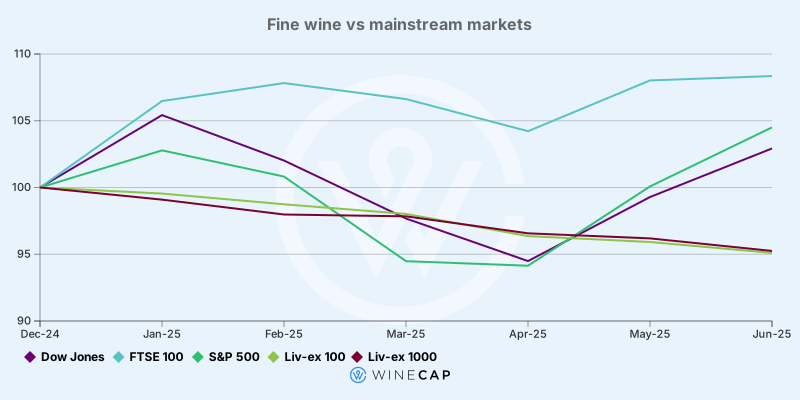
While mainstream equity markets swung between bear and bull phases in Q2, the fine wine market charted a notably more stable path. Fine wine prices declined modestly over the period, but without the sharp drops or rallies seen in the S&P 500, Dow Jones Industrial, or FTSE 100. The contrast, seen in the chart above, reinforces fine wine’s reputation as a lower-volatility asset during times of heightened macroeconomic and geopolitical uncertainty.

Importantly, this steady decline was not marked by panic selling or dramatic shifts. This reflects the market’s structural differences: lower liquidity, longer holding periods, and a collector-investor base that prioritises wealth preservation over short-term trading.

Moreover, beneath the surface, outliers and outperformers remain. Read on to discover where relative value has emerged, and which regions and producers have shown resilience – or even strength – so far this year.

Regional fine wine performance: year-to-date trends

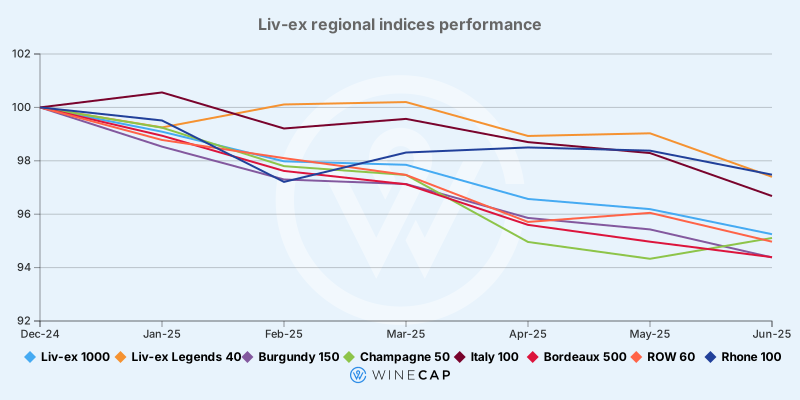
The first half of 2025 has revealed consistent pressure across nearly all fine wine indices, with no region posting growth year-to-date. Yet the degree of decline varies.

Liv-ex fine wine regional indices

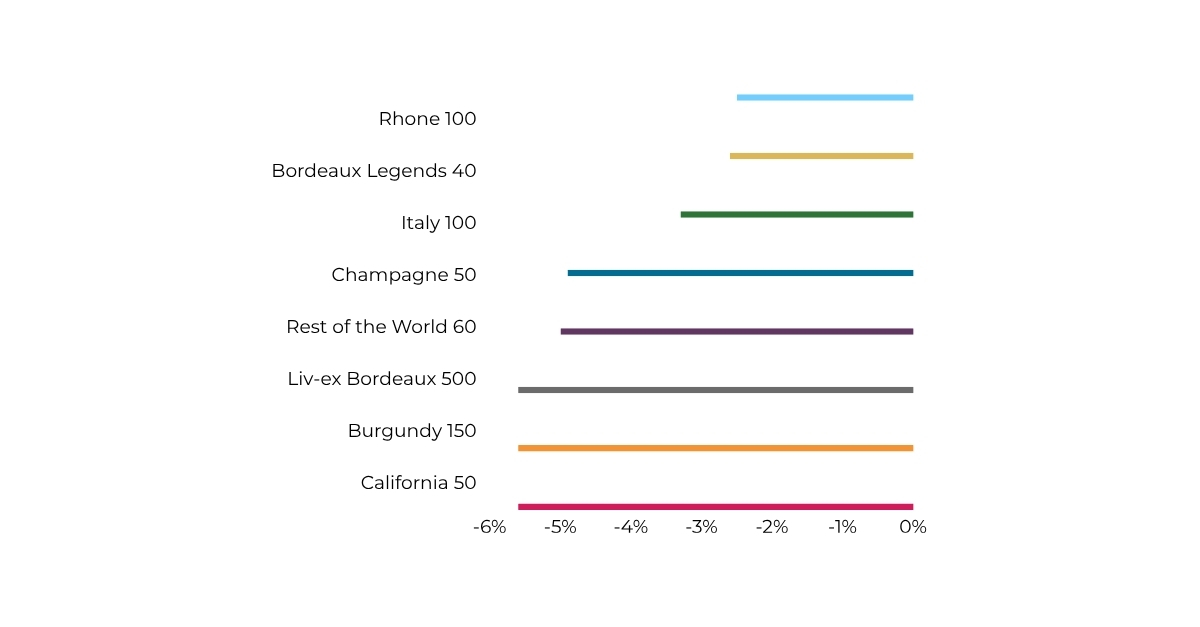
Bordeaux and Burgundy lead declines (-5.6%)

Both the Liv-ex Bordeaux 500 and Burgundy 150 have posted the steepest year-to-date losses among the major indices, each down 5.6%. For Bordeaux, this reflects tepid interest in younger vintages and a sluggish En Primeur campaign, coupled with a lack of support from Asia. Burgundy continues to correct from previous pricing spikes, as buyers recalibrate in search of better relative value.

Auction results defy the indices

While Bordeaux and Burgundy’s regional indices posted year-to-date declines of -5.6%, recent auction results tell a different story at the very top end of the market.

In June 2025, Christie’s held a landmark sale of the personal wine collection of billionaire collector Bill Koch, generating a record-breaking $28.8 million over three days. The sale drew global participation and intense bidding across 1,500 lots, each of which was sold. The standout was a 1999 Romanée-Conti Methuselah, which fetched an eye-catching $275,000.

The collection featured rare Bordeaux and Burgundy – the very categories currently under pressure in secondary market indices – yet buyer appetite was strong, and prices exceeded estimates across multiple lots.

Champagne shows relative stability

The Champagne 50 has held up better than most, down just 4.9% year-to-date, and was the only region to show positive month-on-month growth in June (+0.8%). While the broader category has cooled after a strong run, interest in top names remains, especially among collectors focused on prestige and scarcity. Indeed, many of Champagne’s top brands now represent the best entry point into the region in years. Prices have stabilised, and there are signs they will not fall any further, but might start to rise again. 

Broader weakness across other regions

  • Rest of the World 60 is down 5.0%, showing soft demand beyond the mainstay regions.
  • California 50, also down 5.6%, mirrors this trend and highlights ongoing sensitivity to U.S. economic and tariff concerns.
  • Italy 100 has dropped 3.3%, suggesting a more measured pullback, consistent with the region’s reputation for offering value and dependable quality.
  • Bordeaux Legends 40 and Rhone 100 are holding up best, with declines of only 2.6% and 2.5% respectively. This speaks to market confidence in mature Bordeaux and Rhône’s reputation for steady, value-driven performance.

best performing wine regions half 1 2025

As the fine wine market works through broader corrections, defensive regions – particularly Rhône and mature Bordeaux – are outperforming, while Burgundy and California remain under pressure. Champagne’s recent bounce may signal early signs of selective recovery. For investors, opportunities may lie in regions demonstrating resilience rather than those still working through valuation resets.

The best-performing wines so far this year

best performing wines half 1 2025

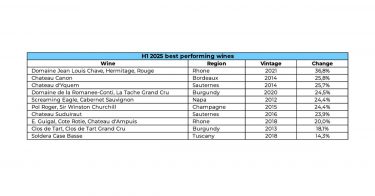
Despite broad declines across regional indices, a select group of wines delivered standout returns in H1 2025, highlighting the importance of producer reputation, scarcity, and vintage specificity in fine wine performance.

The Rhône leads driven by Chave

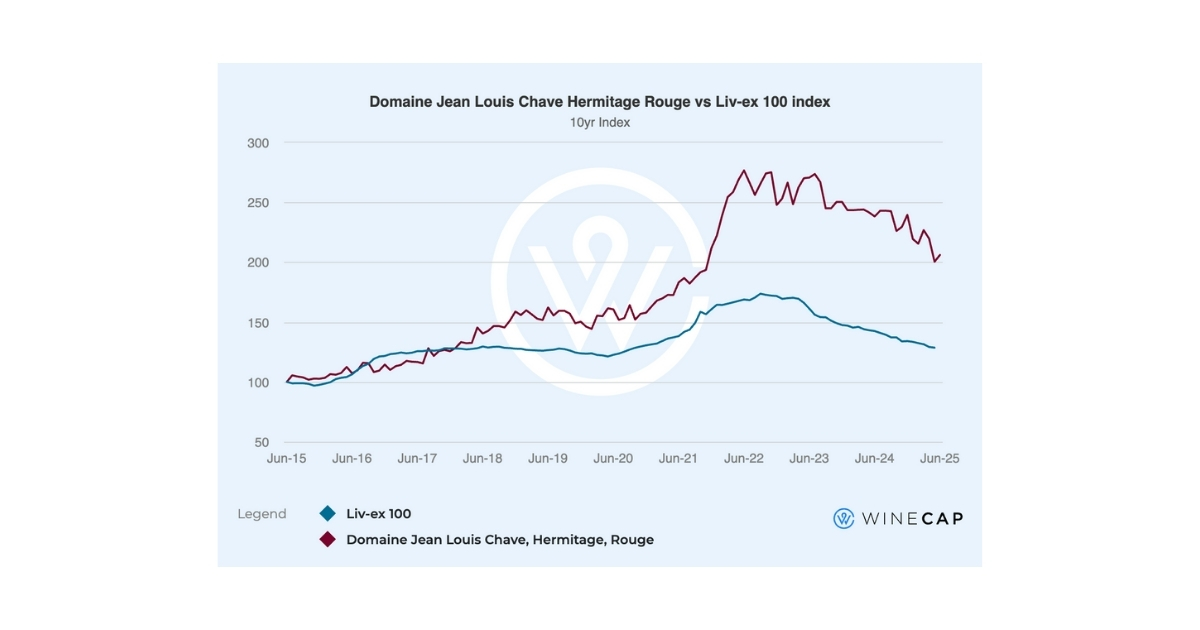
The top-performing wine was Domaine Jean Louis Chave’s 2021 Hermitage Rouge, which rose +36.8% in the first half of the year. This outperformance stands in stark contrast to the overall Rhône 100 index, which declined 2.5%. Over the last decade, prices for the brand are up 127% (compare its performance to other market benchmarks on Wine Track).

Domaine Jean Louis Chave Hermitage

Château d’Yquem 2014 and Château Suduiraut 2016 returned 25.7% and 23.9% respectively, bucking the downward trend in Sauternes. On a brand level, Yquem has risen 7% in the last six months and 3% in Q2; Suduiraut is up 11% in H1 2025. These results signal renewed collector appetite for premium dessert wines – particularly in top vintages where quality and longevity are indisputable – yet prices remain relatively low.

Prestige investment opportunities in Napa and Champagne 

The California 50 index fell 5.6%, but iconic Napa cult wine Screaming Eagle 2012 rose 24.4%, affirming the strength of globally recognised, ultra-luxury labels. Indeed, average prices for the brand rose 5% in H1 2025. Similarly, Pol Roger Sir Winston Churchill 2015 posted a 24.4% gain, demonstrating that top-tier Champagne continues to attract collectors even as the Champagne 50 index overall declined.

Burgundy and Tuscany standouts reinforce blue-chip strategies

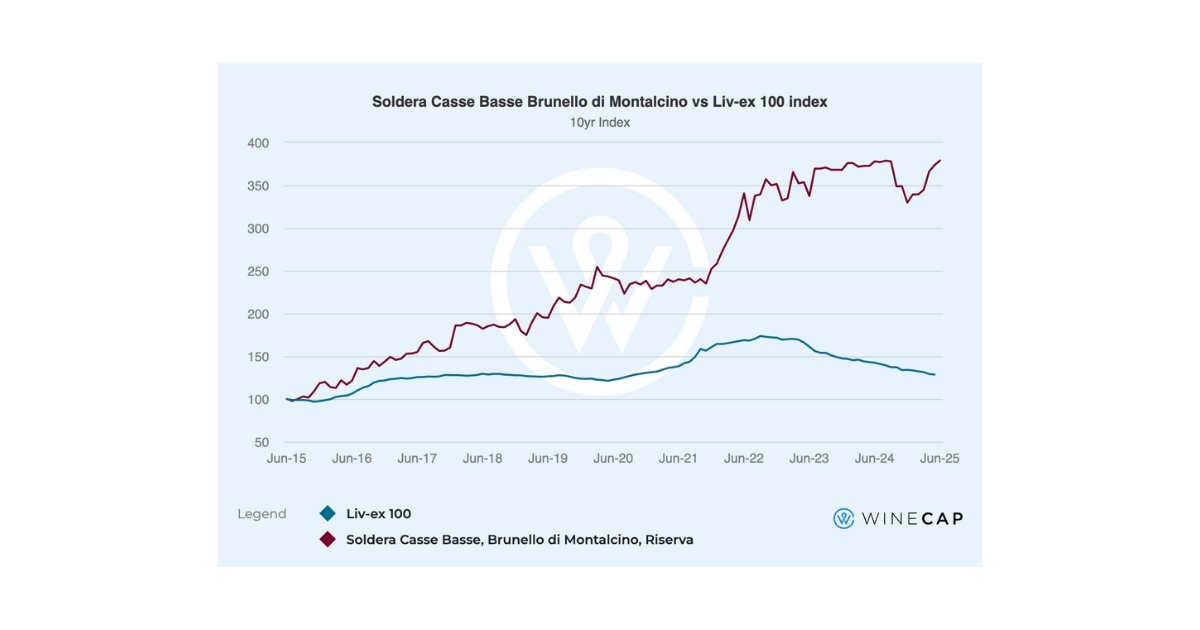
Despite Burgundy’s broader correction, DRC’s La Tâche 2020 and Clos de Tart 2013 delivered 24.5% and 18.1% returns respectively. These names remain benchmarks of rarity and prestige. Meanwhile, Soldera Case Basse 2018 gained 14.3%, pointing to sustained momentum behind top Italian producers. In Q2 alone, prices for the Tuscan premium brand are up 11%; in H1, 16%. 

Soldera Montalcino fine wine performance

Investor takeaways

  • Market-wide declines don’t mean universal losses. Select wines not only held value but also delivered double-digit returns.
  • Rarity and recognisability remain key drivers. Names like Chave, Yquem, Screaming Eagle, and DRC continue to offer portfolio resilience.
  • Smart vintage selection pays. Wines from underappreciated years – like Canon 2014 – produced outsized gains relative to their pricing base.
  • Dessert wines are back on the radar. Contrarian plays in Sauternes may offer continued upside in H2 2025.

Brands to watch

Signs of a Champagne revival

After being the fine wine market’s standout performer in 2022, Champagne experienced one of the sharpest pullbacks during the broader market correction of 2023–2024. However, signals suggest the tide may now be turning again.

From peak to pause: A market in transition

Prices across the Champagne sector have fallen significantly from their highs, but the sell-off appears to have run its course. June marked a notable shift: Champagne was the first regional index to post positive month-on-month growth, rising +0.8%, a potential inflexion point after months of stagnation.

More importantly, price stability has returned. The sector’s recent performance suggests we may be entering a new phase of the Champagne investment cycle, where prices consolidate before a potential recovery.

Market data signals stabilisation

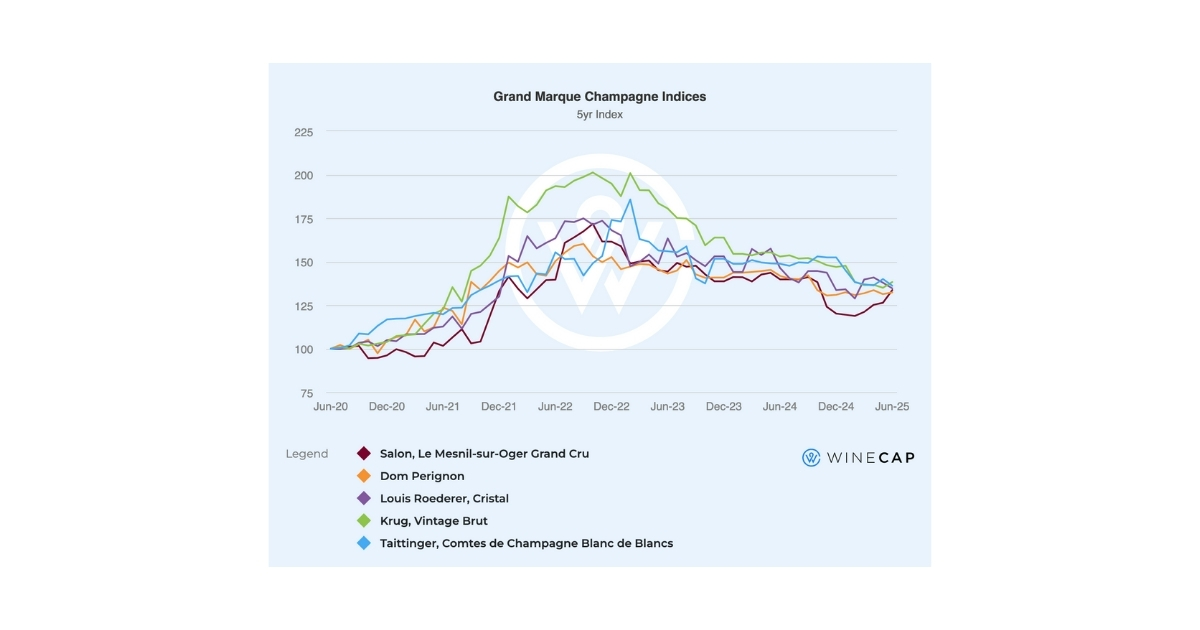
To test this trend, we analysed the 10 most recent vintages of the five most-searched “Grand Marque” Champagnes:

Of these 50 individual wines,

  • 43 have resisted their price declines,
  • 40 have remained stable for at least six months,
  • the indexes aggregating their vintages confirm this plateau.

Champagne fine wine indices

Notably, Dom Pérignon has shown the earliest and most sustained stabilisation, with its index bottoming out in November 2024. Krug Vintage and Taittinger Comtes de Champagne are the most recent to enter this stable phase, suggesting broader alignment across the category.

A new phase for Champagne?

This pattern of index symmetry and brand-level stabilisation is a clear signal that Champagne may be transitioning from correction to consolidation. Investor sentiment appears to be catching up to underlying fundamentals, with many of Champagne’s leading brands now offering compelling re-entry points. Liv-ex market share data supports this trend:year-to-date, Champagne has taken 12.4% of the market by value, up from an annual 2024 average of 11.8%, signalling that demand is returning. 

If this trend holds, Champagne could become one of the first major regions to re-enter positive growth territory, supported by brand power, vintage scarcity, and collector loyalty.

Q3 2025 market outlook: A pause before the pulse?

The third quarter – traditionally the quietest in the fine wine calendar – arrives amid a tentative calm. Following the volatility of Q2, Q3 is shaping up to be more subdued but not without potential catalysts.

Tariff watch

President Trump’s planned tariffs, originally slated for Q2, have now been delayed until August 1st. Markets have so far responded with a muted shrug, suggesting either tariff fatigue or confidence that negotiations may temper the final impact. But the uncertainty remains a live wire: should enforcement proceed, volatility could resurface late in the quarter. For now, however, investors appear cautiously indifferent.

La Place de Bordeaux’s autumn window

With the Bordeaux 2024 En Primeur campaign having underwhelmed, attention now turns to La Place de Bordeaux’s autumn campaign. This presents a rare chance for standout producers from around the world to seize attention, particularly those releasing back vintages or special bottlings. A well-priced, tightly-curated campaign could reignite interest and provide pockets of momentum in an otherwise quiet market.

Rest of the World builds buzz

As traditional strongholds like Bordeaux and Burgundy continue to correct or stagnate, Rest of the World wines are beginning to command more attention. California, Tuscany, and Rhône producers featured prominently among H1’s top performers, and collectors may increasingly look to these regions for value, scarcity, and differentiation in the second half of the year.

A stable market… but will it rise?

Fine wine’s reputation for stability held firm in H1, avoiding the sharp swings seen in equities. The question now is whether this stability will give way to price appreciation. While some wines are poised to rise, we expect the broader market to remain sluggish through the summer. Liquidity typically thins in July and August, and the broader mood is unlikely to shift meaningfully until September.

What to watch

  • Tariff developments post-August 1st
  • Autumn releases on La Place, especially non-Bordeaux
  • Top Champagne brands starting to rise in value
  • Collector appetite for emerging regional stars
  • Signs of rotation from defensive to opportunistic buying behaviour

WineCap’s independent market analysis showcases the value of portfolio diversification and the stability offered by investing in wine. Speak to one of our wine investment experts and start building your portfolio. Schedule your free consultation today.