Categories
Quarterly-reports

Q2 2024 Fine Wine Report

Our Q2 2024 report has now been released. The report examines the macroeconomic factors affecting fine wine prices, the Bordeaux 2023 En Primeur campaign, the best-performing wines, industry news and an outlook for Q3.

Executive summary

  • The second quarter built on the successes of the first, with risk assets delivering another set of positive returns to investors.
  • Global equity markets were buoyed by resilient economic growth and rising investor confidence.
  • UK investment sentiment also improved after a landslide election win for the new Labour government.
  • The fine wine market remains a buyers’ market, with Burgundy and Champagne priced down the most in Q2. 
  • Bordeaux back vintages enjoyed rising demand and prices, following the 2023 En Primeur campaign.
  • The best-performing wine in Q2 was the 100-point Château Léoville Las Cases 2016.
  • This year’s En Primeur yielded mixed results with few great successes despite the general price cuts. 
  • Some of the best releases included the First Growths and their second wines, Beychevelle, and Cheval Blanc.
  • In other news, Sotheby’s Burgundy sale smashed wine auction records and Marchesi Antinori took full ownership of the Washington State winery Col Solare.
  • In buying opportunities, Latour 2009 offers perfect scores at the best possible price on the market.
  • Looking ahead, we anticipate the autumn La Place de Bordeaux campaign following a short summer lull.

The trends that shaped the fine wine market

Economic resilience boasts global markets

The second quarter delivered positive results for global equity markets which were buoyed by resilient economic growth, and supportive earnings and sales expectations. This strong economic foundation has allowed equities to advance, even as stubborn inflation poses potential challenges. Bond markets also appeared attractive; however, the same economic resilience that benefitted equities introduced near-term risks for fixed-income investments.

UK investment sentiment also improved following a landslide election victory for the new Labour government. The British pound, which has been the strongest major currency against the dollar this year, nudged higher when the scale of Labour’s victory became clear. The UK-focused FTSE 250 share index, which has outperformed the more global FTSE 100 year-to-date, rose to its highest level since April 2022, reflecting renewed investor confidence in the country’s economic prospects.

Fine wine – a buyer’s market

Meanwhile, fine wine prices continued to decline. The Liv-ex 1000 index, the broadest measure of the market, is currently at the level it was in August 2021 (388.28). Despite falling prices, trade volumes are higher than this time last year, suggesting that buyers are seizing opportunities to acquire wines at more favourable prices. Moreover, some of the best-performing wines this quarter rose as much as 20% in value. There are opportunities to be had if one follows closely.

En Primeur and Bordeaux’s falling prices

Some of these opportunities arose during the 2023 Bordeaux En Primeur campaign. The best new releases offered a compelling mix of quality and value, with a significant potential for future price appreciation. These included Beychevelle, Cheval Blanc, and the First Growths’ Grand vins and second wines – still, few and far between given the scale of the campaign. In the secondary market, Bordeaux prices fell 1.8% in the second quarter, making back vintages even more attractive. The only index that rose in value as the campaign concluded was the Bordeaux Legends 40 – exceptional older vintages that enjoyed rising demand. 

Regional fine wine performance
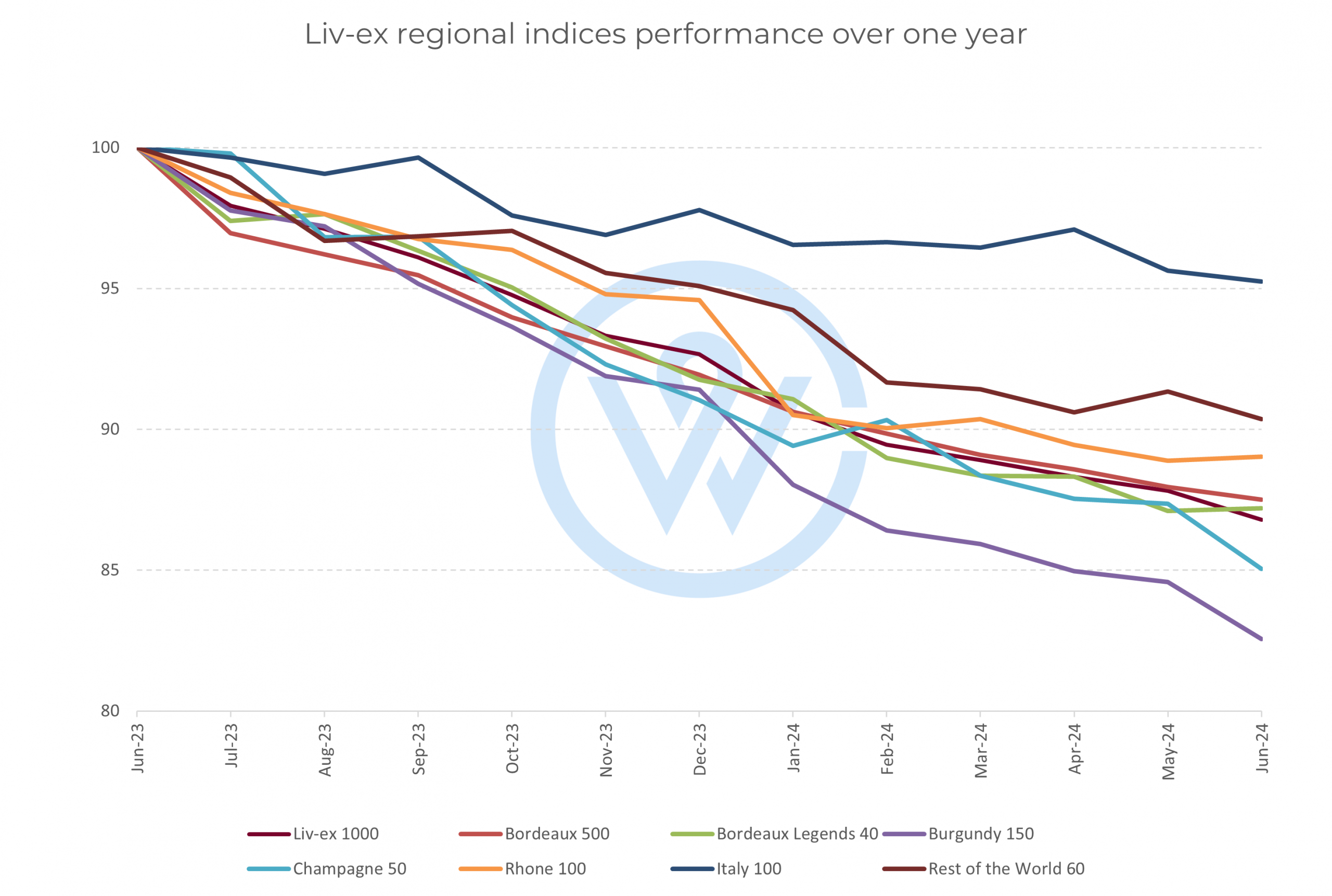
As the market’s focus shifted to new releases, prices in the secondary market fell in Q2. The broadest measure, the Liv-ex 1000 index, dipped 2.4%. It was led lower by the Burgundy 150 (-3.9%) and the Champagne 50 (-3.7%). The Rest of the World 60 and the Italy 100 indices experienced the smallest declines of 1.1% and 1.2% respectively.

As the chart above shows, Italy has shown relative resilience in the current bearish market. Despite broader market uncertainties, some Italian brands have even recorded positive movement in the last six months as high as 15%.

In June, the Bordeaux Legends 40 index recorded its first positive movement in almost a year, rising 0.3%. The index tracks the performance of a selection of 40 Bordeaux wines from exceptional older vintages (from 1989 onwards). As we have previously highlighted, older vintages can often be a lucrative investment prospect, offering a combination of quality, value and bottle age. 

The best-performing wines in Q2
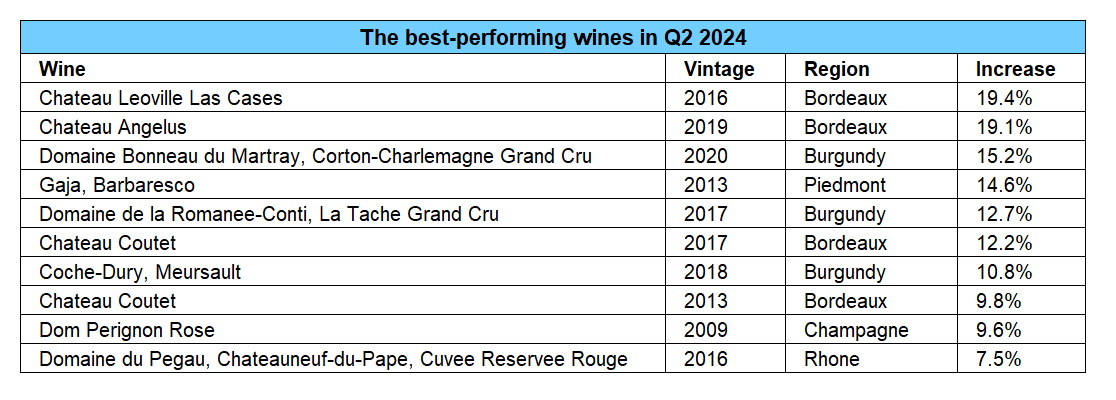
The best-performing wines this quarter were a diverse mix from Bordeaux, Burgundy, Piedmont, the Rhone and Champagne. Leading the charge was the 100-point (WA) Château Léoville Las Cases 2016, with an impressive 19.4% increase. William Kelley described it as ‘one of the high points of this great vintage’. Close behind was Château Angélus 2019, which saw a 19.1% rise.

From Burgundy, Domaine Bonneau du Martray Corton-Charlemagne Grand Cru 2020 came third, up 15.2%. Other wines from the region that rose in value included Domaine de la Romanée-Conti La Tache Grand Cru 2017 and Coche-Dury Meursault 2018

Dom Pérignon Rosé 2009 also made the rankings, with a 9.6% rise this past quarter. On average, prices for the wine have risen 83% in the last decade.

Fine wine news

Sotheby’s Burgundy sale smashes records

On July 5, 2024, Sotheby’s conducted its first exclusive single-owner Burgundy sale, breaking eight world records and achieving €2 million ($2.1 million). Held in the historic Caves du Couvent des Cordeliers in Beaune, the auction featured over 175 lots from Taiwanese entrepreneur Pierre Chen’s cellar.

Top highlights included six bottles of Chevalier Montrachet d’Auvenay 2009, which fetched €106,250 (£89,915), and 12 bottles of Domaine Armand Rousseau Chambertin Clos de Bèze 1990, sold for €100,000 (£84,630). Among the record-setting sales were three bottles of 2005 DRC Échezeaux at €10,000 per bottle and a magnum of 2005 DRC La Tâche at €35,000.

Last month, Chen’s collection of fine and rare Champagne achieved €1.35 million (£1.14 million) at Sotheby’s in Paris, with notable sales including three magnums of Salon Le Mesnil Blanc de Blancs 1990 for €25,000 (£19,600) and a magnum of Dom Pérignon P3 1966 for €23,750 (£20,100), both setting new records.

Sotheby’s expects Chen’s collection to fetch a record $50 million (£39.2 million) by the series’ end, with upcoming auctions in New York and Hong Kong.

Antinori expands into Washington

Marchesi Antinori, one of Italy’s oldest family-owned fine wine producers, has taken full ownership of the Washington State winery Col Solare, which was established as a joint venture in 1995 with Ste. Michelle Wine Estate (SMWE). The acquisition includes the winery, the estate vineyard spanning 12 hectares planted primarily with Cabernet Sauvignon, and the brand, which produces around 5,000 bottles annually. Piero Antinori, president of Marchesi Antinori, expressed admiration for Red Mountain AVA’s unique terroir, emphasising the challenge and excitement of producing high-quality Washington red wines.

Juan Muñoz-Oca, COO of Antinori USA, highlighted the significance of this acquisition, reflecting Washington’s growing reputation for luxury wines. This move follows Antinori’s 2022 acquisition of Napa’s Stag’s Leap Wine Cellars, transitioning from a 15% to 100% stake after SMWE was sold to Sycamore Partners for $1.2 billion in 2021. Besides Stag’s Leap, Antinori owns Antica, a 200-hectare estate in Napa Valley, as part of their expansion in the states.

Buying opportunities: Latour 2009
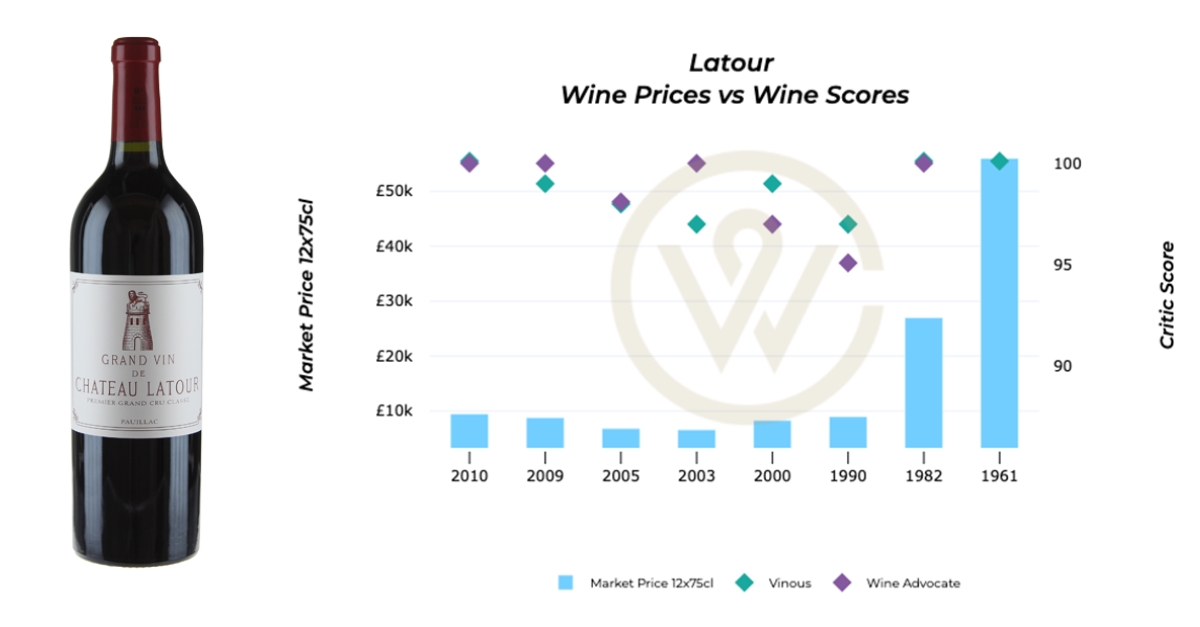
Château Latour 2009 currently represents a combination of perfect scores and perfect timing. The highest-scoring wine ever at the annual Southwold tasting, Latour 2009 is now at the best price it has been in almost a decade. 

The recipient of no less than five perfect scores from Robert Parker, Lisa Perrotti-Brown MW, Jeff Leve, James Suckling, and Falstaff, Latour 2009 is a stand-out wine among critics. Hailed by Robert Parker as the greatest vintage he’d ever tasted, more recently Neal Martin described it as ‘outstanding’ and a ‘Latour firing on all cylinders’.

Latour is also the highest-scoring 2009 Bordeaux on Cellar Tracker, where it’s also the second-highest-scoring wine of the entire decade, beaten only by Petrus 2000 at more than six times the price.

In terms of price performance, Latour has outperformed all the other First Growths over one, two and five years. 

The 2009 vintage, which is currently available at one of the lowest price points ever, offers value among other prime vintages. Its scores match the 1982 and 1961, both of which come at a significant premium.

It is more affordable than the 2010 as well as the 2000 and 1990 vintages but with superior scores than all of them. The 2009 Latour is a hidden gem that seems particularly good to seek out now.

Outlook for Q3

With the onset of the summer lull, the market is expected to experience a temporary slowdown as usual. Despite this seasonal dip, numerous opportunities remain available. The market for collectibles, including fine wine, is gaining popularity among new investors looking for diversity and uncorrelated market returns.  

Over the next two months, the fine wine market will shift its focus to wines from around the globe as the autumn La Place de Bordeaux campaign takes centre stage. Esteemed producers such as Almaviva, Opus One, Vérité, Seña, Catena Zapata, Masseto, and Solaia will unveil their latest vintages on the international stage, accompanied by numerous other exciting releases.

As the campaign expands to include New World wines, the category is expected to see a surge in secondary market demand, potentially driving up prices. We will continue to spotlight the best investment opportunities where exceptional quality and brand prestige meet attractive pricing.

WineCap’s independent market analysis showcases the value of portfolio diversification and the stability offered by investing in wine. Speak to one of our wine investment experts and start building your portfolio. Schedule your free consultation today.

Categories
Quarterly-reports

Q1 2024 Fine Wine Report

Our Q1 2024 Fine Wine Report has now been released. The report offers a comprehensive overview of the fine wine market in the last quarter, including the impact of interest rates and geopolitical risks, the best-performing wines and regions, and analysis on the rising popularity of non-vintage Champagne as an investment.

Report highlights:

  • Mainstream markets rallied in Q1 2024, driven by resilient economic growth and expectations for future interest rate cuts by central banks.
  • The first green shoots started to appear in the fine wine market towards the end of Q1.
  • Fine wine prices (Liv-ex 100 index) experienced a smaller decline of 1% in Q1, compared to a fall of 4.2% in Q4 2023.
  • Italian wine enjoyed rising demand amid a flurry of new releases, including the 100-point Sassicaia 2021.
  • A number of Champagne labels that experienced consistent declines last year have started to recover, including Dom Pérignon, Salon Le Mesnil, and Pol Roger.
  • The Burgundy 2022 En Primeur campaign delivered high quality and quantity, with about 10% of producers reducing pricing year-on-year due to the challenging market environment.
  • China lifted tariffs on Australian wine after more than three years.
  • Critics and trade are now preparing for the 2023 Bordeaux En Primeur campaign, which will dominate the news in Q2 2024.

Click below to download your free copy of our quarterly investment report.


Fine Wine Report

Categories
Learn

History of Burgundy’s price performance

The following article is an extract from our Burgundy regional wine investment report.

  • Burgundy is the region with the highest average bottle prices.
  • It is the best-performing fine wine region, considerably outperforming industry benchmarks.
  • This article analyses its historic performance, the drivers behind its success, and what this might meant for the future of the region.

Burgundy has earned an impressive reputation in the fine wine investment landscape. The region is the outright leader when it comes to average bottle prices and the long-term performance of its wines.

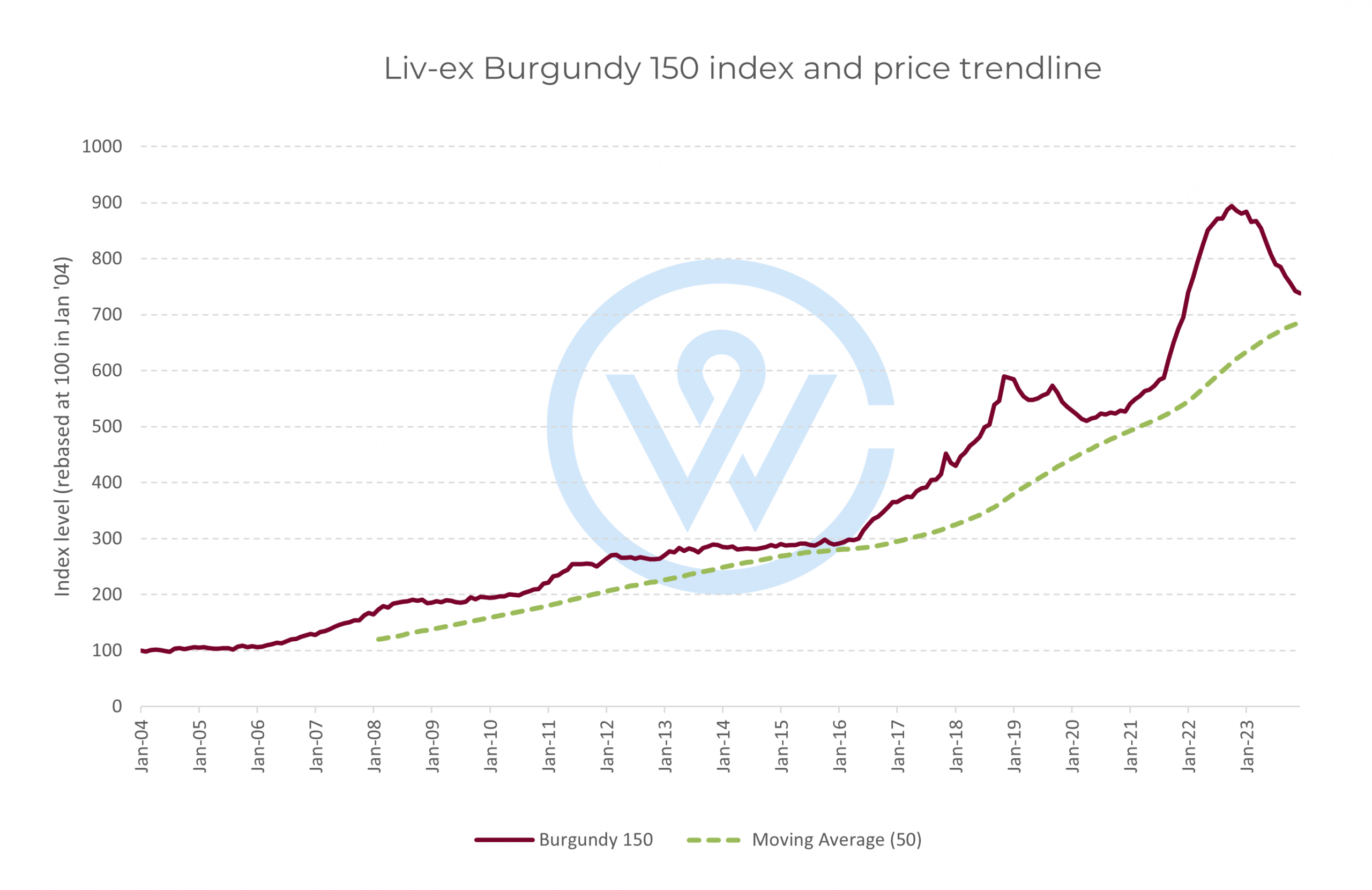
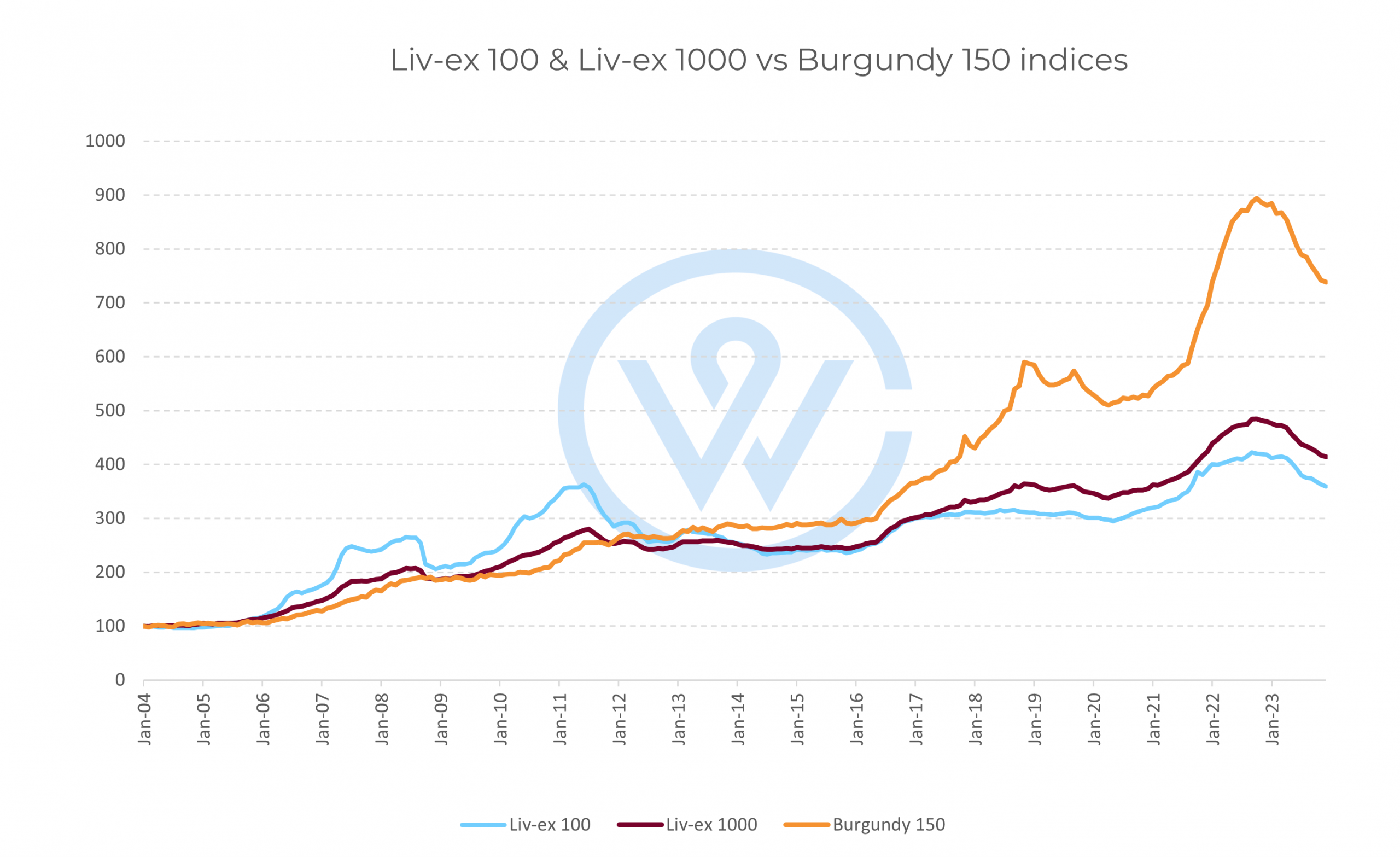
The Burgundy 150 index, which tracks the prices of the last ten vintages across 15 Burgundy brands, is the leading Liv-ex regional index, continually outperforming Bordeaux, Italy and Champagne. It is up over 650% since its inception.

Although the index only comprises a narrow pool of highly traded wines, it provides an indication of the direction of Burgundy prices. During its impressive rise, the index experienced only one significant drop of 15%, giving investors confidence that its punctuated equilibrium will continue.

Historic performance of Burgundy prices

The Liv-ex Burgundy 150 index doubled from early 2006 to mid/late 2008 — the first awakening of the Burgundy market as a new generation of wealthy consumers started to dominate the collectors’ market. This was at least in part driven by the volume of information available to them online from reviewers like Robert Parker and Allen Meadows and a greater focus on fine wine from the major auction houses.

After the 2008 financial crisis, Burgundy was somewhat left in the shadow. With the opening of the Chinese market, Bordeaux grew massively between 2008 and 2011. When Bordeaux fell from its 2011 peak, a new generation of investors flocked to Burgundy, seeking growth and breadth to their holdings.

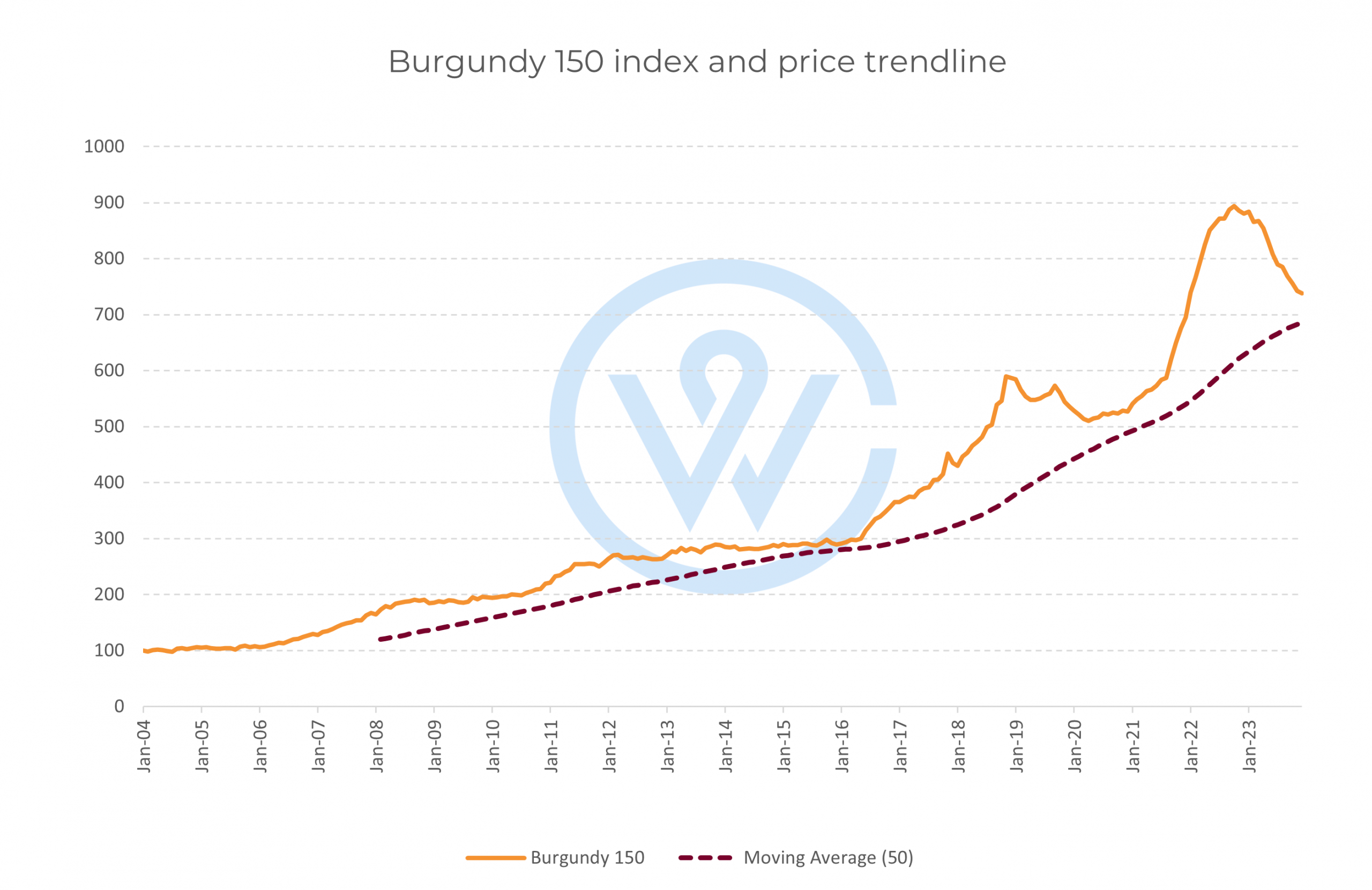
From 2016 to late-2018, the value of the Burgundy 150 index doubled again. This can be attributed to growing liquidity in the sector and its recognition as a viable high-return investment. The region experienced a period of decline in 2019/2020, after a 15-year period without any significant downward movements. Some of this retreat has been related to profit taking and, later on, to the Covid-19 pandemic. Burgundy quickly made up for lost time in 2021 and 2022, with factors such as increased at-home consumption of fine wine, growing online trade, and rising liquidity contributing to its success. The index hit an all-time high in October 2022 at 909.4.

The market at large experienced another period of contraction in 2023, due to a combination of macroeconomic factors such as geopolitical conflicts, the lasting effects of the pandemic, high inflation and rising interest rates. Burgundy was the hardest hit region.

However, the overall direction of prices remains upwards as the trendline in the chart below shows. Such periods are advantageous times for Burgundy buyers who are usually able to find more stock at lower prices.

To find out more about the investment market for Burgundy wines, read the full report here.

Categories
News

Assessing the Burgundy 2022 En Primeur campaign

  • Burgundy prices continued to spiral downwards in January, falling 3.7%.
  • This created a challenging backdrop for the unfolding Burgundy 2022 campaign, which saw about 10% of producers reduce pricing year-on-year.
  • The current market dynamics offer investors a unique window to enrich their collections with both new gems and proven performers.

Burgundy took the spotlight at the beginning of the year with the unfolding 2022 En Primeur campaign. Already in our Q4 2023 report, we questioned the potential of the new releases to stimulate an otherwise dormant market. On the one hand, there was the excitement of the new mixed with high quality and quantity playing to the campaign’s advantage; on the other, much depended on pricing.

Market conditions and pricing challenges

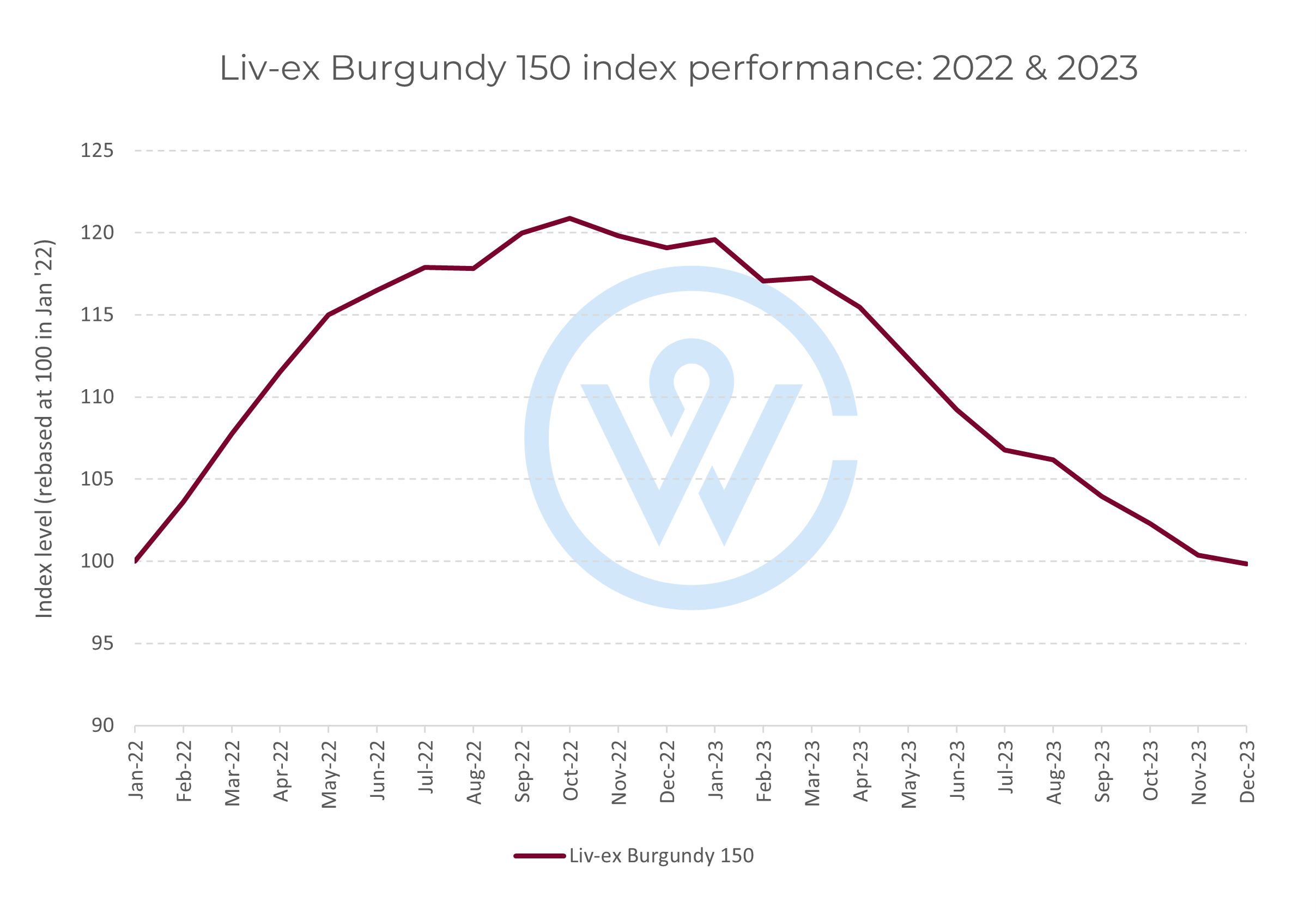
Burgundy prices continued to spiral downwards in January, with the Liv-ex Burgundy 150 index starting the year with a 3.7% decrease. To say that this created a challenging backdrop for the new releases would be an understatement. Prices at release had to come down.

And partially they did. According to Liv-ex, about 10% of the top producers ‘lowered their prices year-on-year’. However, ‘about 40% raised their prices, even if only modestly’. Thanks to greater quantities, allocations were mostly restored.

Burgundy 2022 – ‘a treasure trove’

As the first releases landed, Burgundy 2022 enjoyed a positive reception from critics and trade. Neal Martin (Vinous) advised that ‘if your favourite growers’ price tags seem fair, then I would not hesitate diving in’. He described the 2022 vintage as ‘Burgundy’s latest trick: a treasure trove of bright ‘n bushy-tailed whites and reds in a season that implied such wines would be impossible, wines predestined to give immense drinking pleasure’.

Investment perspective and older vintages

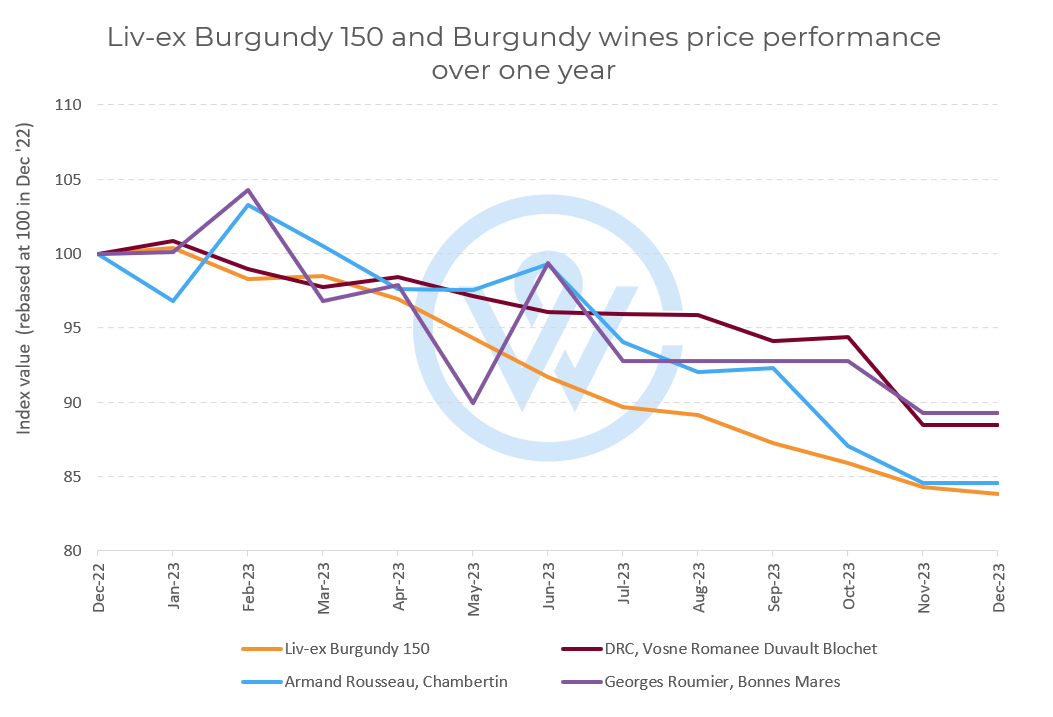
However, prices for older vintages remain under pressure, creating buying opportunities for already physical and readily available wines. For instance, three of Burgundy’s outstanding long-term wine performers have all seen dips between 15% and 10% in the last year. Over the last decade, however, DRC Vosne-Romanée Cuvée Duvault Blochet is up 388%; Georges Roumier Bonnes Mares – 339%, and Armand Rousseau Chambertin – 279% on average.

Meanwhile, the Burgundy 150 index has decreased 16% in the last year. Still, the overall long-term index trajectory remains upwards, as the chart below shows.

Searching for value

The current market dynamics offer investors a unique window to enrich their collections with both new gems and proven performers across older physically available vintages.

When it comes to the latest, the Burgundy 2022 En Primeur campaign presents a complex tapestry of quality, quantity, and pricing amidst challenging market conditions. Despite initial price pressures, the adjustments made by producers and the positive critical reception underscore the potential of the new releases. Neal Martin’s endorsement further elevates the vintage, suggesting that for the discerning buyer, Burgundy 2022 provides not just immediate drinking pleasure but also long-term investment opportunities.

WineCap’s independent market analysis showcases the value of portfolio diversification and the stability offered by investing in wine. Speak to one of our wine investment experts and start building your portfolio. Schedule your free consultation today.

Categories
News

Burgundy 2022: a promising vintage in a challenging market

  • The 2022 vintage boasts high quality and quantity – ‘the largest crop in 23 years’.
  • It is being launched in a downward market, following ten months of consistent price declines.
  • As demand has tempered and stock has (re-)entered the market, the success of the upcoming releases will largely depend on pricing.

Burgundy’s 2022 vintage is being launched in a downward market, following ten months of consistent price declines. The success of the upcoming releases will largely depend on pricing, but will its quality and quantity have the potential to turn the tables?

Critical opinions on Burgundy 2022

Critic reports thus far have been overwhelmingly positive, applauding both the quality and the quantity of the vintage. 2022 marks the largest crop in 23 years, with some producers seeing double the yields of the previous year. According to Matthew Hayes (JancisRobinson.com), ‘across the whole of Burgundy, 2022 offered a whopping 75.4% more wine (red, white and crémant) compared with 2021’.

Contrary to expectations, the vintage produced wines with typicity, purity, and freshness despite the extreme weather. Hayes commented that ‘2022 was the second-hottest year that the Côte d’Or has endured this century and should logically have followed in the footsteps of the equally stifling solaire years of 2019 and 2020, producing wines with rich, deep fruit profiles and vibrant acidities to ensure long life but […] the wines show a generally impeccable balance of tidy, ripe fruit, discreet acidity and equally (and mostly) refined tannins’.

Hayes revealed that ‘the best-sited and best-rooted vines appeared to have coped well with the heat and in the Côte d’Or the excellence of the top premiers and grands crus shines clearly’.

The prevailing opinion is that 2022 is an excellent year for white wines, reminiscent of 2017 and 2020. Meanwhile, tasting notes from the Côte de Beaune and Côte de Nuits highlighted dense red wines with well-integrated tannins, simultaneously offering elegance and concentration. The wines are expected to be approachable in youth but with significant ageing potential.

However, the market onto which they are released is just as important as the releases themselves.

The current market for Burgundy

In October 2022, the Liv-ex Burgundy 150 index reached an unprecedented peak, marking a staggering 809.4% increase since its inception in December 2003. Twenty years later, Burgundy remains the best-performing fine wine region.

However, since its peak, prices have tumbled 17.4%. This decline has been attributed to various macroeconomic factors that led to a shift in investor sentiment. As the economic landscape became more uncertain, fine wine buyers have grown increasingly risk-averse, causing a contraction in demand for more volatile investments.

This trend was particularly pronounced in Burgundy, which had soared too high across the whole spectrum. At these stratospheric prices, the market saw more sellers than buyers, with investors keen to liquidate their stock. Top-tier Burgundy (re-)entered the market as sellers were looking to make gains.

This perception of increased risk and a preference for stability among investors led to a decrease in Burgundy’s trade share by value. The falling prices further exacerbated this trend.

The market conditions present a challenging backdrop for the high-quality high-quantity Burgundy 2022 En Primeur campaign. Will the excitement of the new be enough to stimulate demand?

WineCap’s independent market analysis showcases the value of portfolio diversification and the stability offered by investing in wine. Speak to one of our wine investment experts and start building your portfolio. Schedule your free consultation today.
Categories
Learn

Navigating the 2023 fine wine market: the rise of Bordeaux amid global risk aversion

  • 2023 marks a notable slowdown in the fine wine market, with price corrections shadowing the bullish trends of previous years.
  • Burgundy and Champagne which led the market to its peak in 2022 are suffering the most.
  • Bordeaux has become a beacon for investors, gaining renewed interest due to its stability and reliability.

As the 2023 Liv-ex Power 100 unveils, a significant shift is evident in the fine wine market. This year marks a notable slowdown, with price corrections shadowing the bullish trends of previous years. Amidst this changing landscape, Bordeaux emerges as a beacon for investors, gaining renewed interest due to its stability and reliability. This article delves into the dynamics of the 2023 fine wine market, highlighting the rise of Bordeaux against a backdrop of global risk aversion.

Understanding the 2023 market slowdown

The fine wine market in 2023 has departed from the spirited activity of past years. After prices across many regions reached stellar levels in 2022, 2023 was a year of corrections. Trade by value and volume also fell, according to the 2023 Liv-ex Power 100 report. Despite more wine labels being traded, the overall number of individual wines traded (on a vintage level) has seen a decrease. This trend points towards a strategic shift towards higher quality wine investments, reflecting a more discerning market behaviour.

The softening of the fine wine market in 2023 can be attributed to a range of factors. Economic uncertainties and global financial market fluctuations have instilled a sense of risk aversion among investors. Inflationary pressures and rising interest rates have also played a role, impacting disposable incomes and investment capabilities. This economic climate has prompted a more cautious approach in luxury investments like fine wine. Additionally, changing consumer behaviours and preferences, along with geopolitical tensions and trade disputes, have further contributed to the market’s softening.

Regional patterns in 2023

In 2023, regional patterns in the wine market have become more pronounced. Burgundy and Champagne, which previously led the market to its peak, are now facing significant corrections. Burgundy has seen a reduction in its presence in the Power 100, while the Burgundy 150 index has fallen 15.4% year-on-year. Similarly, Champagne’s market has also softened, with the Champagne 50 index dipping 19.4%.

The rankings reveal a trend towards stability, liquidity, and relative value, which are prominently found in Bordeaux. This region has emerged as a beacon of resilience in the fine wine market, adding five wines to the Power 100 and benefiting from its reputation for consistent quality and reliable investment.

Conversely, California, while losing five wines in the ranking, managed to maintain its trade share, indicating a selective but sustained interest in its wines. This shift reflects a broader market inclination towards established regions and brands, suggesting a cautious approach by collectors and investors in a turbulent market.

As market dynamics evolve, regions like Italy and Spain are gaining traction, with brands like Vietti and Dominio de Pingus showing positive growth, further diversifying the landscape of investment-worthy wines. These regions are increasingly seen as offering valuable investment-worthy wines, attracting attention for their unique qualities and potential for growth.

The most powerful brands of 2023

In the realm of individual brands, certain names have demonstrated remarkable resilience and adaptability amidst the market downturn. Bordeaux’s Château Climens, for instance, has made an impressive leap in the rankings, rising from 353rd place in 2022 to 98th this year. This is a testament to its successful brand repositioning under new ownership.

Similarly, in California, brands like Opus One and Screaming Eagle continue to hold strong positions. Opus One, in particular, has risen dramatically, from 82nd in 2022 to 4th this year, signifying continued interest in top-tier wines from this region despite broader market challenges.

Despite facing a pullback Burgundy still has powerful players like Kei Shiogai, which took the top spot in terms of price performance, with its Market Price rising 185.7% year-on-year.

The strength of these brands lies not just in their historical significance or quality but also in their ability to retain high liquidity and trading volumes, essential in a market that is increasingly focusing on safer investments. This trend suggests that while the market is retracting in some areas, there remains a robust demand for wines that represent the pinnacle of their respective regions.

Adapting to the evolving wine market dynamics

As we navigate through the evolving dynamics of the fine wine market, it is clear that understanding and adapting to these changes is crucial for future investing. The trends of 2023, from the renewed interest in Bordeaux and the resilience of powerful brands, provide valuable insights into the market’s direction.

WineCap’s independent market analysis showcases the value of portfolio diversification and the stability offered by investing in wine. Speak to one of our wine investment experts and start building your portfolio. Schedule your free consultation today.
 

Categories
News

Four key market trends from the 2023 Liv-ex Classification

  • The fine wine market is diversifying, with Argentina and Switzerland making new entries in the 2023 Liv-ex Classification.
  • Bordeaux’s influence is waning, now accounting for less than 30% of wines in the classification, while other regions like Champagne rise in prominence.
  • Internal shifts in Burgundy indicate changing buying preferences, driven by the search for value and stock.

The Liv-ex Classification is a ranking of the world’s leading fine wine labels, based solely on their price. The classification takes into account minimum levels of activity and number of vintages traded over one year to present a more accurate picture of the market today. Like the 1855 Bordeaux Classification, the wines are divided into five tiers (price bands).

The 2023 edition featured 296 wines from nine countries. It presented a broad overview of the state of the secondary market – what is trading, and at what price levels. As the market continues to evolve, we break down four key trends from the 2023 Liv-ex classification.

Continued expansion in the world of fine wine

While the number of wines that qualified for inclusion in the 2023 rankings was lower than in the previous 2021 edition (349) due to changes in the methodology, the fine wine investment market has continued to diversify.

Argentina re-entered the rankings with five wines compared to having just one in 2019. Switzerland also joined the classification for the first time with Gantenbein Pinot Noir. Meanwhile, Spain and Chile saw 40% and 100% respective increases in the number of wines entering.

Regional diversity was particularly noticeable in the second-lowest priced 4th tier (£456-£637 per 12×75), which featured wines from France (24), Italy (16), Portugal (3), Australia (2), Spain (1), the USA (1), and Argentina (1).

Bordeaux among global competitors

It is no secret that Bordeaux’s dominance in the fine wine investment market has been fading since its glory days in 2009-2010. The continued broadening of the market has meant that the region has become one of many players, accounting for under 30% of the wines in the 2023 classification.

This has been further aided by its mediocre price performance relative to other regions. The Bordeaux 500 index has risen just 2.9% over the last two years, compared to a 19% move for its parental Liv-ex 1000 index, and a 36.7% increase for Champagne, which has been the best performer. All considered, Liv-ex wrote that ‘this pattern may well continue in future editions’ as new entrants challenge Bordeaux’s monopoly.

While Bordeaux’s influence wanes, other regions like Champagne are capturing the limelight.

The stellar rise of Champagne prices

Champagne has experienced a significant price surge in recent years, which has been reflected in the global rankings.

The majority of Champagnes (10) in the classification entered the first tier – wines priced above £3,641 per 12×75. The remaining 12 were split between tier 2 (£1,002-£3,640) and tier 3 (£638-£1,001). There were no Champagnes in tiers 4 and 5 (wines below £1,000 per case).

The most expensive Champagne was Jacques Selosse Millésime, with an average trade price of £32,516 per case, followed by Krug’s Clos d’Ambonnay (£30,426) and Clos du Mesnil (£17,509). The latter has risen 105% in value over the last five years.

On average, Champagne prices are up 62.8% during this time. They peaked in October 2022, following a year and a half of steady ascent. Since then, the Liv-ex Champagne 50 index has entered a corrective phase – but not significant enough to change the region’s trajectory. Sustained demand has been further buoying its performance.

Internal reshuffling in Burgundy

Burgundy, home to the most expensive wines in the rankings, has been undergoing an internal shift. New entrants have replaced many of the labels in previous editions, signalling changes in buying preferences.

Heightened demand for the region in 2022 led buyers to explore different wines within Burgundy, seeking both value and stock availability. Some of the new entrants in the 2023 classification include Prieuré Roch Ladoix Le Clou Rouge, Domaine Louis Jadot Gevrey-Chambertin Premier Cru Clos Saint-Jacques and Domaine Trapet Père et Fils Latricières-Chambertin Grand Cru.

Interestingly, while these new labels have entered the ranking, they seem to have replaced older, perhaps less active, Burgundy labels. Indeed, the overall proportion of Burgundy wines in the classification has remained steady, even as specific labels fall in and out of favour.

As new players emerge and existing ones adapt, one thing is clear: the fine wine market will continue to diversify and evolve, promising a fascinating future for everyone involved.

WineCap’s independent market analysis showcases the value of portfolio diversification and the stability offered by investing in wine. Speak to one of our wine investment experts and start building your portfolio. Schedule your free consultation today.
Categories
News

Joseph Drouhin expands vineyard holdings to meet rising Burgundy demand

  • Joseph Drouhin has acquired two properties, Château de Chasselas in Saint-Véran and Rapet in Saint-Romain.
  • The expansion comes as both producers and buyers seek to find stock and value in an increasingly competitive market for Burgundy.
  • Drouhin has been a brand on the move, with some of its wines rising near 40% in value in the last year.

Joseph Drouhin expands its vineyard holdings 

Rising demand for Burgundy has fueled winery purchases and new investments. One of the most prominent producers, Maison Joseph Drouhin, has expanded its vineyard holdings with the recent acquisition of Château de Chasselas in Saint-Véran and Rapet in Saint-Romain.

Frédéric Drouhin, president of the Maison, explained that this decision was driven by increased competition and challenges in acquiring vineyards and purchasing grapes. The purchase focuses on high-quality yet more affordable areas in Burgundy – outside the main Côte d’Or villages, as both producers and buyers seek to find value in a region that has experienced significant price increases in recent years.

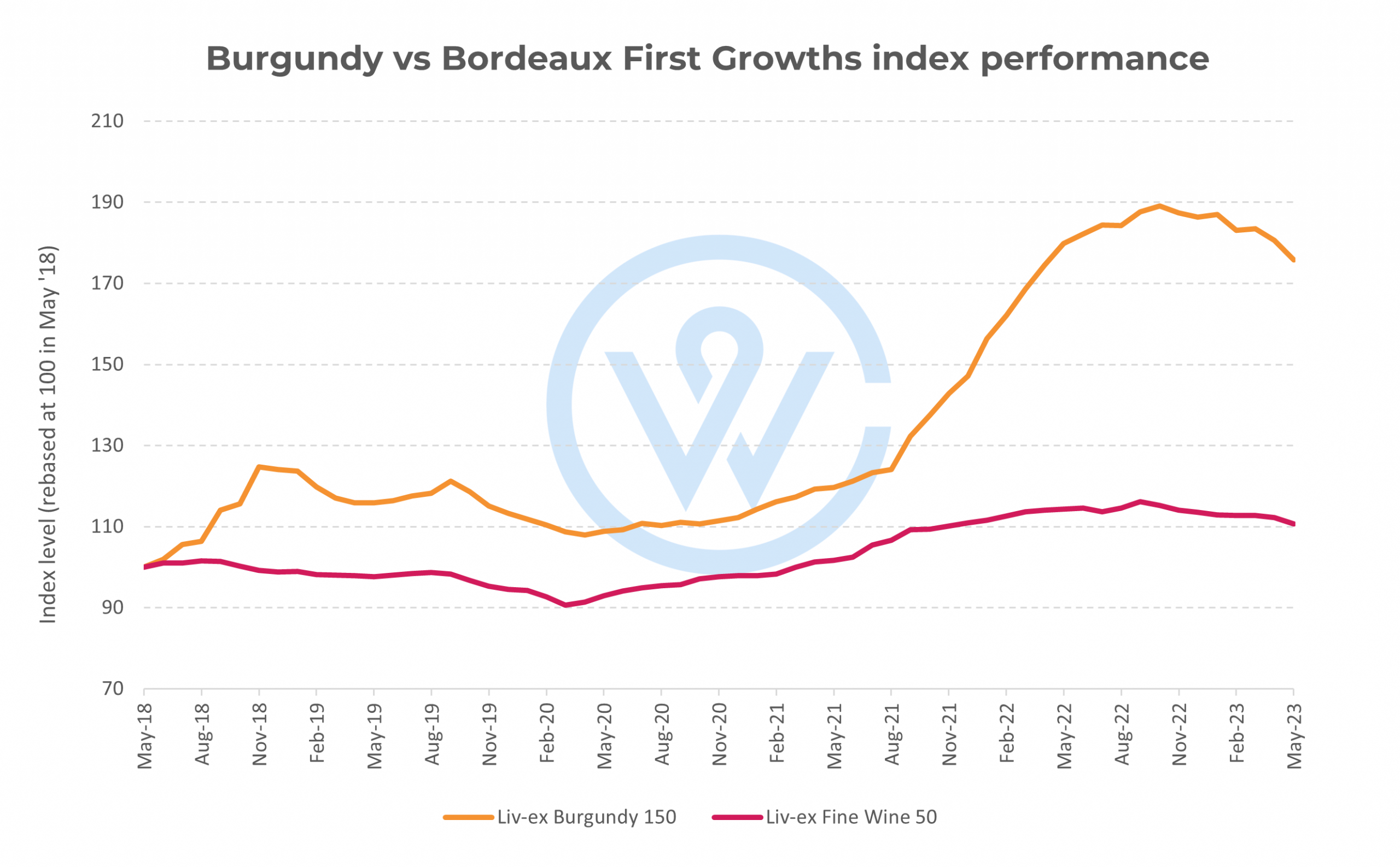
Just in the last five years, Burgundy fine wine prices have risen 75.7% – more than seven times the prices of the Bordeaux First Growths.

The insatiable demand and investment interest in the region have also impacted the cost of land, creating something of a vicious circle. 

The price of the latest Drouhin purchase was not disclosed.

The estates

Château de Chasselas encompasses 17.3 acres and is already a major supplier of Drouhin’s Saint-Véran wine. The property also includes small parcels in Chasselas and Beaujolais. The Rapet estate spans 19.8 acres and includes both Pinot Noir and Chardonnay vineyards in Saint-Romain, as well as small parcels in Auxey-Duresses, Pommard, and Meursault.

The debut vintage of Drouhin’s Saint-Romain wine is the 2022, while the first bottling of Saint-Véran Château de Chasselas will be the 2023 vintage, which will be released in 2024. All the newly acquired vineyards are being transitioned to organic farming practices.

With these acquisitions, Maison Joseph Drouhin owns close to 250 acres of vineyards, spanning from Chablis to Mâcon and encompassing 60 appellations. Their portfolio includes 14 Grands Crus and 20 Premier Crus. 

Drouhin’s place in Burgundy’s secondary market

Joseph Drouhin has been a Burgundy brand on the move. The brand jumped 142 places in the 2022 Power 100 rankings, thanks to its price performance. 

Four wines from the estate also ranked in the first tier of the 2021 Liv-ex Classification, which ranks the wines of the world solely by price: Montrachet Grand Cru Marquis de Laguiche, Musigny Grand Cru, Chambertin-Clos de Bèze Grand Cru, and Chambolle-Musigny Premier Cru Les Amoureuses.

The best performing Drouhin wines

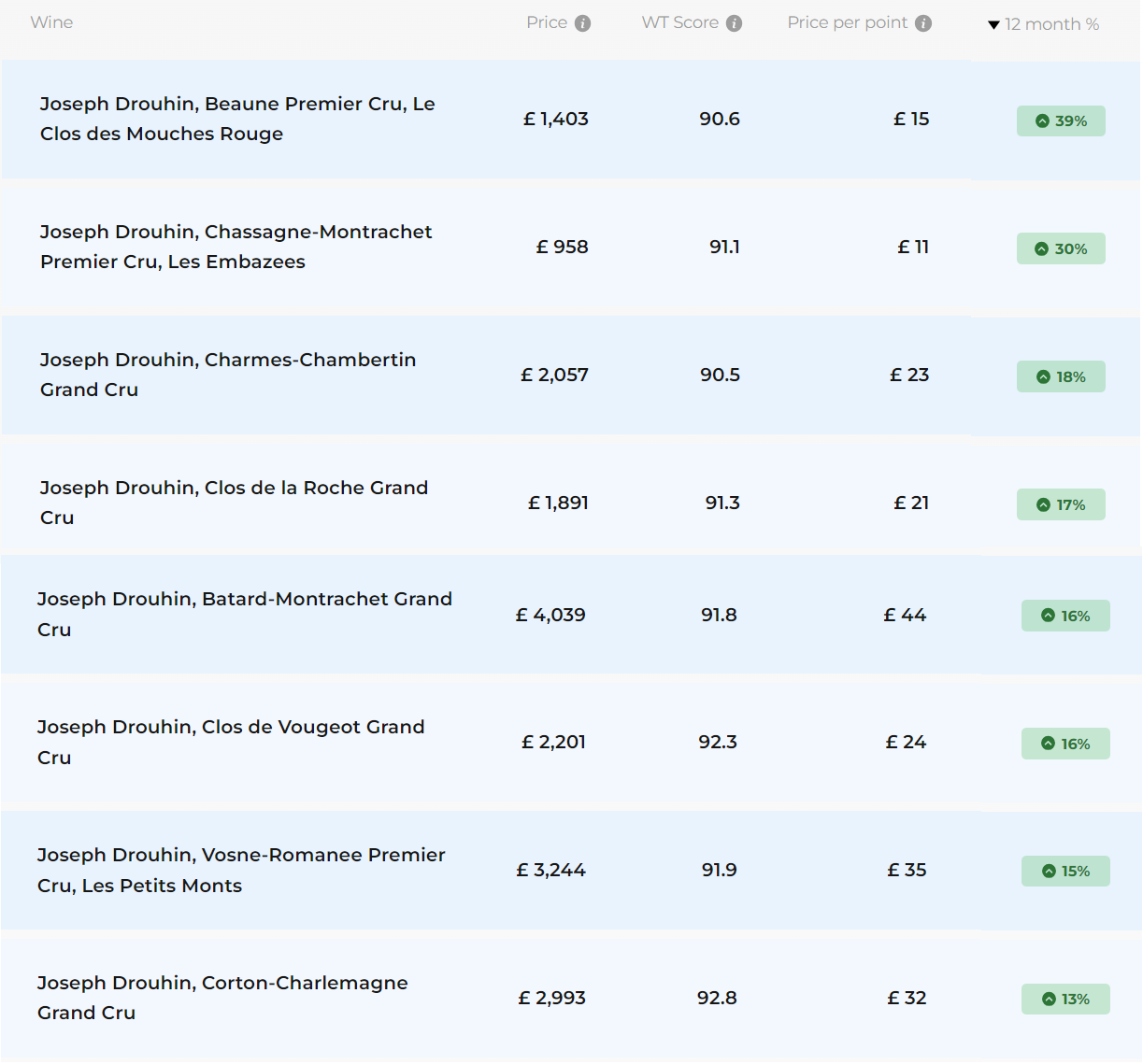
In the last year alone, the best performing Joseph Drouhin wines have risen between 13% and 39%, outperforming the Burgundy 150 index. 

The biggest riser has been their Beaune Premier Cru Le Clos des Mouches Rouge, which has an average price of £1,403 per case.

You can now explore the historic performance of these wines on Wine Track. Our tool provides a clear overview of a fine wine’s track record, including critic scores, average price and investment returns. 

WineCap’s independent market analysis showcases the value of portfolio diversification and the stability offered by investing in wine. Speak to one of our wine investment experts and start building your portfolio. Schedule your free consultation today.
 

Categories
News

Chablis Commission Pleased with 2022 Harvest

While Chablis declared 2021 to be a ‘complicated’ year, 2022 has proven to be a real contrast, with the Chablis Commission having declared this year’s harvest to be a healthier and overall higher-yielding one.

Paul Espitalié – president of the Chablis Commission – commented that 2022 was a much more dynamic vintage when compared to 2021, as the years before it had ushered in ‘challenges for winemakers in Chablis with the changing and unpredictable climate’.

Many winegrowers in Chablis rejoiced after the harvest this year as yields were plentiful and almost up to the maximum amount permitted. Because of this, the commission is hopeful that the region will be able to make up some lost ground with regards to volumes for export markets, where the UK still holds the top spot.

Espitalié commented that: ‘The UK continues to be our most important export market and we believe a key element to the continuing success of Chablis wines’. He also added that one of the commission’s main focuses is to increase consumer awareness of both Petit Chablis and Chablis wines.

‘These appellations have just as much to offer the market, particularly in the current financial climate in terms of offering great value wines,’ he said.

The 2022 harvest’s wines will be available in the UK shortly. Over the course of a year, a total of 3.8 million bottles were sold in the UK in 2021 – 2022.

Looking ahead, 17% of all Chablis vineyards are currently 100% organic and the subregion is also on track to hit the Burgundy-wide target of becoming carbon neutral by 2035. The aim of these initiatives is to improve the vineyards’ health and protect the local industry for the years to come.

Read more about the potential of Burgundy’s 2022 harvest here.

Categories
Insight

The DRC Ransom Plot

One of Burgundy’s most sought-out producers is Domaine de la Romanée-Conti (DRC). It was the Benedictine monks who were the first to recognise the Côte d’Or’s potential as a winegrowing area. They divided up and organised the parcels of land that produced the finest grapes. 

This piece of land was originally called ‘Le Cloux des Cinq Journaux’, then ‘Le Cros de Cloux’. After changing ownership many times after the monks tended the vines there, the plot was renamed as ‘La Romanée’ by the Croonembourg family. However, it wasn’t until 1760 that this legendary site was given its name that remains to this day. Louis-François of Bourbon – the Prince Le Conti – named it ‘Romanée-Conti’ when he purchased the 4.46 acre plot.

It is rumoured that the prince acquired the land as he discovered that his rival – Madame de Pompadour – who was also vying for the affection of the king, Louis XV, planned on buying the vineyard. The prince hired an agent to carry out his wishes and hoarded all the domaine’s wines for himself, throwing elaborate parties for his distinguished guests.

Domaine de la Romanée-Conti’s wines are some of the most eye-wateringly expensive in the world. Even having the means to purchase them doesn’t necessarily translate into being able to buy them as production levels are so low that only approximately 500 cases of La Romanée-Conti are made each year.

One villain – having discovered just how much the wines were retailing for – hatched a plan in 2010 to hold DRC’s co-owner and head winemaker, Aubert de Villaine, to ransom.

Having made detailed drawings of the vineyard and, shockingly, having poisoned two of DRC’s vines with herbicide already, the crook sent a ransom letter, addressed to Villaine. In it, they demanded €1.3 million from the estate, otherwise they would poison the remainder of the historic vines. 

It transpired that the culprit wasn’t as cunning as you’d have thought. Villaine enlisted the help of private investigators who delivered the ransom money to the specified location and a certain Jacques Soltys retrieved a parcel full of false notes and was met by police who were lying in wait.

After such an ordeal, things returned to normal at the estate. The grapes were picked, fermented and transformed into the 2010 vintage that, unsurprisingly, was proclaimed to be one of the all-time greatest years. 

Search for all of DRC’s wines and find out their performance on Wine Track