Categories
Learn

Profiling the fine wine investor in 2024

  • Nearly 30% of the UK’s high-net-worth (HNW) investors incorporate fine wine into their portfolios.
  • They tend to be cautious, but in 2024, investors with balanced risk profiles are increasingly dipping into the world of drinkable assets.
  • Since last year, the demographic has shifted a little towards less experienced investors, indicating that new HNWs could be getting involved with fine wine.

Fine wine, historically a passion-driven investment, has predominantly attracted older, seasoned investors interested in both enjoying and preserving their wealth. However, recent trends indicate a shift as younger, less experienced investors in the UK are increasingly drawn to fine wine for different reasons – not least because the fine wine market has become more accessible.

Fine wine allocations in investment portfolios

In 2024, nearly 30% of the UK’s high-net-worth (HNW) investors incorporate fine wine into their portfolios.

66% are allocating up to 10% of their portfolio to fine wine, with the remaining 34% reserving over 11%. In 2024, 2% are allocating over a third of their portfolio to fine wine. This trend reveals a more polarising wealth distribution, considering that last year just half of wealth managers kept fine wine allocations under 10%, but none invested over 30% of their wealth in fine wine.

Investors’ risk profiles

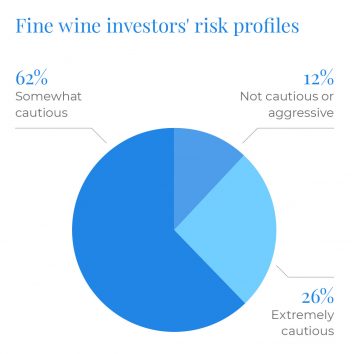
Fine wine investors tend to be the cautious type. According to our 2024 wealth management survey, 88% of respondents incorporate fine wine into portfolios for investors with a ‘somewhat cautious’ or ‘extremely cautious’ risk tolerance. As fine wine can help provide stability, it can have a calming influence on overall performance. 

Cautious investment portfolios also generally contain a greater proportion of bonds and cash-like assets. The inflation-resistance of wine can help to buffer out some of the risks this can present over the long term. 

The remaining 12% tend to use wine for balanced portfolios (compared to 10% last year). None of the respondents use the asset for clients with higher risk tolerances.

In 2024, around 2% of respondents are using fine wine for ‘somewhat aggressive’ portfolios. As fine wine has historically exhibited strong growth during recessions and periods of high inflation, it could easily be used to diversify high-risk portfolios. 
Investment experience

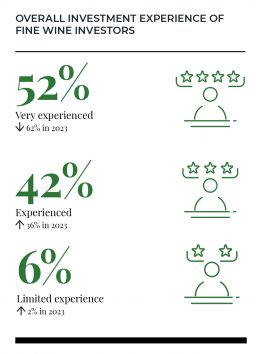
In line with this trend, over the past 12 months, fine wine has started to move beyond the realm of ‘very experienced’ investors. The slow spread towards ‘experienced’ and ‘somewhat experienced’ investors suggests that fine wine is becoming a more mainstream asset. 

This move could be prompted by the demand to invest in sustainable and low-carbon assets. As this trend is particularly strong with younger investors, it fits that they could have less experience. 

This year, 52% of UK wealth managers rated their investment clients as ‘very experienced’ with fine wine, compared to 62% in 2023. Meanwhile, clients with medium or limited experience grew their fine wine investments.
Fine wine has long been perceived as an exclusive, somewhat intimidating investment, traditionally reserved for a privileged few. But as our recent research indicates, attitudes are slowly changing.

For more information on the changing fine wine investors’ demographics, read our exclusive Wealth Report 2024: UK Edition.

WineCap’s independent market analysis showcases the value of portfolio diversification and the stability offered by investing in wine. Speak to one of our wine investment experts and start building your portfolio. Schedule your free consultation today.

Categories
Learn

Top reasons to invest in fine wine in 2024

  • Stability, sustainability and increased market liquidity are the key drivers of investment interest in fine wine. 
  • UK investors are also attracted by the tax advantages of fine wine, which is classed as a ‘wasting asset’.
  • Meanwhile, passion investing is on the rise in the US, seeing an 8% uptick since last year.  

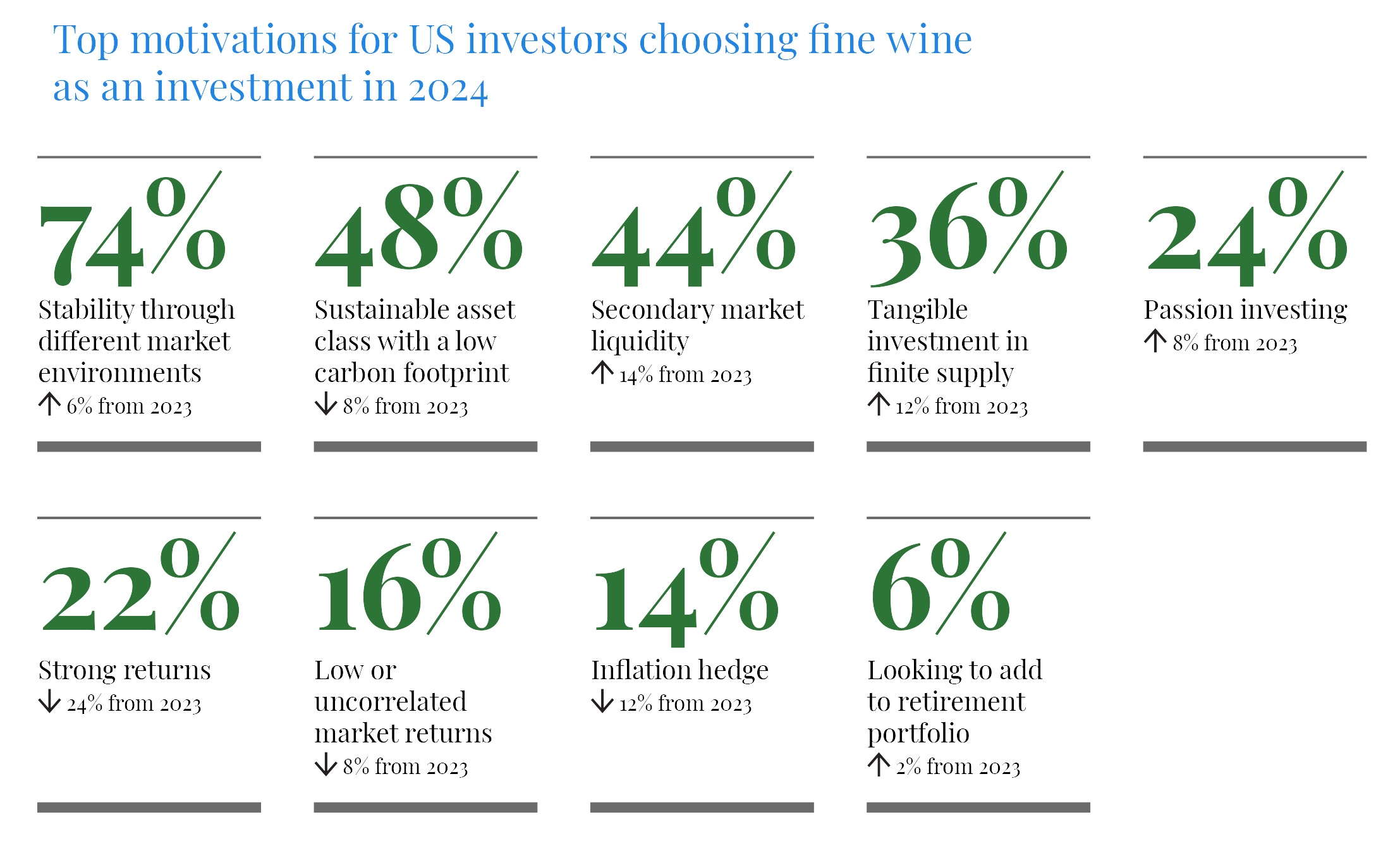
Our recent survey among UK and US wealth managers revealed the top reasons why investors are choosing fine wine in 2024. 

While there are differences in their motivations based on demographic, sustainability, stability through different economic environments, and increased liquidity came at the forefront in both markets.  

Fine wine’s stability during market volatility

In uncertain times, investors often seek tangible assets that offer stability. As WineCap’s CEO, Alexander Westgarth puts it, ‘In times of hardship, people want something solid. Literally. Tangible assets like property, gold or fine wine tend to feel more precious during market downfalls’. 

With US market sentiment being one of fear, according to the Fear & Greed index, 74% of US wealth managers chose stability as their top reason to include fine wine in client portfolios, marking a 6% increase from last year.

In the UK, stability came as the second most important factor driving demand for fine wine. It was cited by 56% of our survey respondents, up 16% since 2023. High inflation, slow economic growth and various macroeconomic headwinds have solidified fine wine’s position as a ‘safe haven’ asset, preferred by UK investors. 

Sustainable investing on the rise

Sustainability was the number one reason to invest in fine wine for UK wealth managers, and the second most important factor in the US. 

As we recently explored (‘The growing importance of sustainability in fine wine investment’), there has been a broader global trend where environmental, social, and governance (ESG) factors are increasingly shaping investment strategies across various asset classes, including fine wine.

Research from Morgan Stanley shows that more than half of individual UK investors plan to increase their allocations to sustainable investments in 2024, making fine wine a great investment option. 

According to our survey, 68% of UK investors invest in fine wine because of its low-carbon benefits, with many fine wine producers leading the charge in sustainable viticulture. 

Improved liquidity

Investors in both the UK and US recognise that the fine wine market is becoming more liquid. Advances in technology have opened up new avenues for investors, simplifying buying and selling processes, improving price transparency, and shifting perceptions of fine wine as an “illiquid liquid.”

As a result, UK investor confidence in the market’s liquidity has increased by 32% in 2024. As for the US, there has been a 14% increase from 2023. 

UK tax benefits

UK investors benefit from fine wine’s status as a ‘wasting asset’ making it a more tax-efficient investment. As of April 2024, UK investors pay up to 28% tax on profits over £3,000. Pre-2022, investors paid tax on anything above £12,300, but the past few years have seen the threshold slashed in a bid to plug the ‘fiscal black hole’. 

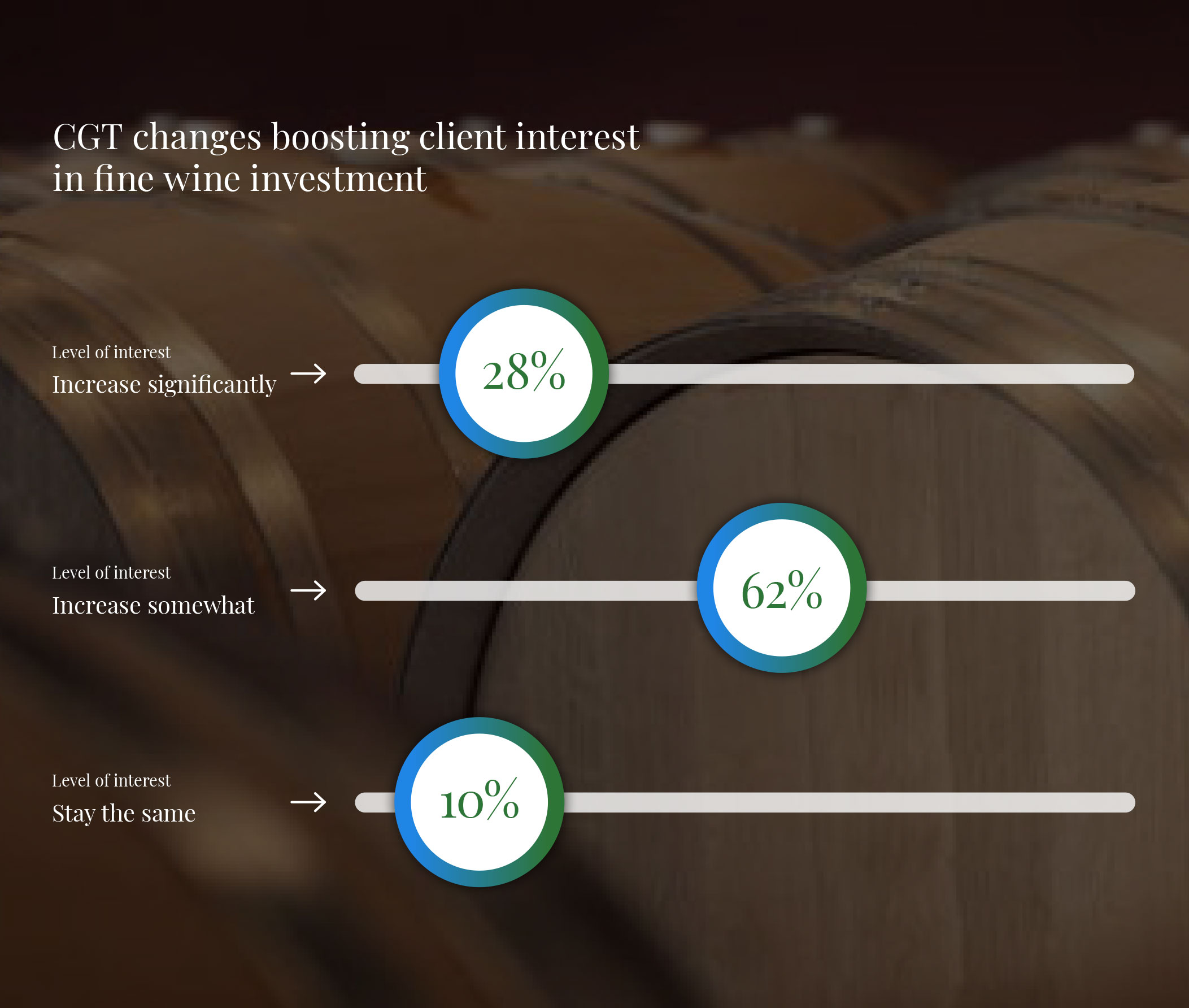
As a ‘wasting asset’, the HMRC does not consider fine wine an investment where the profit should be taxed. Investors recognise this benefit, with 90% of our survey respondents noting that the CGT changes will increase the attractiveness of fine wine.

Tax efficiency was the fourth most important reason for UK investors, cited by 38% of the respondents.

The overlap between collecting and investing in the US

Fine wine, long seen simply as a passion asset, has managed to rebrand itself as a sound alternative investment choice. UK investors today focus less on ‘passion’, a motivation that has seen a 16% dip since last year. 

Still, in the US, many investors start out as collectors. ‘Passion investing’ has been on the rise across the pond, with 24% of the survey respondents being motivated by earning a profit and enjoying the experience that comes with owning a fine wine collection. 

For the full breakdown of the reasons why investors choose fine wine in 2024, read our UK and US Wealth reports.

WineCap’s independent market analysis showcases the value of portfolio diversification and the stability offered by investing in wine. Speak to one of our wine investment experts and start building your portfolio. Schedule your free consultation today.


Categories
Learn

How technology has democratised fine wine investment in 2024

  • Technology has democratised fine wine investment by opening new avenues and making the asset more accessible to novice investors.
  • Since last year, there has been a 32% increase in UK investor confidence in the market’s liquidity – a shift partly driven by technology.
  • 80% of UK investors believe that technology like blockchain will create more security and confidence in the sector.

In the world of fine wine, exclusivity has long defined the industry, which has historically attracted seasoned aficionados and connoisseurs with extensive resources and specialised knowledge.

In recent years, technology has democratised the sector, opening new avenues and making fine wine appeal to a more diverse investor demographic. 

According to our 2024 UK Wealth Report, technological advancements have contributed to fine wine going mainstream and thus expanding the market’s appeal to a broader audience, in particular, less experienced investors. Technology has simplified buying and selling processes, enhanced pricing transparency and improved the market’s overall liquidity.

Technology leads to an increase in investor confidence

Since last year, there has been a 32% increase in UK investor confidence in the market’s liquidity – a shift partly driven by technological advancements. In the US, this number is 14%. 

An increasing number of fine wine investors are leveraging data and technology to inform their buying and selling strategies and track the value of their portfolio.  

Online platforms, like WineTrack, have made it easier to identify investment opportunities, compare prices and critic scores and track a brand’s historic performance all in one place. Meanwhile, fine wine indices like the Liv-ex regional indices can help investors compare the performance of different regions and identify market trends.

Advanced technology’s role in fine wine trading

According to our survey, investors and wealth managers are increasingly receptive to new developments, like the use of blockchain technology, in the fine wine investment landscape.

80% of UK investors believe that technology like blockchain will create more security and confidence in the sector, up from 56% last year. In the US, 76% of investors recognise its benefits, up from 54% in 2023.

52% of the UK survey respondents think that blockchain will make reputable releases, such as En Primeur offers, more accessible for investors without using a third party. Still, 6% of them remain sceptical about how this would work in practice.

Meanwhile, 46% of US wealth managers think that blockchain will bring greater transparency in the supply chain, and further boost investor confidence.

As a growing number of new investors consider fine wine for its unique benefits diversifying traditional portfolios, technological innovations continue to redefine their overall experience and industry standards. 

From blockchain contributing to supply chain transparency to online wine investment platforms shaping decision-making, these technological advancements are evening out the playing field by creating new opportunities in the market and appealing to a broader audience. 

For those interested in exploring this trend further, WineCap’s 2024 Wealth Report offers an in-depth look into the top motivations for investing in fine wine, the trends shaping the market, and investor sentiment.

Download your complimentary copy here

WineCap’s independent market analysis showcases the value of portfolio diversification and the stability offered by investing in wine. Speak to one of our wine investment experts and start building your portfolio. Schedule your free consultation today.

Categories
Learn

The rising demand for collectibles

  • The impending largest intergenerational wealth handover is driving the expansion of the collectibles market.
  • Demand is rising among younger investors looking to diversify their portfolios with assets that offer uncorrelated market returns. 
  • Fine wine is the most popular collectible among UK investors, followed by luxury handbags and jewellery. 

From luxury handbags to fine wine and whisky, the collectibles market is expanding and attracting rising demand from investors that is set to continue. 

This shift is driven by the onset of the largest intergenerational wealth handover in history and a growing appetite among younger investors to diversify their portfolios with assets that offer uncorrelated market returns. 

The evolution of the collectibles market

The allure of collectibles as investments is not a recent phenomenon. Historically, items like fine art, rare coins, and vintage wines have been appreciated for their aesthetic and cultural value. During periods of economic uncertainty, tangible assets like these often retained their value better than traditional financial instruments. For example, during the Great Depression, art and rare coins rose in price, providing a hedge against financial market volatility.

In the post-World War II era, the collectibles market began to gain more structure and legitimacy. Auction houses such as Sotheby’s and Christie’s played pivotal roles in establishing benchmarks for the value of fine art and antiques. The rise of specialised indices, such as the Mei Moses Art Index, helped quantify returns on art investments, further opening the market.

The collectibles market has further evolved in recent years with the help of technology. Technological advancements have democratised access to market information and trading platforms, making it easier for investors to track market trends and make informed decisions. Indices like Wine Track help prospective investors see the average price of a wine, critic scores and investment returns over different time periods for free and at a glance. 

A testament to the rising demand is the expansion of the market. According to investment bank Nomura, the art and collectibles category is now larger than private assets ($1.6 trillion) and more than twice the size of private debt markets ($0.8 trillion). 

The most wanted collectibles for portfolio diversification

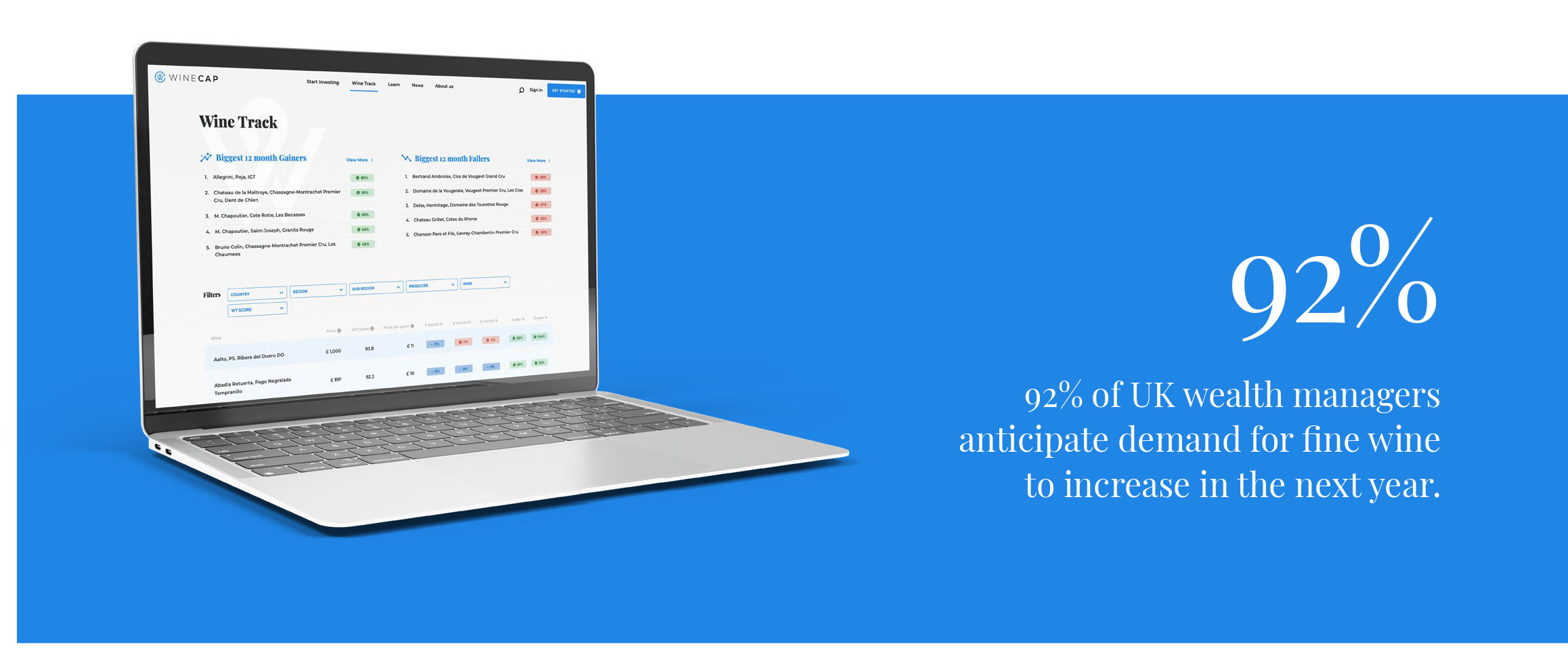
Among collectibles, fine wine is king. 92% of UK wealth managers anticipate demand to increase in the next year. Compared to other luxury assets, the fine wine market is more established and less volatile, offering increased liquidity and price transparency.

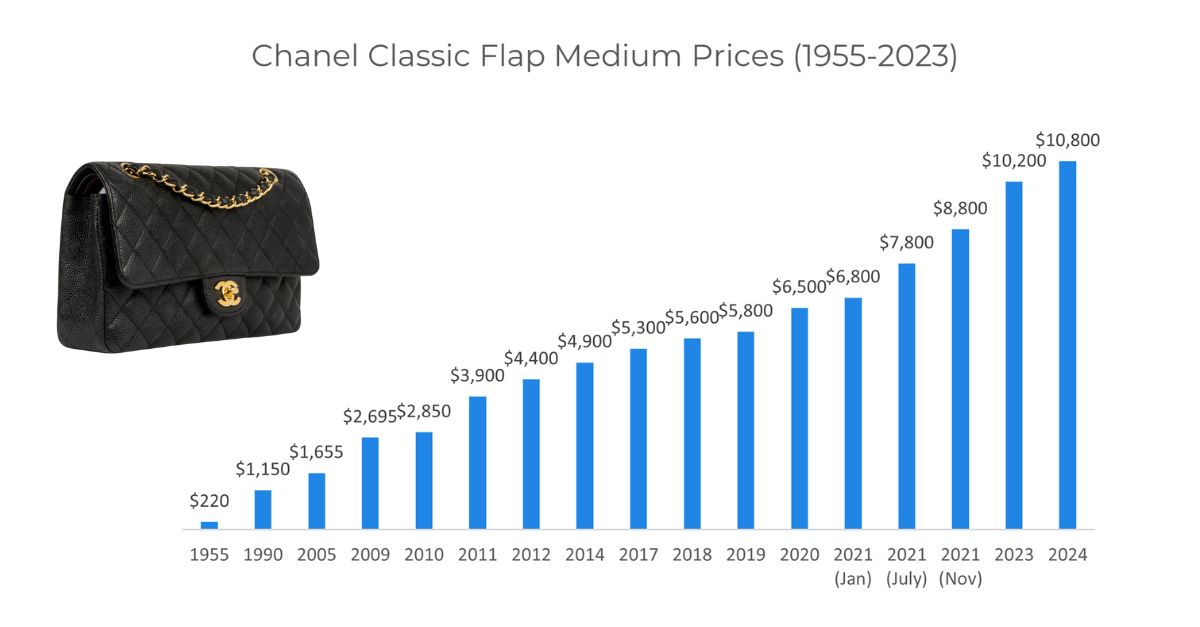
The second most popular collectible in 2024 is luxury handbags, with 86% of wealth managers expecting demand to rise further. As recently explored, interest in handbags as an investment has grown in line with rising prices in the primary market. For instance, the price of the Chanel medium classic flap bag is up close to 553% since 2005, and 4,809% since 1955.

Jewellery is the third most popular collectible in 2024 for 84% of wealth managers, followed by coins (82%). The fifth spot is shared by watches and rare whisky at 78%.

When it comes to the latter, fine wine investment companies are already capitalising on this trend by branching out into spirits. While its secondary market is still in the early stages of its development, rare whisky has already set pricing records.

Earlier this year, a 30-year-old bottle of The Emerald Isle by The Craft Irish Whiskey Co. sold for a staggering $2.8 million, breaking the world record for the most expensive bottle ever sold. The previous record was held by a 1926 Macallan bottle priced at $2.7 million. These figures dwarf the record for the most expensive fine wine ever auctioned, the 1995 Domaine de la Romanée-Conti Grand Cru, which fetched $558,000. 

Collectibles vs mainstream investments

The rise in demand for collectibles comes at a time when traditional investments, like stocks and bonds, are facing heightened volatility and lower returns. Collectibles offer a unique proposition: they are not directly correlated with financial markets, providing a hedge against market downturns.

Moreover, collectibles have an intrinsic value tied to their rarity, cultural significance, and aesthetic appeal, which can appreciate over time independently of market conditions.

The stability and growth potential of these assets make them attractive alternatives to traditional investment avenues, and investors are increasingly perceptive of these benefits.

As the market for collectibles continues to evolve, clients are likely to find new and exciting opportunities in this dynamic sector.

WineCap’s independent market analysis showcases the value of portfolio diversification and the stability offered by investing in wine. Speak to one of our wine investment experts and start building your portfolio. Schedule your free consultation today.
Categories
Learn

Fine wine vs luxury handbags: the investment perspective

  • Luxury handbags are the second most popular collectible item among UK wealth managers in 2024, after fine wine.
  • Rising prices in the primary market for handbags have led to investment interest.
  • While valuations for brands like Chanel and Hermès have spiked dramatically, the secondary market is less established and more illiquid than the fine wine market.

Recent headlines have been filled with news about skyrocketing prices for luxury handbags. The price of the Chanel medium classic flap bag has risen close to 553% since 2005; and 4,809% since 1955.

With prices in the primary market reaching record highs, interest in handbags as a collectible has grown. The term ‘investment piece’ no longer serves to simply describe the timelessness of an item; for investors today, it has taken a much more literal meaning.

Meanwhile, fine wine remains a more established member of the ‘collectibles’ family. In recent years, fine wine has transitioned from a passion investment to a mainstream asset class.

This article explores the shift in investment trends, the rising popularity of luxury assets, and the risks and rewards associated with fine wine and luxury handbags.

A shift in investment trends

Traditionally, investments have been confined to stocks, bonds, and real estate. Now, they are sharing the spotlight with more tactile assets like fine wine and luxury handbags.

According to our recent survey among US and UK wealth managers, there has been a significant uptick in interest for collectibles. In 2024, 78% of US wealth managers expect demand for luxury handbags to increase, complemented by a strong ongoing interest in fine wine (84%).

In the UK, 86% anticipate growth in demand for luxury handbags, up 6% from 2023, while 92% expect sustained demand for fine wine.

The full findings of this survey will be released later this month.

Comparing fine wine vs luxury handbags

Fine wine is sought after for its stability and remains the top investment choice among alternative assets. Its secondary market is more established, offering increased liquidity and price transparency.

It does not lack impressive performers either; luxury Champagnes Salon Le Mesnil-sur-Oger Grand Cru has appreciated 304% over a decade, and Egly-Ouriet Brut Millésime Grand Cru has seen returns of 452%. Prestigious Burgundy wine, Domaine René Engel Vosne-Romanée is up 3,105% over the same period.

Although luxury handbags are a newer investment avenue, they have shown considerable promise. The valuation of iconic pieces like the Hermès Birkin and Chanel Flap Bag has spiked dramatically, reflecting their growing appeal among investors who value both fashion and finance.

Celebrity endorsements

Celebrity endorsements have significantly influenced this market segment. For instance, the Louis Vuitton Pochette Accessoires bag retailed for $165 in 2001; today, it costs $1,520 – an increase of 821%. Over that period, celebrities like Paris Hilton, Nicole Richie, and even fictional character Carrie Bradshaw have boosted its value.

This phenomenon is less prevalent in the world of fine wine, though not entirely absent. Domaine Dujac, for instance, became a brand on the move (the highest riser in the 2018 Liv-ex Power 100 rankings) due to DJ Khaled’s endorsement in a music video.

Investor demographics

Another key distinction between these investment avenues lies in their typical investor demographics. According to the Financial Times, luxury handbags tend to attract younger female clients, who are drawn to both the fashion statement and the investment potential of these pieces. In contrast, the typical fine wine investor is often older and male, with a preference for the historical depth and long-term value appreciation that fine wines offer.

Risks and rewards

Investing in luxury handbags comes with its set of challenges. Unlike fine wine, which can be stored and aged with relative ease, handbags require meticulous care to maintain their condition and value.

Additionally, the market for luxury bags is more volatile, influenced heavily by trends and the limited number of high-value players like Hermès, Chanel, and Louis Vuitton. Future demand for specific models or brands can be unpredictable, and the resale market is often less liquid than that of fine wines.

Both fine wine and luxury handbags offer intriguing opportunities for portfolio diversification, each with unique benefits and challenges. The consistent performance and security of fine wine make it a reliable choice for those seeking steady growth. In contrast, luxury handbags can provide the pleasure of owning a piece of high fashion, though they carry higher risks.

As the luxury investment landscape continues to evolve, the blend of passion and profitability remains a compelling draw for high-net-worth investors globally.

WineCap’s independent market analysis showcases the value of portfolio diversification and the stability offered by investing in wine. Speak to one of our wine investment experts and start building your portfolio. Schedule your free consultation today.

Categories
Learn

Bordeaux En Primeur 2023: under pressure

  • Bordeaux 2023 largely met trade expectations for reduced pricing but only some releases have stood out as offering fantastic value. 
  • Price cuts slowed towards the end of the campaign, from 27.4% average discount in week one, to 23.3% in week four.  
  • Bordeaux’s ability to adapt does not only matter for its short-term sales but also for its long-term relevance in a highly competitive market.

Over the last month, our news coverage centered around the ongoing Bordeaux 2023 En Primeur campaign, examining critic scores and the investment potential of the new releases. 

Prior to the start of the campaign, Bordeaux châteaux faced considerable pressure from the trade to reduce release prices. Price cuts of around 30% were expected. In some cases, these expectations were met, with reductions of up to 40%. 

Now that the campaign is coming to a close, we weigh its success, considering the current state of Bordeaux’s investment market. 

En Primeur 2023 – back in vogue?

Critics of En Primeur contend that the system no longer meets buyer expectations, and the 2023 vintage wanted to rise to the challenge of defying the norm.

Partially it did. Wines like Lafite Rothschild, Carruades de Lafite, Mouton Rothschild, Petit Mouton, Beychevelle, Cheval Blanc and Haut-Brion delivered value and were met with high demand. 

Liv-ex reported immediate trades on its exchange for some of the releases. A developing secondary market is a positive sign for investors, although both Lafite Rothschild and Mouton Rothschild 2023 changed hands below their opening levels. 

According to Liv-ex, ‘it is clear there continues to be a market for Bordeaux En Primeur at the right price. What that price is, is perhaps less clear and will not always be agreed upon’.

The En Primeur golden rule  

For investors, an En Primeur release needs to be the most affordable wine among vintages with comparable scores to make sense. Where that isn’t the case, one should be cautious when buying. 

‘Our golden rule is the En Primeur price is the cheapest you can get. You can’t get anything cheaper. Generally speaking, it’s reasonably successful, not to say 100% successful, and then the price goes up.’ – Philippe Blanc, Château Beychevelle

En Primeur should be forever the lowest price you can find in your bottle. If you purchase later, it’s going to be more difficult to find and it’s going to be more expensive.’ – Pierre-Olivier Clouet, Château Cheval Blanc

The price decrease trajectory

The average price reduction among the top wines released in the first week of the campaign was 27.4%, going as low as 40% discount on the previous year.

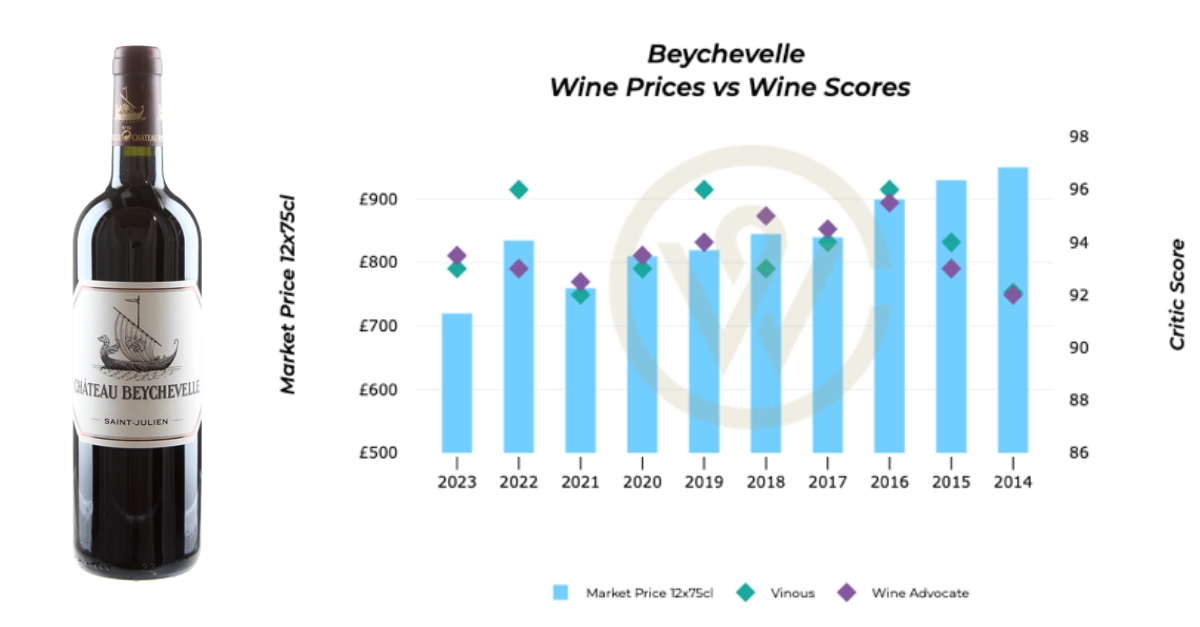
In the fourth week of the campaign, this trajectory of offers slowed down. The average discount was reduced to 23.2%, the most significant being Château La Fleur-Pétrus 2023, down 33.6%, and the least significant, Beychevelle (-11.1%).

However, even though Beychevelle has seen one of the smallest discounts, it has still been one of the best value releases this campaign.

The Bordeaux market slowdown

The pressure to reduce release pricing was largely owing to the current market environment. 

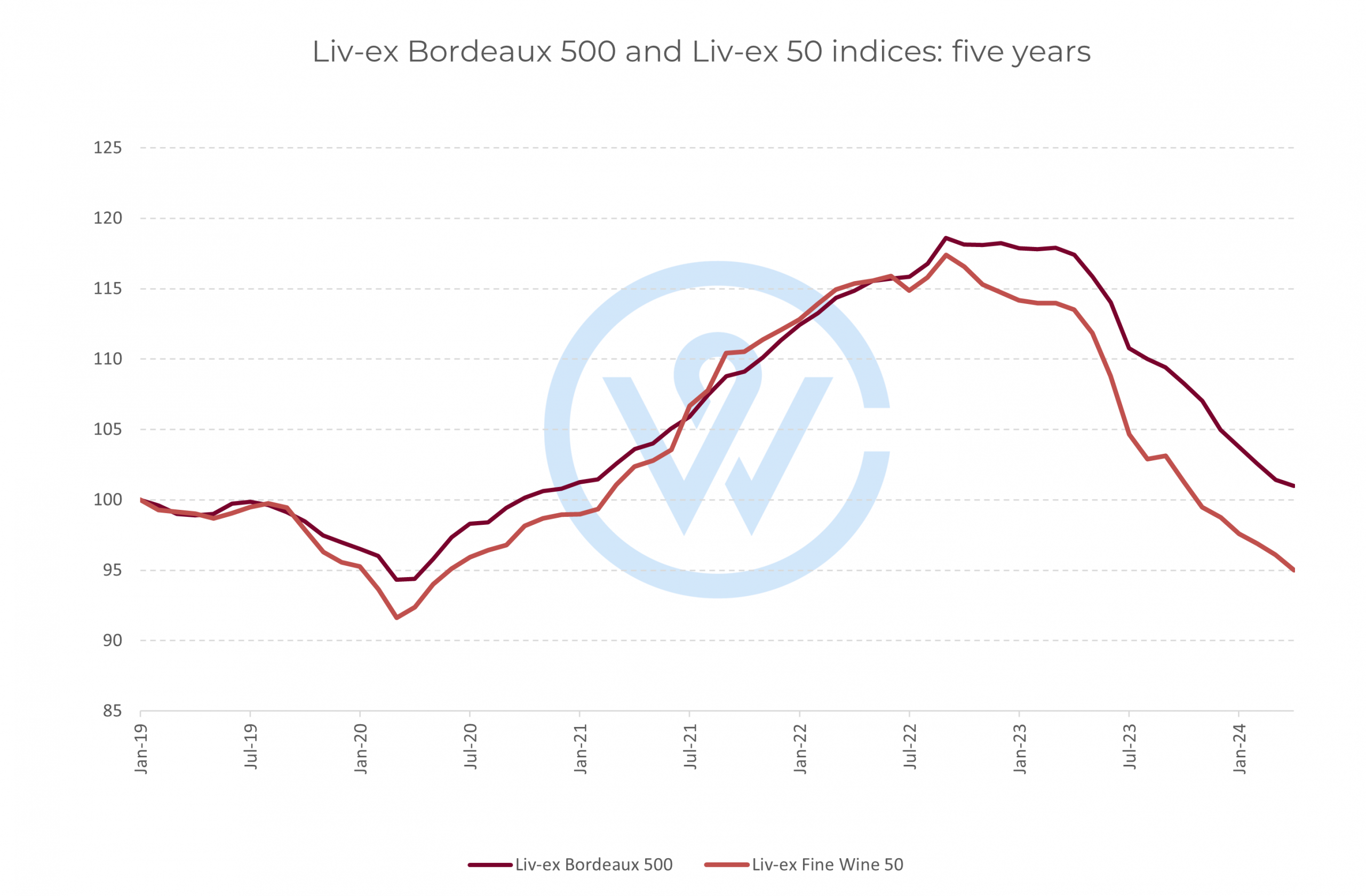
Over the past two years, Bordeaux prices are down 12%. Over the past five years, Bordeaux is one of the slowest growing markets, up 2.1%, considerably lagging behind Burgundy (25.2%), Italy (31.2%) and Champagne (45.5%). 

The market for top Bordeaux has suffered the most. First Growth prices are down 17.3% in the last two years, and 3.7% in the last five years.

The region is also losing market share to its contenders. In 2023, Bordeaux accounted for 40% of the trade by value on Liv-ex compared to 60% in 2018.

This is further exacerbated by slowing demand. Liv-ex noted that today ‘there is more than three times as much Bordeaux for sale than the fine wine market is looking to absorb’.

The need to adapt

The 2023 En Primeur campaign has unfolded under the shadow of mounting pressure for Bordeaux to realign with market demands. The campaign highlighted the critical balance Bordeaux must maintain: offering wines at attractive prices for everyone in the chain. 

Successful examples from this year’s campaign, where price cuts coincided with high demand, underscore the potential for Bordeaux to adapt. However, the slower reduction rates towards the campaign’s end and varied responses from buyers reflect the ongoing debate about the optimal pricing strategy.

Ultimately, as Bordeaux grapples with these challenges, the 2023 En Primeur has underscored the importance of responsiveness to market dynamics. The region’s ability to adjust will not only determine its short-term sales but also its long-term relevance in a highly competitive and ever-evolving global wine market.

WineCap’s independent market analysis showcases the value of portfolio diversification and the stability offered by investing in wine. Speak to one of our wine investment experts and start building your portfolio. Schedule your free consultation today. 
Categories
Learn

What is En Primeur? A short guide for wine investors

  • En Primeur is a three-tier system, involving châteaux, négociants, and courtiers.
  • It allows buyers to purchase wines early, while they are still in barrel.
  • It provides an opportunity to secure allocations of highly sought-after wines that might appreciate in value when bottled.

En Primeur, also known as ‘wine futures’, is a practice rooted deeply in the traditions of the French wine market, particularly prominent in Bordeaux. This unique system allows investors and wine enthusiasts to purchase wines early, while they are still in the barrel, well before they are bottled and released on the general market. This method not only provides a fascinating glimpse into the future of wine investment but also plays a critical role in the financial ecosystem of wine production.

Historical context

The concept of En Primeur dates back over 60 years and has its origins in the post-World War II landscape. During this period, French wine producers faced significant financial challenges. To alleviate these pressures, influential wine merchants, known as négociants, began purchasing wine while it was still maturing in barrels. This arrangement allowed them to lock in supplies at a potentially lower cost and gave the châteaux much-needed cash flow to continue operations.

The En Primeur campaign

Traditionally, the En Primeur campaign kicks off in the spring following the harvest. Wine merchants and critics are invited to sample the young, unfinished wines, which are still in the process of aging. Based on these tastings, they make decisions about purchasing the wines, several years before the final product will be ready for consumption.

The price of the wines can be influenced by several factors, including the perceived quality of the latest vintage, historical brand positioning, critic scores, and market conditions. Once the wine is eventually bottled and ready, it is shipped to the buyers, typically between 18 and 24 months after the sale.

Advantages for investors

Investing in En Primeur can offer several benefits. Firstly, it provides an opportunity to secure allocations of highly sought-after wines, which might be difficult to obtain after release due to limited quantities and high demand. Moreover, purchasing wines at this early stage can be cost-effective, as prices for these wines might significantly increase by the time they reach the market, following bottling and release.

Historically, certain vintages have shown high returns. For instance, the 2008 vintage has risen 79% in value on average since release. Such potential for appreciation makes En Primeur an attractive option for investors looking to diversify their portfolios.

Risks and considerations

However, investing in En Primeur is not without risks. The market can be volatile, and there is no guarantee that purchased wines will increase in value. Recent campaigns have seen negative returns in some cases; for instance, the average price of the 2020 vintage is down 10% since release, of the 2017 – 13%. This means that the wines are now cheaper in the physical market.

Economic downturns, changes in consumer taste, and low critic scores can affect the investment’s outcome. Additionally, buyers commit capital upfront without a guarantee of the wine’s quality at bottling.

The cost of participation can also be a barrier. En Primeur often requires purchasing by the case, which can be prohibitive for smaller investors. Furthermore, there are storage costs to consider, as these wines often need to be aged further in suitable conditions before reaching their optimal drinking window, which can span from five to fifty years.

The global influence of Bordeaux En Primeur

Still, the attention that Bordeaux En Primeur commands, and on a global scale, remains unrivalled. No other region attracts the same level of hype among press and trade. This success has inspired similar practices in other wine regions worldwide, including Burgundy, the Rhône Valley, and even non-French regions such as Italy, Spain, and parts of the New World. These regions have adopted the En Primeur model to varying degrees of success, influenced by their specific market demands and the exclusivity of the wines offered.

For buyers to take fill advantage of En Primeur, keen understanding of the wine market and insight into vintage variations is required. As with any investment, potential investors should perform due diligence, consulting with experts and considering their financial position and investment strategy.

WineCap’s independent market analysis showcases the value of portfolio diversification and the stability offered by investing in wine. Speak to one of our wine investment experts and start building your portfolio. Schedule your free consultation today.

Categories
Learn

History of Burgundy’s price performance

The following article is an extract from our Burgundy regional wine investment report.

  • Burgundy is the region with the highest average bottle prices.
  • It is the best-performing fine wine region, considerably outperforming industry benchmarks.
  • This article analyses its historic performance, the drivers behind its success, and what this might meant for the future of the region.

Burgundy has earned an impressive reputation in the fine wine investment landscape. The region is the outright leader when it comes to average bottle prices and the long-term performance of its wines.

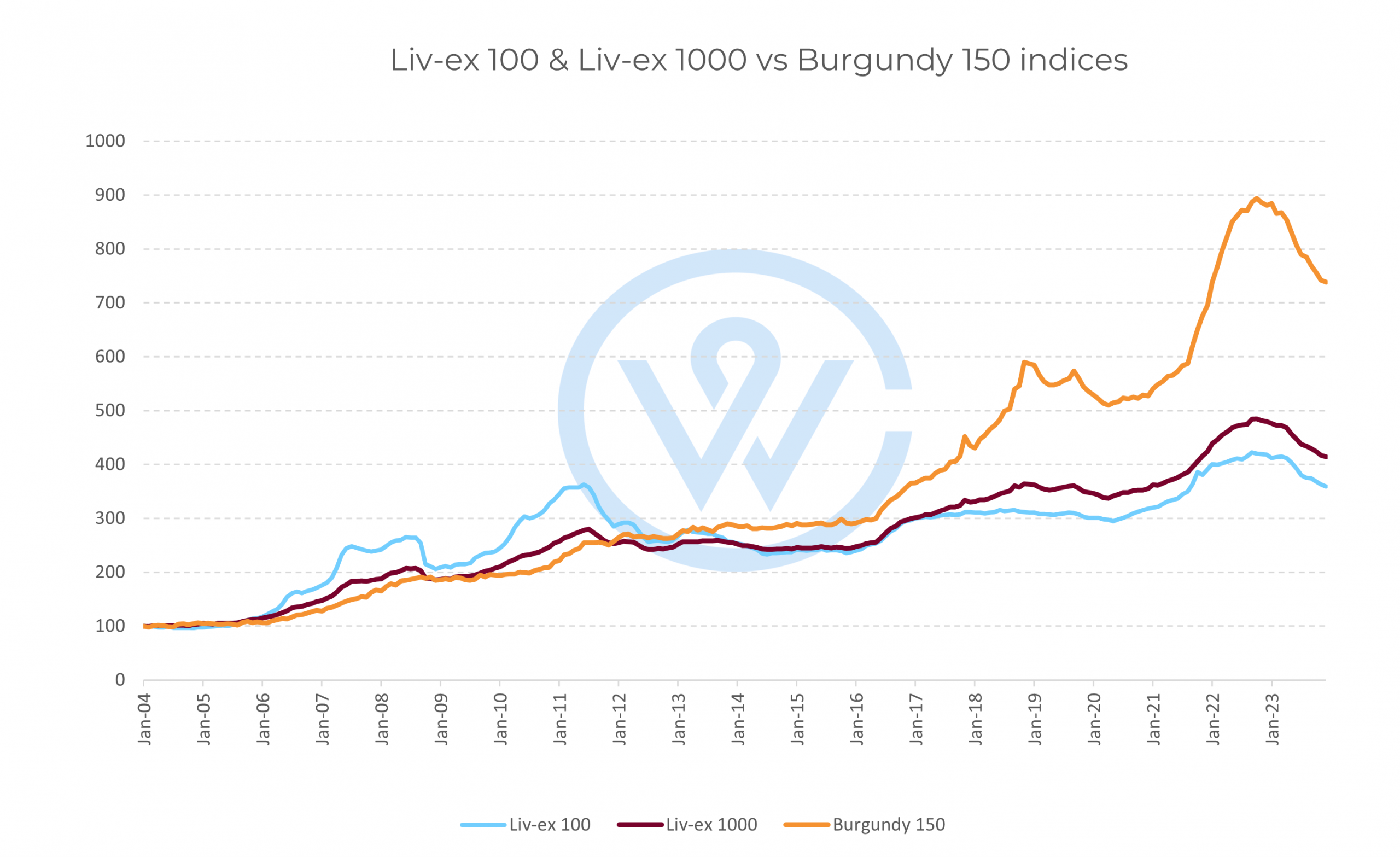
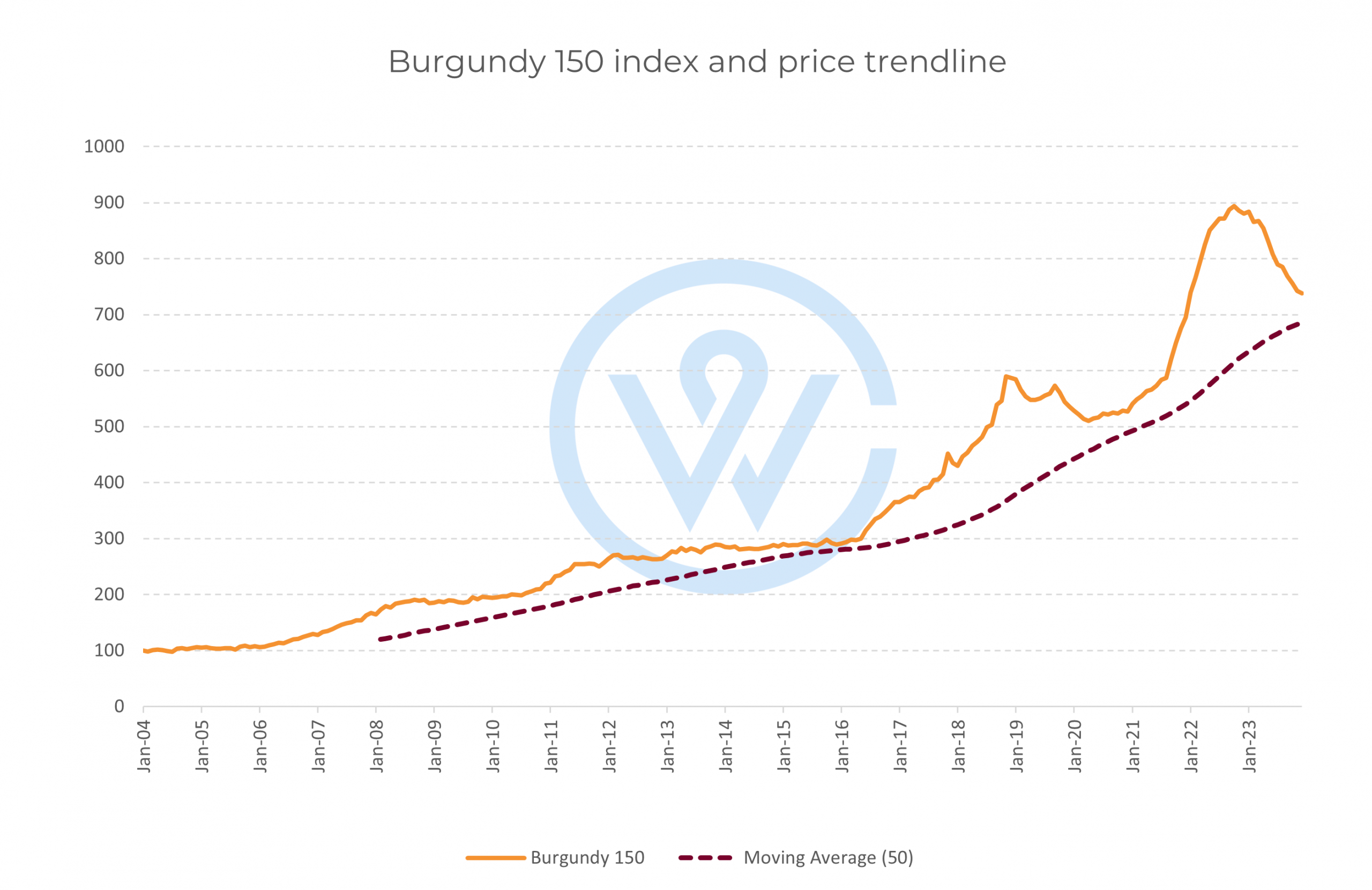
The Burgundy 150 index, which tracks the prices of the last ten vintages across 15 Burgundy brands, is the leading Liv-ex regional index, continually outperforming Bordeaux, Italy and Champagne. It is up over 650% since its inception.

Although the index only comprises a narrow pool of highly traded wines, it provides an indication of the direction of Burgundy prices. During its impressive rise, the index experienced only one significant drop of 15%, giving investors confidence that its punctuated equilibrium will continue.

Historic performance of Burgundy prices

The Liv-ex Burgundy 150 index doubled from early 2006 to mid/late 2008 — the first awakening of the Burgundy market as a new generation of wealthy consumers started to dominate the collectors’ market. This was at least in part driven by the volume of information available to them online from reviewers like Robert Parker and Allen Meadows and a greater focus on fine wine from the major auction houses.

After the 2008 financial crisis, Burgundy was somewhat left in the shadow. With the opening of the Chinese market, Bordeaux grew massively between 2008 and 2011. When Bordeaux fell from its 2011 peak, a new generation of investors flocked to Burgundy, seeking growth and breadth to their holdings.

From 2016 to late-2018, the value of the Burgundy 150 index doubled again. This can be attributed to growing liquidity in the sector and its recognition as a viable high-return investment. The region experienced a period of decline in 2019/2020, after a 15-year period without any significant downward movements. Some of this retreat has been related to profit taking and, later on, to the Covid-19 pandemic. Burgundy quickly made up for lost time in 2021 and 2022, with factors such as increased at-home consumption of fine wine, growing online trade, and rising liquidity contributing to its success. The index hit an all-time high in October 2022 at 909.4.

The market at large experienced another period of contraction in 2023, due to a combination of macroeconomic factors such as geopolitical conflicts, the lasting effects of the pandemic, high inflation and rising interest rates. Burgundy was the hardest hit region.

However, the overall direction of prices remains upwards as the trendline in the chart below shows. Such periods are advantageous times for Burgundy buyers who are usually able to find more stock at lower prices.

To find out more about the investment market for Burgundy wines, read the full report here.

Categories
Learn

Inside Champagne’s wine investment market

  • Champagne has enjoyed rising popularity as an investment in recent years, which has been reflected in its price performance.
  • The Liv-ex Champagne 50 index has considerably outperformed industry benchmarks.
  • While quality is important, brands and age are the most significant drivers behind its performance.

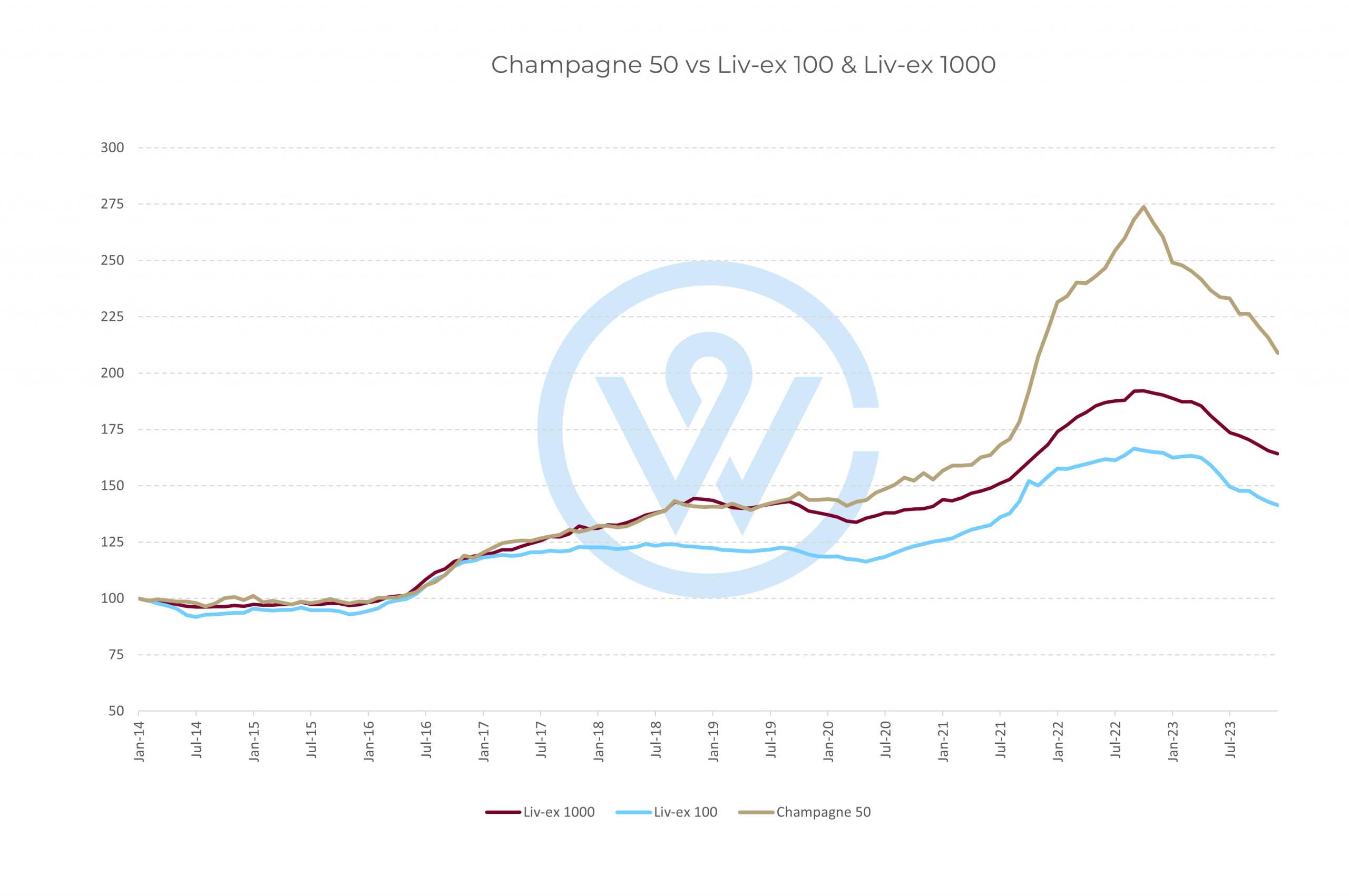
Champagne has enjoyed rising popularity as an investment in recent years, which has been reflected in its price performance. The Liv-ex Champagne 50 index, which tracks some of the most sought-after wines including Krug Vintage Brut, Bollinger La Grande Année, Dom Pérignon, Louis Roederer Cristal, and Taittinger Comtes de Champagne among others, has significantly outperformed global benchmarks. Over the last decade, the Champagne 50 index is up 108.9%, compared to 41.4% for the Liv-ex 100 and 64.3% for the broader Liv-ex 1000 index.

These numbers clearly demonstrate that Champagne is a smart addition to any diversified investment portfolio and should no longer be considered just a celebratory indulgence.

Champagne’s price performance

Much of Champagne’s remarkable performance happened between mid-2020 and the end of 2022, when the index appreciated 90.9% (May 2020 – October 2022). This period was marked by great uncertainty, from the Covid-19 pandemic, through war in Ukraine, rising inflation and recession. As the ultimate ‘luxury good’ in the fine wine market, Champagne performed particularly well and its rising prices did little to temper demand.

Since then, prices have calmed but demand remains strong. Champagne dominated the list of the top-traded wines on Liv-ex in 2023, with Louis Roederer Cristal 2015 leading the value rankings, and Dom Pérignon 2013 – by volume.

Supply and demand dynamics

Demand for Champagne has led to increases in its overall production from 50 million bottles in the 1970s to over 300 million today. Of these, Moët & Chandon contributes over 30 million bottles per year, making it the world’s largest Champagne producer.

Despite relatively healthy production volumes, the availability of vintage Champagne is limited (due to its staggering consumption market, which includes hospitality and entertainment industry buyers). This further enhances its desirability as an investment.

As it ages, its quality improves; as it is consumed, its supply decreases. This dynamic brings about an inverse supply curve – the ideal scenario for investors.

Smaller initial costs are another positive, as Champagne offers both new and experienced investors relative affordability. Although prices have moved considerably in recent years, the average case of top Champagne costs less than a case of the top wines of Bordeaux, Burgundy, California or Italy. Meanwhile, the region offers better returns.

What makes Champagne investment unique

The fine wine market has long been influenced by major critics. While critics do play a part in the evolution of Champagne prices, brands and age have proven to be more significant performance drivers.

Champagne houses that have an established and historically proven identity are already ahead of the game; however, endorsements from sources such as royal weddings, celebrities and high-visibility restaurants have paved the way for emerging cuvées.

Champagne is a more direct market than ones like Bordeaux as there are no négociants; the structure in Champagne is such that over 90% of producers are now also distributors.

Thanks to its artisanal qualities, ‘grower Champagne’ is a newly expanding sector (small estates where the brand identity is centred around the vigneron themselves). Leading this group are the likes of Jacques Selosse, Egly-Ouriet and Ulysse Collin.

An added benefit to Champagne’s appeal is its drinkability. If an investor simply cannot resist popping the cork, Champagne can be readily consumed much earlier than premium investment wines, further diminishing supply and driving prices up.

To find out more about the investment market for Champagne, read the full report here.

Categories
Learn

Inside the USA’s wine investment market

The following article is an extract from our USA regional wine investment report.

  • Today, the USA is one of the key fine wine investment regions.
  • Its share of secondary market trade has risen from 0.1% in 2010 to around 8% this year.
  • Demand has been stimulated by a string of good vintages in the past decade, high critic scores, and expanding distribution.

Today, the USA is one of the key fine wine investment regions. Its share of secondary market trade has risen from 0.1% in 2010 to about 8% this year, and an increasing number of previously overlooked wineries are now showing investment-worthy returns.

Inside the USA’s investment market

California has long been the driver behind the USA’s ever-growing presence in the fine wine investment landscape, accounting for roughly 99% of the country’s secondary market trade. Buying demand has been largely UK and US-driven and centred around the top names: Screaming Eagle, Opus One, Dominus, Harlan Estate, Promontory, and Scarecrow.

Price differentials

California is the second-most-expensive fine wine region after Burgundy, based on the average price of its leading estates. However, there are big differences in pricing between the region’s top names.

At the time of writing, the average case price of Screaming Eagle Cabernet Sauvignon is £39,117, compared to £7,399 for Promontory, £3,764 for Opus One, £2,773 for Dominus, and £2,719 for Ridge Monte Bello. To explore average trade prices, visit our indexing tool Wine Track.

Price performance

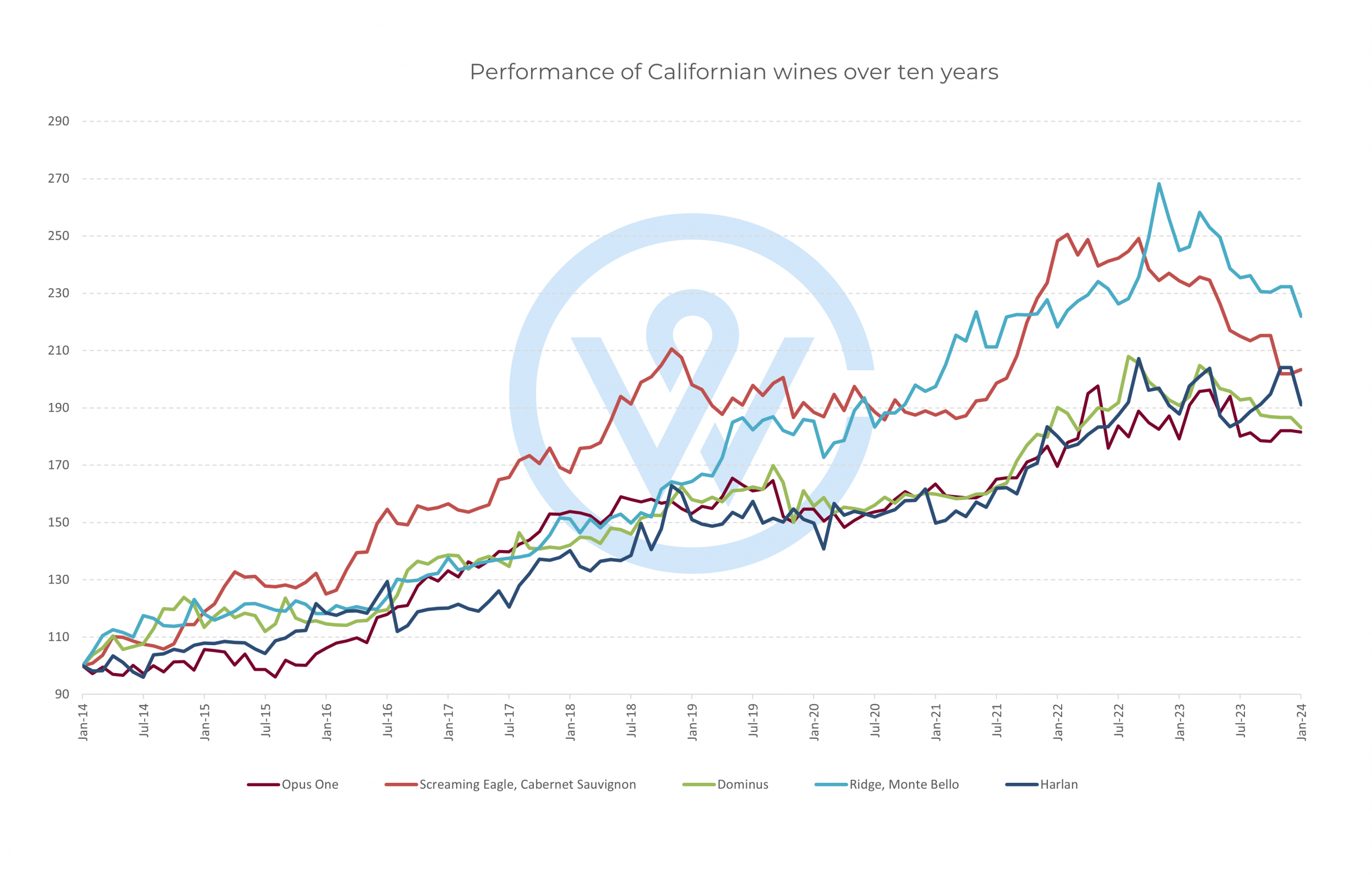
Prices for Californian fine wines have risen slowly and steadily. Over the last 15 years, the Liv-ex California 50 index which tracks the price movements of the last 10 physical vintages across five of the most traded brands (Dominus, Opus One, Harlan, Ridge, and Screaming Eagle) has outperformed both the Liv-ex 100 and Liv-ex 1000 indices. The California 50 is up 166.2%, compared to 71.6% for the Liv-ex 100 and 116.6% for the Liv-ex 1000. Moreover, over the long and short term, California has fared better than Bordeaux as an investment, yielding higher returns.

The best brands for investment

Among the most popular labels, Ridge Monte Bello has been the best-performing Californian wine, up 121.9% in the last decade. It has been followed by Screaming Eagle Cabernet Sauvignon with a 103.3% rise and Harlan, up 91.1%. All the wines in the chart below have risen over 80% in the last decade.

However, other producers beyond the most traded names have also been making waves. Caymus Cabernet Sauvignon has risen an impressive 154.8%, while Dunn Howell Mountain Cabernet Sauvignon is up 137.5% in the last decade. This data suggests that there is a significant number of American wines beyond the most popular names that can deliver healthy investment returns.

California: A 100-point region

Price performance has been influenced by ‘cult’ status and vintage quality. California regularly tops critic rankings as the region with the most 100-point wines. Relatively consistent climate has led to less vintage variation than in other dominant fine-wine producing regions. Major critic publications like Wine Advocate and Wine Enthusiast highlight 2001, 2007, 2012, 2013, 2015, 2016, 2018, 2019, and 2021 as particularly good.

To find out more about the investment market for US wines, read the full report here.