- Red wine remains the primary driver of the global fine wine investment market due to its ageing potential and more active secondary market.
- Three varieties (Cabernet Sauvignon, Pinot Noir, and Merlot) form the historical core of the secondary market.
- Modern viticulture has allowed many traditional European grapes to find expressions in new regions.
While white wine accounts for a major share of global wine production, the fine wine market has long been dominated by red wine. One of the key reasons is tannin – a natural compound found in grape skins, seeds, and stems that acts as a preservative, allowing the best red wines to evolve and improve over decades.
As red wines age, their primary fruit flavours gradually develop into more complex tertiary characteristics, including earthy, savoury, leather, tobacco, and forest floor notes. This ability to transform over time is central to both their appeal among collectors and their long-term market value.
This is not to say that white wine cannot be age-worthy, complex, or investment-worthy – many of the world’s greatest white wines certainly are. However, as a broad generalisation, red wines are more closely associated with longevity, structure, complexity, and collectability, making them the cornerstone of the fine wine investment market.
Cabernet Sauvignon: The global standard
Cabernet Sauvignon is widely regarded as the world’s most important fine wine grape variety. Originating in 17th-century France through a natural crossing of Cabernet Franc and Sauvignon Blanc, it is known for its thick skins, high tannin levels, and naturally high acidity – qualities that give the grape exceptional structure and ageing potential.
Today, Cabernet Sauvignon forms the backbone of many of the world’s most collectible and investment-grade wines, particularly in Bordeaux and Napa Valley. The grape thrives in well-drained gravel soils, which retain heat and help promote the slow, even ripening needed to achieve full phenolic maturity.
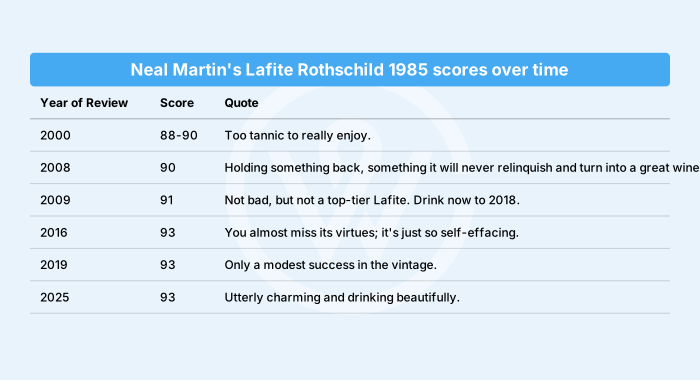
In Bordeaux’s Medoc, Cabernet Sauvignon defines legendary estates such as Chateau Lafite Rothschild and Chateau Mouton Rothschild. Here, it produces wines known for their blackcurrant fruit, cedar, graphite, and tobacco characteristics, alongside the structure required for decades of development in bottle. One of Cabernet Sauvignon’s defining traits is its ability to clearly express terroir while maintaining a recognisable varietal identity.
Outside France, Cabernet Sauvignon has become the flagship grape of Napa Valley, where warmer conditions create richer, more opulent expressions. Wines from top estates such as Screaming Eagle have achieved cult status on the secondary market due to their rarity, critic scores, and global demand.
Modern viticulture has also allowed Cabernet Sauvignon to thrive beyond its traditional regions. One of the most important examples is Sassicaia from Bolgheri in Tuscany – a Cabernet-led blend that helped establish the ‘Super Tuscan’ category and transformed the reputation of Italian fine wine internationally.
- Iconic wines: Chateau Lafite Rothschild (Pauillac), Screaming Eagle (Napa Valley).
- Out-of-region star: Sassicaia from Bolgheri, Italy.
- Investment relevance: Very high. It is the cornerstone of almost every major fine wine portfolio.
Merlot: The velvet architect
Merlot is often seen as the softer counterpart to Cabernet Sauvignon, yet it is one of the world’s most important fine wine grape varieties in its own right. Known for its supple texture, rounded tannins, and generous fruit profile, Merlot typically delivers flavours of plum, black cherry, raspberry, and chocolate, alongside a distinctive velvety mouthfeel.
In Bordeaux, Merlot is the dominant grape on the Right Bank, particularly in Pomerol and Saint-Emilion, where clay-rich soils help the variety achieve exceptional ripeness and concentration. These conditions produce some of the most luxurious and collectible wines in the world, combining richness with remarkable finesse and ageing potential.
Merlot’s naturally earlier ripening cycle and approachable tannin structure have also made it highly adaptable across different climates and winemaking regions. While the grape experienced a temporary decline in popularity in mainstream wine culture during the early 2000s, its position at the top tier of the fine wine market has never truly been challenged.
At its highest level, Merlot produces wines celebrated for their extraordinary texture, aromatic complexity, and seamless balance. The greatest examples evolve over decades, developing layers of truffle, cedar, tobacco, earth, and exotic spice while retaining their signature softness and elegance.
Beyond Bordeaux, Merlot has also achieved remarkable success internationally. One of the most famous examples is Masseto from Tuscany – a 100% Merlot wine that consistently commands some of the highest prices in the Italian fine wine market and has become one of the world’s most collectible cult wines.
- Iconic wines: Chateau Petrus (Pomerol), Chateau Cheval Blanc (Saint-Emilion).
- Out-of-region star: Masseto from Tuscany, Italy.
- Investment relevance: High, particularly for wines from the Right Bank of Bordeaux and top Italian estates.
Pinot Noir: The ethereal king
Pinot Noir is one of the world’s most revered and challenging grape varieties, producing wines celebrated for their elegance, complexity, and remarkable ability to express terroir. Unlike more powerful red grapes such as Cabernet Sauvignon, Pinot Noir is defined by finesse rather than structure, offering bright acidity, silky tannins, and intensely aromatic profiles.
The grape’s thin skins make it particularly delicate and difficult to cultivate. Pinot Noir thrives in cooler climates and requires meticulous vineyard management to avoid disease, over-ripeness, or loss of aromatic precision. When grown successfully, however, it can produce some of the most profound and sought-after wines in the world.
The spiritual home of Pinot Noir is Burgundy, where centuries of vineyard classification and tiny Grand Cru holdings have created an extraordinary level of scarcity. Estates such as Domaine de la Romanee-Conti and Domaine Armand Rousseau produce wines that are among the rarest and most expensive on the global secondary market. Demand consistently exceeds supply, contributing to the long-term appreciation of Burgundy’s top wines.
Young Pinot Noir is often characterised by flavours of red cherry, raspberry, rose petal, and spice. With age, the wines evolve into more savoury and complex expressions, developing notes of truffle, forest floor, dried herbs, and earthy undergrowth – qualities that have led many collectors to describe great Pinot Noir as ethereal.
While Burgundy remains the benchmark, Pinot Noir has also found exceptional success internationally. One of the standout examples is Felton Road in Central Otago, New Zealand, where the combination of cool temperatures, intense sunlight, and careful vineyard practices has produced wines capable of rivaling many prestigious French counterparts in complexity and ageing potential.
- Iconic wines: DRC La Tache (Burgundy), Domaine Rousseau Chambertin (Burgundy).
- Out-of-region star: Felton Road in Central Otago, New Zealand.
- Investment relevance: Very high. The combination of extreme scarcity and prestigious reputation makes it a blue-chip essential.
Syrah/Shiraz: The spicy powerhouse
Syrah (known as Shiraz in many New World regions) is one of the world’s most versatile and expressive red wine grape varieties. Capable of producing wines ranging from savoury and restrained to rich and powerful, it is prized for its depth of flavour, structure, and impressive ageing potential.
In France’s Northern Rhone, Syrah reaches some of its greatest heights. Here, cooler continental conditions produce wines defined by black pepper, smoked meat, violet, olive tapenade, and dark berry fruit. Appellations such as Hermitage and Cote-Rotie are renowned for producing wines with remarkable longevity, often capable of ageing for several decades while developing layers of leather, earth, spice, and game.
In contrast, Australian Shiraz – particularly from regions such as the Barossa Valley – tends to deliver a fuller-bodied and more fruit-driven style. These wines are known for concentrated blackberry fruit, chocolate, sweet spice, and powerful texture, often supported by generous oak influence. Penfolds Grange remains the most famous example, having established Australian fine wine on the global stage and becoming one of the country’s most collectible investment wines.
One of Syrah/Shiraz’s greatest strengths is its adaptability. The grape performs exceptionally well in both cooler and warmer climates, allowing producers around the world to create distinct regional interpretations while retaining the variety’s characteristic depth and spice.
Beyond its traditional strongholds, Syrah has also become central to several cult wine movements. A leading example is Sine Qua Non in California’s Santa Barbara County, where extremely limited-production Syrah blends have achieved near-mythical status among collectors due to their rarity, critic scores, and unconventional winemaking approach.
- Iconic wines: Hermitage La Chapelle (Rhone), Penfolds Grange (Australia).
- Out-of-region star: Sine Qua Non from Santa Barbara, California.
- Investment relevance: High, especially for established regional benchmarks and limited-production cult labels.
Cabernet Franc: The fragrant ancestor
Often overshadowed by its offspring, Cabernet Sauvignon, Cabernet Franc is an essential variety for adding fragrance and freshness to blends. It is known for its herbal notes, particularly graphite and bell pepper, and its lighter tannic structure. In the Loire Valley, it is made as a varietal wine, while in Bordeaux, it is a critical component in Right Bank blends.
In recent years, Cabernet Franc has begun to emerge from the shadow of other varieties. Although single varietal expressions remain the exception, critics and collectors are increasingly recognising its ability to produce world-class wines that are both elegant and age-worthy. Some of the highest-scoring wines in the world feature a significant proportion of Cabernet Franc, providing a lifted aromatic profile that contrasts with riper fruit.
Often overshadowed by its more famous offspring, Cabernet Sauvignon, Cabernet Franc is nevertheless one of the most important red wine grape varieties. Believed to be one of the parent grapes of Cabernet Sauvignon, it is celebrated for the fragrance, freshness, and aromatic complexity it brings to blends.
Cabernet Franc typically produces wines with lighter tannins and brighter acidity than Cabernet Sauvignon, alongside distinctive notes of graphite, crushed herbs, violets, bell pepper, tobacco, and red berry fruit. Its naturally aromatic profile makes it particularly valuable in regions where elegance and freshness are prioritised over sheer power.
In Bordeaux, Cabernet Franc plays a crucial role in many of the great Right Bank wines of Saint-Emilion and Pomerol, where it adds lift, structure, and perfume to Merlot-dominant blends. Chateau Cheval Blanc is perhaps the most famous example, with Cabernet Franc often making up a substantial proportion of the final wine and contributing significantly to its longevity and complexity.
Outside Bordeaux, Cabernet Franc achieves varietal prominence in France’s Loire Valley, particularly in appellations such as Chinon and Saumur-Champigny. Here, producers like Clos Rougeard have demonstrated the grape’s extraordinary ageing potential and helped elevate Loire Cabernet Franc into the upper tier of collectible fine wine.
In recent years, Cabernet Franc has increasingly emerged from the shadow of other Bordeaux varieties. Critics and collectors have begun to recognise its ability to produce world-class wines with exceptional balance, aromatic precision, and age-worthiness. Some of the highest-rated wines globally now feature a significant proportion of Cabernet Franc.
Internationally, the grape has also shown exceptional promise in high-altitude regions. One of the standout examples is Gran Enemigo Gualtallary Single Vineyard from Mendoza, Argentina, which has helped redefine perceptions of Cabernet Franc outside Europe through its combination of intensity, minerality, and finesse.
- Iconic wines: Chateau Cheval Blanc (Saint-Emilion), Clos Rougeard (Loire).
- Out-of-region star: Gran Enemigo Gualtallary Single Vineyard from Mendoza, Argentina.
- Investment relevance: Established through its role in leading Bordeaux wines, though the market for single-varietal Cabernet Franc remains niche.
Nebbiolo: The tannic titan
Nebbiolo is the defining grape of Piedmont and one of Italy’s most prestigious fine wine varieties. Despite producing wines that are relatively pale in colour, Nebbiolo is known for its formidable tannins, high acidity, and extraordinary ageing potential – characteristics that allow the greatest examples to evolve for decades.
The grape reaches its highest expression in Barolo and Barbaresco, where the unique combination of limestone-rich soils, rolling hills, and continental climate creates wines of remarkable structure and complexity. Young Nebbiolo is often intensely firm and tightly wound, historically requiring many years in bottle before becoming fully approachable.
A classic mature Nebbiolo is defined by its signature aromas of tar and roses, alongside notes of red cherry, dried herbs, truffle, tobacco, leather, and forest floor. With age, the wines gain extraordinary nuance and aromatic depth while retaining the vibrant acidity that gives the variety its unmistakable energy and longevity.
Over the past two decades, the market for top Nebbiolo has grown significantly as collectors increasingly seek alternatives to Burgundy and Bordeaux. Producers such as Giacomo Conterno and Bruno Giacosa have become global reference points for collectible Italian wine, while Piedmont’s single-vineyard crus have steadily gained recognition for their distinctive terroir expression.
Although Nebbiolo remains notoriously difficult to cultivate outside its native region, a small number of international producers have begun to demonstrate its potential elsewhere. One notable example is Luke Lambert in Australia’s Yarra Valley, where careful vineyard management and cooler conditions have produced elegant, highly regarded expressions that capture many of Nebbiolo’s defining characteristics.
- Iconic wines: Giacomo Conterno Monfortino (Barolo), Bruno Giacosa Santo Stefano (Barbaresco).
- Out-of-region star: Luke Lambert in the Yarra Valley, Australia.
- Investment relevance: High, with potential for further development. It is one of the primary pillars of Italian wine investment.
Tempranillo: The Spanish backbone
Tempranillo is Spain’s most important red grape variety and the foundation of many of the country’s greatest fine wines. Best known for its role in Rioja and Ribera del Duero, the grape is valued for its balance of ripe fruit, savoury complexity, and exceptional compatibility with oak ageing.
Typically producing medium to full-bodied wines with moderate acidity and structured yet approachable tannins, Tempranillo develops flavours of red cherry, plum, dried fig, tobacco, leather, cedar, vanilla, and spice over time. Its adaptability allows producers to craft both traditional long-aged wines and more modern, fruit-driven styles.
In Rioja, Tempranillo is closely associated with extended oak maturation, particularly within the Reserva and Gran Reserva classifications. These categories are legally required to undergo significant ageing before release, often resulting in wines that already display a degree of tertiary complexity upon entering the market. This built-in maturity has helped establish Rioja as one of the most dependable regions for collectors seeking age-worthy wines at comparatively accessible prices.
Further west in Ribera del Duero, Tempranillo – often referred to locally as Tinto Fino or Tinta del Pais – produces more powerful and concentrated wines due to the region’s higher altitude and extreme temperature shifts. Vega Sicilia Unico remains the benchmark example, widely regarded as one of Spain’s greatest collectible wines and a longstanding presence on the global secondary market.
Over recent decades, Spain’s leading producers have successfully elevated Tempranillo onto the international fine wine stage, building reputations capable of competing with many prestigious estates from France and Italy. As global interest in Spanish fine wine continues to grow, top Tempranillo-based wines have become increasingly attractive to collectors and investors seeking value outside more established markets.
Outside Spain, Tempranillo has achieved limited but notable success in select regions with similar climatic conditions. One of the standout examples is Abacela in Oregon’s Umpqua Valley, where the founders deliberately identified a terroir resembling Ribera del Duero in order to cultivate the variety successfully.
- Iconic wines: Vega Sicilia Unico (Ribera del Duero), La Rioja Alta Gran Reserva 890 (Rioja).
- Out-of-region star: Abacela in the Umpqua Valley, Oregon.
- Investment relevance: High for only a few high profile Spanish names with an established track record.
Touriga Nacional: The Portuguese power
Touriga Nacional is widely regarded as Portugal’s greatest red grape variety. Traditionally associated with Vintage Port, this thick-skinned variety produces highly concentrated wines with flavours of blackberry, dark plum, cassis, and wild herbs, alongside its signature floral notes of violet and lavender.
Historically, Touriga Nacional achieved global recognition through its role in Vintage Port, where it contributes backbone, perfume, and longevity. Top Vintage Ports from leading houses such as Taylor’s and Quinta do Noval can evolve for many decades, developing extraordinary complexity with age.
In recent years, Touriga Nacional has also become increasingly important in Portugal’s premium dry red wine sector. Producers across the Douro Valley and Dao have demonstrated the grape’s ability to create sophisticated, age-worthy table wines that combine concentration with elegance and freshness.
The variety’s natural resilience to heat and ability to retain acidity have also attracted growing international attention as global wine regions adapt to rising temperatures. Although Touriga Nacional remains relatively uncommon outside Portugal, a handful of producers have begun exploring its potential abroad. One notable example is Next of Kyn in California’s Santa Barbara County, where the Krankl family of Sine Qua Non has produced highly sought-after, limited-production interpretations of the grape.
Despite Portugal’s strong winemaking heritage, the investment market for Touriga Nacional remains relatively niche compared to Bordeaux, Burgundy, or Italy. Vintage Port maintains a respected position among collectors due to its longevity and historic prestige, while top dry red expressions continue to develop a smaller but passionate cult following.
- Iconic wines: Taylor’s Vintage Port, Quinta do Noval Nacional.
- Out-of-region star: Next of Kyn Touriga Nacional from Santa Barbara, California.
- Investment relevance: Limited, although Port has a high profile, and top-tier dry reds have a cult collector appeal.
Grenache Noir: The sensual blend
Grenache Noir – known as Garnacha in Spain – is one of the Mediterranean’s most important red grape varieties. Thriving in hot, dry climates, Grenache produces wines with elevated alcohol, soft tannins, and flavours of ripe strawberry, raspberry, cherry, and spice.
Despite its approachable nature, Grenache is capable of making wines with remarkable concentration, complexity, and ageing potential when sourced from old vines and low-yielding vineyards. The grape’s naturally lower tannin structure gives many wines a smooth, sensual texture, while its ability to accumulate high sugar levels contributes richness and power.
Grenache plays a central role in some of the world’s most famous blended wines. In France’s Southern Rhone, it forms the backbone of Chateauneuf-du-Pape and many classic GSM blends – combinations of Grenache, Syrah, and Mourvedre – where it adds plush fruit, body, and warmth alongside the structure and spice of its blending partners.
In Spain, Grenache has become synonymous with the rugged slate soils of Priorat, where old-vine Garnacha produces intensely concentrated wines with minerality, dark fruit, and exceptional depth. Producers such as Alvaro Palacios have helped elevate the grape to international fine wine status, proving that Grenache can rival more traditionally prestigious varieties in complexity and collectability.
At the highest level, single-varietal Grenache can deliver wines of immense scale and aromatic intensity while still retaining elegance and freshness. This richer, more hedonistic style has developed a dedicated following among collectors and critics alike.
Outside Europe, Australia has emerged as one of the most exciting regions for premium Grenache. A standout example is Yangarra Estate’s High Sands Grenache from McLaren Vale, produced from old bush vines and widely regarded as one of the benchmark expressions of Australian Grenache.
- Iconic wines: Chateau Rayas (Chateauneuf-du-Pape), Alvaro Palacios L’Ermita (Priorat).
- Out-of-region star: Yangarra Estate High Sands Grenache from McLaren Vale, Australia.
- Investment relevance: High but only for a few specific producers.
Zinfandel: The California heritage
Zinfandel is a grape that has become synonymous with California’s wine history. Known for its bold fruit character, elevated alcohol levels, and expressive spice, Zinfandel produces wines that are rich, energetic, and unmistakably Californian in style. Genetically identical to Italy’s Primitivo, Zinfandel is a heritage variety that can produce truly profound wines from old-vine sites that are over a century old.
The grape typically delivers flavours of blackberry, raspberry jam, plum, black pepper, liquorice, and baking spice, often accompanied by a distinctive brambly or peppery edge. Its naturally uneven ripening can create wines with both ripe fruit richness and refreshing acidity, contributing to their complexity and individuality.
While much of the world’s Zinfandel is produced in a fruit-forward style intended for early drinking, the finest examples demonstrate considerable ageing potential. Producers such as Ridge Vineyards have shown that carefully made Zinfandel-based wines can evolve gracefully for decades, developing savoury, earthy, and spicy tertiary characteristics over time.
Zinfandel also occupies a unique place within the California fine wine landscape. Unlike the more internationally recognised Cabernet Sauvignon category, top Zinfandel wines appeal to collectors seeking authenticity, heritage vineyards, and a more distinctive expression of California terroir.
Outside the United States, the grape achieves notable success in southern Italy under the name Primitivo. One of the most acclaimed examples is Gianfranco Fino’s “Es” Primitivo di Manduria from Puglia, which has helped elevate perceptions of the variety in Europe through its concentration, balance, and critical acclaim.
- Iconic wines: Ridge Monte Bello (contains some Zinfandel in blends), Turley Old Vine Zinfandel.
- Out-of-region star: Gianfranco Fino “Es” Primitivo di Manduria from Puglia, Italy.
- Investment relevance: Niche.
Malbec: The Andean success
Malbec originated in southwest France, where it was traditionally used to produce the deeply coloured and highly tannic “black wines” of Cahors. While the grape still plays an important role there today, it was Argentina that transformed Malbec into an internationally recognised fine wine variety.
In the high-altitude vineyards of Mendoza – particularly the Uco Valley – Malbec thrives under intense sunlight, cool mountain nights, and dry growing conditions. These unique environmental factors allow the grape to achieve full ripeness while preserving freshness and aromatic precision, resulting in wines with deep colour, velvety tannins, and expressive notes of black cherry, plum, violet, cocoa, and spice.
Compared with the firmer, more rustic expressions historically associated with Cahors, Argentine Malbec tends to deliver a more polished and approachable style. However, the finest examples also possess significant structure, minerality, and ageing potential.
The global success of Malbec has played a major role in establishing Argentina as a serious force within the fine wine market. Leading estates such as Catena Zapata have demonstrated that top vineyard sites in Mendoza can produce wines capable of competing with benchmark wines from Europe and North America, both critically and commercially.
Today, many of Argentina’s most prestigious Malbec bottlings are sourced from carefully selected high-altitude vineyards, where lower temperatures and poor mountain soils contribute concentration, tension, and complexity. These wines have become increasingly attractive to collectors seeking quality and value outside more established fine wine regions.
- Iconic wines: Catena Zapata Adrianna Vineyard (Argentina), Chateau du Cedre (Cahors).
- Out-of-region star: Mount Veeder Magic Canyon Malbec from Napa Valley.
- Investment relevance: Niche, mostly for top-tier Argentine estates.
Mourvedre: The Mediterranean red
Mourvedre (known as Monastrell in Spain) is a late-ripening variety that produces meaty, tannic, and intensely coloured wines. The grape is particularly associated with the Southern Rhone, where it plays a key supporting role in many GSM blends alongside Grenache and Syrah. In these wines, Mourvedre contributes depth, spice, tannic backbone, and earthy complexity, helping balance the richness and fruit intensity of its blending partners.
Mourvedre reaches its purest and most celebrated varietal expression in Bandol, on France’s Mediterranean coast. Here, the combination of coastal influence, limestone soils, and abundant sunshine allows the grape to fully ripen while retaining freshness and structure.
Thanks to its naturally high tannin levels and resistance to oxidation, Mourvedre is exceptionally well suited to long-term ageing. The finest examples can evolve for decades, gradually softening and developing increasingly savoury and tertiary characteristics over time.
Although traditionally viewed as a blending grape, Mourvedre has developed a growing following among collectors who appreciate its distinctive combination of rusticity, complexity, and longevity. Prestigious Rhone producers such as Chateau de Beaucastel have played a major role in elevating the grape’s international reputation.
Outside Europe, Mourvedre has also found success in warmer regions of California and Australia. One of the standout examples is Tablas Creek Vineyard in Paso Robles, founded in partnership with the Perrin family of Beaucastel specifically to champion Rhone red wine grape varieties in the United States.
- Iconic wines: Domaine Tempier (Bandol), Chateau de Beaucastel (Rhone).
- Out-of-region star: Tablas Creek Vineyard “Esprit de Tablas” from Paso Robles, California.
- Investment relevance: Average, for established estates in Bandol and prestigious Rhone blends.
Sangiovese: The heart of Tuscany
Sangiovese is Italy’s most important red grape variety and the foundation of many of the country’s greatest wines. Best known for its role in Tuscany, the grape is capable of producing a wide spectrum of styles, ranging from the bright, approachable wines of Chianti to the powerful, long-lived icons of Brunello di Montalcino.
Characterised by high acidity, firm tannins, and vibrant red fruit, Sangiovese typically displays flavours of sour cherry, plum, dried herbs, tobacco, leather, and earthy spice. Its naturally elevated acidity gives the wines freshness and structure.
The expression of Sangiovese varies considerably depending on terroir and winemaking approach. In Chianti Classico, the grape often produces more savoury and elegant wines, while in Montalcino it achieves greater concentration and power due to the region’s warmer and drier climate. Brunello di Montalcino, made exclusively from Sangiovese, has become one of Italy’s most collectible wine categories thanks to its ageing potential and international prestige. Today, Sangiovese-based wines from leading Tuscan estates are among the most actively traded Italian wines on the secondary market.
Outside Italy, Sangiovese remains relatively uncommon but has achieved notable success in select regions. One standout example is Leonetti Cellar in Washington State’s Walla Walla Valley, where the grape has produced structured and refined wines with a dedicated cult following.
- Iconic wines: Biondi-Santi Riserva (Brunello), Fontodi Flaccianello della Pieve.
- Out-of-region star: Leonetti Cellar Sangiovese from Walla Walla Valley, Washington State.
- Investment relevance: High for some Brunello benchmarks.
FAQ: Red wine grape types
Why are red wines more popular for investment than whites?
Red wines generally contain higher levels of tannin and phenolics from skin contact. This provides a natural preservative that allows them to age and improve over much longer periods than most whites.
What is the difference between Syrah and Shiraz?
They are the same grape variety. Syrah usually refers to the peppery, structured style of the Northern Rhone, while Shiraz refers to the riper style characteristic of Australia.
Do all red wines need to be aged?
No. Most wines are made for early consumption and lack the tannic structure required for long-term cellaring. Only a small percentage of global production is considered investment-grade.
What makes a red wine investment-grade?
It is a combination of producer reputation, regional prestige, scarcity, high critic scores, and a proven track record of secondary market liquidity.
Is Cabernet Sauvignon the best grape for ageing?
While it is a benchmark for longevity, other varieties like Nebbiolo and Touriga Nacional can age just as long.
WineCap’s independent market analysis showcases the value of portfolio diversification and the stability offered by investing in wine. Speak to one of our wine investment experts and start building your portfolio. Schedule your free consultation today.