Categories
Learn

Biodynamic, organic and regenerative viticulture: A guide to sustainable wine farming

  • Comparing organic, biodynamic, and regenerative farming reveals less about wine quality than about producers behind the wines.
  • Biodynamic certification through Demeter is the most demanding of the three frameworks.
  • Regenerative farming is the youngest of the three and the most grounded in current agricultural science.

The debate around sustainable viticulture matters to investors for a reason that goes beyond environmental concern. A producer who farms organically, biodynamically, or regeneratively is making a costly, long-term commitment to their land. That commitment rarely goes unnoticed by the market. This article compares the three main approaches: what they require, where they came from, and what each signals about the producers whose wines feature in investment portfolios.

Sustainable farming as an investor signal

Organic, biodynamic, and regenerative certification does not guarantee better grapes or better wine. Each can improve vine health and fruit quality over time, but none produces reliably higher scores or stronger secondary market performance on its own. What they do is signal something about the winemaker. A producer who absorbs the cost and complexity of sustainable certification thinks in decades rather than quarters.

The correlation is worth noting in concrete terms. Domaine Leroy, farmed biodynamically under Lalou Bize-Leroy, produces Burgundies that can command prices matching or exceeding DRC. DRC itself farms biodynamically. Neither estate would attribute its pricing to its farming method alone, but the discipline required to maintain certification at that scale reflects the attention to detail that drives quality and long-term secondary market performance. 

Viticulture attracts more scrutiny than most agricultural sectors because the outputs are expensive and the producers are named. That visibility means wine has consistently served as a proving ground for new farming philosophies and technologies.

Organic viticulture: the first widespread green movement

Organic farming is the most familiar of the three frameworks. Its modern form developed after WWII, driven by concern over industrial agriculture methods that spread rapidly in the early 20th century. 

Three figures defined its intellectual foundations: Sir Albert Howard, whose 1940 work “An Agricultural Testament” argued for soil fertility as the basis of health; Lord Northbourne, who coined the term “organic farming” the same year; and Lady Eve Balfour, whose 1943 study “The Living Soil” led directly to the founding of the UK Soil Association. 

Major certifying bodies today include the Soil Association in the UK, ECOCERT across continental Europe, and the USDA National Organic Program in the United States. High-profile adopters include Domaine Leflaive in Puligny-Montrachet and Opus One in Napa Valley.

Key facts about organic viticulture:

  • Organic farming limits chemical inputs to a prescribed list. It does not mean zero inputs. Synthetic additives are broadly banned, but the permitted list still includes copper sulphate as a fungicide.
  • In a difficult vintage, producers sometimes face a stark choice: use a non-permitted input to protect the crop, or lose their certification for several years while the prohibited substance clears the land. Re-certification typically requires a minimum of three years of compliance. 
  • Despite its green credentials, organic farming’s reliance on copper sulphate creates problems of its own. The compound accumulates in soils over repeated applications, is toxic to earthworms at higher concentrations, and has been subject to progressively tighter EU limits.

Biodynamic viticulture: the farm as a self-sustaining system

Biodynamic farming shares organic farming’s rejection of synthetic inputs but adds a deeper philosophical framework. Its origins trace to a series of lectures delivered by the Austrian philosopher Rudolf Steiner in 1924, in which he presented agriculture as an integrated biological system shaped partly by cosmic rhythms. 

Biodynamics entered fine wine largely through France and California from the 1980s: Nicolas Joly at Coulee de Serrant in the Loire, Lalou Bize-Leroy at Domaine Leroy in Burgundy, Olivier Humbrecht at Zind-Humbrecht in Alsace, and Benziger Family Winery in California were among the early adopters. The concentration of high-profile names in this group has done more than any other factor to raise biodynamics’ profile among collectors.

Key facts about biodynamic viticulture:

  • Biodynamic preparations are applied in homoeopathic quantities to stimulate soil biology. Preparation 500, for example, involves fermenting cow manure in a buried cow horn over winter and applying the result in minute amounts across the vineyard.
  • The approach uses a planting calendar based on lunar and celestial cycles, which classifies each day as root, flower, fruit, or leaf and prescribes different vineyard activities accordingly.
  • Scientific scrutiny of biodynamics focuses most on its cosmic and homoeopathic elements, which lack reproducible evidence. A more concrete concern is the same copper sulphate accumulation issue that affects organic farming: Demeter certification permits it, and producers who spray regularly can build up problematic soil concentrations over time.

Regenerative viticulture: the most holistic approach

Regenerative farming is the youngest of the three frameworks and the one with the least standardised definition. Unlike organics or biodynamics, it does not prescribe a fixed set of practices. It is a philosophy that asks how farming can actively restore ecological function rather than simply limit harm. Its intellectual roots draw on soil science, permaculture, and Indigenous land management traditions. 

Regenerative Organic Certified (ROC) is one emerging standard, though the field remains fragmented compared to the established certification infrastructure behind organic and biodynamic farming. 

In a vineyard context, regenerative practice often looks different from either organic or biodynamic farming at the level of visible daily activity. Reducing or eliminating tillage between vine rows preserves the mycorrhizal networks (fungal systems that extend the vine’s root reach and improve nutrient uptake) that repeated ploughing destroys over time. Permanent cover crops between rows hold moisture, fix nitrogen, and support insect populations that regulate pests naturally. The cumulative effect over years is a soil structure with measurably higher organic matter, better water retention, and lower dependency on any external inputs, permitted or otherwise.

Tablas Creek in California’s Paso Robles and Fetzer Vineyards have been among the most visible advocates of regenerative viticulture. However, many high profile winemakers such as Cheval Blanc and Haut Bailly integrate regenerative farming methodologies into their practices by planting trees and hedges alongside their vines to improve biodiversity..  Chateaux Palmer even has a dedicated Director of Regenerative Development.

Key facts about regenerative viticulture:

  • Core practices include minimal or no-till cultivation, cover cropping between vine rows, on-farm composting, and deliberate increases in on-site biodiversity.
  • Regenerative farming focuses on outcome, not prohibitions and seeks measurable improvements in soil carbon levels, water retention, and ecosystem health over time.
  • Of the three approaches, regenerative agriculture aligns most closely with current agricultural science. Its focus on soil carbon and biodiversity reflects research directions that have strengthened considerably since 2000 and that inform mainstream agri-policy across the EU and UK.

Sustainable farming and modern agritech are compatible

None of these three approaches requires producers to abandon modern technology. Drones, in-field sensors, and subterranean mapping are increasingly common tools in sustainably farmed vineyards, helping winemakers monitor vine stress, track soil moisture, and identify disease pressure with precision that manual observation cannot replicate. 

Precision application of any input, whether permitted or not, tends to reduce total quantities used. A Demeter-certified producer who uses aerial analytics to identify early fungal risk applies less copper sulphate per hectare than one who treats on a fixed calendar schedule. Certification philosophy and agricultural technology are not in tension; in practice, they often reinforce each other.

Why viticulture suits these methods better than almost any other crop

The case for regenerative, organic, or biodynamic farming looks very different depending on what is being grown. For staple crops, the yield gap between intensive and low-input farming carries real consequences: synthetic nitrogen fertiliser alone supports the nutrition of an estimated 40-50% of the world’s current population, and any large-scale reduction in its use would reduce global calorie availability faster than soil health improvements could compensate. The argument for low-input farming in arable agriculture requires managing that constraint carefully.

Viticulture faces no equivalent pressure. A 20% yield reduction in a Burgundy Grand Cru vineyard is a commercial consideration for the producer; it is not a food security event. The economics of fine wine, where quality commands a price premium large enough to absorb the cost of more labour-intensive, lower-yielding methods, create precisely the conditions in which regenerative, organic, and biodynamic farming are most viable. With its high value per hectare, long investment horizons, named producers accountable for quality over decades, and buyers who actively reward evidence of land stewardship, fine wine is structurally well-suited to these methods in a way that wheat, rice, or soy simply is not.

Certification as a signal of long-term commitment

Investors rarely need to resolve the scientific debate around biodynamics, or to assess whether a given producer’s regenerative programme meets a formal standard. The value of these certifications lies in what they indicate. A producer who farms under any of these frameworks accepts significant cost, operational constraint, and real commercial risk in a difficult vintage. That level of commitment to the land correlates, over time, with the quality discipline that drives secondary market performance. The certification itself is not a guarantee of that outcome. It is evidence of a certain kind of producer, and distinguishing that type from those who farm solely for yield is one of the more reliable filters available when evaluating the names in a portfolio.

FAQ: Organic, biodynamic, and regenerative viticulture

Does sustainable farming certification affect a wine’s secondary market price?
Not directly, but it correlates with quality indicators that do. Producers who farm under certified sustainable frameworks tend to achieve higher critical scores over time, and sustained critical acclaim is one of the strongest drivers of secondary market appreciation. 

Which certifying body is most widely recognised in fine wine?
Demeter International, which certifies biodynamic producers, is the most consistently recognised across major wine markets. The EU organic leaf logo carries strong recognition as does the Soil Association equivalent. Regenerative Organic Certified (ROC) is gaining profile but remains newer and less universally understood by buyers and critics.

What is the practical difference between organic and biodynamic certification?
Biodynamic certification through Demeter requires organic compliance plus additional practices: specific preparations applied to soil and vines, a planting calendar based on celestial cycles, and a commitment to the farm as a self-sustaining ecosystem. The certification process is more demanding and the annual audit more detailed. Biodynamic producers are a subset of organic producers; all Demeter-certified vineyards are also organic, but not vice versa.

Is a certified sustainable wine a safer investment than a conventionally farmed one?
The certification itself does not reduce risk. Sustainable certification is useful as a proxy for producer intent and long-term land management, but it should sit alongside pricing history, appellation liquidity, and provenance rather than substituting for it.

WineCap’s independent market analysis showcases the value of portfolio diversification and the stability offered by investing in wine. Speak to one of our wine investment experts and start building your portfolio. Schedule your free consultation today.
Categories
Learn

10 fascinating facts about Domaine de la Romanee-Conti

  • Domaine de la Romanee-Conti (DRC) farms just 31 hectares of Grand Cru vineyards in Burgundy, yet accounts for a disproportionate share of secondary market activity.
  • The estate produces ten wines across some of the region’s most sought-after sites, creating multiple entry points for collectors and investors.
  • Several of DRC’s “lesser” Grand Cru wines have delivered stronger percentage price growth than the flagship Romanee-Conti itself.

Few producers exert as much influence on the fine wine market as Domaine de la Romanee-Conti. Despite its small size, the estate has become the benchmark for Burgundy investment, combining exceptional scarcity, global demand, and consistent secondary market liquidity.

DRC’s wines occupy a unique position within the market. The estate’s production is limited, allocation-driven, and closely followed by collectors worldwide. As a result, its bottles frequently rank among the most traded and highest-valued wines on the secondary market.

From its vineyard holdings and wine hierarchy to its pricing structure and market performance, the estate operates according to dynamics that set it apart from almost every other producer in fine wine. This guide explores ten key facts every investor should know about Domaine de la Romanee-Conti.

  1. The estate’s origins date back to 1232

Understanding DRC begins with understanding its history. The parcel that became Romanee-Conti has documented records dating to 1232, when it was cultivated by Cistercian monks from the Abbey of Saint-Vivant, a few kilometres to the north. The Church held the vineyard for centuries until the French Revolution triggered the forced sale of ecclesiastical property. After several transfers, the Duvault-Blochet family acquired the domaine in 1869. Under their ownership, the estate assembled something close to its modern portfolio of grand cru holdings. The Duvault-Blochet name endures today in the domaine’s youngest vines, which are declassified to Premier Cru (one level below Grand Cru) and released under that label in years when the quality merits it. Eight hundred years of continuous cultivation on the same parcels is not just a heritage claim; it is a record that informs every viticultural decision the domaine makes.

  1. A prince gave the vineyard its name and kept all the wine for himself

In 1760, Louis-Francois de Bourbon, Prince de Conti, purchased the La Romanee parcel from the monks and appended his title to the vineyard’s name. Having acquired it, he withdrew all of its production from the market and reserved it entirely for his personal consumption. This set a precedent of scarcity that remains embedded in DRC’s identity to this day. The Prince lost the estate during the Revolution, but the name survived. For investors, that lineage matters and makes part of DRC’s mystique.

  1. The vineyards are among the most valuable land on earth

Scarcity drives DRC’s investment case more directly than any other single factor. The Romanee-Conti monopole (a vineyard owned in its entirety by one producer) measures 1.81 hectares, roughly the size of three football pitches. Estimates of its value per hectare place it among the most expensive agricultural land anywhere in the world. 

DRC’s total managed holdings amount to 31 hectares. Compare that to Lafite Rothschild, whose vineyards cover roughly three times that area, or to the broader Haut-Medoc, which exceeds 4,000 hectares. DRC’s smallest parcel, Batard-Montrachet, covers less than half the area of an Olympic athletics infield. That extreme restriction of supply with no capacity to expand forms the structural basis for DRC prices that no single difficult or bountiful vintage can permanently reverse.

  1. A blackmail plot targeted the Romanee-Conti vines

In 2010, anonymous letters arrived at DRC making an extortion demand: pay a reported sum of €1 million, or the vines of the Romanee-Conti vineyard would be poisoned. DRC notified the police, who established an undercover operation in an attempt to identify and apprehend the perpetrator before damage was done. 

Before an arrest could be made, vines in the Romanee-Conti plot were found to have had holes drilled into their roots and herbicide injected into the wood. The estate discovered the attack in time; affected plants were treated and ultimately survived. A suspect was subsequently identified and prosecuted. The episode became widely known in 2011 after coverage in publications including Vanity Fair

  1. DRC has a longstanding familial relationship with Domaine Leroy/Domaine d’Auvenay

Lalou Bize-Leroy served as co-manager of DRC from 1974 until her removal by the other shareholders in 1992 following a commercial dispute. Her tenure shaped the domaine’s approach to biodynamic viticulture and the modern shape of the Domaine. 

The removal did not sever her connection to DRC: she retains a significant ownership stake in the estate to this day. Her own labels, Domaine Leroy and Domaine d’Auvenay, produce Burgundy wines that in some cases command prices exceeding DRC itself, making her simultaneously a minority owner of and the only realistic pricing competitor to the domaine she once helped to run. 

For investors, this is worth understanding: DRC’s shareholder base includes one of the most influential voices in Burgundy’s secondary market, whose own releases provide a constant reference point against which DRC pricing is measured.

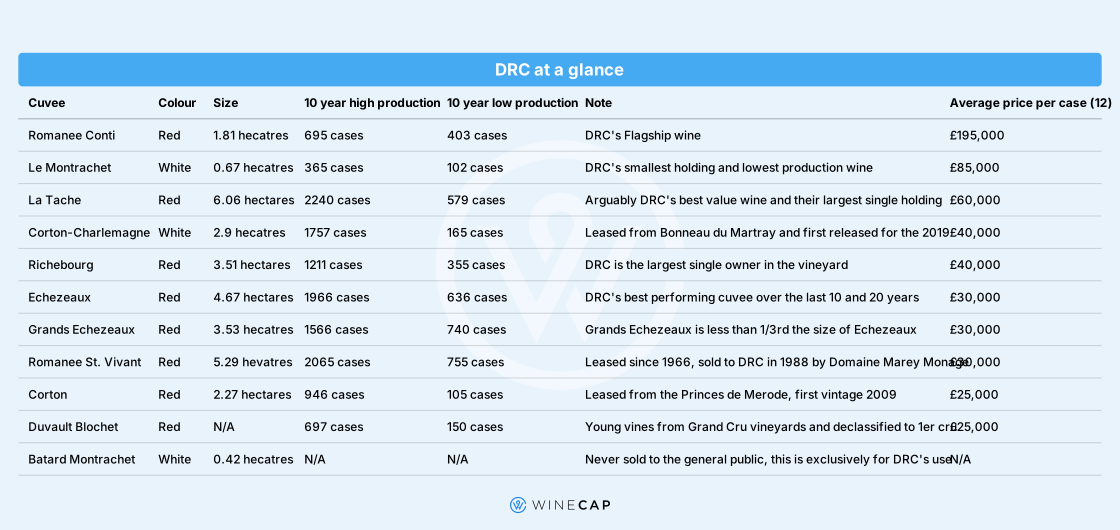
  1. The ten cuvees 

DRC produces ten wines spanning Grand Cru Burgundy in red and white, plus one Premier Cru. Each occupies a different position in the secondary market.

Facts about Domaine de la Romanee-Conti Burgundy

  1. Distribution is controlled territory by territory

DRC does not sell direct to individuals. Distribution operates through an official importer or distributor in each territory, who decides which clients receive an allocation and in what quantities. In most markets, access is restricted to the most established, highest-spending accounts. Even a well-resourced buyer may spend years building the relationship required to secure an annual allocation and will often have to spend hundreds of thousands of pounds on other wines to do so. 

One exception stands out. In Sweden, all wine retail operates through the state monopoly Systembolaget. DRC allocations to Sweden are distributed via a public lottery open to any Systembolaget customer. In principle, any Swedish resident can enter and win the right to purchase a bottle of Romanee-Conti. 

  1. Mixed cases defined how DRC reached collectors for decades

For much of DRC’s modern commercial history, the wines were sold only in mixed cases. Buyers had no option to purchase single labels; they took a fixed assortment in broadly set proportions. A representative case might include one bottle of Romanee-Conti, three of La Tache, two of Richebourg, three of Romanee-Saint-Vivant, one of Grands-Echezeaux, two of Echezeaux, and, for buyers with particularly strong importer relationships, a bottle of Le Montrachet. The model served DRC by ensuring the full range sold, and also meant that access to Romanee-Conti required taking the entire portfolio. 

That system has been changing. Increasingly DRC distributes in smaller unmixed cases of one to three bottles, reflecting both collector preference, the deepening of global demand for individual cuvees at the top of the range, and the rising prices which push even the most affordable releases into very rarified air.

  1. DRC holds the largest Grand Cru portfolio in Burgundy

DRC is widely understood to be a tiny producer, which in absolute terms it is. Yet it holds the distinction of being the largest domaine in Burgundy by the size of its Grand Cru holdings. That is a significant position in a region where Grand Cru vineyards account for only around 1.5% of total plantings. Until the Duvault-Blochet label was launched in 1999, every DRC release was a Grand Cru. 

Today the estate owns parcels outright in Romanee-Conti, La Tache, Richebourg, Romanee-Saint-Vivant, Grands-Echezeaux, Echezeaux, and Le Montrachet, while leasing additional Grand Cru land at Corton, Corton-Charlemagne, and Batard-Montrachet. 

The concentration of Burgundy’s most restricted and most valued appellations into the hands of a single domaine represents a position that no competitor could replicate today: available Grand Cru land changes hands infrequently, and when it does, the prices ensure that only the most capitalised buyers compete.

  1. The secondary market rewards investors in the accessible cuvees

DRC’s investment credentials are supported by the data. Echezeaux and Grands-Echezeaux delivered approximately 250% returns over the last decade, outpacing every other DRC cuvee across the same period. La Tache and Le Montrachet returned just over 150%. Romanee-Conti itself returned around 70%, reflecting a wine already priced to near-perfection at the point of purchase. The pattern is consistent: DRC’s less expensive cuvees have offered stronger total returns because their entry prices leave more room for appreciation. 

At the auction level, the estate’s liquidity is exceptional. DRC accounts for nearly 20% of all wine sold by Sotheby’s. The five Bordeaux First Growths combined only just exceed that figure. For investors, that depth of secondary market activity means a DRC holding can be liquidated with confidence across vintages, formats, and geographies.

Why DRC remains the benchmark for fine wine investment

DRC’s investment case rests on three things: 

  • Irreplaceable land
  • A cuvee hierarchy that gives investors genuine choice across price points
  • A secondary market deep enough to absorb significant holdings at any time 

The estate’s history adds context but not return; what drives performance is the combination of finite supply, credible pricing, and a global collector base that has deepened with every passing decade. 

For new investors, the performance data offers a clear steer: the flagship is not always the best entry point. For those already holding DRC, the liquidity figures confirm what experienced auction buyers have long understood. This is not a wine that stays in cellars indefinitely. It moves, it trades, and it rewards those who understand its mechanics.

FAQ: Investing in DRC

Is Romanee-Conti the best DRC wine to buy as an investment?

Not necessarily. Romanee-Conti is the most famous and the most expensive, but its price already reflects that status. Over the last decade, Echezeaux and Grands-Echezeaux have returned approximately 250% against Romanee-Conti’s 70%. For investors focused on total return rather than trophy ownership, other cuvees have historically offered a stronger case.

How do collectors access DRC at release?

DRC is allocated through official distributors in each territory, and access in most markets is restricted to established, high-spending accounts. This means that the secondary market is the most reliable route to acquire stock.

Does DRC hold its value in difficult vintages?

No wine is entirely insulated from vintage variation, but DRC’s secondary market depth provides meaningful downside protection. The estate’s position means there is consistent global demand for its bottles regardless of vintage, limiting the price adjustments seen elsewhere in poorer vintages.

What is the minimum entry point for a DRC investment?

Corton, Echezeaux and Grands-Echezeaux represent the most accessible entry points among DRC’s mainline cuvees and have delivered the strongest returns over the last decade. Duvault-Blochet, the estate’s Premier Cru, offers an even lower entry price and carries the DRC provenance, though it is not released every year and trades with less secondary market depth than the Grands Crus.

How liquid is DRC compared to Bordeaux?

DRC accounts for nearly 20% of wine sold at Sotheby’s; only the combined five Bordeaux First Growths exceed it, and only marginally. Unlike Bordeaux, where liquidity is spread across many producers, DRC’s liquidity is concentrated in a single domaine.

WineCap’s independent market analysis showcases the value of portfolio diversification and the stability offered by investing in wine. Speak to one of our wine investment experts and start building your portfolio. Schedule your free consultation today.
Categories
Learn

Investing in Champagne: A guide to the best Champagne brands for investment

  • Champagne combines strong global brand recognition with an established secondary market, making it one of the most investable fine wine categories.
  • Investment activity is concentrated among prestige cuvees from leading houses such as Dom Perignon, Krug, Cristal and Salon.
  • Vintage quality, provenance and professional storage are key factors when building a Champagne investment portfolio.

Champagne occupies a unique position within the fine wine market. Combining global brand recognition, strong secondary market liquidity and a long history of collectability, it has become an important component of many wine investment portfolios.

While the region produces hundreds of millions of bottles annually, investment activity is concentrated among a relatively small number of prestige cuvees and sought-after producers. Understanding the differences between these wines is essential for anyone considering Champagne as part of a diversified portfolio.

Understanding the Champagne investment landscape

The Champagne market can broadly be divided into two categories: the Grandes Marques and grower producers.

The Grandes Marques are the large Champagne houses that dominate global sales. Many produce millions of bottles annually and have established international distribution networks. Within these portfolios, investment interest is typically focused on prestige cuvees – the flagship wines made from the house’s best fruit and released in limited quantities.

Alongside the major houses sits a growing number of smaller grower producers. These estates grow their own grapes and produce wines that emphasise individual vineyard sites and terroir expression. While most remain collector-focused rather than investment-focused, a handful have become increasingly sought after on the secondary market.

The leading Champagne brands for investment

Dom Perignon

Dom Pérignon remains one of the most recognisable names in fine wine and is often considered the benchmark investment Champagne.

Produced exclusively as a vintage wine, each release reflects the conditions of a single growing season. Despite larger production volumes than many competing prestige cuvées, strong global demand has helped maintain liquidity, making Dom Pérignon one of the most actively traded Champagnes on the secondary market.

Krug

Krug occupies a distinctive position within Champagne. Known for its complex, oak-influenced style and long ageing potential, the house has developed a loyal following among collectors.

Alongside the flagship Grande Cuvee, investors closely follow Krug Vintage, Clos du Mesnil and Clos d’Ambonnay, all of which are produced in limited quantities and command strong secondary market demand.

Louis Roederer Cristal

Originally created for Tsar Alexander II of Russia, Cristal has become one of Champagne’s most recognised prestige cuvées.

Produced primarily from estate-owned vineyards, Cristal combines strong brand recognition with a reputation for longevity. It is consistently among the most sought-after wines in Champagne and regularly features in diversified fine wine portfolios.

Salon

Salon is one of the rarest and most collectible wines produced in Champagne.

Made exclusively from Chardonnay grown in Le Mesnil-sur-Oger, Salon is only released in exceptional vintages. Production volumes are extremely limited, contributing to its reputation among collectors and its strong presence on the secondary market.

Pol Roger

Pol Roger remains family-owned and is best known in investment circles for its prestige cuvee, Sir Winston Churchill.

Produced in relatively limited quantities and backed by a long-standing reputation for quality, the wine has developed a strong collector following and offers an alternative to some of the larger luxury brands.

Taittinger Comtes de Champagne

Comtes de Champagne Blanc de Blancs is widely regarded as one of the leading Chardonnay-based wines in the region.

Combining strong critical acclaim with a history of ageing well, it has become a popular choice among collectors seeking exposure to prestige Champagne at a lower entry point than some of the region’s most expensive labels.

Other notable Champagne houses

While investment activity is concentrated among a relatively small number of wines, several other Champagne houses play an important role in the market.

  • Moet & Chandon: Moet & Chandon is the undisputed king of Champagne volume. Founded in 1743, it produces an estimated 30 million bottles a year. Its “Imperial” Non-Vintage is the most recognised wine label in the world. 
  • Veuve Clicquot: Ranking second in volume, Veuve Clicquot is another pillar of the LVMH portfolio. Famous for its bold “Yellow Label,” the brand has a massive cultural footprint. Unlike Moet, it does make a prestige cuvee, “La Grande Dame”, which is a respected investment-grade wine.
  • Mumm: Known for its “Grand Cordon” signature and its historic association with the French royal courts, Mumm is a high-volume powerhouse that champions the structured power of Pinot Noir.
  • Delamotte: Sister house to the legendary Salon, Delamotte is prized by insiders as an elegant, Chardonnay-focused insider’s choice that offers exceptional value from the Grand Cru soils of Le Mesnil-sur-Oger.
  • Ruinart: Founded in 1729 and sold to Moet & Chandon in 1963, Ruinart is defined by its mastery of Chardonnay, resulting in a crystalline, aromatic style housed in its iconic, historic crayeres (chalk cellars).
  • Philipponnat: This family-led house is celebrated for its intense, Pinot Noir-dominant style and for producing the legendary Clos des Goisses, a single-vineyard wine from one of the steepest vineyards in Champagne.
  • Billecart-Salmon: Renowned for its meticulous “cold fermentation” process and legendary Rose, this medium-sized, family-owned house is a favourite among sommeliers for its finesse and purity of fruit.
  • Charles Heidsieck: This house was founded by the legendary Charles-Camille Heidsieck, whose mid-19th-century travels to America earned him the nickname and birthed the enduring phrase “Champagne Charlie.”
  • Pommery: Under the leadership of the visionary Madame Pommery, the house revolutionised the industry by launching the first commercially successful “Brut” Champagne (Pommery Brut Nature 1874) in an era of sugary wines.
  • Gosset: Established in 1584, Gosset is the oldest wine house in the Champagne region and maintains a signature “gastronomic” style by avoiding malolactic fermentation to preserve natural, bracing acidity.
  • Piper-Heidsieck: The house recently signalled its commitment to ultra-prestige by spinning off its top cuvee, “Rare,” into its own independent brand to compete at the very highest tier of the market.
  • Perrier-Jouet: Celebrated for its striking packaging, its global reputation centres on its prestige cuvee, Belle Epoque, which features the iconic anemone design created by artist Emile Galle in 1902. While it possesses immense shelf appeal, the house delivers quality and reliable price appreciation.
  • Bollinger: Founded in 1829 and one of the few remaining independent, family-controlled houses, Bollinger is famously associated with both the British Royal Family and James Bond. Collectors prize its late-release cuvee, R.D. (Recently Disgorged), and the ultra-rare Vieilles Vignes Francaises.

The rise of grower Champagne

Over the past two decades, grower Champagne has become an increasingly important part of the collector market.

Unlike the major houses, grower producers focus on wines made exclusively from their own vineyards. The result is often a stronger emphasis on terroir and site expression.

Although liquidity remains lower than that of the leading Grandes Marques, several producers have achieved cult status among collectors.

Notable brands include:

  • Jacques Selosse: The undisputed godfather of the grower movement, Anselme Selosse fundamentally changed Champagne by applying Burgundian principles of terroir and oxidative, solera-style ageing to the region’s chalky soils.
  • Cedric Bouchard: Under the “Roses de Jeanne” label, Bouchard produces revolutionary, single-vineyard, single-variety wines with low-pressure bubbles that emphasise the vinous intensity of a still wine over traditional effervescence.
  • Ulysse Collin: A disciple of Selosse, Olivier Collin crafts cult-status, parcel-specific Champagnes from the Petit Morin that are celebrated for their long barrel-ageing and profound, savoury depth.
  • Pierre Peters: A benchmark for Blanc de Blancs in the Grand Cru of Le Mesnil-sur-Oger, this family estate crafts chiselled, mineral-driven Chardonnays, most notably the legendary and ageworthy “Les Chetillons.”
  • Henri Giraud: Operating out of Ay, Henri Giraud produces opulent, Pinot Noir-dominant wines that are fermented in oak from the local Argonne forest, creating a rich and distinctively luxurious profile.
  • Vilmart & Cie: Often described as a boutique alternative to Krug, Vilmart excels in barrel-fermented blends from Rilly-la-Montagne that strike a perfect balance between electric acidity and a creamy, oak-influenced texture.
  • Jacquesson: While technically a Maison, the Chiquet brothers operate with a radical grower ethos, replacing the standard consistent Non-Vintage with their “700-series” that celebrates the specific identity and vintage characteristics of each base year. 

Champagne’s position in the secondary market

Champagne has become one of the most important categories within the fine wine investment market.

Historically, prices have exhibited lower volatility than some other regions, supported by strong global demand and the strength of established luxury brands. The category experienced significant growth during the market rally of 2020-2022 before correcting alongside the wider fine wine market.

More recently, Champagne has shown signs of stabilisation and recovery, reinforcing its position as a core component of many fine wine portfolios.

Key considerations for Champagne investors

Producer reputation

The strongest demand tends to be concentrated among established brands with a proven track record on the secondary market.

Vintage quality

Certain vintages attract greater collector demand due to growing conditions and long-term ageing potential. Examples frequently cited by collectors include 2002, 2008, 2012 and 2014.

Provenance and storage

As with all fine wine investments, provenance is critical. Professional bonded storage helps preserve condition, authenticity and resale value.

Bottle format

Larger formats, particularly magnums, can command premiums due to their relative rarity and favourable ageing characteristics.


FAQ: Best Champagne brands for investments

Why is Champagne considered a good investment?

Champagne benefits from strong global demand, recognised luxury brands and an established secondary market, making it one of the most actively traded categories in fine wine.

Should I invest in non-vintage Champagne?

Most investment activity focuses on vintage wines and prestige cuvées. However, certain non-vintage releases, such as Krug Grande Cuvée, have developed collector demand.

What is a prestige cuvee?

A prestige cuvée is the flagship wine produced by a Champagne house, typically made from its best vineyard sites and aged longer before release.

Are grower Champagnes good investments?

Some grower producers have developed strong collector followings, although liquidity generally remains lower than that of the leading Grandes Marques.

WineCap’s independent market analysis showcases the value of portfolio diversification and the stability offered by investing in wine. Speak to one of our wine investment experts and start building your portfolio. Schedule your free consultation today.
Categories
News

Fine wine vs whisky investment: What wealth managers prefer in 2026

  • Fine wine remains the leading collectable asset among wealth managers, with 97% of UK and US respondents expecting demand to rise in 2026.
  • Whisky is gaining ground, with demand expectations reaching 91% in the UK and 83% in the US.
  • Despite growing interest in both assets, fine wine continues to benefit from stronger and more consistent confidence among wealth managers.

Alternative assets have become an increasingly important part of investment portfolios in recent years. From art and classic cars to watches, whisky and fine wine, investors are looking beyond traditional markets in search of diversification, resilience and long-term value.

Among these collectibles, fine wine and whisky are often grouped together. Both are tangible assets with finite supply, a passionate global following, and the potential for capital appreciation. Yet despite their similarities, they offer different investment propositions.

WineCap’s Wealth Report research shows that wealth managers remain highly optimistic about both assets in 2026, despite a period marked by inflation concerns, geopolitical uncertainty, and shifting investor priorities. While demand expectations have strengthened, confidence in fine wine has remained consistently high since the first year of our research in 2023. Sentiment towards whisky, by contrast, has been more variable, perhaps reflecting the different levels of market maturity, liquidity and infrastructure underpinning the two asset classes.

So, when comparing fine wine and whisky as investments in 2026, where do wealth managers see the greatest opportunities? And what factors continue to drive stronger demand expectations for fine wine?

In this article, we examine how wealth managers’ attitudes towards fine wine and whisky have evolved between 2023 and 2026 before exploring the key differences in market structure, liquidity, risk and long-term investment potential.

How wealth managers’ attitudes to wine and whisky have changed since 2023

WineCap’s Wealth Reports from 2023 to 2026 measured how many wealth managers and financial advisors in both the UK and US expected client demand for fine wine and whisky investments to increase over the following 12 months. The results reveal growing confidence in both asset classes, but they also highlight some important differences in how the markets have developed.

Fine wine continues to lead demand expectations among UK wealth managers

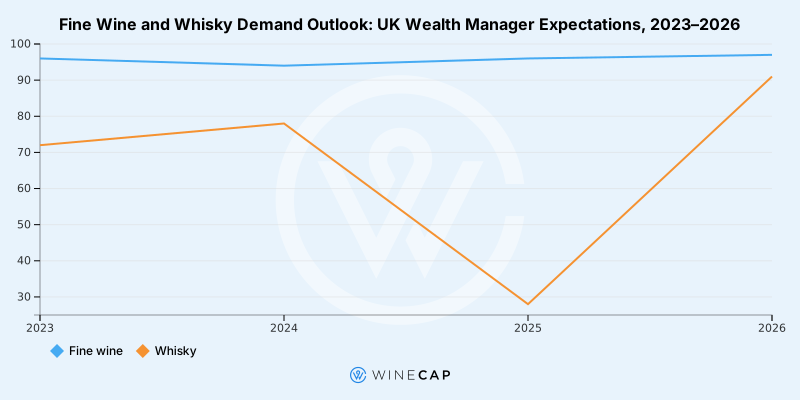
Among UK wealth managers, expectations for increased demand for fine wine have remained exceptionally strong throughout the period. In every survey year, more than 94% of respondents expected client demand to rise, climbing from 96% in 2023 to 97% in 2026. This consistency reflects fine wine’s established position within the UK’s alternative investment landscape, where it is increasingly viewed as a mature and professionally managed asset class.

Fine wine vs Whisky UK

Whisky has followed a less predictable path. While demand expectations rose from 72% in 2023 to 78% in 2024, sentiment weakened in 2025 before rebounding sharply to 91% in 2026. Despite these fluctuations, the latest figures suggest growing confidence in whisky’s long-term appeal as investors continue to explore tangible assets beyond traditional markets.

Whisky investment gathers momentum in the US

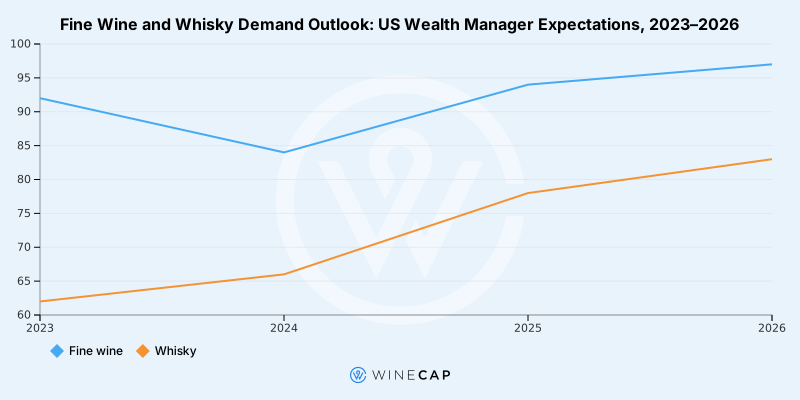
Similarly, in the US, wealth managers reported consistently strong expectations for rising client demand for fine wine throughout the period. Although confidence dipped from 92% in 2023 to 84% in 2024, sentiment recovered quickly, reaching 94% in 2025 and 97% in 2026. By the end of the period, US wealth managers were just as optimistic about fine wine demand as their UK counterparts. 

fine wine vs whisky us

Whisky followed an equally positive trajectory in the US. Expectations for increased client demand rose steadily from 62% in 2023 to 83% in 2026, without the fluctuations seen in the UK market. This suggests a growing awareness of whisky as an alternative investment among US investors, supported by increasing media coverage, auction activity and interest in collectable assets more broadly.

Despite these differences, several themes emerge across both markets. First, confidence in fine wine remains exceptionally high. In every year surveyed, fine wine outperformed whisky in terms of expected client demand, reinforcing its position as the most established collectable asset among wealth managers.

Second, the gap between the two asset classes is narrowing. While fine wine remains the preferred option, enthusiasm for whisky has strengthened considerably since 2023, particularly in the United States. By 2026, more than four-fifths of wealth managers in both countries expected demand for whisky investments to increase.

Taken together, the data points to a broader trend: investors are becoming increasingly comfortable allocating capital to tangible alternative assets. Yet while whisky continues to gain traction, the fine wine market’s maturity, liquidity and pricing transparency appear to be helping it retain its position as the most established collectable asset among wealth managers in both the UK and US.

Why investors compare fine wine and whisky

As investors look beyond traditional asset classes, fine wine and whisky are increasingly competing for the same pool of capital.

The comparison is a natural one. Both are tangible assets with finite supply, global collector markets and strong luxury brand associations. Unlike shares or bonds, fine wine and whisky derive value not only from financial considerations but also from rarity, provenance and cultural significance.

Both asset classes also benefit from scarcity. Every bottle of wine and whisky opened reduces the remaining supply and permanently shrinks the market. In the case of cask whisky, the maturation process itself can add another layer of scarcity and value creation over time.

For many investors, fine wine and whisky offer an attractive alternative to traditional financial markets. They are often viewed as portfolio diversifiers, with inner performance drivers that differ from those affecting equities and bonds. During periods of inflation, market volatility or economic uncertainty, tangible assets can become particularly appealing.

Yet while wine and whisky share many of the characteristics associated with successful collectibles, they differ in terms of market structure, liquidity and investment accessibility. These differences go some way in explaining why wealth managers continue to show stronger confidence in fine wine despite growing enthusiasm for whisky.

Fine wine vs whisky: key differences for investors

Although both assets sit within the broader category of luxury collectibles, the experience of investing in fine wine can be very different from investing in whisky.

wine vs whisky

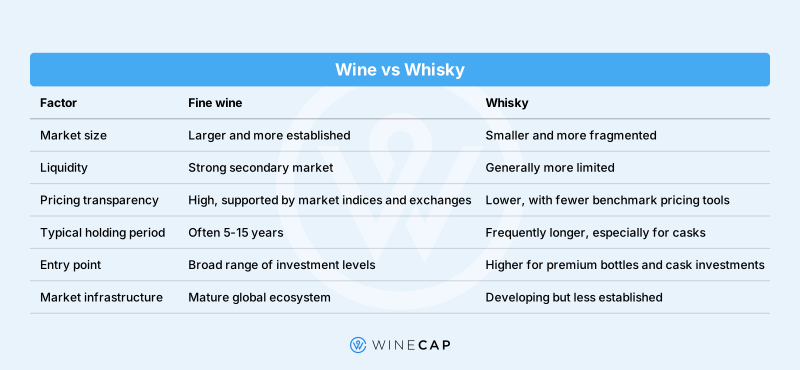
One of the most significant differences lies in market maturity. Fine wine has benefited from decades of development as an investment asset, supported by merchants, brokers, exchanges and independent pricing platforms. Investors can access historical performance data, monitor market trends, and track valuations with a level of transparency rarely seen in other collectible markets.

Liquidity is another important distinction. Investment-grade wines from leading regions such as Bordeaux, Burgundy, Champagne, and Tuscany are traded globally through established channels. While whisky has developed an increasingly active secondary market, trading volumes remain smaller, and liquidity can vary significantly depending on the distillery, release or cask.

Diversification also tends to be easier in fine wine. Investors can spread risk across multiple regions, producers, vintages and styles, creating portfolios with broad exposure to different market drivers. Whisky investors often face a more concentrated universe of investment-grade opportunities.

These advantages do not necessarily make fine wine a superior investment in every circumstance. However, they help explain why wealth managers often view wine as the more mature and accessible option within the collectible asset universe.

Why wine appears to be winning wealth manager attention

The Wealth Report data suggests that demand expectations for fine wine remain consistently stronger than those for whisky among both UK and US wealth managers. Several factors may help explain this trend.

The first is transparency. Fine wine benefits from a more sophisticated pricing ecosystem, with platforms such as Liv-ex providing real-time market data, historical performance information and widely recognised benchmark indices. 

Market depth is equally important. Fine wine is supported by a global network of merchants, brokers, exchanges, storage providers and collectors. This infrastructure creates liquidity and confidence, making it easier for investors to enter and exit positions compared with many other collectable assets.

Portfolio construction is another advantage. Fine wine offers exposure across multiple regions, producers, vintages and price points, enabling investors to build diversified portfolios tailored to different risk profiles and investment objectives.

Recent market conditions may also be playing a role. Following a broader correction across the fine wine market since 2022, many investment-grade wines are trading below previous highs. For long-term investors, this has created opportunities to acquire sought-after wines at more attractive valuations, a theme highlighted throughout WineCap’s recent market analysis.

Finally, fine wine’s long history as a traded asset may appeal to wealth managers seeking predictability and professionalism. While whisky has generated considerable excitement in recent years, particularly around cask investments, fine wine’s established market structure may be better aligned with the requirements of advisers responsible for managing client portfolios over the long term.

Whisky’s investment strengths

Despite fine wine’s advantages in market maturity and liquidity, whisky possesses several characteristics that continue to attract investors and explain its growing popularity.

One of whisky’s greatest strengths is its accessibility as a concept. Many consumers are already familiar with iconic brands such as Macallan, Springbank and Yamazaki, and auction headlines featuring record-breaking bottle sales frequently generate mainstream media attention. This visibility can make whisky easier for new investors to understand and engage with.

Scarcity is another powerful driver. Distilleries cannot rapidly increase production of aged stocks, meaning supply constraints can become particularly pronounced for highly sought-after releases. As global demand rises, especially in Asia and North America, these scarcity dynamics can support long-term value appreciation.

Cask ownership has also introduced a unique investment proposition that has no direct equivalent in the wine market. Because whisky continues to mature while stored in cask, investors are effectively holding an asset that changes over time. This creates opportunities for value growth through both ageing and scarcity, although it also introduces additional complexity and risk.

Whisky may also appeal to investors seeking higher growth potential. While this can come with greater volatility, some investors are attracted by the possibility of significant gains from rare bottles, limited releases or sought-after casks. For those with a higher risk tolerance, whisky’s relatively young investment market can present opportunities that are less common in more established asset classes.

Ultimately, whisky’s appeal lies in its combination of scarcity, storytelling, and growth potential. While it may not yet offer the same level of transparency or liquidity as fine wine, its increasing popularity suggests it will remain an important part of the alternative investment landscape.

Fine wine vs whisky: the outlook for 2026 and beyond

The Wealth Report data makes one thing clear: demand expectations for both fine wine and whisky are strengthening. Wealth managers in the UK and US increasingly expect clients to allocate capital towards tangible assets, reflecting broader interest in collectibles, luxury assets and alternative investments.

Yet despite whisky’s growing popularity, fine wine continues to benefit from deeper market infrastructure, greater transparency and stronger liquidity. These advantages help explain why wealth managers continue to express greater confidence in fine wine’s long-term investment prospects.

As interest in collectable assets grows, both markets are likely to expand. For now, however, fine wine remains the benchmark against which other luxury investment assets are measured.

FAQ: Fine wine vs whisky

Is wine or whisky a better investment?

There is no definitive answer, as the right choice depends on an investor’s objectives, risk tolerance and investment horizon. Fine wine generally offers greater market transparency, liquidity and diversification opportunities, making it attractive to wealth managers and long-term investors. Whisky can offer higher growth potential in some areas of the market, but it is often associated with greater volatility and a less mature trading ecosystem.

Are fine wine and whisky casks wasting assets?

In the UK, both fine wine and whisky casks are generally regarded as wasting assets because they have a finite lifespan. As a result, gains on investment-grade wine and whisky casks are typically exempt from Capital Gains Tax (CGT). However, tax treatment can vary depending on the asset and an investor’s individual circumstances, so professional advice should always be sought.

Should I invest in whisky casks or fine wine?

Whisky casks and fine wine are very different investments. Fine wine benefits from established pricing data, active secondary markets and a broad range of investment-grade opportunities. Whisky casks can offer unique value appreciation through the maturation process, but they typically require specialist knowledge and may involve additional costs, regulatory considerations and liquidity challenges.

What are the best alternative investments besides stocks?

Popular alternative investments include fine wine, whisky, art, classic cars, watches, private equity, real estate and precious metals. Each asset class has different risk and return characteristics. 

Is whisky still a good investment in 2026?

Many wealth managers believe demand for whisky investments will continue to grow in 2026. WineCap’s Wealth Report found that 91% of UK wealth managers and 83% of US wealth managers expect client demand for whisky investments to increase over the next 12 months. While the market remains attractive, investors should be aware that whisky can be less liquid and more volatile than fine wine.

How liquid is whisky compared with wine?

Fine wine is generally considered the more liquid asset. Investment-grade wines are traded globally through merchants, brokers and exchanges, supported by transparent pricing and established market infrastructure. Whisky’s secondary market has expanded significantly in recent years, but liquidity can vary considerably depending on the bottle, distillery or cask.

What do wealth managers think about wine investments?

WineCap’s Wealth Report data suggests wealth managers remain optimistic about fine wine. In 2026, 97% of wealth managers surveyed in both the UK and US expected client demand for fine wine investments to increase over the following 12 months. 

WineCap’s independent market analysis showcases the value of portfolio diversification and the stability offered by investing in wine. Speak to one of our wine investment experts and start building your portfolio. Schedule your free consultation today.
 

Categories
Learn

How to start a wine investment portfolio in the UK: A beginner’s guide

  • The UK is one of the world’s leading fine wine trading hubs, with access to bonded storage, global buyers, and established market infrastructure.
  • Storing wine in bond helps preserve provenance, improves liquidity, and defers VAT and duty until the wine is removed from storage.
  • Diversifying across regions such as Bordeaux, Burgundy, Champagne, and Tuscany can help spread risk and improve long-term portfolio resilience.

Fine wine has become an increasingly recognised alternative asset, offering investors exposure to a tangible market with a long history of value appreciation. For UK-based investors, access to bonded storage, transparent pricing data, and one of the world’s largest fine wine trading networks makes it an attractive place to start building a portfolio. This guide explains the key steps involved, from selecting investment-grade wines to storing and managing them effectively.

What makes wine a unique investment asset

Fine wine is a sophisticated financial instrument that differs fundamentally from traditional equities and bonds. It is an “improving asset” that gains value as it matures over decades. Simultaneously, it exists in a state of diminishing supply: as bottles are opened and consumed, the remaining investment-grade stock becomes scarcer, driving up the price for the surviving bottles.

In the current 2026 landscape, fine wine is the pre-eminent collectible. Wealth managers rank it as the most sought-after “passion” asset, ahead of rare whisky, luxury watches, and art. 

Our research shows that investors are primarily drawn to its performance across three main pillars:

  • Stability: 71% of investors choose wine for its resilience through different market environments.
  • Strong returns: 57% cite historical performance as a primary driver for their allocation.
  • Sustainability: 44% of modern investors are attracted to the ESC-conscious nature of an asset intrinsically linked to the land.

Fine wine provides a “calming effect” on portfolios due to its low correlation with mainstream equity markets. While traditional markets face ongoing volatility, fine wine acts as a reliable store of wealth that transcends currency fluctuations and borders.

  • Interest rates: 77% of advisors believe rising interest rates actually help fine wine perform as investors seek “hard” stores of value.
  • Inflation: 45% of wealth managers identify inflation spikes as a primary driver for wine, as its intrinsic value provides a reliable backstop against devaluing “paper” wealth.
  • Consumption: 55% recognise that steady consumption provides a physical hedge that traditional assets cannot match.

Why the UK is the world’s wine investment hub

The UK occupies a unique position in the global fine wine market. For centuries, London has acted as the primary marketplace for the world’s most prestigious estates. This history has created a robust infrastructure that makes starting a wine portfolio here simpler and more secure than in almost any other territory.

Investors in the UK benefit from access to the most sophisticated secondary market in the world. When you start a portfolio in the UK, you are plugging into a network of trade that ensures your assets remain liquid and easy to value.

The legal and tax advantages in the UK

One of the most compelling reasons to start a wine portfolio in the UK is the potential for tax-efficient growth. For most private investors, wine is classified by HM Revenue and Customs as a “wasting asset” or a “chattel”. This means that gains made on the sale of wine are often exempt from Capital Gains Tax (CGT).

This exemption typically applies because wine has a predictable life of less than 50 years. This makes it an attractive alternative to traditional stocks or property, which are subject to significant tax burdens upon sale. Furthermore, by keeping your wine in professional storage, you can defer or entirely avoid the payment of VAT and excise duty. However, you should always consult a professional tax advisor.

Storage: the foundation of a UK portfolio

Successful wine investment is built on a foundation of professional storage. In the UK, this means using a government-regulated bonded warehouse. These facilities, such as Octavian or London City Bond (LCB), provide a tax-free environment where wine is kept in perfect conditions to age properly. This status is critical for the biological health of the wine but is more important to fine wine investors as a way of preserving its future financial value.

Bonded storage offers several technical advantages for the UK investor:

  • Provenance guarantee: The wine remains in a controlled ecosystem, providing a clear paper trail from the producer to the current owner.
  • Climate control: Temperature and humidity are maintained to ensure wines do not age prematurely.
  • Tax deferral: VAT and duty are only paid if the wine is removed from the warehouse for consumption.
  • Secondary market liquidity: Professional traders are more willing to buy wine that has been stored in a private home cellar due to the risk of heat damage or poor handling.

Selecting the right wines for growth

When starting out, it is tempting to buy wines based on personal taste. However, a performance-driven portfolio must avoid this trap and focus on blue-chip labels with proven secondary market demand. These are wines produced in limited quantities by estates with centuries of heritage. They possess the structure to age for thirty years or more.

Bordeaux remains the core of most UK portfolios. Its high production volumes and established classification systems provide a level of stability that is hard to find elsewhere. Names like Chateau Lafite Rothschild or Chateau Mouton Rothschild act as the pillars of the wine world. They offer deep liquidity, meaning they can be sold easily if you need to access your capital.

For those seeking higher growth, Burgundy and Italy offer exciting opportunities. Burgundy is a market of extreme scarcity, where a single vineyard may only produce a few thousand bottles. This supply-and-demand imbalance can lead to explosive price appreciation. Italy, particularly Tuscany, offers excellent value and has shown remarkable resilience during broader economic downturns.

Diversification and the ladder of vintages

A well-structured portfolio should be diversified across different regions and maturity levels. Professional advisors often suggest a “ladder” approach to vintages. This involves holding a mix of young “En Primeur” wines and mature vintages that are entering their peak drinking window.

Diversification helps mitigate the risk of a single region underperforming. For instance, when Bordeaux experiences a period of stagnation, Champagne or Tuscany may be seeing a spike. By spreading your capital across these categories, you ensure that your portfolio is not overly exposed to the climatic or economic shifts of a single region.

Market entry strategies for the UK investor

There are two primary ways to begin your wine investment journey in the UK. You can either invest a lump sum to create an instant, diversified portfolio, or you can commit to a slow build up and regular purchases. Both strategies have their merits depending on your overall financial objectives and time horizon.

Key considerations for your entry strategy include:

  • Lump sum investing: This allows you to gain immediate market exposure across multiple wines and multiple wine regions.
  • Monthly contributions: This strategy allows you to build a position in the market over time and reduce the impact of short-term price volatility, but without discipline can result in a less structured collection.
  • Minimum investment: Most professional platforms suggest a starting point of at least £5,000 to £10,000 to ensure you can achieve meaningful diversification across multiple cases of wine.

Valuation and tracking your performance

Once your portfolio is established, you must track its performance with the same rigour as any other financial asset. In the past, this was a manual and opaque process. Today, digital platforms provide real-time valuations based on actual trade data from the secondary market. You no longer have to guess what your wine is worth.

Regular reviews (at least once a year) are essential. They allow you to identify “plateauing” assets that may be sold to reinvest in newer, higher-growth opportunities.

Why choose WineCap for your UK wine investment portfolio?

WineCap was founded on the principles of performance and simplicity. We understand that the traditional world of wine can feel exclusionary and overly complex. Our mission is to remove these barriers, providing private investors with the same data-led insights used by professionals.

We handle the heavy lifting of portfolio management:

  • Sourcing: We use advanced algorithms to identify wines that are technically undervalued compared to their peers.
  • Logistics: We manage the transport and insurance of your wine from the estate to the bonded warehouse.
  • Storage: Your assets are held in a secure, personal sub-account within a leading UK bonded facility.
  • Exits: When it is time to sell, we use our global network to find the best possible price for your assets.

Long-term thinking and exit strategies

Fine wine is typically considered a medium- to long-term investment, with most investors adopting a holding period of five to ten years or more. Over time, available supply tends to decline as bottles are consumed, which can support prices when demand remains strong.

It is also important to consider how and when you may sell your wines. Storing wine in bond provides a level of flexibility and access to a global market of merchants, collectors, and trade buyers, while preserving provenance and storage records. Whether your stock is destined for a restaurant in Tokyo or a private cellar in New York, the UK’s bonded system ensures it can be moved efficiently and safely. This global reach is what ultimately protects your capital and ensures a profitable exit.

FAQ: How to start a wine investment portfolio

Is there a minimum amount I need to start a wine portfolio? 

While you can buy a single bottle, a diversified investment portfolio typically requires a minimum of £5,000-£10,000. This allows for a spread across different regions and prevents you from being over-exposed to a single vintage or a single wine.

Do I have to pay tax on my wine investment gains? 

In the UK, wine is often exempt from Capital Gains Tax because it is considered a wasting asset. However, tax laws can change, and exemptions depend on your individual circumstances. Always seek professional tax advice.

How quickly can I sell my wine if I need cash? 

Liquidity depends on the wines you own. Blue-chip Bordeaux or high profile Champagnes can often be sold within days or weeks. Niche or “cult” wines may take longer to find the right buyer at the right price.

Can I drink the wine in my investment portfolio? 

Yes. You can take delivery of your wine at any time. However, you will be required to pay the outstanding VAT and excise duty before the wine can be removed from the bonded warehouse.

WineCap’s independent market analysis showcases the value of portfolio diversification and the stability offered by investing in wine. Speak to one of our wine investment experts and start building your portfolio. Schedule your free consultation today.
Categories
Learn

Sassicaia: The Super Tuscan that changed Italian wine forever

  • Sassicaia is widely regarded as the original Super Tuscan, pioneering the use of Bordeaux grape varieties in Tuscany and helping reshape modern Italian wine.
  • Produced by Tenuta San Guido in Bolgheri, Sassicaia is the only Italian wine with its own dedicated appellation: Bolgheri Sassicaia DOC.
  • Sassicaia is one of Italy’s most traded and collectible fine wines, combining global demand, strong liquidity, and a long track record of investment performance.

Sassicaia is the wine that transformed the global perception of Italian fine wine. Widely regarded as the original Super Tuscan, it demonstrated that the coastal vineyards of Bolgheri could produce Cabernet-based wines capable of competing with the world’s greatest Bordeaux.

Produced at Tenuta San Guido, Sassicaia has become one of the most influential and collectible wines in the world. It is the only wine in Italy with its own dedicated DOC appellation, has consistently ranked among the leading brands in the Liv-ex Power 100, and remains one of the most actively traded Italian wines on the secondary market.

For investors, Sassicaia combines global recognition, deep market liquidity, and a long history of price appreciation. Alongside Tignanello and Masseto, it sits firmly within the elite tier of Italian investment-grade wines, offering both long-term growth potential and resilience during periods of market volatility.

Sassicaia at a glance

Sassicaia at a glance

1. The Super Tuscan rebellion

The story of Sassicaia begins with a challenge to the Italian wine establishment.

During the 1960s, Italian wine regulations were highly prescriptive. In Tuscany, many producers were required to follow blending rules that prioritised tradition over quality, including the use of white grape varieties in wines intended for ageing.

Marchese Mario Incisa della Rocchetta had different ambitions. Inspired by the great wines of Bordeaux, he planted Cabernet Sauvignon at his Tenuta San Guido estate in Bolgheri on Tuscany’s western coast. Initially, the wine was made solely for private consumption and was never intended to become a commercial product.

When Sassicaia was first commercially released in 1971 (from the 1968 vintage), it could not qualify for any recognised quality designation because it used grape varieties that fell outside the regulations. Instead, it was labelled simply as Vino da Tavola.

What began as a personal experiment ultimately sparked the Super Tuscan movement, demonstrating that world-class wines could be produced outside Italy’s traditional appellation system and helping reshape the country’s wine laws in the decades that followed.

2. Terroir of the “place of stones”

The name “Sassicaia” translates from Italian to mean a “place of stones”. This refers to the gravelly clay soils found in the 42-hectare vineyard that was originally planted in 1944. Marchese Mario Incisa della Rocchetta noted that this terrain bore a striking resemblance to the gravelly terroir of Graves in Bordeaux.

The geography of the vineyards is unique within Tuscany. Situated on the Tyrrhenian Coast, the site benefits from cooling “Libeccio” winds that lift off the sea. These winds prevent the grapes from over-ripening in the hot sun and maintain the fresh acidity required for long-term ageing.

This combination of well-drained, stony soil and a maritime climate creates a profile of structural elegance. It is a terroir that distinguishes Sassicaia from the warmer, hilly interior of Tuscany.

3. The grapes and the technical blend

Sassicaia has maintained a remarkably consistent blend throughout its history. It is typically composed of 85% Cabernet Sauvignon and 15% Cabernet Franc. The Cabernet clones were originally sourced from a friend’s estate in nearby Pisa.

The winemaking process focuses on precision rather than power. It involves:

  • Short maceration periods to ensure refined tannins.
  • Separate fermentation for every vineyard parcel to allow for meticulous blending.
  • The total avoidance of artificial yeasts to preserve the natural character of the fruit.
  • Ageing for approximately 24 months in French oak barriques.

Historically, the estate utilised Slavonian oak until the 1983 vintage, when it made the definitive switch to more costly French oak. This change added further polish and complexity to the wine’s structure. The goal remains to achieve a balance of ripe fruit and herbal sophistication.

4. The legendary 1985 vintage

If there is one vintage that defines the modern era of Italian wine, it is the 1985 Sassicaia. This bottle was the first Italian wine to receive a perfect 100-point score from the critic Robert Parker. Parker described the wine as “otherworldly,” and it became the benchmark for the entire region.

The 1985 vintage was born from a challenging year. A violent hailstorm in the spring led to very low yields, and a harsh winter frost had killed thousands of the area’s olive trees. Yet, the resulting wine showed a level of vitality and fiber that few had seen before in Italy.

For investors, this vintage transformed Sassicaia into a global blue-chip asset. It remains a mythical bottle that continues to age with a “long arch and a long plateau”. Even decades later, it shows no signs of slowing down. Although the volume of trades has fallen, prices of the 1985 are up 60% in the last five years and more than 150% over the last decade, cementing its status as one of the greatest wines of the 20th century.

5. The 21st century Golden Age

Following a somewhat lackluster period in the 1990s, often attributed to the large number of young vines from estate expansion, Sassicaia entered a new golden age. This modern era is defined by a level of purity and precision that has captivated the world’s leading critics.

Two recent vintages stand as modern titans:

  • 2016: Monica Larner called this 100-point masterpiece “the wine we have all been waiting for”. It has seen significant price appreciation since its release.
  • 2021: This vintage earned 100 points from Antonio Galloni, who described it as marrying “textural intensity with classic refinement”.

The 2006, 2008, and 2013 vintages are also considered modern highlights. The 2008 vintage was particularly notable as it was produced “without a winemaker” following the retirement of the legendary Giacomo Tachis in 2007. These years prove the estate’s ability to achieve excellence across varying conditions.

6. Beyond Sassicaia: the Tenuta San Guido portfolio

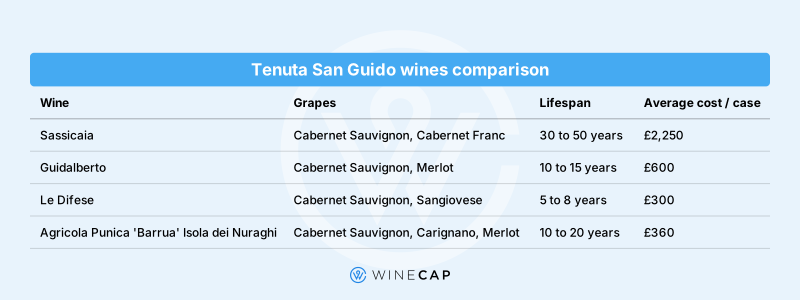
Although Sassicaia is the estate’s flagship wine, Tenuta San Guido produces a small portfolio that offers different expressions of the estate’s philosophy.

Guidalberto

Introduced in 2000, Guidalberto blends Cabernet Sauvignon and Merlot. Designed to be more approachable in its youth, it offers many of the hallmarks of Sassicaia at a more accessible price point.

Le Difese

Le Difese combines Cabernet Sauvignon with Sangiovese, creating a versatile and approachable wine intended for earlier drinking.

The family has also been involved in Agricola Punica in Sardinia, a project developed alongside the late Giacomo Tachis. The venture focuses on Carignano-based wines that showcase another side of Italian terroir.

Tenuta San Guido wines comparison

7. Investment performance and market liquidity

Sassicaia is one of the most reliable and liquid assets in the world of fine wine. It consistently ranks in the top five of the Liv-ex Power 100, which measures the strength of brands in the secondary market.

Historically, Sassicaia has performed neck-and-neck with Tignanello for the bulk of the last 25 years. While Tignanello has shown slightly more resilience since the market peak in 2022, largely due to its lower entry price, both brands have remained more stable than major French investment-grade wines over the same period.

Most vintages of Sassicaia have seen capital gains exceeding 100% over a ten-year period. Its status is bolstered by its production volume: roughly 250,000 bottles annually. 

This scale ensures there is always a deep market for buyers and sellers – a critical factor for portfolio liquidity.

8. The most searched-for Italian icon 

Sassicaia occupies a unique space in the digital world of fine wine. It is consistently the most searched-for Italian wine on Wine-Searcher, a metric that reflects immense global demand. This popularity spans across North America, Asia, and Europe.

Moreover, the brand trust associated with Tenuta San Guido is unparalleled in Italy. This is partly due to its early adoption by the American market following the 1976 Judgement of Paris era. As global drinkers became more willing to look beyond Bordeaux, Sassicaia was perfectly positioned to lead the charge.

Its broader place in fine wine is secured by its own DOC. In 1994, it was granted the Bolgheri Sassicaia DOC, making it the only single-vineyard designation in Italy. This was a formal acknowledgement of its unique quality by the very bureaucracy it once rebelled against.

9. Cultural influence and celebrity fans

The fame of Sassicaia has been amplified by high-profile admirers who have shared their passion on social media. For these celebrities, Sassicaia is more than a wine: it is a symbol of sophistication and elite status.

Notable celebrity fans include:

  • LeBron James: The basketball legend has frequently posted about his love for Italian wine, with Sassicaia often featuring on his table.
  • Barack Obama: The former President was reported to have enjoyed Sassicaia during state visits and private dinners.
  • Rihanna: The music icon has been spotted with bottles of Sassicaia, further cementing its cultural crossover appeal.

Social media discussions by these figures have introduced the brand to a younger, luxury-focused demographic. This celebrity influence helps sustain the “halo effect” of the brand, ensuring it remains relevant to new generations of wealthy collectors.

10. “We are all children of Sassicaia”

The impact of Sassicaia on the Italian wine industry is impossible to overstate; so much so that no one questions the quote of winemaker Michele Satta who once famously told critic Monica Larner: “We are all children of Sassicaia”.

Its influence has been felt in the creation of other legendary wines, including:

  • Tignanello (Tuscany): Piero Antinori was the nephew of Mario Incisa della Rocchetta and was directly inspired by his uncle’s Cabernet experiment.
  • San Leonardo (Trentino): Often called the “Sassicaia of the North,” this estate was developed after its owner was mentored at Tenuta San Guido.
  • Montevetrano (Campania): Known as the “Sassicaia of the South”, it proved that volcanic soils could produce Cabernet blends of similar stature.

Sassicaia provided the blueprint for quality that surpassed existing DOC regulations. It proved that Italy could aim higher and achieve a level of purity and prestige with Cabernet that was previously almost the sole domain of France. Today, it remains a North Star and quality reference for winemakers across the entire peninsula.

FAQ: Sassicaia 

Is Sassicaia a Bordeaux blend? 

Yes, as it is primarily Cabernet Sauvignon and Cabernet Franc. However, its coastal Tuscan terroir distinguishes it from the wines of the Medoc.

Why was it originally called a “table wine”? 

When first released in 1971, the use of French grapes like Cabernet Sauvignon was not permitted under the existing DOC laws of the 1970s. As a result, it had to be classified as “Vino da Tavola,” even though its quality was exceptional.

How does Sassicaia compare to Tignanello for investment? 

Both are elite blue-chips. Sassicaia has a slightly higher status and its own unique DOC, while Tignanello has been more resilient during market corrections due to its wider accessibility and slightly lower price point.

What is the best way to store Sassicaia for long-term growth? 

To maintain its value and provenance, it should always be stored in a professional, temperature-controlled bonded warehouse. This ensures a pristine chain of custody which is essential for achieving top prices on the secondary market.

What makes the 1985 vintage so special? 

It was the first Italian wine to earn a perfect 100-point score from Robert Parker. Despite being a difficult year for growers, the wine achieved a level of complexity and longevity that changed the global perception of Italian wine forever.

WineCap’s independent market analysis showcases the value of portfolio diversification and the stability offered by investing in wine. Speak to one of our wine investment experts and start building your portfolio. Schedule your free consultation today.
Categories
Learn

The WineCap guide to the best Bordeaux vintages

  • The best Bordeaux vintages are shaped by exceptional growing conditions that balance ripeness, freshness and longevity.
  • The highest-quality vintages do not always deliver the strongest investment returns.
  • Modern viticulture has made Bordeaux more consistent, raising quality levels across almost every vintage.

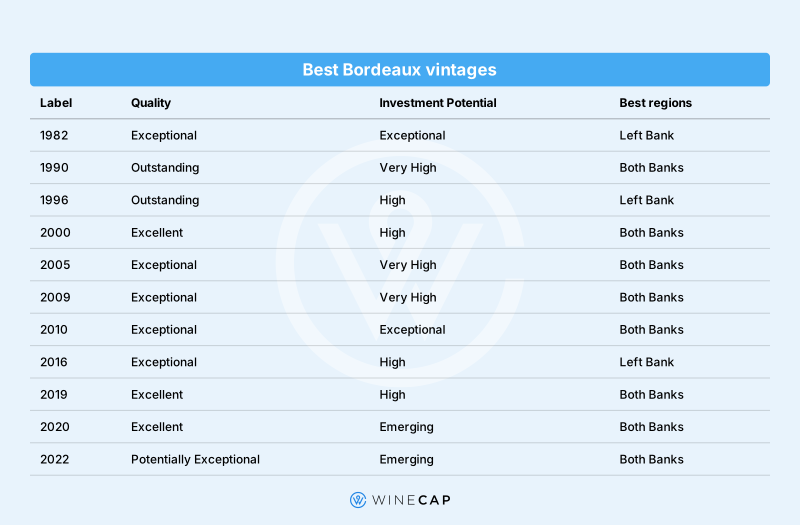
Bordeaux is home to some of the most collectible wines in the world, but not all great vintages perform equally on the secondary market. While weather conditions largely determine quality in the vineyard, investment performance is influenced by a combination of critic scores, release pricing, scarcity, brand strength, and long-term market demand.

This guide explores the most important Bordeaux vintages from both a wine and investment perspective, highlighting the years that have shaped the fine wine market and continue to attract collectors worldwide.

What are the best Bordeaux vintages?

The most important Bordeaux vintages for collectors and investors are 1982, 1990, 1996, 2000, 2005, 2009, 2010, 2016, 2019, 2020 and 2022. These vintages combine exceptional growing conditions with strong critical acclaim, long-term ageing potential and sustained demand on the secondary market.

However, the best Bordeaux vintages are not always the best investments. While quality is a prerequisite for investment-grade wine, long-term performance is influenced by release pricing, scarcity, brand strength, liquidity and global demand.

Best Bordeaux Vintages

What defines a truly great Bordeaux vintage?

Best Bordeaux Vintages

The quality of an individual Bordeaux wine depends on terroir, vineyard management and winemaking decisions. The quality of a Bordeaux vintage, however, is largely determined by weather conditions throughout the growing season.

A truly great vintage requires a rare alignment of climatic factors. Vines must progress steadily from budburst to harvest without major disruptions such as spring frost, poor flowering conditions, prolonged summer rain or harvest-time storms.

According to the late Denis Dubourdieu, the renowned Bordeaux oenologist and owner of Chateau Doisy-Daene, great vintages typically share four characteristics:

  • Early and rapid flowering
  • Gradual water stress during July to regulate vine growth
  • Warm, dry conditions throughout August and September
  • A dry harvest period that allows growers to pick at optimal ripeness

These conditions promote full phenolic ripeness while preserving acidity and freshness, creating wines capable of long-term ageing.

Great vintages are not always great investments

One of the biggest misconceptions in fine wine investment is that the highest-quality vintages automatically generate the strongest returns.

In reality, entry price is often just as important as quality.

When a vintage receives universal critical acclaim, chateau owners frequently increase release prices substantially. While these wines may be exceptional, their investment upside can be limited if expectations are already fully reflected in release pricing.

Conversely, less celebrated vintages are often released at significant discounts. Backed by the same chateau brands, vineyard sites and winemaking expertise, these wines can deliver stronger percentage returns during market recoveries. For instance, over the last decade vintages of Lafite Rothschild such as 20012, 2013 and 2014 how outperformed much more celebrated wines such as the 2005, 2009 and 2010:

Lafite-rothschild-prime vs off vintages

For investors, understanding value matters just as much as understanding quality.

The pre-1982 legends: 1945, 1947 and 1961

Before modern viticulture and winery technology, Bordeaux was far more vulnerable to seasonal variation. As a result, great vintages were rarer but often more distinctive.

The 1945 vintage remains one of the most celebrated in wine history. Harvested as the Second World War came to an end, it produced wines of extraordinary concentration and longevity.

The heatwave conditions of 1947 created unusually rich and opulent wines that challenged traditional Bordeaux structures.

Meanwhile, 1961 became legendary after severe spring frost dramatically reduced yields, concentrating the surviving fruit and producing some of the most profound wines ever made.

Notable wines

  • Chateau Mouton Rothschild 1945: Iconic for its “V for Victory” label and immense longevity.
  • Chateau Cheval Blanc 1947: Often cited as one of the greatest wines ever produced.
  • Chateau Latour 1961: A powerhouse that still tastes youthful after sixty years.
  • Chateau Palmer 1961: A legendary Margaux that many consider the equal of the First Growths. 

These wines have become historical artefacts as much as investment assets, frequently achieving record auction prices.

1982: The dawn of the modern investment era

The 1982 vintage changed Bordeaux forever.

A warm growing season produced ripe, generous wines that contrasted sharply with the austere styles of previous decades. More importantly, it coincided with the rise of Robert Parker, whose enthusiastic endorsement of the vintage helped establish the influence of critic scores on global demand.

For many investors, 1982 marks the beginning of the modern fine wine market.

Investment snapshot

  • Established the importance of critic scores in pricing
  • Highly liquid on the secondary market
  • Significant demand from Asian collectors during the 2000s
  • Remains one of the most traded mature vintages globally

Notable wines

  • Chateau Lafite Rothschild 1982: The definitive investment wine of the 1980’s and 25 years later the symbol of the emerging Chinese market.
  • Chateau Mouton Rothschild 1982: Known for its exotic spice and incredible richness.
  • Chateau Pichon Longueville Comtesse de Lalande 1982: A legendary Pauillac that matches the First Growths in quality.

1990: A tale of two banks

The 1990 vintage completed a trilogy of outstanding years following 1988 and 1989.

While 1989 may boast higher individual peaks, 1990 is generally considered the more consistent vintage across Bordeaux. Rich fruit, balanced structure and broad regional success make it one of the most attractive mature vintages available today.

Investment snapshot

  • Strong representation across both banks
  • Highly sought after by collectors seeking mature Bordeaux
  • Continues to benefit from declining availability

Notable wines

  • Chateau Montrose 1990: A Saint-Estephe legend that earned a perfect 100-point score from Robert Parker.
  • Chateau Margaux 1990: Celebrated for its floral elegance and silky texture. 
  • Chateau Cheval Blanc 1990: A classic expression of Saint-Emilion’s finest gravel soils.

1996: The Left Bank triumphs

The 1996 vintage highlights how regional variation can shape Bordeaux.

Heavy rain affected parts of the Right Bank during harvest, while the Medoc enjoyed ideal conditions for Cabernet Sauvignon. The result was one of the greatest Left Bank vintages of the modern era.

Investment snapshot

  • Particularly strong for Pauillac, Saint-Julien and Saint-Estephe
  • Increasingly recognised as one of the best Left Bank vintages since 1982
  • Offers relative value compared to 2005 and 2010

Notable wines

  • Chateau Leoville Las Cases 1996: Often described as a “First Growth in all but name” in this year. 
  • Chateau Margaux 1996: Neal Martin has suggested this may the the Left Back highlight
  • Chateau Cos d’Estournel 1996: A powerful, spicy Saint-Estephe that exemplifies the vintage.

2000: The millennium vintage

The 2000 vintage benefited from ideal weather and exceptional marketing.

Demand for the “Millennium Vintage” pushed Bordeaux into a new era of global collecting. Many estates also released special packaging and commemorative bottlings that continue to command premiums today.

In hindsight, 2000 can also be viewed as a transitional vintage that marked the beginning of Bordeaux’s adaptation to a warming climate.

Investment snapshot

  • Strong global recognition
  • Unique collector appeal
  • Widely traded and highly liquid

Notable wines

  • Chateau Mouton Rothschild 2000: Famous for its “Augsburg Ram” gold-enamelled bottle. 
  • Chateau Pavie 2000: A controversial and powerful wine that defined the modern Saint-Emilion style. 
  • Chateau Lynch-Bages 2000: A classic Pauillac that remains a collector favourite. 
  • Chateau La Mission Haut-Brion 2000: A Graves powerhouse with exceptional mineral depth.

2005: A vintage for the patient

Arguably the first universally acclaimed great vintage since 1982, 2005 was defined by a severe lack of rain rather than excessive heat. This led to tiny, thick-skinned grapes with massive tannins and high acidity. The wines are incredibly concentrated and have the structural profile for a very long life.

Patience is essential for this vintage. Even at twenty years of age, many of the top wines still require decanting to soften their formidable tannins. It is a vintage that rewards the long-term collector rather than the short-term drinker. The consistency across the Left and Right Banks makes it an attractive prospect for investment.

Investment snapshot

  • Exceptional quality across both banks
  • Strong critical support
  • Long-term cellaring potential
  • Consistent performance across major indices

Notable wines

  • Chateau Latour 2005: A monumental wine that is only just beginning to open up.
  • Chateau La Mission Haut-Brion 2005: Often considered the wine of the vintage.
  • Chateau Ausone 2005: A sublime and rare Right Bank legend.
  • Chateau Leoville Poyferre 2005: A Saint-Julien that punches well above its weight.

2009: The peak of opulence

The 2009 vintage was presented on release as potentially the greatest year in history. This reputation was fuelled by the unbridled enthusiasm of Robert Parker, who awarded more 100-point scores than in any previous year. It was a vintage of high alcohol, low acidity, and incredibly plush, ripe fruit.

Stylistically, 2009 represents the peak of “Parkerization”, a trend toward rich, opulent, and hedonistic wines. While some critics have raised concerns that the wines lack the bones for very long term ageing, they have proven to be remarkably successful. Unusually, this was also a great year for sweet wines in Sauternes which tends not to be at their best when Bordeaux reds are most successful.

Investment snapshot

  • Numerous 100-point scores
  • Strong global demand since release
  • Popular among both collectors and drinkers

Notable wines

  • Chateau Ducru-Beaucaillou 2009: A sensual and flamboyant Saint-Julien.
  • Chateau Yquem 2009: A masterclass in botrytised sweet wine.
  • Chateau Pontet-Canet 2009: A biodynamic pioneer that achieved a perfect score.
  • Chateau Cos d’Estournel 2009: A powerful, modern wine that split critical opinion on release.

2010: The connoisseur’s choice

The 2010 vintage is inseparable from its predecessor. While 2009 was opulent and approachable, 2010 was more structured and intellectually demanding. Neal Martin noted that when winemakers were asked for their preference, ninety percent chose 2010. It possessed higher acidity and firmer tannins than 2009, suggesting an even longer life in the cellar.

While 2009 is often more fun to drink young, 2010 is the vintage for the serious connoisseur. It is slightly less consistent across the lower tiers of the market, but at the top end, the wines are profound and it remains one of the most sought-after years for those building a blue-chip wine portfolio.

Investment snapshot

  • One of the strongest blue-chip investment vintages
  • Exceptional ageing potential
  • Frequently considered superior to 2009 among professionals

Notable wines

  • Chateau Figeac 2010: A refined and complex Saint-Emilion that is highly prized.
  • Chateau Latour 2010: Considered by many to be a perfect wine and a modern legend.
  • Chateau Petrus 2010: An opulent and rare Pomerol of immense value.
  • Chateau Montrose 2010: A structured powerhouse that defines the Saint-Estephe appellation.

The modern classics: 2016, 2019 and 2020

The last decade has seen a remarkable run of quality. The 2016 vintage is often cited as the modern classic, offering a perfect balance of ripeness and freshness. It is particularly strong in the northern Medoc. Notably, 2016 has the best ratings of any vintage at the annual Southwold blind tasting event.

The 2019 vintage followed, celebrated for its purity of fruit and silky textures, often compared to 2009 but with more elegance.

The 2020 vintage completed this recent trilogy. Produced under the constraints of a global pandemic, it resulted in wines of great concentration and character. These three years provide a wealth of options for the modern investor, offering high critic scores and clear regional identities.

Investment snapshot

  • Strong critical support
  • Significant trading on the secondary market
  • Attractive long-term holding potential

Notable wines

  • Chateau Les Carmes Haut-Brion 2016: A rising star that has seen significant price growth.
  • Chateau Lynch-Bages 2019: A high-scoring classic that offers excellent relative value.
  • Chateau Smith Haut Lafitte 2020: A Graves estate that continues to reach new heights.
  • Chateau Cheval Blanc 2016: A sublime and elegant Right Bank masterpiece.

The emerging star: 2022

The 2022 vintage was born in a year of extreme heat and drought, yet the wines have surprised critics with their freshness. It is a vintage where the technical skill of winemakers was truly tested. The results are variable, but the best wines are truly spectacular. It is a vintage that highlights the resilience of Bordeaux’s greatest terroirs.

Investment snapshot

  • Potentially historic quality
  • Strong early critical reception
  • May become a defining climate-era vintage

Notable wines

  • Chateau Rauzan-Segla 2022: A Margaux estate that has seen a significant jump in reputation.
  • Chateau Beau-Sejour Becot 2022: A Right Bank star with exceptional scores.
  • Chateau Climens 2022: A legendary sweet wine that made a triumphant return.
  • Chateau Montrose 2022: Wine Advocate’s William Kelley described it as the “quintessence of contemporary Bordeaux”.

The hidden gems: 1986, 2003 and 2018

Not every great year receives the same spotlight. The 1986 vintage has lived in the shadow of 1982 for decades, despite producing some incredibly long-lived and high quality wines. The 2003 vintage was historically hot, and while some wines have proved to be over-ripe, the best estates in the northern Medoc produced unique and powerful bottlings.

The 2018 vintage is another often overlooked year of great character. It was a warm vintage that produced dark, concentrated wines, with high alcohol but surprisingly good acidity. With modern technology, winemakers are now much better equipped to handle these hot years than they were in 2003.

Notable wines

  • Chateau Margaux 1986: An exceptional wine that many prefer to the 1982.
  • Chateau Montrose 2003: A Saint-Estephe that thrived in the heat.
  • Chateau Calon Segur 2018: A structured and powerful wine with great longevity.

Best Bordeaux vintages for investment

While every portfolio is different, several vintages consistently stand out due to their combination of quality, liquidity and long-term market demand:

  1. 1982 – the original modern investment vintage
  2. 2005 – exceptional quality across Bordeaux
  3. 2010 – extraordinary structure and longevity
  4. 2016 – modern classic with broad critical support
  5. 2019 – combines critical acclaim and relative value 

The strongest investment vintages are not always the highest-scoring vintages. Entry price, market sentiment and supply dynamics are equally important considerations.

FAQ: Best Bordeaux vintages 

What is the best Bordeaux vintage?

There is no universal answer, but 1982, 2005, 2010 and 2016 are frequently cited among the greatest modern Bordeaux vintages.

Which Bordeaux vintages are best for investment?

1982, 2005, 2010, 2016 and 2022 are among the most compelling vintages from an investment perspective due to their quality, market demand and long-term potential.

What is the best way to buy top Bordeaux vintages?

En Primeur can provide early access and strong provenance, while purchasing mature wines reduces vintage and ageing risk. In recent years, mature wines have often offered compelling relative value.

Can I drink a great Bordeaux vintage young?

You can, but many top Bordeaux wines are built for decades of ageing. Wines from 2005 and 2010, in particular, may still be developing and can appear overly tannic when opened too early.

Are second wines worth investing in?

Yes. In strong vintages such as 2016 and 2019, second wines from leading estates can offer attractive quality and value.

How has climate change affected Bordeaux?

Climate change has resulted in earlier budbreak and earlier harvest dates, producing riper fruit and higher alcohol levels. It has also increased the frequency of extreme weather events, including frost, drought and heatwaves.

WineCap’s independent market analysis showcases the value of portfolio diversification and the stability offered by investing in wine. Speak to one of our wine investment experts and start building your portfolio. Schedule your free consultation today.
Categories
Learn

Discover Chateauneuf-du-Pape in 10 facts

  • Chateauneuf-du-Pape is the Southern Rhone’s most prestigious appellation, renowned for its age-worthy red and white wines.
  • Leading producers such as Chateau Rayas, Domaine du Pegau, and Clos des Papes are highly sought after on the secondary market.
  • The region offers strong value compared to Bordeaux and Burgundy, making it an increasingly popular choice.

As the most prestigious appellation in the Southern Rhone, Chateauneuf-du-Pape occupies a unique position in the fine wine market. Renowned for its rich history, distinctive terroir, and long-lived wines, the region has produced some of France’s most sought-after bottles. From its papal origins to its role in shaping modern wine law, these ten facts explain why Chateauneuf-du-Pape remains one of the wine world’s most fascinating regions.

1. The Rhone is France’s fourth major fine wine region

Alongside Bordeaux, Burgundy, and Champagne, the Rhone Valley is considered one of France’s four most important fine wine regions. While it enjoys a strong reputation among collectors and critics, it remains a relatively small segment of the secondary market.

This is reflected in Liv-ex data, where Rhone wines account for just 5% of brands featured in the Liv-ex Power 100. Consumer interest is similarly concentrated, with only a handful of Rhone wines ranking among Wine-Searcher’s most-searched labels. While this can present opportunities for collectors seeking value, market liquidity is generally strongest among the region’s most established producers.

2. Chateauneuf-du-Pape helped shape modern wine law

The name Châteauneuf-du-Pape translates as “the Pope’s new castle” and dates back to the 14th century, when the Papacy relocated from Rome to nearby Avignon. Several popes took a keen interest in the area’s vineyards, helping establish the region’s reputation for wine production.

Chateauneuf-du-Pape’s influence extends beyond its history. In 1936, it became one of the first French regions to receive Appellation d’Origine Controlee (AOC) status, following the efforts of Baron Pierre Le Roy of Chateau Fortia. The Baron recognised that rigorous self-regulation was the only way to protect the region’s reputation from adulteration, “identity theft” and industrial wine adjacent products using the Chateauneuf-du-Pape name. His work helped create the framework for protecting wine origin, authenticity, and production standards across France, forming the foundation of the AOC system still used today. 

This landmark 1936 decree also established five other foundational AOCs: Arbois, Cassis, Cognac, Monbazillac, and Tavel. Regions like Pauillac were only recognised the following year in 1937.The 1936 AOCs

The region is also home to one of the most eccentric laws in the world of wine. In 1954, during a period of global UFO hysteria, the local mayor passed a municipal decree banning flying saucers from landing or taking off in the vineyards. Known as the Cointet law, it remains on the books today. Thankfully, it has not impacted the emerging use of drones in viticulture.

3. Chateauneuf-du-Pape is the flagship appellation of the Southern Rhone

The Rhone Valley is divided into two distinct wine regions: the Northern Rhone and the Southern Rhone. Chateauneuf-du-Pape is widely regarded as the leading appellation of the South, both in terms of reputation and international recognition.

The region is home to some of the Rhone Valley’s most sought-after wines, including Chateau Rayas, which consistently ranks among the most searched-for and collectible Rhône labels. Alongside estates such as Clos des Papes, Château de Beaucastel, and Domaine du Pegau, it has helped establish Chateauneuf-du-Pape as the benchmark for Southern Rhone fine wine.

While the Northern Rhone is known for Syrah-based wines from appellations such as Hermitage and Cote-Rotie, Chateauneuf-du-Pape is best known for its Grenache-led blends, which typically produce richer, fuller-bodied wines. The appellation also offers a broader range of price points than many Northern Rhone wines, contributing to its enduring appeal among collectors.

4. Chateauneuf-du-Pape is one of the Rhone’s driest appellations

Chateauneuf-du-Pape’s terroir is defined by heat, sunshine, and limited rainfall. The appellation is one of the driest in the Rhone Valley, with conditions that encourage vines to develop deep root systems in search of water. These naturally low-yielding conditions contribute to the concentration and intensity for which the region’s wines are known.

The region is equally famous for the Mistral, a powerful north wind that sweeps through the Rhone Valley. While strong gusts can occasionally damage vines, the Mistral plays a vital role in vineyard health by reducing humidity and drying vineyards after rainfall. This helps limit the spread of fungal diseases and has long supported the widespread adoption of organic and low-intervention viticulture.

5. The famous galets roules were shaped by the ancient Rhone

One of the defining features of Châteauneuf-du-Pape is its abundance of galets roules – large, rounded quartzite stones that cover many of the region’s most renowned vineyards, particularly the plateau of La Crau. These stones were carried downstream by the ancient Rhone River and deposited over thousands of years, creating one of the appellation’s most distinctive landscapes.

The galets roules play an important role in vine growing. During the day, they absorb heat from the Provençal sun before gradually releasing it overnight, helping grapes achieve consistent ripeness throughout the growing season. They also promote drainage and help reduce water evaporation from the soil, which can be particularly beneficial during the hot, dry summers for which the region is known.

Although galets roules are the appellation’s most recognisable geological feature, Chateauneuf-du-Pape’s terroir is remarkably diverse. The region’s vineyards are planted across a patchwork of soils that includes sand, limestone, clay, and gravel, contributing to the wide range of wine styles produced across the appellation.

6. Chateauneuf-du-Pape permits 18 grape varieties

Few fine wine regions allow as much blending flexibility as Chateauneuf-du-Pape. The appellation officially authorises 18 grape varieties, giving producers a wide range of options when crafting their wines. This diversity allows winemakers to adapt to different growing conditions and create blends that balance fruit, structure, freshness, and ageing potential.

The primary backbone of the region is the “GSM” blend, consisting of:

  • Grenache: Providing plush red fruit, high alcohol, and soft tannins.
  • Syrah: Adding structural tannins, deep colour, and notes of black pepper.
  • Mourvedre: Providing the earthy complexity and structural bones required for long-term cellaring.

The technical requirements for these wines are among the strictest in France. Every bottle must reach a minimum natural alcohol of 12.5%, and the practice of adding sugar to increase alcohol is strictly forbidden. Furthermore, the 100% hand-harvesting rule ensures that only the highest quality fruit enters the winery.

7. White Chateauneuf-du-Pape represents just 5% of production

Although Chateauneuf-du-Pape is best known for its red wines, the appellation also produces a small quantity of white wine. White Châteauneuf-du-Pape accounts for only around 5% of total production, making it one of the region’s lesser-known specialties.

The wines are typically made from varieties including Grenache Blanc, Roussanne, Clairette, and Bourboulenc. Unlike many white wines from cooler regions, they are often full-bodied and richly textured, with flavours ranging from stone fruit and citrus to honeysuckle, fennel, and spice.

Some of the appellation’s most highly regarded whites, such as Chateau de Beaucastel’s Roussanne Vieilles Vignes, have demonstrated an impressive capacity to age. However, production remains limited, and white Chateauneuf-du-Pape continues to be overshadowed by the region’s internationally renowned red blends.

8. Chateau Rayas, Beaucastel and Clos des Papes are among the region’s most sought-after producers

Chateauneuf-du-Pape is home to some of the Rhône Valley’s most prestigious estates, many of which are concentrated around the renowned vineyards of La Crau and the sandy soils of sectors such as Pignan. These terroirs have helped establish the appellation’s reputation for producing some of France’s most collectible wines.

Among the most acclaimed producers is Chateau Rayas, whose rare, Grenache-dominated wines have achieved cult status among collectors and regularly command some of the highest prices in the Rhone Valley. Clos des Papes, led by the Avril family, is another benchmark estate, renowned for producing a single red and white cuvée that consistently rank among the appellation’s finest wines.

Other leading names include Domaine du Vieux Telegraphe, whose vineyards on the La Crau plateau produce some of the region’s most age-worthy wines; Chateau de Beaucastel, famous for its use of all permitted grape varieties and Mourvedre-led style; and Domaine du Pegau, whose traditional, unfiltered wines have developed a devoted following among collectors worldwide.

9. The greatest Chateauneuf-du-Pape vintages span four decades

One of Chateauneuf-du-Pape’s strengths is its consistency. The region’s warm, dry climate means exceptional vintages occur more frequently than in many other fine wine regions.

Among the most highly regarded modern vintages is 2016, widely considered one of the greatest years in the appellation’s history thanks to its combination of concentration, freshness, and balance. The 2019 vintage also received widespread acclaim for producing powerful yet remarkably fresh wines, while 2010 is celebrated for its structure, depth, and long ageing potential.

Earlier vintages continue to attract collectors. The rich and expressive 2007 vintage remains highly sought after, while 1998 is often cited as one of the finest vintages of the late twentieth century. The legendary 1989 and 1990 vintages are still regarded as reference points for mature Chateauneuf-du-Pape, producing wines that have demonstrated exceptional longevity over more than three decades.

For collectors building a cellar, these vintages provide a useful guide to some of the region’s most successful and historically significant releases.

Key facts:

  • 2019: An outstanding “hot” year. Despite the heat, the wines maintain surprising freshness and are noted for having very thick skins, leading to deep color and high tannins.
  • 2016: Frequently called the “vintage of a lifetime.” It is celebrated for its extraordinary balance of ripe fruit and fresh acidity. Many critics consider it superior even to the legendary 1990.
  • 2010: A “benchmark” year. These wines are known for their massive tannic structure and incredible depth. They are currently just entering their optimal drinking window in 2026 but will last for decades.
  • 2007: A “hedonistic” vintage. Characterised by an exceptionally dry and windy summer, the wines are powerful, rich, and high in alcohol, though some purists find them almost too “big.”
  • 1998: Often cited as the best vintage of the late 20th century. These wines are currently in a “sweet spot,” showing complex tertiary notes of truffle, leather, and spice.
  • 1990 & 1989: The twin legends. 1989 is often preferred for its structure, while 1990 is famed for its opulence. The 1985 vintage is also significant as it produced the region’s first 100-point wine.

10. The Rhone remains underrepresented in the fine wine market

Despite its quality and history, the Rhone remains less prominent in the global fine wine market than Bordeaux, Burgundy, and Champagne. This is partly due to perception. Some Rhone wines, particularly during the height of Robert Parker’s influence, were associated with a richer, more powerful style that later became less fashionable among some collectors.

The region has also faced reputational challenges. In 2017, the Guillaume Ryckwaert fraud case involved the mislabelling of lower-value wine as Cotes du Rhone. Although this did not involve the leading estates of Chateauneuf-du-Pape, it contributed to wider scrutiny of the Rhone’s image.

Brand visibility is another factor. Compared with Bordeaux or Burgundy, the Rhone has fewer globally recognised labels and a less unified marketing identity. Its reputation is also split between the Syrah-led wines of the Northern Rhone and the Grenache-led blends of the South, which can make the region harder for new collectors to navigate.

Finally, the Rhone’s consistency can work against it from a market perspective. High scores are relatively common in strong vintages, meaning individual years do not always generate the same urgency as a standout Bordeaux or Burgundy vintage. This helps explain why the region can offer high-quality wines at comparatively accessible prices.

For collectors, this combination of quality, scarcity, and relatively modest market attention is what makes Chateauneuf-du-Pape such a compelling region to explore.

FAQ: Chateauneuf-du-Pape

Why does Chateauneuf-du-Pape have such a high minimum alcohol requirement?

The appellation requires wines to reach a minimum natural alcohol level of 12.5%, reflecting the warm, sunny climate of the Southern Rhone. Chaptalisation (the addition of sugar to increase alcohol) is also prohibited. Together, these rules help preserve the traditional style and identity of Châteauneuf-du-Pape wines.

Why are all Chateauneuf-du-Pape grapes harvested by hand?

Hand harvesting is mandatory throughout the appellation. This allows growers to carefully select healthy bunches and helps minimise damage to the fruit before it reaches the winery. The rule is part of the strict production standards that have defined the region since the creation of the AOC.

What are galets roules?

Galets roules are the large, rounded stones that cover many of Chateauneuf-du-Pape’s vineyards. Deposited by the ancient Rhône River, they absorb heat during the day and slowly release it overnight, helping grapes ripen evenly. They have become one of the most recognisable features of the appellation’s terroir.

What is the most famous producer in Chateauneuf-du-Pape?

Chateau Rayas is widely regarded as the region’s most iconic producer and produces some of the Rhone Valley’s most sought-after wines. Other benchmark estates include Chateau de Beaucastel, Clos des Papes, Domaine du Vieux Telegraphe, and Domaine du Pegau.

What are the best Chateauneuf-du-Pape vintages?

Among the most highly regarded vintages are 2016, 2019, 2010, 2007, 1998, 1990, and 1989. These years are celebrated for their combination of concentration, balance, ageing potential, and critical acclaim.

WineCap’s independent market analysis showcases the value of portfolio diversification and the stability offered by investing in wine. Speak to one of our wine investment experts and start building your portfolio. Schedule your free consultation today.
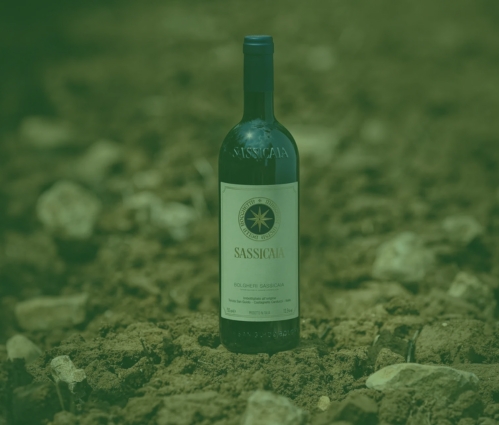
Categories
News

Gold’s correction and the changing definition of a safe-haven asset

  • Gold’s rapid rise and subsequent fall to a six-month low have challenged assumptions about the stability of traditional safe-haven assets.
  • Fine wine operates under fundamentally different market dynamics, with values driven by scarcity, provenance and global demand.
  • Recent survey findings reveal that wealth managers increasingly recognise fine wine’s safe haven benefits and expect demand to increase.

Recent volatility in gold markets has reignited debate around what constitutes a true safe-haven asset. After reaching record highs earlier this year amid geopolitical tensions and economic uncertainty, the precious metal has experienced a sharp correction, reminding investors that even traditional defensive assets can be vulnerable to changing market sentiment.

While gold remains one of the world’s most established stores of value, its recent price swings have highlighted an important trend among wealth managers and investors: a growing willingness to look beyond conventional safe-havens and towards alternative assets that can offer diversification benefits.

Findings from the 2026 WineCap Wealth Reports suggest that fine wine is increasingly occupying this role within modern portfolios.

Gold’s rally and reversal

Gold entered 2026 with remarkable momentum. Against a backdrop of geopolitical tensions, inflation concerns and continued central bank buying, the metal surged to a record high of around $5,500 per ounce in late January. At its peak, the rally had pushed gold more than 65% higher than a year earlier, reinforcing its reputation as one of the market’s preferred defensive assets.

This momentum, however, proved difficult to sustain. Persistent inflation and rising oil prices have increased expectations that interest rates could remain higher for longer, boosting Treasury yields and reducing the appeal of non-yielding assets such as gold. At the same time, stronger risk appetite in other areas of the market encouraged investors to rotate capital elsewhere. Analysts have also pointed to profit-taking after an exceptionally strong rally, with gold having become heavily crowded as a safe-haven trade earlier in the year.

Gold subsequently fell more than 20% from its peak, recently touching a six-month low of $4,022 per ounce. This has put the metal on course for its weakest quarterly performance in almost a decade. 

The correction does not diminish gold’s long-term role in diversified portfolios. However, it shows that even traditional safe-haven assets can be vulnerable to shifts in market sentiment, investor positioning and macroeconomic expectations. It also raises a broader question for investors: what characteristics should a modern safe-haven asset possess? Increasingly, attention is turning towards alternative stores of value whose underlying drivers differ from those of financial markets, including investment-grade fine wine.

Gold vs investment-grade wine: market dynamics

Gold’s recent correction highlights a fundamental difference between traditional safe-haven assets and alternative stores of value such as fine wine.

While gold prices are more heavily influenced by macroeconomic developments, fine wine is driven by a different internal set of factors. Scarcity, vintage quality, producer reputation and global collector demand all play a more vital role in determining value.

Market structure is also important. Gold is traded across vast physical and derivative markets, where activity from hedge funds, futures traders and institutional investors can amplify short-term price movements. Fine wine, by contrast, remains a predominantly physical asset market, with pricing driven by transactions between collectors, merchants and investors.

This does not make fine wine immune to market cycles. The sector has undergone a correction of its own since 2022 following the exceptional growth seen during the pandemic period. However, the adjustment has been gradual, reflecting changing buyer sentiment and price recalibration rather than the sharp swings often seen in more liquid financial markets.

The importance of scarcity

Another key distinction between gold and fine wine lies in their supply dynamics.

Every ounce of gold ever mined remains part of the global stockpile, whether held in central bank vaults, investment funds or private ownership. Fine wine operates differently. Once a vintage is released, supply can only move in one direction. Bottles are consumed or permanently removed from circulation, gradually reducing availability over time.

For sought-after wines from leading producers, this declining supply creates a scarcity profile that few asset classes can replicate. Combined with global demand, it has historically supported long-term value across many of the world’s most prestigious wine regions.

The correction seen across the fine wine market since 2022 has also created more attractive entry points for investors. Following a period of price adjustment, many regions and producers are now trading at levels that offer improved value compared with recent peaks.

At the same time, market activity has shown signs of stabilisation, supported by more realistic release pricing (including during this year’s Bordeaux En Primeur campaign), improved buyer confidence and growing engagement from international collectors.

Looking ahead

The 2026 WineCap Wealth Reports found that 97% of wealth managers and financial advisers expect demand for fine wine to increase over the coming year, representing the highest level of positive sentiment recorded since the study began four years ago.

Whether this translates into stronger market performance remains to be seen. However, the data suggests that fine wine is being recognised for qualities that investors have traditionally associated with safe-haven assets: scarcity, tangibility, global demand and low correlation to mainstream financial markets.

Gold’s recent volatility does not diminish its place within defensive portfolios. However, it serves as a reminder that even the most established safe-haven assets are subject to changing market conditions.

Today’s investors are recognising that resilience comes not from relying on a single asset class, but from combining assets with different return drivers and risk profiles. As demand for diversification continues to grow, fine wine is becoming an increasingly important part of that conversation.

FAQ: Gold’s correction and safe-haven assets

What is a safe-haven asset?

A safe-haven asset is an investment expected to retain or increase its value during periods of economic uncertainty or market volatility. Traditional safe-haven assets include gold, government bonds and cash, while alternative assets such as fine wine are increasingly being considered for their diversification benefits and low correlation to financial markets.

How does fine wine differ from gold as an investment?

Gold prices are heavily influenced by macroeconomic factors such as interest rates, inflation expectations and investor sentiment. Fine wine, by contrast, derives its value from scarcity, vintage quality, producer reputation and global collector demand. As a physical asset, it is also less exposed to speculative trading activity than many financial markets.

Is fine wine considered a safe-haven asset?

Fine wine is increasingly viewed as a complementary safe-haven asset due to its physical nature, limited supply and historically low correlation with traditional financial markets. While no investment is risk-free, many investors use fine wine as part of a diversified portfolio designed to preserve wealth over the long term.

Why are investors allocating to alternative assets such as fine wine?

Investors are increasingly seeking diversification beyond stocks and bonds. Alternative assets such as fine wine offer exposure to different market drivers, helping reduce portfolio concentration risk while providing access to tangible assets with global demand and limited supply.

WineCap’s independent market analysis showcases the value of portfolio diversification and the stability offered by investing in wine. Speak to one of our wine investment experts and start building your portfolio. Schedule your free consultation today.
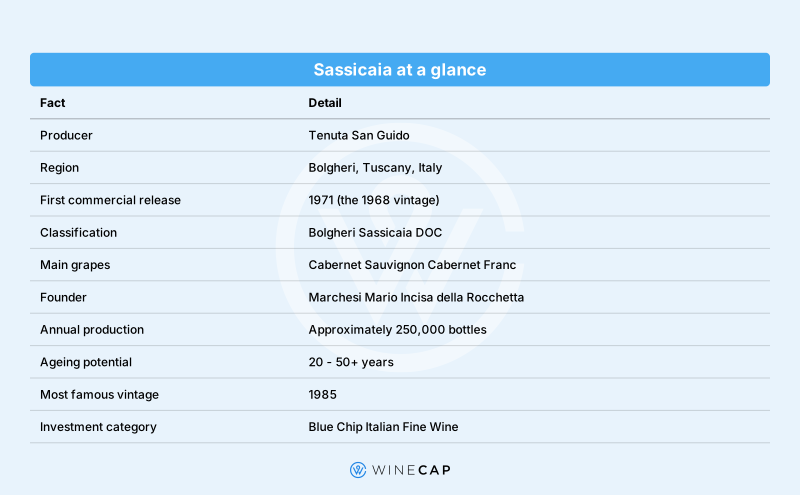
Categories
Learn

How to value fine wine: what your collection is really worth

  • Knowing how to value fine wine, and being able to get a meaningful value for your collection is critical in building a wine investment portfolio.
  • A bottle without documented storage provenance can be worth less on the secondary market than the same wine held in bond with a full history.
  • Fine wine audits go beyond prices to include drinking windows, vintage context, and market trends, all of which matter for informed trading.

Fine wine is one of the few luxury assets with an active secondary market, meaning the value of a bottle or case can change significantly over time. Whether you’re a collector, investor, inheriting a cellar, or considering selling part of your collection, understanding what your wine is really worth is essential.

Unlike most consumer goods, investment-grade wines do not have a fixed value. Prices can rise or fall based on factors such as critic scores, vintage quality, scarcity, global demand, and market sentiment. A wine purchased for release can be worth substantially more years late – or, in some cases, less than its original release price.

Part of understanding how to value fine wine is recognising the difference between the primary and secondary markets. The primary market refers to wines sold directly by producers, merchants, or through En Primeur campaigns. Once those wines are released into circulation and begin trading between collectors, merchants, and investors, they enter the secondary market, where their value is determined by real-world supply and demand. While release prices are often the lowest point of entry, this is not always the case – particularly in recent En Primeur campaigns where some wines have later become available on the secondary market at lower prices.

Whether you’re assessing a single bottle or an extensive cellar, accurate wine valuation relies on more than the original purchase price. Provenance, storage conditions, market performance, and current trading activity all play a role. This guide explains how fine wine is valued, what information you’ll need to provide, where reliable pricing data comes from, and how to determine the true market value of your collection.

Why wine valuations matter

The purpose of a wine valuation often determines both the methodology and the level of detail required. A valuation prepared for insurance purposes will differ from one intended for inheritance tax planning, estate administration, or sale.

For insurance, valuations should be reviewed regularly to reflect current market conditions. Fine wine prices can move substantially over time, particularly for sought-after investment-grade wines. A collection insured at historic purchase prices may be significantly under-insured if market values have appreciated.

Tax, probate, and inheritance-related valuations typically require a more formal approach. HMRC expects valuations to be supported by verifiable market evidence, with values assessed at a specific date rather than using current market prices. For estates containing fine wine, establishing an accurate valuation can be an important part of the wider administration process.

The most common reason for seeking a valuation, however, is the intention to sell. In these circumstances, understanding current market value is only the starting point. Achieving the best possible price depends on factors such as market conditions, buyer demand, provenance, and the route to market. Collections brought to market with sufficient planning and specialist guidance generally achieve stronger results than those sold under time pressure. As with most assets, flexibility and preparation tend to be rewarded.

The information needed before valuing fine wine

A meaningful fine wine valuation depends on accurate information. The essentials are the producer, wine name, vintage year, case format, number of bottles, and whether the wine is held in its original wooden case or as individual bottles.

Provenance is one of the most important factors in determining value. A wine stored in a professional, temperature-controlled bonded warehouse, with a clear transfer history, will usually command a higher price than the same wine with limited or undocumented storage records. For buyers, provenance provides confidence that the wine has been stored correctly and remains in good condition.

Wines without proof of professional storage are often discounted, even when the producer or vintage is highly desirable. In some cases, poor or unclear provenance can make a valuable bottle harder to sell at full market value.

Loose bottles stored at home are typically the most challenging to value. They may still have resale value, but the achievable price is usually lower than for wines held in original wooden cases under bond. Original cases in professional storage represent the strongest valuation position, offering traceability, intact packaging, and the highest level of buyer confidence.

More than headline prices: the value of a fine wine audit

A simple price check can establish what a wine is worth today. A comprehensive collection audit provides a much deeper understanding of both current value and future potential.

Beyond market pricing, a detailed review can identify wines approaching their optimal drinking window, assess how individual vintages compare with others from the same producer, and highlight broader market trends affecting a collection. This context is particularly important in fine wine, where two vintages of the same wine can perform very differently on the secondary market.

For collectors and investors, this additional layer of analysis can help inform decisions about what to hold, what to sell, and where opportunities may exist within a portfolio. It can also reveal concentrations in specific regions, producers, or vintages that may increase risk or limit exposure to emerging market trends.

While merchants can often provide indicative valuations, specialist wine investment firms are typically better equipped to deliver a structured collection review. Their analysis draws on live secondary market pricing, historical performance data, liquidity trends, and vintage comparisons to provide a more complete picture of a collection’s strengths and weaknesses.

WineCap offers this service, combining current market valuations with portfolio analysis, vintage performance data, and expert commentary, and helping clients understand not only what their wines are worth today, but how they fit within the wider fine wine market.

Understanding wine valuation price sources

The accuracy of a wine valuation depends heavily on the quality of the pricing data behind it. 

Wine-Searcher is the most widely used pricing tool among private collectors. It aggregates listings from thousands of merchants around the world, providing a broad view of the prices at which wines are currently being offered. Its greatest strength is accessibility; anyone can quickly research a wine and compare prices across multiple retailers.

However, Wine-Searcher primarily reflects asking prices rather than completed transactions. A merchant may list a wine at a particular price, but there is no guarantee that buyers are willing to transact at that level. As a result, Wine-Searcher is best viewed as an indicator of market sentiment and retail pricing rather than a definitive measure of market value.

Liv-ex (the London International Vintners Exchange) serves a different role. Used predominantly by the wine trade, it tracks bid, offer, and transaction data across the secondary market, providing a clearer picture of where wines are actually changing hands. 

The challenge for private collectors is that Liv-ex data is not freely available, making it difficult to access the same level of market intelligence used by merchants, brokers, and investment specialists. For this reason, professional wine valuations often combine multiple data sources, including secondary market transactions, merchant listings, auction results, and proprietary market analysis.

At WineCap, valuations draw on various secondary market and auction sources, as well as proprietary pricing tools to provide a balanced view of current market conditions. This helps ensure valuations reflect not only where wines are being offered, but also where the market is genuinely willing to transact.

Who can value a wine collection?

Most established wine merchants offer valuation services and can provide a reasonable assessment of a collection’s current market value. For smaller collections of well-known wines, this is often sufficient, particularly when the objective is insurance, estate planning, or a general understanding of what a collection may be worth.

When obtaining a valuation, it is worth understanding the methodology behind the figures. Some valuations are based primarily on retail offer prices, while others incorporate secondary market transaction data. The latter is generally more representative of what a wine could realistically achieve in the market, particularly for investment-grade wines that trade regularly between collectors, merchants, and investors.

More complex collections may benefit from a specialist approach. Large cellars, mixed vintages, multiple regions, rare formats, or wines with uncertain provenance often require a deeper level of analysis than a straightforward price assessment.

Wine investment specialists can provide additional context beyond current market value, including vintage comparisons, market performance trends, drinking window analysis, liquidity considerations, and portfolio concentration risks. For collectors and investors, this broader perspective can help inform decisions about whether to hold, sell, or rebalance a collection.

A valuation is only part of the story

Understanding the value of a wine collection provides clarity, but it is what happens next that matters most. Whether the objective is insurance, estate planning, selling, or simply tracking a collection’s progress over time, a reliable valuation creates the foundation for informed decision-making.

Because fine wine is an actively traded asset, values evolve as vintages mature, supply diminishes, and market demand shifts. Regular reviews can help collectors keep pace with these changes and identify opportunities that might otherwise be overlooked.

For those considering a sale, preparation is often the difference between a satisfactory outcome and an exceptional one. The more time available to assess the collection, verify provenance, and understand market conditions, the greater the likelihood of achieving the best result.

Fine wine has always rewarded a long-term perspective. The same principle often applies when assessing its value.

FAQ: Fine wine valuation

What information do I need to provide to get my wine valued?

The key details are the producer name, wine name, vintage year, number of bottles, and case format, including whether the wine is held as loose bottles or in its original wooden case. Provenance documentation, particularly proof of professional storage, should also be provided wherever possible, as it can have a significant impact on market value.

Will wine stored at home be valued the same as wine in bonded storage?

No. Wines held in professional bonded storage, with a clear and documented transfer history, will usually achieve stronger prices on the secondary market. Wines stored at home may still have resale value, but without a formal provenance record, buyers typically apply a discount. In some cases, unclear storage history can make otherwise valuable wines more difficult to sell at full market value.

Is Wine-Searcher a reliable guide to what my wine is worth?

It is a useful starting point, but it lists offer prices from merchants, not completed trades. What a merchant asks and what a buyer actually pays can differ considerably. For a more accurate picture, you need pricing based on real secondary market transactions.

How is a full collection audit different from a simple valuation?

A valuation gives you a current price. A full audit goes further: drinking windows, how specific vintages have tracked over time, trends across the regions and styles you hold, and an assessment of whether your collection is balanced from an investment perspective. For anyone making decisions about what to hold or sell, the broader analysis is the more useful document.

Does WineCap provide wine valuations?
Yes. WineCap provides collection valuations using live secondary market data. Beyond the headline figure, WineCap can provide drinking window analysis, vintage performance context, and portfolio commentary – particularly useful for investors who want to make informed decisions about what to hold, sell, or acquire next.

WineCap’s independent market analysis showcases the value of portfolio diversification and the stability offered by investing in wine. Speak to one of our wine investment experts and start building your portfolio. Schedule your free consultation today.