Categories
Quarterly-reports

Q1 2024 Fine Wine Report

Our Q1 2024 Fine Wine Report has now been released. The report offers a comprehensive overview of the fine wine market in the last quarter, including the impact of interest rates and geopolitical risks, the best-performing wines and regions, and analysis on the rising popularity of non-vintage Champagne as an investment.

Report highlights:

  • Mainstream markets rallied in Q1 2024, driven by resilient economic growth and expectations for future interest rate cuts by central banks.
  • The first green shoots started to appear in the fine wine market towards the end of Q1.
  • Fine wine prices (Liv-ex 100 index) experienced a smaller decline of 1% in Q1, compared to a fall of 4.2% in Q4 2023.
  • Italian wine enjoyed rising demand amid a flurry of new releases, including the 100-point Sassicaia 2021.
  • A number of Champagne labels that experienced consistent declines last year have started to recover, including Dom Pérignon, Salon Le Mesnil, and Pol Roger.
  • The Burgundy 2022 En Primeur campaign delivered high quality and quantity, with about 10% of producers reducing pricing year-on-year due to the challenging market environment.
  • China lifted tariffs on Australian wine after more than three years.
  • Critics and trade are now preparing for the 2023 Bordeaux En Primeur campaign, which will dominate the news in Q2 2024.

Click below to download your free copy of our quarterly investment report.


Fine Wine Report

Categories
Learn

Inside Champagne’s wine investment market

  • Champagne has enjoyed rising popularity as an investment in recent years, which has been reflected in its price performance.
  • The Liv-ex Champagne 50 index has considerably outperformed industry benchmarks.
  • While quality is important, brands and age are the most significant drivers behind its performance.

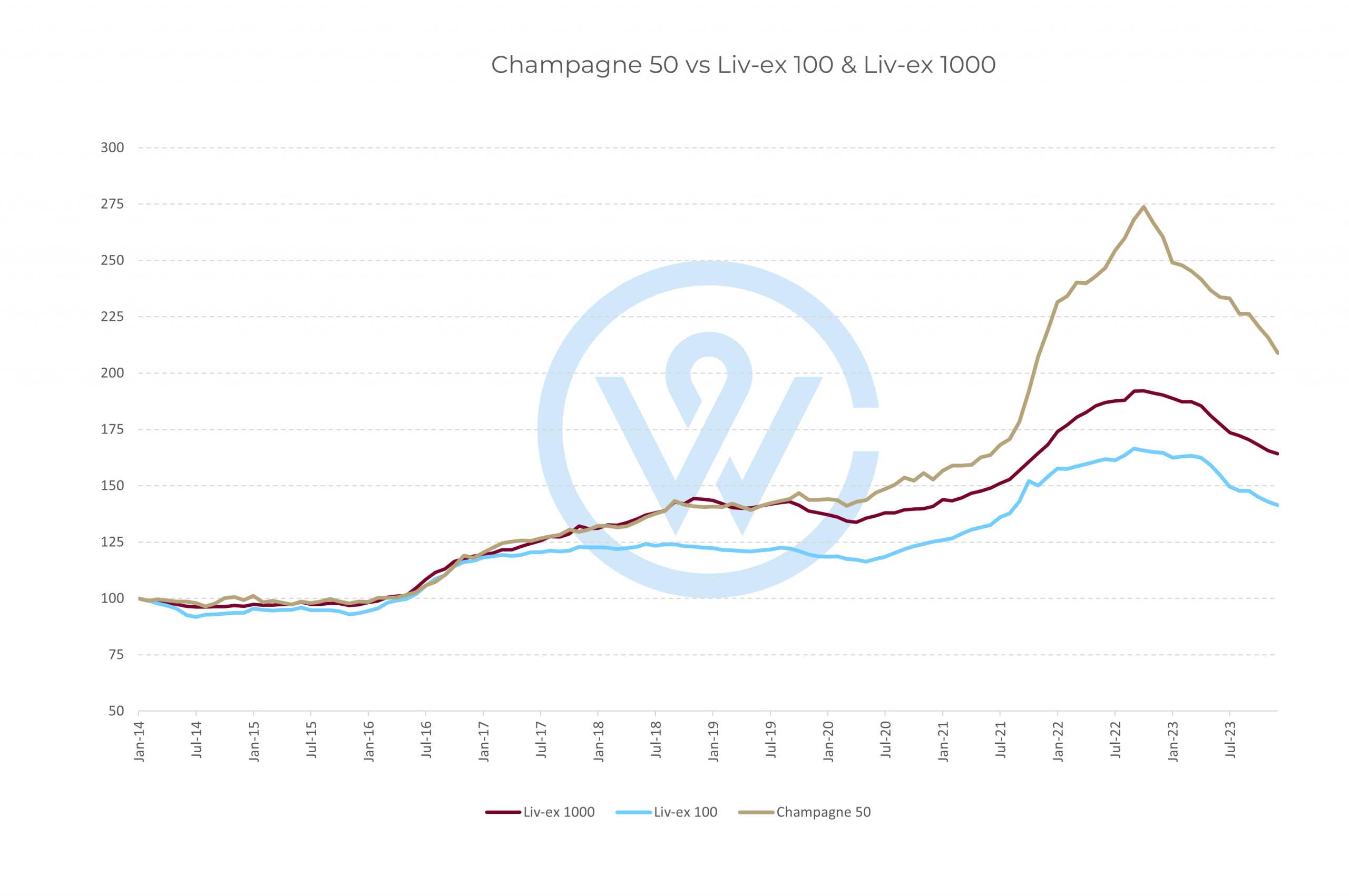
Champagne has enjoyed rising popularity as an investment in recent years, which has been reflected in its price performance. The Liv-ex Champagne 50 index, which tracks some of the most sought-after wines including Krug Vintage Brut, Bollinger La Grande Année, Dom Pérignon, Louis Roederer Cristal, and Taittinger Comtes de Champagne among others, has significantly outperformed global benchmarks. Over the last decade, the Champagne 50 index is up 108.9%, compared to 41.4% for the Liv-ex 100 and 64.3% for the broader Liv-ex 1000 index.

These numbers clearly demonstrate that Champagne is a smart addition to any diversified investment portfolio and should no longer be considered just a celebratory indulgence.

Champagne’s price performance

Much of Champagne’s remarkable performance happened between mid-2020 and the end of 2022, when the index appreciated 90.9% (May 2020 – October 2022). This period was marked by great uncertainty, from the Covid-19 pandemic, through war in Ukraine, rising inflation and recession. As the ultimate ‘luxury good’ in the fine wine market, Champagne performed particularly well and its rising prices did little to temper demand.

Since then, prices have calmed but demand remains strong. Champagne dominated the list of the top-traded wines on Liv-ex in 2023, with Louis Roederer Cristal 2015 leading the value rankings, and Dom Pérignon 2013 – by volume.

Supply and demand dynamics

Demand for Champagne has led to increases in its overall production from 50 million bottles in the 1970s to over 300 million today. Of these, Moët & Chandon contributes over 30 million bottles per year, making it the world’s largest Champagne producer.

Despite relatively healthy production volumes, the availability of vintage Champagne is limited (due to its staggering consumption market, which includes hospitality and entertainment industry buyers). This further enhances its desirability as an investment.

As it ages, its quality improves; as it is consumed, its supply decreases. This dynamic brings about an inverse supply curve – the ideal scenario for investors.

Smaller initial costs are another positive, as Champagne offers both new and experienced investors relative affordability. Although prices have moved considerably in recent years, the average case of top Champagne costs less than a case of the top wines of Bordeaux, Burgundy, California or Italy. Meanwhile, the region offers better returns.

What makes Champagne investment unique

The fine wine market has long been influenced by major critics. While critics do play a part in the evolution of Champagne prices, brands and age have proven to be more significant performance drivers.

Champagne houses that have an established and historically proven identity are already ahead of the game; however, endorsements from sources such as royal weddings, celebrities and high-visibility restaurants have paved the way for emerging cuvées.

Champagne is a more direct market than ones like Bordeaux as there are no négociants; the structure in Champagne is such that over 90% of producers are now also distributors.

Thanks to its artisanal qualities, ‘grower Champagne’ is a newly expanding sector (small estates where the brand identity is centred around the vigneron themselves). Leading this group are the likes of Jacques Selosse, Egly-Ouriet and Ulysse Collin.

An added benefit to Champagne’s appeal is its drinkability. If an investor simply cannot resist popping the cork, Champagne can be readily consumed much earlier than premium investment wines, further diminishing supply and driving prices up.

To find out more about the investment market for Champagne, read the full report here.

Categories
Learn

Navigating the 2023 fine wine market: the rise of Bordeaux amid global risk aversion

  • 2023 marks a notable slowdown in the fine wine market, with price corrections shadowing the bullish trends of previous years.
  • Burgundy and Champagne which led the market to its peak in 2022 are suffering the most.
  • Bordeaux has become a beacon for investors, gaining renewed interest due to its stability and reliability.

As the 2023 Liv-ex Power 100 unveils, a significant shift is evident in the fine wine market. This year marks a notable slowdown, with price corrections shadowing the bullish trends of previous years. Amidst this changing landscape, Bordeaux emerges as a beacon for investors, gaining renewed interest due to its stability and reliability. This article delves into the dynamics of the 2023 fine wine market, highlighting the rise of Bordeaux against a backdrop of global risk aversion.

Understanding the 2023 market slowdown

The fine wine market in 2023 has departed from the spirited activity of past years. After prices across many regions reached stellar levels in 2022, 2023 was a year of corrections. Trade by value and volume also fell, according to the 2023 Liv-ex Power 100 report. Despite more wine labels being traded, the overall number of individual wines traded (on a vintage level) has seen a decrease. This trend points towards a strategic shift towards higher quality wine investments, reflecting a more discerning market behaviour.

The softening of the fine wine market in 2023 can be attributed to a range of factors. Economic uncertainties and global financial market fluctuations have instilled a sense of risk aversion among investors. Inflationary pressures and rising interest rates have also played a role, impacting disposable incomes and investment capabilities. This economic climate has prompted a more cautious approach in luxury investments like fine wine. Additionally, changing consumer behaviours and preferences, along with geopolitical tensions and trade disputes, have further contributed to the market’s softening.

Regional patterns in 2023

In 2023, regional patterns in the wine market have become more pronounced. Burgundy and Champagne, which previously led the market to its peak, are now facing significant corrections. Burgundy has seen a reduction in its presence in the Power 100, while the Burgundy 150 index has fallen 15.4% year-on-year. Similarly, Champagne’s market has also softened, with the Champagne 50 index dipping 19.4%.

The rankings reveal a trend towards stability, liquidity, and relative value, which are prominently found in Bordeaux. This region has emerged as a beacon of resilience in the fine wine market, adding five wines to the Power 100 and benefiting from its reputation for consistent quality and reliable investment.

Conversely, California, while losing five wines in the ranking, managed to maintain its trade share, indicating a selective but sustained interest in its wines. This shift reflects a broader market inclination towards established regions and brands, suggesting a cautious approach by collectors and investors in a turbulent market.

As market dynamics evolve, regions like Italy and Spain are gaining traction, with brands like Vietti and Dominio de Pingus showing positive growth, further diversifying the landscape of investment-worthy wines. These regions are increasingly seen as offering valuable investment-worthy wines, attracting attention for their unique qualities and potential for growth.

The most powerful brands of 2023

In the realm of individual brands, certain names have demonstrated remarkable resilience and adaptability amidst the market downturn. Bordeaux’s Château Climens, for instance, has made an impressive leap in the rankings, rising from 353rd place in 2022 to 98th this year. This is a testament to its successful brand repositioning under new ownership.

Similarly, in California, brands like Opus One and Screaming Eagle continue to hold strong positions. Opus One, in particular, has risen dramatically, from 82nd in 2022 to 4th this year, signifying continued interest in top-tier wines from this region despite broader market challenges.

Despite facing a pullback Burgundy still has powerful players like Kei Shiogai, which took the top spot in terms of price performance, with its Market Price rising 185.7% year-on-year.

The strength of these brands lies not just in their historical significance or quality but also in their ability to retain high liquidity and trading volumes, essential in a market that is increasingly focusing on safer investments. This trend suggests that while the market is retracting in some areas, there remains a robust demand for wines that represent the pinnacle of their respective regions.

Adapting to the evolving wine market dynamics

As we navigate through the evolving dynamics of the fine wine market, it is clear that understanding and adapting to these changes is crucial for future investing. The trends of 2023, from the renewed interest in Bordeaux and the resilience of powerful brands, provide valuable insights into the market’s direction.

WineCap’s independent market analysis showcases the value of portfolio diversification and the stability offered by investing in wine. Speak to one of our wine investment experts and start building your portfolio. Schedule your free consultation today.

 

Categories
News

Examining the investment potential of Salon 2013 amid heightened demand

  • Salon Le Mesnil Blanc de Blancs 2013 has enjoyed heightened demand shortly after release.
  • The 2013 offers good value compared to similarly scored back vintages, which come at a significant price premium.
  • Salon has delivered higher returns (71%) than the Champagne 50 index (62.8%) over the last five years.

The latest release from Champagne house Salon has already been met with heightened demand. Salon Le Mesnil Blanc de Blancs 2013 came to the market at the end of September, and featured among the most traded wines on Liv-ex shortly after. Below we examine the reasons behind this increased interest and the wine’s investment potential.

The ‘magnificent’ 2013 Salon release

The 2013 was the first vintage release following two unusual releases: the 2012 which the Champagne house initially said they would not offer, and the 2008 of which only 8,000 magnum bottles were released (about 1/3 of their normal production).

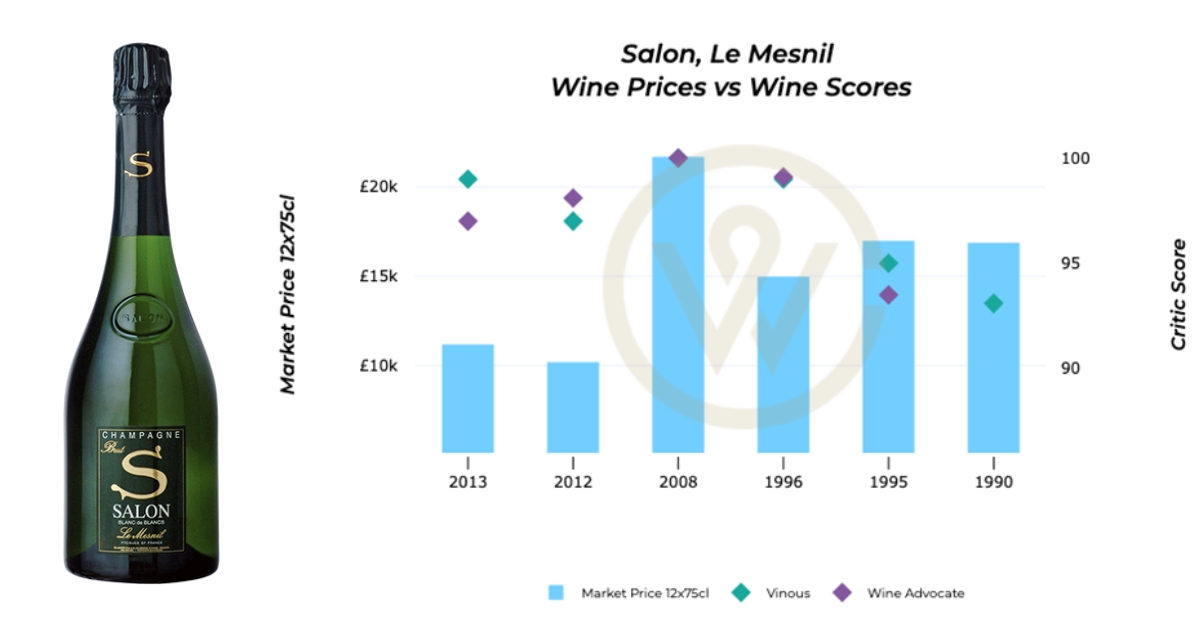
The wine received 99-points from Antonio Galloni (Vinous), who declared it ‘the most powerful, dense young Salon I have ever tasted’. The critic further noted: ‘Champagne of mind-bending complexity, the 2013 possesses tremendous mid-palate intensity and power from the very first taste’.

Meanwhile, the Wine Advocate’s Yohan Castaing awarded the wine 97-points, saying that 2013 is ‘more complex and incisive than the 2002 and exhibits similar power to the 2012 at this early stage’.

In terms of value, the 2013 stands out among other Salon vintages available in the market today. The only higher-scoring scoring wine is the 2008 at nearly twice the price. Other similarly scored back vintages such as the 1996, 1995, and 1990 also come at a significant premium to the 2013.

Salon brand performance

Perhaps the most coveted of all Champagne brands, Salon is certainly one of the rarest. Only around 50,000-60,000 bottles are made in most years, and fewer than 50 vintages in the last 100 years.

Salon is a wine defined by its singularity, representing a single vintage expression from one grape and one village. The wine was originally conceived as a private label for the consumption of its founder Eugène-Aimé Salon at a time when the making of Champagne was characterised by blending.

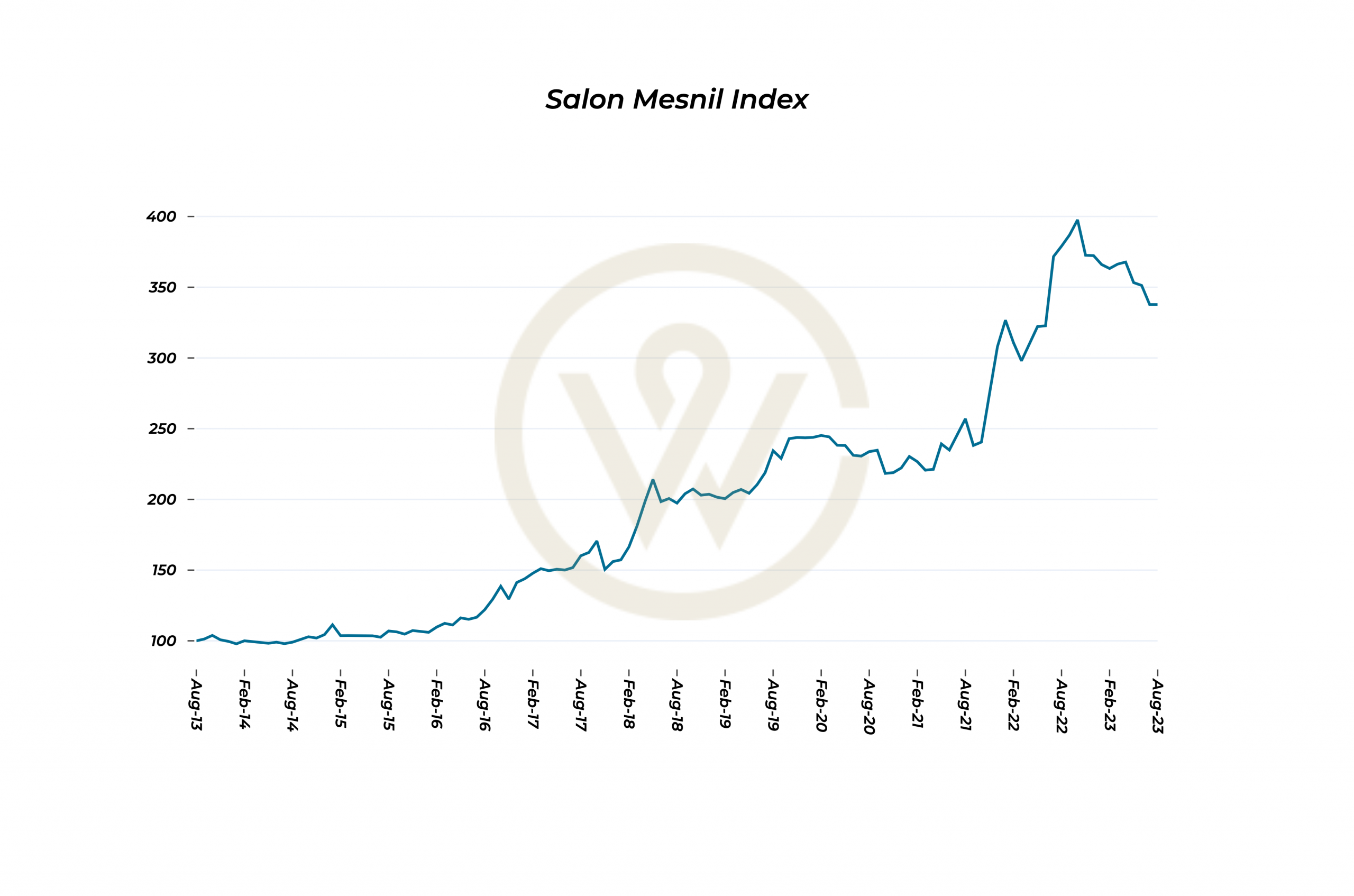
Salon’s exclusivity has been reflected in its investment performance. The wine has delivered higher returns (71%) than the Champagne 50 index (62.8%) over the last five years.

Even in the current climate that has seen prices fall across the board, Salon has fared better than average, down 7% compared to a 12.9% decrease for the broader index, which includes the likes of Krug and Cristal.

The long-term prospects for a wine as rare and highly regarded as Salon are more than promising. There is significant space for Champagne prices to rise in the medium term, and a wine like Salon is especially well placed to benefit.

WineCap’s independent market analysis showcases the value of portfolio diversification and the stability offered by investing in wine. Speak to one of our wine investment experts and start building your portfolio. Schedule your free consultation today.
Categories
News

Investment opportunities in LVMH Champagnes

  • Recent LVMH Champagne releases offer a combination of high quality and relative value for money.
  • Dom Pérignon 2013 has been the most in-demand wine so far this year.
  • The current market environment has created plenty of Champagne buying opportunities, among which Krug 2006 stands out.

A name synonymous with luxury and quality, Louis Vuitton Moët Hennessy’s (LVMH) wines have become mainstays of any serious wine investment portfolio. Owners of iconic brands like Krug, Dom Pérignon, Ruinart, Veuve Clicquot and Ace of Spades, LVMH has set unparalleled standards in Champagne production.

Not only have their wines delivered quality, as affirmed by critic scores, but they have brought greater liquidity to the Champagne market. A common theme uniting some of their recent releases is the outstanding value they offer compared to back vintages.

Dom Pérignon 2013 – the most wanted wine this year

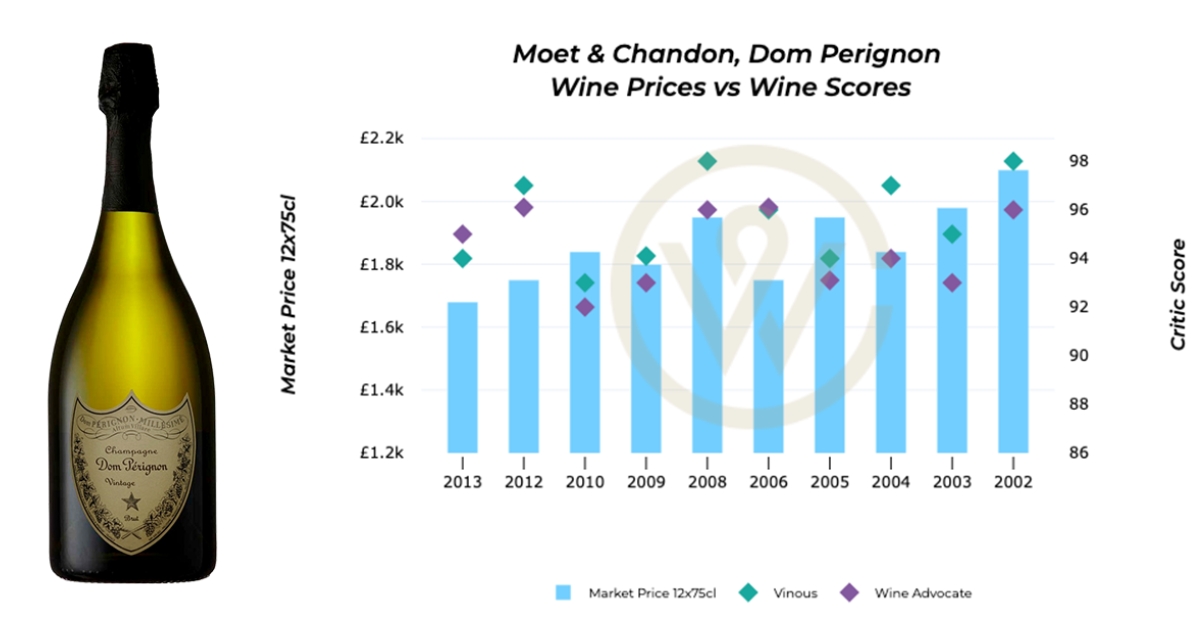
Dom Pérignon 2013 is the latest release from the most in-demand Champagne brand. The wine boasts 95+ points from the Wine Advocate’s William Kelley, who called it ‘a lovely wine, defined by the long, cool growing season’.

The remarkable value it offers – as the most affordable Dom Pérignon vintage in the market today – has led it to become the most traded wine by both value and volume this year. The wine’s price has fallen slightly since release (-7.1%), in line with the recent reconciliation in Champagne prices. The Champagne 50 index has dipped 13.1% year-to-date.

However, the brand’s overall trajectory is upwards, with Dom Pérignon prices rising 64% on average in the last five years, and 133% over the last decade, making it an opportune time to buy.

Latest Krug Grande Cuvée editions

The crowning jewel of LVMH, Champagne house Krug, also introduced its latest Grande Cuvée earlier this year. The 171st edition, blended meticulously from 30 different vintages dating back to 2000, represents the lowest-priced Krug GC.

Magnums of the 168th edition are also new to the market, with the hallowed 2012 as the base vintage. Older releases of such magnums are hard to find and command a hefty premium, once again underlining the value to be had here.

Opportunities in Krug 

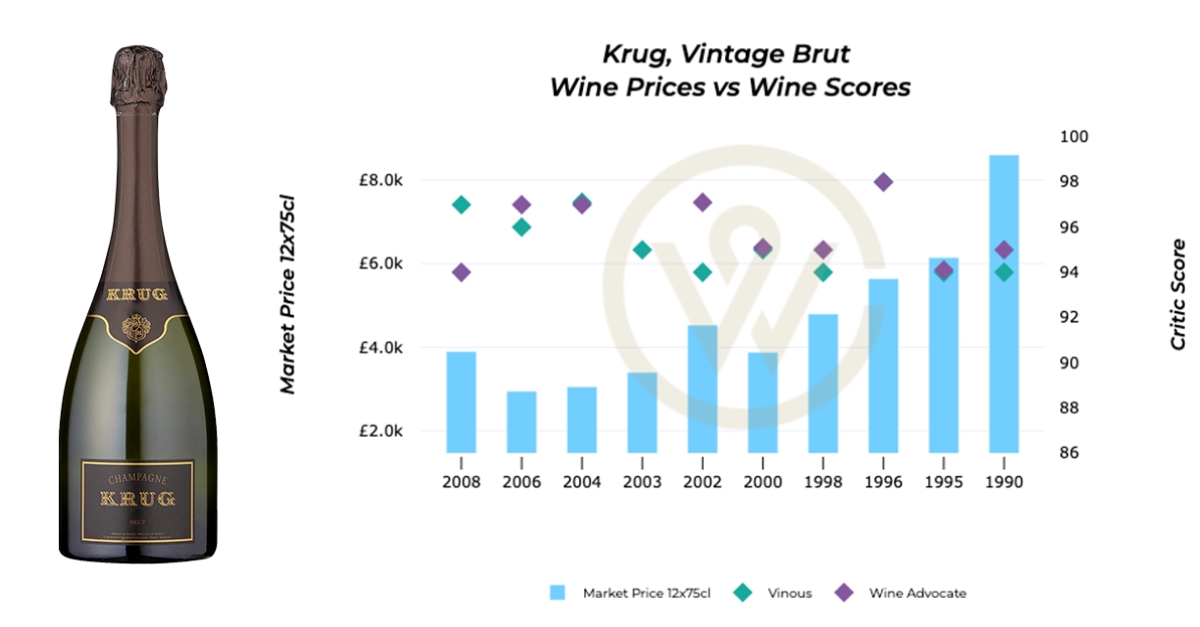
The recent decline in Champagne prices has created buying opportunities for some of the top names. The latest Krug vintage, the 2008, has become more affordable after dipping 29.0% year-to-date. The wine received 97-points from Antonio Galloni (Vinous) who described it as a ‘nervy, electrifying Champagne, the likes of which has not emerged from Krug’s cellars since the magical 1996’.

However, the 2006 presents an even better investment opportunity. While it is the lowest-priced Krug vintage, its scores align with pricier alternatives such as 2002. The 2006 boasts 96-points from Neal Martin, 97-points from Galloni and 98-points from Kelley, making its value proposition even more evident.

Krug prices have risen 71% on average in the last five years (see more on Wine Track).

Buyers can find plenty of opportunities in LVMH’s Champagnes. Despite the recent dip in the Champagne market, the long-term trajectory of these illustrious brands indicates a steady and impressive rise. The value on offer in some of the most recent offerings makes them an even more lucrative acquisition.

WineCap’s independent market analysis showcases the value of portfolio diversification and the stability offered by investing in wine. Speak to one of our wine investment experts and start building your portfolio. Schedule your free consultation today.



Categories
News

Four key market trends from the 2023 Liv-ex Classification

  • The fine wine market is diversifying, with Argentina and Switzerland making new entries in the 2023 Liv-ex Classification.
  • Bordeaux’s influence is waning, now accounting for less than 30% of wines in the classification, while other regions like Champagne rise in prominence.
  • Internal shifts in Burgundy indicate changing buying preferences, driven by the search for value and stock.

The Liv-ex Classification is a ranking of the world’s leading fine wine labels, based solely on their price. The classification takes into account minimum levels of activity and number of vintages traded over one year to present a more accurate picture of the market today. Like the 1855 Bordeaux Classification, the wines are divided into five tiers (price bands).

The 2023 edition featured 296 wines from nine countries. It presented a broad overview of the state of the secondary market – what is trading, and at what price levels. As the market continues to evolve, we break down four key trends from the 2023 Liv-ex classification.

Continued expansion in the world of fine wine

While the number of wines that qualified for inclusion in the 2023 rankings was lower than in the previous 2021 edition (349) due to changes in the methodology, the fine wine investment market has continued to diversify.

Argentina re-entered the rankings with five wines compared to having just one in 2019. Switzerland also joined the classification for the first time with Gantenbein Pinot Noir. Meanwhile, Spain and Chile saw 40% and 100% respective increases in the number of wines entering.

Regional diversity was particularly noticeable in the second-lowest priced 4th tier (£456-£637 per 12×75), which featured wines from France (24), Italy (16), Portugal (3), Australia (2), Spain (1), the USA (1), and Argentina (1).

Bordeaux among global competitors

It is no secret that Bordeaux’s dominance in the fine wine investment market has been fading since its glory days in 2009-2010. The continued broadening of the market has meant that the region has become one of many players, accounting for under 30% of the wines in the 2023 classification.

This has been further aided by its mediocre price performance relative to other regions. The Bordeaux 500 index has risen just 2.9% over the last two years, compared to a 19% move for its parental Liv-ex 1000 index, and a 36.7% increase for Champagne, which has been the best performer. All considered, Liv-ex wrote that ‘this pattern may well continue in future editions’ as new entrants challenge Bordeaux’s monopoly.

While Bordeaux’s influence wanes, other regions like Champagne are capturing the limelight.

The stellar rise of Champagne prices

Champagne has experienced a significant price surge in recent years, which has been reflected in the global rankings.

The majority of Champagnes (10) in the classification entered the first tier – wines priced above £3,641 per 12×75. The remaining 12 were split between tier 2 (£1,002-£3,640) and tier 3 (£638-£1,001). There were no Champagnes in tiers 4 and 5 (wines below £1,000 per case).

The most expensive Champagne was Jacques Selosse Millésime, with an average trade price of £32,516 per case, followed by Krug’s Clos d’Ambonnay (£30,426) and Clos du Mesnil (£17,509). The latter has risen 105% in value over the last five years.

On average, Champagne prices are up 62.8% during this time. They peaked in October 2022, following a year and a half of steady ascent. Since then, the Liv-ex Champagne 50 index has entered a corrective phase – but not significant enough to change the region’s trajectory. Sustained demand has been further buoying its performance.

Internal reshuffling in Burgundy

Burgundy, home to the most expensive wines in the rankings, has been undergoing an internal shift. New entrants have replaced many of the labels in previous editions, signalling changes in buying preferences.

Heightened demand for the region in 2022 led buyers to explore different wines within Burgundy, seeking both value and stock availability. Some of the new entrants in the 2023 classification include Prieuré Roch Ladoix Le Clou Rouge, Domaine Louis Jadot Gevrey-Chambertin Premier Cru Clos Saint-Jacques and Domaine Trapet Père et Fils Latricières-Chambertin Grand Cru.

Interestingly, while these new labels have entered the ranking, they seem to have replaced older, perhaps less active, Burgundy labels. Indeed, the overall proportion of Burgundy wines in the classification has remained steady, even as specific labels fall in and out of favour.

As new players emerge and existing ones adapt, one thing is clear: the fine wine market will continue to diversify and evolve, promising a fascinating future for everyone involved.

WineCap’s independent market analysis showcases the value of portfolio diversification and the stability offered by investing in wine. Speak to one of our wine investment experts and start building your portfolio. Schedule your free consultation today.
Categories
News

Champagne’s financial bubbles: rising costs spark concerns over affordability

  • Rising production costs and inflationary pressures in Champagne have raised concerns around its accessibility and its appeal to consumers.
  • Higher interest rates pose challenges for financing grape supplies, potentially eroding profit margins for smaller Champagne producers.
  • Champagne’s investment market has also been undergoing a similar shift, which has diminished its relative affordability compared to other fine wine regions.

Champagne has experienced a period of remarkable success, with a new record turnover set for the region in 2022, The Drinks Business highlighted in an article this week. However, leading figures in the region have noted that inflationary pressures and rising production costs could potentially make Champagne too expensive. This is a particular concern at the lower end of the market where fixed costs make up a larger proportion of the value of the wine and the need to keep prices affordable is more pronounced. But prices have come under pressure in the secondary market too, which has shifted its dynamics.

Champagne’s rising costs spark concerns among smaller producers

The escalating prices of grapes, along with increasing costs of labour, energy, packaging materials, and glass, have placed significant financial pressures on some Champagne houses. According to the article, the price of grapes from the 2022 harvest rose by as much as 10% compared to the much smaller 2021 vintage.

Rising interest rates, which were sitting below 1% two years ago and have now reached 3% and higher, have added extra pressure on financing grape supplies, potentially eroding profit margins of smaller producers. Meanwhile, various packaging materials, including paper, foils, cases, and glass, are up by around 40%.

The rising production costs may lead to further price increases for Champagne. This situation raises concerns around Champagne’s accessibility and its appeal to consumers. Some producers fear that higher prices could deter customers and potentially drive them towards alternative sparkling wines.

The shifting dynamics of Champagne’s investment market

The dynamics of Champagne’s secondary market have also been undergoing a clear shift. Previously, everything seemed to work in Champagne’s favour: abundant stock, strong distribution, consistent demand, and relative value compared to other fine wines.

Speculators have taken advantage of Champagne’s strengths, fuelled by a string of excellent vintages that increased demand. This has altered the traditional rules of the Champagne market, as speculators often hold onto their stock without consuming it, resulting in potential oversupply. The sustainability of rising prices in the face of a potential stock overhang can present a challenge.

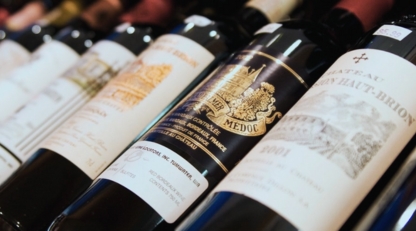
Meanwhile, the rising price of Champagne has diminished its relative price advantage compared to other fine wine regions. Previously considered an affordable entry point into the world of fine wine, Champagne’s average prices now rival those of Bordeaux. For instance, the average case price of Krug Vintage Brut (£5,001) is higher than that of the First Growth Château Haut-Brion (£4,802).

Champagne vs Bordeaux

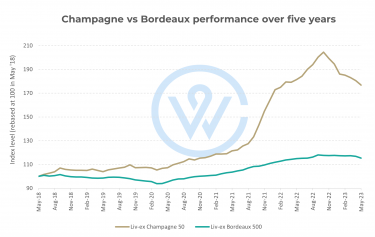
*Over the last five years, Champagne prices are up 76.8%, compared to 15.3% for Bordeaux. Champagne experienced stellar price performance between mid-2021 and the end of last year. Year-to-date, its index is down 9.1%.

Some producers have also displayed an ambition to raise prices. Notable brands, such as Philipponnat’s Clos des Goisses and Lanson’s Le Clos Lanson, have joined La Place de Bordeaux, signaling their intent to push their brands. Last year, François Pinault’s Artemis Group acquired a majority stake in Champagne Jacquesson. While this highlighted Champagne’s investment potential, it also indicated a departure from offering wines at entry-level prices.

All of this presents a complex landscape for Champagne’s future pricing and market positioning; particularly, for smaller more affordable producers, less able to spreads costs over multiple products and absorb the rising costs. Is the era of affordable Champagne over?

WineCap’s independent market analysis showcases the value of portfolio diversification and the stability offered by investing in wine. Speak to one of our wine investment experts and start building your portfolio. Schedule your free consultation today.
Categories
News

Champagne Jacquesson Purchased by Pinault Family

François Pinault, owner of Artémis Domaines, has finalised the acquisition of Champagne Jacquesson.

In February last year, Artémis Domaines took control of a minority stake of 33% in Champagne Jacquesson. At the time there was speculation that a full takeover would ensue later in the year. Managing the Dizy-based operation with his brother Laurent since 1990, Jean-Hervé Chiquet has confirmed that the complete takeover happened in December 2022. Chiquet commented: ‘When we bought back Michael Mackenzie’s shares (in the company) at the end of 2020, we started to think about a new partner and found that Artémis Domaines was interested. We started to discuss options with them and agreed on their arrival as a minority shareholder last February.’

‘Since then, we have had time to get to know each other and, as Laurent and I have no successor in our family, we have decided to put Jacquesson in the best hands possible to guarantee its future and to be sure that our dedication to quality will remain or even be improved,’ Chiquet added. Although he and his brother won’t be actively involved in managing the company, ‘we will continue to supply the company with grapes from our own vineyards and I will stay on as a member of the board but without an operational role,’ Jean-Hervé added.

Located in Dizy outside of Epernay, the Jacquesson estate was purchased by Jean-Hervé and Laurent’s father in the 1970s. The estate dates back to the 18th century and Joseph Krug worked there before he founded his own house in 1843. The brothers have shaken up the ‘Brut sans année’ market with the introduction of their Cuvée 700 concept. Their first release – Cuvée 728 – centred on the 2000 harvest and was released in 2004.

Chiquet, who has previously spoken about his and his brother’s approach, said: ‘The Cuvée 700 concept is unique in Champagne and is the opposite of a non-vintage wine. We seek excellence rather than homogeneity, respect for the character of the vintage rather than its denial, and the preference to create a “house style”, the doctrine most other producers in Champagne follow for their non-vintage blends. Our Cuvée 700 is the only blended wine we produce; it is meant to be the expression of a year and thus each year offers a different identity which we recognise by numbering the cuvée.’

Read more about the Pinault family’s 2022 acquisition of Champagne Henriot.

Categories
News

Champagne Producers Fight Against Zero Herbicide U-Turn

Winemakers in Champagne have written an open letter – published in Le Monde on the 6th of December – that voiced their opposition to the professional bodies’ reneging on a commitment to phaze out the use of all chemical herbicides in the region by 2025.

The date was significant: it was the day of the Annual General Meeting of the Association Viticole Champenoise (AVC). At the AGM, both the Syndicat General des Vignerons (SGV) and the Union des Maisons de Champagne (UMC) had officially announced – five years previously – that herbicides would be banned.

Jean-Marie Barillère, former president of the UMC, commented in 2018: ‘There are only two possible outcomes: either we move forwards or we are forced to move, with all the risks the latter entails in ecological terms, in terms of image and therefore in economic terms for our industry and our businesses. I prefer to forge a path towards a virtuous Champagne, rather than keep dwelling on the past.’

Maxime Toubart, president of the Syndicat General des Vignerons, also said at the 2018 AGM: ‘Our objective is, in a few years’ time, to be able to talk about a 100% sustainable Champagne, that takes its commitments seriously and can be held up as an example, and which can proudly proclaim: zero herbicides.’

Despite previous assurances, in 2022, Toubart refused to add the zero-herbicide policy to the cahier des charges: the Champagne appellation’s rulebook. Because of this, the dispute between the SGV, the Association Biologique Champenoise (ACB) and a union of organic growers, has only gained momentum.

President of the ACB, Jérôme Bourgeois, commented: ‘It is unacceptable that a prestigious appellation like Champagne can even imagine walking back a core environmental promise made five years ago, especially in today’s ecological climate.’

While the main Champagne body (the CIVC) didn’t comment on the open letter at the 2022 Annual General Meeting, David Châtillon – UMC president – did speak about the importance of preserving ‘Champagne’s perceived image’. Promisingly, he also made it clear that the Champagne region is committed to its zero-herbicide pledge, although no deadline was given.

In their address, Toubert added that ‘Champagne was greener than it ever had been before.’ This was supported by Arnaud Descotes, the CIVC’s technical director, who highlighted that the new herbicide law brought in last year has restricted the number of treatments permitted, as well as which herbicides are allowed.

Whether the initial deadline to rule out herbicides by 2025 will be met remains to be seen. However, one thing is for sure, those who signed the open letter are still keeping up the pressure: ‘We, Champagne winegrowers, Champagne houses and members of cooperatives, call upon the SGV and the UMC to continue implementing their progress strategy by respecting the deadline of ‘Zero Herbicides by 2025’, embracing an effective and sustainable commitment of our sector, in the interests of all stakeholders in the Champagne region and our fellow citizens.’

Read more recent Champagne news: Moët Hennessy’s Champagne Stocks Running Low.

Categories
News

Moët Hennessy’s Champagne Stocks Running Low

Moët Hennessy’s CEO has commented that due to high demand from affluent buyers in the run up to Christmas, its Champagnes are ‘running out of stock’.

Philippe Schaus, Moët Hennessy’s CEO, spoke to Bloomberg Television and said that the French luxury company – that owns top Champagne brands including, Dom Pérignon, Krug, Moët & Chandon and Veuve Clicquot – was ‘running out of stock’ of some of its bubbly. This is mainly due to Covid rules having been relaxed and more people socialising.

‘As people are coming out of Covid there’s been pent up demand for luxury, enjoyment and travelling,’ Schaus commented.

Schaus didn’t elaborate on which Champagnes were running low, or hint at what the state-of-play is with specific brands’ stock levels.

Louis Vuitton Moët Hennessy (LVMH) shared last month that its wine and spirit divisions had delivered double-digit revenue growth in Q3 of this year. Still wines and Champagne were the best performing categories. 

The luxury conglomerate announced that sales had risen ‘sharply’ this year in Europe, the United States and Japan. The two main drivers of this growth can be attributed to international travel resuming after the pandemic, as well as ‘solid demand’ from consumers.

On the subject of the strength of the US dollar in the market, Bloomberg made the point that strong growth might simply have been because US shoppers were able to take advantage of this by buying luxury items in Europe. However, Schaus indicated that there is still uncertainty out there due to rising inflation. It’s possible that some products will go up in price due to the rising cost of raw materials. 

Find out more about Dom Pérignon’s new P2 2004 release in our recent news article.