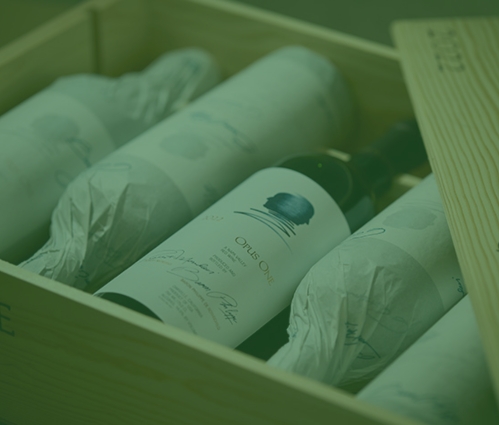
- Opus One is the highest profile joint venture between the Old and New World in winemaking.
- The wine is one of the most traded and reliable alternative assets in the fine wine market.
- Opus One often outperforms other cult labels thanks to its global brand recognition and consistent quality.
As one of the highest profile wines in California, Opus One has spent decades bridging the gap between traditional European heritage and American enterprise and viticultural innovation. For anyone building a resilient fine wine portfolio, understanding its secondary market liquidity and performance is essential.
This guide breaks down the ten things you need to know about this iconic Cabernet benchmark, exploring how its production scale and critical history continue to offer secure capital growth for those investing in wine.
1. A transatlantic handshake: The history of Opus One
The story of Opus One began in 1970 with a meeting between two giants of the wine world: Baron Philippe de Rothschild of Château Mouton Rothschild and Napa Valley pioneer Robert Mondavi. Their shared ambition was to create a Bordeaux-style blend in California that could rival the finest wines of France.
Robert Mondavi played a defining role in the post-war American wine renaissance. After a family dispute over the future of the Charles Krug Winery – where he had worked alongside his father and brother since the 1940s – Mondavi founded his own winery in Napa Valley in 1965, helping establish California as a serious fine wine region.
Baron Philippe de Rothschild, meanwhile, rebuilt Château Mouton Rothschild following the Second World War. After escaping the German occupation of France, he returned to Bordeaux and revived the family estate in the early 1950s, eventually transforming Mouton Rothschild into one of the world’s most iconic wine brands.
Together, the pair set out to create a luxury Napa Valley Cabernet Sauvignon blend crafted with a distinct Bordeaux sensibility. It marked the first time a leading Bordeaux estate had partnered with a California producer to create an entirely new wine brand – a move that proved seismic for the global wine industry. Baron Philippe de Rothschild’s involvement brought immediate prestige and international credibility to the project.
The partnership was officially announced in 1980, although the first vintages – 1979 and 1980 – were released together in 1984. Today, Opus One remains a 50/50 partnership between Baron Philippe de Rothschild S.A. and Constellation Brands, which acquired Robert Mondavi Winery in 2004.
More than four decades later, Opus One continues to stand as one of Napa Valley’s most prestigious wines and a landmark collaboration that proved California terroir could produce world-class fine wine under French-inspired winemaking principles.
Key facts about Opus One:
- Founded through a partnership between Robert Mondavi and Baron Philippe de Rothschild
- Officially launched in 1980
- First vintages: 1979 and 1980
- Located in Oakville, Napa Valley
- Inspired by the structure and philosophy of Bordeaux blends
- One of the first major collaborations between Bordeaux and California winemaking
- Currently co-owned by Baron Philippe de Rothschild S.A. and Constellation Brands
- Widely regarded as one of Napa Valley’s most collectible fine wines
2. The Judgement of Paris: The catalyst behind Opus One
Although Baron Philippe de Rothschild and Robert Mondavi first discussed collaboration after meeting in Hawaii in 1970, it is difficult to ignore the significance of the 1976 Judgement of Paris tasting in accelerating the vision behind Opus One.
The now legendary blind tasting saw California wines defeat some of France’s greatest estates – including Chateau Mouton Rothschild – sending shockwaves through the global wine industry and permanently changing perceptions of Napa Valley wine.
Rather than dismissing California’s rise, Baron Philippe recognised an opportunity. He understood that Napa Valley was no longer a winemaking backwater, but a region capable of competing with the world’s finest wines. By partnering with Mondavi, the Rothschild family could help shape the future style of premium California wine while establishing a foothold in one of the wine world’s fastest-growing regions.
The collaboration also helped legitimise Napa Valley in the eyes of European collectors and investors. At a time when many traditional French producers remained sceptical of New World wines, Mouton Rothschild became the first First Growth Bordeaux estate to fully embrace a major California partnership.
From the outset, the ambition behind Opus One was clear: to create a “California First Growth” capable of standing alongside the great wines of Bordeaux.
The success of Opus One would later inspire other prestigious French wine families to invest in Napa Valley and the wider New World wine scene, helping transform California into a globally respected fine wine region.
Key facts about the Judgement of Paris and Opus One:
- The Judgement of Paris took place in 1976
- California wines defeated leading French wines in a blind tasting
- Chateau Mouton Rothschild was among the French estates defeated
- Baron Philippe de Rothschild saw Napa Valley as a long-term opportunity rather than a threat
- Opus One was designed to become a “California First Growth”
- Mouton Rothschild was the first First Growth Bordeaux estate to pursue a major New World partnership
- The success of Opus One encouraged further French investment in Napa Valley
- The partnership helped elevate Napa Valley’s reputation among European collectors and investors
3. The Opus One vineyards
Opus One is located in the heart of Napa Valley’s Oakville AVA, one of the region’s most prestigious and sought-after vineyard areas. Renowned for producing some of California’s greatest Cabernet Sauvignon wines, Oakville offers the ideal combination of climate, soil, and exposure needed to create wines with both power and longevity.
The Opus One estate spans 68 hectares of vineyards across four distinct parcels, including prized sections of the historic To Kalon Vineyard, widely regarded as one of Napa Valley’s most iconic vineyard sites. These vineyards form the backbone of Opus One’s signature Bordeaux-style blend, dominated by Cabernet Sauvignon alongside smaller amounts of Merlot, Cabernet Franc, Petit Verdot, and Malbec.
Viticulture at Opus One combines traditional vineyard observation with modern precision technology. The estate employs high-density planting, encouraging the vines to compete for water and nutrients. This naturally reduces berry size and increases concentration, helping produce the depth, structure, and ageing potential for which Opus One is known.
Sustainability also plays a major role in the estate’s philosophy. Opus One is certified as a Napa Green winery, reflecting its commitment to environmentally responsible farming and long-term vineyard health. Advanced tools such as infrared sensors are used throughout the vineyards to monitor vine stress, water usage, and overall vine health, allowing the team to make highly precise decisions during the growing season.
The deep, gravelly, well-drained soils of Oakville are particularly well suited to Cabernet Sauvignon, helping create wines with intense concentration, refined tannins, and remarkable balance.
Key facts about the Opus One vineyards:
- Located in Napa Valley’s prestigious Oakville AVA
- Estate covers approximately 68 hectares of vineyards
- Includes parcels from the famous To Kalon Vineyard
- Cabernet Sauvignon is the dominant grape variety
- High-density planting is used to increase berry concentration
- Sustainable farming is central to the estate’s philosophy
- Certified as a “Napa Green” winery
- Infrared sensor technology is used to monitor vine health and water stress
- Oakville’s gravelly soils are considered ideal for premium Cabernet Sauvignon production
4. A Bordeaux heart in a Napa body
The composition of Opus One is always led by Cabernet Sauvignon, but it remains a classic Bordeaux-style blend. Depending on the vintage, the wine incorporates varying percentages of Merlot, Cabernet Franc, Petit Verdot, and Malbec. This multi-varietal approach allows the winemaking team to adjust the final blend to achieve a consistent house style.
While many Napa producers focus on single-varietal Cabernet Sauvignon, Opus One proves its Bordeaux influence using other grapes to add layers of aromatic nuance and textural silkiness. Cabernet Franc provides floral notes, while Petit Verdot adds structure and deep colour. This complexity is one of the reasons the wine is so highly regarded.
Key facts about the Opus One blend:
- Cabernet Sauvignon typically accounts for 80–95% of the blend
- Other varieties include Merlot, Cabernet Franc, Petit Verdot, and Malbec
- The blend changes slightly depending on the vintage
- Cabernet Franc adds floral aromatics and elegance
- Petit Verdot contributes colour, structure, and mid-palate weight
- Malbec is used sparingly to add richness and dark fruit character
- Every vineyard parcel is fermented separately before blending
- The goal is to combine Napa Valley fruit intensity with Bordeaux-style structure and balance
5. Inside the Opus One winery
Completed in 1991, the Opus One winery is widely regarded as one of Napa Valley’s most iconic and influential winery designs. Combining architectural elegance with technical precision, the estate helped redefine what a modern fine wine winery could look like, inspiring winery architecture around the world over the past four decades.
Designed by architect Scott Johnson, the winery is partially built into the hillside, allowing for natural temperature regulation and minimal visual impact on the surrounding landscape. This subterranean design also supports gravity-flow winemaking, a gentle process that reduces excessive pumping and helps preserve the purity and integrity of the fruit throughout production.
In recent years, Opus One has also undergone extensive renovation and landscaping upgrades as part of a broader sustainability and estate stewardship initiative. The redesign focused on restoring the original architectural vision while incorporating drought-resistant native planting and environmentally conscious landscaping. According to reports, the project is expected to significantly reduce water consumption across the estate.
Technology plays a major role in the cellar. Optical sorting machines are used to inspect grapes before fermentation, ensuring that only the highest-quality fruit is selected. Fermentation takes place in 50 individual steel and wood vats, allowing the winemaking team to vinify each vineyard parcel separately for maximum precision during blending.
Opus One also employs extended maceration, keeping the grape skins and seeds in contact with the juice for longer periods to extract colour, texture, and fine-grained tannins that contribute to the wine’s structure and ageing potential.
Following fermentation, the wine is aged for approximately 18 months in 100% new French oak barrels. This élevage adds layers of spice, cedar, and vanilla that have become hallmarks of the Opus One style. The wine then spends an additional 18 months ageing in bottle before release, allowing the blend to integrate and develop further complexity before reaching the market.
Key facts about the Opus One winery:
- The winery was completed in 1991
- Designed by renowned architect Scott Johnson
- Built partially underground for natural temperature control
- Uses gravity-flow winemaking to handle grapes gently
- Recently renovated with sustainability-focused landscaping upgrades
- Estate redesign aims to significantly reduce water consumption
- Optical sorting technology ensures only top-quality fruit is used
- 50 individual steel and wood vats allow plot-by-plot vinification
- Extended maceration is used to build structure and texture
- Wines are aged for around 18 months in 100% new French oak
- Additional bottle ageing takes place before release
- The winery is regarded as one of Napa Valley’s architectural landmarks
6. The Opus One tasting profile
Opus One is celebrated for its balance, combining the richness and ripeness of Napa Valley fruit with the structure and restraint more commonly associated with top Bordeaux wines. While many Napa Cabernet Sauvignon blends lean toward power and opulence, Opus One is known for its precision, texture, and refinement.
In its youth, the wine typically displays intense aromas of black cherry, cassis, blackberry, and plum, layered with notes of cedar, rose petals, dark chocolate, and graphite. Ageing in 100% new French oak adds subtle nuances of toasted vanilla, espresso, baking spice, and sandalwood, though the oak is generally well integrated rather than dominant.
The defining characteristic of Opus One is often considered its texture. The tannins are famously polished and supple, giving the wine an approachable quality even in its early years. At the same time, the wine retains the acidity and structural depth needed for long-term ageing, allowing top vintages to evolve gracefully for decades.
Compared with many of its Napa Valley peers, Opus One often shows slightly higher acidity and greater restraint, helping preserve freshness and elegance alongside its concentrated fruit profile. This balance has led many critics and collectors to describe the wine as “European” in style despite its unmistakable New World ripeness.
With bottle age, the wine develops increasingly complex tertiary characteristics, including leather, forest floor, dried herbs, tobacco, and truffle, adding further depth and sophistication over time.
Key tasting characteristics of Opus One:
- Primary aromas include cassis, black cherry, blackberry, and plum
- Common secondary notes include cedar, dark chocolate, espresso, and sandalwood
- 100% new French oak contributes vanilla and baking spice complexity
- Known for exceptionally polished and supple tannins
- Typically shows higher acidity than many Napa Valley Cabernet blends
- Balances Napa fruit richness with Bordeaux-style restraint
- Develops tertiary notes of leather, truffle, tobacco, and dried herbs with age
- Often approachable young but capable of ageing for several decades
- Frequently described as combining New World ripeness with European structure and elegance
7. The range: Opus One and Overture
Unlike many large Napa Valley estates that produce multiple labels and limited editions, Opus One has remained remarkably focused. The estate centres around its flagship wine, Opus One, often referred to as the “Grand Vin” in reference to the traditions of Bordeaux. Alongside it sits a second wine, Overture, which was originally available exclusively through the winery before receiving wider international distribution.
Produced for the first time in 1993, Overture follows the same Bordeaux-inspired philosophy as the flagship wine, using the classic blend of Cabernet Sauvignon, Merlot, Cabernet Franc, Petit Verdot, and Malbec. However, while Opus One is vintage-specific, Overture is unusual in that it is crafted as a multi-vintage blend.
This approach allows the winemaking team to combine wines from different harvests to create a more approachable and consistent style year after year. Fruit used for Overture comes from lots that do not ultimately make the final blend for Opus One, though the quality remains exceptionally high by Napa Valley standards.
Compared with the flagship wine, Overture is typically softer, more accessible in its youth, and slightly less structured, making it appealing to collectors looking to experience the Opus One style without the extended ageing requirements often associated with the Grand Vin.
Like Opus One, Overture is also aged in French oak barrels, although generally for a shorter period. The result is a polished and refined Napa Valley Bordeaux blend that retains the estate’s signature balance and elegance while offering earlier drinking appeal.
Key facts about Opus One and Overture:
- Opus One is the estate’s flagship “Grand Vin”
- Overture serves as the estate’s second wine
- Overture was first released in 1993
- For many years, Overture was only available directly from the winery
- Overture is a rare example of a luxury non-vintage Napa Valley red wine
- The blend includes Cabernet Sauvignon, Merlot, Cabernet Franc, Petit Verdot, and Malbec
- Fruit used for Overture comes from lots not selected for the flagship blend
- Overture is designed to be softer and more approachable when young
- Both wines are aged in French oak barrels
- The non-vintage format allows Overture to maintain stylistic consistency year after year
8. Opus One’s production scale
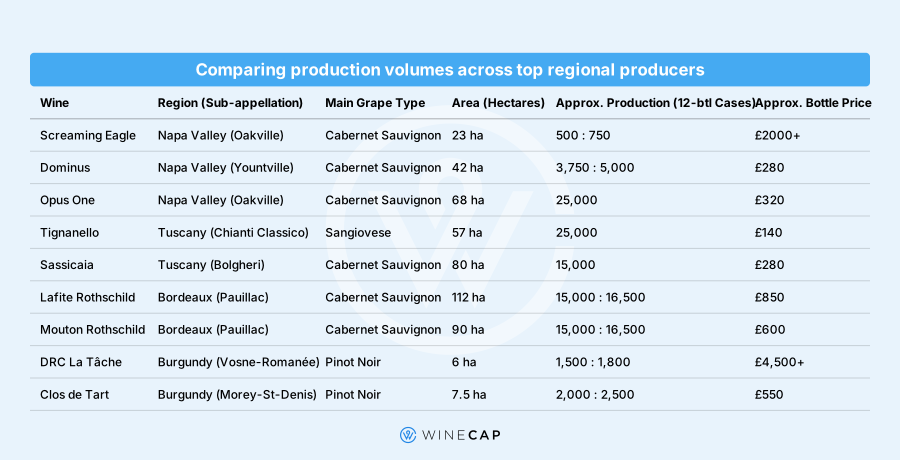
One of the most remarkable aspects of Opus One is its scale. While many of Napa Valley’s cult wines are produced in extremely limited quantities, Opus One operates on a far larger level without sacrificing the quality and consistency expected from a world-class fine wine estate.
The winery produces approximately 25,000 cases annually, making it significantly larger than ultra-small-production Napa labels such as Screaming Eagle, which produces fewer than 1,000 cases per year. Yet despite this comparatively high volume, Opus One has maintained its position as one of the most prestigious and collectible wines in California.
On a global level, Opus One’s production is closer in scale to the great First Growth estates of Bordeaux, such as Chateau Lafite Rothschild and Chateau Mouton Rothschild, than to many boutique Napa Valley producers. It also exceeds the production volumes of several iconic Italian fine wines, including Sassicaia and Tignanello.
This scale brings several advantages. Greater production allows Opus One to maintain a strong international presence across top restaurants, merchants, and collectors worldwide, while also creating valuable liquidity in the secondary market. Unlike many cult Napa wines that rarely trade due to limited availability, Opus One remains one of the few California wines with a consistently active global resale market.
The estate’s scale also supports major investment in vineyard research, sustainability initiatives, and winemaking technology, helping maintain consistency across vintages despite the challenges that come with producing wine at such volume.
Perhaps most impressive is that Opus One has managed to preserve its luxury image and premium pricing despite producing far more wine than many of its Napa Valley peers – a balance few wineries successfully achieve.
Key facts about Opus One’s production:
- Produces approximately 25,000 cases annually
- Significantly larger production than most Napa Valley cult wines
- Production exceeds many leading Italian fine wines, including Sassicaia and Tignanello
- Comparable in scale to major Bordeaux First Growth estates
- Large production supports strong global restaurant and retail presence
- One of the few Napa Valley wines with consistent secondary market liquidity
- Scale enables major investment in technology, sustainability, and research
- Maintains premium pricing despite relatively high production volumes
- Consistency across large-scale production is considered one of the estate’s greatest achievements
9. Consistent quality across vintages
One of the defining characteristics of Opus One is its remarkable consistency, both in style and overall quality. This reliability is largely a reflection of Napa Valley’s comparatively stable climate, particularly within the Oakville AVA, where warm days, cool nights, and predictable growing conditions provide an ideal environment for Cabernet Sauvignon-based wines.
Unlike Bordeaux, where vintages can vary dramatically due to unpredictable weather and harvest conditions, Napa Valley offers a far more consistent growing season. This allows the Opus One winemaking team to achieve a high level of ripeness and balance year after year while maintaining the estate’s signature style of elegance, structure, and refinement.
Although Opus One has long been considered one of California’s benchmark wines, the estate’s critical reputation has strengthened considerably since the 1990s. Advances in precision viticulture, optical sorting technology, vineyard mapping, and parcel-by-parcel winemaking have further elevated quality levels, resulting in increasingly refined and critically acclaimed releases.
Several modern vintages are now regarded among the finest ever produced by the estate, with collectors and critics particularly praising vintages that combine Napa Valley ripeness with freshness, structure, and ageing potential.
Top modern Opus One vintages:
- 2010
- 2013
- 2015
- 2016
- 2019
- 2023
10. Market performance: The blue-chip king of Napa Valley
Opus One is often regarded as one of the safest and most reliable investments in California fine wine. While ultra-rare cult wines such as Screaming Eagle or Harlan Estate may command higher headline prices due to extreme scarcity, Opus One offers something equally important to collectors and investors: liquidity, consistency, and global brand recognition.
Thanks to its larger production scale and international distribution, Opus One is one of the few Napa Valley wines that trades regularly on the secondary market. This consistent market activity creates stronger price transparency and makes it easier for collectors to buy and sell compared with smaller-production cult labels that rarely appear at auction or on trading platforms.
The estate’s association with the Rothschild family also provides an additional layer of prestige and investor confidence. Few California wineries possess the same level of international brand recognition, particularly among buyers in Asia, Europe, and the United States.
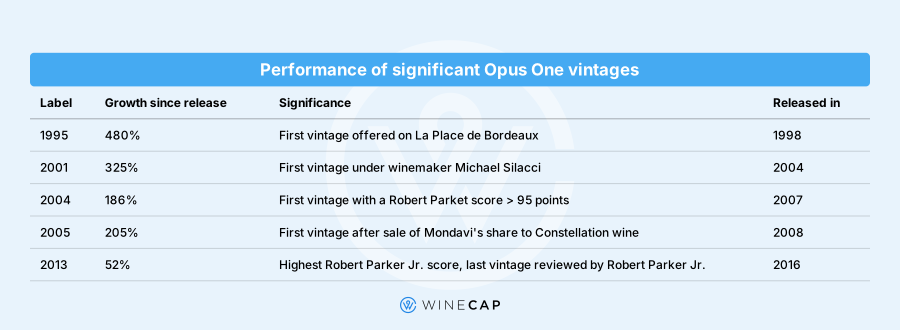
Historically, Opus One has shown strong long-term price appreciation, especially for well-stored older vintages from the 1980s and 1990s, which have become increasingly scarce.
Key facts about Opus One’s market performance:
- Considered one of the most liquid Napa Valley wines on the secondary market
- Often viewed as a lower-risk California wine investment
- Strong global brand recognition supports long-term demand
- Particularly popular in Asian markets, especially Japan
- Older vintages from the 1980s and 1990s continue to appreciate in value
- Frequently receives high critic scores, supporting investment-grade status
- More actively traded than many small-production Napa cult wines
- Association with the Rothschild family adds international prestige and trust
FAQ: Opus One
Is Opus One expensive?
In absolute terms, yes – Opus One is one of Napa Valley’s premium fine wines. However, within the context of the luxury wine market, it is often considered relatively well priced for its reputation, consistency, and long-term performance.
Who are the two heads featured on the Opus One label?
The two profiles featured on the Opus One label are stylised silhouettes of the winery’s founders: Robert Mondavi and Baron Philippe de Rothschild.
The label symbolises the partnership between Napa Valley and Bordeaux that defined the creation of Opus One and helped reshape perceptions of California fine wine on the global stage.
Can I visit the winery?
Yes, Opus One offers tasting experiences, though appointments are essential and often booked months in advance. If you’re interested, reach out to your WineCap Account Manager.
Is Overture a good investment?
Overture is generally considered a “drinker’s wine” rather than an investment asset, as it lacks the vintage-specific rarity of the flagship.
How long should I age Opus One?
While approachable after five years, the best vintages reach their peak maturity between 15 and 25 years after the harvest.
WineCap’s independent market analysis showcases the value of portfolio diversification and the stability offered by investing in wine. Speak to one of our wine investment experts and start building your portfolio. Schedule your free consultation today.