Categories
News

The state of the fine wine market so far in 2024

  • Fine wine remains a buyer’s market in 2024.
  • Burgundy prices have fallen the most, while Italy has been the most resilient region. 
  • Some wines have outperformed the market, such as L’Église-Clinet 2012.

The fine wine market remains a buyer’s market in 2024. All fine wine regions have experienced declines, with prices for Burgundy, Bordeaux, and Champagne falling the most. 

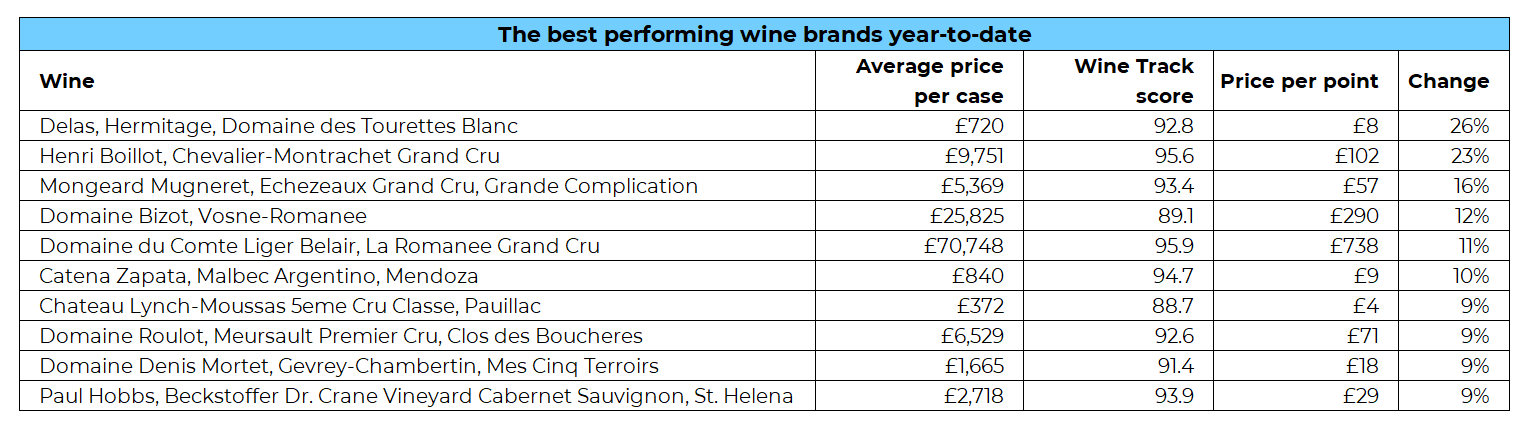
Still, some wine brands have outperformed the market by far – such as Henri Boillot Chevalier-Montrachet Grand Cru, which is up 23% since the beginning of the year.

Regional wine performance so far in 2024

The fine wine market’s downturn has continued into 2024. The broadest measure of the market, the Liv-ex 1000 index, is down 4.9% year-to-date. Within it, Burgundy (-7.0%) and the Rest of the World (-4.8%) sub-indices have fallen the most. 

The Champagne 50 index is also down 4.5%. However, the index rose 0.9% last month, buoyed by Dom Pérignon 2006 and 2012, Louis Roederer Cristal Rosé 2008 and various vintages of Pol Roger’s Cuvée Sir Winston Churchill. 
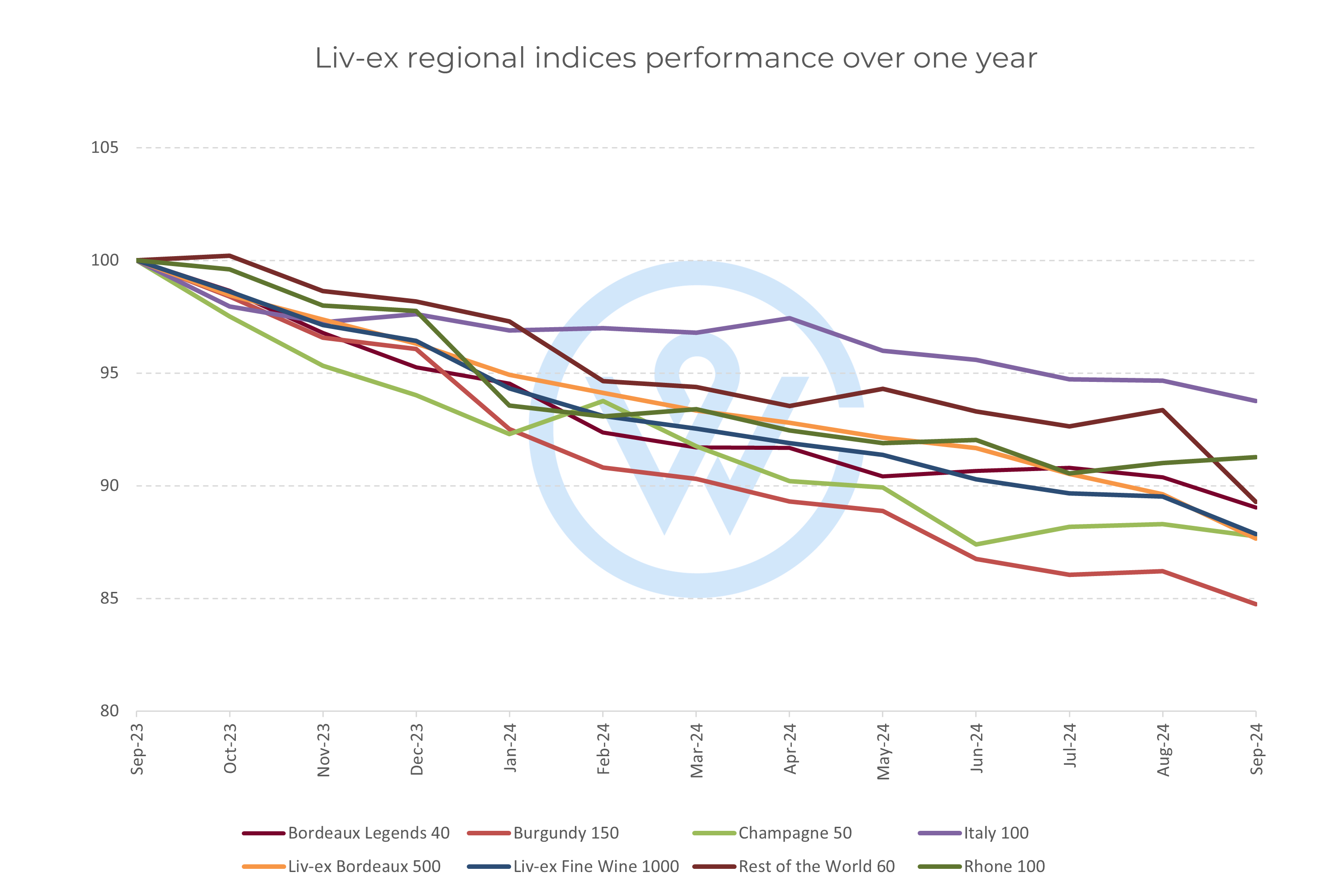
As we have previously explored, Italy has been the most resilient fine wine region, down 2.3% year-to-date. Its performance has been stabilised by brands from Piedmont, specifically Barolo and Barbaresco. 

The Rhône 100 index, which has been the perennial underperformer over the long term, has also experienced lesser declines this year, falling just 3.2%. Outside the Liv-ex 1000 index, the California 50 is down 3.8%. 

The biggest risers this year

Despite broader market uncertainties, some brands have risen by close to 30% in value since the beginning of the year (as of August 1st).

With an average case price of £720, Delas Hermitage Domaine des Tourettes Blanc is up 26% this year. It has been followed by a high-profile Burgundy – Henri Boillot Chevalier-Montrachet Grand Cru, which has risen 23%. 

The most expensive wine on the rankings, Domaine du Comte Liger-Belair La Romanée Grand Cru, has enjoyed an 11% rise. 
The best performing wines

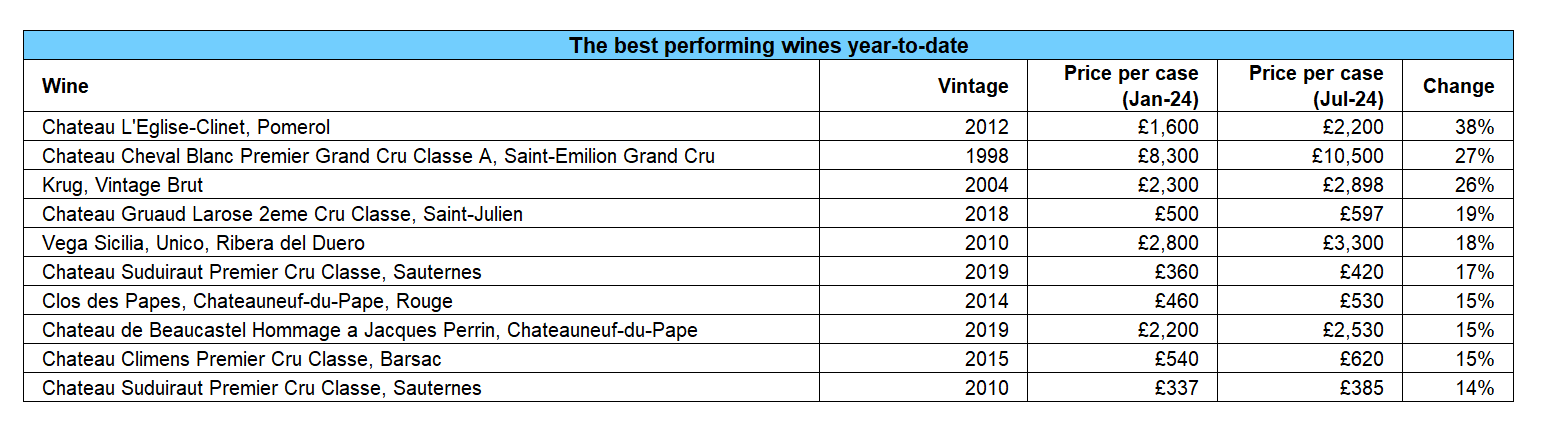
When it comes to the best performing individual wines, Bordeaux leads the way with L’Église-Clinet 2012, up an impressive 38%. It has been followed by Cheval Blanc 1998, up 27%. 

Another top Bordeaux comes fourth – Gruaud Larose 2018 (19%). Sweet Bordeaux also features in the table with two vintages from Suduiraut, 2019 and 2010, and Climens 2015.  

Meanwhile, Champagne’s best performer is the ‘gorgeous’ (AG 98 points) Krug 2004, up 26%. 
While the fine wine market has continued to face declines across most regions in 2024, presenting great opportunities for lower-than-average prices, some wines have shown remarkable resilience. Even in a buyer’s market, excellence prevails.   

For more on the state of the fine wine market, read our latest quarterly report

WineCap’s independent market analysis showcases the value of portfolio diversification and the stability offered by investing in wine. Speak to one of our wine investment experts and start building your portfolio. Schedule your free consultation today.

Categories
Learn

The rising demand for collectibles

  • The impending largest intergenerational wealth handover is driving the expansion of the collectibles market.
  • Demand is rising among younger investors looking to diversify their portfolios with assets that offer uncorrelated market returns. 
  • Fine wine is the most popular collectible among UK investors, followed by luxury handbags and jewellery. 

From luxury handbags to fine wine and whisky, the collectibles market is expanding and attracting rising demand from investors that is set to continue. 

This shift is driven by the onset of the largest intergenerational wealth handover in history and a growing appetite among younger investors to diversify their portfolios with assets that offer uncorrelated market returns. 

The evolution of the collectibles market

The allure of collectibles as investments is not a recent phenomenon. Historically, items like fine art, rare coins, and vintage wines have been appreciated for their aesthetic and cultural value. During periods of economic uncertainty, tangible assets like these often retained their value better than traditional financial instruments. For example, during the Great Depression, art and rare coins rose in price, providing a hedge against financial market volatility.

In the post-World War II era, the collectibles market began to gain more structure and legitimacy. Auction houses such as Sotheby’s and Christie’s played pivotal roles in establishing benchmarks for the value of fine art and antiques. The rise of specialised indices, such as the Mei Moses Art Index, helped quantify returns on art investments, further opening the market.

The collectibles market has further evolved in recent years with the help of technology. Technological advancements have democratised access to market information and trading platforms, making it easier for investors to track market trends and make informed decisions. Indices like Wine Track help prospective investors see the average price of a wine, critic scores and investment returns over different time periods for free and at a glance. 

A testament to the rising demand is the expansion of the market. According to investment bank Nomura, the art and collectibles category is now larger than private assets ($1.6 trillion) and more than twice the size of private debt markets ($0.8 trillion). 

The most wanted collectibles for portfolio diversification

Among collectibles, fine wine is king. 92% of UK wealth managers anticipate demand to increase in the next year. Compared to other luxury assets, the fine wine market is more established and less volatile, offering increased liquidity and price transparency.

The second most popular collectible in 2024 is luxury handbags, with 86% of wealth managers expecting demand to rise further. As recently explored, interest in handbags as an investment has grown in line with rising prices in the primary market. For instance, the price of the Chanel medium classic flap bag is up close to 553% since 2005, and 4,809% since 1955.

Jewellery is the third most popular collectible in 2024 for 84% of wealth managers, followed by coins (82%). The fifth spot is shared by watches and rare whisky at 78%.

When it comes to the latter, fine wine investment companies are already capitalising on this trend by branching out into spirits. While its secondary market is still in the early stages of its development, rare whisky has already set pricing records.

Earlier this year, a 30-year-old bottle of The Emerald Isle by The Craft Irish Whiskey Co. sold for a staggering $2.8 million, breaking the world record for the most expensive bottle ever sold. The previous record was held by a 1926 Macallan bottle priced at $2.7 million. These figures dwarf the record for the most expensive fine wine ever auctioned, the 1995 Domaine de la Romanée-Conti Grand Cru, which fetched $558,000. 

Collectibles vs mainstream investments

The rise in demand for collectibles comes at a time when traditional investments, like stocks and bonds, are facing heightened volatility and lower returns. Collectibles offer a unique proposition: they are not directly correlated with financial markets, providing a hedge against market downturns.

Moreover, collectibles have an intrinsic value tied to their rarity, cultural significance, and aesthetic appeal, which can appreciate over time independently of market conditions.

The stability and growth potential of these assets make them attractive alternatives to traditional investment avenues, and investors are increasingly perceptive of these benefits.

As the market for collectibles continues to evolve, clients are likely to find new and exciting opportunities in this dynamic sector.

WineCap’s independent market analysis showcases the value of portfolio diversification and the stability offered by investing in wine. Speak to one of our wine investment experts and start building your portfolio. Schedule your free consultation today.
Categories
News

‘Dragon’ wines for Chinese New Year

  • The Chinese zodiac has historically impacted fine wine demand in Asia.
  • 2024 is the year of the Wood Dragon, with previous vintages under the same sign being 2012, 2000, 1988 and 1976.
  • We examine the best wines from these ‘Dragon’ years and other associated labels.

As the Lunar New Year draws near, that of the Wood Dragon, the fine wine market is feeling the influence of the Chinese zodiac. Historically, the zodiac has had an impact on buying, particularly in Asia, with increased demand for wines from previous vintages carrying the same zodiac sign or those symbolically linked to it. Which will be the trending ‘Dragon’ wines this year?

Past ‘Dragon’ vintages

The last four ‘Dragon’ vintages were 2012, 2000, 1988 and 1976.

2012

In terms of growing season, the most recent 2012 ‘Dragon’ year was challenging in many fine wine producing regions, including Bordeaux and Burgundy, which led to mixed quality. However, it is widely considered as one of the greatest Champagne vintages this century, with Tuscany and the Rhône also excelling in some areas. Famous 100-point (Wine Advocate) wines include M. Chapoutier Ermitage l’Ermite from the Rhône (rated by Jeb Dunnuck), L’Eglise-Clinet from Bordeaux (William Kelley), Pingus (Luis Gutiérrez) from Spain and Screaming Eagle (Robert Parker) from California.

2000

The 2000 vintage was brilliant in Bordeaux with many of the wines now reaching maturity. This classic vintage saw Parker award Pavie, La Mission Haut-Brion and Pétrus 100-point scores, with Lafleur receiving the same perfect score from Neal Martin, and Cheval Blanc from Antonio Galloni. The 2000 was also another legendary year for Champagne, with highly rated wines including Krug Clos du Mesnil, Louis Roederer Cristal and Dom Pérignon P2. In Burgundy, the vintage was largely seen as one for early consumption due to low acidity, but many of the wines are now drinking perfectly. The appellations that shone were Nuits-Saint-Georges, Chambolle-Musigny and Morey-Saint-Denis.

1988

A great year for the sweet wines of Bordeaux, 1988 Sauternes and Barsac have stood the test of time. Initially considered a Right Bank vintage, Lisa Perrotti-Brown MW (The Wine Independent) recently wrote that wines ‘from Saint-Émilion, Pomerol, and Pessac-Léognan […] should be drunk soon’. 1988 is another vintage to drink soon in Burgundy that produced classic, long-lived wines with good depth of fruit. The year was much more abundant in Chardonnay than in Pinot Noir, and hence better for reds than for whites.

1976

Going back close to 50 years, the 1976 vintage was a mixed bag for much of the wine world. In France, Champagne and Alsace fared better than Bordeaux and Burgundy, and Germany enjoyed a fantastic year. The most significant event was the Judgement of Paris tasting, which put California on the fine wine map. In terms of 100-point wines, Robert Parker’s 1976 favourites were Penfolds Grange and Guigal Côte-Rôtie La Mouline.

Beychevelle – the most famous ‘Dragon’ wine

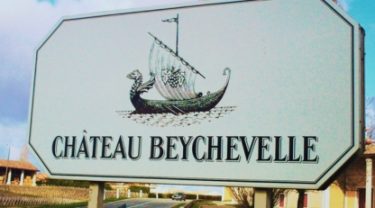
When it comes to associations, Château Beychevelle is an apt choice for the ‘Dragon’ year as its Chinese name means ‘dragon boat’. The wine’s label also depicts a ship with the head of a griffin. Its 2012 vintage is ‘one of the stars of St. Julien’, according to Parker, who described it as ‘elegant and powerful, rich and intense, but light on its feet’. He recommended drinking it between 2019 and 2051.

WineCap’s independent market analysis showcases the value of portfolio diversification and the stability offered by investing in wine. Speak to one of our wine investment experts and start building your portfolio. Schedule your free consultation today.

Categories
News

New World releases from the autumn La Place de Bordeaux campaign

  • The La Place de Bordeaux campaign is in full swing, with releases from Chile, Italy, USA, France and more.
  • A recurring theme in the campaign has been the price increases for the new releases, compared to their previous vintages.
  • While La Place remains an exciting global marketplace for New and Old World wines, the ultimate value of the releases should be judged in a broader context.

The La Place de Bordeaux autumn campaign has gathered momentum over the past two weeks, with releases from Chile, Italy, USA, France and more.

The campaign kicked off with Paul Jaboulet Aîné’s Hermitage La Chapelle 2021, along with the re-release of some of its library vintages, namely 2013, 2011 and 2006. Napa Valley’s Opus One also re-released its 2018 and 2019 vintages, which led to heightened demand for the brand. Below we take a look at some of the recent New World releases from the campaign so far, examining their pricing and investment potential.

Seña 2021

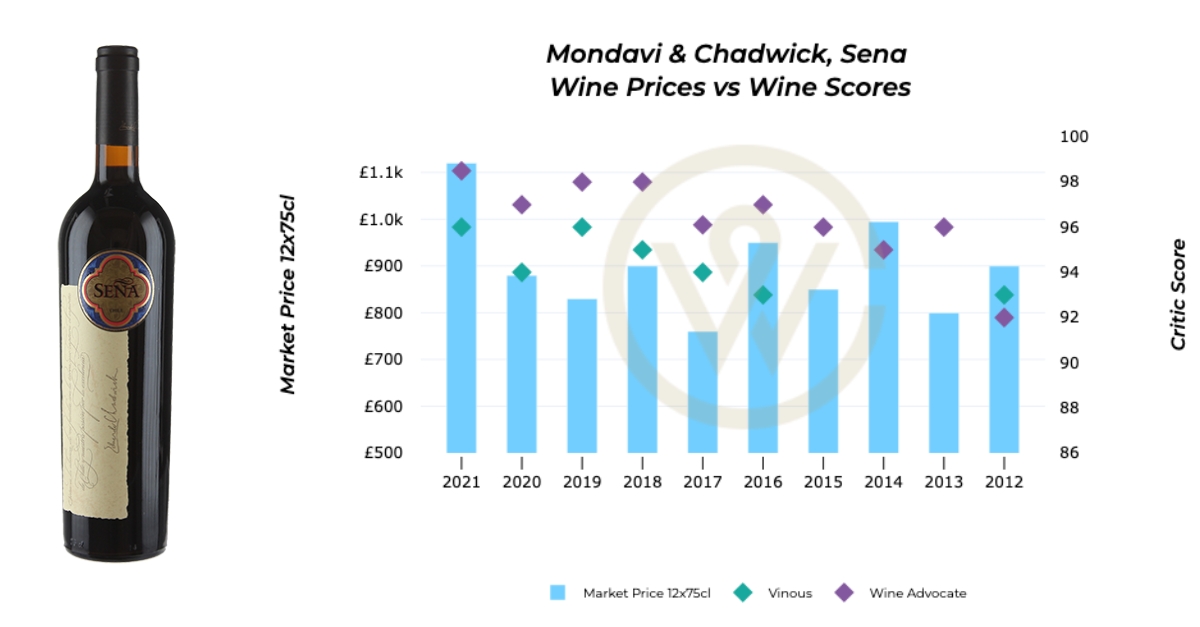
The newly released 2021 vintage of Mondavi & Chadwick’s Seña is the highest priced wine across recent vintages from the brand.

Seña 2021 was released at €90 per bottle ex-négociant, up 5.9% on the 2020. The wine came with a recommended retail price of £1,344 per 12×75, representing a 30.6% increase on last year.

The 2021 Seña received 98+ points from The Wine Advocate’s Luis Gutiérrez, who described it as ‘one of the finest vintages’. Meanwhile, Joaquín Hidalgo (Vinous) gave it 96-points and said that ‘it will grow in the bottle’.

Other more attractively priced but similarly scored vintages include 2019 and 2018. Over the last ten years, Seña prices have increased 90% on average.

Almaviva 2021

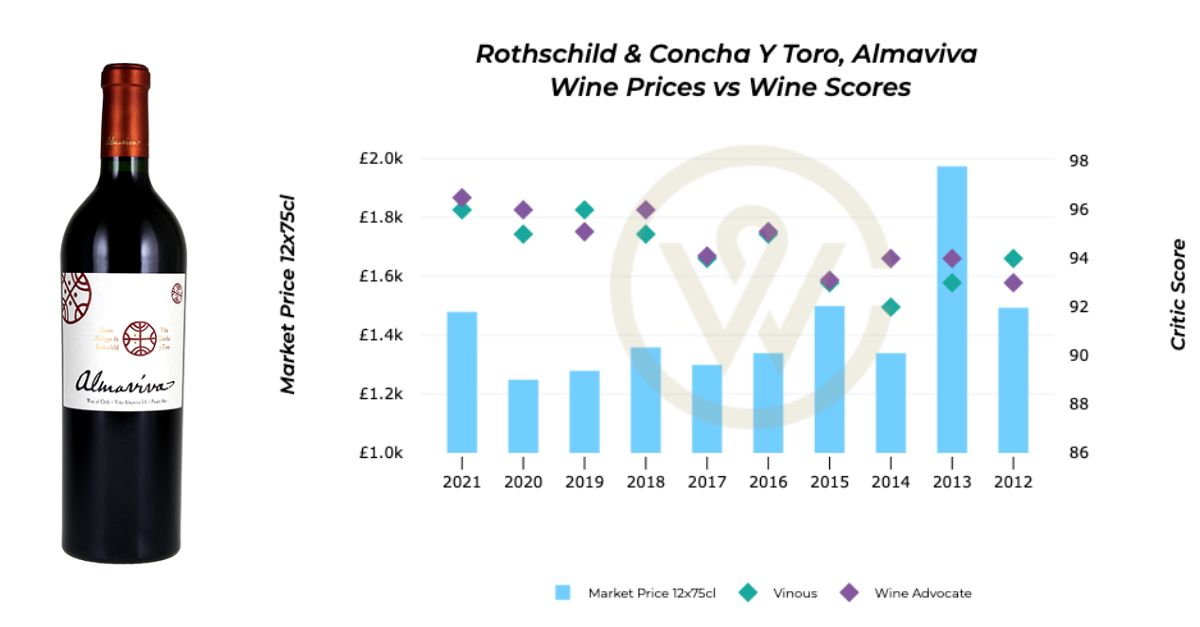
Another release from Chile, Almaviva 2021, was offered via La Place at €122 per bottle ex-négociant, up 5.2% on the 2020. The wine was released internationally for £1,448 per 12×75. It received 96+ points from Luis Gutiérrez, and another 96-points from Joaquín Hidalgo, who praised its ‘enticing nose’ and ‘velvet texture’.

However, some back vintages such as the 2020, 2019 and 2018 offer better value. Our Almaviva index has recorded positive performance both in the short and the long term. Over five years, prices have risen 41%, and over ten – 147%.

Nicolás Catena Zapata 2020

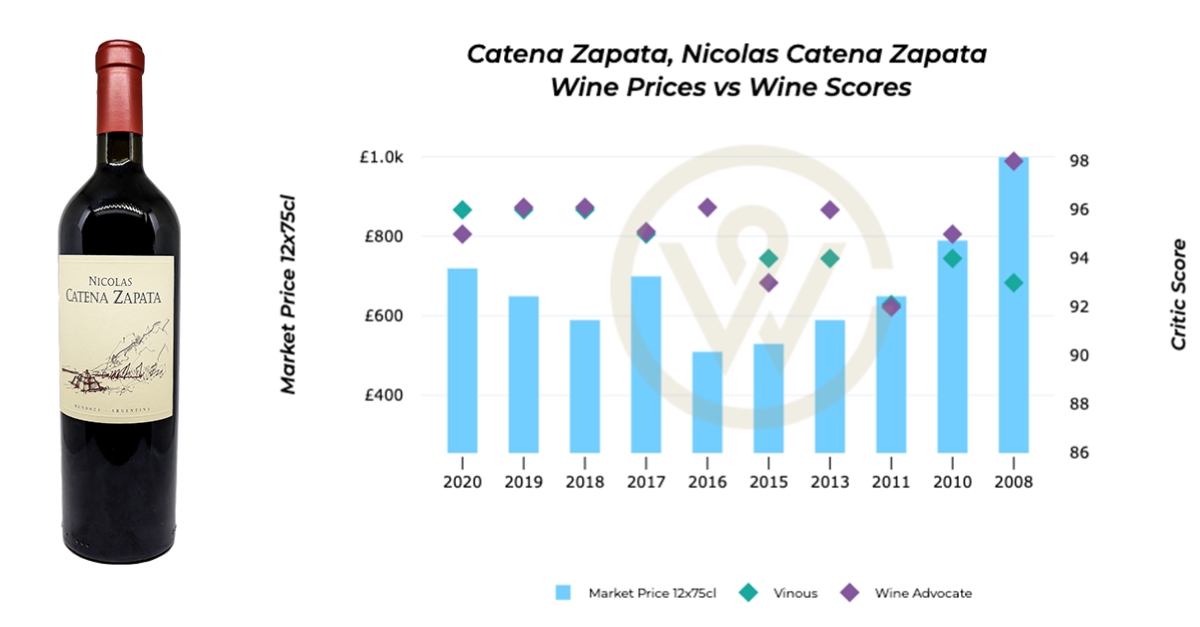
The Argentinian wine Nicolás Catena Zapata 2020 was released at €53.30 per bottle ex-négociant, up 1.5% on the 2019. It has been offered internationally at £720 per 12×75, down 1.6% on the 2019’s opening price.

It received 95-points from Gutiérrez and 96-points from Hidalgo, who observed that this ‘meticulously crafted red achieves perfect balance in a warm vintage’. However, there are plenty of good value buying opportunities in back vintages, notably 2019, 2018 and 2016.

Nicolás Catena Zapata has enjoyed a positive performance over the last five (33%) and ten years (104%).

A recurring theme in the campaign has been the price increases for the new releases, compared to their previous vintages. Similar to the spring Bordeaux 2022 campaign, often back vintages available at a discount hold better investment potential. While La Place continues to showcase the diversity of fine wine, and remains an exciting global marketplace for New and Old World wines, the ultimate value of the releases should be judged in a broader context.

WineCap’s independent market analysis showcases the value of portfolio diversification and the stability offered by investing in wine. Speak to one of our wine investment experts and start building your portfolio. Schedule your free consultation today.
 

Categories
Learn

The role of wine ratings in fine wine investment

  • Wine ratings play a crucial role in wine investment, with high scores from influential critics impacting demand and market value.
  • To use ratings effectively, investors should consider both the initial score and potential for growth.
  • The Wine Track score provides a broader view of a wine’s quality across multiple vintages and publications, helping investors assess wines at a glance.

For many investors, fine wine offers a fascinating, enjoyable, and potentially profitable venture. However, the wine market is highly nuanced, requiring a keen understanding of various factors influencing wine values. One such factor, critical to successful wine investment, is the wine rating system. This score, given by wine critics to a particular bottle or vintage, can dramatically impact its market value and demand.

Wine ratings, typically on a 100-point scale, offer a quantitative measure of the wine’s quality. The ratings of influential critics such as Robert Parker, Neal Martin and Wine Spectator can have a significant impact on the market value of a wine. This is why savvy investors pay close attention to these scores, as they can quickly identify high potential investments.

The power and influence of ratings

However, it’s not enough to simply buy wines with high ratings. The rating system is far more nuanced, with the potential for dramatic shifts in a wine’s rating over time. A wine may be rated in its youth, then again as it matures. In some cases, a wine’s rating may increase as it develops, making it an excellent investment if purchased early. Conversely, a wine that doesn’t mature as expected can see its rating (and value) drop.

How critics have moved the wine market

Some historical examples illustrate the power that critics wield in the wine investment market:

  • Robert Parker and the 1982 Bordeaux vintage: Parker’s high scores for the 1982 Bordeaux wines went against the grain of other critics, and as the wines matured and proved him right, their market values soared.
  • James Suckling and Super Tuscan wines: Suckling’s high scores and positive reviews in the 1980s and 90s for these non-traditional Italian wines helped elevate their status and market prices.
  • Jancis Robinson and Austrian wines: Robinson’s praise for the quality and complexity of wines from Austria increased their international profile and market value.
  • Robert Parker and Napa Valley: Parker’s positive reviews of Napa Valley Cabernet Sauvignon and Bordeaux blends in the 1990s contributed to increased demand and higher prices for these wines.
  • Wines Spectator’s Wine of the Year: Wine Spectator, one of the most influential wine publications globally, selects its “Wine of the Year” based on quality, value, availability, and an X-factor they call “excitement.” The wine usually becomes a hot commodity in the secondary market, breaking all-time trading record within the day of the announcement, like Marques Murrieta Castillo Ygay Gran Reserva Especial 2010 in 2020.

Knowing the critics and selling wine

To use ratings effectively, investors should consider both the initial score and potential for growth. Some wines, especially those from renowned producers in prestigious regions like Bordeaux or Burgundy, are consistently well-rated and have a history of aging well. However, there are also opportunities to find “sleeper” wines – those with moderate initial ratings that improve significantly over time.

A key part of understanding and using wine ratings is understanding the critics. Each has a different palate and preference, and their ratings reflect these tastes. Robert Parker, for instance, was known for favouring bold, robust wines from Bordeaux, California, and the Rhône. However, since Parker’s retirement, the wine criticism landscape has been undergoing a gradual shift, reflecting changing consumer preferences and a growing appreciation for diversity in wine styles, such as lighter and lower-alcohol wines.

The Wine Track score – ratings at a glance

Now it is also possible to access a brand’s average score thanks to the Wine Track score. The Wine Track score provides a broader view of a wine’s quality across multiple vintages, which can be particularly useful for potential investors seeking a more comprehensive evaluation of a wine’s investment potential.

It aggregates multiple wine vintages of a wine to create a score out of 100. It unifies more than 100 wine critics’ scores from 12 global publications that use different methodologies. By providing a combined score, it helps investors assess wines on the fine wine market at a glance.

In conclusion, while wine ratings are not the sole determinant of a wine’s investment potential, they play an integral part in the wine investment strategy. With careful consideration and a well-rounded understanding of the wine market, investors can utilise these ratings to guide their purchases and optimise their portfolios.

WineCap’s independent market analysis showcases the value of portfolio diversification and the stability offered by investing in wine. Speak to one of our wine investment experts and start building your portfolio. Schedule your free consultation today.


Categories
News

Champagne’s financial bubbles: rising costs spark concerns over affordability

  • Rising production costs and inflationary pressures in Champagne have raised concerns around its accessibility and its appeal to consumers.
  • Higher interest rates pose challenges for financing grape supplies, potentially eroding profit margins for smaller Champagne producers.
  • Champagne’s investment market has also been undergoing a similar shift, which has diminished its relative affordability compared to other fine wine regions.

Champagne has experienced a period of remarkable success, with a new record turnover set for the region in 2022, The Drinks Business highlighted in an article this week. However, leading figures in the region have noted that inflationary pressures and rising production costs could potentially make Champagne too expensive. This is a particular concern at the lower end of the market where fixed costs make up a larger proportion of the value of the wine and the need to keep prices affordable is more pronounced. But prices have come under pressure in the secondary market too, which has shifted its dynamics.

Champagne’s rising costs spark concerns among smaller producers

The escalating prices of grapes, along with increasing costs of labour, energy, packaging materials, and glass, have placed significant financial pressures on some Champagne houses. According to the article, the price of grapes from the 2022 harvest rose by as much as 10% compared to the much smaller 2021 vintage.

Rising interest rates, which were sitting below 1% two years ago and have now reached 3% and higher, have added extra pressure on financing grape supplies, potentially eroding profit margins of smaller producers. Meanwhile, various packaging materials, including paper, foils, cases, and glass, are up by around 40%.

The rising production costs may lead to further price increases for Champagne. This situation raises concerns around Champagne’s accessibility and its appeal to consumers. Some producers fear that higher prices could deter customers and potentially drive them towards alternative sparkling wines.

The shifting dynamics of Champagne’s investment market

The dynamics of Champagne’s secondary market have also been undergoing a clear shift. Previously, everything seemed to work in Champagne’s favour: abundant stock, strong distribution, consistent demand, and relative value compared to other fine wines.

Speculators have taken advantage of Champagne’s strengths, fuelled by a string of excellent vintages that increased demand. This has altered the traditional rules of the Champagne market, as speculators often hold onto their stock without consuming it, resulting in potential oversupply. The sustainability of rising prices in the face of a potential stock overhang can present a challenge.

Meanwhile, the rising price of Champagne has diminished its relative price advantage compared to other fine wine regions. Previously considered an affordable entry point into the world of fine wine, Champagne’s average prices now rival those of Bordeaux. For instance, the average case price of Krug Vintage Brut (£5,001) is higher than that of the First Growth Château Haut-Brion (£4,802).

Champagne vs Bordeaux

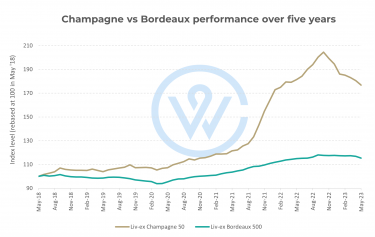
*Over the last five years, Champagne prices are up 76.8%, compared to 15.3% for Bordeaux. Champagne experienced stellar price performance between mid-2021 and the end of last year. Year-to-date, its index is down 9.1%.

Some producers have also displayed an ambition to raise prices. Notable brands, such as Philipponnat’s Clos des Goisses and Lanson’s Le Clos Lanson, have joined La Place de Bordeaux, signaling their intent to push their brands. Last year, François Pinault’s Artemis Group acquired a majority stake in Champagne Jacquesson. While this highlighted Champagne’s investment potential, it also indicated a departure from offering wines at entry-level prices.

All of this presents a complex landscape for Champagne’s future pricing and market positioning; particularly, for smaller more affordable producers, less able to spreads costs over multiple products and absorb the rising costs. Is the era of affordable Champagne over?

WineCap’s independent market analysis showcases the value of portfolio diversification and the stability offered by investing in wine. Speak to one of our wine investment experts and start building your portfolio. Schedule your free consultation today.
Categories
Learn

Investing in fine wine or in stocks – which is safer?

If you’re looking for viable investment opportunities then you’ve likely considered a range of potential investments, including stocks and wine. But of these two drastically different investment arenas, which is the safer option during the current economic climate?

In this article, discover the pros and cons of investing in wine and investing in stocks to help you make a more informed decision about which investment direction is best suited to you.

The pros of investing in wine


A lower-risk tangible investment

Fine wine is a physical product with intrinsic value. Unlike stocks – which are intangible and can theoretically fall to zero – fine wine always holds some market value because it is consumable.

Key reasons wine is considered lower-risk:

  • It is insured and professionally stored

  • It cannot suddenly become worthless

  • Supply is finite: once opened and consumed, bottles disappear

  • Historically lower volatility than equities

Fine wine is a physical asset, so it represents a very low-risk investment. When you invest in the market, your wines are stored in optimal conditions within a secure bonded warehouse.

Enjoyable, and globally recognised

Investment wine is both a luxury asset and a globally traded commodity. Its value is supported by long-term demand from:

  • Collectors

  • Restaurants and hospitality buyers

  • Private clients

  • Global auction houses

This creates a large, stable market for well-selected wines.

Strong historical performance

Fine wine has shown remarkably consistent returns over the past two decades. According to S&P Global, wine is one of the few luxury assets to have withstood the harsh impact on assets triggered by the coronavirus pandemic, proving the market relatively resilient. Indeed, wine is widely considered to be a ‘safe haven asset’. Moreover:

  • Fine wine delivered 13.6% annualised returns over 15 years

  • Many top regions have outperformed major stock market indices over the same period

This steady upward trend appeals to investors seeking long-term resilience rather than rapid, high-risk gains.

Attractive tax treatment (UK/Some markets)

In many cases, fine wine is exempt from Capital Gains Tax because it is often classified as a “wasting asset.” This makes returns more efficient compared to traditional taxable assets.

The cons of investing in wine


Portfolio valuation can be tricky

Unlike publicly traded equities:

  • Wine doesn’t have real-time pricing

  • Market activity is slower

  • Valuations depend on recent trades, availability, and provenance

Specialist platforms greatly improve transparency – but it’s still less instant than stock market data.

Choosing the right wines requires expertise

Not every bottle appreciates. Risks include:

  • Overpaying for highly popular but widely available labels

  • Selecting wines with limited long-term demand

  • Buying wines from weaker vintages

This is why many investors rely on professional advisory services.

Selling wine can take a while

Wine is a slower, more deliberate market. Selling may take:

  • Several days, for liquid, in-demand wines

  • Several weeks or months for niche or rare bottles

Investors should treat fine wine as a medium- to long-term asset, not a short-term liquidity tool.

The pros of investing in stocks


The potential for large cash gains

Stocks can appreciate rapidly due to:

  • Strong earnings

  • New product launches

  • Market expansion

  • Industry disruption

This makes equities well-suited for long-term wealth building.

Quick purchases and sales

Stocks can be:

  • Bought instantly

  • Sold instantly

  • Traded globally

  • Accessed 24/7 via digital platforms

This liquidity makes equities ideal for short-term or flexible investing.

Easy diversification

With thousands of companies across dozens of industries, investors can spread risk across:

  • Regions

  • Sectors

  • Growth styles

  • Market caps

They can also spread risk by investing in alternative assets like fine wine.

The cons of investing in stocks


An erratic, volatile marketplace

Stock prices are sensitive to:

  • Inflation and interest rates

  • Political events

  • Global crises

  • Corporate earnings

  • Market sentiment

Sharp daily swings make equities riskier than wine, especially for conservative investors.

Limited transparency

Public companies release information – but not everything is disclosed. Investors may lack visibility into:

  • Internal management issues

  • Supply-chain risks

  • True financial health

This information gap introduces uncertainty when selecting stocks.

Capital Gains Tax

Profits made on equities are typically taxable. Depending on your tax jurisdiction, this can significantly reduce real returns.

Fine wine often avoids this (again, depending on jurisdiction), which is a major reason many high-net-worth investors diversify into alternative assets.

Wine or stocks – which is the safer investment?

While stocks offer higher potential gains, they also carry higher volatility and can suffer significant short-term losses.

Fine wine, on the other hand:

  • Is less volatile

  • Has a strong track record of steady returns

  • Holds intrinsic value

  • Benefits from global luxury demand

  • Offers potential tax advantages

If stability is your priority – or if you are building a long-term, diversified portfolio – fine wine is generally considered the safer investment.

Talk to our wine investment experts

If you’d like personalised guidance or want to explore building a fine wine portfolio, schedule a free 30-minute consultation with one of our experts.

Schedule your free consultation

FAQs About Wine vs. Stock Investing

1. Is wine really a safer investment than stocks?

Wine is typically less volatile and has historically shown steadier growth. Stocks offer higher potential returns but also higher risk.

2. How long should I hold investment wine?

Most investors hold wine for 5–10+ years, allowing rarity, bottle consumption, and collector demand to increase value.

3. Can wine lose value?

Yes. Poor vintage reputation, market oversupply, or weak critic scores can influence prices. Expert guidance reduces this risk.

4. Do I need special storage for investment wine?

Yes – professional bonded storage ensures optimal temperature, humidity, provenance, and insurance.

5. Can wine outperform the stock market?

Historically, fine wine has outperformed several major stock indices over long periods due to steady compounding and low volatility.

6. Is wine a good hedge during recessions?

Often, yes. Fine wine has shown strong resilience during economic downturns and is widely seen as a safe-haven asset.