Categories
Learn

How to invest £50,000 in wine

  • More regions and more wines have become investable in recent years due to increasing liquidity
  • Core French regions make up the largest part of our model portfolio: Bordeaux anchors liquidity, Burgundy adds scarcity, Champagne adds brand recognition 
  • Prices fell from early 2023 to late 2025 and have since stabilised, with early gains in older Bordeaux and Champagne

Yes, £50,000 is enough to build a wine portfolio, and it’s enough to build a diversified wine portfolio. This guide sets out a model split with the largest holding of 40% in Bordeaux, 25% in Burgundy, 15% in Champagne, and 10% each in Italy and other regions. It explains the role each region plays, from liquidity (how quickly a wine sells at a fair price) to scarcity, and covers the costs, risks and exit routes that decide what an investor keeps.

Is £50,000 enough to build a diversified wine portfolio?

£50,000 buys exposure to every major region with enough money in each to hold several of the market’s key brands. 

Scale inherently changes what a portfolio can hold. Domaine de la Romanee-Conti, the Burgundy estate whose wines sit at the very top of the market, is unlikely to appear in a £25,000 portfolio when prices start at £6,000+ for a case of three bottles of their most affordable wines. At £50,000, an investor can start to include wines with that kind of profile, and can spread the money across regions, vintages and price points instead of concentrating it in a few cases.

Diversification is the practical benefit. A single case of a famous wine concentrates risk in one producer, one vintage and one group of buyers. Spreading £50,000 across regions and roles means a weak spell in any one of them has less impact on a portfolio’s overall value.

What are the major sectors for wine investors?

Wine already diversifies a wider portfolio, but there is a strong case for diversifying within wine as well. Regions and styles take turns leading the market, so an investor who holds several reduces dependence on any single cycle. 

  • Bordeaux provides liquidity. Its high production volumes and global recognition make it the cornerstone of the secondary market (buying and selling between collectors and investors after a wine’s first release).
  • Burgundy provides scarcity. Small vineyard parcels and limited production keep supply tight, which makes its best wines the market’s most prized collectables.
  • Champagne provides accessibility. High trading volumes and strong brand recognition give it a wide buyer pool, at a lower price per bottle than Burgundy. For most people, fine wine means a bottle of Champagne.
  • Italy shares a number of characteristics with Champagne, in particular high trading volumes and strong brand recognition. Its presence in the market has expanded over the past decade, and a concentrated group of wines, led by the Super Tuscans (Tuscan reds made outside the region’s traditional appellation rules), is genuinely investable.

Other regions provide variety, although they have few investable wines and lower liquidity. They should form a smaller part of a portfolio and might include:

  • California, led by Napa Valley
  • The Rhone Valley in France
  • Spain, including Rioja and Ribera del Duero
  • Australia
  • Alsace in France

These roles complement each other. Bordeaux and Champagne supply the wines most likely to sell quickly, Champagne and Italy supply wines where depletion through drinking has a larger and more immediate impact on values. Burgundy supplies scarcity, and other regions add variety. A portfolio built only on scarcity can struggle to sell in a quiet market, while one built only on liquidity gives up the pricing power and appreciation that rarity can bring.

How should I split £50,000 across wine regions?

The precise distribution of value in a portfolio will vary depending on prevailing market conditions, an individual investor’s personal preferences, and where good prices are available at any given time. This model should be taken as a guide only and not as a fixed proportion. 

Individual investors may prefer to focus on the accessibility of Champagne or the rarity in a more costly region like Burgundy.

WineCap’s model portfolio puts about 40% of a £50,000 budget in Bordeaux, 25% in Burgundy, 15% in Champagne, 10% in Italy and 10% in other regions. 
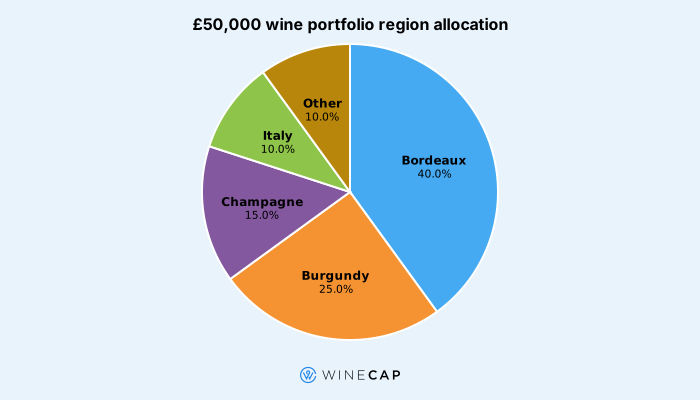
Pie chart of a £50,000 wine portfolio

This structure has changed over time. In the early 2000s, only Bordeaux had meaningful liquidity, and that was concentrated in First Growth Bordeaux, (the five top-ranked Bordeaux chateaux in the 1855 Bordeaux classification), so those wines would have dominated any well-constructed portfolio. Liquidity has since grown sharply in other regions, alongside stronger performance that has driven greater investor interest. 

Any portfolio model will vary with budget. At £25,000, five regional slices leave little room to buy meaningful volume, so fewer regions make sense. At £100,000, an investor can add more wines, higher-priced bottles and possibly a larger allocation outside the core regions. 

Why put 40% of a wine portfolio in Bordeaux?

Bordeaux anchors a wine portfolio because it is the deepest and most liquid market. A deep market has many buyers and sellers, so an investor can usually sell without cutting the price sharply.

Search and trade data show how far ahead Bordeaux sits. Wine-Searcher (a price comparison site whose rankings measure search interest, not completed trades) puts Bordeaux in seven of its ten most searched-for wines, with the First Growths accounting for five of those ten.

Completed trades tell the same story. On the largest b2b exchange where merchants trade wine with each other, Bordeaux makes up five of the ten most traded wines by value.

On most technical measures of liquidity, or their proxies, Bordeaux comes out on top. The five First Growths (Lafite Rothschild, Latour, Margaux, Haut-Brion and Mouton Rothschild) are its best-known names, which is why the Bordeaux allocation builds its core around them.

A handful of individual wines may trade more often than the most traded Bordeaux. Nothing else matches the region for depth. That depth is why Bordeaux takes 40% of the model portfolio: it is the part most likely to sell quickly if an investor needs cash.

How much should I invest in Burgundy?

Burgundy offers scarcity and high prices per bottle, and it takes 25% of the model portfolio. If Bordeaux is about depth and liquidity, Burgundy is the clearest expression of collectability, where perceived quality and exclusivity make their home.

At the very top of the classic car market, buyers and sellers repeat a phrase: “try and find another one.” Burgundy is the closest thing to that for wine. Restricted supply means even small changes in demand can have an outsized effect on prices.

Scarcity also changes how Burgundian wines behave in a downturn. Thinner trading meant that price falls from 2023 to 2025 were less visible than in Bordeaux and Champagne.  Price falls in less liquid wine may only show up now that trading volumes have begun to grow again. For a seller, thin trading means fewer buyers at any one time and a quoted price may not be what a seller achieves in a thin market.

High prices mean a Burgundy allocation of £10,000 to £12,500 buys fewer bottles than the same sum would in Champagne. Investors in this region therefore choose carefully, often favouring established domaines whose wines have a record of strong demand.

How much should I invest in Champagne?

Champagne costs less per bottle than Burgundy, which is why it often takes 15% to 20% of the model portfolio. Even the most expensive wines such as Krug, Clos du Mesnil (Wine Track, WineCap’s data product, shows an average case price of £16,505 across vintages) or Bollinger Vieilles Vignes Francaises (£13,775 average case price), compare favourably with the most costly Burgundy that can easily be more than £100,000 a case. A smaller allocation in Champagne can still buy meaningful volumes of the highest profile and most liquid wines.

Champagne has the broadest brand recognition in fine wine. For most people who are not wine enthusiasts, “fine wine” means a bottle of Champagne, likely from Moet & Chandon, Dom Perignon, Cristal or Veuve Clicquot. These are among the few wine brands that reach beyond wine lovers, and that recognition widens the pool of potential buyers. Trading data backs this up. On the major trading platform, Dom Perignon was the single most traded wine by volume in two of the last three years.

Consumption patterns and production levels are also different: In comparison to top wines from other regions, Champagne tends to get drunk more quickly after its release. Although this balances against larger production volumes, it does mean that depletion becomes a factor in pricing more quickly.

Those same high volumes make Champagne easier to sell, and they make price moves show up quickly. Champagne’s price falls from 2023 to 2025 were visible for that reason, and its most liquid names have led the recovery so far.

Where does Italian wine fit in a portfolio?

Italian wine earns 10% of the portfolio because its liquidity has grown strongly over the past decade, even though it lacks Bordeaux’s depth. Sassicaia (the original Super Tuscan, made by Tenuta San Guido) is heavily traded and frequently ranks among the five most traded wines on the largest exchange.

Italy’s share of the market has grown in the same way as Burgundy’s and Champagne’s, rising from 5% in 2014 to more than 16% in 2026. Italy’s recent growth has been more attractive than Bordeaux, Champagne or Burgundy, partly because of affordability and partly because of more moderate growth from 2020 to 2023. While prices did correct, falls since 2023 have been dramatically smaller than in other sectors.

Fewer Italian wines are investable, and the focus belongs on Tuscany and particularly the Super Tuscans, which WineCap’s guide covers in detail. In a £50,000 portfolio, an investor might begin to look beyond Tuscany at Piedmont wines such as Barolo and Barbaresco, and a handful of wines in Abruzzo on the Adriatic or Valpolicella in Veneto

What goes in the other 10% of a wine portfolio?

The other 10% is the flexible part of the portfolio. Pockets of liquidity exist outside the four core regions, although these wines are inherently less liquid. These regions have fewer investable wines; Investors should treat this allocation as a small supporting holding, not a core one.

At £50,000, portfolios will not be able to hold wines from every one of these additional sectors.
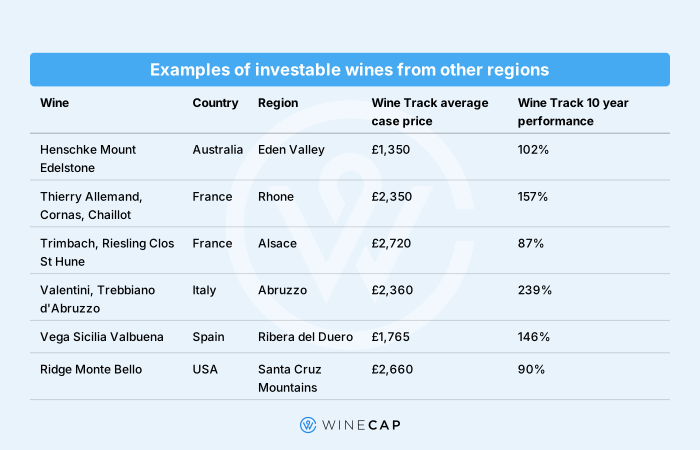
£50k others excerpts

Which wines could a £50,000 portfolio hold?

A model portfolio gives each region three types of holdings: core wines that anchor the allocation, supporting wines that add range at a lower price, and left-field wines with smaller markets. The wines below are illustrative, not a recommendation, and the mix shifts as prices and availability change.

At these budgets, core Burgundy and Champagne mean established producers at accessible price points, not the market’s rarest bottles.
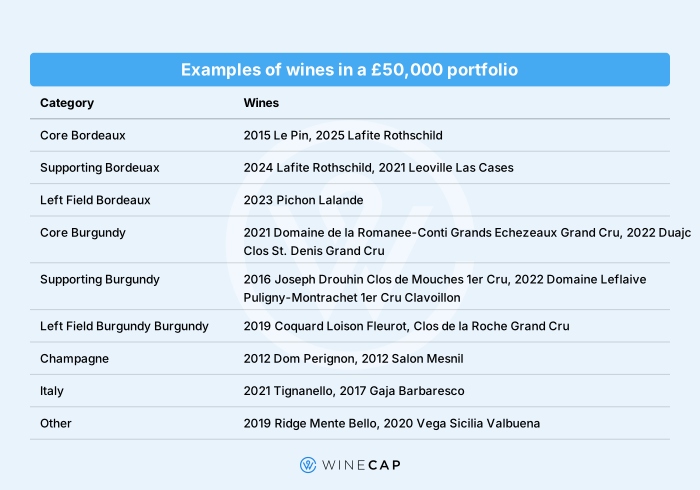
Example of wines that could a £50,000 portfolio hold

What returns can I expect from wine, and what can go wrong?

Historical returns show how wide the range of outcomes can be. Some Burgundies have risen 20x over the last decade (Wine Track shows Domaine Bizot Echezeaux Grand Cru up 1960% in 10 years), but that is not the norm.  Many mainstream accessible wines have seen growth of over 100% in the last decade (e.g. Dom Perignon 2005 up 130% in the last decade). 

However, prices can also fall. From early 2023 to the end of 2025, prices dropped across much of the market, especially in Bordeaux En Primeur releases (the newest vintages of wine sold the year after harvest before bottling).  Those released at the top of the market in 2021-2023 were particularly impacted, for example, Lafite Rothschild 2020 was at one point down 40% from its release price. Values have since stabilised and have begun to rise, led by older Bordeaux and high-liquidity wines such as Dom Perignon.  In recent months those gains have begun to spread to other regions and vintages. 

Averages also hide wide differences. A region’s headline index can rise while individual wines fall, and the best performers of one cycle are often not the leaders of the next. That is why spreading across regions, producers and vintages matters more than picking a single winner.

How do I sell wine when I want to exit?

The exit route depends largely on the provider. With a managed provider, the provider handles the sale. With a merchant or marketplace, the investor does more of the work.

WineCap manages the entire sale of wine stored with it for a flat 3% fee, working across different platforms to sell the wine in a timely manner. Auction platforms can sometimes achieve the best return, but costs can be high. For self-directed investors, platforms like Squelch and BidforWine charge from 5%-10%, but the seller arranges listing, photography and delivery, so the headline fee understates the effort.

Liquidity in wine differs from equities or bonds. It sits closer to property but has good substitutability, supported by in-bond storage (an HMRC-regulated facility that allows long-term storage with duty and VAT unpaid), which can make it easier to find buyers than other treasure assets such as whisky, art or antiques.

Price drives speed. An investor with a specific price target may wait until the market reaches it, while one in a hurry may price below the market. Higher-priced wines tend to be less liquid, at the very top end of the market, a wine like Domaine Leroy, Musigny at £30,000 or more per bottle simply does not have that many buyers. 

WineCap’s broad guidance is to expect a full portfolio sale to take at least three months. Some wines will find new homes much faster, particularly if the seller prices aggressively.

Exit costs belong in the plan from the start, and investors should understand that wine is not suited to be a good source of short-term liquidity.

A £50,000 wine portfolio works best as a long-term allocation

A £50,000 portfolio gives an investor the scale to hold wine as an allocation and not as a bet on a single case. The harder decisions come after the purchase: how to rebalance as vintages mature and liquidity moves between regions, and when to sell. Regional leadership has changed before, from near-total Bordeaux dominance in the early 2000s to today’s broader mix, and it may change again.

Investors who build for that change, with costs understood and an exit route planned from the start, own something more durable than any single wine. The next step is to test the model split against a personal budget, risk appetite and time horizon, ideally with an adviser who sees the whole market.

FAQ: investing £50,000 in wine

How many wines should a £50,000 portfolio hold?

Our sample £50,000 portfolio holds 26 different wines, so no single bottle dominates the result, however, there may be reasons for an investor to look for greater concentration or more diversification.  It would be unusual for a portfolio of this size to hold fewer than 10 different wines or more than 40.

Can I invest less than £50,000 in wine?

Yes, although smaller budgets work best with fewer regions. At £25,000, more costly wines and more niche regions may best be avoided. 

How long should I hold a £50,000 wine portfolio?

Holding periods depend on the wine, and best returns can take years to arrive. WineCap generally advises a hold period of at least 5-10 years.

How is wine investment taxed in the UK?

UK tax treatment depends on individual circumstances and HMRC rules. Fine wine is generally treated as a wasting asset (an item with a predictable life of 50 years or less), which usually means gains on sale are exempt from capital gains tax. This is general information, not tax advice, so investors should seek professional advice.

Does storage matter for a wine portfolio?

Yes, very much. Buyers discount heavily when a wine lacks a documented storage record, and wine kept in bond is much easier to sell than VAT and duty-paid wine. Selling a case of Chateau Lafite Rothschild stored in bond since release is a very different proposition to one stored at home in unverifiable conditions.

WineCap’s independent market analysis helps investors build diversified fine wine portfolios with full ownership and transparent pricing. Speak to one of our wine investment experts and start building your portfolio. Schedule your free consultation today.
Categories
Learn

An Investor’s Guide to Super Tuscan Wines

  • Super Tuscan wines broke Tuscany’s winemaking rules and became some of Italy’s most traded and most liquid fine wines
  • The top five most searched-for Italian wines on Wine-Searcher and almost half of the 25 most searched-for Italian wines are all Super Tuscans
  • Italian wines, especially Super Tuscan wines, play a useful diversification role in investors’ portfolios

Super Tuscan wines began as an act of defiance and became some of Italy’s most liquid and investable fine wines. Producers broke Tuscany’s appellation rules (the legal codes that set where a wine is made, which grapes it uses and how), accepted a humble label, and made wines that critics and collectors then rewarded. This guide explains what defines a Super Tuscan, which producers matter and why these wines can earn a place in an investment portfolio.

What is a Super Tuscan wine?

A Super Tuscan is a Tuscan wine made outside the strict wine-making rules that historically governed the region’s best known winemaking areas. The label has no legal definition, so it tells an investor nothing about quality or production methods. What links the category is the act of rule-breaking, which created some of Italy’s most recognisable investment brands.

Appellation rules exist to protect a region’s identity and set a quality floor, they dictate much of the way a wine is made. For example, Chianti rules had for decades limited the grapes producers could plant and required a small proportion of white grapes in the final blend. A producer who wanted a different wine had to leave the system, and a label that sat outside it lost the prestige of the official classification, which is how the Super Tuscan idea began.

Producers broke the rules in two main ways:

  • Planting grapes the local rules did not permit, such as Cabernet Sauvignon
  • Abandoning a mandatory blend, such as the white grapes once required in Chianti

In other regions, appellation rules guarantee production methods and grape types in a way that no longer applies to wines that choose the Super Tuscan identity. For instance, Champagne must undergo fermentation in its bottle, while a red Premier Cru Burgundy must be made of Pinot Noir. No such rules apply to a Super Tuscan wine.

What’s special about Sassicaia? 

Sassicaia let off the starting gun on the Super Tuscan story. Inspired by the wines of Bordeaux, Marchese Mario Incisa della Rocchetta planted Cabernet Sauvignon at his Tenuta San Guido estate in Bolgheri on Tuscany’s western coast. Initially, the wine was made solely for private consumption and was never intended to become a commercial product.

The rules of the day did not permit wine made from these grapes to carry the regional brand, so Sassicaia carried the lowest label in Italy’s system, “Vino da Tavola” (table wine). The irony is that the table wine outperformed its peers in quality, and later in performance, desirability and trading in the secondary market (buying and selling between collectors and investors after the first release of a wine).

Dozens of producers followed, and eventually the rules themselves had to change. In 1992 the IGT classification was created to sit above Vino da Tavola and carry some regional specificity. The Super Tuscan’s status was cemented in 1994 with Sassicaia receiving its own appellation, becoming the only single estate appellation in Italy. 

Critics confirmed the quality that was possible from these rule breakers. Sassicaia 1985 became the first Italian wine to earn 100 points from influential American critic Robert Parker in 1992. High scores for other Super Tuscan’s followed. In 2001, The World Atlas of Wine, a standard reference text could state without controversy that “Italy was no longer second to France”. 

New buyers were excited by the story of defiance against Italian bureaucracy and the brand of Super Tuscan became more and more powerful. The wider following that grew supports the secondary market liquidity investors value today.

Super Tuscan producers: the rule-breakers investors should know

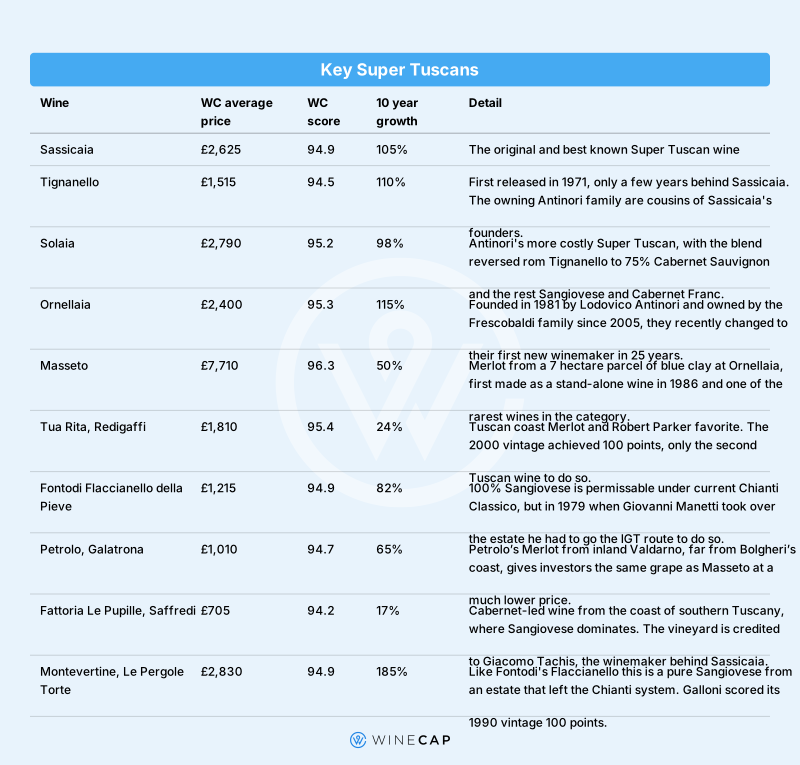
A handful of names account for most of the category’s secondary market trading and its core of investable wines.  

Table of ten key Super Tuscan wines comparing WineCap average prices, scores and 10-year growth

Beyond this core there are other notable Super Tuscan wines worthy of mention: 

  • Gaja, Ca’Marcanda: Although its core remains in Piedmont, Gaja also own a Tuscan estate, bringing a northern Italian name to Cabernet and Merlot country
  • Frescobaldi Luce: In a similar vein to Mouton Rothschild’s involvement in California icon wine Opus One, Luce began as a Frescobaldi and Mondavi partnership in 1995 to make a Merlot and Sangiovese blend
  • Soldera, Casse Basse: Gianfranco Soldera resigned from the Brunello consortium in 2013 after vandals destroyed six vintages of his wine, and began labelling his wines IGT thereafter

What unifies all of the Super Tuscans, isn’t performance or winemaking or even terroir. It’s the act of breaking with regulation, this makes for a very broad church. 

Why Super Tuscans earn a place in investment portfolios

There are many different reasons why a Super Tuscan wine would be included in an investment portfolio, and none of them are exclusive to the category. They include:

  • Profile: Popularity doesn’t equal performance, but it is nevertheless a useful measure. Super Tuscan wines make up the top five most searched-for Italian wines on WineSearcher. Liv-ex (the largest B2B wine trading platform) curates an annual  Power 100 brand ranking that is another proxy for popularity; 8 of the 11 Italian wines to feature in the top 10 since 2014 have been Super Tuscan brands.  
  • Relative value: A key part of the appeal for Italian wines in general and Super Tuscan wines in particular. Wines like Tignanello and Sassicaia enter the market well below the highest profile Bordeaux wines such as Lafite Rothschild, but earn comparable critic scores.
  • Scarcity: A factor for all investable wines but for some Super Tuscans it is a key part of their appeal. Masseto makes only around 2,500 cases per year, Casse Basse Brunello di Montalcino around half of that. With production this low, even modest changes in demand can have a significant impact on prices. Conversely fewer bottles change hands, so a seller may wait longer for the right buyer than with a more liquid brand.
  • Diversification: A portfolio built only on Bordeaux depends on one region, one set of critics and one market mood. Adding Tuscan wines spreads that exposure across different grapes, styles and buyer groups, which can soften the effect of a downturn in any single area, as was the case from the peak of the market in 2022 to early 2026.
  • Growing Liquidity: Italy has become one of fine wine’s biggest liquidity growth stories. Italian wine’s share of trade by value on the largest trading platform has more than tripled from 5% in 2014–2016 exceeding 16% in 2026.

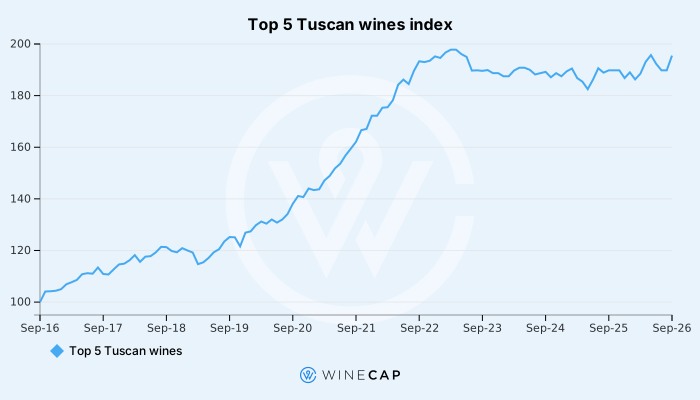
Ultimately, the prime concern for investors is performance. Our 10-year index of WineCap market prices for the five most searched for Tuscan wines (Sassicaia, Tignanello, Masseto, Ornellaia and Solaia) is currently up 95% from its starting level and despite the market correction has stayed within 10% of its high. For investors, Tuscan wines have been amongst the most resilient holdings through the recent downturn.

Line chart of the top 5 Tuscan wines index, up around 95% between September 2016 and September 2026

How Bordeaux’s distribution system widens the buyer pool for Italian wine

Distribution decides how many buyers can reach a wine, and that shapes how easily an investor can sell it. La Place de Bordeaux is the merchant network, centred on Bordeaux, that distributes top wines to buyers in London, Tokyo, Hong Kong and beyond. Its negociants (merchant houses that buy from producers and resell to the trade) give wine access to thousands of global buyers, which tends to raise liquidity and steady prices.

Access to La Place works as a quality signal as well as a sales channel. A wine on the platform has been accepted by the merchants who handle the world’s most traded bottles, and that acceptance tends to support both demand and price discovery.

Solaia joined La Place in 2009, which gave it access to a far wider group of international merchants. A broader buyer base is one reason Antinori’s Cabernet-led wine commands the prices it does.

Bibi Graetz shows that the arrangement can also unwind. Early releases from this coastal Tuscan producer had been very successful and supported significant growth, but as the market contracted so did merchant demand leading to unsold wines. 2025 was the last year Bibi Graetz released their flagship “Testamatta” through the Bordeaux network, and the estate has returned to working more closely with a smaller group of producers. 

The Super Tuscan family tree supports demand

The Super Tuscan brand’s power sustains demand, and its influence extends beyond just the highest profile wines. WineCap’s guide to Sassicaia points to attention from public figures including LeBron James, Barack Obama and Rihanna. Such attention to the region’s halo wine introduces Super Tuscans beyond core wine buyers to a larger demographic interested in high profile luxury brands.

The Sassicaia’s descendants show how far the model reached. The cross pollination with Tignanello is clear, with that wine coming from Piero Antinori, nephew of Sassicaia’s founder. The influence can also be seen in other regions: In Trentino, San Leonardo became widely known as the Sassicaia of the North, and in Campania, Montevetrano as the Sassicaia of the South. These wines don’t just prove that Cabernet blends of comparable ambition could succeed far from Bolgheri, but also show the power of Sassicaia, and by extension the Super Tuscan brand.

Super Tuscan wines built their reputation on the same idea: that Italian producers could compete with Bordeaux on their own terms, and win buyers who had never considered Italy for serious cellaring. The halo power of the top wines support demand in two ways. It widens the pool of buyers who recognise the concept of a Super Tuscan wine, and it gives owners confidence that a bottle can be resold. 

Michele Satta, a Bolgheri producer, put the debt simply: “We are all children of Sassicaia.“

Super Tuscans and Piedmont wines play different roles in an Italian portfolio

For investors, Piedmont overwhelmingly means Barolo and Barbaresco, the wines that attract most collector and investor interest in the region both crafted from the Nebbiolo grape.

In its structure and production Piedmont resembles Burgundy. Both regions draw fine distinctions between wines, with many small estates, individual vineyard names and sharp differences between vintages. Producers tend to make many different wines in lower quantities and from small parcels. This means that collecting is driven by site specificity as much as brand power. Bruno Giacosa makes 35 wines, Giuseppe Mascarello 29 and Aldo Conterno 27, so selection takes real expertise.

Super Tuscans are closer to the Bordeaux model. Production volumes are larger, and the producers are brand-led, with a short list of established names carrying the category. Ornellaia makes 10 wines, and Tenuta San Guido, the maker of Sassicaia, makes only 5. Sassicaia alone is produced at around 200,000 bottles a year, which makes the top names easier to follow, benchmark and trade. Global luxury recognition and a broader, more mainstream buyer base add to this, making the top names easier to sell. 

In exactly the same way that investors will likely hold both Bordeaux and Burgundy, they are likely to hold Piedmont and Super Tuscans alongside each other.

Super Tuscans have earned a core place in a wine portfolio

Super Tuscans have moved from rule-breaking outsiders to an established part of the fine wine market. Italian wine’s share of trade by value has more than tripled in a decade, to over 16%, while the top five Tuscan wines are up 95% over ten years and have stayed within 10% of their high through a downturn that had a much larger impact on other regions. 

That record, and a brand that now reaches well beyond wine specialists, earns Super Tuscans a place at the core of a well-considered modern portfolio alongside the core French regions in Bordeaux, Burgundy and Champagne.

FAQ: investing in Super Tuscan wines

What is a Super Tuscan wine?

A Super Tuscan is a Tuscan red made outside the appellation rules of its time, whether by using unapproved grapes, dropping a mandatory blend or choosing a looser label. The term has no legal definition. Sassicaia, first sold in 1971 as table wine, is the original example, and it now has its own DOC.

Is Sassicaia or Tignanello the better investment?

Both are viable assets for investors and they have traded closely together over long periods. Sassicaia holds higher status and has a higher search ranking, while Tignanello has a lower entry price, which has helped it prove resilient in market corrections.

Are Super Tuscans a safer investment than Bordeaux?

Not automatically. Tuscan wines held up comparatively well after the 2022 peak, but returns are never guaranteed. Some like Sassicaia trade deeply, while a higher priced but smaller production wine such as Soldera Casse Basse may take longer to sell.

How much does it cost to enter the Super Tuscan market?

Entry costs vary widely. Fontodi’s Flaccianello della Pieve offers a low cost route into top Italian wine with WineCap’s Wine Track average price at just over £1,200 a case, while Masseto sits at the other end of the scale with prices approaching £8,000 per case.

How are Super Tuscans taxed in the UK?

UK tax treatment depends on individual circumstances and HMRC rules. Fine wine is generally treated as a wasting asset (an item with a predictable life of 50 years or less), which usually means gains on sale are exempt from capital gains tax, and the same treatment is generally applied to labels such as Tignanello and Sassicaia. This is general information, not tax advice, so investors should take professional advice.

Does storage matter for Super Tuscans?

Yes. A bottle of Tenuta San Guido, Sassicaia 1985 with a documented storage history in a bonded warehouse can be sold with its provenance intact, which supports a premium. Wine kept at home without records is usually discounted by buyers, however good the producer.

WineCap’s independent market analysis helps investors build diversified fine wine portfolios with full ownership and transparent pricing. Speak to one of our wine investment experts and start building your portfolio. Schedule your free consultation today.
Categories
Learn

What are second wines, and are they worth investing in?

  • Second wines offer investors a lower cost entry point into top-end producers and vintages
  • The best-known second wines, Petit Mouton Rothschild and Carruades de Lafite, rose around 80% between August 2016 and 2022
  • Second wines can fall further than top wines during a correction, and have a lower trading volume

Wine producers will frequently make more than one wine from the same parcel of land. The highest-quality wine will be known as the grand vin; the second wine is the label given to the next wine in the quality hierarchy. This guide sets out what defines a genuine second wine, how their prices and liquidity compare with flagship bottlings, and how and why their investment performance differs. It also covers where the second-wine model breaks down, from Burgundy’s parcel-driven hierarchy to Champagne’s vintage tiers, so investors know when the comparison applies and when it doesn’t.

What actually is a second wine?

A second wine is a producer’s own internal declassification of fruit that does not make the grand vin (the estate’s flagship blend). Nearly every fine wine region with a quality hierarchy  uses some version of this idea, but Bordeaux formalised it most clearly, and among the top tier of Bordeaux wines its adoption is almost universal. Investors benefit from understanding it because a second wine is not a lesser producer trying to copy a famous name. It is the same winemaking team, the same vineyard and the same cellar, sold at a materially lower price.

Estates arrive at a second wine in three main ways:

  • Selecting out fruit that falls short of the quality bar for the grand vin in a given year
  • Drawing from distinct parcels within the estate that consistently rank below the parcels used for the grand vin, or that produce fruit that is not as well suited to making a wine for significant ageing
  • Using the fruit of younger vines, which typically need more years establishing themselves before they contribute to the flagship blend

The exact method varies by producer, and, in practice, the lines are often blurred. What rarely varies is the outcome: a second wine that shares a terroir and a production team with a famous name, priced for investors, collectors and consumers who want exposure to such an estate without paying grand vin prices.

Why scores and lifespans differ from the grand vin

Second wines are built to drink sooner, and their scores tend to be lower. While a grand vin is typically structured for decades of ageing, a second wine is made for an earlier drinking window, often framed as a wine for collectors to enjoy while they are still waiting for the grand vin to mature. 

Some of this comes from different inputs (i.e. the grapes that the wine is made from), some from different treatments those grapes receive in the cellar. 

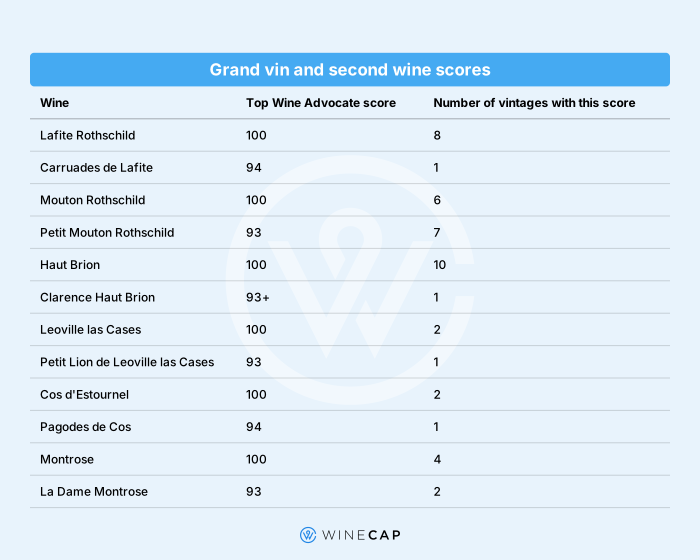
Critic scores make the quality gap clear. Across six leading Bordeaux estates, three first growths and three super seconds, WineCap’s analysis found every grand vin has scored 100 points from Wine Advocate (one of the most closely watched critic scores in Bordeaux) in at least one vintage. Their second wines tell a different story: only two, Carruades de Lafite and Pagodes de Cos, have ever scored above 93 points, and each has done so only once.

Table comparing top Wine Advocate scores for six Bordeaux grand vins at 100 points and their second wines at 93 to 94

That gap does not make second wines a poor investment. It makes them a different one: a shorter-dated, higher volatility bet on the same producer’s skill, priced accordingly.

Spotting a genuine second wine

Not every wine linked to a famous name is actually its second wine. Two situations can catch out investors:

  • Sibling estates under common ownership. Chateau Clerc Milon and Chateau d’Armailhac both belong to the Rothschild family behind Chateau Mouton Rothschild, but neither is Mouton’s second wine. They are separate, independently classified estates that happen to share an owner
  • Similar names, unrelated producers. Chateau Carmes Haut-Brion is a distinct estate with no ownership link to Chateau Haut-Brion, despite the similar name.

Bordeaux’s 1855 classification also shows how close to universal the second wine model has become. Almost every classified growth now makes at least one second wine, and some make three or four. Chateau d’Armailhac (part of the Mouton Rothschild stable of wines) is a rare exception: despite its reputation and despite its status as a fifth growth in the 1855 classification it produces no second wine of its own.

How second wines perform against their grand vin

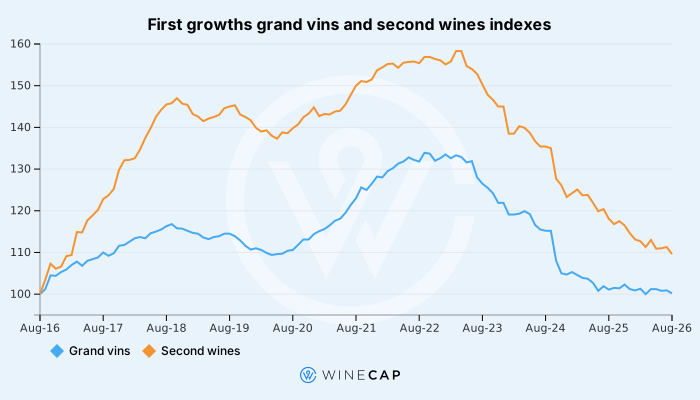
Second wines move further than their grand vins in both directions, Our index of first growths and their respective second wines shows this very clearly:

Index chart of first growth grand vins and second wines from 2016 to 2026, second wines rising higher then falling further

  • Grand vins growth hit 33% in October 2022 before retreating, while the index of their second wines saw nearly 60% growth over the same period
  • Within the second wines index, Petit Mouton Rothschild and Carruades de Lafite each rose by around 80 per cent at their peak
  • Within the corresponding grand vin index, Mouton Rothschild and Lafite Rothschild rose by around 40 per cent at their peak

The same amplification worked in reverse once the market turned:

  • Carruades de Lafite fell by 43% while Lafite Rothschild declined by 33%
  • Petit Mouton Rothschild fell by 28% while Mouton Rothschild fell by 21%

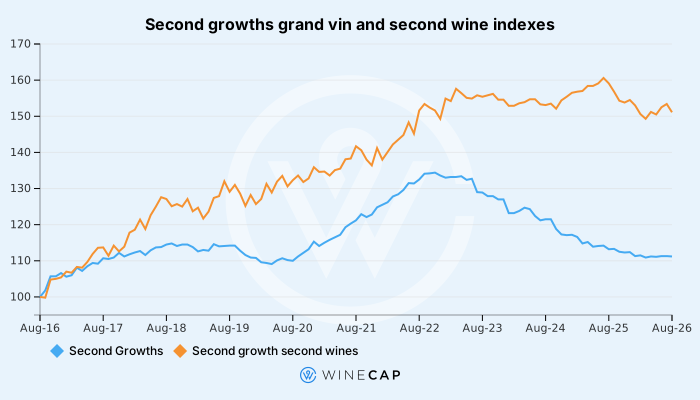
The index of Second Growths follows a broadly similar pattern to the index of First Growths. Prices rose about 30% between August 2016 and mid- to late 2022 before falling back down.  Their second wines however have behaved quite differently in the current cycle. Prices stabilised in late 2022 and early 2023, around 50% above their 2016 levels, and have largely held firm since.

These modest falls reflect the fact that Second Growth’s second wines trade less often and are more likely to be drunk than resold.  Their lower value has also insulated them: holders who need access to capital are able to raise more money more quickly by selling First Growths and their second wines than they were by selling the second wines of Second Growths.

Index chart of second growth grand vins and their second wines from 2016 to 2026, second wines holding well above

Price and liquidity: what a second wine costs and how they trade

Price is where the appeal of second wines is most direct. Across a sample of eight paired first and second wines from First Growth and Second Growth estates, second wines currently trade at an average of around a third of their grand vin’s price, with most estates falling between 28% and 40% lower.

That discount buys a wine from the same terroir and winemaking team, but it comes with a liquidity cost. Our analysis across four of the most actively traded first wines in Bordeaux shows that the second wines from the same estates saw between 15% and 40% of the number of trades of the first wines on the secondary market over recent vintages. 

Investors weighing a second wine purchase should treat that thinner market as part of the trade-off and be aware that exiting a position can take longer or require more flexibility on price.

Second wines beyond Bordeaux

The second wine model travels well outside Bordeaux, though not in the same form everywhere.

Napa Valley has adopted a close equivalent for many of its most sought-after producers:

  • Harlan Estate makes The Maiden, sourced from younger vines and parcels not selected for the flagship blend
  • Screaming Eagle makes Flight, formerly Second Flight following the same logic
  • Scarecrow makes M. Etain, a second label built on the same J.J. Cohn Estate fruit. The name is French for “Mr. Tin,” a nod to the Tin Man, continuing the Wizard of Oz theme

These wines tend to echo Bordeaux’s pattern: strong demand for the flagship pulls the second label up with it during a rally, and the reverse happens in a correction. However the sample is smaller and the market thinner than in Bordeaux.

Tuscany offers a mixed picture. Ornellaia follows something close to the Bordeaux model, with Serre Nuove dell’Ornellaia as its second wine and Le Volte dell’Ornellaia as a third, more accessible tier. Sassicaia’s relationship with Guidalberto and Le Difese, made by the same producer, Tenuta San Guido, is looser. These are related wines from the same team rather than strict declassifications of Sassicaia fruit, so investors should treat them as an adjacent opportunity rather than a discounted route into Sassicaia itself.

Where the second-wine model does not apply

Burgundy and Piedmont do not follow the same model. Producers in both regions typically make many different wines from distinct, often tiny parcels, each with its own identity rather than representing a ranking below an obvious flagship. In Burgundy, investors should not consider La Tache a second wine of Domaine de la Romanee-Conti, even though it sits below Romanee-Conti itself in price. The hierarchy is more complex and involves the location and terroir of specific parcels of land, Grand cru, Premier Cru, or monopole classifications, as well as price, and is not necessarily about quality per se.

The same applies to Gaja in Piedmont. Gaja Barbaresco sits at a different price point from single-vineyard wines such as Sori San Lorenzo, but the relationship is one of terroir specificity, not a grand vin and its derivatives.

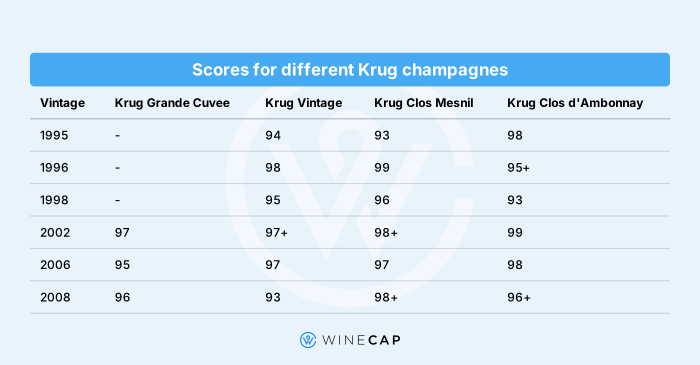
Champagne follows a third pattern entirely. Houses like Krug produce several tiers of wine, from the multi-vintage Krug Grande Cuvee through to Krug Vintage and single-parcel wines such as Krug Clos d’Ambonnay. However, the distinction is about vintage and terroir specificity, not a quality cut. 

There is a clear price hierarchy between these wines, Krug Grande Cuvee is around £1600 per dozen, while Krug Clos d’Ambonnay can be £2,000-3,000 a bottle, but there is not the same structural relationship or quality divergence investors see between Chateau Lafite Rothschild and Carruades de Lafite.

Table of Wine Advocate scores for Krug Grande Cuvee, Vintage, Clos du Mesnil and Clos d'Ambonnay by vintage

Second wines reward selective buying, not blanket exposure

The investment case for a second wine is not that it is a cheaper version of its grand vin. It occupies a different position, the same producer’s skill and terroir, with its own liquidity, holding period and volatility profile. Treating a second wine as a simple discount route into a famous name misses the larger swings in both directions and the thinner market that comes with it.

For investors who understand that trade-off, second wines offer a genuine way to diversify exposure across more estates and vintages within the same budget as a smaller number of grand vins. 

FAQ: buying second wines

Are second wines a good entry point for a first-time fine wine investor?

They can be. The most actively traded second wines have the liquidity and performance that merits investment; however, the number of second wines that pass the threshold of investability is lower than for first wines. 

How liquid is the secondary market for second wines?

Less liquid than for the grand vin, though it varies by estate. Across a sample of four actively traded Bordeaux first wines, their second wines saw between around 15% and 40% of the number of trades over four recent vintages, so exits can take longer to execute at a target price.

Do second wines have a shorter holding period than grand vins?

Not necessarily as an investment, but they are built to drink sooner. Scores also run lower. Across a six-estate sample, only Carruades de Lafite and Pagodes de Cos have scored above 93 points from Wine Advocate, and each just once, against every grand vin in the sample hitting 100 points, most of them multiple times.

Are all classified growth second wines worth the same attention?

No. Price ratios to the grand vin range from around 28% to 40% across the sample WineCap reviewed, and trading activity varies just as widely. With this in mind, each second wine needs assessing against its own grand vin rather than as part of a single category.

Can a wine with a similar name to a famous estate be mistaken for its second wine?

Yes, and it is a common error. Chateau Carmes Haut-Brion, despite the shared name, has no ownership link to Chateau Haut-Brion. Investors should confirm the actual relationship before treating any wine as a discounted route into a bigger name.

WineCap’s independent market analysis helps investors build diversified fine wine portfolios with full ownership and transparent pricing. Speak to one of our wine investment experts and start building your portfolio. Schedule your free consultation today.
Categories
News

Sotheby’s Haut-Brion sale offers investors early signs of a quality-led fine wine recovery

  • Sotheby’s sale of 676 Chateau Haut-Brion lots shows investors that fine wine demand remains concentrated in the estate’s flagship wine (the grand vin) and in older vintages and larger formats
  • Our analysis found more than half of Haut-Brion’s grand vin lots sold above 150% of their estimated midpoint, against 8% or fewer across other wines in the sale
  • Second wines accounted for 62.2% of all unsold lots despite representing only 38.2% of the sale, exposing a sharp gap in demand across a single estate

Sotheby’s held a dedicated sale of Chateau Haut-Brion wines in Paris on October 1, 2026, offering 676 lots with a combined pre-sale estimate range of £2.1-2.9 million. The sale celebrates the 10th decade of the Dillon family’s ownership of the Bordeaux first growth, spanning vintages dating back nearly a century, and is another sign to investors of emerging confidence in specific market sectors.

Our own analysis of the results, covering every single-vintage lot sold, found a selective market – with demand concentrated heavily in Chateau Haut-Brion’s “grand vin” (the estate’s flagship red; the second wines are made from fruit grown in secondary vineyards or deemed unsuitable for the first wine ). Demand was also concentrated on older vintages, and large-format bottlings, while the estate’s second wines and its white wine lagged significantly behind. This is consistent with our broader reading of the fine wine market that the current recovery is building first at the top end of the market and being driven by wines of the highest quality rather than broad-based demand.

Sotheby’s sale marks the Dillon family’s 10th decade at Chateau Haut-Brion

Clarence Dillon acquired Chateau Haut-Brion in 1935, the same year he founded the investment bank that would eventually become part of UBS. The sale celebrates the 10th decade of the family’s ownership of the estate. Prince Robert of Luxembourg, Clarence Dillon’s great-grandson through Joan Dillon, joined the Domaine Clarence Dillon board in 1993, became general manager in 2002, and has served as president since 2008. He now runs the estate directly.

676 lots spanned nearly a century of Haut-Brion vintages

The sale offered 676 lots spanning Chateau Haut-Brion, Chateau Haut-Brion Blanc, and the estate’s second wines across roughly a century of vintages. Notably absent was any wine from Chateau La Mission Haut-Brion, a separate, independently owned estate the Dillon family only acquired in 1983, nearly half a century after Clarence Dillon’s original purchase. The sale also included a full barrel of the 2025 vintage and a series of bespoke dining experiences created for the anniversary, each paired with a rare vintage.

The 2025 barrel, still widely available to buy en primeur (the mechanism by which most Bordeaux wines release while still in the barrel) from merchants, ultimately sold for nearly £140,000, an 85% premium to prevailing market prices. The price included a cellar visit, a tasting experience, and the option to customise the bottles’ back labels, justifying  some of the premium.

WineCap’s analysis finds a widening gap between grand vin and second-label demand

Our analysis, covering every single-vintage lot in the sale, found Chateau Haut-Brion’s grand vin performing in a different league from every other wine on offer. 

  • Of 221 grand vin lots, 218 sold, a 98.6% sell-through rate (the share of lots that find a buyer)
  • 52.8% of those sold grand vin lots cleared 150% of their estimate midpoint 
  • The other wines in the sale cleared this 150% estimate threshold on 8% of lots or fewer
  • Only three grand vin lots failed to sell, each standard-format bottles from poor vintages (2002 and 2007)
  • Second wines Le Clarence de Haut-Brion and La Clarte de Haut-Brion together made up only 38.2% of all lots offered but accounted for 62.2% of those that went unsold

Age and bottle formats reinforced the same pattern. 

  • Vintages predating 1990 sold through at more than 95% and averaged nearly 2 times their estimate midpoint
  • Vintages from 1990 onward sold through at less than 80% and averaged only 1.1 to 1.3 times midpoint 
  • Large formats added a further premium on top of the age effect: double magnums and jeroboams-and-larger sold through at more than 91%, against 78.8% for standard bottles, and averaged 1.86 and 1.77 times their estimate midpoint 
  • Haut-Brion Blanc was the one wine where this pattern reversed, its sell-through rate falling from 100% in half bottles to just 50% in the largest formats

Large formats and pre-1990 vintages delivered the sale’s standout prices

The 1989 vintage, scored 100 points by multiple reviewers including Robert Parker, was the standout performer of the entire sale. All five cases offered found buyers, raising nearly £200,000 combined against a pre-sale estimate midpoint of just over £70,000 – nearly 175% above estimate. A single double magnum of the 1989 sold for more than £48,000, likely a record for a post-war vintage of Haut-Brion. 

The 1986 vintage performed almost as strongly: two cases of three double magnums both sold, together raising four times their combined pre-sale estimate. A case of the 1971 sold for close to 80% above the previous auction record for this vintage and four times its own estimate midpoint. Magnums of the 2000 vintage sold for 40% above the previous magnum record, set in 2022 at Prince Robert of Luxembourg’s own New York sale of wines from his personal cellar. 

The 2000 vintage also produced the sale’s clearest format anomaly, with its magnums outselling its double magnums and jeroboams on price, a reversal of the large-format advantage that held everywhere else in the sale. Each of these headline results sits inside the sale’s broader age gradient, concentrated in vintages at least two decades old, which is consistent with how much of a rarity premium Paris buyers were prepared to pay for mature stock over recent releases.

A quality-led recovery

Entering the fourth quarter of 2026, the Haut-Brion results point to where fine wine demand is actually concentrating: established producer names, large formats and slightly older vintages, rather than characterising the market as a whole. This pattern fits our broader reading of the recovery already underway across fine wine, bolstered by quality and scarcity at the top end rather than by renewed demand spreading evenly across every label and vintage a producer makes. Investors weighing exposure can factor this into their consideration on risk and potential rewards, as well as market timing.

FAQ: Sotheby’s Chateau Haut-Brion sale

What does the Haut-Brion sale mean for fine wine as an asset class? 

It reinforces WineCap’s reading that the current recovery is led by quality and scarcity rather than broad, market-wide demand. 

How significantly did Haut-Brion’s second wines underperform the grand vin? 

Le Clarence de Haut-Brion and La Clarte de Haut-Brion made up only 38.2% of all lots in the sale but accounted for 62.2% of everything that went unsold. Neither second wine cleared the 150%-of-estimate threshold on more than a handful of lots, against 52.8% for the grand vin. 

Does the sale suggest investors should prioritise large-format bottlings? 

Not necessarily, but it does provide a reminder of why some exposure to large formats, particularly from more prestigious producers, is worth having. The improved prices balance against lower liquidity and potentially a longer period before depletion becomes a factor in increasing prices.

Is Chateau Haut-Brion Blanc worth holding as an investment?
Perhaps. Low sell through rates (74.9%, against 98.6% for the grand vin) are evidence of limited demand and backup our reading that dry white Bordeaux is still an emerging market for investors. Opportunities are likely to be found in the highest-profile white Bordeaux, but this auction points to liquidity as a risk factor. 

How does this sale compare Sotheby’s 2022 Prince Robert of Luxembourg sale? 

The 2026 sale prices eclipsed a number of values set in 2022, despite that being a broadly more favourable point in the market cycle. That earlier sale was held for charity, which makes the scale of the new records even more significant.

WineCap’s independent market analysis showcases the value of portfolio diversification and the stability offered by investing in wine. Speak to one of our wine investment experts and start building your portfolio. Schedule your free consultation today.
Categories
Quarterly-reports

Q3 2026 Fine Wine Report

This report examines what the wine market is showing investors in Q3 2026, reporting on Michelin’s entry into wine criticism, the development of the autumn release campaign, and the prospects for Q4.

  • Gold recovered from its worst quarter in a decade, but fell short of highs, remaining below January’s peak and August’s rally high
  • Global equities wobbled throughout September and new Federal Reserve chair Kevin Warsh reversed the dovish expectations that greeted his appointment
  • Geopolitical tensions remain a major feature of mainstream markets. Wars in Iran and Ukraine continue to affect the global macroeconomic climate,  tensions between Saudi Arabia and Yemen are exacerbating the situation
  • Michelin’s debut in wine criticism landed with a scale no critic can match, immediately becoming the highest profile voice in wine, and a new metric for investors to monitor
  • Opus One’s release of the 2023 vintage is the highpoint of the Autumn release campaign so far, providing value and high scores
  • Sotheby’s confirmed a dedicated Chateau Haut-Brion sale for October marking the Dillon family’s 90th year of stewardship

Executive Summary

Q3 2026 was defined less by what fine wine did on its own terms than by two external forces testing how the market prices reputation. After years as a financial backer of The Wine Advocate, Michelin launched its first producer ratings under its own name. It initially released Burgundy rankings in July, followed by Bordeaux in September. Michelin arrived to wine criticism with an audience larger than every other major wine critic combined and a different approach to reviews.

At the same time, the autumn release campaign gave buyers another reminder that the search for price discipline has become the market’s defining behaviour. Most releases were priced above their own back vintages and were met with resistance, with Opus One’s well judged offering the clearest exception.

Against this backdrop, the larger macro picture stayed unsettled. Equities continued a choppy run through the quarter, geopolitical tensions resurfaced around the Strait of Hormuz and in US-Canada trade relations, and a new Federal Reserve chair widely expected to cut rates instead raised them and signalled more increases to come. 

Fine wine’s own indexes continued to move largely independently of this backdrop, consistent with the theme our Q2 2026 report identified: buyers rewarding scarcity, quality and relative value over sentiment. On the secondary market, fine wine prices rose throughout the quarter with August trade at an 18 month high, despite summer typically being a quiet period 

The macro backdrop

Equity markets moved through a choppy quarter, with the S&P 500 extending its gains through July and August before losing momentum in September. Inflation remained sticky across major economies, a dynamic largely attributable to geopolitics. The US military maintains that the Strait of Hormuz remains open; transits have fallen although they are higher now than late July lows. Houthi attacks on Saudi pipelines and Red Sea shipping routes have added further pressure to global trade flows. A renewed bout of US: Canada trade tension added a second front of uncertainty.

The quarter’s most consequential monetary development was the emergence of Kevin Warsh as the new chair of the Federal Reserve, succeeding Jerome Powell. Markets had broadly priced Warsh as a dovish appointment likely to cut rates at the first opportunity; instead, he raised rates and signalled further increases this year, a reversal that has fed into elevated bond-market concern over both interest-rate policy and government debt sustainability.

Gold’s quarter illustrated the same unsettled mood. Having posted its worst quarterly performance in over a decade in Q2, gold staged one of its largest rallies in decades in August, at one point rising roughly 15%, before retreating. At its peak, the August rally topped out at $4,650, and gold remains below its January 2026 all-time high of $5,500.

Michelin enters wine criticism

After years holding a financial stake in The Wine Advocate, Michelin launched its own wine ratings under its own branding for the first time this quarter, opening with Burgundy in July, followed by Bordeaux in September. Notably, Michelin ranks producers, not individual wines. They are rated on a one-to-three “bunch” scale assessed against five criteria: agronomy quality, technical mastery, identity, balance, and consistency across vintages.

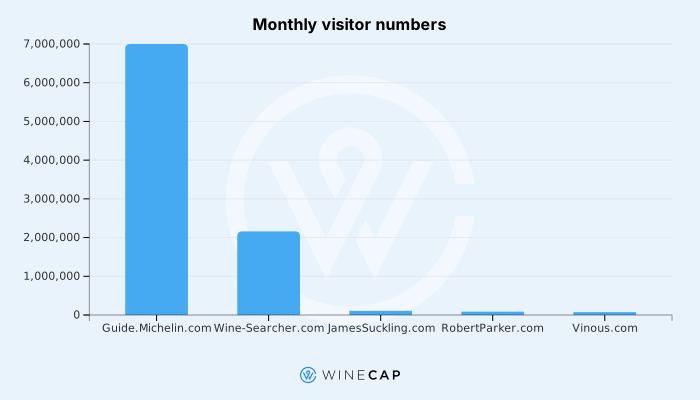
The scale of Michelin’s platform is what sets this apart from any previous shift in wine criticism. Michelin’s guide draws nearly 7 million monthly visitors, versus around 100,000 each for James Suckling, Robert Parker, Vinous. This means Michelin’s reach is more than 20 times larger than that of the three largest wine review platforms and three times larger than Wine-Searchers’ reach (full analysis).

Bar chart of monthly visitors to wine review sites, with Michelin's guide far ahead of every critic platform

In Burgundy, Domaine Leroy, Domaine de la Romanee-Conti and Domaine d’Auvenay, three of the most sought after producers in the region, took the top three-bunch tier. The most striking divergence from market pricing was Armand Rousseau, rated just one bunch despite bottles commanding up to £8,000.

In Bordeaux, Lafite Rothschild, d’Yquem, Cheval Blanc, Lafleur, Petrus, Montrose and Leoville Las Cases took the top tier, with three First Growths (the top tier of Bordeaux’s historic classification), Mouton Rothschild, Margaux and Haut-Brion placed a tier lower. Chateau Latour was omitted entirely, with a Michelin spokesperson later telling Decanter magazine: “For a small number of estates, including Chateau Latour, our evaluation process had not been fully completed by the time this inaugural selection was finalised, and our inspectors had therefore not yet reached a collegiate conclusion.”

Our analysis found no evidence yet that Michelin’s ratings have moved the market: Burgundy prices actually fell in July, immediately after Michelin’s rankings were published, before recovering in August. Due to the long-term nature of fine wine investment, it remains too early to draw conclusions from the Bordeaux selection, published on the 7th of September.

Given the unprecedented size of Michelin’s audience, we believe the wines worth watching closest for impact are those it left out entirely, such as Latour, and those ranked substantially lower than their market standing might suggest, such as Armand Rousseau.

The Autumn release campaign

Some of the highest profile releases of the Autumn campaign included:

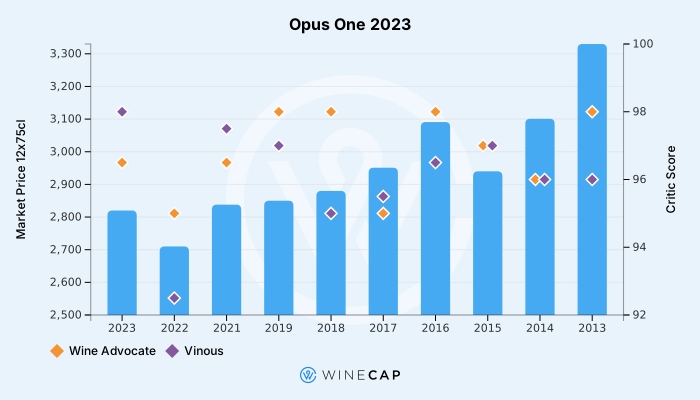
  • Opus One 2023: released at £2,815 per 12x75cl, competitive against older back vintages including 2013 (£3,320), 2016 (£3,090) and 2014 (£3,100)
  • Masseto 2023: released at £5,760 per 12x75cl, a number of recent vintages with similar or superior scores were available for better prices
  • Penfolds Grange 2022: released at £3,900 per 12x75cl, among the more affordable vintages were 2013 and 2008, both with 100 points from Robert Parker
  • Sena 2024: one of Chile’s few investable wines released at £960 per 12x75cl to become the most costly vintage on the market

The autumn release campaign largely of New World and non-Bordeaux estates proved broadly disappointing on price and found little interest. With the exception of Opus One, most releases arrived priced above their own available back vintages, in some cases by wide margins. This repeats the pattern our Q2 report identified during the Bordeaux 2025 En Primeur campaign (En Primeur is the system of buying newly released Bordeaux wine before it’s bottled). Buyers are consistently rejecting new releases priced above proven, comparable vintages.

Opus One’s 2023 stood out as the campaign’s one clearly attractive release. At £2,815 per case of 12, it was priced below nearly every back vintage on record including the 2013 (£3,320), 2016 (£3,090) and 2014 (£3,100), while carrying critic scores from Wine Advocate and Vinous (98 points) that matched the best of those back vintages.

Opus One market price by vintage with Wine Advocate and Vinous scores, the 2023 in line with recent releases

This quarter’s campaign reinforces the theme running through 2026: buyers are pricing new releases against the available back catalogue, not against critic scores or brand prestige alone, and estates that ignore that discipline are meeting resistance. Opus One’s pricing suggests the lesson from Bordeaux’s 2025 En Primeur – that value relative to back vintages, not vintage reputation, wins demand – is starting to inform how at least some global wines producers approach release pricing, even if most have yet to adjust.

The best-performing wines of Q3 2026

The message for the first half of 2026 was clearly about the market finding value in back vintages of Bordeaux. Q3 2026’s top performers show far more regional breadth, but still retain their focus on older vintages. 

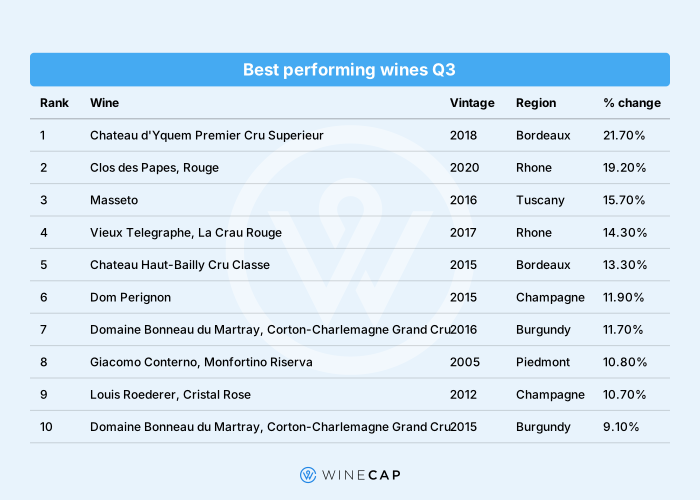
Bordeaux supplied 90% of Q2’s top 10 performing wines, and 80% of Q1’s. In Q3, Bordeaux’s share of the top 10 fell to just 20%, with Chateau d’Yquem 2018 and Chateau Haut-Bailly 2015 the only representatives. In their place, the list split evenly across five regions: two wines each from Bordeaux, Burgundy, Champagne, the Rhone and Italy, a spread not seen at any point earlier in the year.

Best performing wines Q3

Widening the lens to the 25 best-performing wines of the quarter reinforces the same story, albeit with a little more concentration in the most prominent regions. Fourteen of the 25, came from Bordeaux, Burgundy, and Champagne, the classic French regions that have anchored the secondary market’s recovery through 2026. 

The age profile of these wines is equally instructive, and points firmly toward established, back-catalogue vintages rather than recent releases. Nine of the top 10 date from 2018 or earlier, with one notable exception: Clos des Papes 2020, the quarter’s second single best performer.  One other wine, Dom Perignon 2015 requires context its relatively young vintage label belying a release that only reached the market in the summer of 2024. 

Across the wider top 25, 2015 and 2016 vintages together account for 40% of the list.

Dom Perignon 2015 is a particularly instructive case for what has happened to the market over the past two years. Released in the summer of 2024, close to what looks in hindsight like the point of peak pessimism, the wine fell by more than 20% in the months that followed. Its Q3 rise of close to 12% now leaves it at a modest 5% to 6% premium to that release price, evidence that buyers are finding value precisely where the preceding falls were steepest.

What do the best-performing wines in Q3 tell investors?

Q3’s best performers show that the market is starting to recognise a broader range of opportunities across the secondary market, and price rises are being felt more widely than in the first half of the year, although this is the early stages of that shift. Growth remains concentrated in the wine world’s largest and most recognised brands, and the broadest recovery so far is still concentrated in Bordeaux, specifically the late 1990s and early 2000s vintages that combine well-recognised, well-established quality with diminishing availability, rapidly approaching drinking windows, and price falls from the downturn. Examples of this dynamic include

  • Margaux 1996 has risen by nearly 20% since a low point in trading in November 2025 
  • Chateau Cheval Blanc 2000 is up around 8% since April 2026
  • La Mission Haut-Brion, 2005 is up 18% over a similar window, having troughed in September last year

Unlike Q1 and Q2, however, this quarter also shows significant movement outside Bordeaux. Burgundy’s share of trade on the leading trade platform Liv-ex, which hovered around 20% for most of 2023, 2024 and 2025, is rising back towards 30%. That renewed interest is concentrated less by appellation tier than by producer, as in Bordeaux it is focused on Burgundy’s highest-cost and highest profile names.

Read alongside the wider spread of regions across this quarter’s top performers, we see a market where price rises are starting to be felt more broadly than earlier in 2026, even if that breadth remains, for now, concentrated at the top of the market.

News round-up

A prominent investor’s case for fine wine

In a widely circulated Substack post, investor Michael Burry – best known for his early bet against the 2008 housing market – set out a case for bonded fine wine as a hedge against dollar devaluation and the disruptive risks he associates with advancing AI and quantum computing. Burry frames physical, storable assets such as First Growth Bordeaux and top Italian labels, singling out Sassicaia, as a form of “short position on the US dollar,” arguing that fine wine’s liquidity and analysability make it an overlooked asset class. Nonetheless, his suggested allocation is modest, up to 10% of a portfolio with a five-figure minimum. The endorsement, from a mainstream investor with a large public following, adds a further voice to a quarter already defined by capital looking beyond conventional equities and bonds.

Europe’s earliest harvest on record

Harvest began exceptionally early across Europe this quarter, with Champagne recording its earliest start on record and Bordeaux, Burgundy and Italy all picking one to two weeks ahead of historical norms, the result of successive heatwaves through the growing season (see our full harvest report). Separately, regulators raised the permitted ceiling on Champagne’s alcohol content in response to riper grapes from the early harvest although realistic alcohol levels for the 2026 vintage are not expected to be dramatically higher than historical precedent.

Outlook for Q4 2026

Q4 opens against a heavier political calendar, with US midterm elections in November likely to shape geopolitical and macroeconomic conditions over the following two years. Outside of these macro crosscurrents, we expect the stability now established in the fine wine market to continue, with buyers keeping their focus on established vintages that still offer value relative to the newest releases, rather than shifting back toward chasing recent vintages or reputation alone.

The quarter’s standout event will likely be Sotheby’s dedicated Chateau Haut-Brion sale in Paris on 1 October, marking the Dillon family’s 90th year of stewardship of the estate. The 676-lot sale spans vintages from 1935 to 2025 with, in Sotheby’s words, unimpeachable chateau provenance throughout. The historic 1961 vintage is represented, while the 100 point 1989 vintage is headlined by 12-bottle cases, and unusually large formats which generally carry a price premium and are likely to be some of the sale’s standout lots. Six bespoke tasting and hospitality experiences created for the anniversary round out the sale. We expect it to set new benchmark prices for the estate and to be one of the defining wine-market stories of Q4.

2026 has been the year fine wine stopped falling. After difficult years following the market’s 2022 peak, prices found a floor showing a relative stability that had been largely absent in previous years. Where growth appeared, it was concentrated rather than broad based: Champagne continued to lead and demand elsewhere favoured established high profile back-vintage wines from Burgundy and Bordeaux over newer releases, a pattern that ran through both the Q2 En Primeur campaign and this quarter’s autumn releases.

That trend has hardened into a firmer signal as the year has progressed, at the end of Q3 the case for a market still in decline is no longer credible. 

Heading into Q4 and on into 2027, our outlook is the most positive it has been since the end of 2023. 

FAQs:

What does Michelin’s move into wine criticism mean for fine wine investors?
Our analysis found no evidence that Michelin’s ratings have moved prices so far, with Burgundy actually dipping before recovering after its rankings were published. Given the unprecedented size of Michelin’s audience, the wines worth watching are those it rated well below market expectations, such as Armand Rousseau.

What should investors watch for heading into Q4?
The US midterm elections in November for their macro and geopolitical impact, and Sotheby’s Chateau Haut-Brion sale on 1 October, which we expect to set benchmark prices for the estate.

Did the Autumn release campaign offer good buying opportunities?
Mostly not. Most releases arrived priced above their own back vintages and met buyer resistance.

WineCap’s independent market analysis showcases the value of portfolio diversification and the stability offered by investing in wine. Speak to one of our wine investment experts and start building your portfolio. Schedule your free consultation today.