- Whether wine is a wasting asset for capital gains tax depends on the bottle, not the category, because HMRC applies a predictable life test of under 50 years.
- HMRC’s manual states it would normally contend that fine wine kept for periods well in excess of 50 years is not a wasting asset.
- Where the exemption does not apply, the chattels rules and the £3,000 annual exempt amount still limit exposure, with gains taxed at 18% or 24% (HMRC, 2026/27).
Fine wine’s reputation as a capital gains tax free asset rests on one narrow statutory rule, and that rule does not cover every bottle. HMRC treats wine as a wasting asset only where its predictable life at acquisition falls under 50 years, and its own guidance singles out long-lived fine wine as the category most likely to fail that test. This article sets out how the rule works, where investment-grade wine sits within it, and which capital gains tax rules apply when the exemption falls away.
What counts as a wasting asset for capital gains tax
HMRC’s wasting asset rule turns on a single number: fifty years. Section 44 of the Taxation of Chargeable Gains Act 1992 defines a wasting asset as one with a predictable life not exceeding 50 years at the time of acquisition. Where an asset is both a wasting asset and a chattel (tangible movable property), section 45 removes the gain from capital gains tax altogether.
That combination explains the attention fine wine receives from private investors. A bottle is tangible, it is movable, and most wine is drunk long before its fiftieth birthday. The exemption applies to the asset in front of HMRC, though, not to wine as a category.
HMRC accepts in its Capital Gains Manual that most wine is consumed well below the age of 50 years, and frames the practical question as whether a wine has turned to vinegar or has merely matured (HMRC, Capital Gains Manual CG76901). Cheap table wine passes that test comfortably. Investment-grade wine is a harder case, and the difference matters at the point of sale rather than the point of purchase.
Two further points frame everything that follows. The exemption is tested at disposal, using facts fixed at the date of acquisition, and the taxpayer carries the burden of establishing those facts. Neither point is obvious from the way the rule is usually summarised in marketing material.
Treatment depends on individual circumstances and may change, so the sections that follow describe how the rules are applied rather than what any particular portfolio will owe.
Why HMRC treats fine wine differently from table wine
Fine wine sits awkwardly inside the wasting asset rule, and HMRC says so directly. The Capital Gains Manual states that, where the facts justify it, HMRC would normally contend that wine is not a wasting asset if it appears to be fine wine which is not unusually kept for substantial periods sometimes well in excess of 50 years (HMRC, CG76901). The wines most likely to be bought as investments are therefore the wines most likely to sit outside the exemption.
Everyday wine faces no real argument in the other direction. A supermarket case will not survive 50 years in bottle, so its predictable life is plainly shorter than the threshold. The problem is that such wine rarely produces a chargeable gain worth arguing about, which leaves the exemption most secure exactly where it is least useful.
Certain investment-grade wines built for long ageing may not qualify for the exemption at all. Investors should take independent tax advice on their own holdings rather than treating the wasting asset rule as automatic.
Fortified wines and other bottles that may not be exempt
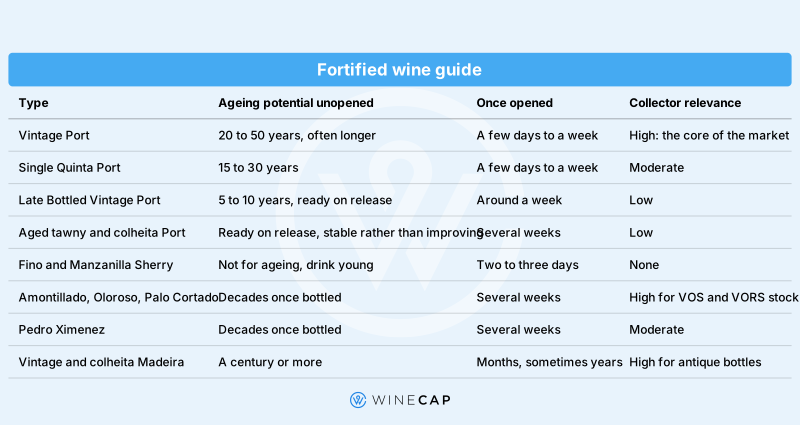
Several categories carry an obvious longevity problem, and HMRC identifies them readily. Each is defined by a storage life that a valuer would put beyond 50 years without much hesitation, which is the same evidence an investor would need to argue the opposite.
- Vintage Port, Madeira and Sherry. Fortification extends life dramatically, and Madeira in particular is drunk at ages measured in centuries rather than decades.
- Cognac, Armagnac and other long-lived spirits. Bottled spirits are stable almost indefinitely, so a sub-50-year predictable life is difficult to sustain.
- Sauternes and other sweet wines. Château d’Yquem is routinely cellared for 50 years or more, and its published drinking windows reflect that.
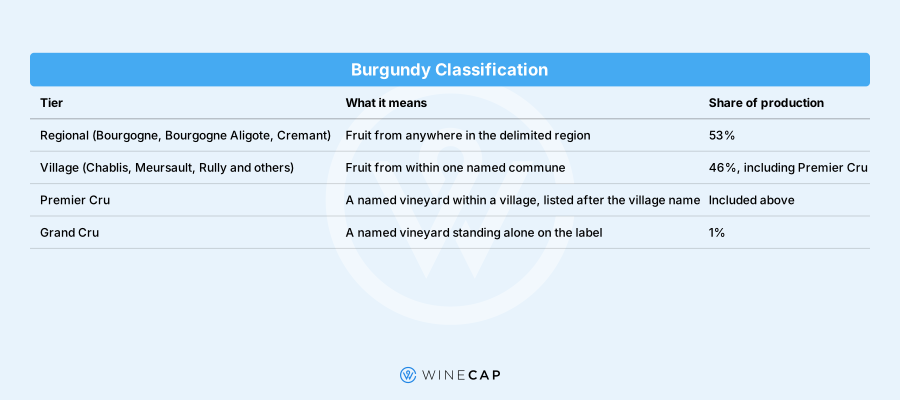
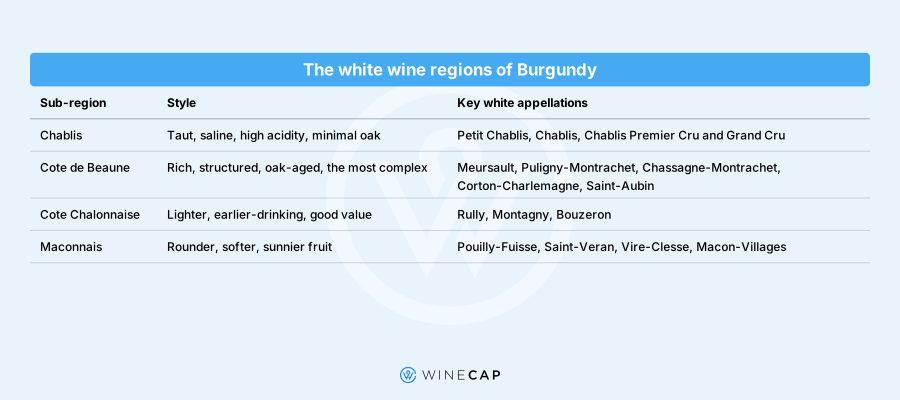
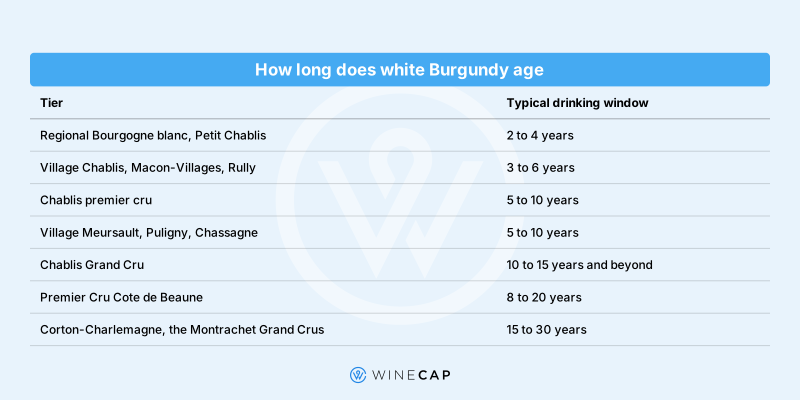
- Classified Bordeaux and top Burgundy in strong vintages. Critics’ drinking windows for leading estates frequently extend beyond half a century, and those windows are evidence HMRC can read as easily as an investor can.
- Prestige Champagne. Late-disgorged and vintage cuvees from the leading houses age far longer than the category’s reputation suggests.
Inclusion on this list does not settle the question. An investor holding these wines needs a documented, wine-specific case for a shorter predictable life rather than a general argument about wine as a category.
Predictable life is measured from when you buy, not the vintage
Predictable life runs from the date of acquisition, not the date on the label. That single point reverses the intuition many investors bring to the question, and it can work in an investor’s favour.
Consider two purchases. A buyer who acquires a mature 1970 Bordeaux in 2026 is holding a wine with perhaps 15 to 20 years of useful drinking life remaining, which sits comfortably below the threshold. A buyer who acquires a 2020 First Growth on release is holding a wine whose critic-assessed drinking window may extend past 2080, which does not.
The age of the bottle at acquisition therefore does more work than its total lifespan. Mature stock purchased late in its life has a stronger claim to wasting asset treatment than young stock bought on release, even where the two wines carry the same label. Portfolios assembled around back vintages and drinking-window purchases sit differently, for tax purposes, from portfolios assembled around En Primeur allocations.
None of this converts an argument into a certainty. HMRC assesses the facts of each disposal, and the burden of showing a predictable life under 50 years sits with the taxpayer.
The chattels exemption when wine is not a wasting asset
A wine that fails the wasting asset test is still a chattel, and the chattels rules limit exposure in their own right. Section 262 of the same Act provides that a gain is not chargeable where the disposal proceeds do not exceed £6,000, with marginal relief above that figure capping the chargeable gain at five thirds of the excess over £6,000 (HMRC, 2026/27).
Several further allowances sit alongside it:
- The annual exempt amount. Individuals have £3,000 of tax-free gains in the 2026/27 tax year, and trusts have £1,500 (HMRC, 2026/27).
- Rates on the balance. Gains above the allowance are taxed at 18% within the basic rate band and 24% above it for the 2026/27 tax year (HMRC, 2026/27).
- Joint ownership. Where a chattel is owned jointly, each owner has their own £6,000 threshold against their share.
- Allowable costs. Acquisition price, buying and selling commissions and other qualifying costs reduce the gain before any rate applies.
A worked example shows the effect. A case sold for £7,500 that originally cost £3,000 produces a gain of £4,500 before relief, but marginal relief caps the chargeable gain at five thirds of the £1,500 excess over the threshold, or £2,500. The annual exempt amount then absorbs most of that balance for an investor with no other gains in the year.
The practical effect is that a portfolio disposed of in measured steps, with proceeds per asset kept modest, may generate little or no chargeable gain even where the wasting asset argument fails.
How the sets rule affects cases of wine
The sets rule catches more investors than any other part of wine’s capital gains tax treatment. HMRC can treat items that form a set as a single asset where they are sold to the same person, or to connected persons, so the £6,000 threshold applies once across the whole transaction rather than to each bottle.
Bottles of the same wine and vintage are natural candidates. They are similar, they are complementary, and a complete case is generally worth more than the sum of its bottles, which is the test HMRC applies. A 12-bottle case sold intact to one buyer is one disposal against one £6,000 threshold, not twelve disposals against twelve.
Splitting a case across several buyers to stay under the limit is the obvious response, and it carries obvious risk. Where the sales are to connected persons, or form part of a single arrangement, HMRC can aggregate them. Genuine commercial reasons for separate sales are a different matter from timing designed purely to fragment a set.
Format complicates the picture. Magnums, double magnums and mixed formats of the same wine can still be similar and complementary, and an original wooden case sold with its packaging intact makes a strong candidate for set treatment. Investors selling through a merchant or at auction benefit from agreeing how lots will be constructed before the sale, because lot structure often determines how many assets have been disposed of.
Record keeping decides most of these questions in practice. Purchase invoices, storage and rotation records, buyer identities and disposal dates are the evidence that distinguishes a series of independent sales from a divided set.
Further reading from WineCap
These Learn articles cover the surrounding ground in more depth:
- The tax benefits of fine wine investment, covering capital gains tax, income tax and inheritance tax together.
- Changes to Capital Gains Tax: what does this mean for fine wine investors?, on how recent rate changes affect wine holdings.
- How to build a diversified fine wine portfolio, on regional and vintage spread.
- Fine wine investment for beginners, for readers new to the asset class.
Trading in wine and the income tax risk
Trading in wine and investing in wine attract different taxes, and the wasting asset exemption is irrelevant to the first. Where activity amounts to a trade, profits fall within income tax at rates up to 45%, plus National Insurance, rather than within the capital gains regime at all.
HMRC applies the badges of trade to decide which is which. Frequency and volume of transactions, short holding periods, the way purchases are financed, whether stock is actively marketed, and whether the buyer holds any intention of consumption all feed the assessment. An investor who buys allocations and holds them in bond for years looks very different from one who turns stock over monthly at a margin.
Structure matters as much as behaviour. Wine held through a company sits outside the chattels and wasting asset reliefs available to individuals, because those provisions apply to chargeable gains on chattels rather than to corporate trading stock. Wine is also treated as taxable property for self-invested personal pensions, so holding it inside a pension wrapper attracts punitive charges rather than shelter.
The distinction is not always clean, and no single badge decides it. Investors running high-frequency activity, or operating through a company, should take specialist advice before assuming capital treatment applies.
The evidence that supports a wasting asset position
A wasting asset position is only as strong as the evidence recorded behind it. HMRC assesses predictable life on the facts as they stood at acquisition, which means the supporting material needs to exist at that point rather than being assembled after a disposal.
Investors in this position typically keep:
- Acquisition records showing the date, price and the age of the wine when bought, since predictable life runs from that date.
- Drinking window evidence from named critics or merchants for the specific wine and vintage, dated at or near acquisition.
- Storage and condition records, including bonded warehouse documentation, ullage checks and any condition reports.
- Disposal records identifying the buyer, the date, the quantity and whether the sale formed part of a set.
Professional valuations carry more weight than an investor’s own assessment. Where the wine sits near the boundary, a written opinion from a specialist merchant or valuer, obtained before disposal, is materially more useful than a retrospective argument.
Timing of the evidence matters more than volume. A drinking window retrieved years after purchase is weaker than a dated merchant assessment held from the outset, and HMRC enquiries typically follow a disposal rather than precede it. Recording the position annually costs little and answers the question that arrives later.
Tax treatment depends on individual circumstances and may change. Nothing in this article is tax advice, and readers should consult a qualified adviser on their own position before relying on any exemption.
How fine wine’s tax treatment compares with other investments
Wine’s position looks favourable against most alternative assets and unremarkable against a few. The comparison matters because the wasting asset argument is often part of the reason wine enters a portfolio, and the alternatives carry reliefs of their own.
- Listed equities and funds. Gains are chargeable at 18% or 24% for 2026/27 unless held inside an ISA or pension, and those wrappers are unavailable to wine (HMRC, 2026/27).
- Gold. UK legal tender coins such as Britannias and Sovereigns are exempt from capital gains tax, while bars and foreign coins are chargeable in the ordinary way (HMRC, 2026/27).
- Classic cars. Private motor cars are specifically exempt, which gives them a clarity wine’s position lacks.
- Art and antiques. These are chattels with long lives, so they attract no wasting asset exemption and rely on the £6,000 threshold alone.
- Whisky casks. Spirits in cask raise similar wasting asset arguments, though the category has drawn increasing regulatory scrutiny over valuation and ownership practices.
Treating the exemption as a question, not a feature
The wasting asset rule is best understood as a question HMRC asks about a specific bottle on a specific date. That framing changes how a portfolio is built. Acquisition age, disposal sequencing, buyer identity and documentation all shape the answer, and each of them is a decision an investor makes rather than a rule handed down.
The wines most attractive for their ageing potential are the wines least likely to satisfy a sub-50-year predictable life. Investors who understand that tension early can plan around it, using the chattels rules, the annual exempt amount and disposal timing where the exemption itself is doubtful. Those who assume the exemption applies across a cellar may find the assumption tested only once a disposal has already happened, when the options have narrowed considerably.
FAQ: Wine and capital gains tax
Is wine exempt from capital gains tax in the UK?
Wine is exempt only where it qualifies as a wasting asset, meaning a predictable life of under 50 years at the date of acquisition, under sections 44 and 45 of the Taxation of Chargeable Gains Act 1992. HMRC’s guidance states it would normally contend that fine wine kept for periods well in excess of 50 years does not qualify (HMRC, CG76901). Treatment depends on individual circumstances and may change, so independent tax advice is essential.
Does the wasting asset exemption apply to vintage Port?
Fortified wines including vintage Port, Madeira and Sherry have recognised storage lives well beyond 50 years, which places them outside the wasting asset exemption in most cases. A gain on those wines is assessed under the ordinary chattels rules instead, with the £6,000 per asset threshold and the £3,000 annual exempt amount available (HMRC, 2026/27).
How much capital gains tax would I pay on a wine sale?
Where a gain is chargeable, the rate is 18% within the basic rate band and 24% above it for the 2026/27 tax year, after deducting the £3,000 annual exempt amount and any allowable costs (HMRC, 2026/27). A single chattel sold for £6,000 or less produces no chargeable gain at all, and marginal relief limits the gain on proceeds slightly above that figure.
Does selling a case of wine count as one disposal or twelve?
A case sold intact to a single buyer is generally treated as one asset, because bottles of the same wine and vintage are similar, complementary and worth more together than separately. That means one £6,000 threshold applies to the whole case. Selling bottles separately to connected persons, or as part of a single arrangement, can still be aggregated by HMRC.
What records should an investor keep to support a wasting asset claim?
Acquisition invoices showing the date, price and age of the wine at purchase are the foundation, since predictable life is measured from acquisition rather than vintage. Dated drinking window assessments from named critics, bonded storage documentation and full disposal records covering buyer and quantity complete the picture. A written valuation from a specialist merchant obtained before sale carries more weight than a retrospective argument.
WineCap’s independent market analysis helps investors build diversified fine wine portfolios with full ownership and transparent pricing. Speak to one of our wine investment experts and start building your portfolio. Schedule your free consultation today.