Categories
News

The most expensive fine wines in 2026

  • Domaine Leroy and Domaine d’Auvenay, both owned by Lalou Bize-Leroy, take 17 of the 25 places in the ranking of the world’s most expensive wine brands and 64.1% of its combined value.
  • Twenty-four of the most expensive fine wine brands in 2026 come from Burgundy, with only Chave’s Ermitage Cathelin, from the northern Rhone, breaking the region’s hold.
  • Romanee-Conti tops the ranking at £195,406 a case but posted the lowest ten-year price move of all 25 wines, at 70.9%.

Burgundy’s rise to the top of the fine wine market has been one of the defining trends of the past decade. Scarce production, growing international demand and a remarkable run-up in prices transformed its leading domaines into some of the world’s most valuable wine brands. Even after the correction that followed the market’s 2022 peak, it is perhaps unsurprising that Burgundy dominates WineCap’s ranking of the most expensive fine wines.

What is more striking is just how concentrated that dominance has become. Twenty-four of the 25 wines on the list come from Burgundy, but 17 come from just two domaines – Domaine Leroy and Domaine d’Auvenay – both owned by Lalou Bize-Leroy. Together, they account for 64.1% of the ranking’s combined value.

At this end of the market, price increasingly tells a story about scarcity as much as quality. The ranking reveals a fine wine summit concentrated around one region, a handful of producers and, above all, one extraordinary owner.
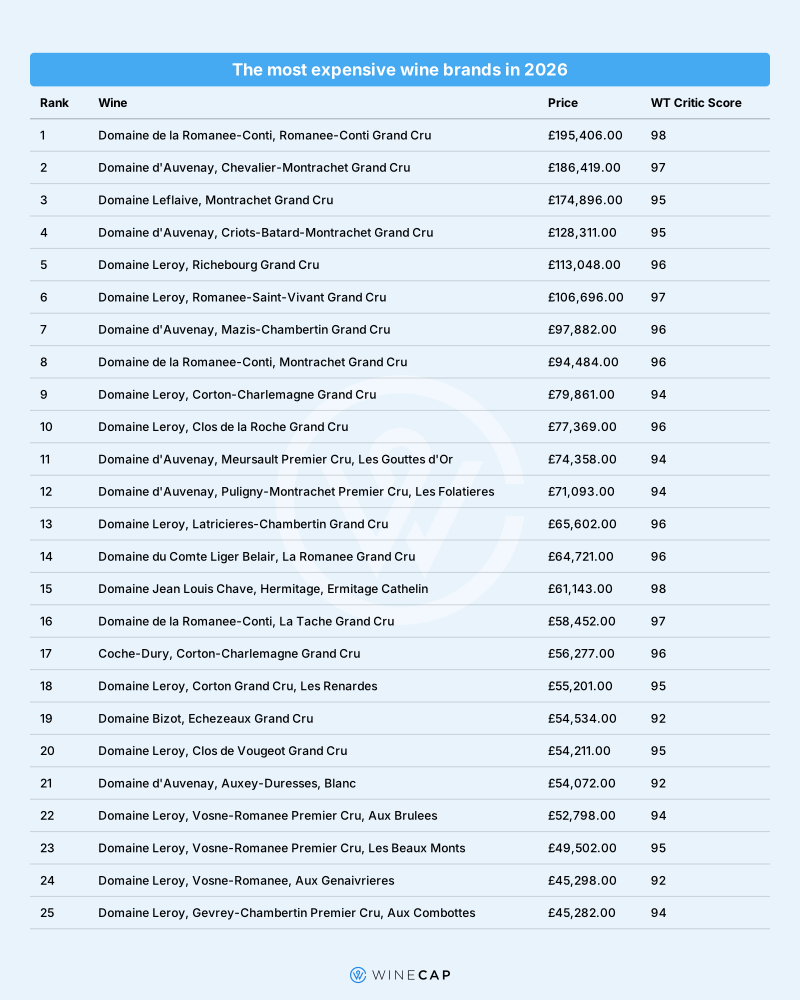
The most expensive wine brands in 2026 critic scores

*Average Case Price – Average market price across basket vintages, per 12×75cl.

*Wine Track Critic Score – Aggregate of published third-party critic scores, normalised to 100 points.

*Methodology: Prices represent the average of the best available market prices across recent vintages, exceptionally rare wines are excluded where there is insufficient reliable market data to establish a comparable price.

Two estates by the same owner dominate the ranking 

The scale of Lalou Bize-Leroy’s presence becomes clearer further down the ranking. Domaine Leroy contributes 11 wines and Domaine d’Auvenay another six, including Chevalier-Montrachet Grand Cru, the second most expensive wine on the list at £186,419 per 12x75cl case equivalent. Because our methodology intentionally excludes wines for which there is very little data, at least four further wines from Leroy and d’Auvenay are not included on our list. By comparison, Domaine de la Romanee-Conti holds three places, while the remaining five producers appear only once each.

Behind those prices is extreme scarcity. Domaine d’Auvenay farms just 3.87 hectares across 16 appellations, with some parcels producing only a few hundred bottles. Its holding in Criots-Batard-Montrachet, for example, extends to just 0.064 hectares. Production at Domaine Leroy is similarly constrained, combining tiny vineyard holdings with some of Burgundy’s lowest yields.

That scarcity is concentrated around one owner. Bize-Leroy, now in her nineties, farms both estates biodynamically and also retains a 25% share of Domaine de la Romanee-Conti. For collectors and investors, the result is unusual: much of the very top of the fine wine price hierarchy is tied to the output, reputation and eventual succession of a single grower.

Burgundy takes 24 of the 25 places

Only one wine breaks Burgundy’s hold on the ranking. Domaine Jean-Louis Chave’s Ermitage Cathelin, from the northern Rhone, sits fifteenth at £61,143 a case. The next non-Burgundy wine does not appear until 28th place, with Screaming Eagle Sauvignon Blanc from Napa Valley.

The gaps become wider from there. Petrus, the highest-ranked Bordeaux, sits 46th, while Krug Clos du Mesnil is Champagne‘s highest entry at 80th. Italy‘s highest-ranked wine, Soldera Case Basse, does not appear until 99th place.

Burgundy’s dominance at the very top comes as the region is also regaining ground in the broader secondary market. In July 2026, it overtook Bordeaux as the most traded region by value on Liv-ex for the first time since 2022, with DRC, Ramonet, Leflaive and d’Auvenay together accounting for roughly a third of Burgundy trade during the month.

The two measures capture different things. Trading share reflects where activity is taking place across the market; this ranking captures the extreme upper end of pricing. But together they underline Burgundy’s unusual position in 2026: it is home to almost every wine at the top of the price hierarchy while once again attracting a growing share of secondary market trade.

For more on Burgundy, read the WineCap Burgundy Regional Report.

White wine sits at the top of a red region

Red wines make up the majority of the ranking, with 16 of the 25 places. Yet white Burgundy is disproportionately represented at the very top: three of the four most expensive wines are white, as are five of the top ten.

The price difference is equally striking:

  • White Burgundy average £102,197 a case, compared with £74,822 for red Burgundy
  • The median white wine costs £79,861, versus £59,798 for red
  • Whites account for 36% of the wines on the list but 43.4% of its combined value

Scarcity helps explain the premium. The great white Grand Cru vineyards of the Cote de Beaune are exceptionally small, and production becomes smaller still when divided between individual domaines and parcels. At the same time, white Burgundy has proved more resilient than red during the recent market correction. Liv-ex has noted an excess of supply over demand for red Burgundy below £5,000 per case, while better-known whites have been an exception.

The most expensive wine has been the slowest riser

Romanee-Conti Grand Cru remains the most expensive wine in the ranking at £195,406 a case, but it has delivered the lowest ten-year price appreciation of all 25 wines, at 70.9%. By contrast, Domaine d’Auvenay’s six wines have risen by an average of 1,178% over the same period, while Domaine Bizot’s Echezeaux Grand Cru recorded the single largest increase, at over 2,000% in the last decade.

The comparison highlights an important distinction between price and performance. Romanee-Conti began the period from an already exceptional valuation, while some of the wines that have risen fastest were starting from much lower bases. These are also exceptionally scarce wines, where relatively few transactions can produce large percentage movements. The figures therefore describe the performance of a highly selective group rather than Burgundy, or fine wine, as a whole.

The recent picture is more subdued. Seventeen of the 25 wines have fallen over the past twelve months, producing an average decline of 2.0%, while their average six-month movement stands at just +0.4%. That follows the wider Burgundy correction: the Liv-ex Burgundy 150 fell 34% between its September 2022 peak and August 2025, before rising 2.2% from September 2025.

Nor does critical acclaim alone explain the price hierarchy. Chave’s Ermitage Cathelin has the highest Wine Track score on the list at 97.6, yet ranks fifteenth by price. Domaine d’Auvenay’s Auxey-Duresses Blanc has the lowest score, at 91.5, but still commands £54,072 a case after rising 494% over five years. Across the 25 wines, the rank correlation between score and price is 0.55, suggesting that critical quality matters, but scarcity, producer reputation and demand play a substantial role in determining price at this end of the market.

What the world’s most expensive wines tell us about the market

WineCap’s ranking is ultimately as much a measure of scarcity as it is of price. Twenty-four of the 25 wines come from Burgundy, 17 come from two domaines controlled by Lalou Bize-Leroy, and many are produced from vineyard holdings measured in fractions of a hectare. At the very top of the fine wine market, supply can be extraordinarily limited.

But the ranking also shows why price alone is an incomplete measure of investment potential. Romanee-Conti is the most expensive wine on the list but has delivered its lowest ten-year appreciation. Critical scores have only a moderate relationship with price, while some wines are so rarely available that establishing a reliable current market value becomes difficult.

That makes the top of the market very different from the broader Burgundy recovery now emerging on the secondary market. Burgundy may have returned to the largest share of Liv-ex trade by value in July, but the wines in this ranking occupy its narrowest and least accessible end. 

Their extraordinary valuations demonstrate the premium the market can place on scarcity and provenance – but also why diversification across producers, regions and price points matters when building a fine wine portfolio.

FAQs: The world’s most expensive wines

What is the most expensive wine in the world in 2026?
Based on WineCap’s Wine Track data as of August 2026, Domaine de la Romanee-Conti’s Romanée-Conti Grand Cru is the most expensive actively traded wine in the ranking, valued at £195,406 per 12x75cl case equivalent.

What are the most expensive wine brands in 2026?
The most expensive fine wine brands are overwhelmingly Burgundian. Domaine Leroy and Domaine d’Auvenay account for 17 of WineCap’s 25 most expensive wines, while Domaine de la Romanee-Conti holds three places.

Why is Domaine Leroy so expensive?
Domaine Leroy combines exceptionally small production with some of Burgundy’s most prestigious vineyard holdings and strong global collector demand. Its wines are produced in very limited quantities, making availability on the secondary market extremely restricted.

Why are Burgundy wines so expensive?
Burgundy’s most sought-after wines come from small, precisely defined vineyards whose production cannot easily be expanded. At the top end, tiny yields, fragmented vineyard ownership and international demand for a handful of producers create significant scarcity premiums.

Is the most expensive wine always the best investment?
No. Romanée-Conti is the most expensive wine in WineCap’s 2026 ranking but recorded the lowest ten-year price appreciation among the 25 wines, at 70.9%. Entry price, liquidity, scarcity and demand all influence investment performance.

What is the most expensive wine outside Burgundy?
Domaine Jean-Louis Chave’s Ermitage Cathelin from the northern Rhone is the only non-Burgundy wine in WineCap’s top 25, ranking fifteenth at £61,143 per case in August 2026.

WineCap’s independent market analysis helps investors build diversified fine wine portfolios with full ownership and transparent pricing. Speak to one of our wine investment experts and start building your portfolio. Schedule your free consultation today.
Categories
News

How the EU-India trade deal could reshape the fine wine market

  • India remains one of the smallest wine markets globally, but consumption is growing rapidly from a very low base.
  • The latest EU-India trade deal marks the first meaningful step toward tariff liberalisation, improving long-term access for European wine.
  • History shows that when large markets open gradually – as China did in the early 2000s – collector demand and investment interest can follow.

India and the European Union announced a major step forward in trade relations last week, with Brussels hailing the agreement in principle as one of the most significant developments in modern EU trade policy. Among the headline areas under discussion: India is expected to begin easing tariffs on European wine, alongside beer and olive oil, as part of a broader push toward gradual market liberalisation.

At first glance, wine may seem like a footnote in a deal dominated by cars, textiles, pharmaceuticals, and geopolitics. But for the fine wine world – and particularly for the long-term evolution of wine investment demand – India’s gradual market opening could prove far more consequential than current consumption figures suggest.

India’s wine market growth: Small base, rapid expansion

India remains one of the least developed wine markets in the world relative to its population.

Wine represents well below 1% of the country’s total alcohol consumption, and India accounts for only a tiny fraction of global wine imports. Total annual consumption is still modest, with domestic producers supplying the majority of the market.

On a per-capita basis, the numbers are striking: India consumes approximately 0.02 litres per adult per year – the equivalent of a single tasting measure per person annually.

To put that in context:

  • Australia consumes over 20 litres per capita
  • France and Italy sit above 40 litres
  • Portugal leads the world at more than 60 litres

India may be the world’s most populous country, but wine remains a marginal category.

And yet the trajectory is clear: India’s wine market has been expanding at double-digit rates, making it one of the fastest-growing alcoholic beverage segments in the country.

Market researchers project India’s wine market could reach around $520 million by 2028, and potentially approach $1 billion by 2034 – still small globally, but significant given today’s base.

Wine consumption in India: A premium lifestyle category

India’s alcohol market remains overwhelmingly dominated by spirits and beer:

  • Spirits: ~53%
  • Beer: ~46%
  • Wine: less than 1%

In high-income economies, wine often represents around 27% of alcohol consumption, and the European region sits closer to 31%. India’s wine market is therefore not simply small; it is structurally underdeveloped. But this is also why the upside is so significant.

Wine is increasingly positioned not as mass alcohol consumption, but as a lifestyle and premium category, particularly in major urban centres. It is also uniquely aligned with the growth of India’s middle class, which comprised 31% of the population in 2023 and is projected to reach 60% by 2047.

Indian wine imports are rising in urban premium markets

Imported wine remains a small segment in absolute terms, but it is gaining visibility in affluent metropolitan markets such as Mumbai, Delhi, and Bengaluru.

European exporters have reported steady growth, and producers are increasingly investing in distribution networks, brand-building, and consumer education.

Crucially, wine markets almost always develop first in wealthy cities before broadening nationally – and India’s trajectory so far fits that pattern.

India’s wine import tariffs: The key barrier to European wine

For decades, India’s wine market has been constrained less by demand than by access.

India’s 150% wine import duty has historically restricted European wine exports, making imported bottles prohibitively expensive. On top of federal tariffs, each Indian state layers its own excise regime, often inflating shelf prices dramatically.

In practice, imported bottles can end up three to five times more expensive than comparable wines in other major markets once all taxes and fees are applied.

Any reduction in national duties would therefore be meaningful since it will start to unwind the single largest structural barrier at the federal level.

True liberalisation, however, would still require significant state-level reform.

India alcohol taxes: State-by-state barriers remain

India’s wine market is extremely fragmented. States fall into four distinct regulatory environments:

  • Private distribution markets – Maharashtra, Goa, Haryana
  • Government monopoly models – Tamil Nadu, Kerala, Delhi
  • Auction and lottery markets – Punjab, Chandigarh
  • Dry states – Bihar, Gujarat, Nagaland, Mizoram

Even where excise rates are manageable, barriers remain high through label registration fees and entry costs. Delhi, for example, charges a Rs. 2 lakh brand fee, while other states impose steep registration hurdles.

Northern states have even introduced “cow cess” levies — welfare fees on every bottle of wine to fund cattle shelters.

This complexity means that India’s market opening will be uneven, gradual, and city-led.

Wine education on the rise

Fine wine markets do not develop through income alone. They require education.

The rise of figures such as Sonal Holland MW, India’s first and only Master of Wine (since 2016), reflects the growing sophistication of India’s wine ecosystem. Her academy and the India Wine Awards are helping to build a professionalised culture of tasting, curation, and consumer knowledge.

This shift matters enormously: investment demand does not emerge without informed appreciation of provenance, scarcity, and value.

EU–India trade deal arrives in a fragmented global trade world

It is impossible to separate this agreement from the wider context in which it has arrived.

Global trade is becoming more fragmented. Tariff regimes are increasingly politicised, supply chains are being re-evaluated, and cross-border flows of goods are being reshaped by geopolitics as much as economics.

The wine market is not immune. Over the past year, the fine wine industry has been watching renewed trade tensions between the US and key partners, alongside uncertainty around tariffs, shipping, and market access. In that environment, any meaningful liberalisation elsewhere carries outsized importance.

India’s decision to begin lowering duties on European wine therefore signals a gradual shift toward integration, and it is coming at a moment when much of the global trade landscape is moving in the opposite direction.

For fine wine, where demand is global but supply is finite, the emergence of new consumer markets has always been one of the most powerful long-term drivers of price appreciation.

China’s wine boom shows what happens when large markets open

The closest modern parallel to the opening of the Indian wine market is China.

In the early 2000s, China’s wine market was similarly underdeveloped. But gradual reductions in trade barriers, expanding distribution, and the emergence of gifting culture created one of the most dramatic demand transformations the wine world has ever seen.

By the late 2000s and early 2010s:

  • Bordeaux became a symbol of luxury
  • Auction activity surged across Asia
  • Global pricing dynamics shifted

India today is not China in 2010. Its regulatory structure is more fragmented, its per-capita consumption far lower, and cultural constraints are more pronounced.

But the structural similarities remain notable:

  • A vast population starting from a low base
  • Rapid urban wealth concentration
  • Wine positioned as aspirational luxury
  • Increasing education and professionalisation
  • Early steps toward reduced import barriers

In markets of this scale, even modest shifts in penetration can carry long-term implications.

What this could mean for fine wine investment

For investors, the key takeaway is not that India will suddenly become a dominant importer of blue-chip Burgundy or Champagne.

The market is still highly taxed, highly regulated, and structurally complex. State-level excise regimes, distribution monopolies, and steep registration costs remain major constraints. True liberalisation will take years.

However, fine wine investment is not driven by today’s consumption alone – it is driven by expectations of future demand.

Opening markets matter because they create:

  • Greater accessibility
  • More transparent pricing
  • Broader consumer participation
  • And, crucially, the early foundations of collector culture

India is not there yet but may now be entering the first stage of a familiar cycle: from niche consumption, to aspirational luxury, to informed collecting, and eventually, to investment-grade demand.

A wine market to watch

In a world where global trade is becoming more fragmented, even the gradual opening of a market of 1.4 billion people is one of the most important long-term developments the fine wine industry can watch.

The industry has speculated for decades about what India could become for fine wine. Now, for the first time, the market may be beginning to find out.


WineCap’s independent market analysis helps investors build diversified fine wine portfolios with full ownership and transparent pricing. Speak to one of our wine investment experts and start building your portfolio. Schedule your free consultation today

Categories
Learn

The tax benefits of fine wine investment

All you need to know about fine wine investment and tax: Why 80% of wealth managers expect demand to rise?

  • Fine wine investment offers significant tax benefits.
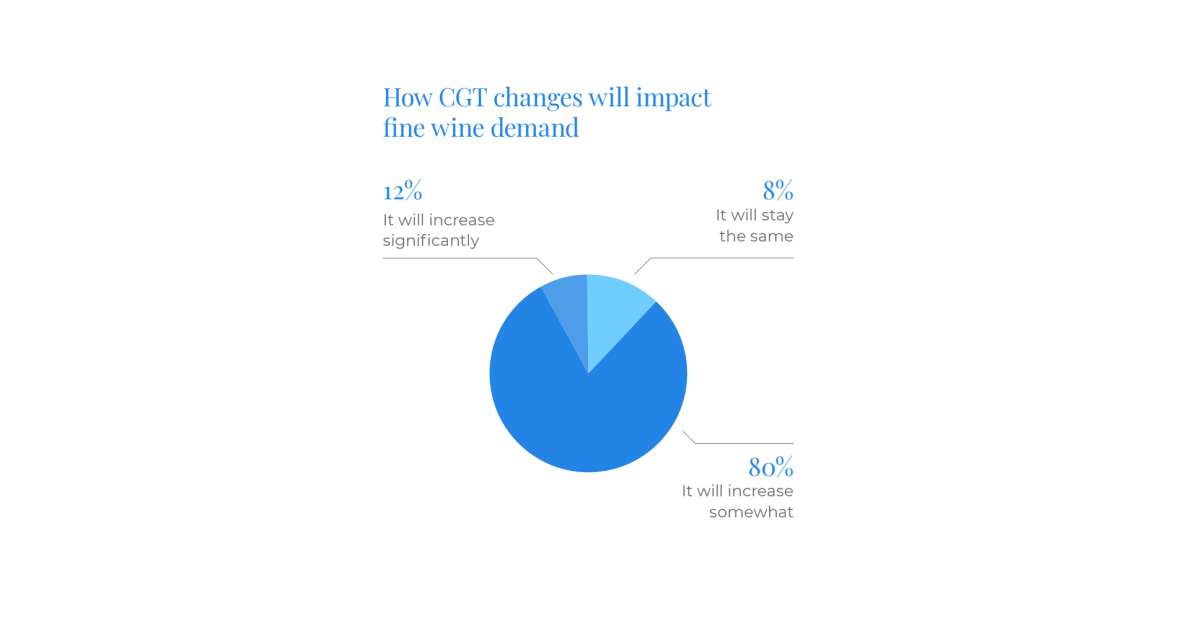
  • 80% of UK wealth managers believe demand for fine wine will rise due to its Capital Gains Tax exemption.
  • Fine wine is also a suitable asset for lifetime gifting.

Fine wine has always held allure – whether for its rich history and cultural value, collectability, or as a tangible luxury asset. But in today’s financial landscape, its unique tax status in the UK is also becoming a key driver of demand.

Under HMRC taxation rules, most fine wines are classed as “wasting assets” – physical goods with a useful life of under 50 years – making them exempt from Capital Gains Tax (CGT). At a time when tax-free allowances are shrinking and effective rates are rising, this treatment is increasingly attractive.

According to the primary research conducted for our WineCap Wealth Report 2025, 80% of wealth managers believe demand for fine wine will rise, specifically due to its CGT exemption. Beyond portfolio diversification and inflation-resistance, fine wine offers a compelling investment case owing to its tax efficiency. kkCGT tax pie chart

Why taxation matters in fine wine investment

When building a wine portfolio, most investors focus on selecting the right producers, vintages, and entry points. Yet, tax treatment can be just as important in shaping overall returns. Unlike stocks and bonds, fine wine occupies a nuanced space in UK tax law as both a chattel and a wasting asset.

By understanding these rules, investors can:

  • Shield profits from unnecessary tax erosion.
  • Structure transactions more strategically.
  • Plan inheritance and succession more effectively.
  • Reduce the risk of HMRC challenges.

CGT and fine wine

One of the most common questions investors ask is: “Do I pay Capital Gains Tax on fine wine?”

The General Rule

Most fine wine sales do not attract CGT, setting wine apart from property, art, or stocks. However, key exemptions and thresholds apply:

Wasting Asset exemption

  • Wines with a useful life under 50 years are classed as wasting assets and are generally CGT-exempt.
  • HMRC may challenge this in cases involving fortified wines or rare bottles intended for very long-term storage.
  • Best practice: Retain expert evidence at purchase to support expected lifespan.

Chattels exemption

  • Applies where a single bottle or set is sold for under £3,000.
  • If profits from a non-wasting asset (e.g., certain collectible bottles) do not exceed £3,000, CGT will not apply.
  • Where a “set” of bottles is sold to one buyer (e.g., a full case commanding a premium), the £3,000 limit applies to the total transaction, not each bottle.

Current allowances and rates

  • Annual CGT allowance: £3,000 (individuals) / £1,500 (trusts).
  • Gains above allowances taxed at: 18% (basic rate), 24% (higher rate).

Income Tax and fine wine

For most investors, Income Tax is not a concern. However, frequent trading could blur the line between investing and business activity.

  • If HMRC deems an individual a ‘trader’, profits may be taxed as income (up to 45%).
  • Occasional investors are safe, but high-volume sellers should seek specialist advice.

Inheritance Tax (IHT) and gifting

Unlike CGT, fine wine offers no special IHT reliefs. Upon death, portfolios are valued at market price and added to the estate:

  • IHT rate: 40% on estate value above £325,000 (nil-rate band).
  • Potentially higher thresholds: up to £500,000 if leaving a home to direct descendants, or £1 million for married couples/civil partners, depending on eligibility.

Fine wine, however, can be well-suited to lifetime gifting strategies – particularly where gifts qualify under Wasting Asset or Chattels Exemptions. As with all tax-sensitive decisions, individual advice is essential.

Best practices for tax-efficient fine wine investment

To optimise returns and reduce risk, investors should:

  • Keep meticulous records: purchase dates, prices, provenance, storage, lifespan assessments.
  • Support claims with expert evidence: especially for lifespan-based exemptions.
  • Seek independent tax advice: rules vary, and personal circumstances matter.
  • Plan long-term: consider inheritance and succession early.
  • Work with specialists: firms like WineCap provide research, portfolio monitoring, and guidance aligned with tax efficiency.

Investor sentiment: Beyond tax efficiency

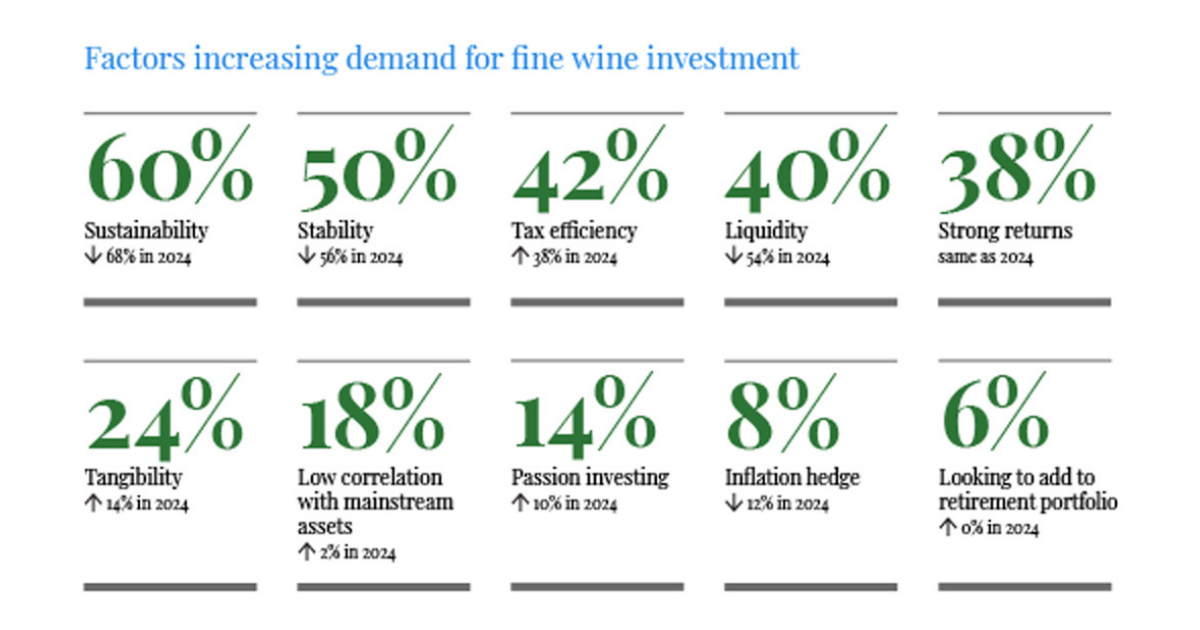
While tax advantages are increasingly influential, they are not the sole driver. According to WineCap Wealth Report 2025, sustainability (60%), stability (50%), and tax efficiency (42%) are among the strongest forces shaping fine wine demand.Fine wine demand

This blend of financial resilience, cultural heritage, and tax efficiency makes fine wine a unique and attractive addition to diversified portfolios.

While UK tax rules provide significant advantages – especially via CGT exemptions – structuring portfolios correctly and planning for inheritance remain essential. By combining careful portfolio building with tax-aware strategies, investors can unlock fine wine’s full potential as a stable, inflation-resistant, and tax-efficient asset class.

At WineCap, we offer the insights and expertise to help investors navigate both the markets and the tax landscape with confidence.

Read our up-to-date Fine Wine Taxation Guide.

Categories
Learn

Fine wine in the age of AI

  • AI has emerged as a transformative force in investment management. 
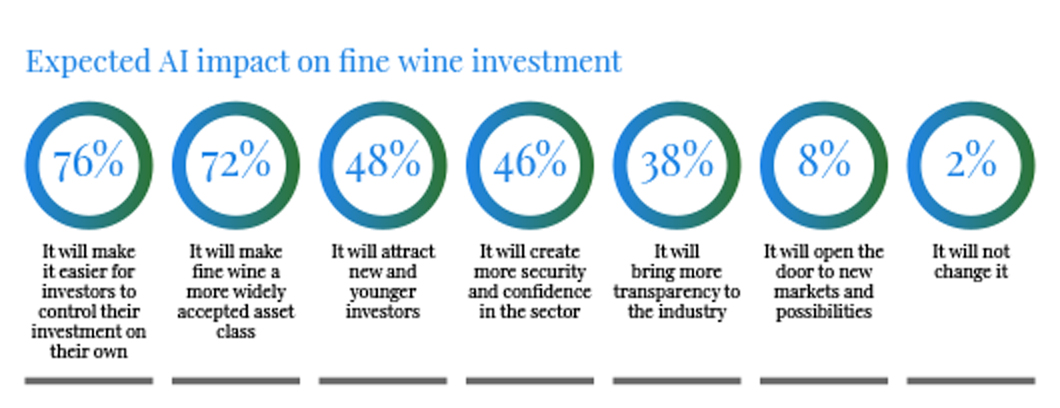
  • 98% of UK wealth managers expect AI to have a significant impact on fine wine investment in the next five years. 
  • Key areas include greater investor control, wider market acceptance and improved transparency.

Artificial intelligence (AI) has emerged as a transformative force in investment management, reshaping industries through advanced data analysis, predictive modelling, and automation. From equities to property, AI-powered tools can process vast amounts of information, identify patterns, and spotlight opportunities with unprecedented speed.

The fine wine sector, traditionally reliant on expert opinion, historical market trends, and insider knowledge, is now at the cusp of a similar transformation. AI is set to redefine how fine wine is valued, traded, and perceived within investment portfolios. Only 2% of WineCap’s latest survey respondents believe AI will have no impact on fine wine investment in the next five years. This overwhelming consensus highlights the disruptive potential of AI and its role in increasing market efficiency, accessibility, and transparency.

So, how exactly is AI poised to reshape fine wine investment? Insights from industry participants highlight several key areas of transformation.

Greater investor control: A shift away from brokers?

The most significant impact predicted by 76% of respondents is that AI will make it easier for investors to control their investments independently.

Historically, fine wine investment has required expertise from brokers, consultants, and wine merchants who provide insights into market pricing, provenance, and expected returns. 

However, AI-driven platforms might reduce reliance on intermediaries by offering investors real-time valuations based on live market transactions and historical performance, automated risk assessments and tailored portfolio strategies.

This shift means that both new and experienced investors will have more tools at their disposal to make informed decisions, potentially leading to a more democratised market.

Fine wine as a more widely accepted asset class

AI’s ability to provide data-backed insights is expected to enhance the credibility of fine wine as an alternative investment category. According to our survey, 72% of UK wealth managers believe AI will make fine wine a more widely accepted asset class.

Currently, one of the biggest barriers to institutional investment in fine wine is valuation inconsistency and market opacity. Unlike stocks, which trade on transparent exchanges, fine wine prices may vary across different auction houses and merchants. 

AI can help solve this problem through improved risk modelling, more accurate valuation algorithms and enhanced demand forecasting to predict which wines will appreciate over time.

With these advancements, institutional investors and wealth managers will find it easier to allocate capital to fine wine, increasing its legitimacy alongside other alternative assets like gold and property. 

Attracting a new generation of investors

Nearly 48% of our survey respondents believe AI will make fine wine investment more appealing to younger generations. This shift is critical as baby boomers – who have traditionally dominated fine wine collecting – begin to exit the market, and younger investors with a digital-first mindset step in.

AI-driven platforms might lower entry barriers for new investors by offering intuitive user interfaces similar to modern trading apps like Robinhood or Wealthfront and providing personalised investment recommendations based on user preferences and risk tolerance.

By enhancing accessibility, AI can help bring fine wine investment into the mainstream of digital wealth management, positioning it alongside equities and ETFs as a viable portfolio component.

Improved transparency in the fine wine market

Lack of transparency has long been a challenge for fine wine investors, making it difficult to track pricing trends, authenticate bottles, and assess liquidity risks. However, AI-powered analytics are poised to change this by introducing new levels of visibility and accuracy into the market.

According to the survey, 38% of respondents believe AI will bring greater transparency to the industry. Key improvements might include live tracking of historical price movements, enhanced authentication processes, and supply-chain analytics;

These improvements will increase investor confidence, reduce information asymmetry, and create a more efficient secondary market.

AI Impact on fine wine investment

WineCap Wealth Report 2025: UK Edition

What does the future hold?

While AI is still in the early stages of adoption in fine wine investment, the technology is already proving its value by enhancing investor control, broadening market access, and increasing transparency. The next five years are likely to see even greater integration of AI into fine wine investment strategies. Potential developments include blockchain integration, predictive analytics, and automated trading platforms.

As the fine wine investment landscape evolves, those who embrace AI-powered insights will gain a competitive edge, benefiting from greater market clarity and data-driven decision-making. The fine wine sector is on the brink of a technological revolution – one that could reshape how investors interact with and perceive this centuries-old asset class.

WineCap’s independent market analysis helps investors build diversified fine wine portfolios with full ownership and transparent pricing. Speak to one of our wine investment experts and start building your portfolio. Schedule your free consultation today.