Categories
Learn

The 2016 vintage: what investors need to know

  • If you’re thinking of investing in fine wine, there are good reasons to add 2016s to portfolios now. Critical opinion is set, and some prices are down significantly from their peaks
  • 2016 produced more 100-point Bordeaux and Napa wines than any harvest since 2000, led by Mouton Rothschild’s near-perfect sweep of every major critic.
  • Bordeaux, Rioja, Piedmont and Tuscany excelled in 2016, but white Burgundy, Alsace and much of Argentina and Chile fell short.

The quality of releases from a given year shapes the odds of a good investment, but it does not decide the outcome. A strong vintage lifts the quality floor, improving the odds that any single wine performs well. At ten years old, 2016 is still a young, actively traded vintage – many of its wines will have decades of life in front of them still. This guide sets out where it delivered, where it fell short, and what that means for investors now.

How good was the 2016 vintage?

A vintage gives investors a probability framework, but does not guarantee that every region or every wine from a region is a good investment.

2016 illustrates the point well. It produced some of the finest Bordeaux of the modern era, and delivered exceptional wines in Rioja, Piedmont and Tuscany too. The same year was far less kind to Chile, Argentina and Alsace, where a difficult growing season produced lesser wines across the board.

For investors, the regional headline is only the starting point. The quality of an individual wine, and more importantly the balance between that quality and a wine’s price, is much more consequential than the aggregate score of the vintage it comes from. A modestly rated 2016 bought cheaply can outperform a celebrated one bought at a premium, and a weaker region’s best producers can still reward a buyer who knows where to look.

What made 2016 a great growing season?

The late oenologist Denis Dubourdieu identified four conditions that reliably produce a great Bordeaux vintage, criteria investors can use to judge any region’s growing season, not just Bordeaux’s:

  • Early and rapid flowering, producing even berry development across the crop
  • Gradual water stress in July, slowing vine growth and concentrating the fruit
  • Warm, dry conditions through August and September, building phenolic ripeness (the development of flavour and tannin compounds in the grape skin) without heat damage
  • A dry harvest period, giving producers the flexibility to pick at optimal maturity

Bordeaux satisfied all four in 2016, and investors can see the result in the region’s pricing and scores. Flowering in early June was remarkably successful given an up-and-down spring, and it produced the region’s largest crop per hectare since 2004.

A near-total drought then set in from late June to mid-September, with many communes receiving barely a tenth of their normal rainfall, while cool nights preserved the acidity that hot, dry summers can strip away. Brief, well-timed rain in mid and late September refreshed the vines without triggering rot, and harvest proceeded through October in mostly dry conditions.

The result was fruit with concentration, freshness and near-total freedom from rot, the combination critics look for in a wine built to last decades in a cellar.

Where the growing season fell short

Not every region shares Bordeaux’s story. White Burgundy failed before the season had properly begun: severe frost in April 2016, the worst the Cote d’Or had seen since 1985, destroyed buds unevenly across the region. Chablis lost nearly its entire crop, and Grand Cru sites in Meursault and Montrachet were hit hard, while other nearby villages escaped almost untouched. The result was a small, patchy harvest rather than a uniformly weak one, which is why individual survivors can still be worth seeking out.

Argentina and Chile failed a different criterion. Both sit in the southern hemisphere, so their 2016 growing season ran from spring 2015 through harvest in early 2016, the opposite calendar to Bordeaux’s. An unusually strong El Nino brought heavy rain through the region’s flowering period and into harvest, disrupting the earliest part of the grape’s growth and forcing growers to pick earlier and in wetter conditions than they wanted. Yields fell sharply as a result. Some producers found an unexpected silver lining in fresher, lower-alcohol wines, but for investors the broader picture is a vintage that struggled against the same dry-flowering and dry-harvest conditions that made Bordeaux’s 2016 so strong.

Where 2016 scored best, region by region

The two independent critic platforms, Wine Advocate and Vinous, broadly agree on where 2016 succeeded and where it didn’t, which gives investors a reliable read on the vintage. 

Wine Advocate’s regional verdicts include:

  • Bordeaux: an amazing vintage overall, strong in every sub-region except a relatively weak Sauternes, the home of sweet white Bordeaux.
  • Burgundy: excellent in Burgundy’s red wine heartland of Cote de Nuits, merely good in the Cote de Beaune, and actively weak for white Burgundy; for Cote de Nuits reds, Wine Advocate rates 2016 slightly behind 2015, 2019 and 2005, on a par with 2020, and slightly ahead of 2010
  • Champagne and the northern Rhone: good growing seasons, but a step or two behind the very best. In Champagne, 2008, 2012, 2013 and 2019 are superior, in the northern Rhone 2010, 2015, 2018 and 2019 receive greater praise. 
  • Chateauneuf-du-Pape: an all-time great, only 1998, 2007 and 2010 boast the same strength
  • Rioja and Ribera del Duero: both had all-time great vintages in 2016
  • Piedmont and Tuscany: all-time greats, spanning Barolo & Barbaresco in Piedmont as well as Brunello, Chianti Classico and Bolgheri in Tuscany
  • Alsace: fair only, are a number of recent vintages enjoy higher scores
  • Argentina, South Australia and Chile: middling to good, but not exceptional
  • North Coast California Cabernet Sauvignon: one of the two or three best vintages ever
  • Willamette Valley, Oregon: very high quality

Vinous reaches a similar hierarchy independently. It rates 2016 an all-time great vintage on both banks of Bordeaux, agrees that Cote de Nuits edges out Cote de Beaune within Burgundy, concurs that 2015 is the slightly stronger Cote de Nuits vintage, and rates Barolo, Barbaresco and Tuscany as all-time greats too. The two platforms align again on Champagne, which Vinous also labels merely good rather than exceptional.

For investors, a 2016 Barolo or Napa Cabernet carries a far stronger tailwind than a 2016 white Burgundy or Alsace.

How 2016 compares with other great vintages

Wine Advocate’s own scoring history gives investors the clearest long-run comparison available, since it is the longest-established review platform with the publication’s archive stretching back over four decades of reviews. Counting 100-point scores across a sample of vintages since 2000, 2016 stands out clearly: it has 35% more 100-point wines than any other year in our sample, a gap wide enough to signal a genuinely exceptional harvest across multiple regions.

How 2016 compares with other great vintages

California is where the gap is starkest. 2016 produced 39 wines rated 100 points on Wine Advocate, more than double the next closest vintage, 2019, which recorded 21. The concentration of perfect scores in a single vintage is unusual even by Napa’s standards, and leaves investors with a wide variety of wines to choose from.

Bordeaux tells a slightly different story. It remains one of 2016’s strongest regions, but 2009 actually produced more 100-point wines on Wine Advocate than 2016. Regardless of the discrepancy, 2016 is exceptional in Bordeaux. A higher number of perfect scores for 2009 does not necessarily make it the better buy today.

The stand-out wines of Bordeaux 2016

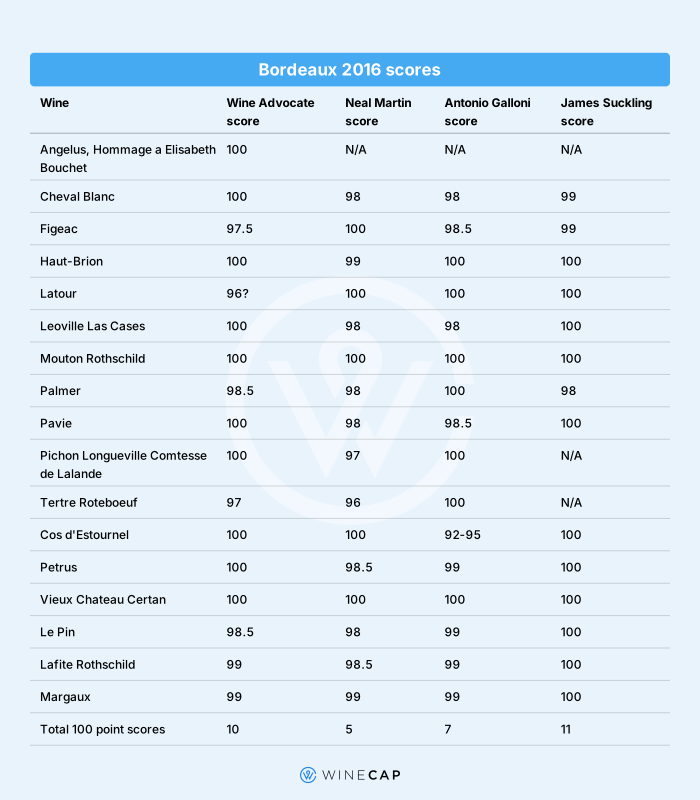
There are a great many high-scoring wines from Bordeaux’s 2016 vintage:

The stand-out wines of Bordeaux 2016

For quality four wines stand out in 2016 Bordeaux, and each shows a different shade of critical consensus:

  • Chateau Mouton Rothschild 2016: arguably the highest-scoring Bordeaux of all time, with perfect 100-point scores fromWine Advocate, James Suckling, Jeff Leve, Jane Anson, Lisa Perrotti-Brown MW, Jean-Marc Quarin, Chris Kissack and La Revue du Vin de France. Vinous’s two critics were emphatic: Antonio Galloni called it “breathtaking”, and Neal Martin said it “bowled him over”.
  • Chateau Latour 2016: close to a clean sweep of 100-point scores elsewhere, though Wine Advocate’s own published score is 96?, with William Kelley dissenting that the wine seemed to miss the purity and precision expected of a first growth in a great vintage, explaining the question mark by suggesting its wilder, more rustic character may integrate further with more bottle age.
  • Chateau Haut-Brion 2016: multiple 100-point scores, including from Wine Advocate, Antonio Galloni at Vinous and James Suckling.
  • Vieux Chateau Certan 2016: 100 points across the board, from Wine Advocate, Neal Martin, Antonio Galloni and James Suckling, a rare right-bank wine matching the left bank’s headline scores.

For investors, the spread of opinion is itself useful information. Mouton’s score is about as close to unanimous as fine wine criticism gets, which supports its position as the vintage’s benchmark. Latour’s solitary dissent is a reminder that even a wine covered in perfect scores can carry a genuine stylistic debate, one worth understanding before paying a premium for consensus that isn’t quite complete.

Why now is the moment to buy 2016

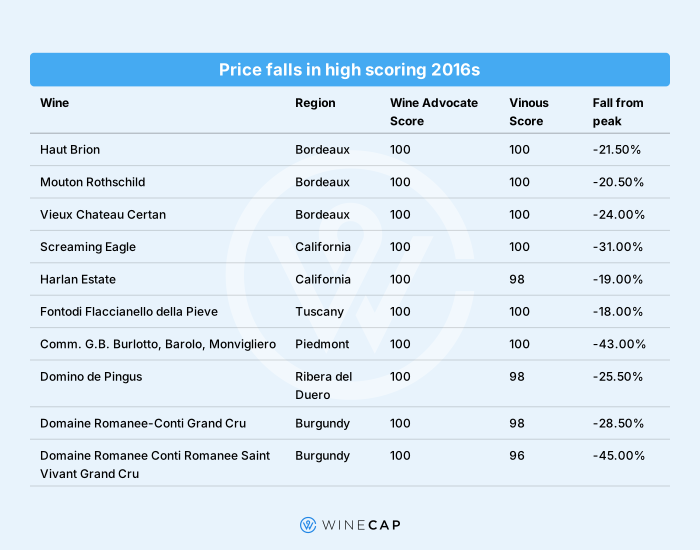
Ten years after harvest, 2016 has reached a point where patient buyers may find compelling reasons to add these wines to their portfolios. Most of these wines were released and first traded as the broader market climbed toward its 2022 and 2023 peak, and nearly all have fallen back since. Some have even fallen below their initial release price. Among the sharpest corrections are:Price falls in high scoring 2016s

That correction is not the only reason 2016 is attractive now. These wines remain common enough to trade actively, which keeps pricing honest: a buyer is unlikely to overpay due to complex price discovery. Most 2016s are yet to enter their drinking windows, so corks are not yet being pulled at scale, and the scarcity premium that comes with a wine entering its prime has not yet built up.

Condition risk is lower than the ten-year headline suggests too. Even Bordeaux’s 2016s, some of the earliest wines from the vintage to be bottled, have typically only been in bottle and with owners since 2018 or 2019.

Ten-year-on retrospective tastings of the Bordeaux 2016s were published earlier this year, and the results were strong enough and uniform enough to ease any concerns around quality and the perception of quality. That news did little to move prices or trading activity at the time, because the broader fine wine market was still in a cautious mood. Sentiment has improved since, which makes the current window an interesting one for investors.

A vintage this strong, in this many regions, makes it easy to assume every wine carries the same tailwind, but the gap between Mouton Rothschild’s near-unanimous perfect scores and a middling Alsace or Argentine 2016 shows how wide the spread within a single year can be.

Strong vintages and high scores are not automatically good investments, and weaker vintages and modestly scored wines are not automatically poor investments, but those need real value and tend to favour the biggest, most liquid brand names.

The wines worth buying now are the ones where an exceptional vintage, a strong individual score and a price that has genuinely corrected and then stabilised all line up together, not simply the ones carrying the most famous vintage year on the label. Ten years on, with prices having fallen, drinking windows still some way off, quality widely agreed upon and hype having died down, 2016 is entering the part of its life where that alignment is easiest to find for investors willing to look past the headline.

FAQ: the 2016 vintage

Is the 2016 vintage a good investment now?

It depends on the wine, not the vintage alone. 2016 is among the strongest Bordeaux, Piedmont and Napa vintages of the past two decades, and some of its best-scoring wines are trading 24% to 45% below their 2022 to 2023 peak. 

Why did white Burgundy perform so poorly in 2016?

A severe frost in April 2016 (the worst the Cote d’Or had seen since 1985), destroyed vine buds before flowering had even begun. Impact was uneven; some regions suffered near-total losses, others were able to harvest a crop, but often of lesser quality. A small number of survivors may be worth seeking out individually.

How liquid is the secondary market for 2016s?

Ten years on, 2016s remain actively traded, which is one of their attractions for buyers today. That liquidity, combined with prices well off their 2022 to 2023 peak, gives investors a genuine entry point rather than a chase for scarce stock.

Are 2016s ready to drink, and does that affect their investment case?

Most 2016s, particularly from Bordeaux, are not yet in their drinking windows, so corks are not being pulled at scale. That matters for investors because a wine entering its drinking window typically builds a premium as bottles get consumed and supply tightens. With that premium still ahead of most 2016s, current prices reflect trading value rather than drink-up demand.

How does 2016 compare with other strong vintages like 2009 or 2010?

It depends on the region and the metric used. Wine Advocate recorded more 100-point Bordeaux wines in 2009 than in 2016, even though 2016 has around 35% more 100-point wines overall than any other vintage sampled since 2000. For Cote de Nuits reds specifically, Wine Advocate rates 2016 slightly behind 2015, 2019 and 2005, but on a par with 2020 and slightly ahead of 2010. Comparisons need to be made vintage by vintage and region by region, not as a single global ranking.

WineCap’s independent market analysis helps investors build diversified fine wine portfolios with full ownership and transparent pricing. Speak to one of our wine investment experts and start building your portfolio. Schedule your free consultation today.

Categories
News

Michelin’s Wine ratings debut with a reach no critic can match, but an uncertain impact for investors

  • Michelin has launched its first wine ratings under its own name, scoring Burgundy and Bordeaux producers on a one-to-three “bunch” scale rather than reviewing individual wines.
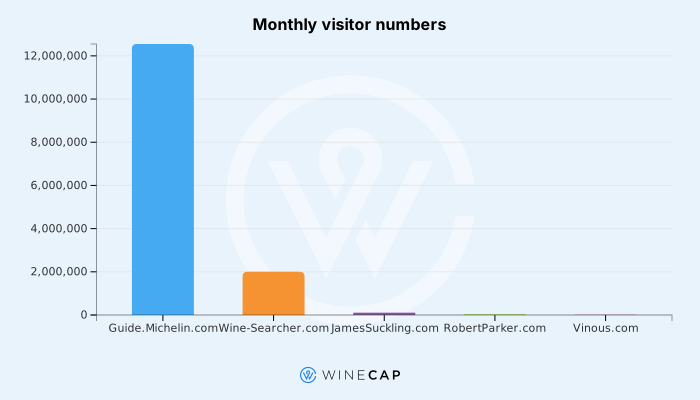
  • Michelin’s platforms attract roughly 12.5 million monthly website visitors, compared with 100,000 for Jamessuckling.com and 30,000 for RobertParker.com, the two largest wine review websites.
  • The data on Michelin’s market impact is genuinely uncertain, and it is far too early for investors to call any significant effect on prices.

Michelin, the tyre company just as well known for its starred restaurant guide, has moved into wine criticism for the first time under its own name, publishing producer-level ratings for Burgundy and Bordeaux that score estates rather than individual bottles. The launch last week follows years of indirect involvement rather than a standing start: Michelin has owned Robert Parker’s Wine Advocate brand and the Robert Parker domain outright since 2019, after acquiring a 40% stake in 2017, but has kept that ownership deliberately unbranded.

This means the group now has a direct editorial voice in the market it has only influenced from behind a separate name until now. The same corporate owner now sits behind both the Wine Advocate’s individual scores and Michelin’s producer-level tiers, concentrating critical influence over pricing signals in a way the trade has not previously had to account for. Our own review of pricing data has found no evidence yet that Michelin’s ratings have moved the market: Burgundy prices actually fell in July after Michelin published its first rankings before rising again in August. It is too early to draw any conclusion for Bordeaux, rated only a week ago, and Michelin’s decision to score producers rather than individual wines will make isolating any future effect harder than it would be under a bottle-by-bottle system. A platform with Michelin’s reach going unnoticed by the market indefinitely seems implausible, all the same.

Michelin’s reach eclipses every dedicated wine critic combined

Michelin’s audience is not simply larger than any individual wine critic’s, it is larger than the entire dedicated wine-criticism sector combined, by a wide margin.

Michelin monthly visitors

Michelin’s platform draws 12.5 million monthly organic visitors; that figure is built around restaurant and travel content rather than wine specifically, but it’s an audience that is now being exposed to new wine content, and it dwarfs any wine platform. 

Among the dedicated wine-critic platforms, James Suckling leads with just over 107,000 monthly visitors, followed by Robert Parker at 32,000 and Vinous at 7,600 – even Wine-Searcher, a price-comparison tool rather than a critic, reaches around 2 million. One can argue that visitor count alone misstates the importance of certain critics.

Regardless, while it’s too soon to infer impact on values and trading history the scale of Michelin cannot be a marginal addition to how the market forms opinions about producers, whatever reservations the trade holds about the approach behind it.

Michelin ranks producers, not individual wines

Michelin’s ratings score estates rather than specific bottles or vintages, a conspicuous departure from how every established wine critic operates, and one that has unsettled parts of the wine trade.

The criticism has focused on Burgundy, where Michelin’s reviews debuted earlier in the summer. Here in particular, the small differences between producers farming adjacent rows in the same vineyard can matter enormously to specialists and have a meaningful impact on price.  The argument being that a producer-level score flattens exactly the distinctions the most active and informed buyers care most about. 

Behavioural evidence cuts the other way for a broader audience though: detail beyond a certain point tends to disengage casual buyers rather than draw them in, and a simpler producer-level signal is likely to travel further than a vintage-by-vintage one. The approach also reads as a deliberate fit with who already reads Michelin. Diners who use the Michelin Guide for restaurants are accustomed to spending significant sums on food and to treating price and reputation as a reasonable proxy for quality, and that same heuristic translates naturally into ranking wine producers rather than parsing individual releases. Michelin was never going to serve the specialist audience that Vinous and the Wine Advocate already own; the producer-level format targets everyone else, and that is a considerably larger pool.

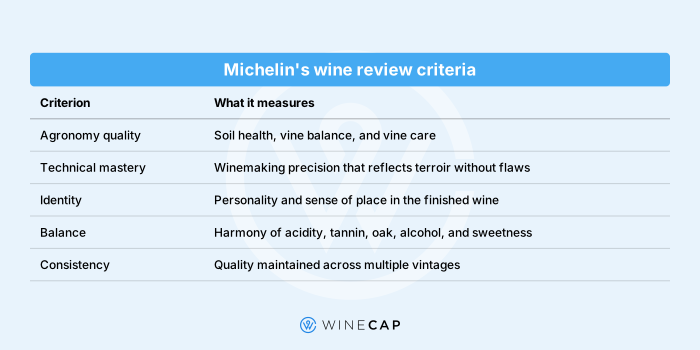
The scoring system rewards consistency across five criteria

Michelin scores producers on a scale of one to three “bunches,” its equivalent of the star system it uses for restaurants, applying five standard criteria to every estate:

Michelin's Wine Review

The inclusion of consistency as a standalone criterion is the clearest signal of intent, Michelin is rating a producer’s ability to repeat quality year after year, not rewarding a single outstanding vintage, which is exactly the kind of judgment long-term investors already need to make about an estate before committing capital to it.

Burgundy’s rankings confirm the obvious and surprise on the rest

The top of Michelin’s Burgundy list holds no surprises: Domaine Leroy, Domaine de la Romanee-Conti, and Domaine d’Auvenay all take the highest three-bunch tier, consistent with where the market has long placed them. 

The largest surprise sits at the one-bunch level. Armand Rousseau, rated with a single bunch, is the sharpest divergence between Michelin’s score and the estate’s standing across the whole list. Armand Rousseau’s wines can approach £8,000 a bottle in the very best vintages, and prices of their Chambertin cuvees have shown no impact from their one-bunch rating. 

Bordeaux’s results raise as many questions as they answer

Bordeaux’s top tier splits into two groups worth separating. Chateau Lafite Rothschild, Chateau d’Yquem, Chateau Cheval Blanc, Chateau Lafleur, and Chateau Petrus earned the top three-bunch score that their market position already assumes. Chateau Montrose and Chateau Leoville Las Cases join them in the top tier too; perhaps a surprise for investors, but not a shock, given the quality they’ve displayed in recent vintages. 

Three other first growths, Chateau Mouton Rothschild, Chateau Margaux, Chateau Haut-Brion, sit in the second tier and are the first surprise. The most striking result, though, is what is missing entirely: no shows for Chateau Ducru-Beaucaillou, Chateau Leoville-Poyferre, and Chateau Pavie, eclipsed by the absence of Chateau Latour. 

Neither Michelin nor Latour has said whether the estate declined to take part or whether inspectors excluded it, and that silence has left the gap open to speculation rather than explanation. Regardless of the reasons its absence is notable, and given the inclusion of another property under the same ownership (Clos de Tart) in the Burgundy ranking, quite a surprise.

Impact on wine investors

So far, there is no evidence that Michelin reviews have impacted prices for Burgundian wines, in fact, Burgundy prices fell in July, the month reviews were published. Certainly, it is too soon to make any pronouncement about an impact on Bordeaux wines, and Michelin’s decision to review at a producer level will make measuring an impact harder.  However, it seems implausible that a platform with the reach of Michelin will not have some impact on the market.

WineCap will be particularly watching for an impact on the prices for wines that have not been included, and those where rankings are substantially lower than might have been expected.

Wine criticism now has a mass-market gatekeeper

Michelin has turned wine criticism into a mass-audience business for the first time, rather than a specialist one the trade debates among itself. Whatever reservations Burgundy and Bordeaux’s most exacting buyers hold about a producer-level lens, an audience the size of Michelin’s does not need the wine trade’s approval to shape how the next generation of buyers finds its way into the category. The professional argument over vineyard-level nuance will likely run for years; the audience Michelin has just brought into wine criticism will decide the more commercially important question first.

FAQ: Michelin’s wine ratings

What is Michelin’s wine scoring system? 

Michelin scores producers, not individual wines, on a one-to-three “bunch” scale assessed against five criteria: agronomy quality, technical mastery, identity, balance, and consistency across vintages. A three-bunch rating is the highest distinction, akin to three stars for their restaurant guides.

Why does Michelin rate producers rather than individual wines?

The approach mirrors how Michelin’s existing food-guide audience already assesses quality in a restaurant rather than judging every dish individually. A producer-level system is also a more approachable entry point for Michelin’s much larger readership.

Is Michelin’s wine judgment independent, given it also owns Robert Parker and the Wine Advocate? 

Michelin has owned the Wine Advocate outright since 2019, having built a 40% stake in 2017 after Robert Parker sold his majority holding in 2012. It kept that ownership unbranded for seven years, and its new producer ratings are the first wine product to carry the Michelin name directly.  Michelin’s CEO has been clear that the new guide is not intended to replace The Wine Advocate.

Why is Chateau Latour missing from Michelin’s Bordeaux rankings? 

Neither Michelin nor Latour has said whether the estate declined to participate or was excluded by inspectors, leaving the reason unexplained for now.

How does Michelin’s audience compare with existing wine critics?

Michelin’s platforms attract an estimated 12.5 million monthly organic visitors, more than 100 times James Suckling’s 100,000 and well over 400 times Robert Parker’s 30,000. Even Wine-Searcher, a price-comparison site rather than a critic, draws only around 2 million monthly visitors by comparison.

What does Michelin’s entry mean for fine wine investors? 

The scale of Michelin’s audience suggests its producer tiers will shape buyer attention, and by extension pricing, for estates placed in the top tier without already commanding blue-chip prices, a dynamic worth watching most closely outside the small group of producers, such as Petrus or Domaine de la Romanee-Conti, whose position was never really in question.

WineCap’s independent market analysis helps investors build diversified fine wine portfolios with full ownership and transparent pricing. Speak to one of our wine investment experts and start building your portfolio. Schedule your free consultation today.

Categories
Learn

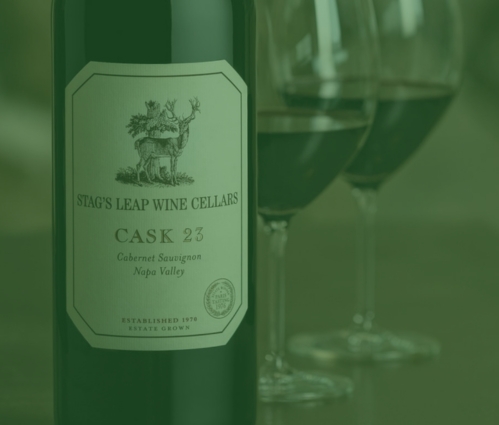
Stag’s Leap Wine Cellars: 10 things investors should know

  • Stag’s Leap Wine Cellars owes its collector premium to the 1976 Judgement of Paris, a blind tasting that changed the global perception of California wine.
  • The winery fought a three-way trademark battle over its name, solved by an apostrophe and sealed by a one-off wine.
  • Cask 23, S.L.V. and Fay are the estate’s most prestigious wines, but they trade less often than Napa’s most liquid cult names.

Stag’s Leap Wine Cellars holds a defining place in Napa Valley history, and not only because of what is in the bottle. Its 1973 Cabernet Sauvignon (without SLV branding at the time) beat Bordeaux’s finest at the 1976 Judgement of Paris, a result French judges tried to disown almost as soon as it was announced. The estate then spent over a decade fighting neighbours over the right to its own name and then the American A.T.F. over regional wine branding. For investors, that history explains the wine’s profile and why buyers need to know exactly which “Stags Leap” they are actually holding.

1. The Judgement of Paris is the real source of the premium

Stag’s Leap Wine Cellars did not build its reputation through decades of steady marketing. It was built in a single afternoon, on 24 May 1976, at the InterContinental Hotel in Paris. British wine merchant Steven Spurrier organised a blind tasting pitting a handful of upstart Californian wines against Bordeaux and Burgundy’s finest, largely as a bicentennial publicity exercise. 

The panel was a who’s who of the French wine establishment itself. Judges included Aubert de Villaine, co-director of Domaine de la Romanee-Conti, Odette Kahn, editor of La Revue du Vin de France, and Pierre Brejoux, inspector general of the Appellation d’Origine Controlee Board, alongside the owners of Chateau Giscours and the restaurant Taillevent. When the scores were tallied blind, Stag’s Leap Wine Cellars’ 1973 Cabernet Sauvignon placed first among the reds, ahead of Chateau Mouton Rothschild 1970 and Chateau Haut-Brion 1970. Odette Kahn reportedly asked for her scorecard back once she realised how she had voted.

2. Time magazine’s report is why the story survived

The result would have counted for little without coverage, and almost none arrived. Only one journalist attended the tasting, George Taber of Time, who happened to be enrolled in Spurrier’s wine school. His report ran unbylined, four paragraphs long, on page 58 of the 7 July 1976 issue. The importance attached to this label today traces back to coverage that almost did not happen.

Taber coined the phrase “Judgment of Paris” on the spot, borrowing from the Greek myth in which the Trojan prince, Paris, judged a contest between three goddesses. The French press largely ignored the result for years, unwilling to give it credibility. It was Time’s brief item, not French coverage, that turned the tasting into the reference point investors and collectors still cite today.

3. The rematch

A single blind tasting could be dismissed as luck, and French critics spent years arguing both that, and also that the French wines would naturally dominate as they aged. The claim did not survive.  

Rematches in 1978, 1986, and a 30th anniversary tasting in 2006 delivered much the same results. At the 30th-anniversary re-tasting in 2006, organised simultaneously in London and California, California reds swept the top five places outright, with Ridge Monte Bello 1971 winning both legs of the event.

Stag’s Leap Wine Cellar’s owner Warren Winiarski’s path to that 1973 vintage is remarkable. He left a lecturing post in political science at the University of Chicago to make wine in Napa, persuaded in part by a homemade Cabernet his neighbour Nathan Fay had been producing since 1961. He planted vineyards in 1970, and 1973 was his second vintage and the first produced entirely at the estate in commercial quantities.

In July 2026, a single bottle of the 1973 sold at auction for $22,500.

4. Stag’s Leap vs Stags’ Leap Vs Stags Leap

Fame complicated things almost immediately. Another Napa property traded on much the same name, and other owners in the region shared the identity as a regional brand. After 1976, all had strong reasons to want it exclusively. The primary legal battle was between Warren Winiarski, Stag’s Leap Wine Cellars owner and Carl Doumani of Stags’ Leap Winery. Eventually, a California Supreme Court judge decreed that they could both use the name with apostrophes in different places, making it wine’s most important punctuation mark. For investors and collectors, confirming exactly which “Stags Leap” a bottle comes from is a genuine due-diligence step, since the labels remain easy to confuse decades later.

Appropriately, Winiarski & Doumani sealed their agreement with a wine blended equally from their two properties. The wine was appropriately named “Accord” and only released once for the 1985 vintage. It has been many years since a bottle has come for sale at auction, and none is currently advertised for sale. The last price in 2024 was £795 a bottle, which would make it the second most expensive wine from Stag’s Leap Wine Cellars, and the most expensive from Stags’ Leap Winery. 

5. The history of the Stags Leap District AVA

A decade later, Winiarski and Doumani were on the same side of another legal battle, this time against the US Bureau of Alcohol, Tobacco and Firearms and its designation of Napa’s fourth American Viticultural Area (AVA), the Stags Leap District AVA. 

It was a battle they would both lose, and today any wine made from at least 85% fruit grown in the district can carry “Stags Leap District” on its label, regardless of which producer it’s from.

Located just north of the town of Napa, the AVA is a narrow strip on the valley floor, separated from the main valley by a small range of hills. At just over 1000 hectares, it is one of the USA’s smallest AVAs, and is occupied by fewer than 20 wineries.

6. The house style

Two adjoining vineyards, farmed on different soils, are behind the estate’s three best-known wines. S.L.V.’s volcanic, free-draining ground produces the darker, more structured Cabernet, while Fay’s alluvial soils give a softer, more perfumed wine that drinks earlier. Cask 23 combines them both.

Cask 23, the estate’s flagship wine, isn’t a fixed recipe:

  • The blend ratio moves with the vintage – the 2019 combined 52% S.L.V. with 48% Fay.
  • The estate has skipped Cask 23 in eight vintages since 1974, including 1980, 1981, 1982, 1988, 1989 and 2011, when the component wines did not meet its standard.
  • Recent releases are aged in 100% new French oak for around 20 months and reach nearly 15% alcohol, without reading as heavy or over-extracted.

The willingness to skip a vintage rather than make a subpar release is always a meaningful statement about a producer and signals a pricing floor and a quality level the estate is prepared to protect.

7. Antinori’s full ownership continues their involvement

Marchesi Antinori has held a minority stake since the 2007 sale, paying $185 million in a joint venture with Washington state’s Chateau Ste. Michelle. In 2023, they acquired full ownership, placing the estate under the control of one of the world’s longest-established wine families and the 10th oldest family-owned company in the world. The house style has stayed centred on the same S.L.V., Fay and Cask 23 hierarchy throughout.

Under Antinori’s ownership, the vineyards have also moved towards regenerative farming with S.L.V. and Fay receiving Regenerative Organic Certified status at the end of 2024, becoming the first vineyards in the Stags Leap District AVA to do so. Practices include:

  • Cover cropping and reduced tillage to protect soil structure.
  • Sheep grazing in place of mechanical mowing.
  • Protection of habitats and biodiversity.

Certification is not an investment argument on its own, but it signals a long ownership horizon and a commitment to quality.

8. Stag’s Leap Wine Cellar’s place in a portfolio

Stag’s Leap Wine Cellars is an iconic wine that played a key role in the development of American viticulture. However, it does not offer the same depth of secondary market trading as Napa’s most liquid names.

US wines accounted for around 8% of trade on Liv-ex in 2026, up from roughly 1% a decade earlier, but that trading activity is concentrated on a few names. The same is true with search data. None of Stag’s Leap’s investable wines is within the top 25 most searched-for American wines. That does not rule out Stag’s Leap as an investment, but it changes the focus and the emphasis.

9. Current pricing sits below Napa’s cult tier

At the top tier, Napa makes some of the most costly wines in the world from producers like Realm, Promontory, and Screaming Eagle. Stag’s Leap makes wines at a broad range of prices, but its top end remains considerably more affordable, and its most costly wines are on par with Bordeaux Super Seconds:

  • Cask 23: From £1,800 per case, Wine Track average at 2,552 per case.
  • S.L.V.: From £1,500 per case, Wine Track average of £1,720 per case
  • Fay: From £1,200 per case, the Wine Track average of £1,350 per case
  • Artemis: From £500 a case, Wine Track average of £750 a case

These prices sit well below Napa’s cult tier. The most viable investment wines are Cask 23, S.L.V. and Fay, which carry the estate’s strongest brand power. Artemis and the estate’s white wines are better understood as part of the producer’s broader commercial range.

10. History supports the investment case, liquidity limits it

Stag’s Leap Wine Cellars helped change the international standing of Napa Cabernet, and its significance extends well beyond the result of one blind tasting. Certainly the estate has a richer story than most Napa producers, but that doesn’t reflect the reality of investing in these wines.

Pedigree must still be weighed against market depth. The estate’s leading wines offer provenance, ageing potential and prices below Napa’s most expensive labels, but they trade less frequently, and buyers must be certain which “Stags Leap” they are actually acquiring. They are therefore best suited to collectors willing to hold for the long term, and accept a slower route to resale.

FAQ: Stag’s Leap Wine Cellars

What is the difference between Stag’s Leap Wine Cellars and Stags’ Leap Winery?

They are separate producers that fought over the same name before a court resolved the dispute by apostrophe placement: Stag’s Leap Wine Cellars keeps it before the S, Stags’ Leap Winery after. The two have no ownership connection. Stag’s Leap Wine Cellars, maker of Cask 23, S.L.V. and Fay, is owned by Marchesi Antinori; Stags’ Leap Winery sits within Treasury Wine Estates, best known for their ownership of Penfolds.

Which Stag’s Leap Wine Cellars wine is the most collectable?

Cask 23 is the flagship and generally the most collectable wine in the range. It is made from selected S.L.V. and Fay lots and has not been released in every vintage. S.L.V. carries particular historical weight as the vineyard behind the 1973 Cabernet that won the Judgement of Paris.

How liquid is the secondary market for Stag’s Leap Wine Cellars?

Liquidity is thinner than for Napa’s most actively traded labels. Sellers should allow sufficient time for resale.

What holding period suits these wines?

The estate wines are best approached as long-term holdings. Fay can be accessible earlier, while S.L.V. and Cask 23 generally reward more time, but all three have drinking windows that extend comfortably to 20 years after their harvest. More affordable wines like Artemis will still have a viable lifespan of 15 years or more.

WineCap’s independent market analysis helps investors build diversified fine wine portfolios with full ownership and transparent pricing. Speak to one of our wine investment experts and start building your portfolio. Schedule your free consultation today.

Categories
News

Opus One 2023 leads a mixed autumn 2026 La Place campaign

  • Opus One’s 2023 release stands out as the strongest of autumn 2026’s La Place campaign so far, with Antonio Galloni’s highest-ever score for the estate.
  • Solaia’s 2023 vintage has launched at RSPs well above the market price for back vintages.
  • Klein Constantia’s Vin de Constance 2023 is also releasing above back vintages, ahead of its first critical reviews.

Autumn 2026’s La Place release campaign got underway last week, following the spring En Primeur season that itself proved a mixed bag for buyers. Approximately a dozen international releases are out so far, spanning Tuscany, Chile, South Africa, the United States and Bordeaux itself, and the results are far from uniform: one is a clear standout, and there are equally clear examples of estates missing the mark.

Our own price and critic score tracking across the vintage history of three of the campaign’s biggest releases – Klein Constantia’s Vin de Constance, Solaia and Opus One – points to a campaign where pricing discipline, not critical acclaim alone, is what will separate the winners from the rest.

Autumn 2026 La Place releases open on a mixed note

This year’s roster includes some of the biggest names in fine wine. As usual, the autumn La Place campaign is smaller and quieter than the spring equivalent. In what looks like a transitional year, highlights of the campaign include:

  •     Opus One (Napa Valley)
  •     Masseto (Tuscany)
  •     Solaia (Tuscany)
  •     Penfolds Grange (South Australia)
  •     Stag’s Leap (Napa Valley)

The spring campaign’s mixed reception has left buyers watching this round more closely than usual for signs that pricing, not just quality, is being taken seriously.

Notable absences include Beaucastel’s Hommage a Jacques Perrin and Philipponnat’s Clos des Goisses, while Bibi Graetz left the platform altogether in 2025.

Merchants and buyers are still calling for a focus on value, a refrain negociants have been repeating since before the spring campaign began. It is too early to fix on a theme for autumn 2026, but the releases so far suggest pricing discipline will decide which wines find buyers and which sit on merchants’ shelves.

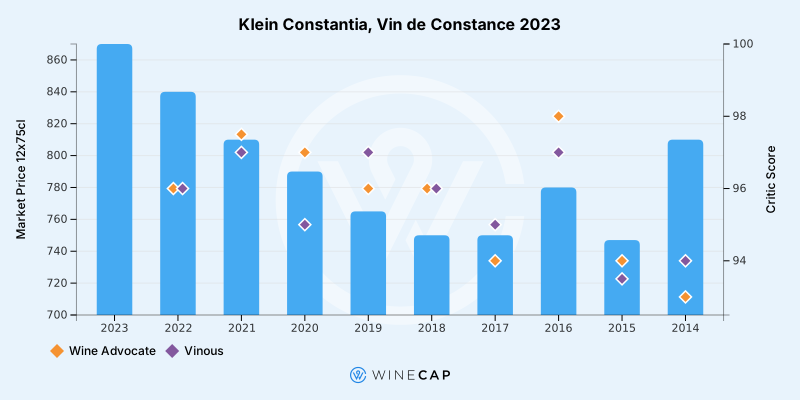
Klein Constantia’s Vin de Constance 2023 arrives at a premium price

Klein Constantia’s Vin de Constance 2023 is priced at £290 for six 50cl bottles – equivalent to £870 on our standardised 12x75cl basis. Vin de Constance is the Constantia valley’s revival of a historic Cape dessert wine. On search rankings, it sits behind only a handful of the very highest-profile Sauternes and amongst the top 200 most searched-for wines overall.

Klein Constantia's Vin de Constance 2023

The 2023 has not yet been widely reviewed, so investors buying now are pricing ahead of critical confirmation rather than in response to it. Vin de Constance’s critic scores have ranged from the low 90s to just short of 98 over the past decade, so a strong debut score for the 2023 is plausible, but not guaranteed – and buyers are, in effect, betting on it.

For portfolios that already lean on Bordeaux and Napa, Vin de Constance offers geographic and stylistic diversification. That case works best, though, when the entry price isn’t already ahead of the wine’s own trading history, which is exactly the position the 2023 puts investors in.

Solaia 2023 launches above recent vintage value

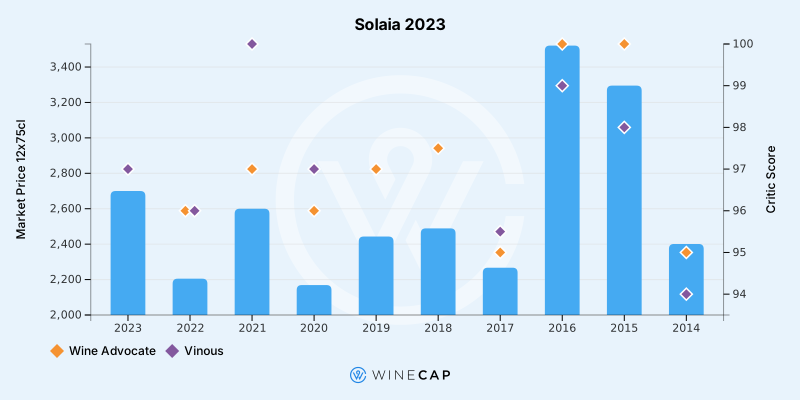
Solaia has been released at an RSP of £3,300 per 12x75cl case, though it is already being advertised as low as £2,700 – a gap wide enough to suggest negociants are testing what the market will bear. The wine is one of Tuscany’s standout wines, a blend built around Cabernet Sauvignon rather than Sangiovese, and search-interest data ranks it as the fifth most searched-for Tuscan wine.

At £3,300, only the two Wine Advocate 100-point vintages – 2016 and 2015 – carry a higher market price than the 2023. That is a high bar to price against, and the comparison with more recent vintages is less flattering: our data puts the 2020 at around £2,160, meaning the 2023’s RSP sits more than 30% above it. Even at the discounted £2,700 already being advertised, Solaia 2023 remains a meaningful premium over other vintages. For investors weighing entry points, discounting alone does not create value if the underlying vintage still doesn’t clear the bar set by its own back catalogue.

Solaia 2023

Negociants may be betting that Antinori’s branding carries the release regardless of the numbers, but on our data, investors have better entry points among Solaia’s own back vintages already trading in the market.

Opus One 2023 stands out as the campaign’s strongest release

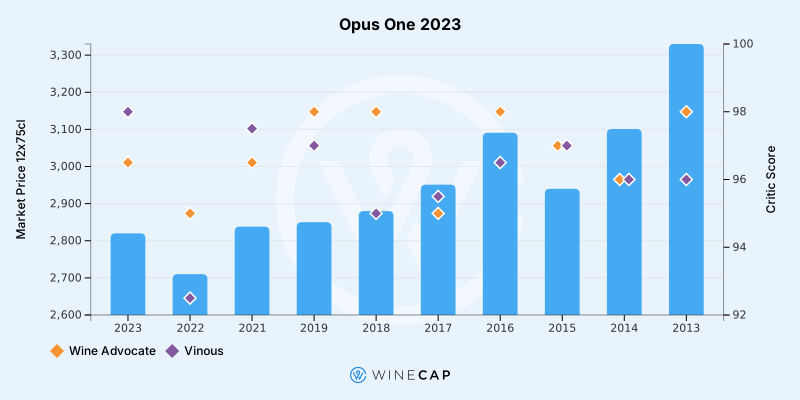
Opus One’s 2023 vintage is the highest-profile release of the campaign so far, arguably the best value. It is Antonio Galloni’s highest-scoring vintage yet for the estate at Vinous and the wine also scores well at Wine Advocate – though the 2019 and 2018 vintages score higher there, the 2023 is reviewer Joe Czerwinski’s highest scoring release at the publication.

Opus One is the Napa Valley joint venture between Robert Mondavi and Baron Philippe de Rothschild’s Mouton Rothschild, first released in the early 1980s, and it remains the most searched-for US wine.

Opus One 2023

Our data shows significant growth (circa 300%) over the past two decades, though it has been more muted in recent years. The 2023’s release price, at roughly £2,820 for a 12-bottle case, sits comfortably within that range or other recent releases.

The wine’s standing on the secondary market reinforces the case: Opus One finished 9th in the 2025 Liv-ex Power 100 rankings and 20th among the exchange’s most traded wines. Over the past decade, it has built a reputation as one of the most consistently traded wines from outside Bordeaux. This track record supports its case as a portfolio anchor. For investors, a record score landing on stable pricing is a strong combination.

Another important La Place release this year has been Masseto, which has released at £1,440 for a three bottle case. Its 2023 scores sit below most of the vintage’s own back-catalogue, well off the 98–100 scores it picked up in 2010, 2015 and 2016, and it’s priced in line with higher scoring recent vintages from 2017-2022 reducing its appeal.

The pattern for autumn 2026 is still taking shape

So far, autumn 2026 has produced one clear standout in Opus One, with other examples showing estates pricing ahead of the value negociants keep promising, and a campaign that overall reads as smaller and more cautious than the spring. Whether that caution turns into genuine repricing, or whether estates hold their nerve on RSP regardless of what the secondary market says, will only become clear as more of the campaign’s headline names come to market in the coming weeks.

Investors weighing entry points into this campaign should treat pricing discipline, not headline scores alone, as the signal worth following. We’ll be watching closely, and reporting back as it does.

FAQ: Autumn 2026 La Place releases

What is the autumn 2026 La Place “hors Bordeaux” campaign?

It is the annual non-Bordeaux release window on La Place de Bordeaux’s negociant network, covering international estates such as Opus One, Solaia and Klein Constantia. This year’s campaign began at the end of last week and has produced around a dozen releases so far, spanning Tuscany, Chile, South Africa, the US and Bordeaux. It follows a spring En Primeur campaign that was itself a mixed bag for buyers.

Why did Bibi Graetz leave La Place de Bordeaux?

Bibi Graetz departed the platform in 2025 after negociants, squeezed by the market conditions that emerged from 2023 onward, became unwilling to commit stock to wines outside Bordeaux itself. His exit is one of several notable absences from this year’s autumn roster, alongside Beaucastel’s Hommage a Jacques Perrin and Philipponnat’s Clos des Goisses.

Is Opus One 2023 good value compared with earlier vintages?

On our tracking, yes: the 2023 releases at roughly £2,820 per 12-bottle case (£1,410 for six), well within the range the wine has traded at for the past couple of years. It is also Antonio Galloni’s highest-scoring vintage yet for the estate at Vinous. That combination of a high score and fair pricing is an attractive offer.

Which major estates are missing from this year’s autumn campaign?

Beaucastel’s Hommage a Jacques Perrin and Philipponnat’s Clos des Goisses are both notably absent this year, and Bibi Graetz has left La Place altogether. Their absence, combined with a generally smaller roster than the spring campaign, is part of why we’re reading autumn 2026 as a transitional year.

Is now a good time to buy into the autumn 2026 releases?

It depends on the wine: our data suggests Opus One 2023 offers a rare combination of a record critic score and stable pricing, while Solaia and Vin de Constance 2023 carry premiums over recent vintages that aren’t yet backed by critical confirmation. With only ten of a dozen-plus releases reviewed so far, we think it’s too early to call a verdict on the campaign as a whole.

WineCap’s independent market analysis showcases the value of portfolio diversification and the stability offered by investing in wine. Speak to one of our wine investment experts and start building your portfolio. Schedule your free consultation today.

Categories
Learn

Wine investment: The complete 2026 guide

  • Wine investment means buying investment-grade wine, stored in bond, to sell later at a higher price: a long-term, unregulated alternative asset, not a savings product.
  • The Liv-ex 100 index fell 2.5% in 2025 after a three-year correction, and posted signs of stabilisation through the first half of 2026.
  • Realistic planning assumes a five to ten year hold, annual storage and management costs, and full awareness that prices fall as well as rise.

Wine investment is the purchase of a small, tightly defined group of wines with the aim of selling them later at a higher price. This guide explains the full mechanics for UK investors: what qualifies as investment grade, how buying and ownership work, what it costs, what returns the indices actually show, the risks, the tax position, and how to build and eventually exit a first portfolio. 

What wine investment actually is

Wine investment is narrower than wine collecting. An investor buys specific wines, almost always in sealed original cases, stores them professionally, and sells once age and scarcity have moved the price. The wine itself is the asset: there is no dividend, no coupon and no income along the way. Returns come entirely from the difference between purchase and sale price, minus costs.

The market that makes this possible is the secondary market (the trade in wines after their original release), where merchants, brokers and exchanges match sellers with buyers worldwide. London sits at its centre. Liv-ex, the London-based fine wine exchange, provides the price benchmarks the industry works from, and its indices function much like equity indices do for shares.

Scale matters here. This is a boutique market, not a deep one. Fewer than a few hundred wines trade with genuine regularity, and even the most liquid names change hands in cases, not milliseconds. That structure shapes everything that follows: pricing, holding periods, costs and exit routes.

What makes a wine investment grade

Investment-grade wine is defined by demand that outlives supply. A tiny fraction of global production qualifies, and the tests are consistent across regions. WineCap’s article on which types of wine are considered investment-grade treats this in depth; the short version follows.

  • Producer pedigree. The estate has a long record of critic scores and secondary market demand: Bordeaux classed growths, Burgundy’s top domaines, prestige Champagne houses, Tuscany’s leading estates, and a small group of Rhone, Spanish and Californian names.
  • Ageing capacity. The wine improves, or at least holds, for decades. A wine that must be drunk within ten years rarely builds secondary market value, and ageing capacity also matters for tax treatment, covered later in this guide.
  • Scarcity with consumption. Production is limited and bottles are steadily drunk, so supply of any vintage only falls over time.
  • Provenance and format. Original wooden cases, bonded storage history and clean documentation command the strongest prices. Broken cases and unverifiable storage attract discounts or no bid at all.
  • A liquid market. The wine trades often enough for prices to be observable. WineCap’s Wine Track database follows around 3,750 investment-relevant wines for exactly this reason.

A useful mental model: the market pays for predictable excellence. Petrus, the subject of WineCap’s guide to the world’s most valuable Bordeaux wine, commands its prices because roughly six decades of vintages have taught buyers what a bottle is worth. New names enter the investment grade slowly, over many vintages, not on one good review.

Why investors put money into fine wine

The investment case rests on structural features of the market rather than any promise about returns. Investors typically cite four.

Supply falls while demand can grow. Each investment-grade vintage is fixed at bottling, and consumption removes stock every year. A 2005 Bordeaux First Growth becomes scarcer every time a bottle is opened, and no producer can make more of it. Few asset classes have supply that mechanically shrinks.

Low correlation with financial markets. Fine wine prices respond to their own supply and demand cycle, critic reassessments and collector wealth rather than to quarterly earnings. Wine still fell in the 2022 to 2025 downturn, so low correlation never means immunity, but drivers differ from equities and bonds, which is why some investors use wine as a diversifier within a broader portfolio. WineCap’s overview of the wine investment market covers this dynamic in more detail.

A tangible, insurable asset. Cases in a bonded warehouse are physical property in the investor’s name, insured at replacement value. Tangibility carries its own obligations, storage and insurance among them, but many investors value owning something that cannot be diluted, delisted or rehypothecated.

An enjoyable subject. Wine rewards study in a way few asset classes do. The 70/30 rule applies to portfolios as well as prose: the investment case leads, and the pleasure of following producers, vintages and regions is a genuine, secondary benefit.

None of these features guarantees an outcome. The market’s own recent history, covered in the returns section below, is the clearest evidence of that.

How fine wine prices are set

Price formation in fine wine follows a logic every investor should understand before buying, because it explains both the opportunities and the traps. Three forces do most of the work: critical assessment, vintage quality and the arithmetic of shrinking supply.

Critics move markets. A high score from an influential reviewer at release, or a favourable rescore years later, changes what buyers will pay, sometimes within days. The effect is strongest in Bordeaux and Burgundy, where a wine’s score history is part of its trading identity. Rescoring works in both directions: a downgrade on retasting can mark a wine down as surely as an upgrade lifts it.

Vintage quality sets the starting terms. Growing-season weather determines whether a year produces wines built for decades or for early drinking, and the market prices the difference from the outset. Great vintages (2005, 2009, 2010 and 2016 in Bordeaux are commonly cited examples) carry premiums at release and typically hold demand longest. Lesser vintages from great producers can offer value, but they age out of the market sooner.

Scarcity then does the slow work. Once a vintage is bottled, every case opened anywhere in the world tightens the remaining supply. A wine entering its drinking window sits in a narrowing corridor: consumption accelerates just as the wine becomes most desirable. That corridor is where much of fine wine’s historical appreciation has occurred, and it is why holding periods matter so much.

Observable prices knit these forces together. Databases such as Wine Track track them daily across thousands of wines. An investor no longer needs to take a seller’s word for what a case is worth, which is precisely why any firm reluctant to benchmark its prices deserves suspicion.

How wine investment works in practice

The mechanics are simpler than most newcomers expect, and WineCap’s explainer on how wine investment works walks through them step by step. Money follows this path: an investor funds an account, wines are bought on the secondary market or at release, the cases move into bonded storage in the investor’s name, they rest there for years, and eventually they are sold back into the trade.

Four buying routes dominate the UK market.

  • Through a specialist platform or merchant. The investor sets a budget and criteria; the firm sources, stores and later sells the wine, charging fees for the service. This is WineCap’s model, with portfolios starting at a £5,000 minimum investment.
  • En Primeur. Buying Bordeaux (and increasingly other regions) as futures, one to two years before bottling, at the release price. WineCap’s short guide to En Primeur for wine investors explains the mechanics and the risks: paying early does not always mean paying less. 
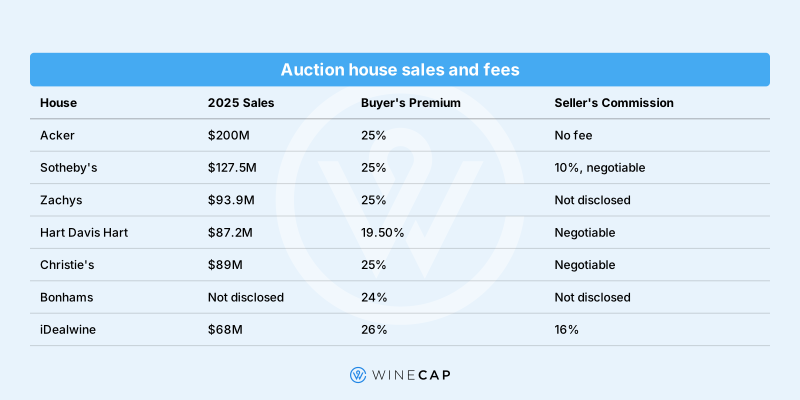
  • At auction. Auction houses offer mature and rare bottles, with buyer’s premiums that routinely add 20% or more to the hammer price, and provenance that varies lot by lot.
  • Peer-to-peer and exchange trading. Experienced investors with trade accounts can deal via exchanges, taking on sourcing, verification and settlement themselves.

En Primeur deserves a closer look because its mechanics differ from every other route. The buyer pays for the wine while it is still in barrel, takes delivery into bond one to two years later, and carries counterparty risk on the producer and merchant chain in between. The historical bargain, release prices below eventual market prices, has not held reliably in recent campaigns, and several vintages released in the early 2020s later traded below their release prices on the secondary market. The route still offers first access to scarce wines and pristine provenance from day one; it simply has to be judged release by release, against secondary market prices for comparable back vintages, rather than bought on tradition.

Ownership is the detail to verify before any money moves, whichever route an investor takes. Reputable firms hold wine in the client’s name, segregated from company assets, in a recognised bonded warehouse. If the paperwork shows anything else, walk away. The collapse of poorly run wine firms has historically hurt clients whose wine was never truly theirs.

What it costs: minimums, fees and charges

Costs decide whether a paper gain becomes a real one, so they deserve the same attention as the wines themselves. A wine that rises 30% over five years, sold through a channel that takes 25% in combined charges, has enriched everyone except its owner.

Typical cost lines across the UK industry:

  • Entry minimums. Managed portfolios commonly start between £3,000 and £25,000 across the industry; WineCap’s minimum is £5,000.
  • Purchase spread or sourcing margin. The difference between the price paid and the wine’s prevailing market level. Ask any firm how its buy prices compare with market benchmarks.
  • Annual management and storage. Bonded storage and insurance are usually charged per case per year, with management fees a percentage of portfolio value.
  • Exit costs. Selling through a merchant or broker involves a commission or margin; auctions add seller’s fees. Factor the exit charge in before buying, not when selling.

Transparency is the test that matters. An investor should be able to see, in writing, every charge between deposit and eventual sale proceeds. Full fee details for WineCap portfolios are available on request and through a free consultation.

Storage, insurance and provenance

Professional storage is not optional at investment grade. The market pays for perfect condition, and perfect condition is only believable when a wine’s whole life is documented. UK investors use bonded warehouses (HMRC-approved facilities where duty and VAT are suspended), which solve three problems at once.

Condition is the first. Bonded facilities hold wine at stable temperature and humidity, in darkness, with minimal movement: the conditions critics and buyers assume when they price a mature case. WineCap clients’ wines are held at London City Bond’s Drakelow facility and insured at replacement value through Zurich.

Tax efficiency is the second. Wine held in bond has not cleared UK customs, so no duty or VAT falls due while it stays there, and a case can pass from seller to buyer within the bond without either charge crystallising. Most investment wine spends its entire life in bond for this reason.

Provenance is the third. An unbroken bonded history is the strongest evidence a buyer can ask for, and it feeds directly into resale value. Cases that leave bond for a private cellar can return, but the gap in the record usually costs money at sale.

Insurance completes the arrangement, and the details matter more than the headline. Cover should be at replacement value rather than purchase price, so a case that has appreciated is insured for what it would cost to replace today, and valuations should update as market prices move. Investors should also confirm whose policy applies: a warehouse’s blanket cover, the platform’s client policy, or their own. Photographic condition reports at intake, now standard at serious facilities, settle disputes before they start and add another layer to the provenance file that future buyers will pay for.

Returns: what the data actually shows

Honest data serves investors better than selective success stories, so this section reports the full cycle. Over the 20 years to 2022, the Liv-ex 100 index (the industry’s benchmark for the most traded fine wines) rose just over 300%. The market then corrected hard: from its October 2022 peak, the broad market fell roughly 30% over the following three years.

The recent numbers are sobering and specific. The Liv-ex 100 declined 2.5% in 2025, a year in which the Knight Frank Luxury Investment Index as a whole closed down just 0.4% (Knight Frank Luxury Investment Index, April 2026). Trade patterns shifted sharply too: US purchase value fell 43.6% year on year in 2025 under tariff pressure, while European purchases rose 48.2%.

The first half of 2026 has looked different. Liv-ex reported broadly stable indices in the first quarter, and US buying recovered to 26.9% of global purchase value in the second quarter, up from 23.3% in the first. WineCap’s own market coverage reached a similar reading in fine wine market starts 2026 on firmer footing.

Individual wines can diverge a long way from the index in both directions. Dom Ruinart Blanc de Blancs, a selected example rather than a representative one, shows a rise of 135% over ten years, a period across which the broad market first climbed steeply and then gave back a substantial part of those gains. Selection, in other words, is where managed research earns its keep, and it can subtract value as easily as add it when done badly.

Holding period shapes the outcome as much as selection does. Fine wine’s appreciation, where it occurs, accrues over the years in which scarcity tightens and a wine approaches its drinking window, and the market’s cycles run long: the recent correction alone lasted roughly three years. An investor with a five to ten year horizon can ride a full cycle; one who may need the money in two years is speculating on timing, in an asset that punishes forced sales. The industry convention of quoting five years as a minimum hold reflects this arithmetic rather than any promise about what five years will deliver.

Two disciplines keep return expectations honest. Measure any wine against the index over the same period, so a strong performer is seen in context. And treat every historical figure, including all of the above, as description rather than prediction: past performance is not a guide to future returns. WineCap’s approach to performance measurement is set out on our performance page.

The risks investors must price in

Every genuine investment case survives its risk list. 

  • Prices fall. The 2022 to 2025 drawdown of roughly 30% is the current, lived reminder. 
  • Illiquidity. Selling takes weeks or months, not minutes. In a weak market, bids for even blue-chip wines can be thin, and a forced seller takes whatever the market offers.
  • No regulatory protection. Wine investment is unregulated in the UK. The Financial Conduct Authority does not authorise it, and investors have no access to the Financial Services Compensation Scheme or the Financial Ombudsman Service if a firm fails or a dispute arises.
  • Fraud and mis-selling. The sector has a documented history of scams, from cold-called “guaranteed return” schemes to firms selling wine they never owned. UK Trading Standards has prosecuted wine investment frauds running into tens of millions of pounds.
  • Cost drag. Storage, insurance, management and exit charges accrue every year, in flat and falling markets as well as rising ones.
  • Currency and policy shocks. The 2025 US tariffs moved global demand within months. Sterling investors also carry exchange rate exposure to a market that prices much of its demand in dollars.
  • Condition and provenance failures. A flooded warehouse, a faked case or a broken storage record can impair value regardless of what the index does.

Sizing is the practical defence. Most advisers who cover alternatives suggest they sit as a minority allocation within a diversified portfolio, money whose multi-year absence an investor can tolerate. Fine wine is a long-term investment that rewards patience.

How fine wine is taxed in the UK

Tax treatment is one of fine wine’s most cited attractions and one of its most misunderstood. The rules deserve precision, and WineCap’s detailed guides to the tax benefits of fine wine investment and to whether wine is a wasting asset for capital gains tax cover the full detail, including worked examples against 2026/27 thresholds.

The headline concerns capital gains tax. HMRC treats an asset with a predictable useful life of under 50 years as a “wasting asset”, exempt from CGT, and its Capital Gains Manual (CG76901) discusses how this applies to wine. Many everyday wines clearly qualify. The complication sits exactly where investors operate: investment-grade wines are built for decades of ageing, and HMRC’s guidance contemplates that fine wines capable of lasting beyond 50 years may not qualify for the exemption. The point is judged case by case, on the wine and the facts.

A second relief exists independently. Wine is a chattel (tangible movable property), and disposals of chattels for proceeds of £6,000 or less are exempt from CGT under HMRC’s chattels rules (HMRC, 2026/27), with marginal relief just above that level. Sales structured as separate cases to separate buyers are, however, aggregated where HMRC treats them as a set.

Duty and VAT behave differently again. Wine kept in bond suspends both until the wine clears customs, which is why bonded storage is the default for investment. Inheritance tax offers no special shelter: wine forms part of an estate at market value like any other possession, and estates with significant cellars need valuations and records their executors can rely on.

Pensions close one door investors sometimes ask about. Wine is tangible movable property, which HMRC’s pension rules treat as taxable property inside a SIPP (self-invested personal pension); holding it there triggers tax charges that remove any benefit, so wine investment sits outside pension wrappers in practice. The comparison with regulated, wrapper-eligible investments also restates a point this guide makes elsewhere: wine investment itself is unregulated in the UK, with no FCA authorisation, FSCS cover or FOS recourse.

Every part of this depends on individual circumstances, and the rules can change at any Budget. Treatment that applies to one investor’s cases may not apply to another’s. Independent tax advice, taken before selling rather than after, is the sensible course.

Building a first portfolio: regions and diversification

Diversification works in wine much as it does elsewhere: across regions, producers, vintages and price points, so no single reassessment or regional slump dominates the outcome. The starting map has five main territories, each with a distinct investment character.

Bordeaux remains the market’s backbone and its most liquid region, accounting for 35.5% of secondary market trade by value in 2025. The 1855 classification gives the Left Bank its hierarchy, from the five First Growths (Lafite Rothschild, Latour, Margaux, Mouton Rothschild and Haut-Brion) down through the classed growths, while the Right Bank contributes Petrus, Le Pin and the leading names of Saint-Emilion and Pomerol. Production volumes are large by fine wine standards, often ten to twenty thousand cases per wine per vintage, which is exactly what makes Bordeaux tradeable: price histories run for decades and a seller can usually find a bid. The so-called super seconds (estates such as Pichon Lalande and Lynch-Bages that trade below First Growth prices on comparable quality) are a common first purchase for value-minded investors.

Burgundy sits at the opposite pole. Production at the top domaines of the Cote de Nuits and Cote de Beaune is measured in hundreds of cases, sometimes fewer, and prices reach the market’s summit. Scarcity cuts both ways: it has driven some of the strongest long-run appreciation in the market, and it thins liquidity, widens pricing and raises the stakes on authenticity. Burgundy rewards knowledge and patience more than any other region, which is why most allocators treat it as a later addition rather than a foundation.

Champagne has become a core allocation rather than a satellite, led by prestige cuvees from houses such as Dom Perignon, Krug, Cristal and Salon. Its investment logic is unusually clean: these wines are drunk in celebration around the world, so consumption retires stock quickly, while house branding keeps demand broad. Italy contributes two poles of its own, Piedmont’s Barolo and Tuscany’s Brunello alongside the Super Tuscans (Sassicaia, Tignanello, Ornellaia and peers), and its share of secondary market trade grew through the recent downturn as buyers sought value outside France. The Rhone, Spain’s Vega Sicilia and California’s cult names (Screaming Eagle, Opus One) complete the usual map, adding breadth at various price levels.

Vintage and producer spread complete the diversification picture. Two cases of the same wine from different vintages behave differently: one may sit in its drinking window while the other is still climbing towards it. Producer concentration carries the same lesson. A portfolio built entirely on one estate, however grand, rides every rescore and every release decision that estate makes. Spreading across eight to twelve producers, several vintages and at least three regions gives a first portfolio the shape professionals build towards.

A first portfolio does not need all of them at once. A common approach weights liquid Bordeaux as the foundation, adds Champagne and Italy for balance, and treats Burgundy and cult names as later, selective additions. WineCap’s beginner’s guide to starting a wine investment portfolio in the UK works through allocation examples in detail.

Wine compared with whisky, art and other alternative assets

Fine wine competes for the same allocation as other collectible and passion assets. Structural differences matter more than any one year’s league table. Wine’s advantage over most rivals is market infrastructure: standardised units (the 12x75cl case), published exchange prices, professional bonded storage and a deep merchant network make fine wine unusually easy to value and to sell for a physical asset. Art sits at the opposite extreme, with unique objects, opaque pricing and sale costs that can consume a fifth of proceeds. Cask whisky has boomed on scarcity narratives but lacks wine’s central price benchmarks, which has made it a magnet for mis-selling; its regulatory position, like wine’s, is unregulated in the UK.

Wine’s disadvantages are equally structural. It is consumed rather than displayed, needs specialist storage, and its correction of 2022 to 2025 showed drawdowns can run for years. Watches and art can be enjoyed daily while held; a case in bond cannot, unless its owner is willing to sacrifice provenance. Investors weighing the categories usually conclude they are complements rather than substitutes, and that the honest comparison is less about which asset “wins” than about which risks an investor understands well enough to carry.

Common mistakes first-time wine investors make

Most mistakes in wine investment are avoidable at the point of purchase. Overpaying at entry is the most expensive and least visible mistake. A case bought 15% above its market level starts its life needing years of appreciation just to reach par. This is why correct valuations and price benchmarking against published market data, before every purchase, is the single highest-value habit an investor can build.

Concentration comes next. First-time portfolios built entirely on one region, one famous producer or one celebrated vintage carry risks their owners rarely price: a regional slump, a critical reassessment or a tariff decision lands on the whole portfolio at once. The 2025 trade data showed how quickly regional demand can rotate, with US purchase value down 43.6% while European buying rose 48.2%.

Ignoring costs quietly erodes the rest. Storage, insurance, management and exit charges continue in flat years, and an investor who never totals them can hold a “winning” wine to a losing outcome. Impatience compounds the damage: selling inside two or three years, before scarcity has done any work, frequently returns less than the wine cost once fees are counted.

The final mistake is the oldest: buying from the wrong counterparty. Wine bought from a cold call, at an unverifiable price, held in a warehouse the buyer cannot name, fails every test this guide has set out. 

How to start: a step-by-step path

The process from first research to funded portfolio is short. Care at each step matters more than speed.

  1. Define the budget and the horizon. Decide the sum, confirm it can stay invested for five to ten years, and place it inside a wider plan: fine wine belongs alongside other assets, not instead of them.
  2. Choose the route. Managed platform, self-directed buying through merchants, En Primeur, auction, or a blend. First-time investors usually start managed; the beginner’s guide to fine wine investment compares the options.
  3. Vet the firm. Apply the due-diligence questions in the next section before signing anything or sending money.
  4. Agree the mandate. Budget, regional spread, holding period and fee schedule, all in writing.
  5. Verify ownership and storage. Confirm the wines sit in your name in a recognised bonded warehouse, insured at replacement value, with documentation to prove it.
  6. Monitor without meddling. Track valuations against a benchmark, using tools like Wine Track. Fine wine repays annual reviews, not daily ones.
  7. Plan the exit from day one. Know how sales work, what they cost and how long they take, before the first case is bought.

Questions along the way have a natural home: WineCap’s help and FAQ centre answers the operational ones, from minimums to withdrawals.

How to sell wine and exit an investment

Exits define realised returns, and the secondary market offers several doors out. A managed platform sells on the client’s behalf through its trade network, handling logistics and documentation for its stated commission or margin. Independent owners can consign to a broker or merchant, list on an exchange through an account holder, or enter wines for auction, where seller’s commissions and settlement timescales vary house by house.

Practical selling discipline focuses on what an owner controls: selling from strength rather than necessity, keeping cases in bond with clean records so they are always saleable, spreading disposals rather than dumping a whole portfolio into one market moment, and comparing the net proceeds a route offers after every fee.

Settlement takes patience. From instruction to cash, a typical trade sale runs weeks; auctions can run longer once cataloguing and payment terms are counted. Investors who need money on a fixed date should sell well ahead of it.

Net proceeds are the only number that counts at exit, and they reward a simple habit: before instructing any sale, ask each available route for its all-in figure after commission, storage settlement and delivery charges, then compare that figure with the wine’s current market level. A route offering 95% of market value with two-week settlement often beats one dangling a higher headline through a slower, costlier channel. Sellers who run this comparison once tend to run it every time.

Choosing a wine investment company

The choice of counterparty carries as much risk as the choice of wine, in an industry where anyone can print a brochure. A short interrogation separates serious firms from the rest.

  • Ownership and segregation. Are wines held in the client’s name, segregated from company stock, in a named bonded warehouse? Ask to see a specimen storage account and insurance certificate.
  • Pricing transparency. How do purchase prices compare with market levels, and will the firm show the comparison? Opacity here is where poor outcomes usually begin.
  • The full fee schedule, in writing. Every charge from entry to exit, with nothing “available on request” that never arrives.
  • Track record and people. How long has the firm traded, who runs it, and what does its own published analysis look like? Independent reviews and press coverage add texture.
  • Realism in the sales conversation. A firm that leads with the 2022 to 2025 drawdown as readily as the 20-year rise is describing the same market this guide does. One that promises dependable returns is describing a market that does not exist, and the Advertising Standards Authority has upheld rulings against wine investment firms for exactly such claims (ASA, 2024 to 2025).
  • No pressure. Cold calls, countdown offers and “act now” framing are the classic markers of the sector’s fraud cases. Legitimate wine is still there next week.

WineCap publishes its data, methodology and market analysis precisely so investors can run these checks. A free consultation exists to answer them.

Where fine wine fits in a 2026 portfolio

The fine wine market entering late 2026 is a more honest proposition than the one marketed at the 2022 peak: repriced by a three-year correction, showing measured signs of stabilisation, and stripped of the easy narratives. That honesty suits serious investors. An asset bought with clear eyes, at a £5,000 minimum rather than a fortune, held in bond for years and measured against a public benchmark, can earn a place in a diversified portfolio precisely because its owner knows what it is and what it is not. The investors best positioned for the next cycle are the ones who understand the machinery this guide describes: what qualifies, what it costs, how it is taxed, and how they will one day sell.

FAQ: Wine investment in 2026

Is wine a good investment in 2026?

Fine wine can suit investors seeking a long-term, tangible, diversifying asset, but it is unregulated in the UK and illiquid compared with shares. Suitability depends on an investor’s horizon, existing portfolio and tolerance for drawdowns.

How much money do I need to start investing in wine? 

UK managed wine portfolios commonly start between £3,000 and £25,000; WineCap’s minimum investment is £5,000. Self-directed buying can begin with a single investment-grade case, though diversification across regions and vintages argues for a larger starting sum.

What returns can I expect from wine investment?

No future return can be promised. The Liv-ex 100 rose just over 300% in the 20 years to 2022, then the market fell roughly 30% over the following three years, and the index declined 2.5% in 2025 alone. Past performance is not a guide to future returns.

Is wine investment tax-free in the UK? 

Sometimes, not automatically. HMRC exempts “wasting assets” (predictable life under 50 years) from capital gains tax, and many wines qualify, but investment-grade wines built for long ageing may not; disposals of £6,000 or less may fall under the separate chattels exemption (HMRC, 2026/27). Treatment depends on individual circumstances and may change, so independent tax advice is essential.

How do I sell my wine investment? 

Wine sells through a managed platform’s trade network, via merchants and brokers, on exchanges, or at auction, with commissions and timescales differing by route. A typical trade sale takes weeks from instruction to settlement. Wines kept in bond with unbroken storage records achieve the strongest prices.

How do I avoid wine investment scams? 

Verify that wines are held in your name in a named bonded warehouse, demand the full fee schedule in writing, compare purchase prices with market levels, and treat cold calls, promised returns and pressure tactics as disqualifying. Wine investment is unregulated in the UK, with no FCA, FSCS or FOS protection, so this due diligence replaces the safety net.

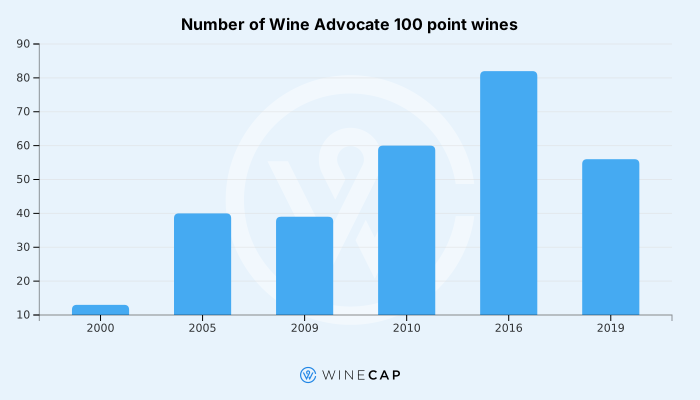
Categories
Learn

What is the difference between auction and market prices in fine wine investment

  • Auction prices and market prices for fine wine are intrinsically linked yet understanding the distinction is important for valuations.
  • Buyer’s premiums of 25% are standard at most major wine auction houses, meaning that  the final price a buyer pays is almost always significantly above the hammer price.
  • For older vintages, auctions dominate fine wine trading.

For fine wine investors, a wine price can mean different things depending on where you look. An auction price records what a buyer was willing to pay for a particular wine at a particular moment, through a competitive bidding process. A market price, by contrast, is typically derived from the prices at which sellers are currently offering comparable wines on the secondary market.

The two are closely related, but they are not interchangeable. Auction results provide evidence of completed transactions, while market prices offer a broader view of current availability and seller expectations. Both are useful, and both have limitations. Understanding the difference – and knowing which measure to use when – is an important part of valuing fine wine.

What auction prices and market prices actually measure

In economic theory, the market price is the equilibrium point at which supply and demand meet. In fine wine, however, the term is used more practically.

A fine wine market price is typically a derived value based on the asking prices of multiple sellers active on the secondary market. It draws on dozens, and sometimes hundreds, of listings to establish the best available price for a comparable case in perfect, or reliably assumed to be perfect, condition.

It is therefore not the price at which one transaction has necessarily taken place. Rather, it is an aggregate view of what sellers are asking for the wine at a particular point in time – and, by extension, what a buyer could reasonably expect to pay to acquire it.

Platforms such as WineCap aggregate these listings into benchmark prices that act as reference points across the secondary market. Market prices simplify price discovery and reduce search friction for buyers and make comparison straightforward, particularly for younger wines in standard formats with clear provenance.

In economic theory auction prices are simply a way to ascertain a market price. A competitive bidding process sets the price in real time. The hammer falls at the highest bid, and that bid becomes the market price for whatever asset is being sold. 

In practice, the two are not synonymous and auction prices can be quite different from market prices. Auctions tend to maximise revenue for rare or scarce assets, because it surfaces the most motivated buyer available on that day. Arguably, that makes auction prices a truer expression of what a specific case of wine is worth at the moment of sale, but is less relevant to the price of another case. 

Auction prices tend to be more volatile, are often higher, and are most commonly seen with a narrower set of wines.

The fine wine auction market: who the players are

Wine auctions operate across a well-established hierarchy of houses. Sotheby’s and Christie’s lead the global auction market broadly, with significant wine departments. For wine specifically, an additional group of specialist auctioneers accounts for the largest share of trading volume. Most auctioneers announce their sales figures in US dollars.

  • Acker Merell and Condit: $200 million (approximately £157 million) in sales in 2025
  • Sotheby’s $127.5 million (approximately £100 million) in sales in 2025
  • Zachys: $93.9 million (approximately £74 million) in sales in 2025
  • Hart Davis Hart: $87.2 million (approximately £69 million), 19.5% buyer’s premium
  • Christie’s: $89 million (approximately £70 million) in sales in 2025

While Bonhams has a wine department, they do not disclose their total wine sales. Online platforms have also expanded the market. iDealwine, a France-based specialist, generated $68 million (approximately £54 million) in 2025 sales. Bid for Wine, owned by Dreweatts, is a regional British auctioneer and operates a comparable digital model in the UK. 

The cost of buying and selling at auction

Auction prices require careful translation before any comparison with market prices. The hammer price (the final bid at which a lot is sold) is not what the buyer pays, and it is not what the seller nets. Both sides face additional costs that can be very significant.

Buyers must add a premium to the hammer price. At most major wine auction houses, this runs at 25%, though Hart Davis Hart charges 19.5% and iDealwine charges 26%. On a case selling for £10,000 at the hammer, a 25% buyer’s premium means a total cost of £12,500 before any delivery or storage charges.

The picture for sellers is more opaque. Houses rarely disclose their commission rates upfront, and rates are almost always negotiable. Acker has set itself apart by charging no seller’s commission, a large part of the reason that they have grown in popularity and revenue. For attractive collections, auction houses compete actively for consignment, with seller’s fees being the major area of negotiation. A seller with a large holding of attractive wines can negotiate seller’s commission to zero. In the most competitive cases, a seller may even secure a proportion of the buyer’s premium, receiving more than 100% of the hammer price as a net return.

Why auction prices are more volatile than market prices

Auction results for the same wine can vary significantly. Condition and provenance (verifiable storage history and ownership chain) drive much of that variability. In the secondary market, younger wines sold in bond carry implied provenance: the storage record is clean by definition. At auction, bottles of varying age and condition compete for buyers who may hold very different views of the same lot.

For instance, in March 2023, three major auction houses sold Domaine de la Romanee-Conti, La Tache 2009. Including buyers’ fees, Acker achieved a case-price equivalent of £70,000, Zachys achieved £62,500, and Sotheby’s achieved £145,000.

At the time, Liv-ex showed a market price of £69,000 per case for the same wine. Wine quality does not explain the spread: the specification across all three lots was identical. The result reflects the specific bidder composition in each room on each day.

Auction prices to ignore: charity sales and distorted results

Not every auction result belongs in a price analysis. Charity auctions regularly produce figures that bear no relationship to market value. Tax treatment creates a real incentive to bid beyond market rates: in the United States, a donor who bids generously at a charity auction may benefit from a tax deduction that reduces their effective net cost. The psychological premium of supporting a high-profile cause adds a further layer. Charity auction results should be stripped from any serious valuation exercise.

The phenomenon extends well beyond wine. In August 2026, “Chassis Zero”, the first production model of Ferrari’s first electric vehicle, the Ferrari Luce, sold at an RM Sotheby’s charity auction during Monterey Car Week in California for $40 million (approximately £32 million). A standard Luce carries a list price of approximately 550,000 euros (roughly £470,000 at launch). No quality or rarity argument explains that gap.

The same distortion appears within wine. In 2026, Chateau Haut-Brion 1961 sold at Sotheby’s in Hong Kong for a case-price equivalent of £17,500, excluding fees. Ten days earlier, a magnum of the same wine sold at Christie’s in London for a case-price equivalent of £65,000, also excluding fees. The Christie’s sale was a charity event. An investor using that result to value their own bottles would overstate the figure by nearly four times.

When auction is the right marketplace

For older wines, auction is the dominant trading mechanism. Analysis of Chateau Lafite Rothschild across seven prime vintages shows how sharply the ratio of auction trades to Liv-ex secondary market trades shifts with age. The older the wine, the more the auction room dominates as the primary marketplace.

The same pattern holds across high-value, long-lived assets generally. Classic cars, watches, and fine art all see the same migration toward auction as the primary trading mechanism as they age and become genuinely rare. Knowing when to use auction prices as a valuation input, when to rely on secondary market benchmarks, and when to discard a result entirely as an outlier or a charity distortion is a genuine source of edge in this market.

FAQ: Auction vs market prices in fine wine investment

How do I know if an auction result is a reliable market reference?

Check three things before using any auction result as a valuation input: whether the sale was a charity event (if so, discard it), the condition and provenance notes on the lot, and whether multiple comparable results support the figure. A single result tells you far less than the range.

Is auction or the secondary market better for selling fine wine?

It depends on the wine and the vintage. Younger wines in bond with clean provenance typically achieve competitive results on the secondary market at lower transaction cost. Older and rarer bottles trade more actively at auction, where specialist buyers concentrate. 

What is the difference between the hammer price and the total cost at auction?

The hammer price is the winning bid, before fees. As a buyer, adding a 25% buyer’s premium to a £10,000 hammer price brings the total to £12,500, before any delivery or storage costs. As a seller, your net return is the hammer price minus any seller’s commission. Sellers of attractive collections can negotiate commissions to zero, or in some cases receive more than the hammer price through a share of buyer fees.

Why are older wines more likely to sell at auction?

As a wine ages, listed secondary market activity falls and auction becomes the primary venue where motivated buyers for rare, old bottles congregate. As our data above shows, that shift is measurable: the 2016 vintage trades equally between auction and Liv-ex, while the 1961 vintage trades at auction 90 times more frequently. Auction provides price discovery for assets with limited comparable transactions, which is precisely what very old fine wine becomes over time.

WineCap’s independent market analysis helps investors build diversified fine wine portfolios with full ownership and transparent pricing. Speak to one of our wine investment experts and start building your portfolio. Schedule your free consultation today.

Categories
News

The most expensive fine wines in 2026

  • Domaine Leroy and Domaine d’Auvenay, both owned by Lalou Bize-Leroy, take 17 of the 25 places in the ranking of the world’s most expensive wine brands and 64.1% of its combined value.
  • Twenty-four of the most expensive fine wine brands in 2026 come from Burgundy, with only Chave’s Ermitage Cathelin, from the northern Rhone, breaking the region’s hold.
  • Romanee-Conti tops the ranking at £195,406 a case but posted the lowest ten-year price move of all 25 wines, at 70.9%.

Burgundy’s rise to the top of the fine wine market has been one of the defining trends of the past decade. Scarce production, growing international demand and a remarkable run-up in prices transformed its leading domaines into some of the world’s most valuable wine brands. Even after the correction that followed the market’s 2022 peak, it is perhaps unsurprising that Burgundy dominates WineCap’s ranking of the most expensive fine wines.

What is more striking is just how concentrated that dominance has become. Twenty-four of the 25 wines on the list come from Burgundy, but 17 come from just two domaines – Domaine Leroy and Domaine d’Auvenay – both owned by Lalou Bize-Leroy. Together, they account for 64.1% of the ranking’s combined value.

At this end of the market, price increasingly tells a story about scarcity as much as quality. The ranking reveals a fine wine summit concentrated around one region, a handful of producers and, above all, one extraordinary owner.

The most expensive wine brands in 2026 critic scores

*Average Case Price – Average market price across basket vintages, per 12×75cl.

*Wine Track Critic Score – Aggregate of published third-party critic scores, normalised to 100 points.

*Methodology: Prices represent the average of the best available market prices across recent vintages, exceptionally rare wines are excluded where there is insufficient reliable market data to establish a comparable price.

Two estates by the same owner dominate the ranking 

The scale of Lalou Bize-Leroy’s presence becomes clearer further down the ranking. Domaine Leroy contributes 11 wines and Domaine d’Auvenay another six, including Chevalier-Montrachet Grand Cru, the second most expensive wine on the list at £186,419 per 12x75cl case equivalent. Because our methodology intentionally excludes wines for which there is very little data, at least four further wines from Leroy and d’Auvenay are not included on our list. By comparison, Domaine de la Romanee-Conti holds three places, while the remaining five producers appear only once each.

Behind those prices is extreme scarcity. Domaine d’Auvenay farms just 3.87 hectares across 16 appellations, with some parcels producing only a few hundred bottles. Its holding in Criots-Batard-Montrachet, for example, extends to just 0.064 hectares. Production at Domaine Leroy is similarly constrained, combining tiny vineyard holdings with some of Burgundy’s lowest yields.

That scarcity is concentrated around one owner. Bize-Leroy, now in her nineties, farms both estates biodynamically and also retains a 25% share of Domaine de la Romanee-Conti. For collectors and investors, the result is unusual: much of the very top of the fine wine price hierarchy is tied to the output, reputation and eventual succession of a single grower.

Burgundy takes 24 of the 25 places

Only one wine breaks Burgundy’s hold on the ranking. Domaine Jean-Louis Chave’s Ermitage Cathelin, from the northern Rhone, sits fifteenth at £61,143 a case. The next non-Burgundy wine does not appear until 28th place, with Screaming Eagle Sauvignon Blanc from Napa Valley.

The gaps become wider from there. Petrus, the highest-ranked Bordeaux, sits 46th, while Krug Clos du Mesnil is Champagne‘s highest entry at 80th. Italy‘s highest-ranked wine, Soldera Case Basse, does not appear until 99th place.

Burgundy’s dominance at the very top comes as the region is also regaining ground in the broader secondary market. In July 2026, it overtook Bordeaux as the most traded region by value on Liv-ex for the first time since 2022, with DRC, Ramonet, Leflaive and d’Auvenay together accounting for roughly a third of Burgundy trade during the month.

The two measures capture different things. Trading share reflects where activity is taking place across the market; this ranking captures the extreme upper end of pricing. But together they underline Burgundy’s unusual position in 2026: it is home to almost every wine at the top of the price hierarchy while once again attracting a growing share of secondary market trade.

For more on Burgundy, read the WineCap Burgundy Regional Report.

White wine sits at the top of a red region

Red wines make up the majority of the ranking, with 16 of the 25 places. Yet white Burgundy is disproportionately represented at the very top: three of the four most expensive wines are white, as are five of the top ten.

The price difference is equally striking:

  • White Burgundy average £102,197 a case, compared with £74,822 for red Burgundy
  • The median white wine costs £79,861, versus £59,798 for red
  • Whites account for 36% of the wines on the list but 43.4% of its combined value

Scarcity helps explain the premium. The great white Grand Cru vineyards of the Cote de Beaune are exceptionally small, and production becomes smaller still when divided between individual domaines and parcels. At the same time, white Burgundy has proved more resilient than red during the recent market correction. Liv-ex has noted an excess of supply over demand for red Burgundy below £5,000 per case, while better-known whites have been an exception.

The most expensive wine has been the slowest riser

Romanee-Conti Grand Cru remains the most expensive wine in the ranking at £195,406 a case, but it has delivered the lowest ten-year price appreciation of all 25 wines, at 70.9%. By contrast, Domaine d’Auvenay’s six wines have risen by an average of 1,178% over the same period, while Domaine Bizot’s Echezeaux Grand Cru recorded the single largest increase, at over 2,000% in the last decade.

The comparison highlights an important distinction between price and performance. Romanee-Conti began the period from an already exceptional valuation, while some of the wines that have risen fastest were starting from much lower bases. These are also exceptionally scarce wines, where relatively few transactions can produce large percentage movements. The figures therefore describe the performance of a highly selective group rather than Burgundy, or fine wine, as a whole.

The recent picture is more subdued. Seventeen of the 25 wines have fallen over the past twelve months, producing an average decline of 2.0%, while their average six-month movement stands at just +0.4%. That follows the wider Burgundy correction: the Liv-ex Burgundy 150 fell 34% between its September 2022 peak and August 2025, before rising 2.2% from September 2025.

Nor does critical acclaim alone explain the price hierarchy. Chave’s Ermitage Cathelin has the highest Wine Track score on the list at 97.6, yet ranks fifteenth by price. Domaine d’Auvenay’s Auxey-Duresses Blanc has the lowest score, at 91.5, but still commands £54,072 a case after rising 494% over five years. Across the 25 wines, the rank correlation between score and price is 0.55, suggesting that critical quality matters, but scarcity, producer reputation and demand play a substantial role in determining price at this end of the market.

What the world’s most expensive wines tell us about the market

WineCap’s ranking is ultimately as much a measure of scarcity as it is of price. Twenty-four of the 25 wines come from Burgundy, 17 come from two domaines controlled by Lalou Bize-Leroy, and many are produced from vineyard holdings measured in fractions of a hectare. At the very top of the fine wine market, supply can be extraordinarily limited.

But the ranking also shows why price alone is an incomplete measure of investment potential. Romanee-Conti is the most expensive wine on the list but has delivered its lowest ten-year appreciation. Critical scores have only a moderate relationship with price, while some wines are so rarely available that establishing a reliable current market value becomes difficult.

That makes the top of the market very different from the broader Burgundy recovery now emerging on the secondary market. Burgundy may have returned to the largest share of Liv-ex trade by value in July, but the wines in this ranking occupy its narrowest and least accessible end. 

Their extraordinary valuations demonstrate the premium the market can place on scarcity and provenance – but also why diversification across producers, regions and price points matters when building a fine wine portfolio.

FAQs: The world’s most expensive wines

What is the most expensive wine in the world in 2026?
Based on WineCap’s Wine Track data as of August 2026, Domaine de la Romanee-Conti’s Romanée-Conti Grand Cru is the most expensive actively traded wine in the ranking, valued at £195,406 per 12x75cl case equivalent.

What are the most expensive wine brands in 2026?
The most expensive fine wine brands are overwhelmingly Burgundian. Domaine Leroy and Domaine d’Auvenay account for 17 of WineCap’s 25 most expensive wines, while Domaine de la Romanee-Conti holds three places.

Why is Domaine Leroy so expensive?
Domaine Leroy combines exceptionally small production with some of Burgundy’s most prestigious vineyard holdings and strong global collector demand. Its wines are produced in very limited quantities, making availability on the secondary market extremely restricted.

Why are Burgundy wines so expensive?
Burgundy’s most sought-after wines come from small, precisely defined vineyards whose production cannot easily be expanded. At the top end, tiny yields, fragmented vineyard ownership and international demand for a handful of producers create significant scarcity premiums.

Is the most expensive wine always the best investment?
No. Romanée-Conti is the most expensive wine in WineCap’s 2026 ranking but recorded the lowest ten-year price appreciation among the 25 wines, at 70.9%. Entry price, liquidity, scarcity and demand all influence investment performance.

What is the most expensive wine outside Burgundy?
Domaine Jean-Louis Chave’s Ermitage Cathelin from the northern Rhone is the only non-Burgundy wine in WineCap’s top 25, ranking fifteenth at £61,143 per case in August 2026.

WineCap’s independent market analysis helps investors build diversified fine wine portfolios with full ownership and transparent pricing. Speak to one of our wine investment experts and start building your portfolio. Schedule your free consultation today.