Categories
Learn

How to develop a taste for fine wine and know what’s actually worth investing in

  • The most effective way to develop a taste for fine wine is exposure: drinking widely, tasting deliberately, and building a personal reference library of what you notice.
  • A wine being exceptional to drink does not make it investable; brand power, secondary market liquidity, and trading data are better indicators than personal preference.
  • Formal wine education and a developed palette are by no means necessary to be a successful wine investor, although each complements the other.

A developed palate and an investment-ready portfolio have commonalities and start from the same place: time spent studying wine. There is no shortcut. Reading, studying tasting frameworks, and visiting wine regions all accelerate the process, but they cannot replace the simple pleasure of tasting and the knowledge that helps accumulate about what quality looks and tastes like. This article covers how to build that knowledge, what resources and education are worth pursuing, and why a wine that tastes exceptional is not necessarily a wine worth buying as an asset.

How do you develop a taste for fine wine?

Exposure is the answer, and it is the only one that works. A trained palate is the foundation on which judgment is built: tasting widely, tasting deliberately, and paying attention to each glass builds an internal reference library. Reading about wine is useful; books, frameworks, and expert notes all provide context but it cannot substitute for the physical experience of comparison.

The practical question is where to point that attention. Two approaches work, and both are equally valid. The first is the deep dive: choosing a producer or region that already appeals and working through their range, back vintages, and sub-appellations. This builds depth quickly. An investor who has tasted several vintages of the same wine across different years develops an understanding of how the wine ages and how the style holds across seasons of varying quality. 

The second approach is the wide circle: drinking across as many regions, grapes, and styles as possible to accumulate comparison points. Both are legitimate and the choice often reflects learning style more than anything else.

The strongest argument for breadth is what unfamiliar wines reveal and the simple pleasure of being surprised. A palate trained only on a single region can of course recognise quality but will miss context, encountering something genuinely strange also forces a more conscious response. Drinking a Savagnin from Jura, or a Txakoli from the Bsaque region will expose you to an experience you could never have elsewhere.

These are not investment categories but they are exercises in calibration. The contrast they provide makes the reference points of Burgundy, Bordeaux, and Champagne easier to understand and easier to articulate with precision.

Keeping records: tasting notes and apps

Writing things down is not mandatory, but a personal record of what has been tasted quickly becomes a reference tool that informal memory cannot replicate. A written tasting note forces a decision: recording observations requires a choice of words, and choosing words demands conscious attention rather than the passive experience of enjoying a glass. Even occasional notes build an archive that, over time, reveals patterns in preference, signals in structure, and gaps in knowledge that informal tasting alone rarely exposes.

The format does not need to be elaborate. A few sentences on what the wine looked like, how it smelled, what it tasted like, and what comparison it triggered is sufficient to start building a record. The physical act of writing also helps to retain memory. Those who prefer a digital home for those records over a fountain pen and a notebook have two particularly strong options. 

  • Vivino is the most widely used wine app: scan a label, rate the wine, and build a personal log with minimal friction. It suits beginners well. 
  • CellarTracker is more sophisticated: it allows detailed tasting note records, full cellar management, and access to a large community database of notes from serious collectors and experienced enthusiasts. 

For an investor managing a portfolio without access to a portal like WineCap’s, CellarTracker also offers a level of organisation that informal note-keeping cannot match.

Using a structured tasting framework

Tasting is ultimately a personal experience, and everyone’s sense of taste and personal preferences are different. However, structured tasting with a shared vocabulary has significant value and turns personal impressions about wine into transferable language. A note that records “nice red, quite tannic” is better than nothing, but it does not build a vocabulary or allow meaningful comparison over time.

The best known and most widely agreed upon structured tasting is the WSET’s Systematic Approach to Tasting (SAT), used across all four levels of their qualification framework. It provides a consistent method for assessing a wine’s appearance, nose, palate, and overall quality, and for recording those observations in terms that other tasters can understand and compare. The full level two framework is available here

Below is an example of the SAT applied to Chateau Montrose 2016, a Saint-Estephe Second Growth with significant investment credentials and a structure that rewards close attention:

  • Appearance: deep ruby-red with a dark, almost inky core; narrow garnet rim indicating youth; clear and bright
  • Nose: pronounced intensity; blackcurrant, blackberry, cedar, cigar box, graphite, dark chocolate, iron
  • Palate: dry; medium-high acidity; high, firm, grippy tannins; medium alcohol; full body; pronounced flavour intensity; black cherry, cassis, tobacco, pencil shavings; very long finish.
  • Conclusions: high quality; emphatically youthful; suitable for bottle ageing.

The structural observations, particularly the tannin level, acidity, and length of finish, carry investment relevance too: High tannin and good acidity are structural indicators of a wine’s capacity to age and, by extension, the point in the future at which it will reach peak value on the secondary market. A wine that drinks beautifully young but lacks structure rarely achieves the same price trajectory.

Formal wine education

Formal qualifications are not a prerequisite for either a good palate or sound investment judgment. What they provide is something that tasting alone does not easily deliver: a shared vocabulary and a consistent analytical framework that makes it possible to communicate precisely about what a wine is doing and why it matters. The Wine and Spirit Education Trust (WSET) is the most widely recognised and accessible provider, offering courses at four levels suited to almost any level of interest or commitment.

Level 1 covers the basics in a single day, providing enough structure and vocabulary to drink more consciously and to begin taking useful notes. Level 2 and 3 develop understanding of grape varieties, key regions, and the fundamentals of winemaking. The Level 4 Diploma, WSET’s highest qualification, typically takes two or more years to complete and covers everything from viticulture and production to regional wine law, the structure of the global wine trade, and contemporary market questions. 

The Master of Wine (MW) represents the highest formal attainment in the wine world. The qualification requires years of dedicated study, passing theory papers, submitting original research, and a notoriously demanding blind tasting examination. The pass rate for the tasting section is often as low as 10 to 15 per cent. 521 people have passed the exam since 1953. It is not a realistic pursuit for most wine enthusiasts, but it provides a useful reference point for what the summit of formal wine expertise looks like.

The Court of Master Sommeliers offers a parallel route, though it is primarily weighted toward wine service and the restaurant trade.

Wine travel and investment regions

Visiting a wine region is one of the best ways to transform abstract knowledge into physical understanding. For an investor or a collector, that understanding clarifies why certain producers command the prices they do and provides a frame of reference for interpreting the secondary market data and trading records that underpin investment decisions. The landscape, the soil types, the proximity of parcels to each other, and the scale at which different estates operate all become legible in a way that reading cannot fully replicate.

Bordeaux and Champagne are the natural starting points. Both regions offer highly developed wine tourism infrastructure, with cellar visits and formal tasting experiences widely available. As two of the most invested in regions, both are also directly relevant to wine investors: the wines encountered on a visit are the same wines measured by WineTrack and priced daily across global exchanges.

The case for local exploration is equally strong. Wine tourism does not require a transatlantic journey or even going to an airport. Readers in the UK will find that the South East of England has developed a serious and well-organised wine tourism scene, with several English sparkling wine producers now attracting strong international critical attention and offering estate visits and tastings. Every state in the USA has wineries from New York in the east, Minnesota in the north, Louisiana in the South and of course California in the west. For visitors to South Africa, the Cape Winelands, particularly Stellenbosch and Franschhoek, offer some of the most visitor-friendly wine tourism anywhere in the world alongside a diverse range of wine styles and price points.  

In almost every country in the world there will be wineries to visit, and a visit to any winery will have a huge amount of practical value to someone interested in growing their knowledge and their palate.  Understanding wine in its place of origin is more efficient than encountering it only at the point of sale.

Essential reading

While no book can replace practical knowledge, there are a number that are of enormous value to wine lovers, and the right books provide context that accelerates tasting rather than replacing it. 

A reader who understands the geography, climate, and classification systems of Bordeaux before opening a bottle of Pauillac will notice more in the glass and ask more useful questions. Four titles stand out as worthy additions to any wine lovers library:

  • The World Atlas of Wine (Hugh Johnson and Jancis Robinson, 8th edition, 2019): The definitive geographical reference, covering every major wine region with detailed maps and producer notes; 
  • Wine Folly: The Master Guide (Madeline Puckette and Justin Hammack, 2018): Visually driven and accessible; the most useful starting point for beginners who absorb information through image and diagram rather than dense text;
  • The Oxford Companion to Wine (edited by Jancis Robinson and Julia Harding, 4th edition, 2015): Encyclopaedic and authoritative; not a book to read cover to cover, but an essential reference when a term, region, or grape variety requires proper investigation;
  • The Wine Bible (Karen MacNeil, 3rd edition, 2023): Comprehensive regional coverage written in a narrative style that makes it considerably more readable than most reference books of comparable scope.

None of these titles provides up to date market data and while the Oxford Companion to wine does include information about wine investing, it is not its focus. For current price performance and secondary market activity, dedicated platforms and trading databases are required alongside them. WineCap’s editorial section covers the investment and market context behind specific wines and regions, making it a useful complement to personal tasting records. A note on what a wine tastes like gains more meaning alongside an understanding of where that wine sits in the secondary market hierarchy. 

Does liking a wine mean it’s a good investment?

Emphatically not. These are two separate questions, and conflating them is one of the most consistent errors that new wine investors make. A wine that tastes exceptional is evidence of quality, and quality matters. But quality alone is not sufficient for investment potential, and the distinction between the two is commercial rather than aesthetic.

The wines that sustain consistent secondary market activity are almost universally those that carry global name recognition built over decades: the Bordeaux first growths, Domaine de la Romanee-Conti (DRC), Petrus, Screaming Eagle. A superb wine from a little-known producer may be fantastic in the glass, but without an active secondary market to sell into, it cannot be exited at a fair price. Without buyers, there is no return.

What drives investability is a convergence of factors that go well beyond what any tasting note captures:

  • Brand power: Name recognition and heritage that generates demand from buyers worldwide, independently of what a specific vintage scores or how it drinks at a given moment.
  • Secondary market liquidity: An active, global pool of buyers at any given point; this is what allows a position to be exited without accepting a distressed price.
  • Critic scores: A useful signal of quality and capable of driving short-term market interest, but insufficient as a standalone indicator; a 100-point score from Robert Parker or a top recommendation from Jancis Robinson can move prices, but it does not guarantee sustained secondary market activity over a decade.
  • Demand: How frequently a wine is searched for and how many merchants list it globally provides a useful proxy for commercial footprint and consumer awareness; wines with thin search presence are harder to sell regardless of quality.
  • Performance history and trading data: While data from Liv-ex is available only to trade members WineTrack, WineCap’s proprietary tracking tool shows the aggregate price performance of an individual wine across multiple vintages and average prices across multiple vintages. This information provides a fuller picture of how it has behaved as an asset over time rather than isolating any single vintage or release.

The investment decision is about convergence across all of these dimensions. A wine that scores on quality, carries genuine brand recognition, shows consistent secondary market liquidity, and demonstrates a sustained price trajectory across vintages is a fundamentally different proposition from one that simply tastes exceptional.

The palate and the portfolio

A developed palate and a clear understanding of what the secondary market rewards are not the same education, but they are not in conflict. Wine investors are often wine lovers: the affinity drives the attention, and the attention builds the reference library that makes better decisions possible. What separates investors from passionate drinkers is that they have learned to hold that love alongside a clear-eyed view of what the market will and will not reward.

Neither education finishes. Every new wine encountered shifts the frame of reference slightly. Every vintage that ages reveals something about what the wine was doing in youth that real-time tasting notes can only partially capture. Market knowledge develops in exactly the same way. The goal is not to arrive at a fixed expertise. It is to keep both processes running in parallel, and to remain clear on which one informs which.

FAQ: Developing a taste for fine wine

How long does it take to develop a palate for fine wine?

A palate is never finished developing. Every new wine encountered shifts the reference point; every return to a wine tasted years earlier reveals how both the wine and the drinker have changed. A useful working vocabulary can we learned in a weekend with the WSET’s frameworks but experienced tasters with decades of exposure still encounter new reference points regularly. The palate that stops developing is one that has stopped encountering new things, not one that has arrived at a plateau.

Do I need a WSET qualification to invest fine wine?

No. WSET qualifications are valuable for building vocabulary, but they are not a prerequisite for investment. Many serious wine investors and wine lovers hold no formal qualification. What matters is an understanding of how the secondary market works, what drives price performance, and how to read trading data rather than relying solely on critical scores. WineCap’s editorial section and tools like WineTrack provide that market context without requiring any qualification.

What makes a wine investment-grade rather than just high quality?

Investment-grade wine combines quality with commercial infrastructure: brand recognition, secondary market liquidity, and a documented price trajectory across vintages. Quality earns critical attention; brand power and liquidity determine whether it can generate a financial return.

Does a high critic score guarantee a good investment?

No, though it can be a short-term market driver. A 100-point score from a notable critic can drive immediate interest and lift prices but sustained secondary market performance depends on brand power and global liquidity, not on any single critical verdict. None of the  most traded wines hold their position on the strength of a single exceptional score alone.

How do I start tracking the wines I have tried?

Tracking the wines you have tried can be as simple as a notebook and a fountain pen and as complicated as a database as you could possibly imagine. Vivino is a good starting point: scan a label, rate the wine, and build a personal log with minimal friction. CellarTracker is a more sophisticated option for anyone who wants to record detailed tasting notes, manage a cellar, and access a community database of notes from serious collectors. WineTrack shows aggregate price performance across vintages, providing market context alongside personal tasting records and helping investors understand how a wine has moved as an asset rather than simply how it has tasted.

WineCap’s independent market analysis showcases the value of portfolio diversification and the stability offered by investing in wine. Speak to one of our wine investment experts and start building your portfolio. Schedule your free consultation today.
Categories
News

Louis Roederer’s Burgundy deal points to where fine wine capital is heading

  • Louis Roederer has completed its first-ever Burgundy acquisition, buying Domaine Pierre Damoy and its nearly eight hectares of Grand Cru Gevrey-Chambertin vineyards.
  • The deal lands as Burgundy Grand Cru land hits record prices even as the region’s secondary bottle market has cooled.
  • It also reinforces a wider trend of Champagne houses diversifying into fine wine estates elsewhere.

Louis Roederer has completed its acquisition of Domaine Pierre Damoy, giving the family-owned Champagne house a foothold in Burgundy for the first time in its 250-year history. The deal, first flagged in April and finalised this month, brings nearly eight hectares of Grand Cru vineyard – primarily in Chambertin, Chambertin-Clos de Beze and Chapelle-Chambertin – into the Roederer Collection. Financial terms were not disclosed.

CEO Frederic Rouzaud called the timing – Roederer’s 250th anniversary year – meaningful, and pledged to preserve Domaine Pierre Damoy’s identity rather than fold it into a house style. The estate also brings Clos Tamisot, a Gevrey-Chambertin monopole, into the group.

Grand Cru land: a scarcer, richer asset

The transaction lands at a moment when Burgundy vineyard land is setting records. Investors paid up to €30m per hectare for the very best individual parcels in 2025, while Premier Cru Chardonnay averaged €2.7m per hectare and Premier Cru Pinot Noir climbed 11% to €1.15m. Grand Cru land is effectively a closed asset class: every hectare is fully planted and no new Grand Cru can be created, so ownership changes are the only way in.

That scarcity is worth separating from the bottle market. Burgundy prices in the secondary market have fallen 15% on average over the past year – the sharpest pullback of any major region. Roederer’s purchase is a reminder that land and bottles can move on different clocks: even as short-term secondary pricing softens, buyers with a long horizon are paying up for irreplaceable terroir.

A hedge against a cooling Champagne market

The deal also fits a broader diversification pattern among Champagne’s leading houses. Global Champagne shipments fell to 266 million bottles in 2025, a third consecutive annual decline, and the Comite Champagne has cut the 2026 harvest cap to 250 million bottles to manage oversupply amid what it calls an “unstable and unpredictable” market. First-half 2026 shipments ticked up 1.2%, but the broader trend remains one of a maturing, cyclical market.

Roederer already spreads its risk across Bordeaux (Chateau Pichon Longueville Comtesse de Lalande), the Rhone (Delas Freres), Provence (Domaines Ott), Portugal (Ramos Pinto) and California. Burgundy was the conspicuous gap in that portfolio, and closing it now reads as much like capital rotation as it does anniversary sentiment.

Two boom-bust regions, two different portfolio roles

Zoom out to the secondary market and Burgundy and Champagne have followed a strikingly similar arc: both rode the 2020–2022 bull run to record highs, and both have since given much of it back. The Liv-ex Burgundy 150 fell 34% from its September 2022 peak to its low in August 2025; the Liv-ex Champagne 50 fell 33.1% over almost the same window.. Both have since edged up from their lows, suggesting the correction has moved into a steadier consolidation phase across both regions.

The similarity in magnitude masks a difference in character. Burgundy’s swings are driven by extreme scarcity: tiny production, fragmented ownership and critic-led demand for specific parcels, which is exactly why Grand Cru land keeps setting price records even as bottle prices correct. That makes it the higher-return, higher-volatility end of a fine wine portfolio – closer to a concentrated bet on irreplaceable terroir than a diversified holding. 

Champagne, by contrast, draws its resilience from brand equity and genuine end-consumer consumption rather than collector speculation; Liv-ex has pointed to strong liquidity and real drinking demand as reasons the Champagne 50 has held up better than the broader market through the downturn. That makes Champagne the more defensive, liquid allocation – prized for stability and brand strength rather than outsized upside.

Roederer’s move captures both roles in one transaction: a Champagne house whose own brand equity (built on Cristal) throws off the capital to buy into Burgundy’s scarcer, more volatile upside, at a moment when both regions are still working through the same correction.

What it means for investors

For fine wine investors, the deal reinforces two things: Burgundy Grand Cru remains one of the few genuinely scarce assets in the wine world, attracting strategic capital even as short-term bottle pricing corrects; and Champagne houses with balance sheets to deploy are treating estate acquisitions elsewhere as a way to diversify away from a shipment cycle that has now turned down three years running. A pullback in Burgundy’s secondary market, paired with rising institutional appetite for the region’s land, is the kind of divergence worth watching for entry points – and a reminder that a well-built portfolio typically holds both: Burgundy for scarcity-driven upside, Champagne for brand-backed stability.

WineCap’s Wine Track data shows the scale of Burgundy’s recent price correction alongside the region’s enduring scarcity value. Speak to one of our wine investment experts to see how this fits into a diversified portfolio. Schedule your free consultation today

Categories
Learn

Ten things about Chateau d’Yquem: Inside Sauternes’ greatest estate

  • Chateau d’Yquem is the sole Premier Cru Superieur in the 1855 classification, a category it occupies alone, above all other Sauternes estates.
  • WineCap’s Yquem index peaked at exactly 50% growth in early 2023, holding its gains, while wider Bordeaux declined sharply after the 2022 market correction.
  • Each vine at Yquem produces roughly one glass of wine per year, making it one of the most labour-intensive fine wines produced anywhere in the world.

Chateau d’Yquem occupies a unique position in the world of fine wine. The only estate awarded Premier Cru Superieur in Bordeaux’s 1855 Classification, it has long been regarded as the benchmark for Sauternes. That exceptional status has translated into enduring collector demand, one of the strongest long-term investment records in the region, and auction prices that have set records for sweet and white wines alike. These ten facts explain what makes Château d’Yquem one of fine wine’s most distinctive investment assets.

1. The most expensive wine in the world to make

Sauternes is the most labour-intensive wine classification in France. Producing it requires botrytis cinerea (noble rot), a fungus that infects and shrivels grapes on the vine, concentrating sugar and flavour into small, wizened berries. At Yquem, that process is pursued with greater intensity than anywhere else in the world. Each vine produces roughly one glass of wine per year. Pickers make multiple passes through the vineyard, called tries, selecting only berries at the precise stage of botrytization. Three passes is now the norm, but in 1997, the harvest required seven separate tries over 32 days.

That selectivity has structural consequences for supply. Around 90 experienced pickers return to Yquem each harvest, and approximately half the fruit they deliver is rejected daily. Cellarmaster Sandrine Garbay assesses each batch at reception, sending pickers back if the fruit falls short. No other estate in Bordeaux maintains this level of selectivity.

2. Noble rot and the wine that never dies

Botrytis cinerea transforms a grape rather than simply concentrating it, and that transformation is the reason Yquem can outlive every other unfortified wine in the world. The fungus penetrates the skin of grapes, extracting water and leaving behind a richer, more complex liquid. Yquem’s microclimate makes this possible: morning mist from the Ciron, a tributary of the Garonne river, coats the vines with moisture that encourages the infection. Afternoon wind and sunshine then dry the grapes, halting the process at precisely the right moment.

The same chemistry that creates the wine also preserves it. Residual sugar, glycerol, and natural acidity produced by botrytis combine as natural preservatives, without any added spirit. Port survives centuries because grape spirit stops fermentation, leaving behind unfermented sugars; Yquem needs no such intervention and is so long lived that the 1811 and the 1847 are still discussed as living wines.

Sauternes sits within a broader family of great sweet wines, but its method is distinct.

  • Port: Fortified by adding raw grape spirit, this kills the yeast and stops fermentation, which preserves sweetness and boosts alcohol.
  • Trockenbeerenauslese: Germany’s most concentrated category, made from individually selected, often botrytis-affected, desiccated berries from cooler terroir. Superb longevity, but a different flavour profile.
  • Ice wine: Made from grapes frozen on the vine, concentrating sugar through freezing rather than fungal dehydration. No botrytis character.

All three can age for decades.

3. What makes Chateau d’Yquem so valuable?

Yquem’s investment case rests on four foundations that few wines in the world share: singular classification status, proven secondary market depth, structural scarcity, and age-worthiness measured in centuries rather than decades. No other Sauternes holds Premier Cru Superieur status. No other Sauternes commands comparable global demand. No other Sauternes enjoys the same reputation, and no other Sauternes is subject to such strict selection standards by the producer.

WineCap’s Yquem index peaked at exactly 50% growth in early 2023, driven by collector demand during a period of sustained interest in fine wine as an asset class. Since then, there has been relatively little drop-off, particularly when compared with the broader Bordeaux market, which fell sharply after the correction that began in 2022. Some falls occurred in the 2011 to 2014 period, but the long-term trend has been consistently upward. That resilience matters to investors who have watched comparable positions in Bordeaux red wine decline.

Yquem is by some distance the leading Sauternes estate on the secondary market: the strongest long-term performer and most liquid Sauternes. Other notable producers include:

  • Climens: Notable recent price rises have been driven by a series of missing vintages in the late 2010s, which reduced available stock. Strong short-term performance, but thin trading depth makes positions harder to exit reliably.
  • Rieussec: Rising release prices from the estate have gradually lifted back-vintage values, creating positive momentum. Secondary market depth still lags behind Yquem.

4. The vintages that never were

Quality is not an aspiration at Yquem. It is a standard with consequences. Ten times across more than a century, the team decided the wine simply was not good enough to release. No second label absorbed the declassified fruit. No portion of the harvest reached the market. The wine sold in bulk, and the vintage disappeared from the Yquem record.

No Yquem was released in: 1910, 1915, 1930, 1951, 1952, 1964, 1972, 1974, 1992 or 2012.

Cellarmaster Sandrine Garbay commented regarding the 2012 vintage: “The 2012 season was dramatic. I really saw what gray rot is. We threw everything away.”

The counterpoint is equally revealing. Yquem produced wine in 1931, 1965, and 1977, years so difficult that most of Bordeaux wished it had not tried. The ability to extract something creditable from the worst conditions is the test of a great terroir. Every time Yquem releases in a difficult vintage, it reinforces the gap between itself and the rest of the appellation.

5. The most critically acclaimed wine ever made

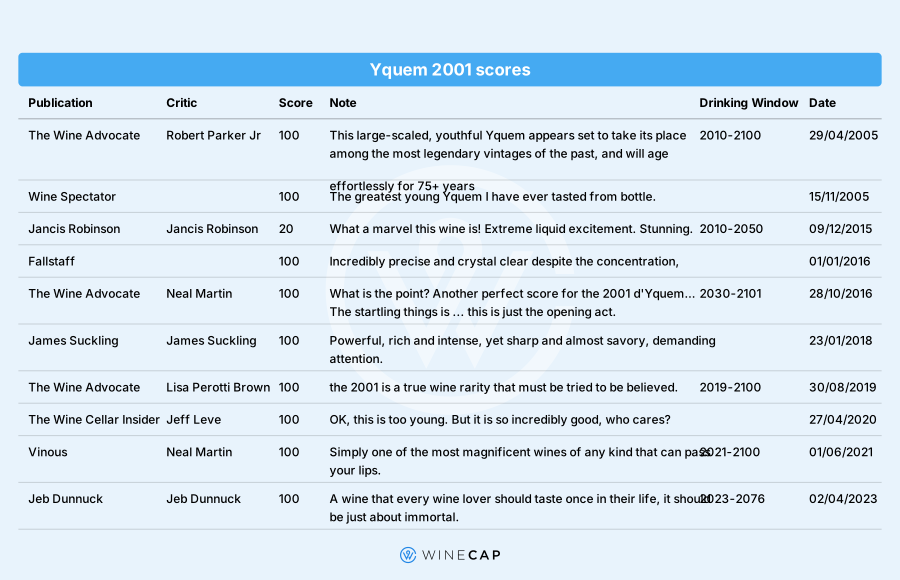
The Yquem 2001 is, by consensus, the most lauded wine in the history of professional criticism. Multiple leading critics awarded it perfect scores. Cellarmaster Sandrine Garbay said: “I thought I would never see that kind of growing season again in terms of the purity and intensity of flavour.” The season delivered exactly what botrytis demands: morning mist, afternoon wind, and a pace of infection that allowed extraordinary complexity to build slowly across every parcel.

Yquem Scores

The question now occupying serious collectors is whether the Yquem 2009 will ultimately rival it. Critic Neal Martin raised this directly: “My only question pertaining to the 2001 is whether the 2009 might ultimately surpass it; time will tell.”

For investors, both vintages represent the same fundamental opportunity: a wine at the peak of its critical reputation, in finite and diminishing supply. The 2001’s excellence is better established and more complete, but the 2009 is more affordable and may in due course represent the better opportunity.

6. The comet vintage and the world’s most expensive bottle

In 1811, a great comet blazed across the European sky for 260 days, the longest recorded period of visibility until Hale-Bopp in 1997. The summer was extraordinary: warm, dry, and long, producing wines across France and Germany that bore its name for generations. Yquem 1811 became the most celebrated of the comet vintages and, on two separate occasions, the most expensive white wine ever sold. No other white wine has approached either threshold.

In July 2011, a 75cl bottle of Yquem 1811 sold at London’s Ritz Hotel, offered by rare wine specialists The Antique Wine Company, for HK$904,000 (approximately £72,000 / $116,000 at the time). The buyer was French private collector Christian Vanneque. The previous world record for the most expensive white wine sold at auction was also held by Yquem: the 1787 vintage at HK$468,000. That both world records belong to the same estate makes a point no marketing can replicate.

The 1847 Yquem is the other great 19th-century reference. That year, a 900-litre tun sold to Grand Duke Constantine, brother of the Russian Czar, for 20,000 gold francs in 1859. The sale announced Yquem’s reputation across European courts and established the template for the extraordinary prices its historic bottles still command today.

7. Y d’Yquem and the quiet revolution in Sauternes

Y d’Yquem (pronounced “ee-grek”) is the estate’s dry white wine, and its existence signals something investors should note: Yquem is actively working to broaden the appeal of Sauternes to new audiences.

Produced since 1959 but made every year only since 2004, it is limited to under 10,000 bottles annually. Estate manager Lorenzo Pasquini describes it as “dry but not completely, a nice encounter between the freshness of a great white wine and the voluptuousness of what reminds us of a Sauternes.”

Yquem is not alone in this direction. Several leading Sauternes estates now produce dry whites alongside their sweet wines:

  • Guiraud, one of the appellation’s consistently high-quality First Growths.
  • Clos de Lunes, made by the Lurton family, who also produce highly regarded whites at Domaine de Chevalier in Pessac-Leognan. 
  • Suduiraut, one of the best-value estates in the Sauternes appellation, offering an accessible price point in the dry category.
  • Climens, the leading estate in Barsac (the Sauternes sub-appellation), has also committed to the category.

Climate change is a part of this as warmer vintages push sugar levels higher and compress the window for selective picking, but this is largely an issue of commercial necessity. Dry whites are both cheaper to make and easier to sell.

8. Yquem and the art of disappearing: a castle hoard and a restaurant heist

Yquem inspires a level of obsession that extends beyond the dining room, and bottles carrying dependable provenance histories command premiums that transcend vintage quality. Two stories, separated by decades, illustrate what that obsession looks like in practice.

In 1945, the aristocratic Beaufort-Spontin family fled Czechoslovakia as the war ended. Before leaving their home at Becov Castle, they hid 136 bottles of wine beneath the chapel floor alongside the Reliquary of St Maurus. Eight of those bottles were Yquem, from the 1892 and 1896 vintages. The collection lay concealed until 1985, when police discovered it following attempts by an American businessman, acting on the family’s behalf, to retrieve it.

In 2016, Yquem’s team used a Coravin device (a needle that extracts a sample through the cork without opening the bottle) to test the wine. It was alive. Cellar master Toni El Khawand led the reconditioning. Only five full original bottles survived intact. They are now on display at Becov Castle. El Khawand described the wine as “a liquid memory.”

The second story moves to October 2021 and the Michelin-starred Atrio restaurant in Caceres, western Spain. Constantin Gabriel Dumitru, a Romanian-Dutch thief, and his partner Priscila Lara Guevara checked in, completed a 14-course tasting menu, and in the small hours stole 45 bottles from the cellar. Among their haul was a bottle of Yquem 1806.  That bottle had already lived several lives: bought at Christie’s London in December 2000 for £6,380, its neck broke during storage in 2001, and the estate reconditioned and re-corked it under a new label signed by Sandrine Garbay. Both thieves were caught and convicted; so far, the bottles have never been found.

9. Beyond the cheese board: Yquem and the art of food matching

Sauternes has spent decades relegated to the dessert course. Repositioning it as a versatile food wine is the estate’s most significant commercial effort and, for investors holding Yquem over the long term, the size of the future collector market depends in part on how successfully that repositioning lands. The most visible expression is the Lighthouse project that began in 2019: a curated network of restaurants worldwide that serve Yquem by the glass alongside specific dishes, reaching drinkers who would never encounter it through a traditional wine list.

The pairings that work best, traditional roast chicken and spiced dishes from India, Mexico, and South-East Asia, challenge expectations and the belief that sweet wines sit at the end of a meal. As the Lighthouse programme introduces Yquem to younger drinkers, it also builds the collector base of the future.

10. From Thomas Jefferson to LVMH: 250 years of ownership

Thomas Jefferson brought Yquem to global attention in May 1787, during his tour of French wine regions as US minister to France. In December of that year, he wrote to the estate requesting 250 bottles of the 1784 vintage and later ordered 30 dozen on behalf of President George Washington, with each president’s initials embossed on the glass. His letter, addressed to “the Lady of Yquem,” acknowledged who was actually running the estate.

That woman was Josephine de Sauvage, orphaned at 17 and widowed at 20, who oversaw Yquem’s transformation into the world’s most revered sweet wine. Arrested three times during the French Revolution, she escaped the guillotine by proving the estate had been purchased rather than granted as a feudal privilege. She pioneered the system of tries (selective passes through the vines) now mandatory for all Sauternes producers. When the 1855 classification named Yquem the sole Premier Cru Superieur, it confirmed what she had built.

The Lur-Saluces family held the estate for more than two centuries before Bernard Arnault of LVMH began acquiring shares in 1996. Alexandre de Lur Saluces fought the sale through the courts before accepting the inevitable. LVMH gained a controlling stake by 2000, and Pierre Lurton was appointed director in 2005, simultaneously overseeing Cheval Blanc. Yquem’s acquisition sat alongside Cheval Blanc and Domaine des Lambrays in LVMH’s first wave of serious fine wine investment, a statement that the world’s leading luxury group and the world’s greatest sweet wine belong in the same portfolio.

Where Yquem fits in a serious wine portfolio

Yquem belongs in a different category from every other sweet wine. Its singular classification, 250-year track record, proven secondary market depth, and resilience through the 2022 Bordeaux correction make it the only Sauternes that sits alongside Bordeaux and Burgundy in an investment portfolio without qualification. 

FAQ: Chateau d’Yquem as an investment

Is Chateau d’Yquem a good wine investment?
Yquem is the most liquid Sauternes on the secondary market and the only sweet wine with the trading depth that allows investors to enter and exit positions reliably. WineCap’s index held its gains better than the wider Bordeaux market through the subsequent correction. For investors seeking exposure to Sauternes, it is the strongest and most consistent option available.

How much does Chateau d’Yquem cost?
Recent vintages trade from around £200 per bottle on the secondary market. The most sought-after releases, including the 2001 and 2009 are closer to £400. Historic bottles can be much more costly, with 20th century bottles often above £3,000 and 19th century bottles regularly trading above £20,000.

How long does Chateau d’Yquem last?
Properly stored Yquem can last centuries. The residual sugar, glycerol, and natural acidity created by botrytis cinerea act as natural preservatives without any added spirit. With correct storage conditions, modern vintages should comfortably exceed 50 years in bottle and very likely much longer.

What is the best Yquem vintage to buy?
The 2001 is the most critically acclaimed sweet wine ever produced and probably the most consistently scored wine of any description with perfect scores from multiple leading critics. The 2009 is the vintage most likely to challenge it for quality. For investors seeking a more accessible entry point younger vintages may be more attractive.

How does Yquem compare to other Sauternes as an investment?
Yquem is the strongest performer and most liquid Sauternes on the secondary market by a considerable margin. No other producer offers the same consistent quality, trading depth or performance.

WineCap’s independent market analysis showcases the value of portfolio diversification and the stability offered by investing in wine. Speak to one of our wine investment experts and start building your portfolio. Schedule your free consultation today.
Categories
Learn

Best UK wine clubs compared: Subscription clubs vs fine wine investment

  • UK wine subscription clubs start from around £20 per month, offering curated, duty-paid bottles for drinking and discovery rather than investment.
  • Several of the UK’s best-known branded wine clubs, including the Sunday Times, BBC Good Food and Daily Mail Wine Clubs, are supplied by the same buying team and fulfilment network.
  • Fine wine investment platforms differ fundamentally from subscription clubs, focusing on investment-grade wines held in bond for long-term ownership and potential resale.

Wine subscription clubs have become one of the UK’s most popular ways to discover new bottles, with memberships ranging from around £20 per month to specialist schemes with one-off joining fees. Most are built around curated deliveries selected by an expert buying team, making them ideal for regular drinking and exploration.

Fine wine investment platforms operate differently. Rather than delivering wine for immediate consumption, they focus on professionally stored, investment-grade wines that remain in bond and can later be sold on the secondary market. This guide compares the leading UK wine clubs, explains how they work, and outlines how they differ from fine wine investment.

What wine subscription clubs offer

A wine subscription club is a curated retail service rather than an investment vehicle. Members receive regular deliveries chosen by a buying team, usually organised by region, style or producer.

The wine is delivered duty paid to a home address and is intended to be enjoyed. Unlike investment-grade wine held in bond, there is generally no established mechanism for storing the bottles professionally or selling them later through the secondary market.

A wine subscription club usually provides:

  • Curated discovery, with a buying team selecting wines the member would not necessarily choose themselves
  • Regular delivery on a monthly or quarterly schedule, or on a flexible credit-accumulation model
  • VAT and duty paid at purchase, the standard UK retail transaction
  • No storage obligations: the wine is intended for drinking, not for holding
  • No secondary market liquidity: there is no infrastructure for selling subscribed bottles on

The main UK wine clubs

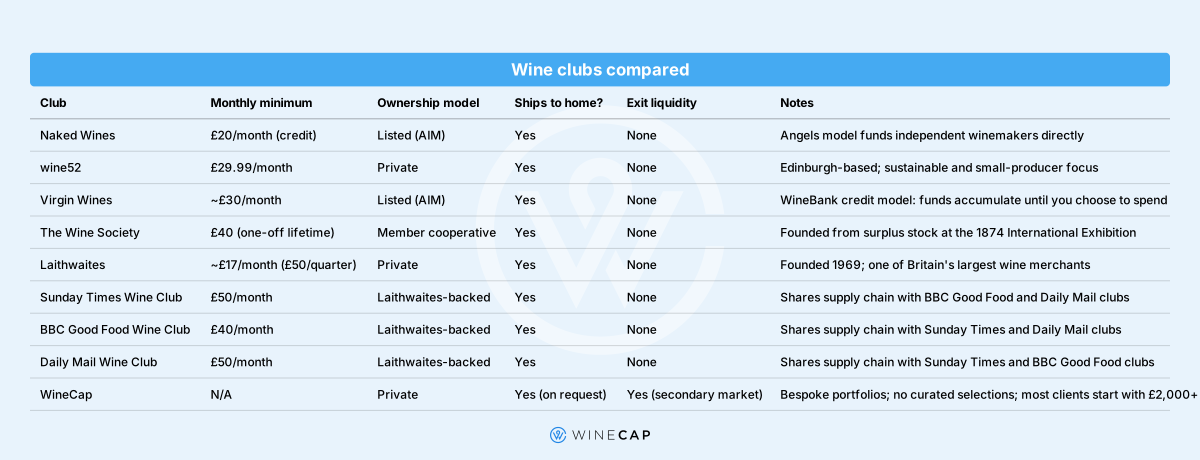
The UK wine club market is more varied than it first appears. Membership models range from monthly subscriptions starting at around £20 to one-off lifetime fees, while providers include member-owned cooperatives, specialist wine merchants and publicly listed retailers. Understanding how each club operates can help buyers choose the model that best suits their drinking habits and budget.

The Wine Society is one of the UK’s oldest and most respected wine organisations. Founded in 1874 using surplus wines from the International Exhibition, it remains a member-owned, not-for-profit cooperative. Members pay a one-off £40 joining fee, with profits reinvested into the business rather than distributed to shareholders. The Society is particularly well regarded for its own-label wines, broad regional range and transparent allocation of limited releases.

Laithwaites operates the Four Seasons Club, which delivers 12 bottles every quarter. It also supplies three of the UK’s best-known media-branded wine clubs: the Sunday Times Wine Club, BBC Good Food Wine Club and Daily Mail Wine Club. Although each has different branding and marketing, they share the same buying team and fulfilment network.

Wine52 focuses on discovery, delivering three bottles each month from smaller producers alongside tasting notes, food-pairing suggestions and a magazine. The emphasis is on introducing members to wines they are unlikely to encounter in supermarkets.

Virgin Wines takes a different approach through WineBank, where members pay a monthly amount into an account and decide when to spend their credit, rather than receiving a fixed monthly case.

Naked Wines operates its Angels model, with members contributing monthly credit that helps fund independent winemakers in return for access to exclusive wines. Because many of these wines are produced specifically for the platform, direct price comparisons with other retailers are often difficult.

Many wine clubs also sell own-label or exclusive-label wines. This can offer good value and access to unique bottlings, but it also makes comparing prices across different retailers more challenging.

Wine clubs

How wine investment platforms differ from subscription clubs

Wine investment platforms and wine subscription clubs both involve buying wine, but they are designed for different purposes. Subscription clubs focus on discovery and enjoyment, while investment platforms are built around long-term ownership, professional storage and access to the secondary market.

When investment-grade wine is purchased through a wine investment platform or specialist merchant, it is typically stored in an HMRC-recognised bonded warehouse. The wine remains in bond, meaning VAT and excise duty are suspended until it is withdrawn for drinking or exported. For collectors holding wine over many years, this can significantly reduce the overall cost of ownership.

In the UK, fine wine is also generally treated as a wasting chattel, meaning gains from its sale are typically exempt from Capital Gains Tax. While wine does not lose this status if it is delivered to a home address, removing it from bond breaks the documented chain of provenance that secondary market buyers rely on when assessing authenticity, storage conditions and value.

Unlike a subscription service, a wine investment platform does not send pre-selected cases each month. Instead, purchases are based on the buyer’s objectives, whether building an investment portfolio, assembling a long-term collection or acquiring wines to enjoy at maturity. The wine remains professionally stored until the owner chooses to sell it or take delivery, making long-term ownership rather than regular consumption the primary focus.

Why provenance and in-bond storage determine value

Provenance is not a minor technical detail in the fine wine market. It is a key pricing input.

A wine held in professional bonded storage from its release carries a documented custody record: the warehouse, the owner, the dates of transfer. Professional bonded warehouses also maintain constant temperature and humidity at the levels fine wine requires for long-term ageing. Home environments rarely match those conditions consistently. Secondary market buyers can assume that they are buying a wine in optimum condition. 

A wine held at home for the same period, even under careful conditions, cannot offer the same confidence in its conditioning. Buyers discount accordingly, and the discount can be significant.

Who should choose a wine club, an investment platform, or both

Wine buying sits on a spectrum, and the choice between a subscription club and an investment platform is not always binary. The question is not whether to drink or to invest. It is what structure serves what purpose.

A wine subscription club suits the buyer who wants regular discovery at a defined monthly cost, with no obligation around storage or resale. The pleasure is immediate. The financial commitment is modest. Laithwaites, wine52, and Naked Wines are all well-suited to this profile, each with a different approach to curation and pricing.

A wine investment platform suits the buyer with a longer horizon: someone building a portfolio of fine wine over five to ten years and seeking the tax efficiency and secondary market access that in-bond ownership provides. That buyer is not choosing against wine enjoyment. They are choosing a different purchasing model and probably greater involvement in the structuring of their collection.

Many collectors run both approaches in parallel. A subscription delivers curated discovery for the table each month. An investment portfolio builds in bonded storage. These are complementary, not competing.

Buyers can help clarify the decision by answering the following questions:

  • Is this wine intended for drinking in the near term, or for holding over five or more years?
  • Does home storage meet the temperature and humidity conditions fine wine requires?
  • Is secondary market access important, or is the enjoyment of drinking the primary goal?
  • What is the monthly or annual budget, and how does that map to investment minimums?

In-person wine clubs

Not all wine clubs deliver bottles to your door. Some focus instead on providing access to exceptional wine lists, tastings and events through a membership model.

The best-known example in the UK is 67 Pall Mall in St James’s, London. Founded in 2015, the private members’ club offers one of the world’s largest wine lists by the glass, alongside dining, educational events and sommelier expertise. Membership is based on an annual fee rather than a subscription for wine deliveries, making it a different proposition from a traditional wine club.

Wine clubs vs wine investment: choosing the right option

Wine subscription clubs and fine wine investment platforms are designed for different goals. Subscription clubs offer convenience, discovery and regular enjoyment, while investment platforms focus on long-term ownership, professional in-bond storage and access to the secondary market.

For many wine enthusiasts, the two models work well together. A subscription club provides a steady stream of wines to enjoy today, while an investment portfolio preserves investment-grade bottles for future drinking or potential resale. Rather than choosing one over the other, the key is understanding what each offers and selecting the approach that best matches your objectives.

FAQ: Wine clubs

Is a wine subscription club the same as wine investment?

No. A wine subscription club is a retail product: a buying team selects bottles and delivers them to a home address, VAT and duty paid. A wine investment platform purchases bottles on a client’s behalf and holds them in a bonded warehouse in duty-suspended status, with secondary market access when the client chooses to sell. The two serve different financial and practical purposes and operate under entirely different structures.

Which wine clubs are available in the UK?

The main services include Laithwaites, wine52, Naked Wines, Virgin Wines, and The Wine Society. Three of the most prominent media-branded clubs, the Sunday Times Wine Club, BBC Good Food Wine Club, and Daily Mail Wine Club, all operate through the Laithwaites supply chain. Choice depends on budget, preferred delivery frequency, and whether the focus is discovery, specific regions, or supporting independent winemakers directly.

What is the difference between the Sunday Times Wine Club and Laithwaites?

In practice, very little. The Sunday Times Wine Club, BBC Good Food Wine Club, and Daily Mail Wine Club are all operated through Laithwaites’ buying team and supply chain. The branding and media partnerships differ, but the wines, selection process, and fulfilment infrastructure are the same across all three.

What does wine held in bond mean?

Wine held in bond is stored in an HMRC-recognised bonded warehouse in duty-suspended status. Excise duty and VAT are not paid until the wine leaves bond, either for delivery or for sale. Professional bonded storage provides controlled temperature and humidity, insurance, and a documented ownership record that supports secondary market pricing. Home storage does not provide equivalent conditions or the same provenance chain.

Can you make money from a wine subscription club?

Not in any structured sense. Once wine has been delivered to a home address, there is no established infrastructure for selling it on the secondary market. Individual bottles can theoretically be sold privately, but without a verified storage record or professional provenance chain, buyers discount heavily. Wine subscription clubs are designed for drinking, not for generating a financial return.

WineCap’s independent market analysis showcases the value of portfolio diversification and the stability offered by investing in wine. Speak to one of our wine investment experts and start building your portfolio. Schedule your free consultation today.
Categories
Learn

The Rhone Valley wine investment guide: Northern vs Southern Rhone

  • Rhone investment is concentrated in a handful of producers, led by Guigal’s La La wines in the Northern Rhône and Chateau Rayas in Chateauneuf-du-Pape.
  • The Rhone represents around 5% of brands in the Liv-ex Power 100, making it a useful diversification play rather than a core portfolio allocation.
  • While the region produces some of the world’s most sought-after wines, investment opportunities are more limited than in Bordeaux or Burgundy due to a narrower secondary market.

The Rhone Valley is one of France’s most prestigious wine regions, producing some of the world’s finest Syrah and Grenache. Yet from an investment perspective, it occupies a different position to Bordeaux, Burgundy and Champagne. Rather than offering broad market depth, Rhône investment is concentrated in a relatively small number of producers with established secondary market demand.

Understanding the distinction between the Northern Rhone and Southern Rhone is essential. The two regions differ in grape varieties, styles, production volumes and investment potential, with estates such as E. Guigal and Chateau Rayas dominating collector interest. This guide explains how the Rhône fine wine market works, which producers matter most, and where the region fits within a diversified investment portfolio.

The Rhone Valley: France’s fourth great wine region

Stretching from Lyon to the Mediterranean, the Rhone Valley is one of France’s largest and most diverse wine regions. Following the course of the Rhone River, it encompasses dozens of appellations with dramatically different climates, soils and grape varieties, from the steep, granite slopes of the Northern Rhone to the warm, rolling vineyards of the south.

The southern Rhone is among France’s most climate-sensitive wine regions, and 2026 has brought that into sharp focus. France endured three major heatwaves in the first half of the year, with temperatures of 40 degrees Celsius across the south for days at a time and daytime highs running 10 to 15 degrees above historical norms. Growers across the Rhone are managing significant water stress, and expectations for the 2026 vintage are already cautious. The frequency and severity of these heat events is increasing, and the southern Rhone’s position on the front line of that trend might impact the region’s investment case over the coming decades.

A region of extraordinary diversity

Although grouped under a single regional name, the Northern and Southern Rhône are separated by a 25-mile stretch around Montélimar and differ markedly in geography, climate and wine style.

The Northern Rhône is small and steep, with granite slopes overlooking the Rhône River. It has a cooler continental climate and is dominated by Syrah, alongside small plantings of Viognier, which produces some of the world’s finest white wines.

The Southern Rhône is larger, warmer and more varied. Its vineyards are planted on limestone, clay and the region’s distinctive galets roulés—large rounded stones that absorb heat during the day and release it at night. Here, Grenache forms the backbone of most blends, supported by varieties such as Syrah, Mourvèdre and Cinsault.

From an investment perspective, however, the market is far more concentrated than the region itself. Most secondary market demand centres on just three appellations: Côte-Rôtie, Hermitage and Châteauneuf-du-Pape. While excellent wines are produced elsewhere in the Rhône, these appellations account for the majority of investment-grade bottles and trading activity, making them the region’s principal focus for collectors.

The northern Rhone: Small in volume, significant in quality

The northern Rhone accounts for roughly 10% of the region’s total production. It produces the lion’s share of the Rhone’s finest wines. The appellations that matter most to investors are Cote Rotie, Hermitage, and, at the margins, Cornas. Condrieu, while producing genuinely great white wine, sits in a different category.

Cote Rotie

The northernmost and today arguably the most celebrated appellation in the Rhone, built on steep south-facing granite slopes above the town of Ampuis. Wines are made primarily from Syrah, though appellation rules permit up to 20% of the white grape Viognier in the blend. Production is small and the finest wines, led by Guigal’s La-Las, command prices that rival First Growth Bordeaux.

Condrieu

A nine-mile stretch of steep, terraced slopes growing only Viognier, producing outstanding white wines. Condrieu came close to extinction in the 1960s and 1970s, when the appellation had shrunk to just a handful of hectares and Viognier as a variety was barely known outside the region. It has since recovered to nearly 200 hectares. The wines are unquestionably fine, but Condrieu is not an investable category in its own right: secondary market depth is essentially absent. The highest-profile wines are Guigal’s La Doriane and Domaine Georges Vernay’s Coteau de Vernon. Chateau-Grillet, carries its own separate AOC designation distinct from the Condrieu AOC, despite sitting within the same geographic zone, and is planted entirely to Viognier.  This monopole of Artemis Domaines (owned by the Pinault family, who also own Chateau Latour in Bordeaux) is one of a literal handful of wines from the Condrieu zone with a viable, if thin, secondary market.

Hermitage

A single south-facing hillside approximately two kilometres long and 500 metres deep, producing both red and white wine in roughly a three-to-one ratio. The vineyard is divided into a dozen or so named parcels and ownership concentrates among four producers: Paul Jaboulet Aine, Chapoutier, Jean-Louis Chave, and Delas Freres. Hermitage avoided the decades of critical and viticultural neglect that afflicted Cote Rotie and has maintained a consistent reputation for producing some of France’s most age-worthy red and white wines.

Cornas

Worthy of mention for quality, and at the top end prices are high enough to suggest investable potential, but secondary market liquidity is currently too limited for Cornas to form a reliable part of a fine wine portfolio.

Guigal and the La-Las: How three wines shaped a region

For much of the 20th century, the northern Rhone operated in relative obscurity. Its renaissance owes more to one producer than to any other: E. Guigal, whose three flagship single-vineyard Cote Roties, La Mouline, La Landonne and La Turque, are known collectively as the La-Las. In 1997, critic Robert Parker gave 100-point scores for all three wines from the 1985 vintage, one of the most significant critical events in the Rhone’s modern history. 

Since the 1985 vintage 1988, 1999, 2003, 2005, 2009, and 2010 have all received triple 100 point scores, a record of excellence that any producer would be proud of. In 2003 and 2009, Guigal, Hermitage Ex-Voto Rouge also achieved 100 points and in 2010, Parker awarded 100 points to Ex-Voto and La Doriane (the estate’s flagship Condrieu), a remarkable sweep across appellations in a single vintage. 

There have been no triple-100 vintages since 2010. 

The secondary market places significant value on the 1985 LaLa’s as a result, with La Landonne and La Turque regularly exceeding £15,000 per case and La Mouline reaching in excess of £20,000 per case.

LaLas growth

Guigal is another example where less costly cuvees see superior growth to higher priced flagships (Doriane averages £1,000 per case, while the LaLas are closer to £3,000).  However, the performance advantage of true icons like the 1985’s are notable: although extreme rarity and advancing years means that prices are more volatile, more dependent on condition and also that trade volume is diminished the performance of each 1985 is markedly superior to any of our all vintage indexes. 

Southern Rhone and Chateauneuf-du-Pape

Tavel’s position as one of the first appellations to receive AOC status in France earns it a historical note and Gigondas and Vacqueyras certainly produce genuinely fine wines. However, for investors examining the southern Rhone, none of these appellations offers the secondary market depth required. Chateauneuf-du-Pape is the only southern Rhone appellation with a credible investment case.

It also holds a special place in French wine history. In 1936, it became one of the first appellations to receive AOC (Appellation d’Origine Controlee) status, following the efforts of Baron Pierre Le Roy, whose work to protect the region’s identity from fraud and adulteration formed the foundation of the French appellation system still used today. The appellation permits 18 grape varieties and is best known for its Grenache-led blends, supported by Syrah and Mourvedre, grown on soils that include the famous galets roules. The Mistral wind, a powerful northerly that sweeps through the valley, limits humidity and supports the widespread organic viticulture for which the region is known.

The key producers for investors are:

  • Chateau Rayas: The most sought-after name in the appellation, producing Grenache-dominant wines that regularly command the highest prices in the southern Rhone.
  • Clos des Papes: Benchmark producer from the Avril family, making a single red and white cuvee that consistently ranks among the appellation’s finest.
  • Chateau de Beaucastel: Famous for using all permitted grape varieties and for a Mourvedre-led style that produces wines of exceptional ageing potential, including one of the appellation’s most celebrated whites.
  • Domaine du Vieux Telegraphe: Vineyards on the La Crau plateau produce wines with a strong secondary market following.
  • Domaine du Pegau: Traditional, unfiltered wines with a devoted collector following and consistent secondary market presence.

The appellation’s strongest vintages for investors include 2016 (widely considered the finest modern vintage, balancing concentration with remarkable freshness), 2019, 2010, 2007, 1998, and the twin reference points of 1990 and 1989.

Comparing prices: a region that punches above its recognition

The thesis on Rhone pricing is straightforward: entry prices for the finest northern Rhone and Chateauneuf-du-Pape wines are broadly comparable to Bordeaux classified growths and, in some cases, to mid-tier Burgundy Grand Cru, while the volume of investable wines is significantly smaller. For investors, that means higher concentration of capital in fewer labels and thinner secondary market trading.

comparing top Rhone wines

The Rhone as a diversification region

Bordeaux, Burgundy, Champagne, and the finest Italian expressions should form the core of most fine wine investment portfolios, for reasons of liquidity, market depth, and the breadth of investable producers within each region. 

The Rhone makes a compelling case for diversification. The wines that justify inclusion are specific and limited: Guigal’s La-Las from the northern Rhone, a handful of wines from Hermitage and the leading Chateauneuf-du-Pape estates, and Chateau-Grillet for investors with appetite for very thin market positions. 

Outside these names, the Rhone produces a significant number of wines with exceptional quality that has not yet translated into the secondary market depth investors need to enter and exit positions reliably. The wines are worth knowing, worth buying and worth drinking, but investor allocations should reflect where the market actually is, not where the quality suggests it could or should be.

FAQ: Rhone Valley wine investment

Is the Rhone Valley a good region for wine investment?

The Rhone is a viable region for diversification within a broader fine wine portfolio, but it is not a primary investment destination in the way Bordeaux or Burgundy are. The secondary market is concentrated around a very small number of producers: Guigal’s La-Las and the leading Chateauneuf-du-Pape estates account for the majority of meaningful trading activity. Outside those names, liquidity is limited and exit timing can be unpredictable.

How expensive are the top Rhone Valley wines?

The La-Las sit among the most expensive wines produced outside Burgundy and Bordeaux. Guigal, La Mouline has exceeded £20,000 per case at auction; La Landonne and La Turque regularly exceed £15,000. Chateau Rayas commands the highest prices in Chateauneuf-du-Pape, with top vintages trading well into four figures per bottle. 

What is the difference between northern and southern Rhone wines?

The northern Rhone produces primarily Syrah-based reds and Viognier-based whites from steep granite hillsides in a continental climate. The southern Rhone is broader and warmer, producing Grenache-led blends. For investors, the northern Rhone’s finest producers and Chateauneuf-du-Pape in the south are the only appellations with meaningful secondary market activity.

What are the best Rhone Valley vintages for investment?

The highest quality vintages are often not the best performers, but they do tend to exhibit greater liquidity and will have a longer lifespan. The consistency of warm, dry conditions especially in the south means strong vintages occur more frequently than in Burgundy or Champagne, which tends to moderate the urgency premium on individual years.

How does Rhone Valley pricing compare to Bordeaux and Burgundy?

Entry prices for the finest Rhone wines are broadly comparable to Bordeaux classified growths and competitive with mid-tier Burgundy Grand Cru, but the number of investable labels is significantly smaller. This concentration means less portfolio flexibility, even the most established names have lower liquidity than Bordeaux and Burgundy mainstays. 

WineCap’s independent market analysis showcases the value of portfolio diversification and the stability offered by investing in wine. Speak to one of our wine investment experts and start building your portfolio. Schedule your free consultation today.
Categories
Learn

Top Right Bank Bordeaux estates: An investor’s guide to Pomerol and Saint-Emilion

  • Right Bank Bordeaux estates, led by Petrus and Le Pin, rank among the most expensive wines in the world.
  • Saint-Emilion is the largest appellation in Bordeaux; Pomerol is the smallest: both operate without a fixed classification, creating different investment dynamics.
  • The Saint-Emilion classification has been contentious for over two decades, with three of its most prestigious estates withdrawing from the system entirely.

Right Bank Bordeaux operates on different terms from the Left. The dominant grape is Merlot, the soils are clay and limestone rather than gravel, and the estates are generally smaller, sometimes dramatically so. The two appellations that matter most to investors are Pomerol and Saint-Emilion. Both sit close to the medieval town of Libourne on Bordeaux’s eastern side, and both produce wines that compete at the top end of the secondary market. Understanding the differences between them, and which producers stand apart within each, is where the investment case begins.

Right Bank vs Left Bank: A different wine, a similar market

The Left Bank of Bordeaux is Cabernet Sauvignon country. The great estates of the Medoc, including Chateau Lafite Rothschild, Chateau Latour, and Chateau Margaux, sit on gravel beds that drain quickly and warm in summer sun, creating ideal conditions for Cabernet ripening. Cross the Gironde and Dordogne rivers to the Right Bank and the terroir changes fundamentally. Clay and limestone soils retain moisture and ripen Merlot more readily than Cabernet. The result is wines that tend toward softness and richness, though the finest age just as impressively as any classified left bank growth.

The Right Bank encompasses several other appellations, including Blaye, Bourg, Fronsac, and Entre-Deux-Mers. These produce decent wine but lack the secondary market presence that makes fine wine investable: no significant price history, no meaningful auction activity, no collector demand of the depth required. This article addresses only Pomerol and Saint-Emilion, the two Right Bank appellations with genuine investment credentials.

In terms of pure investment performance, the Left Bank and Right Bank offer similar dynamics. Over the last thirty years the Left has been a little more responsive to changing conditions and tends to see greater growth, while the Right has been more resilient. Overall, however, the performance has been relatively even between the two. 

Saint-Emilion and Pomerol: Size, grapes, and geography

Pomerol and Saint-Emilion make a contrasting pair. Pomerol is the smallest appellation in Bordeaux, covering around 800 hectares of gently rolling clay plateau north-east of Libourne, with no grand chateau architecture and no official classification. Saint-Emilion is the largest appellation in Bordeaux at roughly 5,500 hectares, with a UNESCO-listed medieval town at its centre, a classification system revised approximately every decade, and a range of estates stretching from genuinely world-class to merely Grand Cru in name.

Both appellations grow primarily Merlot, supplemented by Cabernet Franc. In Pomerol, Merlot can account for 95% or more of a blend on the finest estates. The dense blue clay soils around Pomerol’s plateau retain moisture and nutrients in a way that produces wines of extraordinary concentration and depth. Saint-Emilion’s geology is more varied: the limestone plateau around the town yields wines of structure and elegance, while the lower slopes and gravelly terraces produce softer, more accessible styles, including the distinctive Cabernet Franc-dominant wines of Chateau Cheval Blanc and Chateau Figeac.

How the Saint-Emilion classification works

The Medoc’s classification has remained almost entirely unchanged since Napoleon III commissioned it, with the 1973 promotion of Mouton Rothschild from Second to First Growth the only significant exception. In contrast, Saint-Emilion reviews its classification roughly every decade, with the most recent revision in 2022. The stated aim is to reflect current quality rather than purely historical reputation.

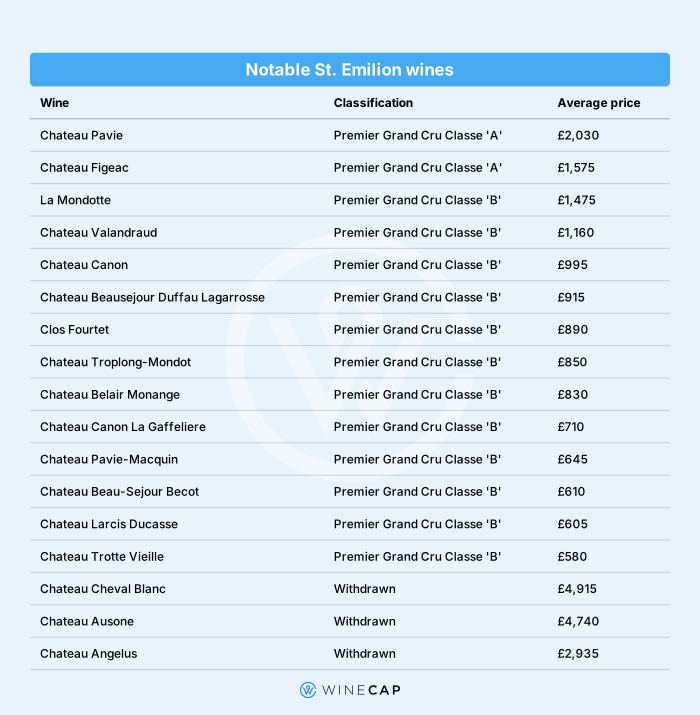
The classification runs in three tiers. At the top, Premier Grand Cru Classe A estates form the smallest and most prestigious group, while Premier Grand Cru Classe B covers a larger and more diverse set of estates. A broader Grand Cru Classe designation covers much of the rest of the appellation while below that and outside of the formal classification lie a further 200+ wines that carry the description “Grand Cru”. For investors, the A tier and the handful of the B tier estates are where secondary market concentration lies.

Saint Emilion wines

The controversy that has surrounded the Saint-Emilion classification

With classification having meaningful financial consequences for estates, it has become a persistent source of dispute. Legal challenges began in earnest with the 2006 revision, and the 2012 classification drew sustained controversy, including court action from estates that disputed the methodology. More seriously in 2021 a French court found the owner of Chateau Angelus Hubert de Bouard, guilty of exercising undue influence over the 2012 classification process.

The reputational damage to the classification became more serious ahead of the 2022 revision. Citing concerns about the process and its integrity, Chateau Ausone and Chateau Cheval Blanc announced their withdrawal from the classification entirely. Chateau Angelus also withdrew citing the unfair denigration of the classification system and the toxic environment around it. 

Chateau Figeac was promoted to Premier Grand Cru Classe A in the 2022 revision, alongside the continuing presence of Chateau Pavie. The result is a classification in which some of the appellation’s finest properties sit outside the official hierarchy while others remain within it, and in which collector demand pays limited attention to the distinction.  

Unlike in 2012 when promotion turbocharged already rising prices for Angelus and Pavie, Figeac’s 2022 promotion coincided with the market stalling and plateauing values. 

Pomerol’s elite: The estates that define the appellation

Pomerol’s top wines compete with any wine in the world on price, liquidity, and collector demand. With the exception of Vieux Chateau Certan, which farms around 14 hectares and represents a relatively more accessible entry into the tier, the estates below are small producers on tiny plots of land. Two command prices that rank among the most expensive wines made anywhere: Petrus and Le Pin.

Petrus

The most celebrated name in Pomerol, farming 11 hectares of almost pure blue clay planted almost entirely to Merlot. 

  • Annual production is around 4,500 cases from 11 hectares. 
  • Best vintages include 2000, 2008, 2009, 2010, 2015, and 2019.
  • Average market price: £30,000 per case

Le Pin

One of 20+ estates owned by the Thienpont family, this is the jewel in their crown and one of the rarest wines in Bordeaux.

  • Approximately 2 hectares, producing fewer than 700 cases per year 
  • Best vintages include 1982, 2005, 2009, 2012, and 2019. 
  • Average market price: £26,000 per case.

Vieux Chateau Certan

Owned by the Thienpont family since the 1920s and known as VCC, scores here often compete with Le Pin and Petrus at much lower prices.

  • Annual production of just under 5,000 cases from 14 hectares
  • Reliable across most good vintages; 2016 and 2019 are outstanding. 
  • Average market price: £1,800 per case.

L’Eglise Clinet

Denis Durantou utterly transformed this producer over a 40 year tenure until his death in 2020. His daughters have continued his work producing a wine that is well loved by critics.

  • Around 5 hectares produce on average 1250 cases per year.
  • Best vintages include 1998, 2005, 2009, 2016, 2019. 
  • Average market price: £1,650 per case.

Pomerol’s second tier estates

Lafleur occupies an unusual position. From the 2025 vintage, it is no longer a Pomerol wine: the estate withdrew from both the Pomerol AOC and the broader Bordeaux designation, becoming a Vin de France. Its profile remains almost as high as Petrus and Le Pin. In good vintages, prices reach comparable levels. The key difference is volatility: Lafleur’s prices swing more dramatically from vintage to vintage than either Petrus or Le Pin.

Trotanoy is the classic estate that competes without yet quite having arrived. Quality and price place it in the same conversation as Vieux Chateau Certan and L’Eglise Clinet, but it has not achieved the same secondary market depth or collector cachet. 

Below this level some estates remain investable, though with more selective market activity and lower overall liquidity making them less favorable than other more prominent options:

  • La Conseillante: Elegant, consistently reliable Pomerol with strong critical support and reasonable secondary market presence.
  • Fleur-Petrus: Moueix family ownership (the same family behind Petrus) lends brand recognition that supports trading activity from collectors new to the appellation.
  • L’Evangile: Owned by Domaines Barons de Rothschild (the Lafite family) since 1990, with investment in quality that has raised the estate’s profile steadily.
  • Clinet: Small production and strong scores in top vintages; occasionally trades above what its broader profile suggests it should.
  • La Violette: Tiny production and a growing collector following, with prices that have risen sharply in recent years relative to the estate’s starting point.
  • Clos L’Eglise: Frequently overlooked, producing dense, concentrated wine that can offer relative value at entry level.
  • Gazin: One of the larger Pomerol estates at around 24 hectares, offering broader accessibility and a degree of secondary market consistency.

Saint-Emilion’s defining estates: The Classe A wines

Five estates have defined the upper tier of Saint-Emilion, though the classification status of each has shifted. Chateau Ausone, Chateau Cheval Blanc, and Chateau Angelus have all withdrawn from the classification in recent years. Chateau Pavie and Chateau Figeac (promoted to Classe A in 2022) remain within it. Withdrawal from the classification has not meaningfully affected collector demand: secondary market pricing for Ausone and Cheval Blanc remains among the strongest of any Bordeaux estate outside the 1855 First Growths.

Chateau Ausone

One of Bordeaux’s most distinctive wines from its limestone escarpment above Saint-Emilion town, its unique terroir make it among the most sought after wines in Bordeaux.

  • Tiny production of around 1,800 cases per year from 7 hectares. 
  • Best vintages include 2005, 2009, 2010, 2015, 2019. 
  • Average market price: £4,750 per case.

Chateau Cheval Blanc

Owned by luxury goodsbehemoth LVMH CHeval Blanc farm an unusually high proportion of Cabernet Franc from one of the largest estates on the Right Bank.

  • 39 hectares produce around 8,000 cases annually. 
  • Best vintages include 2000, 2005, 2009, 2010, 2015, 2016. 
  • Average market price: £4,900 per case.

Chateau Angelus

With their iconic bell Angelus has become one of the best known St Emilion wines, and like Pavie saw prices climb significantly in the years around their promotion to Grand Cru Classe A in 2012.

  • Of their larger holdings only 27 hectares can be used for the Grand Vin to produce around 7,000 cases per year.
  • Best vintages include 2000, 2005, 2009, 2012, 2016. 
  • Average market price: £2,900 per case.

Chateau Pavie

Former supermarket magnate Gerard Perse purchased Pavie in 1998, after his death in 2025 responsibility was taken by his daughter Angelique and her husband. 

  • Here around 35 hectares produce on average around 6,500 cases per year.
  • Best vintages include 2000, 2005, 2009, 2010, 2016. 
  • Average market price: £2,030 per case.

Chateau Figeac

The newest entry to St. Emilion’s top tier, Figeac’s promotion was widely expected and came after a decade of rising prices.

  • 54 hectares of gravelly soils make a little more than 8,000 cases per year.
  • Best vintages include 2000, 2009, 2015, 2016, 2022. 
  • Average market price: £1,575 per case.

Saint-Emilion Premier Grand Cru Classe B: Three wines worth watching

Twelve estates currently hold Premier Grand Cru Classe B status. For investors, three stand apart for secondary market presence, critical support, and overall investable profile.

Canon

The most significant of the three, and the most consistent performer. Chanel (through the Wertheimer brothers) has owned the estate since 1996. Chanel also owns Chateau Rauzan-Segla in Margaux. 

  • Approximate secondary market price: £995 per case

Troplong Mondot 

Acquired by French reinsurance company SCOR in 2017, with Aymeric de Gironde appointed to lead the estate. The new direction has drawn substantially improved critical reception. 

  • Approximate secondary market price: £850 per case

Beausejour Duffau-Lagarrosse

6.5 hectares of clay-limestone soils on the western plateau, producing wines of genuine structure and longevity. 

  • Approximate secondary market price: £915 per case

Why invest in Bordeaux Right Bank wines? 

Pomerol and Saint-Emilion present distinct propositions. Pomerol offers no classification, tiny estates, and some of the world’s highest per-bottle prices, driven by scarcity that is structural rather than manufactured. Saint-Emilion offers a broader price range, a classification system that creates opportunity and noise in equal measure, and a set of estates where critical momentum and ownership changes have been shown to drive value shifts. 

For investors, the most durable positions in both appellations rest on the same foundation: small production, consistent quality, and collector demand that outpaces available supply.

FAQ: Right Bank Bordeaux investment

What is the difference between Pomerol and Saint-Emilion for investors?
For investors the distinction is largely about price points. For entry-level investment in the Right Bank, Saint-Emilion offers more choice; for long-term holdings at the highest level, Pomerol’s top estates have few rivals.

How much does Petrus cost on the secondary market?
Petrus sits among the most expensive wines in Bordeaux, with secondary market prices varying significantly by vintage. Average value of above £30,000 per case can rise to £100,000 in large formats and strong vintages and only a handful of poorer young vintages are available for less than £25,000 per case.

Does the Saint-Emilion classification matter for investors?
Classification status influences market perception, but the 2022 controversy demonstrated that it does not in isolation determine collector demand. For investors, producer quality, production volume, and secondary market liquidity are more reliable indicators than classification tier alone.

How liquid is Right Bank Bordeaux on the secondary market?
Liquidity varies considerably across the tier. Petrus, Cheval Blanc, and Le Pin trade regularly at auction and on platforms including Liv-ex despite lower production volume than their Left Bank cousins. Below the top tier, investors in second-tier Pomerol or Saint-Emilion Classe B estates should expect longer selling timelines which makes position sizing and entry price more important decisions.

What are the best vintages for Right Bank Bordeaux investment?
Across both Pomerol and Saint-Emilion, the years most consistently cited by collectors and the secondary market include 2000, 2005, 2009, 2010, 2015, 2016, and 2019. The 2016 vintage is particularly notable for Saint-Emilion but as is the case elsewhere, lesser vintages can provide outsized returns, although longer term holds should still favor the best quality.

WineCap’s independent market analysis showcases the value of portfolio diversification and the stability offered by investing in wine. Speak to one of our wine investment experts and start building your portfolio. Schedule your free consultation today.
Categories
News

Fine wine’s price correction meets a new generation of collectors

  • 97% of UK and US wealth managers expect demand for fine wine to remain strong, the highest result among other collectibles.
  • Fine wine prices have fallen around 25% since their 2022 peak but have outperformed several rival luxury collectibles over the past decade.
  • Independent research from Areni Global and Chubb points to younger, digitally engaged collectors as the main source of future demand growth.

Fine wine has spent the past three years in correction, with prices well below their 2022 peak and trading activity increasingly selective. One measure has not followed prices down: expected demand compared to other collectibles.

WineCap’s Wealth Report shows fine wine continues to rank as the collectible category for which wealth managers continue to expect the most client demand, in both the UK and US, through every year of the downturn. New research from Knight Frank, Areni Global and insurer Chubb may suggest why – the market’s buyer base is changing, and its demand cycle is becoming increasingly detached from its price cycle.

Prices down, but the decade record holds

Knight Frank’s Wealth Report 2026 captures both sides of the current market. Over the past decade, the Liv-ex 100 rose 34.1%, ahead of classic cars (31.3%) and well ahead of coloured diamonds (3.1%). Regional performance within that measure was stronger still: Burgundy gained almost 106% and Italy nearly 61% over the past ten years. 

However, the shorter-term picture reverses that ranking. Since its 2022 peak, the Liv-ex 100 has fallen 24.7%, including a 2.5% decline in 2025 alone, while cars, diamonds and watches all delivered better five-year returns. Knight Frank’s broader gauge, the Knight Frank Luxury Investment Index (KFLII) – a weighted basket of ten collectible classes – closed 2025 down just 0.4% and remains up 38.6% over the decade, meaning wine underperformed the composite on both timeframes even as it beat individual rivals over ten years.

Knight Frank singles out Tuscany as one of the market’s clearer value opportunities: labels such as Sassicaia and Tignanello continue to trade at roughly half the price of comparable Burgundy and Bordeaux despite similar critic scores. The report expects the gap to keep shaping demand into 2026, alongside uncertainty over US tariff policy given America’s weight as a buyer base. Elsewhere in the KFLII basket, 2025 was a stronger year: the WatchCharts Overall Market rose 5.1% (Patek Philippe’s index up 12.1% against Rolex’s 4.6%), fancy colour diamonds held broadly stable against a struggling wider diamond trade, and Hermes Birkin and Kelly bags slipped just 0.2%, with demand rotating toward worn “beater” bags in the US$6,000-US$9,000 range favoured by younger buyers – a demand-side pattern that somewhat mirrors what’s happening in fine wine.

Wealth managers still rank wine the top demand story

WineCap’s Wealth Report has tracked wealth managers’ expectations for client demand across major collectible categories since 2023. Fine wine has led every year. In the UK, between 94% and 97% of wealth managers surveyed have expected demand for fine wine to increase each year since 2023, ahead of watches (78–90%) and classic cars (22–70%, the most volatile reading in the set). 

The US shows the same pattern: after dipping to 84% in 2024, expected demand for fine wine climbed to 97% in 2026, again the highest-ranked category, with classic cars at 71% and categories such as stamps (69%) and antique furniture (60%) trailing well behind. Falling prices would typically be expected to soften that kind of forward-looking confidence; instead, wine’s demand score sits at or near a four-year high in both markets heading into 2026.

A younger, digitally native buyer base

Areni Global, the wine-focused think tank, has offered a likely explanation. Its February 2026 study, “The New Fine Wine Consumer: How people under 40 find their way into fine wine” — produced with Berry Bros & Rudd, 67 Pall Mall, Vinophiles Society and the Young Members Circle of the International Wine and Food Society – found strikingly consistent collecting behaviour among under-40s across London, Paris, New York, Hong Kong, Shanghai and Singapore.

The research identified a “collector’s spark” window between ages 26 and 35: those who enter the market in this window are far more likely to keep collecting for decades, while those who haven’t entered by 40 largely never do. Discovery increasingly runs through peer networks and digital communities rather than family inheritance. “Horizontal discovery,” in co-founder Pauline Vicard’s terms, supported by wine-tech platforms, blockchain provenance tools and a generation that expects the same real-time feedback loops from a wine portfolio that they get from other alternative-asset apps.

Investing in wine, but not insuring it

Chubb’s newly released research into younger affluent consumers reinforced the same generational shift. Surveying “HENRYs” – high earners not yet rich, typically in their 20s to mid-40s with incomes of $250,000 to over $1 million – Chubb found 78% weigh an item’s future value as a top purchasing factor. 

Wine collectors were the most engaged group measured: 81% actively drink from their collections, the highest hands-on rate of any category in the survey, and 45% cited status, prestige and expertise-building as a motivation. Close to half have collected for five years or more, and 21% for a decade-plus – tenure that lines up closely with Areni Global’s 26-to-35 “spark” window.

That conviction, nevertheless, hasn’t translated into cover. More than half of young collectors overall remain uninsured, chiefly because 46% of the uninsured wrongly believe their homeowners’ policy already protects their valuables, while 34% simply don’t see their collection as at risk. 

Fine wine outlook in 2026 and beyond

Taken together, the research points to a fine wine market that is evolving in ways price indices alone cannot fully explain.

Knight Frank’s data shows a market still around 25% below its 2022 peak. Yet WineCap’s Wealth Report shows wealth managers continue to expect stronger demand for fine wine than for any other collectible. Areni Global identifies a growing pipeline of collectors entering the market before the age of 40, while Chubb’s research suggests these buyers are digitally engaged, investment-minded and building collections with a long-term perspective.

None of this means the market is immune to further volatility. Interest rates, currency movements, geopolitical developments and US trade policy will continue to influence prices in the near term.

What the research does suggest is that today’s correction differs from many previous market downturns. Rather than driving buyers away, it has coincided with a generational shift in demand. Fine wine is attracting a new cohort of collectors who view it not simply as a luxury product, but as a long-term alternative asset.

For investors, that may prove to be the more significant trend. Market cycles come and go, but the long-term outlook for any collectible ultimately depends on whether new buyers replace those leaving the market. The combined evidence from WineCap, Knight Frank, Areni Global and Chubb suggests that transition is already underway.

FAQ: Fine wine collecting and investing

Is fine wine an alternative investment?

Yes. Fine wine is considered an alternative investment because it sits outside traditional asset classes such as equities, bonds and cash. Investors buy investment-grade wines with the expectation that their value will appreciate over time, driven by scarcity, global demand and limited production. Unlike financial securities, fine wine is a tangible asset with an established secondary market.

What is a collectible investment?

A collectible investment is a physical asset purchased with the expectation that it will increase in value over time. Examples include fine wine, classic cars, watches, art, rare whisky, coins and stamps. Collectibles typically derive their value from scarcity, provenance, condition and demand among collectors.

Which collectibles are considered investable?

The most established investment-grade collectibles include fine wine, fine art, classic cars, luxury watches, rare whisky, coloured diamonds and certain handbags. These markets benefit from active secondary trading, transparent pricing and strong global demand, although liquidity and risk vary significantly between categories.

Why is fine wine considered an attractive investment?

Fine wine combines several characteristics investors value: limited supply, global demand, transparent pricing, long-term performance and relatively low correlation with traditional financial markets. Because investment-grade wines are consumed over time, supply naturally declines, increasing scarcity for the remaining bottles.

Why do wealth managers recommend fine wine?

Many wealth managers view fine wine as a portfolio diversifier rather than a replacement for traditional investments. It can help reduce concentration risk because its performance is influenced by different factors than equities or bonds. Wine is also a tangible asset with a long history of global collector demand.

What is portfolio diversification?

Portfolio diversification means spreading investments across different asset classes to reduce overall risk. Rather than relying on a single investment, diversified portfolios combine assets such as shares, bonds, property, cash and alternatives like fine wine. If one asset class performs poorly, others may help offset losses.

How does fine wine diversify an investment portfolio?

Fine wine has historically shown relatively low correlation with traditional financial markets. Its value is driven by factors such as production volumes, vintage quality, critic scores and collector demand rather than corporate earnings or interest rates. As a result, many investors use fine wine to complement broader portfolios.

What makes a wine investment-grade?

Investment-grade wines typically come from established producers with proven secondary market demand, limited production and long ageing potential. Regions such as Bordeaux, Burgundy, Champagne, Tuscany and Piedmont dominate the market, although investment opportunities also exist elsewhere.

Why do fine wine prices increase over time?

As investment-grade wines are consumed, fewer bottles remain available for future buyers. Combined with strong global demand and limited annual production, this natural reduction in supply can support prices over the long term. However, values are also influenced by broader economic conditions and collector sentiment.

How does fine wine compare with other collectibles?

Fine wine shares many characteristics with other luxury collectibles, including scarcity and provenance, but differs in having an increasingly transparent global trading market. Unlike watches or art, wine is also a “wasting asset” acting as a tax advantage in the UK.

Who invests in fine wine?

Fine wine attracts a broad range of investors, from private collectors and high-net-worth individuals to family offices and wealth managers. Recent research also suggests younger, digitally engaged collectors are entering the market earlier, viewing fine wine as both a passion asset and a long-term investment.

What risks should fine wine investors consider?

Like any investment, fine wine carries risks. Prices can fluctuate, liquidity varies between wines, and returns are not guaranteed. Investors should also consider storage costs, insurance, provenance and holding periods. Fine wine is generally viewed as a medium- to long-term investment rather than a short-term trade.

WineCap’s independent market analysis showcases the value of portfolio diversification and the stability offered by investing in wine. Speak to one of our wine investment experts and start building your portfolio. Schedule your free consultation today.
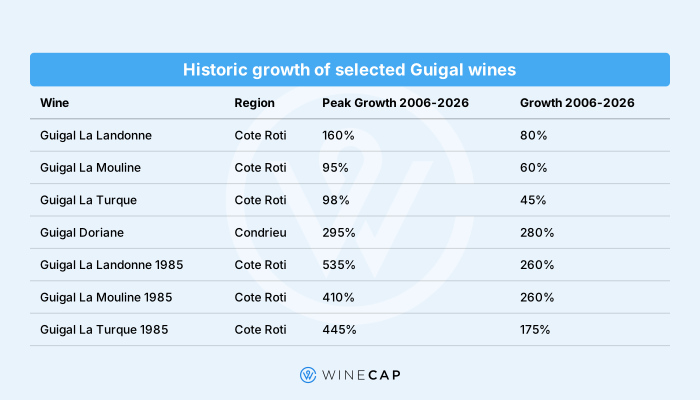
Categories
Learn

Burgundy Grand Cru: What investors need to know

  • Burgundy’s 33 Grand Cru vineyards cover just 2% of the region’s vineyard area, making them among the world’s scarcest fine wine assets.
  • The same Grand Cru vineyard can produce wines ranging from under £100 to well over £10,000 per bottle, meaning vineyard classification alone is not enough to guide an investment decision.
  • Dozens of winemakers can work a single vineyard so producer selection matters as much as the vineyard.

Burgundy’s Grand Cru vineyards sit at the pinnacle of one of the world’s most prestigious wine classifications. Their rarity, reputation and collectability have made Grand Cru Burgundy a cornerstone of many investment portfolios.

For investors Grand Cru status is only the starting point. Unlike Bordeaux, where classifications apply to estates, Burgundy classifies vineyards. A Grand Cru designation identifies exceptional land, but it does not guarantee an exceptional investment. The same vineyard can produce bottles worth under £100 or more than £10,000, depending on who farms the land and who makes the wine.

The most successful investments evaluate both the vineyard and the producer, recognising that the land establishes a wine’s potential while the winemaker ultimately determines its quality, scarcity and long-term market performance.

What is Burgundy Grand Cru, and how is it different from Bordeaux?

Burgundy operates a three-tier quality hierarchy. At the base sit regional and village wines, covering the majority of production. These are generally made for easy drinking fairly soon after harvest and are not as a rule recommended for investment.

Above them are Premier Cru vineyards, of which there are several hundred, each with its own name and regulated growing conditions, many of which are viable investments. 

At the top stand 33 Grand Cru, as with other tiers this status is awarded to the land, not to the producer who farms it. This is in stark contrast to Bordeaux where classification applies to estates, which can expand, reduce, or restructure their landholdings over time. 

A Burgundian Grand Cru is a fixed geographic designation: the same plot, the same appellation boundaries, the same yield limits, regardless of who owns it or how much of it they own. This produces radical fragmentation. Where a classified Bordeaux estate might produce 200,000 bottles per year from a single consolidated holding, a Burgundy Grand Cru producer may own a fraction of a hectare and make a few hundred cases. In Bordeaux, the estate defines the wine. In Burgundy, the place and the person both do, and the place can be very small indeed.

How rare is Grand Cru Burgundy?

The rarity argument for Burgundy Grand Cru begins with the land. The thirty-three appellations in total, account for approximately 2% of Burgundy’s total vineyards. In production terms, the share is smaller still. Strict yield regulations across Grand Cru land, combined with the choices of quality-focused producers who harvest well below the permitted maximum, mean that actual output is a fraction of what the land could theoretically produce.

Nine of Burgundy’s 33 Grand Cru appellations are monopoles, meaning a single producer owns and farms the entire vineyard. Monopoles represent the ultimate expression of scarcity: one vineyard, one producer, generally only one wine. For estates who control monopoles such as Domaine de la Romanee-Conti, Domaine du Comte Liger-Belair and Domaine Lamarche, collectors have no alternative source if they want those wines.

Most Grand Crus are divided among multiple owners, sometimes dozens of them. This fragmentation lies at the heart of Burgundy investing. While the supply of each vineyard is fixed, the quality, production volumes and market value of its wines vary dramatically from one producer to another. Understanding who farms a Grand Cru is therefore just as important as understanding the vineyard itself.

Chablis Grand Cru: the outlier

Chablis Grand Cru occupies a distinct position within the 33. There is technically one Grand Cru in Chablis, divided into seven named Climats (sub-sections within the appellation): Blanchot, Bougros, Les Clos, Grenouilles, Preuses, Valmur, and Vaudesir. Producers can market these separately or under the broader Chablis Grand Cru label. At around 100 hectares the Chablis Grand Cru is large by Burgundy standards.

The style is also distinct. Chablis sits further north than the Cote d’Or, producing Chardonnay with higher natural acidity and a steely, mineral character that sits closer in profile to the Sauvignon Blancs from Sancerre in the Loire Valley than to the richer whites of Meursault or Puligny-Montrachet. 

Very few Chablis wines exceed £50 per bottle, and the investment profile of the category is modest: secondary market depth is limited, and price appreciation has lagged the most in-demand Burgundy appellations by a significant margin. The major producers are:

  • Vincent Dauvissat: the most critically acclaimed name in Chablis, farming with rigour and producing Grand Cru wines with ageing potential and collector-grade demand. Prices can exceed £1,000 a bottle.
  • Francois Raveneau: also highly regarded but notably more affordable than Dauvissat,the most costly vintages are between £200 and £300.
  • William Fevre: the largest Grand Cru landholder in Chablis, farming 17 hectares of Grand Cru. William Fevre was acquired in 2022 by Domaines Artemis as part of a larger purchase and subsequently sold to Domains Barons de Rothschild, the owners of Chateau Lafite Rothschild in 2024, in their first move into Burgundy.

The largest Grand Cru vineyards

Burgundy’s largest Grand Crus produce more wine, trade more actively on the secondary market, and offer more entry points for investors than the rarest appellations. They are also divided among many producers, which makes selection more complex not less. These five Grand Crus are each larger than 20 hectares and produce several hundred thousand bottles per year collectively, but quality within that volume is not consistent.

  • Corton (~160 ha)

The only red Grand Cru in the Cote de Beaune, covering multiple named Climats including Bressandes, Clos du Roi, and Renardes, alongside the white Corton-Charlemagne. Collectively, Corton’s Grand Crus produce roughly 500,000 bottles per year across all producers and Climates.

  • Corton-Charlemagne (~52 ha)

The principal white Grand Cru of the Cote de Beaune, planted entirely to Chardonnay and producing around 200,000 bottles per year. The finest examples, from Coche Dury, Leroy and DRC Can reach £5000 a bottle, while wines from Louis Jadot, Bonneau du Martray, and Joseph Drouhin can match their scores at prices well under £500 per bottle.

  • Clos Vougeot (~50 ha)

A single walled vineyard with more than 80 individual owners, producing around 200,000 bottles per year from producers whose quality varies quite widely but it is one of the most affordable Grand Cru. Chateau de La Tour is the largest landholder here and consistently noted for its good value.

  • Echezeaux (~37 ha)

Adjacent to the DRC monopoles but with multiple producers. Around 130,000 bottles per year, and the best examples, from DRC and Emmanuel Rouget, represent some of the most attractively priced bottles at Grand Cru level.

  • Charmes-Chambertin (~31 ha) 

The largest of the Chambertin-family Grand Crus, producing around 100,000 bottles per year. Wines are generally lighter in structure than Chambertin itself, reflecting both the soils and the separation from Gevrey-Chambertin’s top slope.

Clos Vougeot is Burgundy’s clearest illustration of what fragmented ownership actually means at the extreme. With more than 80 owners sharing 50 hectares, some producers hold enough land to make 10,000 bottles a year; others cannot fill a single barrel of 300 bottles. Some do not vinify under their own label, selling their fruit or leasing the land to others instead.

The smallest Grand Cru vineyards

At the opposite end of the scale, Burgundy’s smallest Grand Crus are defined entirely by rarity. All those below 5 hectares command prices that reflect supply constraints. Production at the most minute is measured in a few thousand bottles per year, against collector demand that can span continents. These are the appellations where the scarcity argument is least theoretical.

  • La Romanee (0.84 ha)

The smallest Grand Cru appellation in France, owned entirely by Domaine du Comte Liger-Belair. Its 0.84 hectares is roughly the footprint of a standard football pitch. Annual production is around 2,500 to 3,000 bottles in a typical year.

  • La Grande Rue (1.65 ha)

A monopole of Domaine Lamarche, situated between La Tache and Romanee-Conti on the Vosne-Romanee slope, producing around 5,000 bottles per year. Promoted to Grand Cru status in 1992.

  • Romanee-Conti (1.8 ha)

The Grand Cru after which the domaine is named, producing around 5,000 to 6,500 bottles per year as a DRC monopole. Secondary market prices for current vintages regularly exceed £20,000 per bottle.

  • Mazoyeres-Chambertin (1.8 ha)

Legally a separate Grand Cru, though wines may be sold under the Charmes-Chambertin label it is frequently confused with Mazis-Chambertin. Limited secondary market profile relative to neighbouring Chambertin-family appellations.

  • Griotte-Chambertin (2.7 ha)

One of the smaller Chambertin-family Grand Crus, producing around 10,000 bottles per year across several producers. Joseph Drouhin Griotte-Chambertin is among the most consistently cited.

  • Ruchottes-Chambertin (3.3 ha)

Domaine Armand Rousseau farms its entire section, “Clos des Ruchottes” (1.06 ha), as a monopole within the appellation.

  • Bienvenue-Batard-Montrachet (3.7 ha)

Adjacent to Batard-Montrachet, producing refined, precise white Burgundy across around 15,000 bottles per year. Domaine Leflaive is the benchmark producer.

  • Croix-Batard-Montrachet (3.9 ha)

The smallest of the Montrachet-adjacent Grand Crus for white wine, producing around 14,000 bottles per year of tightly structured, age-worthy Chardonnay.

The smallest Grand Cru appellations offer the most distilled version of the Burgundy investment thesis: annual production of 2,500 to 6,000 bottles, a fixed and finite supply, and no mechanism for increasing output regardless of demand. When bottles appear at auction, competition is acute. Secondary market trading is thin by nature, which can make price discovery unreliable, but the direction of long-term demand is clear.

Grand Cru monopoles: single-owner vineyards

A monopole is a Grand Cru appellation under single ownership, where one producer makes all the wine that can carry that designation. Monopole status creates the starkest possible supply dynamic: no second bottle, no alternative label, no other source.

  • Clos de Tart (7.5 ha)

Owned by the Pinault family (of Chateau Latour) since their acquisition from Mommessin in 2018. This Morey-Saint-Denis Grand Cru produces around 25,000 to 30,000 bottles per year, release prices have risen significantly since the change of ownership.

  • La Tache (6 ha)

Also a DRC monopole, and often described as the only Grand Cru that rivals Romanee-Conti in quality.  Although that is true within DRC’s portfolio it is an exaggeration when compared to the rest of Burgundy. Annual production is around 20,000 to 25,000 bottles.

  • Romanee-Conti (1.8 ha)

Owned by DRC. The most celebrated wine in Burgundy by most measures, producing around 5,000 to 6,500 bottles per year. Prices for current vintages regularly exceed £20,000 per bottle.

  • La Grande Rue (1.65 ha) 

Owned by Domaine Lamarche, producing around 5,000 bottles per year from its site between La Tache and Romanee-Conti.

  • Ruchottes-Chambertin (1.1 ha)

The entire grand cru is not a monopole but unusually one specific parcel “Clos des Ruchottes” owned by Armand Rousseau is recognised as such.

  • La Romanee (0.84 ha)

Owned by Domaine du Comte Liger-Belair since 2001. The smallest Grand Cru appellation in France, producing 2,500 to 3,000 bottles per year.

The Corton Exception

Corton is unique among Burgundy’s Grand Crus. Rather than a single, uniform vineyard, it comprises numerous named climats spread across around 160 hectares. While the Corton Grand Cru appellation is shared by many producers, several individual climats are monopoles, owned and farmed by a single estate. These are not separate Grand Cru appellations, but they create the same investment dynamic: one producer, one interpretation of a distinctive site, and a finite supply that cannot be replicated.

  • Corton Clos des Marechaudes

A monopole of Domaine du Pavillon (part of Albert Bichot) within the larger Corton Grand Cru, producing around 8,000 bottles per year.

  • Corton Clos des Cortons Faiveley

A monopole of Domaine Faiveley within Corton, covering approximately 3 hectares and producing around 10,000 to 12,000 bottles per year.

  • Corton Clos de Chevalier

A monopole of Domaine Jean Chartron within Corton this site is smaller than a football pitch and production is less than 2,000 bottles a year

Cote de Nuits standouts

The Cote de Nuits is the northern tip of Burgundy and runs south from Dijon through some of the most valuable agricultural land in the world. Almost all of its Grand Crus produce red wine from Pinot Noir, and the finest achieve a combination of structure, longevity, and complexity that collectors and investors return to generation after generation. Beyond the vineyards already covered key Grand Crus include:

  • Mazis-Chambertin (9.1 ha)

One of the highest-regarded of the nine Chambertin-family Grand Crus, producing wines with excellent ageing capacity. Domaine Armand Rousseau, Mazis-Chambertin and Domaine Faiveley, Mazis-Chambertin are the most consistently acclaimed.

  • Musigny (10.7 ha)

The prestige Grand Cru of Chambolle-Musigny and one of the most structured reds in the entire Cote de Nuits. Domaine Leroy Musigny is the most searched for wine in the appellation and consistently among the most costly Burgundy wines.

  • Chambertin (12.9 ha)

The senior Grand Cru of Gevrey-Chambertin, producing wines of exceptional structure and longevity when made well. The producer quality range is among the widest in Burgundy: Armand Rousseau and Dujac’s Chambertin sell well above £2,000 per bottle; Domaine Leroyhas reached £10,000+ per bottle while less prominent producers sell below £200.

  • Bonnes Mares (15.5 ha)

A Grand Cru straddling Chambolle-Musigny and Morey-Saint-Denis, producing powerful, structured reds with more grip than Musigny’s more celebrated refinement. Domaine Georges Roumier, Bonnes Mares is the benchmark, trading at several thousand pounds per bottle.

  • Clos de la Roche (16.9 ha)

The largest and arguably the most undervalued Grand Cru in Morey-Saint-Denis. Domaine Dujac is the most searched for producer here, with Domaine Ponsot not far behind.

Cote de Beaune standouts

The Cote de Beaune is Burgundy’s white wine heartland. Its Grand Cru Chardonnays are the most commercially active and critically scrutinised white wines in the world, and attract secondary market attention that rivals the top red Grand Crus of the Cote de Nuits. Prices for the finest producers begin above £1,000 per bottle and can be much higher in the most sought-after vintages. Their prestige reflects centuries of accumulated reputation supported by consistent critical and auction results:

  • Montrachet (8 ha)

Widely regarded as the greatest white wine vineyard on earth, split between Puligny-Montrachet and Chassagne-Montrachet and divided among approximately 14 producers. Combined production is around 30,000 bottles per year. Domaine de la Romanee-Conti and Domaine Leflaive are the most coveted expressions but more than a dozen producers make wines here that retail above £1,000 per bottle.

  • Batard-Montrachet (11.9 ha)

The larger companion to Montrachet, also divided between both villages, producing around 45,000 bottles per year. The price range is wide, from around £200 to over £1,000 per bottle depending on producer.

What Grand Cru means for investors

Grand Cru designation establishes the ceiling for a wine’s potential. It guarantees nothing about what is in the bottle. The clearest demonstration is Chambertin. One appellation, dozens of producers, and a prices range that is almost two orders of magnitude. Domaine Leroy’s Chambertin trades at around £10,000 per bottle. Domaine Armand Rousseau and Domaine Dujac both sell well above £2,000. Both are exceptional wines commanding exceptional prices. Others working the same Grand Cru soil with less reputation and less rigour, sell below £200 per bottle.

This is not a pricing anomaly. It reflects the reality that in Burgundy producer reputation, vine age, farming approach, and allocation access all determine secondary market value more directly than appellation name. Investors who understand this can make more precise decisions. Those who select on Grand Cru status alone pay for the land while ignoring the person who translates it into wine.

A broader thesis applies too. Within a producer’s range, the most prestigious Grand Cru is not always the wine that delivers the strongest proportional return over a given holding period. A lesser producer in the same vineyard or Premier Cru from the same producer may gain more in percentage terms, while attracting less capital at entry. 

Nevertheless Grand Crus retains real advantages: superior longevity, stronger secondary market liquidity for the finest examples, and clearer identity for buyers holding for decades. The relationship between price, prestige, and performance is not linear, investors who navigate it carefully find opportunity at every level of the hierarchy, not only at the top.

The land is fixed; the choice is not

Burgundy’s 33 Grand Cru appellations produce many of the world’s most sought-after wines. Their rarity gives investors a clear framework, but it does not provide a buying list nor does it identify exceptional investments.

The vineyards themselves will not change. Their boundaries are fixed, their supply finite, and their reputations firmly established. The more important variable is the producer. The same Grand Cru vineyard can produce wines worth less than £100 or more than £10,000 per bottle, depending on who farms it and how they translate the site’s potential into wine. WineCap look beyond the appellation to evaluate reputation, viticulture, production volumes and long-term market demand, and investors should do likewise.

Understanding that distinction is what turns Burgundy’s Grand Cru classification from a map of great vineyards into a guide for building a stronger portfolio.

FAQ: Burgundy Grand Cru investment

How much does Burgundy Grand Cru wine cost?
Grand Cru Burgundy spans one of the widest price ranges in fine wine. At the Chablis level, most bottles fall below £50. On the Cote d’Or, entry prices from lesser-known producers start around £100 to £200 per bottle. Top producers in prestige appellations command several thousand pounds with some reaching ten times that with age.

Why does the producer matter so much in Burgundy Grand Cru?
Because the classification system awards status to the land, not the winemaker and multiple producers may farm parcels within the same Grand Cru, with quality, reputation, and methods varying significantly between them. The vineyard sets the potential; the producer determines whether it is reached.

What is a monopole, and why does it matter for investors?
A monopole is a Grand Cru appellation entirely under single ownership, meaning one producer makes all the wine that can carry that designation. Monopole status removes all alternative supply: there is no second producer to moderate demand or provide access. This strengthens the scarcity argument.

Is Chablis Grand Cru worth investing in?
As a quality category, Chablis Grand Cru has genuine merit. As an investment vehicle, it is limited to two or three producers. Very few bottles exceed £50, secondary market depth is shallow compared to the Cote d’Or, and price appreciation has been modest relative to the top Burgundy appellations. 

How much wine does Romanee-Conti produce each year?
DRC’s Romanee-Conti, the 1.8-hectare monopole, produces around 5,000 to 6,500 bottles per year depending on the vintage. By contrast, Clos Vougeot, at 50 hectares, produces around 200,000 bottles annually across its 80-plus owners. That difference illustrates the full spectrum of supply within a single classification, and why “Grand Cru” alone tells an investor very little about rarity.

WineCap’s independent market analysis showcases the value of portfolio diversification and the stability offered by investing in wine. Speak to one of our wine investment experts and start building your portfolio. Schedule your free consultation today.
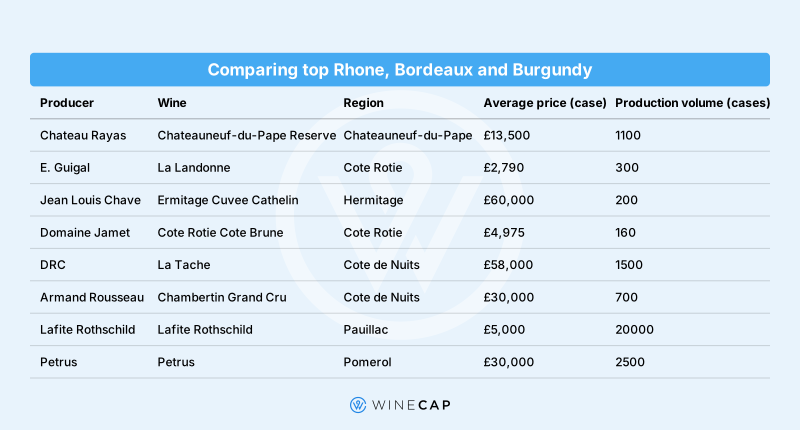
Categories
Learn

The impact of climate change on wine: what investors need to know

  • The impact of climate change on wine is already measurable: French harvest dates have moved forward by an average of two to three weeks since the 1980s.
  • 70% of today’s wine regions could face substantial suitability loss if warming exceeds 2°C, while only around a quarter stand to benefit.
  • Fine wine investors may be unusual beneficiaries of climate disruption in the medium term, as heritage regions decline and demand concentrates on a shrinking supply of established vintages.

Climate change is reshaping the conditions that make great wine possible. The effects are already visible in the vineyard: harvest dates, the varieties planted, and the hierarchy of individual sites within long-established regions are all in motion. Research published in Nature in 2024 found that up to 70% of the world’s current wine regions could face substantial suitability loss if warming exceeds 2°C. 

For fine wine investors, this is not background noise, nor is it a theory up for debate. The supply, style, and geography of the world’s most collected wines are changing now, and investors who understand these structural changes will be better equipped to assess long-term scarcity, quality and regional risk.

Climate change is already measurable

Viticulture traditionally happens on marginal farming land that’s unsuitable for other crops by virtue of its elevation, gradient or soil quality. Very often grapes are grown at the boundary of what a given climate can reliably ripen, making vineyards an effective early-warning system for changing conditions. Harvest dates across France’s major wine regions have moved forward by two to three weeks on average since the 1980s. Among producers and viticultural scientists, the direction of change is no longer seriously disputed.

The 2024 study in Nature Reviews Earth and Environment provides the most comprehensive quantification of what lies ahead. The 2°C threshold, the same target at the centre of international climate policy, marks the boundary between disruption that can be largely managed within existing winegrowing regions and disruption that reshapes the industry structurally.

A new global wine map: winners and losers

Climate change creates redistribution, not uniform loss. Some regions stand to benefit from warming; others face mounting pressure. The investment significance of this redistribution will take decades to register fully in secondary market pricing.

  • English sparkling wine is one of the clearest and earliest quality beneficiaries. The warming of southern England has made consistent ripeness achievable, with producers including Wiston, Nyetimber and Gusbourne now drawing serious critical attention. 
  • Hot Mediterranean climates are already under significant stress. Rising temperatures compress the window for retaining the freshness and acidity that define quality in many of the region’s key varieties.
  • California climate projections suggest suitable wine-growing area could shrink by up to 50% under current warming trajectories, with lower-elevation vineyards most exposed.
  • Northern Atlantic regions (Brittany, parts of northern England, northern Germany) are potential beneficiaries as warming gradually extends suitable growing conditions northward.

The pace of change will not be even. Regions close to the 2°C tipping point face the most acute near-term risk while those in cooler margins may see quality improve before conditions deteriorate.

However, greater suitability for grape growing does not automatically translate into investment-grade wines. Reputation, critical recognition and secondary market liquidity take decades to establish.

Local hierarchies within regions are shifting too

The changes are not only between regions. Within established appellations, the relative quality ranking of individual vineyard sites is under revision for the first time in generations. The best plots of one era are not guaranteed to be the best plots of the next.

Three forces drive this internal redistribution. South-facing slopes, which maximise sun exposure and were long considered the premium position within most northern hemisphere appellations, are now less automatically desirable in regions where warming has already advanced: additional sun can produce heat stress rather than quality. Higher-altitude vineyards, which cool more quickly at night and retain acidity more effectively, are gaining relative standing. Sites with reliable access to water, through proximity to rivers, groundwater, or other sources, are becoming increasingly valuable as summer drought stress affects more of the growing season across more regions.

For investors, knowing the site matters more than it did a generation ago, and the sites worth knowing are changing.

Earlier harvests alter wine style

Harvest dates have advanced by weeks across many of the world’s leading wine regions, reflecting faster ripening under warmer conditions. For producers, this means managing grapes that accumulate sugar more quickly while trying to preserve acidity and freshness.

Grape harvest data change

For investors, the implication is that the climatic conditions behind many of the most celebrated long-lived vintages are becoming less common. As growing seasons compress, producing wines with the same balance, complexity and ageing potential becomes increasingly challenging, even as producers adapt through changing viticultural practices.

Extreme events and shrinking yields

Shifting averages describe the trend. Extreme events determine the vintage. A warmer, more energetic atmosphere generates weather events of greater frequency and severity, and their effect on annual production can be immediate and severe. In Bordeaux, production data illustrates the pattern directly with a clear trend of falling harvests that cannot be explained by a reduction in vineyard area. 2024 and 2025 were the two smallest harvests in the region since 1991. The clustering of very small harvests in the recent period reflects a growing season increasingly shaped by extremes rather than reliable averages.

Bordeaux harvest yields

*Data from Gavin Quinney and CIVB.

Three types of event drive the most acute production losses in fine wine regions:

Frost

A warming climate triggers earlier budburst, exposing young shoots to late-season frost events that previously arrived before the vine had emerged from dormancy. The April 2017 frosts across Burgundy, Champagne, and Chablis destroyed the majority of that year’s crop in affected appellations.

Hail 

Warmer temperatures increase the energy available to storm systems, raising the frequency and intensity of localised hailstorms. A single event can destroy an entire year’s production in a specific vineyard.

Drought 

Water stress causes its own issues, but high temperatures and dry vegetation have also expanded fire risk across California, southern France, and Australia, threatening both vineyards and the surrounding infrastructure.

Water stress and the rules that may have to change

Water stress is one of the most significant long-term challenges facing fine wine production in warmer climates. Many of the world’s most prestigious appellation systems have historically prohibited or severely restricted irrigation, based on the belief that moderate water stress encourages deeper root systems and concentrates flavour in the grapes. Those rules were developed for a climate that no longer consistently delivers sufficient rainfall during the growing season.

In 2025, Chateau Lafleur, one of Pomerol’s most celebrated estates and among the most sought-after wines on the Bordeaux secondary market, announced it would withdraw from both the Pomerol AOC and Bordeaux appellations. From the 2025 vintage onwards, all six wines produced by the Lafleur group would be labelled Vin de France. In explaining the decision, the Guinaudeau family cited climate change directly, saying that its vineyard practices were “evolving much faster than what is authorised in our Appellation of Origine system.”

The estate has not disclosed every adaptation behind the decision. However, its departure illustrates a broader challenge facing many traditional wine regions: the growing tension between long-established appellation rules and the practical changes required to adapt to a warming climate. As environmental conditions evolve, regulatory frameworks may need to evolve with them.

How warming changes what ends up in the glass

Temperature has a direct influence on grape composition at harvest. Warmer growing seasons accelerate sugar accumulation, leading to higher potential alcohol, while making it more difficult to retain the acidity and freshness that define many of the world’s finest wines. The leading Burgundy wines of the 1970s and 1980s typically finished at around 12-12.5% alcohol; today, wines from the same appellations regularly exceed 13.5%.

The relationship between warming and quality is not linear. Regions that were once too cool to ripen grapes consistently have often benefited from rising temperatures, with parts of England, northern Germany and higher-altitude vineyard sites producing increasingly impressive wines. Beyond a certain point, however, further warming can upset the balance between ripeness, acidity and aromatic complexity. For many of the world’s most prestigious cool-climate regions, the challenge is no longer simply achieving ripeness, but preserving the freshness and balance that have long defined their identity.

The investor’s paradox: why climate risk may increase scarcity

For producers, climate change is primarily a production challenge. For investors, it also has implications for supply.

If established fine wine regions produce fewer outstanding vintages over time, the greatest wines already in circulation become relatively scarcer. All else being equal, that could strengthen the long-term value of mature wines from the world’s leading estates, particularly those with established reputations and proven secondary-market demand.

The relationship is not straightforward, however, and several factors could influence how scarcity translates into prices:

  • Markets adjust gradually. Reputation is built over decades, and climate-related changes are unlikely to be reflected immediately in secondary-market prices.
  • Collector preferences may evolve. As emerging regions establish stronger reputations and wine styles change, demand could gradually broaden beyond today’s traditional fine wine regions.
  • Producers will continue to adapt. Changes in vineyard management, grape varieties, site selection and appellation regulations may help offset some of the production pressures associated with a warming climate.

Rather than viewing climate change solely as a source of risk, investors should consider how it may reshape relative value across regions and producers. Estates with exceptional vineyard sites, strong track records and the resources to adapt are likely to remain best positioned as growing conditions evolve. Chateau Lafleur’s decision to leave the Pomerol AOC illustrates how some of the world’s leading producers are already prepared to challenge long-standing conventions in response to climate pressures.

Climate is now part of the investment decision

Fine wine has always rewarded investors who understand the factors that shape long-term supply. Climate change has become one of the most important of those factors, influencing production, quality and regional competitiveness across the world’s leading wine regions.

While uncertainty remains over the pace and extent of future change, climate is increasingly becoming another lens through which investors can assess long-term opportunity and risk. Understanding how warming may affect supply, producer adaptation and regional quality can help build a more informed, resilient fine wine portfolio.

FAQ: Climate change and its impact on wine investment

Does climate change pose a direct risk to an existing fine wine portfolio?

No. Bottles already produced and cellared are unaffected by changing growing conditions. The scarcity value of mature wine from heritage regions under climate pressure may actually increase as future production becomes less reliable. 

Which wine regions face the greatest climate risk?

Particularly acute climate risk is a consideration in lowland regions of California, Greece, Italy and Southern Spain. The regions best positioned to retain suitability are those with elevation, latitude, or reliable water access providing a natural buffer against rising temperatures.

Are new regions an opportunity for investors?

While new regions are coming to the fore, and many are crafting outstanding wine, the investment case does not yet follow. Secondary market liquidity is essentially absent, and no established price-discovery mechanism exists. The highest profile example of English sparkling wine is a quality story; it is not yet an investable category.

Does climate change make English sparkling wine worth considering as an investment?

Not yet. English sparkling wine has made genuine quality progress, and consistent ripeness in southern England is now an expectation rather than a fortunate exception. The investment infrastructure required for a wine to be a serious collectible, a functioning secondary market, auction price data, and a body of long-term price performance, does not yet exist. Quality and investability are related but not the same thing.

What does Chateau Lafleur’s appellation withdrawal mean for investors who hold the wine?

Very little, as existing bottles retain their AOC classification, and nothing will change for those wines. The broader signal is more significant: the tension between appellation rules and climate adaptation is now acute enough to affect even the most established and celebrated producers.

How should investors think about the 2°C threshold identified in recent research?

For investors, the practical implication is to weight future purchases and attention toward regions with the structural characteristics that provide a buffer at higher temperatures: elevation, northerly latitude, or reliable water access. Higher-altitude zones within established appellations, and regions whose current coolness gives them room to improve before they overshoot, are better positioned than flat, low-lying vineyard land in climates that are already warm.

WineCap’s independent market analysis showcases the value of portfolio diversification and the stability offered by investing in wine. Speak to one of our wine investment experts and start building your portfolio. Schedule your free consultation today.
Categories
Learn

The investor’s guide to Gaja: 10 things you need to know

  • Gaja has consistently been recognised as one of the most powerful Italian producers. 
  • Gaja’s best-performing investment wines are Gaia & Rey, Sperss, and the multi-vineyard Barbaresco, which offer stronger returns at lower entry prices.
  • Although Gaja remains best known for its Barbarescos, it now makes more wine in Tuscany than in Piedmont.

Gaja is arguably Italy’s most influential fine wine producer. Founded in Barbaresco in 1859, the family estate helped transform both the reputation of Italian wine and the global market for Nebbiolo. Yet for investors, Gaja offers an unexpected lesson: its most famous wines are not necessarily its best-performing assets. Here are ten things every wine investor and collector should know.

1. Gaja sits at the top of the Italian fine wine hierarchy

Gaja occupies a position in Italian wine that no other producer quite matches. The house is built on Barbaresco (the DOCG appellation in the Langhe hills of northwest Italy that produces Nebbiolo-based red wines), but its reach extends to Tuscany, where it operates two separate estates. Few Piedmontese producers have made that crossing; fewer still have done so with critical and commercial success.

For investors, that breadth matters. Piedmont and Tuscany carry different collector bases, different vintage cycles, and different secondary market dynamics. The decision to anchor the house in Barbaresco rather than Barolo (the other great Nebbiolo appellation, and the one that typically dominates international collector attention) is both historically determined and commercially distinctive.

2. Five generations of family ownership since 1859

Gaja was founded in 1859 by Giovanni Gaja in the village of Barbaresco and has remained in the same family for five generations without being sold, merged, or taken outside family control. That continuity is exceptional in European fine wine, where inheritance pressures and capital requirements have pushed many historic estates toward corporate ownership over the past half century.

The current generation is led by Angelo’s three children: Gaia, Giovanni, and Rossana Gaja. Gaia serves as the public face of the business and drives its commercial direction. The handover from Angelo, who transformed the estate into an internationally recognised brand from 1961 onwards, has been gradual and deliberate. 

For investors, family ownership signals long-term strategic consistency: the priorities that have defined Gaja’s approach, quality above volume, estate-grown grapes over bought-in fruit, personal identity over corporate anonymity, are structurally embedded rather than dependent on any external shareholder agenda.

3. How Angelo Gaja changed Italian wine from a single cellar

Angelo Gaja took over the family winery in 1961 at the age of 21. What followed was one of the most consequential individual interventions in Italian wine history. Angelo had studied oenology in France and observed what was happening in Burgundy and Bordeaux: green harvesting (removing a proportion of grape bunches in summer to concentrate the remaining crop), higher vine density, aging in small French oak barriques rather than the large Slavonian oak casks (botti) that had defined Piedmont’s cellars for generations.

He introduced all of these practices in Barbaresco, where they were deeply unfamiliar. He also pioneered the bottling of single-vineyard Barbaresco, beginning with Sori San Lorenzo in 1967, at a time when almost all Barbaresco was blended across multiple vineyard sites. That decision reframed the appellation’s identity, establishing the concept of named individual crus that today defines how the finest Barbaresco and Barolo are understood by collectors.

4. Gaja spent 130 years making only Barbaresco

For the first 130 years of its history, Gaja made wine exclusively in Barbaresco. Although Barolo is often considered Piedmont’s flagship appellation, the estate remained committed to its home region and refused to expand until it could do so on its own terms.

That opportunity came in 1988, when Gaja acquired vineyards in Serralunga d’Alba, one of Barolo’s most prestigious communes. True to the family’s philosophy, the estate only entered the appellation after securing vineyards of its own, rather than buying fruit from growers. The result is a relatively small Barolo portfolio centred on Sperss, Conteisa and Dagromis, produced to the same standards as its Barbaresco wines.

The timing proved significant. As Barolo’s international reputation grew rapidly through the 1980s and 1990s, Gaja chose patience over speed, prioritising estate ownership and long-term quality over immediate commercial opportunity. That disciplined approach continues to define the producer today.

5. The 1996 declassification that shook Piedmont

In 1996, Angelo Gaja made a decision that the Piedmont wine establishment found deeply unsettling. He voluntarily declassified all of his single-vineyard Barbarescos, along with his Barolo Sperss, from their respective DOCG classifications (Italy’s highest appellation tier) to the far less prestigious Langhe Rosso DOC. The reason was practical: he wanted to blend approximately five percent Barbera (a widely grown Piedmont grape variety) into the wines, which the Barbaresco and Barolo regulations did not permit.

The decision provoked considerable debate. A producer at the very top of Italian wine choosing to label its flagships with a classification associated with everyday table wine sent a pointed message about how the house ranked its own winemaking priorities relative to appellation politics. Departing the classification attracted far more attention than the return to it: from 2013, Gaja began the gradual process of re-entering DOCG classification, a decision that passed with notably little controversy.

6. The Gaja range spans Piedmont and Tuscany

Today, Gaja produces more than 20 wines across Piedmont and Tuscany, making it one of Italy’s most diverse fine wine producers. While the estate is synonymous with Barbaresco, its portfolio now spans Nebbiolo, Chardonnay, Cabernet Sauvignon and Brunello di Montalcino, offering collectors a wide range of styles and investment opportunities.

The estate’s most iconic wines are its three single-vineyard Barbarescos: Sori San Lorenzo, first released in 1967 and renowned for its structure and longevity; Sorì Tildin, often regarded as the flagship of the trio; and Costa Russi, typically the most approachable in its youth. Alongside these sits Gaja Barbaresco, the multi-vineyard blend that the family considers its flagship wine and one that has historically offered excellent value for investors.

Following its expansion into Barolo, Gaja introduced three distinct expressions of the appellation. Sperss, sourced from Serralunga d’Alba, is the estate’s benchmark Barolo and one of its strongest long-term investment performers. Conteisa, produced from vineyards in La Morra and Serralunga, offers a more elegant style, while Dagromis provides an earlier-drinking introduction to the range.

Beyond Nebbiolo, Gaja has produced one of Italy’s most celebrated white wines since 1979. Gaia & Rey, named after Angelo Gaja’s daughter and grandmother, helped establish Chardonnay as a serious fine wine in Italy and remains one of the producer’s best-performing investment wines.

The family’s Tuscan estates complete the portfolio. Ca’Marcanda in Bolgheri produces Camarcanda, Magari and Promis, while Pieve Santa Restituta in Montalcino is dedicated to Brunello di Montalcino, including the highly regarded single-vineyard Sugarille. Today, Gaja produces more wine in Tuscany than in its historic Piedmont home – a fact that surprises many collectors.

7. A producer willing to name his wines with a sense of humour and a long memory

Angelo Gaja has shown a consistent willingness to mark his more unconventional decisions with names that acknowledge rather than obscure them. In 1982, he planted Cabernet Sauvignon in some of Barbaresco’s finest vineyard land. His father, Giovanni Gaja, responded with the Piedmontese exclamation “Darmagi!” (meaning “what a pity”). Angelo named the resulting wine Darmagi (“what a pity”), turning his father’s criticism into one of Italy’s most recognisable wine labels.

Ca’Marcanda, the larger of Gaja’s two Tuscan estates, carries an equally self-aware name. “Ca’Marcanda” translates from local dialect as “House of Haggling,” or “House of endless negotiation” a direct reference to the long and protracted negotiations that preceded Angelo’s acquisition of the Bolgheri property from the local farmers who had previously owned it. 

Brand personality of this kind carries value: wines with a strong narrative identity attract collector attention and media coverage that sustains long-term demand.

8. A track record of choosing quality over revenue

Gaja has never been afraid to sacrifice short-term revenue to protect the long-term reputation of the estate. Following a challenging growing season in 2002, the family chose not to bottle any wine under the Gaja label, selling the entire vintage in bulk instead. For a producer of Gaja’s stature, it was an extraordinary decision.

The same philosophy guided the 2012 vintage. Rather than release its celebrated single-vineyard Barbarescos, Sorì San Lorenzo, Sori Tildin and Costa Russi, Gaja redirected the fruit into its multi-vineyard Barbaresco. The estate concluded that the wines did not meet the standard expected of the individual crus.

This disciplined approach has become one of Gaja’s defining characteristics. By withholding wines that fall short of its benchmark, the estate reinforces confidence in every bottle that reaches the market – a quality that helps underpin both its reputation and its long-term investment appeal.

9. One of the world’s strongest fine wine brands

Gaja’s reputation extends far beyond Italy. In the Liv-ex Power 100 – the annual ranking of the world’s most powerful fine wine brands based on price performance, trade activity and market value – Gaja reached second place in 2024, the highest ranking ever achieved by an Italian producer. Although it slipped to eleventh in 2025, it remained among the world’s most influential fine wine brands.

Its secondary market presence is equally impressive. By trading volume in 2025, Gaja ranked among Italy’s six most actively traded producers, alongside names such as Sassicaia, Ornellaia, Giacomo Conterno, Valdicava and Produttori del Barbaresco.

Few producers combine brand prestige with this level of market liquidity. Gaja’s wines are sought after by collectors worldwide, yet they also trade consistently on the secondary market, making the estate one of the cornerstones of Italian fine wine investment.

10. Gaja’s best investments aren’t its most famous wines

The most important lesson for investors is that Gaja’s flagship wines are not necessarily its strongest performers. While Sori San Lorenzo, Sori Tildin and Costa Russi command the greatest attention and the highest release prices, Wine Track data shows that Gaia & Rey, Sperss, Conteisa and the multi-vineyard Gaja Barbaresco have historically delivered stronger percentage returns.

The reason is simple. These wines benefit from the full strength of the Gaja brand while entering the market at more accessible prices, leaving greater scope for appreciation as demand grows. By contrast, the single-vineyard Barbarescos are priced to reflect their prestige from the outset.

Gaja wines performance

This pattern is not unique to Gaja. Across many of the world’s leading producers, the greatest investment opportunities often sit just below the flagship tier, where brand recognition remains exceptionally strong but release prices are less fully valued.

For investors building an Italian fine wine portfolio, Gaja offers more than a collection of iconic labels. It combines one of the industry’s strongest brands with deep secondary market liquidity and a range of wines that appeal to different budgets and investment objectives. Looking beyond the headline bottles can uncover some of the estate’s most compelling long-term opportunities.

FAQ: Gaja

How liquid are Gaja wines on the secondary market?
Gaja ranked among the six most heavily traded Italian fine wine brands by volume in 2025, behind only Giacomo Conterno, Valdicava, Ornellaia, Sassicaia, and Produttori del Barbaresco. The single-vineyard Barbarescos carry the strongest name recognition, but the multi-vineyard Barbaresco and Sperss Barolo also trade with consistent frequency. 

What is the best entry point in the Gaja range for a new investor?
The multi-vineyard Gaja Barbaresco and the Sperss Barolo offer the most accessible entry from an investment perspective: both carry the full weight of the Gaja brand at lower price points than the single-vineyard crus. Gaia & Rey, the Langhe Chardonnay should not be overlooked.

How important is vintage selection when investing in Gaja?
Vintage selection matters significantly just as much in Piedmont as elsewhere and Nebbiolo’s sensitivity to growing conditions produces marked variation between years. Gaja’s own quality decisions reinforce this: the 2002 vintage was sold in bulk without bottling, and no single-vineyard wines were produced in 2012. 

Does Gaja’s Tuscan presence strengthen or dilute its investment case?
The fact that Gaja now produces more wine in Tuscany than in Piedmont reflects genuine strategic commitment rather than opportunistic expansion, and strengthens rather than dilutes the overall brand.

WineCap’s independent market analysis showcases the value of portfolio diversification and the stability offered by investing in wine. Speak to one of our wine investment experts and start building your portfolio. Schedule your free consultation today.