Categories
Learn

What are appellation laws and why do they matter to wine investors?

  • Wine appellation laws are the legal frameworks that define where a wine can be produced, which grape varieties may be used, and how it must be made.
  • While often viewed as a guide to style and quality, appellation systems play a far more important role for wine investors and collectors. 
  • Appellation systems serve as a guide to investment grade value, helping to separate high value assets from low value commodity production.

The legal structures governing global viticulture are fundamental to wine investment. Appellation laws help guarantee authenticity, preserve regional identity and provide a framework for quality control, transforming wine from a simple agricultural product into a recognised alternative asset. From vineyard boundaries and permitted yields to ageing requirements and winemaking techniques, these regulations underpin the scarcity, reputation and collectability that drive long-term value. Understanding how appellation systems operate can help investors identify the wines, regions and producers most likely to retain demand over time.

The origins of wine legislation

The history of wine regulation is rooted in a long struggle against fraud, counterfeiting and market instability. For centuries, prestigious wine regions faced the challenge of imitators selling inferior products under famous regional names. Evidence of this problem stretches back to antiquity, with counterfeit merchant stamps discovered among the ruins of Pompeii.

The issue became particularly acute during the late nineteenth century. The phylloxera epidemic devastated vineyards across Europe, dramatically reducing production and creating opportunities for fraudulent and adulterated wines to enter the market. As supply shortages intensified and consumer confidence weakened, producers and governments increasingly recognised the need for formal systems that could protect both authenticity and reputation.

One of the earliest legal precedents for protecting a product’s geographic origin emerged in Tuscany in 1716, when Grand Duke Cosimo III de’ Medici issued a decree defining the boundaries of four prominent wine-producing areas, including Chianti. The objective was clear: to safeguard the reputation of Tuscany’s most valuable wines and protect consumers from imitation. Similar concepts had already appeared elsewhere in European law, notably in 1411 when King Charles VI of France granted special protections to Roquefort cheese, linking quality and identity to a specific place of origin.

The modern appellation framework, however, was established in France in 1936 with the creation of the Appellation d’Origine Contrôlée (AOC) system and the founding of what is now the Institut National de l’Origine et de la Qualité (INAO). Championed by Baron Pierre Le Roy of Château Fortia in Châteauneuf-du-Pape, the legislation created legally protected wine regions with strict rules governing vineyard boundaries, grape varieties, yields and production methods.

The success of the French model influenced wine legislation across Europe. Italy introduced its DOC system in 1963 before later creating the prestigious DOCG category, while Spain developed its Denominación de Origen (DO) and Denominación de Origen Calificada (DOCa) classifications. Together, these appellation systems established the legal foundations that continue to underpin today’s fine wine market, protecting provenance, preserving regional identity and helping to create the scarcity that supports long-term investment value.

How appellation laws dictate vineyard practice

Appellation laws are remarkably granular, governing every physical and agricultural variable within a vineyard. They do not merely draw a line on a map; they establish rigid parameters that dictate how a producer must manage their land. These rules ensure that production remains bounded by traditional methods that are believed to deliver the highest possible quality. 

The strictest AOC rules are generally regarded as those that apply to Grand Cru Burgundy and Champagne.  The rigidity of Burgundy’s rules is most clearly seen in the prohibition of blending different Grand Cru wines together. Meanwhile, the administrative criteria for Champagne include:

  • Mandatory hand-harvesting: Mechanical harvestering is forbidden anywhere in Champagne. Every single grape must be picked by hand 
  • Strict pressing limits: The law dictates exactly how much juice can be extracted from a given weight of grapes. For a 4,000-kilogram press, producers are only allowed to extract 2,550 litres of juice. Anything beyond this limit cannot legally be used to make Champagne.
  • The traditional method mandate: Every single bottle of Champagne must undergo its secondary fermentation inside the exact physical bottle that the consumer eventually buys. Industrial pressurized tanks are illegal under the AOC framework.

Rules in leading appellations can be remarkably detailed. As the example below illustrates, the Haut-Medoc AOC regulations govern everything from vine density and row spacing to pruning methods, maximum yields and permitted grape varieties. These requirements are designed to protect regional identity, maintain quality standards and prevent excessive production.

For investors and collectors, such regulations provide an additional layer of confidence. By restricting yields and codifying vineyard and winemaking practices, appellation laws help preserve scarcity, consistency and provenance – three of the key attributes that underpin long-term value in the fine wine market.

The legal codification of terroir

For investors and collectors, one of the most important functions of appellation laws is that they transform the concept of terroir into a legally enforceable framework. Terroir encompasses the combination of soil, climate, topography and human tradition that gives a wine its distinctive identity. Without legal protection, producers could source grapes from outside a region and market the resulting wine under a prestigious geographic name, undermining both authenticity and consumer confidence.

Appellation systems address this problem by tying a wine’s identity to a precisely defined area of land. Only grapes grown within designated boundaries and produced according to prescribed regulations may carry the appellation name. This creates a direct link between place and product, protecting the reputation of established wine regions and preserving the integrity of their brands.

From an investment perspective, these geographic boundaries also create scarcity. Land within a Grand Cru vineyard in Burgundy, a classified growth in Bordeaux or a prestigious Barolo cru cannot simply be expanded in response to rising demand. Supply is therefore constrained by geography, helping to support the long-term value of the region’s most sought-after wines.

Equally important is consistency. By regulating grape varieties, yields, vineyard practices and production methods, appellation laws help ensure that wines maintain a recognisable identity from one generation to the next. In doing so, they provide the transparency, provenance and authenticity that underpin confidence in the fine wine market and contribute to the long-term collectability of the world’s leading wines.

Mapping the investment grade landscape

Navigating the landscape of appellations requires understanding which specific classifications hold true investment value and which are designed for the mass commercial market. The secondary trade relies on a narrow selection of designations that historically demonstrate the greatest price stability and demand.

The primary regions and specific appellations that matter to collectors include:

  • Bordeaux: The secondary market focus is strictly tied to the elite communal appellations of the Left Bank and Right Bank, specifically Pauillac, Margaux, Saint Julien, Saint Estephe, Pessac Leognan, Pomerol, Saint Emilion Grand Cru, and Sauternes.
  • Burgundy: Value is driven by the internal hierarchy of Burgundy, where trading is concentrated in the Grand Cru and Premier Cru classifications.
  • Champagne: Demand is centered on vintage expressions and prestige cuvees produced under the Champagne AOC.
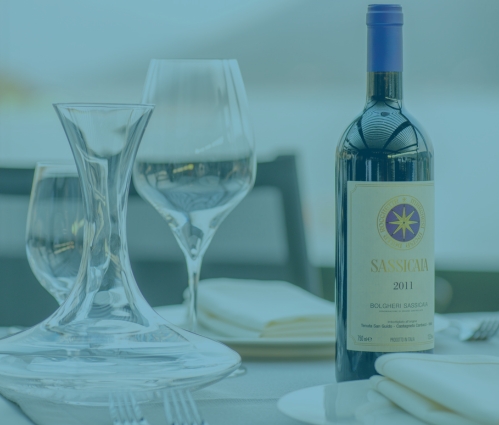
  • Tuscany: The investment landscape is defined by the Chianti Classico DOCG, Brunello di Montalcino DOCG, the unique single vineyard Bolgheri Sassicaia DOC classification and the Super Tuscans that exist in opposition to AOC rules, but are still governed by IGT rules for the region.
  • Piedmont: The market focuses almost exclusively on the village specific sub zones of Barolo and Barbaresco, where single vineyard designations highlight precise terroir.

Generally, broad regional appellations offer limited appeal for collectors and investors, although there are notable exceptions. Designations such as Bordeaux AOC or Crémant de Bordeaux cover large geographic areas and permit substantial production volumes, resulting in wines that are widely available and intended primarily for everyday consumption. While these appellations can deliver excellent value for drinkers, they typically lack the scarcity, brand prestige and long-term ageing potential that underpin investment-grade wines. As a result, meaningful price appreciation is uncommon, particularly when compared with the tightly defined appellations and estate-level classifications that dominate the fine wine secondary market.

Decoding the wine label

A wine label is far more than a marketing tool. It serves as a legal document that communicates a wine’s origin, classification and compliance with the regulations of its appellation. For collectors and investors, learning to read a wine label is one of the simplest ways to assess a bottle’s provenance, quality level and potential investment appeal.

While labelling requirements vary between countries, most fine wine labels are required to display several key pieces of information:

  • The official appellation or classification – Examples include Appellation d’Origine Contrôlée (AOC) in France, Denominazione di Origine Controllata e Garantita (DOCG) in Italy and American Viticultural Area (AVA) in the United States. These designations indicate the regulatory framework under which the wine was produced.
  • The geographic origin – The name of the appellation, village, cru or vineyard identifies where the grapes were grown. In general, highly specific geographic designations, such as a single vineyard or Grand Cru site, indicate greater scarcity and stricter production requirements than broad regional appellations.
  • The vintage year – For vintage wines, this indicates the year in which the grapes were harvested. In regions where blending across years is common, such as Champagne, non-vintage wines may not display a harvest year, while vintage bottlings are produced from grapes harvested in a single declared year.
  • Alcohol by volume (ABV) – Most wine-producing countries require producers to state the wine’s alcohol content, providing additional information about style and ripeness.

Collectors should also pay attention to legally protected terms such as Mis en Bouteille au Château, Estate Bottled or Domaine Bottled. While the exact definitions vary by region, these statements generally indicate that grape growing, winemaking and bottling were carried out under the direct control of the estate, providing an additional layer of provenance and authenticity.

Regulatory adaptation under climate change

Climate change presents one of the greatest challenges the modern appellation system has ever faced. Many of today’s regulations were developed during the cooler growing conditions of the twentieth century and are increasingly being tested by rising temperatures, prolonged droughts, extreme weather events and earlier harvest dates. As conditions evolve, regulators are being forced to balance the preservation of tradition with the need for adaptation.

In response, many leading wine regions have begun revising long-standing rules. In Bordeaux, authorities have approved several additional grape varieties, including the heat-tolerant Touriga Nacional, to help producers manage rising alcohol levels and maintain freshness. Elsewhere, regions that historically restricted irrigation have introduced greater flexibility during periods of severe drought, recognising that vine health and long-term sustainability must remain a priority.

These changes highlight an important reality for investors: appellation systems are not static. Their continued relevance depends on their ability to evolve alongside the environmental conditions they were designed to regulate. While the core principles of provenance, authenticity and regional identity remain intact, the specific rules governing production are increasingly being updated to reflect a changing climate.

In some cases, producers have chosen to step outside traditional classifications in pursuit of greater flexibility. However, these remain the exception rather than the rule. For most of the world’s leading wine regions, the challenge is not whether appellation systems will survive, but how they will adapt. Understanding this evolution will become increasingly important as climate change reshapes the future of fine wine.

FAQ: Appellation laws 

What is the main purpose of an appellation law?

The primary purpose is to protect the geographic reputation of a wine region and prevent consumer fraud. Legally enforcing boundaries and production methods ensures that a wine carrying the regional name possesses the authentic characteristics of that specific place.

How do appellation regulations help fine wine investors?

They provide a vital layer of security regarding authenticity and provenance. Because compliance is legally mandated, investors can trust that a certified bottle meets strict quality controls, which underpins asset valuation and liquidity on the secondary market.

Can any wine produced within Bordeaux use a prestigious village name?

No. A wine can only carry a specific village name, such as Pauillac or Margaux, if the vineyards sit entirely within that defined zone and the winemaking adheres to the strict rules of that local classification. General production falls into the lower value regional category.

Are appellation laws rigid or do they change over time?

Appellation laws do adapt, although this happens at the speed of bureaucracy. Regulatory bodies update rules in response to environmental realities, such as allowing new climate resilient grape varieties or adjusting maximum permissible yields to maintain balance under changing weather conditions.

Are tastings a part of appellation laws?

Yes, many appellation laws include a tasting component, and many regional classifications are tiered in large part depending on the assessments of a tasting committee.

WineCap’s independent market analysis showcases the value of portfolio diversification and the stability offered by investing in wine. Speak to one of our wine investment experts and start building your portfolio. Schedule your free consultation today.
Categories
Learn

The history of Italian wine and its rise as a fine wine investment

  • The history of Italian wine spans three millennia, with over 500 indigenous grape varieties, making it the world’s most diverse viticultural landscape.
  • The transition from mass-produced bulk wine to world-class investment assets was driven by the Super Tuscan movement and the formalisation of the DOCG system.
  • Italian fine wine has become a vital diversifier in wine investment portfolios, offering low volatility and high liquidity.

The history of Italian wine is a story of innovation, regulation and regional identity, culminating in the emergence of some of the world’s most sought-after wines.

For centuries, Italy’s viticultural landscape was defined by production volume rather than prestige, but today it stands as a cornerstone of the fine wine secondary market. From the bureaucratic foundations laid by the Roman Empire to the creation of the DOC and DOCG systems, each stage of this evolution has shaped the investment landscape that exists today. For collectors and investors, understanding this transformation provides essential context for why leading labels from Tuscany and Piedmont have become prized assets, valued for their global demand, liquidity and long-term stability.

The early Roman influence 

Long before the unification of the Italian state, the peninsula was renowned for its viticultural abundance. The ancient Greeks referred to Southern Italy as Enotria, the “Land of Wine”,  reflecting a culture where vines were integrated into every aspect of daily life from simple sustenance to religious ritual.

It was the Romans though who transformed winemaking from a domestic craft into a bureaucratic industry. While the Greeks provided earlier agricultural observations, the Romans were the first to produce truly extensive technical manuals. Writers such as Columella and Cato the Elder documented precise instructions on soil selection, vine density, and fermentation. These records represent the first systematic Western codification of winemaking integrating wine into the Roman state’s extensive economic machine. They documented every technical variable:

  • The exact ratios of additives, such as seawater or honey, used to stabilise lower-grade wines.
  • Specific yields expected from different types of trellising and pruning.
  • Classifications based on quality, which directly informed military rations and imperial taxation.

This bureaucratic rigour established a legacy of regulation that eventually evolved into the modern DOC system. As well as developing vine training systems, identifying the best wine producing regions and  exporting large volumes of wine across the empire, it proved that quality could be managed and tracked, turning a volatile biological product into a reliable, taxable asset for the Roman state.

From Empire to the Age of Enlightenment

Following the fall of Rome, the Church became the primary steward of Italian viticulture. Monastic orders maintained vineyards across Italy focusing on consistent production for both sacramental use and local trade and in the process preserving grape varieties, vineyards and above all knowledge of viticultural practice. 

By the early 18th century wine was a major source of tax revenue across Italian principalities, not least to the ailing Medici family who had noted that Tuscany was suffering from counterfeiting and fraud with lesser producers labelling inferior wine as Chianti.  

This prompted a pivotal moment in the history of wine when in 1716 Grand Duke Cosimo III de’ Medici issued a decree defining the official boundaries for four wine-producing areas in Tuscany. It was the earliest legal precedent for protecting a wine’s geographic origin and reputation.

The 1716 decree had two direct objectives

  • Geographic definition: He wanted to legally define exactly where “Chianti” and other top wines could be grown. This established the four historic zones: Chianti, Pomino, Carmignano, and Val d’Arno di Sopra.
  • Quality assurance: The decree was paired with the creation of a “Congregation” (a primitive regulatory body) to oversee the production and sale of these wines. The goal was to ensure that wine leaving Tuscany met a certain standard, protecting the long-term trust of foreign buyers.

The Italian bulk wine crisis

The early twentieth century was difficult for the Italian wine trade. While a wave of immigration to the United States from the late 19th century onwards was a critical part of that country’s wine story, two World Wars and the arrival of the phylloxera pest decimated the Italian wine landscape. Following the Second World War, the focus shifted toward high-yield, mass-market production and economic recovery.

This era was defined by the ubiquitous straw-covered bottles of Chianti (known ironically as Fiascos) found in every formica tabled Italian restaurant across the United Kingdom as late as the 1980s and 1990s. These wines were often of dubious quality and diluted the international reputation of Italian viticulture.  Although exceptions existed, only a small portion of wine was even bottled by its producer and the vast majority of postwar Italian wine could be generously described as “rustic”. The market came to view Italy as a source of cheap, everyday table wine rather than an investment-grade prospect. 

Characteristics of the bulk era:

  • Priority given to quantity over quality and terroir.
  • The dominance of large cooperatives that blended grapes from multiple regions.
  • Lack of stringent quality controls or ageing requirements.
  • A global perception of Italy as a secondary player to France.

The 1960s quality revolution

Against this background, in the 1960s, the Italian government decided to embark on a monumental task of regulating wine production, creating hundreds of defined wines under the Denominazione di Origine Controllata (DOC). 

This process was inspired by France’s appellation controlee system which had done so much over the previous 50 years to improve the baseline quality and international reputation of French wine. The system was later strengthened by the introduction of the DOCG category. The “G” stands for Garantita, representing the highest tier of quality: these laws mandated strict limits on yields, specific grape percentages, and mandatory bottle ageing.

The hierarchy of Italian wine from top to bottom went as follows:

  • DOCG: The pinnacle of quality with the strictest production standards.
  • DOC: Regional designations focused on traditional methods and varieties.
  • IGT: A flexible category that allows for creative blending outside of old rules.
  • Vino da Tavola: Basic table wine with minimal regulatory oversight.

DOC and DOCG classifications were active from 1963 and performed admirably but like all bureaucracy were not without flaws.  The rigidity of the rules fossilised practices both good and bad especially around overly generous yields; raising the floor for Italian wine also seemed to implement a ceiling.  

It took less than a decade for the insurgency to start.  

The Super Tuscan rebellion and Sassicaia

The rules brought in during the 1960s were stifling.  Not only were yields overly generous but they also specified the proportion of different grape varieties that could be used, forcing Chianti producers to use at least 10% of local white grape varieties. Anyone who wanted to make a 100% Sangiovese, experiment with French grape varieties or do anything that wasn’t on the prescribed list was out of luck.

The Super Tuscan movement 

A fair number of wines claim to be the first “Super Tuscan” but most would agree that Sassicaia is the originator. Intended initially for it to be for his own consumption, Marchese Mario Incisa della Rocchetta’ entirely ignored the DOCG rulebook by planting Cabernet Sauvignon at his Tenuta San Guido estate on the Italian coast in Bolgheri, southwest of Florence.

The vines for Sassicaia were first planted in the 1940s, but only five years after the DOCG rules came into force the decision was made to make commercial release.  The first vintage to be sold came to market in 1971, and wore its “Vino de Tavola” designation with pride.

It is no exaggeration to describe this as “year one” for modern Italian wine. In the years that followed, dozens of winemakers broke away from the DOC/DOCG regulations, with the mission to make higher quality wine.

The success of many of these wines can be seen in revisions to the DOC rules that have brought a number of them back into the fold of Chianti or Bolgheri. In 1992, a new law was passed to restructure the system and deal with many of the unintended negative consequences of the 1963 laws. Sassicaia’s impact was such that in 1994 it was granted its own DOC, making it the only single vineyard DOC in Italy. Others such as Fontodi’s Flacianello della Pieve remain classified as IGT (Indicazione Geografica Tipica) wines to this day. 

By the early 2000s, Italy’s reputation among oenophiles had improved substantially.  Already in the 2001 World Atlas of Wine, Jancis Robinson declared that Italy was no longer playing second fiddle to France.

The Barolo Wars: Modernists vs. Traditionalists

While the 1980s saw a revolution reshape Tuscany, Piedmont underwent its own transformation through what became known as the Barolo Wars.

At the heart of the debate was a clash between tradition and modernity. Traditional producers favoured extended macerations and ageing in large, neutral Slavonian oak casks, producing structured, age-worthy wines that often required many years in bottle before revealing their full potential.

A new generation of winemakers, later dubbed the Barolo Boys, sought to create wines that were more approachable in their youth while retaining Nebbiolo’s distinctive character. They introduced shorter macerations, temperature-controlled fermentation, rotary fermenters, green harvesting and ageing in smaller French oak barriques. These techniques produced softer tannins, greater fruit expression and a style that quickly attracted international attention.

Many of the producers who led this movement remain among Barolo’s most celebrated names today, including:

  • Elio Altare: The spiritual leader of the modernists.
  • Paolo Scavino: Early adopter of rotofermenters for softer tannins.
  • Luciano Sandrone: Known for the “Cannubi Boschis” bottling which earned 100 points.
  • Domenico Clerico: Champion of high-quality vineyard sites in Monforte d’Alba.

While other great names such as Bartolo Mascarell, Bruno Giacosa and Giacomo Conterno remained conspicuously traditional, this conflict has eventually led to a middle ground where even the most steadfast producers employ some of the newer techniques to blend modern precision with traditional soul.

Brunello di Montalcino: The Tuscan Powerhouse

While Chianti was working to redefine its identity, the hilltop town of Montalcino was quietly establishing a reputation for producing some of Italy’s most age-worthy wines.

The region’s modern history is closely tied to Ferruccio Biondi-Santi, who is credited with identifying and championing a particular biotype of Sangiovese, known locally as Sangiovese Grosso or Brunello. The resulting wines displayed remarkable concentration, structure and longevity, setting a new benchmark for quality in Tuscany.

Brunello di Montalcino gained significant international recognition during the 1980s and 1990s, particularly in the United States, where demand for powerful, cellar-worthy wines was growing rapidly. Strict production regulations, including lengthy ageing requirements before release, reinforced its reputation as a serious collector’s wine.

Today, Brunello remains one of Italy’s most respected fine wine categories. Leading producers such as Biondi-Santi, Soldera, Case Basse and Poggio di Sotto continue to attract strong demand from collectors, while the region’s combination of prestige, scarcity and ageing potential has helped underpin its long-term appeal within the fine wine market.

The wealth of indigenous varieties

Italy’s greatest strength lies in its extraordinary viticultural diversity. While many of the world’s leading wine regions are built around a relatively small number of international grape varieties, Italy is home to more than 500 officially recognised indigenous varieties, reflecting centuries of local adaptation and winemaking tradition.

For investors and collectors, however, the fine wine market remains concentrated around a handful of regions and grapes. Nebbiolo in Piedmont and Sangiovese in Tuscany underpin many of Italy’s most sought-after wines, while international varieties such as Cabernet Sauvignon, Merlot and Cabernet Franc continue to play an important role in the Super Tuscan category.

Beyond these established names, a number of indigenous varieties are attracting growing attention. Aglianico, often referred to as the “Barolo of the South”, produces structured, long-lived wines in regions such as Campania and Basilicata. Meanwhile, Nerello Mascalese, cultivated on the slopes of Mount Etna, has emerged as one of Italy’s most exciting varieties, prized for its elegance, transparency and volcanic character. While these wines have yet to achieve the liquidity or market depth of Barolo, Brunello or the leading Super Tuscans, they represent an increasingly important part of Italy’s evolving fine wine landscape.

Key Indigenous Grapes for Collectors

  • Nebbiolo – The noble grape behind Barolo and Barbaresco, renowned for its longevity and ability to express terroir.
  • Sangiovese – Tuscany’s defining variety and the foundation of Brunello di Montalcino, Chianti Classico and many of the region’s finest wines.
  • Corvina – The principal grape of Amarone della Valpolicella, producing rich, powerful wines with impressive ageing potential.
  • Nerello Mascalese – Sicily’s flagship fine wine grape, responsible for the elegant and increasingly sought-after wines of Mount Etna.

The Prosecco explosion

Following the quality-driven revolutions in Tuscany and Piedmont, the next major chapter in Italian wine’s evolution was defined by commercial success on a global scale.

Although Prosecco’s history stretches back centuries, it was not until the late 1990s and early 2000s that exports accelerated dramatically. Offering an approachable and affordable sparkling wine style, Prosecco succeeded in reaching a broad international audience, achieving a level of mainstream recognition that few sparkling wine categories outside Champagne had previously attained.

A pivotal moment came in 2009 with the reorganisation of the region’s appellation system. The creation of the Prosecco DOC, alongside the elevation of Conegliano Valdobbiadene and Asolo to DOCG status, strengthened geographical protections for the category and formally established Glera as the grape variety’s official name. These changes helped safeguard the identity of Prosecco as demand continued to rise.

By the 2010s, Prosecco had become one of the most successful wine categories in the world, with global sales volumes surpassing Champagne. Its accessibility, consistency and versatility transformed it from a regional Italian speciality into a fixture of the international wine market.

From an investment perspective, Prosecco occupies a very different position to Italy’s leading fine wines. It lacks the scarcity, ageing potential and secondary-market demand that underpin investment-grade status. Nevertheless, its importance to the Italian wine industry cannot be overstated.

As Italy’s largest wine export category by volume, Prosecco has played a central role in expanding the country’s global reach and strengthening consumer awareness of Italian wine. For many drinkers, it serves as an introduction to Italian wine culture, creating familiarity with Italian regions, producers and appellations. While collectors may ultimately gravitate towards Barolo, Brunello or the leading Super Tuscans, Prosecco has helped ensure that Italy remains one of the most visible and influential wine-producing nations in the world.

The modern Italian wine investment market 

Over the past 15 years, Italy has moved from a specialist interest to a core part of the fine wine secondary market. As trade has become less concentrated around Bordeaux, Italian wines – and Tuscany in particular – have been among the clearest beneficiaries.

During periods of volatility in Bordeaux or Burgundy, Italian wines have often provided a measure of stability, supported by strong brand recognition, consistent global demand and relative value.

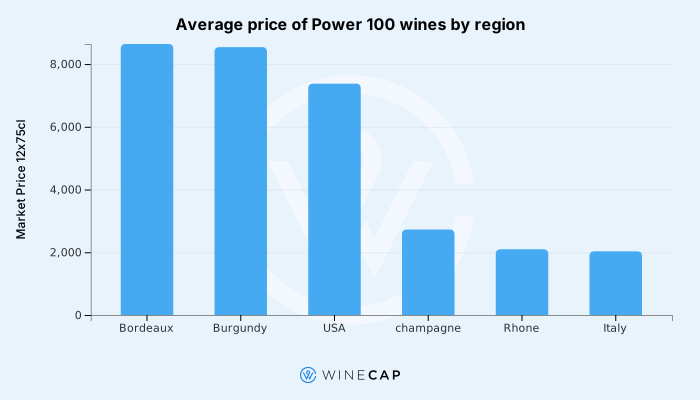
This has been particularly evident since the market peak in 2022. While Bordeaux, Burgundy and Champagne have all experienced price corrections, many Tuscan wines have held up comparatively well. At the same time, Italy continues to offer conspicuous value when set against other major fine wine regions, particularly Burgundy, where pricing remains elevated despite recent declines.

Average price Power 100 wines by region

Reasons for Italy’s market strength:

  • Lower correlation to traditional markets compared to Bordeaux.
  • Excellent price-to-quality ratios for high-scoring vintages.
  • Deep historical roots that provide long-term brand stability.
  • Expanding global demand, particularly in the US and Asian markets.

Italy’s journey from the vineyards of the Roman Empire to today’s fine wine trading platforms has been defined by a constant tension between tradition and innovation. Whether through the regulatory foundations laid by Cosimo III, the quality revolution of the DOCG system, the rebellious spirit of the Super Tuscans, or the global success of Prosecco, each chapter has contributed to the country’s remarkable transformation.

Understanding this history explains why Italy now occupies such an important place in the fine wine market. Combining world-renowned brands, exceptional regional diversity, strong global demand and relative value, Italian wine has evolved from a source of everyday table wine into one of the most compelling categories for long-term collectors and investors.

FAQ: Italian wine history

Which Italian wines are considered investment grade?

The Italian fine wine market is dominated by a relatively small group of prestigious regions and producers. The most widely traded investment-grade wines come from Barolo and Barbaresco in Piedmont, Brunello di Montalcino in Tuscany, and the leading Super Tuscan estates of Bolgheri. Iconic names such as Sassicaia, Ornellaia, Masseto, Giacomo Conterno, Bruno Giacosa and Biondi-Santi are particularly sought after due to their global demand, limited production and strong track record on the secondary market.

What is the difference between DOC and DOCG?

DOC (Denominazione di Origine Controllata) and DOCG (Denominazione di Origine Controllata e Garantita) are Italy’s two highest wine classifications. Both establish rules governing grape varieties, production methods and geographic origin. DOCG represents the highest tier and generally imposes stricter regulations, including lower permitted yields, longer ageing requirements in some regions and additional quality controls. DOCG wines must also pass a tasting evaluation before release, helping to safeguard the reputation of Italy’s most prestigious appellations.

Why did Super Tuscans start as table wines?

The first Super Tuscans were classified as simple table wines because they did not comply with the DOC regulations of the time. Many producers chose to use international grape varieties such as Cabernet Sauvignon and Merlot, while others wanted to make 100% Sangiovese wines outside the prescribed rules. Although these wines often exceeded the quality of many classified wines, they were forced to carry the lowly Vino da Tavola designation until Italian wine laws were modernised in the 1990s.

How long can top Italian wines age?

Italy’s finest wines are among the most age-worthy in the world. Top Barolo and Brunello di Montalcino wines can often age for 30 to 50 years, while exceptional bottles from leading producers may continue to evolve for even longer. Over time, youthful fruit flavours give way to more complex aromas of dried flowers, leather, tobacco, truffle and spice. Proper storage conditions are essential to maximise a wine’s ageing potential.

Why is Prosecco cheaper than Champagne?

Prosecco is typically less expensive than Champagne because it is produced using the Charmat Method, in which secondary fermentation takes place in large pressurised stainless-steel tanks rather than individual bottles. This approach is faster and less labour-intensive than the traditional method used in Champagne. In addition, Prosecco vineyards generally have lower land costs and higher production volumes, allowing producers to offer quality sparkling wine at a more accessible price point.

WineCap’s independent market analysis showcases the value of portfolio diversification and the stability offered by investing in wine. Speak to one of our wine investment experts and start building your portfolio. Schedule your free consultation today.
Categories
News

Bordeaux 2025 En Primeur enters the final stretch

  • The Bordeaux 2025 En Primeur campaign is approaching its conclusion, bringing the market’s verdict into sharper focus.
  • Quality has largely exceeded expectations, with many leading estates earning scores comparable to some of the strongest recent vintages.
  • In a more selective market, buyers are increasingly comparing new releases against physical back-vintages, making value the defining theme of the campaign.

After several weeks of closely watched releases, Bordeaux 2025 En Primeur is entering its final phase.

With many of the region’s leading estates now having revealed their prices and the remaining headline releases arriving in quick succession, attention is beginning to shift from individual wines to the broader success of the campaign. As the dust starts to settle, a clearer picture is emerging – not only of the quality of the vintage, but also of what today’s collectors and investors are willing to pay for it.

A vintage that exceeded expectations

The 2025 growing season presented challenges, yet critics have generally responded positively to the wines. Across the region, many chateaux have produced wines that combine freshness, precision and structure, with several estates earning scores that place them comfortably among the strongest releases of the last decade.

The quality narrative has therefore been relatively straightforward. The more interesting story has been the market’s reaction. In the current climate, price, availability and relative value have become just as important as critic scores. 

Value remains the defining theme

The defining characteristic of the Bordeaux 2025 campaign has been the focus on value.

Many estates responded to softer market conditions by reducing release prices compared to recent vintages. In several cases, these reductions have been significant enough to attract renewed interest from merchants and collectors alike. Yet lower pricing alone has not guaranteed success.

Today’s buyers are armed with more information than ever before. Rather than simply purchasing the newest release, they are comparing it against mature vintages with established track records, critic scores and known market performance.

As a result, the most successful releases have generally been those able to demonstrate a compelling value proposition relative to comparable back-vintages.

Latest Bordeaux 2025 En Primeur releases

Mouton Rothschild

Among the campaign’s most anticipated releases, First Growth Chateau Mouton Rothschild 2025 arrived with considerable excitement.

For the first time in the estate’s history, the Grand Vin is composed of 98% Cabernet Sauvignon and just 2% Merlot, making it one of the purest expressions of Cabernet Sauvignon ever produced at the estate. In many ways, the 2025 is a wine that reflects the warm conditions of the growing season, delivering the structure and concentration that Cabernet Sauvignon lovers seek.

Critics have responded enthusiastically. Neal Martin awarded the wine 96-98 points, describing it as a “quintessential Mouton Rothschild” that should age exceptionally well in bottle. William Kelley scored the wine 97-99 points, highlighting its remarkable intensity and concentration.

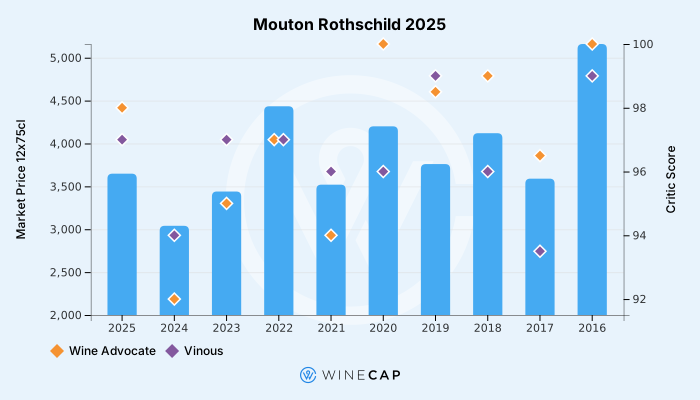
chateau mouton rothschild premier cru classe pauillac 2016 2025 wine prices

For collectors seeking a landmark expression of Cabernet Sauvignon from one of Bordeaux’s most celebrated estates, the 2025 release presents a compelling proposition.

However, the release also illustrates one of the key themes of the wider campaign.

Analysis of current market pricing shows that the highly-rated 2019 vintage remains available at only a marginal premium to the newly released 2025. While the 2025 offers rarity, provenance and long-term ageing potential, the 2019 is an already bottled wine, carrying even more impressive critical credentials at just 1.3% premium.

La Mission Haut-Brion

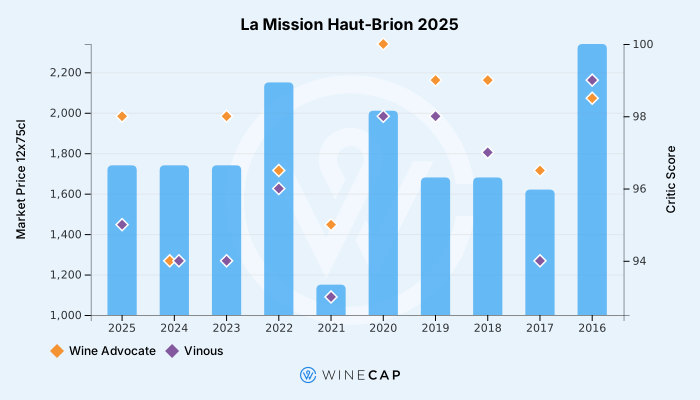
chateau la mission haut brion 2016-2025 wine prices

Chateau La Mission Haut-Brion 2025 was released at a level that compares favourably with both the 2023 and 2024 vintages, making it one of the more attractively positioned wines among the leading Left Bank estates.

Critical reception was positive. Neal Martin awarded the wine 94-96 points, noting that it “has to play second fiddle to Haut-Brion this year, but it is still a great La Mission.” Antonio Galloni was even more enthusiastic, scoring it 97-99 points and describing it as “magnificent”. He called it “one of my early favourites in this vintage”.

Viewed in isolation, the release makes a strong case for itself. Yet it also demonstrates the challenge facing many of this year’s En Primeur wines.

When compared with physical back vintages, the value proposition becomes less clear. Both the 2018 and 2019 remain available at comparable market levels, while offering proven track records, established critical acclaim and immediate availability. The 2025 may represent better value than the estate’s most recent releases, but buyers looking purely through a value lens are likely to find themselves drawn towards the higher-scored 2019 in particular.

Beychevelle

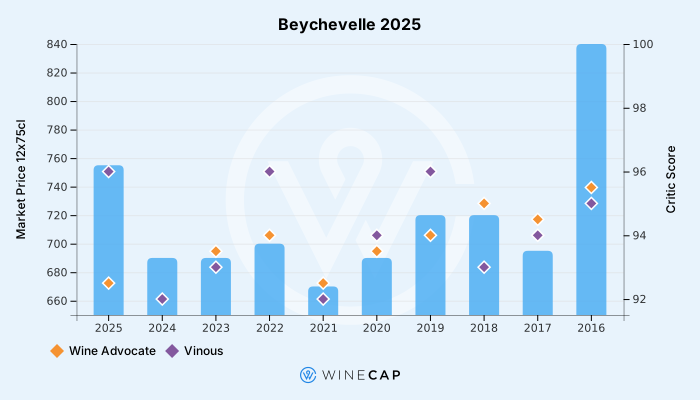
chateau beychevelle 4eme cru classe saint julien 2016-2025 wine prices

Beychevelle 2025 attracted considerable praise from critics and was among the better-received classified growth releases of the campaign.

Neal Martin awarded 95-97 points, declaring: “I don’t think Philippe Blanc has overseen a Beychevelle as good as this.” Antonio Galloni echoed that sentiment, calling it an “exceptional Beychevelle, one of the finest in recent memory”, while also giving 95-97 points.

At first glance, the release price appears attractive, particularly when compared with some of the estate’s most celebrated vintages such as 2016, 2010, 2009 and 2005.

However, the picture changes once more recent vintages enter the equation.

The 2018, 2019 and 2022 are all available in the market at levels that compare favourably with the new release while carrying similarly impressive critical credentials. As a result, Beychevelle 2025 highlights a recurring theme of this campaign: a wine can be attractively priced relative to its historic peak vintages and still struggle to offer the strongest value proposition available to buyers today.

The market’s verdict

As Bordeaux 2025 approaches the finish line, the campaign appears likely to be remembered less for any single release and more for what it revealed about today’s fine wine buyer.

The willingness to engage when quality is high remains strong. Demand has not disappeared. But collectors are no longer buying simply because a wine is new or because it carries a prestigious label. Instead, they are demanding a clear value proposition.

For Bordeaux, that may ultimately be one of the most important lessons of the 2025 campaign.

The quality of the wines has rarely been in doubt. The challenge has been convincing buyers that En Primeur remains the most attractive place to allocate capital. As the final releases land, the market’s response suggests that when pricing, quality and scarcity align, demand remains alive.

FAQ: Bordeaux En Primeur 2025

What is Bordeaux En Primeur?

Bordeaux En Primeur is the system through which wines are sold while still ageing in barrel, typically around two years before they are bottled and released to the market. Buyers purchase wines based on early critic assessments, with the expectation that prices may rise once the wines become physically available.

How has the Bordeaux 2025 En Primeur campaign been received?
The Bordeaux 2025 campaign has generally been well received by critics, with many wines earning scores comparable to some of the strongest recent vintages. However, buyer enthusiasm has been driven as much by value as by quality, with collectors carefully comparing release prices against available back-vintages.

Is Bordeaux 2025 considered a good vintage?
While the growing season presented several challenges, critics have responded positively to many of the wines. The vintage has been praised for producing wines with freshness, structure and precision, with several leading estates receiving scores that compare favourably with highly regarded recent vintages.

Why are buyers comparing Bordeaux 2025 with older vintages?
In today’s market, collectors are increasingly focused on value. Rather than purchasing a wine simply because it is newly released, buyers are comparing critic scores, pricing, drinking windows and long-term potential against mature vintages that are already bottled and available for delivery.

What makes Mouton Rothschild 2025 unique?
Chateau Mouton Rothschild 2025 is notable for containing 98% Cabernet Sauvignon and just 2% Merlot, making it the most Cabernet-dominant Grand Vin in the estate’s history. 

Should collectors buy Bordeaux 2025 or back-vintages?
The answer depends on individual objectives. Bordeaux 2025 offers provenance, long-term ageing potential and access to highly rated wines at release. However, several back-vintages currently offer comparable or stronger critic scores at similar price levels, making value analysis an important part of any buying decision.
WineCap’s independent market analysis showcases the value of portfolio diversification and the stability offered by investing in wine. Speak to one of our wine investment experts and start building your portfolio. Schedule your free consultation today.
Categories
Learn

Sweet wines explained: from Sauternes to Tokaji Aszu

  • Sweet wines are produced using a variety of techniques including noble rot, late harvesting, air drying, and freezing.
  • Some of the world’s most prestigious wines, including Chateau d’Yquem and Tokaji Aszu, are sweet wines capable of ageing for decades.
  • While sweet wines can offer value and diversification for collectors, secondary market demand remains concentrated on a small number of leading producers.

Sweet wines may lack the spotlight enjoyed by Bordeaux, Burgundy and Champagne, but they are responsible for some of the most complex, long-lived and labour-intensive bottles in the world.

From the botrytised vineyards of Sauternes and Tokaj to Germany’s prized Rieslings, sweet wines come in many styles. What unites them is the concentration of sugar, acidity and flavour that allows the finest examples to evolve for decades in bottle.

For wine investors, sweet wines also represent an overlooked corner of the market. While trading volumes are lower than for leading dry wines, many of the world’s finest dessert wines offer exceptional quality, remarkable longevity and, in some cases, compelling value.

This guide explores how sweet wines are made, the regions that define the category and the role they play in today’s fine wine market.

What makes a wine sweet?

Sweetness in wine comes from residual sugar – natural grape sugars that remain after fermentation has finished.

While many consumers associate sweet wine with inexpensive supermarket brands, the world’s finest sweet wines achieve their sweetness naturally through specialised vineyard practices that concentrate sugar within the grape.

The key to great sweet wine is balance. Sugar alone can make a wine feel heavy or cloying. The best examples combine sweetness with vibrant acidity, creating wines that are rich and intense yet remarkably fresh.

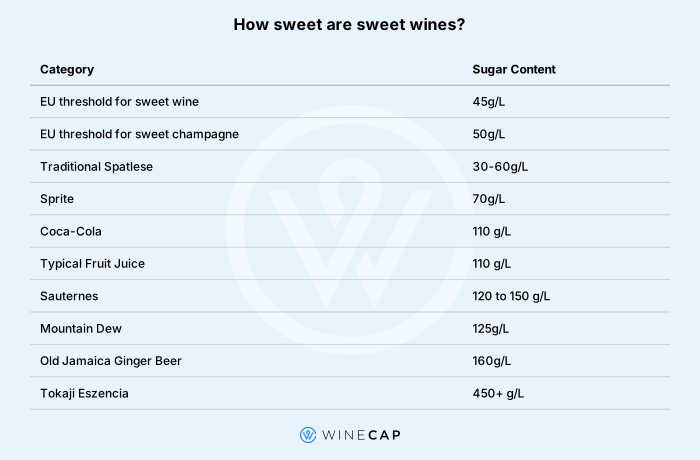
Interestingly, many sweet wines contain less sugar than popular soft drinks. A glass of Sauternes or Tokaji may taste intensely sweet, but high acidity and complex flavours often make them feel more balanced than sugary soft drinks.

How sweet are sweet wines

Why are sweet wines expensive to produce?

The finest sweet wines are among the most labour-intensive wines in the world.

In regions such as Sauternes, vineyard workers may pass through the same rows multiple times during harvest, selecting only individual grapes that have reached the ideal stage of concentration. Yields can be dramatically lower than those of dry wines, and entire vintages may be compromised if weather conditions fail to cooperate.

Despite these challenges, many sweet wines remain surprisingly affordable compared to leading dry wines from Burgundy, Napa Valley and Bordeaux. This combination of rarity, complexity and relative value makes sweet wine an appealing category for collectors seeking something beyond the market’s most heavily traded regions.

How are sweet wines made?

The world’s finest sweet wines rely on natural methods of concentrating sugar within the grape. The most important techniques include noble rot, late harvesting, air drying and freezing grapes on the vine.

Noble rot (Botrytis cinerea)

The most prestigious sweet wines in the world are produced using Botrytis cinerea, commonly known as noble rot.

Under the right conditions, this beneficial fungus punctures grape skins, allowing water to evaporate while concentrating sugars, acids and flavour compounds. The result is a wine of extraordinary intensity and complexity.

Botrytised wines are often characterised by aromas of honey, marmalade, dried apricot and exotic spice. They also possess remarkable ageing potential, with the finest examples evolving for many decades.

Producing noble rot wines is highly risky. The fungus requires a delicate balance of humid mornings and warm, dry afternoons. Too much moisture can cause destructive grey rot rather than noble rot, potentially ruining the crop.

Sauternes in Bordeaux remains the world’s benchmark for botrytised wine, although outstanding examples are also produced in Tokaj, Germany, Austria and the Loire Valley.

At a glance:

  • Botrytis requires a specific cycle of damp mornings and dry, sunny afternoons.
  • It is a risky process because the fungus can turn into grey rot if it rains too much.
  • Grapes must be harvested by hand in multiple “tries” or passes.
  • Common flavour markers include marmalade, honey, and exotic spices.
  • Famous regions include Sauternes, Barsac, and Quarts de Chaume Grand Cru in the Loire Valley.

Late harvest wines

Late harvest wines are made by leaving grapes on the vine beyond the normal harvest period.

As the grapes continue to ripen, water evaporates and sugar levels increase naturally. Unlike botrytised wines, noble rot is not necessarily involved.

These wines typically retain more primary fruit character than noble rot wines, displaying flavours of peach, apricot, citrus and tropical fruit. High acidity remains crucial to maintaining freshness and balance.

Riesling and Chenin Blanc are particularly well suited to this style, while Alsace’s Vendange Tardive wines are among the best-known examples.

At a glance: 

  • Grapes often look shrivelled or like raisins on the vine.
  • The technique relies on a dry, warm autumn to prevent spoilage.
  • High acidity is crucial to balance the increased sugar levels.
  • Riesling and Chenin Blanc are particularly suited to this style.
  • These wines are often more affordable than botrytised alternatives.

Air drying (Passito)

Air drying, known as the passito method in Italy, involves harvesting grapes and then drying them before fermentation.

Traditionally, bunches are laid on straw mats or stored in well-ventilated drying rooms for weeks or even months. As water evaporates, sugars, acids and flavours become increasingly concentrated.

This technique produces rich, complex wines with flavours of dried fruits, nuts, caramel and spice. Unlike noble rot wines, the concentration occurs after harvest, giving winemakers greater control over the process.

Notable examples include Vin Santo from Tuscany and Recioto della Valpolicella from Veneto.

At a glance: 

  • Known as appassimento.
  • The primary region is Veneto in Italy where it’s used to make Amarone.
  • Straw mats are traditionally used, leading to the term “straw wine.”
  • Flavours often lean toward dried fruits and roasted nuts, flavors that Sauternes tends to develop with extended aging.

Ice wine (Eiswein)

Ice wine is produced from grapes that freeze naturally on the vine.

The grapes are harvested and pressed while frozen, allowing only a small quantity of highly concentrated juice to be extracted. The frozen water remains behind as ice crystals, resulting in intensely sweet wines balanced by exceptionally high acidity.

The process is inherently risky because producers must wait for sufficiently cold temperatures while leaving the fruit exposed in the vineyard. If freezing conditions fail to arrive, the crop may be lost entirely.

Canada and Germany are widely regarded as the leading producers of ice wine.

At a glance: 

  • Grapes are often picked in the middle of the night to ensure they stay frozen and pressed immediately in a cold environment
  • Yields are extremely low, often only five to ten per cent of a normal harvest.
  • Riesling, Vidal, and Cabernet Franc are common varieties.
  • Ice wine is rarely affected by Botrytis, leading to very clean flavours.
  • Cryoextraction is possible, mechanically freezing grapes, but these wines are often subject to labelling restrictions.

Sauternes: the benchmark for sweet wine

No discussion of sweet wine would be complete without Sauternes.

Located south of Bordeaux, the region benefits from a unique microclimate created by the meeting of the Ciron and Garonne rivers. Morning mists encourage the development of noble rot, while sunny afternoons help concentrate the grapes.

The wines are typically produced from Semillon, Sauvignon Blanc and Muscadelle. Semillon provides richness and ageing potential, while Sauvignon Blanc contributes acidity and aromatic freshness.

At the pinnacle sits Chateau d’Yquem, the only estate awarded Premier Cru Superieur status in Bordeaux’s 1855 Classification. For many collectors, Yquem occupies a similar position within sweet wine to that of the First Growths in Bordeaux.

The finest vintages can age for a century or more, developing extraordinary layers of honey, caramel, spice and dried fruit while retaining remarkable freshness.

Tokaji Aszu: Hungary’s historic treasure

Often described as one of the world’s first great fine wines, Tokaji Aszú has a history dating back centuries.

Produced in Hungary’s Tokaj region, it is made using botrytised grapes, primarily Furmint and Harslevelu. Traditionally, the affected berries are collected separately and added to a base wine, creating a style known for its intense sweetness, vibrant acidity and exceptional longevity.

Historically, sweetness levels were measured using a puttonyos system, reflecting the number of baskets of botrytised grapes added during production. The rarest and most concentrated wines are known as Eszencia, one of the most intensely sweet wines produced anywhere in the world.

Tokaji was famously described as “the wine of kings and the king of wines” and remains one of the most distinctive sweet wine styles available today.

Beyond Sauternes and Tokaj

While Sauternes and Tokaji dominate discussions around sweet wine, several other regions produce outstanding examples.

Germany is renowned for sweet Rieslings ranging from Spätlese and Auslese to the rare Beerenauslese and Trockenbeerenauslese categories. Leading producers such as Egon Müller and Joh. Jos. Prüm have demonstrated the remarkable ageing potential and collectability of these wines.

In South Africa, Klein Constantia’s Vin de Constance continues a tradition that dates back to the eighteenth century and remains one of the Southern Hemisphere’s most celebrated sweet wines.

Meanwhile, producers across Alsace, Austria and the Loire Valley continue to craft sweet wines that combine richness, complexity and longevity.

Can you invest in sweet wines? 

Sweet wines occupy a niche position within the secondary market. Trading volumes are generally lower than those of Bordeaux, Burgundy and Champagne, meaning liquidity can be more limited.

However, the category offers some unique characteristics. The finest sweet wines possess extraordinary ageing potential, often remaining vibrant for many decades. Prices have also tended to move independently from broader fine wine market trends, making sweet wine an interesting source of diversification for collectors.

Market demand is concentrated around a relatively small number of leading names, particularly Chateau d’Yquem, top Sauternes estates, rare Tokaji Aszu bottlings and a handful of elite German producers.

As a result, most collectors view sweet wine as a complementary part of a broader cellar rather than a primary driver of investment returns. For many enthusiasts, the attraction lies as much in the drinking experience as in the potential for appreciation.

At a glance:

  • Secondary market demand is concentrated on a few top names.
  • Sweet wines are often released with significant age, reducing the “early bird” profit.
  • They are excellent for long-term cellaring due to their incredible stability.
  • Most collectors buy sweet wine to drink rather than to flip for profit.

Final thoughts

Sweet wines remain one of the most fascinating and misunderstood categories in the wine world. Produced using some of the most demanding techniques in viticulture, the finest examples combine extraordinary concentration with freshness, complexity and longevity.

Whether exploring the legendary wines of Sauternes, the historic vineyards of Tokaj or the elegant sweet Rieslings of Germany, collectors can discover wines that offer both exceptional drinking experiences and a unique perspective on the fine wine market.

Far from being an outdated style, the world’s finest sweet wines continue to demonstrate why they have captivated collectors, critics and wine lovers for centuries.

FAQ: Sweet wines

How long does a bottle of Sauternes last once opened?

Sweet wines generally last longer than dry wines after opening due to their higher sugar levels. A bottle of Sauternes stored in the refrigerator and sealed with a stopper can often remain enjoyable for one to three weeks, although freshness and aromatic intensity will gradually decline over time.

What is the difference between late harvest and noble rot?

Late harvest wines are made from grapes that remain on the vine longer than usual, allowing sugars to concentrate naturally. Noble rot wines are affected by the fungus Botrytis cinerea, which dehydrates the grapes and further concentrates sugars, acids and flavours. Noble rot typically produces more complex aromas, including honey, marmalade and spice.

What is noble rot in wine?

Noble rot is the beneficial form of the fungus Botrytis cinerea. Under the right conditions, it causes grapes to lose water while concentrating sugars and flavour compounds. The process is responsible for some of the world’s most celebrated sweet wines, including Sauternes and Tokaji Aszú.

Can sweet wine be aged?

Yes. The finest sweet wines are among the most age-worthy wines in the world. Their combination of sugar, acidity and concentration allows many examples to evolve for decades, while exceptional bottles of Sauternes, Tokaji and German Riesling can continue developing for a century or more.

Why is ice wine so expensive?

Ice wine is expensive because it is one of the most challenging wine styles to produce. Grapes must freeze naturally on the vine before harvest, yields are extremely low, and the harvest often takes place in difficult winter conditions. The small amount of juice extracted from frozen grapes also contributes to the high production cost.

What is the difference between Sauternes and Tokaji Aszu?

Both are prestigious sweet wines made using botrytised grapes, but they come from different regions and grape varieties. Sauternes is produced in Bordeaux, primarily from Semillon and Sauvignon Blanc, while Tokaji Aszú is made in Hungary using grapes such as Furmint and Hárslevelű. Tokaji is often characterised by higher acidity and a distinctive citrus and apricot profile.

Do sweet wines pair well with food?

Yes. Sweet wines are highly versatile at the table. They are traditionally paired with desserts, but many styles also work exceptionally well with blue cheese, foie gras, spicy dishes and certain seafood preparations. The best pairings balance sweetness, acidity and intensity of flavour.

Are sweet wines a good investment?

Sweet wines can play a role in a diversified fine wine collection, particularly top examples from Sauternes, Tokaj and Germany. However, secondary market demand is generally lower than for Bordeaux, Burgundy and Champagne, meaning they are often purchased as much for enjoyment as for investment potential.

WineCap’s independent market analysis showcases the value of portfolio diversification and the stability offered by investing in wine. Speak to one of our wine investment experts and start building your portfolio. Schedule your free consultation today.
Categories
News

Burgundy’s most expensive wines and the record vineyard prices driving them

  • Burgundy vineyard prices reached new records in 2025, even as vineyard values across France fell by 6.8% on average.
  • Premier Cru white vineyards in the Cote-d’Or now average £2.3 million per hectare, while Premier Cru red vineyards have climbed to almost £1 million per hectare.
  • Domaine de la Romanee-Conti, Leroy and Leflaive dominate Burgundy’s luxury wine market, producing some of the region’s most valuable and sought-after bottles.

Burgundy has long occupied a unique position in the fine wine world, but new data suggests the region has moved beyond traditional measures of agricultural value altogether. According to newly released figures from France’s rural land agency, Safer, vineyard prices in Burgundy once again broke records in 2025, reinforcing the region’s status as one of the world’s most sought-after luxury assets.

A hectare of Premier Cru white wine vineyard land in the Cote-d’Or rose 6% over the past year to an average of £2.3million, while Premier Cru red wine vineyards increased by 11% to almost  £1million per hectare. At these levels, Burgundy’s finest vineyard sites are increasingly being compared not to farmland, but to luxury real estate and other collectible assets prized by ultra-high-net-worth buyers.

For collectors and investors, the implications extend beyond the vineyard. The value of Burgundy’s most coveted land underpins the scarcity and prestige of the wines themselves, helping explain why the region continues to dominate the upper echelons of the fine wine market.

Burgundy’s bubble in a challenging market

What makes Burgundy’s performance particularly remarkable is the backdrop against which it is occurring.

Across France, vineyard values have come under pressure. Excluding Champagne, average vineyard prices fell by 6.8% over the past year as changing consumption habits, weaker demand for red wine and economic uncertainty weighed on the sector.

Bordeaux has been among the hardest-hit regions. Falling global demand for red wine has contributed to significant corrections in vineyard values, with average prices reportedly declining by 24%. Even some of the region’s most prestigious appellations have not escaped the downturn, with Pauillac and Margaux seeing substantial declines.

Yet Burgundy continues to move in the opposite direction.

The reason lies in a combination of extreme scarcity and global demand. Unlike many wine regions that expand their borders, Burgundy’s greatest vineyards are finite, immutable and impossible to replicate. Moreover, Grand Cru and Premier Cru sites are often fragmented into tiny holdings and fully planted. Ownership opportunities are exceptionally rare, while demand increasingly comes from a global pool of wealthy collectors, investors and luxury buyers. A stake in a Burgundy vineyard has come to represent ownership of one of the world’s most prestigious luxury goods at its source.

When land prices drive bottle prices

The relationship between vineyard values and bottle prices is not always straightforward, but in Burgundy the connection seems unusually strong. As vineyard land becomes more valuable, the scarcity narrative surrounding the wines intensifies. Tiny production volumes, growing international demand and the reputation of Burgundy’s most prized terroirs create a powerful feedback loop that supports both land and wine prices.

This has helped Burgundy’s leading wines maintain extraordinary valuations even during a period when the broader fine wine market has experienced a correction. While many regions have seen prices soften – including Burgundy as a whole – its most iconic names continue to command some of the highest prices in the secondary market despite momentary dips.

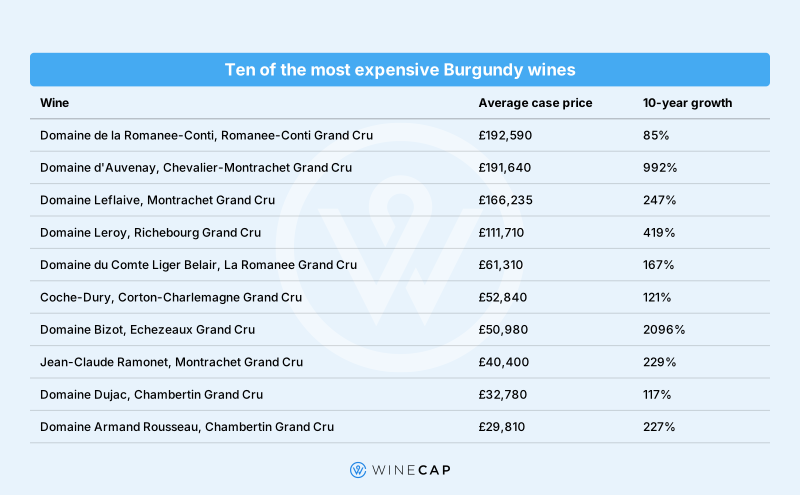
Deep dive: Ten of the most expensive Burgundy wines

Based on average case prices, Burgundy’s most costly wines reveal the extraordinary premium attached to the region’s greatest terroirs.Ten of the most expensive Burgundy wines

Several themes emerge from the rankings.

First is the dominance of Grand Cru terroir. Every wine on the list originates from Burgundy’s highest classification level, highlighting the premium investors place on the region’s top vineyard sites.

Second is the growing prominence of white Burgundy. Four of the ten wines are Chardonnay-based, namely Domaine d’Auvenay Chevalier-Montrachet, Domaine Leflaive Montrachet, Coche-Dury Corton-Charlemagne and Jean-Claude Ramonet Montrachet. This reflects both the surging global demand for white Burgundy and the scarcity of these wines.

Perhaps most striking is the scale of appreciation achieved by certain producers. Domaine Bizot’s Echezeaux Grand Cru leads the field with remarkable ten-year growth of 2,096%, while Domaine d’Auvenay’s Chevalier-Montrachet has gained 992% over the same period. These figures highlight the extent to which scarcity and cult status can drive long-term performance.

It is also worth noting some notable absentees. Wines such as Leroy Musigny would undoubtedly rank among Burgundy’s most expensive bottles, but limited trading volumes mean there is insufficient market data to establish reliable pricing. The same applies to the wines of Henri Jayer. While they remain among the most coveted and expensive wines in the world, the legendary winemaker’s death in 2006 and the tiny quantities currently in circulation mean transactions are too infrequent to provide robust market benchmarks.

A league of its own

The latest vineyard pricing data reinforces a reality that fine wine collectors have understood for years: Burgundy increasingly operates according to its own supply-and-demand dynamics.

While shifting consumer preferences, economic uncertainty and broader market corrections continue to affect many wine regions, Burgundy’s greatest vineyards are among the world’s most coveted luxury assets. Their scarcity is absolute, their prestige unrivalled and their appeal increasingly global.

Whether measured by the value of the land itself or by the prices achieved by the wines it produces, Burgundy continues to occupy a category almost entirely of its own. In a market searching for certainty, the region remains the closest thing fine wine has to a true blue-chip asset.

FAQ: Burgundy wine and vineyard prices

Why are Burgundy vineyard prices so high?

Burgundy’s finest vineyards are among the scarcest agricultural assets in the world. Grand Cru and Premier Cru sites are finite, fully planted and protected by strict appellation boundaries, meaning supply cannot expand to meet growing global demand.

How much is a hectare of Burgundy vineyard worth?

According to Safer’s 2025 data, a hectare of Premier Cru white vineyard land in the Cote-d’Or averages £2.3 million, while Premier Cru red vineyard land approaches £1 million per hectare. The region’s most prestigious Grand Cru sites would command substantially higher prices if they came to market.

Why is Burgundy outperforming other wine regions?

Unlike many wine regions facing declining consumption and oversupply concerns, Burgundy benefits from extremely limited production, strong global demand and a collector base willing to pay significant premiums for the region’s most prestigious wines and vineyard holdings.

What is the most expensive Burgundy wine?

Domaine de la Romanee-Conti’s Romanee-Conti Grand Cru is currently the most expensive Burgundy wine by average case price, valued at approximately just under £200k per case.

Are Burgundy wines still a good investment?

Past performance does not guarantee future returns, but Burgundy continues to demonstrate many characteristics associated with blue-chip investment assets: finite supply, global demand, strong brand equity and a long history of value appreciation among its most prestigious producers and vineyard sites.

How are vineyard prices linked to wine prices?

Higher vineyard values reinforce the scarcity and prestige of the wines produced from those sites. In Burgundy, where production volumes are often extremely limited, rising land values and rising bottle prices frequently support one another through a self-reinforcing cycle of demand and scarcity.

WineCap’s independent market analysis showcases the value of portfolio diversification and the stability offered by investing in wine. Speak to one of our wine investment experts and start building your portfolio. Schedule your free consultation today.
Categories
Learn

How technology is changing the world of fine wine

  • Modern technology is helping producers make higher-quality wines through more precise vineyard management and winemaking techniques.
  • Advances in logistics, storage and authentication are strengthening provenance, an important driver of value in the fine wine market.
  • While blockchain has attracted attention, artificial intelligence is likely to have the greatest long-term impact on how wine is produced, traded and collected.

Technology has become an increasingly important part of the fine wine industry, influencing everything from vineyard management and winemaking to storage, provenance and market transparency. While many of the most significant innovations of the past were focused on improving vineyard survival and production consistency, today’s technologies are increasingly geared towards enhancing quality, sustainability and precision.

From drones monitoring vine health to sensors tracking storage and transport conditions, data now plays a role throughout the lifecycle of a bottle. These developments not only help producers make better wines but also provide collectors and investors with greater confidence in provenance, authenticity and long-term value.

As fine wine continues to evolve as both a collectible and an alternative asset, technology is helping bridge the gap between centuries-old traditions and the demands of a modern global market.

Foundational technology in wine: 1860-1960

Before the digital age, some of the most important technological advances in wine were biological and mechanical. Between the late nineteenth and mid-twentieth centuries, innovation was often driven by necessity as producers responded to disease, changing consumer demand and the increasing commercialisation of wine.

Perhaps the most significant challenge was phylloxera, a vine pest that devastated European vineyards during the late 1800s. The solution was to graft European Vitis vinifera vines onto resistant American rootstocks – a practice that remains the foundation of modern viticulture today.

During the same period, the work of French scientist Louis Pasteur transformed winemaking. His research into fermentation helped producers better understand the role of yeast and bacteria, reducing spoilage and improving consistency.

Advances in glass production, bottling technology and mechanised farming further reshaped the industry. Estate bottling became increasingly common, while tractors and modern transport networks improved efficiency throughout the supply chain. Together, these innovations laid the foundations for the global fine wine market we know today.

Technology in the vineyard: The precision revolution

Modern vineyards have become increasingly data-driven environments. Rather than treating an entire vineyard as a single unit, growers can now analyse and manage individual plots according to their specific characteristics.

  • Drones have become essential tools allowing chateaux to identify areas of stress before they are visible to the naked eye. By responding to granular data chemical treatments can be applied only where they are needed.
  • Remote sensors and local weather stations monitor soil moisture at the root level and track local humidity and temperature shifts allowing more informed choices regarding irrigation and harvest timing.
  • Robots can now perform labour-intensive tasks like weeding with a level of precision that human crews struggle to match. In extremely high value vineyards they may also have a security function.
  • Breeding technology has shifted its focus from increasing yields to increasing  environmental resilience. As the climate changes, the development of drought-resistant varieties and rootstocks has become a priority.
  • Subterranean mapping: The rise of geophysics tools allow winemakers to visualise exactly where water is stored and where root systems might struggle. Understanding this helps in matching specific clones to the correct plots, increasing the quality of investment grade wines.
  • In-field analytics: Handheld spectrometers brought laboratory-grade analysis directly into the vineyard in the early 2000s measuring sugar levels or phenolic ripeness in situ. Data now allows producers to pinpoint the exact moment a specific parcel reaches the required ripeness.

Technology in the winery

Inside the winery, technology allows producers to make more precise decisions throughout the winemaking process. The objective is rarely to replace the winemaker’s judgement, but rather to provide better information and greater control.

The process begins before fermentation. 

  • Optical sorting machines use cameras and sensors to analyse individual grapes, automatically removing fruit that is underripe, damaged or diseased. This ensures that only the best fruit reaches the tank. 
  • Densimetric sorting submerges grapes in water so riper berries, which have higher sugar concentrations and greater density, sink to the bottom. Underripe or diluted grapes float to the surface and are discarded. Like optical sorters this guarantees uniformity and ensures that fermentation begins with fruit of a consistent ripeness level.  

These technologies are particularly valuable in challenging vintages, helping ensure that only the highest-quality fruit enters the fermentation tanks.

Once fermentation begins, smart tanks equipped with integrated sensors can continuously monitor temperature, sugar levels and extraction. Automated systems allow winemakers to respond quickly to changing conditions, helping preserve fruit character and maintain balance throughout fermentation.

The growing use of smaller fermentation vessels has also enabled more detailed plot-level vinification. Fruit from individual parcels can be fermented separately, allowing producers to capture subtle differences in terroir before constructing the final blend.

Advances in microbiology continue to expand the winemaker’s toolkit. Specific yeast strains can be selected to encourage particular fermentation outcomes, reduce unwanted aromas or help manage alcohol levels in increasingly warm growing conditions.

Technology is also influencing winery design. Many modern wineries incorporate gravity-flow systems, allowing grapes and wine to move naturally through the production process with minimal pumping. By reducing mechanical intervention, producers aim to preserve fruit quality and minimise oxidation.

Architectural innovation is increasingly aligned with sustainability goals as well. Underground cellars and energy-efficient winery designs can help maintain stable temperatures while reducing energy consumption.

Technology in logistics and provenance

The role of technology does not end once the wine is in the bottle. Preserving provenance and ensuring optimal storage conditions are essential factors in maintaining both quality and value.

Fine wine businesses like WineCap and their storage partners increasingly make use of:

  • Smart pallet sensors: Integrated devices now track temperature and vibration levels in real time during transport. This ensures that fine wine is not compromised by thermal shock or physical agitation while moving from the cellar to the warehouse.
  • Secondary market security: Detailed environmental data allows investors to verify that a bottle has never been exposed to heat damage. This objective proof of perfect storage adds significant value and confidence to the global secondary market.
  • RFID tracking: Radio Frequency Identification (RFID) tags allow for rapid, automated inventory management. Bottles can be tracked with pinpoint accuracy through every stage of the supply chain, reducing the risk of loss or logistical error.

Innovative packaging and the development of new closures also can reduce the cost of logistics and lower the risk of opening a spoiled bottle.

  • DIAM closures: This technology uses carbon dioxide to strip the chemicals causing cork taint from natural cork. This provides a traditional aesthetic with a technical guarantee of zero spoilage for up to three decades.
  • The Margaux experiments: Leading estates like Chateau Margaux have conducted decades of research into alternative closures from screwcaps to glass stoppers to find the ultimate balance between historical tradition and technical performance.
  • Sustainability and logistics: The industry is exploring low-weight bottles and stackable glass formats. By reducing weight and improving spatial efficiency (inspired by high-density logistics models like those used by IKEA), wineries can significantly lower the carbon footprint of transport.

Technology and the secondary market

Technology has also transformed how collectors interact with fine wine. Authentication tools such as security tags, micro-etching and digital verification systems help combat counterfeiting and provide greater confidence in provenance. In many cases, collectors can verify authenticity directly using a smartphone.

Digital platforms have also improved access to information. Interactive QR codes increasingly provide consumers with detailed information about a wine’s production, history and provenance.

Meanwhile, online databases and community-driven platforms have democratised wine criticism. Rather than relying exclusively on a small number of professional critics, collectors can now access hundreds or even thousands of tasting notes and reviews from wine enthusiasts around the world.

Perhaps most significantly, digital portfolio management tools provide greater transparency around pricing and market performance. Collectors can track the value of their holdings in real time, monitor market trends and manage their cellars more effectively.

The digital frontier: Blockchain, AI and the future of fine wine

Emerging technologies such as blockchain, NFTs and artificial intelligence have generated considerable interest within the wine industry. However, their practical impact varies considerably.

Blockchain-based ownership records have been promoted as a solution for provenance and authenticity. While these systems may offer benefits in some circumstances, many of the challenges they aim to address are already managed through bonded storage networks, established merchants and detailed provenance records.

Artificial intelligence may prove more transformative. AI is already being used to analyse vineyard data, predict disease pressure and support decision-making throughout the production process.

Beyond the vineyard, AI-powered tools are beginning to assist collectors with portfolio management, market analysis and cellar organisation. As these technologies continue to develop, their influence across the wine industry is likely to grow.

FAQ: Technology in wine 

Does technology in the winery make all wine taste the same? 

No. When used correctly, technology actually helps winemakers highlight the unique characteristics of their land. It removes the “noise” of spoilage or faulty fermentation, allowing the true terroir to shine.

Is machine harvesting and sorting inferior to hand picking? 

Historically, yes. However, modern optical sorters on harvesters can now be programmed to reject underripe or damaged berries. In some cases, modern machines can be more selective than a tired human crew.

What is the most important piece of tech for a wine investor? 

Beyond a reliable thermometer/hygrometer in the cellar, a subscription to a data platform like Cellartracker or Wine-Searcher is likely to be very useful to any serious collector or investor.

Will robots eventually replace vineyard workers? 

Robots will likely handle the most repetitive and physically demanding tasks. However, the high-level decision-making required for tasks like winter pruning or determining the exact day of harvest will always require human expertise.

How does technology help protect wine provenance?

Technologies such as RFID tracking, environmental monitoring systems and digital authentication tools help create a documented record of a wine’s storage and movement throughout the supply chain. This can provide greater confidence in authenticity, condition and provenance, all of which can influence a wine’s value in the secondary market.

How is artificial intelligence being used in wine production?

Artificial intelligence is increasingly being used to analyse vineyard data, predict disease outbreaks and identify optimal harvest dates. While AI can support decision-making, it is typically used alongside human expertise rather than as a replacement for it.

Can technology help producers adapt to climate change?

Yes. Precision agriculture tools allow growers to monitor water availability, vine stress and weather conditions more accurately. Advances in grape breeding and rootstock development are also helping vineyards adapt to warmer temperatures and changing growing conditions.

How do wineries monitor fermentation today?

Many modern wineries use tanks equipped with sensors that continuously track temperature, sugar levels and other key fermentation metrics. This allows winemakers to respond quickly to changing conditions and maintain greater control over the process.

What is precision viticulture?

Precision viticulture is the use of data and technology to manage vineyards at a more detailed level. Rather than treating an entire vineyard as a single unit, growers can make decisions based on the specific needs of individual plots or even individual rows of vines.

How does technology affect the value of investment-grade wine?

Technology can support value by improving provenance, authenticity and storage records. Greater transparency around a wine’s history and condition can increase buyer confidence, particularly in the secondary market.

What technology is likely to have the biggest impact on wine in the future?

Artificial intelligence is widely seen as one of the most significant emerging technologies. Potential applications range from vineyard management and climate adaptation to market analysis, portfolio management and consumer education.

Categories
Learn

The ultimate guide to Opus One: Napa Valley’s top cult wine

  • Opus One is the highest profile joint venture between the Old and New World in winemaking.
  • The wine is one of the most traded and reliable alternative assets in the fine wine market.
  • Opus One often outperforms other cult labels thanks to its global brand recognition and consistent quality.

As one of the highest profile wines in California, Opus One has spent decades bridging the gap between traditional European heritage and American enterprise and viticultural innovation. For anyone building a resilient fine wine portfolio, understanding its secondary market liquidity and performance is essential.

This guide breaks down the ten things you need to know about this iconic Cabernet benchmark, exploring how its production scale and critical history continue to offer secure capital growth for those investing in wine.

1. A transatlantic handshake: The history of Opus One

The story of Opus One began in 1970 with a meeting between two giants of the wine world: Baron Philippe de Rothschild of Château Mouton Rothschild and Napa Valley pioneer Robert Mondavi. Their shared ambition was to create a Bordeaux-style blend in California that could rival the finest wines of France.

Robert Mondavi played a defining role in the post-war American wine renaissance. After a family dispute over the future of the Charles Krug Winery – where he had worked alongside his father and brother since the 1940s – Mondavi founded his own winery in Napa Valley in 1965, helping establish California as a serious fine wine region.

Baron Philippe de Rothschild, meanwhile, rebuilt Château Mouton Rothschild following the Second World War. After escaping the German occupation of France, he returned to Bordeaux and revived the family estate in the early 1950s, eventually transforming Mouton Rothschild into one of the world’s most iconic wine brands.

Together, the pair set out to create a luxury Napa Valley Cabernet Sauvignon blend crafted with a distinct Bordeaux sensibility. It marked the first time a leading Bordeaux estate had partnered with a California producer to create an entirely new wine brand – a move that proved seismic for the global wine industry. Baron Philippe de Rothschild’s involvement brought immediate prestige and international credibility to the project.

The partnership was officially announced in 1980, although the first vintages – 1979 and 1980 – were released together in 1984. Today, Opus One remains a 50/50 partnership between Baron Philippe de Rothschild S.A. and Constellation Brands, which acquired Robert Mondavi Winery in 2004.

More than four decades later, Opus One continues to stand as one of Napa Valley’s most prestigious wines and a landmark collaboration that proved California terroir could produce world-class fine wine under French-inspired winemaking principles.

Key facts about Opus One:

  • Founded through a partnership between Robert Mondavi and Baron Philippe de Rothschild
  • Officially launched in 1980
  • First vintages: 1979 and 1980
  • Located in Oakville, Napa Valley
  • Inspired by the structure and philosophy of Bordeaux blends
  • One of the first major collaborations between Bordeaux and California winemaking
  • Currently co-owned by Baron Philippe de Rothschild S.A. and Constellation Brands
  • Widely regarded as one of Napa Valley’s most collectible fine wines

2. The Judgement of Paris: The catalyst behind Opus One

Although Baron Philippe de Rothschild and Robert Mondavi first discussed collaboration after meeting in Hawaii in 1970, it is difficult to ignore the significance of the 1976 Judgement of Paris tasting in accelerating the vision behind Opus One.

The now legendary blind tasting saw California wines defeat some of France’s greatest estates – including Chateau Mouton Rothschild – sending shockwaves through the global wine industry and permanently changing perceptions of Napa Valley wine.

Rather than dismissing California’s rise, Baron Philippe recognised an opportunity. He understood that Napa Valley was no longer a winemaking backwater, but a region capable of competing with the world’s finest wines. By partnering with Mondavi, the Rothschild family could help shape the future style of premium California wine while establishing a foothold in one of the wine world’s fastest-growing regions.

The collaboration also helped legitimise Napa Valley in the eyes of European collectors and investors. At a time when many traditional French producers remained sceptical of New World wines, Mouton Rothschild became the first First Growth Bordeaux estate to fully embrace a major California partnership.

From the outset, the ambition behind Opus One was clear: to create a “California First Growth” capable of standing alongside the great wines of Bordeaux.

The success of Opus One would later inspire other prestigious French wine families to invest in Napa Valley and the wider New World wine scene, helping transform California into a globally respected fine wine region.

Key facts about the Judgement of Paris and Opus One:

  • The Judgement of Paris took place in 1976
  • California wines defeated leading French wines in a blind tasting
  • Chateau Mouton Rothschild was among the French estates defeated
  • Baron Philippe de Rothschild saw Napa Valley as a long-term opportunity rather than a threat
  • Opus One was designed to become a “California First Growth”
  • Mouton Rothschild was the first First Growth Bordeaux estate to pursue a major New World partnership
  • The success of Opus One encouraged further French investment in Napa Valley
  • The partnership helped elevate Napa Valley’s reputation among European collectors and investors

3. The Opus One vineyards

Opus One is located in the heart of Napa Valley’s Oakville AVA, one of the region’s most prestigious and sought-after vineyard areas. Renowned for producing some of California’s greatest Cabernet Sauvignon wines, Oakville offers the ideal combination of climate, soil, and exposure needed to create wines with both power and longevity.

The Opus One estate spans 68 hectares of vineyards across four distinct parcels, including prized sections of the historic To Kalon Vineyard,  widely regarded as one of Napa Valley’s most iconic vineyard sites. These vineyards form the backbone of Opus One’s signature Bordeaux-style blend, dominated by Cabernet Sauvignon alongside smaller amounts of Merlot, Cabernet Franc, Petit Verdot, and Malbec.

Viticulture at Opus One combines traditional vineyard observation with modern precision technology. The estate employs high-density planting, encouraging the vines to compete for water and nutrients. This naturally reduces berry size and increases concentration, helping produce the depth, structure, and ageing potential for which Opus One is known.

Sustainability also plays a major role in the estate’s philosophy. Opus One is certified as a Napa Green winery, reflecting its commitment to environmentally responsible farming and long-term vineyard health. Advanced tools such as infrared sensors are used throughout the vineyards to monitor vine stress, water usage, and overall vine health, allowing the team to make highly precise decisions during the growing season.

The deep, gravelly, well-drained soils of Oakville are particularly well suited to Cabernet Sauvignon, helping create wines with intense concentration, refined tannins, and remarkable balance.

Key facts about the Opus One vineyards:

  • Located in Napa Valley’s prestigious Oakville AVA
  • Estate covers approximately 68 hectares of vineyards
  • Includes parcels from the famous To Kalon Vineyard
  • Cabernet Sauvignon is the dominant grape variety
  • High-density planting is used to increase berry concentration
  • Sustainable farming is central to the estate’s philosophy
  • Certified as a “Napa Green” winery
  • Infrared sensor technology is used to monitor vine health and water stress
  • Oakville’s gravelly soils are considered ideal for premium Cabernet Sauvignon production

4. A Bordeaux heart in a Napa body

The composition of Opus One is always led by Cabernet Sauvignon, but it remains a classic Bordeaux-style blend. Depending on the vintage, the wine incorporates varying percentages of Merlot, Cabernet Franc, Petit Verdot, and Malbec. This multi-varietal approach allows the winemaking team to adjust the final blend to achieve a consistent house style.

While many Napa producers focus on single-varietal Cabernet Sauvignon, Opus One proves its Bordeaux influence using other grapes to add layers of aromatic nuance and textural silkiness. Cabernet Franc provides floral notes, while Petit Verdot adds structure and deep colour. This complexity is one of the reasons the wine is so highly regarded.

Key facts about the Opus One blend:

  • Cabernet Sauvignon typically accounts for 80–95% of the blend
  • Other varieties include Merlot, Cabernet Franc, Petit Verdot, and Malbec
  • The blend changes slightly depending on the vintage
  • Cabernet Franc adds floral aromatics and elegance
  • Petit Verdot contributes colour, structure, and mid-palate weight
  • Malbec is used sparingly to add richness and dark fruit character
  • Every vineyard parcel is fermented separately before blending
  • The goal is to combine Napa Valley fruit intensity with Bordeaux-style structure and balance

5. Inside the Opus One winery

Completed in 1991, the Opus One winery is widely regarded as one of Napa Valley’s most iconic and influential winery designs. Combining architectural elegance with technical precision, the estate helped redefine what a modern fine wine winery could look like, inspiring winery architecture around the world over the past four decades.

Designed by architect Scott Johnson, the winery is partially built into the hillside, allowing for natural temperature regulation and minimal visual impact on the surrounding landscape. This subterranean design also supports gravity-flow winemaking, a gentle process that reduces excessive pumping and helps preserve the purity and integrity of the fruit throughout production.

In recent years, Opus One has also undergone extensive renovation and landscaping upgrades as part of a broader sustainability and estate stewardship initiative. The redesign focused on restoring the original architectural vision while incorporating drought-resistant native planting and environmentally conscious landscaping. According to reports, the project is expected to significantly reduce water consumption across the estate.

Technology plays a major role in the cellar. Optical sorting machines are used to inspect grapes before fermentation, ensuring that only the highest-quality fruit is selected. Fermentation takes place in 50 individual steel and wood vats, allowing the winemaking team to vinify each vineyard parcel separately for maximum precision during blending.

Opus One also employs extended maceration, keeping the grape skins and seeds in contact with the juice for longer periods to extract colour, texture, and fine-grained tannins that contribute to the wine’s structure and ageing potential.

Following fermentation, the wine is aged for approximately 18 months in 100% new French oak barrels. This élevage adds layers of spice, cedar, and vanilla that have become hallmarks of the Opus One style. The wine then spends an additional 18 months ageing in bottle before release, allowing the blend to integrate and develop further complexity before reaching the market.

Key facts about the Opus One winery:

  • The winery was completed in 1991
  • Designed by renowned architect Scott Johnson
  • Built partially underground for natural temperature control
  • Uses gravity-flow winemaking to handle grapes gently
  • Recently renovated with sustainability-focused landscaping upgrades
  • Estate redesign aims to significantly reduce water consumption
  • Optical sorting technology ensures only top-quality fruit is used
  • 50 individual steel and wood vats allow plot-by-plot vinification
  • Extended maceration is used to build structure and texture
  • Wines are aged for around 18 months in 100% new French oak
  • Additional bottle ageing takes place before release
  • The winery is regarded as one of Napa Valley’s architectural landmarks

6. The Opus One tasting profile

Opus One is celebrated for its balance, combining the richness and ripeness of Napa Valley fruit with the structure and restraint more commonly associated with top Bordeaux wines. While many Napa Cabernet Sauvignon blends lean toward power and opulence, Opus One is known for its precision, texture, and refinement.

In its youth, the wine typically displays intense aromas of black cherry, cassis, blackberry, and plum, layered with notes of cedar, rose petals, dark chocolate, and graphite. Ageing in 100% new French oak adds subtle nuances of toasted vanilla, espresso, baking spice, and sandalwood, though the oak is generally well integrated rather than dominant.

The defining characteristic of Opus One is often considered its texture. The tannins are famously polished and supple, giving the wine an approachable quality even in its early years. At the same time, the wine retains the acidity and structural depth needed for long-term ageing, allowing top vintages to evolve gracefully for decades.

Compared with many of its Napa Valley peers, Opus One often shows slightly higher acidity and greater restraint, helping preserve freshness and elegance alongside its concentrated fruit profile. This balance has led many critics and collectors to describe the wine as “European” in style despite its unmistakable New World ripeness.

With bottle age, the wine develops increasingly complex tertiary characteristics, including leather, forest floor, dried herbs, tobacco, and truffle, adding further depth and sophistication over time.

Key tasting characteristics of Opus One:

  • Primary aromas include cassis, black cherry, blackberry, and plum
  • Common secondary notes include cedar, dark chocolate, espresso, and sandalwood
  • 100% new French oak contributes vanilla and baking spice complexity
  • Known for exceptionally polished and supple tannins
  • Typically shows higher acidity than many Napa Valley Cabernet blends
  • Balances Napa fruit richness with Bordeaux-style restraint
  • Develops tertiary notes of leather, truffle, tobacco, and dried herbs with age
  • Often approachable young but capable of ageing for several decades
  • Frequently described as combining New World ripeness with European structure and elegance

7. The range: Opus One and Overture

Unlike many large Napa Valley estates that produce multiple labels and limited editions, Opus One has remained remarkably focused. The estate centres around its flagship wine, Opus One, often referred to as the “Grand Vin” in reference to the traditions of Bordeaux. Alongside it sits a second wine, Overture, which was originally available exclusively through the winery before receiving wider international distribution.

Produced for the first time in 1993, Overture follows the same Bordeaux-inspired philosophy as the flagship wine, using the classic blend of Cabernet Sauvignon, Merlot, Cabernet Franc, Petit Verdot, and Malbec. However, while Opus One is vintage-specific, Overture is unusual in that it is crafted as a multi-vintage blend.

This approach allows the winemaking team to combine wines from different harvests to create a more approachable and consistent style year after year. Fruit used for Overture comes from lots that do not ultimately make the final blend for Opus One, though the quality remains exceptionally high by Napa Valley standards.

Compared with the flagship wine, Overture is typically softer, more accessible in its youth, and slightly less structured, making it appealing to collectors looking to experience the Opus One style without the extended ageing requirements often associated with the Grand Vin.

Like Opus One, Overture is also aged in French oak barrels, although generally for a shorter period. The result is a polished and refined Napa Valley Bordeaux blend that retains the estate’s signature balance and elegance while offering earlier drinking appeal.

Key facts about Opus One and Overture:

  • Opus One is the estate’s flagship “Grand Vin”
  • Overture serves as the estate’s second wine
  • Overture was first released in 1993
  • For many years, Overture was only available directly from the winery
  • Overture is a rare example of a luxury non-vintage Napa Valley red wine
  • The blend includes Cabernet Sauvignon, Merlot, Cabernet Franc, Petit Verdot, and Malbec
  • Fruit used for Overture comes from lots not selected for the flagship blend
  • Overture is designed to be softer and more approachable when young
  • Both wines are aged in French oak barrels
  • The non-vintage format allows Overture to maintain stylistic consistency year after year

8. Opus One’s production scale

One of the most remarkable aspects of Opus One is its scale. While many of Napa Valley’s cult wines are produced in extremely limited quantities, Opus One operates on a far larger level without sacrificing the quality and consistency expected from a world-class fine wine estate.

The winery produces approximately 25,000 cases annually, making it significantly larger than ultra-small-production Napa labels such as Screaming Eagle, which produces fewer than 1,000 cases per year. Yet despite this comparatively high volume, Opus One has maintained its position as one of the most prestigious and collectible wines in California.

On a global level, Opus One’s production is closer in scale to the great First Growth estates of Bordeaux, such as Chateau Lafite Rothschild and Chateau Mouton Rothschild, than to many boutique Napa Valley producers. It also exceeds the production volumes of several iconic Italian fine wines, including Sassicaia and Tignanello.

This scale brings several advantages. Greater production allows Opus One to maintain a strong international presence across top restaurants, merchants, and collectors worldwide, while also creating valuable liquidity in the secondary market. Unlike many cult Napa wines that rarely trade due to limited availability, Opus One remains one of the few California wines with a consistently active global resale market.

The estate’s scale also supports major investment in vineyard research, sustainability initiatives, and winemaking technology, helping maintain consistency across vintages despite the challenges that come with producing wine at such volume.

Perhaps most impressive is that Opus One has managed to preserve its luxury image and premium pricing despite producing far more wine than many of its Napa Valley peers – a balance few wineries successfully achieve.

Key facts about Opus One’s production:

  • Produces approximately 25,000 cases annually
  • Significantly larger production than most Napa Valley cult wines
  • Production exceeds many leading Italian fine wines, including Sassicaia and Tignanello
  • Comparable in scale to major Bordeaux First Growth estates
  • Large production supports strong global restaurant and retail presence
  • One of the few Napa Valley wines with consistent secondary market liquidity
  • Scale enables major investment in technology, sustainability, and research
  • Maintains premium pricing despite relatively high production volumes
  • Consistency across large-scale production is considered one of the estate’s greatest achievements

Comparing Opus One Production volumes

9. Consistent quality across vintages

One of the defining characteristics of Opus One is its remarkable consistency, both in style and overall quality. This reliability is largely a reflection of Napa Valley’s comparatively stable climate, particularly within the Oakville AVA, where warm days, cool nights, and predictable growing conditions provide an ideal environment for Cabernet Sauvignon-based wines.

Unlike Bordeaux, where vintages can vary dramatically due to unpredictable weather and harvest conditions, Napa Valley offers a far more consistent growing season. This allows the Opus One winemaking team to achieve a high level of ripeness and balance year after year while maintaining the estate’s signature style of elegance, structure, and refinement.

Although Opus One has long been considered one of California’s benchmark wines, the estate’s critical reputation has strengthened considerably since the 1990s. Advances in precision viticulture, optical sorting technology, vineyard mapping, and parcel-by-parcel winemaking have further elevated quality levels, resulting in increasingly refined and critically acclaimed releases.

Several modern vintages are now regarded among the finest ever produced by the estate, with collectors and critics particularly praising vintages that combine Napa Valley ripeness with freshness, structure, and ageing potential.

Top modern Opus One vintages:

  • 2010
  • 2013
  • 2015
  • 2016
  • 2019
  • 2023

10. Market performance: The blue-chip king of Napa Valley

Opus One is often regarded as one of the safest and most reliable investments in California fine wine. While ultra-rare cult wines such as Screaming Eagle or Harlan Estate may command higher headline prices due to extreme scarcity, Opus One offers something equally important to collectors and investors: liquidity, consistency, and global brand recognition.

Thanks to its larger production scale and international distribution, Opus One is one of the few Napa Valley wines that trades regularly on the secondary market. This consistent market activity creates stronger price transparency and makes it easier for collectors to buy and sell compared with smaller-production cult labels that rarely appear at auction or on trading platforms.

The estate’s association with the Rothschild family also provides an additional layer of prestige and investor confidence. Few California wineries possess the same level of international brand recognition, particularly among buyers in Asia, Europe, and the United States.

Historically, Opus One has shown strong long-term price appreciation, especially for well-stored older vintages from the 1980s and 1990s, which have become increasingly scarce. 

Key facts about Opus One’s market performance:

  • Considered one of the most liquid Napa Valley wines on the secondary market
  • Often viewed as a lower-risk California wine investment
  • Strong global brand recognition supports long-term demand
  • Particularly popular in Asian markets, especially Japan
  • Older vintages from the 1980s and 1990s continue to appreciate in value
  • Frequently receives high critic scores, supporting investment-grade status
  • More actively traded than many small-production Napa cult wines
  • Association with the Rothschild family adds international prestige and trust

Performance of significant opus one vintages

FAQ: Opus One

Is Opus One expensive?

In absolute terms, yes – Opus One is one of Napa Valley’s premium fine wines. However, within the context of the luxury wine market, it is often considered relatively well priced for its reputation, consistency, and long-term performance.

Who are the two heads featured on the Opus One label?

The two profiles featured on the Opus One label are stylised silhouettes of the winery’s founders: Robert Mondavi and Baron Philippe de Rothschild.

The label symbolises the partnership between Napa Valley and Bordeaux that defined the creation of Opus One and helped reshape perceptions of California fine wine on the global stage.

Can I visit the winery? 

Yes, Opus One offers tasting experiences, though appointments are essential and often booked months in advance. If you’re interested, reach out to your WineCap Account Manager. 

Is Overture a good investment? 

Overture is generally considered a “drinker’s wine” rather than an investment asset, as it lacks the vintage-specific rarity of the flagship.

How long should I age Opus One? 

While approachable after five years, the best vintages reach their peak maturity between 15 and 25 years after the harvest.

WineCap’s independent market analysis showcases the value of portfolio diversification and the stability offered by investing in wine. Speak to one of our wine investment experts and start building your portfolio. Schedule your free consultation today.