Categories
Learn

Wine bottle sizes and their importance explained

  • Bottle sizes play an important role in the investment landscape.
  • How many ml are in a bottle of wine influences maturation and value.
  • Prestigious regions favour different bottle sizes for ageing.
  • Careful consideration of varying bottle types is critical for a wine investment strategy.

Standard, Magnum, Jeroboam, and Melchizedek: Understanding wine bottle sizes is key for wine investors. Wine bottle size impacts how wine matures, its value, and its portfolio performance. This guide covers the names, background, and advantages of each size, helping wine investors navigate which formats are optimal for their strategy and have the potential for long-term returns.

Wine bottle sizes

There is more to the wide array of wine bottle sizes than their intriguing names. The size of a bottle, whether a Piccolo or a Melchizedek, is crucial in wine maturing and value. From an investment and collecting point of view, knowledge about how many mls in a bottle of wine informs decisions on choice, storage, and how long to hold an asset.

This guide demystifies the names, uses, history, and importance of different wine bottle sizes, explaining the advantages of each for both established and newcomer investors.

Wine bottle sizes names

Split/Piccolo (187 ml / 18.7 cl)

The Split, or Piccolo (meaning “tiny” in Italian), contains a single serving of wine. It is most usually used for sparkling wines like Champagne or Prosecco.

Advantages

  • perfect for individual glasses
  • when from a prestigious house, adds charm to a wine collection

Half-Bottle (375 ml / 37.5 cl)

A half-bottle holds 2.5 glasses of wine. It is commonly used for still styles destined for early enjoyment and dessert wines such as Sauternes.

Advantages

  • offer a unique tasting experience
  • affordable route to rare wines

Half Litre/Jennie (500 ml / 50 cl)

The Jennie is not as common as the previous two sizes. How many ml in a bottle of wine of this size? The answer is 500ml or three glasses. It is usually found in parts of Germany and regions like the Loire Valley, typically for sweet wines.

Advantages

  • ideal for smaller servings (sweet or dry)
  • adds variety to collections

Standard Bottle (750 ml / 75 cl)

This is the size investors and collectors are most familiar with. This global benchmark has endured since the 19th century and was standardised in the 1970s. It contains five glasses, making it a practical and versatile option for daily use and cellaring.

Advantages

Litre Bottle (1 litre / 100 cl)

This bottle size holds 1.33 standard bottles. It is a common sight in European table wines. The Litre Bottle is less prevalent in collections of fine wines.

Advantages

  • offers practicality for casual drinking
  • ideal for large gatherings

Magnum (1.5 litres / 150 cl)

How many mils in a bottle of wine named a Magnum? This holds 1.5 litres and has a firm place in the world of collecting and investing because of its maturation-enhancing attributes. It is especially prevalent among premium wines from Bordeaux, Burgundy, and Champagne. The name derives from the Latin for ‘large’ and has been used since the end of the 1700s.

Advantages

  • volume allows wine to mature gradually, enhancing complexity
  • prized for both prestige and superior maturation capacity

Larger and less common bottle sizes

We now enter the world of the large wine bottle format. The names become even more exotic, historical, and often biblical. The significance for collectors and investors is even more notable.

Jeroboam/Double Magnum (3 litres / 300 cl, 4.5 litres/ 450 cl, 5 litres/ 500cl )

The Jeroboam, or Double Magnum, contains four times the quantity of wine as the standard bottle. The first documented use of this name dates to the early decades of the 18th century in Bordeaux. It was named after a biblical king to signify its superior size. How many ml is in a bottle of wine with these names depends on the region. In Champagne and Burgundy, both names can refer to a 3-litre capacity, while in Bordeaux, this quantity solely means Double Magnum. In the same region, a Jeroboam indicates 5 litres.

Advantages

  • ideal for high-quality wines and long-term ageing
  • offers rarity and collectability

Rehoboam (4.5 litres / 450 cl)

This big bottle of wine is known as the Rehoboam, the name of the biblical king who was the son of wise man Solomon. This size is common in fine wine regions, Champagne and Burgundy.

Advantages

  • allows wines to mature slowly and steadily, deepening complexity
  • especially prized for Grand Cru reds

Methuselah/Imperial (6 litres / 600 cl)

Often referred to as an “Imperial” in Bordeaux, the Methuselah is named for the longest-lived figure in the Old Testament (969 years). While nearly a millennium in the cellar might be a challenge for even the finest of wines, the name does nod to the longevity offered by large-format wines. This 6-litre size is highly valued in Champagne, Bordeaux, and Burgundy for the maturation it facilitates.

Advantages

  • for wines destined for long-term ageing
  • valued for rarity and maturation potential

Salmanazar (9 litres / 900 cl)

Also falling into the category of “big bottles of wine”, the Salmanazar has the capacity for 12 standard bottles. Most often associated with Bordeaux and Champagne, this size is named for a dynasty of Assyrian kings who had vast kingdoms in the BC era.

Advantages

Balthazar (12 litres / 1,200 cl)

Balthazar bottles hold 16 standard bottles. They are used for the finest-quality wines, destined for gradual, complex evolution. This large format aids in the slowing of unwanted oxidation, allowing elegant ageing. Balthazar was one of the biblical wise men and an ancient king.

Advantages

  • very large bottle of wine ideal for slow, finessed evolution
  • valued for combination of rarity and prestige

Nebuchadnezzar (15 litres / 1,500 cl)

A Nebuchadnezzars is the equivalent to 20 standard bottles. These rare formats are delegated to the most prestigious wines, especially those from Bordeaux or Burgundy. This format takes its name from another biblical source: Nebuchadnezzar, Babylon’s greatest king, who transformed his kingdom into a magnificent land.

Advantages

  • size facilitates slow, finessed evolution
  • rare and prestigious bottle format

Rare and colossal formats

This section is dedicated to massive bottles of wine. These formats are reserved for top vintages and appellations. They are among the most prized sizes for investment and collecting. They are usually named after biblical kings and figures to symbolise generosity, grandeur, and abundance.

Melchior (18 litres / 1,800 cl)

This huge bottle of wine contains 18 litres. Named Melchior after one of the three wise men, this format is exceptionally rare, reserved for top vintages from premium regions like Bordeaux, Burgundy, and Champagne.

Advantages

  • size allows deep, gradual evolution
  • valued for both rarity and quality.

Solomon (20 litres / 2,000 cl)

Solomon was the biblical king admired for his wisdom, wealth, and eloquence. Solomons are reserved for ceremonial releases and special editions, usually in blue-chip regions like Bordeaux and Burgundy. Their historical significance, along with their rarity make them highly valuable.

Advantages

  • Rare and prized
  • Historical value
  • Capacity supports finessed evolution

Sovereign (22.5 litres / 2,250 cl)

This massive bottle of wine brings us from ancient to modern times. It was introduced by Taittinger Champagne house in 1988, when it was used to christen the world’s largest cruise ship, the Sovereign of the Seas. This format is associated with luxury and the most celebrated wines and vintages.

Advantages

Primat/Goliath (27 litres / 2,700 cl)

This is nearly classed as the largest wine bottle. Colossal, with a capacity of 27 litres or 36 bottles, Primat is synonymous with exclusivity. Also called Primato or Goliath after the giant biblical warrior, it is reserved for the finest Bordeaux, Burgundy, and Champagne. Its volume capacity amplifies ageing potential and value. The name Primat is derived from the Latin for “first class”. In the wine world, it was used for the first time in 1999.

Advantages

Melchizedek/ Midas (30 litres / 3,000 cl)

The biggest wine bottle format in the collecting and investment space is the Melchizedek, with a capacity for 40 bottles. Nicknamed the “king of all bottles”, this exceptionally rare format is used for Grand Vins and special releases, showcasing the pinnacle of prestige, rarity, and ageing capacity. It is named after a biblical king and priest famed for his wisdom and foresight. The moniker “Midas” refers to the Greek mythological king known for turning everything he touched into gold. The name reflects the ultimate luxury of this size.

Advantages

The large wine bottle: Regions and history

Wine bottle sizes have taken centuries to evolve. In early viniculture, before glassmaking developed, wines were stored in clay vessels. To provide gravitas, many large bottle sizes of wine were named after well-known biblical or historical figures.

The choice of size of a bottle of wine varies regionally. Champagne favours Magnums and the Jeroboams size for ageing, Bordeaux prefers large wine bottle sizes for reds, and Burgundy prefers them for Grand Crus. In other premium regions such as Tuscany, the Rhône, and Rioja, similar practices mirror local winemaking traditions and styles.

Wine bottle sizes: Impact on wine ageing and value

How many milliliters in a wine bottle influences oxidation and the pace and depth of maturation. The greater the height of a bottle of wine and the wine bottle diameter, the slower the ageing process is, resulting in complexity over decades. Investors and collectors prize a very large wine bottle like Magnums, Jeroboams, and Methuselahs for longevity, stability, rarity, and, often, higher market value than the standard size of a wine bottle.

Size of wine bottle: Collecting and investing

Market value

Larger bottles command premium prices owing to their rarity, ageing capacity, and prestige. Magnums, Jeroboams, and Methuselahs from Bordeaux and Champagne are highly valued, elevating both portfolios and collections.

Investment potential

Slow-maturing wines in large formats often appreciate over the years. Limited editions or special releases increase value, making them excellent choices for long-term investment horizons.

Display prestige

The largest bottle sizes enhance cellars with their value and prestige. Large wine bottles speak of wine expertise and add aesthetic and financial value to collections.

Final thoughts: wine bottle sizes and names

From the tiny Piccolo to the massive Melchizedek, wine bottle sizes impart history and symbolism, and influence the wine itself. An understanding of how many mls in a bottle of wine can help collectors and investors appreciate the position of different sizes.

Next time you review your wine investment strategy, think about wine bottles sizes. They’re more than vessels with colourful names; they have the potential to transform your portfolio.

FAQs

  1. Why do collectors admire big-format bottles of wine so much?
    Large formats like Magnums and Jeroboams aren’t just visually impressive – they age more gracefully thanks to slower oxidation. This means finer texture, deeper complexity, and often a higher market value over time.
  2. Is there a real benefit to buying unusual sizes like Salmanazar or Melchizedek?
    Yes. Beyond the spectacle, these huge bottles are produced in tiny quantities. Their rarity, combined with exceptional ageing potential, makes them sought-after assets in wine investment portfolios.
  3. How many ml are actually in a bottle of wine – and why does it matter?
    Bottle size can range from 187 ml Piccolos to 30-litre Melchizedeks. The volume affects how wine develops, how rare the format is, and ultimately how desirable it becomes on the secondary market – key factors for collectors and investors alike.

WineCap’s independent market analysis helps investors build diversified fine wine portfolios with full ownership and transparent pricing. Speak to one of our wine investment experts and start building your portfolio. Schedule your free consultation today
Categories
Learn

Types of Champagne explained

Beyond the glamour of iconic Champagne brands, the category’s power and influence is found in its diversity. Each Champagne style — from cellar-worthy Vintage wines to cult Grower labels — has its own story, profile, and market behaviour. Understanding these distinctions is key for navigating one of the fine wine world’s most resilient segments.

Bullet points

  • Champagne is prestigious wine with global enduring appeal  
  • Four categories of Champagne are Vintage, NV Brut, Rosé, and Grower Champagne
  • Each segment has a unique profile and significance for consumers, investors, and collectors
  • Luxury, strong brands, scarcity, and terroir expression are features wine lovers appreciate about Champagne

Best Champagne styles

Champagne has long held a unique place in the fine wine world. This can be explained by the fact that it is both a symbol of luxury and an extraordinarily resilient wine category. Over the medium and long-term, Champagne weathers market cycles, global uncertainty, and changing consumer tastes while maintaining robust demand.

Behind the prestigious labels and glamour lies:

  • a diverse array of Champagne styles with varying structures
  • “cellarability”
  • market behaviour
  • investment profiles

Developing an understanding of types of Champagne is critical for any wine investment journey. What follows is a breakdown of the four key Champagne categories that are most significant to investors and why. These are: Vintage, Brut (Non-Vintage), Rosé, and Grower Champagne.

We look at what defines these kinds of sparkling wine and why they are important from both a drinking and Champagne investment perspective.

1. Vintage Champagne

 What is Vintage Champagne?

Vintage Champagne is a distinguished wine produced solely in exceptional years. This means that a particular Champagne sub-region’s weather conditions have been ideal, yielding fruit of excellent quality and optimal concentration. This enabled the wine to stand alone, showing the unique characteristics of the harvest. This is opposed to the practice of blending wines from across multiple years, as is typical for Non-Vintage (NV) Champagne.

Vintage Champagne requires a minimum of three years of lees ageing. Some houses age vintage cuvées for longer to enhance complexity.

Style

Since it reflects a single, outstanding year, Vintage Champagne tends to be more concentrated, structured, and complex than its NV counterparts. It displays:

  • rich textures
  • evolved fruit
  • nutty, biscuity, brioche, toasty complexity
  • good mineral definition
  • the capacity to cellar for decades

Champagne houses often regard their vintage wines as emblematic expressions of terroir and brand identity.

Why is Vintage one of the types of Champagne important for investors?

Vintage Champagne is viewed as the most consistent and reliable asset in the sparkling wine investment category. This is for the following reasons:

  • limited production: only made in the best years, and usually in much smaller quantities than NV Champagne
  • exceptional longevity: finest vintages from great champagne brands such as Krug, Dom Pérignon, Bollinger Champagne, Pol Roger Champagne and Roederer evolve over decades, resulting in steady price appreciation
  • historical price performance: Vintage Champagne has displayed some of the most advantageous compound annual growth rates in the fine wine sector, with so-called blue-chip vintages garnering above-average returns  
  •  strong demand globally: Vintage Champagne is consumed widely all around the world, creating pressure on diminishing stocks. This leads to scarcity and increases in  Dom Perignon price, for example

From a Champagne investment perspective, Vintage is the category’s backbone. It offers steady long-term growth and less volatility. These features make it an ideal place for beginner investors to start.

2. Brut Non-Vintage (NV) 

What is Brut NV Champagne?

Brut NV Champagne is the most common and one of the types of Champagne that wine lovers usually experience first (around 90% of Champagne sold is Brut).

Brut Champagne are made through blending what are called “base wines” from several different vintages. Together, they produce a consistent and recognisable “house style”. Prestige NV cuvées are especially sought-after, demonstrating house blending skill, distinct quality, and complexity with the finest fruit from across vintages. 

NV is one of the types of Champagne required to age for at least 15 months prior to release. Many producers go beyond this minimum to enhance a wine’s depth.

Style

A typical Brut NV is:

  • dry, fresh, and crisp
  • bright and citrusy
  • well balanced with delicate brioche or pastry hints
  • built for early enjoyment, but some styles lend themselves to ageing

Because NV wines reflect the house’s philosophy, they serve as an essential introduction to each brand.

Why is NV Champagne important for investors?

Usually, Brut NV Champagne is not a key focus for longer-term investment. However, it plays an important role in the broader evaluation of a house’s reputation and offers insights into wider market conditions. Here’s why:

  • brand identity/consistency: solid NV releases bolster brand confidence, especially important for great Champagne brands like Bollinger, Pol Roger, Roederer, and Charles Heidsieck
  • market demand: Prestige NV cuvées (finest blends) have become collectibles, demonstrating steady performance and rising interest from investors. Examples include Krug Grande Cuvée, Laurent-Perrier Grand Siècle
  • portfolio diversification: Prestige NV offers accessibility and can be ideal for shorter-term investment arcs
  • gateway for collectors: robust NV sales drive interest in a house’s vintage and Prestige Champagne, influencing their long-term value 

Brut NV is not a leading stand-alone Champagne investment category. That said, top prestige NV cuvées demonstrate stability and gradual value appreciation. Investors and collectors are increasingly recognising the value of this segment for building verticals that are brand-oriented.

3. Rosé Champagne

What is Rosé Champagne?

Rosé Champagne emerged as a style in the late 18th century, with Ruinart and Veuve Clicquot the first houses to produce pink sparkling wine. Wine lovers admire it for its fresh, expressive character and delicate red fruit. This Champagne can be produced in two ways:

  • blending small quantities of still Pinot Noir or Meunier into Blanc Champagne
  • the saignée method, where the pink colour comes from brief red grape skin contact

The majority of Rosé Champagnes are NV, made from a blend of multiple base wines from different harvests for a consistent, identifiable house style. Like Brut NV, this is one of the types of Champagne that is required to age for at least 15 months before release. Many houses go beyond this minimum to develop extra depth and elegance.

Style

A Rosé Champagne bottle features:

  • subtle red berry such as strawberry, raspberry, cherry
  • full, rounder mouthfeel
  • appealing hue that promotes a luxurious image
  • food-pairing versatility

For many wine consumers, Rosé Champagne has an indulgent and celebratory profile.

Why is Rosé important for Champagne investment?

Rosé Champagne has seen a rapid rise in popularity around the world, especially among younger, HNW individuals. Its position as one of the industry’s fastest-growing types of Champagne segments is paralleled by its increasing significance in the investment space. This is because of:

  • scarcity: this style requires additional production steps, needs more grape selection, and has smaller production amounts than standard Champagne.
  • luxury appeal: markets in Asia, the UK, and the US, especially, have elevated rosé to a Champagne status symbol
  • strong market performance: prestige rosés like Cristal Rosé, Dom Pérignon Rosé, and Krug Rosé regularly outperform many of their Brut counterparts
  • faster appreciation: Rosé Champagne typically appreciates in value more quickly than Brut
  • ageing capacity: leading rosé cuvées age elegantly, developing highly-valued, savoury umami depth

For investors looking for high-growth and scarcity, prestige rosé Champagnes display strong performance.

4. Grower Champagne

What is Grower Champagne?

This segment (usually labelled “RM” meaning récoltant-manipulant) is one of the region’s most exciting types of Champagne. The term encompasses producers who cultivate their own fruit and make Champagne from such vineyard holdings. These tend towards small, artisanal, often family affairs that cultivate single villages or specific parcels.

They contrast with big houses (NM, or négociant manipulant) that use multiple growers from across the region to source their grapes.

Style

Grower Champagnes are:

  • terroir-driven, expressing a sense of place
  • distinctive and full of character
  • produced in small quantities

Leading examples of Grower Champagne names include Egly-Ouriet, Selosse, Cédric Bouchard, and Ulysse Collin.

Why is Grower Champagne important for investors?

Grower Champagne has a unique profile, which has led to this sparkling wine’s rise in the fine wine world. By extension, this elevation is influencing its status in the Champagne investment world for the following reasons:

  • scarcity: most growers produce minuscule quantities
  • cult status: demand for Champagne with precise terroir identity is on the rise
  • market recognition: top grower producers are achieving impressive secondary market footprints, with steep year-on-year appreciation
  • premiumisation: Grower Champagne resembles Burgundy’s signature approach of single-vineyard, terroir-driven wines

Grower Champagnes brings a boutique, diversifying slant to a portfolio, offering a contrast to the market behaviour of large-volume houses. They’re ideal for investors who appreciate scarcity, craftsmanship, and terroir purity. 

Final thoughts: The enduring appeal of different types of Champagne

A number of factors position Champagne as a compelling wine investment category. These are:

  • reliable global consumption
  • strong brands
  • strict production regulations for quality guarantee
  • ageing capacity
  • growing scarcity of older vintages
  • luxury demand

Whether building a diversified portfolio or focusing on targeted, high-performing cuvées, an understanding of various types of Champagne  is essential for informed investment. This sparkling wine’s styles collectively represent a resilient, robust, and rewarding segment of the fine wine investment space. 

FAQs

How should an investor think about the best Vintage Champagnes?

Vintage Champagne from leading houses forms the cornerstone for long-term investment. This category features historically proven returns, consistent ageing trajectories, global liquidity, and relatively low volatility.

How should an investor approach Prestige Rosé?

This Champagne category is a high-growth luxury segment offering excellent price arcs. It is characterised by robust international demand, small production, and impressive long-term appreciation.

What’s the ideal investment strategy for Grower Champagne?

Grower Champagne is a boutique segment with cult followings and an appeal driven by scarcity and a distinct identity. It is gaining traction because of its very limited amounts and how it offers the opportunity for diversification and early positioning for emerging iconic names.

What’s the best way to approach NV Brut Champagne?

Although typically secondary to Vintage or Rosé Champagne for long-term horizons, Brut NV represents a good gauge of house reputation. Prestige NV cuvées can display solid performance for short to medium-term investment.

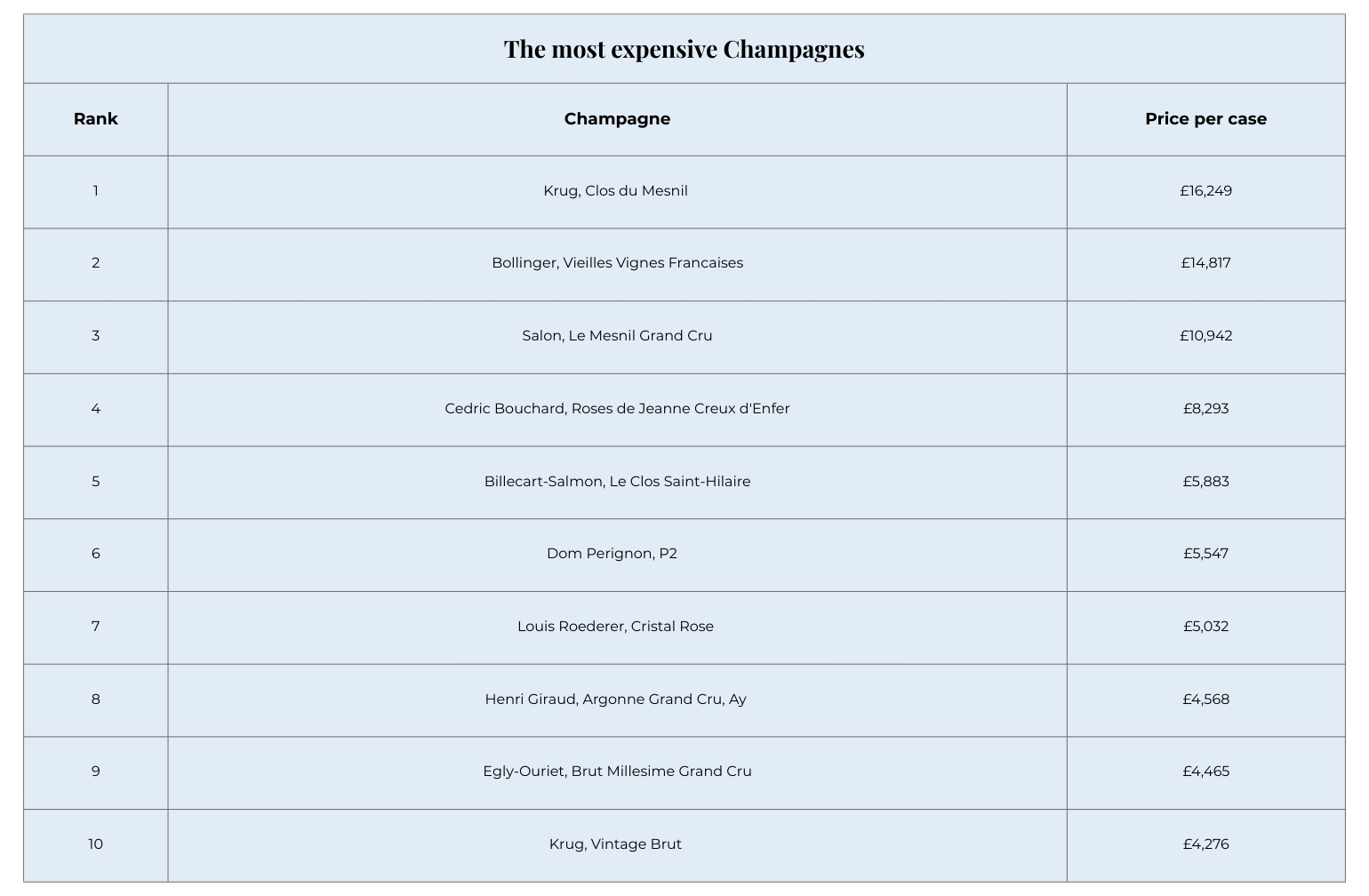
The most expensive Champagne brands

The table below shows the most expensive Champagnes, with prices per case, according to Wine Track data. For more information on performance and scores, please visit Wine Track.

Most expensive Champagne brands table

Looking for more? See also WineCap’s Champagne Regional Report.

WineCap’s independent market analysis helps investors build diversified fine wine portfolios with full ownership and transparent pricing. Speak to one of our wine investment experts and start building your portfolio. Schedule your free consultation today
Categories
Learn

Fine wine investment returns: if you’d put £1,000 in 10 years ago

Fine wine has long been celebrated as both a pleasure to own and a source of steady, inflation-beating returns. But how much difference can the choice of region, producer, and timing make over the long term?

Using Wine Track data, we’ve taken a decade-long view – from 2015 to 2025 – to see exactly how a £1,000 investment in some of the world’s most sought-after wines would have performed. The results reveal disparities between regions and labels, driven by factors such as scarcity, critical acclaim, brand momentum, and the fluctuations of global demand.

In some cases, your £1,000 would have barely kept pace with inflation. In others, it could have doubled, tripled, or even more – often in places you might not expect. What’s more, because fine wine is a cyclical market, today’s leaders aren’t always tomorrow’s winners, and periods of market correction can present some of the best opportunities for future growth.

This analysis explores several key regions, showing not just the percentage returns but also what your £1,000 investment would be worth today, and what you could have bought then compared with now.

Bordeaux: a decade of divergence

In 2015, a £1,000 investment in a top Bordeaux could have taken very different paths over the following decade. If you had chosen Château Figeac, your £1,000 would now be worth £2,310 – more than doubling your money thanks to a +131% average return over the past decade. This performance has been fuelled by Figeac’s promotion to Premier Grand Cru Classé A and consistently high-scoring vintages.

Château Les Carmes Haut-Brion in Pessac-Léognan has been another star performer, climbing 163% over the past ten years. This is a rare combination of strong brand momentum, critical acclaim, and relative scarcity, making it one of the most compelling growth stories in the Bordeaux market.

By contrast, the First Growths have had a more subdued performance. Looking at the current average market prices for the several blue-chip Pauillac labels and their second wines, the past decade has been anything but uniform:

  • Château Lafite Rothschild sits today at around £5,106 per case, up just 6% over the last decade. This reflects both its lofty 2015 starting point and the cooling of the top-tier Bordeaux segment in recent years. However, some vintages have outperformed the overall brand.
  • Château Latour is similar, with a 10-year rise of 4%, now averaging £4,960 per case.
  • Château Mouton Rothschild fared better, with a 22% decade-long gain to £4,496 per case, thanks partly to strong demand for key vintages in the late 2010s.

The best relative value in the First Growth orbit has often been found in their second wines:

This ‘second wine premium’ over the decade illustrates a key point for investors: sometimes the best relative value comes not from the pinnacle labels, but from their immediate tier below. These wines benefit from the halo effect of the grand vin’s reputation while offering lower starting prices.

However, the current context matters. The performance of the Liv-ex 50 (First Growths) and Bordeaux 500 (broader region) shows how the 2022 peak has given way to a sharp correction, with prices now trending towards 2015 levels. This is classic market cyclicality: those who bought during the previous trough and held through the rally have realised strong gains; those entering now may be positioning themselves at the start of the next upswing.

Burgundy: the market reset

If Bordeaux’s decade has been a story of cyclical swings and selective outperformance, Burgundy’s has been one of explosive gains followed by a sharp correction. The Liv-ex Burgundy 150 index more than quadrupled between 2015 and its 2022 peak, fuelled by surging global demand for small-production, high-prestige domaines. Since then, prices have retraced significantly, but remain far above their 2015 levels, underscoring the long-term wealth-generating power of the region’s top wines.

At the very top sits Domaine de la Romanée-Conti, Romanée-Conti Grand Cru, whose sky-high starting point means it was always going to operate in a different financial stratosphere to most wines. Over the past decade, prices have risen by 147%, elevating the wine’s average price per case to £213,303.

Among the biggest long-term winners is Domaine René Engel, Vosne-Romanée Premier Cru Aux Brûlées, which has climbed 1,482% in the past decade. That’s enough to turn £1,000 into a staggering £15,820 today. Engel’s cult status has only intensified since the sudden passing of Philippe Engel in 2005, leaving the estate without a clear successor, and its eventual sale to François Pinault, who renamed it Domaine d’Eugénie.

Meanwhile, Domaine Leroy Richebourg Grand Cru has appreciated by 507% over the same period, due to a combination of biodynamic viticulture, minuscule yields, and demand consistently outstripping supply.

The sheer magnitude of these returns reflects Burgundy’s unique market dynamics:

  • Scarcity at every level – often just a handful of barrels per cru.
  • Global demand from Asia to the Americas.
  • Producer-led brand power that eclipses even vintage variation in driving prices.

Yet the post-2022 decline in Burgundy shows that even this hallowed region is not immune to market cycles. For investors, today’s lower prices could represent a rare opportunity to enter or rebalance Burgundy holdings – though the barriers to entry at the very top remain as formidable as ever.

Champagne: the market fizzes with potential

Champagne has traditionally been viewed as a steady, blue-chip corner of the fine wine market: less volatile than Burgundy and Bordeaux, yet capable of delivering strong long-term growth. Over the past decade, the Champagne 50 index has shown a clear upward trajectory, punctuated by a sharp rally between 2019 and 2022 before a mild correction. 

The most eye-catching long-term gains have come not only from the established houses but also from small-production grower-producers like Egly-Ouriet, Brut Millésime Grand Cru, which has surged 633% in the last decade. That growth has been fuelled by a wave of sommelier-driven interest in terroir-driven Champagne and limited allocations reaching the market.

Prestige cuvées from major houses have also rewarded patient investors. Salon Le Mesnil-sur-Oger Grand Cru has delivered a 298% return, while Billecart-Salmon Le Clos Saint-Hilaire climbed 203%.

A particularly notable outlier is Cédric Bouchard, Rosé de Saignée Le Creux d’Enfer, with an extraordinary 418% return – turning £1,000 into £5,180 – reflecting the explosive demand for rare, artisanal Champagne in recent years.

Champagne’s appeal lies in its dual identity: both a luxury good for immediate enjoyment and a serious investment asset. With the market cooling slightly from 2022 highs, current conditions may offer attractive entry points for those looking to secure allocations before the next phase of appreciation.

Italy: quiet consistency and standout performers

Italy’s fine wine market has been a story of steady, broad-based growth over the past decade, delivering consistent returns and avoiding some of the more extreme volatility seen in Burgundy or Champagne. 

At the very top of the performance table sits G.B. Burlotto Barolo Monvigliero, with a remarkable 1,162% return over the last ten years. In Tuscany, Soldera Casse Basse, Brunello di Montalcino Riserva has been a powerhouse, rising 280% over the decade. The modern Tuscan icon Masseto has also posted a healthy 79%, taking £1,000 to £1,790.

Italy’s appeal lies in its combination of relative affordability, quality across multiple regions, and improving international distribution. While Piedmont’s and Tuscany’s top names have led the charge, there’s also significant breadth in the country from Abruzzo, Veneto, and beyond, giving investors multiple entry points into a market with both stability and pockets of spectacular growth.

Lessons from a decade of fine wine investing

Looking back from 2025, one reality stands out: fine wine is not a single market, but a patchwork of micro-markets, each with its own rhythm, risks, and rewards. 

For investors, three lessons are clear:

  1. Selection is everything – Even within a single region, the difference between a modest gain and a market-beating return can be measured in multiples.
  2. Cycles create opportunity – Market peaks and troughs are inevitable; buying quality during a correction often positions you for the next rally.
  3. Diversification pays off – Spreading capital across regions and producer tiers balances the potential for growth with the stability of blue-chip holdings.

As the market sits in a post-2022 cooling phase, parallels with earlier cycles suggest that this may be a moment for strategic accumulation. History shows that the investors who pair patience with informed selection tend to enjoy the richest rewards – sometimes quite literally.

Categories
Learn

Understanding Burgundy’s quality and ownership divisions

Following on from our guide on Burgundy’s sub-regions, we turn our focus to the region’s quality and ownership divisions, which are equally integral to understanding what makes Burgundy’s wines so exceptional.

Quality divisions

Grand Cru
At the pinnacle of Burgundy’s wine hierarchy are the 33 Grand Crus, which represent around 2% of total production. These wines are the epitome of excellence, with yields restricted to a maximum of 35 hectolitres per hectare (hl/ha) and often far lower. Revered for their age-worthiness, these wines generally require five to seven years to begin showing their potential, with many capable of aging for decades. Grand Cru wines are among the most prestigious and collectible in the world.

Premier Cru
Premier Cru wines, comprising 12% of Burgundy’s production, are crafted from 640 officially recognized superior vineyard sites. With permitted yields of up to 45 hl/ha, these wines showcase the terroir’s expressive character. They typically require three to five years of aging but can develop even greater complexity with extended cellaring. These wines are highly regarded by connoisseurs for their balance of quality and accessibility.

Village Wines
Village wines account for 36% of Burgundy’s production and are produced under 44 communal appellations. These wines can be blends from various vineyards within a village or from single, unclassified plots. With a yield allowance of 50 hl/ha, Village wines offer excellent value for money and are known for their approachable nature. While they are often enjoyed young, many can be aged for two to four years or more, depending on their origin and vintage.

Regional Appellations
Regional appellations, collectively known as Vin de Bourgogne, make up nearly half of Burgundy’s total production. With yields of up to 70 hl/ha for reds and 75 hl/ha for whites, these wines are ideal for everyday enjoyment. While they lack the investment potential of higher classifications, they offer an accessible introduction to the region’s styles and are valued for their straightforward appeal.

Ownership Divisions

Monopoles
Monopoles are vineyards with a single owner, a rarity in Burgundy where fragmented ownership is the norm. There are fewer than 50 monopoles in the entire region, and many are associated with some of the most iconic wines. Examples include Domaine de la Romanée-Conti’s Romanée-Conti, Domaine du Comte Liger-Belair’s La Romanée, and Domaine du Clos de Tart’s Clos de Tart. These monopoles exist across Grand Cru, Premier Cru, and Village levels, and their exclusivity adds to their allure.

Domaine Wines
A domaine refers to an estate that grows its own grapes and produces its wine in-house. This approach allows the producer complete control over viticulture and winemaking, ensuring consistency and quality. Domaine wines are highly esteemed for their reflection of the estate’s unique terroir and meticulous craftsmanship. These wines are considered benchmarks of Burgundy’s artisanal winemaking tradition.

Négoce Wines
A négociant is a merchant who sources grapes, juice, or finished wine from growers and produces wine under their own label. While some perceive négociant wines as inferior, many are of exceptional quality due to the long-standing relationships between négociants and growers. This collaborative model enables access to fruit from top-tier vineyards, allowing skilled winemakers to craft extraordinary wines. Prestigious négoce producers, such as Maison Leroy, often rival their domaine counterparts in quality and acclaim.

Looking for more? Read our Burgundy Regional Report, which delves into the fundamentals of this fascinating region and the development of its investment market.

Categories
Regional-reports

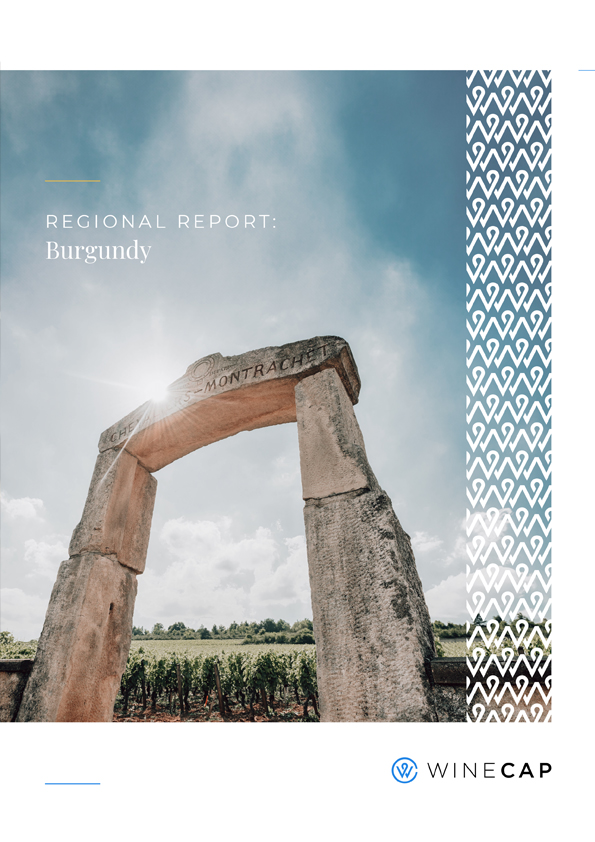
Burgundy | Regional Report

There is a maxim in the wine trade: no matter where a wine lover starts, they end up in Burgundy.

A key part of the attraction is in its contradictions: it is the most romantic wine region but also the most expensive; quality tends to be high but quantities are low; intuition is key but it is also one of the most researched regions.

With only two primary grape varieties and three classification ranks, Burgundy may appear simple, but with dozens of controlled places of origin (AOCs), hundreds of producers and thousands of wine labels, it can be incredibly complicated.

Our Burgundy Report delves into the fundamentals of this fascinating region, including the development of its investment market, historic performance, recent expansion and key players.

Discover more about:

  • Burgundy’s price performance
  • The expansion of Burgundy’s investment market
  • History of the Burgundy wine region
  • Burgundy’s structure and fragmentation
  • Key Burgundy producers
  • How we choose Burgundy for investment

Do not hesitate to get in touch and speak to one of our wine investment advisors for further information and to reserve your allocations.

Download your complimentary copy of Burgundy’s Regional Report and discover how fine wine can enhance your investment portfolio.

Burgundy Report Cover
Burgundy’s Regional Report
 Download
Categories
Regional-reports

Insights from leading Bordeaux fine wine producers

Our Insights from leading Bordeaux fine wine producers report is now available to download. This report is the result of 32 face-to-face interviews WineCap conducted in 2022 with some of Bordeaux’s leading châteaux owners, winemakers and senior representatives. 

While global stock and bond markets have had a turbulent year, the fine wine sector has continued to perform strongly. Thanks to its low correlation with mainstream asset classes and defensive characteristics, fine wine is attracting a wider investor audience.

WineCap recently undertook research among leading fine wine producers responsible for many of the highest quality vineyards in Bordeaux. We are delighted to share some key findings, which include, wine producers’ oldest vintage and favourite year, their views on new permitted grape varieties and how they are coping with challenges such as climate change.

Despite the perception that older vintages are more desirable, it’s fascinating to find that most leading Bordeaux producers prefer wines from the last decade. Find out which vintages they mention in particular in this report. 

While six new grape varieties are now permitted to be planted in Bordeaux, to help producers adapt to climate change, Cabernet Sauvignon remains the dominant grape variety, representing 32% of the total 1,668 hectares in the region. 

A key priority for the wine producers we interviewed is to maintain the same volume to all their existing customers, while attempting to supply as much as possible to new ones. While some producers have acquired adjacent land to expand production volumes to meet growing demand, volumes can vary dramatically depending on the quality of the harvest. Managing demand expectations is therefore a key challenge and calls for a flexible approach on the part of the customer.

Download our new report to discover key insights from one of the world’s top fine wine regions.

United States Regional Report


Categories
Report

Bordeaux 2020 | Vintage Report

Our Bordeaux En Primeur 2020 Report is available to download. Discover our wine investment experts thoughts on 2020, a vintage that has widely been heralded by prominent wine critics as excellent and the third in a row of top Bordeaux vintages. Find out which Bordeaux sub-regions and producers they feel delivered top class wines that are worth seeking out. 

As with the two vintages that preceded it, conditions in 2020 favoured producers with multiple plots of different soil types due to the abundance of both sunshine and rainfall. Right Bank clay soils were better able to retain water and thus sustain the vines. 

Although Bordeaux En Primeur 2020 is undoubtedly a fantastic vintage, investors are advised to be selective and search for relative value rather than being led solely by critics’ scores. 

Through careful study and data analysis, WineCap provides insight into the wines that we feel present both value and opportunity for capital growth. With our bespoke, industry-leading graph and analysis tools we have concluded that the wines selected in this report are attractive prospects and that any carefully built investment portfolio should consider 2020 Bordeaux.

Click the button below to download our Bordeaux En Primeur Report. Do not hesitate to get in touch and speak to one of our wine investment advisors to reserve your allocations.

Categories
Report Uncategorized

Bordeaux 2019 | Vintage Report

Our Bordeaux En Primeur 2019 Report is available to download. Find out what our wine investment experts thought of 2019, a wonderful vintage that saw a surprisingly successful En Primeur campaign during the global uncertainty and financial stress of the time. Discover which Bordeaux sub-regions and producers we feel delivered top class wines worth paying attention to. 

In 2019, cool weather during flowering led to reduced quantities and conditions favoured producers with multiple plots of different soil types that could handle both the sunshine and rainfall. Right Bank clay soils were better able to retain water and thus sustain the vines.

Though 2019 is undoubtedly a fantastic vintage, investors are advised to be selective and search for relative value rather than being led solely by critics’ scores. 2019 was quite different in terms of how tastings were conducted. No longer could massive trade tastings be held for the media and critics. Therefore, the tasting notes from that year may be the most careful and well-thought out of any, as the critics were not being whisked from one mass tasting to another and could taste samples at their leisure at home. Without the pressure of being in the company of the winemaker, or under the influence of peers, these may be some of the most honest ratings ever. 

Through careful study and data analysis, WineCap provides insight into the wines that we feel present both value and opportunity for capital growth. With our bespoke, industry-leading graph and analysis tools we have concluded that the wines selected in this report are attractive prospects and that any carefully built investment portfolio should consider 2019 Bordeaux.

Click the button below to download our Bordeaux En Primeur Report. Do not hesitate to get in touch and speak to one of our wine investment advisors to discuss buying wines En Primeur.

Categories
Special-reports

Fine Wine Investment | Guide

A renaissance in the market over the last two decades has let the secret of fine wine out, and the mainstream investment community has responded in kind. The word on fine wine is that it’s not just for the privileged few: it is an ideal choice for everyday investors looking to diversify their portfolios.

By choosing fine wine, you benefit from a proven market that is stable, relatively detached from the mainstream, and consistent in its double-digit returns. What’s more, fine wine offers you a great hedge against inflation.

Discover in our Fine Wine Investment Guide:

  • How to invest successfully in fine wine
  • What WineCap will do for you
  • The beauty of fine wine as an investment
  • The long-term returns of fine wine
  • The influence of wine critics
  • How to create the perfect portfolio

Click the button below to download our Fine Wine Investment Guide and learn more about our proven strategy for investment success.

Do not hesitate to get in touch and speak to one of our wine investment advisors for further information and to reserve your allocations.

Fine Wine Investment Guide cover


Fine Wine Investment

Download
Categories
Report

Champagne | Regional Report

Champagne needs little introduction, even to those not typically involved with fine wine. It is everywhere – from restaurants and clubs to airport lounges and private cellars. Fit for every occasion, Champagne has developed an investment market in part thanks to its strong brand recognition. More approachable than other fine wines, the Champagne market has become one of the most liquid – an added benefit for investors. In fact, the region dominated the top-traded wines on the secondary market in 2023.

A decade ago, the region made up less than 3% of the fine wine investment market. Today, its trade share comfortably sits between 13% and 15%, making it a close contender to Burgundy (the second-     most-popular region after Bordeaux).

Pricing dynamics have also evolved during this time. From a relatively modest price performer, and one of the most affordable entry points into the wine investment market, Champagne has risen to new heights in recent years. As the ultimate fine wine ‘luxury’ asset, Champagne has shown remarkable resilience to economic crisis and relatively low volatility.

Our Champagne Report delves into the fundamentals of this fascinating region, including the development of its investment market, historic performance, recent expansion and key players.

Discover more about:

  • Champagne’s investment performance
  • Supply and demand dynamics
  • Key Champagne houses and brands to watch

Do not hesitate to get in touch and speak to one of our wine investment advisors for further information and to reserve your allocations.