Categories
Learn

The ultimate guide to Bordeaux En Primeur

  • Bordeaux En Primeur is a system where wine is purchased while it is still maturing in barrel, typically 18 months before bottling and delivery.
  • The system operates through a unique network of brokers and merchants known as La Place de Bordeaux.
  • Successful participation in the campaign requires a data-led approach, focusing on the relative value of new releases compared to available back vintages.

What is En Primeur wine buying?

En Primeur, also known as wine futures, is the shorthand for an ecosystem of wine producers, negociant, and merchants that allows consumers and investors to buy wine while it is still in the barrel, before the final bottling takes place. 

While other regions do offer En Primeur purchases, the system is best known in Bordeaux. Grapes for the Bordeaux wines are harvested in the autumn and the young wine is offered for sale the following spring. In practice, this means that the 2026 En Primeur campaign is for the 2025 vintage, 2025 En Primeur was for the 2024 vintage etc.

At this stage, the wine is sold while it is a work in progress, unfinished, unblended and still requiring further ageing in the chateau cellars before being bottled and shipped.

Buyers pay a specific release price for the wine, which can be the lowest price the wine will ever see. This is dependent on the chateaux and negociants setting a sensible entry point and markets holding steady or improving. Once purchased, the wine remains at the estate until a few months after it is bottled, which usually happens 18 months to two years after the harvest. 

A short history of Bordeaux wine futures

Like everything in Bordeaux, the roots of the En Primeur system stretch back but the widespread adoption of modern En Primeur sales has its origins in the early 1970s.  

The establishment of En Primeur was prompted by global recession and cash flow issues caused by the 1973 oil crisis. After poor sales of the 1973 and 1974 vintages, merchants and producers were badly in need of money and with 1975’s samples well received, the wine trade found a way to bring forward revenue and sell wines early, funding the next year’s production and labour costs without waiting for the wine to mature.

It was only with later vintages that the economic advantages of En Primeur buying became clear to investors.

How the En Primeur system operates today

The Bordeaux En Primeur market is governed by La Place de Bordeaux and involves three primary players: chateaux, courtiers and negociants. 

  • Chateaux are the winemakers.
  • Courtiers are brokers who act as middle men distributing the wine to a handful of B2B merchants in Bordeaux known as negociants.
  • Negociants then sell the wine to merchants across the globe who in turn sell to their clients.

Chateaux rarely sells directly to retailers or private clients. Instead, they release allocations to a small group of courtiers who then sell them to a slightly larger group of  negociants in France. Even when a chateau has a strong relationship with a merchant like WineCap and wants to guarantee them allocations, that transaction will still go through a negociant.

Every April, the world’s wine trade descends on the city of Bordeaux for the primeur tastings, with journalists, importers, and merchants spending a manic week tasting hundreds of barrel samples often on multiple occasions to assess the quality of the new vintage. Based on these assessments and the general economic climate, the chateaux release their prices over several subsequent weeks, generally through May and June with negociants simultaneously offering dozens of wines to international merchants, who sell to private clients.

Which UK merchants offer En Primeur?

Most reputable fine wine merchants in the UK participate in the annual campaign. This includes historic firms and modern investment platforms. In a high-quality oversubscribed vintage, retailers compete for allocations of the most sought-after wines, with those that buy most broadly getting priority. In poorer vintages, the balance of power shifts with negociants working harder to place their wines. When selecting a merchant, it is vital to choose one with a proven track record, as you are essentially buying a promise of future delivery.

Buying En Primeur with WineCap

Even if you consider yourself a drinker rather than a collector, looking at wine through an investment lens is beneficial. WineCap’s perspective focuses heavily on relative value and our approach is data first. We believe that a purchase should only be made when there is a clear advantage to doing so. In the En Primeur market, this means carefully analysing whether a new release is actually priced better than an available comparable back vintage. 

Thinking about fine wine with an investment perspective will help ensure you get the best value for money from your purchases, even if your end goal is drinking pleasure. Speak to one of our wine investment experts 

How to evaluate En Primeur opportunities

Evaluation begins with critic scores from major platforms and critics like Neal Martin and Antonio Galloni at Vinous, William Kelley and Yohan Castaing at Robert Parker’s Wine Advocate, James Lawther at JancisRobinson.com, Jane Anson or Lisa Perrotti-Brown MW.

The key is to compare the release price of the new vintage against the current market prices of comparable physically delivered back vintages. If a physical wine from a great year like 2019 is available at a similar price to a new release of similar quality, the financial argument for the newer wine is weak.

You need a compelling reason to buy a wine that is less affordable than a comparable vintage already sitting in a warehouse, vintage reputation is a major factor but investors should always be selective. This is particularly the case in vintages where quality varies significantly between estates. In those years, you must focus on specific successes rather than the vintage as a whole. Early on, it looks like the high-quality 2025 vintage will be one of them.

Benefits of buying wine En Primeur

One primary benefit of buying wine En Primeur is guaranteed access in the formats you are looking for. For the most famous chateaux, allocations can be tight and buying wine futures may be the only way to secure a case of the top labels at opening prices. In especially strong vintages releases for a specific wine may come in several tranches often with later tranches being made available at higher prices: the wine trade’s version of dynamic pricing. WineCap would typically not recommend buying second or third tranches. 

Another major advantage is the ability to request non-standard formats. You can order half bottles, magnums, double magnums, or even larger formats at the time of purchase. These formats can be harder to find on the secondary market once the wine is bottled, so if you’re looking for a large format of wine to drink in 20+ years to celebrate an anniversary or the birth of a child, En Primeur may be especially attractive. This is especially important if you are in a wine market where availability is lower and prices higher than in the major markets of the UK and EU.

When the wines are priced correctly, En Primeur can be the best price the wines will ever be. Finally, buying pre-bottling ensures perfect provenance as the wine moves directly from the chateau to a bonded warehouse in an unbroken chain of custody.

Finding price lists and reports

To stay informed on En Primeur, you should subscribe to newsletters and offers from reputable merchants. These provide real time updates on releases and pricing. Major review platforms are key for technical data such as vintage reports and professional critic scores, although merchants will share those with their clients. Critics spend weeks in Bordeaux tasting hundreds of samples to produce the reports that form the market’s understanding of the vintage quality and how it is likely to evolve over time.

Key factors for consideration

Brand power is the most significant indicator of future liquidity. Names like Chateau Latour or Chateau Cheval Blanc have global demand that protects their value, and search rankings on websites like Wine-searcher provide an excellent proxy by which collectors and investors can understand this. 

Overall vintage quality and pricing will dictate the general market mood, but you must also consider the liquidity and quality of the specific label. Some wines are easy to sell at any time, while others may take much longer to find a buyer. Past performance of the estate is also a useful metric.

A good merchant such as WineCap will synthesise all this data before making recommendations to their clients. Speak to one of our wine investment experts.

Risks of buying wine En Primeur

The most obvious risk is that the final quality may not reflect early critic reviews i.e. a wine that scored highly in barrel may not show as well once it is in the bottle. En Primeur scores are generally given in a range, normally of two to three points to reflect this uncertainty.

Prices may also fall. If a chateau releases its wine at too high a cost, the market may reject the price, leading to lower values when the wines become physical and secondary market trading begins in earnest. 

There are also macro-economic considerations. General market volatility can impact luxury assets although that tends to be less significant and delayed for fine wine, and the broad economic climate and the cost of money may impact demand.

Currency fluctuations and fixed prices

Buyers often worry about currency moves between release and delivery; however, for a UK client, changes do not affect the original purchase. You have committed to buy the wine at a fixed price in GBP at the time of the offer and in return your price is fixed so you should not be concerned about changes in exchange rate between the point of purchase and the point of delivery. 

Subsequently a weak pound can sometimes make UK-held stock more attractive to international buyers, potentially increasing its value.

Storage and delivery logistics

When you buy En Primeur, the price you pay is normally ex-VAT and duty. This means the wine is held in bond once it arrives in the UK. The wine will be delivered to a professional bonded warehouse, such as Octavian or LCB, roughly two years after the campaign. 

At this point, you can choose to keep the wine in bond to preserve its investment potential, avoiding the immediate payment of VAT and excise duty. Unless you are able to cellar the wine properly yourself this is normally the best decision as it ensures the wine ages in benign conditions.  

Another less frequently mentioned benefit of in-bond storage is that the necessity of arranging to have a wine delivered to you means more intent is required before consumption. That is to say, you are less likely to drink on a whim and more likely to wait until the wines are at a point where they are truly ready to enjoy before pulling corks. 

Recommended wines for long-term cellaring

Almost any wine released En Primeur will be suitable for at least a few years of ageing. Even relatively humble estates like Chateau Laroque, Les Cruzelles, and Chateau Cantemerle will easily age and improve over the course of 10-20 years and provide excellent drinking pleasure. Top-tier estates, including the First Growths and their Right Bank peers, are built to allow 40 to 50 years of development in a good vintage although they can be enjoyed sooner.

FAQ: Bordeaux En Primeur

Can I buy En Primeur wines online with UK delivery? 

Yes, most UK merchants allow you to purchase online but it’s always a good idea to engage with your account manager ahead of time, especially if you have specific wines of formats in mind. Physical delivery to your home only occurs once the wine is bottled and the duty and VAT have been paid.

What is a negociant?

A negociant is a wine merchant that operates business-to-business offering wines for sale to retail partners operating business-to-consumer.  

When do new vintage En Primeur campaigns typically start? 

The main Bordeaux campaign begins in the spring, usually starting in mid-late April with the tasting week, with prices following in May and June. It is rare that a campaign goes beyond July, but it has been known to happen.

Which regions are most known for their wine futures offerings? 

Bordeaux is the pioneer and by far the best known, but Burgundy, the Rhone, and some producers in Tuscany and California also offer wines En Primeur.

Is buying En Primeur a guaranteed investment?

No, it is not a guaranteed return. Success depends on the quality of the vintage, the value of the release pricing compared to back vintages and market sentiment.

WineCap’s independent market analysis helps investors build diversified fine wine portfolios with full ownership and transparent pricing. Speak to one of our wine investment experts and start building your portfolio. Schedule your free consultation today
Categories
News

Bordeaux 2025 En Primeur: Quality meets a market at the crossroads

  • Bordeaux 2025 is a low-yield, heat-shaped vintage delivering concentration, freshness, and a clear shift toward precision viticulture.
  • Early reports point to a high-quality vintage with the potential to rival benchmark years like 2010 and 2016.
  • Set against a cooling market, the En Primeur campaign represents a critical opportunity to reset expectations around pricing and value.

From April 20th to 23rd, 2026, Bordeaux welcomed thousands of merchants, critics, and collectors for the En Primeur tastings of the 2025 vintage. Shaped by intense heat and reduced yields, the new vintage reflects a growing emphasis on precision viticulture – an approach that could come to define Bordeaux’s modern identity.

Yet the usual energy surrounding En Primeur unfolds against a more cautious economic backdrop. Bordeaux finds itself in a period of recalibration. As the first in-barrel scores emerge and the campaign gathers momentum, attention turns not only to what sets the 2025 vintage apart, but also to whether this release can offer real value.

A note on Bordeaux En Primeur

Few moments in the fine wine calendar carry the weight of En Primeur week. Orchestrated by the Union des Grands Crus de Bordeaux (UGCB), the event sees chateaux open their doors to professionals eager to sample wines just months after they were harvested.

Unlike the bottled wines, the En Primeur wines are still unfinished, first presented while ageing in oak. Tasting from barrel requires an expert palate to see through the raw tannins and vibrant acidity to glimpse the potential for greatness years down the line. It is a period of masterclasses, technical presentations, and intense market discussion that signals the pricing direction for the entire year ahead.

The 2025 represents a fascinating stylistic shift. Despite the heat, alcohol levels are reportedly low to moderate. The wines have pronounced aromatics, silky tannins and brisk acidity – hallmarks of great ageing potential. 

Bordeaux 2025: What we know so far

Bordeaux weather and crop reports indicate that 2025 was a year of climatic extremes, resulting in high quality but notably low yields. In fact, production statistics show that 2025 is the smallest crop since the frost-bitten 1991, with yields across many top appellations falling 15-30% below the five-year average.

A season of heat and superb ripening

The growing season was defined by a warm spring and a blistering summer. June 2025 was recorded as one of the hottest in French history, second only to the infamous 2003. This heat, combined with a dry August, led to:

  • Smaller berries: The lack of water and high heat restricted grape size, leading to intense concentration and thick skins.
  • Exceptional phenolic ripeness: While the yields are small, the quality of the tannins is reportedly superb.
  • The “rain of relief”: Just as drought stress became critical, rain in late August and early September refreshed the vines, preserving essential acidity and preventing alcohol levels from spiralling out of control.

Regional highlights

  • The Left Bank (Médoc, Pauillac, St-Julien): The deep-rooted old Cabernet Sauvignon vines thrived, producing structured, age-worthy wines reminiscent of 2022 but with a touch more freshness.
  • The Right Bank (St-Émilion, Pomerol): Clay and limestone soils held onto moisture better than gravel, allowing Merlot to reach lush ripeness without excessive heat stress.
  • Dry whites: Harvested early in mid-August, these show vibrant acidity and tropical aromatics.

The Bordeaux market: The recalibration phase

While the 2025 quality is expected to be high once critic scores are released, the market mood is best described as unsettled. For decades, Bordeaux held an unchallenged dominance in the fine wine market. Recent years have seen a cooling of demand, especially for young releases.

The challenges

  • Increased competition: High-quality rivals from Burgundy, Tuscany, Napa Valley, and even emerging regions have eaten into Bordeaux’s traditional market share.
  • Pricing fatigue: Consistent price hikes in recent En Primeur campaigns – often regardless of the broader economic climate – have tested the loyalty of even the most dedicated collectors.
  • Stock overhang: Many merchants are currently carrying significant inventories of recent great years (2018, 2019, 2020), which has created a bottleneck in the secondary market.

The silver lining

Despite these headwinds, the appetite for older, physical vintages remains robust. There is a clear divergence in the market: while younger vintages (2021-2023) struggle for traction, back vintages from the mid-2000s and 2010s continue to see steady price appreciation. This suggests that the brand of Bordeaux is as strong as ever. The issue lies specifically with release pricing.

Buying wine En Primeur: The question of value

For decades, the “golden rule” of Bordeaux was that En Primeur represented the lowest price point for a wine’s entire lifespan. Today, that assumption is being challenged by data.

Looking at prices at release versus now, several recent vintages can be found on the secondary market for the same price or even less. This has shifted the focus from buying everything to selective acquisition based on specific brand value. Tools like Wine Track, which show the historic performance of specific wine brands, can help investors understand long-term trajectories.

Why data matters

In the 2025 campaign, savvy buyers will be looking for relative value. If a 2025 release is priced higher than a physical, high-scoring 2019 or 2020 vintage currently sitting in a merchant’s warehouse, the incentive to buy En Primeur diminishes. However, because the 2025 yields are so low, scarcity may drive demand for the top-tier “blue chip” estates (the First Growths and their Right Bank equivalents).

The 2025 Bordeaux En Primeur verdict

As critics release their first scores over the coming weeks, all eyes will be on the “price-to-quality ratio.” The 2025 vintage has all the hallmarks of a collector’s dream: scarcity, concentration, and classical structure. For the Bordeaux trade, the 2025 En Primeur is an opportunity for a reset. With early reports pointing towards a vintage that could rival the greats of 2010 or 2016, the quality is likely there.

If the châteaux can marry this quality with a pricing strategy that respects the current market reality, 2025 could mark the beginning of a vibrant new chapter for the world’s most famous wine region.

Bordeaux comment: UGCB President, François-Xavier Maroteaux speaks to WineCap

WineCap: The 2025 vintage promises high quality, yet it arrives as the secondary market has just started to recover from a five-year low, and growing geopolitical tensions discourage speculation and might isolate certain market segments. How do you intend to position the 2025 launch so it doesn’t just survive the current market, but actually revitalises the ‘Bordeaux Brand’ globally?

François-Xavier Maroteaux: The 2025 vintage is a genuine opportunity – but only if we use it wisely. First, pricing must be honest: release prices that ignore five years of secondary market correction damage trust more than they protect margins. A well-priced great vintage is far more powerful than an overpriced one. Second, the narrative must move beyond scores – 2025 has a compelling story of terroir and style that needs to reach consumers directly, not just through trade press. Third, our négociants are brand ambassadors, not just a distribution channel: the properties that genuinely invest in informing and equipping their partners will see it reflected in every market. Finally, the retreat of speculative demand is not a threat – it’s a rebalancing. Bordeaux built its reputation on wine people actually wanted to drink. Refocusing on that is not a concession to difficult times. It’s a return to what made the region great. 

WC: Where do you see the biggest interest in buying Bordeaux at release in the coming years?

FXM: The interest in buying Bordeaux at release remains genuinely global. The best proof of this is the En Primeur week itself: every year, wine professionals from more than 80 nationalities make the journey to taste and buy. That breadth of engagement, even in difficult market conditions, is a strong signal that the foundation is there. Beyond geography, there is another compelling reason to buy at release that we shouldn’t underestimate (and we should be communicating much more actively!): formats. En Primeur remains the best – often the only – window to secure large formats. Magnums, double magnums, imperials are allocated at release and rarely available later at any price. The opportunity is to refocus En Primeur on what it does uniquely well: access, formats, and relationship. That’s a proposition that holds regardless of geopolitics.

WC: Is the En Primeur system still going strong, in your personal view? Do you believe it still offers a genuine win-win? Has it become a luxury-only club for the top 50 estates?

FXM: Yes, I do believe the En Primeur system still works – but I think we need to be honest about what it has become. It works very well for a relatively narrow group of estates where brand strength and secondary market liquidity reinforce each other. For the broader Bordeaux pyramid, it is more complicated. That said, I don’t think the answer is to abandon the system. The answer is to make the win-win genuine again. That means pricing with discipline, communicating with transparency, and making sure négociants and merchants actually make money when they support a release. When that alignment exists, En Primeur is a unique and powerful tool. When it doesn’t, it becomes – as you say – a luxury club for the top names. 

FAQ: Everything you need to know about Bordeaux En Primeur

What does “En Primeur” mean?

En Primeur is a method of purchasing wine while it is still maturing in the barrel. This allows collectors and investors to secure highly sought-after wines before bottling and general market release. This typically happens two years after harvest.

When is the Bordeaux 2025 En Primeur week?

The official tasting week for the 2025 vintage takes place from April 20 to April 23, 2026. During this time, international critics and trade professionals sample the wine from barrel to determine early scores and quality ratings.

Is the 2025 Bordeaux vintage good?

Bordeaux 2025 is a high-quality vintage with intense concentration and bold fruit profiles.Yields are lower than average, which often results in wines with significant ageing potential and structural density.

Why are yields low for the 2025 vintage?

The 2025 growing season saw record-breaking heat and extended dry periods. While this led to exceptional grape ripeness and thick skins (tannin), it resulted in smaller berries and less juice. These lower yields often drive up demand due to the limited number of cases available globally.

Is buying En Primeur a good investment?

Buying En Primeur can be a strategic investment, particularly for top-tier estates (First Growths and “Super Seconds”). However, it is essential to use data-driven insights. While release prices were historically the lowest point of entry, current market fluctuations mean buyers should compare release prices against available physical back-vintages to ensure they are getting true value, as older vintages can often present better buying opportunities than En Primeur.

When is the delivery of the 2025 Bordeaux wines?

In the spring or summer of 2028, following their mandatory ageing period in the châteaux cellars.

What are the “big three” factors to watch in the 2025 campaign?

  1. Critic scores: Initial ratings from major publications will dictate immediate global demand.
  2. Release pricing: How châteaux price their wine in relation to the secondary market.
  3. Volume: With lower yields reported, the scarcity of specific labels will likely be a driver of demand.

WineCap’s independent market analysis helps investors build diversified fine wine portfolios with full ownership and transparent pricing. Speak to one of our wine investment experts and start building your portfolio. Schedule your free consultation today.

Categories
News

Is fine wine investment impacted by wealth exodus?

  • As wealth moves between generations and jurisdictions, investors are prioritising assets with universal value and “borderless” appeal.
  • About 60% of global investors today show increased interest in globally transportable assets due to political and tax developments.
  • Fine wine can serve as the ultimate “borderless” asset, offering stability and low correlation to mainstream markets.

As the global population of high-net-worth individuals (HNWIs) expands, we are witnessing the cusp of the largest intergenerational wealth transfer in history – all set against a backdrop of profound instability. While private wealth continues to grow, the economic situation of some major countries is weakening, and, consequently, the world is witnessing an unrivalled migration of HNWIs.

This multifaceted shift of wealth is taking place in an unstable global climate, where governments are continually redefining the “social contract” through major reforms and the overhaul of domestic tax regimes. This quest for stability and the safeguarding of assets is prompting a mass relocation of HNWIs that is reshaping traditional “capitals of wealth.”

Findings from the 2026 WineCap Wealth Reports – conducted among hundreds of wealth managers and financial advisors in the UK and US – reveal how this exodus is fundamentally altering the modern investment portfolio. As HNWIs move across borders to escape fiscal tightening and political volatility, fine wine has emerged as a sophisticated, “borderless” financial instrument that could well fit the mobile elite.

Why is wealth moving?

The current exodus is driven by a “perfect storm” of factors that vary by region but share a common goal: capital preservation.

  • In the UK: The term “Wexit” (Wealth Exit) has gained traction following the abolition of the “non-dom” tax status and significant reforms to inheritance tax. Wealthy individuals who once viewed London as a permanent safe haven are now looking toward more tax-favourable jurisdictions.
  • In the US: Movement is driven by a desire to diversify away from domestic political volatility and a weakening reliance on the US Dollar as a singular store of value.
  • Globally: Inflation and high interest rates have made traditional “paper” assets feel increasingly fragile, prompting a flight to tangible quality holdings.

Defining the “borderless” asset

As investors become more mobile, they require assets that share that mobility. A borderless asset is a financial instrument that maintains its value and liquidity regardless of geographical location. Unlike real estate, which is physically anchored to a single jurisdiction, fine wine is recognised and tradable globally.

Fine wine has solidified its role in this exodus due to four key characteristics:

  1. Tangible value: A physical luxury asset with intrinsic worth.
  2. Low correlation to mainstream markets: It operates independently of the “noise” of equity and bond market volatility.
  3. Inherent scarcity: Consumption leads to a permanent reduction in supply. As demand remains steady or increases, prices rise.
  4. Fiscal stability: Fine wine acts as a defensive anchor during periods of high inflation.

Demand for portable asset

A defining trend of 2026 is demand for globally transportable assets. For an investor who is  relocating, an asset that can be stored in a bonded warehouse in one country and sold in another – without the friction of traditional capital flight – is invaluable.

  • UK Context (“Wexit”): With 95% of UK advisors citing fine wine’s status as a “wasting asset” (generally exempt from Capital Gains Tax), it has become a primary tool for “Wexit” planning. Sixty-one per cent of UK wealth managers report that their clients are now explicitly prioritising investments with high portability.
  • US Context: In the US, where 56% of respondents noted a similar priority for mobility, fine wine has evolved from a simple diversifier into a strategic, borderless tool for navigating global wealth transfers.

Since fine wine is not anchored to any single jurisdiction, it allows the modern investor to maintain wealth across borders while avoiding the risks associated with fixed-location assets.

Fine wine’s universal value and fiscal efficiency

The appeal of fine wine is further bolstered by its intrinsic value, which transcends currency fluctuations and regional economic stressors.

  • Currency neutrality: In the US, 98% of wealth managers noted that fine wine’s lack of a direct peg to the USD plays a significant role in its appeal as money moves globally.
  • Tax efficiency: In the UK, 95% of advisors cite its status as a “wasting asset” – which generally exempts it from Capital Gains Tax (CGT) – as a primary driver for its inclusion in sophisticated portfolios.
  • Market maturity: Trading fine wine has become easier than ever before for both buyers and sellers; half of global investors now recognise the sector’s improved liquidity within a well-established, global secondary market.

Deepening capital commitment

The convergence of portability, universal value, and defensive resilience has catalysed a transformation in how capital is committed to fine wine. No longer viewed as a peripheral “passion project” or a speculative hobby, fine wine has solidified its role as a viable alternative asset. This shift can at least partially be attributed to the wealth exodus, as borderless alternatives can offer both stability and growth.

The 2026 WineCap Wealth Reports quantify this deepening commitment, revealing a significant jump in portfolio exposure compared to just twelve months prior. Approximately half of all surveyed wealth managers in the US and nearly half in the UK now report that their clients allocate between 11-20% of their total portfolios to fine wine. This “standard” allocation demonstrates that wine is now being treated with the same strategic weight as traditional alternative mainstays like private equity or hedge funds.

Perhaps the most telling indicator of this trend is the emergence of the “heavyweight” segment – investors who view fine wine as a primary vehicle for wealth preservation during transit. Over a third of respondents in both the UK and US noted that their most committed clients now dedicate between 21-30% of their total wealth to the asset class. To put this in perspective, this represents a tectonic shift in investor behaviour: in 2025, a negligible portion of the market (less than 2% across both regions) held allocations exceeding 20%. 

This deepening commitment is underpinned by growing conviction among the professional advisor community. With a record-breaking 97% of wealth managers forecasting a further increase in demand throughout 2026, the trajectory is clear. 

Fine wine has moved beyond its status as a simple diversifier; it has become the preeminent collectible for a generation of investors who want to preserve, grow, and – most importantly – move their wealth across any jurisdiction on the global map.

WineCap’s independent market analysis helps investors build diversified fine wine portfolios with full ownership and transparent pricing. Speak to one of our wine investment experts and start building your portfolio. Schedule your free consultation today.

Categories
Special-reports

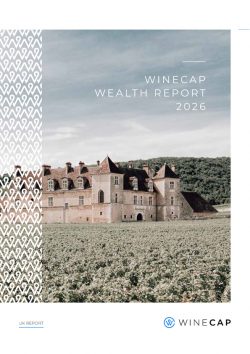
WineCap Wealth Report 2026: UK Edition

Fine wine has continued its transition from a luxury collectible to a critical fiscal anchor for the UK’s wealthiest investors. According to the newly released WineCap Wealth Report 2026, the asset class is seeing an unprecedented surge in professional confidence, serving as a “borderless” hedge against domestic economic volatility and tax shifts.

Drawing on exclusive research from leading UK wealth managers and financial advisors, the 2026 report explores how fine wine is being utilised to navigate a high-inflation environment and a historic exodus of capital from the UK.

Key report findings:

  • 97% of wealth managers expect demand for fine wine to rise in 2026 – the highest level of confidence in the report’s four-year history.
  • Over a third of committed investors now allocate 21-30% of their total wealth to fine wine.
  • 61% of advisors cite portability as a primary driver, as investors seek assets that can easily move across jurisdictions.
  • 95% of advisors highlight fine wine’s status as a “wasting asset” (exempt from Capital Gains Tax) as a core reason for its broadening appeal.
  • 74% of managers believe AI is the primary catalyst for the market’s future, driving new standards in provenance and price transparency.

From passion to portability

The 2026 report highlights a significant evolution in investor behaviour. While 2025 saw a generational shift, 2026 is defined by geopolitical necessity. As High-Net-Worth Individuals (HNWIs) relocate at record rates, the demand for tangible, transportable wealth has skyrocketed. Unlike real estate, fine wine offers “portable liquidity,” maintaining its intrinsic value whether the owner is in London, Geneva, or Singapore.

Resilience in a high-interest world

Despite a high-interest-rate environment, the report reveals a surprising trend: 77% of wealth managers believe rising rates actually support fine wine performance. This “flight to quality” suggests that when traditional markets become volatile, investors retreat to “hard” assets with proven longevity.

The role of Artificial Intelligence

With nearly three-quarters of the industry looking to AI for security, the market is becoming more transparent and accessible than ever before. From verifying centuries-old provenance to real-time global price tracking, AI is providing the institutional-grade confidence that modern wealth managers demand.

The full report further examines the “Great Wealth Flight,” the impact of global trade shifts on risk appetite, and why fine wine is now considered a “fiscal necessity” in a diversified portfolio.


WineCap Wealth Report 2026 UK: Edition
Download
Categories
Special-reports

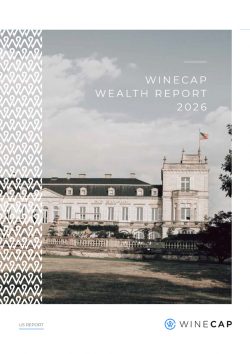
WineCap Wealth Report 2026: US Edition

Fine wine has officially stepped out of the private cellar and into the heart of the American investment portfolio. According to the newly released WineCap Wealth Report 2026: US Edition, the asset class is experiencing a historic surge in institutional and private interest, repositioning itself as a critical defensive pillar against global economic volatility.

Based on fresh research among US-based wealth managers and financial advisors, the 2026 report reveals an unprecedented shift in how high-net-worth (HNW) individuals are protecting their capital.

Key report findings:

  • A record 97% of US wealth managers expect demand for fine wine to increase in 2026 – the highest level of bullish sentiment recorded in the study’s history.
  • In a major shift, one-third of investors now dedicate 21-30% of their total wealth to fine wine, marking a significant leap from 2025 levels.
  • 81% of advisors now view fine wine as a “fiscal necessity,” valuing it as a borderless asset that remains independent of currency fluctuations.
  • 67% of respondents believe Artificial Intelligence is the primary driver for future market transparency, price discovery, and fraud detection.
  • For the modern investor, values drive value – 55% of investors now cite ESG and environmental credentials as a decisive factor for market entry.

From passion asset to defensive pillar

The 2026 report highlights a professionalization of the market. While wine was once categorized as a “passion asset,” US advisors now prioritize it for its low correlation to traditional markets. As geopolitical uncertainty persists, the “borderless” nature of fine wine – its ability to be moved and traded globally without being tied to a single central bank – has made it an essential component of the “Great Wealth Flight” strategy.

The rise of the green cellar

Sustainability is no longer a secondary concern for US investors. With over half of respondents prioritizing ESG credentials, the report highlights a growing demand for “conscious” viticulture. Investors are increasingly looking for estates that combine world-class heritage with future-proof environmental standards, proving that sustainability and high performance now go hand-in-hand.

Transparency through technology

The “black box” of wine pricing is being opened by AI. Two-thirds of US wealth managers now look to Artificial Intelligence to provide the institutional-grade security once missing from the sector. According to the survey data, technology is providing the confidence needed for advisors to recommend higher portfolio allocations than ever before.

The full report further explores the impact of interest rate hikes on tangible assets, the growing demand for collectibles, and why fine wine is now considered a “fiscal necessity” in a diversified portfolio.

WineCap Wealth Report 2026 US: Edition
Download

Categories
Learn

What is a Veblen good in fine wine?

  • In fine wine, Veblen status is reserved for a tiny fraction of brands where absolute scarcity and “price-as-prestige” make the cost a primary feature of the product.
  • “Super-Tier” wines like DRC or Petrus can defy traditional economics because their high price tags actively increase desirability.
  • As “vanity assets” catering to the ultra-wealthy, these wines often act as a defensive hedge, maintaining value during market downturns and moving independently of traditional stocks.

In the turbulent waters of the global economy, most consumer goods follow the predictable laws of gravity: when prices rise, demand falls. However, within the climate-controlled cellars of the world’s elite, a different set of physics applies. 

By analysing the Veblen effect, scarcity mechanics, and the psychological drivers of luxury consumption, we can determine if fine wine is the ultimate “vanity asset” and a viable anchor for alternative investment strategies.

The Veblen effect: When price signifies value

In standard economic models, demand decreases as prices rise. However, Veblen goods defy this logic. Named after economist Thorstein Veblen, these are “vanity assets” where a high price tag actually increases desirability by signalling exclusivity and status.

Consider the most expensive wines in the world, such as Domaine de la Romanée-Conti (DRC) or Chateau Petrus. For the ultra-high-net-worth individual, the Petrus wine price is secondary to its rarity. As the price of luxury red wine risess, it enters a stratosphere where it is no longer competing with other beverages, but with rare art, investment watches, and stamp collecting. This “prestige premium” creates a floor for the market, as the target demographic remains insulated from the belt-tightening that affects broader consumer goods during a downturn.

The “Veblen threshold”

It is a common misconception that all expensive wine is a Veblen good. In reality, most fine wines – even those costing several hundred dollars – still obey the traditional laws of economics. If a well-regarded Napa Cabernet doubles in price, many collectors will simply pivot to a similar quality producer from the Rhône or Tuscany.

The true Veblen Effect is reserved for an elite “Super-Tier” of brands. For names like Domaine de la Romanée-Conti (DRC), Château Petrus, or Screaming Eagle, the astronomical price is the product.

In these rare cases, the brand combines absolute scarcity (only a few hundred cases produced annually) with social signalling. When the price of a DRC Romanée-Conti rises from $15,000 to $25,000, demand actually intensifies. The price hike serves as a filter, ensuring that only the most powerful collectors can “play,” thereby increasing the wine’s status as the ultimate trophy. For these brands, a lower price would actually damage their perceived value by making them “too accessible.”

Fine wine as an inflation hedge

One of the most compelling reasons for whisky investment or fine wine allocation is its role as a hedge against the effects of inflation. Unlike currency, which loses purchasing power as central banks increase supply, the supply of vintage red wines is physically capped by the harvest of a specific year.

When the cost of living rises, tangible assets – often referred to as “hard assets” – typically appreciate. Fine wine is a prime example of a Veblen good that retains value because its production cannot be artificially inflated. You cannot simply “print” more 1982 Chateau Lafite Rothschild or Chateau Margaux wine. This inherent scarcity ensures that the wine valuation often moves in lockstep with, or ahead of, inflationary trends.

Fine wine vs stocks 

Investors often seek alternative funds to achieve diversification. While AI intelligence stocks and renewable energy ETF options provide growth, they are highly sensitive to interest rate hikes and geopolitical shifts. Fine wine, however, often shows a low or even inverse correlation to the S&P 500.

During a market “flight to quality,” capital frequently moves out of volatile wine stocks or AI exchange-traded funds and into stable, physical assets. This is why legendary estates like Chateau Latour or Chateau d’Yquem are often described as “defensive” assets. Even in a recession, the global demand for the most expensive whiskey and costly Champagne remains high in emerging markets, providing a globalised safety net for the collector’s wine collection.

Active vs passive investing

For the wine connoisseur, the market offers two paths: active vs passive investing.

  • Active investing: This involves the physical acquisition and storage of bottles. It requires a deep understanding of terroir, top Bordeaux vintages, and the vinification process. The investor must manage red wine storage temperature and ensure the wine cellar temperature is optimal to maintain provenance.
  • Passive investing: For those who prefer a hands-off approach, wine-focused alternative investment strategies allow for exposure to the market without the logistical burden of handling a large wine bottle or an entire cellar operation.

Navigating the “Vanity” trap

While the term “vanity asset” might imply a lack of substance, in the world of pricey wines, vanity is a market force. The desire to own a Chateau Margaux or a Masseto wine drives the secondary market liquidity. However, the wine buyer must be wary of “hype” wines that lack the historical track record of a Grand Cru or a St Emilion wine.

True investment-grade wine requires a marriage of alcohol content (which aids preservation), a prestigious appellation, and a high volume of critical acclaim. Whether you are looking at whisky barrel investment or a case of Pomerol wine, the goal is to find assets that the world’s elite will always want to put on their table, regardless of the current economic climate.

Fine wine defies traditional inflation because it exists at the intersection of art, history, and luxury. As a Veblen good, its value is psychologically reinforced by its price. By diversifying a portfolio with expensive red or white wine, investors can protect their wealth from the erosion of inflation and the unpredictability of the stock market. In the end, a bottle of Chateau Petrus is more than just a drink – it is a bulwark against economic uncertainty.

People also ask:

1. Does wine actually taste better because it’s a Veblen good?

Psychologically, yes. Studies in neuroeconomics have shown that when people are told a wine is more expensive, the pleasure centers of their brain (the medial orbitofrontal cortex) show higher activity. While the chemical composition doesn’t change, the “price-placebo effect” means the Veblen status actually enhances the sensory experience for the drinker.

2. What is the biggest risk in wine investment?

The primary risks are liquidity and provenance. Unlike a stock, you cannot sell a bottle of wine instantly with a click. It can take weeks or months to find a buyer at a fair price. Additionally, if you cannot prove the wine was stored at a consistent and appropriate temperature, its value can plummet, as the wine may have spoiled.

3. Is there a “Veblen” equivalent in spirits?

The market for rare Japanese whisky (like Karuizawa) and “The Macallan fine and rare series” mirrors the wine market. These spirits are often bought as “trophy assets” and are rarely intended to be opened, functioning purely as a store of wealth and a status symbol.

4. Can a wine lose its Veblen status?

Yes. Veblen status relies heavily on brand prestige. If a prestigious estate significantly increases its production volume (diluting scarcity) or if a series of poor vintages damages its critical reputation, it can fall back into the category of a “normal” luxury good, where price increases will once again lead to a drop in demand.

WineCap’s independent market analysis helps investors build diversified fine wine portfolios with full ownership and transparent pricing. Speak to one of our wine investment experts and start building your portfolio. Schedule your free consultation today.

Categories
Quarterly-reports

Q1 2026 Fine Wine Report

In our first quarterly summary for the year, we look at how global geopolitical instability has affected demand for safe-haven assets and how fine wine is poised to benefit. We also examine the pricing strategy of recent releases through La Place de Bordeaux, and what this tells us about the state of the market and how it sets the tone for the upcoming En Primeur campaign. Beyond the news headlines, we deep dive into this quarter’s top performers – wines that have shown resilience and, in some cases, double-digit returns.  

Key findings: 

  • Geopolitical instability in the Middle East has driven a “flight to safety” among investors. As a tangible hedge against inflation and market volatility, fine wine is keenly poised.
  • New releases from Yquem, Latour, and Bollinger have combined high quality with keen pricing strategies that prioritise market liquidity.
  • Bordeaux accounted for 80% of the quarter’s top performers, led by Sauternes and Barsac.
  • A consistently increasing bid:offer ratio throughout Q1 suggests the secondary market has established a solid floor and is seeing defensive growth entering Q2.  
  • Landmark trade deals in India and Europe are redirecting global liquidity, creating a structural foundation for long-term demand growth in the East.
  • A new record-breaking auction result set by DRC 1945 at $812,500 highlighted the unprecedented value the market continues to place on rare, historic assets.

Executive summary

The first quarter of 2026 was a tale of two halves, beginning with a surge of renewed market optimism that quickly collided with a transformative geopolitical crisis. The year opened with the FTSE 100 hitting historic milestones and a “Goldilocks” cooling of inflation, but the upward trajectory of mainstream markets was abruptly severed by the outbreak of the war in Iran and the subsequent closure of the Strait of Hormuz. The conflict triggered an immediate and aggressive “flight to safety,” sending gold and the U.S. Dollar to premium levels, simultaneously forcing a dramatic repricing of global energy and supply chain risks. 

As markets continue to grapple with a destabilised Middle East and investors look to navigate heightened volatility, assets that offer both tangibility and independence from traditional market shocks like fine wine can be uniquely positioned to benefit.

According to our annual wealth management survey (full results to be released next week), 50% of US and 35% of UK respondents believe that global conflict actually helps fine wine perform during periods of market volatility in the sense that it highlights fine wine’s role as a psychological and financial refuge. Fine wine’s physical nature provides a sense of security that digital or equity-based assets cannot replicate in a climate of uncertainty. 

While fine wine operates on its own internal dynamics, the signs of a market recovery from within have been highly encouraging. The bid:offer ratio has continued to rise throughout the quarter, signalling increased demand and growing liquidity – both of which have underpinned price stability. As our report explores, while broader market indices remain steady, select high-performing labels have already registered double-digit returns this quarter.

Perhaps the most encouraging sign of optimism has been the sensible pricing of new releases. Vintages that offer clear relative value compared to back-catalogue stock are reinvigorating buyer appetite and restoring long-term trust. This disciplined approach to pricing sets a constructive tone for the upcoming Bordeaux En Primeur campaign – the defining event of Q2 – which we anticipate will be a critical barometer for the market’s direction in the months ahead.

What new wine releases tell us about the state of the market?

While the global economy faces external shocks, the fine wine market is providing its own internal “green shoots”. The narrative of the last six months has been one of adjustment and acceptance. We are seeing a concerted effort from major estates to meet the market where it is, rather than where they wish it to be.

This trend arguably began last summer with Taittinger Comtes de Champagne Rosé  2012. Offered at what many consider the low point of the recent market cycle, it was the first major release priced with enough sensitivity to reinvigorate trade. That successful launch set a precedent that we are now seeing echoed across the board in the 2026 Spring releases from giants like Bollinger, Yquem, and Latour.

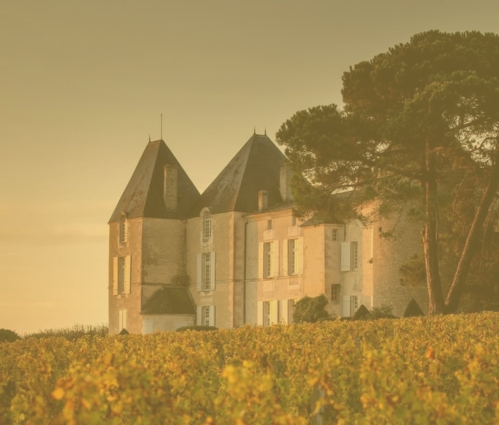
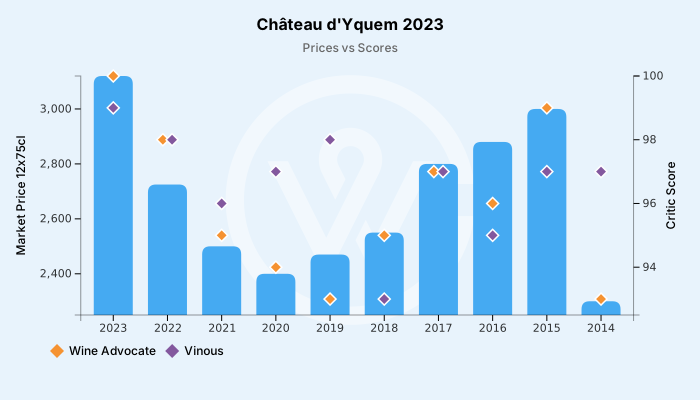
The “Yquem Factor”: Quality meets stability

The recent release of Château d’Yquem serves as a primary example of how tangibility and quality are driving the current “flight to safety.” With a rare unanimity of 100-point scores from Wine Advocate, James Suckling, and Vinum, this “epochal” vintage is being compared to the legendary 2001. However, by coming to market at roughly 50% of the price of its 2001 peer, Yquem is offering a clear value proposition in a volatile world. This sensible entry point, combined with the fact that our Wine Track Yquem index has remained remarkably stable since early 2025, highlights the region’s role as a resilient financial refuge.

chateau yquem 2023 wine prices

Latour 2019: The benchmark for “keen” pricing

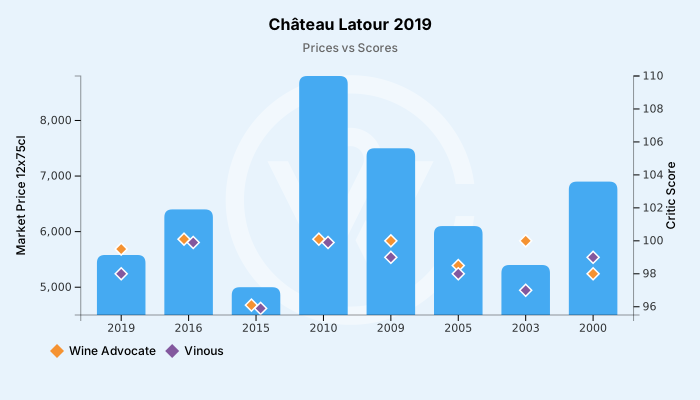
The momentum has reached a crescendo with the release of Château Latour 2019. While critics like William Kelley describe it as a “profound wine in the making,” its true significance lies in its pricing strategy. Released at a more accessible level than any comparable back vintage, it sits 15% lower than the 2016, even as prices for the 2009 and 2010 vintages have begun to climb. By pricing the 2019 to offer immediate relative value, Latour is successfully reinvigorating trade and setting a disciplined, optimistic tone for the upcoming campaign in the region.

chateau latour 2019 wine prices

Bollinger La Grande Année 2018: Value in Champagne

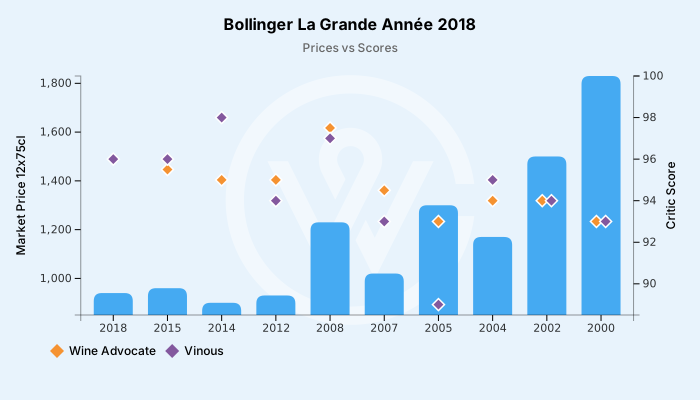
Outside of Bordeaux, Champagne house Bollinger released its 2018 La Grande Année Brut and Rosé this March.  As the first of a trio of exceptional warm vintages – drawing comparisons to the legendary 1988–1990 run – the wine arrives with significant critical weight. Boasting a 96-point score from Antonio Galloni (Vinous), the 2018 notably outperforms the prestigious 2002 and 2012 editions. Crucially, Bollinger has matched this high quality with an aggressive pricing strategy, entering the market at an approximately 15% lower cost than the most recent 2015 release. The competitive price point of the house echoes the strategy seen with Latour and Yquem, proving that producers across the board understand the importance of liquidity and building buyer trust.

bollinger grande annee 2018 champagne

Acceptance of the “new reality”

These releases signal a significant shift in the primary market. By pricing new vintages to offer relative value against existing back-stock, estates are rebuilding trust and liquidity. This discipline is being mirrored in the secondary market, where we are seeing:

  1. Improved trade volumes: A rising bid:offer ratio across the major exchanges.
  2. Sustained stability: A “floor” has been established, allowing for the double-digit returns seen in our top-performing wines this quarter.

This environment of sensible pricing and high critic consensus sets a highly optimistic tone for the upcoming Bordeaux En Primeur campaign. It suggests that the market has not just stabilised, but is actively preparing for its next growth phase.

The best-performing wines of Q1 2026

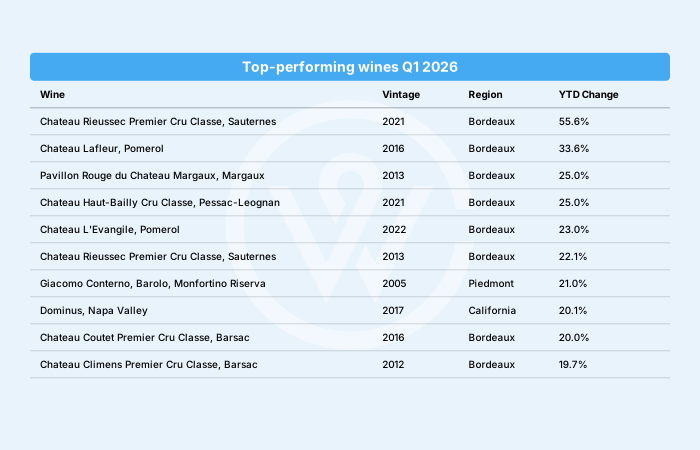
While the broader market has focused on stability, a selection of labels has delivered exceptional year-to-date (YTD) growth. The first quarter was unequivocally dominated by Bordeaux, which accounted for eight of the top ten performers, showcasing the region’s enduring appeal as a primary destination for “flight to safety” capital.

The resurgence of Sauternes and Barsac

The most striking trend of Q1 has been the performance of Bordeaux’s sweet wines. Chateau Rieussec 2021 led the market with a remarkable 55.6% YTD increase, further supported by its 2013 vintage, which grew by 22.1%. This positive momentum can be tied to buyers finding value in back vintages in light of more expensive recent Rieussec releases. This trend extended to Barsac, where Chateau Coutet 2016 and Chateau Climens 2012 both posted gains near 20%. This suggests a significant re-rating of the sector as investors seek out high-quality wines that may have been previously undervalued.

Blue-chip resilience

Beyond the sweet wine categories, Right Bank powerhouses and elite Left Bank estates showed defensive strength:

  • Chateau Lafleur 2016 saw a significant jump of 33.6%, reinforcing its status as a collector favourite with high scarcity value.
  • Pavillon Rouge du Chateau Margaux 2013 and Chateau Haut-Bailly 2021 both delivered a robust 25% return, proving that quality second wines and top-tier Cru Classé estates remain resilient despite the wider geopolitical “re-pricing.”

Diversification beyond Bordeaux

Outside of France, top-tier international labels also found favour. Italy’s Giacomo Conterno, Barolo Monfortino Riserva 2005 rose by 21.0%, while California’s Dominus 2017 represented Napa Valley with a strong 20.1% gain.

top performing wines quarter 1 2026

New wine auction record

Perhaps the most significant wine event in Q1 came from the auction room, which saw a new record broken for the most expensive wine ever sold. In a definitive display of the market’s appetite for rare, tangible history, Acker Merrall & Condit auctioned a single bottle of 1945 Domaine de la Romanée-Conti (DRC) Romanée-Conti for a record-breaking $812,500 (including buyer’s premium).

This sale shattered the previous world record for a standard 75cl bottle, set in 2018. As one of only 600 bottles ever produced from this “unicorn” vintage – harvested at the close of WWII and just before the vineyard’s vines were pulled for replanting – the 1945 DRC represents the pinnacle of provenance and scarcity. The new record is a powerful reminder that even amidst geopolitical uncertainty, the world’s most historic and tangible assets continue to command unprecedented value.

Q1 wine tariffs update

A significant theme this past quarter was the shifting landscape of global wine tariffs, ranging from US policy changes and the landmark India trade deal to the evolving terms for Australian wine imports into Europe.

The US “tariff reset”

The US market began the quarter in a state of regulatory flux. In February, the Supreme Court struck down previous “emergency” tariffs as unconstitutional, only for the executive branch to immediately pivot to Section 122 of the Trade Act. This imposed a new 10% baseline tariff (with threats to rise to 15%) on almost all imported wine.

  • The market impact: While this has created a “wait-and-see” approach among some US collectors, the secondary market has proven remarkably resilient. Unlike previous cycles, the market is no longer solely dependent on a hyper-active US base; instead, it is being bolstered by robust demand from Europe and Asia. Furthermore, US buying activity has shown improvement compared to the same period last year, suggesting that seasoned collectors are looking past the “noise” of temporary duties.
  • The opportunity: These new tariffs are temporary by design, set to expire in late July 2026 unless extended by Congress. This 150-day window has paradoxically increased the appeal of existing “pre-tariff” stock already held in US warehouses, while the broader global market continues to find its floor through diversified international trade.

India: The next great frontier

Perhaps the most significant long-term development for the fine wine market is the newly signed EU-India and UK-India trade deals. For nearly two decades, India’s 150% federal import tariff has stood as the single greatest barrier to entry for the world’s most prestigious estates.

  • The update: Under the new agreements, tariffs on premium EU and UK wines are being slashed from 150% down to 100% immediately, with a glide path to 25% over the next decade for bottles meeting specific price thresholds.
  • The impact: While this policy change is unlikely to transform the market overnight, it represents a massive structural milestone. With India’s middle class projected to comprise 60% of the population by 2047, this tariff reduction provides the necessary foundation for India to eventually rival China as a primary pillar of global fine wine demand. By lowering the cost of entry, these deals open a vital new channel for liquidity and diversification at a time when traditional Western markets are facing increased volatility.

EU removes tariffs on Australian wine imports

Following years of friction, Australia and the EU finalised a Free Trade Agreement (FTA) in late March. This deal effectively removes almost all EU import tariffs on Australian wine – a move expected to save Australian exporters roughly $37 million annually.

  • The trade-Off: In exchange for zero-tariff access, Australia has agreed to protect 1,600 EU Geographical Indications (GIs). Most notably, Australian producers will phase out the use of “Prosecco” on export labels over the next ten years.
  • The benefit: This agreement levels the playing field for Australian “fine wine” exports into Europe, allowing high-end producers from regions like Margaret River and the Barossa to compete more aggressively with European counterparts on price.

Why this matters 

As global trade becomes more fragmented, these shifts are redirecting the flow of fine wine. While US demand is temporarily throttled by domestic policy uncertainty, the “opening up” of India and the streamlined EU-Australia trade route suggest that liquidity is shifting toward the East and the Commonwealth.

Fine wine outlook for Q2 2026

The global macro environment remains defined by heightened uncertainty. With the conflict in the Middle East continuing to disrupt energy corridors, global inflation has seen a resurgence. In this high-inflation environment, the case for fine wine as a proven inflation hedge and a “tangible” store of wealth has rarely been more compelling. Unlike traditional equities, which remain sensitive to fluctuating interest rates and energy-driven volatility, fine wine’s historical low correlation to mainstream markets is expected to remain its greatest strength throughout the spring.

The Bordeaux 2025 En Primeur campaign

The defining event for the wine trade will be the Bordeaux 2025 En Primeur campaign (April–June). Following the “keen” pricing strategies established by Latour and Yquem in Q1, the industry mood is one of cautious optimism. There is a clear expectation that for the 2025 vintage to succeed, estates must continue this trend of market-aligned pricing.

  • The opportunity: If châteaux offer the 2025 vintage at a relative discount to existing physical stock, we can expect a release of sideline capital into the market.
  • The sentiment: Early reports suggest the 2025 vintage is one of exceptional quality, potentially providing the “high-score, high-value” combination required to sustain the market’s current recovery phase.

Industry events and global liquidity

Beyond Bordeaux, the upcoming London Wine Fair and various Asian trade summits in May will serve as critical barometers for global liquidity. We expect these events to highlight the burgeoning demand from the rest of the world, especially in light of recent tariff changes.

Solid market floor

Overall, our outlook for Q2 is one of defensive growth. While the world remains volatile, the “green shoots” identified in Q1 – sensible pricing, rising bid:offer ratios, and record-breaking auction results – suggest that fine wine has established a solid floor. Its relative isolation from traditional markets can also play in its favour, providing investors with a psychological and financial refuge that continues to command value even as mainstream markets fluctuate.

Q&A

Q: How has the war in Iran impacted the fine wine market compared to gold? 

A: While gold remains the traditional “first responder” to geopolitical shocks – surpassing $5,400/oz this quarter – fine wine is also a “safe haven” asset. Its value is driven by different mechanics; while gold reacts to currency fear, fine wine reacts to the search for tangible, depleting assets. This quarter, we saw fine wine indices rise, proving the asset’s role as an effective portfolio “smoother” during times of crisis.

Q: With inflation rising again due to energy costs, is now a good time to buy? 

A: Historically, yes. Fine wine has a proven track record of outpacing inflation, particularly when cost-of-living increases are driven by supply shocks. Because it is a physical asset with a finite supply that decreases as it is consumed, it naturally holds its value better than cash. With prices for many blue-chip wines currently near a five-year floor, Q1 has presented a rare “double opportunity”: low entry prices combined with high inflation protection.

Q: What should I look for in the upcoming Bordeaux En Primeur?

A: The “golden rule” for En Primeur is relative value. We are looking for châteaux that follow the lead of Latour and Yquem by offering “keen” pricing. The 2025 vintage is reported to be of exceptional quality but with lower yields due to the August heatwaves; this scarcity, combined with sensible release prices, could make it a significant investment opportunity.

WineCap’s independent market analysis helps investors build diversified fine wine portfolios with full ownership and transparent pricing. Speak to one of our wine investment experts and start building your portfolio. Schedule your free consultation today.

Categories
News

Wine investment 2026: How the under-40s are reshaping the market

  • Younger investors are abandoning traditional collecting habits in favour of data-driven strategies.
  • Peer validation is more important than family tradition when it comes to fine wine buying under 40.
  • The under-40 cohort utilises a multi-channel digital ecosystem to find their way into the fine wine market.

In 2026, fine wine investment is undergoing a generational shift. Younger investors under 40 are moving away from traditional collecting, a new report from think tank Areni Global reveals. Instead, they are opting for data-driven wine strategies, digital wine-tech platforms, and alternative asset diversification to hedge against stock market volatility. With fine wine prices currently sitting near five-year lows, under-40s are increasingly viewing the asset class as a critical alternative for diversifying their portfolios. Passion alone is no longer the leading force behind buying fine wine.

Why Millennials and Gen Z view wine as an alternative asset

The traditional “inheritance model” of wine collecting is dead. For decades, the industry assumed a passion for fine wine was passed down through family cellar keys. However, 2026 market data from Areni Global confirms a radical shift: younger investors are entering the market through independent, digital, and social channels.

Peer groups and shared wine experiences

Unlike previous generations, Millennial and Gen Z wine investors prioritise “horizontal discovery.” This means interest is sparked by peer groups, social “defining moments,” and digital communities rather than family heritage. For wealth managers, this highlights a shift from legacy-based collecting to community-driven wine investing.

The 40-year window

The report identifies a “collector’s spark” that must be ignited between the ages of 26 and 35. If a professional hasn’t entered the market by 40, they likely never will.

Gamified investing

For the 30% of the population with a “collector’s pulse,” wine investing is treated like gaming. This means valuing tight mechanics (real time data and execution), clear progression (visualising the growth of a portfolio), and digital transparency.

Women in wine investment 

One of the most significant “systemic failures” in the industry is the retention of female wine investors. While women under 25 enter wine education at rates nearly equal to men, a sharp drop-off occurs in their 30s, with only 25% becoming regular buyers. To tap into this $100bn+ investment opportunity, the 2026 market must evolve. Success lies in building business models that reflect the lifestyle and purchasing patterns of high-net-worth professional women, focusing on value-aligned investing and easier access.

How the under-40s discover the market

The entry point for the modern wine investor has shifted from the oak-panelled cellar to the palm of the hand. Unlike previous generations who relied on exclusive merchant relationships, the under-40 cohort utilises a multi-channel digital ecosystem to find their way into the market.

Social media transparency

Discovery now happens via Instagram influencers, sommeliers on TikTok, and finance-focused creators on YouTube and Substack. These creators strip away the pretension of fine wine, explaining market movements and vintage quality in simple, relatable terms.

The rise of wine-tech

Technology has emerged as a transformative force in wine investment, revolutionising various aspects of the industry. From verifying provenance to streamlining valuation processes, advancements such as blockchain and artificial intelligence (AI) have played a crucial role. Ultimately, the rise of specialised wine investment apps and platforms has been the ultimate “barrier-breaker.” These platforms have lowered the financial entry barrier, making fine wine a viable alternative asset for those looking to diversify away from the volatility of stocks and crypto.

The “social proof” factor

In line with the Areni Global findings, social proof is the primary driver of engagement. Seeing friends or colleagues discuss their wine portfolios creates a “FOMO” (fear of missing out) effect that traditional advertising cannot replicate. This is often supplemented by luxury lifestyle crossover – an interest in fine dining and high-end collectibles naturally leading toward the financial potential of the bottles on the table.

Value-driven investing

Younger investors are increasingly attracted to the sustainability and heritage of fine wine. In an era of “fast fashion” and ephemeral digital goods, a 50-year-old bottle of sustainably farmed Bordeaux represents a tangible, value-aligned asset that appeals to the ethics of the modern professional.

A beginner’s guide to wine portfolio management in 2026

If you are a professional under 40 looking to capitalise on the current market reset, here is the strategic roadmap for 2026:

I. Store wine in-bond

Never take physical delivery of your investment wine. Storing wine in-bond (IB) in a government-regulated, temperature-controlled warehouse is the only way to guarantee provenance. A bottle that has left the “bonded circuit” is immediately worth less to a future buyer because its storage history is broken.

II. Focus on liquidity

New investors often make the mistake of buying obscure labels they personally enjoy. As an investor, focus on liquidity. Regions like Tuscany (Sassicaia, Tignanello) and Champagne currently offer the best balance of lower entry prices and high secondary market demand.

III. Think long-term

Fine wine is not a “get rich quick” scheme. It is a medium-to-long-term play. The natural price appreciation occurs as a vintage is consumed and the global supply shrinks. Plan for a minimum holding period of five to 10 years to see the full “S-curve” of appreciation.

IV. Use wine data

Gone are the days of spreadsheets and faxed price lists. The modern investor uses platforms like WineCap to track real-time valuations and regional performance trends. In 2026, data is as important as the wine in the bottle.

FAQ

1. Is fine wine a good investment in 2026?

With fine wine prices currently sitting at near five-year lows, many analysts view 2026 as an optimal entry point for a “buy low” strategy. Fine wine historically offers a low correlation to traditional equity markets, acting as a defensive “liquid property” asset during periods of financial volatility.

2. What does “in-bond” (IB) storage mean?

“In Bond” refers to wine stored in a government-regulated, climate-controlled warehouse where VAT and Duty do not apply. For investors, this is essential: it guarantees the wine’s provenance (its history of perfect storage), making it significantly easier and more profitable to resell on the secondary market.

4. How to invest in wine for beginners without expertise?

The 2026 market is seeing a surge of “investment newbies” who use data-driven platforms rather than decades of tasting experience. By following trusted market analysts, using price-tracking tools like Wine Track, and focusing on high-liquidity “Blue Chip” labels, beginners can make informed financial decisions without being professional sommeliers.

5. Why is the under-40 demographic important for the wine market?

The Areni Global report identifies a critical “collector’s spark” window between the ages of 26 and 35. Investors who enter the market during this time are more likely to stay engaged for decades. Capturing this demographic is essential for the market’s long-term liquidity and growth.

6. How long should I hold my wine investment?

Fine wine is a medium-to-long-term asset. While some high-demand vintages see short-term spikes, typically, appreciation requires a holding period of five to 10 years. This allows the global supply to dwindle as wine gets consumed, naturally driving up the price of the remaining bottles.

7. What are the best wine regions to invest in right now?

While Bordeaux remains the market’s bedrock, 2026 trends show strong growth in Tuscany, Napa and Champagne. These regions offer high “brand liquidity,” meaning they are easy to trade on the secondary market and often have a lower entry price than top-tier Burgundy.

Categories
News

Burgundy En Primeur 2024 and the current market

  • The 2024 Burgundy vintage is low volume with a classic profile
  • Informed selection of reputable domaines and appellations is essential when making purchasing decisions.
  • Burgundy wines showed signs of bounce in Q3 after steady price decline
  • The region remains a major player in the fine wine market despite shifts in Power 100 index

The 2024 Burgundy vintage is characterised by scarcity, precision, and classical elegance. A challenging growing season resulted in sharply reduced yields across the region, notably in red Burgundy wines. However, careful vineyard and winery management produced wines, albeit in smaller volumes, of exceptional quality, balance, and typicity. This is especially evident from Grand Cru and Premier Cru holdings.

This year’s En Primeur campaign unfolds against a complex market environment backdrop: previous vintages are still competing on the secondary market and fine wine pricing is showing cautious signs of stabilisation. This environment is offering collectors and investors opportunity and selectivity from the year’s best Burgundy wines.

This report examines the 2024 Burgundy vintage. It compares reds and Burgundy white wine, highlights standout domaines and appellations, and positions the campaign in a wider market context. This overview provides insights for both investment potential and enjoyment.

2024: Scarcity, vibrancy, and intensity

The defining characteristic of the 2024 Burgundy vintage is that of reduced volumes owing to a difficult growing season. Yields saw significant losses across the region, especially for red Burgundy wines. However, diligent work in the vineyard and winery resulted in wines that display a modern character with an old-school profile. The vintage is widely regarded as a year for admirers of classic, timeless Burgundy wines after a run of (with the exception of 2021) hot summers.

Chablis producer, Samuel Billaud, described the year as “a combination of 2014 (freshness and vibrancy) and 2021 (concentration and intensity of fruit).”

Climatic conditions and alcohol levels in 2024

Cool, wet conditions in spring led to coulure, resulting in reduced yields for Bourgogne red Burgundy wine. Chardonnay was not as badly affected. Spring and summer rain meant mildew and disease also posed a threat, which vignerons tried to deal with through repeated vineyard treatments where possible. Chablis was the worst affected, with yields often under 10hl/ha (usually 50hl/ha). The Côte de Nuits hovered around 15hl/ha. In the Côte de Beaune, red Burgundy grapes yields were at around 50% of typical levels. Chardonnay fared better at about 40hl/ha. Some areas, like the Mâconnais, had normal yields for Mâcon Burgundy. Lower-lying vineyards suffered more than mid-slope holdings. Localised hailstorms also added stress to vineyards. A clement late summer and a cool, dry north wind helped salvage the harvest.

  • Chardonnay’s greatest terroirs benefited from the cool, accentuating typicity and depth.
  • Pinot Noir’s low yields ultimately meant good phenolic maturity and intense ripeness.

Domaines demonstrated meticulous vineyard management and rigorous sorting to mitigate the impact of mildew. Potential alcohol levels across the vintage largely fell short of 13% abv. Some winemakers mitigated this with selective chaptalisation by half a degree. Both tartaric and malic acidities were higher than the previous year. During élevage, this resulted in softer, creamier acidity in fresh, zippy wines.

Reds vs white Burgundy wines: the essence of vintage quality

Like the previous vintage, 2024 was the year of Chardonnay, but Pinot Noirs also displayed grace, character, and balance. Many commenters noted that modern vineyard and winery methods had made finessed red Burgundy wines possible in conditions that would have written off Pinot Noir even just 25 years ago. The consensus was that the style for both reds and whites was traditional and classic, with a modern elegance.

Burgundy white wine featured:

  • Fresh acidity
  • Restrained, concentrated citrus
  • Precise minerality and structure

Grand Crus and Premier crus benefited from the cool weather conditions more than the Villages sites located on lower slopes. Standout appellations include: 

  • Puligny Montrachet wine, such as Les Caillerets
  • Chablis Grand Cru Les Preuses
  • Chevalier Montrachet Grand Cru 

Burgundy Pinot Noir is one of the recent best Burgundy years for:

  • Small quantities
  • Concentrated fruit
  • Elegant, precise profiles

The vintage’s Pinot Noir yields were greatly reduced by the weather, but the wines were classic, expressive, and understated. Carefully timed harvest and stringent sorting resulted in reds with transparency, a core of red fruit, and supple tannins. 

Notable successes include:

  • Gevrey Chambertin Les Dix Climats
  • Volnay 1er Cru Clos des Chenes

Overall, producers such as Samuel Billaud, Domaine Drouhin-Laroze, Pierre-Vincent Girardin, Domaine Y. Clerget, and Simon Colin have been praised for fresh, chiselled Burgundy wines with dynamism and terroir transparency.

Comparing 2023 vs 2024 Burgundy

Comparisons between the 2023 and 2024 Burgundy vintages are inevitable.

  • 2023: Large quantities, wide variability, precision-driven wines
  • 2024: Low volumes (notably of Burgundy red wine grapes), classic, elegant wines with concentrated fruit

Several growers and critics have noted similarities between 2024 and great Burgundy vintages for key characteristics: 2014 for its Burgundy quintessence and 2021 for its intense fruit.

Buyers should approach 2024 with a focus on appellation and domaine, rather than a broad perspective. 

Burgundy 2024 in market context

The Burgundy En Primeur 2024 campaign unfolds against a unique market backdrop.

  • The volumes of 2023 and 2024 mean that there is the potential for competition from previous vintage stock
  • Following a 5-year steady decline in prices, in Q3 2025, Burgundy showed signs of stabilisation with a slight bounce in prices
  • Out of the leading fine wine regions, Burgundy wines had the most movement in the Power 100 index, with ten brands dropping out and nine entering
  • Most climbers are mid-range wines priced under £2,000 in a movement towards prioritising Burgundy to enjoy, not solely as an investment asset
  • Top tier in the Classification Report dominated by Burgundy
  • The region retains a 25–30% share of the global fine wine market, underlining its enduring importance
  • Burgundy continues to demonstrate resilience driven by scarcity and long-term demand

Overall, the best Burgundy wine still constitutes a market juggernaut, but demand is price sensitive. Burgundy vs Bordeaux wine (the dominant fine wine region) comparisons will be accentuated by the En Primeur pricing approach. Commentators and producers alike project Burgundy prices to be reasonable despite a low-volume vintage.

Pricing strategies and producer behaviour

Understanding market conditions, many producers are flexible about their 2024 pricing approach.

Key influencers include:

  • Lower yields by themselves do not automatically justify higher release prices
  • Pricing impacted by values of back vintages of Burgundy wines
  • Producers face margin pressure, but stock inactive in the supply chain has no advantages
  • Burgundy learned that Bordeaux En Primeur overpricing in recent years reduces incentive for early buying
  • Low yields mean the best 2024 wines could be fiercely contested

More limited 2024 yields compared to 2023, sensible pricing, and lessons from Bordeaux hint that demand will be robust for the scarcest, highest-quality wines.

Competition from the secondary market

A key influence on the Burgundy En Primeur 2024 campaign is competition from the secondary market.
Well-stored top rated Burgundy wines from recent strong vintages are maturing well and available at attractive prices. Additionally, market softening has made buyers and investors less willing to purchase at any price. The options are to:

  • Secure 2024 En Primeur at fair pricing (“fair” meaning Bordeaux vs Burgundy En Primeur pricing referenced above)
  • Choose established older vintages with track records

This landscape puts pressure on producers for reasonable pricing and rewards buyers who carefully assess value across multiple vintages.

How buyers should approach Burgundy En Primeur 2024

With such low yields and varied performance across appellations and even plots, the 2024 campaign demands a selective and discerning approach rather than indiscriminate buying.

Essential takeaways:

  • Reduced volumes
  • Pressure to price according to market
  • Classic styles (reds and Burgundy whites)
  • Grand Crus and top Premiers Crus across regions in Burgundy benefited most from the cool, precise vintage
  • Signs of gradual market uptick 

Whether or not 2024 is one of the best Burgundy vintages is not of prime importance. What is critical is that, with its classic styles, low quantities, and appearance at a time when the market hints at upward correction, 2024 could present competitive opportunities for selective investors.

Burgundy’s enduring strength

Despite short-term market shifts, Burgundy’s long-term fundamentals remain robust:

  • Exceptional vineyards
  • Strong global demand
  • Enduring, prestigious cultural and historical legacy
  • Consistent scarcity at the very top tier of Burgundy wines

The 2024 En Primeur campaign puts in relief a region responding to market and climate pressures while maintaining the qualities that make good Burgundy wine such a consistently prized segment. 

Final thoughts on Burgundy En Primeur 2024

The 2024 Burgundy vintage offers a rare combination of low volumes, selective quality, and evolving pricing strategies at a moment when the fine market has signalled a bounce following pricing decline.

The finest Burgundy wine examples – particularly among the best white Burgundy – display precision, vitality, and strong value. 

Jasper Morris MW says …”a miserable growing season does not have to translate into miserable wines”, adding, “Do not boycott 2024 – there are many delicious wines which merit attention”

Neal Martin (Vinous) says: “2024 is an endlessly fascinating vintage that will enamour the small number who imbibe the fruits of much labour.”

For informed investors, the present market conditions create a strategic window to engage with wine from Burgundy thoughtfully, balancing new releases against secondary market opportunities. 


WineCap’s independent market analysis helps investors build diversified fine wine portfolios with full ownership and transparent pricing. Speak to one of our wine investment experts and start building your portfolio. Schedule your free consultation today
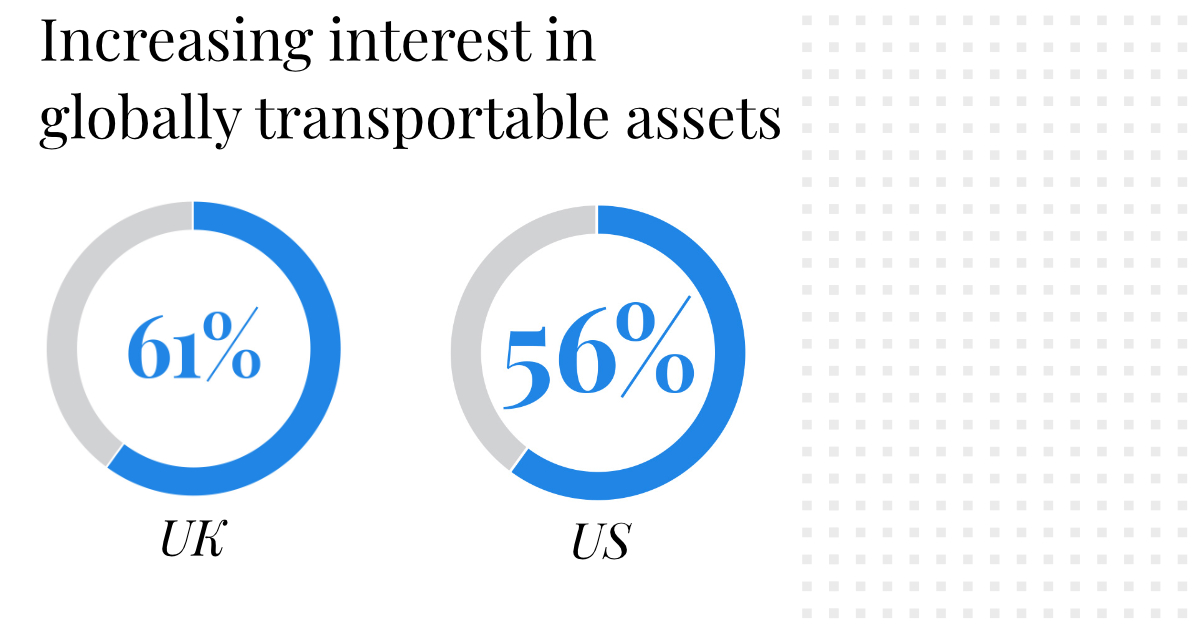
Categories
News

Fine wine market starts 2026 on firmer footing

  • The fine wine market has closed 2025 on a positive note, with prices rising for four consecutive months.
  • Despite improving momentum, fine wine prices remain close to five-year lows, creating buying opportunities. 
  • Market broadening is a defining feature of rising markets, and 2026 is likely to mark the early stages of this transition.

After three years defined by correction, caution and recalibration, the fine wine market enters 2026 in a notably stronger position. Prices have stabilised, liquidity has improved, and demand is beginning to broaden – all signs that the market has moved beyond its most challenging phase and is laying the foundations for a sustainable recovery.

While it would be premature to describe the current environment as a full rebound, the early months of 2026 mark the firmest starting point the fine wine market has seen since 2022. For investors with a medium- to long-term horizon, this combination of stabilising prices and still-attractive valuations presents one of the most compelling opportunity windows in several years.

A firmer start to the year than at any point in the past three years

In our final article of 2025, we examined the performance of Bordeaux, Burgundy and Champagne – the three most important fine wine regions for investors – and highlighted pockets of growth across each. Crucially, that momentum has not faded with the turn of the calendar year.

Fine wine prices have now risen for four consecutive months, closing 2025 on a positive note and carrying that strength into early 2026. This sustained improvement matters. Rather than a short-term technical bounce, it signals a market that is beginning to find equilibrium after a prolonged period of repricing.

Key indicators suggest the market is now operating on firmer footing:

  • Prices have stabilised after reaching five-year lows
  • Liquidity has improved across leading regions and producers
  • Buyers are returning with greater confidence and selectivity
  • Multiple regions are now participating in early recovery trends

Taken together, these developments point to a healthier, more balanced fine wine market entering the new year.

Buying opportunities remain as prices hover near five-year lows

Despite improving momentum, fine wine prices remain close to five-year lows across many regions and vintages. Historically, this late-stage downturn phase – when prices stabilise before rising meaningfully – has offered some of the most attractive entry points for long-term investors.

Importantly, recovery does not begin with uniformly rising prices. Instead, it starts with price consolidation, followed by gradual gains concentrated in the most liquid and well-recognised segments of the market. That is precisely the pattern emerging today.

For investors, this creates a rare alignment of conditions:

  • Valuations remain compelling
  • Downside risk has diminished compared to previous years
  • Demand is rising without speculative excess
  • Portfolio construction can prioritise quality and value

Rather than signalling missed opportunity, the current environment suggests that disciplined, data-driven allocation remains well-timed.

Demand is rising and signs of recovery are becoming clearer

Demand has strengthened steadily since the second half of 2025, with improving sentiment evident across both private collectors and wealth managers. While activity remains selective, confidence has clearly returned.

Several regions have already begun to turn:

  • Champagne has benefited from strong global recognition, accessible entry points and consistent liquidity
  • Bordeaux has stabilised, particularly in older vintages and First and Second Growths
  • Burgundy continues to demonstrate resilience driven by scarcity and long-term demand
  • Tuscany and the Rhône have seen renewed interest as investors look beyond the most concentrated names

This multi-regional participation is an important signal. Recoveries that are confined to a single region tend to be fragile; recoveries that broaden tend to endure.

Momentum from late 2025 has been sustained

One of the most encouraging developments is the continuity of momentum. This matters for two reasons. First, it suggests that buyers are responding to fundamentals rather than short-term catalysts. Second, it indicates that confidence is building gradually, allowing the market to recover in a measured, sustainable way.

Sustained momentum also reinforces the importance of patience. Fine wine recoveries rarely follow sharp, V-shaped trajectories. Instead, they evolve through phases of stabilisation, selective appreciation and eventual broadening.

The case for market broadening in 2026

Market broadening is a defining feature of rising markets, and 2026 is likely to mark the early stages of this transition.

During periods of falling or uncertain prices, demand tends to narrow. Investors concentrate on the most established names, mature vintages and highest-liquidity wines. This was a defining theme throughout much of 2024 and 2025 global wine investment trends.

As confidence improves, the opposite dynamic emerges:

  • Buyers begin to search for relative value
  • Secondary regions and vintages re-enter consideration
  • Portfolios become more diversified
  • Opportunity expands beyond a small group of blue-chip wines

In 2026, this process is likely to unfold gradually, with selective broadening, supported by brand strength and the search for value.

Tariffs and the macro backdrop: a potential catalyst

Another factor shaping early 2026 sentiment is the evolving global trade environment. Tariffs remain under review by the US Supreme Court after lower courts deemed them illegal. While outcomes remain uncertain, the broader implications extend well beyond fine wine.

Should tariff pressures ease, the effects could ripple across global markets:

  • Improved trade clarity
  • Increased capital availability
  • Stronger investor confidence
  • Renewed appetite for alternative assets

In periods when liquidity improves and uncertainty recedes, portfolio diversification tends to increase. As a top-performing collectible and passion investment, historically, fine wine has benefited from such shifts. 

Fine wine remains the most in-demand collectible

According to the WineCap 2025 Wealth Reports, fine wine is the most in-demand collectible asset among wealth managers and financial advisers, outperforming art, watches, whisky and luxury handbags.

Several factors continue to underpin this appeal:

  • Proven long-term performance
  • Increasing market transparency
  • Global liquidity and established secondary markets
  • Growing acceptance within diversified portfolios

Fine wine’s evolution from passion asset to mainstream alternative investment has been gradual, but it is now firmly established.

Looking ahead: The 2026 Wealth Report

As the market enters this next phase, attention will increasingly turn to how wealth managers and financial advisers are adapting their allocation strategies. WineCap’s upcoming 2026 Wealth Report will examine these shifts in detail, exploring how fine wine is being integrated into portfolios amid changing economic conditions.

Early indications suggest that fine wine’s role as a diversification tool is strengthening, supported by improved data access, transparency and liquidity.

A healthier starting point for 2026

The fine wine market enters 2026 at a point where prices have stabilised, demand is rising, and opportunity is broadening. For investors, this marks a healthier phase of the cycle. After three challenging years, the market is finally positioned to move forward on firmer footing – and for those willing to act selectively, the early stages of recovery often prove the most rewarding.

WineCap’s independent market analysis helps investors build diversified fine wine portfolios with full ownership and transparent pricing. Speak to one of our wine investment experts and start building your portfolio. Schedule your free consultation today.