Categories
Learn

What are appellation laws and why do they matter to wine investors?

  • Wine appellation laws are the legal frameworks that define where a wine can be produced, which grape varieties may be used, and how it must be made.
  • While often viewed as a guide to style and quality, appellation systems play a far more important role for wine investors and collectors. 
  • Appellation systems serve as a guide to investment grade value, helping to separate high value assets from low value commodity production.

The legal structures governing global viticulture are fundamental to wine investment. Appellation laws help guarantee authenticity, preserve regional identity and provide a framework for quality control, transforming wine from a simple agricultural product into a recognised alternative asset. From vineyard boundaries and permitted yields to ageing requirements and winemaking techniques, these regulations underpin the scarcity, reputation and collectability that drive long-term value. Understanding how appellation systems operate can help investors identify the wines, regions and producers most likely to retain demand over time.

The origins of wine legislation

The history of wine regulation is rooted in a long struggle against fraud, counterfeiting and market instability. For centuries, prestigious wine regions faced the challenge of imitators selling inferior products under famous regional names. Evidence of this problem stretches back to antiquity, with counterfeit merchant stamps discovered among the ruins of Pompeii.

The issue became particularly acute during the late nineteenth century. The phylloxera epidemic devastated vineyards across Europe, dramatically reducing production and creating opportunities for fraudulent and adulterated wines to enter the market. As supply shortages intensified and consumer confidence weakened, producers and governments increasingly recognised the need for formal systems that could protect both authenticity and reputation.

One of the earliest legal precedents for protecting a product’s geographic origin emerged in Tuscany in 1716, when Grand Duke Cosimo III de’ Medici issued a decree defining the boundaries of four prominent wine-producing areas, including Chianti. The objective was clear: to safeguard the reputation of Tuscany’s most valuable wines and protect consumers from imitation. Similar concepts had already appeared elsewhere in European law, notably in 1411 when King Charles VI of France granted special protections to Roquefort cheese, linking quality and identity to a specific place of origin.

The modern appellation framework, however, was established in France in 1936 with the creation of the Appellation d’Origine Contrôlée (AOC) system and the founding of what is now the Institut National de l’Origine et de la Qualité (INAO). Championed by Baron Pierre Le Roy of Château Fortia in Châteauneuf-du-Pape, the legislation created legally protected wine regions with strict rules governing vineyard boundaries, grape varieties, yields and production methods.

The success of the French model influenced wine legislation across Europe. Italy introduced its DOC system in 1963 before later creating the prestigious DOCG category, while Spain developed its Denominación de Origen (DO) and Denominación de Origen Calificada (DOCa) classifications. Together, these appellation systems established the legal foundations that continue to underpin today’s fine wine market, protecting provenance, preserving regional identity and helping to create the scarcity that supports long-term investment value.

How appellation laws dictate vineyard practice

Appellation laws are remarkably granular, governing every physical and agricultural variable within a vineyard. They do not merely draw a line on a map; they establish rigid parameters that dictate how a producer must manage their land. These rules ensure that production remains bounded by traditional methods that are believed to deliver the highest possible quality. 

The strictest AOC rules are generally regarded as those that apply to Grand Cru Burgundy and Champagne.  The rigidity of Burgundy’s rules is most clearly seen in the prohibition of blending different Grand Cru wines together. Meanwhile, the administrative criteria for Champagne include:

  • Mandatory hand-harvesting: Mechanical harvestering is forbidden anywhere in Champagne. Every single grape must be picked by hand 
  • Strict pressing limits: The law dictates exactly how much juice can be extracted from a given weight of grapes. For a 4,000-kilogram press, producers are only allowed to extract 2,550 litres of juice. Anything beyond this limit cannot legally be used to make Champagne.
  • The traditional method mandate: Every single bottle of Champagne must undergo its secondary fermentation inside the exact physical bottle that the consumer eventually buys. Industrial pressurized tanks are illegal under the AOC framework.

Rules in leading appellations can be remarkably detailed. As the example below illustrates, the Haut-Medoc AOC regulations govern everything from vine density and row spacing to pruning methods, maximum yields and permitted grape varieties. These requirements are designed to protect regional identity, maintain quality standards and prevent excessive production.

For investors and collectors, such regulations provide an additional layer of confidence. By restricting yields and codifying vineyard and winemaking practices, appellation laws help preserve scarcity, consistency and provenance – three of the key attributes that underpin long-term value in the fine wine market.

The legal codification of terroir

For investors and collectors, one of the most important functions of appellation laws is that they transform the concept of terroir into a legally enforceable framework. Terroir encompasses the combination of soil, climate, topography and human tradition that gives a wine its distinctive identity. Without legal protection, producers could source grapes from outside a region and market the resulting wine under a prestigious geographic name, undermining both authenticity and consumer confidence.

Appellation systems address this problem by tying a wine’s identity to a precisely defined area of land. Only grapes grown within designated boundaries and produced according to prescribed regulations may carry the appellation name. This creates a direct link between place and product, protecting the reputation of established wine regions and preserving the integrity of their brands.

From an investment perspective, these geographic boundaries also create scarcity. Land within a Grand Cru vineyard in Burgundy, a classified growth in Bordeaux or a prestigious Barolo cru cannot simply be expanded in response to rising demand. Supply is therefore constrained by geography, helping to support the long-term value of the region’s most sought-after wines.

Equally important is consistency. By regulating grape varieties, yields, vineyard practices and production methods, appellation laws help ensure that wines maintain a recognisable identity from one generation to the next. In doing so, they provide the transparency, provenance and authenticity that underpin confidence in the fine wine market and contribute to the long-term collectability of the world’s leading wines.

Mapping the investment grade landscape

Navigating the landscape of appellations requires understanding which specific classifications hold true investment value and which are designed for the mass commercial market. The secondary trade relies on a narrow selection of designations that historically demonstrate the greatest price stability and demand.

The primary regions and specific appellations that matter to collectors include:

  • Bordeaux: The secondary market focus is strictly tied to the elite communal appellations of the Left Bank and Right Bank, specifically Pauillac, Margaux, Saint Julien, Saint Estephe, Pessac Leognan, Pomerol, Saint Emilion Grand Cru, and Sauternes.
  • Burgundy: Value is driven by the internal hierarchy of Burgundy, where trading is concentrated in the Grand Cru and Premier Cru classifications.
  • Champagne: Demand is centered on vintage expressions and prestige cuvees produced under the Champagne AOC.
  • Tuscany: The investment landscape is defined by the Chianti Classico DOCG, Brunello di Montalcino DOCG, the unique single vineyard Bolgheri Sassicaia DOC classification and the Super Tuscans that exist in opposition to AOC rules, but are still governed by IGT rules for the region.
  • Piedmont: The market focuses almost exclusively on the village specific sub zones of Barolo and Barbaresco, where single vineyard designations highlight precise terroir.

Generally, broad regional appellations offer limited appeal for collectors and investors, although there are notable exceptions. Designations such as Bordeaux AOC or Crémant de Bordeaux cover large geographic areas and permit substantial production volumes, resulting in wines that are widely available and intended primarily for everyday consumption. While these appellations can deliver excellent value for drinkers, they typically lack the scarcity, brand prestige and long-term ageing potential that underpin investment-grade wines. As a result, meaningful price appreciation is uncommon, particularly when compared with the tightly defined appellations and estate-level classifications that dominate the fine wine secondary market.

Decoding the wine label

A wine label is far more than a marketing tool. It serves as a legal document that communicates a wine’s origin, classification and compliance with the regulations of its appellation. For collectors and investors, learning to read a wine label is one of the simplest ways to assess a bottle’s provenance, quality level and potential investment appeal.

While labelling requirements vary between countries, most fine wine labels are required to display several key pieces of information:

  • The official appellation or classification – Examples include Appellation d’Origine Contrôlée (AOC) in France, Denominazione di Origine Controllata e Garantita (DOCG) in Italy and American Viticultural Area (AVA) in the United States. These designations indicate the regulatory framework under which the wine was produced.
  • The geographic origin – The name of the appellation, village, cru or vineyard identifies where the grapes were grown. In general, highly specific geographic designations, such as a single vineyard or Grand Cru site, indicate greater scarcity and stricter production requirements than broad regional appellations.
  • The vintage year – For vintage wines, this indicates the year in which the grapes were harvested. In regions where blending across years is common, such as Champagne, non-vintage wines may not display a harvest year, while vintage bottlings are produced from grapes harvested in a single declared year.
  • Alcohol by volume (ABV) – Most wine-producing countries require producers to state the wine’s alcohol content, providing additional information about style and ripeness.

Collectors should also pay attention to legally protected terms such as Mis en Bouteille au Château, Estate Bottled or Domaine Bottled. While the exact definitions vary by region, these statements generally indicate that grape growing, winemaking and bottling were carried out under the direct control of the estate, providing an additional layer of provenance and authenticity.

Regulatory adaptation under climate change

Climate change presents one of the greatest challenges the modern appellation system has ever faced. Many of today’s regulations were developed during the cooler growing conditions of the twentieth century and are increasingly being tested by rising temperatures, prolonged droughts, extreme weather events and earlier harvest dates. As conditions evolve, regulators are being forced to balance the preservation of tradition with the need for adaptation.

In response, many leading wine regions have begun revising long-standing rules. In Bordeaux, authorities have approved several additional grape varieties, including the heat-tolerant Touriga Nacional, to help producers manage rising alcohol levels and maintain freshness. Elsewhere, regions that historically restricted irrigation have introduced greater flexibility during periods of severe drought, recognising that vine health and long-term sustainability must remain a priority.

These changes highlight an important reality for investors: appellation systems are not static. Their continued relevance depends on their ability to evolve alongside the environmental conditions they were designed to regulate. While the core principles of provenance, authenticity and regional identity remain intact, the specific rules governing production are increasingly being updated to reflect a changing climate.

In some cases, producers have chosen to step outside traditional classifications in pursuit of greater flexibility. However, these remain the exception rather than the rule. For most of the world’s leading wine regions, the challenge is not whether appellation systems will survive, but how they will adapt. Understanding this evolution will become increasingly important as climate change reshapes the future of fine wine.

FAQ: Appellation laws 

What is the main purpose of an appellation law?

The primary purpose is to protect the geographic reputation of a wine region and prevent consumer fraud. Legally enforcing boundaries and production methods ensures that a wine carrying the regional name possesses the authentic characteristics of that specific place.

How do appellation regulations help fine wine investors?

They provide a vital layer of security regarding authenticity and provenance. Because compliance is legally mandated, investors can trust that a certified bottle meets strict quality controls, which underpins asset valuation and liquidity on the secondary market.

Can any wine produced within Bordeaux use a prestigious village name?

No. A wine can only carry a specific village name, such as Pauillac or Margaux, if the vineyards sit entirely within that defined zone and the winemaking adheres to the strict rules of that local classification. General production falls into the lower value regional category.

Are appellation laws rigid or do they change over time?

Appellation laws do adapt, although this happens at the speed of bureaucracy. Regulatory bodies update rules in response to environmental realities, such as allowing new climate resilient grape varieties or adjusting maximum permissible yields to maintain balance under changing weather conditions.

Are tastings a part of appellation laws?

Yes, many appellation laws include a tasting component, and many regional classifications are tiered in large part depending on the assessments of a tasting committee.

WineCap’s independent market analysis helps investors build diversified fine wine portfolios with full ownership and transparent pricing. Speak to one of our wine investment experts and start building your portfolio. Schedule your free consultation today.
Categories
Learn

The history of Italian wine and its rise as a fine wine investment

  • The history of Italian wine spans three millennia, with over 500 indigenous grape varieties, making it the world’s most diverse viticultural landscape.
  • The transition from mass-produced bulk wine to world-class investment assets was driven by the Super Tuscan movement and the formalisation of the DOCG system.
  • Italian fine wine has become a vital diversifier in wine investment portfolios, offering low volatility and high liquidity.

The history of Italian wine is a story of innovation, regulation and regional identity, culminating in the emergence of some of the world’s most sought-after wines.

For centuries, Italy’s viticultural landscape was defined by production volume rather than prestige, but today it stands as a cornerstone of the fine wine secondary market. From the bureaucratic foundations laid by the Roman Empire to the creation of the DOC and DOCG systems, each stage of this evolution has shaped the investment landscape that exists today. For collectors and investors, understanding this transformation provides essential context for why leading labels from Tuscany and Piedmont have become prized assets, valued for their global demand, liquidity and long-term stability.

The early Roman influence 

Long before the unification of the Italian state, the peninsula was renowned for its viticultural abundance. The ancient Greeks referred to Southern Italy as Enotria, the “Land of Wine”,  reflecting a culture where vines were integrated into every aspect of daily life from simple sustenance to religious ritual.

It was the Romans though who transformed winemaking from a domestic craft into a bureaucratic industry. While the Greeks provided earlier agricultural observations, the Romans were the first to produce truly extensive technical manuals. Writers such as Columella and Cato the Elder documented precise instructions on soil selection, vine density, and fermentation. These records represent the first systematic Western codification of winemaking integrating wine into the Roman state’s extensive economic machine. They documented every technical variable:

  • The exact ratios of additives, such as seawater or honey, used to stabilise lower-grade wines.
  • Specific yields expected from different types of trellising and pruning.
  • Classifications based on quality, which directly informed military rations and imperial taxation.

This bureaucratic rigour established a legacy of regulation that eventually evolved into the modern DOC system. As well as developing vine training systems, identifying the best wine producing regions and  exporting large volumes of wine across the empire, it proved that quality could be managed and tracked, turning a volatile biological product into a reliable, taxable asset for the Roman state.

From Empire to the Age of Enlightenment

Following the fall of Rome, the Church became the primary steward of Italian viticulture. Monastic orders maintained vineyards across Italy focusing on consistent production for both sacramental use and local trade and in the process preserving grape varieties, vineyards and above all knowledge of viticultural practice. 

By the early 18th century wine was a major source of tax revenue across Italian principalities, not least to the ailing Medici family who had noted that Tuscany was suffering from counterfeiting and fraud with lesser producers labelling inferior wine as Chianti.  

This prompted a pivotal moment in the history of wine when in 1716 Grand Duke Cosimo III de’ Medici issued a decree defining the official boundaries for four wine-producing areas in Tuscany. It was the earliest legal precedent for protecting a wine’s geographic origin and reputation.

The 1716 decree had two direct objectives

  • Geographic definition: He wanted to legally define exactly where “Chianti” and other top wines could be grown. This established the four historic zones: Chianti, Pomino, Carmignano, and Val d’Arno di Sopra.
  • Quality assurance: The decree was paired with the creation of a “Congregation” (a primitive regulatory body) to oversee the production and sale of these wines. The goal was to ensure that wine leaving Tuscany met a certain standard, protecting the long-term trust of foreign buyers.

The Italian bulk wine crisis

The early twentieth century was difficult for the Italian wine trade. While a wave of immigration to the United States from the late 19th century onwards was a critical part of that country’s wine story, two World Wars and the arrival of the phylloxera pest decimated the Italian wine landscape. Following the Second World War, the focus shifted toward high-yield, mass-market production and economic recovery.

This era was defined by the ubiquitous straw-covered bottles of Chianti (known ironically as Fiascos) found in every formica tabled Italian restaurant across the United Kingdom as late as the 1980s and 1990s. These wines were often of dubious quality and diluted the international reputation of Italian viticulture.  Although exceptions existed, only a small portion of wine was even bottled by its producer and the vast majority of postwar Italian wine could be generously described as “rustic”. The market came to view Italy as a source of cheap, everyday table wine rather than an investment-grade prospect. 

Characteristics of the bulk era:

  • Priority given to quantity over quality and terroir.
  • The dominance of large cooperatives that blended grapes from multiple regions.
  • Lack of stringent quality controls or ageing requirements.
  • A global perception of Italy as a secondary player to France.

The 1960s quality revolution

Against this background, in the 1960s, the Italian government decided to embark on a monumental task of regulating wine production, creating hundreds of defined wines under the Denominazione di Origine Controllata (DOC). 

This process was inspired by France’s appellation controlee system which had done so much over the previous 50 years to improve the baseline quality and international reputation of French wine. The system was later strengthened by the introduction of the DOCG category. The “G” stands for Garantita, representing the highest tier of quality: these laws mandated strict limits on yields, specific grape percentages, and mandatory bottle ageing.

The hierarchy of Italian wine from top to bottom went as follows:

  • DOCG: The pinnacle of quality with the strictest production standards.
  • DOC: Regional designations focused on traditional methods and varieties.
  • IGT: A flexible category that allows for creative blending outside of old rules.
  • Vino da Tavola: Basic table wine with minimal regulatory oversight.

DOC and DOCG classifications were active from 1963 and performed admirably but like all bureaucracy were not without flaws.  The rigidity of the rules fossilised practices both good and bad especially around overly generous yields; raising the floor for Italian wine also seemed to implement a ceiling.  

It took less than a decade for the insurgency to start.  

The Super Tuscan rebellion and Sassicaia

The rules brought in during the 1960s were stifling.  Not only were yields overly generous but they also specified the proportion of different grape varieties that could be used, forcing Chianti producers to use at least 10% of local white grape varieties. Anyone who wanted to make a 100% Sangiovese, experiment with French grape varieties or do anything that wasn’t on the prescribed list was out of luck.

The Super Tuscan movement 

A fair number of wines claim to be the first “Super Tuscan” but most would agree that Sassicaia is the originator. Intended initially for it to be for his own consumption, Marchese Mario Incisa della Rocchetta’ entirely ignored the DOCG rulebook by planting Cabernet Sauvignon at his Tenuta San Guido estate on the Italian coast in Bolgheri, southwest of Florence.

The vines for Sassicaia were first planted in the 1940s, but only five years after the DOCG rules came into force the decision was made to make commercial release.  The first vintage to be sold came to market in 1971, and wore its “Vino de Tavola” designation with pride.

It is no exaggeration to describe this as “year one” for modern Italian wine. In the years that followed, dozens of winemakers broke away from the DOC/DOCG regulations, with the mission to make higher quality wine.

The success of many of these wines can be seen in revisions to the DOC rules that have brought a number of them back into the fold of Chianti or Bolgheri. In 1992, a new law was passed to restructure the system and deal with many of the unintended negative consequences of the 1963 laws. Sassicaia’s impact was such that in 1994 it was granted its own DOC, making it the only single vineyard DOC in Italy. Others such as Fontodi’s Flacianello della Pieve remain classified as IGT (Indicazione Geografica Tipica) wines to this day. 

By the early 2000s, Italy’s reputation among oenophiles had improved substantially.  Already in the 2001 World Atlas of Wine, Jancis Robinson declared that Italy was no longer playing second fiddle to France.

The Barolo Wars: Modernists vs. Traditionalists

While the 1980s saw a revolution reshape Tuscany, Piedmont underwent its own transformation through what became known as the Barolo Wars.

At the heart of the debate was a clash between tradition and modernity. Traditional producers favoured extended macerations and ageing in large, neutral Slavonian oak casks, producing structured, age-worthy wines that often required many years in bottle before revealing their full potential.

A new generation of winemakers, later dubbed the Barolo Boys, sought to create wines that were more approachable in their youth while retaining Nebbiolo’s distinctive character. They introduced shorter macerations, temperature-controlled fermentation, rotary fermenters, green harvesting and ageing in smaller French oak barriques. These techniques produced softer tannins, greater fruit expression and a style that quickly attracted international attention.

Many of the producers who led this movement remain among Barolo’s most celebrated names today, including:

  • Elio Altare: The spiritual leader of the modernists.
  • Paolo Scavino: Early adopter of rotofermenters for softer tannins.
  • Luciano Sandrone: Known for the “Cannubi Boschis” bottling which earned 100 points.
  • Domenico Clerico: Champion of high-quality vineyard sites in Monforte d’Alba.

While other great names such as Bartolo Mascarell, Bruno Giacosa and Giacomo Conterno remained conspicuously traditional, this conflict has eventually led to a middle ground where even the most steadfast producers employ some of the newer techniques to blend modern precision with traditional soul.

Brunello di Montalcino: The Tuscan Powerhouse

While Chianti was working to redefine its identity, the hilltop town of Montalcino was quietly establishing a reputation for producing some of Italy’s most age-worthy wines.

The region’s modern history is closely tied to Ferruccio Biondi-Santi, who is credited with identifying and championing a particular biotype of Sangiovese, known locally as Sangiovese Grosso or Brunello. The resulting wines displayed remarkable concentration, structure and longevity, setting a new benchmark for quality in Tuscany.

Brunello di Montalcino gained significant international recognition during the 1980s and 1990s, particularly in the United States, where demand for powerful, cellar-worthy wines was growing rapidly. Strict production regulations, including lengthy ageing requirements before release, reinforced its reputation as a serious collector’s wine.

Today, Brunello remains one of Italy’s most respected fine wine categories. Leading producers such as Biondi-Santi, Soldera, Case Basse and Poggio di Sotto continue to attract strong demand from collectors, while the region’s combination of prestige, scarcity and ageing potential has helped underpin its long-term appeal within the fine wine market.

The wealth of indigenous varieties

Italy’s greatest strength lies in its extraordinary viticultural diversity. While many of the world’s leading wine regions are built around a relatively small number of international grape varieties, Italy is home to more than 500 officially recognised indigenous varieties, reflecting centuries of local adaptation and winemaking tradition.

For investors and collectors, however, the fine wine market remains concentrated around a handful of regions and grapes. Nebbiolo in Piedmont and Sangiovese in Tuscany underpin many of Italy’s most sought-after wines, while international varieties such as Cabernet Sauvignon, Merlot and Cabernet Franc continue to play an important role in the Super Tuscan category.

Beyond these established names, a number of indigenous varieties are attracting growing attention. Aglianico, often referred to as the “Barolo of the South”, produces structured, long-lived wines in regions such as Campania and Basilicata. Meanwhile, Nerello Mascalese, cultivated on the slopes of Mount Etna, has emerged as one of Italy’s most exciting varieties, prized for its elegance, transparency and volcanic character. While these wines have yet to achieve the liquidity or market depth of Barolo, Brunello or the leading Super Tuscans, they represent an increasingly important part of Italy’s evolving fine wine landscape.

Key Indigenous Grapes for Collectors

  • Nebbiolo – The noble grape behind Barolo and Barbaresco, renowned for its longevity and ability to express terroir.
  • Sangiovese – Tuscany’s defining variety and the foundation of Brunello di Montalcino, Chianti Classico and many of the region’s finest wines.
  • Corvina – The principal grape of Amarone della Valpolicella, producing rich, powerful wines with impressive ageing potential.
  • Nerello Mascalese – Sicily’s flagship fine wine grape, responsible for the elegant and increasingly sought-after wines of Mount Etna.

The Prosecco explosion

Following the quality-driven revolutions in Tuscany and Piedmont, the next major chapter in Italian wine’s evolution was defined by commercial success on a global scale.

Although Prosecco’s history stretches back centuries, it was not until the late 1990s and early 2000s that exports accelerated dramatically. Offering an approachable and affordable sparkling wine style, Prosecco succeeded in reaching a broad international audience, achieving a level of mainstream recognition that few sparkling wine categories outside Champagne had previously attained.

A pivotal moment came in 2009 with the reorganisation of the region’s appellation system. The creation of the Prosecco DOC, alongside the elevation of Conegliano Valdobbiadene and Asolo to DOCG status, strengthened geographical protections for the category and formally established Glera as the grape variety’s official name. These changes helped safeguard the identity of Prosecco as demand continued to rise.

By the 2010s, Prosecco had become one of the most successful wine categories in the world, with global sales volumes surpassing Champagne. Its accessibility, consistency and versatility transformed it from a regional Italian speciality into a fixture of the international wine market.

From an investment perspective, Prosecco occupies a very different position to Italy’s leading fine wines. It lacks the scarcity, ageing potential and secondary-market demand that underpin investment-grade status. Nevertheless, its importance to the Italian wine industry cannot be overstated.

As Italy’s largest wine export category by volume, Prosecco has played a central role in expanding the country’s global reach and strengthening consumer awareness of Italian wine. For many drinkers, it serves as an introduction to Italian wine culture, creating familiarity with Italian regions, producers and appellations. While collectors may ultimately gravitate towards Barolo, Brunello or the leading Super Tuscans, Prosecco has helped ensure that Italy remains one of the most visible and influential wine-producing nations in the world.

The modern Italian wine investment market 

Over the past 15 years, Italy has moved from a specialist interest to a core part of the fine wine secondary market. As trade has become less concentrated around Bordeaux, Italian wines – and Tuscany in particular – have been among the clearest beneficiaries.

During periods of volatility in Bordeaux or Burgundy, Italian wines have often provided a measure of stability, supported by strong brand recognition, consistent global demand and relative value.

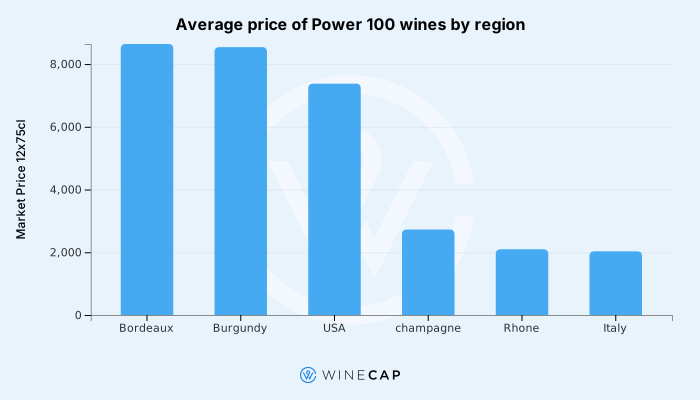
This has been particularly evident since the market peak in 2022. While Bordeaux, Burgundy and Champagne have all experienced price corrections, many Tuscan wines have held up comparatively well. At the same time, Italy continues to offer conspicuous value when set against other major fine wine regions, particularly Burgundy, where pricing remains elevated despite recent declines.

Average price Power 100 wines by region

Reasons for Italy’s market strength:

  • Lower correlation to traditional markets compared to Bordeaux.
  • Excellent price-to-quality ratios for high-scoring vintages.
  • Deep historical roots that provide long-term brand stability.
  • Expanding global demand, particularly in the US and Asian markets.

Italy’s journey from the vineyards of the Roman Empire to today’s fine wine trading platforms has been defined by a constant tension between tradition and innovation. Whether through the regulatory foundations laid by Cosimo III, the quality revolution of the DOCG system, the rebellious spirit of the Super Tuscans, or the global success of Prosecco, each chapter has contributed to the country’s remarkable transformation.

Understanding this history explains why Italy now occupies such an important place in the fine wine market. Combining world-renowned brands, exceptional regional diversity, strong global demand and relative value, Italian wine has evolved from a source of everyday table wine into one of the most compelling categories for long-term collectors and investors.

FAQ: Italian wine history

Which Italian wines are considered investment grade?

The Italian fine wine market is dominated by a relatively small group of prestigious regions and producers. The most widely traded investment-grade wines come from Barolo and Barbaresco in Piedmont, Brunello di Montalcino in Tuscany, and the leading Super Tuscan estates of Bolgheri. Iconic names such as Sassicaia, Ornellaia, Masseto, Giacomo Conterno, Bruno Giacosa and Biondi-Santi are particularly sought after due to their global demand, limited production and strong track record on the secondary market.

What is the difference between DOC and DOCG?

DOC (Denominazione di Origine Controllata) and DOCG (Denominazione di Origine Controllata e Garantita) are Italy’s two highest wine classifications. Both establish rules governing grape varieties, production methods and geographic origin. DOCG represents the highest tier and generally imposes stricter regulations, including lower permitted yields, longer ageing requirements in some regions and additional quality controls. DOCG wines must also pass a tasting evaluation before release, helping to safeguard the reputation of Italy’s most prestigious appellations.

Why did Super Tuscans start as table wines?

The first Super Tuscans were classified as simple table wines because they did not comply with the DOC regulations of the time. Many producers chose to use international grape varieties such as Cabernet Sauvignon and Merlot, while others wanted to make 100% Sangiovese wines outside the prescribed rules. Although these wines often exceeded the quality of many classified wines, they were forced to carry the lowly Vino da Tavola designation until Italian wine laws were modernised in the 1990s.

How long can top Italian wines age?

Italy’s finest wines are among the most age-worthy in the world. Top Barolo and Brunello di Montalcino wines can often age for 30 to 50 years, while exceptional bottles from leading producers may continue to evolve for even longer. Over time, youthful fruit flavours give way to more complex aromas of dried flowers, leather, tobacco, truffle and spice. Proper storage conditions are essential to maximise a wine’s ageing potential.

Why is Prosecco cheaper than Champagne?

Prosecco is typically less expensive than Champagne because it is produced using the Charmat Method, in which secondary fermentation takes place in large pressurised stainless-steel tanks rather than individual bottles. This approach is faster and less labour-intensive than the traditional method used in Champagne. In addition, Prosecco vineyards generally have lower land costs and higher production volumes, allowing producers to offer quality sparkling wine at a more accessible price point.

WineCap’s independent market analysis helps investors build diversified fine wine portfolios with full ownership and transparent pricing. Speak to one of our wine investment experts and start building your portfolio. Schedule your free consultation today.
Categories
Learn

Sweet wines explained: from Sauternes to Tokaji Aszu

  • Sweet wines are produced using a variety of techniques including noble rot, late harvesting, air drying, and freezing.
  • Some of the world’s most prestigious wines, including Chateau d’Yquem and Tokaji Aszu, are sweet wines capable of ageing for decades.
  • While sweet wines can offer value and diversification for collectors, secondary market demand remains concentrated on a small number of leading producers.

Sweet wines may lack the spotlight enjoyed by Bordeaux, Burgundy and Champagne, but they are responsible for some of the most complex, long-lived and labour-intensive bottles in the world.

From the botrytised vineyards of Sauternes and Tokaj to Germany’s prized Rieslings, sweet wines come in many styles. What unites them is the concentration of sugar, acidity and flavour that allows the finest examples to evolve for decades in bottle.

For wine investors, sweet wines also represent an overlooked corner of the market. While trading volumes are lower than for leading dry wines, many of the world’s finest dessert wines offer exceptional quality, remarkable longevity and, in some cases, compelling value.

This guide explores how sweet wines are made, the regions that define the category and the role they play in today’s fine wine market.

What makes a wine sweet?

Sweetness in wine comes from residual sugar – natural grape sugars that remain after fermentation has finished.

While many consumers associate sweet wine with inexpensive supermarket brands, the world’s finest sweet wines achieve their sweetness naturally through specialised vineyard practices that concentrate sugar within the grape.

The key to great sweet wine is balance. Sugar alone can make a wine feel heavy or cloying. The best examples combine sweetness with vibrant acidity, creating wines that are rich and intense yet remarkably fresh.

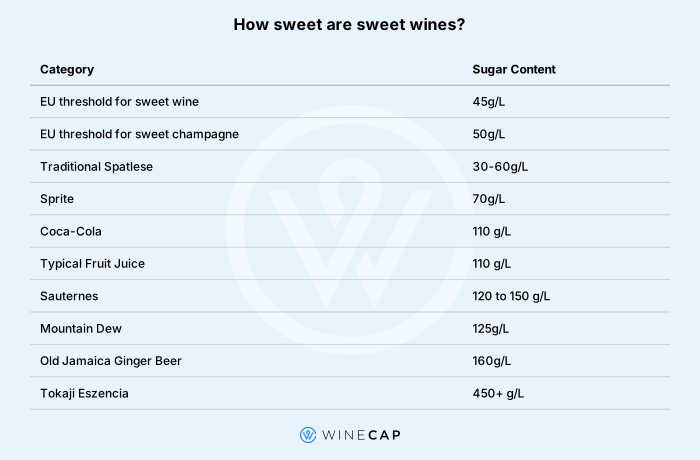
Interestingly, many sweet wines contain less sugar than popular soft drinks. A glass of Sauternes or Tokaji may taste intensely sweet, but high acidity and complex flavours often make them feel more balanced than sugary soft drinks.

How sweet are sweet wines

Why are sweet wines expensive to produce?

The finest sweet wines are among the most labour-intensive wines in the world.

In regions such as Sauternes, vineyard workers may pass through the same rows multiple times during harvest, selecting only individual grapes that have reached the ideal stage of concentration. Yields can be dramatically lower than those of dry wines, and entire vintages may be compromised if weather conditions fail to cooperate.

Despite these challenges, many sweet wines remain surprisingly affordable compared to leading dry wines from Burgundy, Napa Valley and Bordeaux. This combination of rarity, complexity and relative value makes sweet wine an appealing category for collectors seeking something beyond the market’s most heavily traded regions.

How are sweet wines made?

The world’s finest sweet wines rely on natural methods of concentrating sugar within the grape. The most important techniques include noble rot, late harvesting, air drying and freezing grapes on the vine.

Noble rot (Botrytis cinerea)

The most prestigious sweet wines in the world are produced using Botrytis cinerea, commonly known as noble rot.

Under the right conditions, this beneficial fungus punctures grape skins, allowing water to evaporate while concentrating sugars, acids and flavour compounds. The result is a wine of extraordinary intensity and complexity.

Botrytised wines are often characterised by aromas of honey, marmalade, dried apricot and exotic spice. They also possess remarkable ageing potential, with the finest examples evolving for many decades.

Producing noble rot wines is highly risky. The fungus requires a delicate balance of humid mornings and warm, dry afternoons. Too much moisture can cause destructive grey rot rather than noble rot, potentially ruining the crop.

Sauternes in Bordeaux remains the world’s benchmark for botrytised wine, although outstanding examples are also produced in Tokaj, Germany, Austria and the Loire Valley.

At a glance:

  • Botrytis requires a specific cycle of damp mornings and dry, sunny afternoons.
  • It is a risky process because the fungus can turn into grey rot if it rains too much.
  • Grapes must be harvested by hand in multiple “tries” or passes.
  • Common flavour markers include marmalade, honey, and exotic spices.
  • Famous regions include Sauternes, Barsac, and Quarts de Chaume Grand Cru in the Loire Valley.

Late harvest wines

Late harvest wines are made by leaving grapes on the vine beyond the normal harvest period.

As the grapes continue to ripen, water evaporates and sugar levels increase naturally. Unlike botrytised wines, noble rot is not necessarily involved.

These wines typically retain more primary fruit character than noble rot wines, displaying flavours of peach, apricot, citrus and tropical fruit. High acidity remains crucial to maintaining freshness and balance.

Riesling and Chenin Blanc are particularly well suited to this style, while Alsace’s Vendange Tardive wines are among the best-known examples.

At a glance: 

  • Grapes often look shrivelled or like raisins on the vine.
  • The technique relies on a dry, warm autumn to prevent spoilage.
  • High acidity is crucial to balance the increased sugar levels.
  • Riesling and Chenin Blanc are particularly suited to this style.
  • These wines are often more affordable than botrytised alternatives.

Air drying (Passito)

Air drying, known as the passito method in Italy, involves harvesting grapes and then drying them before fermentation.

Traditionally, bunches are laid on straw mats or stored in well-ventilated drying rooms for weeks or even months. As water evaporates, sugars, acids and flavours become increasingly concentrated.

This technique produces rich, complex wines with flavours of dried fruits, nuts, caramel and spice. Unlike noble rot wines, the concentration occurs after harvest, giving winemakers greater control over the process.

Notable examples include Vin Santo from Tuscany and Recioto della Valpolicella from Veneto.

At a glance: 

  • Known as appassimento.
  • The primary region is Veneto in Italy where it’s used to make Amarone.
  • Straw mats are traditionally used, leading to the term “straw wine.”
  • Flavours often lean toward dried fruits and roasted nuts, flavors that Sauternes tends to develop with extended aging.

Ice wine (Eiswein)

Ice wine is produced from grapes that freeze naturally on the vine.

The grapes are harvested and pressed while frozen, allowing only a small quantity of highly concentrated juice to be extracted. The frozen water remains behind as ice crystals, resulting in intensely sweet wines balanced by exceptionally high acidity.

The process is inherently risky because producers must wait for sufficiently cold temperatures while leaving the fruit exposed in the vineyard. If freezing conditions fail to arrive, the crop may be lost entirely.

Canada and Germany are widely regarded as the leading producers of ice wine.

At a glance: 

  • Grapes are often picked in the middle of the night to ensure they stay frozen and pressed immediately in a cold environment
  • Yields are extremely low, often only five to ten per cent of a normal harvest.
  • Riesling, Vidal, and Cabernet Franc are common varieties.
  • Ice wine is rarely affected by Botrytis, leading to very clean flavours.
  • Cryoextraction is possible, mechanically freezing grapes, but these wines are often subject to labelling restrictions.

Sauternes: the benchmark for sweet wine

No discussion of sweet wine would be complete without Sauternes.

Located south of Bordeaux, the region benefits from a unique microclimate created by the meeting of the Ciron and Garonne rivers. Morning mists encourage the development of noble rot, while sunny afternoons help concentrate the grapes.

The wines are typically produced from Semillon, Sauvignon Blanc and Muscadelle. Semillon provides richness and ageing potential, while Sauvignon Blanc contributes acidity and aromatic freshness.

At the pinnacle sits Chateau d’Yquem, the only estate awarded Premier Cru Superieur status in Bordeaux’s 1855 Classification. For many collectors, Yquem occupies a similar position within sweet wine to that of the First Growths in Bordeaux.

The finest vintages can age for a century or more, developing extraordinary layers of honey, caramel, spice and dried fruit while retaining remarkable freshness.

Tokaji Aszu: Hungary’s historic treasure

Often described as one of the world’s first great fine wines, Tokaji Aszú has a history dating back centuries.

Produced in Hungary’s Tokaj region, it is made using botrytised grapes, primarily Furmint and Harslevelu. Traditionally, the affected berries are collected separately and added to a base wine, creating a style known for its intense sweetness, vibrant acidity and exceptional longevity.

Historically, sweetness levels were measured using a puttonyos system, reflecting the number of baskets of botrytised grapes added during production. The rarest and most concentrated wines are known as Eszencia, one of the most intensely sweet wines produced anywhere in the world.

Tokaji was famously described as “the wine of kings and the king of wines” and remains one of the most distinctive sweet wine styles available today.

Beyond Sauternes and Tokaj

While Sauternes and Tokaji dominate discussions around sweet wine, several other regions produce outstanding examples.

Germany is renowned for sweet Rieslings ranging from Spätlese and Auslese to the rare Beerenauslese and Trockenbeerenauslese categories. Leading producers such as Egon Müller and Joh. Jos. Prüm have demonstrated the remarkable ageing potential and collectability of these wines.

In South Africa, Klein Constantia’s Vin de Constance continues a tradition that dates back to the eighteenth century and remains one of the Southern Hemisphere’s most celebrated sweet wines.

Meanwhile, producers across Alsace, Austria and the Loire Valley continue to craft sweet wines that combine richness, complexity and longevity.

Can you invest in sweet wines? 

Sweet wines occupy a niche position within the secondary market. Trading volumes are generally lower than those of Bordeaux, Burgundy and Champagne, meaning liquidity can be more limited.

However, the category offers some unique characteristics. The finest sweet wines possess extraordinary ageing potential, often remaining vibrant for many decades. Prices have also tended to move independently from broader fine wine market trends, making sweet wine an interesting source of diversification for collectors.

Market demand is concentrated around a relatively small number of leading names, particularly Chateau d’Yquem, top Sauternes estates, rare Tokaji Aszu bottlings and a handful of elite German producers.

As a result, most collectors view sweet wine as a complementary part of a broader cellar rather than a primary driver of investment returns. For many enthusiasts, the attraction lies as much in the drinking experience as in the potential for appreciation.

At a glance:

  • Secondary market demand is concentrated on a few top names.
  • Sweet wines are often released with significant age, reducing the “early bird” profit.
  • They are excellent for long-term cellaring due to their incredible stability.
  • Most collectors buy sweet wine to drink rather than to flip for profit.

Final thoughts

Sweet wines remain one of the most fascinating and misunderstood categories in the wine world. Produced using some of the most demanding techniques in viticulture, the finest examples combine extraordinary concentration with freshness, complexity and longevity.

Whether exploring the legendary wines of Sauternes, the historic vineyards of Tokaj or the elegant sweet Rieslings of Germany, collectors can discover wines that offer both exceptional drinking experiences and a unique perspective on the fine wine market.

Far from being an outdated style, the world’s finest sweet wines continue to demonstrate why they have captivated collectors, critics and wine lovers for centuries.

FAQ: Sweet wines

How long does a bottle of Sauternes last once opened?

Sweet wines generally last longer than dry wines after opening due to their higher sugar levels. A bottle of Sauternes stored in the refrigerator and sealed with a stopper can often remain enjoyable for one to three weeks, although freshness and aromatic intensity will gradually decline over time.

What is the difference between late harvest and noble rot?

Late harvest wines are made from grapes that remain on the vine longer than usual, allowing sugars to concentrate naturally. Noble rot wines are affected by the fungus Botrytis cinerea, which dehydrates the grapes and further concentrates sugars, acids and flavours. Noble rot typically produces more complex aromas, including honey, marmalade and spice.

What is noble rot in wine?

Noble rot is the beneficial form of the fungus Botrytis cinerea. Under the right conditions, it causes grapes to lose water while concentrating sugars and flavour compounds. The process is responsible for some of the world’s most celebrated sweet wines, including Sauternes and Tokaji Aszú.

Can sweet wine be aged?

Yes. The finest sweet wines are among the most age-worthy wines in the world. Their combination of sugar, acidity and concentration allows many examples to evolve for decades, while exceptional bottles of Sauternes, Tokaji and German Riesling can continue developing for a century or more.

Why is ice wine so expensive?

Ice wine is expensive because it is one of the most challenging wine styles to produce. Grapes must freeze naturally on the vine before harvest, yields are extremely low, and the harvest often takes place in difficult winter conditions. The small amount of juice extracted from frozen grapes also contributes to the high production cost.

What is the difference between Sauternes and Tokaji Aszu?

Both are prestigious sweet wines made using botrytised grapes, but they come from different regions and grape varieties. Sauternes is produced in Bordeaux, primarily from Semillon and Sauvignon Blanc, while Tokaji Aszú is made in Hungary using grapes such as Furmint and Hárslevelű. Tokaji is often characterised by higher acidity and a distinctive citrus and apricot profile.

Do sweet wines pair well with food?

Yes. Sweet wines are highly versatile at the table. They are traditionally paired with desserts, but many styles also work exceptionally well with blue cheese, foie gras, spicy dishes and certain seafood preparations. The best pairings balance sweetness, acidity and intensity of flavour.

Are sweet wines a good investment?

Sweet wines can play a role in a diversified fine wine collection, particularly top examples from Sauternes, Tokaj and Germany. However, secondary market demand is generally lower than for Bordeaux, Burgundy and Champagne, meaning they are often purchased as much for enjoyment as for investment potential.

WineCap’s independent market analysis helps investors build diversified fine wine portfolios with full ownership and transparent pricing. Speak to one of our wine investment experts and start building your portfolio. Schedule your free consultation today.
Categories
Learn

How technology is changing the world of fine wine

  • Modern technology is helping producers make higher-quality wines through more precise vineyard management and winemaking techniques.
  • Advances in logistics, storage and authentication are strengthening provenance, an important driver of value in the fine wine market.
  • While blockchain has attracted attention, artificial intelligence is likely to have the greatest long-term impact on how wine is produced, traded and collected.

Technology has become an increasingly important part of the fine wine industry, influencing everything from vineyard management and winemaking to storage, provenance and market transparency. While many of the most significant innovations of the past were focused on improving vineyard survival and production consistency, today’s technologies are increasingly geared towards enhancing quality, sustainability and precision.

From drones monitoring vine health to sensors tracking storage and transport conditions, data now plays a role throughout the lifecycle of a bottle. These developments not only help producers make better wines but also provide collectors and investors with greater confidence in provenance, authenticity and long-term value.

As fine wine continues to evolve as both a collectible and an alternative asset, technology is helping bridge the gap between centuries-old traditions and the demands of a modern global market.

Foundational technology in wine: 1860-1960

Before the digital age, some of the most important technological advances in wine were biological and mechanical. Between the late nineteenth and mid-twentieth centuries, innovation was often driven by necessity as producers responded to disease, changing consumer demand and the increasing commercialisation of wine.

Perhaps the most significant challenge was phylloxera, a vine pest that devastated European vineyards during the late 1800s. The solution was to graft European Vitis vinifera vines onto resistant American rootstocks – a practice that remains the foundation of modern viticulture today.

During the same period, the work of French scientist Louis Pasteur transformed winemaking. His research into fermentation helped producers better understand the role of yeast and bacteria, reducing spoilage and improving consistency.

Advances in glass production, bottling technology and mechanised farming further reshaped the industry. Estate bottling became increasingly common, while tractors and modern transport networks improved efficiency throughout the supply chain. Together, these innovations laid the foundations for the global fine wine market we know today.

Technology in the vineyard: The precision revolution

Modern vineyards have become increasingly data-driven environments. Rather than treating an entire vineyard as a single unit, growers can now analyse and manage individual plots according to their specific characteristics.

  • Drones have become essential tools allowing chateaux to identify areas of stress before they are visible to the naked eye. By responding to granular data chemical treatments can be applied only where they are needed.
  • Remote sensors and local weather stations monitor soil moisture at the root level and track local humidity and temperature shifts allowing more informed choices regarding irrigation and harvest timing.
  • Robots can now perform labour-intensive tasks like weeding with a level of precision that human crews struggle to match. In extremely high value vineyards they may also have a security function.
  • Breeding technology has shifted its focus from increasing yields to increasing  environmental resilience. As the climate changes, the development of drought-resistant varieties and rootstocks has become a priority.
  • Subterranean mapping: The rise of geophysics tools allow winemakers to visualise exactly where water is stored and where root systems might struggle. Understanding this helps in matching specific clones to the correct plots, increasing the quality of investment grade wines.
  • In-field analytics: Handheld spectrometers brought laboratory-grade analysis directly into the vineyard in the early 2000s measuring sugar levels or phenolic ripeness in situ. Data now allows producers to pinpoint the exact moment a specific parcel reaches the required ripeness.

Technology in the winery

Inside the winery, technology allows producers to make more precise decisions throughout the winemaking process. The objective is rarely to replace the winemaker’s judgement, but rather to provide better information and greater control.

The process begins before fermentation. 

  • Optical sorting machines use cameras and sensors to analyse individual grapes, automatically removing fruit that is underripe, damaged or diseased. This ensures that only the best fruit reaches the tank. 
  • Densimetric sorting submerges grapes in water so riper berries, which have higher sugar concentrations and greater density, sink to the bottom. Underripe or diluted grapes float to the surface and are discarded. Like optical sorters this guarantees uniformity and ensures that fermentation begins with fruit of a consistent ripeness level.  

These technologies are particularly valuable in challenging vintages, helping ensure that only the highest-quality fruit enters the fermentation tanks.

Once fermentation begins, smart tanks equipped with integrated sensors can continuously monitor temperature, sugar levels and extraction. Automated systems allow winemakers to respond quickly to changing conditions, helping preserve fruit character and maintain balance throughout fermentation.

The growing use of smaller fermentation vessels has also enabled more detailed plot-level vinification. Fruit from individual parcels can be fermented separately, allowing producers to capture subtle differences in terroir before constructing the final blend.

Advances in microbiology continue to expand the winemaker’s toolkit. Specific yeast strains can be selected to encourage particular fermentation outcomes, reduce unwanted aromas or help manage alcohol levels in increasingly warm growing conditions.

Technology is also influencing winery design. Many modern wineries incorporate gravity-flow systems, allowing grapes and wine to move naturally through the production process with minimal pumping. By reducing mechanical intervention, producers aim to preserve fruit quality and minimise oxidation.

Architectural innovation is increasingly aligned with sustainability goals as well. Underground cellars and energy-efficient winery designs can help maintain stable temperatures while reducing energy consumption.

Technology in logistics and provenance

The role of technology does not end once the wine is in the bottle. Preserving provenance and ensuring optimal storage conditions are essential factors in maintaining both quality and value.

Fine wine businesses like WineCap and their storage partners increasingly make use of:

  • Smart pallet sensors: Integrated devices now track temperature and vibration levels in real time during transport. This ensures that fine wine is not compromised by thermal shock or physical agitation while moving from the cellar to the warehouse.
  • Secondary market security: Detailed environmental data allows investors to verify that a bottle has never been exposed to heat damage. This objective proof of perfect storage adds significant value and confidence to the global secondary market.
  • RFID tracking: Radio Frequency Identification (RFID) tags allow for rapid, automated inventory management. Bottles can be tracked with pinpoint accuracy through every stage of the supply chain, reducing the risk of loss or logistical error.

Innovative packaging and the development of new closures also can reduce the cost of logistics and lower the risk of opening a spoiled bottle.

  • DIAM closures: This technology uses carbon dioxide to strip the chemicals causing cork taint from natural cork. This provides a traditional aesthetic with a technical guarantee of zero spoilage for up to three decades.
  • The Margaux experiments: Leading estates like Chateau Margaux have conducted decades of research into alternative closures from screwcaps to glass stoppers to find the ultimate balance between historical tradition and technical performance.
  • Sustainability and logistics: The industry is exploring low-weight bottles and stackable glass formats. By reducing weight and improving spatial efficiency (inspired by high-density logistics models like those used by IKEA), wineries can significantly lower the carbon footprint of transport.

Technology and the secondary market

Technology has also transformed how collectors interact with fine wine. Authentication tools such as security tags, micro-etching and digital verification systems help combat counterfeiting and provide greater confidence in provenance. In many cases, collectors can verify authenticity directly using a smartphone.

Digital platforms have also improved access to information. Interactive QR codes increasingly provide consumers with detailed information about a wine’s production, history and provenance.

Meanwhile, online databases and community-driven platforms have democratised wine criticism. Rather than relying exclusively on a small number of professional critics, collectors can now access hundreds or even thousands of tasting notes and reviews from wine enthusiasts around the world.

Perhaps most significantly, digital portfolio management tools provide greater transparency around pricing and market performance. Collectors can track the value of their holdings in real time, monitor market trends and manage their cellars more effectively.

The digital frontier: Blockchain, AI and the future of fine wine

Emerging technologies such as blockchain, NFTs and artificial intelligence have generated considerable interest within the wine industry. However, their practical impact varies considerably.

Blockchain-based ownership records have been promoted as a solution for provenance and authenticity. While these systems may offer benefits in some circumstances, many of the challenges they aim to address are already managed through bonded storage networks, established merchants and detailed provenance records.

Artificial intelligence may prove more transformative. AI is already being used to analyse vineyard data, predict disease pressure and support decision-making throughout the production process.

Beyond the vineyard, AI-powered tools are beginning to assist collectors with portfolio management, market analysis and cellar organisation. As these technologies continue to develop, their influence across the wine industry is likely to grow.

FAQ: Technology in wine 

Does technology in the winery make all wine taste the same? 

No. When used correctly, technology actually helps winemakers highlight the unique characteristics of their land. It removes the “noise” of spoilage or faulty fermentation, allowing the true terroir to shine.

Is machine harvesting and sorting inferior to hand picking? 

Historically, yes. However, modern optical sorters on harvesters can now be programmed to reject underripe or damaged berries. In some cases, modern machines can be more selective than a tired human crew.

What is the most important piece of tech for a wine investor? 

Beyond a reliable thermometer/hygrometer in the cellar, a subscription to a data platform like Cellartracker or Wine-Searcher is likely to be very useful to any serious collector or investor.

Will robots eventually replace vineyard workers? 

Robots will likely handle the most repetitive and physically demanding tasks. However, the high-level decision-making required for tasks like winter pruning or determining the exact day of harvest will always require human expertise.

How does technology help protect wine provenance?

Technologies such as RFID tracking, environmental monitoring systems and digital authentication tools help create a documented record of a wine’s storage and movement throughout the supply chain. This can provide greater confidence in authenticity, condition and provenance, all of which can influence a wine’s value in the secondary market.

How is artificial intelligence being used in wine production?

Artificial intelligence is increasingly being used to analyse vineyard data, predict disease outbreaks and identify optimal harvest dates. While AI can support decision-making, it is typically used alongside human expertise rather than as a replacement for it.

Can technology help producers adapt to climate change?

Yes. Precision agriculture tools allow growers to monitor water availability, vine stress and weather conditions more accurately. Advances in grape breeding and rootstock development are also helping vineyards adapt to warmer temperatures and changing growing conditions.

How do wineries monitor fermentation today?

Many modern wineries use tanks equipped with sensors that continuously track temperature, sugar levels and other key fermentation metrics. This allows winemakers to respond quickly to changing conditions and maintain greater control over the process.

What is precision viticulture?

Precision viticulture is the use of data and technology to manage vineyards at a more detailed level. Rather than treating an entire vineyard as a single unit, growers can make decisions based on the specific needs of individual plots or even individual rows of vines.

How does technology affect the value of investment-grade wine?

Technology can support value by improving provenance, authenticity and storage records. Greater transparency around a wine’s history and condition can increase buyer confidence, particularly in the secondary market.

What technology is likely to have the biggest impact on wine in the future?

Artificial intelligence is widely seen as one of the most significant emerging technologies. Potential applications range from vineyard management and climate adaptation to market analysis, portfolio management and consumer education.

Categories
Learn

The ultimate guide to Opus One: Napa Valley’s top cult wine

  • Opus One is the highest profile joint venture between the Old and New World in winemaking.
  • The wine is one of the most traded and reliable alternative assets in the fine wine market.
  • Opus One often outperforms other cult labels thanks to its global brand recognition and consistent quality.

As one of the highest profile wines in California, Opus One has spent decades bridging the gap between traditional European heritage and American enterprise and viticultural innovation. For anyone building a resilient fine wine portfolio, understanding its secondary market liquidity and performance is essential.

This guide breaks down the ten things you need to know about this iconic Cabernet benchmark, exploring how its production scale and critical history continue to offer secure capital growth for those investing in wine.

1. A transatlantic handshake: The history of Opus One

The story of Opus One began in 1970 with a meeting between two giants of the wine world: Baron Philippe de Rothschild of Château Mouton Rothschild and Napa Valley pioneer Robert Mondavi. Their shared ambition was to create a Bordeaux-style blend in California that could rival the finest wines of France.

Robert Mondavi played a defining role in the post-war American wine renaissance. After a family dispute over the future of the Charles Krug Winery – where he had worked alongside his father and brother since the 1940s – Mondavi founded his own winery in Napa Valley in 1965, helping establish California as a serious fine wine region.

Baron Philippe de Rothschild, meanwhile, rebuilt Château Mouton Rothschild following the Second World War. After escaping the German occupation of France, he returned to Bordeaux and revived the family estate in the early 1950s, eventually transforming Mouton Rothschild into one of the world’s most iconic wine brands.

Together, the pair set out to create a luxury Napa Valley Cabernet Sauvignon blend crafted with a distinct Bordeaux sensibility. It marked the first time a leading Bordeaux estate had partnered with a California producer to create an entirely new wine brand – a move that proved seismic for the global wine industry. Baron Philippe de Rothschild’s involvement brought immediate prestige and international credibility to the project.

The partnership was officially announced in 1980, although the first vintages – 1979 and 1980 – were released together in 1984. Today, Opus One remains a 50/50 partnership between Baron Philippe de Rothschild S.A. and Constellation Brands, which acquired Robert Mondavi Winery in 2004.

More than four decades later, Opus One continues to stand as one of Napa Valley’s most prestigious wines and a landmark collaboration that proved California terroir could produce world-class fine wine under French-inspired winemaking principles.

Key facts about Opus One:

  • Founded through a partnership between Robert Mondavi and Baron Philippe de Rothschild
  • Officially launched in 1980
  • First vintages: 1979 and 1980
  • Located in Oakville, Napa Valley
  • Inspired by the structure and philosophy of Bordeaux blends
  • One of the first major collaborations between Bordeaux and California winemaking
  • Currently co-owned by Baron Philippe de Rothschild S.A. and Constellation Brands
  • Widely regarded as one of Napa Valley’s most collectible fine wines

2. The Judgement of Paris: The catalyst behind Opus One

Although Baron Philippe de Rothschild and Robert Mondavi first discussed collaboration after meeting in Hawaii in 1970, it is difficult to ignore the significance of the 1976 Judgement of Paris tasting in accelerating the vision behind Opus One.

The now legendary blind tasting saw California wines defeat some of France’s greatest estates – including Chateau Mouton Rothschild – sending shockwaves through the global wine industry and permanently changing perceptions of Napa Valley wine.

Rather than dismissing California’s rise, Baron Philippe recognised an opportunity. He understood that Napa Valley was no longer a winemaking backwater, but a region capable of competing with the world’s finest wines. By partnering with Mondavi, the Rothschild family could help shape the future style of premium California wine while establishing a foothold in one of the wine world’s fastest-growing regions.

The collaboration also helped legitimise Napa Valley in the eyes of European collectors and investors. At a time when many traditional French producers remained sceptical of New World wines, Mouton Rothschild became the first First Growth Bordeaux estate to fully embrace a major California partnership.

From the outset, the ambition behind Opus One was clear: to create a “California First Growth” capable of standing alongside the great wines of Bordeaux.

The success of Opus One would later inspire other prestigious French wine families to invest in Napa Valley and the wider New World wine scene, helping transform California into a globally respected fine wine region.

Key facts about the Judgement of Paris and Opus One:

  • The Judgement of Paris took place in 1976
  • California wines defeated leading French wines in a blind tasting
  • Chateau Mouton Rothschild was among the French estates defeated
  • Baron Philippe de Rothschild saw Napa Valley as a long-term opportunity rather than a threat
  • Opus One was designed to become a “California First Growth”
  • Mouton Rothschild was the first First Growth Bordeaux estate to pursue a major New World partnership
  • The success of Opus One encouraged further French investment in Napa Valley
  • The partnership helped elevate Napa Valley’s reputation among European collectors and investors

3. The Opus One vineyards

Opus One is located in the heart of Napa Valley’s Oakville AVA, one of the region’s most prestigious and sought-after vineyard areas. Renowned for producing some of California’s greatest Cabernet Sauvignon wines, Oakville offers the ideal combination of climate, soil, and exposure needed to create wines with both power and longevity.

The Opus One estate spans 68 hectares of vineyards across four distinct parcels, including prized sections of the historic To Kalon Vineyard,  widely regarded as one of Napa Valley’s most iconic vineyard sites. These vineyards form the backbone of Opus One’s signature Bordeaux-style blend, dominated by Cabernet Sauvignon alongside smaller amounts of Merlot, Cabernet Franc, Petit Verdot, and Malbec.

Viticulture at Opus One combines traditional vineyard observation with modern precision technology. The estate employs high-density planting, encouraging the vines to compete for water and nutrients. This naturally reduces berry size and increases concentration, helping produce the depth, structure, and ageing potential for which Opus One is known.

Sustainability also plays a major role in the estate’s philosophy. Opus One is certified as a Napa Green winery, reflecting its commitment to environmentally responsible farming and long-term vineyard health. Advanced tools such as infrared sensors are used throughout the vineyards to monitor vine stress, water usage, and overall vine health, allowing the team to make highly precise decisions during the growing season.

The deep, gravelly, well-drained soils of Oakville are particularly well suited to Cabernet Sauvignon, helping create wines with intense concentration, refined tannins, and remarkable balance.

Key facts about the Opus One vineyards:

  • Located in Napa Valley’s prestigious Oakville AVA
  • Estate covers approximately 68 hectares of vineyards
  • Includes parcels from the famous To Kalon Vineyard
  • Cabernet Sauvignon is the dominant grape variety
  • High-density planting is used to increase berry concentration
  • Sustainable farming is central to the estate’s philosophy
  • Certified as a “Napa Green” winery
  • Infrared sensor technology is used to monitor vine health and water stress
  • Oakville’s gravelly soils are considered ideal for premium Cabernet Sauvignon production

4. A Bordeaux heart in a Napa body

The composition of Opus One is always led by Cabernet Sauvignon, but it remains a classic Bordeaux-style blend. Depending on the vintage, the wine incorporates varying percentages of Merlot, Cabernet Franc, Petit Verdot, and Malbec. This multi-varietal approach allows the winemaking team to adjust the final blend to achieve a consistent house style.

While many Napa producers focus on single-varietal Cabernet Sauvignon, Opus One proves its Bordeaux influence using other grapes to add layers of aromatic nuance and textural silkiness. Cabernet Franc provides floral notes, while Petit Verdot adds structure and deep colour. This complexity is one of the reasons the wine is so highly regarded.

Key facts about the Opus One blend:

  • Cabernet Sauvignon typically accounts for 80–95% of the blend
  • Other varieties include Merlot, Cabernet Franc, Petit Verdot, and Malbec
  • The blend changes slightly depending on the vintage
  • Cabernet Franc adds floral aromatics and elegance
  • Petit Verdot contributes colour, structure, and mid-palate weight
  • Malbec is used sparingly to add richness and dark fruit character
  • Every vineyard parcel is fermented separately before blending
  • The goal is to combine Napa Valley fruit intensity with Bordeaux-style structure and balance

5. Inside the Opus One winery

Completed in 1991, the Opus One winery is widely regarded as one of Napa Valley’s most iconic and influential winery designs. Combining architectural elegance with technical precision, the estate helped redefine what a modern fine wine winery could look like, inspiring winery architecture around the world over the past four decades.

Designed by architect Scott Johnson, the winery is partially built into the hillside, allowing for natural temperature regulation and minimal visual impact on the surrounding landscape. This subterranean design also supports gravity-flow winemaking, a gentle process that reduces excessive pumping and helps preserve the purity and integrity of the fruit throughout production.

In recent years, Opus One has also undergone extensive renovation and landscaping upgrades as part of a broader sustainability and estate stewardship initiative. The redesign focused on restoring the original architectural vision while incorporating drought-resistant native planting and environmentally conscious landscaping. According to reports, the project is expected to significantly reduce water consumption across the estate.

Technology plays a major role in the cellar. Optical sorting machines are used to inspect grapes before fermentation, ensuring that only the highest-quality fruit is selected. Fermentation takes place in 50 individual steel and wood vats, allowing the winemaking team to vinify each vineyard parcel separately for maximum precision during blending.

Opus One also employs extended maceration, keeping the grape skins and seeds in contact with the juice for longer periods to extract colour, texture, and fine-grained tannins that contribute to the wine’s structure and ageing potential.

Following fermentation, the wine is aged for approximately 18 months in 100% new French oak barrels. This élevage adds layers of spice, cedar, and vanilla that have become hallmarks of the Opus One style. The wine then spends an additional 18 months ageing in bottle before release, allowing the blend to integrate and develop further complexity before reaching the market.

Key facts about the Opus One winery:

  • The winery was completed in 1991
  • Designed by renowned architect Scott Johnson
  • Built partially underground for natural temperature control
  • Uses gravity-flow winemaking to handle grapes gently
  • Recently renovated with sustainability-focused landscaping upgrades
  • Estate redesign aims to significantly reduce water consumption
  • Optical sorting technology ensures only top-quality fruit is used
  • 50 individual steel and wood vats allow plot-by-plot vinification
  • Extended maceration is used to build structure and texture
  • Wines are aged for around 18 months in 100% new French oak
  • Additional bottle ageing takes place before release
  • The winery is regarded as one of Napa Valley’s architectural landmarks

6. The Opus One tasting profile

Opus One is celebrated for its balance, combining the richness and ripeness of Napa Valley fruit with the structure and restraint more commonly associated with top Bordeaux wines. While many Napa Cabernet Sauvignon blends lean toward power and opulence, Opus One is known for its precision, texture, and refinement.

In its youth, the wine typically displays intense aromas of black cherry, cassis, blackberry, and plum, layered with notes of cedar, rose petals, dark chocolate, and graphite. Ageing in 100% new French oak adds subtle nuances of toasted vanilla, espresso, baking spice, and sandalwood, though the oak is generally well integrated rather than dominant.

The defining characteristic of Opus One is often considered its texture. The tannins are famously polished and supple, giving the wine an approachable quality even in its early years. At the same time, the wine retains the acidity and structural depth needed for long-term ageing, allowing top vintages to evolve gracefully for decades.

Compared with many of its Napa Valley peers, Opus One often shows slightly higher acidity and greater restraint, helping preserve freshness and elegance alongside its concentrated fruit profile. This balance has led many critics and collectors to describe the wine as “European” in style despite its unmistakable New World ripeness.

With bottle age, the wine develops increasingly complex tertiary characteristics, including leather, forest floor, dried herbs, tobacco, and truffle, adding further depth and sophistication over time.

Key tasting characteristics of Opus One:

  • Primary aromas include cassis, black cherry, blackberry, and plum
  • Common secondary notes include cedar, dark chocolate, espresso, and sandalwood
  • 100% new French oak contributes vanilla and baking spice complexity
  • Known for exceptionally polished and supple tannins
  • Typically shows higher acidity than many Napa Valley Cabernet blends
  • Balances Napa fruit richness with Bordeaux-style restraint
  • Develops tertiary notes of leather, truffle, tobacco, and dried herbs with age
  • Often approachable young but capable of ageing for several decades
  • Frequently described as combining New World ripeness with European structure and elegance

7. The range: Opus One and Overture

Unlike many large Napa Valley estates that produce multiple labels and limited editions, Opus One has remained remarkably focused. The estate centres around its flagship wine, Opus One, often referred to as the “Grand Vin” in reference to the traditions of Bordeaux. Alongside it sits a second wine, Overture, which was originally available exclusively through the winery before receiving wider international distribution.

Produced for the first time in 1993, Overture follows the same Bordeaux-inspired philosophy as the flagship wine, using the classic blend of Cabernet Sauvignon, Merlot, Cabernet Franc, Petit Verdot, and Malbec. However, while Opus One is vintage-specific, Overture is unusual in that it is crafted as a multi-vintage blend.

This approach allows the winemaking team to combine wines from different harvests to create a more approachable and consistent style year after year. Fruit used for Overture comes from lots that do not ultimately make the final blend for Opus One, though the quality remains exceptionally high by Napa Valley standards.

Compared with the flagship wine, Overture is typically softer, more accessible in its youth, and slightly less structured, making it appealing to collectors looking to experience the Opus One style without the extended ageing requirements often associated with the Grand Vin.

Like Opus One, Overture is also aged in French oak barrels, although generally for a shorter period. The result is a polished and refined Napa Valley Bordeaux blend that retains the estate’s signature balance and elegance while offering earlier drinking appeal.

Key facts about Opus One and Overture:

  • Opus One is the estate’s flagship “Grand Vin”
  • Overture serves as the estate’s second wine
  • Overture was first released in 1993
  • For many years, Overture was only available directly from the winery
  • Overture is a rare example of a luxury non-vintage Napa Valley red wine
  • The blend includes Cabernet Sauvignon, Merlot, Cabernet Franc, Petit Verdot, and Malbec
  • Fruit used for Overture comes from lots not selected for the flagship blend
  • Overture is designed to be softer and more approachable when young
  • Both wines are aged in French oak barrels
  • The non-vintage format allows Overture to maintain stylistic consistency year after year

8. Opus One’s production scale

One of the most remarkable aspects of Opus One is its scale. While many of Napa Valley’s cult wines are produced in extremely limited quantities, Opus One operates on a far larger level without sacrificing the quality and consistency expected from a world-class fine wine estate.

The winery produces approximately 25,000 cases annually, making it significantly larger than ultra-small-production Napa labels such as Screaming Eagle, which produces fewer than 1,000 cases per year. Yet despite this comparatively high volume, Opus One has maintained its position as one of the most prestigious and collectible wines in California.

On a global level, Opus One’s production is closer in scale to the great First Growth estates of Bordeaux, such as Chateau Lafite Rothschild and Chateau Mouton Rothschild, than to many boutique Napa Valley producers. It also exceeds the production volumes of several iconic Italian fine wines, including Sassicaia and Tignanello.

This scale brings several advantages. Greater production allows Opus One to maintain a strong international presence across top restaurants, merchants, and collectors worldwide, while also creating valuable liquidity in the secondary market. Unlike many cult Napa wines that rarely trade due to limited availability, Opus One remains one of the few California wines with a consistently active global resale market.

The estate’s scale also supports major investment in vineyard research, sustainability initiatives, and winemaking technology, helping maintain consistency across vintages despite the challenges that come with producing wine at such volume.

Perhaps most impressive is that Opus One has managed to preserve its luxury image and premium pricing despite producing far more wine than many of its Napa Valley peers – a balance few wineries successfully achieve.

Key facts about Opus One’s production:

  • Produces approximately 25,000 cases annually
  • Significantly larger production than most Napa Valley cult wines
  • Production exceeds many leading Italian fine wines, including Sassicaia and Tignanello
  • Comparable in scale to major Bordeaux First Growth estates
  • Large production supports strong global restaurant and retail presence
  • One of the few Napa Valley wines with consistent secondary market liquidity
  • Scale enables major investment in technology, sustainability, and research
  • Maintains premium pricing despite relatively high production volumes
  • Consistency across large-scale production is considered one of the estate’s greatest achievements

Comparing Opus One Production volumes

9. Consistent quality across vintages

One of the defining characteristics of Opus One is its remarkable consistency, both in style and overall quality. This reliability is largely a reflection of Napa Valley’s comparatively stable climate, particularly within the Oakville AVA, where warm days, cool nights, and predictable growing conditions provide an ideal environment for Cabernet Sauvignon-based wines.

Unlike Bordeaux, where vintages can vary dramatically due to unpredictable weather and harvest conditions, Napa Valley offers a far more consistent growing season. This allows the Opus One winemaking team to achieve a high level of ripeness and balance year after year while maintaining the estate’s signature style of elegance, structure, and refinement.

Although Opus One has long been considered one of California’s benchmark wines, the estate’s critical reputation has strengthened considerably since the 1990s. Advances in precision viticulture, optical sorting technology, vineyard mapping, and parcel-by-parcel winemaking have further elevated quality levels, resulting in increasingly refined and critically acclaimed releases.

Several modern vintages are now regarded among the finest ever produced by the estate, with collectors and critics particularly praising vintages that combine Napa Valley ripeness with freshness, structure, and ageing potential.

Top modern Opus One vintages:

  • 2010
  • 2013
  • 2015
  • 2016
  • 2019
  • 2023

10. Market performance: The blue-chip king of Napa Valley

Opus One is often regarded as one of the safest and most reliable investments in California fine wine. While ultra-rare cult wines such as Screaming Eagle or Harlan Estate may command higher headline prices due to extreme scarcity, Opus One offers something equally important to collectors and investors: liquidity, consistency, and global brand recognition.

Thanks to its larger production scale and international distribution, Opus One is one of the few Napa Valley wines that trades regularly on the secondary market. This consistent market activity creates stronger price transparency and makes it easier for collectors to buy and sell compared with smaller-production cult labels that rarely appear at auction or on trading platforms.

The estate’s association with the Rothschild family also provides an additional layer of prestige and investor confidence. Few California wineries possess the same level of international brand recognition, particularly among buyers in Asia, Europe, and the United States.

Historically, Opus One has shown strong long-term price appreciation, especially for well-stored older vintages from the 1980s and 1990s, which have become increasingly scarce. 

Key facts about Opus One’s market performance:

  • Considered one of the most liquid Napa Valley wines on the secondary market
  • Often viewed as a lower-risk California wine investment
  • Strong global brand recognition supports long-term demand
  • Particularly popular in Asian markets, especially Japan
  • Older vintages from the 1980s and 1990s continue to appreciate in value
  • Frequently receives high critic scores, supporting investment-grade status
  • More actively traded than many small-production Napa cult wines
  • Association with the Rothschild family adds international prestige and trust

Performance of significant opus one vintages

FAQ: Opus One

Is Opus One expensive?

In absolute terms, yes – Opus One is one of Napa Valley’s premium fine wines. However, within the context of the luxury wine market, it is often considered relatively well priced for its reputation, consistency, and long-term performance.

Who are the two heads featured on the Opus One label?

The two profiles featured on the Opus One label are stylised silhouettes of the winery’s founders: Robert Mondavi and Baron Philippe de Rothschild.

The label symbolises the partnership between Napa Valley and Bordeaux that defined the creation of Opus One and helped reshape perceptions of California fine wine on the global stage.

Can I visit the winery? 

Yes, Opus One offers tasting experiences, though appointments are essential and often booked months in advance. If you’re interested, reach out to your WineCap Account Manager. 

Is Overture a good investment? 

Overture is generally considered a “drinker’s wine” rather than an investment asset, as it lacks the vintage-specific rarity of the flagship.

How long should I age Opus One? 

While approachable after five years, the best vintages reach their peak maturity between 15 and 25 years after the harvest.

WineCap’s independent market analysis helps investors build diversified fine wine portfolios with full ownership and transparent pricing. Speak to one of our wine investment experts and start building your portfolio. Schedule your free consultation today.

Categories
Learn

Ten Tuscan wine producers every investor needs to know

  • Tuscany serves as the mainstay for investing in Italian wine, combining large production with global recognition.
  • The top ten Tuscan wine producers have historically shown resilience during market fluctuations.
  • Tuscany offers a clear dual strategy for investors, balancing international grape varieties and traditional Sangiovese.

From the historic estates of Chianti Classico and Brunello di Montalcino to the revolutionary Super Tuscan pioneers of Bolgheri, Tuscany offers investors access to some of the world’s most sought-after wines. In this guide, we explore ten Tuscan wine producers every investor needs to know, highlighting the estates that continue to define quality, rarity, and long-term market relevance.

Tuscany remains one of the most important regions in the fine wine investment market, combining centuries of winemaking heritage with global demand, critical acclaim, and strong secondary market performance. While names like Sassicaia and Masseto dominate headlines, there is a diverse range of Tuscan wine producers that are shaping the future of collectible Italian wine.

1. Sassicaia

Sassicaia is the foundational Super Tuscan wine that altered the global perception of Italian viticulture. Created by Marchese Mario Incisa della Rocchetta at Tenuta San Guido, the wine began as a private experiment to replicate the Cabernet-led blends of Bordeaux on the coastal soils of Bolgheri. The stony, gravelly terroir bore a striking structural resemblance to the Graves region, providing a natural drainage engine that allowed French varieties to flourish.

From a wine investment standpoint, Sassicaia is one of the most reliable instruments in the entire fine wine trade. It regularly places within the top five of the Liv-ex Power 100 rankings and remains the most searched for Italian wine globally on Wine-Searcher. With a steady annual production of roughly 250,000 bottles, it offers a perfect combination of high market liquidity and defensive price stability, backed by a one of a kind autonomous Bolgheri Sassicaia DOC designation.

  • Top vintages include: 1985, 2016, 2021
  • Most expensive vintages include: 1985, 1988

2. Tignanello

Produced by the historic Marchesi Antinori family, Tignanello stands as a commercial triumph. Its first releases came to market in the early 1970s shortly after Sassicaia, Tignanello chose a slightly different blending path, retaining a dominant share of Sangiovese while integrating Cabernet Sauvignon and Cabernet Franc to smooth out the regional profile.

The long-term market performance of Tignanello has been exceptional, with our Tignanello index showing growth of 160% over the last decade. Because its entry price remains low, particularly when compared to Bordeaux First Growths, Tignanello displays significant structural resilience during broader market corrections. For much of the last fifteen years, its trading momentum has moved almost in lockstep with Sassicaia, making it a staple asset for private collectors.

  • Top vintages include: 2015, 2016, 2021
  • Most expensive vintages include: 1971, 1978

3. Masseto

Among truly investable wines with an active secondary market, Masseto is the rarest and most costly Super Tuscan. Cultivated on a small, seven hectare hill of Pliocene clay in Bolgheri, this wine is a 100% Merlot bottling whose signature is an opulent, highly concentrated style and absolute varietal purity.

The estate operates on an entirely different scale of volume compared to its neighbors, producing a limited allocation that naturally triggers desire among global buyers. Masseto possesses immense brand equity, consistently commanding some of the highest prices for any Italian red wine. Its steady capital growth curve makes it a premier selection for wealth preservation.

  • Top vintages include: 2006, 2015, 2016
  • Most expensive vintages include: 1986, 2006

4. Redigaffi

Produced by the Tua Rita estate in the Maremma region, Redigaffi is the other great Merlot master of Italy. This 100% Merlot bottling cemented its status when the 2000 vintage became the first Italian wine since 1985 Sassicaia to receive a perfect 100-point score from the influential critic Robert Parker.

For a strategic investor, Redigaffi represents a high value alternative to Masseto, often trading at approximately a quarter of the price while achieving comparable critical evaluations. This pricing gap offers significant headroom for future gains.

  • Top vintages include: 2000, 2015, 2016
  • Most expensive vintages include: 1994, 2000

5. Solaia

Solaia is Tignanello’s stablemate and opposite twin, originating from a contiguous, sun drenched vineyard parcel on the Antinori estate. While Tignanello is anchored by Sangiovese, Solaia reverses the equation with the blend dominated by Cabernet Sauvignon and Cabernet Franc with a smaller structural component of Sangiovese.

In 2009, Solaia joined Masseto as one of the pioneering Italian labels to distribute its production through the historic Bordeaux merchant system known as La Place de Bordeaux. This institutional shift granted the estate access to a vast global network of international merchants, drastically increasing its access to collectors, consumers and investors across the world.

  • Top vintages include: 1997, 2015, 2016
  • Most expensive vintages include: 1978, 1997

6. Ornellaia

Ornellaia is an essential pillar of the coastal Bolgheri landscape. Historically the Ornellaia team also produced Masseto which only gained its own home until 2019. Crafted as a classic Bordeaux blend, Ornellaia is celebrated for its polished precision and consistent critical acclaim across varying vintage conditions.

The estate is currently in a transitional phase that investors are watching with close attention. The long–term winemaker recently departed the property to take over technical direction at the renovated Bordeaux Second Growth, Chateau Lascombes. This leadership shift could make older back vintages highly collectible assets as historical markers of the estate’s previous era.

  • Top vintages include: 2001, 2010, 2016
  • Most expensive vintages include: 1985, 2001

7. Case Basse di Gianfranco Soldera

Located in the traditional heartland of southern Tuscany, Case Basse di Gianfranco Soldera represents the peak of cult traditional Sangiovese production. Located in Montalcino, the late Gianfranco Soldera practiced a philosophy of total non-intervention allowing spontaneous fermentation in wooden vats, creating 100% Sangiovese wines of great complexity. 

The estate operates with a very small production footprint, yielding allocations that are highly restricted. This scarcity ensures that Case Basse remains completely outside standard market volatility, with prices having risen nearly 300% in the last decade. When it comes to performance, Case Basse successfully challenges Masseto at the top of the Italian valuation table, making it an elite target for collectors who prioritise absolute rarity over transactional volume.

  • Top vintages include: 2001, 2006, 2015
  • Most expensive vintages include: 1990, 2006

8. Biondi Santi Brunello di Montalcino

Biondi Santi is universally recognised as the historic father of Brunello di Montalcino, having effectively created the designation in the late nineteenth century by isolating specific Sangiovese clones and heavily influencing the later establishment of the Consorzio del Vino Brunello di Montalcino. The estate’s flagship Riserva bottles are legendary for their monumental tannic structure, often requiring decades of cellaring before entering their optimal drinking window.

The secondary market treats Biondi Santi Riserva as a blue-chip asset, akin to a classic Left Bank First Growth. The wine possesses a maturity curve that spans half a century, providing private portfolios with a highly secure, slow maturing store of wealth and appreciation.

  • Top vintages include: 1955, 2010, 2015
  • Most expensive vintages include: 1955, 1964

9. Fontodi Flaccianello della Pieve

Situated in the heart of Chianti Classico, Fontodi is a champion of organic farming and modern Sangiovese expression. The estate’s most investable wine is Flaccianello della Pieve, a 100% Sangiovese bottling that revolutionized the perception of Central Tuscan wine.

Flaccianello delivers on quality with scores consistently above 96 points at a fraction of the cost of many of Bolgheri’s high profile Super Tuscans. This provides investors with an accessible entry point into top Italian wine, showing steady capital growth as the secondary market increasingly rewards producers delivering high quality at competitive prices. While less investable, by virtue of its pricepoint, Vigna del Sorbo, Fontodi’s Chianti Classico, deserves mention and may be the best value wine in the appellation.

  • Top vintages include: 2006, 2010, 2016
  • Most expensive vintages include: 1981, 1990

10. Bibi Graetz

Bibi Graetz represents the artistic avant-garde of modern Tuscan winemaking. An artist by training with no formal enological schooling, Graetz began sourcing old vine Sangiovese, Colorino, and Canaiolo parcels around Fiesole to craft wines that completely defied the technical norms of the early 2000s.

His flagship wine, Testamatta, has undergone a dramatic stylistic evolution over the last two decades, transitioning from an opulent, oak heavy profile towards a style of striking transparency and mineral definition. This stylistic shift and the use of La Place de Bordeaux as a distribution channel have triggered growing interest.

  • Top vintages include: 2015, 2016, 2019
  • Most expensive vintages include: 2000, 2006

10 Tuscan producers you need to know

FAQ: Top Tuscan wine producers

Why did the Super Tuscan movement choose the IGT classification over DOCG status? 

They didn’t. Winemakers like Mario Incisa della Rocchetta broke suffocating rules on wine making by planting French varieties like Cabernet Sauvignon. Because these grapes were unauthorized, the government forced them to label their wines as basic table wine, launching the IGT classification into the consciousness of fine wine lovers.

How do aging rules for Brunello di Montalcino affect the secondary market? 

Brunello di Montalcino is bound by some of the most rigid ageing laws in Europe, requiring a mandatory five years of cellaring before commercial release, with at least two of those years spent inside traditional oak casks. For an investor this delay before initial secondary trade data can be analysed does mean that the qualities of a vintage are better understood before the wines are available to buy.

What specific advantage does La Place de Bordeaux provide to Tuscan estates like Solaia? 

By routing their allocations through La Place de Bordeaux’s network of French brokers and merchants Tuscan producers bypass regional distributors and instantly access thousands of global buyers in London, Tokyo, and Hong Kong. This global distribution model increases the liquidity of the asset, stabilising market prices and reducing regional transaction friction.

Is fine wine from Tuscany subject to Capital Gains Tax in the United Kingdom? 

For the majority of private collectors in the UK, fine wine is classified by HMRC as a wasting asset because it is a tangible product that naturally evolves and breaks down over a predictable lifespan of less than fifty years. Consequently, capital gains realised from the sale of these bottles are generally exempt from taxation, making labels like Tignanello and Sassicaia highly efficient structures for wealth preservation.

How can I protect my investment in Tuscan wines?

As with all investment grade wines arguably the most important step you can take as a wine investor is to ensure proper in-bond storage with a reputable company like WineCap.

WineCap’s independent market analysis helps investors build diversified fine wine portfolios with full ownership and transparent pricing. Speak to one of our wine investment experts and start building your portfolio. Schedule your free consultation today.
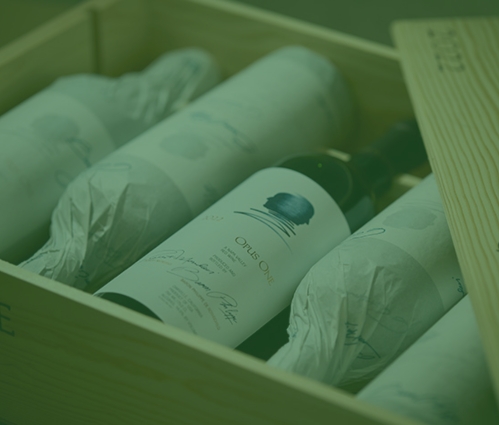
Categories
Learn

Frontier viticulture: The world’s most surprising wine-producing regions

  • Frontier viticulture refers to wine production in extreme, unconventional, and emerging regions once considered unsuitable for growing quality grapes.
  • The world’s most surprising wine-producing regions now include Poland, Sweden, Mongolia, Tahiti, Tanzania, and even vineyards near the Arctic Circle and Gobi Desert.
  • Climate change, hybrid grape varieties, and advances in vineyard technology are expanding global winemaking far beyond traditional regions.

Winemaking is no longer confined to the traditional vineyards of France, Italy, or California. Frontier viticulture – the cultivation of grapes in extreme, unconventional, and emerging wine regions – is rapidly expanding the global wine map into places once considered impossible for quality wine production.

Driven by climate change, technological innovation, and ambitious experimentation, vines are now being cultivated everywhere from Szczecin on the Baltic coast and the Nordic vineyards of Sweden to the valleys of Mongolia and the edge of the Gobi Desert. These unexpected wine-producing regions are redefining what is possible in modern viticulture.

It is important to manage expectations before diving into these fascinating terroirs. These are not investment-grade wines. Bottles from Tahiti or Tanzania currently do not trade on global exchanges or appear at major auctions, which means they are not investment-grade.

However, these wines are local curiosities, experimental projects, and cultural treasures that reveal how adaptable the vine can be under pressure. From tropical atolls to sub-arctic vineyards, frontier viticulture offers a glimpse into the future of global winemaking.

Poland: the Baltic renaissance

Poland has seen one of the most rapid expansions of viticulture in Northern Europe. What was once a landscape dominated by vodka and beer is now home to hundreds of commercial vineyards. The industry has benefitted from a string of warmer summers and a national desire to rediscover a forgotten historical winemaking tradition.

With its continental climate, production is largely focused on hardy hybrid varieties that can withstand the bitter Polish winters and late spring frosts. Grapes like Solaris and Hibernal for whites, or Rondo and Regent for reds, are the backbone of the industry. These varieties ripen early and possess high resistance to fungal diseases, making them a perfect match for the Polish terroir.

Key facts about Polish wine:

  • Most vineyards are located in the Lubuskie and Lower Silesia regions.
  • The city of Zielona Góra hosts one of the oldest wine festivals in Europe.
  • Polish sparkling wines like those from the United Kingdom are gaining particular acclaim for their bracing acidity.
  • The focus remains on the domestic market and high-end restaurants in Warsaw.

Luxembourg: The Moselle’s quiet neighbour

Seeing that one of the most famous wine rivers in the world, the Moselle, passes directly through it, Luxembourg is perhaps the least surprising entry on this list. While the German and French sections of this river get the most global attention, the Luxembourg side produces exceptional white wines.

The vineyards are concentrated on a narrow strip along the river, where steep shell-limestone slopes provide excellent drainage. The region specialises in fresh, aromatic whites. Riesling, Pinot Gris, and Auxerrois are the dominant varieties here.

Key facts about Luxembourg wine:

  • Luxembourg is famous for its Cremant de Luxembourg, a high-quality sparkling wine.
  • The wines are known for their purity and lean, mineral character.
  • Most of the production is consumed within the Grand Duchy or exported to nearby Belgium.
  • The quality standards are governed by a strict Marque Nationale system.

Sweden: Scandinavia’s cool-climate frontier

Sweden is currently at the frontier of northerly cool-climate winemaking. While the industry remains small, it is growing steadily as warmer temperatures and more growing degree days make viticulture increasingly viable in the country’s south. Most vineyards are located in Skåne, where maritime influences from the Baltic Sea help extend the growing season.

Swedish winemakers rely heavily on hardy hybrid grapes such as Solaris, producing wines known for their bright acidity, lean fruit profile, and mineral freshness. Sparkling wine has become a major focus, with many producers drawing comparisons to England’s cool-climate success story. Despite tiny production volumes, Swedish wines are gaining attention among sommeliers and Nordic restaurants as well as finding listings at Systembolaget, the state alcohol monopoly.

Key facts about Swedish wine:

  • Most Swedish vineyards are concentrated in the Skåne region
  • Solaris is the dominant grape variety in Swedish viticulture
  • Swedish wines are increasingly focused on premium sparkling production

Nuclear powered wines from Finland

Finland occupies a unique place in frontier fermentation, not because of grape vineyards, but because of its long tradition of producing wines from Arctic berries and fruits. The country’s harsh sub-arctic climate makes large-scale grape viticulture extremely difficult, so Finnish producers have instead mastered the use of indigenous ingredients such as cloudberries, lingonberries, bilberries, and sea buckthorn.

Finland is also home to a growing wave of experimental Nordic urban wineries. Producers like Noita Winery import organic grapes from Austria before fermenting them in Finland, pushing the boundaries of what modern Nordic winemaking can look like.

However, one of Finland’s most remarkable vineyard projects is located near the Olkiluoto nuclear power plant, where waste heat helps warm the surrounding soil and protect grapevines from freezing temperatures. These Finnish growers, like their Swedish counterparts, rely on cold-resistant hybrid grapes such as Zilga to survive the harsh climate. Production volumes are microscopic, with the  wines consumed by staff and guests at the power plant.

Key facts about Finnish wine: 

  • Finland has some of the world’s most northerly experimental vineyards
  • Vineyards near the Olkiluoto nuclear plant benefit from waste heat
  • Finnish wines are typically light-bodied with intense acidity and herbal notes

Mongolia “steppes” up to the plate

Mongolia is perhaps the most extreme environment currently attempting to produce wine. The country is known for its vast plains and dramatic temperature swings; however, a small number of experimental vineyards have been planted in the more sheltered valleys of the south.

The challenges are immense. Winters can see temperatures drop to minus forty degrees Celsius, necessitating the burying of vines to protect them from the frost. This labor-intensive process is common in parts of China and is now being trialled in Mongolia.

Key facts about Mongolian wine:

  • Most Mongolian wine is still produced from imported fruit or concentrate.
  • True estate-grown Mongolian wine is one of the rarest liquids on the planet.
  • The goal is to produce a local product for the growing hospitality industry in Ulaanbaatar.

Mexico: the historic heart of North America

Mexico is home to the oldest winery in the Americas, Casa Madero, founded in 1597. While it was overshadowed by California for much of the 20th century, the Mexican wine industry is currently enjoying a major revival which has its heart in the alluvial gravels of Baja’s Valle de Guadalupe.

The climate here is Mediterranean, with hot days and cool nights influenced by the California current in the Pacific ocean. Mexican winemakers are known for their experimental spirit. They often blend varieties that are rarely seen together in Europe, such as Nebbiolo and Cabernet Sauvignon.

Key facts about Mexican wine:

  • Mexico produces powerful, high-alcohol reds with a distinct saline finish.
  • The region is a major destination for luxury tourism and increasingly wine tourism.
  • Mexican wine is increasingly finding its way onto the wine lists of top US restaurants.

Mauritius: volcanic grapes in the Indian Ocean

Mauritius is a new frontier for tropical winemaking. While the island has long produced a spirit from lychees and other fruits, true viticulture is a recent development. The volcanic soils of the island provide a unique mineral base for the vines.

The challenges of the tropics include high humidity and the perpetual vegetative cycle which creates the lack of a winter dormancy period for the vines. There is currently no wine produced on a commercial scale. However, vineyards have been planted, and the results of the first experimental harvests are being closely watched.

Key facts about Mauritian wine:

  • The focus is on white varieties that can maintain acidity in the heat.
  • Vineyard management must be extremely precise to prevent fungal rot.
  • Mauritius represents the growing interest in “island wine” across the globe.

Tanzania: the Dodoma Highlands

Tanzania is the second-largest wine producer in sub-Saharan Africa after South Africa. The industry is centred around the semi-arid plateau of the Dodoma region, where the high altitude and low humidity provide a viable environment for viticulture.

The “Makutupora” grape, a local variety, is a mainstay of the industry. While most of the wine is consumed locally or used for sacramental purposes, there is a growing interest in improving quality for the export market.

Key facts about Tanzanian wine:

  • The Tanzanian government has actively supported the expansion of the wine sector.
  • Most wineries are located at an altitude of over 1,000 metres.
  • Tanzania is a rare example of a successful tropical wine industry on the African continent.

Tahiti: wine from the atoll

The most unlikely vineyard in the world might be found in French Polynesia. On the atoll of Rangiroa, the “Vin de Tahiti” project has defied the odds. The vines are planted just metres from the lagoon, growing in soil composed of crushed coral and sand.

Like Mauritius and Tanzania the climate allows for two harvests a year, one in May and another in October, and necessitates a completely different approach to vineyard management. The vines never truly go dormant, requiring the winemaker to trick the plant into resting.

Key facts about “Vin de Tahiti”:

  • The project focuses on Carignan and Muscat Hamburg.
  • Freshwater for irrigation is sourced from wells that tap into the lens of fresh water beneath the atoll.
  • Polynesia proves that wine can be made in even the most remote and challenging environments.

The global expansion of viticulture into unexpected territories is a vital, forward-looking development in the wine market. As climate change reshapes traditional boundaries and pioneering viticulturists leverage new technology, these terroirs are increasingly showing their ability to yield wines of character, structure, and balance.

For the wine collector, the development of these emerging regions underscores the importance of staying adaptable. While the historic European powerhouses of France and Italy are likely to remain the bedrock of any portfolio, keeping a close eye on these rising frontiers may offer a way to capture early-stage growth. Diversification has always been a primary shield against market volatility, and tomorrow’s blue-chip assets may very well emerge from the most unexpected corners of the map.

FAQ: Unexpected countries making wine in 2026

Can these wines be aged like Bordeaux? 

Maybe. Most wines from these emerging regions are designed for early consumption and will probably not benefit from extended aging, as they lack the tannic structure and acidity required for multi-decade cellaring. However, don’t be shocked if the best wines from some of these regions respond well to cellaring.

Why are these wines not considered investment-grade? 

Investment-grade wine requires a deep secondary market and a history of price appreciation. These regions are still in the early stages of establishing their brand identity and quality benchmarks.

Are hybrid grapes inferior to Vitis vinifera? 

Not necessarily. While Vitis vinifera is the standard for fine wine, hybrids are essential for survival in extreme climates. Modern hybrids are producing wines of increasing quality and character.

Is climate change making these regions more viable? 

Yes. Rising temperatures are opening up new northern latitudes to viticulture. However, it also brings challenges like unpredictable frost and extreme weather events that can destroy a harvest.

Where can I buy these wines? 

These wines are best sought out in their home countries or through specialist importers who focus on “off-the-beaten-track” regions. While some do appear on supermarket shelves, most will not.

WineCap’s independent market analysis helps investors build diversified fine wine portfolios with full ownership and transparent pricing. Speak to one of our wine investment experts and start building your portfolio. Schedule your free consultation today

Categories
Learn

The Judgment of Paris 1976: How California changed fine wine

  • At the Judgement of Paris blind tasting competition in 1976, California wines defeated some of France’s most prestigious Bordeaux and Burgundy estates.
  • This tasting transformed Napa Valley from an emerging region into a global fine wine powerhouse.
  • The event also impacted the global wine industry, increasing the investment potential of New World wines.

As the wine world marks the 50th anniversary of the Judgment of Paris on May 24th, the historic tasting remains as relevant today as it was in 1976. Widely regarded as one of the most important turning points in modern wine history, the Judgment of Paris saw California wines defeat some of France’s most prestigious Bordeaux and Burgundy estates in a blind tasting that stunned critics and permanently reshaped global perceptions of fine wine.

Organised by British wine merchant Steven Spurrier, the event challenged the long-held belief that truly world-class wine could only come from Europe. Overnight, Napa Valley was transformed from an emerging wine region into a global fine wine powerhouse.

The impact extended far beyond California. The Judgment of Paris accelerated the rise of New World wine regions across Australia, Chile, South Africa, and beyond, helping to redefine the global fine wine landscape.

Half a century later, the legacy of the tasting continues to influence both collectors and markets, echoed in anniversary rematches and landmark events such as the 2004 Berlin Tasting, which further highlighted the growing stature of New World wines. In today’s article, we look back at the history of American fine wine and explore how the Judgment of Paris changed the industry forever.

American wine before Prohibition

Long before the Judgment of Paris placed California on the global stage, the foundations of American fine wine had already been laid. By the late 19th century, California was home to a thriving wine industry shaped by European immigrants who brought generations of viticultural knowledge from Italy, France, and Germany to the fertile valleys of Napa and Sonoma.

The industry developed rapidly. By the 1880s, Californian wines were already earning recognition at international competitions, demonstrating that the region had the potential to compete with established European producers decades before the famous 1976 tasting. Winemakers focused heavily on classic European grape varieties, while pioneering estates such as Inglenook and Beringer established reputations that still endure today.

Pre-Prohibition America also benefited from a period of innovation and opportunity. As the phylloxera epidemic devastated vineyards across Europe, Californian producers found growing demand abroad, while institutions such as the University of California helped advance viticultural research and modern winemaking practices.

Key features of pre-Prohibition American wine included:

  • A diverse range of grape varieties, including Zinfandel, Riesling, and Cabernet Sauvignon.
  • The development of sophisticated winery infrastructure across Northern California.
  • Export opportunities to European markets impacted by phylloxera.
  • Early investment in viticultural research and education.

How Prohibition nearly destroyed California wine

If the late 19th century laid the foundations for American fine wine, Prohibition almost erased them entirely. Introduced through the Volstead Act in 1920, Prohibition brought legal wine production in the United States to a near standstill and devastated California’s young but promising wine industry.

Many wineries were forced to close permanently, while others survived only by producing sacramental wine or grape juice. Vineyards were abandoned, uprooted, or replanted with high-yield grape varieties better suited to bulk production and home winemaking than quality-focused fine wine.

By the time Prohibition ended in 1933, California’s wine industry had lost much of the momentum it had built before the turn of the century. Generations of expertise, vineyard knowledge, and winemaking tradition had disappeared, leaving producers to rebuild almost from scratch.

Recovery was gradual throughout the 1940s and 1950s, but the real turning point came during the 1960s, when a new generation of ambitious winemakers began to reimagine what California wine could become. Figures such as Robert Mondavi believed Napa Valley could rival the great estates of Bordeaux and Burgundy, not simply imitate them.

Investment poured into modern winemaking technology, temperature-controlled fermentation, French oak ageing, and improved vineyard material imported from Europe. Alongside this came a renewed focus on precision viticulture and quality over quantity – principles that would ultimately set the stage for the Judgment of Paris in 1976.

This period marked the birth of modern Napa Valley and the beginning of California’s rise as a global fine wine region.

Key milestones included:

  • The opening of Robert Mondavi Winery in 1966, Napa Valley’s first major new winery since the 1930s.
  • A renewed emphasis on scientific viticulture and technical education.
  • Replanting vineyards with premium Cabernet Sauvignon and Chardonnay clones.
  • The emergence of boutique wineries focused on limited production and quality over volume.

European perceptions of American wine in the 1960s and 1970s

By the time California’s wine renaissance began gathering momentum in the 1960s and early 1970s, much of the European wine establishment still viewed American wine with a mixture of scepticism, indifference, and outright condescension.

France, in particular, was seen as the unquestioned centre of the fine wine world. The great estates of Bordeaux and Burgundy represented centuries of tradition, hierarchy, and prestige, while California was largely dismissed as an ambitious outsider with little cultural legitimacy. To many European critics and producers, American wine lacked the history, terroir, and refinement required to compete seriously on the global stage.

There was also a broader perception that wine in Europe was part of a deeply rooted cultural inheritance, shaped over generations by family-owned estates and regional identity. In contrast, California’s wineries were often seen as commercial ventures run by wealthy entrepreneurs rather than custodians of tradition. For some within the old-world establishment, the idea that American producers could rival centuries-old French winemaking expertise seemed almost unthinkable.

Stylistically, European palates were accustomed to the structure, restraint, acidity, and earthy complexity associated with classic continental wines. California wines, produced in a warmer climate and often showing riper fruit profiles, were frequently criticised as lacking finesse, balance, and ageing potential.

Common European criticisms during this period included:

  • American wines were considered overly alcoholic and lacking in “soul” or terroir expression.
  • The absence of a formal hierarchy comparable to the 1855 Bordeaux Classification reinforced perceptions of limited tradition.
  • California’s sunny climate was believed to produce soft or “flabby” wines without sufficient acidity or structure.
  • The term “New World wine” often had a negative connotation, implying that regions outside Europe could not produce truly great fine wine.

Steven Spurrier: The architect behind the Judgment of Paris

The event that would ultimately transform the global wine industry was organised by Steven Spurrier, an English wine merchant living in Paris whose curiosity and willingness to challenge convention would make wine history.

Spurrier owned Les Caves de la Madeleine, a respected Paris wine shop, alongside L’Académie du Vin, one of the city’s most influential wine schools. Although deeply passionate about French wine, he possessed a curious and open-minded palate and as it turned out, a knack for marketing.

In the mid-1970s, Spurrier and his colleague Patricia Gallagher travelled through Napa and Sonoma, tasting wines from a new generation of ambitious Californian producers. What they discovered surprised them. Far from producing simple commercial wines, many estates were crafting Cabernet Sauvignon and Chardonnay of remarkable quality, structure, and balance.

Convinced that these wines deserved serious recognition, Spurrier decided to organise a blind tasting in Paris featuring top Californian wines against some of France’s most prestigious Bordeaux and Burgundy estates. The event was timed to coincide with the bicentennial of the American Revolution in 1976 – a symbolic moment that would later add to the mythology surrounding the tasting.

At the time, Spurrier expected the French wines to win comfortably. The tasting was intended less as a challenge to French supremacy and more as an opportunity to introduce California’s emerging wine scene to the Parisian establishment. Yet the decision to judge the wines blind created something far more significant.

Spurrier’s goals for the tasting included:

  • Introducing French critics and trade figures to the quality of Californian viticulture and winemaking.
  • Creating a fair, blind comparison between French and American wines.
  • Generating publicity and interest for his Paris wine business and wine school.

The contenders: The white wines

The white wine category of the Judgment of Paris focused on Chardonnay, Burgundy’s signature grape variety. Steven Spurrier selected six Californian Chardonnays to compete against four leading white Burgundies in a blind tasting that many expected France to dominate comfortably.

The French lineup featured some of the most prestigious names in Burgundy, including Meursault and Montrachet producers whose reputations remain legendary today. Meanwhile, the Californian wines represented a new wave of technically precise, quality-focused winemaking emerging from Napa and beyond.

The white wine lineup was made up of 10 wines from 1972, 1793 and 1974:

California: 

  • Chateau Montelena
  • Chalone Vineyard
  • Spring Mountain Vineyard
  • Freemark Abbey
  • Veedercrest
  • David Bruce

France

  • Domaine Roulot, Meursault Charmes
  • Joseph Drouhin, Beaune Clos des Mouches
  • Ramonet-Prudhon, Batard-Montrachet
  • Domaine Leflaive, Puligny-Montrachet

The contenders: The red wines

For the red wine flight, the focus shifted to Cabernet Sauvignon, with six Californian wines competing against four leading Bordeaux estates.

The French lineup featured prestigious classified growths, including First Growths Chateau Mouton Rothschild and Chateau Haut-Brion. The Bordeaux vintages of 1970 and 1971 were highly regarded at the time, with the 1970 vintage in particular considered one of the region’s strongest since the legendary 1961s.

By contrast, the Californian wines came primarily from the 1972 and 1973 vintages – years that were not especially celebrated at the time and presented several growing challenges. Yet these wines would later come to symbolise a turning point in modern fine wine history.

The red wine lineup comprised:

California

  • Stag’s Leap Wine Cellars
  • Ridge Vineyards Monte Bello
  • Heitz Wine Cellars Martha’s Vineyard
  • Mayacamas Vineyards
  • Clos Du Val
  • Freemark Abbey

France

  • Chateau Mouton Rothschild
  • Chateau Haut-Brion
  • Chateau Montrose
  • Chateau Leoville Las Cases

The process: A scrupulously blind tasting

The Judgment of Paris took place on 24 May 1976 at the InterContinental Hotel in Paris. Determined to ensure complete impartiality, Steven Spurrier organised the event as a fully blind tasting, with all wines served in plain bottles and carafes so the judges could not identify the producers or regions.

The panel consisted of nine leading figures from the French wine establishment, including top critics, restaurateurs, and representatives from the Institut National des Appellations d’Origine (INAO). Among them were Odette Kahn, editor of La Revue du Vin de France, and Aubert de Villaine, who had recently become director of Domaine de la Romanee-Conti.

Spurrier and his colleague Patricia Gallagher also scored the wines, although their results were excluded from the final tally. Importantly, the judges were not told they were comparing French wines against Californian wines, removing any regional bias from the process.

Only one journalist attended the tasting: George M. Taber of Time magazine.

Few in the room expected the results that would follow.

The results: The shock heard around the wine world

When the scores from the white wine flight were revealed, the room was stunned. Chateau Montelena’s 1973 Chardonnay from Napa Valley had taken first place, outperforming some of Burgundy’s most prestigious white wines in a result few had considered possible.

The red wine results proved even more shocking. Stag’s Leap Wine Cellars’ 1973 Cabernet Sauvignon ranked ahead of legendary Bordeaux estates including Chateau Mouton Rothschild and Chateau Haut-Brion, both from highly regarded vintages. The California wines had swept both categories, fundamentally proving that premium wine was not the sole preserve of the French.

The official winners were:

  • Top white wine: Chateau Montelena 1973 Chardonnay
    (Winemaker: Miljenko “Mike” Grgich)
  • Top red wine: Stag’s Leap Wine Cellars 1973 Cabernet Sauvignon
    (Winemaker: Warren Winiarski)

The immediate reaction: Disbelief and celebration

The reaction to the Judgment of Paris differed dramatically on either side of the Atlantic. In the United States, George Taber’s article in Time magazine, titled “Judgment of Paris,” turned the winning winemakers into overnight celebrities. It sparked a wave of national pride and a surge in demand for domestic fine wine.

In France, the response was cooler. Many within the French wine establishment reacted with disbelief, or outright denial. Some argued the Bordeaux and Burgundy wines had been tasted too young and would ultimately prove superior with age, while much of the French press chose to ignore the event entirely.

Reactions from the industry:

  • Odette Kahn, editor of the Revue du Vin de France, unsuccessfully tried to have her scores returned.
  • Baron Philippe de Rothschild was reportedly furious that his wines had been outperformed by “upstarts.”
  • Wineries like Chateau Montelena and Stag’s Leap saw their waiting lists grow exponentially overnight.
  • The event provided the validation needed for American investors to put significant capital into the Napa Valley.

Testing the ageing myth: Repeat tastings

One of the primary French defences was that California wines would not age gracefully. To address this, repeat tastings were held on the 10th, 20th, and 30th anniversaries of the original event. These competitions used the same vintages to see how they had evolved over decades in the bottle.

In almost every instance, the California wines continued to hold their own or even extend their lead. In the 30th anniversary tasting held in 2006, Ridge Vineyards Monte Bello 1971 took first place overall showing beyond doubt that high-quality New World Cabernet had the structural integrity and complexity for long-term cellaring.

These repeat tastings helped dismantle one of the final barriers preventing New World wines from being fully accepted within the fine wine establishment: the belief that they could not mature over decades in bottle.

The long-term impact: The birth of a global fine wine market

The Judgment of Paris fundamentally changed the trajectory of the global wine industry. More than simply elevating California, it opened the door for producers across the New World to compete seriously on the international stage and reshaped how collectors, critics, and investors viewed fine wine.

Regions such as Australia, Chile, and South Africa were emboldened to pursue quality at the highest level, while consumers became increasingly willing to look beyond Europe’s traditional powerhouses. Fine wine was no longer viewed solely through the lens of Bordeaux and Burgundy – it had become a genuinely global market.

Steven Spurrier himself continued to champion emerging wine regions. In 2004, he organised the Berlin Tasting, where leading Chilean wines including Seña and Viñedo Chadwick outperformed top French and Italian estates in another blind tasting. Much like the Judgment of Paris, the event helped bring international recognition to a rising wine region and demonstrated how dramatically the fine wine landscape had evolved.

The legacy of the Judgment of Paris continues to resonate today:

  • Bottles of the winning 1973 Chateau Montelena and Stag’s Leap Wine Cellars wines are now held in the Smithsonian Institution’s permanent collection.
  • The tasting became the defining origin story of modern American fine wine and inspired the 2008 film Bottle Shock.
  • Napa Valley emerged as one of the world’s leading destinations for luxury wine tourism and fine wine investment.
  • The event helped encourage a wave of international partnerships and overseas investment by established European wine families.

Several iconic collaborations followed in the decades after 1976. Baron Philippe de Rothschild partnered with Robert Mondavi to create Opus One, whose first vintage was released in 1984, while Aubert de Villaine later co-founded Hyde de Villaine in California in 2000.

When Steven Spurrier died in 2021 at the age of 79, tributes appeared across major international publications including The New York Times, The Times, The San Francisco Chronicle, and The Economist – a reflection of the enduring significance of the tasting he organised that changed wine history forever.

FAQ: The Judgement of Paris

Which California wines won the Judgment of Paris?

The two winning wines were Chateau Montelena 1973 Chardonnay and Stag’s Leap Wine Cellars 1973 Cabernet Sauvignon.

Who organised the Judgment of Paris tasting?

The tasting was organised by British wine merchant Steven Spurrier and his colleague Patricia Gallagher in Paris.

Was the tasting really blind? 

Yes, the nine French judges tasted the wines without any knowledge of their origin, using a 20-point scale to ensure objectivity.

Why is it called the “Judgment of Paris”? 

The name was coined by Time magazine journalist George Taber, referencing the Greek myth where Paris must judge the beauty of three goddesses.

What happened to the winning wines? 

Today, the winning bottles are considered historical artefacts. Their success paved the way for California cult wines to achieve the high secondary market prices we see today.

How did the Judgment of Paris impact Napa Valley?

The event transformed Napa Valley into a globally respected fine wine region, attracting investment, tourism, and international recognition.

What is the connection between the Judgment of Paris and wine investment?

The tasting helped legitimise New World wines in the eyes of collectors and investors, contributing to the growth of fine wine as a global investment asset class.

Were there rematches after the original tasting?

Yes. Anniversary tastings were held in 1986, 1996, and 2006 using many of the same wines. Californian wines continued to perform exceptionally well, disproving claims that they could not age long term.

What was the Berlin Tasting of 2004?

The Berlin Tasting was another blind wine competition organised by Steven Spurrier, where leading Chilean wines outperformed top French and Italian wines, further highlighting the rise of New World fine wine.

Categories
Learn

Top Bordeaux estates every wine investor needs to know

  • The top Bordeaux estates every wine investor needs to know extend beyond the First Growths.
  • Bordeaux remains the bedrock of the global fine wine market as the region with the highest share and greatest liquidity.
  • Rising stars and chateaux with new winemaking leadership offer diverse investing opportunities.

When it comes to fine wine investment, no region rivals Bordeaux. It remains the financial heart of the global wine trade, offering the deepest secondary market, the greatest liquidity, and some of the world’s most recognisable collectible wines.

But the top Bordeaux estates every wine investor needs to know are no longer limited to the First Growths. While the historic blue-chip chateaux continue to anchor portfolios, investors are increasingly turning their attention to estates with rising reputations, ambitious new leadership, and strong long-term growth potential.

Bordeaux’s dominance has always been built on scale. Unlike the tiny, fragmented vineyards of Burgundy, leading Bordeaux estates can produce 15,000–20,000 cases of their Grand Vin each year. This creates a uniquely active marketplace with reliable pricing data and consistent global demand, making Bordeaux one of the easiest regions for investors to enter and exit.

Today, the region offers far more diversity than in the past. Alongside the established icons are a new generation of estates redefining quality and investment appeal – creating opportunities for collectors at every level of the market.

The enduring legacy of the 1855 classification

No discussion of Bordeaux’s top estates for investment is complete without understanding the influence of the 1855 classification. Created at the request of Emperor Napoleon III for the Exposition Universelle in Paris, the ranking divided the leading estates of the Medoc and Sauternes into five tiers, from First Growths to Fifth Growths, based on the prices their wines commanded at the time.

More than 170 years later, the classification still shapes the global fine wine market. It remains one of the strongest indicators of prestige, demand, and long-term investment confidence, with the First Growths continuing to represent some of the most liquid and sought-after wines in the world.

The legacy of the 1855 system extends far beyond the borders of Bordeaux. It provided the conceptual blueprint for the French Appellation d’Origine Controlee (AOC) rules and has influenced classification systems across the globe. From the quality designations in Spain to Langton’s classification of Australian wine, the idea of codifying excellence through geographical and historical merit traces its roots back to this Napoleonic decree. For the modern investor, the First Growths still represent a pinnacle of secure, liquid assets that remains in constant demand.

The First Growths

The five “Premier Cru” or “First Growth” properties of the Left Bank represent the ultimate blue-chip assets in wine asset management. These wines possess unmatched global brand equity and an extraordinary capacity to evolve over multiple decades in a cellar. They form the liquid core of the secondary trade, ensuring high transactional stability across all market cycles.

1. Chateau Lafite Rothschild

Located in Pauillac, Chateau Lafite Rothschild is often considered the most prestigious and consistently sought-after of the First Growths. Known for its precision, elegance, and signature graphite character, Lafite has long commanded exceptional demand from both collectors and investors worldwide.

  • Best vintages include: 1982, 1996, 2000, 2003, 2005, 2009, 2010, 2016, 2018.
  • Most expensive vintages include: 1961 & 1982

2. Chateau Latour

Chateau Latour is renowned for producing some of the most powerful and long-lived wines in Bordeaux. In 2012, the estate made the landmark decision to leave the En Primeur system, choosing instead to release wines only once they had reached greater maturity in bottle. Recent releases include the 2019 vintage in 2026 and the 2016 vintage in 2025.

  • Best vintages include: 1961, 1982, 1990, 1996, 2000, 2003, 2005, 2009, 2010.
  • Most expensive vintages include: 1961 & 1982.

3. Chateau Mouton Rothschild

Mouton Rothschild is famous for its opulent style and iconic artist-designed labels. The estate also holds a unique place in Bordeaux history as the only chateau ever promoted within the 1855 Classification, achieving First Growth status in 1973.

  • Best vintages include: 1945, 1959, 1982, 1986, 1996, 2000, 2005, 2010, 2016.
  • Most expensive vintages include: 1945 & 2000.

4. Chateau Margaux

Often regarded as the most elegant of the First Growths, Chateau Margaux is revered for its floral aromatics, finesse, and extraordinary refinement. Its reputation for beauty and consistency has helped secure enduring global demand in the secondary market.

  • Best vintages include: 1928, 1953, 1961, 1982, 1983, 1990, 1996, 2000, 2005, 2010, 2015.
  • Most expensive vintages include: 1953 & 1990.

5. Chateau Haut-Brion

The oldest of the First Growths, Chateau Haut-Brion is uniquely located outside the Medoc in Pessac-Leognan. Instantly recognisable by its distinctive bottle shape, the estate is celebrated for wines combining smoky complexity, mineral depth, and remarkable longevity.

  • Best vintages include: 1959, 1961, 1989, 1990, 1998, 2000, 2005, 2009, 2010, 2015.
  • Most expensive vintages include: 1959 & 1989.

Beyond the First Growths: The most important Bordeaux investment estates

While the 1855 classification only covers the Left Bank, the elite tier of Bordeaux collection is completed by the legendary properties of the Right Bank. Although this group is traditionally referred to as “the big eight”, any realistic market analysis must treat it as a big nine and include the king of sweet wines: Chateau d’Yquem.

6. Petrus

Situated on the iron-rich clay soils of the Pomerol plateau, Petrus is technically unclassified but often stands as the most expensive red wine in Bordeaux. Produced almost exclusively from Merlot, it offers immense concentration and structural depth.

  • Best vintages include: 1947, 1961, 1989, 1990, 1998, 2000, 2005, 2009, 2010, 2015, 2016.
  • Most expensive vintages include: 1961 & 2000.

7. Chateau Cheval Blanc

A Saint-Emilion icon, Cheval Blanc is famous for its unusually high proportion of Cabernet Franc in the final blend. The wine delivers a unique sensory profile of exotic aromatics, silken textures, and multi-decadal cellaring potential.  

  • Best vintages include: 1921, 1947, 1961, 1982, 1990, 1998, 2000, 2005, 2009, 2010, 2015, 2016.
  • Most expensive vintages include: 1947 & 1982.

8. Chateau Ausone

Perched on the limestone slopes of Saint-Emilion, Chateau Ausone produces one of Bordeaux’s rarest and most age-worthy wines. Tiny production volumes and a unique terroir contribute to its intense mineral character and long-term investment appeal.

  • Best vintages include: 2000, 2003, 2005, 2009, 2010, 2015, 2016.
  • Most expensive vintages include: 1921 & 2005.

9. Chateau d’Yquem

The only estate awarded Premier Cru Superieur status in the 1855 Classification, Château d’Yquem remains the benchmark for sweet wine globally. Its meticulous harvest process – involving multiple passes through the vineyard to select individually botrytised grapes – produces wines capable of ageing for more than a century.

  • Best vintages include: 1921, 1937, 1967, 1983, 1986, 1988, 1989, 1990, 2001, 2009, 2015.
  • Most expensive vintages include: 1921 & 2001.

Cult Bordeaux investment wines: Lafleur & Le Pin

Beyond the established big nine, two Pomerol producers have captured the focus of the secondary wine market through an extreme strategy of scarcity. The immense popularity of Chateau Lafleur and Le Pin is a relatively new development compared to the centuries of fame enjoyed by the First Growths. These micro-estates produce a tiny fraction of the volumes found on the Left Bank, which triggers dramatic price competition among elite global collectors.

10. Chateau Lafleur

Lafleur sits on a unique gravelly patch of the Pomerol plateau, producing a highly prized blend of Cabernet Franc and Merlot. In a major development, the estate withdrew from the AOC classification system to gain farming flexibility against climate change.

  • Best vintages include: 1945, 1947, 1950, 1982, 2000, 2005, 2009, 2010, 2015, 2016.
  • Most expensive vintages include: 2000 & 2005.

11. Le Pin

Le Pin is one of the smallest and most exclusive estates in Bordeaux, producing just 500–600 cases of pure Merlot annually from a tiny parcel in Pomerol. This extreme rarity has helped make it one of the most expensive and highly traded wines in the fine wine market.

  • Best vintages include: 1982, 1989, 1990, 1998, 2000, 2005, 2009, 2010, 2015, 2016.
  • Most expensive vintages include: 1982 & 1990

Other important Bordeaux investment wines: Robert Parker and the “Magic 20”

The “Magic 20” is a group of Bordeaux estates that became a focal point for investors at the peak of Robert Parker’s influence in the early 2010s. Parker, the world’s most famous wine critic, identified these producers as those consistently making wines of First Growth quality despite their lower official classifications. This list became a blueprint for “smart money” collectors looking for high quality at a lower entry price than the big nine.

Interestingly, the original list omitted several estates that many believe should have been included. For example, Vieux Chateau Certan in Pomerol and Chateau Montrose in Saint-Estephe were not part of the “Magic 20”. Given their current quality, prices, and popularity, this omission seems surprising. Both estates now consistently rank inside the top 100 most searched for wines on Wine-Searcher, reflecting their status as elite assets in the secondary market.

Rising Bordeaux stars in the secondary market

The last decade has seen the emergence of several “rising stars” that have significantly outperformed the broader market. These estates have often benefited from massive investment in their cellars and a change in winemaking philosophy. They are now challenging the established hierarchy of Bordeaux.

Canon (Saint-Emilion)

Under the ownership of Chanel, Canon has seen a dramatic rise in quality and price. The 2015 vintage was a turning point that cemented its status as a top-tier collectible.

Figeac

Long considered the most “Medoc-style” of the Saint-Emilion wines due to its high Cabernet content, Figeac was recently promoted to Premier Grand Cru Classe A. This promotion has driven significant interest from global investors.

Les Carmes Haut-Brion

This estate in Pessac-Leognan has become a cult favourite. It has an unusually high proportion of Cabernet Franc in the blend. Its price index rose 160% from 2016 to 2022.

One Bordeaux estate to watch over the next decade

For investors looking beyond the well-established blue-chip names, Chateau Lascombes could emerge as one of Bordeaux’s most compelling long-term opportunities over the next decade. Located in Margaux, it is a Second Growth with vast potential: coming from a prestigious appellation, operating at a significant scale, and possessing brand recognition. However, recent developments suggest Château Lascombes may be entering a transformative era.

The estate was recently acquired by new ownership, which appointed acclaimed winemaker Axel Heinz to lead the next chapter of its evolution. Heinz spent more than 15 years overseeing the success of Ornellaia and Masseto in Tuscany, helping establish both among the world’s most collectible wines. 

With substantial investment, renewed focus, and high-profile leadership now in place, Chateau Lascombes could follow a trajectory similar to estates such as Chateau Canon or Chateau Rauzan-Segla – properties that underwent dramatic quality improvements before experiencing significant rises in both reputation and market value.

For long-term investors, Chateau Lascombes may represent one of the most interesting “watch list” estates in Bordeaux today.

FAQ: Top Bordeaux estates for investment

Which Bordeaux wine has seen the highest price increase? 

The 1982 vintage of Chateau Lafite Rothschild is often cited as the most costly and influential vintage of the modern era. However, other First Growths like Mouton 2000 and Haut-Brion 1989 have also seen extraordinary gains.

Why are Lafleur and Le Pin so expensive? 

Their high prices are driven by extreme scarcity. Unlike the large estates of the Medoc, these Pomerol producers have tiny vineyard holdings and produce very few cases each year, leading to high demand on the secondary market.

What is the significance of the “Magic 20” list today? 

While the list was created well over a decade ago, it remains a useful guide for identifying estates that offer First Growth quality.

Is Chateau d’Yquem a good investment even though it is a sweet wine? 

Yes. Yquem is the most collectible sweet wine in the world and has a global following. Its unique ability to age for over a hundred years makes it a very stable asset for long-term wealth preservation.

Why is the 1855 classification still important? 

Despite being nearly 170 years old, the classification still influences market value in Bordeaux. It provides a historical framework that investors trust, though it is now used alongside modern critical scores and market data.

WineCap’s independent market analysis helps investors build diversified fine wine portfolios with full ownership and transparent pricing. Speak to one of our wine investment experts and start building your portfolio. Schedule your free consultation today.
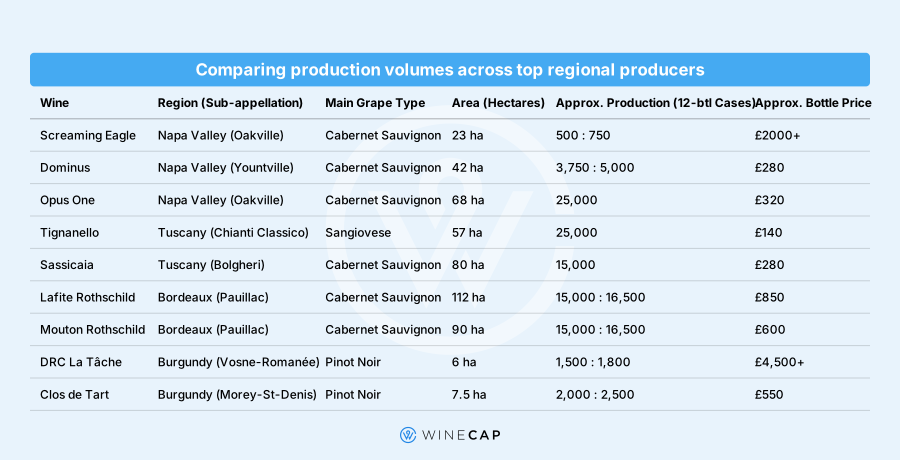
Categories
Learn

How vintage variation impacts wine investment value

  • Vintage in wine refers to the year the grapes were harvested, not the year of release.
  • A vintage wine is a biological time capsule of that year’s specific weather patterns.
  • For investors, vintage quality is a key driver of secondary market value and longevity.

In the world of fine wine, a vintage is much more than a date on a label; it is a record of a single growing season. Wine, in many ways, is bottled history.

For a wine to carry a vintage date, the grapes must have been harvested in that specific year, although regional regulations allow for some flexibility in the exact percentages used. Unlike non-vintage wines such as NV Champagne or Sherry, which rely on blending across multiple years to maintain a consistent house style, vintage wines embrace variation.

For the investor, this variation is what creates a market. A 1982 Château Lafite Rothschild is a fundamentally different financial and sensory asset to a 1983, despite being produced from the same vineyards, by the same team, in the same winery, only a year apart.

Beyond a great vintage

In fine wine investment, a great vintage is certainly an advantage, but it cannot be the only consideration. A 100-point “vintage of the century” may sound like a guaranteed success, yet price is often the factor that ultimately determines investment performance.

Chateau Lafite Rothschild 2013 is a textbook example of this dynamic. Produced during a challenging growing season and criticised by some commentators as “lightweight”, the wine was released at comparatively modest prices. But when the Bordeaux market began to recover in 2015, that low entry point became its greatest strength. The wine did not need to be legendary to succeed as an asset; it simply needed to be Lafite Rothschild.

While the heavily hyped and aggressively priced 2010s struggled to justify their release valuations, the 2013 quietly outperformed expectations. Between 2015 and 2018, values doubled, and by the market peak in 2022, prices had risen by around 180% on the secondary market.

For the savvy investor, this highlights that a weaker vintage bought at the right price can often prove a far better investment than a perfect vintage bought at the wrong one.

How time influences vintage quality

While it is rare for the broader consensus around an entire vintage to dramatically change over time, opinions on individual wines often do. In fine wine, time is arguably the single most important ingredient in any portfolio.

Unlike most consumer goods, which begin to depreciate the moment they are purchased, investment-grade wine is a living asset that evolves in bottle. This is one of the qualities that makes fine wine such a unique alternative asset class. With age, wines can gain complexity, harmony and character, sometimes transforming dramatically from their youthful state.Neal Martin's Lafite Rothschild 1985 scores over time

The evolution of Chateau Lafite Rothschild 1985 provides a compelling example. Neal Martin’s scores for the wine improved significantly over time, illustrating how a wine that may initially appear restrained or underwhelming can reveal extraordinary quality with sufficient bottle age.

It is entirely possible for a wine to disappoint in its youth yet become exceptional decades later. Vintage matters, but it is not everything. In fine wine, patience is often rewarded, and few assets benefit from time quite like wine does.

How regionality impacts vintage variation

Vintage quality is rarely uniform across the wine world. A “vintage of the century” in Bordeaux does not necessarily translate to Tuscany, the Mosel or Napa Valley. Each region responds differently to the conditions of a growing season, shaped by its climate, geography and grape varieties.

For investors, this regional variation creates opportunity as well as diversification. A difficult, rain-affected year in Bordeaux may coincide with an outstanding vintage in Champagne or Piedmont. Understanding these regional differences allows WineCap to build more resilient portfolios, reducing reliance on the fortunes of any single region or vintage.

Technology and vintage quality

Modern technology and greater precision in the vineyard and winery have also transformed what constitutes an “off-vintage”. Today, even challenging years can produce impressive wines thanks to significant advances in viticulture and winemaking.

Optical sorting tables, for example, allow estates to remove underripe or damaged grapes with extraordinary accuracy, ensuring only the best fruit reaches the vat. Drones and satellite mapping provide detailed insights into vineyard health and how vines are responding to the pressures of the growing season. Meanwhile, smaller and more numerous fermentation vats allow winemakers to vinify individual parcels separately, giving them far greater control when constructing the final blend. Grapes affected by heat stress or uneven ripening can therefore be handled more gently and precisely.

A talented winemaker cannot transform a poor year into a mythical 100-point vintage, but they can dramatically raise the floor of quality. As a result, modern “off-vintages” are often significantly better than their equivalents from the 1970s or 1980s. For collectors and drinkers alike, this can create compelling value, even if the long-term investment upside may be more limited.

Natural factors that shape a vintage

Despite all the advances in technology and winemaking, wine remains fundamentally an agricultural product, shaped by the whims of weather and climate. Ultimately, it is nature that determines whether a vintage will be remembered as great, average or forgettable.

Many leading critics and winemakers have attempted to define the ingredients of a great vintage. Among the clearest explanations are those offered by Antonio Galloni of Vinous and Denis Dubourdieu, the renowned Bordeaux consultant and Professor of Oenology at the University of Bordeaux. Their analysis highlights several recurring themes that consistently underpin the world’s greatest vintages:

1. Budburst and flowering

A great vintage is won or lost during the growing season, which typically lasts from April to October in the Northern Hemisphere. The process begins with budburst, where the vine wakes up from winter dormancy.

If a vintage is to be legendary, it requires:

  • A steady progression without major shocks.
  • No frost during budburst as this can kill potential fruit.
  • Dry enough weather during flowering (the “fruit set”) as rain can cause uneven development. 
  • A seamless transition from flowering to veraison (when grapes change colour and soften) and finally to the harvest.

2. Sunshine and heat

Sugar accumulation in grapes requires consistent sunlight. Regions measure this through “Growing Degree Days” (GDD), a sum of the daily temperatures above a certain threshold.

A great vintage typically features a warm, but not scorching, summer. Excessive heat can cause the vines to shut down to conserve water, leading to cooked flavours and high alcohol. Conversely, a cool year may result in underripe tannins. The Goldilocks vintage provides just enough heat to ripen the fruit while maintaining elegance.

3. Diurnal range

One of the most overlooked factors in a top-tier vintage is the diurnal temperature shift, the difference between the daytime high and the nighttime low.

Warm days build sugars and fruit intensity, but cool nights are essential to preserve natural acidity. Without these cool nights, the grapes “breathe away” their acidity, losing the structure they need for long-term ageing. Legendary years are almost always defined by significant diurnal shifts.

4. Water stress

Vines actually produce higher quality grapes when they are slightly stressed. If a vine has too much water, it focuses on growing leaves rather than ripening fruit, leading to diluted flavours.

A great vintage usually features a dry late summer. This signals to the vine that it must put all its energy into the grapes to ensure the survival of its seeds. 

However, extreme drought is just as unwelcome as too much rain. The best vintages are those where there is just enough moisture to keep the vine alive while forcing it to struggle.

5. Phenolic ripeness vs sugar ripeness

A good wine grape is much more than a sweet juicy sugar bomb. True quality is also determined by phenolic ripeness, the maturity of the skins, seeds, and stems that go into the vat.

In a great year, phenolic ripeness keeps pace with sugar ripeness. This ensures that the tannins are sweet and silky rather than bitter and astringent. If the weather is too hot, sugar levels can spike before the tannins are ready, leading to an unbalanced wine that feels hot from alcohol but green on the finish.

6. The harvest window

The final two weeks before harvest are the most critical in the entire year. A vintage that looks perfect in August can be ruined by a single hailstorm or a week of heavy rain in September.

Rain just before harvest causes the grapes to swell with water, diluting the flavour and potentially causing the skins to burst, leading to rot (botrytis). A “classic” vintage is often defined by an Indian summer: dry, warm weather in late autumn that allows winemakers to pick the fruit at the right moment without rushing to beat a storm.

What vintages are the best investment

From an investment standpoint, the best vintages carry a Halo Effect. A legendary year like 1982 in Bordeaux or 2010 in Piedmont creates a tide that lifts all boats; even lesser-known estates will see their prices rise because of the vintage reputation.

Investors should look for:

  • A balance between quality and prices: A great vintage is likely to be more costly than a poor one, but if other historic releases are better priced then buyers should beware.
  • Longevity: A great vintage provides the structural bones that allow a wine to appreciate over a longer period.
  • Critical acclaim: Years that receive high aggregate scores from major critics are often beneficiaries of better liquidity as well as higher prices.

Ultimately, vintage is one of the most powerful forces in the fine wine market, but it should never be viewed in isolation. Great investing is not simply about chasing the highest-scoring years; it is about understanding the relationship between quality, price, longevity, regional dynamics and timing. A legendary vintage can create extraordinary returns, but so can an overlooked year released at the right price and given time to mature.

FAQ: Vintage variation 

Does a more expensive wine always mean a better vintage? 

Not necessarily. A famous estate in a poor vintage will still be expensive due to brand power, but it may have less investment upside than a rising-star estate in a legendary vintage.

Can a wine be “too ripe”? 

Yes. In very hot vintages, wines can lose their varietal character and acidity, becoming heavy and lacking the finesse that collectors look for.

What is a “late harvest” vintage? 

This usually refers to years where cool weather delayed ripening, often resulting in wines with higher acidity and more delicate, floral aromatics.  It can also refer to a specific style of sweet wine. 

How does climate change affect vintages? 

It is making great vintages more frequent in historically cool regions like Burgundy and Germany, but it is also increasing the risk of extreme weather events like frost and heatwaves.

WineCap’s independent market analysis helps investors build diversified fine wine portfolios with full ownership and transparent pricing. Speak to one of our wine investment experts and start building your portfolio. Schedule your free consultation today.