Categories
News

Are Bordeaux classifications still relevant for investors?

WineCap has conducted a series of interviews with key figures at major Bordeaux estates. Today we shed light on their perspectives on the relevance of historic classifications. 

  • Left and Right Bank producers think the 1855 and 1955 classifications are still important reference for investors.
  • Branding influence represents a counter pattern. 
  • Market forces bring lower-tier Growths to the fore but not trend-setting.

The majority of a tranche of wine producers interviewed by WineCap from both the Left and Right banks are confident that Bordeaux classification systems remain relevant, citing historical framework and terroir as the main factors in determining wine quality and value.

Châteaux also think that the 1855 Classification of Bordeaux and the Saint-Émilion Classification of 1955 will continue to have an impact on wine investor and consumer choices in the decades ahead.

‘This is the classification of terroir,’ said Château Cheval Blanc CEO, Pierre-Oliver Clouet. ‘The (original) classification was very clear and continues to be the same today’.

The classification systems

The 1855 Classification of Bordeaux is a ranking of the top wines from the Left Bank’s Médoc region, Graves, Sauternes and Barsac. It was established to coincide with Napoleon III’s Exposition Universelle de Paris, with wines categorised according to reputation and market price from Fifth to the top ranking of First Growth. With the exception of minor changes, it has never been altered. The houses in the highest level are Latour, Lafite Rothschild, Mouton Rothschild, Margaux and Haut Brion.

On the Right Bank, a wine classification hierarchy was founded in 1955 covering Saint-Émilion and Pomerol. Updated every decade with the last review held in 2022, it grades wines into the top tier of Premier Grand Cru Classé A, Premier Grand Cru Classé B, and the broader category of Grand Cru Classé.

Staying power

Philippe Bascaules managing director of First Growth Château Margaux said soil was the defining factor in the 1855 ranking. ‘I think for 90%, it’s still relevant because the quality of the wine is given by the soil, and the soil doesn’t change’. 

Philippe Blanc General Manager Château Beychevelle referred to the enduring legacy of the 1855 system. The Saint-Julien house that he oversees is ranked as a Fourth Growth and he does not see this changing in the future. 

‘I don’t think any serious people have ever written that first growths didn’t deserve their place,’ he told WineCap. ‘I would say in 30 years’ time, stick to the 1855 classification in Médoc’.

Vincent Millet, General Manager at the Third Growth Château Calon Segur in Saint-Estèphe agrees. ‘The 1855 classification was based not only on the observation of the winegrower through the constitution of his vineyard, but also of his wines,’ he said. ‘For me, it makes no sense to question it, because in a way, it reflects the potential of the different appellations’. 

Christian Seely is the managing director of AXA millésimes, the company that owns Second Growth Pichon-Baron in Pauillac. He hints at the foresight of the original ranking framework. ‘I would say that where around 80% of the châteaux were in the classification in 1855 is where they ought to be today. I don’t think another 20 years is going to change that’.

Brand over classification

However, as the global wine landscape shifts and changes, a significant number of Bordeaux winemakers are putting equal weighting in branding and, in some cases, over classification systems. 

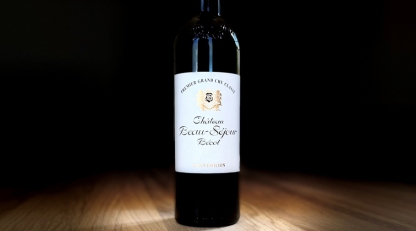
Julien Barthe, the co-owner and managing director of Premier Grand Cru Classé B, Château Beau-Séjour Becot in Saint-Émilion is of this number. ‘We were very lucky in Beau-Séjour Becot because we were classified as Premier Cru Classé in 1955. Why? Maybe because we are a good winemaker family, but for sure because we have unique and outstanding soil and terroir’. 

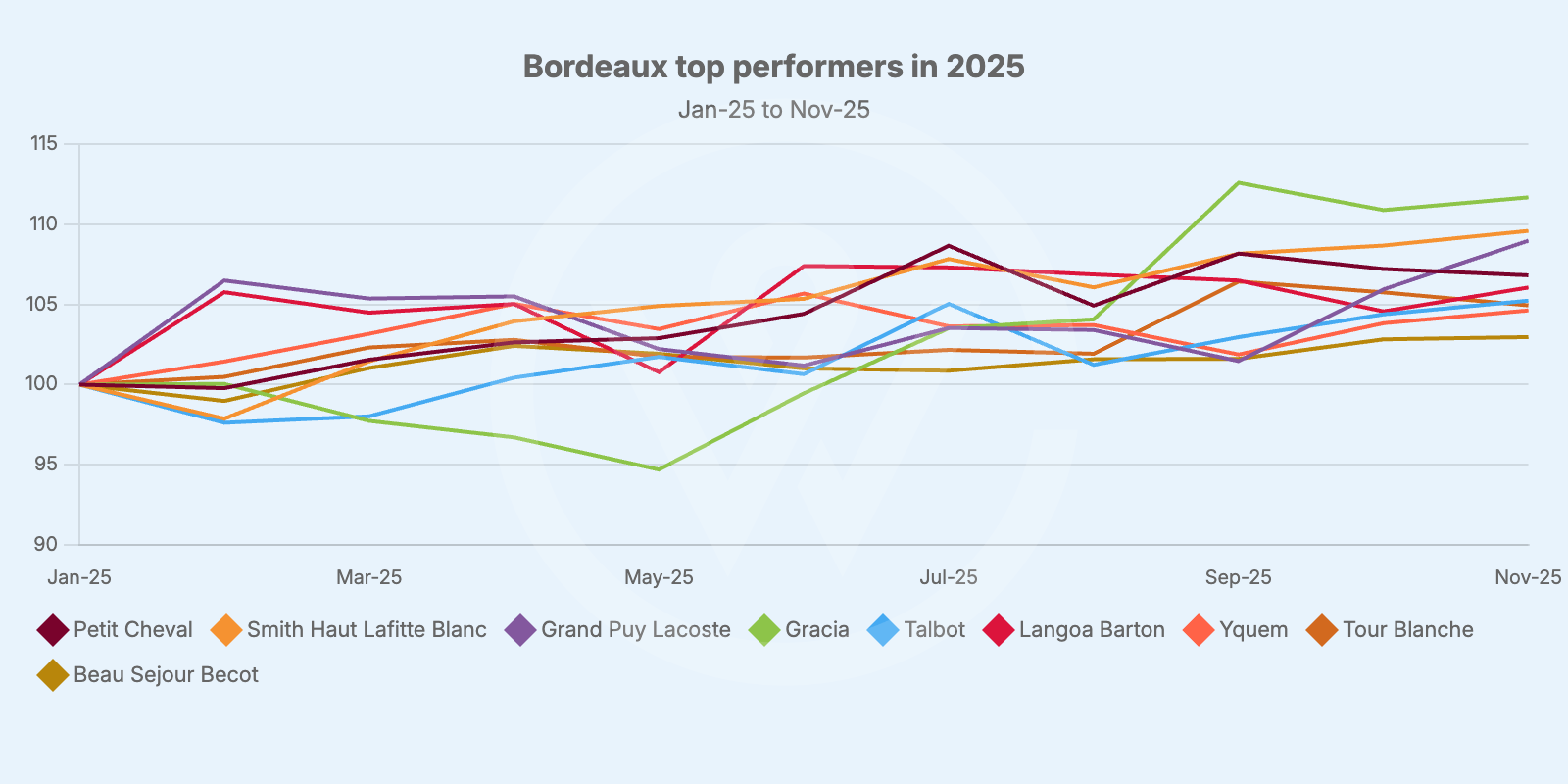
Despite his acknowledgment of ranked terroir quality, Barthe believes that a house’s brand is gaining traction. ‘Do you know Beau-Séjour Becot or do you not know Beau-Séjour Becot? I really think that the brand will be more important than the classification’. In the last decade, their average wine price has risen 60%, outperforming fellow estates, La Mondotte, Clos Fourtet and Larcis Ducasse.

Calon Segur’s Vincent Millet agrees: ‘What is most interesting today is not so much the classification, but the strength of the brand. For example, you have properties that are ranked fifth in the classification and which have a reputation. A strong brand can be more important than certain Second great classified growths of Margaux, for example. We at Calon Ségur have this strength, this brand that we maintain through the quality of our wines’.

General Manager of Saint-Émilion Grand Cru Classé, Château La Dominique, Gwendoline Lucas said that both Right and Left Bank classifications were becoming irrelevant. ‘Today the consumer doesn’t drink First, Second or Third Growth or Saint-Émilion B or A. They drink a wine they know. They know the style of the wine, so they will drink Château La Dominique rather than Saint-Émilion Grand Cru Classé. So, I would say that the brand, the history and the wine itself, will override classification’. 

From an investing perspective, La Dominique has enjoyed a 96% price increase since 2015.

Lower tiers’ achievements

WineCap interviewees recognised the above-average performance of Growths from the lower end of the 1855 classification but were not certain that this constituted a solid trend.

Pichon-Baron’s Seely said: ‘You obviously get exceptional cases of some châteaux outperforming in relation to their classification. You have a Fifth Growth that performs like a Second Growth, and perhaps there are just one or two that perform a little lower than their original ranking. But those cases actually, I think, are the exceptions rather than the norm’. 

Evolution of Bordeaux’s investment performance

Bordeaux remains the most important wine investment region, accounting for over a third of the fine wine market by value today with a 200% average growth on top labels since 2005. The First Growths, their second wines and “super second” estates are often the cornerstones of investment portfolios. 

To find out more about the region, read our Bordeaux Regional Report.

Categories
Regional-reports

United States | Regional Report

1976 was the turning point for California and US wine in general. ‘The Judgement of Paris’ blind tasting on May 24th proved that France had a serious contender when top Californian Bordeaux blends were tasted against Bordeaux classed growths, and Californian Chardonnays against white Burgundy. To the surprise of many, California led on both fronts.

This was the first step that set the region in motion. In the 1990s, the first Californian ‘cult wines’ emerged – big brands that attracted collector followings. Producers such as Inglenook, Stag’s Leap, and Robert Mondavi were the pioneers, but it was Screaming Eagle that established the formula for success that many followed: tiny volumes, word-of-mouth hype, and soaring prices. Robert Parker’s appraisal and perfect scores further bolstered their image.

The global market for US wines, dominated by California but also featuring wines from Washington and Oregon, has exploded in recent years. Its share of secondary market trade has risen from 0.1% in 2010 to around 7% this year, and an increasing number of previously overlooked wineries are now showing investment-worthy returns.

Our USA Report delves into the development of its investment market, historic performance, recent expansion and key players.

Discover more about:

  • History of the US wine industry
  • International and domestic trade
  • California’s most significant AVAs
  • Napa Valley’s investment-worthy wines

Do not hesitate to get in touch and speak to one of our wine investment advisors for further information and to reserve your allocations.

Download your complimentary copy of the United States Regional Report and discover how fine wine can enhance your investment portfolio.

United States Regional ReportDownload


Categories
Learn

How is the price of fine wine determined?

The price of fine wine is influenced by a combination of tangible and intangible factors. For anyone interested in wine investment, understanding these factors is essential to making informed decisions. This guide explores the key elements that determine the price of fine wine, from production to market dynamics.

Producer and brand reputation

The reputation of a winery or estate significantly impacts the price of its wines. Prestigious producers, often with centuries-old traditions and consistent track records of quality, command higher prices. These brands have established trust and recognition in the global market, creating demand that sustains their premium pricing. A bottle from a renowned producer like Château Margaux, Domaine de la Romanée-Conti, or Screaming Eagle is synonymous with luxury and excellence. Even wines from less prominent producers within these regions gain value by association, benefiting from the overall prestige of their appellation or terroir.

Vintage quality

The quality of the harvest in a particular year, known as the vintage, is one of the most critical factors in determining wine prices. Weather conditions during the growing season have a profound impact on grape quality, which in turn affects the wine’s flavor, aging potential, and market desirability. Exceptional vintages often garner high critical acclaim, making them highly sought after by collectors and investors alike. For example, Bordeaux’s 1982 vintage and Burgundy’s 2010 vintage are renowned for their excellence and have seen sharp price appreciation over time. On the other hand, wines from less favorable vintages may be priced lower initially or experience slower value growth.

Scarcity and production volume

Scarcity plays a pivotal role in determining the price of fine wine. Wines from small-batch producers or limited-production labels are often more valuable because demand outstrips supply. Additionally, the concept of “drink or hold” means that as bottles are consumed, the remaining supply becomes increasingly rare, further driving up prices. For example, cult wines from Napa Valley, which are produced in limited quantities, often experience rapid price increases due to their exclusivity. Over time, the scarcity of these wines enhances their desirability, making them a strong candidate for investment.

Critical scores and reviews

The opinions of influential wine critics and publications play a significant role in shaping a wine’s price. High scores or glowing reviews can lead to immediate surges in demand and pricing, while mediocre evaluations may suppress a wine’s market reception. A 100-point score from Robert Parker, for instance, can increase a wine’s price by 30-50% almost overnight. Wines with consistently high ratings from multiple critics maintain stronger long-term value, as these endorsements build buyer confidence and elevate the wine’s reputation in the market. Conversely, a lack of critical acclaim can limit a wine’s appeal, even if it has other desirable qualities.

Provenance and storage conditions

Provenance refers to the documented history of a wine’s ownership and storage. It is a crucial factor in maintaining and enhancing a wine’s value. Wines with impeccable provenance that have been stored under ideal conditions, such as controlled temperature and humidity, fetch higher prices at auction or in private sales. Poor storage or uncertain provenance can drastically reduce a wine’s worth, even if it is rare or highly rated. Auction houses and private collectors often highlight provenance as a selling point, justifying higher prices for bottles with a verifiable and pristine history. Wines sold directly from the producer or through trusted merchants also carry a premium for their authenticity and reliability.

Market trends and global demand

Broader economic and market trends significantly influence wine prices. Factors such as rising wealth in emerging markets, changing consumer preferences, and currency exchange rates can all impact global demand for fine wine. For example, growing interest in Burgundy from Asian markets over the past decade has driven exponential price increases for wines from this region. Shifts in consumer tastes, such as a preference for organic or biodynamic wines, can also affect pricing, as these categories attract a more environmentally conscious audience. Additionally, economic stability in key markets often correlates with increased investment in fine wine, further bolstering demand.

Age and maturity

The age and maturity of a wine are also critical in determining its price. As fine wine ages, its value often increases, especially as it approaches its optimal drinking window. Collectors are willing to pay a premium for wines that have been properly aged, as this reduces the time and risk associated with cellaring young wines. For example, a young Bordeaux might sell for $200 upon release but appreciate to $500 or more as it nears its peak drinking years. This appreciation makes aged wines particularly attractive to both collectors and investors seeking reliable returns.

Regional prestige and classification systems

Certain wine regions, such as Bordeaux, Burgundy, and Napa Valley, carry inherent prestige that significantly influences pricing. Classification systems, like Bordeaux’s 1855 Classification or Burgundy’s Grand Cru designations, further bolster a wine’s market position. For instance, First Growth Bordeaux, such as Château Latour, consistently commands higher prices than less prestigious classifications, regardless of vintage. Similarly, Burgundy’s Grand Crus outperform wines from lesser designations due to their perceived quality and exclusivity. This regional prestige not only affects initial pricing but also contributes to a wine’s long-term appreciation potential.

WineCap’s independent market analysis showcases the value of portfolio diversification and the stability offered by investing in wine. Speak to one of our wine investment experts and start building your portfolio. Schedule your free consultation today.

Categories
News

‘Snake’ wines for Chinese New Year

  • 2025 marks the Year of the Wood Snake, with previous vintages under the same zodiac sign including 2013, 2001, 1989, and 1977.
  • The Chinese zodiac has traditionally had an impact on wine demand in Asia, which in turn affects the price performance of highly sought-after wines. 
  • We highlight the best regions and wines from past ‘Snake’ years.

The Chinese zodiac continues to influence fine wine trends in Asia, particularly around Lunar New Year. 2025 marks the Year of the Wood Snake, with previous vintages under the same zodiac sign including 2013, 2001, 1989, and 1977. Below we explore the best regions and wines from these ‘Snake’ years and their investment appeal.

The significance of the snake in Chinese culture

In Chinese tradition, the Snake symbolises wisdom, intuition, and elegance. The Wood Snake specifically reflects growth, creativity, and a steady rooted approach to success. These traits align well with the qualities sought after in fine wines: depth, complexity, and balance. Lunar New Year celebrations often include gifting wines that embody these ideals, making vintages from previous Snake years highly sought-after. 

Past ‘Snake’ vintages

2013

A cooler vintage in many wine regions, 2013 produced exceptional wines in Napa Valley, Burgundy and the Rhône. Burgundy excelled with refined reds and whites celebrated for their freshness and purity, with the best examples coming from notable producers such as Domaine de la Romanée-Conti and Comte Georges de Vogüé.

In Napa Valley, a warm, dry autumn contributed to standout Cabernet Sauvignon wines, including iconic labels like Opus One, Dominus, and Screaming Eagle earning high critical appraisal. These highly sought-after wines are likely to enjoy increased demand and rising prices in light of the year of the Snake. 

The Rhône also over-delivered in 2013, with M. Chapoutier’s Ermitage Le Pavillon and Guigal’s single-vineyard wines demonstrating the vintage’s potential. In Italy, Barolo and Barbaresco shone brightly, with producers like Gaja and Vietti crafting wines with great ageing potential. 

2001

Hailed as a classic vintage across several regions, 2001 is especially prized for high-end Bordeaux, which is now reaching its peak. Highlights include renowned estates such as Château Latour, Château Margaux, and Château d’Yquem. The latter achieved a perfect score from Robert Parker, cementing its status as one of the finest sweet wines of the century.

Italy’s Barolo region experienced a legendary year in 2001. Wines from Bruno Giacosa, Bartolo Mascarello, and Giuseppe Rinaldi are benchmarks of the vintage. Meanwhile, the Rhône delivered one of its best years, with Guigal’s La La wines setting new standards for Syrah.

1989

Widely regarded as one of Bordeaux’s greatest vintages, 1989 produced rich, opulent wines with excellent ageing potential. Standouts include Château Haut-Brion, which earned a perfect score from Robert Parker, and Pétrus. In Sauternes, Château d’Yquem once again delivered a reference point for the region.

Beyond Bordeaux, Germany enjoyed a successful year for Riesling. The Mosel and Rheingau regions produced highly collectible wines, celebrated for their vibrant acidity and age-worthy structure. These Rieslings remain a cornerstone for those seeking top-quality German wines.

1977

1977 was a triumphant year for Port production, which has made vintage Port from producers like Taylor’s, Fonseca, and Graham’s a cornerstone for collectors focused on fortified wines. Noteworthy wines from other regions include Domaine Leroy in Burgundy and Château Pichon Lalande in Bordeaux still surprise with their enduring quality and long drinking windows.

Market appeal of ‘Snake’ vintages

Buyers can find regional highlights across all of these Snake-year vintages that are likely to see increased demand in 2025, whether it is 2013 Napa or 1989 Bordeaux. The cultural significance of the snake adds an extra layer of allure in Asian markets, where symbolism often plays a role in purchasing decisions.

WineCap’s independent market analysis showcases the value of portfolio diversification and the stability offered by investing in wine. Speak to one of our wine investment experts and start building your portfolio. Schedule your free consultation today.

Categories
Regional-reports

Bordeaux Regional Report

Our Bordeaux Regional Report examines the evolution of its investment market, the First Growths, their second wines and En Primeur.

Bordeaux has long been the backbone of the fine wine market. Its unique combination of history, scale, and globally recognised brands has positioned it not just as a leading wine region, but as the reference point for fine wine investment worldwide.

As early as 1787, Thomas Jefferson recognised the collectible potential of Bordeaux’s finest estates. More than two centuries later, that early insight still holds true. While the fine wine market has diversified significantly in recent years, Bordeaux continues to play a defining role – often setting the tone for broader market performance.

At its peak in 2010, Bordeaux accounted for an extraordinary 96% of the fine wine market by value. Although its share has since moderated as regions such as Burgundy and Champagne have risen, Bordeaux remains the most influential and liquid region in the investment landscape.

WineCap’s Bordeaux Regional Report explores why this remains the case – and where the most compelling opportunities now lie.

Key findings from the Bordeaux Regional Report

Bordeaux remains the most important fine wine investment region

Despite increased diversification, Bordeaux still accounts for over a third of the fine wine market by value today. Its long-established distribution networks, global demand, and deep secondary market continue to underpin its dominance, particularly for investors prioritising liquidity and long-term stability.

The First Growths continue to anchor the market

The Bordeaux First Growths – Château Lafite Rothschild, Château Latour, Château Margaux, Château Haut-Brion, and Château Mouton Rothschild – remain the cornerstones of fine wine portfolios. While their share of total trade has declined from historic highs, they still represent around 30% of Bordeaux’s secondary market activity, reinforcing their role as pricing benchmarks and confidence indicators.

Second Wines and “Super Seconds” offer compelling value

One of the most notable trends highlighted in the report is the growing importance of second wines and so-called “Super Second” estates. These wines benefit from the same terroirs and technical expertise as their flagship counterparts but offer more accessible entry points. In many cases, they have delivered stronger relative performance over the past decade, driven by rising quality and growing global recognition.

Older vintages are often undervalued

The report shows that some of the most attractive opportunities in Bordeaux today lie not in the latest releases, but in older, overlooked vintages. These wines frequently trade at favourable price-to-quality ratios and can offer greater upside potential than more recent En Primeur releases, particularly in a more price-sensitive market environment.

En Primeur’s influence has weakened

While En Primeur remains a defining feature of Bordeaux, its role has evolved. Pricing misalignment in recent campaigns has reduced its appeal, shifting the focus towards disciplined, selective participation. The report highlights that En Primeur can still present opportunities, but only when release prices reflect broader market conditions and long-term value.

Bordeaux’s role in a diversified market

As the fine wine market has broadened to include Burgundy, Champagne, Italy, and California, Bordeaux has increasingly positioned itself as the region of stability. Its slower but steadier appreciation, combined with unrivalled liquidity, continues to make it a foundational allocation within diversified fine wine portfolios.

Explore the full report

WineCap’s Bordeaux Regional Report provides a detailed analysis of the region’s evolution, historic performance, key investment estates, and future outlook in an increasingly diversified fine wine market.

Download the full Bordeaux Regional Report to explore the data, insights, and opportunities shaping one of the world’s most important fine wine regions.


Bordeaux Regional Report
Download

Categories
Learn

A guide to Burgundy wine regions

Burgundy is one of the world’s most revered and historically significant wine regions. For centuries, it has captivated collectors and wine lovers with its ability to express terroir more precisely than almost anywhere else on earth. Understanding the regions in Burgundy is essential to understanding why it produces some of the most sought-after fine wines in the world.

Unlike larger wine regions defined by broad styles or dominant producers, Burgundy is a mosaic of tiny appellations, historic villages, and meticulously delineated vineyard parcels. Here, value, quality, and reputation are shaped not by château names, but by vineyard location, soil composition, and microclimate. This is a region where a few metres of land can dramatically change a wine’s character – and its price.

At the heart of Burgundy’s complexity lies its regional structure. While thousands of climats and individual vineyards exist, the region is fundamentally organised into five core Burgundy wine regions, each contributing something distinct to Burgundy’s identity. From the cool, mineral-driven whites of Chablis to the warmer, expressive wines of the Mâconnais, these regions together form one of the most intricate wine landscapes in the world.

Regions in Burgundy: structure

Geographically, Burgundy forms a long, narrow corridor of vineyards running from north to south through eastern France. It is divided into four contiguous regions and one satellite region, each with its own climate, soils, and stylistic identity.

Although Beaujolais is sometimes associated with Burgundy through tradition and grape variety, administratively it belongs to the Rhône and is not considered part of Burgundy’s official wine regions.

Burgundy’s vineyard area totals approximately 30,000 hectares, with more than 80% classified under the AOC system. Despite producing only around a quarter of Bordeaux’s volume, Burgundy’s influence on the fine wine market is disproportionately large. Its emphasis on scarcity, site specificity, and classification has made it a benchmark for quality worldwide.

Chablis (Satellite)

Located just two hours southeast of Paris, Chablis is Burgundy’s northernmost outpost and one of the world’s great sources of white wine. Unlike the rest of Burgundy, Chablis sits geographically apart from the Côte d’Or, forming a satellite region with a distinct climate and geological identity.

Chablis produces wines exclusively from Chardonnay grapes, yet its style is markedly different from the richer whites of the south. This is largely due to its Kimmeridgian limestone soils, formed from an ancient seabed rich in fossilised marine life.

Characteristics of Chablis wines

Chablis wines are renowned for their:

  • purity and tension

  • minimal oak influence

  • pronounced chalky minerality

  • long ageing potential at Premier Cru and Grand Cru levels

Cool continental temperatures preserve acidity, giving Chablis its linear structure and precise expression.

Appellations of Chablis

Chablis is divided into four hierarchical appellations:

  • Petit Chablis

  • Chablis

  • Chablis Premier Cru

  • Chablis Grand Cru

The Grand Cru vineyards – just seven climats clustered along the Serein River – represent one of Burgundy’s smallest and most prestigious fine wine zones. Premier Cru sites such as Vaillons, Montmains, Fourchaume and Vaulorent also play a crucial role in defining Chablis’ quality hierarchy.

Côte de Nuits: the heart of Pinot Noir

The Côte de Nuits forms the northern half of the Côte d’Or and is widely regarded as the spiritual home of the world’s greatest Pinot Noir. This narrow strip of east-facing limestone slopes produces some of the most expensive and sought-after red wines on earth.

Key villages include Gevrey-Chambertin, Morey Saint-Denis, Vosne-Romanée, Chambolle-Musigny, and Nuits-Saint-Georges. The region is also home to the most iconic Burgundy estate of all: Domaine de la Romanée-Conti.

Monastic origins and vineyard classification

Viticulture in the Côte de Nuits dates back to Roman times, but it was Benedictine and Cistercian monks who laid the foundations of Burgundy’s modern vineyard system during the Middle Ages. Through centuries of observation, they identified which vineyard parcels consistently produced superior wines, giving rise to the concept of climats and, eventually, grand cru vineyards.

Côte de Nuits Grand Crus

Some of the world’s most revered grand crus are located here, including:

  • Chambertin

  • Clos Saint-Denis

  • Clos de Vougeot

  • Échézeaux

  • Richebourg

  • Romanée-Conti

  • La Tâche

These wines command extraordinary prices due to their rarity, tiny production levels, and global demand. Even in weaker market cycles, Côte de Nuits grand crus remain among the most liquid assets in fine wine.

The Côte de Nuits forms the northern half of the Côte d’Or and is the spiritual home of the world’s greatest Pinot Noir. This narrow strip of hillside produces some of Burgundy’s most celebrated bottles – home to legendary appellations like Gevrey-Chambertin, Morey Saint-Denis, Vosne-Romanée, and the most iconic estate of all, Domaine de la Romanée-Conti.

Côte de Beaune: elegance, balance and great white wines

The Côte de Beaune forms the southern half of the Côte d’Or and is centred around the historic town of Beaune, the commercial heart of Burgundy. This region is unique in producing both exceptional red and white wines, with a stronger emphasis on Chardonnay than its northern neighbour.

A region of diversity

Before the introduction of the AOC system in 1936, wines from this area were broadly referred to as “Beaune wines.” Today, the Côte de Beaune encompasses a complex patchwork of villages, Premier Cru climats, and celebrated grand cru sites.

Iconic appellations include Puligny-Montrachet, Chassagne-Montrachet, Meursault, and Aloxe-Corton. White wines from grand cru vineyards such as Corton-Charlemagne and Montrachet are widely considered among the finest Chardonnay expressions in the world.

The Côte de Beaune contains more than 40 Premier Cru climats, producing wines prized for their balance, structure, and ageing potential.

Côte Chalonnaise: value and tradition

Situated south of the Côte de Beaune, the Côte Chalonnaise is often overlooked yet it plays a vital role in Burgundy’s ecosystem. The region produces high-quality wines from Pinot Noir, Chardonnay, and Aligoté, often at more accessible price points than the Côte d’Or.

Notable appellations of the Côte Chalonnaise

Key villages include:

  • Mercurey

  • Givry

  • Rully

  • Montagny

These appellations offer excellent value while maintaining Burgundian character. Historically, the Côte Chalonnaise also played a key role in the development of Crémant de Bourgogne, with early sparkling wine production centred around Rully and Mercurey.

Mâcconais: warmth, fruit and approachability

The Mâconnais is Burgundy’s southernmost wine region, defined by rolling hills, warmer temperatures, and dramatic limestone formations. Monastic orders, particularly the Abbey of Cluny, were instrumental in establishing viticulture here as early as the 10th century.

Wine styles and grape varieties

Around 80% of vineyards are planted to Chardonnay, producing wines that are generally riper and more fruit-forward than those of northern Burgundy. The region also grows Gamay and smaller amounts of Pinot Noir.

Notable regional appellations include:

  • Pouilly-Fuissé

  • Pouilly-Vinzelles

  • Saint-Véran

  • Viré-Clessé

These wines consistently offer strong quality and value, making the Mâconnais an increasingly important region for collectors seeking Burgundy character without Côte d’Or pricing.

Final thoughts on Burgundy wine regions

Burgundy’s complexity is not a barrier – it is its greatest strength. From the steely minerality of Chablis to the haunting depth of Vosne-Romanée and the crystalline precision of Puligny-Montrachet, each region offers its own interpretation of Pinot Noir and Chardonnay.

Together, these Burgundy wine regions form one of the most intellectually rewarding and historically rich wine landscapes in the world. Defined by centuries of observation, monastic influence, and an unparalleled focus on terroir, Burgundy continues to set the global benchmark for fine wine – captivating collectors, investors, and wine lovers alike.

Looking for more? Read our Burgundy Regional Report, which delves into the fundamentals of this fascinating region and the development of its investment market. 

Categories
News

Burgundy En Primeur 2023 and the current market

  • The 2023 Burgundy vintage is bountiful but heterogeneous in quality.
  • Careful selection of reputable domains and top producers is necessary when making purchasing decisions.
  • In the secondary market, Burgundy prices have fallen 15.2% in the last year.

The Burgundy En Primeur 2023 campaign brings a vintage full of potential and expectations: potential due to the quality but mostly quantity of the vintage in a region defined by scarcity, and expectations for reduced pricing given producers’ desire to sell.

This article provides an overview of the 2023 Burgundy vintage and the market environment that surrounds its launch. 

A heterogeneous but plentiful vintage

The 2023 Burgundy vintage first made news for its volume, which surpassed the region’s average production levels by 30%. Despite heat, drought and flooding challenges, the overall perception is of success – large quantities and above-average quality. Sarah Marsh MW summed it up: ‘The 2023 Burgundy was a bounteous but heterogenous vintage in which the white wines outshone the reds’. 

2023 saw a late-season heat spike that concentrated the fruit. Chardonnay benefited from earlier harvests before extreme heat, while Pinot Noir avoided dilution concerns and achieved natural alcohol levels of 13 – 13.5%. 

The vintage’s overall quality depended heavily on producer management, such as controlling yields for reds and maintaining freshness and acidity in whites. In comparison to the richer, more consistent 2022 vintage, the 2023s demonstrate greater precision, transparency and approachability. Growers and critics have suggested that the 2022/23 might mirror the 2015/16 or 2009/10 pairs.  

The highlights include Bonnes Mares, which stood out for its opulence and structure, with the best examples from Domaine de la Vougeraie and Domaine Dujac. For whites, cooler and mineral-driven sites like Puligny Caillerets and Meursault Perrières were particularly compelling, showcasing precision and vibrancy. Producers like Comte de Vogue, Jean Chartron, and Violot-Guillemard have garnered critical praise. 

Market context

The Burgundy En Primeur 2023 campaign unfolds against a backdrop of shifting market dynamics. Following a robust 2022 vintage and a successful campaign, producers are navigating a softened market. Burgundy prices have fallen 15.2% in the past year, more than any other fine wine region.


Additionally, seven Burgundies dropped from the list of the most 100 most powerful brands in the world in 2024. Still, Burgundy continues to dominate the list, cementing its place as a powerhouse in the global fine wine market. The region’s market share also remains strong, hovering around 25% and sometimes reaching 30%.

Pricing strategies

As producers seek to gather momentum with the 2023 vintage, some are keeping stable pricing levels or even lowering prices. The sizable 2023 yields stand in contrast to the tiny harvests anticipated in 2024, further amplifying the value proposition of the current release.

The 2023 vintage can thus represent a strategic opportunity. Careful selection – looking both at quality and value compared to older vintages – will be necessary, especially as the downward market trend offers a window to secure high-quality Burgundy wines at more accessible price points. More and better priced stock from older vintages has become available, creating competition for the new releases. 

The current market dynamics, characterised by adjusted pricing and evolving consumer trends, create an intriguing context for the campaign. As Burgundy continues to adapt to market shifts and climatic challenges, its enduring prestige remains as compelling as ever.

WineCap’s independent market analysis showcases the value of portfolio diversification and the stability offered by investing in wine. Speak to one of our wine investment experts and start building your portfolio. Schedule your free consultation today
Categories
Learn

Fine wine vs crypto? History, volatility and market returns

  • Fine wine offers steady, long-term growth with controlled price fluctuations, while Bitcoin’s extreme volatility presents both high-risk and high-reward opportunities.
  • Fine wine’s centuries-old market is supported by scarcity, provenance, and established ecosystems, contrasting Bitcoin’s shorter, speculation-driven history.
  • Fine wine appeals to risk-averse investors seeking diversification, while Bitcoin caters to those pursuing rapid investments.

Bitcoin has recently captured investment interest as it surged past the $100,000 (£80,000) benchmark for the first time in December last year, up from $45,000 (£36,000) at the beginning of 2024. With its meteoric rise fuelled by regulatory approvals for cryptocurrency exchange-traded funds and mostly the results of the US presidential election, Bitcoin demonstrated its ability to deliver unparalleled gains. Yet, crypto remains a high-risk asset defined by dramatic volatility. From its genesis in 2009, Bitcoin has seen multiple boom-and-bust cycles, with price swings of over 50% in both directions within a single year not uncommon. 

By contrast, fine wine represents a markedly different asset class, appealing to those who prioritise stability and long-term appreciation. The fine wine market has a storied history spanning centuries, with values driven by scarcity, provenance, and global demand rather than speculative hype. While prices in the fine wine market can fluctuate, they tend to avoid the extreme volatility seen in cryptocurrencies. Instead, they enjoy steady growth that outpaces inflation and provides a reliable hedge against economic uncertainty.

Volatility

Bitcoin’s price chart tells a story of rapid ascents and precipitous falls. For example, its 2017 bull run saw prices climb from £800 ($1,000) to nearly £16,000 ($20,000) only to crash to £2,400 ($3,000) the following year. Similar patterns occurred in 2021 and again in 2024, leaving investors questioning when the next downturn might strike.

Fine wine, on the other hand, avoids such dramatic shifts. Prices typically rise or fall within a controlled range, supported by consistent demand from collectors and investors worldwide.

Historical context

Cryptocurrencies are a product of the digital age, with Bitcoin gaining widespread attention only over the past decade. Its rise has been driven by speculative interest, technological innovation, and the allure of decentralisation. However, its short history leaves it vulnerable to regulatory uncertainties, technological disruptions, and shifting investor sentiment.

Fine wine, conversely, boasts a legacy that stretches back centuries. Iconic regions like Bordeaux, Burgundy, and Tuscany have long been synonymous with quality and value. Investments in fine wine are supported by an established ecosystem of producers, merchants, and auction houses. This historical grounding provides a level of security that new asset classes like cryptocurrency struggle to match.

Market performance

One of the defining features of fine wine as an investment is the importance of regional performance. For instance, Burgundy has risen 550% on average over the last twenty years, with some wines achieving returns of over 1,500%. 

The world of fine wine has its own higher risk and higher return investments but it also offers a range of reliable long-term performers. This is why building a fine wine portfolio requires expertise and careful curation. A well-diversified portfolio includes big brands but also undervalued wines and vintages from a variety of regions which can see their value rise based on demand, critic scores, age or other intrinsic factors. 

Liquidity: fast vs steady

Liquidity is another key difference between fine wine and crypto. Bitcoin can be bought and sold 24/7 on global exchanges, making it one of the most liquid investments available. However, this liquidity can exacerbate price swings, with significant moves often triggered by news events or changes in market sentiment.

Fine wine, while less liquid, offers a more controlled market environment. Secondary sales typically occur through investment companies and trading platforms, with prices reflecting a stable and growing investor base. This slower pace can be an advantage for investors seeking to avoid speculative bubbles.

Diversification and portfolio strategy

In today’s investment landscape, fine wine and cryptocurrency appeal to very different investor profiles. Bitcoin caters to those seeking high-risk, high-reward opportunities, while fine wine offers steady, long-term growth and diversification. Incorporating both into a portfolio can provide balance, but the emphasis should align with an investor’s risk tolerance and financial goals.

Fine wine also underscores the importance of expertise. A portfolio focused on iconic regions and proven vintages can deliver strong returns, with minimal exposure to the broader market’s ups and downs. As seen in the market of 2024, the best-performing wines relied on deep knowledge of regional trends and intrinsic dynamics.

WineCap’s independent market analysis showcases the value of portfolio diversification and the stability offered by investing in wine. Speak to one of our wine investment experts and start building your portfolio. Schedule your free consultation today.

Categories
News

The evolution of Bordeaux’s vineyard prices: what’s behind the price tag?

  • Vineyard prices in Pauillac have risen over 700% in the last 30 years.  
  • Sauternes has faced a 90% decline during the same period. 
  • Pomerol has significantly outpaced Saint-Émilion, partly due to its compact size and luxury appeal.

The American Association of Wine Economists has released data on the evolution of Bordeaux vineyard prices from 1991 to 2023. Over this period, Bordeaux has become the centrepiece of a thriving, regulated wine investment market.

Global demand for Bordeaux wines has fueled remarkable growth, with top estates achieving iconic status as luxury brands. A 2011 valuation revealed that over 50 of Bordeaux’s leading châteaux belong to the €50 million club, with a combined market value exceeding €15 billion.

In the past two decades, Bordeaux fine wine prices have risen by an average of 200%, accompanied by significant increases in vineyard prices in its most sought-after appellations.

This article delves into the shifting dynamics of Bordeaux’s wine industry, examining their impact on vineyard prices and the contrasting trajectories of key sub-regions like Pauillac, Sauternes, Pomerol, and Saint-Émilion.

Pauillac’s extraordinary growth

Pauillac’s vineyard prices have experienced extraordinary growth over the past three decades, surging by 700.6% from €374,700 per hectare in 1991 to €3 million in 2023. The region is home to the First Growths Lafite Rothschild, Latour, and Mouton Rothschild.

When compared to other regions, Pauillac’s relatively small size – spanning approximately 1,200 hectares under vine – is a key factor contributing to its high vineyard prices. This limited vineyard area, combined with the prestige of its châteaux, creates a scarcity effect that drives up demand and valuation. Despite its compact footprint, Pauillac has managed to consistently dominate the fine wine market.

The rise of Pauillac aligns with the global increase in demand for fine Bordeaux wines, particularly during the 2000s and early 2010s, when new markets like China became major consumers. However, this growth has slowed in recent years. This could stem from market saturation, with collectors shifting their attention to other Bordeaux appellations or entirely different regions such as Burgundy and Champagne. 

The decline of Sauternes

In stark contrast to Pauillac, Sauternes has suffered a decline, losing nearly 90% of its vineyard value since 1991. Once valued at €293,000 per hectare – higher than Saint-Émilion at the time – Sauternes vineyards are now priced at around €30,000 per hectare, according to AAWE. This fall can largely be attributed to waning consumer interest in sweet wines.

The production costs associated with Sauternes, which involve the labour-intensive process of harvesting botrytised (noble rot) grapes further compound the issue. While top producers like Château d’Yquem continue to uphold the region’s reputation, the broader market for Sauternes is facing challenges due to changing consumer preferences.

Pomerol and Saint-Émilion: a tale of two trajectories

Pomerol and Saint-Émilion present an interesting comparison, with Pomerol emerging as a high-growth luxury niche and Saint-Émilion maintaining steady performance. From 1991 to 2023, Pomerol vineyard prices rose by 213.4%, reaching €2 million per hectare, while Saint-Émilion saw only a modest 14.7% increase to €300,000 per hectare. These differences can be explained by several key factors.

  1. Size and scale

Saint-Émilion spans a vast 5,400 hectares, compared to Pomerol’s much smaller 800 hectares. This sheer scale means Saint-Émilion includes a wide range of producers, from elite châteaux like Cheval Blanc and Ausone to lesser-known estates producing more affordable wines. In contrast, Pomerol’s compact size results in a higher concentration of prestigious vineyards, with fewer smaller players to dilute its overall market perception.

  1. Classification systems

Saint-Émilion’s classification system – updated every decade – categorises its estates into tiers such as Premier Grand Cru Classé A and B, and Grand Cru Classé. However, the frequent use of the “Grand Cru” designation (applied to over 60% of the region’s wines) might work against it, and partly diminish the exclusivity of this title.

Conversely, Pomerol lacks any formal classification system, allowing individual estates like Pétrus and Le Pin to dominate through their reputations alone. This lack of stratification has paradoxically bolstered the region’s image as a luxury appellation. Its reputation as a source of small-production, Merlot-dominant wines has further cemented its status as a ‘cult’ appellation among collectors and investors. 

  1. Smaller players and price dilution

Saint-Émilion’s large number of smaller, lesser-known producers contributes to its lower average vineyard price. These producers often operate outside the Grand Cru Classé system, pulling down the overall valuation of the region. In Pomerol, the scarcity of vineyards and the dominance of high-profile estates create a ‘halo effect’ that supports consistently high valuations, even for lesser-known properties.

Implications for the wine investment market

The contrasting trajectories of Bordeaux’s appellations highlight the complexity of the fine wine investment market. Pauillac’s recent plateau demonstrates that even the most prestigious regions are not immune to market saturation, while Pomerol’s steady growth underscores the enduring appeal of scarcity and exclusivity. In contrast, Sauternes illustrates the vulnerability of regions reliant on shifting consumer preferences. However, renewed efforts by producers to embrace sustainability, innovation, and rebranding may help revive interest in sweet wines and mitigate some of these challenges.

Despite fluctuations, Bordeaux’s iconic estates and global reputation remain a cornerstone of the fine wine market. For investors and collectors, navigating the nuanced landscape of vineyard prices and evolving market dynamics will be crucial to securing long-term success in this ever-changing industry.

WineCap’s independent market analysis showcases the value of portfolio diversification and the stability offered by investing in wine. Speak to one of our wine investment experts and start building your portfolio. Schedule your free consultation today
Categories
Learn

2024’s big investment themes

  • AI integration has been a significant driver of market activity in 2024.
  • US dollar surged following President Donald Trump’s re-election, but subsequent tariff announcements led to market volatility. 
  • Fine wine solidified its status as the most popular collectible asset in 2024.

The global investment landscape in 2024 has been shaped by the interplay of technological innovation, geopolitical shifts, and a growing appetite for alternative assets. From the rapid integration of AI and rising interest in collectibles to the continued emphasis on sustainability and diversification, investors have navigated an evolving landscape with a focus on innovation, stability, and resilience. Below we examined the big investment themes that defined the year that was. 

AI adoption and mergers and acquisitions

The rapid adoption of AI has been a significant driver of market activity in 2024. Major corporations across various sectors have invested heavily in AI infrastructure to enhance operational efficiency and innovation. This surge in AI integration has led to increased capital expenditures, with leading tech firms projected to spend over $200 billion on AI-related infrastructure, doubling their 2021 spending. 

The growing demand for AI expertise has spurred a wave of mergers and acquisitions among asset managers. A survey by PwC revealed that 81% of global asset managers and institutional investors are considering strategic partnerships or acquisitions of AI-capable businesses by 2028. 

Sports investing gains momentum

Investing in sports has emerged as an attractive avenue, with major leagues’ valuations outpacing the S&P 500 by up to five times. Relaxed ownership rules and the rapid growth in valuations have drawn interest from top firms. Investment options include equity ownership in teams or franchises and credit through loans or structured equity for team or stadium development. However, the sector’s illiquidity and lack of extensive historical performance data require higher return expectations and a thorough understanding of investment projections. 

Currency volatility amid political developments

The U.S. dollar exhibited notable volatility throughout the year, influenced by political developments and economic policies. Following President Donald Trump’s re-election, the dollar initially strengthened against major currencies, driven by investor optimism over proposed tax cuts and infrastructure spending. However, subsequent announcements of tariffs on imports from Canada, Mexico, and China led to market jitters, causing fluctuations in the dollar’s value. 

Global market adjustments

Trump’s policies, including tax cuts and increased tariffs, impacted global markets. U.S. Treasury 10-year bonds surged in yield, anticipating higher budget deficits and inflation, potentially decreasing the likelihood of Federal Reserve rate cuts. Sectors like defense, mining, and international firms earning in dollars were poised to benefit from the currency strength, while renewable energy companies and the automotive industry have faced challenges. 

Emphasis on diversification and alternative investments

In response to market uncertainties, there has been a heightened focus on diversification and alternative investments. Strategies such as incorporating real assets like real estate, commodities, and infrastructure into portfolios have been recommended to hedge against inflation. Additionally, interest in private credit has surged due to its attractive returns, with institutional investors seeking to capture higher yields and diversify portfolios with liquid alternatives and hedge funds. 

Fine wine – the most popular collectible

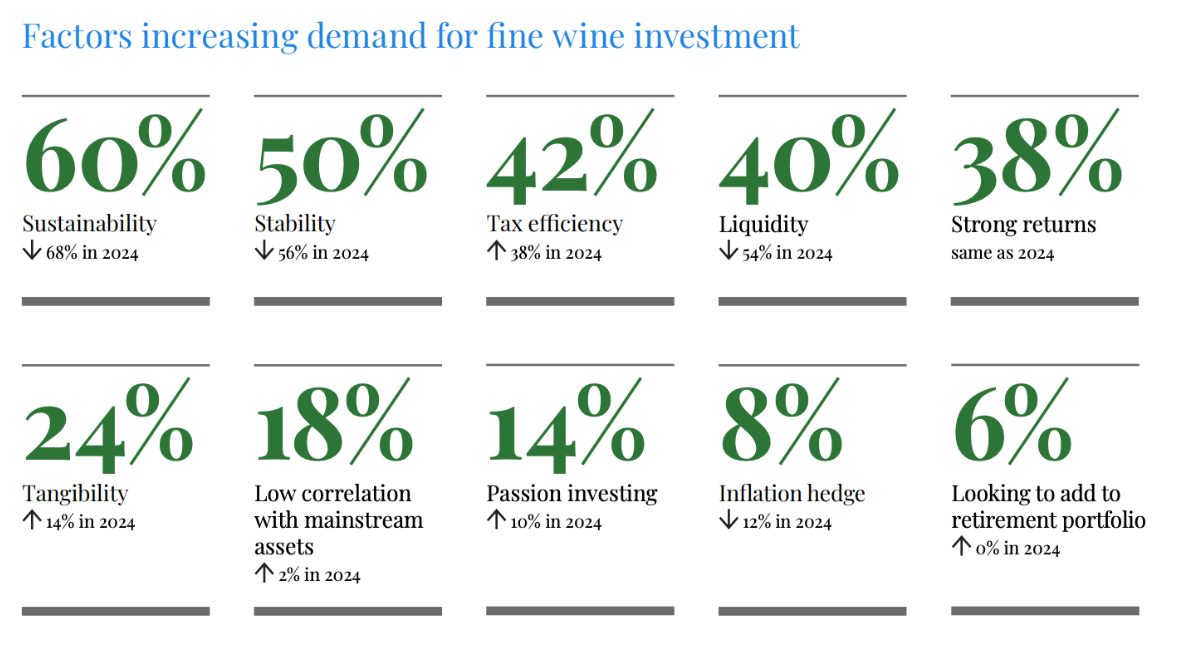
Fine wine has solidified its status as the most popular collectible asset in 2024, driven by its unique blend of stability, sustainability, and market appeal. A remarkable 92% of wealth managers anticipate demand for fine wine to increase over the next year, reflecting its growing allure.

Several factors have contributed to fine wine’s investment appeal including supply and demand, and tax efficiency. Investor confidence in the market’s liquidity has also surged by 32% in 2024, bolstered by advanced technologies that improve trading experiences and ensure security. Fine wine is increasingly viewed as a socially and environmentally conscious investment, with 68% of wealth managers citing sustainability as a key motivation for their clients to invest in this asset. Finally, fine wine continues to offer a stable alternative amid economic volatility. These attributes position fine wine as a cornerstone in the broader trend toward alternative investments. 

Environmental, social, and governance (ESG) considerations

Sustainable investment considerations have remained a focal point, with changing regulatory disclosures and a growing emphasis on ESG factors. The EU continues to lead in the sustainable funds market, accounting for 84% of global assets in this sector. However, amid allegations of greenwashing and stricter regulations, there has been a notable decrease in funds incorporating ESG-related terms into their names, particularly in the United States. 

In summary, 2024 has been characterized by technological advancements, strategic corporate activities, and a cautious yet opportunistic investment approach amid political and economic uncertainties. 

See also: Special report – 2023’s big investment themes: fine wine and beyond

WineCap’s independent market analysis showcases the value of portfolio diversification and the stability offered by investing in wine. Speak to one of our wine investment experts and start building your portfolio. Schedule your free consultation today.