- Tuscany serves as the mainstay for investing in Italian wine, combining large production with global recognition.
- The top ten Tuscan wine producers have historically shown resilience during market fluctuations.
- Tuscany offers a clear dual strategy for investors, balancing international grape varieties and traditional Sangiovese.
From the historic estates of Chianti Classico and Brunello di Montalcino to the revolutionary Super Tuscan pioneers of Bolgheri, Tuscany offers investors access to some of the world’s most sought-after wines. In this guide, we explore ten Tuscan wine producers every investor needs to know, highlighting the estates that continue to define quality, rarity, and long-term market relevance.
Tuscany remains one of the most important regions in the fine wine investment market, combining centuries of winemaking heritage with global demand, critical acclaim, and strong secondary market performance. While names like Sassicaia and Masseto dominate headlines, there is a diverse range of Tuscan wine producers that are shaping the future of collectible Italian wine.
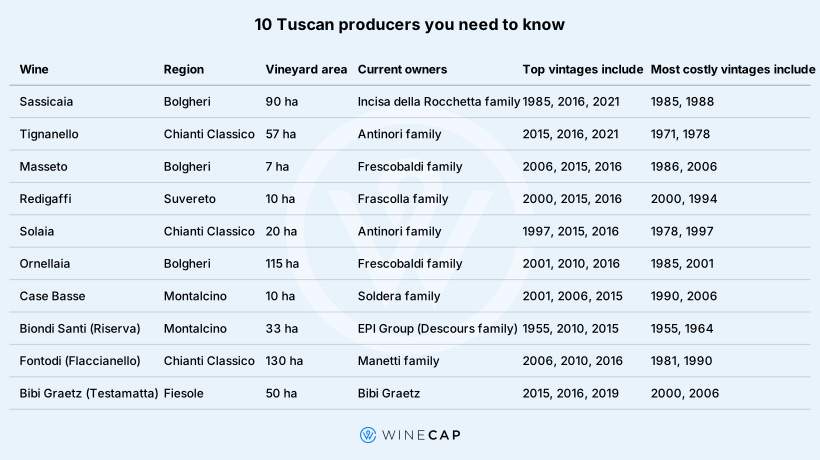
1. Sassicaia
Sassicaia is the foundational Super Tuscan wine that altered the global perception of Italian viticulture. Created by Marchese Mario Incisa della Rocchetta at Tenuta San Guido, the wine began as a private experiment to replicate the Cabernet-led blends of Bordeaux on the coastal soils of Bolgheri. The stony, gravelly terroir bore a striking structural resemblance to the Graves region, providing a natural drainage engine that allowed French varieties to flourish.
From a wine investment standpoint, Sassicaia is one of the most reliable instruments in the entire fine wine trade. It regularly places within the top five of the Liv-ex Power 100 rankings and remains the most searched for Italian wine globally on Wine-Searcher. With a steady annual production of roughly 250,000 bottles, it offers a perfect combination of high market liquidity and defensive price stability, backed by a one of a kind autonomous Bolgheri Sassicaia DOC designation.
- Top vintages include: 1985, 2016, 2021
- Most expensive vintages include: 1985, 1988
2. Tignanello
Produced by the historic Marchesi Antinori family, Tignanello stands as a commercial triumph. Its first releases came to market in the early 1970s shortly after Sassicaia, Tignanello chose a slightly different blending path, retaining a dominant share of Sangiovese while integrating Cabernet Sauvignon and Cabernet Franc to smooth out the regional profile.
The long-term market performance of Tignanello has been exceptional, with our Tignanello index showing growth of 160% over the last decade. Because its entry price remains low, particularly when compared to Bordeaux First Growths, Tignanello displays significant structural resilience during broader market corrections. For much of the last fifteen years, its trading momentum has moved almost in lockstep with Sassicaia, making it a staple asset for private collectors.
- Top vintages include: 2015, 2016, 2021
- Most expensive vintages include: 1971, 1978
3. Masseto
Among truly investable wines with an active secondary market, Masseto is the rarest and most costly Super Tuscan. Cultivated on a small, seven hectare hill of Pliocene clay in Bolgheri, this wine is a 100% Merlot bottling whose signature is an opulent, highly concentrated style and absolute varietal purity.
The estate operates on an entirely different scale of volume compared to its neighbors, producing a limited allocation that naturally triggers desire among global buyers. Masseto possesses immense brand equity, consistently commanding some of the highest prices for any Italian red wine. Its steady capital growth curve makes it a premier selection for wealth preservation.
- Top vintages include: 2006, 2015, 2016
- Most expensive vintages include: 1986, 2006
4. Redigaffi
Produced by the Tua Rita estate in the Maremma region, Redigaffi is the other great Merlot master of Italy. This 100% Merlot bottling cemented its status when the 2000 vintage became the first Italian wine since 1985 Sassicaia to receive a perfect 100-point score from the influential critic Robert Parker.
For a strategic investor, Redigaffi represents a high value alternative to Masseto, often trading at approximately a quarter of the price while achieving comparable critical evaluations. This pricing gap offers significant headroom for future gains.
- Top vintages include: 2000, 2015, 2016
- Most expensive vintages include: 1994, 2000
5. Solaia
Solaia is Tignanello’s stablemate and opposite twin, originating from a contiguous, sun drenched vineyard parcel on the Antinori estate. While Tignanello is anchored by Sangiovese, Solaia reverses the equation with the blend dominated by Cabernet Sauvignon and Cabernet Franc with a smaller structural component of Sangiovese.
In 2009, Solaia joined Masseto as one of the pioneering Italian labels to distribute its production through the historic Bordeaux merchant system known as La Place de Bordeaux. This institutional shift granted the estate access to a vast global network of international merchants, drastically increasing its access to collectors, consumers and investors across the world.
- Top vintages include: 1997, 2015, 2016
- Most expensive vintages include: 1978, 1997
6. Ornellaia
Ornellaia is an essential pillar of the coastal Bolgheri landscape. Historically the Ornellaia team also produced Masseto which only gained its own home until 2019. Crafted as a classic Bordeaux blend, Ornellaia is celebrated for its polished precision and consistent critical acclaim across varying vintage conditions.
The estate is currently in a transitional phase that investors are watching with close attention. The long–term winemaker recently departed the property to take over technical direction at the renovated Bordeaux Second Growth, Chateau Lascombes. This leadership shift could make older back vintages highly collectible assets as historical markers of the estate’s previous era.
- Top vintages include: 2001, 2010, 2016
- Most expensive vintages include: 1985, 2001
7. Case Basse di Gianfranco Soldera
Located in the traditional heartland of southern Tuscany, Case Basse di Gianfranco Soldera represents the peak of cult traditional Sangiovese production. Located in Montalcino, the late Gianfranco Soldera practiced a philosophy of total non-intervention allowing spontaneous fermentation in wooden vats, creating 100% Sangiovese wines of great complexity.
The estate operates with a very small production footprint, yielding allocations that are highly restricted. This scarcity ensures that Case Basse remains completely outside standard market volatility, with prices having risen nearly 300% in the last decade. When it comes to performance, Case Basse successfully challenges Masseto at the top of the Italian valuation table, making it an elite target for collectors who prioritise absolute rarity over transactional volume.
- Top vintages include: 2001, 2006, 2015
- Most expensive vintages include: 1990, 2006
8. Biondi Santi Brunello di Montalcino
Biondi Santi is universally recognised as the historic father of Brunello di Montalcino, having effectively created the designation in the late nineteenth century by isolating specific Sangiovese clones and heavily influencing the later establishment of the Consorzio del Vino Brunello di Montalcino. The estate’s flagship Riserva bottles are legendary for their monumental tannic structure, often requiring decades of cellaring before entering their optimal drinking window.
The secondary market treats Biondi Santi Riserva as a blue-chip asset, akin to a classic Left Bank First Growth. The wine possesses a maturity curve that spans half a century, providing private portfolios with a highly secure, slow maturing store of wealth and appreciation.
- Top vintages include: 1955, 2010, 2015
- Most expensive vintages include: 1955, 1964
9. Fontodi Flaccianello della Pieve
Situated in the heart of Chianti Classico, Fontodi is a champion of organic farming and modern Sangiovese expression. The estate’s most investable wine is Flaccianello della Pieve, a 100% Sangiovese bottling that revolutionized the perception of Central Tuscan wine.
Flaccianello delivers on quality with scores consistently above 96 points at a fraction of the cost of many of Bolgheri’s high profile Super Tuscans. This provides investors with an accessible entry point into top Italian wine, showing steady capital growth as the secondary market increasingly rewards producers delivering high quality at competitive prices. While less investable, by virtue of its pricepoint, Vigna del Sorbo, Fontodi’s Chianti Classico, deserves mention and may be the best value wine in the appellation.
- Top vintages include: 2006, 2010, 2016
- Most expensive vintages include: 1981, 1990
10. Bibi Graetz
Bibi Graetz represents the artistic avant-garde of modern Tuscan winemaking. An artist by training with no formal enological schooling, Graetz began sourcing old vine Sangiovese, Colorino, and Canaiolo parcels around Fiesole to craft wines that completely defied the technical norms of the early 2000s.
His flagship wine, Testamatta, has undergone a dramatic stylistic evolution over the last two decades, transitioning from an opulent, oak heavy profile towards a style of striking transparency and mineral definition. This stylistic shift and the use of La Place de Bordeaux as a distribution channel have triggered growing interest.
- Top vintages include: 2015, 2016, 2019
- Most expensive vintages include: 2000, 2006
FAQ: Top Tuscan wine producers
Why did the Super Tuscan movement choose the IGT classification over DOCG status?
They didn’t. Winemakers like Mario Incisa della Rocchetta broke suffocating rules on wine making by planting French varieties like Cabernet Sauvignon. Because these grapes were unauthorized, the government forced them to label their wines as basic table wine, launching the IGT classification into the consciousness of fine wine lovers.
How do aging rules for Brunello di Montalcino affect the secondary market?
Brunello di Montalcino is bound by some of the most rigid ageing laws in Europe, requiring a mandatory five years of cellaring before commercial release, with at least two of those years spent inside traditional oak casks. For an investor this delay before initial secondary trade data can be analysed does mean that the qualities of a vintage are better understood before the wines are available to buy.
What specific advantage does La Place de Bordeaux provide to Tuscan estates like Solaia?
By routing their allocations through La Place de Bordeaux’s network of French brokers and merchants Tuscan producers bypass regional distributors and instantly access thousands of global buyers in London, Tokyo, and Hong Kong. This global distribution model increases the liquidity of the asset, stabilising market prices and reducing regional transaction friction.
Is fine wine from Tuscany subject to Capital Gains Tax in the United Kingdom?
For the majority of private collectors in the UK, fine wine is classified by HMRC as a wasting asset because it is a tangible product that naturally evolves and breaks down over a predictable lifespan of less than fifty years. Consequently, capital gains realised from the sale of these bottles are generally exempt from taxation, making labels like Tignanello and Sassicaia highly efficient structures for wealth preservation.
How can I protect my investment in Tuscan wines?
As with all investment grade wines arguably the most important step you can take as a wine investor is to ensure proper in-bond storage with a reputable company like WineCap.
WineCap’s independent market analysis helps investors build diversified fine wine portfolios with full ownership and transparent pricing. Speak to one of our wine investment experts and start building your portfolio. Schedule your free consultation today.