- The ageing potential of a wine is one half of the mechanism that drives its long-term growth.
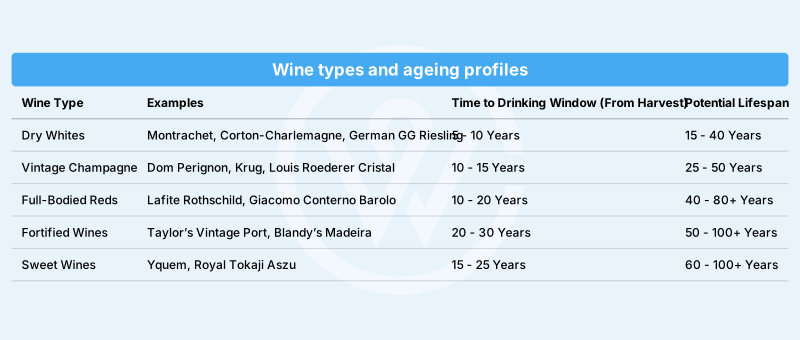
- Fortified and sweet wines represent the apex of longevity due to higher levels of alcohol, sugar, and acidity, which act as natural preservatives.
- While traditional regions like Bordeaux and Piedmont remain the benchmarks for cellaring, modern viticulture in the New World is expanding the horizons.
The importance of ageing in wine investment
Wine is an improving asset in diminishing supply, and time is the most critical ingredient in any fine wine portfolio.
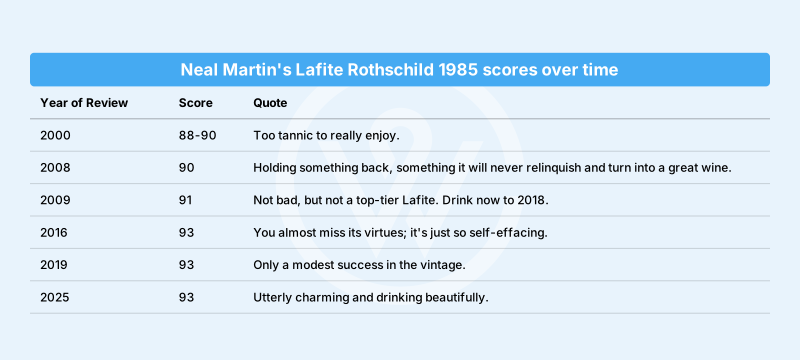
Unlike most consumer goods that depreciate in value the moment they are purchased, investment-grade wine is a living asset that evolves and improves over time. This is a unique feature to wine and the improvement can be dramatic, as seen in the table below which illustrates Vinous’ Neal Martin Lafite Rothschild 1985 score evolution over time.
Not only do fine wines improve over time, they also become scarcer. Every bottle drunk reduces the global supply. For a vintage to gain value, it must be able to survive several decades in a cellar. Without this longevity, a wine is a simple consumption purchase rather than a potential investment.
The relationship between age and value is often non-linear. A wine may trade at its release price for several years before hitting a “drinking window.” Once critics confirm a vintage is reaching its peak, demand and pricing often surges and consumption increases. This phase of the lifecycle is where the most significant returns are frequently realised.
What happens when wine ages?
Fine wine is essentially a slow-motion chemistry set. Even when fermentation has ended, the wine matures through constant slow changes that dictate its long-term investment value.
Key transformations include:
- Micro-oxygenation: Trace amounts of air enter through the cork over decades. This controlled oxidation transforms simple primary fruit into complex tertiary aromas such as leather, tobacco, or forest floor.
- Polymerisation: Harsh tannin molecules link together to form long chains. These feel silkier on the tongue and eventually precipitate as sediment, naturally refining the wine’s texture and mouthfeel.
- Esterification: Acids and alcohols react to create esters. This chemical evolution develops the “bouquet,” adding tertiary layers of spice, truffle, and earth that are absent in younger vintages.
- Anthocyanin shift: The chemicals giving wine its colours change their structure. Red wines fade from vibrant purple to garnet or brick, while white wines darken toward deep gold or amber.
A consistent, cool cellar ensures these reactions happen gradually. Rushing the process with heat prevents complexity from developing. These molecular shifts are what transform a standard wine into a rare, high-value asset.
Wine vs whisky: The biological divide
A common point of confusion for new collectors is the difference between wine and spirits like whisky. Whisky is a distilled spirit with a high alcohol content that effectively halts biological change. Once a whisky is bottled, its flavour profile remains static.
Wine is a living product. It continues to interact with trace amounts of oxygen through the cork and undergoes complex chemical reactions between its acids, tannins, and alcohols. These reactions are what create the sought-after aromas of leather, earth, and dried spices. A bottle of Lafite Rothschild from the 1980s tastes vastly different today than it did in 1990; an examination of scores over time shows this very clearly.
This dynamic nature is why storage conditions are so critical for wine. While a bottle of Macallan can sit on a shelf for years, a First Growth Bordeaux requires a temperature-controlled environment. The risk of spoilage is the price an investor pays for the potential of improvement.
Fortified wines: The indestructible assets
Fortified wines occupy a unique space in the wine world. Unlike “normal” fine wines, which typically range from 12% to 14.5% alcohol, fortified wines are bolstered with grape spirit. This process raises the alcohol level to between 17% and 22%..
This addition of spirit serves two purposes: it stops fermentation early, leaving residual sugar, and acts as a powerful preservative. This is why fortified wines can survive for centuries. While a dry red wine might reach its peak at 40 years, a top-tier Vintage Port or Madeira can still be improving at 100 years.
The winemaking process is also distinct. In many cases, these wines are intentionally exposed to heat or oxygen during production to stabilise them. This pre-ageing makes them incredibly resilient once they are in the bottle.
Long-lived Port
Port is perhaps the most famous fortified wine. Vintage Port is only produced in years of exceptional quality, known as a “declaration.” These wines are designed to be cellared for at least 20 to 50 years before they show their true potential.
The structure of Port comes from its intense tannins and high sugar content. Over time, the aggressive spirit integrates with the fruit, creating a velvet-like texture. Examples of legendary long-lived Ports include:
- Taylor’s Vintage Port (notably the 1945 and 1992 vintages).
- Graham’s The Stone Terraces.
- Quinta do Noval Nacional.
These wines are often considered the ultimate inheritance assets. They are frequently purchased to mark the birth of a child, with the intention of being opened many decades later. Their survival rate is higher than almost any other wine style because they are more robust: so long as the cork remains intact, they are likely to retain their quality.
Sherry with extraordinary ageing potential
While much of the Sherry market is focused on fresh styles, wines like Oloroso, Palo Cortado, and Amontillado have extraordinary ageing potential. The best examples come from the “VOS” (Very Old Sherry) and “VORS” (Very Old Rare Sherry) categories.
These wines have already spent an average of 20 or 30 years ageing in a solera system before bottling. Because they have been intentionally exposed to oxygen for decades, they are virtually immune to further oxidation in the bottle. They offer some of the most complex aromatic profiles in the world, featuring roasted nuts, saline notes, and dried citrus.
Collectible examples include:
- Gonzalez Byass “Matusalem” Oloroso
- Valdespino “Coliseo” Palo Cortado
- Tradición VORS Amontillado
Bordeaux: The global benchmark
Bordeaux is the foundational region for wine investment. Its primary grape, Cabernet Sauvignon, is naturally high in tannins and acidity which are the building blocks of its longevity. As anyone who has attended En Primeur tastings can attest, the structure of a young Bordeaux can be quite harsh, but time softens these elements into a harmonious whole.
The First Growths, such as Latour and Mouton Rothschild, are famous for their ability to withstand long ageing. Even in “off” vintages, the technical precision of these estates ensures a long life.
Notable examples of long-lived Bordeaux:
- Chateau Latour 1961
- Chateau Haut-Brion 1989
- Chateau Montrose 1990
The elegance of aged Burgundy
Burgundy offers a different ageing profile compared to Bordeaux because Pinot Noir is a thinner-skinned grape with lower tannin levels. Longevity in Burgundy comes from the perfect balance of acidity and the incredible concentration of fruit found in Grand Cru sites.
While a Bordeaux might be powerful, an aged Burgundy is ethereal. The transition from fresh raspberry to truffle and forest floor flavors is one of the most celebrated experiences in fine wine. However, Burgundy can be more temperamental in the cellar, making provenance and storage even more critical.
Examples of iconic ageing Burgundy:
- Domaine de la Romanee-Conti (DRC) La Tache
- Domaine Armand Rousseau Chambertin
- Domaine Leflaive Montrachet
Piedmont: Italy’s answer to Burgundy
Like Burgundy, Piedmont focuses on single-vineyard sites and a single grape: Nebbiolo. Nebbiolo is an unusual variety that looks light in the glass but possesses massive tannins and high acidity. Historically young Barolo and Barbaresco were almost impenetrable. It was only in recent years that Piedmont winemakers would declare that their wines could be enjoyed in less than 30 years.
Still, these wines require time to reveal their beauty. A classic Barolo often needs ten to 15 years to become approachable. The best vintages from top producers like Giacomo Conterno or Bruno Giacosa can easily last for half a century.
Examples of long-lived Piedmont:
- Giacomo Conterno Barolo Riserva Monfortino
- Bruno Giacosa Barbaresco Santo Stefano
- Gaja Barbaresco
Tuscany: The rise of the Super Tuscans
Tuscany has two main pillars, both of which can craft long-lived wines: Brunello di Montalcino and the Super Tuscans. Brunello is made from 100% Sangiovese and is legally required to undergo extensive ageing before release. The structure of top Brunello allows it to evolve gracefully for 30 years or more.
Super Tuscans are almost defined by their incorporation of the international varieties brought to fame by Bordeaux: Cabernet Sauvignon and Merlot. These wines were designed to compete on the global stage and have proven their ability to cellar. Sassicaia and Tignanello are the primary examples that investors look for but there are many others that will reward cellaring.
Key Tuscan ageing stars:
- Biondi-Santi Brunello di Montalcino Riserva
- Tenuta San Guido Sassicaia
- Masseto
The New World: USA and South America
The United States, particularly Napa Valley, has established itself as a producer of long-lived Cabernet Sauvignon. Estates like Ridge Vineyards, Stags Leap Wine Cellars and Heitz have bottles from the 1960s and 1970s that are still drinking beautifully today as evidenced by ongoing re-tastings of wines from the 1976 Judgment of Paris. While the cult wines of Napa are frequently approachable in their youth they are also built for long-term cellaring.
In South America, the focus is on high-altitude sites that preserve acidity. Argentina’s Malbec and Chile’s Cabernet blends have shown surprising resilience. Producers are now making wines with more restrained oak and higher acidity to ensure they age as well as their European counterparts.
Examples of New World longevity:
- Ridge Monte Bello (California)
- Screaming Eagle Cabernet Sauvignon (California)
- Catena Zapata Adrianna Vineyard (Argentina)
- Seña (Chile)
South Africa and Australia
South Africa has a long history of sweet wine production, but its red blends from Stellenbosch are now proving their mettle. The Cabernet-based wines from Kanonkop are known for their ability to age for several decades and will often outlast their peers from much more expensive regions.
Australia is home to some of the oldest vines in the world. For instance, the grandfather vines at Henschke were planted in the 1860s and vintages from the 1950s have performed well at recent tastings. Penfolds Grange is also well known for its longevity: a multi-regional Shiraz blend that is designed to be tucked away for 30 to 50 years. The power and concentration of Australian Shiraz provide a sturdy foundation for ageing.
Notable examples:
- Henschke Hill of Grace (Eden Valley)
- Penfolds Grange (South Australia)
- Kanonkop Paul Sauer (Stellenbosch)
Dry white wines: Longevity and evolution
Top-tier still whites also possess a capacity to be aged, even if equivalent quality red wines are generally better able to accommodate multiple decades in the cellar. Longevity in this category is primarily driven by high natural acidity and the fruit concentration found in prestigious vineyard sites. Over time, as colour darkens these wines move away from fresh citrus notes, gaining complex tertiary aromas such as honey, toasted nuts, dried flowers and even cheese as they reach extremely old age.
Notable examples of ageable still whites can hail from many regions, but old world dry whites from Burgundy, Bordeaux, Alsace, the German regions in the Rhine and Mosel valleys are arguably best known for their capacity to age with grace. Examples include:
- Domaine Joseph Drouhin Montrachet Marquis de Laguiche Grand Cru (Burgundy)
- Domaine de Chevalier Blanc (Bordeaux)
- Keller G-Max Riesling Trocken (Rheinhessen)
- Trimbach Riesling Clos Sainte Hune (Alsace)
Can sparkling wine age?
While non-vintage Champagne is ready to drink as soon as it’s available, Vintage Champagne has an undeniable ageing potential. The high acidity and the presence of carbon dioxide act as preservatives that allow ageing to occur over many decades.
As Champagne ages, the bubbles become finer and begin to fade, while the flavour profile shifts from fresh citrus to brioche, honey, and roasted nuts. Some collectors specifically seek late-disgorged bottles that have spent extra time on their lees for even more complexity. Producers are happy to meet that demand: Dom Perignon recently added P3 to their line, allowing a third release window for the best vintages offering vintages from the 1960s and 1970s and 1980s to the market almost 50 years after their initial offering.
Examples of long-lived Champagne:
- Dom Perignon
- Krug Vintage
- Salon Le Mesnil
Underwater ageing: A new frontier
One of the most intriguing developments in recent years is the practice of ageing wine underwater. This trend was sparked by the discovery of 170-year-old Champagne in a shipwreck in the Baltic Sea. The bottles were found to be in remarkable condition, the theory being that constant temperature, darkness, pressure and the lack of vibration fundamentally slow down the ageing process.
Producers are now intentionally submerging cages of wine in the ocean. Notable projects include:
- Veuve Clicquot’s “Cellar in the Sea”
- Leclerc’s Abyss
- Drappier’s Immersion
- Mira Winery (Napa Valley)
- Crusoe Treasure (Spain)
The golden finish: Long-lived sweet wines
Sweet wines are the true champions of the cellar. The combination of high sugar and high acidity creates a nearly immortal product of which Sauternes is the most famous example. Here botrytis, a fungal infestation also known as “noble rot”, concentrates the sugars and acids to an extreme degree.
A top-tier Sauternes like Chateau d’Yquem can easily age for a century. Over time, the wine turns from bright gold to a deep amber colour and the flavours evolve from tropical fruit to complex notes of creme brulee, dried fruits, marzipan and nutmeg.
Other sweet wine icons:
- Suduiraut (Sauternes)
- Egon Müller Scharzhofberger Riesling TBA (Germany)
- Royal Tokaji 6 Puttonyos (Hungary)
- Klein Constantia Vin de Constance (South Africa)
FAQ
How do I know if a wine has ageing potential?
Look for a balance of high acidity, strong tannin structure (for reds), and high fruit concentration. Reviews from reputable critics often include a suggested “drinking window” to help guide your decision.
What is the best temperature for ageing wine?
A constant temperature of around 12 to 14 degrees Celsius is ideal for long-term development. Significant fluctuations in temperature can cause the wine to expand and contract, potentially damaging the cork seal.
Does expensive wine always age better than affordable bottles?
Not necessarily. While most investment-grade wines are expensive because of their longevity, some high-priced wines are made for early consumption. Always check the specific style and vintage before deciding to cellar a bottle.
Can I age white wine as long as red wine?
Most white wines are intended for early drinking, but high-acid whites like Riesling and Chardonnay from top sites can age for decades. Sweet white wines like Sauternes have the longest potential of all unfortified wine styles.
WineCap’s independent market analysis showcases the value of portfolio diversification and the stability offered by investing in wine. Speak to one of our wine investment experts and start building your portfolio. Schedule your free consultation today.
Hey, like this? Why not share it with a buddy?
« Which wines have the best ROI? A 10-year fine wine performance reviewWhat is the difference between wine and Fine wine? »