Categories
News

Is Champagne’s investment market bouncing back?

After a long correction, Champagne is showing early signs of recovery. Discover which brands are stabilising and why now may be the time to invest in Champagne.

  • In June 2025, the Liv-ex Champagne 50 index saw its first monthly rise in a year, suggesting stabilisation across top brands like Dom Pérignon, Krug, and Taittinger. 
  • Our analysis of 50 flagship vintage Champagnes shows widespread price flatlining, indicating consolidation. 
  • With rising demand seen in its market share, Champagne may offer early-cycle upside potential for fine wine investors looking for value and brand prestige.

After more than a year of price corrections, Champagne’s investment market may be turning a critical corner. June brought a notable shift: the Liv-ex Champagne 50 index was the first regional fine wine index to post positive month-on-month growth, rising 0.8%. Though modest, the move could signal a broader turning point when seen in the context of individual brands’ performance within the region.

Champagne’s market performance

Over the past five years, Champagne’s market performance has resembled a game of two halves. From March 2020 to October 2022 – a span of 31 months – prices rose steadily, climbing 93.9% to reach a record high. In the 31 months since that peak, they have steadily declined, falling 34.7%. The index is now trending at 2021 levels. However, following a period of consolidation, June marked its first monthly gain in a year, with a modest rise of 0.8%.

Coinciding with the broader Champagne market recovery, several of the region’s most iconic wines are beginning to show signs of renewed investor confidence.

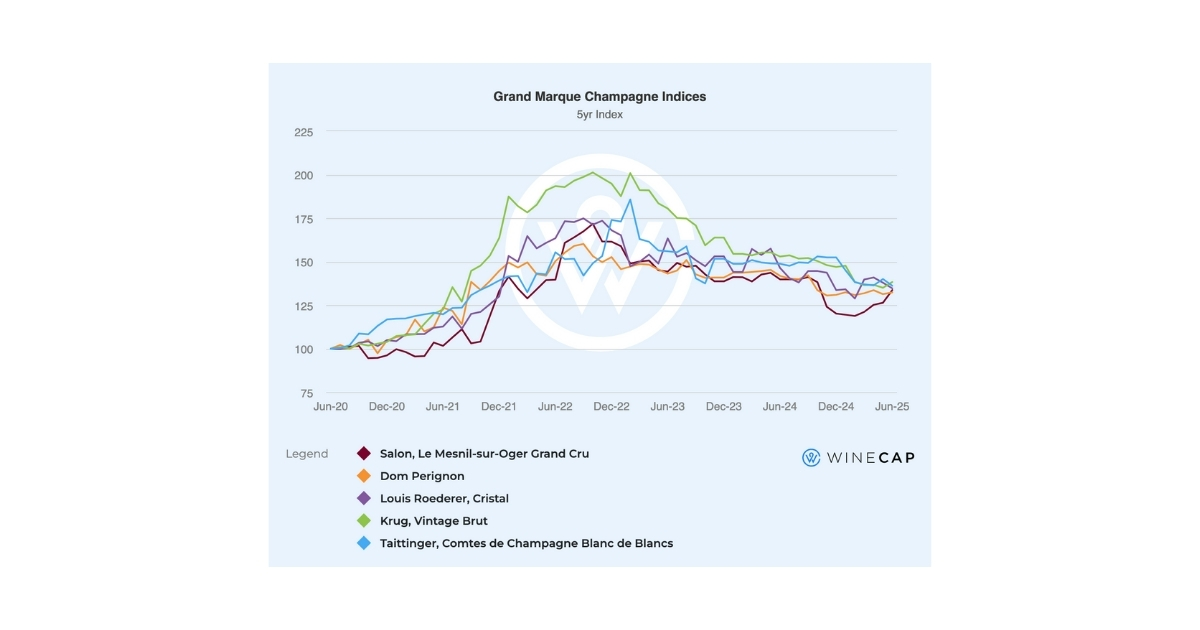
To validate this emerging trend, WineCap analysed the ten most recent vintages of the five most-searched Grand Marque Champagnes (often considered some of the best Champagne for fine wine collectors):

Of these 50 reference-point wines:

  • 43 have seen arrests to their price declines
  • 40 have remained stable for at least six months

Aggregate brand indices are flatlining – a classic sign of consolidation.

Champagne fine wine indices

Dom Pérignon led the stabilisation trend, with its index bottoming out in November 2024, while Krug and Taittinger have more recently entered plateau territory, indicating synchronisation across the broader Champagne landscape.

Demand for Champagne is back on the up too. Just in Q2 (see our Q2 Fine Wine Report), the region experienced a full cycle, with US demand temporarily retreating on tariff threat in April, to climb back up over May and peak in June. Year-to-date, the region’s market share on Liv-ex is above 2024 levels.  

Early signals for a recovery cycle

This alignment of brand-level stability and regional index uplift could mark the beginning of a new investment cycle for Champagne. It’s a phase where prices consolidate before potentially trending upward, as supply scarcity and brand equity reassert themselves.

Investor sentiment is beginning to reflect this reality. Liv-ex data shows Champagne’s market share by value has risen to 12.4% year-to-date, up from an annual average of 11.8% in 2024. This re-engagement suggests confidence in Champagne’s medium-term upside potential.

Champagne’s investment appeal

Champagne’s investment appeal lies in its accessibility and worldwide distribution. Despite economic difficulties, Champagne is still seen as a celebratory tipple, enjoying consumption as well as investment interest. The region today features more than just brand prestige – its fundamentals are strong, with critical acclaim, ageing potential, scarcity, and collector loyalty. 

With prices now having corrected to more attractive entry points, many of the region’s flagship wines offer value relative to their historic highs.

If current trends hold, Champagne may become the first major fine wine region to re-enter growth territory, outpacing peers who are still midway through correction. For investors seeking diversification or cyclical opportunity, the signs are clear: Champagne may be popping again soon.

See also: Champagne Investment Report 

WineCap’s independent market analysis showcases the value of portfolio diversification and the stability offered by investing in wine. Speak to one of our wine investment experts and start building your portfolio. Schedule your free consultation today.

Categories
News

The best-performing wines of H1 2025: the bright spots in a soft market

  • Fine wine prices continued to decline in H1 2025 against a challenging global economic backdrop. 
  • A small group of wines outpaced the broader market by a wide margin, with the best-performing wine rising over 36%.
  • In a recalibrating market, scarcity, selectivity, and substance will continue to define success.

The global fine wine market continued its cautious descent through the first half of 2025, extending a downward trend that began in earnest in late 2022. From Champagne to California, regional indices recorded further losses – a sobering contrast to the post-pandemic surge that peaked in September 2022. What followed has been nearly 18 months of persistent price softening.

Yet even in this declining market environment, select wines showed resilience and in some cases, delivered double-digit growth. A small group of wines outpaced the broader market by a wide margin, with the best-performing wine rising over 36% in H1 alone. These rare outliers were not driven by hype or thematic rotation, but by a return to fundamentals: scarcity, maturity, critical acclaim, and name recognition. In a soft market, selectivity became strategy, and quality, its own form of currency.

The macroeconomic backdrop: volatility returns

H1 2025 unfolded against a challenging global economic backdrop, with fine wine caught in the crosscurrents of:

Reignited trade tensions

The surprise announcement of 200% US tariffs on EU wine imports in March rattled the industry. While the final figure was scaled back to 20% and implementation delayed by 90 days, the initial shock had an immediate effect. US demand plummeted initially, and confidence took time to recover – despite evidence of resilient buying behaviour by Q2.

Subdued Asian demand 

In Asia, sentiment remained quiet. Many buyers – particularly in Hong Kong and mainland China – adopted a wait-and-see posture, citing political and market uncertainty. The result was lower volume and thinner trading conditions for key regions like Burgundy, Bordeaux, and Champagne.

Monetary pressures impact

Persistent interest rate pressure globally has reduced the appeal of illiquid assets such as wine. With safer yields available in cash or bonds, some collectors have hesitated to commit fresh capital or have chosen to sell.

A tepid Bordeaux En Primeur campaign

The Bordeaux 2024 En Primeur campaign, already burdened by a slow market and a hesitant consumer base, failed to inspire broad demand. Pricing fatigue, underwhelming back-vintage performance, and merchant overstocking created difficult conditions even for well-scored wines.

Liv-ex indices reflected the climate:

    • Liv-ex 50 (tracking First Growth performance): -6% in H1, now back to 2016 levels.
    • Liv-ex 100 (Liv-ex benchmark index): -4.9% in H1, now back to 2020 levels.
    • Liv-ex 1000 (broadest market measure): -4.7% in H1, now back to 2020 levels.

Amid these headwinds, investment allocations required precise selection more than ever.

Regional performance – H1 2025

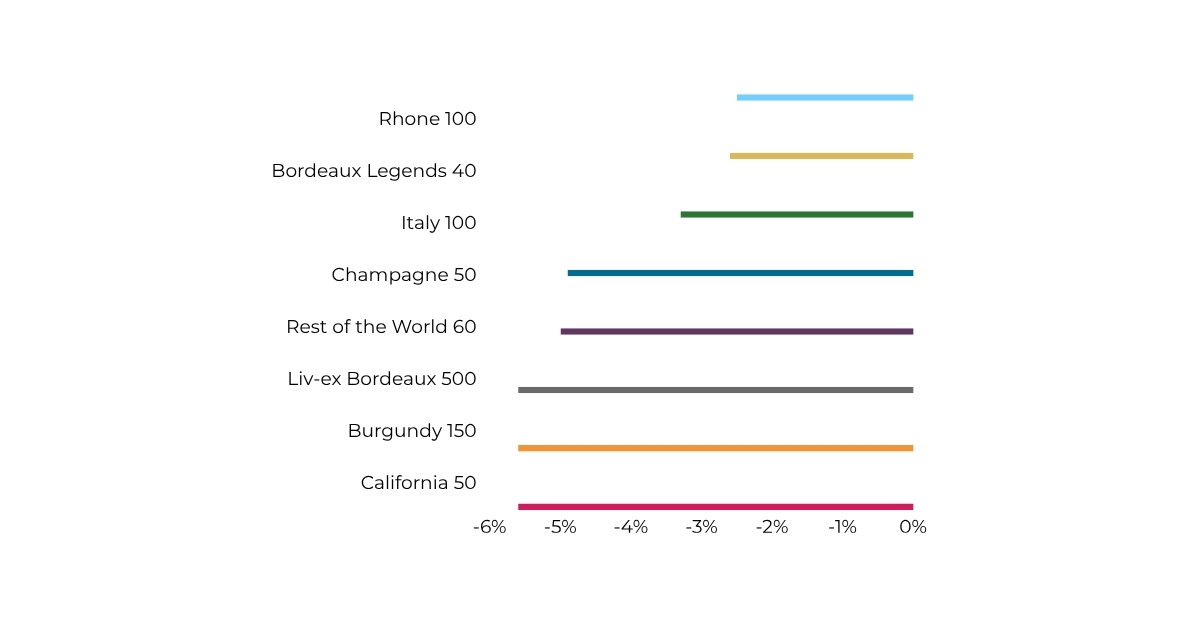
Though every major region ended H1 in negative territory, the magnitude of decline varied, offering insight into what categories still command investor attention and which ones may face longer-term repositioning.

best performing wine regions half 1 2025

The best-performing region: the Rhône

The Rhône 100 index emerged as the most defensive performer in H1, down just 2.5%. This may come as a surprise, given Rhône’s traditionally lower liquidity compared to Bordeaux or Burgundy. Yet in periods of risk aversion, the region’s combination of world-class producers (e.g. Jean Louis Chave, Guigal), lower pricing, critical appraisal, and hence good value for money have made it an increasingly attractive hunting ground for value-driven buyers.

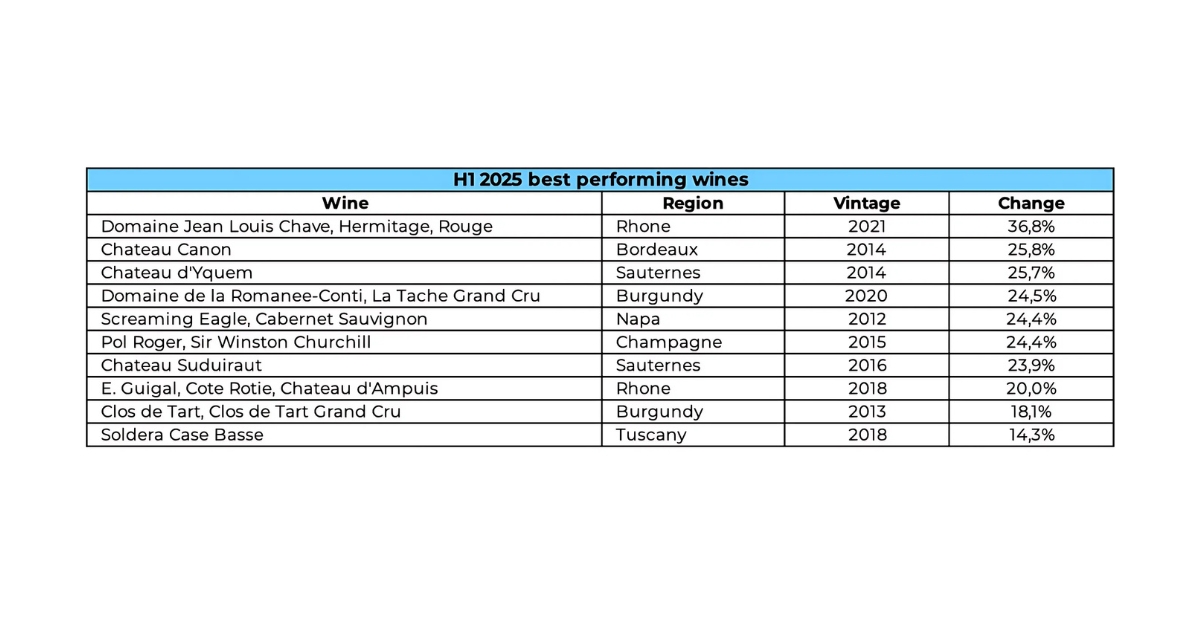
Several Rhône wines appeared in the H1 top 10 performance list, including Chave’s Hermitage Rouge 2021 (+36.8%) and Guigal’s Côte Rôtie Château d’Ampuis 2018 (+20.0%) – reinforcing Rhône’s reputation as a quiet outperformer in challenging times.

The worst-performing regions: Bordeaux, Burgundy and California

Three major regions – California, Burgundy, and the broader Bordeaux 500 – each fell 5.6%, making them the weakest performers year to date.

  • Burgundy’s fall reflects an overdue correction after its dramatic run-up in 2021–2022. Though top-tier names (like DRC and Clos de Tart) remain in demand, the broader category has struggled under inflated pricing and speculative fatigue.
  • Similar to Burgundy, California, particularly its cult Cabernet segment, has suffered from reduced international demand.
  • Bordeaux’s broader weakness may be attributed to the underperformance of back vintages. However, its Legends 40 sub-index, focused on top estates with market longevity, proved more resilient (-2.6%).

H1 2025 top performers: the outliers that defied the trend

While most indices slipped, a handful of wines delivered double-digit returns.

best performing wines half 1 2025

Insights from the standouts

The Rhône leads with Chave’s Hermitage

Despite the Rhône 100 index declining 2.5%, Jean Louis Chave’s 2021 Hermitage Rouge rose 36.8% – a stark outperformance driven by limited availability and increased global recognition of its collectible status.

Sweet wines surged

Both Château d’Yquem 2014 and Château Suduiraut 2016 featured in the top ten, defying the quiet backdrop for Sauternes. This suggests renewed collector interest in undervalued dessert wines, particularly when linked to exceptional vintages.

US cult wines hold their own

Screaming Eagle 2012 proved resilient, with a 24.4% rise in value since the start of the year. Despite the California 50 index falling 5.6%, high-end Napa commands global attention in top-tier vintages.

Champagne’s prestige cuvées still sparkle

While the Champagne 50 index fell 4.9%, Pol Roger Sir Winston Churchill 2015 bucked the trend with +24.4%, showing how top releases can outperform broader categories when aged and ready to drink.

Key takeaways for investors

Market-wide corrections are not uniform. Even in downturns, well-selected wines can deliver strong returns.

Rarity and recognisability drive results. Names like DRC, Yquem, Chave, and Screaming Eagle continue to act as safe harbours.

Blue-chip vintage selection matters. Wines from ‘off’ vintages like Canon 2014 offered some of the best entry points and upside surprises.

Sweet wines are staging a quiet comeback. This suggests contrarian plays may have room to run in H2.

Selectivity as the strategy for H2 2025

The first half of 2025 has confirmed what seasoned collectors already know: not all wines move with the market. Even as regional indices declined across the board, a handful of exceptional bottles bucked the trend, delivering standout returns through a combination of rarity, critical reputation, and maturity.

In today’s climate, the challenge isn’t access to wine but making the right decisions. Broad market exposure has offered little protection. Instead, performance has come from targeted allocations, where deep knowledge of producers, vintages, and release histories gives investors the edge.

Looking ahead to H2, the outlook is cautiously constructive. While macroeconomic headwinds remain – from tariffs and interest rates to uneven global demand – opportunities still exist for those willing to look beyond the indices.

In a recalibrating market, scarcity, selectivity, and substance will continue to define success.

WineCap’s independent market analysis showcases the value of portfolio diversification and the stability offered by investing in wine. Speak to one of our wine investment experts and start building your portfolio. Schedule your free consultation today.

Categories
News

Bordeaux wine labels: role in wine investment?

Alongside ‘provenance’, ‘scarcity’, and ‘vintage’, another key influence on wine investment potential is ‘producer and brand reputation’. These words encompass tradition, track record, trust, and market recognition, and there’s little that more instantly communicates these features than a wine label.

WineCap spoke with prestigious Bordeaux châteaux and learned about the importance of connection to heritage behind the vast array of wine labels found in the leading wine investment region.

  • Classic châteaux images inspire confidence with age-old legacy.
  • Colour is a strong signal of recognisable brand association.
  • Historic tales showcase links to the region’s heritage.

Classic Left-bank style: Château Margaux, First Growth

One label that has barely altered over time is that of Château Margaux. Displaying an image of the house’s legendary neo-classical château, after rebranding in recent years, the label’s font harks back to the style used by the estate in the late 1800s

Philippe Bascaules, managing director, commented to WineCap on the pedigree of the overall design and the value of immediate recognition. ‘The label of the bottle of Château Margaux is very old. It was designed at the beginning of the 19th century. It’s just the image of the château, which became our logo. I think it’s probably one of the most famous wine labels.’

Regal opulence, eastern allure: Château Ducru-Beaucaillou, Second Growth

Combining Western and Eastern finesse, the label of Château Ducru-Beaucaillou displays an oblique line illustration of the majestic estate set against a luxuriant golden-hued backdrop.

‘This label was created by the Johnstons, who owned the estate at the end of the 19th century, and, except for only slight changes, it has never changed,’ Bruno Borie, co-owner and manager of the Sant-Julien château, told WineCap. ‘It has always been this beautiful yellow, orange, and gold. I think the inspiration was the Venetian Palladian palaces that were painted in this beautiful yellow colour. Also, the late 19th-century Nathaniel Johnston married Princess Mary of Caradja from Istanbul, and she was a princess from a Greek family installed in Turkey who were very close to the sultan. Mary probably introduced this beautiful yellow colour, which was eastern – Orientalism was a style that was very fashionable at the end of the 19th century.’

Borie added that the label’s hue was possibly also influenced by contemporary trade with the Far East. “I don’t know if it was the intention, but I think that they were already shipping to Asia in those days, and gold was the colour of the Chinese Emperor.”

Borie noted the prominence of the house labelling. ‘When you are in front of a shelf or when you are in a restaurant, you immediately recognise that Ducru-Beaucaillou label. It’s a unique label that you need probably half a second to find.’

On the secondary market, the wine’s value has risen 50% over the last decade.

Historic story: Château Beychevelle, Fourth Growth

Breaking from the tradition of displaying a grand Bordeaux estate on the label, Château Beychevelle features an arresting black-and-white illustration of a vessel on a river. The boat is adorned with a griffon-like figurehead that looks ahead confidently as it floats on the calm river waters. Its sail is lowered and bears a cluster of grapes, while a pennant flag flutters gracefully from the mast.

The depiction honours the estate’s 17th-century foundations, when the first Duke of Épernon – a renowned and admired French admiral – owned the Gironde River château. His presence commanded such high regard that ships sailing by on the river would lower their sails in respect. This historic tale inspired both the estate’s emblem and name Beychevelle, from the Gascon phrase ‘Bêcha vêla,’ translating as ‘lower the sails’.

‘You don’t see a building, you don’t see a chateau or a gate, which is very common on wine labels,’ managing director of the Saint-Julien house, Philippe Blanc, told WineCap. ‘You’ve got this white corner cut label with a boat, which is quite rare and is very definitely recognisable as Beychevelle. Some people think the boat is a Viking boat, but it’s not. It’s a local boat going along the River Gironde and lowering its sail to show respect to the Duke.’

Over the past 12 months, the average case price of Chateau Beychevelle has dipped in value by 7%, but in the past 10 years, it has increased by 55%.

Bold and colourful: Château Lafon-Rochet, Fourth Growth

When Saint-Estèphe producer Château Lafon-Rochet transformed the appearance of its buildings from muted grey to vivid colour, the influence extended beyond its premises to its label.

Today, featuring a striking mustard-yellow backdrop, the house’s label displays a front-facing illustration of the elegant château, with diagonal vineyard lines in the foreground adding a sense of dynamism.

‘The label’s colour was inspired by my father,’ said general manager Basile Tesseron. ‘He disliked the grey façade and experimented with painting the château yellow, green, and red – one colour per year.’

In the end, yellow came out on top. ‘In 2000, he decided that if the château would stay yellow, the label should match. It may be bold, but now it’s unmistakably ours.’

The wine investment performance of Lafon-Rochet has been equally unmistakable – up 65% over the last decade, outperforming all the First Growths.

Dignity and blossoms: Château La Conseillante

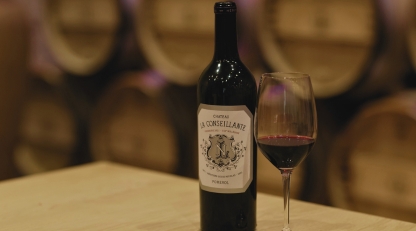
The elegant grayscale label of Pomeral house, Château La Conseillante, quietly communicates family prestige. It features a shield-shaped emblem carrying the letters “L” and “N” for founder Louis Nicolas, which is framed by intricate, stylised berries and florals.

‘The inspiration is very simple – it’s the original logo of Louis Nicolas,’ general manager Marielle Cazaux told WineCap. ‘In French, we call it the ‘armoirée’.’

The classic design of the label is further enhanced by the bottle’s violet neck foil, which, as Cazaux said, subtly mirrors the floral violet notes often found in wine’s aromas and flavours.

Château La Conseillante prices have seen an increase of 81% over the last ten years.

See also our Bordeaux I Regional Report

WineCap’s independent market analysis showcases the value of portfolio diversification and the stability offered by investing in wine. Speak to one of our wine investment experts and start building your portfolio. Schedule your free consultation today.

Categories
News

Lower En Primeur volumes: Bordeaux estates explain

The nature of Bordeaux’s En Primeur campaign varies each year depending on growing conditions and market forces. However, one aspect is emerging as a strong trend across vintages: volumes released during En Primeur are decreasing.

WineCap spoke with prominent Bordeaux producers for deeper insights into the reasons for this pattern.

  • Interviewed châteaux release between 60% and 90% En Primeur.
  • Rising temperatures and organic farming reduce yields and En Primeur offerings.
  • Châteaux need to consider both on- and off-trade customers.
  • Climate change necessitates holding wine for style, and brand preservation in future.
  • Competition to produce the highest quality reduces volume.

Decreased production and adaptable approach

Several producers WineCap interviewed explained that, in addition to the variable vintages typical of the Bordeaux region, global warming and changing vineyard practices are lowering yields.

Château Pichon Comtesse, Second Growth, Pauillac

Nicolas Glumineau, CEO and winemaker, recognised lower yields and wine volumes in recent years as contributing to the changing dynamics of the En Primeur system.

‘For Pichon Comtesse, it’s not due to the fact that we want to retain more volumes here in the cellars,’ Glumineau told WineCap. ‘I really do believe in the En Primeur system, despite seeing less and less volume of wine released this way. Volumes released have gone down because of lower yields over the last ten to 15 years. Still, I want to play the game of En Primeur, so that’s why we release something like 80% of our production every year’.

Château Smith Haut-Lafitte, Grand Cru Classé, Graves

Florence Cathiard, co-owner with her husband Daniel of Château Smith Haut-Lafitte, said that low yields influenced their decisions to reduce En Primeur volumes but commented that it was possible some maneuvering occurred.

‘For us, it’s not voluntary. It’s because of organic certification, which means we tend to have too low volumes,’ she said. 

Château Margaux, First Growth, Haut-Médoc

‘The En Primeur volume, of course, is lower than ten or 20 years ago because the yield is much lower than before. Also, we are much more demanding in our selection for Château Margaux. So the total volume of Château Margaux has decreased tremendously,’ managing director, Philippe Bascaules, told WineCap. ‘That said, the quantity of En Primeur hasn’t changed a lot. Depending on the vintage, we can sell 70% to 85% of the production’.

Bascaules emphasised that it was the level of the yield and strict selection for quality control, rather than the house’s reluctance to participate, that created an impression of reduction. ‘En Primeur is very important for us’.

Château Pavie, Premier Grand Cru Classé (A), Saint-Émilion

‘At Château Pavie, we haven’t really changed the policy of let’s release less wine or let’s release more wine,’ Olivier Gailly, commercial director, said. ‘We adapt vintage to vintage. There is no strict rule as to what we want to release; the percentage might change vintage after vintage, depending on the dynamic of the market and of the vintage itself’.

Château Clinet, Pomerol

‘I think the main reason for the reduction in En Primeur volumes is the fact that sustainable viticultural practices reduce the volumes made per producer,’ Ronan Laborde, managing director and owner, explained.

‘Also, there is a strong competition to produce the best wine possible. You cannot do this with high volumes. So that’s why you also see more and more Bordeaux wine producers offering second wines or sometimes third wines. So, the quantity produced on the first wine is reduced. I think these are the two main reasons why the En Primeur volumes that are offered seem to be smaller than in the past’.

Customer choice

While some Bordeaux producers have a flexible strategy to their En Primeur releases, others believe that such versatility can have drawbacks, and that producer marketing and client demand should dictate stability in decision-making.

Troplong Mondot, Premier Grand Cru Classé B, Saint-Émilion

Ferréol du Fou, commercial director of Troplong Mondot, described lowering En Primeur quantities as ‘a huge mistake’, citing customer appetite as a key driver to the house’s stance.

‘Our strategy is to release 80% of the production every year, even if production is low. People need wines, and we need to show the label to the world. En Primeur is a way to offer a good deal for the consumer’.

Château Beau-Séjour Bécot, Premier Grand Cru Classé B, Saint-Émilion

Julien Barthe, who co-owns Château Beau-Séjour Bécot with his wife Juliet, has a similar position.

‘I think it’s a big mistake for many châteaux because they want to increase their prices, so they deliver a small volume. I really don’t think it’s a good way to promote your wine,’ he told WineCap. ‘This is not the case at Beau-Séjour Becot. We release around 85% to 90% of our production every year because we want to offer a good number of bottles to all our clients. We want to say ‘thanks, guys, you buy my wine, we are happy, we will be happy when you drink this wine’’.

Château Pichon-Longueville Baron, Second Growth, Pauillac

Christian Seely, managing director of AXA Millésimes, which owns Château Pichon-Longueville Baron, also believes that offering customers options is crucial, even if this involves holding a substantial amount of stock.

‘We release about half of our production of Grand Vin En Primeur, and we keep the other half back for a number of years,’ he said. ‘The reason we do that is that it gives our customers two options; if they want to buy En Primeur, they can. If they don’t feel like buying En Primeur and would like to come back and buy the wine from the property five years later, we still have stocks of wine for them here. The chances are it’s going to be a little bit more expensive a few years later, but it would have been kept in the perfect location at the property. So, by doing half En Primeur and half stock available at the château, we feel that we’re offering our customers the choice’.

Châteaux traditional commercial activities

An important influence on En Primeur release quantities for several chateaux is retaining volumes to maintain established business activities on site and throughout on- and off-trade networks.

Château Beychevelle, Fourth Growth, Saint-Julien 

Philippe Blanc, general manager of Château Beychevelle, stressed to WineCap that the house took local customers into account when making decisions about what levels of wine to release En Primeur.

‘We don’t play the scarcity game, we play the game of En Primeur’, he said. ‘We’ve got over 100 negociant customers, which is a lot, and we sell 85% of our production En Primeur. Before 2016, we were selling 95% or 96%, which is extremely high. We were frustrated to not have any volumes of available wines for doing anything. For example, if tomorrow you decided you wanted to have an event with us, we could make an event because we always have enough wine for drinking, but we have no wine for selling. It was a bit frustrating for us and the merchants here or abroad when they asked for, say, five cases of wine for customers, and we had no wine. So, we decided to decrease the shares sold En Primeur to 85%.’

Blanc went on to explain that, while there had been a decrease in En Primeur volumes, there was no intention to go lower. ‘And why are we so dedicated to En Primeur? Beychevelle, as you probably know, is a wine which increases its value over time, and our golden rule is that the Primeur price is the lowest you can get. We could say, okay, keep more, because the price will go up, but we don’t want this policy, because setting the price at a more reasonable level makes it possible to sell it to the traditional market. So, we stick to that.’

Château Canon, Premier Grand Cru Classé, Saint-Émilion

Nicolas Audebert, winemaker and general manager of the Saint-Émilion estate, has the same perspective on En Primeur with the house operating within its framework. It also considers the on-trade environment when making decisions about wine proportions for the annual campaign.

‘We consider that the En Primeur moment and campaign are extremely important, and we play the game. We do not put a small volume in En Primeur,’ he told WineCap. ‘Of course, we keep some volume here at the chateau to be able to have wine for the next 20 years, to have wine for the bibliothèque, and be able to do fantastic tastings 80 or 100 years from now.’

The chateau puts a minimum of 70% of the production, every year, En Primeur, with Audebert describing it as a ‘fantastic time where everybody’s looking at Bordeaux’ and ‘a win-win for the consumer and for us’.

Château Cheval Blanc, Saint-Émilion

At between 60% and 70%, Pierre-Oliver Clouet, winemaker and the technical manager at the Right Bank house, sometimes commits even lower amounts than peers to the En Primeur campaign.

‘We keep around one-third of our crops to sell in five, ten, or 15 years, to have an opportunity to provide some bottles to restaurants, wine shops, or distributors who don’t have the opportunity to have storage. We alter the model a little between two-thirds En Primeur and one-third available for the market – ready-to-drink, in fact’.                                                                

Wine heritage

For Cos d’Estournel, the annual En Primeur allocation decision relates to the house’s legacy: mitigating the impact of climate change on the classic and recognisable style of the house’s wine is of prime concern.

Cos d’Estournel, Second Growth, Saint-Estèphe

‘Well, in terms of En Primeur, the volumes are quite different compared to before because before, the context was different,’ commercial director Charles Thomas told WineCap. ‘Twenty, 30, or 40 years ago, when you couldn’t sell your wine, you would sell all your wine if you could. Also, when you look at global warming, the style of wine could be a bit different in 20 years. So, in terms of style, it’s also quite important to keep some wine that we make now and to be able to release it later on.’

See also our Bordeaux I Regional Report

Categories
News

Mixed signals: correction continues but top wines prove the exception

  • Despite a broader market correction, some fine wines have risen over 10% year-to-date. 
  • The top-performers are united by their strong value proposition. 
  • The 2024 En Primeur is all about momentum and timing, given the mixed quality and the availability of well-priced older vintages.

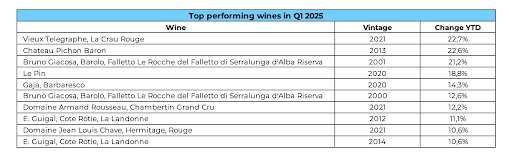
Despite a broader market correction – with the Liv-ex 1000 index declining 2.1% year-to-date – select fine wines have demonstrated remarkable resilience. A closer look at Q1’s top performers reveals a diverse spread across key wine regions: Bordeaux, Piedmont, the Rhône, and Burgundy.

The best performing wines

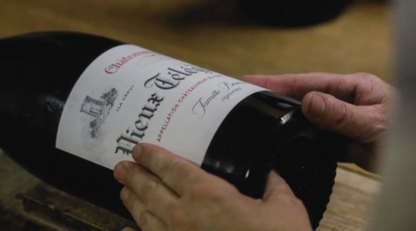
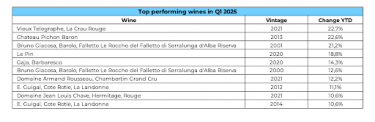
The best performing wine was Vieux Telegraphe La Crau Rouge 2021, which surged 22.7%. The long-term trajectory of the brand has been upwards, with a 54% rise in value over the past decade.

The second spot was taken up by Pichon Baron 2013 with a 22.6% rise. Often overlooked due to the vintage’s cooler weather, it now stands out for its relative value and strong long-term potential. Over the past ten years, the brand’s prices have climbed by 58% on average.

From the Northern Rhône, Guigal’s La Landonne secured two spots on the leaderboard: the 2012 vintage rose 11.1%, while the 2014 – 10.6%. Across the past decade, the La La wines have appreciated by 47%, affirming their iconic status among Rhône collectors.

From Barolo, the 2001 Bruno Giacosa Serralunga d’Alba made the top ten with a 21.2% rise, showcasing continued demand for aged, cellar-ready Nebbiolo from one of Piedmont’s most revered producers.

Regional trends: pressure persists

While these individual wines bucked the trend, broader regional indices tell a more sobering story. Both Burgundy and Bordeaux, the primary pillars of the fine wine market, fell by 2.9% in Q1. Even regions that showed resilience – such as the Rhône, which rose 1.1% in March – remain down overall for the quarter.

This pattern underscores the current investor mindset: cautious, value-driven, and increasingly selective.

2024 En Primeur: momentum and timing

The 2024 Bordeaux En Primeur campaign has landed in challenging terrain. With the market in retreat and the specter of new U.S. tariffs, producers have had no choice but to re-evaluate pricing strategies. The first releases came in below last year’s prices, and before critic scores were published.

While these adjustments reflect an awareness of the macroeconomic environment, price cuts alone don’t guarantee demand. Investors are weighing these new offers against older vintages available at comparable – or better – value.

The swift pace and early start of this year’s campaign echo the successful 2019 En Primeur release, which capitalised on momentum and timing. However, given the mixed vintage quality and volatile market, strategic selectivity is more essential than ever.

Looking for more? Read our Q1 2025 Fine Wine Report.

Categories
Learn

How does Bordeaux set its release prices?

In the springtime of each year, all eyes turn to Bordeaux as the region begins its extended En Primeur campaign when châteaux across this prominent region set their wine prices.

Such decisions require the navigation of multiple factors within a delicate financial and cultural ecosystem. WineCap spoke with eminent producers for insights into what influences the all-important price setting.

  •         Previous vintages and price key influences
  •         Profitability for all players is an important driver
  •         Compelling price point for customers is critical
  •         Brand and critical ratings have some impact

Château Smith Haut-Lafitte, Grand Cru Classé, Graves

“Don’t believe people say, ‘I do it all by myself’,” said Florence Cathiard who co-owns the Graves house with her husband Daniel. “It’s a long process and very delicate because we have to take several parameters into account.”

These include contemplating pushing prices higher because of swift sales in previous years, the vintage quality, and the general global environment.

“We also take advice from some of the best négociants, brokers, and even some importers — not those who are just trying to put the price down, to sell high, but the real friends.”

Château Pichon-Longueville Baron, Second Growth, Pauillac

Christian Seely, managing director of AXA Millésimes, owner of Château Pichon-Longueville Baron, has devised a formula for the optimal release price of a Grand Cru Wine.

“The ideal price is the highest price possible at which my existing customers will buy the wine with enthusiasm,” he said. “It has to be the highest price possible, otherwise I might get fired. But it has to be the highest price possible at which my existing customers will buy the wine with enthusiasm. If you go too high, your existing customers might buy it without enthusiasm. If you go much too high, maybe your existing customers won’t buy it, and that would be terrible. It’s a personal judgment based on experience.”

Château Pichon Comtesse, Second Growth, Pauillac

Nicolas Glumineau, CEO and winemaker of Château Pichon Comtesse, combines mathematics with common sense.

To price the wine correctly, you have to be very respectful of your market. And what we do is to have a very sharp eye on market prices,” he explained. “We consider that each step of the distribution chain has to get remuneration. It’s very important for each of us to earn money thanks to the distribution of Pichon Comtesse.”

Château Cheval Blanc, Saint-Émilion

Pierre-Oliver Clouet, Managing Director at Château Cheval Blanc has a similarly logical approach.

“En Primeur should be forever the lowest price you can find in your bottle,” he told WineCap. “The release price depends on many things: the quality of the vintage, the economic context in the world, and, as well, the price of new vintages available on the market. So, ultimately, the definition of the price En Primeur is not something difficult to reach. This is something mathematical.”

Château Canon, Premier Grand Cru Classé, Saint-Émilion.

Nicolas Audebert also follows mathematical logic in the pricing game. “If you go En Primeur, the interest for the consumer, the guy buying the bottle is that ‘if I buy en primeur, the bottle that I will put in my cellar and not able to drink now, it has to be at a lower price of the same quality I can buy in the market and drink now’,” he told WineCap.

Audebert takes an equivalent quality vintage from recent years, considers the margin, does some precision-calculations, and arrives at a price that offers a ‘win-win’ for all parties.

“Of course, afterwards, you can have ‘plus-value’ on the exceptional quality of the vintage or something like that. But if we play primeur, we have to play the game of logical pricing.”

Château Pavie, Premier Grand Cru Classé (A), Saint-Émilion

“There are some secrets,” jokes Olivier Gailly, commercial director for the Perse wine family at the renowned house. “There are a lot of different factors, which are, first of all, the history of your château, the different vintages and prices in the past, and how successful it was.

If the market demands, you have to push some, but you have to listen to it as well. Of course, ratings still play a role, meaning the feedback from the customers when they come and taste during the En Primeur week in Bordeaux. We then meet with Monsieur Perse and take the decision together. The final one will be his, being the owner of the property.”

Château La Mondotte, Premier Grand Cru Classé, Saint-Émilion

“If you have the wrong price, it’s a disaster,” Stéphane von Neipperg, owner of the Right Bank house said. “Nobody wants a lot of people wh don’t want to buy the wine.”

When his team goes to the market, they consider the global economy, the local market price direction, and information from brokers and négociants. “You have to absolutely test the price with negotiants, brokers, and also with your friends, the importers. Then we can say, ‘well, this would be a good price’. A good price is when everyone in the business makes money.”

Cos d’Estournel, Second Growth, Saint-Estèphe

Charles Thomas, commercial director of the Left Bank château, places an emphasis on quality and the good value the region offers when deciding on price. “I would be lying if I said it doesn’t depend sometimes on the exchange rate,” he said. “But also, it’s according to the quality we have — and this is the most important thing. Bordeaux is not expensive when you look at Burgundy and Napa Valley and some wine from other appellations.”

Vintage has more of an impact than elsewhere and can link to market price, Thomas added. “Of course, in Bordeaux you have the vintage effect that you don’t always have in other parts of the world. We try to be more stable for the client or the consumer, though, so they can accept any necessary price variation.”

Château Angelus, Saint-Émilion

As well as previous vintage pricing in Bordeaux and internationally, for Château Angelus CEO Stéphanie de Boüard-Rivoal, two more factors are key influences when the prestigious house goes to market.

“The volume as well, of course, because it makes a real impact,” she explained. “I’d say the strength of the brand as well.”

See also our Bordeaux I Regional Report

WineCap’s independent market analysis showcases the value of portfolio diversification and the stability offered by investing in wine. Speak to one of our wine investment experts and start building your portfolio. Schedule your free consultation today.

Categories
News

Wine Advocate’s top-scoring Bordeaux 2024 wines

  • William Kelley defines Bordeaux 2024 as the ‘weakest vintage of the last decade’.
  • The vintage is characterised by challenges – weather and economic. 
  • Kelley’s top three wines achieved a barrel range of 94-96 points.

The Wine Advocate was among the first to release their Bordeaux 2024 En Primeur report last week, with William Kelley calling it the ‘weakest vintage of the last decade’. The report, titled ‘Ripeness is all’, highlights the challenging weather conditions and the growers ability to time the harvest, which played a crucial role in the making of the best wines. 

The style of the vintage

For Kelley, 2024 is not a Left or a Right Bank vintage; he argued that it ‘can only be understood on a producer basis’. 

For him, it is ‘more of a throwback, exhibiting flavors more familiar from the decade of the 1990s than more recent years’. The best wines show ‘the estate signature’ style and possess a ‘strong identity’. 

Kelley explained that ‘the most compelling 2024s are intensely flavored middleweights with good structure and energy, exhibiting integrated acidity and ripe tannin’.

‘A handful of wines, often thanks to a riskily late harvest and generally from early-ripening sites, even possess a density and mid-palate amplitude that transcends the year and which will render them hard to identify in blind tastings a decade from now’, he continued.

To achieve these results, terroir was crucial: ‘better-drained, earlier-ripening plots fared best’ in a year defined by cold and rain. Sorting was important too but only for fully ripe grapes.

Vintage challenges

Bordeaux 2024 will go down in history as a challenging vintage – first, due to the weather, and second, the macroeconomic context, including the waning sentiment towards the En Primeur system.

When it comes to the weather, it was a year of negative records. Kelley noted that ‘March-May saw 35% more rainfall than the 20-year average, making 2024 the third wettest spring recorded, after 1979 and 2008’. This delayed flowering, leading to uneven ripeness within bunches, which could have only been mitigated by patience. 

Rain and falling temperatures in September presented more obstacles – botrytis, and slower degradation of acidities and pyrazines. Many producers were quick to harvest – often underripe grapes; those that dared to wait gained ‘mid-palate amplitude and degrading pyrazines in the process, even if analytical maturity alone registered little change’.  

Now that the vintage is being released onto a downward market, Bordeaux is facing mounting pressure. In his report, Kelley wrote: ‘An excellent vintage at a very fair price might perhaps have been capable of reigniting some interest in en primeur, but it seems unlikely that 2024, beyond a handful of châteaux, will be able to achieve that.’

He concluded that ‘if Bordeaux rides high in good times, it is unavoidable that the region should also experience market lows particularly acutely. Bordeaux will be back, of course, it’s only a matter of time.’

Selectivity is key

Given this vintage background, strict selectivity when purchasing Bordeaux 2024 will be key. Beyond pricing, which has to be fair in the context of older vintages, critic scores play an important role. 

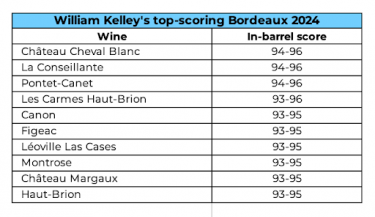
Kelley’s highest score for this vintage was a barrel range of 94-96 points, which went to three wines: Cheval Blanc, La Conseillante and Pontet-Canet (released on 23 April).

Of the three, La Conseillante has been the best price performer on a brand level, rising over 70% in value over the past decade, and considerably outperforming the broader Bordeaux market. 

For Kelley, these three wines were the ‘stars of the vintage’. For Cheval Blanc, he explained that ‘Pierre-Olivier Clouet and his team conducted an aggressive green harvest and also, exceptionally, used densimetric sorting to mitigate heterogenous maturity between and within bunches, accepting losses to rot in pursuit of full maturity.’ 

Sorting was also strict at Conseillante, which is ‘a blend of 80% Merlot and 20% Cabernet Franc that produced 22 hectoliters per hectare after extensive sorting’.

When it comes to Pontet-Canet, Kelley said that the final wine ‘underlines the fact that daring to harvest late paid dividends in this challenging vintage, wafting from the glass with aromas of cassis, black raspberries and plums mingled with accents of rose petals, licorice and exotic spices.’

See also our Bordeaux I Regional Report

WineCap’s independent market analysis showcases the value of portfolio diversification and the stability offered by investing in wine. Speak to one of our wine investment experts and start building your portfolio. Schedule your free consultation today.

Categories
Learn

What makes fine wine a great portfolio diversifier?

  • One of the key characteristics that make fine wine an attractive diversifier is its low correlation to traditional financial markets.
  • Its scarcity and tangibility further drive up its value. 
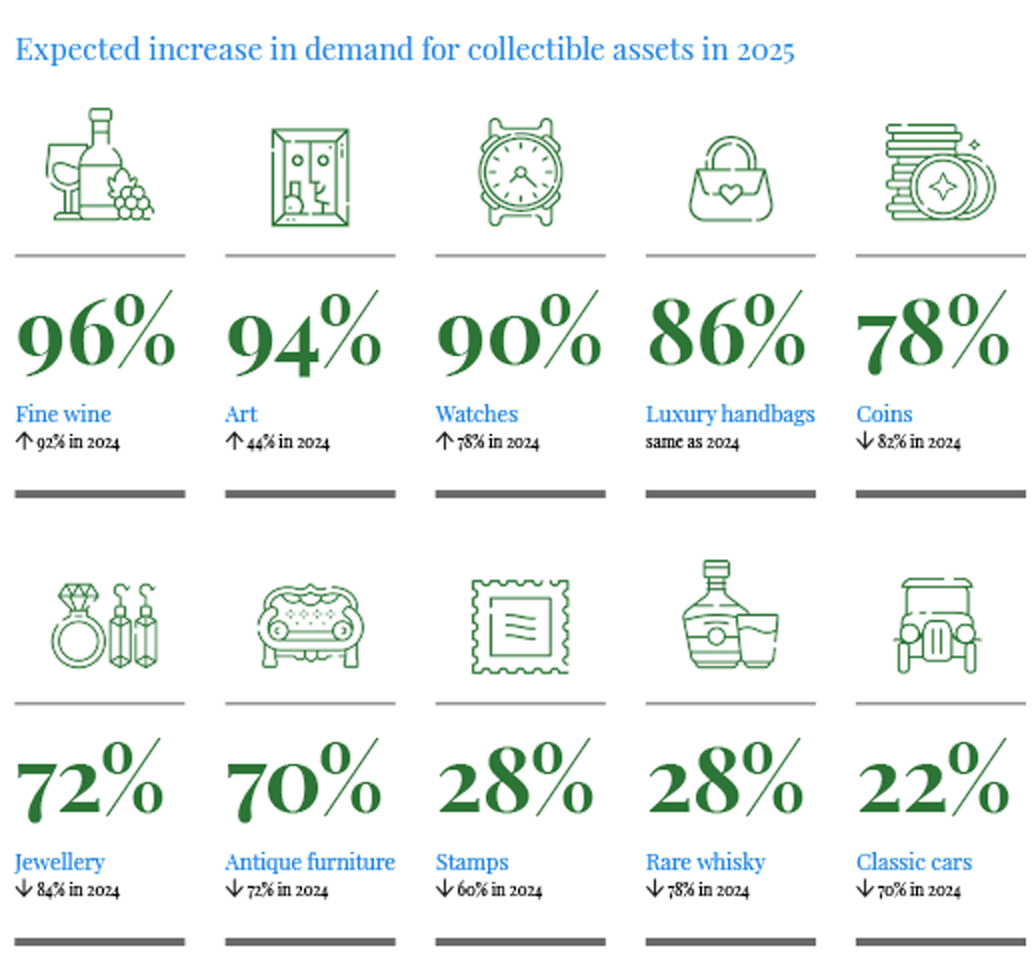
  • According to the WineCap Wealth Report 2025, 96% of UK wealth managers expect demand for fine wine to increase, a testament to its growing recognition as a valuable asset class. 

Moreover, fine wine’s value is tied to its provenance, condition, and aging potential, making it a tangible investment with intrinsic worth. Unlike cryptocurrencies or speculative stocks, which can experience extreme fluctuations based on sentiment or market cycles, fine wine benefits from an established secondary market where demand remains steady among collectors, investors, and luxury buyers.

Inflation hedge and wealth preservation

Fine wine serves as a natural hedge against inflation, protecting purchasing power when traditional assets are eroded by rising costs. As inflation increases, the prices of hard assets like fine art, real estate, and fine wine tend to appreciate, maintaining their value in real terms.

Wealth managers increasingly recommend allocating a small percentage of a portfolio to alternative assets like fine wine to safeguard against economic turbulence.

Tax efficiency for UK investors

For UK-based investors, fine wine presents a significant tax advantage over traditional investments. Unlike stocks, real estate, or business assets that are subject to Capital Gains Tax (CGT), fine wine is classified as a “wasting asset”, meaning it has an anticipated lifespan of less than 50 years.

This classification makes fine wine exempt from CGT, allowing investors to realise profits without the same tax burdens as other asset classes.

For example, a traditional investment yielding a £5,000 profit could be subject to CGT at rates of up to 24%, reducing net returns. In contrast, a fine wine investment with the same £5,000 profit would be tax-free, maximising gains for high-net-worth investors.

This tax efficiency makes fine wine particularly attractive in wealth management strategies, especially as the UK government has lowered CGT allowances and increased tax rates in recent years.

Growing institutional and HNW investor demand

The perception of fine wine as a viable financial asset is rapidly evolving. Traditionally the domain of private collectors and enthusiasts, fine wine is now being incorporated into portfolios managed by wealth advisors, family offices, and institutional investors.

According to the WineCap Wealth Report 2025, 96% of UK wealth managers expect demand for fine wine to increase, a testament to its growing recognition as a valuable asset class. 

Additionally, AI-powered investment tools are making fine wine more accessible to a broader range of investors. Fine wine companies and professionally managed portfolios allow investors to gain exposure without needing deep industry expertise.

This institutional adoption further legitimises fine wine as a serious financial instrument, enhancing its liquidity and long-term viability.

Why fine wine deserves a place in your portfolio

Incorporating fine wine into an investment portfolio provides stability, tax efficiency, inflation protection, and strong diversification benefits. Its low correlation with traditional assets makes it particularly valuable during periods of market uncertainty, while its scarcity-driven appreciation ensures long-term value retention.

For investors seeking to protect and grow wealth, fine wine remains one of the most compelling alternative investments available today.

Categories
Quarterly-reports

Q1 2025 Fine Wine Report

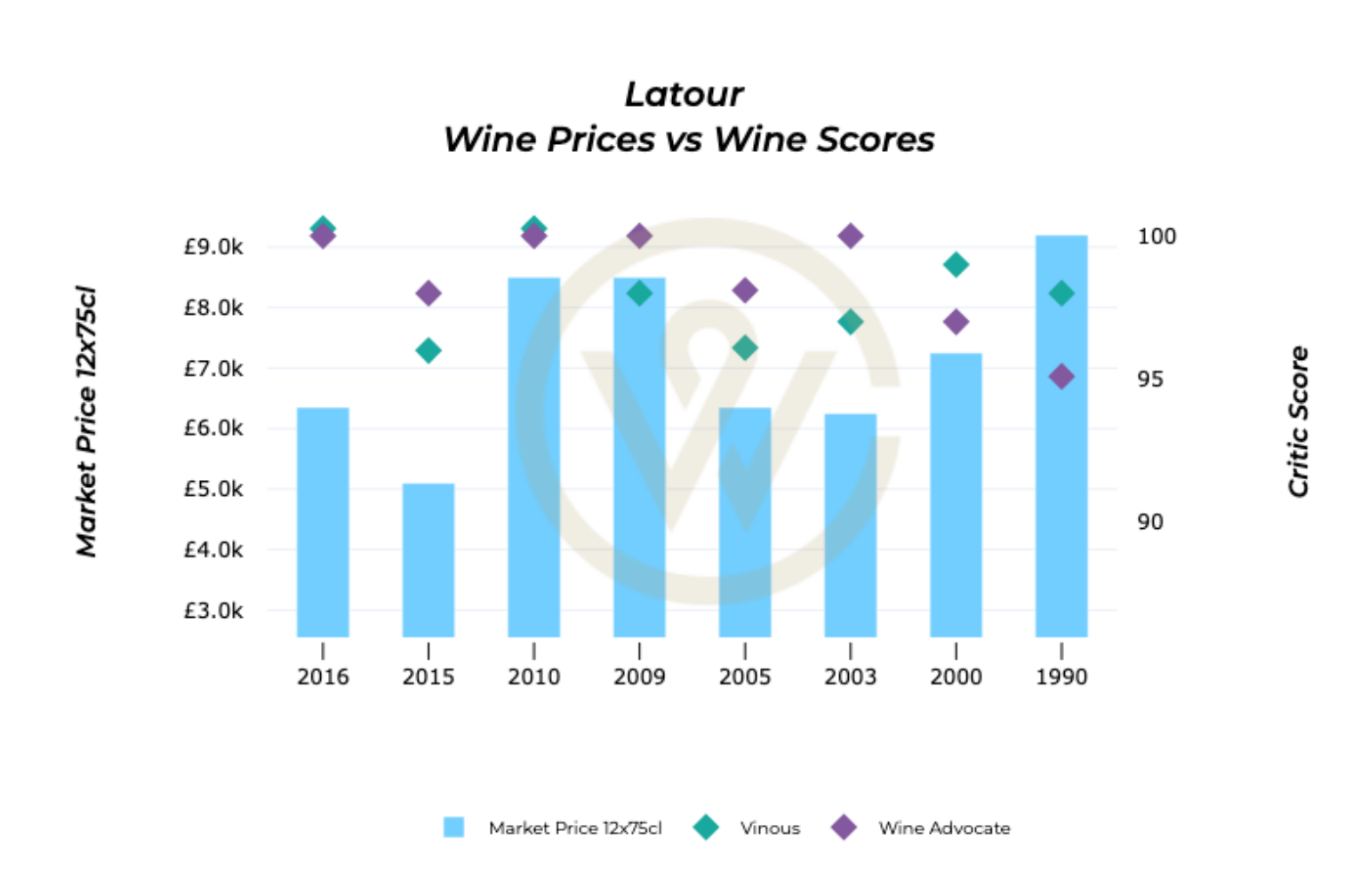
It has been a volatile start to the year, with President Donald Trump’s return to the White House unsettling global markets. The fine wine market continued its measured slowdown, yet optimism persists: wealth managers increasingly view fine wine as a strategic diversifier, with demand expected to rise in 2025. Q1 saw a cautiously successful Burgundy 2023 En Primeur campaign and a mixed round of spring La Place releases – headlined by the highly anticipated, 6×100-point Latour 2016.

This report explores the key trends that shaped Q1, from geopolitical tensions and shifting market sentiment to the top-performing wines and regional highlights.

Executive summary

  • Mainstream markets faltered:
    At the time of writing, the S&P 500 has fallen 7.2% year-to-date, Nikkei 225 dropped 20.5%, and crude oil is down 13.2%.
  • Fine wine prices dipped:
    The Liv-ex 100 declined 2.0% in Q1 2025. The broader Liv-ex 1000 index is down 2.1%.
  • Regional performance:
    Bordeaux and Burgundy were the weakest regions in Q1, each falling 2.9%. Italy continued to show resilience, down just 0.4%.
  • Top performer:
    The best performing wine was Vieux Telegraphe La Crau Rouge 2021, which surged 22.7%.
  • La Place spring campaign:
    Expanded further with new entrants. The Latour 2016, backed by six 100-point scores, stood out as one of the most successful and talked-about releases.
  • Looking ahead:
    The Bordeaux 2024 En Primeur campaign, the key fine wine event of Q2, faces heightened price pressure and buyer caution amid broader economic headwinds.

The trends that shaped the fine wine market

Escalating trade war tensions

One of the most disruptive forces in Q1 2025 has been the re-escalation of global trade tensions, largely stemming from President Donald Trump’s newly announced tariffs. The dramatic return to tariffs has created significant headwinds for global markets, and fine wine has not been immune.

Tariffs fluctuated rapidly. In early April, Trump declared 54% tariffs on Chinese goods imported into the US, a figure he raised to 125% just days later. In the same breath, he confirmed 20% tariffs on European goods, before abruptly announcing a 90-day pause on April 9th, during which tariffs for all non-Chinese countries were lowered to 10%. While this provided short-term relief to EU producers, the volatility has caused widespread uncertainty. 

One thing seems clear: the coming months will be pivotal, with trade developments likely to dictate sentiment and demand in key markets.

Markets under stress

In Q1 2025, mainstream financial markets experienced significant volatility, largely driven by the abrupt changes outlined above. The S&P 500 entered correction territory, declining over 10% from its February 19th high, before partially recovering in late March. The energy sector mirrored this instability. Oil prices plunged to a four-year low amid recession fears and heightened tariffs, only to rebound following announcements of tariff pauses. The rapid succession of policy shifts has led to a climate of uncertainty, making it difficult for investors to anticipate market movements.

Fine wine in Q1 2025

The fine wine market similarly felt the pressure. Prices fell 2% on average over the last three months. The broader Liv-ex 1000 index declined 2.1%, highlighting continued softness across the board. Regionally, Bordeaux and Burgundy were the weakest performers, each down 2.9%. Italy once again stood out for its resilience, declining 0.4%, thanks to consistent demand for top names and relatively stable pricing. The top performing wines in Q1 included Bruno Giacosa Barolo Falletto Vigna Le Rocche Riserva 2014 (72.1%), Château Léoville Barton 2021 (30.9%), and Château Rieussec 2019 (22.8%).

Pressure on En Primeur

The ongoing trade war comes at a particularly sensitive time for the Bordeaux 2024 En Primeur campaign, which is about to launch. The system has been under increasing scrutiny in recent years, with release prices often failing to offer meaningful value versus back vintages. The threat of added import costs, even if delayed, puts further pressure on producers and négociants to rethink pricing strategies. With confidence in En Primeur already eroding, this year’s campaign faces a delicate balancing act: justify pricing amid broader market weakness, or risk alienating already-cautious buyers.

Regional fine wine performance in Q1

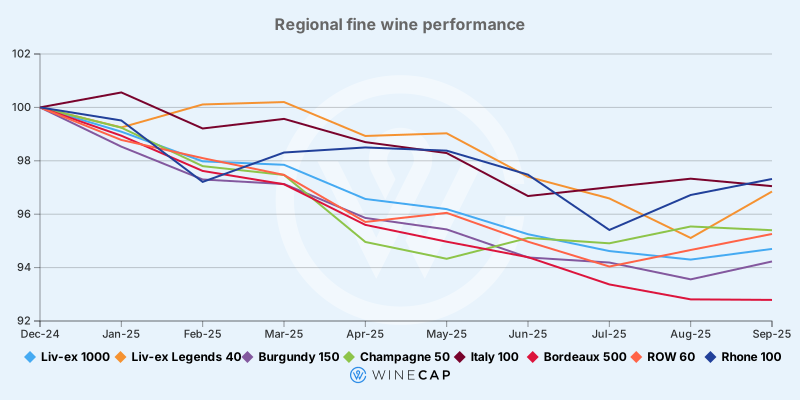
Regional fine wine performance


Since the start of the year, fine wine prices across major regions have fallen 2.1% on average. While some regions experienced temporary increases – the Rhône bounced back by 1.1% in March – the majority were in consistent decline. Burgundy and Bordeaux – the two dominant market forces – fell the most, down 2.9% in Q1. 

Despite falling prices, Liv-ex noted that trade activity is rising – total trade volume and value were up on Q1 2024.

The best-performing wines

Q1’s top performers comprised a varied group from across Bordeaux, Piedmont, the Rhône, and Burgundy. The best performing wine was Vieux Telegraphe La Crau Rouge 2021, which surged 22.7%. Pichon Baron 2013 followed with a 22.6% rise. 

Two vintages of Guigal La Landonne also appeared in the rankings, the 2012 (11.1%) and 2014 (10.6%). 

From Barolo, the 2001 Bruno Giacosa Serralunga d’Alba made the top ten with a 21.2% rise in value over the past three months.

The spring La Place campaign

March saw just over 50 wine releases via La Place de Bordeaux, including new Burgundies, grower Champagne and big names like Promontory 2020, Ao Yun 2021 and Latour 2016. 

The latter was particularly notable as the first prime release to hit the market since the château abandoned the En Primeur system. The wine boasts a number of 100-points from major critics including Neal Martin, Antonio Galloni, Lisa Perotti-Brown MW, Jane Anson, Jeff Leve, and Tim Atkin.

The comparisons being made – to 1961, 1982, and 2010 – suggest the wine is already being framed within the estate’s historic lineage. What’s more, while the price reflects its stature, its positioning below recent back vintages like 2009 and 2010 suggests value for money.

In a campaign that highlighted the growing breadth of La Place, Latour served as a reminder of Bordeaux’s enduring ability to dominate the conversation, when it chooses to.

Latour wine prices vs wine scores

Fine wine enjoys resilient fundamentals and growing confidence

Beneath the surface of a softening market, confidence in fine wine as a long-term investment continues to strengthen. Our recent Wealth Reports released in Q1 revealed a clear trend in investor attitudes: 96% of UK wealth managers expect demand for fine wine to increase in 2025, underscoring its growing role in diversified portfolios.

This optimism is rooted in fine wine’s defining characteristics – low correlation to mainstream markets, long-term price appreciation, and intrinsic scarcity. While short-term volatility and trade disruptions have created a subdued environment, many see this as an attractive entry point. With prices off their peak, the market now offers a rare opportunity to access top names at more favourable levels.

Fine wine is increasingly viewed as a maturing asset class – one that rewards patience rather than speculation. As macroeconomic uncertainty continues to rattle equities and bonds, fine wine’s stability and resilience are drawing renewed attention from high-net-worth individuals and wealth advisors.

Collectible assets 2025

Q2 2025 market outlook

All eyes now turn to the Bordeaux 2024 En Primeur campaign – the most significant event in the fine wine calendar and a litmus test for buyer confidence in a fragile market. After a lacklustre few years, the system finds itself at a crossroads. Pressure is mounting for producers and négociants to reset expectations, as past campaigns have struggled to offer compelling value compared to back vintages already available on the secondary market. Adding to the challenge is the uncertain tariff environment. 

At the same time, there is cautious optimism. While prices across Bordeaux have softened, trade volume has increased – a signal that buyers are still engaged, albeit more selective. If producers respond with competitive pricing and clear value propositions, 2024 could mark a turning point for the campaign.

Beyond Bordeaux, Q2 is expected to bring continued price sensitivity, but also renewed interest from investors who see current levels as a buying opportunity. The long-term fundamentals remain intact: scarcity, brand equity, and an increasing role for fine wine in diversified portfolios. In short, while the market remains in a momentary phase of recalibration, Q2 may offer the first signs of recovery if the right tone is struck.

WineCap’s independent market analysis showcases the value of portfolio diversification and the stability offered by investing in wine. Speak to one of our wine investment experts and start building your portfolio. Schedule your free consultation today.

Categories
News

Part II Bordeaux climate change: adaptive viticulture the way forward?

With vineyard temperatures on the rise in Bordeaux, WineCap spoke with leading Bordeaux estates about how they’re fighting back to protect both wine heritage and future generations.

  • Adaptive viticulture is a widespread method of coping with climate change.
  • Traditional and experimental moderating methods are both in use.
  • High temperatures can be beneficial for recent and, potentially, near-term vintage quality.

Vineyard layout, clones, rootstocks, and varietal proportion: Château Beau-Séjour Bécot, Château Margaux, Château La Conseillante, and Château Pavie

To moderate the impact of climate change, Julien Barthe, co-owner of Beau-Séjour Becot has implemented a radical vineyard layout change to prevent berry burn. ‘The vineyard was formerly planted in an east-west direction. From mid-day to 1 pm, the sun arrived on the west side, right on the berries. This is why we changed the orientation from north to south ­— to avoid the same effect.’

Philippe Bascaules, managing director of Château Margaux has taken the same approach. ‘We decided to change the orientation of our rows,’ he told WineCap.

Barthe also explained that the house is using new clonal selections of Cabernet Franc to help retain the freshness in its Merlot-dominant blends.

Cultivating resilient vines was, similarly, the approach of Marielle Cazaux, the general manager of La Conseillante. ‘Climate change is a big question. We are thinking long term about rootstocks and grape variety.’

Referring to early-ripening Merlot’s vulnerability to climate change, Cazaux stressed the importance of preserving its classic wine profile. ‘We are adapting the rootstock to be more resilient against hydraulic stress and thinking about changing the clones a little bit.’

Olivier Gailly from Château Pavie said that his team had already begun experimenting with climate-resistant proportions of grape varietals at the turn of the century. The house replanted its vineyards with an increased quantity of later-ripening Cabernet Sauvignon and similarly-behaving Cabernet Franc to blend with Merlot. This proportion has helped to maintain wine freshness as temperatures rise. 

Adaptive vineyard management: Château Cheval Blanc, Château Angelus, and Château Calon Segur

Traditional vineyard management techniques such as dense canopy cultivation, durable old vine revival, and biodiversity practices that support the mitigation of climate change have been intensified around Bordeaux since at least the millennium. While some methods have a short time frame, Pierre-Oliver Clouet, winemaker and technical manager at Château Cheval Blanc, which famously voluntarily withdrew from the Saint-Émilion classification system in 2021, spoke about the need for a long-term view.

‘We should adapt today to preserve Cheval Blanc in 20 years,’ he told WineCap. ‘Global warming is going to be a problem because, with two or three more degrees, the wine quality is still going to be good enough, but the identity will not be the same.’

Clouet said the château implements cover crop techniques to protect the soil from high temperatures, enhance soil nutrients and resilience, and to conserve rainwater more efficiently. He has also planted trees to expand cooling shade for vines and is training plants that are heat- and disease-resistant.

Saint-Émilion peer Château Angelus, which also opted out of the appellation’s classification system in 2022, uses a device that assists with hydrating and cooling vines in a region with stringent irrigation rules. President and CEO Stéphanie de Boüard-Rivoal explained: For hail, we have a device that is a balloon that auto launches. It’s blown with helium and contains salt crystals so when it’s swollen by a cloud, it spreads out the salt and allows the ice to melt. Instead of having hail, we have rain,’ she told WineCap.

Cooling heat-stressed plants was also a priority for Vincent Millet, general manager of Château Calon Ségur. He told WineCap how he and his team are refining a mechanism to conserve cooling dampness in vineyard plots: ‘We are setting up specific enclosure systems which can trap and return humidity to the plant.’

Research and experimentation: Château La Dominique

While age-old vineyard methods are adapted to counter the perils of global warming, innovation is a key part of Château La Dominique’s philosophy.

General manager, Gwendoline Lucas, detailed the producer’s efforts in this area. ‘We are very concerned about climate change, so we started working with Bordeaux Sciences Agro years ago to do some research about how we can better manage our vineyard,’ she told WineCap. ‘We are also part of VitiREV, which is the first European fund specialising in viticultural ecological transition. We are like a laboratory testing new solutions from startups. We see a lot of proposals and when we think that something is quite interesting, we try it in our vineyard.’

Beneficial natural environment: Château Pavie, Château Canon, Cos d’Estournel, and Château Margaux

While acknowledging the potential hazards of climate change, several producers told WineCap that they had, to date, avoided any serious consequences of rising temperatures across Bordeaux by dint of resilient terroir. Whether location or soil composition, nature provides a mitigating influence to the heat, ensuring balance and traditional character in yield and wines.

‘We are fortunate to have this exceptional limestone terroir which really keeps a lot of freshness in the wine,’ said Olivier Gailly, commercial director of Saint-Émilion house Château Pavie. ‘Then we have the forests around the château which are very important to keep a bit cooler.’

Soil make-up was also cited by Nicolas Audebert, winemaker and general manager at fellow Saint-Émilion house, Château Canon. Referring to climate change, he said: ‘We see it in berry ripeness every day, but we still have a long way to go before we get into trouble because we are on a fantastic, limestone terroir.’

The water-retaining freshness of limestone guarantees that vines do not suffer severe heat stress, Audebert added, also noting the benefits of micro-practices.

‘There are a lot of fantastic wine producing regions in the world where the climate is warmer than here and they manage,’ he said. ‘I spent ten years in Argentina making wine so I have some experience of how we can evolve our viticulture to protect it. There are thousands of small things we can adapt to keep that elegant, vibrant, precise, style we like.’

Vineyard coolness was also cited by Charles Thomas, commercial director at Cos d’Estournel. ‘We are lucky enough to be in the north part of the Médoc where we have the Gironde River providing freshness to the vineyard.’

Not all Bordeaux producers regard climate change unfavourably and are optimistic that, with a responsive approach, the trials of the decades ahead will be overcome.

‘I think we are just at the beginning,’ Philippe Bascaules of Château Margaux told WineCap. ‘For the last ten years, summer drought and heat have helped us to make even better wine. But, of course, we know that if the temperatures continue to increase, we will be in big trouble because it will not only change the quantity of wine but also the style of the wine we want to produce.’

To this end, the chateau continues to be attentive and flexible in the face of global warming. ‘At least for the next 50 years, I’m quite optimistic that we will find the parameters and the techniques to continue to produce the wine of Château Margaux as it exists today,’ he said. ‘I don’t know about after that because who knows what the temperature will be in Bordeaux in 50 years?’

See also our Bordeaux I Regional Report