
- According to wealth managers, UK investors that allocate to fine wine are more risk-averse in their strategies than US clients.
- Risk appetite is one of the clearest indicators of investor sentiment.
- The overwhelming majority of wine investors across both markets are “somewhat cautious” in their approach.
Risk appetite is one of the clearest indicators of investor sentiment. In periods of economic optimism, investors tend to pursue growth more aggressively, increasing exposure to volatile or emerging assets. During uncertain periods, however, capital preservation becomes the dominant theme.
The fine wine market occupies a unique position within this spectrum. While fine wine is increasingly recognised as a legitimate alternative asset class, it has historically attracted investors seeking stability, diversification, and long-term wealth preservation rather than speculative returns – a theme explored earlier this month.
Data from the last three editions of the WineCap Wealth Report provides a revealing snapshot of how investor attitudes towards risk have evolved across the UK and US between 2024 and 2026. The findings show that while investors in both markets remain broadly cautious, there are notable differences in risk tolerance between the two countries. Those differences may reveal broader trends shaping the global investment landscape.
The UK: cautious by nature
UK investors have consistently demonstrated a conservative approach to risk over the past three years.
In 2024, 26% of UK respondents described themselves as “extremely cautious,” while a further 62% identified as “somewhat cautious.” Just 12% considered themselves “not cautious,” and no respondents described themselves as aggressive.
By 2025, attitudes appeared to shift slightly. The percentage of extremely cautious investors fell from 26% to 22%, while the share of investors who were “not cautious” more than doubled to 26%. This suggested a temporary improvement in confidence as markets adjusted to higher interest rates and inflationary pressures.
However, the 2026 data points to a more nuanced picture. While the proportion of extremely cautious investors fell again to 19%, the share of somewhat cautious investors surged to 70% – the highest level recorded over the three-year period. At the same time, only 6% described themselves as “not cautious,” while 5% identified as “somewhat aggressive.”
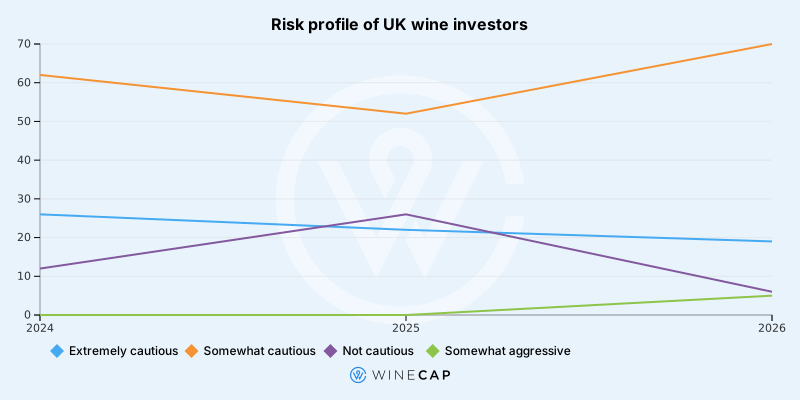
Rather than signalling rising confidence, the 2026 figures suggest UK investors are consolidating around a middle ground: cautious, but not entirely defensive.
This reflects the broader macroeconomic environment. Over the past three years, UK investors have faced persistent uncertainty, including inflationary pressure, elevated borrowing costs, geopolitical instability, and slowing economic growth. Even as headline inflation has moderated, concerns around recession risks and global trade disruption continue to weigh on investor sentiment.
Against this backdrop, fine wine’s defensive characteristics have become increasingly attractive. Wine has historically demonstrated lower volatility than equities and cryptocurrencies, while also benefiting from tangible asset backing and finite supply dynamics.
For many UK investors, therefore, fine wine is less about aggressive growth and more about portfolio resilience.
The US: greater appetite for risk
Compared to their UK counterparts, US investors consistently display a higher tolerance for risk.
In 2024, only 20% of US respondents identified as extremely cautious, significantly lower than the UK figure of 26%. Meanwhile, 30% described themselves as “not cautious,” compared to just 12% in the UK. The US was also the only market where respondents identified as “somewhat aggressive,” even if only marginally at 2%.
The divergence became more pronounced in 2025. While the proportion of extremely cautious US investors rose to 28%, 8% of respondents identified as “somewhat aggressive”, compared to none in the UK.
By 2026, US investor sentiment shifted again. Extremely cautious respondents fell back to 21%, while 12% described themselves as somewhat aggressive and 3% as extremely aggressive. Even though 60% of respondents still considered themselves “somewhat cautious”, the US remained materially more growth-oriented than the UK.
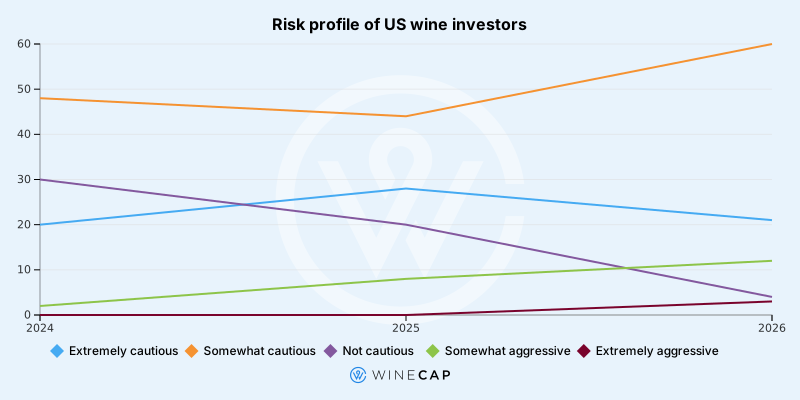
Several structural factors may explain this difference.
Firstly, the US investment culture has historically been more comfortable with risk-taking. American investors tend to have greater exposure to equities, technology stocks, venture capital, and speculative growth assets than investors in the UK or Europe.
Secondly, the prolonged bull market environment that followed the pandemic recovery reinforced a stronger appetite for higher-return opportunities. Despite periods of volatility, US equity markets have continued to outperform many global peers, encouraging investors to maintain a more aggressive mindset.
Thirdly, fine wine itself may be perceived differently in the US market. While UK investors often approach wine as a preservation asset comparable to gold or art, American investors increasingly view fine wine as part of a broader alternative investment strategy that includes collectibles, private equity, and luxury assets. This difference in perception naturally affects risk appetite.
What the data tells us about investor psychology
Perhaps the most interesting takeaway from the WineCap Wealth Report data is that neither market has become decisively more aggressive over time. Instead, the findings suggest investors are adapting to a “new normal” defined by uncertainty.
Across both the UK and the US, the dominant category throughout all three years remains “somewhat cautious.” This is important because it reflects neither panic nor exuberance. Investors are not retreating entirely from markets. Nor are they displaying the speculative behaviour often associated with periods of excessive optimism.
Rather, they appear increasingly selective. This aligns closely with broader trends across the fine wine market itself. Following the post-pandemic boom of 2021/2022, the fine wine market experienced a broad correction. Burgundy prices softened sharply, Bordeaux trading slowed, and buyers became more value-conscious.
Meanwhile, falling prices created buying opportunities and lower entry points for new investors, entering the market with a more strategic mindset. Rather than chasing rapid appreciation, wine investors are focusing on long-term fundamentals, diversification, scarcity, and producer quality.
This shift may explain why caution remains elevated even as interest in alternative assets continues to grow.
Fine wine’s role in a cautious investment environment
The findings also reinforce fine wine’s evolving role within diversified portfolios.
In highly speculative environments, alternative assets are often pursued for their high returns. But in periods of volatility and macroeconomic uncertainty, investors increasingly prioritise assets with defensive qualities. This is where fine wine stands apart from many other alternatives.
Unlike cryptocurrencies or highly speculative growth assets, fine wine benefits from intrinsic scarcity, global demand, and a long-established secondary market. Consumption gradually reduces supply over time, while the world’s leading producers maintain enduring brand equity.
Even among investors who describe themselves as cautious, 97% of the surveyed wealth managers in 2026 expect interest in fine wine to grow because the asset offers a balance between preservation and appreciation potential.
Looking ahead
The contrast between UK and US investors ultimately reflects two different approaches to alternative investing.
UK investors continue to prioritise stability, wealth preservation, and measured portfolio diversification. US investors, while still cautious overall, demonstrate a greater willingness to pursue higher-risk opportunities and more aggressive growth strategies.
Yet despite these differences, both markets are converging around a similar idea: resilience matters, and fine wine provides just that.
The last three years have reshaped investor expectations. Inflation shocks, geopolitical tensions, rising interest rates, and heightened market volatility have reinforced the importance of diversification and downside protection. In this environment, fine wine’s appeal becomes increasingly clear. Occupying a middle ground, fine wine is neither purely speculative nor entirely defensive. Fine wine is an asset class best suited to those seeking long-term wealth preservation alongside measured growth.
The WineCap Wealth Report data suggests that while investors may remain cautious, confidence in fine wine as a strategic asset continues to grow. And in uncertain markets, cautious confidence may ultimately prove more sustainable than aggressive optimism.
WineCap’s independent market analysis helps investors build diversified fine wine portfolios with full ownership and transparent pricing. Speak to one of our wine investment experts and start building your portfolio. Schedule your free consultation today.
Hey, like this? Why not share it with a buddy?
« Frontier viticulture: The world’s most surprising wine-producing regionsTen Tuscan wine producers every investor needs to know »