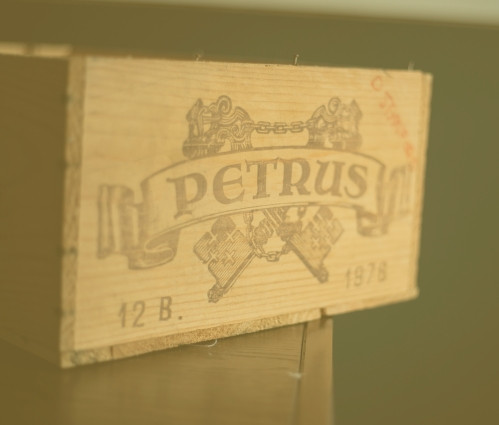
- Chateau Petrus has no official classification, yet it commands a higher average price than every Bordeaux First Growth on the secondary market.
- Liv-ex ranked Petrus fourth in its 2025 Classification at over £31,000 a bottle, ahead of Latour and Lafite by a wide margin.
- Petrus produces around 30,000 bottles a year from just 11.4 hectares, with no second wine to absorb rejected fruit.
Chateau Petrus sits outside every formal hierarchy in Bordeaux and still outprices all of them. Pomerol has never been classified, so Petrus carries no rank, no growth status, and no crest to justify its position. Its case rests instead on a unique patch of clay, a tiny production run, and seven decades of disciplined ownership under the Moueix family. These ten facts explain why Petrus trades as the most expensive Bordeaux on the secondary market and what that means for an investor weighing it against classified First Growths.
1. The blue clay boutonniere that no other estate can copy
Petrus sits on a geological anomaly rather than a brand story. The Pomerol plateau contains roughly 20 hectares of a raised mound known locally as the boutonniere (buttonhole), where the topsoil and subsoil are packed with iron-rich blue clay unlike anything found in neighbouring vineyards. Petrus occupies 11.4 hectares of that mound, more than half of the entire deposit, at the highest point in the appellation.
The clay behaves differently from the gravel and sand that dominate the rest of Pomerol. It swells and seals when wet, then holds moisture through dry summers, feeding the vines steadily rather than in the stop-start pattern typical of free-draining soils. This cannot be replicated. No amount of capital can buy a second boutonniere; Petrus and its immediate neighbours hold a finite, non-transferable input that underwrites the entire investment case, their excellence, their price point and their growth.
2. No classification, no chateau, and a label that just says Petrus
Pomerol has never been classified, a gap that sets it apart from the rest of Bordeaux. The comparison is stark:
- Medoc and Sauternes: fixed by the 1855 Classification, unchanged for over a century except for Mouton Rothschild’s 1973 promotion.
- Saint-Emilion: classified in 1955 and revised periodically, most recently amid legal disputes over methodology.
- Pomerol: never classified at all, its reputation built entirely after the appellation gained recognition in the mid-20th century, too late to be included in 1855.
Petrus has no grand building either. The estate operates from a modest farmhouse, and the label itself never carries the word “chateau,” reading simply “Petrus, Pomerol.” For investors, this is the clearest possible illustration that price and prestige here rest purely on market consensus and critical reputation.
That reputation is not a recent development. Cocks and Feret, the 19th century’s standard reference guide to Bordeaux still being published today, listed Petrus in 1868 alongside Chateau Trotanoy and just behind Vieux Chateau Certan. A decade later, Petrus won a gold medal at the 1878 Paris Exposition Universelle, an event significant enough at the time to establish a selling price on a par with a Medoc Second Growth, the first Pomerol wine ever to reach that level. The absence of a formal classification has never stopped the market from ranking Petrus among Bordeaux’s elite.
3. From a Libourne hotelier’s widow to a global luxury house
Petrus changed hands slowly and deliberately across the 20th century. The Arnaud family sold up in 1917, and by 1925 Madame Edmond Loubat, who ran a hotel in nearby Libourne, began buying shares. She held full ownership by 1945 and insisted Petrus be priced alongside the First Growths, a conviction that shaped everything that followed.
That same year, negociant Jean-Pierre Moueix secured exclusive selling rights, and the partnership between the two built Petrus into an international name. Following Madame Loubat’s death in 1961, Moueix gradually consolidated control, buying out remaining family shares by 1964 and expanding the vineyard from 7 to 11.4 hectares in 1969 with land purchased from neighbouring Chateau Gazin.
Jean-Francois Moueix now owns the estate with his children. In September 2018, the family sold a 20 percent stake to Colombian-American billionaire Alejandro Santo Domingo, a signal of the kind of institutional capital now willing to buy into Pomerol’s top asset.
Technical continuity has mattered just as much as ownership continuity. Jean-Claude Berrouet served as winemaker for 45 consecutive vintages before retiring in 2008, when his son Olivier Berrouet took over, an unbroken line of stewardship that few Bordeaux estates can match. In 1947, Madame Loubat even presented two magnums of the 1938 vintage to the Lord Mayor of London to mark the wedding of Princess Elizabeth, an early sign of the estate’s ambition to sit among the wines fit for royal occasions.
4. A single grape variety, only since 2010
Petrus is 100 percent Merlot, but that purity is recent. Earlier vintages carried a small proportion of Cabernet Franc, and the shift to a pure Merlot blend only became permanent at the end of 2010.
The average vine age across the vineyard now exceeds 45 years. Old vines produce lower yields and smaller berries, concentrating flavour and structure in ways young vines cannot replicate regardless of technique in the cellar. For an investor comparing Petrus with Cabernet-dominant Left Bank First Growths, the single-variety approach removes one common source of vintage variation and puts the burden of consistency squarely on terroir and vine age instead.
5. The frost that built a tradition
A severe winter frost in 1956 destroyed roughly two-thirds of the Petrus vineyard. Rather than replanting, Madame Loubat chose to coppice (recepage), cutting the surviving vines back hard to force new growth from established root systems, a technique untried in the region at the time. Her gamble worked, and the practice became the house method whenever vines need renewal.
That single decision is why Petrus has such old vines and a reminder that scarcity value is often the product of specific historical choices rather than an inherent, permanent feature of a vineyard.
6. The vintages that define Petrus
Petrus has a settled list of legendary vintages that recur across critical assessments and auction records: 1929, 1945, 1947, 1961, 1964, 1982, 1989, 1990, 2000, 2005, 2009, and 2010. Robert Parker awarded a perfect 100-point score to nine of these, including 1921, 1929, 1947, 1961, 1989, 1990, 2000, 2009, and 2010.
Just as notable is what does not exist. In 1956, 1965, and 1991, the estate judged the harvest unfit for release and declared no wine at all under the Petrus name, a decision made easier by the absence of a second label to absorb the shortfall.
- 1947 and 1961: among the most sought-after vintages in Bordeaux, commanding auction prices as high as £12,500 a bottle for exceptional examples.
- 1990 and 2000: modern benchmark vintages combining critical acclaim with more available stock than the pre-war years.
- 2009 and 2010: back-to-back perfect-score vintages that remain the most liquid entry points into top-tier Petrus today.
7. Petrus has no second wine
Petrus produces an average of just 30,000 bottles a year, roughly 2,500 cases, from a stringent pre-assemblage selection process. Parcels that fail to meet the required standard are simply rejected from the Grand Vin. Unlike most Bordeaux estates, there is no second label to catch that declassified fruit and sell it under a different name.
The consequence is a permanently constrained supply that cannot expand even in generous vintages, because quality control operates as a hard ceiling rather than a sorting exercise. Total annual output stays essentially fixed regardless of vineyard conditions.
8. Priced above every First Growth
Petrus does not need classified status to command the highest price in Bordeaux. In the 2025 Liv-ex Classification, which ranks wines by trading value over the preceding year, Petrus placed fourth overall at an average price above £31,000 a bottle, the highest of any Bordeaux wine included.
- Petrus: fourth in the 2025 Liv-ex Classification, ahead of every First Growth.
- Chateau Latour: ranked 36th in the same table.
- Chateau Lafite Rothschild: ranked 39th, despite its own strong brand recognition.
Alongside neighbouring Le Pin, whose own production runs to just a few thousand bottles a year, Petrus leads a small group of Pomerol wines that consistently outprice the classified Medoc estates. Wine-Searcher has separately placed Petrus around sixth among the world’s most expensive wines across all producing countries, behind only a handful of ultra-rare Burgundies, proof that in this corner of Bordeaux, reputation has entirely decoupled from official rank.
9. Petrus skips En Primeur
Most Bordeaux estates release new vintages as futures during the En Primeur campaign each spring, selling wine still ageing in barrel. Petrus, through the Moueix negociant house, has repeatedly declined to show at the standard early tastings, presenting its wines later once fermentation and ageing have progressed further.
This mirrors Chateau Latour’s 2012 decision to withdraw from En Primeur entirely and release only when a wine is ready to drink. For investors, the practical effect is that positions in Petrus are built on the post-release secondary market through merchants, brokers, or auction.
10. From Le Pavillon’s corner table to the International Space Station
Petrus became a status symbol in New York during the 1960s, largely through restaurateur Henri Soule, whose Le Pavillon served it to a clientele that reportedly included shipping magnate Aristotle Onassis. Wine writer Alexis Lichine observed at the time that ordering Petrus had become as much about signalling status as appreciating the wine itself.
That cultural pull has never really faded. In 2021, a bottle of Petrus 2000 that had spent 14 months aboard the International Space Station as part of a scientific ageing study sold privately through Christie’s for approximately $1 million, far above the price of an identical bottle that stayed on earth. A reminder if one were needed that Petrus’s mythology now carries its own commercial weight, separate from any single vintage’s technical merits.
Where Petrus sits in a fine wine portfolio
Petrus makes the case that reputation, not classification, ultimately sets price in Bordeaux. Its combination of unrepeatable terroir, permanently capped output, and disciplined ownership has produced a wine that trades above every First Growth without holding any official rank at all. That is a powerful signal for long-term value, but it comes paired with genuine concentration risk: a market this thin, built around roughly 30,000 bottles a year, can move sharply in either direction on comparatively modest shifts in demand.
For most portfolios, Petrus works best as a concentrated, high-conviction position rather than a core holding, sitting alongside broader exposure to classified Bordeaux, Burgundy, and other Pomerol names such as Le Pin. Its scarcity is precisely what makes it valuable, and precisely why it should never carry outsized weight on its own.
FAQ: Investing in Chateau Petrus
Is Chateau Petrus a good wine investment?
Petrus has a strong long-term track record and currently trades as the highest-priced Bordeaux on Liv-ex, ranking fourth in the 2025 Classification ahead of every First Growth. Its appeal rests on genuine scarcity, roughly 30,000 bottles a year with no second wine, but that same scarcity means thinner trading volumes than more widely available First Growths.
How much does a bottle of Petrus cost?
Prices vary enormously by vintage and condition. Its current average Market Price on Wine Track sits at £29,700 per 12×75 case.
Is Petrus easy to buy and sell?
Petrus trades less frequently than the classified First Growths simply because so little of it exists, but strong global demand and its position in the Liv-ex Classification indicate a functioning, active secondary market. Investors should expect wider bid-offer spreads than for higher-volume Bordeaux names.
What is the best Petrus vintage to buy?
The 2009 and 2010 vintages, both awarded perfect scores by Robert Parker, are generally seen as the most accessible entry points into top-tier Petrus today, combining critical acclaim with comparatively more available stock than pre-war legends like 1947 or 1961.
How does Petrus compare to Le Pin as an investment?
Petrus and Le Pin are the two Pomerol wines that consistently outprice the classified Medoc estates, though Le Pin’s production is smaller still, around 6,000 to 12,000 bottles a year depending on vintage. Petrus offers a longer track record and slightly deeper trading history, while Le Pin trades on even greater rarity.
WineCap’s independent market analysis helps investors build diversified fine wine portfolios with full ownership and transparent pricing. Speak to one of our wine investment experts and start building your portfolio. Schedule your free consultation today.
Hey, like this? Why not share it with a buddy?
« Harvest 2026: Europe’s earliest picking on record as heat reshapes the vintageWhite Burgundy explained: Appellations, producers and ageing »