- The best Burgundy vintages for collectors and investors today combine exceptional quality with active secondary markets and long ageing potential.
- The most universally praised Burgundy vintages include 1945, 1959, 1978, 1985, 1990, 2005, 2010, 2015 and 2019.
- The highest quality Burgundy vintages are not always the strongest investments.
Burgundy occupies a singular position in fine wine investment. No other region combines such extreme scarcity, such granular price differentials between individual parcels, and such sensitivity to the conditions of a single growing season. Unlike Bordeaux, where blending and estate scale provide a buffer against vintage variation, Burgundy’s reliance on Pinot Noir and Chardonnay in small, precisely defined plots means the gap between a great vintage and a difficult one is rarely recoverable. This guide covers the vintages that matter most, why they matter, and where the strongest opportunities lie for wine investors today.
Which are the best Burgundy vintages?
The best and most universally praised Burgundy vintages for investors and collectors are 1945, 1959, 1978, 1985, 1990, 2005, 2010, 2015 and 2019. These years combine exceptional growing conditions with strong critical acclaim, long ageing potential, and sustained secondary market demand.
Burgundy’s vintage hierarchy is less linear than Bordeaux’s and regional variation is more significant: the same year that produces magnificent Gevrey-Chambertin can disappoint in Vosnee-Romanee. That complexity demands a more precise approach from investors than a simple ranking.
What defines a great Burgundy vintage?
The quality of any individual Burgundy wine depends on terroir, vineyard management, and winemaking decisions. Across a full vintage, growing conditions are the dominant factor.
The framework developed by the late Denis Dubourdieu, the renowned Bordeaux oenologist, offers a useful starting point for understanding what great vintages share. Though his research was rooted in Bordeaux, his four conditions apply with equal force to Burgundy:
- Early and rapid flowering to ensure even berry development
- Gradual water stress to regulate vine growth and concentrate the fruit
- Warm, dry conditions through August and September to achieve full phenolic ripeness
- A dry harvest period that allows picking at optimal maturity
Burgundy, however, is a demanding region, and Pinot Noir is a thin-skinned variety with narrow tolerance for heat, rain, and disease. The cooling effect of elevation and aspect in the Cote d’Or (the thin strip of limestone-rich hillside that produces Burgundy’s greatest wines) is critical: warm days combined with cool nights in late August preserve the aromatic compounds that define great Pinot Noir. Without that diurnal temperature variation, wines risk losing the precision that drives collector demand.
Timing also matters more acutely in Burgundy than almost anywhere else. The harvesting window for Pinot Noir is narrow. Pick too early and tannins lack ripeness. Wait too long and autumn rain can introduce rot with devastating speed. The greatest Burgundy vintages share not just good weather, but perfect timing.
The best Burgundy vintages are not always the best investments
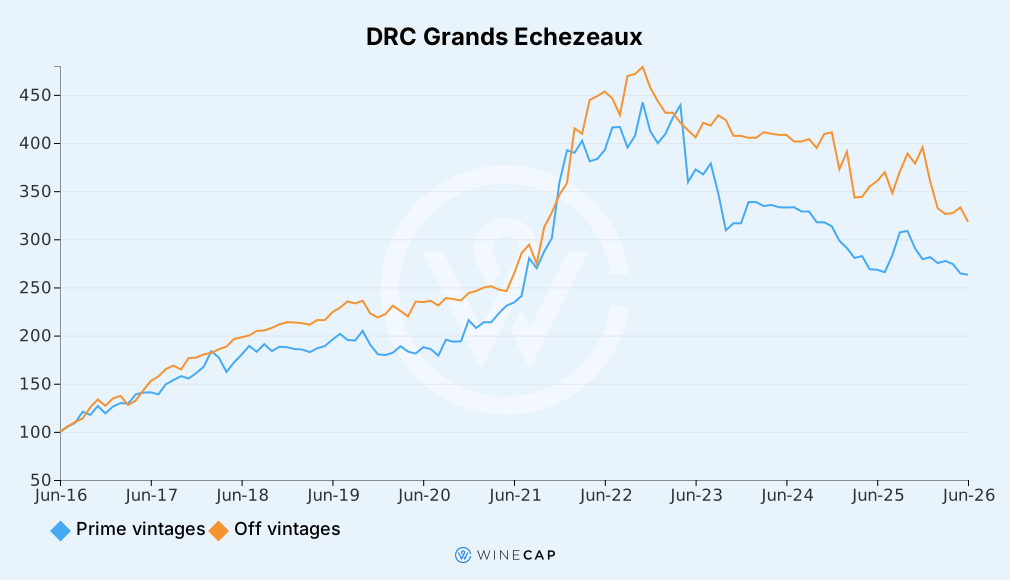
The relationship between vintage quality and investment return is no more direct in Burgundy than elsewhere. When a year receives universal critical acclaim, domaines raise release prices to reflect it. Wines from the finest vintages often carry a premium on release, which limits their subsequent upside in the immediate secondary market.
This is why less celebrated vintages can offer stronger returns for investors prepared to look beyond headline scores. The same domaine, same vineyard, and same winemaking expertise produce the wine in a quieter year as in a legendary one. When the market discounts a vintage out of proportion to its actual quality, the opportunity for appreciation grows.
Burgundy’s three investment categories
Burgundy is not a single investment market. It is better understood as three distinct categories, each responding differently to vintage conditions.
Cote de Nuits reds are the region’s investment benchmark. Home to most of Burgundy’s grand cru vineyards and producers such as Domaine de la Romanee-Conti, Armand Rousseau and Comte Georges de Vogué, the Côte de Nuits produces concentrated, long-lived Pinot Noir that commands some of the highest prices in the fine wine market. Warm, balanced vintages tend to deliver the greatest investment opportunities here.
Cote de Beaune reds offer a different style. Wines from villages such as Volnay, Pommard and Beaune are generally lighter, more approachable and more affordable than those from the Cote de Nuits. They often perform best in cooler vintages that preserve freshness and elegance, meaning their strongest years do not always coincide with those of the Côte de Nuits.
White Burgundy forms a third investment category altogether. Produced primarily from Chardonnay in Meursault, Puligny-Montrachet and Chassagne-Montrachet, as well as Chablis further north, the finest examples from producers such as Coche-Dury, Comtes Lafon and Domaine Leflaive rival the region’s top red wines in both price and demand. Their ideal growing conditions also differ: while sunshine is essential for ripeness, retained acidity is equally important, meaning some vintages favour the whites even when the reds are less exceptional.
The pre-1985 legends: 1945, 1949, 1959 and 1978
The decades before 1985 produced some of the greatest Burgundy ever made, but in conditions that bear little resemblance to the modern market. Most wine was sold to negociants rather than bottled at the domaine: even into the 1970s, fewer than 20% of Burgundy wines were estate-bottled. Authenticity, provenance, and storage conditions matter more for bottles from this era than for any other category in fine wine. For investors, that uncertainty is the primary risk. Detailed tasting notes for wines of this age are, by their nature, difficult to source, and any reviews that exist should be treated as indicative rather than definitive given the bottle variation that is present.
The 1945 vintage produced wines of extraordinary concentration across France. The Romanee-Conti 1945, the last vintage made from pre-phyloxera vines, has broken auction records multiple times, most recently changing hands at auction for over $800,000 for a single bottle.
The 1949 vintage is another great pre-modern year, combining richness with structural precision. The Clos des Lambrays 1949, from the Grand Cru vineyard in Morey-Saint-Denis, is among its most celebrated expressions.
1959 is also widely praised, marked by the heat and concentration that define Burgundy’s greatest pre-modern vintages.
1978 arrived in a very different style: a cool, slow-ripening year whose structured wines required patience to reveal their quality.
Investment snapshot:
- Pre-1985 Burgundy represents the highest risk and highest potential reward category in fine wine investment
- Authentication, specialist provenance records, and condition assessment are essential prerequisites for any transaction
- These bottles trade primarily at auction; private market transactions are rare and pricing is opaque.
Notable wines:
- 1945 Domaine de la Romanee-Conti, Romanee-Conti: One of the most valuable bottles ever sold at auction and the benchmark for pre-modern Burgundy
- 1949 Clos des Lambrays: An outstanding expression of a legendary vintage whose age makes surviving bottles with verified provenance exceptionally rare
- 1959 Domaine de la Romanee-Conti, La Tache: Among the most consistently cited bottles from a remarkable heat vintage
- 1978 Armand Rousseau Chambertin: A structured and precise wine demonstrating the extraordinary longevity of the finest examples from this underrated year
The start of the modern era: 1985 and 1990
The mid-1980s mark a turning point in Burgundy’s history. Domaine bottling, lower-intervention viticulture, and more rigorous vineyard management and cellar hygiene began to transform the region’s consistency. Producers including Henri Jayer and Lalou Bize-Leroy established practices that define Burgundy’s modern identity. For investors, this shift matters: from 1985 onwards, provenance is more reliable and the gap between négociant-bottled and domaine-bottled wines becomes far more pronounced.
The 1985 vintage produced clean, precise wines whose balance has allowed them to age gracefully. They are not the most powerful expressions of the decade, but their elegance has proved durable. Both the Cote de Nuits and the Cote de Beaune performed well for reds.
1990 is a different proposition, rich, opulent, and broadly successful, it stands as one of the great early modern red Burgundy vintages. The warmth of the growing season produced wines of unusual density and concentration. White Burgundy in 1990 was also strong, though the reds remain the primary focus of collector and investor attention.
Investment snapshot:
- 1985 and 1990 mark the start of reliable domaine-bottled Burgundy: authentication risk is substantially lower than for pre-1985 vintages
- 1990 reds remain highly sought after by collectors seeking mature, ready-to-drink investment-grade wine as surviving stock continues to decline
- Domaine bottling improves both quality consistency and secondary market traceability, making these years easier to value and transact than their predecessors
Notable wines:
- 1985 Armand Rousseau Chambertin Clos de Beze: a precise and beautifully aged wine from Gevrey-Chambertin’s most celebrated grand cru
- 1985 Henri Jayer Vosne-Romanee Les Brulees: a defining expression of the vintage from one of the producers who shaped the modern era
- 1990 Domaine Leroy Musigny: among the greatest red Burgundies of the modern era, combining extraordinary density with Chambolle-Musigny’s characteristic elegance
- Romanee-Conti 1990, Domaine de la Romanee-Conti: a profound wine from a profound year, and among the most consistently celebrated 1990s on the secondary market
The early 21st century: 2005 and 2010
The 2005 vintage stands as one of Burgundy’s defining years of the modern era. A dry summer concentrated the fruit, producing tightly wound wines with remarkable ageing potential across both the Cote de Nuits and the Cote de Beaune. White Burgundy in 2005 was also very strong: the combination of ripeness and retained acidity has produced whites still in the early stages of their development.
2010 is often described as the connoisseur’s choice. A cooler, more structured year, it produced wines of extraordinary precision and tension. Red Burgundy from 2010 represents one of the finest vintages of the century so far, with yields that were low and quality that was very high across the best domaines. White Burgundy in 2010 was also consistently excellent, particularly in the Cote de Beaune.
Investment snapshot:
- 2005 offers exceptional long-term ageing potential and remains one of the most consistently praised vintages across both reds and whites
- 2010 is the stronger choice for investors seeking pure, structured Pinot Noir at or near its peak intellectual complexity
- Both years are well established on the secondary market with good liquidity for the top producers
Notable wines:
- La Tache 2005, Domaine de la Romanee-Conti: a monumental wine combining the power and precision that define the vintage at its best
- Chambertin 2005, Armand Rousseau: tightly structured, still developing, and widely regarded as one of the greatest modern expressions of this grand cru
- Musigny 2010, Comte Georges de Vogue: a benchmark expression of Chambolle-Musigny from one of its most respected producers
- Echezeaux 2010, Domaine de la Romanee-Conti: outstanding relative value within the DRC range in an exceptional vintage
The teens: 2015, 2019 and 2020
The period from 2015 to 2020 delivered a strong run of quality in Burgundy, producing several vintages of genuine greatness in quick succession.
2015 was the most accessible of the three. A warm, generous growing season produced wines of unusual richness for Burgundy, combining ripe fruit with clean structure. Red and white Burgundy in 2015 is already rewarding those who open it while retaining the depth to age for decades further.
2019 is for many, the finest red Burgundy vintage since 1990. A hot summer was tempered by excellent diurnal variation in the Cote d’Or, producing wines of extraordinary concentration and aromatic purity.
2020 produced its own kind of excellence: more structured and fresher than 2019, with small yields maintaining quality at a high level throughout.
Investment snapshot:
- 2015 offers the best near-term accessibility of the three and is already trading actively, making it a clear entry point for new investors
- 2019 carries the strongest critical consensus of the group and may be the most significant investment vintage of the recent run
- 2020 offers relative value compared to 2019 with comparable quality across many appellations
- All three vintages benefit from the high production standards and strong domaine identities of the modern era
Notable wines:
- La Tache 2015, Domaine de la Romanee-Conti: sumptuous and complex, accessible earlier than most DRC vintages
- Chambertin 2019, Armand Rousseau: widely considered among the finest wines produced in Burgundy in the modern era
- Musigny 2019, Comte Georges de Vogue: extraordinary precision and elegance from Chambolle-Musigny’s most celebrated producer
- Romanee-Conti 2020, Domaine de la Romanee-Conti: a profound wine from a vintage that the secondary market has been relatively slow to fully price
The great white vintages: 2017 and 2014
White Burgundy does not follow the red vintage hierarchy, and two years deserve specific attention for white wine investors.
The 2017 vintage produced some of the finest white Burgundy of the century. Warm sunshine built extraordinary ripeness while careful harvest timing preserved the acidity that gives Chardonnay its structure and longevity. The result was rich, complex, and beautifully balanced wines across Meursault, Puligny-Montrachet, Chablis, and Chassagne-Montrachet. For the reds, 2017 was solid rather than exceptional, making it a vintage where the whites clearly outperformed.
2014 is a similar case. A challenging growing season produced moderate red wines across much of the region, but the whites were consistently excellent: precise, mineral, and built for long ageing. Producers including Raveneau in Chablis, Coche-Dury in Meursault, and Domaine Leflaive in Puligny-Montrachet made wines of the highest quality.
Notable wines:
- Meursault Perrieres 2017, Coche-Dury: among the most sought-after white Burgundies of the modern era, from the Côte de Beaune’s most celebrated white wine producer
- Puligny-Montrachet Les Combettes 2017, Domaine Leflaive: a biodynamically farmed wine of great precision combining the richness of the vintage with characteristic freshness
- Chablis Grand Cru Les Clos 2014, Raveneau: a characteristically mineral and long-lived wine from one of Chablis’s greatest producers
- Meursault Genevrieres 2014, Comtes Lafon: a profound expression of white Burgundy from the Côte de Beaune’s most reliable grand estate
Bubbling under: 1999, 2009 and 2012
Three vintages sit just outside the first tier but can offer compelling opportunities for investors and collectors.
1999 is notable for an unusual reversal: it is perhaps the only vintage in the last generation where Cote de Beaune reds outperformed those from the Cote de Nuits. Appellations including Volnay, Pommard, and Beaune produced wines of genuine quality while the Côte de Nuits was more variable. For collectors seeking Côte de Beaune reds at their best 1999 represents a rare opportunity.
2009 was a warm, generous year producing wines of immediate appeal and plush fruit. It lacks some of the consistency of 2010 or 2019, but wines from the top domaines are excellent, and the vintage has a loyal following among collectors who value accessibility.
2012 is the most intriguing of the three for patient investors. A difficult, disease-prone growing season produced devastatingly small yields: some producers lost the majority of their crop. The survivors are often very fine. The combination of genuine scarcity and real quality means investment-grade 2012 Burgundy availability has already contracted significantly and will continue to tighten.
Buying Burgundy for the long term: what the vintage record tells us
Burgundy’s vintage record makes one argument consistently: the greatest wines and the greatest investments are related but not identical. The collector who paid peak-market prices for universally acclaimed vintages has often underperformed the investor who identified the overlooked year behind it.
The three vintages that represent the strongest combination of quality,availability in today’s market are 2005, 2015, and 2019. Each offers a different profile: 2005 for ageing potential, 2015 for accessibility and active secondary market trading, 2019 for the most emphatic critical endorsements.
Beyond those three, the case for other vintages can still be strong. Burgundy is a region where specialist knowledge pays a measurable premium and the vintage chart is where that knowledge begins.
FAQ: Best Burgundy vintages
What is the best Burgundy vintage?
The most universally acclaimed modern vintages are 1990, 2005, and 2019. For white Burgundy specifically, 2017 and 2014 rival or exceed many other years in quality.
Are the best Burgundy vintages the strongest investments?
Not automatically. Highly celebrated vintages are often priced to reflect their reputation on release, which limits subsequent upside. Less acclaimed years from the same domaines and vineyards can deliver stronger percentage returns.
How does Burgundy differ from Bordeaux as a vintage investment?
Burgundy’s vintage variation is more extreme and more localised. A single great year in Bordeaux tends to be broadly great across the region. In Burgundy, the Côte de Nuits and Côte de Beaune can diverge significantly, as can red and white wines.
What is the best entry point for new investors in Burgundy?
For investors new to Burgundy, 2015 and 2019 offer arguably the clearest combination of quality, availability, and secondary market depth, but the investment case can vary greatly from wine to wine.
How long should Burgundy be held as an investment?
The finest red Burgundy from the top domaines rewards patient holding. Wines from 2005 and 2010 are still developing and will continue to improve for decades. Even the more accessible vintages of 2015 and 2019 benefit considerable cellaring before reaching their peak. WineCap always recommend investors expect at least a 5 year hold.
WineCap’s independent market analysis helps investors build diversified fine wine portfolios with full ownership and transparent pricing. Speak to one of our wine investment experts and start building your portfolio. Schedule your free consultation today.
Hey, like this? Why not share it with a buddy?
« How to store fine wine: The investor’s guide to cellar and bondWhy fine wine is a long-term investment »